The Lost Art of Ancient Chinese Girl Names
Imagine choosing a name the way you'd compose a poem — weighing every syllable against philosophy, cosmology, and centuries of literary tradition. That's exactly what parents in imperial China did when naming their daughters. Ancient Chinese girl names weren't picked from a list. They were crafted, character by character, to harmonize sound, meaning, visual beauty, and even elemental balance.
Today, popular Chinese girl names like Zixin (梓欣) or Yinuo (一诺) reflect modern tastes. But the names you'll find in this article belong to a different world entirely — one spanning roughly 3,000 years, from the Zhou dynasty (1046 BCE) through the fall of the Qing dynasty in 1912.
What Makes a Name Truly Ancient
So what makes a Chinese name ancient rather than simply old-fashioned? It comes down to how the name was built. Traditional Chinese naming customs for girls drew on systems that modern parents rarely consult: Confucian virtue frameworks, Daoist nature symbolism, Five Elements theory, and classical poetry stretching back millennia. Each character in a name carried four simultaneous dimensions — sound, form, meaning, and elemental energy — all working together like instruments in an orchestra.
Ancient Chinese girl names with meaning weren't just pleasant words. They were compressed philosophies, literary allusions, and cosmic alignments packed into one or two characters.
A name in ancient China was never just a label. It was a poem written in four languages at once — sound, image, meaning, and energy — and all four had to rhyme.
A Quick Guide to Pinyin and Tones
Before diving into specific names, you'll want to know how to pronounce ancient Chinese names correctly. Mandarin Chinese uses pinyin — a romanization system that represents each syllable's sound. The key difference from English? Every syllable carries a tone that changes its meaning entirely.
Here's a quick breakdown of the four tones:
- First tone (ˉ) — high and level, like sustaining a musical note. Example: mā (mother)
- Second tone (ˊ) — rising, like asking a surprised question. Example: má (hemp)
- Third tone (ˇ) — dips low then rises, a slight scoop. Example: mǎ (horse)
- Fourth tone (ˋ) — sharp and falling, like a firm command. Example: mà (scold)
Throughout this article, you'll see tone marks above vowels in pinyin. These aren't decorative — they're essential. The name Lán (兰, orchid, second tone) sounds completely different from Làn (烂, rotten, fourth tone). Getting tones right is the difference between poetry and confusion.
With pronunciation covered, the real question becomes: how did ancient families actually decide which name a daughter would carry for life? The answer involves a naming system far more complex than anything used today.
The Ancient Multi-Name System and How Women Received Their Names
In modern life, you have one given name and one surname. Simple. In ancient China, a person could carry three or more names across their lifetime — each one unlocked at a different stage and used in different social contexts. This Chinese naming system of birth name vs courtesy name created layers of identity that no single label could capture.
How did women get names in ancient China? The short answer: it depended heavily on when she lived, who her family was, and whether history bothered to record her name at all.
Birth Names and Courtesy Names for Women
The ancient naming structure revolved around three distinct categories, each serving a unique social function:
| Name Type | Chinese | Pinyin | When Given | Purpose | Example for Women |
|---|---|---|---|---|---|
| Birth Name | 名 | ming | Shortly after birth (often on the third day) | Used by parents and elders; considered intimate and private | Ban Zhao's ming: Zhāo (昭, "luminous") |
| Courtesy Name | 字 | zi | At the coming-of-age ceremony (jī 笄, the hairpin ceremony for girls at age 15) | Used by peers and in formal social settings; showed respect by avoiding the birth name | Cai Wenji's zi: Wenji (文姬, "cultured lady") |
| Art/Literary Name | 号 | hao | Self-chosen in adulthood | Used in literary, artistic, or scholarly circles; expressed personal ideals | Li Qingzhao's hao: Yi'an Jushi (易安居士, "Recluse of Yi'an") |
Here's where it gets interesting for women specifically. Men received their zi at age 20 during the guanli (冠礼, capping ceremony). Women received theirs at 15 during the jili (笄礼, hairpin ceremony), which also signaled readiness for marriage. The ancient Chinese courtesy name for women often complemented or expanded on the birth name's meaning — if a girl's ming referenced the moon, her zi might invoke moonlit water or evening clouds.
But there's a catch. Many women's birth names were never recorded in official histories. Noble women from the Zhou and Spring and Autumn periods were typically identified by their clan surname (shi 氏) plus a ranking term like Meng (孟, eldest), Zhong (仲, second), or Ji (季, youngest). A woman called "Meng Jiang" wasn't named Jiang — she was the eldest daughter of the Jiang clan. Her actual ming may have been known only within her household.
How Social Class Shaped Naming Practices
Chinese girl naming traditions by social class varied dramatically. Picture three daughters born in the same dynasty but into different households:
- Imperial and noble families — Daughters received carefully constructed ming names consulting diviners and classical texts. They were granted formal zi at their hairpin ceremony, and these names entered court records. Empress Wu Zetian's original ming, for instance, was Zhao (曌) — a character she reportedly invented herself, combining the sun and moon above the sky.
- Scholarly gentry (shidafu 士大夫) families — Fathers often chose names from the Book of Songs or other classics. Daughters in literary households sometimes adopted hao names to sign their poetry and calligraphy, a practice that became more common during the Tang and Song dynasties.
- Commoner families — Naming was simpler and more practical. Girls might be called by birth order (Sānniang 三娘, "Third Lady"), a seasonal reference, or a humble "milk name" (rǔming 乳名) meant to deflect evil spirits. Formal zi were rare for commoner women.
This class divide means that the ancient girl names surviving in historical records skew heavily toward the elite. The names of farmers' daughters, weavers, and market women are largely lost — making the ones that do survive all the more precious as windows into how ordinary families thought about their girls.
What shaped these naming choices at a deeper level wasn't just social standing. Behind every character selection lay an entire philosophical framework — Confucian, Daoist, or cosmological — that dictated which meanings were appropriate, which sounds were harmonious, and which elemental energies a daughter's name should carry.
Philosophy and Cosmology Behind Ancient Naming Choices
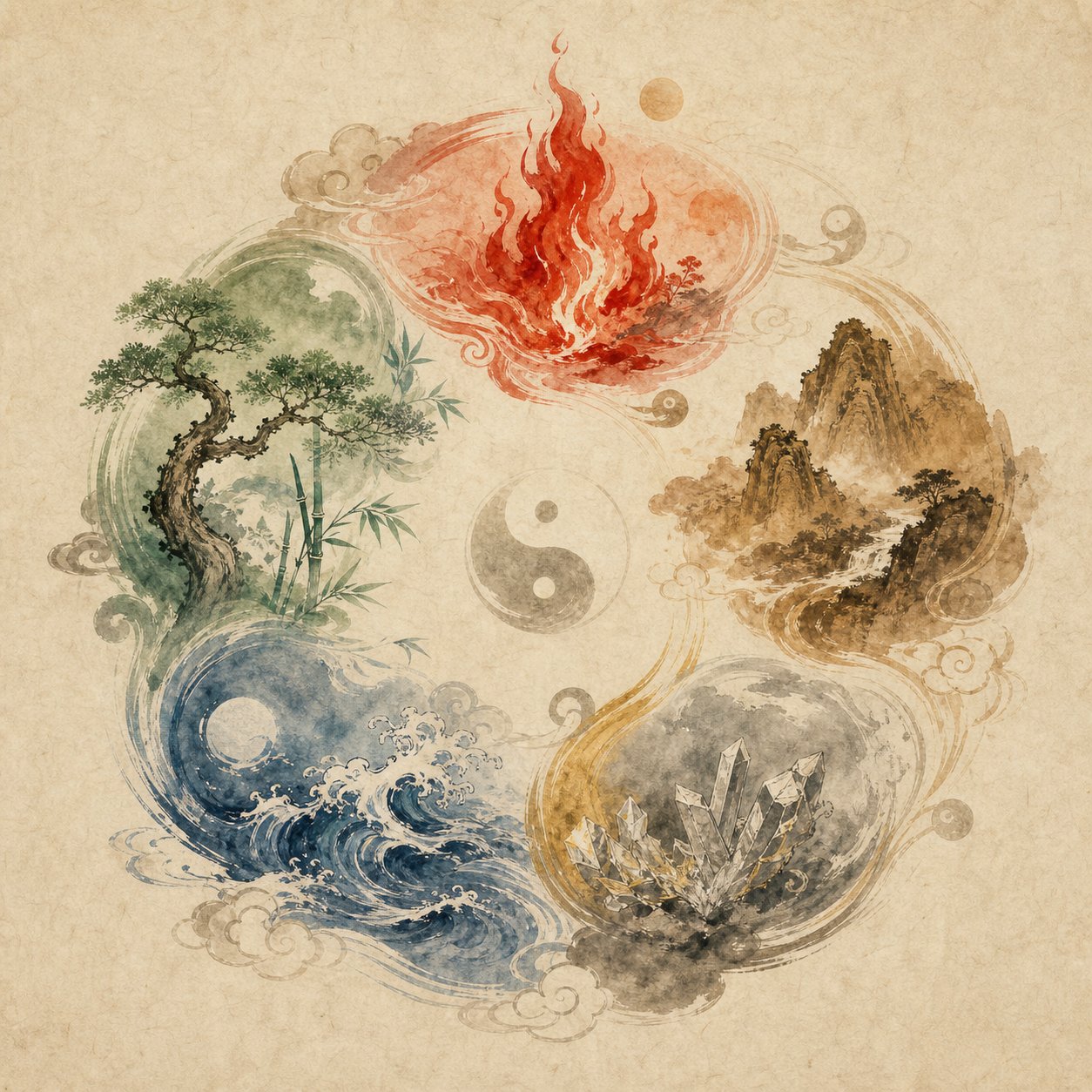
A name wasn't just a gift from parent to child — it was a negotiation between human intention and cosmic order. Ancient Chinese families didn't simply pick characters that sounded pretty. They consulted philosophical traditions the way an architect consults blueprints, selecting each element of a daughter's name to align with moral ideals, natural forces, and the energetic balance of the universe itself.
Three major systems dominated this process: Confucian virtue ethics, Daoist nature philosophy, and the cosmological framework of the Five Elements and Yin-Yang. Each produced a distinct flavor of name, and many families blended all three into a single, layered creation.
Confucian Virtue Names for Daughters
Confucianism shaped Chinese society for over two millennia, and its influence on naming was direct. Parents who followed Confucian ideals chose characters that encoded specific moral qualities they hoped a daughter would embody. These weren't vague wishes — they were deliberate instructions compressed into a name.
The logic was straightforward: if you name a girl after a virtue, you remind her (and everyone who speaks her name) of the standard she's meant to uphold. Confucian virtue names for Chinese girls drew from a well-defined set of qualities — propriety (li 礼), benevolence (ren 仁), filial devotion (xiao 孝), wisdom (zhi 智), and faithfulness (xin 信).
Here are examples of Confucian-rooted names that appear in historical records:
- Shūyí (淑仪) — 淑 means "virtuous, gentle" and 仪 means "proper demeanor." Together they describe a woman whose inner goodness radiates through graceful conduct. This name encodes the Confucian ideal of inner virtue expressed through outward propriety.
- Huìxián (惠贤) — 惠 means "kind, benevolent" and 贤 means "worthy, virtuous." A name that directly invokes ren (benevolence) — the highest Confucian virtue — applied to feminine wisdom.
- Jìngzhēn (敬贞) — 敬 means "reverent, respectful" and 贞 means "chaste, steadfast." This pairing reflects the Confucian emphasis on loyalty and moral constancy, qualities prized in daughters of scholarly families.
- Xiàoróng (孝容) — 孝 means "filial piety" and 容 means "countenance, grace." The name literally reads as "filial grace" — a daughter whose devotion to family shows in her bearing.
- Lǐzhēn (礼贞) — 礼 means "ritual propriety" and 贞 means "integrity." A name grounded entirely in the Confucian framework of correct behavior and moral firmness.
You'll notice a pattern: these names pair an abstract virtue with a character suggesting how that virtue manifests visibly. The combination creates a miniature moral portrait — not just "be good," but "be good in this specific, observable way."
Daoist Nature Names and Five Element Harmony
Where Confucian names pointed inward toward moral cultivation, Daoist-inspired names pointed outward — toward mist on mountains, moonlight on water, wind through bamboo. Daoism taught that the highest wisdom meant aligning with nature's effortless flow (wu wei 无为), and parents who drew from this tradition gave daughters names that evoked the natural world's quiet power.
Daoist nature-inspired girl names in Chinese tend to favor imagery associated with yin energy: water, moonlight, clouds, dew, and flowers. These weren't considered lesser than yang imagery — they represented depth, receptivity, and transformative subtlety.
- Yúnxī (云溪) — 云 means "cloud" and 溪 means "mountain stream." A name evoking the Daoist ideal of flowing freely like water and drifting like clouds — unattached, natural, at ease.
- Lùníng (露凝) — 露 means "dew" and 凝 means "to condense, to gather." Dew forming at dawn — a moment of quiet transformation, perfectly capturing Daoist stillness.
- Yuèhán (月涵) — 月 means "moon" and 涵 means "to contain, encompass." The moon reflected in deep water — suggesting inner depth that holds vast meaning without display.
- Xiáyǐng (霞影) — 霞 means "rosy clouds, dawn mist" and 影 means "shadow, reflection." An image of colored light playing across the sky — beautiful precisely because it's impermanent.
- Zhīlán (芝兰) — 芝 means "lingzhi mushroom" (symbol of immortality) and 兰 means "orchid." Both are Daoist symbols of purity and transcendence, making this a name steeped in spiritual aspiration.
The Five Elements theory added another dimension entirely. Traced back to the early Zhou dynasty (1046-256 BCE), the Wu Xing (五行) system holds that five elemental energies — Wood (木), Fire (火), Earth (土), Metal (金), and Water (水) — constantly interact through cycles of generation and control. Each element carries both Yin and Yang forms, and understanding their balance was considered essential for harmony in all aspects of life.
When a daughter was born, her birth date and hour were mapped onto a Bazi (八字) chart — the Four Pillars of Destiny — to determine which elements were strong, weak, or missing in her cosmic profile. A name was then chosen to compensate for imbalances. If a girl's chart showed excess Fire and insufficient Water, her parents might select characters containing the water radical (氵) or meanings associated with Water's qualities: wisdom, adaptability, and gentle flow.
Here's how five elements theory in Chinese naming translated into actual girl names:
- Water (水) names: Hánbō (涵波, "encompassing waves"), Qīngyíng (清莹, "clear and luminous") — chosen for girls lacking Water energy. Water in its Yin form (Gui Water 癸) is represented by dew and mist, making these characters especially fitting for daughters.
- Wood (木) names: Mùlán (木兰, "magnolia"), Yìzhú (艺竹, "artistic bamboo") — selected when a chart needed growth energy. Yin Wood (Yi Wood 乙) represents small plants and flowers, aligning naturally with feminine naming conventions.
- Fire (火) names: Yànníng (焰宁, "flame at peace"), Xīróng (熙蓉, "radiant lotus") — used when warmth and illumination were needed. Yin Fire (Ding Fire 丁) represents candlelight and gentle warmth rather than blazing intensity.
- Earth (土) names: Péiluán (培鸾, "nurturing phoenix"), Yùníng (玉宁, "jade tranquility") — grounding names for charts needing stability. Yin Earth (Ji Earth 己) embodies soft soil and nurturing adaptability.
- Metal (金) names: Xīnyuè (鑫悦, "abundant metal, joyful"), Jǐnxiù (锦秀, "brocade elegance") — strengthening names when Metal was deficient. Yin Metal (Xin Metal 辛) represents precious gems and jewelry, making it a natural fit for girls' names.
The Yin-Yang balance in ancient Chinese names operated as a governing principle over all other considerations. Since daughters were associated with Yin energy, their names typically favored Yin expressions of each element — the gentle stream rather than the ocean, the candle rather than the sun, the sapling rather than the towering tree. This wasn't about limitation. It was about resonance. A name harmonized with a child's inherent energy rather than working against it.
Parents who took this seriously — and most educated families did — would consult the generative cycle (相生) to ensure the elements in a name supported rather than clashed with the child's chart. A girl born with strong Wood energy might receive a name containing Water characters, since Water generates Wood in the nurturing cycle. Choosing a Metal-associated name for the same child would invoke the overcoming cycle (Metal diminishes Wood), creating disharmony.
These weren't superstitions treated lightly. They were systematic frameworks applied with the same rigor a physician brought to diagnosis. The result? Names that functioned simultaneously as identity, aspiration, and cosmic prescription — each character doing triple duty across philosophical, aesthetic, and metaphysical registers.
Of course, philosophy alone didn't determine which names actually appeared in the historical record. Naming fashions shifted dramatically across dynasties, as political upheavals, literary movements, and changing attitudes toward women reshaped what parents considered beautiful, appropriate, or auspicious for a daughter.
Chinese Girl Names by Historical Dynasty
Philosophical frameworks provided the raw materials, but each dynasty shaped those materials according to its own aesthetic temperament. A name considered elegant in the restrained Zhou court would have sounded stiff during the Tang dynasty's poetic golden age. Tracing how naming conventions evolved across centuries reveals not just changing tastes but shifting ideas about what a daughter could be.
Zhou and Han Dynasty Names
The Zhou dynasty (1046-256 BCE) produced the most formal, ritual-bound names in Chinese history. Daughters of noble families received names tied to ceremonial language, ancestral virtue, and clan identity. These names feel almost architectural — built for permanence rather than beauty.
Han dynasty Chinese names for girls (202 BCE-220 CE) shifted toward Confucian moral vocabulary as the philosophy became state orthodoxy. Characters encoding virtue, luminosity, and scholarly refinement dominated. Historical records from this period preserve more women's names than any previous era, giving us a clearer picture of actual naming practice.
| Dynasty | Name (Characters) | Pinyin | Meaning | Cultural Context |
|---|---|---|---|---|
| Zhou | 庄姜 (莊姜) | Zhuāng Jiāng | "Dignified one of the Jiang clan" | A noblewoman praised in the Book of Songs for her beauty and virtue; her name reflects Zhou-era clan identification |
| Zhou | 孟嬴 | Mèng Yíng | "Eldest daughter of the Ying clan" | Ranking-plus-clan format typical of Zhou aristocratic women |
| Zhou | 季芈 | Jì Mǐ | "Youngest of the Mi clan" | Chu state naming convention; Mi was the royal surname of Chu |
| Han | 昭 (昭) | Zhāo | "Luminous, illustrious" | Birth name of Ban Zhao, the famous female historian; reflects Han emphasis on intellectual brilliance |
| Han | 嫽 (嫽) | Liáo | "Elegant, beautiful" | Name of Feng Liao, a Han diplomat to the Western Regions; rare character suggesting refined grace |
| Han | 文姬 | Wénjī | "Cultured lady" | Courtesy name of Cai Yan, the poet-musician; 姬 was a classical term for a refined woman |
You'll notice the Zhou names are inseparable from clan identity — the individual almost disappears behind her family. By the Han, personal names emerge with their own distinct character, reflecting a growing recognition of individual merit.
Tang and Song Dynasty Names
The Tang dynasty (618-907 CE) unleashed a poetic revolution that transformed naming. Tang dynasty girl names and meanings drew heavily from nature imagery — flowers, moonlight, mist, and seasonal landscapes flooded the naming vocabulary. This was the era when naming a daughter became an explicitly literary act.
The Four Great Female Poets of the Tang Dynasty — Li Ye (courtesy name Jilan 季兰, "orchid of the season"), Xue Tao (courtesy name Hongdu 洪度, "vast measure"), Liu Caichun (采春, "gathering spring"), and Yu Xuanji (玄机, "mysterious subtlety") — illustrate how Tang women's names embraced nature, intellect, and even spiritual mystery.
Song dynasty female names with characters shifted toward quieter refinement. Where Tang names burst with color and movement, Song names favored understatement — subtle literary allusions, restrained elegance, and intellectual depth over sensory dazzle.
| Dynasty | Name (Characters) | Pinyin | Meaning | Cultural Context |
|---|---|---|---|---|
| Tang | 季兰 (季蘭) | Jìlán | "Orchid of the season" | Courtesy name of poet Li Ye; orchid symbolized purity and artistic refinement in Tang culture |
| Tang | 幼微 | Yòuwēi | "Young and subtle" | Courtesy name of poet Yu Xuanji; 微 suggests hidden depth and delicate perception |
| Tang | 采春 (採春) | Cǎichūn | "Gathering spring" | Name of poet Liu Caichun; evokes the Tang love of seasonal imagery and active engagement with nature |
| Tang | 薛涛 (薛濤) | Xuē Tāo | "Great waves" (surname Xue) | The poet Xue Tao; 涛 (surging waves) was an unusually bold character for a woman's name, reflecting Tang openness |
| Song | 清照 | Qīngzhào | "Clear illumination" | Name of Li Qingzhao, greatest female ci poet; 清 (clear) + 照 (to illuminate) suggests lucid insight |
| Song | 淑真 | Shūzhēn | "Virtuous and genuine" | Name of poet Zhu Shuzhen; combines Confucian virtue (淑) with authenticity (真) |
| Song | 如晦 | Rúhuì | "Like twilight" | A literary name style favoring the understated; 晦 suggests the beauty of dimness and ambiguity |
Ming and Qing Dynasty Names
The Ming dynasty (1368-1644) saw a conscious return to classical sources. Parents mined the Book of Songs and ancient histories for characters that felt timeless rather than trendy. Ming princess names recorded in imperial genealogies — like Zhu Jingjing (朱静静, "serene tranquility") and Zhu Yuhua (朱玉华, "jade splendor") — show this classicist impulse clearly.
Qing dynasty names for daughters grew more elaborate, often combining two full-weight characters into compound meanings. The Qing imperial family favored auspicious pairings: princesses received titles containing characters like Shou (寿, longevity), Rong (荣, glory), and Duan (端, dignified). Commoner families followed suit with their own layered compounds.
| Dynasty | Name (Characters) | Pinyin | Meaning | Cultural Context |
|---|---|---|---|---|
| Ming | 玉华 (玉華) | Yùhuá | "Jade splendor" | Name of Princess Nankang (Zhu Yuhua); jade imagery dominated Ming naming as a symbol of moral purity |
| Ming | 瑶娥 | Yáo'é | "Precious jade beauty" | Name of Princess Shouyang under the Wanli Emperor; 瑶 (precious jade) + 娥 (graceful woman) |
| Ming | 惠简 (惠簡) | Huìjiǎn | "Kind and unadorned" | Name of Princess Huaishu; reflects late Ming preference for pairing virtue with simplicity |
| Qing | 寿安 (壽安) | Shòu'ān | "Longevity and peace" | Title-name of a Daoguang Emperor princess; Qing imperial names favored auspicious compound blessings |
| Qing | 荣宪 (榮憲) | Róngxiàn | "Glorious and principled" | Princess Rongxian of the Kangxi reign (1673-1728); combines glory with constitutional virtue |
| Qing | 端敏 | Duānmǐn | "Dignified and perceptive" | Princess title under Kangxi; 端 (upright) + 敏 (quick-witted) — a Qing ideal of composed intelligence |
A clear arc emerges across these dynasties. Zhou names anchored a girl to her clan. Han names encoded moral aspiration. Tang names exploded into poetic imagery. Song names refined that imagery into quiet elegance. Ming names reached backward for classical authority. And Qing names layered multiple blessings into elaborate compounds — as if a single virtue was no longer enough to carry a daughter's future.
What's striking is how many of these names trace directly back to specific poems, songs, and literary passages. The parents weren't inventing from scratch — they were quoting. And the texts they quoted most often form a surprisingly short list of classical masterworks that served as naming dictionaries for millennia.
Classical Chinese Literature Names for Girls: Poetry as a Naming Source
Chinese parents didn't invent names in a vacuum. They reached for the bookshelf. For over two thousand years, a handful of classical texts served as the primary wellspring for girl names — so much so that educated families could identify which poem or passage a name referenced the moment they heard it. Choosing a name from a revered text wasn't just aesthetically pleasing. It signaled the family's literary cultivation and embedded the daughter within a tradition stretching back centuries before her birth.
Which texts mattered most? The answer has remained remarkably consistent across dynasties. Here are the most influential classical sources for naming, ranked by their historical reach and the sheer number of girl names they've generated:
- Shijing (诗经, Book of Songs) — The oldest poetry collection in Chinese, compiled around 600 BCE. Its 305 folk songs and court hymns remain the single most-quoted source for girl names.
- Chu Ci (楚辞, Songs of Chu) — A collection of mystical, shamanistic poetry from the Warring States period. Known for ethereal imagery and mythological names that feel otherworldly.
- Tang Poetry (唐诗) — The golden age of Chinese verse. Thousands of poems by Li Bai, Du Fu, Wang Wei, and others provided nature-rich imagery that parents mined for girl names inspired by Tang dynasty poetry.
- Hongloumeng (红楼梦, Dream of the Red Chamber) — Cao Xueqin's 18th-century novel created character names so perfectly crafted that they became cultural archetypes, influencing naming for generations after publication.
- Ci Poetry of the Song Dynasty (宋词) — The lyric poetry form perfected during the Song era, with its intimate emotional vocabulary and delicate seasonal imagery.
Each of these sources offered something distinct. The Shijing gave earthy, folk-rooted beauty. The Chu Ci gave transcendence. Tang poetry gave vivid natural landscapes. And the great novels gave names that carried entire personalities within them.
Names from the Book of Songs and Songs of Chu
The Shijing holds a unique position in Chinese naming culture. As the oldest poetry classic of the Chinese, predating Confucius by some three centuries, it was considered the foundation of all literary education. Confucius himself reportedly said, "If you do not study the Shijing, you will have nothing to speak with." For naming purposes, this meant that any character drawn from the Book of Songs carried automatic classical authority.
Chinese girl names from the Book of Songs (Shijing) tend to draw from the Guofeng (国风, "Airs of the States") section — folk songs celebrating love, nature, and feminine beauty. Consider this famous passage from the poem "Peach Blossoms" (桃夭, Tao Yao):
桃之夭夭,灼灼其华。之子于归,宜其室家。 — "The peach tree is young and elegant, brilliant are its flowers. This young woman goes to her new home, bringing harmony to her household."
From this single poem, parents extracted names like Taoyao (桃夭, "young peach"), Zhuohua (灼华, "brilliant flower"), and Yijia (宜家, "harmonizing the home"). The name Zhuohua (灼华) became especially popular — its two characters compress an entire image of radiant blossoming into a girl's identity.
Another beloved Shijing source is "Qing Qing Zi Jin" (青青子衿), which gave rise to the name Zijin (子衿, "your collar" — a tender image of longing for a beloved). The poem "Shu Yu" (蜀黍) contributed Jingnu (静女, "quiet maiden"), while "Han Guang" (汉广) inspired names using the character Yao (窈, "graceful and secluded").
The Songs of Chu operated in a completely different register. Where the Shijing was grounded in earthly life — harvests, weddings, seasonal labor — the Chu Ci soared into mythological realms. Written primarily by Qu Yuan (c. 340-278 BCE) and his followers, these poems invoked goddesses, spirit journeys, and celestial landscapes. The naming vocabulary they produced feels almost supernatural.
纷吾既有此内美兮,又重之以修能。 — "I possess this inner beauty, and I layer upon it cultivated ability." (Li Sao, Qu Yuan)
This single line from the Li Sao (离骚, "Encountering Sorrow") generated the name Neimei (内美, "inner beauty") and reinforced the use of Xiuneng (修能, "cultivated talent") as a naming concept. Qu Yuan's poem also popularized floral names with spiritual overtones — Lanzhī (兰芷, "orchid and angelica"), Qióngyáo (琼瑶, "precious jade"), and Língyún (凌云, "soaring above clouds").
The Chu Ci poem "The Goddess of the Xiang River" (湘夫人) gave parents names like Mùxī (沐兮, "bathed in light") and Xiāngpèi (湘佩, "ornament of the Xiang"). These names carried a mythological weight that ordinary nature imagery couldn't match — they placed a daughter in the company of goddesses.
Tang Poetry and Classical Novel Heroines
Girl names inspired by Tang dynasty poetry reflect the era's obsession with landscape, emotion, and sensory precision. Tang poets wrote with such vivid imagery that individual lines became naming templates for centuries. Wang Wei's quiet mountain scenes, Li Shangyin's layered romantic allusions, and Li Bai's moonlit reveries all fed the naming tradition.
Consider Li Shangyin's famous line:
沧海月明珠有泪,蓝田日暖玉生烟。 — "In the vast sea, moonlight reveals pearls with tears; at Lantian, warm sun makes jade produce mist."
From this couplet alone, parents drew names like Zhūlèi (珠泪, "pearl tears" — later softened to Mingzhu 明珠, "bright pearl"), Yùyān (玉烟, "jade mist"), and Yuèmíng (月明, "moonlit clarity"). The image of jade producing mist in warm sunlight — something precious revealing hidden beauty under the right conditions — became a powerful metaphor for a daughter's potential.
Wang Wei's nature poetry contributed quieter names: Kōngshān (空山, "empty mountain") inspired names using Kong (空, "vast, open") paired with natural imagery, while his line "明月松间照" ("bright moon shining through pines") reinforced Sōngyuè (松月, "pine moon") as a naming combination suggesting solitude and clarity.
The transition from poetry to prose fiction opened yet another naming dimension. Cao Xueqin's Dream of the Red Chamber (published 1791) didn't just tell a story — it created a naming system so intricate that an entire field of scholarship (Redology) studies its character names. The Dream of the Red Chamber character names and their meanings operate on multiple levels simultaneously: surface beauty, hidden wordplay, and foreshadowing of each character's fate.
The novel's central women illustrate this perfectly:
- Lin Daiyu (林黛玉) — 黛 means "dark eyebrow pigment" and 玉 means "jade." Her name evokes delicate, dark-hued beauty — and the character 黛 contains a hidden sorrow, as eyebrow pigment was associated with tears and longing in classical poetry. Daiyu's name foreshadows her tragic fate as a woman of deep feeling destroyed by circumstances beyond her control.
- Xue Baochai (薛宝钗) — 宝 means "precious" and 钗 means "hairpin." Where Daiyu's name suggests natural, unadorned beauty (jade), Baochai's name points to crafted ornament (a golden hairpin). This contrast encodes their fundamental difference: Daiyu represents spiritual authenticity while Baochai embodies Confucian propriety and social polish.
- Qin Keqing (秦可卿) — 可卿 means "worthy of affection" or "lovable." The surface meaning is tender, but scholars note that 卿 was also a term used between lovers, giving the name an undercurrent of romantic entanglement that mirrors her storyline.
- Miaoyu (妙玉) — 妙 means "wondrous, subtle" and 玉 means "jade." A Buddhist nun whose name suggests jade that has transcended ordinary beauty — spiritual refinement beyond worldly attachment.
What made Cao Xueqin's naming so influential was his demonstration that a name could function as compressed narrative. After the novel's publication, parents began crafting names with the same layered intentionality — choosing characters whose surface meaning was beautiful but whose deeper resonances told a story about who they hoped their daughter would become.
These literary sources didn't operate in isolation. A single name might quote the Shijing while echoing a Tang poem and nodding to a character from fiction. The art lay in weaving these references together so seamlessly that the name felt inevitable rather than assembled — which brings us to the technical craft of how ancient name-makers actually constructed these multilayered creations, character by character, stroke by stroke.
Famous Ancient Chinese Women and the Stories Behind Their Names
Literary texts gave parents a vocabulary for naming. But the most compelling proof that these names carried real weight comes from the women who actually bore them — scholars, poets, politicians, and innovators whose names weren't just beautiful labels but compressed portraits of their era's highest aspirations. Studying historical Chinese female names from real women reveals how naming philosophy translated into lived identity.
Each woman profiled here left a mark on Chinese civilization. And in every case, her name tells you something about the world she was born into — what it valued in daughters, what it permitted them to become, and what it hoped they might achieve.
| Name (Characters) | Pinyin | Dynasty | Role | Name Meaning Analysis |
|---|---|---|---|---|
| 班昭 | Ban Zhao | Han (49-120 CE) | Historian, scholar | 昭 (zhao) means "luminous, illustrious" — a character associated with clarity of intellect and moral radiance. Reflects the Han emphasis on scholarly brilliance as the highest feminine virtue among elite families. |
| 蔡琰 (字 文姬) | Cai Yan (zi: Wenji) | Han (c. 177-250 CE) | Poet, musician | 琰 (yan) means "lustrous jade" — beauty with substance. Her courtesy name 文姬 (Wenji) pairs 文 (literary, cultured) with 姬 (refined lady), encoding the Han ideal of a woman whose elegance flows from learning. |
| 谢道韫 | Xie Daoyun | Jin (c. 340-399 CE) | Poet, intellectual | 道 (dao) means "the Way" and 韫 (yun) means "to conceal something precious within." Together: one who holds the Dao inside — wisdom carried quietly, not displayed. A deeply Daoist name from a Confucian aristocratic family. |
| 上官婉儿 | Shangguan Wan'er | Tang (664-710 CE) | Politician, poet, court official | 婉 (wan) means "graceful, gentle, compliant" and 儿 (er) is an affectionate diminutive. The surface meaning suggests softness — yet Wan'er became one of the most powerful political figures of the Tang court. Her name's gentleness masked iron capability. |
| 李清照 | Li Qingzhao | Song (1084-1155 CE) | Ci poet, literary critic | 清 (qing) means "clear, pure" and 照 (zhao) means "to illuminate, to shine." The Li Qingzhao name meaning in Chinese suggests lucid radiance — a mind that sees clearly and illuminates what it touches. Perfectly mirrors her reputation for crystalline emotional precision in verse. |
| 黄道婆 | Huang Daopo | Yuan (c. 1245-1330 CE) | Textile innovator | 道婆 (daopo) means "woman of the Dao" — likely a title rather than a birth name, given after she lived among Daoist communities. It reflects how commoner women's true names were often lost, replaced by descriptive epithets that honored their spiritual or practical contributions. |
Poets and Scholars Whose Names Endure
The Ban Zhao and Cai Wenji name analysis reveals a pattern specific to Han dynasty intellectual women. Both names use characters associated with light and precious materials — 昭 (luminous) and 琰 (lustrous jade). This wasn't coincidence. Han-era families who educated their daughters chose names signaling that brilliance was expected, not merely hoped for. Ban Zhao's father, the historian Ban Biao, named her with the same character used for clarity in official documents. He was naming a future scholar, not just a daughter.
Xie Daoyun's name operates differently. The Jin dynasty valued philosophical depth over outward display, and her name — "concealing the Dao within" — captures that perfectly. She's remembered for a single poetic moment: when her uncle asked the family to describe falling snow, young Daoyun compared it to willow catkins drifting on the wind. Her name's emphasis on hidden treasure proved prophetic. Brilliance held quietly, then revealed at exactly the right moment.
Li Qingzhao stands as perhaps the most perfectly named woman in Chinese literary history. 清照 — clear illumination — describes both her poetic style (emotionally transparent, startlingly precise) and her critical temperament (she famously evaluated other poets with unsparing clarity). Her father, the scholar Li Gefei, drew from a vocabulary of light and purity that Song dynasty intellectuals favored for daughters they expected to think independently.
Empresses and Political Figures
Shangguan Wan'er's name presents an irony that historians have long noted. 婉 (graceful, yielding) was among the most conventional characters for Tang-era girls — it suggested the compliant femininity Confucian society demanded. Yet Wan'er wielded political power that rivaled male ministers, drafting imperial edicts and shaping court policy under Empress Wu Zetian and Emperor Zhongzong. Her name reads like camouflage: softness on the surface, authority underneath.
Huang Daopo's case reminds us that famous ancient Chinese women's names and meanings don't always survive intact. As a commoner woman — likely sold into an unhappy marriage as a child before fleeing to Hainan Island — her birth name was never recorded. "Daopo" is what history gave her after she revolutionized cotton textile production in the Yangtze Delta. The title honors her contribution while erasing her original identity, a pattern repeated for countless women whose innovations outlived their names.
What connects all six women is this: their names weren't accidents. Whether chosen by scholarly fathers, granted as courtesy names at fifteen, or assigned by posterity, each name encoded a relationship between the individual and her culture's deepest values. The craft behind that encoding — how characters were selected for tonal balance, visual harmony, and layered meaning — was itself a sophisticated art form with rules as precise as poetry.
The Aesthetic Craft of Building a Beautiful Ancient Name
Rules as precise as poetry — that's not an exaggeration. Ancient name-makers operated more like composers than casual shoppers, balancing multiple technical constraints simultaneously. Understanding how to construct a Chinese girl name with tonal harmony, visual proportion, and layered meaning reveals why this process could take weeks or even months of deliberation in educated families.
Think of it this way: a name had to sound musical when spoken aloud, look balanced when written in calligraphy, carry literary depth when analyzed, and resonate with the right elemental energy. Fail on any single dimension, and the name was considered incomplete — like a song with a beautiful melody but clashing lyrics.
Tonal Harmony and Stroke Balance
Mandarin's four tones aren't just a pronunciation feature — they're a musical system. When ancient parents selected a given name, they tested how its tones interacted with the surname's tone. The goal was melodic flow, not monotony. A name where all three characters shared the same tone (say, three third-tone syllables in a row) would sound flat and awkward, like a drumbeat with no variation.
The ideal pattern moved through contrasting tones. Consider the name Li Qingzhao (李清照): Li is third tone (falling-rising), Qing is first tone (high level), and Zhao is fourth tone (sharp falling). The sequence creates a dynamic arc — dip, sustain, drop — that carries clearly across a room. Ancient naming guides explicitly warned against pairing surnames and given names that produced tonal collisions or monotonous repetition.
Beyond tone, name-makers also guarded against homophone problems. A name might sound elegant in isolation, but if its pronunciation matched a common word with negative connotations — illness, poverty, death — it was immediately discarded. This phonetic vigilance explains why certain beautiful characters rarely appear in names despite their lovely meanings.
Visual balance operated on a parallel track. Chinese characters aren't abstract letters — they're compositions of strokes that occupy a square space, each one a small picture. When written together (especially in calligraphy, where names appeared on scrolls, seals, and formal documents), the characters needed to look proportional.
The principle was straightforward: pair dense characters with simpler ones. If a surname contained many strokes — like Wei (魏, 17 strokes) — a skilled namer would choose given-name characters with fewer strokes to create visual breathing room. Conversely, a simple surname like Ding (丁, 2 strokes) could support more complex given-name characters without the whole name feeling top-heavy. This wasn't vanity. A name's visual impression carried real social weight in a culture where your name was written — on red envelopes, official documents, and personal seals — far more often than it was spoken.
Stroke count meaning in Chinese naming went beyond aesthetics into numerology. Certain stroke totals were considered auspicious (numbers associated with growth, prosperity, or harmony), while others were avoided. Name-makers would count the total strokes across all characters and adjust their choices to hit favorable numbers — adding another constraint to an already demanding process.
Radicals and Character Composition in Girl Names
Here's where the craft gets truly intricate. Every Chinese character contains a radical — a component that signals the character's semantic category. When ancient parents chose characters for a daughter's name, the radical wasn't incidental. It was a deliberate thematic signal, a visual whisper about what kind of meaning the name carried.
Imagine scanning a name and instantly knowing its thematic territory just from the radical structure — the way you might recognize a musical genre from the first few notes. That's what literate readers in ancient China experienced. Chinese character radicals used in girl names clustered around a specific set of symbolic domains:
- Jade radical (玉/王) — Symbolized purity, preciousness, and moral integrity. Characters: 琳 (lin, beautiful jade), 瑶 (yao, precious jade), 璇 (xuan, fine jade), 琬 (wan, mellow jade). The jade radical was perhaps the single most common marker of a girl's name in classical texts.
- Grass/plant radical (艹) — Evoked natural beauty, gentleness, and flourishing life. Characters: 芝 (zhi, lingzhi mushroom), 兰 (lan, orchid), 蕙 (hui, fragrant orchid), 萱 (xuan, daylily/mother's flower), 芷 (zhi, angelica). As one Kunqu Opera naming tradition noted, actresses playing young female roles received names with the grass radical because it implied "the beauty and tenderness of the female is like fragrant grass."
- Woman radical (女) — Directly encoded feminine virtue and grace. Characters: 婉 (wan, graceful), 娴 (xian, refined), 嫣 (yan, beautiful), 姝 (shu, beautiful girl), 媛 (yuan, noble lady). These characters made gender identity explicit within the name itself.
- Water radical (氵) — Suggested wisdom, adaptability, depth, and gentle flow. Characters: 涵 (han, to contain), 清 (qing, clear), 溪 (xi, stream), 澜 (lan, rippling waves), 洁 (jie, pure). Water-radical characters were especially favored for girls whose birth charts needed Water element reinforcement.
- Silk radical (纟) — Implied refinement, connection, and delicate craftsmanship. Characters: 绮 (qi, fine silk), 纨 (wan, white silk), 绣 (xiu, embroidery), 缃 (xiang, light yellow silk). These names carried associations with both material elegance and artistic skill.
- Heart/mind radical (忄/心) — Pointed to inner emotional and moral qualities. Characters: 慧 (hui, wisdom), 惠 (hui, kindness), 恬 (tian, tranquil), 悦 (yue, joyful). Names with this radical emphasized character over appearance.
- Sun/brightness radical (日) — Conveyed illumination, clarity, and warmth. Characters: 晗 (han, dawn light), 曦 (xi, morning sunlight), 昭 (zhao, luminous), 晴 (qing, clear sky). These balanced the yin-associated imagery common in girls' names with gentle yang brightness.
Semantic layering in ancient Chinese names meant that a single character operated on at least three levels simultaneously. Take the character 蕙 (hui): on the surface, it means "fragrant orchid." At the literary level, it echoes Qu Yuan's Chu Ci poetry, where orchids symbolize moral purity. At the radical level, the grass component (艹) signals natural beauty. And phonetically, it sounds identical to 惠 (hui, kindness) — creating an auditory double meaning that educated listeners would catch instantly.
This is what separated a competent name from a masterful one. A competent name satisfied one or two dimensions. A masterful name made every element — tone, stroke count, radical, literary echo, phonetic resonance — point in the same direction, reinforcing a single coherent identity from multiple angles at once.
Yet even the most technically perfect name could fail if it violated one of ancient China's many naming taboos — restrictions so strict that using the wrong character could bring social disgrace or even legal punishment upon a family.
Chinese Naming Taboos to Avoid for Girls: Ancient Restrictions Still Relevant Today
A technically perfect name could still ruin a family. In imperial China, using the wrong character — even unknowingly — wasn't just a social misstep. It was an offense punishable by demotion, exile, or worse. The system of bihui (避讳) naming restrictions in ancient China governed which characters were forbidden territory, and these rules shaped girl names just as powerfully as philosophy or poetry did.
Not respecting the appropriate naming taboos was considered a sign of lacking education and respect, bringing shame to both the offender and the offended person. For parents naming a daughter, this meant navigating an invisible minefield of restricted characters that shifted with every new emperor, every generation, and every regional custom.
Imperial and Ancestral Name Taboos
The core principle was simple: you could not use any character that appeared in the personal name of the reigning emperor, previous emperors of the same dynasty, or your own direct ancestors. Sounds manageable — until you realize that some emperors had names containing extremely common characters, effectively removing everyday words from the naming vocabulary of an entire population.
Emperor Xuan of Han, for example, originally bore the name Bingyi (病已), which contained two very common characters. He eventually changed his own name to Xun (询), a far less common character, specifically to ease the burden on his people. Emperor Taizong of Tang (Li Shimin 李世民) initially allowed a partial exception — his subjects only needed to avoid the characters 世 and 民 appearing together in sequence, not individually. But his son Emperor Gaozong reversed this leniency after Taizong's death, requiring complete avoidance of both characters in any context. This forced the chancellor Li Shiji to change his name to Li Ji.
For girls' names, the practical impact was significant. Characters not allowed in Chinese names during any given reign might include beautiful, poetic characters that would otherwise be perfect for a daughter. If an emperor's name contained 玄 (xuan, "mysterious, profound") — as with Emperor Xuanzong of Tang — that character vanished from the naming pool overnight. Parents who had already named a daughter using a newly taboo character sometimes had to formally rename her.
Here are the major categories of bihui restrictions that affected naming choices:
- Imperial taboo (国讳, guohui) — Characters from the emperor's personal name were forbidden for all subjects. During the Ming Emperor of Han's reign (Liu Zhuang), people with the surname Zhuang (庄) were ordered to change it entirely to Yan (严).
- Ancestral taboo (家讳, jiahui) — Characters from parents' and grandparents' names could not be used for children. This was a family-level restriction that varied by household, making it impossible to compile a universal "safe" list.
- Sage taboo (圣讳, shenghui) — Characters from the names of Confucius (Kong Qiu 孔丘) and other revered sages were avoided out of respect. The character 丘 (qiu, "hill") was particularly restricted in scholarly families.
- Dynastic accumulation — Each new emperor added to the restricted list without removing previous restrictions. By the late Qing dynasty, the cumulative list of forbidden characters had grown substantial, narrowing the available naming vocabulary considerably.
Later dynasties recognized this problem. Ming and Qing emperors frequently gave princes names containing rare or newly invented characters precisely so that fewer common words would become taboo if those princes ascended the throne. This was a deliberate act of mercy toward future subjects — and future parents trying to name their children.
Cultural Sensitivities for Modern Parents
Beyond imperial taboos, gendered restrictions added another layer. Certain characters were considered too powerful, too martial, or too ambitious for a girl's name in conservative eras. Characters like 龙 (long, "dragon"), 霸 (ba, "hegemon"), or 武 (wu, "martial") were reserved for sons. Using them for a daughter wasn't illegal — but it invited social judgment and was seen as tempting misfortune by misaligning a child's name with her expected role.
Homophone taboos operated more subtly. Chinese is rich in homophones — distinct characters that share identical pronunciation. A name might look beautiful on paper but sound identical to an unlucky word when spoken aloud. Parents carefully tested every potential name against words for death (死, si), loss (失, shi), suffering (苦, ku), and poverty (贫, pin). Even near-homophones triggered caution. This is why certain lovely characters rarely appear in names despite their appealing meanings — their sound carries unwanted echoes.
If you're considering an ancient name for a child today, these cultural mistakes to avoid when choosing Chinese names still matter:
- Check generational context. A name drawn from classical poetry might coincidentally share characters with a family elder's name. In Chinese culture, this remains disrespectful even in informal modern families.
- Test pronunciation in full context. Say the complete name — surname plus given name — aloud repeatedly. Listen for unintended homophones or tonal combinations that produce awkward or unfortunate sounds in Mandarin, Cantonese, or your family's dialect.
- Understand the character's full history. Some characters carry historical associations that aren't obvious from dictionary definitions. A character used in a famous concubine's name or associated with a tragic literary figure may carry connotations you didn't intend.
- Avoid overly archaic characters that modern systems can't process. Some ancient characters aren't included in standard digital encoding (Unicode), meaning they can't be typed on computers or printed on official documents — a practical problem that didn't exist in the brush-and-ink era.
- Respect the weight of what you're choosing. An ancient name isn't a costume. It carries centuries of cultural meaning. If you're selecting a name rooted in Confucian virtue or Daoist philosophy, understand what that tradition actually taught — not just what the characters look like.
These restrictions might sound limiting. But constraints breed creativity. The most skilled ancient name-makers treated taboos not as obstacles but as creative parameters — the way a sonnet's fourteen-line structure forces a poet toward precision rather than away from beauty. Working within these boundaries while still producing names of genuine elegance was itself a mark of cultural mastery.
That same spirit of creative constraint is resurfacing today, as a new generation of Chinese parents turns back toward classical naming traditions — not out of obligation, but out of a desire to give their daughters names with roots deeper than last year's trending character list.
How to Choose an Authentic Ancient Chinese Girl Name
That desire isn't hypothetical — it's already reshaping how millions of Chinese families name their daughters. The guofeng classical Chinese name revival trend has moved from niche cultural circles into mainstream parenting, producing a generation of children whose names sound like they stepped out of a Song dynasty poetry anthology rather than a modern baby-name app.
The Guofeng Revival of Classical Names
Guofeng (国风, literally "national style") started as an aesthetic movement — think Hanfu fashion, traditional makeup tutorials, and classical music remixes. But it has reached deeply into naming culture. A Global Times report on newborn naming trends found that parents from the post-1990 generation are increasingly drawing names directly from classical texts like the Tao Te Ching, the Book of Songs, and Song dynasty poetry. Names like "Yanzhou" (砚舟, "inkstone boat"), rooted in a poem by Northern Song poet Zeng Gong, appeared on trending newborn lists across multiple provinces.
Cultural sociologist Xu Shumin described this shift as young parents "reclaiming traditional Chinese culture as a living aesthetic in everyday life." One mother in Chengdu named her daughter Chirou (驰柔), drawn from Chapter 43 of the Tao Te Ching — a passage about the quiet power of softness overcoming hardness. She called the name her daughter's "first life gift," one that "carries cultural tradition beyond value."
This isn't nostalgia for nostalgia's sake. These parents grew up during a period of parallel technological advancement and cultural revival. Just as they might wear Hanfu to express identity, naming a child from classical sources is another form of cultural self-expression — deliberate, informed, and personal.
The ancient Chinese girl names vs boy names differences become especially visible within this revival. Parents reaching into classical texts tend to follow traditional thematic divisions, even unconsciously. Girls' names still gravitate toward nature imagery (flowers, moonlight, streams), inner virtues (gentleness, wisdom, clarity), and sensory delicacy (fragrance, soft light, mist). Boys' names pull from a different register entirely — ambition (鹏程, "roc's journey"), strength (浩然, "vast and righteous"), and public achievement (建功, "establishing merit"). The structural difference is visible at the radical level too: girls' names cluster around jade, grass, water, and silk radicals, while boys' names favor metal, mountain, and strength-related components.
This gendered distinction isn't rigid — Tang dynasty naming was notably more fluid — but it remains the default pattern most parents follow when consulting classical sources.
How to Choose an Authentic Ancient Name
If you're drawn to giving a daughter a name with genuine classical roots, the process requires more than browsing a list. Here are the steps to pick a traditional Chinese name for a baby girl that carries real historical weight rather than surface-level prettiness:
- Start with a classical source text. Choose a specific work — the Shijing, Chu Ci, a Tang poem, or a philosophical classic — and read it in the original. Find a line or image that resonates with what you hope for your daughter. The name should emerge from a passage you genuinely connect with, not a random character plucked from a dictionary.
- Verify historical usage. Search historical records, genealogies, and literary anthologies to confirm that your chosen characters actually appeared in names during the period you're drawing from. A character might be ancient without ever having been used as a name — context matters.
- Test tonal compatibility with the surname. Say the full name aloud — surname plus given name — at least twenty times. Listen for tonal monotony, awkward transitions, or unintended homophones. The name should flow musically, not stumble.
- Check stroke balance visually. Write the complete name in both simplified and traditional characters. Does it look proportional? A visually lopsided name will feel wrong every time it appears on paper, a seal, or a screen.
- Examine the radical structure. Identify the radicals in your chosen characters. Do they align thematically? A name combining a water-radical character with a fire-radical character creates elemental tension that traditional naming would avoid unless deliberately compensating for a birth chart imbalance.
- Confirm no taboo conflicts. Check that the characters don't duplicate names of living grandparents or great-grandparents. Test for homophone collisions with unlucky words in Mandarin and any family dialect.
- Understand the full cultural weight. Research every association your chosen characters carry — literary, historical, and colloquial. A name that references a tragic heroine or a disgraced historical figure carries that narrative whether you intend it or not.
The goal isn't perfection on every dimension — that's nearly impossible. It's informed intentionality. When you understand what you're choosing and why, the name becomes what that Chengdu mother described: a first life gift, one that connects a daughter to something larger than the moment she was born into.
Ancient Chinese girl names survived millennia not because they were trendy but because they were built to last — rooted in philosophy, shaped by poetry, and refined by centuries of accumulated craft. Giving a daughter one of these names today isn't borrowing from the past. It's continuing a conversation that never really stopped.
Frequently Asked Questions About Ancient Chinese Girl Names
1. What makes a Chinese girl name ancient rather than just old-fashioned?
An ancient Chinese girl name is distinguished by how it was constructed, not merely its age. These names drew on interconnected systems that modern parents rarely use together: Confucian virtue frameworks, Daoist nature symbolism, Five Elements theory, and classical poetry dating back millennia. Each character carried four simultaneous dimensions — sound, form, meaning, and elemental energy — all working in harmony. A name from the Tang dynasty, for example, might reference a specific poem while balancing tonal flow, stroke count numerology, and elemental compensation for the child's birth chart. Modern old-fashioned names may use traditional characters but lack this multilayered philosophical architecture.
2. How did women receive their names in ancient China?
Ancient Chinese women could carry multiple names across their lifetime. A birth name (ming) was given shortly after birth, used only by parents and elders. At age 15, during the hairpin ceremony (jili), a girl received her courtesy name (zi), used by peers and in formal settings. Literary women sometimes adopted a self-chosen art name (hao) in adulthood. However, naming practices varied dramatically by social class. Imperial daughters received carefully crafted names consulting diviners and classical texts, scholarly families drew from the Book of Songs, while commoner girls might simply be called by birth order or given humble milk names to deflect evil spirits.
3. What are the best classical Chinese texts to find authentic ancient girl names?
The most influential sources, ranked by historical reach, are the Shijing (Book of Songs) for earthy folk-rooted beauty, the Chu Ci (Songs of Chu) for ethereal mythological names, Tang Poetry for vivid nature imagery, Dream of the Red Chamber for names functioning as compressed narratives, and Song dynasty ci poetry for intimate emotional vocabulary. The Shijing remains the single most-quoted source, with poems like 'Peach Blossoms' generating names such as Zhuohua (brilliant flower) that have been used for over two thousand years. Each text offers a distinct naming flavor, and skilled parents often wove references from multiple sources into a single name.
4. What naming taboos should I avoid when choosing an ancient Chinese name for a girl today?
Several traditional restrictions remain culturally relevant. Never duplicate characters from living grandparents' or great-grandparents' names, as this is still considered disrespectful. Test the full name aloud for homophone collisions with unlucky words like death (si), loss (shi), or suffering (ku) in both Mandarin and your family's dialect. Research all historical associations your chosen characters carry — a name referencing a tragic literary figure carries that narrative unintentionally. Also verify that archaic characters are included in standard Unicode encoding, since some ancient characters cannot be typed on computers or printed on official documents.
5. How do ancient Chinese girl names differ structurally from ancient boy names?
The differences appear at every level of construction. Girls' names traditionally favored nature imagery associated with yin energy — flowers, moonlight, streams, mist, and dew — while boys' names emphasized yang qualities like ambition, strength, and public achievement. At the radical level, girls' names cluster around jade (玉), grass (艹), water (氵), silk (纟), and woman (女) radicals, while boys' names favor metal, mountain, and strength-related components. Thematically, girls' names encoded inner virtues like gentleness, wisdom, and clarity, whereas boys' names pointed outward toward merit and accomplishment. The Tang dynasty was notably more fluid in these distinctions than other periods.