What Are Auspicious Stroke Numbers for Names
Auspicious stroke numbers for names refer to a numerological system rooted in East Asian naming traditions where the total number of brush strokes used to write a person's name characters is believed to shape fortune, personality, and life outcomes. Each stroke total from 1 through 81 carries a specific meaning, ranging from highly auspicious (大吉) to deeply inauspicious (大凶), and parents across China and Japan have relied on this system for generations when choosing names for their children.
In East Asian naming culture, a name is not merely a label. It is a calculated arrangement of strokes designed to channel favorable energy across a person's entire lifetime.
What Stroke Numbers Mean in Naming Traditions
Imagine choosing a baby's name not just for how it sounds, but for the precise number of pen strokes each character requires. That is exactly what millions of families do. In both the Chinese tradition of 姓名學 (name study) and the Japanese practice of 姓名判断 (seimei handan), practitioners count every brush stroke in a name's characters and cross-reference the totals against established fortune charts. A name totaling 8 strokes, for instance, is associated with stability, prosperity, and steady success. A total of 19, on the other hand, signals sudden change, loss, and turbulence. The system treats these numbers as energetic blueprints that quietly influence health, career, relationships, and overall luck.
Why 81 Numbers Form the Foundation
Why exactly 81? The number derives from classical Chinese numerology, where the digits 1 through 9 represent fundamental cosmic principles. Odd numbers are yang, even numbers are yin, and when combined in all possible triadic arrangements, they produce 9 x 9 = 81 total expressions. This makes 81 the complete cycle of numerological energies. Once a name's stroke count exceeds 81, the system simply loops back: you subtract 80 and use the remainder. So a hypothetical name with 100 strokes would reference number 19 on the chart. The cycle is considered a lucky number of Japan's naming philosophy precisely because it mirrors the belief that all fortune eventually returns to its origin.
Chinese and Japanese Systems at a Glance
Both Chinese 姓名學 and Japanese seimei handan share this 81-number foundation, yet they diverge in methodology. Chinese practitioners often integrate stroke analysis with a person's birth chart and Five Elements theory. Japanese practitioners typically apply a five-grid system that breaks the name into separate sections, each governing a different life domain. Both systems, however, agree on the core premise: certain stroke totals are lucky in Japanese and Chinese culture alike, while others carry warnings worth heeding. This article covers both traditions in one unified resource, giving you the tools to understand how stroke counts work regardless of which system you encounter.
Origins and History of the 81-Number System
The 81-number framework did not appear overnight. It grew from centuries of cosmological thinking, was formalized by a single scholar in early 20th-century Japan, and then traveled back across East Asia to become one of the most widely practiced forms of Japanese numerology and Chinese name study alike.
Historical Roots of the 81-Number Cycle
The system we use today traces directly to Kumazaki Ken'o, a Japanese scholar who formalized the Five Grids Analysis Method (五格剖象法) in 1918. Kumazaki drew heavily on Chinese I Ching (易經) numerology, specifically its "image" and "number" theories, and structured them into a repeatable method for evaluating names. His work established the concept that japanese lucky numbers embedded in a name's stroke count could predict fortune across different life stages.
The system did not stay in Japan for long. Here is how it spread:
- 1918 — Kumazaki Ken'o publishes the Five Grids Analysis Method in Japan, drawing on classical Chinese I Ching principles to assign meaning to stroke totals from 1 through 81.
- 1936 — Bai Yuguang (also known as Bai Huiwen), a Taiwanese student studying in Japan, translates and introduces the method to Taiwan, sparking widespread adoption.
- 1940s-1970s — The practice spreads to South Korea, Southeast Asia, and Hong Kong, adapting to local naming conventions along the way.
- 1990s — Chinese fate analysis scholars such as Fang Chen integrate the Five Grids method with traditional Chinese I Ching principles, standardizing it for mainland China using the Kangxi Dictionary as the authoritative stroke count reference.
The Mathematical Logic Behind the System
Why does the cycle stop at 81 and not 100 or 108? The answer lies in I Ching cosmology. The number 9 represents the ultimate yang energy, the highest single digit and the fullest expression of force. Multiply 9 by itself and you get 81, which symbolizes the complete cycle of all possible energetic states before returning to unity. In this view, 81 is not arbitrary. It is the point where all fortune patterns have been expressed and the cycle resets to 1.
This reset mechanism has a practical application. When a name's total stroke count exceeds 81, practitioners subtract 80 and use the remainder. A name totaling 95 strokes, for example, would reference number 15 on the chart (95 minus 80). The logic mirrors the I Ching belief that energy is cyclical, never linear, always returning to its source.
How Stroke Numerology Spread Across East Asia
What makes this history remarkable is the reverse migration. The philosophical roots are Chinese, yet the formalized system was born in Japan. When it returned to Chinese-speaking regions, practitioners enriched it with Bazi (Four Pillars) analysis and Five Elements theory, creating a more layered approach than Kumazaki's original framework. Each culture treated the same 81 numbers as a lucky number for japanese or Chinese families, but layered its own interpretive traditions on top. Korean practitioners added their own phonetic considerations, while Southeast Asian Chinese communities blended it with local dialect-based sound symbolism.
This cross-pollination means that the system you encounter today is rarely "pure" Japanese or Chinese. It is a living tradition shaped by a century of regional adaptation, all anchored to the same 81-number cycle and the shared conviction that stroke counts carry real weight in shaping a person's path.
Chinese and Japanese Stroke Number Traditions Compared
Regional adaptation produced two distinct schools of practice that share the same 81-number backbone yet differ in almost every practical detail. If you are researching lucky numbers in Japan versus China, understanding these differences prevents you from mixing incompatible rules and arriving at a misleading reading.
Chinese 姓名學 Methodology
Chinese name study (姓名學) treats stroke analysis as one layer within a broader fate-mapping system. Practitioners typically combine the Five Grids calculation with a person's Bazi (Four Pillars of Destiny) birth chart, Five Elements balance, and sometimes even phonetic yin-yang classification. The authoritative reference for stroke counts is the Kangxi Dictionary (康熙字典), compiled in 1716, which standardizes traditional character forms regardless of whether the person uses simplified characters in daily life.
Chinese methodology also places heavy emphasis on the relationship between grid elements and the person's birth chart. A name might score well on the 81-number chart yet still be considered unsuitable if its elemental profile clashes with the individual's natal elements. This layered approach means Chinese practitioners rarely evaluate stroke numbers in isolation.
Japanese 姓名判断 Methodology
Japanese seimei handan (姓名判断) centers almost entirely on the five-grid framework, known as go-kaku (五格). Each grid produces a number, and each number maps to a fortune label from dai-kichi (great blessing) to dai-kyo (major misfortune). Strong readings look for balance across all five pillars rather than fixating on a single lucky number in Japan's naming tradition.
Stroke counts in Japanese practice follow standard kanji dictionaries such as the Shin Kangorin or Kadokawa Shin Jigen. Unlike the Chinese approach, Japanese seimei handan does not typically require reverting to older character forms. The kanji as officially recognized by Japan's Joyo Kanji list is usually counted at face value. Birth chart integration is less common, making the system more self-contained and accessible to families doing their own research.
Key Differences Between the Two Systems
When you compare the two traditions side by side, the contrasts become clear. The table below maps the most important dimensions where they diverge:
| Dimension | Chinese 姓名學 | Japanese 姓名判断 |
|---|---|---|
| Primary Grid Structure | Five Grids, often supplemented with Three Talents (三才) analysis | Five Grids (go-kaku) as the central and often sole framework |
| Stroke Counting Standard | Kangxi Dictionary traditional forms (e.g., 氵 counts as 4, not 3) | Standard kanji dictionaries; radicals typically counted at face value |
| Birth Chart Integration | Essential — Bazi and Five Elements balance guide name selection | Optional — some practitioners include it, many do not |
| Interpretation Philosophy | Holistic: stroke numbers must harmonize with natal elements and phonetics | Structural: balanced numbers across all five pillars indicate good fortune |
| Authoritative References | Kangxi Dictionary (康熙字典) | Shin Kangorin, Kadokawa Shin Jigen, Joyo Kanji standards |
| Radical Adjustments | Required — many radicals revert to original full forms for counting | Generally not required — radicals counted as written |
| Professional Title | Naming master (命名師 / 取名師) | Meimei-shi (命名師) or seimei handan practitioner |
One practical consequence stands out: the same kanji can yield different stroke counts depending on which system you follow. The water radical (氵) is a classic example. Chinese 姓名學 counts it as 4 strokes because it traces back to the full character 水. Japanese seimei handan typically counts it as 3, the number of strokes you actually write. This single discrepancy can shift an entire grid result, turning what appears to be a lucky and unlucky numbers in Japan scenario into a completely different reading under Chinese rules.
For anyone evaluating auspicious stroke numbers for names, the takeaway is straightforward: pick one system and stay consistent. Mixing Chinese radical adjustments with Japanese grid interpretations produces unreliable results that neither tradition would endorse.
Understanding the Five-Grid Analysis System
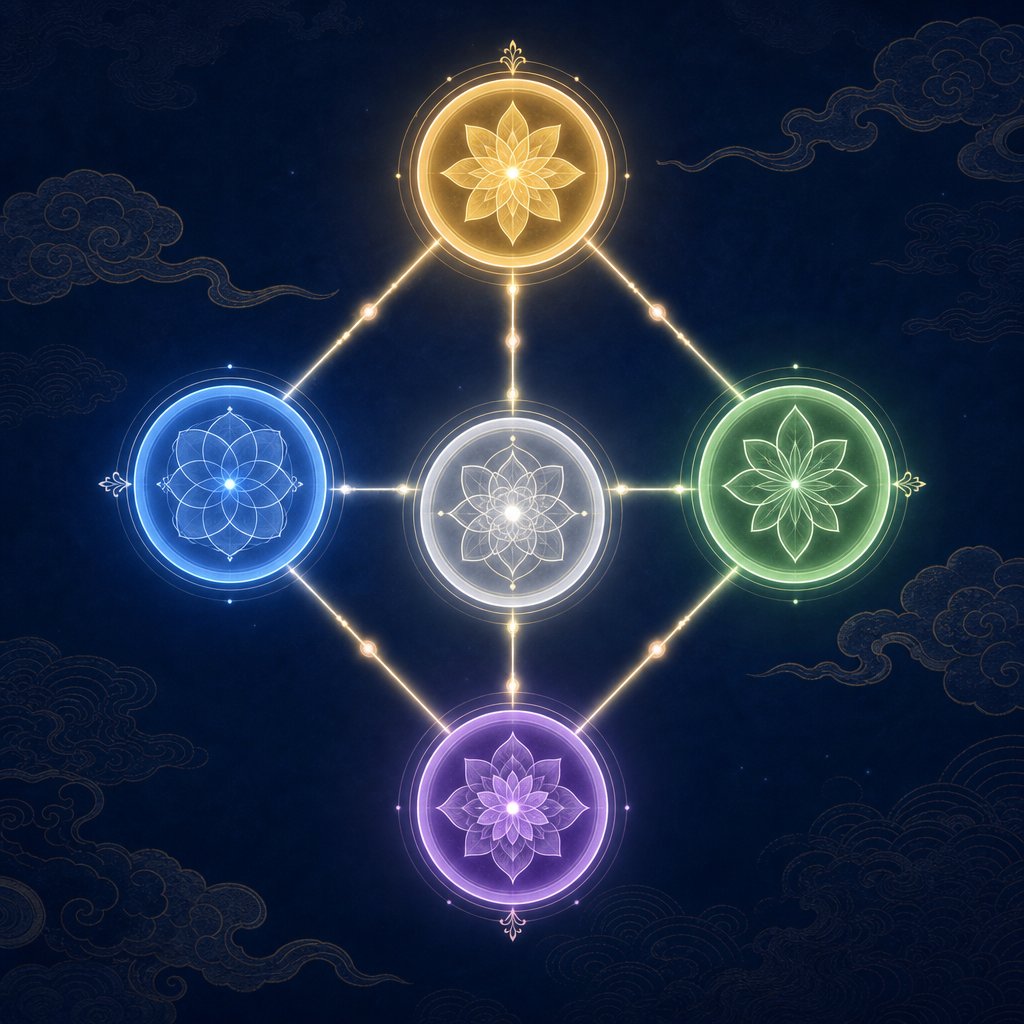
Knowing which system to follow is one thing. Knowing how to actually calculate a reading is another. The five-grid system (五格剖象法) is the engine behind professional name analysis in both Chinese and Japanese traditions. It breaks a full name into five separate stroke-count totals, each governing a distinct domain of life. Rather than reducing your name to a single number, this method reads five numbers simultaneously, and the interplay between them determines whether a name carries balanced fortune or hidden conflict.
Think of it this way: your name is not one signal. It is five signals broadcasting at once, each tuned to a different frequency of your life experience.
The Five Grids and Their Life Domains
Each grid, or kaku (格), maps to a specific life domain and draws from a different combination of characters in your full name. According to the go-kaku framework used in seimei handan, the five pillars are:
- Tenkaku (天格) — Heaven Grid: Represents lineage, ancestry, and inherited family fortune. This grid reflects the energy passed down through your surname and is not something you can change. It sets the backdrop against which the other grids operate.
- Jinkaku (人格) — Personality Grid: Governs core personality, leadership ability, and social force. This is widely considered the most influential grid for your active adult life, shaping how you engage with the world and how others perceive you.
- Chikaku (地格) — Earth Grid: Covers inner vitality, emotional tendencies, and early life development. It reflects your private self and the foundation built during youth.
- Gaikaku (外格) — Outer Grid: Relates to external conditions, social environment, and interpersonal relationships. It captures the forces acting on you from outside, including career opportunities and social networks.
- Soukaku (総格) — Total Grid: Represents the broad life trajectory and overall fortune arc. Many practitioners consider this the summary reading that becomes most relevant in later years.
A strong reading does not rely on one lucky japanese number alone. Balance across all five pillars is what separates a genuinely well-chosen name from one that merely looks good on a single metric.
Step-by-Step Calculation Formulas
Sounds complex? The math itself is straightforward once you understand the structure. For the most common Japanese name format, a single-character surname (A) paired with a two-character given name (B + C), the formulas work like this:
| Grid | Formula | Life Domain | Primary Age Range |
|---|---|---|---|
| Tenkaku (天格) | Surname strokes + 1 | Lineage, inherited fortune | Ancestral (background influence) |
| Jinkaku (人格) | Last surname character (A) + First given name character (B) | Core personality, social force | Mid-life (20s through 50s) |
| Chikaku (地格) | Given name strokes (B + C) | Inner vitality, emotional foundation | Youth (birth through 20s) |
| Gaikaku (外格) | Total strokes - Jinkaku + 1 | External environment, relationships | Mid to later life |
| Soukaku (総格) | All characters combined (A + B + C) | Overall life arc | Later years (55+) |
The "+1" padding appears whenever a name component has only one character. For a two-character surname (A1 + A2) with a two-character given name (B1 + B2), tenkaku simply becomes A1 + A2 with no padding needed, and chikaku becomes B1 + B2. The padding rule ensures that single-character components still produce meaningful grid values rather than duplicating another grid's result.
Here is a quick example. Take the surname 山 (yama, 3 strokes) and given name 田花 (ta + hana, 5 + 7 strokes):
- Tenkaku: 3 + 1 = 4
- Jinkaku: 3 + 5 = 8
- Chikaku: 5 + 7 = 12
- Gaikaku: 15 - 8 + 1 = 8
- Soukaku: 3 + 5 + 7 = 15
Each of these numbers is then checked against the 81-number fortune chart. In this example, 8 and 15 are both traditionally considered lucky japanese numbers associated with prosperity and social harmony, while 4 carries a more cautious reading.
How the Grids Interact With Each Other
Individual grid scores matter, but the relationship between adjacent grids matters more. Practitioners look at how neighboring grids support or undermine each other, particularly the trio of tenkaku, jinkaku, and chikaku, often called the Three Talents (三才配置). If jinkaku sits between a supportive tenkaku above and a stable chikaku below, the reading suggests a person whose inherited fortune and inner foundation both reinforce their active personality.
Conflict between grids tells a different story. A person with the luckiest number in Japan sitting in their soukaku but a clashing jinkaku-chikaku pair may find that their later-life promise is undermined by personality struggles or emotional instability during formative years. The system reads like a circuit: energy flows smoothly when grids are in harmony, and short-circuits when they clash.
This grid interaction is precisely why experienced practitioners never evaluate a single number in isolation. A name that scores 15 in soukaku (highly auspicious) but pairs it with conflicting elemental energies between jinkaku and chikaku would still raise concerns. The five grids function as an interconnected system, and the quality of a name emerges from the pattern they form together, not from any one number standing alone.
Five Elements and Their Connection to Stroke Numbers
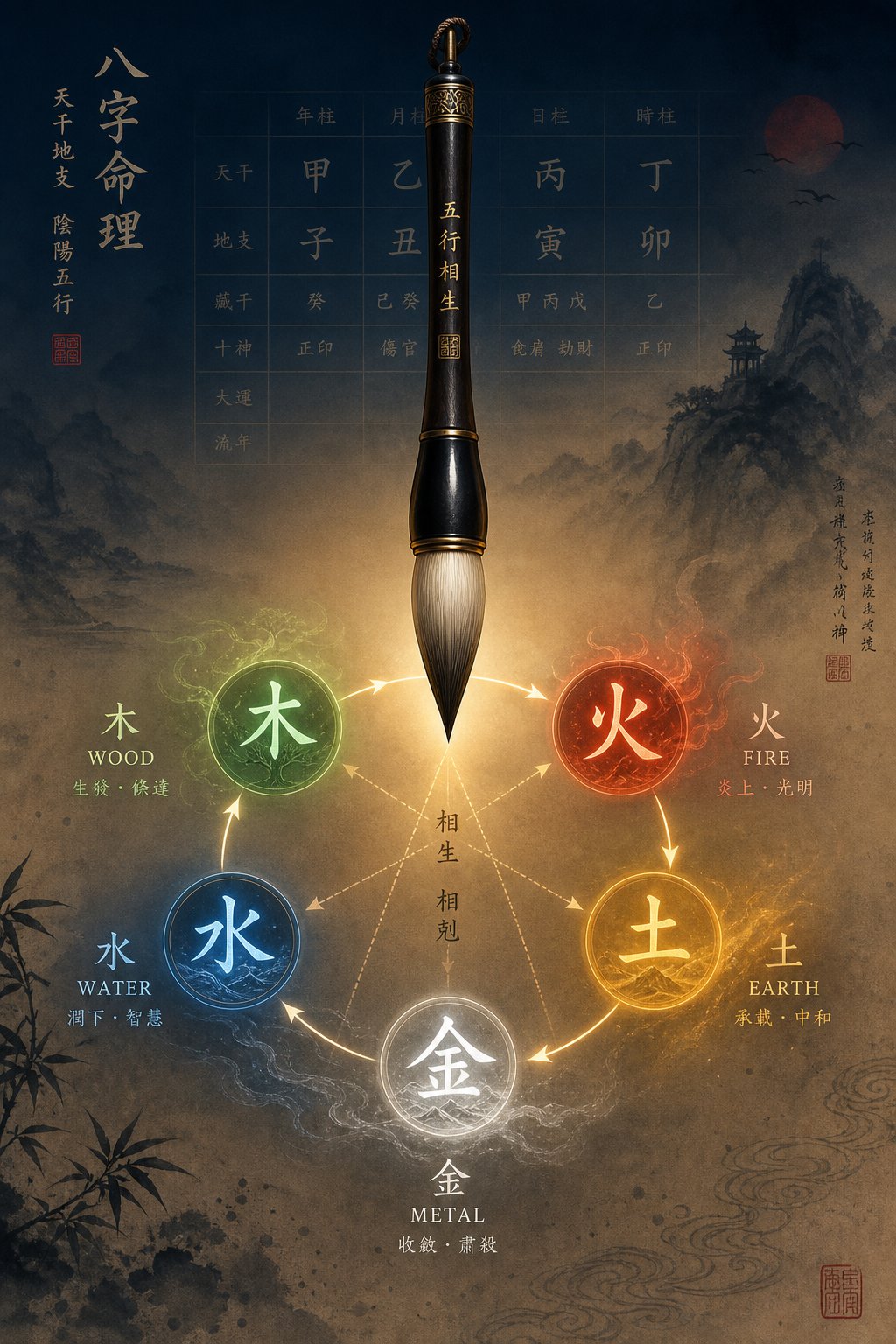
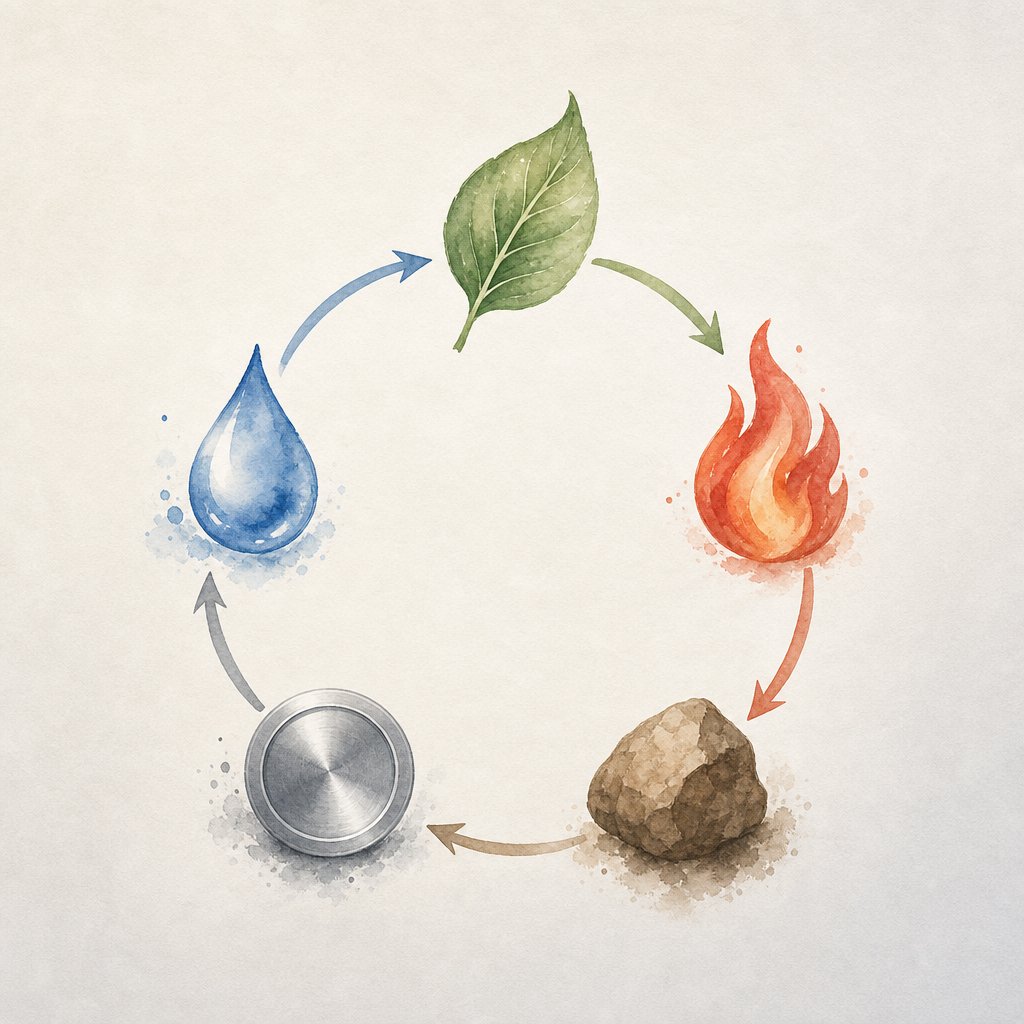
Grid interaction depends on something deeper than raw numbers. The mechanism that determines whether two adjacent grids support or clash with each other is Wu Xing (五行), the Five Elements system of Wood, Fire, Earth, Metal, and Water. Every stroke total maps to one of these five phases, and the elemental relationship between neighboring grids is what practitioners actually evaluate when judging a name's harmony.
Mapping Numbers to Wood Fire Earth Metal Water
The assignment rule is simple: look at the last digit of any grid's stroke total. That final digit determines which element governs that grid. You do not need to memorize complex tables. Just check the ones digit.
- Wood (木) — numbers ending in 1 or 2: Expanding, upward energy. Associated with growth, vitality, and spring. A grid total of 11, 22, or 32 all carry Wood energy.
- Fire (火) — numbers ending in 3 or 4: Radiating, ascending energy. Linked to passion, visibility, and summer. Totals like 13, 24, or 33 belong to Fire.
- Earth (土) — numbers ending in 5 or 6: Stabilizing, centering energy. Represents grounding, reliability, and transition. Numbers such as 15, 16, or 25 fall under Earth.
- Metal (金) — numbers ending in 7 or 8: Contracting, refining energy. Connected to decisiveness, structure, and autumn. Totals of 7, 18, or 28 carry Metal energy.
- Water (水) — numbers ending in 9 or 0: Descending, flowing energy. Tied to wisdom, adaptability, and winter. Numbers like 9, 10, or 20 belong to Water.
When you see a character described as kanji lucky for naming purposes, its fortune often traces back to this elemental assignment. A character contributing 8 strokes to a grid brings Metal energy, which may be exactly what a person's chart needs, or exactly what it should avoid. The number alone is not enough. Its element tells the full story.
Productive and Destructive Element Cycles
Elements do not exist in isolation. They interact through two fundamental cycles that determine whether adjacent grids in your name create support or friction.
The Generating Cycle (相生) flows like this: Wood feeds Fire, Fire creates Earth, Earth bears Metal, Metal collects Water, and Water nourishes Wood. When two neighboring grids follow this sequence, energy flows smoothly from one life domain to the next. A jinkaku grid with Fire energy sitting above a chikaku grid with Earth energy, for example, represents a productive relationship where personality strength naturally builds a stable emotional foundation.
The Controlling Cycle (相克) works differently: Wood parts Earth, Earth dams Water, Water quenches Fire, Fire melts Metal, and Metal cuts Wood. When adjacent grids fall into this pattern, one domain suppresses another. A tenkaku carrying Metal energy paired with a jinkaku carrying Wood energy suggests inherited family circumstances that restrict personal expression rather than support it.
The ideal Three Talents configuration, as Chinese nameology practitioners emphasize, is continuous generation across tenkaku, jinkaku, and chikaku. A sequence like Wood-Fire-Earth means each grid feeds the next, creating a smooth life trajectory from inherited fortune through active personality into emotional stability.
Balancing Name Elements With Birth Chart
Here is where stroke number selection becomes truly personal. A name that looks lucky in Japanese kanji charts might still be wrong for a specific individual if its elemental profile conflicts with their Bazi (八字) birth chart.
Your Bazi is calculated from your birth year, month, day, and hour, converted into Heavenly Stems and Earthly Branches. This reveals which elements dominate your natal chart and which are weak or missing. A person born with excessive Wood energy, for instance, does not benefit from a name loaded with Wood-element stroke totals (numbers ending in 1 or 2). Instead, they need Metal energy (numbers ending in 7 or 8) to control the excess, or Fire energy (3 or 4) to drain it productively.
The process works in three steps. First, a Bazi analysis identifies your Day Master strength and pinpoints which elements serve as your "Useful Gods" (用神), the phases most beneficial to your balance. Second, you select stroke totals for each grid that produce those needed elements. Third, you verify that the elements across all five grids follow the generating cycle rather than the controlling one.
This is why finding a character that is lucky in kanji dictionaries is only the starting point. A character with 8 strokes (Metal) might be perfect for someone whose chart lacks structure and decisiveness, yet harmful for someone already overloaded with Metal energy. The same stroke count shifts from remedy to excess depending on who carries the name. Elemental balance is always personal, never universal, and it is the bridge between abstract number charts and a name that genuinely fits the individual who will live with it.
How to Count Strokes Correctly for Name Analysis
Elemental balance only works if the numbers feeding into it are accurate. A single miscounted stroke shifts a grid total, changes its elemental assignment, and can flip an entire reading from auspicious to inauspicious. This makes stroke counting the most deceptively difficult step in the entire process. You might assume counting chinese name strokes is as simple as tracing each line on paper, but traditional nameology applies a set of rules that often contradict what your eyes see on the page.
Simplified Versus Traditional Character Stroke Counts
Here is the first rule that trips people up: if you are working within the Chinese 姓名學 system, you count strokes based on the traditional (繁體) form of a character, not the simplified (簡體) version used in mainland China today. This applies even if the person writes simplified characters in everyday life.
Why? The system was formalized using the Kangxi Dictionary (康熙字典) as its stroke count authority, and that dictionary records traditional forms exclusively. Simplified characters were introduced in the 1950s and 1960s to improve literacy rates, but nameology practitioners consider the traditional form to carry the character's original energetic structure.
A few examples make this concrete:
- 龍 (dragon) has 16 strokes in traditional form. Its simplified version 龙 has only 5. A nameology reading uses 16.
- 書 (book/writing) counts as 10 strokes traditionally. The simplified 书 has just 4.
- 華 (splendid/China) carries 14 strokes. Simplified 华 has 6.
The gap between simplified and traditional counts can be enormous, sometimes differing by 10 or more strokes. Using the wrong form does not just produce a slightly off reading. It produces a completely different one. Anyone learning how to count strokes in chinese characters for naming purposes must start by identifying the traditional equivalent of every character in the name.
Radical Stroke Adjustments and Special Rules
Even after converting to traditional forms, you are not done. Chinese nameology applies radical reversion rules that further adjust certain stroke counts. Common radicals, the building-block components that appear on the left, right, top, or bottom of characters, are counted according to their original standalone form rather than their abbreviated written shape.
The water radical is the most cited example. When you write 氵(the three-dot water radical appearing in characters like 河, 海, or 洋), your hand draws 3 strokes. But in traditional nameology, this radical reverts to its full form 水, which has 4 strokes. So the kanji stroke count for names using this radical adds one extra stroke that casual counting would miss.
This rule applies to many frequently used radicals. The table below lists the most common adjustments:
| Radical (as written) | Apparent Stroke Count | Original Full Form | Nameology Stroke Count | Example Characters |
|---|---|---|---|---|
| 氵 (water) | 3 | 水 | 4 | 河, 海, 洋 |
| 忄 (heart) | 3 | 心 | 4 | 情, 悟, 慎 |
| 扌 (hand) | 3 | 手 | 4 | 打, 持, 拓 |
| 犭 (dog/animal) | 3 | 犬 | 4 | 狼, 猫, 獅 |
| 礻 (spirit/altar) | 4 | 示 | 5 | 祥, 福, 禮 |
| 衤 (clothing) | 5 | 衣 | 6 | 裕, 補, 褔 |
| 辶 (walk/advance) | 3 | 辵 | 7 | 道, 達, 運 |
| 阝left (mound) | 2 | 阜 | 8 | 陽, 陳, 隆 |
| 阝right (city) | 2 | 邑 | 7 | 郭, 鄭, 都 |
| 艹 (grass) | 3 | 艸 | 6 | 花, 英, 莉 |
| 月 (meat radical) | 4 | 肉 | 6 | 肝, 腸, 膚 |
Notice how dramatic some adjustments are. The walking radical (辶) looks like 3 strokes on paper but counts as 7 in nameology. The left-ear radical (阝) appears to be just 2 strokes yet counts as 8. Missing even one of these adjustments throws off the entire grid calculation.
Japanese seimei handan, by contrast, generally does not apply these radical reversions. A practitioner working in the japanese for lucky name readings typically counts radicals at face value, exactly as they appear in standard kanji dictionaries. This is one of the most consequential differences between the two systems and a major reason why the same name can produce different grid totals depending on which tradition you follow.
Reliable Sources for Accurate Stroke Counts
Given these complexities, guessing stroke counts is a recipe for error. Practitioners rely on specific authoritative references:
- Kangxi Dictionary (康熙字典): The gold standard for Chinese nameology. Published in 1716 under Emperor Kangxi, it catalogs over 47,000 characters with their traditional stroke counts. Most professional naming software in Chinese-speaking regions uses Kangxi counts as the default.
- Shin Kangorin (新漢語林) and Kadokawa Shin Jigen (角川新字源): Standard Japanese kanji references used in seimei handan. These follow modern kanji forms without radical reversion.
- Online Kangxi stroke count tools: Several websites allow you to input a character and receive its Kangxi-standard stroke count instantly. These are useful for quick checks but should be cross-referenced when a character contains ambiguous radicals.
One practical tip: if you are performing a self-assessment, write out each character's radical components separately and check whether any of them appear in the adjustment table above. Characters with water, heart, hand, or grass radicals are the most common sources of miscounting. A name like 海明 (hai ming) looks like it totals 11 + 8 = 19 strokes at first glance, but with the water radical adjustment, 海 actually counts as 11 strokes under Kangxi rules (the radical adds 1, but other components also need verification against the dictionary).
The safest approach is always to verify each character individually against the Kangxi Dictionary rather than relying on mental arithmetic. Professional practitioners keep annotated character lists precisely because even experienced analysts occasionally second-guess a radical count. Accuracy here is not pedantic. It is foundational. Every grid calculation, every elemental assignment, and every fortune reading downstream depends on getting this first step right.
Complete Auspicious and Inauspicious Stroke Numbers Reference
Accurate stroke counts and correct elemental assignments only matter if you know which totals to aim for and which to avoid. This is the section most people are actually looking for: a clear breakdown of all 81 stroke numbers organized by fortune tier, so you can quickly evaluate whether a name's grid totals land in favorable or unfavorable territory.
The classifications below draw from both the Chinese 靈動數 (spirit-movement number) tradition and Japanese seimei handan fortune ratings. While minor interpretation differences exist between systems, the core groupings remain remarkably consistent across both traditions.
Highly Auspicious Stroke Numbers and Their Meanings
These are the numbers practitioners actively seek when constructing a name. They represent the strongest positive energies in the 81-number cycle, and landing one of these in your jinkaku (personality grid) or soukaku (total grid) is considered especially favorable.
| Stroke Number | Rating | Associated Meaning | Element |
|---|---|---|---|
| 1 | 大吉 | Origin of all fortune; the primal creative force | Wood (Yang) |
| 3 | 大吉 | Heavenly hope; good personality earns trust and success | Fire (Yang) |
| 5 | 大吉 | Longevity and prosperity; excellent mind-body balance | Earth (Yang) |
| 11 | 大吉 | Steady renewal; like spring returning to revive all things | Wood (Yang) |
| 13 | 大吉 | Brilliant strategy; popularity and responsible leadership | Fire (Yang) |
| 15 | 大吉 | Blessings of fortune and longevity; harmony with others | Earth (Yang) |
| 16 | 大吉 | Noble assistance; celebrity-level influence and achievement | Earth (Yin) |
| 21 | 大吉 | Moonlight leadership; intelligence rewarded by luck | Wood (Yang) |
| 23 | 大吉 | Rising sun; seizing opportunities for extraordinary status | Fire (Yang) |
| 24 | 吉 | Productive abundance; wealth built through skill and creativity | Fire (Yin) |
| 31 | 大吉 | Wisdom and courage; firm convictions with generous tolerance | Wood (Yang) |
| 32 | 大吉 | Ray of light; extraordinary luck and opportunity from nothing | Wood (Yin) |
| 33 | 吉 | Prosperous household; honest expression brings honor and power | Fire (Yang) |
| 37 | 吉 | Self-reliance; patience and adaptability lead to great heights | Metal (Yang) |
| 39 | 吉 | Strong leadership; sincerity and sociability earn respect | Water (Yang) |
| 41 | 大吉 | True strength; patience and flexibility overcome all hardship | Wood (Yang) |
| 45 | 吉 | Favorable wind; confidence and willpower gather support | Earth (Yang) |
| 47 | 吉 | Flowering; inclusive harmony produces abundant blooming | Metal (Yang) |
| 48 | 吉 | Wise strategist; natural balance and strong moral character | Metal (Yin) |
| 52 | 吉 | Foresight realized; good judgment leads to wealth and honor | Wood (Yin) |
| 63 | 吉 | Prosperity and harmony; devoted focus achieves great things | Fire (Yang) |
| 65 | 吉 | Longevity with honor; seizing opportunity brings lasting fame | Earth (Yang) |
| 67 | 吉 | Smooth commerce; business ventures succeed naturally | Metal (Yang) |
| 81 | 大吉 | Return to origin; the cycle completes with renewed prosperity | Wood (Yang) |
Among these, numbers 11, 15, 16, 21, 31, 32, and 41 are the most sought-after because they combine strong fortune ratings with versatile elemental profiles. Number 15, for instance, appears on virtually every practitioner's recommended list. Its Earth element provides stability, and its meaning of "blessings, harmony, and family prosperity" makes it suitable across all five grids. Similarly, 31 is prized as a japan lucky numbers favorite because it signals leadership tempered by generosity, a combination that serves well in both career and family domains.
Inauspicious Stroke Numbers to Avoid
Equally important is knowing which unlucky stroke numbers to avoid. These carry energies associated with instability, isolation, loss, or repeated hardship. Landing one of these in your jinkaku or soukaku grid is what practitioners flag as a serious concern.
| Stroke Number | Rating | Associated Meaning | Element |
|---|---|---|---|
| 2 | 凶 | Stop and start; difficulty integrating, repeated stalling | Wood (Yin) |
| 4 | 凶 | Hardship; disturbances in health and home, unfulfilled dreams | Fire (Yin) |
| 9 | 凶 | Adversity; sharp mind undermined by anxiety and nervousness | Water (Yang) |
| 10 | 凶 | Extremes; instability, hasty changes, lack of grounding | Water (Yin) |
| 12 | 凶 | Frustration; artistic talent paired with loneliness | Wood (Yin) |
| 14 | 凶 | Unreasonable isolation; strong opinions drive others away | Fire (Yin) |
| 19 | 大凶 | Obstacles; luck cannot be expected despite clear intelligence | Water (Yang) |
| 20 | 凶 | Instability; extreme swings causing physical and social problems | Water (Yin) |
| 22 | 凶 | Weakness; loneliness from marching to a different drummer | Wood (Yin) |
| 26 | 凶 | Turbulence; greed and stubbornness undermine solid effort | Earth (Yin) |
| 28 | 凶 | Disaster-prone; genius that fails to assess its environment | Metal (Yin) |
| 34 | 半凶 | Transfiguration; rebellious spirit causes relationship trouble | Fire (Yin) |
| 36 | 凶 | Turbulent waves; constant hardship, talent without fortune | Earth (Yin) |
| 44 | 凶 | Calculated plans fail; ambition invites defeat | Fire (Yin) |
| 46 | 凶 | Broken vessel; rough path requiring constant vigilance | Earth (Yin) |
| 50 | 凶 | Precariousness; success mysteriously collapses | Water (Yin) |
| 54 | 凶 | Zealotry; sharp instincts ruined by reckless enthusiasm | Fire (Yin) |
| 55 | 凶 | Fickle superiority; decisive action without moral compass | Earth (Yang) |
| 56 | 凶 | Passivity; selfish nature with few prospects for recovery | Earth (Yin) |
| 59 | 凶 | Stagnation; impatience paired with lack of ambition | Water (Yang) |
| 60 | 凶 | Darkness; easily strays off path and becomes lost | Water (Yin) |
A pattern emerges when you study the bad luck numbers in japan and Chinese traditions together: numbers ending in 0 are disproportionately inauspicious. The Chinese 靈動數 system explicitly states that Water Yin numbers (those ending in 0) have "no auspicious numbers" and should not be used. Numbers 10, 20, 30, 40, 50, and 60 all carry cautionary or outright negative readings. This aligns with the broader numerological principle that 0 represents emptiness and dissolution rather than generative force.
Number 19 deserves special attention as the most consistently warned-against total across both traditions. Despite being associated with intelligence and aesthetic sensibility, it carries a "very unlucky" rating because those gifts are perpetually undermined by nervous energy and external obstacles. A name with 19 in the jinkaku grid is something most practitioners would immediately flag for revision.
Real-world examples reinforce these patterns. As one Singapore-based feng shui researcher noted, prominent figures like Andy Lau (劉德華, 44 strokes total) and Zoe Tay (鄭惠玉, 36 strokes total) carry names that fall into inauspicious categories under this system, yet achieved extraordinary success. This highlights an important nuance: stroke numbers represent one layer of influence, not an absolute destiny verdict.
Using the Reference Table for Name Selection
When you are selecting auspicious numbers for names, keep these practical guidelines in mind:
- Prioritize jinkaku and soukaku. These two grids carry the most weight in determining active life fortune and overall trajectory. Landing a 大吉 number in either of these positions has the greatest positive impact.
- Check all five grids, not just one. A name with 15 in soukaku but 19 in jinkaku still carries significant risk. Balance matters more than any single standout number.
- Watch the element column. A number might be rated 吉 but still cause problems if its element clashes with adjacent grids. Use the element assignments to verify that neighboring grids follow the generating cycle (Wood to Fire to Earth to Metal to Water).
- Avoid numbers ending in 0. Across both Chinese and Japanese systems, these consistently rank among the least favorable options. If a grid calculation produces a total ending in 0, consider adjusting character choices.
- Treat neutral numbers (半吉) as context-dependent. Numbers like 7, 17, 27, 30, and 35 are not harmful, but they are not actively helpful either. They work fine in tenkaku or gaikaku where the stakes are lower, but you would want something stronger in jinkaku or soukaku.
This reference gives you the raw data to evaluate any name quickly. Yet numbers alone do not tell the complete story. The most common errors people make when applying this information, from miscounting strokes to ignoring grid harmony, can turn even a well-intentioned name selection into a flawed one.
Applying Stroke Number Analysis to Non-CJK Names
What if your name is not written in kanji or Chinese characters at all? People with Western names often wonder whether this system applies to them. The short answer: an adaptation exists. Japanese onomancy enthusiasts have developed a method for calculating a western name stroke count by assigning each Latin letter a number based on how many times the pen lifts from the paper to write it. The approach is informal and debated, but it offers a fun entry point for anyone curious about where their name lands on the 81-number chart.
The Latin Letter Stroke Count Method
The logic mirrors how kanji strokes are counted. Each time your pen leaves the paper while writing a letter, that counts as one stroke. The letter "O" requires a single continuous motion, so it equals 1 stroke. The letter "E" requires a vertical line plus three horizontal bars, totaling 4 strokes. Some letters can be written in more than one way, so alternate counts exist. As Jonelle Patrick's adaptation of seimei handan for English names notes, you can choose the version you prefer when a letter has multiple valid stroke counts.
Here is the standard stroke count chart for the Latin alphabet:
| Letter | Stroke Count | Letter | Stroke Count | Letter | Stroke Count |
|---|---|---|---|---|---|
| A | 3 | J | 1 (or 2) | S | 1 |
| B | 2 | K | 3 | T | 2 |
| C | 1 | L | 1 (or 2) | U | 1 |
| D | 2 | M | 4 (or 1) | V | 2 (or 1) |
| E | 4 | N | 3 (or 1) | W | 4 (or 1) |
| F | 3 | O | 1 | X | 2 |
| G | 2 | P | 2 | Y | 2 (or 3) |
| H | 3 | Q | 2 | Z | 3 (or 1) |
| I | 1 (or 3) | R | 3 |
Letters shown with alternate counts reflect different handwriting styles. "I" counts as 1 if written as a single vertical stroke, or 3 if you add top and bottom serifs. "M" counts as 4 if written with four separate strokes, or 1 if drawn in a single continuous motion.
Calculating Your Western Name Score
To find your overall fortune number, add up the english name numerology strokes for every letter in your full name (first and last combined). Then check that total against the 81-number chart from the previous section.
A quick example: the name PATRICK breaks down as P(2) + A(3) + T(2) + R(3) + I(1) + C(1) + K(3) = 15. If you were curious how Patrick in Japanese onomancy would score, that total of 15 lands squarely in the "highly auspicious" tier, associated with harmony, fortune, and natural leadership. Not bad for a name chosen without a calculator in hand.
For a fuller reading, you can also separate the surname and given name to calculate individual grids, just as you would with lucky japanese names written in kanji. The surname strokes feed into tenkaku, the given name into chikaku, and the combined total into soukaku.
Limitations of Cross-Cultural Application
This adaptation is entertaining and occasionally insightful, but it carries important caveats:
- No historical foundation: The 81-number system was developed over centuries specifically for CJK characters. Latin letter stroke counts are a modern, informal overlay without the same depth of tradition or scholarly refinement.
- No elemental integration: Traditional practice ties stroke numbers to birth charts and Five Elements balance. Western name adaptations rarely incorporate this layer, making the reading superficial by comparison.
- Handwriting variability: Kanji stroke counts are standardized by dictionaries. Latin letter stroke counts depend on personal handwriting style, introducing subjectivity that does not exist in the original system.
- Cultural context matters: The system's power in East Asian societies comes partly from collective belief and centuries of cultural reinforcement. Applying it outside that context changes its nature from a living tradition to a curiosity.
None of this means the exercise is worthless. Pattern recognition and self-reflection have value regardless of the framework that prompts them. But treating a Western name stroke count with the same weight as a professionally analyzed kanji name overstates what the adaptation can deliver. Think of it as a doorway into understanding the system rather than a definitive reading of your fate.
Common Mistakes and When to Seek Professional Guidance
Understanding the system is one thing. Applying it without stumbling into well-worn traps is another. Even people who have read extensively about choosing lucky name strokes make errors that undermine the entire exercise. Some of these mistakes are technical. Others are conceptual, rooted in misunderstandings about how the system actually works. Practitioners who perform professional name analysis consultation regularly see the same handful of errors repeated by parents and self-researchers alike.
Most Common Stroke Number Selection Errors
If you are doing your own research, watch for these pitfalls. Each one is common enough that experienced practitioners flag them immediately when reviewing a client's self-selected name:
- Blindly adding a missing element from the birth chart: This is the single most frequent name stroke number mistake. If a Bazi chart lacks Water, many people assume the name should load up on Water-element strokes (numbers ending in 9 or 0). But as practitioner Sean Chan explains, introducing a missing element can actually collapse the chart's structure and make its flaws more pronounced. A chart missing Water might rely on that absence for stability. The correct approach evaluates the chart's overall flow, structure (格局), and environmental adjustment (調侯) before deciding which elements genuinely help.
- Using simplified character stroke counts: Counting 龙 as 5 strokes instead of 龍 as 16 produces a completely different grid reading. Anyone working within the Chinese 姓名學 system must use Kangxi Dictionary traditional forms. This seimei handan common error is less frequent in Japanese practice, where standard kanji counts apply, but cross-system confusion still trips people up.
- Focusing only on soukaku (total strokes): A name with a beautiful total of 31 or 41 looks great on paper. But if jinkaku lands on 19 or chikaku hits 20, the name carries serious internal conflict. All five grids matter. Soukaku reflects later-life trajectory, but jinkaku governs your active adult years and carries arguably more daily influence.
- Assuming one auspicious number guarantees a good name: A single 大吉 number does not override poor grid harmony. If the elements across tenkaku, jinkaku, and chikaku follow the controlling cycle instead of the generating cycle, the Three Talents configuration is broken regardless of how impressive any individual number looks.
- Ignoring radical stroke adjustments: Counting 氵 as 3 instead of 4, or 辶 as 3 instead of 7, shifts grid totals and changes elemental assignments. One missed radical adjustment can flip an entire reading from auspicious to inauspicious.
- Mixing systems: Applying Chinese radical reversion rules while using Japanese fortune interpretations, or vice versa, produces hybrid results that neither tradition would validate. Pick one system and stay consistent throughout.
What You Can Self-Assess Versus What Needs Expert Help
Self-research works well for certain tasks. You can reliably count strokes using the Kangxi Dictionary, calculate all five grid totals, check those totals against the 81-number chart, and verify that adjacent grid elements follow the generating cycle. These are mechanical steps with clear rules, and anyone willing to be careful and methodical can perform them accurately.
Where self-assessment breaks down is Bazi integration. Determining which elements your birth chart actually needs requires years of study. The structure analysis alone involves identifying your Day Master strength, assessing whether the chart follows a standard or special pattern, and evaluating seasonal adjustments. Getting this wrong does not just produce a suboptimal name. It can produce one that actively works against the person carrying it.
A realistic rule of thumb: if you are selecting between pre-screened names that all have strong grid numbers and good elemental flow, self-assessment is sufficient. If you are building a name from scratch and need to integrate it with a specific birth chart, professional guidance adds genuine value that self-study cannot easily replicate.
Finding a Qualified Naming Practitioner
Not all practitioners operate at the same level. When seeking a professional name analysis consultation, look for these indicators of competence:
- They ask for the exact birth time: Any practitioner who selects a name without requesting the birth year, month, day, and hour is skipping the Bazi integration step entirely. This is a red flag.
- They explain their reasoning: A credible practitioner walks you through why specific elements were chosen, how the grid numbers interact, and what the Three Talents configuration means for the child. Transparency about methodology signals genuine expertise.
- They use the Kangxi Dictionary standard: Ask which stroke count reference they use. If they cannot name it or seem unfamiliar with radical adjustments, their technical foundation may be weak.
- They acknowledge trade-offs: As Sean Chan notes, getting all six criteria right (five grids plus Three Talents) is "extremely difficult, especially when the surname and chart is fixed." A practitioner who claims every name they produce is perfect across all dimensions is overpromising.
- They have verifiable experience: Look for practitioners who share case studies, explain their background in metaphysics study, or come recommended by previous clients. Years of practice matter because pattern recognition improves with exposure to hundreds of charts.
The naming process is ultimately a collaboration. You bring knowledge of your family, your cultural context, and the sounds and meanings that resonate with you. A skilled practitioner brings the technical rigor to ensure those preferences align with favorable stroke patterns and elemental balance. Neither side works as well alone as they do together.
Frequently Asked Questions About Auspicious Stroke Numbers for Names
1. What are the luckiest stroke numbers for a name?
The most consistently recommended stroke numbers across both Chinese and Japanese traditions are 11, 15, 16, 21, 31, 32, and 41. These carry a rating of dai-kichi (great blessing) and are associated with prosperity, leadership, harmony, and renewal. Number 15 is particularly versatile because its Earth element provides stability and its meaning suits all five grid positions equally well.
2. Which stroke numbers should I avoid when naming a baby?
Numbers 19, 20, 10, 4, 14, 28, and 44 are among the most warned-against totals. Number 19 is especially cautionary as it signals intelligence undermined by anxiety and external obstacles. As a general rule, numbers ending in 0 are disproportionately inauspicious across both Chinese and Japanese systems because zero represents emptiness rather than generative force.
3. Do I count simplified or traditional Chinese character strokes for name analysis?
In the Chinese naming system (姓名學), you must use traditional character stroke counts based on the Kangxi Dictionary, even if the person writes simplified characters daily. The difference can be dramatic — for example, 龍 (dragon) counts as 16 strokes traditionally versus only 5 for its simplified form 龙. Japanese seimei handan uses standard kanji dictionary counts without reverting to older forms.
4. How does the five-grid system work for name analysis?
The five-grid system divides a full name into five stroke-count totals: tenkaku (heaven/lineage), jinkaku (personality), chikaku (earth/youth), gaikaku (outer/social), and soukaku (total/life arc). Each grid governs a different life domain and age range. Practitioners evaluate not just individual grid scores but the elemental relationships between adjacent grids, seeking a generating cycle (Wood-Fire-Earth-Metal-Water) rather than a controlling one.
5. Can I apply stroke number analysis to an English or Western name?
An informal adaptation exists where each Latin letter is assigned a stroke count based on pen lifts needed to write it. You add up all letter strokes in your full name and check the total against the 81-number chart. However, this method lacks the historical depth, standardized references, and birth chart integration of the original CJK system. It works as an introductory exercise but should not be treated with the same weight as a traditional kanji-based reading.