What Is Bazi Chart Element Counting and Why It Matters
You pulled up your bazi chart, stared at eight Chinese characters arranged in four pillars, and thought: now what? The answer starts with counting. Specifically, counting how much Wood, Fire, Earth, Metal, and Water actually show up across those eight characters.
What Element Counting Actually Means in Bazi
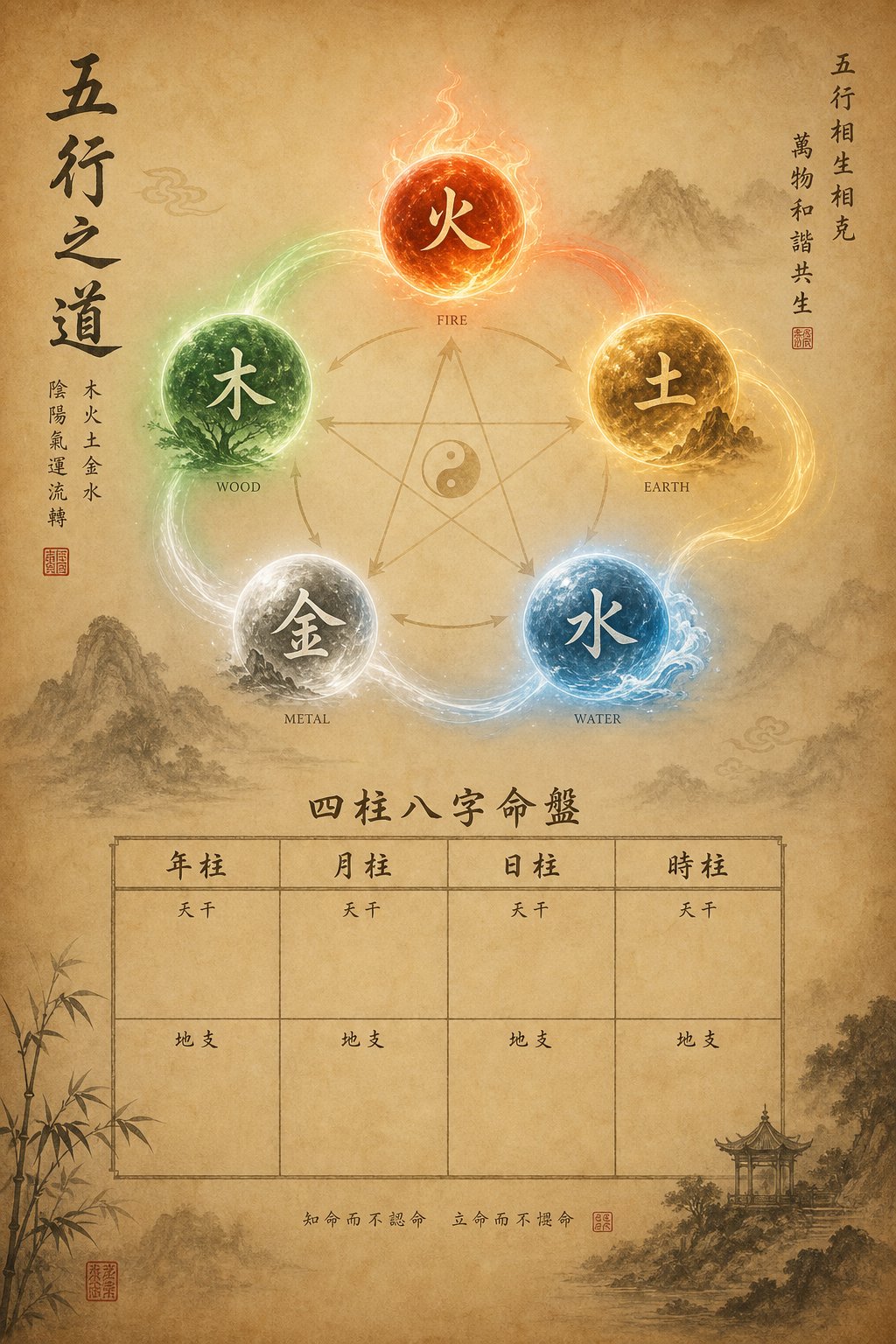
Bazi chart element counting is the process of tallying how many times each of the chinese five elements — Wood, Fire, Earth, Metal, and Water — appears across all eight characters (Heavenly Stems and Earthly Branches) in a Four Pillars of Destiny chart.
That is the entire concept at its core. A ba zi chart (literally "eight characters" in Chinese) encodes your birth data into a grid of elemental energies. Element counting gives you a quantitative snapshot of what your chart contains — which elements dominate, which ones barely show up, and which might be missing entirely. Think of it as taking inventory before you start interpreting.
Why Counting Elements Is the First Step in Chart Analysis
Without a clear element tally, every other layer of bazi analysis rests on guesswork. You cannot determine whether your Day Master is strong or weak, identify favorable elements, or spot imbalances until you know the raw distribution. As noted in standard bázi methodology, assessing element balance across all eight characters is the foundation that supports everything from personality insights to timing predictions.
Most beginner guides skip this step or oversimplify it. Advanced resources assume you already know how to do it. This article fills that gap — a technical, fully actionable walkthrough of bazi chart element counting that you can apply to your own four pillars of destiny without needing a paid consultation. The catch? It requires knowing exactly which element each Heavenly Stem and Earthly Branch carries, including the hidden stems most people overlook.
Mapping All 10 Heavenly Stems to Their Elements
The Heavenly Stems are where your element count begins. These are the four characters sitting in the top row of your chart — one per pillar. Each stem maps directly to one of the five elements in the wu xing system, and each carries either Yang or Yin polarity. No ambiguity, no exceptions.
The 10 Heavenly Stems and Their Five Element Assignments
There are exactly ten Heavenly Stems in Chinese metaphysics. They cycle through the five elements in order — Wood, Fire, Earth, Metal, Water — with each element appearing twice: once as Yang, once as Yin. If you have ever wondered "what is my chinese zodiac heavenly element," the answer lives in this table.
| Stem (Chinese) | Pinyin | Element | Polarity | Nature Image |
|---|---|---|---|---|
| 甲 | Jia | Wood | Yang | Towering tree |
| 乙 | Yi | Wood | Yin | Vine or flower |
| 丙 | Bing | Fire | Yang | Sun |
| 丁 | Ding | Fire | Yin | Candlelight |
| 戊 | Wu | Earth | Yang | Mountain |
| 己 | Ji | Earth | Yin | Farmland |
| 庚 | Geng | Metal | Yang | Sword or axe |
| 辛 | Xin | Metal | Yin | Jewelry |
| 壬 | Ren | Water | Yang | Ocean or river |
| 癸 | Gui | Water | Yin | Rain or mist |
Notice the pattern: odd-numbered stems (1st, 3rd, 5th, 7th, 9th) are always Yang, and even-numbered stems (2nd, 4th, 6th, 8th, 10th) are always Yin. The sequence originates from ancient pictographic characters tied to the agricultural cycle — from seed sprouting in spring through harvest in autumn and dormancy in winter.
Understanding Yin and Yang Polarity in Each Stem
So what does polarity mean in astrology when applied to these stems? Yang represents outward, expansive, and forceful energy. Yin represents inward, receptive, and subtle energy. Jia Wood is a towering oak — rigid, visible, dominant. Yi Wood is a climbing vine — flexible, adaptive, yielding. Same element, very different expression.
Here is the practical question for element counting: does polarity matter when you tally?
For a basic element count, no. Jia and Yi both register as one instance of Wood each. Bing and Ding both count as Fire. You are tallying the five elements across your chart, not ten stems. The Yang or Yin distinction does not change the elemental category.
Polarity becomes relevant in more advanced layers of analysis — specifically when assessing relationships between stems, determining the Ten Gods, or evaluating how a particular element expresses itself in your life. A Yang Metal Day Master (Geng) interacts with other elements differently than a Yin Metal Day Master (Xin), even though both are Metal. But that is interpretation, not counting.
For the purpose of building your element tally, treat each stem as a straightforward +1 to its corresponding element. Four Heavenly Stems across four pillars give you four data points immediately. The complexity arrives when you look below those stems — into the Earthly Branches, where elements hide in layers.
The 12 Earthly Branches and Their Hidden Stems Revealed
The bottom row of your chart — the four Earthly Branches — is where most people get their element count wrong. Unlike Heavenly Stems, which map cleanly to a single element each, Earthly Branches are containers. Each one holds between one and three hidden stems inside it, and those hidden elements absolutely count toward your tally. Miss them, and your chinese zodiac element chart is incomplete before you even start interpreting.
The 12 Earthly Branches and Their Primary Elements
Every Earthly Branch carries a primary element — its dominant energy and the one most visibly expressed. If you have ever looked up your chinese zodiac animal and element, the primary element is what most calculators show you. But it is only the surface layer.
Here is the complete reference. The "Primary Element" column reflects the main qi of each branch — the element that defines its fundamental nature within the chinese zodiac four pillars system.
| Branch (Chinese) | Pinyin | Animal Sign | Primary Element | Hidden Stems |
|---|---|---|---|---|
| 子 | Zi | Rat | Water | 癸 (Gui Water) |
| 丑 | Chou | Ox | Earth | 己 (Ji Earth), 癸 (Gui Water), 辛 (Xin Metal) |
| 寅 | Yin | Tiger | Wood | 甲 (Jia Wood), 丙 (Bing Fire), 戊 (Wu Earth) |
| 卯 | Mao | Rabbit | Wood | 乙 (Yi Wood) |
| 辰 | Chen | Dragon | Earth | 戊 (Wu Earth), 乙 (Yi Wood), 癸 (Gui Water) |
| 巳 | Si | Snake | Fire | 丙 (Bing Fire), 庚 (Geng Metal), 戊 (Wu Earth) |
| 午 | Wu | Horse | Fire | 丁 (Ding Fire), 己 (Ji Earth) |
| 未 | Wei | Goat | Earth | 己 (Ji Earth), 丁 (Ding Fire), 乙 (Yi Wood) |
| 申 | Shen | Monkey | Metal | 庚 (Geng Metal), 壬 (Ren Water), 戊 (Wu Earth) |
| 酉 | You | Rooster | Metal | 辛 (Xin Metal) |
| 戌 | Xu | Dog | Earth | 戊 (Wu Earth), 辛 (Xin Metal), 丁 (Ding Fire) |
| 亥 | Hai | Pig | Water | 壬 (Ren Water), 甲 (Jia Wood) |
Hidden Stems Inside Each Earthly Branch
Look at the "Hidden Stems" column closely. You will notice three distinct patterns:
- Simple branches (1 hidden stem): Zi, Mao, and You each contain only a single hidden stem. These are the purest branches — their energy is concentrated and undiluted. Zi is purely Water, Mao is purely Wood, and You is purely Metal.
- Dual branches (2 hidden stems): Wu and Hai each contain two hidden stems. Horse (Wu) holds Fire and Earth. Pig (Hai) holds Water and Wood. These carry a secondary element alongside their main qi.
- Complex branches (3 hidden stems): Chou, Yin, Chen, Si, Wei, Shen, and Xu each contain three hidden stems. These are the branches that trip people up most often. Tiger (Yin), for example, is primarily Wood — but it also contains Fire and Earth inside it.
Why does this matter for your element count? Imagine your chart has Tiger in the Year Branch. A surface-level reading using a chinese zodiac with elements calculator might register that as one instance of Wood. But a thorough count recognizes that Tiger contributes Wood, Fire, and Earth to your chart simultaneously. That is three elements from a single branch.
The hidden stems within each branch follow a specific hierarchy. The first stem listed is the "main qi" — the dominant energy that defines the branch. The second is the "middle qi" or side energy. The third (when present) is the "residual qi" — a trace element left over from the previous seasonal phase. This hierarchy matters when you move beyond raw counting into weighted analysis, but for building your initial tally, every hidden stem gets recorded.
Consider the four Earth branches — Chou, Chen, Wei, and Xu. Each one is primarily Earth, yet each contains completely different secondary elements. Chou hides Water and Metal. Chen hides Wood and Water. Wei hides Fire and Wood. Xu hides Metal and Fire. If your chart contains two Earth branches, you cannot assume they contribute identical elemental profiles. The chinese zodiac 4 pillars system encodes far more nuance than a simple animal-sign lookup reveals.
This is precisely where bazi chart element counting separates from casual zodiac browsing. Your four Earthly Branches potentially contribute anywhere from four elements (if all branches are simple) to twelve additional hidden stems (if all branches are complex). Most charts fall somewhere in between, typically yielding seven to ten hidden stem entries on top of the four visible Heavenly Stems.
The question that naturally follows: do these hidden stems carry the same weight as the visible ones sitting on top of each pillar? That distinction changes everything about how your final tally translates into real chart analysis.
How Hidden Stems Change Your Element Count
Short answer: no, hidden stems do not carry the same weight as visible ones. A chart with three visible Water stems tells a very different story than a chart where three Water stems are buried inside Earthly Branches. Both scenarios register the same raw count, but the energy operates differently — and understanding that difference is one of the bazi reading basics that separates surface-level tallying from genuine bazi analysis.
Visible Stems vs Hidden Stems in Element Counting
Picture your four pillars as a two-story structure. The top floor — your four Heavenly Stems — is what the world sees. These elements are overt, active, and immediately expressed. They represent qualities, behaviors, and energies that manifest openly in your life. When Metal sits visibly in your Month Stem, that Metal energy is accessible and direct.
The ground floor — your four Earthly Branches — holds the hidden stems. These elements are latent. They exist in your chart, they influence your life, but they operate beneath the surface. Think of them as potential energy rather than kinetic energy. A hidden Fire stem inside your Year Branch is not broadcasting Fire the same way a visible Fire stem in your Year Pillar does.
For a ba zi reading to be accurate, both layers must be accounted for. But treating them as identical in influence leads to distorted conclusions. Here is how practitioners typically differentiate them:
- Visible stems — represent external expression, conscious traits, and active energy. They interact directly with other visible stems through combinations and clashes.
- Hidden stems — represent internal reserves, latent talents, and subconscious patterns. They become activated when a Luck Pillar or annual pillar brings matching energy to the surface.
This distinction matters practically. If your element count shows four instances of Wood but three of them are hidden, your chart does not express Wood the same way it would if three were visible. The Wood is there — it just operates quietly until external timing draws it out.
How Much Weight Do Hidden Stems Carry
Among experienced practitioners, the most widely used weighting framework assigns influence based on the hidden stem's position within its branch:
- Main Qi (Ben Qi): The dominant hidden stem in each branch. It carries approximately 60-70% of that branch's elemental influence. This is the stem that defines the branch's primary nature — for example, Jia Wood inside Tiger or Geng Metal inside Monkey.
- Middle Qi (Zhong Qi): The secondary hidden stem, present in about eight of the twelve branches. It carries moderate influence — roughly 20-30% of the branch's energy.
- Residual Qi (Yu Qi): The trace element, a leftover from the previous seasonal phase. It carries the least weight — approximately 10% of the branch's influence. Present in only about half the branches.
Sounds complex? It can be. But the core principle is straightforward: not all hidden stems are equal, even within the same branch. A Main Qi hidden stem has significantly more pull than a Residual Qi stem tucked into the same container.
One important caveat: weighting systems vary among practitioners. Some schools assign fixed percentages. Others use a simpler tiered approach — full weight for visible stems and Main Qi, half weight for Middle Qi, and minimal weight for Residual Qi. Still others argue that any hidden stem matching a visible stem elsewhere in the chart (called a "transparent stem") should be upgraded to full weight because it has surfaced.
There is no single universal standard here, and any ba zi reading that presents one weighting system as the only correct method is oversimplifying. What matters for your bazi reading is consistency — pick a framework, apply it uniformly across all four branches, and use it as a lens rather than an absolute verdict.
For a basic element tally, the practical approach is this: count everything first, then note which elements appear visibly versus which are hidden and at what qi level. This gives you both the raw distribution and the qualitative context to interpret it. A flat count tells you what is present. A weighted count tells you what is active.
With both layers mapped and their relative influence understood, the next logical step is assembling these pieces into a repeatable process — a method you can apply to any chart, start to finish, without second-guessing which elements to include or where to find them.

The Complete Element Counting Method From Start to Finish
You have the reference tables. You understand the difference between visible and hidden stems. What you need now is a repeatable process — something you can follow every time you sit down with a chart, whether it is your own or someone else's. Here is exactly how to read bazi chart element distribution in six sequential steps.
Step-by-Step Process for Counting All Five Elements
Open your chart from any ba zi calculator or four pillars calculator — free or paid, it does not matter as long as it displays all four pillars with their Heavenly Stems and Earthly Branches clearly labeled. Then follow this sequence:
- Identify your four Heavenly Stems. These sit in the top row of your chart — one per pillar (Year, Month, Day, Hour). Write them down or note them separately.
- Record the element of each Heavenly Stem. Using the stem-to-element mapping, assign Wood, Fire, Earth, Metal, or Water to each of the four stems. You now have four element data points.
- Identify your four Earthly Branches. These occupy the bottom row — again, one per pillar. Note the branch name or animal sign for each position.
- Extract the hidden stems from each branch. This is where most people stop too early. Look up each branch in the hidden stems table and list every stem contained within it — main qi, middle qi, and residual qi. Depending on your branches, you will pull between four and twelve additional stems.
- Assign elements to every hidden stem. Each hidden stem is itself a Heavenly Stem, so it maps directly to one of the five elements. Record them all.
- Tally your final element count. Add up every instance of Wood, Fire, Earth, Metal, and Water across both visible stems and hidden stems. This gives you the complete raw distribution of your chart.
That is the entire method. Six steps, applied consistently, and you have a full picture of elemental presence. A four pillars of destiny calculator with bazi calculator and analysis features will often automate steps 4 and 5 for you — but knowing how to do it manually means you can verify any tool's output and catch errors that automated systems sometimes introduce.
Handling the Day Master in Your Count
Here is a question that trips up nearly everyone learning how to read bazi chart balance: do you include the Day Master in your element tally, or leave it out?
The Day Master — the Heavenly Stem of your Day Pillar — represents you. It is your core elemental identity. Whether to count it depends on what question you are asking:
- Include the Day Master when you want a complete picture of all elements present in the chart. This is the standard approach for a raw element distribution. You are simply documenting what exists across all eight characters, and the Day Master is one of those characters.
- Exclude the Day Master when you are assessing how much support your Day Master receives from the rest of the chart. In this context, you are asking: "How much of my element appears in the surrounding pillars?" Counting the Day Master itself would inflate the answer — you already know it is there. You want to see what the environment provides.
Most practitioners use both approaches at different stages. The raw tally (Day Master included) tells you overall chart composition. The support assessment (Day Master excluded) tells you whether your core element is strong or weak relative to everything around it. A 4 pillars calculator that offers bazi calculator and analysis will sometimes present both views — total element count and Day Master strength score — as separate outputs.
When in doubt, count everything first. You can always subtract the Day Master later when you shift from counting into strength assessment. The important thing is knowing which question each approach answers so you do not confuse a composition snapshot with a strength evaluation.
Numbers on a page only become meaningful when you see them applied to an actual chart. A worked example — pillar by pillar, stem by stem — makes the difference between understanding the method in theory and being able to execute it with confidence on your own four pillars.
A Full Worked Example of Element Counting in Action
Theory is useful. Seeing it applied to an actual chart is what makes it stick. Let's walk through a complete bazi chart calculator output — pillar by pillar — and build the element tally from scratch. You can follow along with your own chart pulled from any bazi calculator online or do this exercise with the sample below.
Sample Chart Breakdown With Full Element Tally
Imagine you have generated your four pillars using an online bazi calculator. The chart displays the following Heavenly Stems and Earthly Branches across all four positions:
| Pillar | Heavenly Stem | Earthly Branch |
|---|---|---|
| Year | 甲 Jia (Yang Wood) | 寅 Yin (Tiger) |
| Month | 丁 Ding (Yin Fire) | 丑 Chou (Ox) |
| Day | 庚 Geng (Yang Metal) | 申 Shen (Monkey) |
| Hour | 壬 Ren (Yang Water) | 午 Wu (Horse) |
The Day Master here is Geng Metal — Yang Metal, the sword or axe archetype. That is the reference point for the entire chart. Now let's count every element present, starting with the easy part.
Step 1: Visible Heavenly Stems
Reading straight across the top row gives you four immediate data points:
- Jia = Wood (Year)
- Ding = Fire (Month)
- Geng = Metal (Day — this is the Day Master)
- Ren = Water (Hour)
Four stems, four elements recorded. Notice that Earth does not appear in any visible position. If you stopped here, you would think this chart has zero Earth. That assumption is about to collapse.
Step 2: Hidden Stems From Each Earthly Branch
This is where the real count lives. Let's extract the hidden stems from each branch using the reference table from earlier:
- Tiger (Year Branch): Jia Wood (main qi), Bing Fire (middle qi), Wu Earth (residual qi) — three hidden stems contributing Wood, Fire, and Earth.
- Ox (Month Branch): Ji Earth (main qi), Gui Water (middle qi), Xin Metal (residual qi) — three hidden stems contributing Earth, Water, and Metal.
- Monkey (Day Branch): Geng Metal (main qi), Ren Water (middle qi), Wu Earth (residual qi) — three hidden stems contributing Metal, Water, and Earth.
- Horse (Hour Branch): Ding Fire (main qi), Ji Earth (middle qi) — two hidden stems contributing Fire and Earth.
That is eleven additional element entries from the branches alone. Combined with the four visible stems, this chart contains fifteen total element instances. A bazi chart calculator online that only shows primary branch elements would miss most of this detail.
Step 3: Final Tally
Adding everything together — visible stems plus all hidden stems — produces the complete element distribution:
| Element | From Visible Stems | From Hidden Stems | Total Count |
|---|---|---|---|
| Wood | 1 (Jia) | 1 (Jia in Tiger) | 2 |
| Fire | 1 (Ding) | 2 (Bing in Tiger, Ding in Horse) | 3 |
| Earth | 0 | 4 (Wu in Tiger, Ji in Ox, Wu in Monkey, Ji in Horse) | 4 |
| Metal | 1 (Geng) | 2 (Xin in Ox, Geng in Monkey) | 3 |
| Water | 1 (Ren) | 2 (Gui in Ox, Ren in Monkey) | 3 |
Reading the Results of Your Element Count
Look at what happened. Earth — completely invisible in the top row — turns out to be the most abundant element in this chart with four instances. If you had only counted visible stems, you would have concluded Earth was absent. That is exactly the kind of error a bazi calculator free tool might produce if it skips hidden stem extraction.
Here is what this tally reveals at a glance:
- Earth dominates with 4 instances, all hidden. This suggests strong latent Earth energy operating beneath the surface — stability and resource energy that is present but not immediately obvious in the person's outward expression.
- Fire, Metal, and Water are evenly distributed at 3 each. The chart has reasonable balance across these three elements.
- Wood is the weakest element with only 2 instances. For a Geng Metal Day Master, Wood represents Wealth — so this is a relevant interpretive detail.
- The Day Master (Metal) has support from two hidden Metal stems (Xin in Ox and Geng in Monkey), plus the visible Geng itself. Excluding the Day Master from the support count, Metal still appears twice in the surrounding environment.
You can replicate this exact process with your own chart. Pull your four pillars from any bazi calculator online tool, extract the hidden stems branch by branch, and build your tally using the same table format. The entire exercise takes five to ten minutes once you are familiar with the branch-to-hidden-stem mappings.
One critical point this example illustrates: a raw count is not the final word on chart balance. This chart shows four Earth instances, but all four sit in hidden positions — three of them as middle qi or residual qi with reduced influence. Meanwhile, the single visible Wood stem (Jia in the Year Pillar) backed by Tiger's main qi Wood carries outsized presence despite its lower count. The numbers tell you what is present. They do not yet tell you what is strong. That distinction — between counting elements and assessing their actual strength — is where bazi calculator analysis tools diverge from one another, and where your interpretation either gains depth or stays flat.

Element Counting vs Element Strength Assessment
Your tally says Earth appears four times. Fire shows up three times. Wood only twice. Does that mean Earth is the strongest element in your chart and Wood is the weakest? Not necessarily. This is the exact point where beginners get stuck — confusing quantity with power. In four pillars astrology, these are two fundamentally different analytical layers, and conflating them leads to flawed conclusions about chart balance.
Counting Elements vs Assessing Element Strength
Element counting answers a simple question: how many instances of each element exist across your eight characters? It is arithmetic. You look at stems, extract hidden stems, and tally. The result is a distribution — a snapshot of elemental presence.
Element strength assessment asks a harder question: how much actual influence does each element wield in this chart right now? That requires context far beyond the raw numbers. Two charts can have identical element counts yet produce completely different strength profiles because strength depends on factors the count alone cannot capture.
Think of it this way. Counting tells you how many soldiers each army has. Strength assessment tells you which army wins the battle — because terrain, positioning, supply lines, and morale all matter beyond headcount.
In chinese astrology four pillars methodology, the factors that determine element strength include:
- Seasonal timing — which element is "in season" based on the Month Branch
- Combinations — when branches combine to transform into a different element entirely
- Clashes — when opposing branches weaken or destroy each other's energy
- Productive cycle support — whether an element receives nourishment from its "parent" element (Water feeding Wood, Wood feeding Fire)
- Controlling cycle pressure — whether an element is being suppressed by its "controller" (Metal cutting Wood, Fire melting Metal)
A raw element count ignores all of these dynamics. It treats every instance of Wood as equal regardless of where it sits, what season the chart was born in, or whether surrounding elements are feeding it or attacking it. Strength assessment layers these interactions on top of the count to determine real influence.
Why Seasonal Influence Changes Everything
Of all the factors that separate counting from strength, season is the most decisive. In the pillars of destiny framework, the Month Branch governs the seasonal energy of the entire chart — it sets the "climate" that either empowers or suppresses every other element present.
Each season amplifies one element and weakens its opposite:
- Spring (Yin, Mao months) — Wood thrives, Metal weakens
- Summer (Si, Wu months) — Fire dominates, Water and Metal struggle
- Autumn (Shen, You months) — Metal peaks, Wood suffers
- Winter (Hai, Zi months) — Water surges, Fire diminishes
The pillars of fortune shift dramatically based on this single variable. A chart born in autumn with three Metal instances has extremely strong Metal — the season supercharges what is already abundant. That same chart born in summer? Those three Metal instances are weakened because Fire (summer's ruler) melts Metal. The count stays identical. The strength changes entirely.
An element appearing multiple times in your chart can still be functionally weak if it is out of season or under sustained attack from controlling elements — just as a single instance of an element can be disproportionately powerful when the season amplifies it.
This is why the four pillars of destiny decade-based luck flow matters so much in professional analysis. As luck pillars shift every ten years, the seasonal and elemental climate around your chart changes — elements that were dormant gain strength, and elements that dominated may lose their edge. Your raw count never changes, but the effective power of each element fluctuates across your lifetime.
So where does this leave your element tally? It remains essential — you cannot assess strength without first knowing what is present. Counting is the foundation. Strength assessment is the interpretation built on top of it. The mistake is stopping at the count and treating it as the final answer. The numbers tell you what your chart contains. Season, cycles, and interactions tell you what your chart actually does with those contents.
Knowing this distinction protects you from the most common errors beginners make — errors that go beyond confusing count with strength and extend into how the count itself gets assembled incorrectly.
Common Element Counting Mistakes to Avoid
Even with the right tables and a clear method, errors creep in. Some are obvious once pointed out. Others are subtle enough that people repeat them for months before realizing their tally has been off the entire time. If you have ever plugged your birth data into a chinese zodiac calculator element tool and felt confused by the results, one of these mistakes is likely the culprit.
Forgetting Hidden Stems in Earthly Branches
This is the single most common error — and the most damaging. People identify their four Heavenly Stems, note the primary element of each Earthly Branch, and call it done. They walk away with an eight-element tally when the chart actually contains fifteen or more data points.
The fix is simple but non-negotiable: every branch must be cracked open. Look up its hidden stems — main qi, middle qi, and residual qi — and record each one. A chinese horoscope element calculator that skips this step is giving you an incomplete picture. As the reference material from OpenFate emphasizes, treating branches as flat, single-element labels is one of the most fundamental beginner mistakes in Bazi — branches are containers with internal depth, not surface symbols.
Confusing Branch Animals With Their Elements
Tiger sounds fierce and woody. Snake feels fiery. But assuming the animal name tells you the full elemental story is a trap. Consider these examples:
- Tiger (Yin) — primarily Wood, yes, but also contains Fire and Earth inside it. Counting Tiger as "just Wood" misses two entire elements.
- Monkey (Shen) — primarily Metal, but also holds Water and Earth. If you are asking "what is my chinese sign and element" and stopping at the primary label, you are leaving hidden Metal, Water, and Earth unaccounted for.
- Dragon (Chen) — primarily Earth, but hides Wood and Water within it. The mythical associations of the Dragon have nothing to do with its elemental composition.
The correction: ignore the animal imagery entirely when counting. Use the branch-to-hidden-stem table every single time. The animal name is a mnemonic, not an elemental definition.
Ignoring Element Absence in Your Chart
Beginners focus on what is present and skip right past what is missing. But a completely absent element — zero instances across all visible and hidden stems — carries significant interpretive weight. It signals a potential deficiency, a blind spot, or an area of life that requires external support.
Here are the remaining errors that round out the full list of pitfalls:
- Double-counting the Day Master when assessing support. Your Day Master is you — it does not support itself. When evaluating whether your element is strong or weak, exclude it from the environmental count. Include it only in the raw distribution tally.
- Treating all element instances as equal weight. A main qi hidden stem and a residual qi hidden stem do not carry the same influence. A visible stem outweighs a deeply buried trace element. Flat counting is a valid first step, but presenting it as the final answer ignores positional hierarchy.
- Using a chinese zodiac and element calculator without verifying hidden stems. Many free tools display only primary branch elements. If your chinese zodiac elements calculator output shows exactly eight elements (four stems plus four branch primaries), it has almost certainly skipped the hidden layer. Cross-reference manually.
- Overlooking absent elements entirely. If your tally shows zero Water across all fifteen-plus positions, that absence is not neutral — it is a data point. Missing elements often indicate the very areas where external support (through luck pillars, annual energy, or lifestyle choices) becomes most relevant.
Each of these mistakes produces a distorted element profile. And a distorted profile leads to wrong conclusions about what your chart needs — which elements are favorable, which are excessive, and where the real imbalances sit. The count itself is mechanical. Getting it right is what makes everything downstream — from identifying your useful god to understanding your luck cycles — actually reliable.
What Your Element Count Reveals About Chart Balance
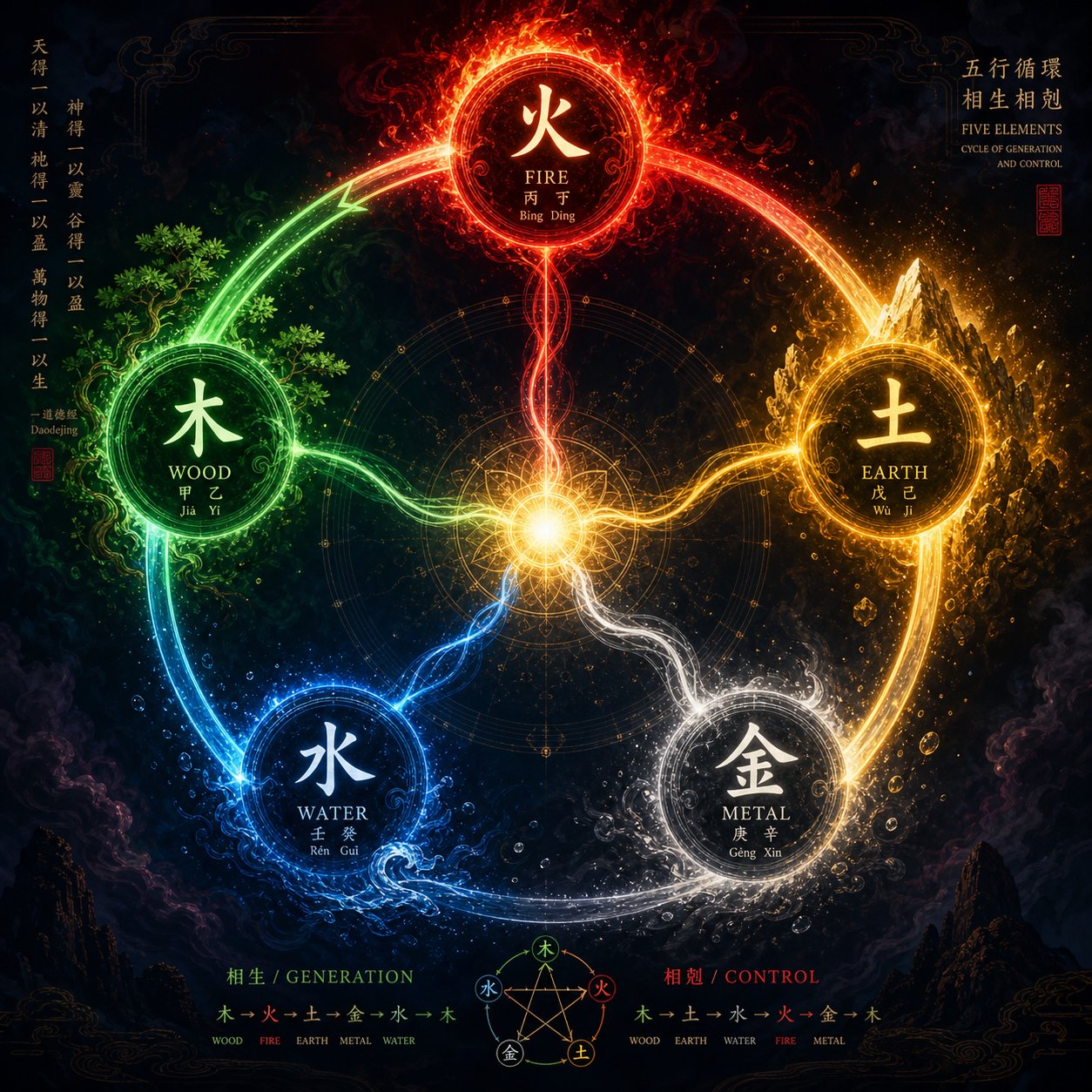
You have your tally. Wood: 2. Fire: 3. Earth: 4. Metal: 3. Water: 3. Now what? Numbers without interpretation are just numbers. The real value of bazi chart element counting emerges when you use that distribution to understand where your chart sits on the spectrum between balance and imbalance — and what that means for navigating your life with greater clarity.
Interpreting Your Element Balance and Imbalances
A common misconception in bazi astrology is that a balanced chart means equal distribution — roughly three instances of each element across the board. In reality, a perfect bazi with exact elemental symmetry is extraordinarily rare and not necessarily ideal. What matters is how the elements relate to your Day Master and whether the overall configuration supports or undermines your core energy.
Here are the general interpretive principles to apply once your five elements chart tally is complete:
- Dominant elements (highest count) indicate areas of excess. If Fire overwhelms your chart, qualities associated with Fire — urgency, visibility, intensity — may manifest as restlessness or burnout rather than warmth and passion. Excess creates pressure, not strength.
- Absent or minimal elements (zero or one instance) point to potential deficiencies. These are areas where your chart lacks internal resources. A chart with no Water, for example, may struggle with adaptability and emotional flow unless external timing (luck pillars or annual energy) supplies it.
- Elements that match your Day Master represent self-energy and peer support. More of your own element generally strengthens your Day Master — but too much can indicate stubbornness or excessive competition in your environment.
- Elements that produce your Day Master (its "parent" in the generative cycle) represent resource and support energy. These nurture you. A chart lacking its resource element may feel unsupported or intellectually depleted.
- Elements that your Day Master controls represent wealth and output opportunities. Their presence suggests avenues for achievement — but only if your Day Master is strong enough to manage them.
In chinese bazi practice, this relationship between the Day Master and surrounding elements is the foundation of the "favorable element" concept. As noted in the BeiDou Nine Calendar analysis framework, the favorable element acts like a nutritional supplement for your chart — it is not simply whatever you lack, but whatever genuinely restores balance relative to your Day Master's strength.
Identifying Your Favorable and Unfavorable Elements
Your element count gives you the raw material. Identifying favorable and unfavorable elements requires one additional judgment: is your Day Master strong or weak relative to its environment?
The logic works like this:
- If your Day Master is strong (well-supported by its own element and resource element, born in a favorable season), it benefits from elements that drain or control it — output elements, wealth elements, and authority elements. These channel excess energy productively.
- If your Day Master is weak (outnumbered by controlling or draining elements, born out of season), it needs reinforcement — more of its own element and its resource element to stabilize before it can handle external demands.
This is where the bazi four pillars of destiny system moves beyond arithmetic into genuine life guidance. A weak Water Day Master surrounded by dominant Earth (which controls Water) and strong Fire (which Water must control) faces pressure from both directions. The favorable elements in that scenario would be Metal (which produces Water) and Water itself (peer support) — not because they are absent, but because they restore functional equilibrium.
Element counting tells you what your chart contains. Favorable element identification tells you what your chart needs. These are sequential steps, not interchangeable ones.
Be transparent with yourself about the limits of self-assessment here. Chinese bazi analysis at the professional level considers not just the natal chart but also the current ten-year luck pillar, annual energy, combinations that transform elements, and clashes that neutralize them. Your element count is one analytical layer — arguably the most foundational one — but it does not operate in isolation.
What it does give you is an informed starting point. You know what is present, what is missing, and what your Day Master's relationship is to the surrounding elements. That is enough to make smarter decisions about timing, career direction, and personal development — and enough to have a genuinely productive conversation with a practitioner if you choose to go deeper.
Frequently Asked Questions About Bazi Chart Element Counting
1. How many elements should I count in a Bazi chart?
A complete bazi chart element count includes far more than eight data points. Your four Heavenly Stems each contribute one element, but your four Earthly Branches contain hidden stems — between one and three each. Most charts yield 15 or more total element instances when you extract all hidden stems from every branch. Counting only the visible stems and primary branch elements gives you an incomplete and potentially misleading distribution.
2. Do hidden stems count the same as visible stems in Bazi?
Hidden stems do not carry equal weight to visible stems. Visible Heavenly Stems represent overt, active energy, while hidden stems within Earthly Branches represent latent or internal energy. Most practitioners use a tiered weighting system: main qi (the dominant hidden stem) carries about 60-70% influence, middle qi carries 20-30%, and residual qi carries roughly 10%. However, weighting systems vary among schools, so consistency in your chosen approach matters more than which specific framework you adopt.
3. Should I include the Day Master when counting elements in my Bazi chart?
It depends on your analytical goal. Include the Day Master for a raw distribution tally that documents everything present across all eight characters. Exclude it when assessing how much support your core element receives from the surrounding environment. Most practitioners use both approaches at different stages — the complete count for overall composition and the exclusion method for determining Day Master strength relative to its surroundings.
4. What is the difference between element counting and element strength in Bazi?
Element counting is a quantitative tally of how many times each element appears across your chart. Element strength is a qualitative assessment of how much actual influence each element wields, factoring in seasonal timing, branch combinations and clashes, productive and destructive cycle relationships, and positional weight. An element can appear multiple times yet remain functionally weak if born out of season or under attack from controlling elements. Counting is the foundation; strength assessment is the interpretation built on top of it.
5. What does it mean if an element is completely missing from my Bazi chart?
A completely absent element — zero instances across all visible and hidden stems — signals a potential deficiency or blind spot in the qualities that element represents. For example, missing Water may indicate challenges with adaptability and emotional flow. However, absence does not mean permanent lack. External timing through ten-year luck pillars and annual energy cycles can temporarily supply missing elements. Identifying absent elements helps you understand where external support or conscious development may be most beneficial.