What BaZi Favorable Elements Mean for Your Name
When Chinese parents choose a name for their child, they often hear the advice: "Pick characters that match the baby's favorable elements." Sounds simple enough. But what are favorable elements, exactly? And how do you go from an abstract elemental prescription to actual characters written on a birth certificate?
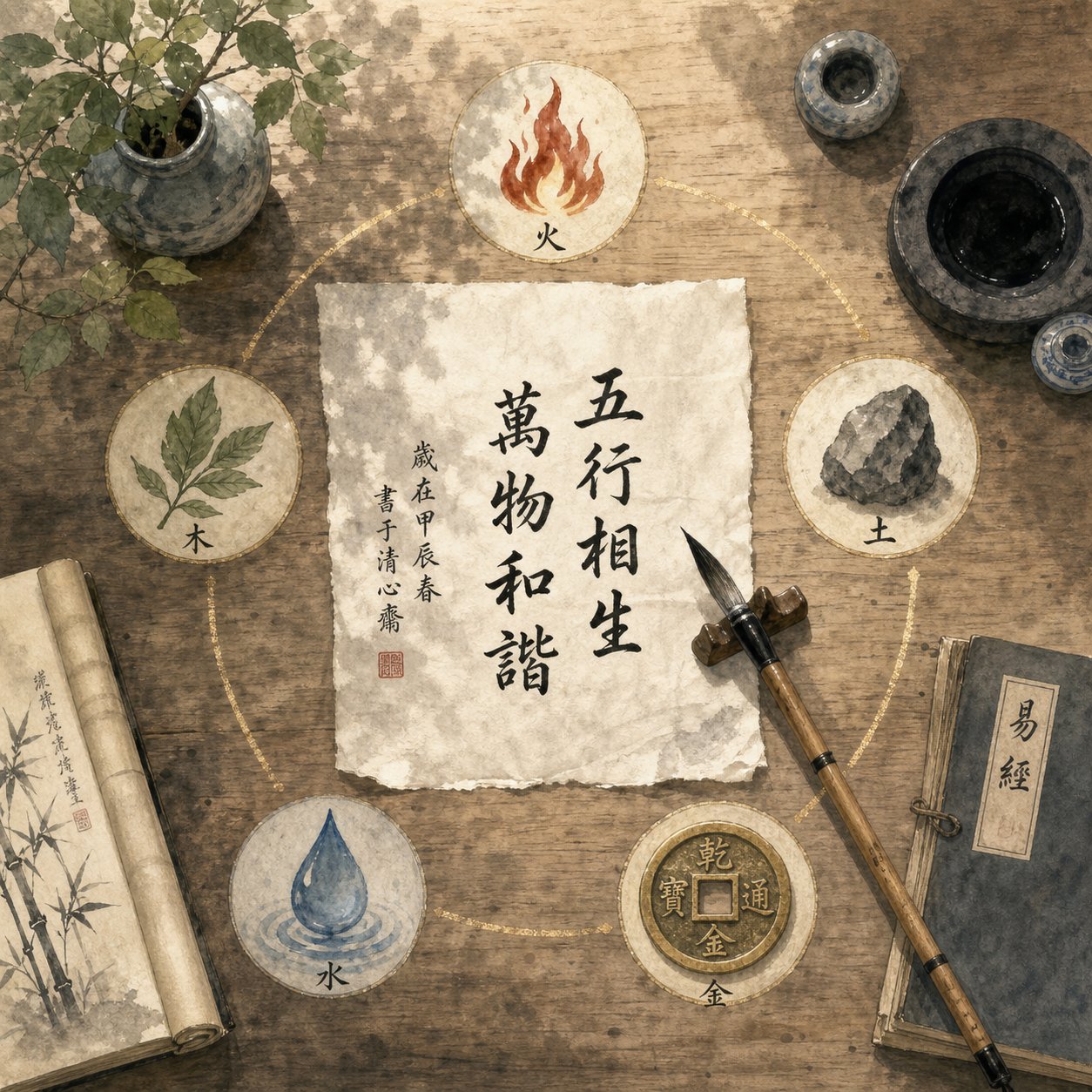
BaZi — sometimes called the Four Pillars of Destiny or Eight Characters — is a Chinese metaphysical system that converts a person's birth year, month, day, and hour into a chart of elemental energies. Each pillar contains a Heavenly Stem and an Earthly Branch, and together they map out the interplay of Wood, Fire, Earth, Metal, and Water in someone's life. The bazi meaning, at its core, is a snapshot of how these five forces were distributed at the exact moment you arrived.
Within that chart, favorable elements (喜用神) are the specific elements that bring balance and vitality to the whole structure. They are not random lucky charms. They are determined through careful analysis of which elements your chart needs most — much like a doctor identifying the right treatment after a thorough diagnosis.
A name is not about what elements are missing — it is about what elements your Day Master needs to thrive.
What Are Favorable Elements in BaZi
The term 喜用神 (xi yong shen) combines two roles. The Useful Element (用神) is the primary force your chart requires for balance. The Favorable Element (喜神) is the secondary supporter that protects and strengthens that primary force. Together, they form the elemental prescription unique to each individual. Identifying them accurately is the foundation of any BaZi-based naming decision — without this step, character selection becomes guesswork.
Why Naming Is the Most Accessible Way to Apply Them
You can apply favorable elements through many channels: career direction, color choices, living environment. But naming stands apart because it is permanent, personal, and present from day one. A name carries elemental energy through its radicals, stroke patterns, and semantic meaning. It travels with a person through every document, introduction, and signature. For parents exploring what is bazi and how it connects to daily life, naming offers the most direct and lasting application.
Who This Guide Is For
Most resources stop at one of two points. They either explain how to find favorable elements without showing how to pick characters, or they list "good naming characters" without connecting them to individual chart analysis. This guide bridges that gap — the translation layer between elemental diagnosis and actual name creation. Whether you are a parent preparing a Chinese name for a newborn, someone considering a name change, or a student of the four pillars of destiny looking to deepen your practice, the workflow ahead takes you from raw birth data to a final, well-reasoned name selection.
The starting point for all of it is your Day Master — the single element in the chart that represents you. Its strength, its seasonal context, and its relationships with surrounding elements determine everything that follows.

Assessing Your Day Master Strength
Your Day Master (日主) is the Heavenly Stem of your Day Pillar — the single element in the bazi chart that represents you. Think of it as your elemental identity, the reference point against which every other element in the chart is measured. Before you can select favorable elements for a name, you need to know whether your Day Master is strong or weak. This judgment shapes the entire prescription.
The Day Master as Your Elemental Identity
Imagine a doctor examining a patient. The patient is your Day Master. The surrounding elements — in the other pillars, in the season of birth — are the environment acting on that patient. Some environments nourish; others drain. The doctor's job is to assess the patient's current condition and then prescribe what restores balance. That prescription is your favorable element.
A strong Day Master has plenty of support and can handle pressure from controlling or draining elements. A weak Day Master lacks backing and needs reinforcement. This is not a personality judgment — someone with a weak Day Master can be mentally resilient, and someone with a strong Day Master can feel stuck. It describes chart condition, not character. Understanding how to read bazi chart strength correctly is what separates accurate naming from guesswork.
How Birth Season Shapes Day Master Strength
The Month Branch carries the heaviest seasonal influence in bazi chart interpretation. It is the first factor to check. Each element thrives in a specific season and struggles in others. A Wood Day Master born in spring starts with a strong foundation. That same Wood Day Master born in autumn — Metal's season — starts under pressure.
| Day Master Element | Strongest Season | Weakest Season | Effect of Strong Season | Effect of Weak Season |
|---|---|---|---|---|
| Wood | Spring (Yin/Mao) | Autumn (Shen/You) | Rooted, growing naturally | Cut and controlled by Metal |
| Fire | Summer (Si/Wu) | Winter (Hai/Zi) | Blazing, fully expressed | Suppressed by Water dominance |
| Earth | Late Summer / Transition months | Spring (Yin/Mao) | Stable, centered | Penetrated and weakened by Wood |
| Metal | Autumn (Shen/You) | Summer (Si/Wu) | Sharp, consolidated | Melted and softened by Fire |
| Water | Winter (Hai/Zi) | Late Summer (Chen/Xu/Chou/Wei) | Flowing, abundant | Absorbed and blocked by Earth |
Season gives you the starting direction, but it is not the whole picture. A Day Master born out of season can still be strong if other pillars provide enough support.
Reading Support and Opposition in the Four Pillars
After season, check two more layers. First, look for roots — does the Day Master's element appear in the Earthly Branches of other pillars? Roots give the Day Master a stable base to stand on. A Jia Wood Day Master with Yin or Mao in the Year or Hour Branch has grounding that a rootless chart lacks.
Second, count the support versus the drain. Two types of elements help the Day Master directly:
- Resource stars — the element that produces your Day Master (Water produces Wood, Wood produces Fire, and so on)
- Companion stars — elements of the same type as your Day Master
Three types of elements pull energy away:
- Output — what the Day Master produces (drains energy)
- Wealth — what the Day Master controls (consumes energy)
- Officer/Seven Killings — what controls the Day Master (adds pressure)
When support outweighs drain, the Day Master is strong. When drain and control dominate, it is weak. A day master calculator can help you generate the chart quickly, but the judgment of strong versus weak still requires weighing these factors in context — season first, roots second, then the overall balance of support against opposition.
This strength assessment is the diagnostic step. It tells you whether your Day Master needs reinforcement (Resource and Companion elements) or release (Output and Wealth elements). That answer directly determines which elements belong in a name — and which ones would push the chart further out of balance.
Identifying Your Useful and Favorable Elements
Knowing whether your Day Master is strong or weak gives you a direction. But direction alone does not hand you a specific element to put in a name. That requires a finer distinction — one that separates the element your chart urgently needs from the element that plays a supporting role behind it.
Useful Element vs Favorable Element Explained
In bazi reading basics, you will encounter two terms that often get lumped together: the Useful Element (用神) and the Favorable Element (喜神). They are not interchangeable. The Useful Element is the primary balancing force — the single element your chart most desperately requires to function well. Think of it as the main prescription. The Favorable Element is the secondary supporter that protects and strengthens that prescription.
Here is a practical way to picture it. If a weak Wood Day Master needs Water as its Useful Element (because Water produces Wood), then Metal becomes the Favorable Element — because Metal produces Water, keeping the supply line intact. The Favorable Element is, in essence, the guardian of the Useful Element. One classical description puts it this way: the Favorable Element is the "用神 of the 用神," a mother-child relationship where the mother's strength ensures the child's safety.
Why does this hierarchy matter for naming? Because a name has limited real estate. A typical Chinese given name contains one or two characters. Each character carries elemental energy. If you treat both elements as equally important and pick characters randomly from either category, you lose the chance to create a deliberate structure within the name itself.
How Ten Gods Relationships Refine Element Selection
Elemental balance is not purely arithmetic. You cannot simply count how many Water or Fire characters appear in a chart and call it done. The Ten Gods (十神) system reveals how each element actually functions relative to your Day Master — and that functional role changes everything in bazi analysis.
Consider this: the element your Day Master controls is your Wealth Star. The bazi wealth star element controlled by day master represents resources you can acquire and manage. For a Wood Day Master, Earth is the Wealth element. But whether that Earth shows up as Direct Wealth (正财) or Indirect Wealth (偏财) depends on polarity — and each behaves differently in the chart.
Similarly, the element that controls your Day Master splits into Direct Officer (正官) and Seven Killings (七杀). The bazi 7 killing actions meaning points to forceful, transformative pressure — very different from the structured authority of the Direct Officer, even though both share the same base element. When determining favorable elements, a skilled bazi reading considers not just which element is needed, but which functional relationship that element fulfills. A chart that needs the Officer star for stability has different naming implications than one that needs the Resource star for nourishment.
Distributing Elements Across Name Characters
Here is the practical framework. When a given name has two characters, treat them as two positions with distinct roles:
- The first character (closest to the surname) should carry the Useful Element (用神). This position holds more structural weight in the name and delivers the primary elemental support.
- The second character should carry the Favorable Element (喜神). It reinforces and protects the first character's energy, completing the support chain.
This distribution mirrors the mother-child logic. The second character feeds energy into the first, which in turn balances the Day Master. The result is a name that does not just contain helpful elements — it arranges them in a productive sequence.
For single-character given names, prioritize the Useful Element without question. You have one slot, so it goes to the element with the highest impact. For two-character names, the layered approach gives you both immediate correction and long-term reinforcement.
Of course, knowing which element to place is only half the challenge. The other half is identifying which characters actually carry that element — and that turns out to be less straightforward than it appears.
Three Ways to Classify Characters by Five Elements
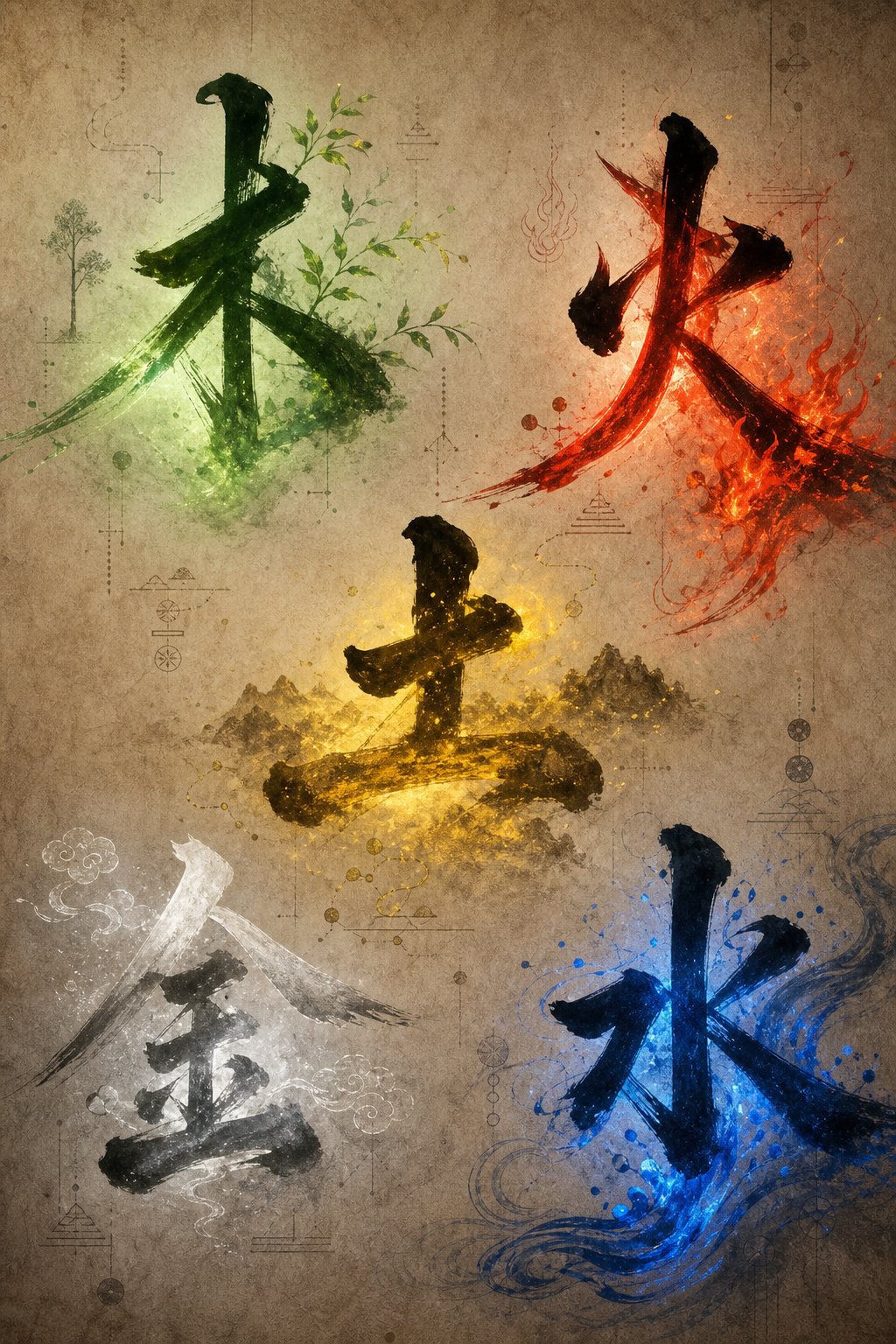
A character like 淼 (miao, vast water) feels obviously Water. But what about 明 (ming, bright)? It contains both 日 (sun) and 月 (moon) — is it Fire, Metal, or something else? In chinese bazi naming practice, you need a reliable system for assigning elements to characters. There are actually three distinct methods, and they do not always agree.
The Radical Method for Element Classification
The most widely used approach looks at a character's radical (部首) — the structural component that categorizes it in Chinese dictionaries. Radicals carry visible elemental signatures that are easy to identify at a glance:
- Wood: 木, 艹 (grass), 竹 (bamboo), 禾 (grain)
- Fire: 火, 灬 (four dots of fire), 日 (sun)
- Earth: 土, 山 (mountain), 石 (stone)
- Metal: 金, 钅 (metal radical), 刂 (knife)
- Water: 氵 (three drops), 水, 雨 (rain), 冫 (ice)
When you see 氵in a character like 浩 (hao, vast) or 泽 (ze, marsh), the Water element is structurally embedded. This method works well because the radical is the most visually persistent part of the character — it shows up every time the name is written, reinforcing that elemental energy through daily use.
The Stroke Count Method
The second approach maps a character's total stroke count to an element using a repeating cycle. Take the last digit of the stroke count and apply this pattern:
- Digits 1 or 2 = Wood
- Digits 3 or 4 = Fire
- Digits 5 or 6 = Earth
- Digits 7 or 8 = Metal
- Digits 9 or 0 = Water
So a character with 11 strokes (last digit 1) would be classified as Wood. A character with 14 strokes (last digit 4) would be Fire. This method comes from the 五格剖象法 naming system and is straightforward to calculate. However, it introduces a complication: should you count strokes based on simplified characters or traditional characters? In bazi in chinese naming traditions, practitioners often use traditional stroke counts even when the name will be registered in simplified form — though this varies by school of thought.
The Meaning and Semantic Method
The third method classifies characters by what they mean rather than how they look or how many strokes they contain. Consider 海 (hai, sea). Its radical 氵already marks it as Water, but even without that radical, the meaning alone — a vast body of water — carries unmistakable Water energy. This method becomes essential for characters whose radicals are ambiguous or whose meanings strongly override their structural components.
Some examples where meaning drives classification:
- 晶 (jing, crystal/sparkling) — the 日 radical suggests Fire, but crystal's association with clarity and hardness can lean Metal depending on context
- 磊 (lei, stacked rocks) — three 石 components, clearly Earth by both radical and meaning
- 翔 (xiang, soaring) — no obvious elemental radical, but the meaning of flight and rising connects to Wood's upward energy
Resolving Conflicts Between Methods
When you look at a ba zi chart and identify that your favorable element is Fire, then search for naming characters, you will inevitably find cases where the three methods disagree. A character might have a Water radical but a Fire-related meaning, or its stroke count points to Metal while its radical says Wood.
The general priority for bazi favorable elements in names follows this hierarchy:
- Radical method takes precedence — because the radical is the most visible and structurally embedded elemental signal. Every time the character is written, that radical reinforces the element.
- Meaning method serves as confirmation — when radical and meaning align, the character carries strong, unambiguous elemental energy. When they conflict, the radical still leads.
- Stroke count method acts as a secondary filter — useful for fine-tuning between candidates that are otherwise equal, but rarely a reason to override a clear radical classification.
The ideal naming character is one where all three methods point to the same element. These characters carry what practitioners call "triple-confirmed" elemental strength. The following reference table shows examples across all five elements, noting where methods align and where they diverge:
| Element | Character (Pinyin) | Radical Classification | Stroke Count Classification | Meaning Classification | Alignment |
|---|---|---|---|---|---|
| Wood | 林 (lin, forest) | Wood (木) | 8 strokes = Metal | Wood (trees) | Partial — radical + meaning agree |
| Wood | 芷 (zhi, angelica) | Wood (艹) | 10 strokes = Water | Wood (plant) | Partial — radical + meaning agree |
| Fire | 炎 (yan, flame) | Fire (火) | 8 strokes = Metal | Fire (blazing) | Partial — radical + meaning agree |
| Fire | 晗 (han, dawn light) | Fire (日) | 11 strokes = Wood | Fire (morning glow) | Partial — radical + meaning agree |
| Earth | 坤 (kun, earth) | Earth (土) | 8 strokes = Metal | Earth (ground, receptive) | Partial — radical + meaning agree |
| Earth | 岩 (yan, rock cliff) | Earth (山) | 8 strokes = Metal | Earth (stone, mountain) | Partial — radical + meaning agree |
| Metal | 锋 (feng, sharp edge) | Metal (钅) | 12 strokes = Wood | Metal (blade, sharpness) | Partial — radical + meaning agree |
| Metal | 鑫 (xin, prosperity) | Metal (金) | 24 strokes = Fire | Metal (gold abundance) | Partial — radical + meaning agree |
| Water | 淳 (chun, pure) | Water (氵) | 11 strokes = Wood | Water (clear, flowing) | Partial — radical + meaning agree |
| Water | 霖 (lin, lasting rain) | Water (雨) | 16 strokes = Earth | Water (continuous rain) | Partial — radical + meaning agree |
You will notice that stroke count rarely aligns with the other two methods. This is precisely why experienced chinese bazi practitioners treat it as a supplementary tool rather than a primary classifier. When selecting characters for a name, start with the radical, confirm with meaning, and let stroke count serve as a tiebreaker — not a veto.
With a reliable method for matching characters to elements, the next question becomes more specific: what kinds of characters work best when your particular favorable element is Wood? Or Fire? Or Water? Each element has its own family of radicals, meanings, and naming considerations that shape which characters feel natural in a name and which feel forced.
Element-Specific Character Selection Strategies
Each of the Five Elements carries a distinct personality — not just in philosophy, but in the types of characters it produces for naming. In four pillars chinese astrology, knowing your favorable element is only the starting point. The real craft lies in choosing characters that channel that element's energy in a way that feels natural, aesthetically pleasing, and appropriate for a name that will last a lifetime.
Wood as Your Favorable Element
Wood represents growth, flexibility, and upward movement. It is the element of spring, of things reaching toward light. When Wood is your favorable element, you want characters that carry living, organic energy — not stiffness or rigidity.
Key radicals and character families to explore:
- 木 (mu) — direct Wood radical: 林 (lin, forest), 柏 (bai, cypress), 梓 (zi, catalpa), 桐 (tong, paulownia)
- 艹 (cao) — grass/plant radical: 芷 (zhi, angelica), 蕊 (rui, stamen), 萱 (xuan, daylily), 茗 (ming, tea shoots)
- 竹 (zhu) — bamboo radical: 筠 (yun, bamboo skin), 箫 (xiao, bamboo flute)
- 禾 (he) — grain radical: 穗 (sui, ear of grain), 秀 (xiu, elegant growth)
Wood characters tend to suggest vitality and resilience. The cypress tree character 柏, for instance, symbolizes endurance through harsh seasons — staying green when everything else has dropped its leaves. Naming consideration unique to Wood: avoid pairing two intensely "tall tree" characters together, as this can create an image of rigidity rather than the flexible strength Wood represents at its best.
Fire as Your Favorable Element
Fire is brightness, warmth, and illumination. It belongs to summer, to the south, to things at their peak expression. Fire-favorable names should radiate energy without burning too hot.
Key radicals and character families:
- 火 (huo) — direct Fire radical: 炎 (yan, flame), 煜 (yu, shining), 烨 (ye, brilliant)
- 灬 (huo) — four-dot fire: 熙 (xi, prosperous light), 照 (zhao, illuminate), 煦 (xu, warm)
- 日 (ri) — sun radical: 晗 (han, dawn light), 昕 (xin, early morning), 晨 (chen, morning), 曦 (xi, sunlight)
Fire characters carry meanings related to clarity, passion, and visibility. A character like 煜 describes sunlight filtering through clouds — bright but not blinding. The naming consideration here: Fire energy is intense. If your chart already has some Fire present and only needs moderate reinforcement, lean toward gentler Fire characters like 煦 (genial warmth) rather than aggressive ones like 炎 (blazing flame). A perfect bazi balance does not mean maximum intensity — it means the right dose.
Earth, Metal, and Water Naming Strategies
The remaining three elements each have their own character families and naming nuances.
Earth — stability, grounding, reliability:
- 土 (tu) — earth radical: 坤 (kun, receptive earth), 培 (pei, to nurture/cultivate)
- 山 (shan) — mountain radical: 岩 (yan, cliff), 峻 (jun, towering), 崇 (chong, lofty)
- 石 (shi) — stone radical: 磊 (lei, stacked rocks, open-hearted)
Earth characters suggest someone dependable and centered. They work well when paired with softer-sounding characters to avoid heaviness.
Metal — precision, clarity, value:
- 金/钅 (jin) — metal/gold radical: 铭 (ming, inscribe), 锋 (feng, sharp edge), 钧 (jun, weight/significance), 鑫 (xin, triple gold)
- 刂 (dao) — knife radical: 利 (li, sharp/beneficial), 刚 (gang, firm)
Metal characters feel decisive and enduring. In chinese astrology 4 pillars practice, Metal-favorable charts often belong to people born in seasons where Metal is weakened — summer Fire melts Metal — so the name provides the sharpness the season took away.
Water — depth, wisdom, adaptability:
- 氵 (shui) — water radical: 泽 (ze, grace/marsh), 浩 (hao, vast), 淳 (chun, pure), 润 (run, nourish)
- 雨 (yu) — rain radical: 霖 (lin, lasting rain), 霏 (fei, misty rain)
- 冫 (bing) — ice radical: 凛 (lin, bracing cold), 冰 (bing, ice)
Water characters suggest someone deep and adaptable. The character 泽 carries a particularly elegant meaning — grace that nourishes others without asking anything in return. Naming consideration: Water is inherently flowing and formless, so pairing it with a character that provides some structure (even from a different element family) can prevent the name from feeling too diffuse.
Working Within Generational Naming Constraints
Many Chinese families follow generational naming conventions (辈分 or 字辈) — a tradition where one character in the given name is fixed for everyone born in the same generation. Your grandfather's generation might all share the character 德, your father's generation 建, and yours 志. This practice predates any individual's birth chart, so the fixed character may or may not align with your favorable element.
When the generational character already matches your favorable element, you have a fortunate alignment. Use the remaining free character to carry the secondary Favorable Element (喜神), completing the support chain discussed earlier.
When it does not match — which is more common — concentrate all your elemental strategy on the free character. Choose one with strong, unambiguous elemental energy: a character where radical and meaning both confirm the target element. This single well-chosen character can carry significant weight, especially if it sits in the position closest to the surname.
In the chinese zodiac four pillars tradition, the goal has never been perfection through a single name. It is about tilting the balance in a helpful direction. Even one character carrying the right element, placed thoughtfully, contributes meaningful support to the chart. The families who maintained 字辈 systems understood that names serve multiple purposes — lineage, identity, and elemental tuning can coexist in two or three characters if each one is chosen with care.
Selecting the right element and the right characters still leaves one common trap that catches many parents: the assumption that a missing element automatically belongs in the name. That logic sounds intuitive, but it can lead to choices that actively harm the chart's balance rather than help it.

The Missing Element Myth and Surname Conflicts
"Your baby's chart is missing Water — better put Water in the name." This advice gets passed around so often that many parents treat it as a rule. It sounds logical on the surface: something is absent, so you add it. But in 4 pillars of destiny interpretation, a chart does not work by simple arithmetic. A chart may seem to lack Water, yet blindly adding Water through naming may worsen the balance if Water is not actually favorable. The absence of an element tells you nothing about whether that element helps or harms your Day Master.
When a Missing Element Should Enter the Name
There is exactly one scenario where a missing element belongs in a name: when it also happens to be the Useful Element or Favorable Element identified through proper Day Master analysis. Imagine a weak Water Day Master born in summer. The chart shows no Metal anywhere. Metal produces Water, so Metal is likely the Useful Element — and it is also missing. In this case, adding Metal characters to the name is correct. But the reason is not "Metal is missing." The reason is "Metal is what the Day Master needs to thrive, and it happens to be absent."
The missing element and the favorable element sometimes overlap. When they do, adding that element feels doubly justified. But the overlap is coincidental, not causal. The favorable element determination must always come first.
When Adding a Missing Element Causes Harm
Consider a strong Wood Day Master born in spring. The chart has no Metal. Metal controls Wood — it is the Officer or Seven Killings star. For a chart that is already overwhelmingly strong, Metal might actually be helpful as a controlling force. But what if the chart is only moderately strong and already has enough pressure from other elements? Forcing Metal into the name because it is "missing" could add unwanted control that destabilizes the chart.
An even clearer example: a weak Fire Day Master with no Water in the chart. Water controls Fire. Adding Water characters to a weak Fire chart — simply because Water is absent — directly attacks the Day Master. The name becomes a source of pressure rather than support. In four pillars destiny practice, this is one of the most common naming mistakes made by well-meaning parents who follow the "fill the gap" logic without checking whether the gap should stay empty.
Balance is contextual, not arithmetic. A missing element is not a hole to fill — it is a question to investigate.
Resolving Conflicts Between Surname and Favorable Element
Even after correctly identifying your favorable element, a practical problem can arise: what if it clashes with your surname's element? Surnames carry elemental energy too. A surname like 林 (lin) is strongly Wood. If your favorable element is Metal — which controls Wood in the destructive cycle — placing a Metal character directly next to a Wood surname creates a visible clash within the name itself.
Two strategies handle this gracefully:
- Insert a mediating element. Use the productive cycle to bridge the gap. If the surname is Wood and the favorable element is Metal, place a Water character in the first position of the given name. Water produces Wood (supporting the surname) and is produced by Metal. Then place the Metal character in the second position. The sequence becomes Wood (surname) → Water (first character) → Metal (second character), creating a chain where each element relates productively to its neighbor rather than clashing directly.
- Position the favorable element in the second character. Distance reduces friction. When the favorable element sits further from the surname, the controlling relationship is softened. The first character can carry a neutral or bridging element, while the second character delivers the elemental support your chart needs without directly opposing the surname.
In a feng shui birth chart or a 4 pillars of destiny reading, the goal is always flow — not confrontation. A name should read as a harmonious sequence where energy moves productively from one character to the next. When surname and favorable element sit in opposition, the solution is not to abandon the favorable element. It is to arrange the characters so that the elemental relationships within the name follow a generative path rather than a destructive one.
This principle of flow extends beyond individual element conflicts. It also shapes how you handle competing naming systems — particularly when stroke count numerology and BaZi element analysis point you in different directions.
Navigating Competing Naming Systems and Modern Constraints
Parents researching chinese bazi astrology for naming often hit a frustrating wall: one practitioner says a character is ideal based on elemental analysis, while another rejects it because the stroke count produces an "inauspicious" number in the 五格 (Five Structures) system. Both sound authoritative. Both claim tradition. So which one wins?
BaZi Elements vs Stroke Count Numerology
These two systems come from very different origins. BaZi elemental naming draws from classical Chinese metaphysics — the same tradition that produced the I-Ching, Five Element theory, and Heavenly Stems and Earthly Branches. Its roots stretch back centuries, and its logic ties directly to the individual's birth chart. The favorable element is personal, diagnostic, and specific to one person's Day Master.
The 五格剖象法 (Five Structures Stroke Analysis), by contrast, is a relatively modern system. It originated in early 20th-century Japan and was later adopted into Chinese naming practice. It works by calculating the stroke counts of each character in a name — surname and given name — then mapping those numbers into five positional "structures" (天格, 地格, 人格, 外格, 总格) that correspond to different life periods and aspects. Each structure receives an auspiciousness rating based on its number, and the relationships between structures are expressed through the Five Elements.
The key difference: BaZi naming starts with the person and asks "what does this individual need?" Stroke numerology starts with the name itself and asks "is this combination of numbers lucky?" One is personalized medicine; the other is a general compatibility score. A bazi calculator and analysis will give you element prescriptions tailored to a specific birth chart. The 五格 method gives the same verdict for anyone sharing that surname and stroke combination, regardless of their birth data.
How to Reconcile Conflicting Systems
When the two systems agree, you have a strong candidate. When they conflict — and they frequently do — here is the practical hierarchy:
- BaZi favorable elements come first. The elemental prescription is non-negotiable because it is derived from the individual's chart. A character that carries the correct Useful Element for your Day Master serves a specific, personalized function.
- Stroke analysis serves as a secondary filter. Among characters that satisfy the BaZi requirement, prefer those that also produce favorable numbers in the 五格 system. Use it to choose between equally good elemental candidates — not to veto a character your chart genuinely needs.
- Never sacrifice the correct element for a "lucky" stroke count. A name with perfect 五格 numbers but the wrong element is like a beautifully wrapped box with the wrong medicine inside.
Practitioners who use both systems — like those applying the 五格 alongside BaZi chart analysis — typically follow this same priority. They identify the beneficial elements first, then select characters whose stroke counts (based on the 康熙字典 traditional forms) also fit auspicious number patterns. The BaZi diagnosis drives the process; the stroke system refines the final selection. A 4 pillars chinese astrology calculator can help you establish the elemental foundation, after which stroke optimization becomes a matter of choosing among pre-qualified candidates.
Modern Legal and Practical Naming Constraints
Traditional naming principles assume you have the full universe of Chinese characters at your disposal. Reality is more restrictive. If you are naming a child in mainland China, several modern constraints shape what is actually possible:
- Character set limitations. China's government database supports approximately 32,000 characters for identity registration. Of the 70,000+ known Chinese characters, many rare or archaic ones simply cannot be entered into the system. A beautifully chosen character that carries your favorable element is useless if it cannot appear on an ID card.
- Simplified vs traditional stroke counts. Names are registered in simplified characters in mainland China, but many naming practitioners calculate strokes using the 康熙字典 (Kangxi Dictionary) traditional forms. The character 王 looks like four strokes but counts as five in the Kangxi system. This discrepancy means you need to verify which counting standard your practitioner uses — and understand that the registered form and the metaphysical calculation may reference different stroke totals.
- Only Chinese characters are permitted. Latin letters, numerals, and symbols are prohibited in registered names. This is straightforward for american bazi practitioners helping diaspora families: if the child will hold a Chinese identity document, the name must consist entirely of valid, computer-encodable Chinese characters.
These constraints rarely eliminate good options entirely. The most commonly used naming characters — those with clear elemental radicals, pleasant sounds, and positive meanings — are well within the supported character set. Problems arise only when parents pursue extremely rare characters for uniqueness. The practical advice: after selecting characters based on elemental and stroke criteria, verify that each character can be typed using standard input methods and appears in current government encoding standards. A quick test on any Chinese input software will confirm this in seconds.
The interplay between ancient systems and modern infrastructure is a reality every naming decision must navigate. But it does not change the fundamental sequence: diagnose the chart, identify the elements, select the characters, then verify against practical constraints. That complete workflow — from raw birth data to a registered, legally valid name — is where all these principles come together into a single actionable process.

Complete Workflow from BaZi Chart to Final Name
You have the theory. You understand Day Master strength, the difference between Useful and Favorable Elements, how to classify characters, and how to handle surname conflicts. What does the full process look like when you sit down with actual birth data and need to arrive at a real name? Here is the end-to-end sequence, from the moment you have a birth time to the moment you write the final characters.
The Eight-Step Naming Workflow
- Generate the BaZi chart from birth data. You need the exact year, month, day, and hour of birth. Use a reliable bazi calculator to convert this into the Four Pillars — each pillar showing its Heavenly Stem and Earthly Branch. A four pillars of destiny calculator will map the birth data into the eight characters that form the chart. Double-check the hour pillar carefully: a birth at 11:05 PM falls into the next day's Zi hour in some systems.
- Identify the Day Master element. Look at the Heavenly Stem of the Day Pillar. This is your Day Master — Wood, Fire, Earth, Metal, or Water, in either Yin or Yang form. Everything else in the chart is measured against this single reference point.
- Assess Day Master strength. Check the birth month's seasonal influence first. Then count roots in the Earthly Branches and weigh support elements against draining elements. Is the Day Master strong, weak, or somewhere in between? This step requires the most judgment.
- Determine the Useful Element (用神) and Favorable Element (喜神). A weak Day Master typically needs the element that produces it (Resource) or the same element (Companion). A strong Day Master typically needs the element it produces (Output) or the element it controls (Wealth). The Favorable Element is whatever supports and protects the Useful Element.
- Check the surname's element for conflicts. Identify the elemental energy your surname carries through its radical and meaning. If it clashes with the Useful Element, plan a mediating element or adjust character positioning as discussed earlier.
- Select characters using the three classification methods. Prioritize the radical method. Search for characters whose radicals match your Useful Element for the first given-name position and your Favorable Element for the second. Confirm with meaning. Build a shortlist of three to five candidates per position.
- Verify the complete name's elemental flow. Read the full name — surname through final character — and trace the elemental relationships. Does energy move through a productive cycle? Does any adjacent pair sit in a destructive relationship without a bridge? Adjust if needed.
- Cross-check against stroke analysis as a secondary filter. Among your shortlisted candidates, calculate stroke counts using traditional (Kangxi) forms. Prefer combinations that produce favorable numbers in the 五格 system. Use this step to choose between equally strong elemental candidates — never to override the elemental prescription.
This sequence mirrors what practitioners do in a professional bazi calculator and interpretation session, condensed into a structured workflow you can follow at your own pace.
When You Can Name Independently vs When to Seek Help
Can you do this yourself? It depends on the chart's complexity. Some charts present a clear picture: a Day Master born deeply out of season with almost no support is obviously weak. The Useful Element practically announces itself. If your chart falls into this category — a clear strong or weak pattern with minimal ambiguity — self-assessment is entirely feasible. A ba zi calculator gives you the raw data, and the framework above guides your decisions.
Other charts are genuinely difficult. A Day Master born in its own season but surrounded by draining elements. A chart where two elements compete for the Useful Element role. A chart with special structures (从格 or 化格) that reverse the normal strong/weak logic entirely. These situations trip up even intermediate students. If you run the analysis and find yourself unsure whether the Day Master is strong or weak — or if the seasonal influence and pillar support point in opposite directions — that ambiguity is your signal to consult someone experienced.
For those exploring programmatic approaches, tools built on python bazi four pillars calculation libraries can generate charts and flag elemental distributions automatically. They handle the math reliably. What they cannot do is make the qualitative judgment call on Day Master strength in borderline cases. The algorithm gives you data; the interpretation still requires human understanding of context.
A chinese bazi calculator — whether online or software-based — is a starting tool, not a finishing tool. It gets you through Steps 1 and 2 cleanly. Steps 3 and 4 are where expertise matters most.
Verifying Your Final Name Selection
Before committing to a name, run it through a final checklist:
- Elemental sequence: Does the name read as a productive flow from surname to final character? No adjacent destructive pairs without mediation?
- Sound: Speak the full name aloud. Do the tones vary? Does it flow at conversational speed without awkward pauses or tonal collisions?
- Visual balance: Write the characters together. Is one dramatically more complex than the others? Extreme stroke-count disparity between characters can look unbalanced on paper.
- Meaning coherence: Read the characters as a phrase. Do they form a coherent image or sentiment? A name whose characters contradict each other semantically — calm water next to raging fire, for instance — can feel internally conflicted regardless of elemental correctness.
- Practical registration: Can each character be typed on standard input software? Does it appear in the government's approved character set? Test this before finalizing.
A bazi chart calculator online can help you double-check the elemental assignments of your chosen characters, but this final verification step is ultimately about the name as a whole — how it sounds, looks, reads, and functions in daily life. The best BaZi-informed name is one where the metaphysical structure is invisible to outsiders. They simply hear a beautiful, meaningful name. The elemental engineering works quietly underneath.
With the workflow complete, what remains is a practical reference — a lookup table of characters organized by element, with guidance on combining them into names where both characters support each other rather than pulling in opposite directions.
Character Reference Table and Element Combinations
A well-chosen character is only as effective as the pairing it sits within. The table below organizes commonly used naming characters by their Five Element classification, rated by how overtly they carry elemental energy. Use it as a starting point when building your shortlist — then apply the combination principles that follow to ensure both characters in a given name work together rather than against each other.
Five Element Character Reference Table
Elemental strength here refers to how visibly and unmistakably a character signals its element. A "strong" character has both radical and meaning pointing to the same element. "Moderate" means the radical is clear but the meaning is broader. "Subtle" means the elemental connection comes primarily through meaning or association rather than an obvious radical.
| Element | Common Radicals | Example Characters (Pinyin) | Elemental Strength |
|---|---|---|---|
| Wood | 木, 艹 | 林 (lin, forest) | Strong |
| Wood | 木, 艹 | 梓 (zi, catalpa tree) | Strong |
| Wood | 木, 艹 | 芷 (zhi, angelica) | Strong |
| Wood | 木, 艹 | 桐 (tong, paulownia) | Strong |
| Wood | 竹, 禾 | 筠 (yun, bamboo skin) | Moderate |
| Wood | — | 卿 (qing, minister/noble) | Subtle |
| Fire | 火, 灬 | 煜 (yu, shining) | Strong |
| Fire | 火, 灬 | 炎 (yan, flame) | Strong |
| Fire | 日 | 晗 (han, dawn light) | Strong |
| Fire | 日 | 曦 (xi, sunlight) | Strong |
| Fire | 灬 | 熙 (xi, prosperous light) | Moderate |
| Fire | — | 昊 (hao, vast sky) | Subtle |
| Earth | 土, 山 | 坤 (kun, receptive earth) | Strong |
| Earth | 土, 山 | 峻 (jun, towering peak) | Strong |
| Earth | 山 | 岳 (yue, great mountain) | Strong |
| Earth | 土 | 培 (pei, to cultivate) | Moderate |
| Earth | 石 | 磊 (lei, stacked rocks) | Moderate |
| Earth | — | 宇 (yu, universe/eaves) | Subtle |
| Metal | 金, 钅 | 铭 (ming, inscribe) | Strong |
| Metal | 金, 钅 | 锋 (feng, sharp edge) | Strong |
| Metal | 金 | 鑫 (xin, triple gold) | Strong |
| Metal | 钅 | 钧 (jun, weight/significance) | Moderate |
| Metal | 刂 | 利 (li, sharp/beneficial) | Moderate |
| Metal | — | 瑞 (rui, auspicious jade) | Subtle |
| Water | 氵, 雨 | 泽 (ze, grace/marsh) | Strong |
| Water | 氵, 雨 | 浩 (hao, vast) | Strong |
| Water | 雨 | 霖 (lin, lasting rain) | Strong |
| Water | 氵 | 涵 (han, contain/nourish) | Strong |
| Water | 氵 | 润 (run, moist/nourish) | Moderate |
| Water | — | 雯 (wen, patterned clouds) | Subtle |
Characters rated "strong" are your safest choices when you need unambiguous elemental delivery. "Moderate" characters work well when you want the element present but not visually dominant. "Subtle" characters are useful when you need a specific meaning or sound and the elemental connection is a bonus rather than the primary driver.
Creating Harmonious Element Combinations
A name with two given-name characters is not just two independent elemental choices placed side by side. The relationship between those characters matters. In bazi four pillars of destiny practice, the Generating Cycle (相生) provides the blueprint for harmonious pairing:
- Wood feeds Fire — a Wood character followed by a Fire character creates a sense of growth igniting into brightness
- Fire creates Earth — Fire followed by Earth suggests energy settling into stability
- Earth bears Metal — Earth followed by Metal evokes something precious emerging from solid ground
- Metal collects Water — Metal followed by Water carries the image of clarity flowing into depth
- Water nourishes Wood — Water followed by Wood feels like potential blooming into life
When your Useful Element and Favorable Element already sit in a productive relationship — say, Water as Useful and Wood as Favorable — the name naturally flows. Water in the first position feeds Wood in the second. But what if your two prescribed elements do not sit adjacent in the Generating Cycle? Imagine needing Fire as Useful and Metal as Favorable. Fire melts Metal — that is a controlling relationship, not a generative one.
In this scenario, you have two options. First, you can reverse the character order if the chart allows flexibility — placing Metal first and Fire second does not follow the productive cycle either (Metal does not generate Fire), but it avoids the direct controlling clash of Fire acting on Metal. Second, and more commonly, you accept that the elemental prescription takes priority over the aesthetic ideal of a perfect generative sequence. The characters still deliver the elements your Day Master needs. The productive cycle between characters is a bonus, not a requirement. It is the relationship between the name and the chart that matters most — not the relationship between the two characters in isolation.
That said, when you have multiple character candidates that satisfy the elemental requirement equally well, prefer the combination that creates a generative flow. Between two equally valid Fire characters for the first position, choose the one whose meaning also transitions naturally into the second character's meaning. A name like 煜林 (yu lin — shining + forest) reads as light illuminating a grove. The Fire-to-Wood relationship here is actually controlling (Fire burns Wood), so 林泽 (lin ze — forest + marsh) would be smoother elementally: Wood and Water sit in a cycle where Water nourishes Wood. Always read the full sequence — surname included — to catch any unintended clashes.
Key Principles to Remember
The entire process of applying bazi favorable elements in names rests on a handful of principles that hold true regardless of which element your chart needs or which characters you ultimately choose. For anyone studying four pillars astrology or approaching chinese astrology four pillars of destiny for the first time, these are the foundations worth internalizing:
- Chart first, characters second. No character is inherently good or bad. Its value depends entirely on whether it delivers what a specific Day Master needs. The same Water character that saves one chart can drown another.
- The Useful Element is non-negotiable. When space is limited — a single-character given name, or a generational constraint — the Useful Element always takes priority over the Favorable Element, stroke count aesthetics, or personal preference.
- Missing does not mean needed. An absent element is only worth adding if independent Day Master analysis confirms it as favorable. The absence itself proves nothing.
- Radical leads classification. When determining a character's element, trust the radical first, confirm with meaning, and treat stroke count as a tiebreaker.
- Flow over force. Arrange characters so elemental energy moves productively through the name. When a direct clash between surname and favorable element is unavoidable, mediate with a bridging element rather than abandoning the prescription.
- BaZi drives, other systems refine. Stroke numerology and other frameworks serve as secondary filters. They help you choose among equally valid candidates — they never override the elemental diagnosis.
Understanding the four pillars of destiny basics gives you the diagnostic framework. The character classification methods give you the tools. And the workflow ties them together into a repeatable process. What makes bazi astrology naming effective is not any single step in isolation — it is the discipline of following the full sequence: assess the Day Master, identify what it needs, find characters that deliver it, and verify that the final name reads as a coherent, harmonious whole. The elemental engineering stays invisible. What people hear is simply a beautiful name.
Frequently Asked Questions About BaZi Favorable Elements in Names
1. How do I find my favorable element for naming purposes?
Start by generating your BaZi chart from your exact birth date and time. Identify your Day Master (the Heavenly Stem of your Day Pillar), then assess whether it is strong or weak by examining the birth season, roots in other pillars, and the balance of supporting versus draining elements. A weak Day Master typically needs the element that produces it (Resource) or the same element (Companion). A strong Day Master benefits from the element it produces (Output) or controls (Wealth). The element your chart most urgently requires is your Useful Element, and the element that protects it is your Favorable Element.
2. Should I add a missing element from my BaZi chart into my name?
Not automatically. A missing element only belongs in a name if it also happens to be the Useful or Favorable Element determined through proper Day Master strength analysis. The absence of an element alone is never a sufficient reason to include it. For example, if Water is missing from a weak Fire Day Master's chart, adding Water would actually harm the chart because Water controls Fire. Always confirm through Day Master analysis that the missing element is genuinely beneficial before placing it in a name.
3. What is the difference between the Useful Element and the Favorable Element in BaZi?
The Useful Element (用神) is the primary balancing force your chart most desperately needs to function well. The Favorable Element (喜神) is the secondary supporter that protects and strengthens the Useful Element. Think of it as a mother-child relationship: the Favorable Element ensures the Useful Element remains effective. In naming, the first given-name character should carry the Useful Element for maximum impact, while the second character carries the Favorable Element to reinforce that support chain.
4. How do I determine which Five Element a Chinese character belongs to?
There are three classification methods. The radical method checks the character's structural component (e.g., the water radical 氵 marks a character as Water). The meaning method classifies by semantic association (e.g., 海 meaning sea is Water). The stroke count method maps the last digit of total strokes to an element using a repeating cycle. When these methods conflict, prioritize the radical first because it is the most visually persistent elemental signal, confirm with meaning second, and use stroke count only as a tiebreaker between otherwise equal candidates.
5. Can I use BaZi naming principles without consulting a professional?
Yes, for charts with clear patterns. If your Day Master is obviously strong or weak — such as being born deeply out of season with minimal support — self-assessment is feasible using online calculators and the systematic workflow of chart generation, strength assessment, element identification, and character selection. However, complex charts with competing elements, borderline strength, or special structures like 从格 benefit from professional consultation. The key signal to seek help is uncertainty about whether your Day Master is strong or weak after running the analysis yourself.