Why Chinese Zodiac Naming Traditions Matter for Rooster-Born Children
When you choose a Chinese name for a child, you're doing more than picking something that sounds pleasant. You're selecting building blocks of energy. Each Chinese character is constructed from smaller components called radicals, and in traditional naming philosophy, those radicals carry cosmic weight that can shape a person's fortune.
What Is Xingmingxue and Why It Matters
Xingmingxue (姓名学) is the classical Chinese study of names. It treats a person's name as a living system where stroke count, tonal balance, elemental alignment, and radical composition all work together. For diaspora families navigating this tradition without fluent Chinese, the radical layer is especially powerful because it offers a clear, visual framework for making naming decisions.
Chinese naming goes far beyond sound and meaning. It weaves cosmic alignment into the very structure of each character, connecting a child's identity to elemental forces through the radicals hidden inside their name.
Think of radicals as the DNA of a character. The radical 木 (mu, wood) inside a name carries wood energy regardless of the character's pronunciation or dictionary definition. Xingmingxue practitioners match these radical energies to a child's birth data, especially their zodiac animal, to create harmony between name and destiny.
How the Rooster Zodiac Connects to Name Radicals
The Rooster is the tenth animal in the twelve-year Chinese zodiac cycle. Its fixed Earthly Branch is 酉 (You), which carries an intrinsic Metal elemental association. This Metal nature, combined with the Rooster's symbolic identity as a grain-eating, tree-perching bird with colorful plumage, creates a specific set of radical affinities.
A Rooster-born child thrives with radicals that echo what a rooster naturally needs: food to eat, a safe place to roost, and fine feathers to display. Radicals that conflict with the Rooster's nature, like those tied to clashing zodiac animals, can introduce disharmony. The goal is to select the best Chinese name radicals for a Rooster zodiac child by aligning the character's internal structure with the animal's elemental identity and symbolic life.
Each Rooster year also pairs with one of the Five Elements (Metal, Water, Wood, Fire, or Earth), creating sub-cycles that further refine which radicals serve a particular child best. A Water Rooster born in 1993 has different radical needs than a Fire Rooster born in 2017. Understanding the Rooster's core nature is the first step; from there, the system branches into increasingly personalized guidance.
Understanding the Rooster's Elemental Nature and Symbolic Traits
The Rooster's naming logic doesn't come from abstract theory alone. It grows directly from two roots: the animal's fixed position in the Earthly Branch system and its observable behavior in nature. When you understand both, the reasoning behind auspicious radicals for Rooster names becomes intuitive rather than mysterious.
The Rooster's Earthly Branch and Metal Element
In the Chinese cosmological calendar, each zodiac animal is locked to one of twelve Earthly Branches (地支, dizhi). The Rooster's branch is 酉 (You), which occupies the hours of 5:00 to 7:00 PM, the time when roosters return to their perch. More importantly for naming, 酉 carries a fixed Metal (金, jin) elemental charge.
What does this Metal association mean in practice? Metal energy represents precision, clarity, decisiveness, and refinement. A Rooster-born person already carries strong Metal qi in their constitutional makeup. The naming task becomes one of support and balance: reinforcing Metal where it serves the child, while introducing complementary elements that prevent rigidity or excess sharpness.
Because the rooster earthly branch metal element pairing is fixed and unchanging regardless of birth year, it forms the baseline for every Rooster name. The sub-cycle element (determined by the specific year) adds a secondary layer, but 酉 and Metal remain the constant foundation.
Symbolic Traits That Guide Radical Selection
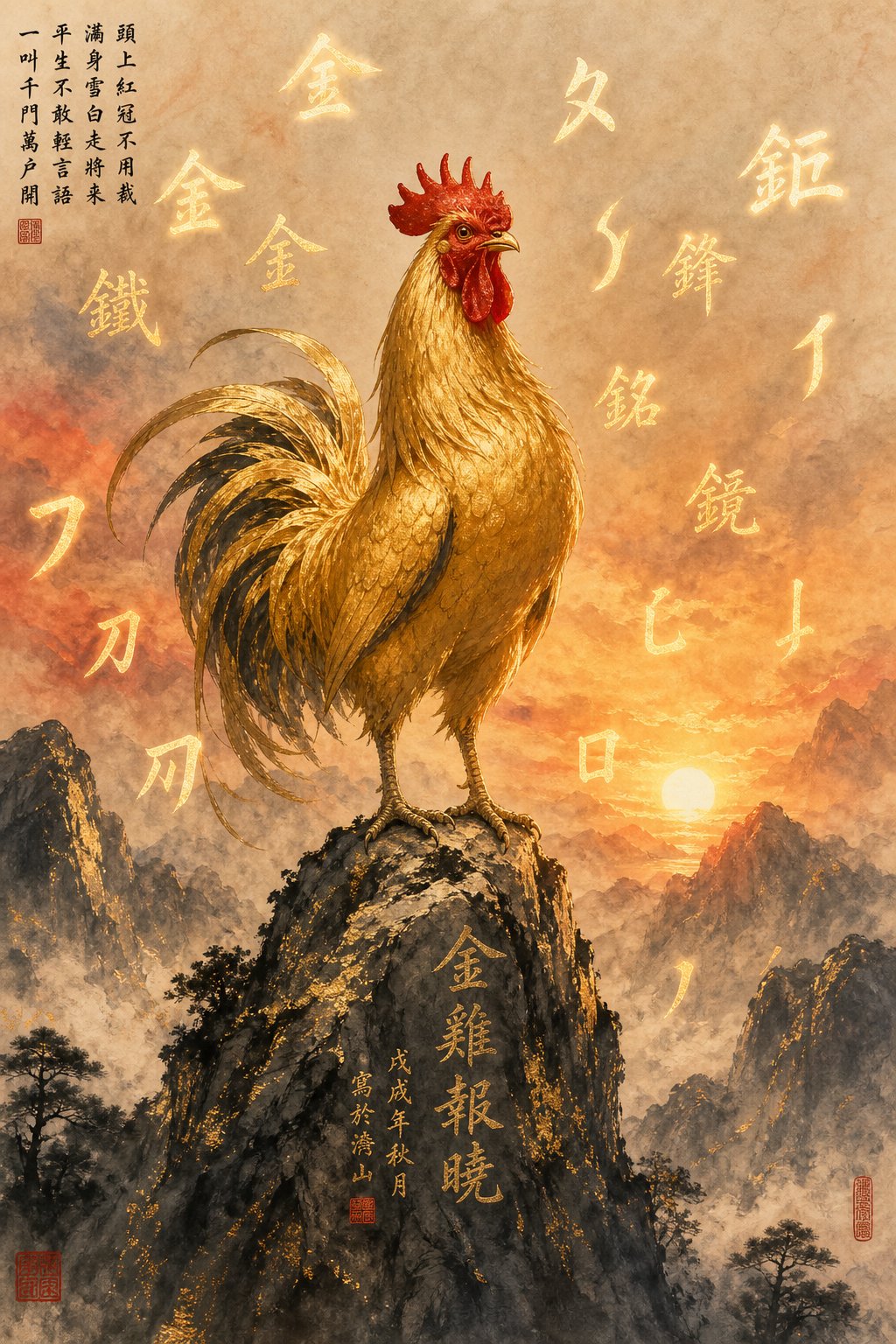
Imagine a rooster in its natural environment. What does it need to thrive? It pecks at grain on the ground. It roosts in sheltered spaces at night. It displays brilliant plumage to assert status. It stands tall on one leg in the iconic "golden rooster" pose. Each of these behaviors maps directly to a category of auspicious radicals.
Here are the core rooster zodiac symbolic traits radicals, organized by the natural behavior they reflect:
- Grain and nourishment (food supply): 禾 (he, grain/cereal crops), 米 (mi, rice), 豆 (dou, bean/legume), 虫 (chong, insect). A well-fed rooster is prosperous and content.
- Shelter and roost (safe home): 宀 (mian, roof/shelter), 冖 (mi, cover/canopy). A rooster with a secure perch is protected from predators and harsh weather.
- Plumage and adornment (beauty and status): 彡 (shan, feathers/decoration), 纟 (si, silk/thread), 衣 (yi, clothing/garment). A rooster with colorful feathers commands respect and attracts good fortune.
- Single-leg stance and elevation (strength and independence): The concept of 金鸡独立 (jinji duli, golden rooster stands on one leg) connects to radicals suggesting height, stability, and self-reliance, such as 山 (shan, mountain).
Traditional Reasoning Behind Rooster Auspicious Radicals
The logic is refreshingly concrete. Traditional naming masters observed the animal and asked: what makes this creature flourish? A rooster that eats grain is well-nourished, so rooster zodiac grain shelter plumage radicals all trace back to this observational method. A rooster under a roof is safe. A rooster with fine feathers is admired. A rooster standing tall is powerful.
Conversely, anything that threatens the rooster's wellbeing becomes a naming taboo. You'll notice this isn't arbitrary superstition but a symbolic system built on ecological logic. The radical 禾 (he) doesn't bring luck through magic; it brings luck because it represents the very thing a rooster needs most to survive and thrive.
This symbolic reasoning also explains why certain radicals carry double weight. A character containing both a shelter radical on top and a grain radical within essentially paints a picture of a rooster safe at home with plenty to eat. That layered symbolism is exactly what practitioners look for when selecting the most auspicious radicals for Rooster names.
With the Rooster's elemental identity and symbolic needs mapped out, the next question becomes practical: which specific radicals deliver the strongest benefit, and how do you evaluate them side by side?
Top Auspicious Radicals That Bring Fortune to Rooster Names
Selecting auspicious Chinese characters for a Rooster-born baby starts with knowing which radical categories carry the most favorable energy. Below, you'll find the best radicals for Rooster zodiac names broken into three symbolic groups, each rooted in what a rooster naturally needs to flourish.
Grain and Nourishment Radicals for Abundance
A rooster spends its day pecking at grain. It thrives on rice, cereal, and legumes. In naming logic, characters built on grain radical Chinese Rooster name components signal a life of plenty, where the child will never lack resources or support from others.
The key radicals here are 禾 (he, grain/cereal crops), 米 (mi, rice), and 豆 (dou, bean). When these appear inside a name character, they paint a picture of a rooster surrounded by food, content and well-provided-for. Naming practitioners note that the presence of these radicals allows a person to receive continual support and help from friends and colleagues throughout life.
Popular characters in this category include 秀 (xiu, elegant/outstanding), 科 (ke, branch of study), 秉 (bing, to hold/grasp), 香 (xiang, fragrant), and 益 (yi, benefit/increase). Each one carries a grain-related radical while also contributing a positive standalone meaning to the name.
Shelter and Roost Radicals for Security
Picture a rooster at dusk, settling safely under a roof or perching in a sheltered coop. That image of protection and stability is exactly what shelter radical Rooster zodiac naming delivers. Characters containing 宀 (mian, roof/shelter) or 冖 (mi, cover/canopy) suggest a life where the child enjoys a stable career, supportive relationships, and a smooth path forward.
The radical 山 (shan, mountain) adds another dimension. A rooster standing on a mountain looks bright and valiant, carrying the symbolism of rising to phoenix status and earning promotion. Characters like 宇 (yu, universe), 安 (an, peace), 宸 (chen, imperial), 容 (rong, tolerance), and 岚 (lan, mountain mist) all draw from this protective energy.
Plumage and Adornment Radicals for Status
The rooster is arguably the most visually striking bird in the barnyard. Its colorful plumage represents elegance, authority, and social standing. Radicals tied to decoration and clothing, such as 彡 (shan, feathers/pattern), 纟 (si, silk thread), and 衣 (yi, clothing), channel this energy into a name. The traditional reasoning holds that a well-dressed rooster is elevated to the status of a phoenix, gaining respect and recognition in society.
Characters like 彦 (yan, accomplished person), 彬 (bin, refined), 彩 (cai, colorful), 裕 (yu, abundant/prosperous), and 维 (wei, to maintain/uphold) all carry these adornment radicals while contributing strong, positive meanings.
Rooster Name Radical Chart With Pinyin
Here is a consolidated reference table covering the primary auspicious radical categories:
| Radical | Meaning | Example Characters (Pinyin) | Symbolic Reasoning |
|---|---|---|---|
| 禾 (he) | Grain, cereal crops | 秀 (xiu), 秉 (bing), 科 (ke), 程 (cheng) | Well-fed rooster enjoys abundance and never lacks support |
| 米 (mi) | Rice | 粮 (liang), 菊 (ju), 籽 (zi) | Staple food source ensures lifelong nourishment and stability |
| 豆 (dou) | Bean, legume | 豊 (li), 登 (deng) | Diverse food supply signals resourcefulness and prosperity |
| 宀 (mian) | Roof, shelter | 安 (an), 宇 (yu), 宸 (chen), 宏 (hong) | Protected rooster enjoys career stability and smooth relationships |
| 冖 (mi) | Cover, canopy | 冠 (guan), 军 (jun) | Sheltered rooster is safe from harm and finds peace |
| 山 (shan) | Mountain | 岚 (lan), 岱 (dai), 岭 (ling), 崇 (chong) | Rooster on a mountain rises to phoenix status and earns promotion |
| 彡 (shan) | Feathers, pattern | 彦 (yan), 彬 (bin), 彤 (tong), 彭 (peng) | Colorful plumage elevates rooster to admired, respected status |
| 纟 (si) | Silk, thread | 维 (wei), 纬 (wei), 绮 (qi) | Fine adornment signals elegance and social standing |
| 衣 (yi) | Clothing, garment | 裕 (yu), 祺 (qi), 福 (fu), 礼 (li) | Dressed-up rooster becomes a phoenix, gaining honor and respect |
You'll notice that many of these characters carry beautiful standalone meanings: peace, elegance, prosperity, refinement. That's the practical beauty of this system. You're not sacrificing a lovely name for the sake of radical alignment. The best Rooster name characters deliver both a pleasing meaning on the surface and favorable radical energy underneath.
Of course, knowing what to include is only half the equation. Certain radicals actively work against a Rooster-born child's fortune, and some carry hidden dangers that aren't obvious without understanding the zodiac clash system.
Radicals to Avoid and Zodiac Clashes That Harm Rooster Names
Favorable radicals pull a Rooster name toward prosperity, but inauspicious radicals for Rooster-born children can quietly undermine that fortune from within. The Chinese zodiac isn't just a list of lucky animals. It's a web of relationships, and some of those relationships are openly hostile. Understanding which radicals trigger conflict is just as important as knowing which ones attract good energy.
Radicals That Trigger Zodiac Clashes for Rooster
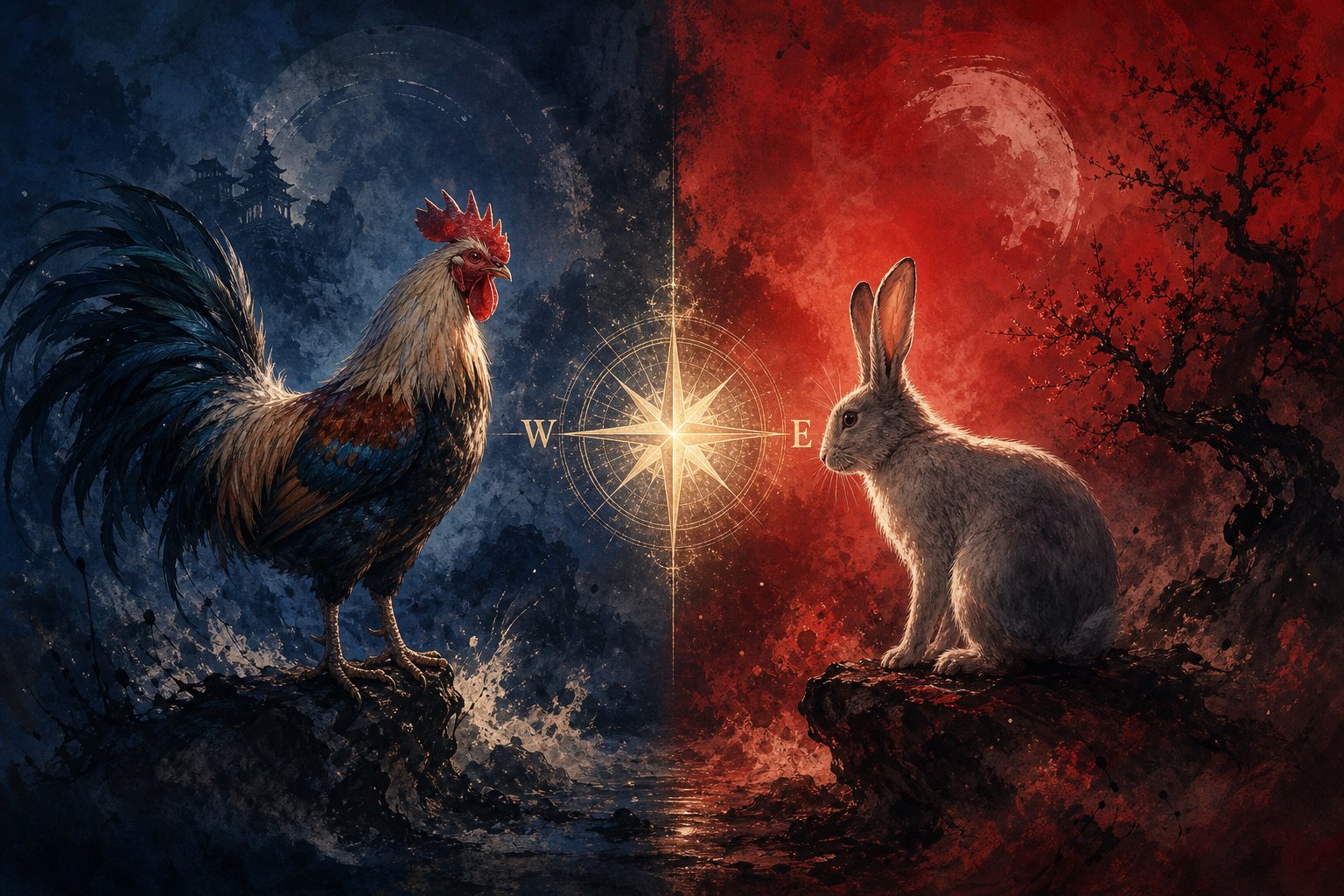
The zodiac clash system, called 六冲 (liu chong, Six Clashes), identifies pairs of animals whose Earthly Branches sit directly opposite each other on the cosmological compass. These opposing forces create friction, instability, and what practitioners describe as a draining of shared luck. For the Rooster, the primary clash is with the Rabbit.
Beyond the Six Clashes, two other relationship frameworks matter. The Six Harms (六害, liu hai) identify subtler antagonisms. For the Rooster, this harm relationship falls with the Dog. The Six Harmonies (六合, liu he) and Three Harmonies (三合, san he) map cooperative pairings. The Rooster's Three Harmony group includes the Snake (巳) and Ox (丑), while its Six Harmony partner is the Dragon (辰). These friendly relationships explain why radicals associated with Snake and Ox energy are welcomed in Rooster names, but radicals tied to the Rabbit or Dog carry damaging vibrations.
In practical naming terms, any radical or character component that evokes a clashing animal introduces that animal's opposing energy directly into the child's name. It's like inviting a rival into your home and expecting peace.
The Rabbit Clash and Other Conflicts to Avoid
The Rooster-Rabbit clash (卯酉相冲) is the most serious conflict in Rooster zodiac naming. The Earthly Branch 卯 (Mao) belongs to the Rabbit and sits in the east, while 酉 (You) belongs to the Rooster and sits in the west. They face each other in direct opposition. Traditional naming guidance warns that characters containing the radical or meaning of 卯 can cause serious harm and make the person prone to illness.
The Rabbit clash extends beyond the obvious. You need to watch for these associated components:
- 卯 (mao) directly, as found in characters like 柳 (liu, willow), 仰 (yang, to look up), and 勉 (mian, to encourage)
- 月 (yue, moon) because the moon is linked to the Rabbit in Chinese mythology, appearing in characters like 朋 (peng, friend), 朝 (chao, morning), and 期 (qi, period)
- 东 (dong, east) because 卯 occupies the eastern position on the compass, making east-associated characters problematic
- 兔 (tu, rabbit) and any component visually or semantically tied to the Rabbit animal
The metal-on-metal conflict is another critical concern. Since the Rooster's branch 酉 already carries strong Metal energy, adding more Metal through radicals like 金 (jin, gold/metal) or 钅 (jin, metal radical) creates what practitioners call infighting. Too much of the same element doesn't double the benefit. It causes internal friction and competition. Characters like 铭 (ming, inscription), 锋 (feng, sharp edge), and 钱 (qian, money) fall into this trap. Related components including 西 (xi, west), 兑 (dui), 申 (shen), and 酉 itself also carry this redundant Metal charge.
Inauspicious Radicals and Their Hidden Dangers
Some Chinese name taboo radicals for the Rooster sign aren't tied to zodiac clashes at all. Instead, they carry violent or harmful imagery that conflicts with the Rooster's nature as a domestic bird vulnerable to slaughter.
Radicals associated with cutting, force, and bloodshed suggest the fate of a rooster headed for the chopping block rather than one that lives long and prospers. The radicals 刀 (dao, knife), 刂 (the knife radical in its side form), 力 (li, force/power), 血 (xue, blood), and 石 (shi, stone) all evoke harm directed at the animal. Similarly, 手 (shou, hand) and 人 (ren, person) suggest human interference with the rooster, which in agricultural life typically means capture or slaughter.
The radicals 子 (zi) and 亥 (hai) introduce additional zodiac friction. 子 is the Earthly Branch of the Rat, and 亥 belongs to the Pig. While neither is a direct clash partner for the Rooster, both carry Water energy that can overwhelm the Rooster's Metal constitution in excess. The radical 北 (bei, north) is also cautioned against because north is the Water direction, reinforcing this elemental imbalance.
| Radical to Avoid | Reason | Zodiac Conflict |
|---|---|---|
| 卯 (mao) | Direct clash branch of the Rabbit | Rooster-Rabbit Six Clash (卯酉冲) |
| 月 (yue, moon) | Mythologically linked to the Rabbit | Rooster-Rabbit Six Clash |
| 东 (dong, east) | Eastern compass position belongs to 卯 | Rooster-Rabbit directional opposition |
| 金/钅 (jin, metal) | Metal-on-metal causes infighting and excess | Elemental redundancy with 酉 |
| 西 (xi, west) / 酉 | Same-branch repetition intensifies Metal excess | Self-clash through elemental overload |
| 刀/刂 (dao, knife) | Suggests slaughter and physical harm to the rooster | Violent imagery, no zodiac harmony |
| 血 (xue, blood) | Evokes sacrifice and injury | Violent imagery |
| 力 (li, force) | Implies coercion and struggle | Harmful pressure on a domestic bird |
| 手/人 (shou/ren) | Human interference suggests capture | Threat to the rooster's freedom |
| 子 (zi, Rat branch) | Introduces excessive Water energy | Elemental imbalance |
| 亥 (hai, Pig branch) | Strong Water conflicts with Metal constitution | Elemental overwhelm |
| 北 (bei, north) | North is the Water direction | Directional elemental conflict |
Sounds like a lot to track? It is. But here's the practical takeaway: when evaluating a character for a Rooster name, look inside its structure. If you spot any component that visually resembles 卯, carries moon or east associations, involves sharp or violent imagery, or doubles down on Metal energy, set that character aside. The goal is a name that feels like a safe, abundant environment for the Rooster spirit, not a battlefield or a butcher's block.
Avoiding harmful radicals clears the path, but building the ideal name requires one more layer of precision. Each Rooster birth year pairs with a specific element, and that sub-cycle shifts which radicals deserve emphasis and which need moderation.
Five Elements Theory and How Birth Sub-Cycles Shape Radical Choices
Every Rooster shares the fixed Metal energy of the Earthly Branch 酉 (You). But not every Rooster is the same. The specific year of birth layers a second elemental influence on top of that Metal foundation, creating five distinct sub-cycles: Metal Rooster, Water Rooster, Wood Rooster, Fire Rooster, and Earth Rooster. This is where five elements Rooster zodiac naming gets personal.
Five Elements Theory Applied to Rooster Naming
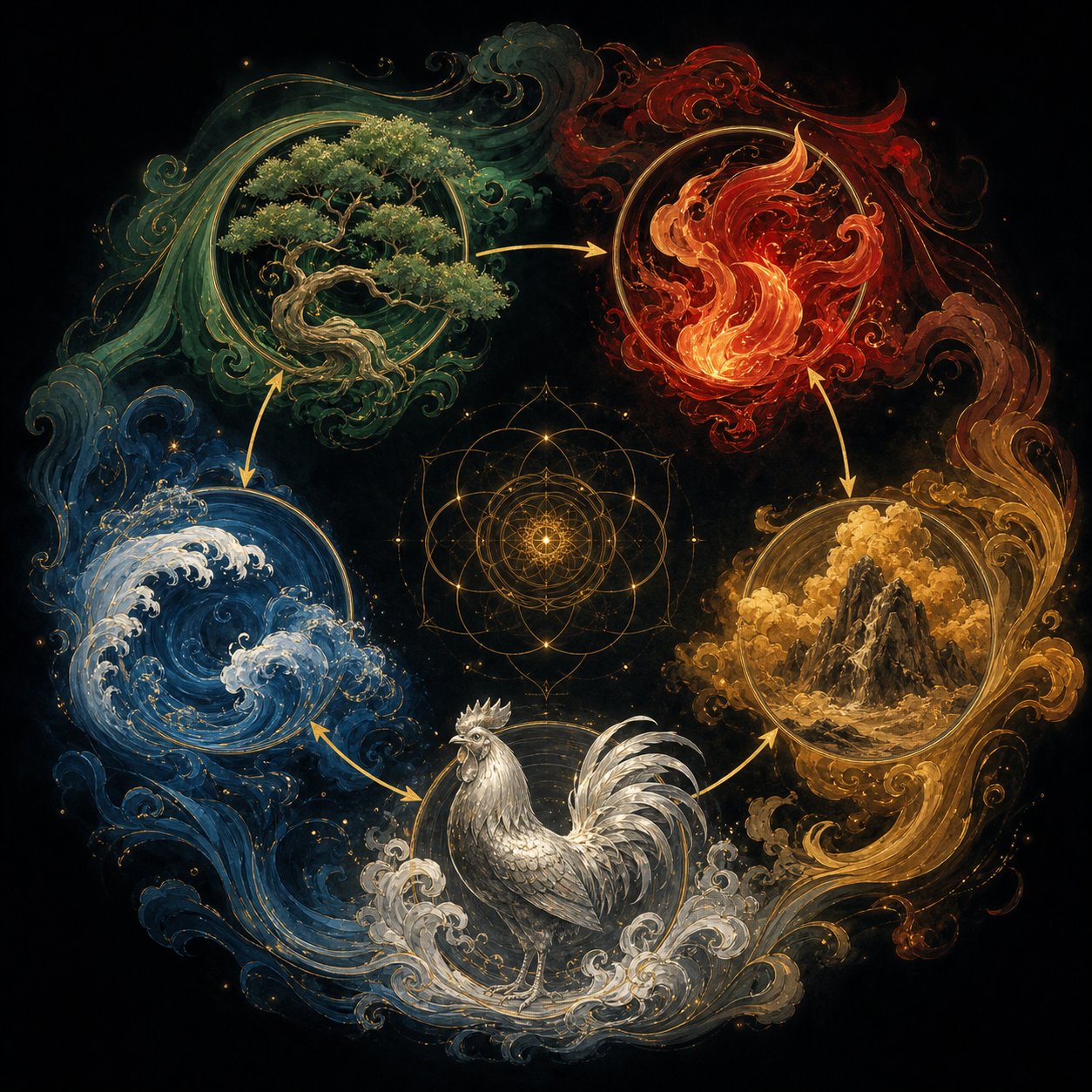
Wu Xing (五行) theory describes five phases of energy: Wood (木, mu), Fire (火, huo), Earth (土, tu), Metal (金, jin), and Water (水, shui). These aren't static materials. As classical Chinese philosophy explains, the character Xing (行) means "movement" or "phase," describing dynamic patterns of energy transformation rather than fixed substances.
Two cycles govern how these phases interact:
- The Generating Cycle (相生, xiang sheng): Each element nourishes the next. Wood feeds Fire. Fire creates Earth. Earth bears Metal. Metal collects Water. Water nourishes Wood.
- The Controlling Cycle (相克, xiang ke): Each element restrains another. Wood parts Earth. Earth dams Water. Water quenches Fire. Fire melts Metal. Metal cuts Wood.
In a balanced system, both cycles operate simultaneously. Generation without control leads to excess; control without generation leads to stagnation. When you apply this to naming, the goal is to identify which element your specific Rooster child needs more of and which one already runs too strong.
Here's the key insight for wu xing theory Chinese baby naming: a child's BaZi (八字) birth chart reveals which elements are dominant, which are weak, and which are missing entirely. The name then acts as a corrective tool, introducing radicals tied to the element that needs reinforcement. For Rooster children, the baseline Metal energy from 酉 is always present, so the sub-cycle element determines what additional balancing is required.
How Your Rooster Sub-Cycle Changes Ideal Radicals
Imagine two children, both born in Rooster years. One arrives in 1981 (Metal Rooster) and the other in 1993 (Water Rooster). The first child carries Metal from both the Earthly Branch and the year cycle, creating a double dose of contracting, refining energy. The second child blends Metal's precision with Water's fluidity. Their radical needs are fundamentally different.
The five Rooster sub-cycles correspond to specific birth years:
- Metal Rooster: 1921, 1981
- Water Rooster: 1933, 1993
- Wood Rooster: 1945, 2005
- Fire Rooster: 1957, 2017
- Earth Rooster: 1909, 1969
Each sub-cycle creates a unique elemental profile. The naming strategy uses the Generating Cycle to identify which element feeds the weak phase, and the Controlling Cycle to identify which element might need moderation to prevent overwhelm. For example, Metal generates Water in the production cycle, so a Water Rooster benefits from metal-associated radicals (金, 钅) that feed its Water nature. Meanwhile, a Wood Rooster already faces tension because Metal controls Wood in the restraining cycle, meaning the child's innate Metal energy actively cuts against the year element. That Wood Rooster needs radicals that strengthen Wood (木, 艹) and introduce Water (氵, 雨) as a bridge, since Water nourishes Wood.
Here is a breakdown of rooster sub-cycle elemental balance names and the radical strategy for each:
| Rooster Sub-Cycle | Dominant Element | Radicals to Strengthen | Radicals to Moderate |
|---|---|---|---|
| Metal Rooster (1921, 1981) | Metal (doubled) | Water radicals: 氵 (shui, water), 雨 (yu, rain) to drain excess Metal productively | Metal radicals: 金, 钅 (already in excess); Fire radicals: 火, 灬 (Fire melts Metal, creating instability) |
| Water Rooster (1933, 1993) | Metal + Water | Wood radicals: 木 (mu, wood), 艹 (cao, grass) since Water generates Wood, channeling energy forward | Earth radicals: 土, 山 (Earth dams Water, creating blockage); excessive Metal radicals (overfeeds Water) |
| Wood Rooster (1945, 2005) | Metal + Wood (internal tension) | Water radicals: 氵, 雨 (Water bridges Metal and Wood by draining Metal and feeding Wood) | Metal radicals: 金, 钅 (intensifies the Metal-controls-Wood conflict); excessive Earth radicals: 土 (Wood controls Earth, draining Wood further) |
| Fire Rooster (1957, 2017) | Metal + Fire (opposing forces) | Earth radicals: 土 (tu, earth), 山 (shan, mountain) since Fire generates Earth, and Earth generates Metal, creating a smooth bridge | Water radicals: 氵, 雨 (Water quenches Fire directly); excessive Metal radicals (Fire-Metal tension already exists) |
| Earth Rooster (1909, 1969) | Metal + Earth (supportive pair) | Metal radicals: 金, 钅 (Earth generates Metal, reinforcing the natural flow); Water radicals: 氵 (Metal generates Water, extending the productive chain) | Wood radicals: 木, 艹 (Wood controls Earth, destabilizing the foundation); excessive Fire radicals (overfeeds Earth, creating heaviness) |
A few patterns emerge from this table. The Metal Rooster and Earth Rooster have the most straightforward naming paths because their sub-cycle elements either match or naturally support the Rooster's baseline Metal. The Wood Rooster and Fire Rooster face internal elemental tension, since their year elements are either controlled by or actively oppose Metal. These children benefit most from "bridge" elements that smooth the relationship between conflicting forces.
Consider a practical example. A Fire Rooster child born in 2017 carries Fire energy that naturally melts Metal. Left unaddressed, this creates a push-pull dynamic: ambition and passion (Fire) clashing with precision and discipline (Metal). Introducing Earth radicals like 山 (shan, mountain) or 土 (tu, earth) through characters such as 崇 (chong, lofty) or 坤 (kun, earth/feminine) creates a productive pathway. Fire generates Earth, and Earth generates Metal, so the name transforms a conflict into a flowing chain of support.
The Wood Rooster faces a similar challenge from the opposite direction. Metal cuts Wood in the controlling cycle, which can manifest as self-doubt or internal resistance. Water radicals serve as the peacemaker here, since Metal generates Water and Water nourishes Wood. A character like 涵 (han, to contain/cultivate) or 泽 (ze, marsh/beneficence) introduces that bridging Water energy without overwhelming the system.
The best Rooster names don't just pile on favorable radicals. They read the child's specific elemental blueprint and use the Generating Cycle to build bridges where tension exists, turning potential conflict into flowing, productive energy.
This elemental layer adds precision to the broader radical categories covered earlier. A shelter radical like 山 (mountain) is generally auspicious for all Roosters, but it becomes especially powerful for a Fire Rooster who needs Earth energy. A grain radical like 禾 (he) carries Wood energy, making it ideal for an Earth Rooster (where Wood's controlling influence is manageable) but potentially problematic for a Wood Rooster already struggling with Metal-Wood tension.
Elemental balance shapes which radicals to prioritize, but it doesn't operate in isolation. Traditional naming also considers whether certain radical energies carry gendered cultural weight, and how modern families can navigate those associations while still honoring the system's logic.
Gender-Specific Radical Recommendations for Rooster Names
Elemental theory tells you which radicals balance your child's constitution. But traditional naming adds another filter: gender. For centuries, Chinese naming practitioners assigned certain radicals to boys and others to girls based on cultural expectations about masculinity and femininity. When selecting the best Chinese name radicals for a Rooster zodiac child, understanding these traditional male female rooster naming radicals helps you make informed choices, whether you follow convention or deliberately cross those boundaries.
Traditional Male Rooster Name Radicals and Their Symbolism
Rooster zodiac boy name radicals traditionally lean toward imagery of strength, ambition, and commanding presence. The rooster is, after all, the one who crows at dawn and claims territory. For sons, practitioners historically favored radicals that amplify this assertive energy:
- 山 (shan, mountain): Suggests stability, grandeur, and the "golden rooster standing on a mountain" image of authority. Characters like 崇 (chong, lofty) and 岳 (yue, great mountain) carry this weight.
- 金/钅 (jin, metal): While excess Metal is cautioned against, moderate Metal presence in a boy's name traditionally signals decisiveness and sharpness. Used carefully for Earth Roosters where the generating cycle supports it.
- 禾 (he, grain): Represents the provider role. Characters like 秉 (bing, to hold/grasp) and 程 (cheng, journey/process) suggest a man who commands resources.
- 宀 (mian, roof): Implies the head of household who provides shelter. Characters like 宏 (hong, grand) and 宇 (yu, universe) evoke expansive ambition.
The underlying logic connects the rooster's natural dominance in the barnyard to expectations of male leadership. A boy named with 山 and 宀 radicals is symbolically a rooster who owns the mountain and the roost.
Traditional Female Rooster Name Radicals and Their Symbolism
Rooster zodiac girl name radicals traditionally draw from the bird's beauty rather than its territorial nature. The hen's grace, the plumage's color, and the refinement of silk and jade all map to feminine naming conventions:
- 彡 (shan, feathers/decoration): Emphasizes elegance and artistic refinement. Characters like 彤 (tong, vermilion) and 彩 (cai, colorful) are classic feminine choices.
- 纟 (si, silk/thread): Suggests delicacy, connection, and fine craftsmanship. Characters like 绮 (qi, beautiful/patterned) carry this energy.
- 王 (wang, jade radical): When appearing as a radical component, 王 often relates to jade rather than kingship. Characters like 瑶 (yao, precious jade), 琳 (lin, fine jade), and 珊 (shan, coral) have long been popular in female given names across multiple generations.
- 衣 (yi, clothing): Connects to the rooster's plumage-as-finery symbolism. Characters like 裕 (yu, abundant) and 祺 (qi, auspicious) suggest a well-adorned life.
These radicals channel the Rooster's beauty aspect. A girl named with 彡 and 纟 radicals is symbolically a rooster whose brilliant feathers earn admiration and elevate her to phoenix status.
Modern Approaches to Gender and Radical Selection
Here's where tradition meets contemporary values. Research on Chinese naming trends shows that gendered radical boundaries have been loosening significantly since the 1980s. Analysis of naming data covering nearly 1.2 billion Han Chinese individuals reveals that after the 1980s, gender-neutral radicals became increasingly common, and even radicals with traditional gendered connotations began crossing boundaries. Daughters are now expected to be "excellent" and "cultured" just as sons are, while the roof radical 宀 appears in boys' names from the 1990s onward, possibly reflecting acceptance of more family-oriented masculinity.
For parents seeking gender neutral Chinese Rooster name characters, several radical categories work beautifully regardless of the child's gender:
- 禾 (he, grain) and 米 (mi, rice): Nourishment carries no inherent gender. Characters like 秀 (xiu, elegant/outstanding) and 香 (xiang, fragrant) serve any child.
- 宀 (mian, roof): Security and belonging are universal needs. 安 (an, peace) and 宸 (chen, imperial) transcend gender lines.
- 山 (shan, mountain): Strength and elevation apply equally. 岚 (lan, mountain mist) has become a popular unisex choice.
The practical takeaway? If you want to honor traditional gendered associations, the framework above gives you clear guidance. If you prefer a modern approach, focus on the elemental and zodiac logic from earlier chapters and let the gender layer fall away. The Rooster's core radical needs, grain, shelter, and plumage, are fundamentally about the animal's wellbeing, not about human gender roles. A well-fed, well-sheltered, beautifully plumed rooster thrives regardless.
Whether you lean traditional or modern in your gender approach, the next challenge is mechanical: how do you combine two or more favorable radicals within a single two-character given name without creating internal conflicts?
Combining Radicals in Two-Character Names for Maximum Benefit
Picking the right radical category is one thing. Fitting two auspicious radicals together inside a single given name, where both characters complement rather than compete, is where the craft gets interesting. Most Chinese given names consist of two characters, and each character carries its own radical energy. When you pair them thoughtfully, the result is greater than the sum of its parts.
Balancing Radicals Across a Two-Character Given Name
Think of a two-character given name as a conversation between two energies. The first character sets the tone, and the second character completes the thought. In Rooster naming, the strongest combinations pair radicals from different symbolic categories rather than doubling up on the same one. A shelter radical in the first character paired with a grain radical in the second, for example, paints a complete picture: a rooster safe under a roof with plenty of food. That's security plus abundance, two distinct blessings working in harmony.
Doubling the same radical category isn't necessarily harmful, but it narrows the symbolic range. Two grain radicals signal abundance twice over without addressing protection or status. Two plumage radicals emphasize beauty but leave the rooster exposed. The best radical combinations for Rooster zodiac names spread their energy across multiple needs, giving the child a well-rounded foundation.
Elemental balance matters here too. If both characters carry Wood-energy radicals (禾 and 艹, for instance), you've loaded the name with a single element. For a Wood Rooster already managing Metal-Wood tension, that concentration could tip the scales. Mixing elemental associations across the two characters, say a Water-energy radical in one and an Earth-energy radical in the other, creates internal flow rather than stagnation.
Radical Combinations That Amplify Positive Energy
How do you actually build a balanced Rooster name from scratch? Here's a step-by-step method that moves from broad to specific:
- Identify the child's elemental needs from birth data. Determine the Rooster sub-cycle (Metal, Water, Wood, Fire, or Earth) and note which elements need strengthening versus moderation based on the Five Elements table from the previous section.
- Select a primary radical category. Choose the radical group that addresses the child's most pressing elemental or symbolic need. If the child is a Fire Rooster needing Earth energy, a shelter radical like 山 (shan) or 宀 (mian) becomes the primary pick.
- Choose a complementary secondary radical. Pick from a different symbolic category that either supports the primary element through the Generating Cycle or addresses a second need. For that same Fire Rooster, pairing an Earth-energy shelter radical with a grain radical like 禾 (he) adds nourishment without elemental conflict.
- Verify no internal conflicts exist. Check both characters against the avoidance list. Confirm that neither character contains hidden components tied to the Rabbit clash (卯, 月, 东), violent imagery (刀, 血), or elemental excess. Also confirm the two radicals don't belong to elements that control each other in a way that creates tension for this specific child's profile.
Here are rooster name radical pairing examples that illustrate strong combinations:
| First Character (Radical) | Second Character (Radical) | Combined Symbolism | Best Suited For |
|---|---|---|---|
| 宇 (yu, universe) — 宀 shelter | 秀 (xiu, elegant) — 禾 grain | Security + abundance: a sheltered rooster with plenty to eat | All Rooster sub-cycles |
| 崇 (chong, lofty) — 山 mountain | 彦 (yan, accomplished) — 彡 plumage | Elevation + recognition: a rooster on a mountain displaying fine feathers | Fire Rooster, Earth Rooster |
| 安 (an, peace) — 宀 shelter | 涵 (han, cultivate) — 氵 water | Stability + depth: a protected rooster with flowing inner resources | Metal Rooster, Wood Rooster |
| 彬 (bin, refined) — 彡 plumage | 程 (cheng, journey) — 禾 grain | Status + provision: an admired rooster with a clear path forward | Water Rooster, Earth Rooster |
You'll notice each pairing draws from two different categories. That diversity is intentional. It mirrors how a real rooster needs multiple conditions met simultaneously: food alone doesn't help if there's no shelter, and beauty alone doesn't matter if the bird is starving.
One subtle point often overlooked: the stroke count and tonal relationship between the two characters also matter in traditional xingmingxue. A name where both characters share the same tone can feel flat when spoken aloud, while contrasting tones create a pleasing rhythm. This isn't strictly a radical concern, but it's worth checking after you've settled on your radical pairing. The most harmonious Rooster names satisfy the ear as well as the cosmological framework.
With the right radical combination in hand, the final step is pulling every layer together: zodiac symbolism, elemental sub-cycle, gender considerations, clash avoidance, and radical pairing. That calls for a clear decision-making framework that walks you through the full process from start to finish.
A Parent's Decision-Making Framework for Rooster Zodiac Naming
You've absorbed the theory: elemental cycles, symbolic categories, clash avoidance, gender considerations, and radical pairing. That's a lot of moving parts. So how do you actually sit down and choose Chinese name radicals for a Rooster baby without getting lost in the complexity? What you need is a clear, sequential path that turns all of this knowledge into concrete decisions.
Step-by-Step Framework for Choosing Rooster Name Radicals
This step-by-step Chinese zodiac name selection process moves from the broadest determination (which Rooster sub-cycle?) down to the finest detail (does the full name flow as a harmonious unit?).
- Determine your child's Rooster sub-cycle element. Identify the birth year and match it to one of the five sub-cycles: Metal Rooster (1981, 2041), Water Rooster (1993, 2053), Wood Rooster (2005, 2065), Fire Rooster (2017, 2077), or Earth Rooster (1969, 2029). This tells you which secondary element layers onto the Rooster's baseline Metal.
- Identify elemental strengths and weaknesses. Use the Generating and Controlling Cycles to determine which elements your child already has in abundance and which ones need reinforcement. A Metal Rooster has doubled Metal and needs Water to drain the excess productively. A Fire Rooster carries opposing forces and needs Earth as a bridge. For deeper precision, consult a BaZi analysis based on the full birth date and time.
- Select a primary auspicious radical category. Based on the elemental need, choose the radical group that delivers the most benefit. Grain radicals (禾, 米) carry Wood energy. Shelter radicals (宀, 山) carry Earth energy. Plumage radicals (彡, 纟) carry Fire or Metal energy depending on context. Match the radical's elemental charge to the element your child needs most.
- Check against the clash and avoidance list. Before committing to any character, scan its internal structure for hidden components tied to the Rabbit clash (卯, 月, 东), violent imagery (刀, 血, 力), or elemental excess. One overlooked component can undermine an otherwise strong name.
- Consider gender preferences. Decide whether you want to follow traditional gendered radical associations, take a modern gender-neutral approach, or blend both. This is a personal and cultural choice, not a cosmological requirement.
- Verify radical harmony across the full name. Confirm that the two characters in the given name draw from different symbolic categories, that their elemental charges don't conflict with each other, and that the tonal pattern sounds pleasing when spoken aloud. The name should read as a complete, balanced image rather than a repetition or contradiction.
Putting It All Together With a Naming Checklist
For parents in the Western diaspora navigating this tradition across languages and cultural distance, this rooster zodiac naming checklist for parents serves as a practical anchor. Print it, bookmark it, or share it with family members involved in the naming discussion:
| Checklist Item | Status | Notes |
|---|---|---|
| Rooster sub-cycle element identified | Yes / No | Birth year determines Metal, Water, Wood, Fire, or Earth |
| Elemental strengths and gaps mapped | Yes / No | Use Generating/Controlling Cycles or full BaZi chart |
| Primary radical category selected | Yes / No | Grain, shelter, or plumage based on elemental need |
| Complementary secondary radical chosen | Yes / No | Different category from primary for balanced symbolism |
| Clash radicals screened out | Yes / No | No 卯, 月, 东, 刀, 血, or excess Metal components |
| Gender approach decided | Yes / No | Traditional, modern, or blended |
| Tonal and phonetic flow confirmed | Yes / No | Name sounds natural and pleasing when spoken |
| Family and cultural preferences honored | Yes / No | Generational characters, surname compatibility, etc. |
The strongest Rooster names unite zodiac symbolism, elemental balance, and personal birth data into a single harmonious structure, giving the child a name that works on every level from sound to cosmic alignment.
One honest note: this rooster birth data radical selection guide covers the core framework, but the interactions between elements, radicals, stroke counts, and BaZi pillars can get genuinely complex. If your child's chart shows unusual elemental distributions, or if you're unsure how to read hidden radical components inside traditional characters, consulting a naming practitioner (姓名学师傅) can save you from subtle missteps. Many practitioners now work remotely and serve English-speaking families, making expert guidance accessible regardless of where you live.
The beauty of this system is that it doesn't ask you to choose between meaning and fortune. A name built on the right radicals for your Rooster child will naturally carry beautiful meanings: peace, abundance, elegance, depth. The cosmic alignment and the human poetry arrive together, woven into the same characters.
Frequently Asked Questions About Rooster Zodiac Name Radicals
1. What are the luckiest radicals for a Rooster zodiac baby name?
The luckiest radicals for Rooster-born children fall into three categories: grain radicals (禾, 米, 豆) symbolizing abundance and lifelong support, shelter radicals (宀, 冖, 山) representing security and career stability, and plumage radicals (彡, 纟, 衣) signifying social status and recognition. These radicals mirror what a rooster naturally needs to thrive: food, a safe roost, and colorful feathers that command respect.
2. Which radicals should be avoided in Chinese names for Rooster-born children?
Rooster names should avoid radicals tied to the Rabbit zodiac clash, including 卯, 月 (moon), and 东 (east). Violent imagery radicals like 刀 (knife), 血 (blood), and 力 (force) suggest slaughter and harm. Excess Metal radicals (金, 钅, 西, 酉) cause elemental overload since the Rooster already carries strong Metal energy from its Earthly Branch. Components associated with the Rat (子) and Pig (亥) branches introduce destabilizing Water energy.
3. How does the Five Elements theory affect Rooster zodiac naming?
Each Rooster birth year pairs with a secondary element (Metal, Water, Wood, Fire, or Earth), creating unique radical needs. A Metal Rooster (1981) has doubled Metal and benefits from Water radicals to drain excess. A Fire Rooster (2017) needs Earth radicals as a bridge between opposing Fire and Metal forces. The Generating and Controlling Cycles guide which radicals strengthen weak elements and which ones should be moderated to prevent imbalance.
4. Can the same radicals be used for both boy and girl Rooster zodiac names?
Yes. While traditional naming assigns mountain and metal radicals to boys and plumage or jade radicals to girls, modern Chinese naming increasingly uses gender-neutral approaches. Grain radicals (禾, 米), shelter radicals (宀), and mountain radicals (山) work well for any child regardless of gender. The Rooster's core needs for nourishment, protection, and beauty are not inherently gendered, so parents can follow tradition or take a contemporary path based on personal preference.
5. How do you combine two auspicious radicals in a Rooster zodiac given name?
The strongest two-character Rooster names pair radicals from different symbolic categories rather than repeating the same one. For example, a shelter radical (宀) in the first character combined with a grain radical (禾) in the second creates a complete image of security plus abundance. After selecting complementary radicals, verify that their elemental charges do not conflict with each other or with the child's sub-cycle element, and confirm neither character contains hidden clash components.