Why Cantonese and Mandarin Names Confuse Everyone
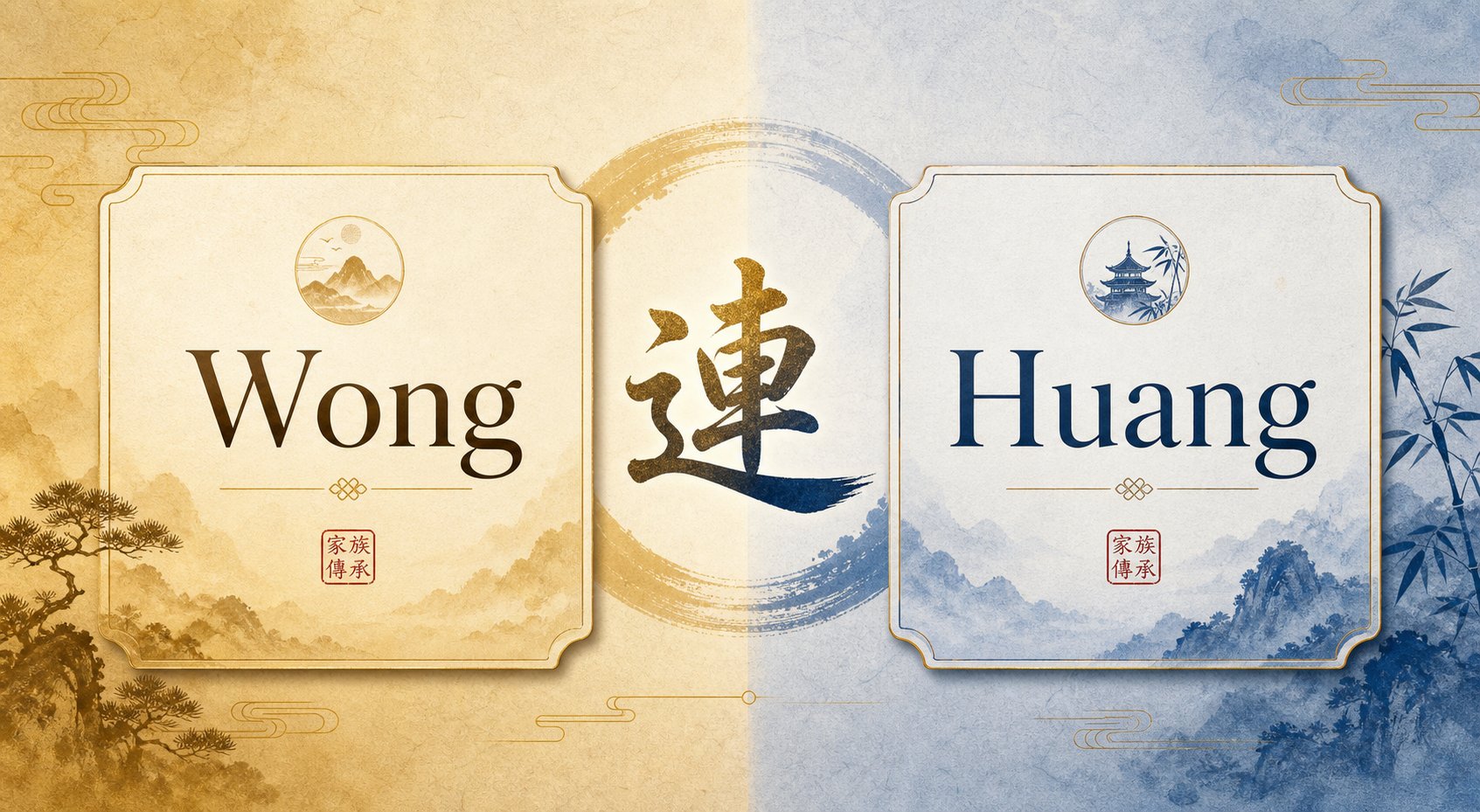
Imagine meeting someone named Wong and someone named Huang at the same event. Different people, right? Not necessarily. Both spellings represent the exact same Chinese character: 黄. The difference comes down to whether the name was romanized through Cantonese or Mandarin pronunciation. This single fact trips up millions of people every year, from hiring managers scanning resumes to family historians tracing their roots.
Why the Same Name Looks Different in Cantonese and Mandarin
Chinese names are built from characters, and each character carries its own meaning and sound. But that sound changes depending on the dialect. A Cantonese name like Chan and a Mandarin name like Chen both come from the character 陈. The underlying chinese name definition is the same: one character, one meaning, one family. Yet the English spelling looks completely different because Cantonese and Mandarin pronounce that character in distinct ways. This is not a translation issue. It is a pronunciation issue that gets locked into official documents, passports, and family records.
Over 90% of Chinese names consist of just 3 characters, and the top 5 surnames alone cover roughly 30.8% of China's registered population. That means a relatively small set of common chinese names generates an enormous number of confusing spelling variations across dialects.
Who This Guide Helps
Whether you are researching your family heritage, working in a professional setting with Chinese-named colleagues, or simply curious about how chinese names work across dialects, this guide breaks it all down. You will learn how to identify whether a romanized name originates from a Cantonese name system or a Mandarin one, why the same character produces different spellings, and how to avoid common mistakes that lead to misidentification. The chinese name definition stays constant at the character level, but the surface-level spelling tells a story about geography, history, and identity.
The differences run deeper than spelling alone. Romanization systems, tonal structures, and centuries of migration history all play a role in shaping how these names appear in English today.
How We Structured This Cantonese vs Mandarin Comparison
Comparing two naming systems that share the same written characters but produce different sounds and spellings requires a clear framework. You cannot simply list Cantonese and Mandarin side by side without understanding what drives the differences. So how do chinese names work when filtered through these two distinct linguistic systems? The answer touches on phonetics, history, geography, and everyday consequences. To keep this comparison grounded and useful, we evaluated the differences across five specific criteria.
Criteria for Comparing Naming Systems
Each criterion below addresses a different layer of the naming puzzle. Together, they give you a complete picture of why the same chinese surname produces different English spellings depending on dialect and region.
- Romanization system - Which standardized or informal system converts characters into Latin letters (Pinyin, Jyutping, Yale, Hong Kong Government romanization, Wade-Giles, etc.)
- Spelling patterns - The visible letter combinations that distinguish Cantonese from Mandarin names at a glance (initial consonants, vowel clusters, and endings)
- Pronunciation and tonal structure - How each dialect's tone count and phonetic inventory shape the romanized output
- Historical and geographic context - Colonial influence, government standardization timelines, and regional migration patterns that locked certain spellings into place
- Real-world impact - Practical consequences in legal documents, healthcare records, genealogy research, and professional settings where chinese name interpretation errors cause misidentification
These five lenses let us move beyond surface-level observation into a structured analysis that serves heritage researchers, professionals, and anyone curious about chinese family names.
Sources and Scope of This Comparison
This comparison draws from naming conventions actively used across mainland China, Hong Kong, Taiwan, and overseas diaspora communities in Southeast Asia, North America, and Europe. For surname frequency and origin data, the Grand Dictionary of Chinese Surnames (中华姓氏大辞典) serves as a key reference point. Published in 1996 after a decade of research, it catalogs 11,969 surnames across China's 56 ethnic groups, including 4,820 Han chinese family names with documented origins. Its data on surname frequency and distribution provides the statistical backbone for understanding which names appear most often and why their romanized forms vary so widely.
Accurate chinese name interpretation requires recognizing that no single romanization system covers all cases. Pinyin dominates in mainland China, but Hong Kong identity cards, Taiwanese passports, and older diaspora records each follow different conventions. Our comparison accounts for all of these, giving you a practical reference regardless of which community or document type you encounter.
With this framework in place, the most logical starting point is the romanization systems themselves, since they are the direct mechanism that turns a single character into two completely different English spellings.
Romanization Systems That Create Different Name Spellings
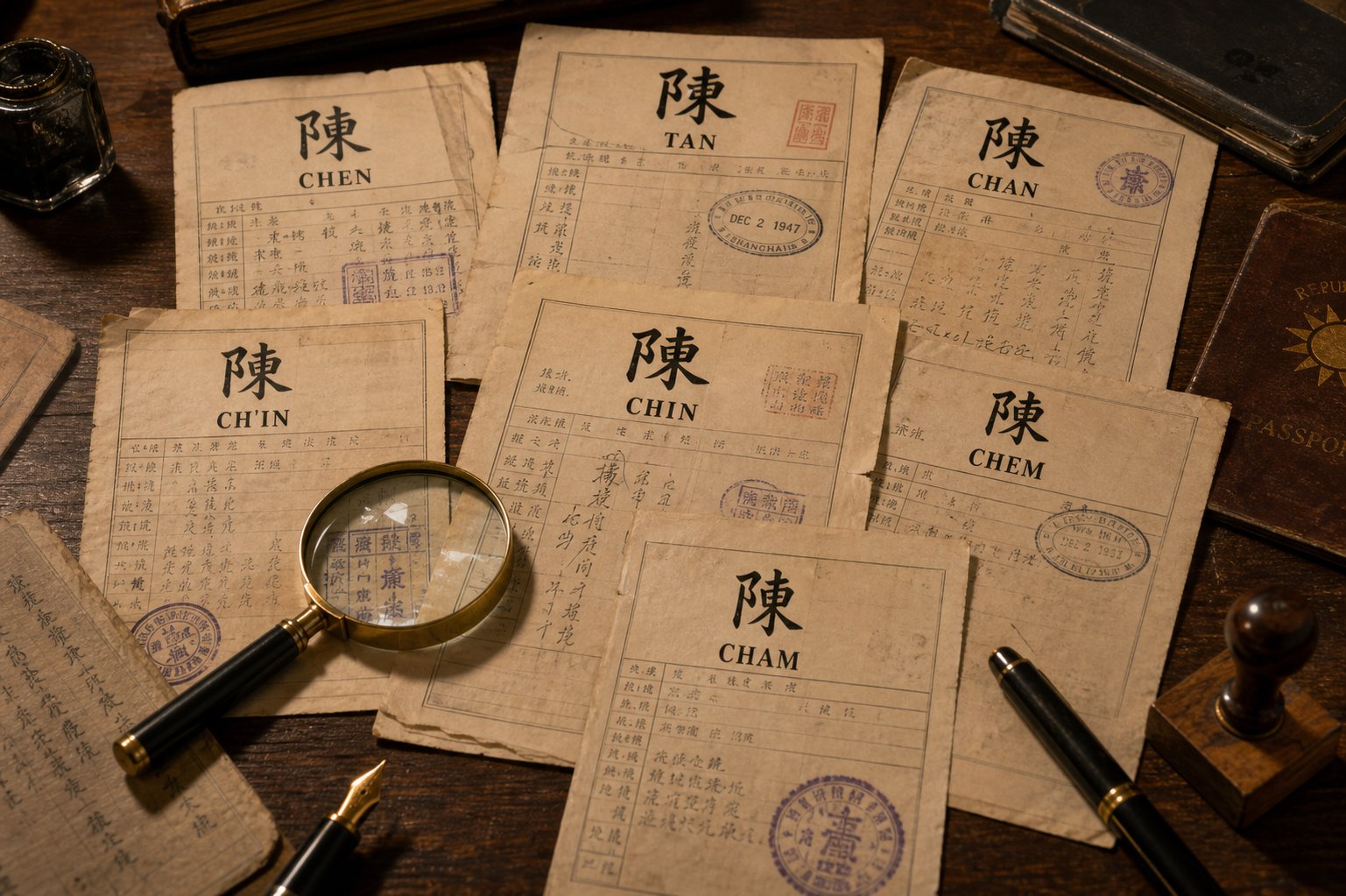
A single Chinese character has one fixed written form. But the moment you need to spell that character using the Latin alphabet, everything depends on which romanization system you use. This is the core mechanism behind every confusing case of chinese names english translation producing two completely different results for the same person's family name. The system chosen determines whether 黄 becomes Wong or Huang, and that choice is rarely up to the individual.
Mandarin Romanization with Hanyu Pinyin
On February 11, 1958, the People's Republic of China officially introduced Hanyu Pinyin as its standard romanization system. The goal was straightforward: create one consistent way to render every name in chinese language using Latin letters. Pinyin replaced older systems like Wade-Giles, which had been in use since the 19th century and remains common in Taiwan. The United Nations adopted Pinyin in 1986, and it is now the global default for Mandarin romanization.
What makes Pinyin powerful for chinese name pronunciation is its strict one-to-one mapping. Each syllable has exactly one approved spelling. The character 张 is always Zhang. The character 黄 is always Huang. There is no ambiguity, no regional variation, and no personal choice involved. This standardization means that anyone converting an english to chinese name or vice versa in a mainland Chinese context will always get the same result.
Wade-Giles, still seen on older Taiwanese documents, produces different spellings for the same sounds. Zhang becomes Chang, Huang becomes Hwang. Zhuyin (Bopomofo), meanwhile, is a phonetic notation system using unique symbols rather than Latin letters, so it does not directly produce English spellings but influences how Taiwanese speakers think about pronunciation.
Cantonese Romanization Systems in Hong Kong and Beyond
Cantonese has no single government-mandated romanization standard. Instead, multiple systems coexist, each producing slightly different spellings for the same name chinese characters. This fragmentation is the primary reason Cantonese names appear so inconsistent in English.
The Hong Kong Government romanization is the most widely encountered system in practice. It appears on identity cards, street signs, and official documents. Yet it has never been formally published as a codified standard. It omits tone markings entirely and does not distinguish between aspirated and unaspirated consonants, which creates ambiguity. Other systems used across Cantonese-speaking communities include:
- Jyutping - Developed by the Linguistic Society of Hong Kong, this is the most linguistically precise system, but it is rarely used on personal documents
- Yale - Commonly taught to American learners of Cantonese, popular in academic settings
- Sidney Lau - Taught to civil servants in colonial-era Hong Kong and broadcast in radio lessons
The result? The same Cantonese speaker's name might be spelled differently depending on which system their identity card office, school, or immigration authority happened to use. A name in chinese language carries one meaning at the character level, but its English spelling becomes a product of local bureaucratic convention.
Why Standardization Matters for Name Spelling
The contrast is stark. Mandarin has one dominant system backed by government authority and international adoption. Cantonese has at least four competing systems plus countless informal local conventions. This asymmetry is the single biggest reason the same surname character produces different English spellings across communities.
| System Name | Language | Region of Use | Standardization Status |
|---|---|---|---|
| Hanyu Pinyin | Mandarin | Mainland China, international | Government-standardized (1958), UN-adopted (1986) |
| Wade-Giles | Mandarin | Taiwan, older academic texts | Historically standardized, declining use |
| Zhuyin (Bopomofo) | Mandarin | Taiwan | Government-standardized for education |
| Hong Kong Government | Cantonese | Hong Kong | Unpublished, informal government convention |
| Jyutping | Cantonese | Academic, Hong Kong | Standardized by LSHK, limited public adoption |
| Yale | Cantonese | US academic institutions | Academic standard, not used on documents |
| Sidney Lau | Cantonese | Hong Kong (colonial era) | Semi-official, now largely historical |
When you encounter a romanized Chinese name, you are not just seeing a translation. You are seeing the fingerprint of whichever system happened to be in use at the time and place that name was first written in English. Pinyin gives you predictability. Cantonese romanization gives you history, but also inconsistency.
These systems explain the spelling. But spelling is only half the story. The tonal structures of each language add another layer of complexity to how names actually sound when spoken aloud.
Common Surnames Compared in Cantonese and Mandarin
Spelling systems create the differences. But what do those differences actually look like across the most common chinese surnames? This is the reference you came here for: a direct, side-by-side comparison showing how the same character produces completely different English spellings depending on dialect. Bookmark this section. You will come back to it.
Top Chinese Surnames in Cantonese and Mandarin Side by Side
The following table covers 20 of the most common chinese last names, ranked roughly by population frequency in China. Each row shows the original character, its Cantonese romanization (based on Hong Kong conventions), its Mandarin Pinyin spelling, and the character's meaning. You will notice that some of the most popular chinese last names look nothing alike across the two systems.
| Chinese Character | Cantonese Romanization | Mandarin Pinyin | Meaning |
|---|---|---|---|
| 王 | Wong | Wang | King |
| 李 | Lee | Li | Plum tree |
| 张 / 張 | Cheung | Zhang | Bow (archer's bow); to stretch |
| 刘 / 劉 | Lau | Liu | Kill (archaic); now used as surname only |
| 陈 / 陳 | Chan | Chen | Ancient state name; to display |
| 杨 / 楊 | Yeung | Yang | Poplar tree |
| 黄 / 黃 | Wong | Huang | Yellow |
| 赵 / 趙 | Chiu | Zhao | Ancient state name |
| 吴 / 吳 | Ng | Wu | Ancient state name |
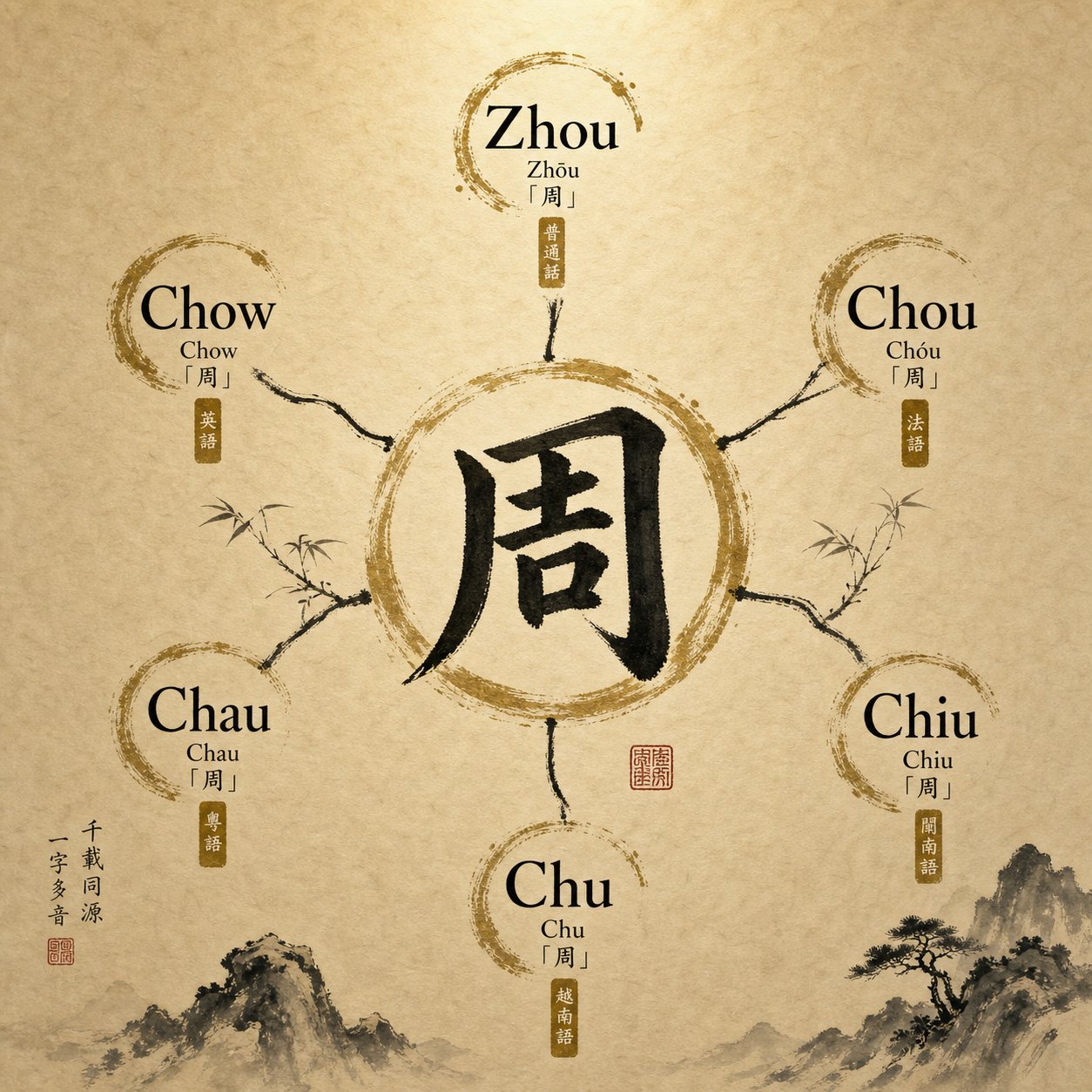
| 周 | Chow | Zhou | Zhou dynasty; cycle |
| 徐 | Tsui | Xu | Slow; ancient state name |
| 孙 / 孫 | Suen | Sun | Grandchild |
| 胡 | Wu | Hu | Reckless; barbarian (archaic) |
| 郭 | Kwok | Guo | Outer city wall |
| 何 | Ho | He | What; which |
| 林 | Lam | Lin | Forest |
| 高 | Ko | Gao | Tall; high |
| 罗 / 羅 | Lo | Luo | Net; to collect |
| 梁 | Leung | Liang | Bridge beam |
| 谢 / 謝 | Tse | Xie | To thank; to decline |
Look at the gap between Cheung and Zhang, or between Ng and Wu. Without context, you would never guess these are the same chinese last name. Yet each pair shares one character, one origin, and one family line. The only variable is dialect.
Why Wong and Huang Are the Same Name
The character 黄 means "yellow" and ranks as the 7th most common surname in China, carried by tens of millions of people. In Mandarin, the initial consonant is an aspirated "h" sound followed by the vowel combination "uang," giving us Huang. In Cantonese, that same character starts with a "w" sound and ends with a nasal "ong," producing Wong.
Here is where it gets even more confusing: the character 王 (meaning "king") is also romanized as Wong in Cantonese. So when you see the chinese last name Wong, it could represent either 黄 or 王. Only the Chinese character itself resolves the ambiguity. This is exactly why understanding chinese last names and meanings at the character level matters more than relying on English spelling alone.
The Asia Media Centre notes that in territories with a sizeable Chinese diaspora, such as Singapore and Malaysia, the way a family name is spelled acts as a signifier of the region a person's ancestors come from. A person surnamed Wong is understood to have Cantonese heritage, likely tracing back to Guangdong province or Hong Kong. Someone surnamed Huang almost certainly has roots in a Mandarin-speaking region or immigrated more recently under Pinyin conventions.
This pattern repeats across the entire list of most common chinese last names. Chan signals Cantonese; Chen signals Mandarin. Cheung signals Hong Kong; Zhang signals the mainland. The spelling is not random. It is a geographic and linguistic fingerprint embedded in every romanized chinese surname.
Spelling tells you where a name came from. But it does not tell you how it sounds when spoken. The tonal systems behind these two languages add yet another dimension to how names are chosen, heard, and understood.
Tonal Differences That Change How Names Sound
Spelling shows you the difference on paper. But when a name is spoken aloud, the gap between Cantonese and Mandarin becomes even wider. Both languages are tonal, meaning pitch changes the meaning of a word entirely. Yet the number of tones each system uses, and how those tones interact with name selection, shapes everything from which chinese first names parents choose to how those names land on a non-speaker's ear.
How Cantonese Tones Shape Name Sounds
Cantonese operates with six primary tones plus three additional entering tones for syllables ending in -p, -t, or -k, giving it up to nine distinct tonal categories. This expanded tonal palette means a single syllable like "si" can carry six completely different meanings depending on pitch. For parents choosing names in chinese and meanings that resonate, this richness offers more phonetic options but also more potential for unintended homophones.
The tonal complexity also explains why Cantonese romanizations tend to have more varied vowel and consonant combinations. Because the language distinguishes more sounds, romanization systems need more letter combinations to capture them. You will see endings like "-eung," "-euk," and "-oet" in Cantonese names that simply do not exist in Mandarin Pinyin. Characters chosen for chinese given names female, such as 悦 (jyut6, meaning "joy"), carry a clipped entering tone that gives the name a crisp, percussive quality when spoken in Cantonese, quite different from its Mandarin counterpart yue.
Mandarin Four-Tone System and Name Selection
Mandarin uses four tones plus a neutral tone: high flat, rising, dipping, and falling. Fewer tones means fewer phonetic collisions per syllable, but it also means parents must be more deliberate about how a full name flows across multiple characters. A common consideration is tone pairing. Parents selecting chinese given names male often avoid placing two falling-tone characters together because the combination sounds abrupt. Popular names like 浩宇 (hao yu, meaning "vast universe") pair a dipping tone with a rising tone, creating a melodic contour that feels balanced when spoken.
The mandarin name meaning matters, but so does the sonic shape. Characters like 轩 (xuan, meaning "lofty") and 涵 (han, meaning "encompassing") appear frequently in modern chinese first names partly because their flat or rising tones pair smoothly with common surnames. According to 2020 Chinese census data, top male names like 奕辰 (yi chen) and top female names like 一诺 (yi nuo) both demonstrate deliberate tonal contrast between characters. The chinese name meaning drives the choice, but pronunciation seals the decision.
Practical Pronunciation Tips for Non-Speakers
You do not need to master tones to navigate names in chinese and meanings more confidently. But recognizing a few key pronunciation patterns helps you identify which system a name comes from and avoid mangling it entirely.
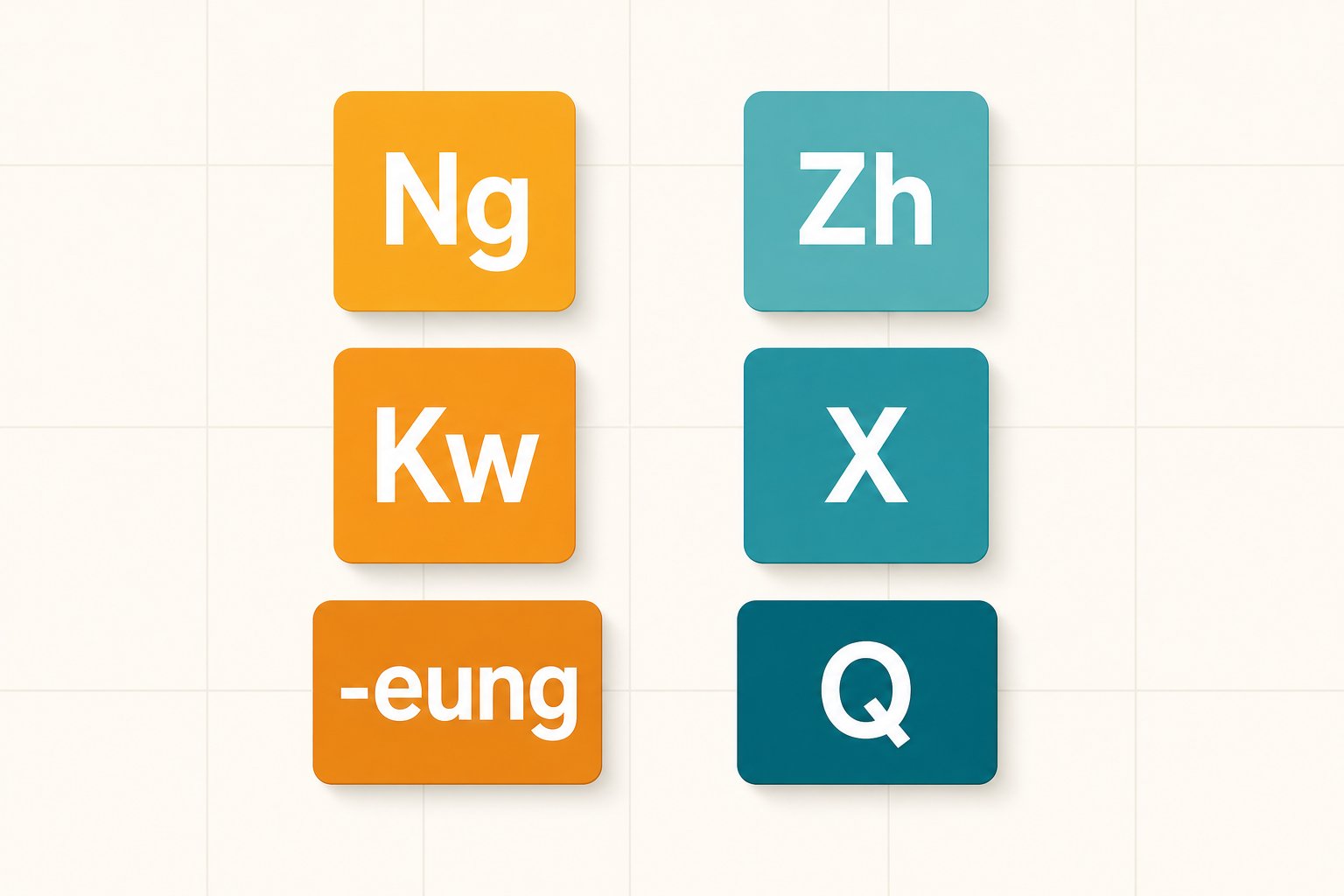
- "Zh," "ch," "sh," and "r" initials appear only in Mandarin Pinyin. If you see Zhang or Shi, you are looking at a Mandarin romanization.
- "Ng" as a syllable-initial sound is distinctly Cantonese. The surname Ng (吴) starts with a nasal sound that Mandarin replaces with "W."
- "Gw" and "kw" clusters exist in Cantonese but not Mandarin. Names like Kwok (郭) use consonant clusters that Pinyin never produces.
- "X" followed by a vowel is exclusively Mandarin Pinyin. Xie, Xu, and Xin have no Cantonese equivalent spelling pattern.
- Syllables ending in "-p," "-t," or "-k" signal Cantonese entering tones. Mandarin syllables never end in these stop consonants.
- "Eu" and "eo" vowel combinations are Cantonese markers. Cheung and Leung use diphthongs absent from Pinyin's vowel inventory.
These patterns give you a quick diagnostic tool. When you encounter an unfamiliar name, scanning for these letter combinations tells you whether the person's name was romanized through Cantonese or Mandarin conventions, even without knowing the underlying character.
Tones and phonetics explain how names sound today. But the reason certain communities use one system over another has less to do with linguistics and everything to do with history, geography, and waves of migration that carried these naming conventions across the globe.
Historical and Geographic Origins Behind Name Variations
Romanization systems did not appear in a vacuum. Each one was shaped by political power, colonial administration, and the specific communities that carried their names overseas. The reason you see Wong on a San Francisco street sign and Huang on a Beijing passport has less to do with personal preference and more to do with which government was issuing documents, and when.
Colonial Hong Kong and the Origins of Cantonese Spellings
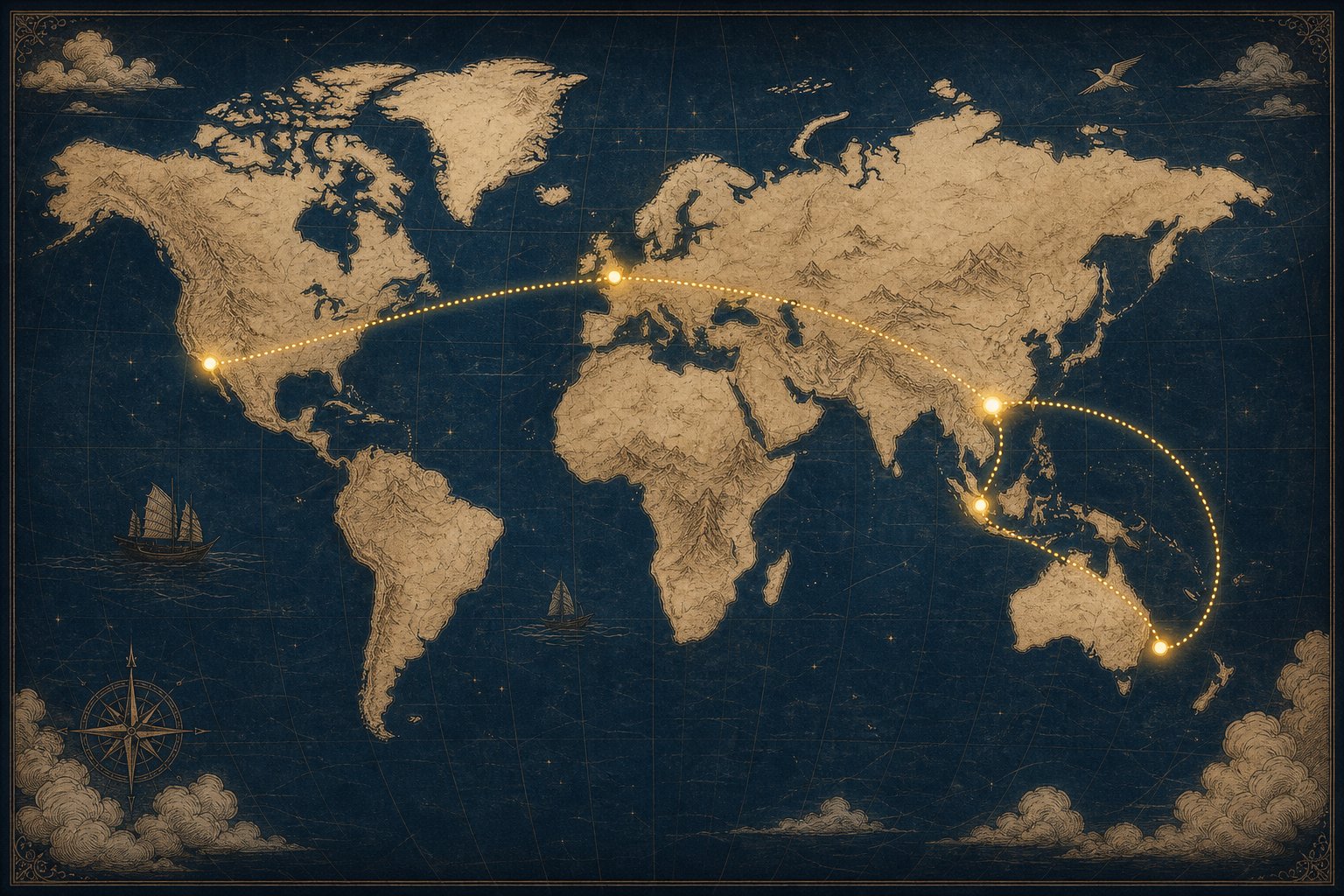
When Britain took control of Hong Kong in 1842, the colonial administration needed a way to render Chinese names in English for legal records, land deeds, and government correspondence. There was no Pinyin yet. There was no standardized Cantonese system either. British officials created ad hoc romanizations based on how Cantonese names sounded to English-speaking ears. These informal conventions became embedded in identity documents, street names, and birth certificates across 155 years of colonial rule.
The huang name origin, for instance, traces back to the ancient state of Huang and the character 黄 meaning "yellow." But in Hong Kong, that character was always written as Wong on official papers because colonial clerks transcribed the Cantonese pronunciation. Similarly, the chen last name origin connects to the ancient state of Chen (陈), but Hong Kong documents rendered it as Chan. These spellings were never formally codified into a published standard, yet they became permanent fixtures of identity for millions of people. As one researcher noted, the intertwined colonial history between Britain and Hong Kong created naming conventions that still replicate themselves in educational settings, administrative data, and health records today.
Why Older Diaspora Communities Use Cantonese Names
Walk through any historic Chinatown in San Francisco, London, Sydney, or Kuala Lumpur and you will notice the asian surnames names on shopfronts follow Cantonese patterns: Wong, Chan, Lee, Lam, Chow. This is not coincidence. Early Chinese immigration to these cities drew overwhelmingly from Guangdong province and its surrounding regions.
San Francisco's Chinese community, with over 170 years of immigration history, remains predominantly Cantonese-speaking. The city's Chinatown associations are still centered around Cantonese and Taishanese, reflecting Gold Rush-era migration patterns. In Southeast Asia, the pattern runs even deeper. Cantonese merchants from Guangdong established settlements as early as the Tang dynasty, and by the 18th and 19th centuries, major waves of Cantonese migrants had settled across Penang, Singapore, and the Malay states. Their chinese surnames and meanings traveled with them, romanized in Cantonese because that was the language they spoke.
The wang last name origin (王, meaning "king") illustrates this perfectly. In older diaspora communities, it appears as Wong. In newer immigrant populations from northern China, it appears as Wang. Same character, same meaning, different era of arrival.
The romanization system a community uses is determined primarily by immigration history. Wherever early immigrants came from Guangdong province, Cantonese spellings dominate. Wherever more recent arrivals came from mainland China under Pinyin conventions, Mandarin spellings prevail.
Modern Pinyin Adoption Across Mainland China
The People's Republic of China adopted Hanyu Pinyin in 1958, and within a generation it became the sole system for romanizing names on passports, international correspondence, and academic publications. The normalization of US-China relations in the 1970s, followed by China's economic opening, triggered new immigration waves composed largely of Mandarin speakers using Pinyin. As scholar Ling-chi Wang of UC Berkeley observed, the rise of China has had a huge impact on which romanization system gains recognition globally.
This shift is visible in real time. Newer Chinese restaurants, businesses, and community organizations in Western cities increasingly display Pinyin-based names. The demographic change is measurable: in San Francisco, Cantonese still accounts for 43.6% of limited-English-proficiency interactions with city services, compared to just 4.1% for Mandarin. But the gap is narrowing as mainland immigration continues.
History explains why these spelling conventions exist. But for someone encountering an unfamiliar name on a document or email, the practical question remains: can you tell which system a name comes from just by looking at the letters?
How to Tell If a Name Is Cantonese or Mandarin
You absolutely can. Romanized Chinese names carry spelling fingerprints that reveal their dialect origin, even if you do not read a single Chinese character. Think of it like hearing an accent in written form. Certain letter combinations only appear in one system, never the other. Once you learn to spot these patterns, identifying whether a name follows Cantonese or Mandarin conventions becomes almost automatic.
Spelling Patterns That Reveal Cantonese Origins
Cantonese romanization produces letter combinations that look unusual to English speakers precisely because they capture sounds Mandarin does not have. Here are the clearest giveaways:
- "Ng" as a word-initial sound - This nasal consonant at the start of a name is exclusively Cantonese. The surname Ng (吴) is the most common example. Mandarin renders the same character as Wu. If you see a 3 letter chinese name starting with Ng, you are looking at Cantonese.
- Double vowels like "oo," "eu," and "eo" - Combinations such as Poon (潘), Leung (梁), and Cheong (张) use diphthongs that Pinyin's vowel system never produces.
- "Gw" and "kw" consonant clusters - Names like Kwok (郭) and Kwong (邝) pair consonants in ways that Mandarin phonology does not allow.
- Final "-k," "-p," and "-t" endings - Cantonese entering tones produce syllables that end in stop consonants. Yip (叶), Shek (石), and Kwok all carry these clipped endings. Mandarin syllables never end this way.
- "Ts" as an initial consonant - Surnames like Tsang (曾), Tsui (徐), and Tse (谢) use this combination, which reflects older Cantonese romanization conventions.
When you encounter wong in chinese contexts, the spelling itself signals Cantonese origin. The "-ong" ending paired with a "W" initial is a hallmark of Hong Kong romanization for characters like 黄 and 王. Mandarin would render these as Huang and Wang respectively.
Spelling Patterns That Indicate Mandarin Pinyin
Pinyin has its own exclusive markers. These letter combinations exist only in the Mandarin system and never appear in Cantonese romanization:
- "X" followed by a vowel - Xie (谢), Xu (徐), Xiao (萧). This is the single most reliable Pinyin indicator. No Cantonese system uses "X" this way.
- "Zh" as an initial - If you need to pronounce Zhang, you are dealing with Mandarin Pinyin. The Sishu Mandarin pronunciation guide approximates it as "John + ng." Cantonese renders the same character (张) as Cheung.
- "Q" followed by a vowel - Qian (钱), Qiu (邱), Qin (秦). This combination is exclusively Mandarin Pinyin. English speakers often stumble here because Q without U looks wrong, but in Pinyin it represents a "ch" sound.
- "-iang" and "-uang" endings - Liang (梁), Huang (黄), Jiang (蒋). These multi-vowel endings are Pinyin constructions. Cantonese uses shorter, punchier endings for the same characters.
- "Sh" and "r" as initials - Shi (施), Ren (任), Shao (邵). Cantonese does not use these initial sounds in its romanization systems.
A useful rule of thumb: if the spelling looks like it could be an English word or follows familiar English phonetics, it is more likely Cantonese. If it looks foreign and uses letter combinations that feel counterintuitive, it is probably Pinyin. Cantonese romanization was created by English speakers transcribing what they heard. Pinyin was designed by Chinese linguists mapping sounds to letters systematically.
Quick Reference Cheat Sheet
The following table gives you a scannable reference for the most reliable spelling indicators. Use it when you encounter an unfamiliar surname中文 and need to quickly determine its dialect origin.
| Spelling Pattern | Likely Origin | Example Names |
|---|---|---|
| Starts with "Ng" | Cantonese | Ng (吴), Ngai (魏) |
| Starts with "X" + vowel | Mandarin Pinyin | Xu (徐), Xie (谢), Xiao (萧) |
| Starts with "Zh" | Mandarin Pinyin | Zhang (张), Zhao (赵), Zhou (周) |
| Starts with "Q" + vowel | Mandarin Pinyin | Qian (钱), Qiu (邱), Qin (秦) |
| Starts with "Ts" | Cantonese | Tsang (曾), Tsui (徐), Tse (谢) |
| Contains "Gw" or "Kw" | Cantonese | Kwok (郭), Kwong (邝) |
| Ends in "-eung" or "-eong" | Cantonese | Cheung (张), Leung (梁), Yeung (杨) |
| Ends in "-iang" or "-uang" | Mandarin Pinyin | Liang (梁), Huang (黄), Jiang (蒋) |
| Ends in "-k," "-p," or "-t" | Cantonese | Kwok (郭), Yip (叶), Shek (石) |
| Contains "oo" or "ow" | Cantonese | Poon (潘), Chow (周), Lau (刘) |
| Chan vs Chen | Cantonese vs Mandarin | Both represent 陈 |
| Lam vs Lin | Cantonese vs Mandarin | Both represent 林 |
| Cheung vs Zhang | Cantonese vs Mandarin | Both represent 张 |
| Leung vs Liang | Cantonese vs Mandarin | Both represent 梁 |
These surname-specific pairs are especially useful. If you see Chan on a business card, you know the person likely has Cantonese heritage. If you see Chen, the name was romanized through Mandarin. Same logic applies to Lam versus Lin, Cheung versus Zhang, and every other pair in the table above.
Pattern recognition gets you far, but it does not make you immune to mistakes. Even experienced professionals misread Chinese names in ways that create real problems, from duplicate medical records to lost genealogy connections. Knowing the most common errors helps you avoid them entirely.
Common Mistakes When Reading Chinese Names
Recognizing spelling patterns is one thing. Avoiding the assumptions that trip people up daily is another. Even well-intentioned professionals make errors when handling Chinese names, and those errors compound in systems that rely on accurate identification. Here are the misconceptions that cause the most damage.
Assuming All Chinese Names Use Pinyin
Pinyin dominates international media and language-learning apps, so many people default to it as the "correct" system. But a huge portion of the global Chinese diaspora does not use Pinyin at all. If you see the surname Tse and try to look it up in a Pinyin dictionary, you will find nothing, because Tse is Cantonese for 谢 (Pinyin: Xie). Treating Pinyin as universal erases the naming conventions of tens of millions of Cantonese speakers in Hong Kong, Macau, and older diaspora communities.
A related mistake involves name order. In Chinese convention, the surname comes first. Someone named 陈大文 is Chen Dawen in Mandarin or Chan Tai Man in Cantonese, with the family name leading. But when that person moves to an English-speaking country, they might flip the order to Dawen Chen or adopt an english name chinese name combination like David Chan. Assuming the first name chinese speakers present is always their given name leads to filing errors and awkward introductions. Some people also split their two-character given name across "first" and "middle" fields on forms, creating phantom chinese middle names that do not actually exist in the original naming structure.
Confusing Different Romanizations for Different People
This is the most consequential mistake. When the same person appears as "Wong" on one document and "Huang" on another, untrained staff often assume these are two separate individuals. The reverse is equally problematic: assuming two people with the same romanized spelling are the same person, when they might represent entirely different characters.
- "Chan and Chen are different families" - Not necessarily. Both can represent 陈. The spelling difference reflects dialect, not lineage.
- "The chinese name first name is always the second word" - Only if the person has already westernized their name order. In original Chinese format, the given name follows the surname.
- "A person's name should be consistent across all documents" - Many people have one romanization on their Hong Kong ID, another on their mainland passport, and a third on university records. This does not indicate fraud.
- "Middle names indicate a generation name" - Sometimes. But often what appears as chinese middle names in Western databases is simply the second character of a two-character given name that was split across form fields.
- "If it does not match Pinyin rules, it is misspelled" - Cantonese romanizations like Ng, Kwok, and Tse follow their own logic. They are not errors.
Real-World Consequences of Name Confusion
These are not academic quibbles. In healthcare, a 2020 review in the Yearbook of Medical Informatics found that patient misidentification leads to duplicate records, missed medical histories, and safety events including wrong-site surgeries. Spelling variations, phonetic differences, and double last names were specifically identified as factors limiting matching algorithm accuracy. When a patient registered as "Wong" at one hospital appears as "Huang" at another, systems fail to link their records, potentially resulting in duplicative testing or dangerous gaps in clinical information.
Research from University College London demonstrated this quantitatively: non-standardized Hong Kong Government romanization achieved only 68.8% recall in data-blocking strategies, compared to over 95% for standardized systems like Jyutping and Pinyin. That 27-percentage-point gap represents real people whose records go unlinked. A historical US Census linkage matched only 3.6% of male Chinese migrants between 1880 and 1900, compared to 16.3% of English migrants, largely due to inconsistent name romanization.
In academic research, the same author publishing under both Cantonese and Mandarin romanizations can appear as two separate scholars, fragmenting citation counts and attribution. In immigration and legal contexts, inconsistencies between an english name chinese name pairing on one document and a different romanization on another can trigger fraud investigations where none is warranted.
The fix is straightforward in principle: always collect the Chinese characters alongside any romanized spelling, and never assume that two different romanizations represent two different people without checking the underlying characters. Systems that rely solely on Latin-alphabet matching will continue to fail Chinese-named populations until this structural gap is addressed.

Which Naming System Matters Most for Your Situation
Structural fixes to databases and record systems take time. But you can apply what you have learned right now, regardless of whether you are tracing ancestry, managing client relationships, or deciding how your own child's name will appear in English. The right approach depends entirely on your context.
Guidance for Heritage and Genealogy Research
If you are researching family history, the romanization on old documents is your first clue to geographic origin. A surname spelled Wong, Chan, or Leung points toward Cantonese-speaking roots, likely Guangdong province, Hong Kong, or early diaspora communities in Southeast Asia and North America. A surname spelled Huang, Chen, or Liang suggests Mandarin-speaking origins or more recent immigration from mainland China under Pinyin conventions.
Start by identifying which romanization system your family records use, then work backward to the likely region of origin. Cross-reference with the character itself whenever possible. The Asia Media Centre confirms that in territories with sizeable Chinese diaspora populations, the way a family name is spelled acts as a signifier of ancestral region. If your family uses Cantonese spellings but you cannot find records in Guangdong archives, consider that Taishanese and other sub-dialects within Guangdong produce yet another set of romanization variants. Knowing how do i say my name in chinese, or more precisely which dialect your ancestors used, unlocks the correct search parameters for genealogy databases.
Best Practices for Professionals
For anyone working with Chinese-named clients, patients, students, or colleagues, one principle overrides everything else: ask. Do not assume a romanization based on what looks familiar. Do not "correct" a Cantonese spelling to Pinyin or vice versa. The person's preferred romanization reflects their identity, their family history, and often their legal documents.
When someone tells you what is your name in chinese, the answer involves characters, dialect, and personal choice. Respect all three. If your systems require a standardized format, collect the Chinese characters alongside the romanized spelling. This single step eliminates the duplicate-record problem and ensures you can always trace back to the source regardless of which English spelling appears on different documents.
Choosing Between Cantonese and Mandarin Romanization
Parents deciding how to name your asian baby face a practical question with lifelong implications. The dialect you choose for romanization determines the English spelling your child carries on every passport, diploma, and professional document. A child named 梁 will go through life as either Leung or Liang. Both are correct. Neither is more "authentic." The choice signals which linguistic community the family identifies with.
If you are looking for a chinese name from english name, or exploring chinese names for english names that honor heritage while working in Western contexts, consider which community your family connects to most strongly. Cantonese romanizations tend to look more intuitive to English speakers (Lee, Wong, Chan) because they were originally transcribed by English ears. Pinyin spellings (Li, Huang, Chen) follow a systematic logic that is globally standardized but sometimes counterintuitive to pronounce without training. Some families in Hong Kong also adopt an English given name paired with a Cantonese surname, a practice where someone might introduce themselves as my name is in cantonese followed by their romanized family name.
Neither Cantonese nor Mandarin romanization is more correct. The choice reflects linguistic heritage, geographic roots, and personal identity rather than any hierarchy between systems.
Here are final recommendations organized by reader type:
- Heritage researchers - Identify the romanization system on your oldest family documents, match it to a region of origin, then search archives using both the character and the dialect-specific spelling.
- Professionals in healthcare, education, or administration - Always collect Chinese characters alongside romanized names. Never assume two different spellings represent two different people without verifying the underlying characters.
- Parents choosing names - Decide which dialect community you want your child's name to reflect, then commit to that romanization consistently across all legal documents from birth.
- Anyone encountering unfamiliar names - Use the spelling-pattern indicators from this guide to identify dialect origin, and when in doubt, simply ask the person how they prefer their name to be written and pronounced.
The most common chinese names and popular chinese names will continue to generate confusion as long as two living dialect traditions produce different English spellings for the same characters. But confusion is not inevitable. Once you understand that Wong and Huang are the same character viewed through different linguistic lenses, every other naming variation falls into place. The spelling is not the name. The character is.
Frequently Asked Questions About Cantonese vs Mandarin Names
1. Why do the same Chinese surnames have different English spellings?
Chinese characters carry fixed meanings but produce different sounds in Cantonese and Mandarin. When these sounds are converted to Latin letters through romanization systems, the same character generates completely different English spellings. For example, the character 陈 sounds like 'Chan' in Cantonese and 'Chen' in Mandarin. The spelling difference reflects dialect pronunciation, not a different family or meaning. Cantonese romanization was largely shaped by British colonial conventions in Hong Kong, while Mandarin uses the government-standardized Hanyu Pinyin system adopted in 1958.
2. How can I tell if a Chinese name is Cantonese or Mandarin?
Several spelling patterns reliably indicate dialect origin. Cantonese markers include names starting with 'Ng,' consonant clusters like 'Kw' or 'Gw,' endings in '-eung' or '-eong,' and syllables ending in stop consonants like -k, -p, or -t. Mandarin Pinyin markers include initials like 'X,' 'Zh,' and 'Q' followed by vowels, plus endings like '-iang' and '-uang.' Specific surname pairs also help: Chan is Cantonese while Chen is Mandarin, Cheung is Cantonese while Zhang is Mandarin, and Lam is Cantonese while Lin is Mandarin.
3. Are Wong and Huang the same last name?
Yes, both Wong and Huang can represent the character 黄, meaning 'yellow,' which is the 7th most common surname in China. Wong is the Cantonese romanization used primarily in Hong Kong and older diaspora communities, while Huang is the Mandarin Pinyin spelling used in mainland China. However, Wong can also represent the character 王 (meaning 'king') in Cantonese, so the only way to confirm which character is intended is to check the Chinese characters themselves rather than relying on the English spelling alone.
4. Why do older Chinatowns use Cantonese name spellings?
Historic Chinatowns in cities like San Francisco, London, and Sydney were established by immigrants who came predominantly from Guangdong province in southern China, where Cantonese is the native language. These migration waves occurred in the 19th and early 20th centuries, long before Pinyin existed. The immigrants romanized their names using Cantonese pronunciation, and those conventions became embedded in community institutions, business names, and family records. More recent immigrants from mainland China tend to use Pinyin, which is why newer Chinese communities display Mandarin-based spellings.
5. What problems does Chinese name confusion cause in official records?
When the same person appears under different romanizations across documents, systems often create duplicate records or fail to link related information. In healthcare, this can lead to missed medical histories, duplicative testing, and patient safety events. Research shows non-standardized Hong Kong romanization achieved only 68.8% recall in record-matching algorithms compared to over 95% for standardized systems. In academic publishing, authors using both Cantonese and Mandarin spellings may have their citation counts fragmented. The recommended solution is always collecting Chinese characters alongside any romanized spelling to enable accurate matching.