Why Chinese Names Transform Across the Global Diaspora
Imagine a family reunion where cousins share the same ancestral surname character — 陈 — yet their passports read Chen, Chan, Tan, and Chin. Same family, same character, four completely different spellings. This isn't a clerical error. It's the result of Chinese diaspora naming patterns: the systematic ways Chinese names transform, adapt, and evolve as communities settle across the globe.
What you'll notice is that these variations aren't random. Each spelling reflects a specific dialect, a particular migration route, and often a colonial bureaucracy that froze one pronunciation into permanent record. Understanding these patterns means reading chinese surnames not from Beijing outward, but from the diaspora itself — from the Chinatowns of San Francisco, the shophouses of Penang, and the suburbs of Sydney back toward a shared origin.
What Makes Diaspora Naming Distinct from Mainland Conventions
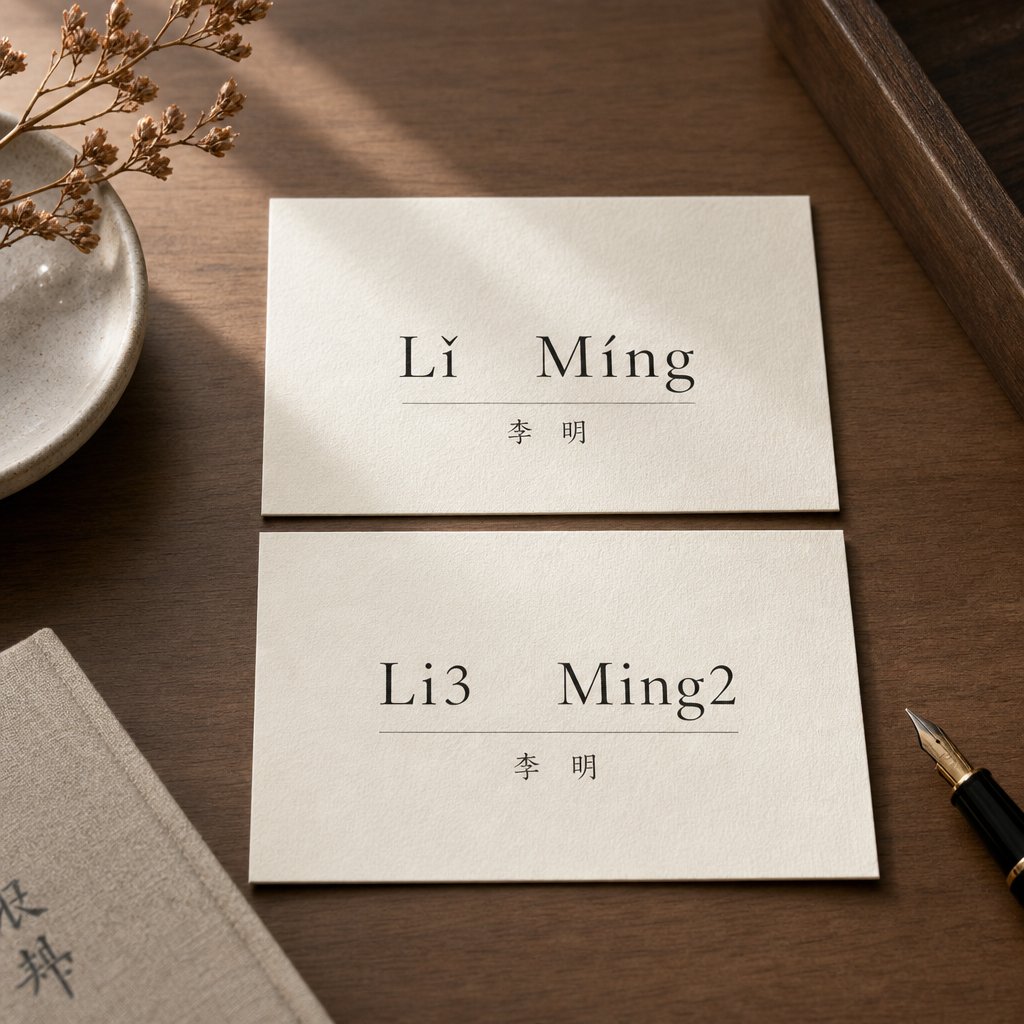
Inside China, naming follows relatively standardized rules. Mandarin Pinyin governs romanization, and typical chinese names appear in a predictable surname-first format. Step outside those borders, and everything shifts. Diaspora naming is shaped by dialect group — whether a family spoke Cantonese, Hokkien, Teochew, or Hakka before emigrating. It's shaped by colonial history, where British clerks in Malaya or Spanish administrators in the Philippines recorded names according to their own phonetic logic. It's shaped by host-country bureaucracy that forced chinese family names into forms designed for Western naming conventions. And it's shaped by generational distance, where each generation drifts further from the original characters and closer to local norms.
The meaning chinese names carry — encoded in carefully chosen characters — often becomes invisible once a name is romanized into an asian name on a foreign document. The character is lost; only the sound remains, and even that sound depends on who was listening when it was first written down.
The Scale of Chinese Diaspora Naming Diversity
The scope of this phenomenon is enormous. Official estimates suggest approximately 60 million overseas Chinese and ethnic Chinese live outside mainland China — nearly equivalent to the population of the United Kingdom. Their naming patterns diverge significantly from PRC conventions, producing a global landscape where asian surnames names can look entirely unrelated despite sharing identical characters.
A single surname character can produce dozens of romanized variants across the global diaspora — not because of error, but because each spelling preserves a specific dialect, a specific era, and a specific colonial encounter frozen in time.
These names and characters tell migration stories that census data alone cannot capture. They reveal which province a family left, which dialect they spoke at home, and which foreign system first attempted to spell their identity. The real question isn't why Chen became Chan — it's how the same written character could generate an entire spectrum of surnames that most people would never connect to one another.
How Chinese Names Are Structured and Why It Matters
Before you can decode how a name transforms across borders, you need to understand how it's built in the first place. So how are chinese names structured? The system is elegant but fundamentally different from Western conventions — and that difference is exactly where diaspora confusion begins.
A full Chinese name typically contains two or three characters total. The surname comes first, followed by the given name. There's no middle name in the Western sense, though the structure can accommodate a generation name that functions somewhat like one. When you see common chinese full names like Wang Xiaoming or Li Mei, the single-syllable word at the front is always the family name.
Surname and Given Name Order in Chinese Tradition
Chinese name order places the family above the individual — literally. The surname leads, signaling lineage and collective identity before personal identity. This is the opposite of English-speaking conventions, where given names come first and the family name trails behind.
Imagine the confusion this creates at an immigration counter. A person named Chen Weiming hands over their documents, and the clerk records "Chen" as a chinese name first name — a given name — while "Weiming" gets logged as the surname. This exact scenario played out repeatedly during early waves of Chinese migration. As the Asia Media Centre documents, such mix-ups in New Zealand resulted in subsequent generations of Chinese families carrying the "wrong" surnames on official records — errors that became permanent.
These chinese naming conventions still trip up modern systems. Airline bookings, university registrations, and government databases built around given-name-first assumptions routinely scramble Chinese names, splitting two-character given names or misidentifying which element is the surname.
The Role of Generation Names and Family Poems
Beyond the basic surname-given name structure, many Chinese families historically followed a tradition called 字辈 (zibei) — the generation poem. This is a pre-composed poem, sometimes written centuries ago by a family's ancestors, where each character in sequence is assigned to a successive generation.
Here's how it works in practice: all male cousins born into the same generation share one character in their given name, drawn from the next line of the poem. Their children's generation takes the following character, and so on. According to genealogy researchers at My China Roots, these generation names were decided in advance by forefathers and could not be changed — they were written into the family's historical records.
For diaspora families, this tradition becomes a powerful genealogical tool — or a fading memory. Some overseas Chinese communities maintained generation poems for several generations after emigrating. Others abandoned the practice within a single generation, especially where assimilation pressure was strong or where the family poem itself was lost during migration. Whether the tradition persists or disappears tells you something about how connected a diaspora community remained to its ancestral village.
Common Chinese Surnames and Their Frequency
One of the most striking features of chinese last names is how few there are. While English-speaking countries have hundreds of thousands of distinct surnames, China draws from a remarkably concentrated pool. The top 100 common chinese last names cover approximately 85 percent of the population, and only about 400 distinct surnames exist in active use.
The concentration at the top is staggering. The most common chinese last names — Wang, Li, and Zhang alone — are shared by more than 270 million people. That's nearly the population of the United States carried by just three family names.
| Surname (Pinyin) | Character | Meaning | Approximate Frequency |
|---|---|---|---|
| Wang | 王 | King | ~92 million |
| Li | 李 | Plum tree | ~93 million |
| Zhang | 张 | Bow (archer) | ~87 million |
| Chen | 陈 | Ancient kingdom | ~64 million |
| Liu | 刘 | Kill (archaic) | ~67 million |
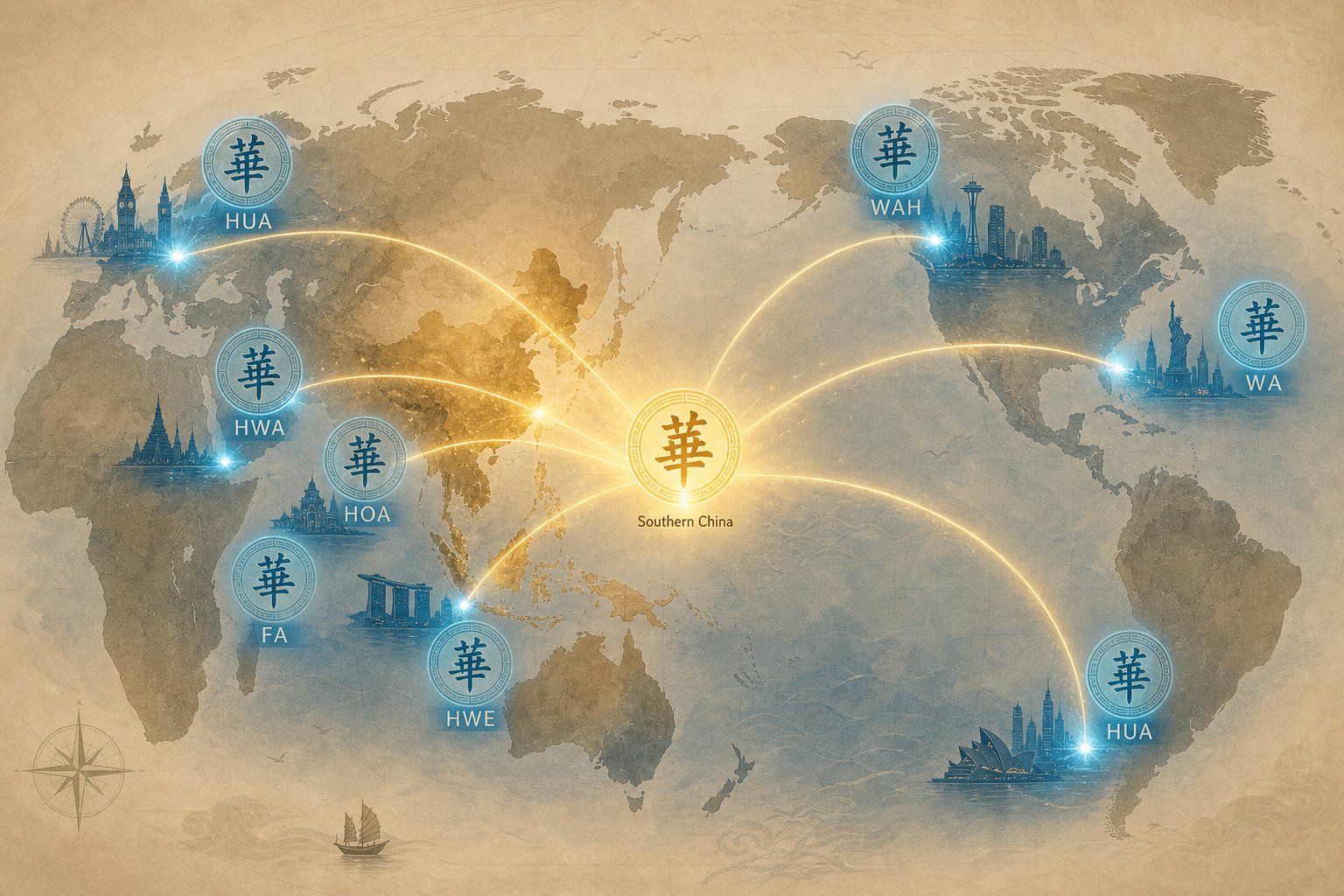
This concentration matters for diaspora naming because it means a relatively small set of surnames generates an outsized number of romanized variants worldwide. When tens of millions of people share the surname 陈, and those people emigrate across different decades to different countries speaking different dialects, the result is a sprawling family of spellings — Chen, Chan, Tan, Chin, Tran — all tracing back to one character. The dialect each family spoke at the moment of emigration determined which version became their permanent identity abroad.
Dialect Groups That Created Different Surname Landscapes
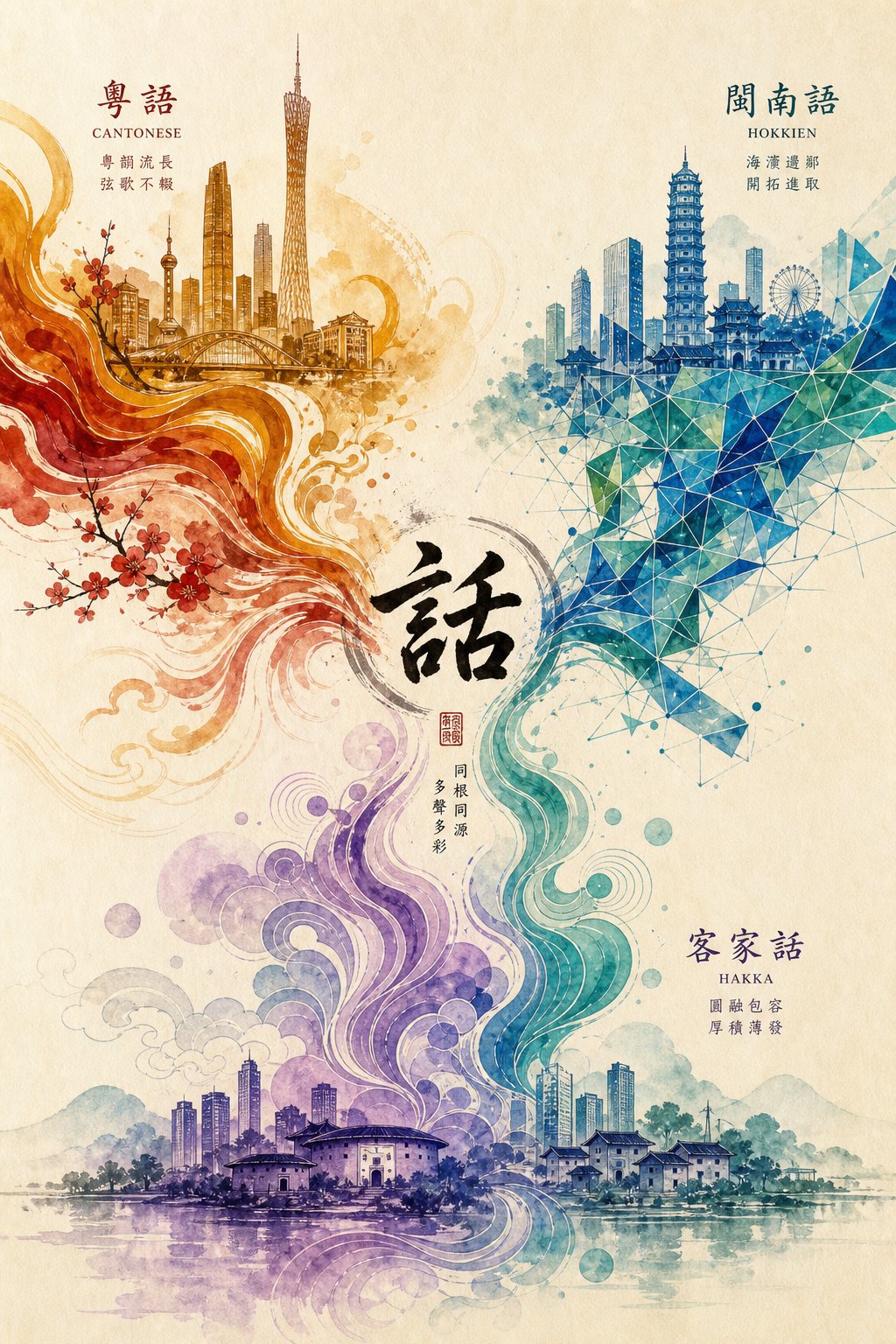
The dialect a family spoke at the moment they left China didn't just influence their surname spelling — it determined it entirely. Each major Chinese dialect group produces its own romanization of the same written characters, and because different dialect groups dominated migration to different parts of the world, entire countries ended up with distinct chinese surname landscapes that look nothing alike.
Cantonese Romanization and Its Global Footprint
Cantonese speakers from Guangdong province and Hong Kong dominated early Chinese migration to the Americas, Australia, and the United Kingdom from the mid-1800s onward. Their pronunciations became the "default" cantonese names that English speakers associate with Chinese identity: Chan, Wong, Ng, Lau, Lee, Cheung.
Consider wong in chinese — it represents the character 黄 (Huang in Mandarin). But for the Cantonese-speaking laborers who built railroads across North America and mined gold in Australia, the sound was "Wong," and that's what immigration clerks wrote down. The same applies to the last name chen: the character 陈 became "Chan" in Cantonese, and for decades, Chan was far more common than Chen in Western countries simply because Cantonese speakers arrived first.
This early dominance means that if you encounter someone named Wong, Ng, or Lau in an English-speaking country, you're likely looking at a family with roots in Guangdong or Hong Kong — or at least one whose ancestors spoke Cantonese when they emigrated. The Asia Media Centre notes that in territories with a sizeable Chinese diaspora, the way a family name is spelled acts as a signifier of the region a person's ancestors came from.
Hokkien and Teochew Naming in Southeast Asia
Shift your attention to Southeast Asia, and the surname landscape changes completely. Hokkien speakers from Fujian province dominated migration to Singapore, Malaysia, the Philippines, and parts of Indonesia. Their pronunciations produced an entirely different set of spellings: Tan (not Chan or Chen), Lim (not Lin or Lam), Ong (not Wang or Wong), Goh, Koh, and Chua.
Teochew speakers — from the Chaoshan region of eastern Guangdong — created yet another layer. The wang last name origin traces back to the character 王, meaning "king." In Mandarin it's Wang, in Cantonese it's Wong, in Hokkien it's Ong, but in Teochew it becomes Heng. Same character, same meaning, four completely different surnames on four different passports.
This is why Singapore and Malaysia have such a distinctive naming profile. You'll find Tan, Lim, Ong, and Goh far more frequently than Chan or Wong — not because different families emigrated, but because Hokkien and Teochew speakers outnumbered Cantonese speakers in those migration streams.
Hakka and Fuzhounese Variations
Hakka speakers add another dimension. Scattered across southern China and known historically as a migrant people even within China, Hakka communities settled in parts of Southeast Asia, Mauritius, and the Caribbean. Their pronunciations overlap with Cantonese in some cases — the huang name origin character 黄 becomes Wong in both Hakka and Cantonese — but diverge sharply in others. The li surname 李 stays close to "Lee" across most dialects, but Zhang (张) becomes "Chong" in Hakka rather than "Cheung" (Cantonese) or "Teo" (Hokkien). If you've ever wondered how to pronounce zhang, the answer depends entirely on which dialect community you're asking.
Fuzhounese speakers from Fuzhou city — distinct from broader Hokkien — have built significant communities in parts of the United States, particularly New York. Their romanizations differ yet again, adding another thread to an already complex tapestry.
The table below shows just how dramatically a single chinese surname character transforms across dialect systems:
| Character | Mandarin (Pinyin) | Cantonese | Hokkien | Teochew | Hakka |
|---|---|---|---|---|---|
| 陈 | Chen | Chan | Tan | Tan | Chin |
| 林 | Lin | Lam | Lim | Lim | Lim |
| 黄 | Huang | Wong | Ng / Ooi | Ng | Wong / Vong |
| 王 | Wang | Wong | Ong | Heng | Wong |
| 李 | Li | Lee / Lei | Lee | Lee | Li / Lee |
Look at the row for 黄 alone — Huang, Wong, Ng, Ooi, and Vong are all the same surname. Without knowing the underlying character, you'd never connect them. Multiply this across hundreds of surnames and millions of emigrants, and you begin to see how dialect groups didn't just influence naming — they built entirely separate surname worlds that coexist across the global diaspora.
Dialect, however, is only one force shaping these names. In many regions, colonial administrators added their own layer of distortion — recording, standardizing, and sometimes outright replacing Chinese names according to systems that had nothing to do with Chinese phonetics at all.
How Colonial History Shaped Chinese Diaspora Surnames
Colonial governments didn't just passively record Chinese names — they actively reshaped them. Across Southeast Asia and beyond, European administrators imposed naming systems that forced Chinese communities to adapt, translate, or entirely abandon their original surnames. These decisions, often made by clerks with no understanding of Chinese phonetics, created permanent surname variations that persist generations later. The chen last name origin might trace back to a single character, but colonial policy could turn it into something unrecognizable.
Spanish Colonial Influence on Chinese Filipino Surnames
The Philippines offers one of the most dramatic examples. In 1849, Spanish Governor Narciso Claveria issued a decree requiring all Filipino subjects — including Chinese mestizos — to adopt surnames from an official catalog. Chinese Filipinos who had been using their own family names were forced into phonetic adaptations or entirely new constructions that blended Hokkien sounds with Spanish spelling conventions.
The results are surnames that no outsider would identify as Chinese: Cojuangco (from the Hokkien Ko Hwan-ko), Ongpin (from Ong Peng), Yuchengco (from Yu Cheng-ko), and Limjoco (from Lim Jo-ko). These character surnames preserved fragments of the original Chinese sound but wrapped them in Spanish orthography, creating a naming layer unique to the Philippines. A tan last name in Singapore and a Tantoco in Manila might share the same ancestral character — 陈 or 陶 — yet appear completely unrelated on paper.
Dutch and Indonesian Naming Policies
Indonesia took assimilation even further. The Dutch colonial period already encouraged Chinese residents to adopt local customs, but the most sweeping change came in 1966-67 under Suharto's New Order regime. According to U.S. government research, most ethnic Chinese Indonesians were forced to take Indonesian names during this period, with very few keeping their original Chinese surnames. The government banned Chinese characters, Chinese-language media, and public displays of chinese family customs — including the use of Chinese names.
Families responded in different ways. Some created entirely new Indonesian-sounding surnames by translating the meaning of their Chinese characters into Javanese or Malay equivalents. Others constructed elaborate surnames that bore no connection to their original name at all. Prominent ethnic Chinese Indonesians ended up with names like William Soeryadjaya, Leo Suryadinata, and Franz Winarta — names that reveal nothing about their Chinese heritage to an outsider. The surname chinese communities once carried became invisible, buried beneath layers of forced assimilation.
British Registration Practices in Malaya and Hong Kong
British colonial naming practices were less overtly coercive but equally consequential. In Malaya, Hong Kong, and the Straits Settlements, British clerks recorded Chinese names based on whatever dialect pronunciation they heard — often inconsistently, sometimes incorrectly. There was no standardized chinese name converter or romanization system in use. A clerk in Penang might spell a Hokkien surname one way, while a clerk in Singapore spelled the same surname differently, and a third clerk in Hong Kong used Cantonese pronunciation entirely.
The Hong Kong Government Cantonese Romanization system wasn't even originally designed for personal names — it was created for street and place naming. The general public simply adopted it for translating people's names, and it became the de facto standard. This means a surname in chinese recorded in Hong Kong in 1920 might follow completely different spelling conventions than the same surname recorded in 1960, even within the same family.
These colonial-era decisions created permanent divergences. Siblings registered at different times or in different offices could end up with different romanized chinese last name spellings. Extended families split across Malaya and Hong Kong might carry surnames that look unrelated despite sharing the same ancestral character.
- Philippines (Spanish): Chinese surnames fused with Spanish orthography, producing unique constructions like Cojuangco, Ongpin, Yuchengco, and Limjoco
- Indonesia (Dutch/Indonesian): Chinese names banned outright; families adopted Indonesian-sounding surnames or created new ones with no visible Chinese connection
- Malaya and Singapore (British): Dialect pronunciations frozen inconsistently by clerks, producing variant spellings of the same surname across documents and family members
- Hong Kong (British): Cantonese romanization standardized informally through a system designed for streets, not people — locking in one dialect's pronunciation as the official record
- Myanmar (British): Chinese surnames sometimes adapted to Burmese phonetics or combined with Burmese naming conventions
What connects all these outcomes is a single pattern: an external authority — not the family itself — determined how a Chinese name would appear in official records. Whether through forced adoption of new surnames, inconsistent transcription, or outright bans on Chinese characters, colonial systems severed the visible link between a diaspora family and its ancestral naming heritage. The original characters might survive in family memory or private documents, but the public-facing name became something else entirely — shaped by whoever held the pen at the registration desk.
Regional Naming Patterns from Southeast Asia to the Americas
Dialect and colonial history don't operate in isolation — they combine with local immigration policy, assimilation pressure, and the sheer demographics of who arrived when. The result is that each major diaspora region developed its own distinct naming ecosystem. Walk into a Chinese community in Bangkok, and the most common chinese names you encounter will look nothing like those in Vancouver or Melbourne. Each region tells a different story about how asian names adapted to survive.
Southeast Asian Chinese Naming Ecosystems
Southeast Asia is home to the largest concentration of overseas Chinese — roughly 30 million people across multiple countries — and each nation produced a radically different naming environment. The variation isn't subtle. It's the difference between a surname being preserved, modified, or erased entirely.
Singapore and Malaysia represent the most linguistically diverse Chinese naming landscapes. Both countries received waves of Hokkien, Teochew, Cantonese, Hakka, and Hainanese migrants, and their naming patterns reflect this mix. The most common chinese surnames in Singapore — Tan, Lim, Lee, Ong, Wong — map directly onto dialect-group demographics. Hokkien speakers form the largest group, which is why Tan (陈) outnumbers Chan or Chen. Malaysia follows a similar pattern but with regional variation: Penang skews Hokkien, Kuala Lumpur has a stronger Cantonese presence, and Johor leans Teochew. Crucially, neither country forced Chinese residents to abandon their surnames, so dialect-based romanizations survived intact across generations.
Thailand took a fundamentally different approach. The Thai Nationality Act of 1913 required all citizens and permanent residents to register a family surname — and each surname had to be unique. For Chinese immigrant families, this created an immediate problem: common chinese names like Chen, Lin, or Huang were shared by thousands of families. Since duplicates were prohibited, Chinese Thai families had to modify or expand their original surnames to create something unique. Some chose Thai words that sounded similar to their Chinese surname. Others created longer surnames by adding syllables or translating the original name's meaning into Thai. The result is that ethnic Chinese Thais today carry surnames like Shinawatra (from the Hakka Qiu family), Vejjajiva, or Chearavanont — names that are distinctly Thai in form but Chinese in origin. The original one-syllable Chinese surname effectively disappeared from public records.
The Philippines and Indonesia — as covered in the colonial context — went even further. Filipino Chinese carry Spanish-influenced constructions, while Indonesian Chinese were pressured into adopting entirely Indonesian names. In both cases, the visible connection to Chinese naming was severed by policy rather than choice.
Chinese Naming in the Americas
The naming landscape in North America tells a story of two distinct migration waves colliding in the same communities. From the 1850s through the mid-20th century, Chinese migration to the United States and Canada was overwhelmingly Cantonese. These early arrivals established the popular chinese names that English speakers came to associate with Chinese identity: Chan, Lee, Wong, Chow, Fong, and Yee. For over a century, these Cantonese romanizations were essentially the only Chinese surnames most Americans or Canadians ever encountered.
Then came the Immigration and Nationality Act of 1965 in the United States, which eliminated national-origin quotas and opened the door to a new wave of migrants — this time predominantly Mandarin-speaking, from Taiwan and later mainland China. They arrived with Pinyin-standardized surnames: Chen instead of Chan, Wang instead of Wong, Huang instead of Ng, Zhang instead of Cheung. The most popular chinese names in American communities shifted visibly. By the 2000s, census data showed that both "Chen" and "Chan" ranked among the most frequent Chinese surnames in the U.S. — the same character, 陈, represented twice because two dialect groups had each left their mark decades apart.
Canada mirrors this pattern with an additional layer: significant Cantonese-speaking migration from Hong Kong accelerated in the 1980s and 1990s ahead of the 1997 handover, reinforcing Cantonese naming conventions in cities like Vancouver and Toronto even as Mandarin-speaking newcomers arrived simultaneously. The result is communities where a Wong and a Huang might live on the same street, attend the same temple, and share the same ancestral surname character without ever realizing it.
Latin America adds yet another dimension. Peru and Cuba received early Cantonese migration in the 19th century, producing surnames adapted to Spanish phonetics — Wong became "Von" or remained "Wong," while other names were hispanicized entirely. Brazil's Chinese community, arriving later and from more diverse origins, carries a mix of Cantonese and Mandarin romanizations filtered through Portuguese spelling conventions.
European and Oceanian Patterns
In the United Kingdom, Chinese naming follows a pattern similar to North America's two-wave structure. Early 20th-century migration from Hong Kong — particularly from the New Territories — established Cantonese surnames in cities like London, Liverpool, and Manchester. Post-1990s migration from mainland China introduced Mandarin Pinyin spellings, and the two systems now coexist. France's Chinese community is notably diverse, drawing heavily from former Indochinese colonies (Vietnam, Cambodia, Laos) where ethnic Chinese had already adapted their names once — meaning a Chinese French surname might carry layers of Vietnamese or Khmer phonetic influence on top of the original dialect pronunciation.
Australia and New Zealand followed the Cantonese-first, Mandarin-later pattern seen across the Anglophone world. Gold rush-era migration in the 1850s-1860s brought Cantonese speakers whose surnames became embedded in local records. Contemporary migration from mainland China, Taiwan, and Malaysia has diversified the naming landscape considerably, making both Cantonese and Hokkien romanizations common alongside Pinyin.
The table below maps how these regional factors combine to produce distinct naming environments:
| Region | Dominant Dialect Group(s) | Typical Surname Romanizations | Common Naming Strategy | Western Name Adoption |
|---|---|---|---|---|
| Singapore / Malaysia | Hokkien, Teochew, Cantonese | Tan, Lim, Ong, Wong, Lee | Dialect romanization preserved; English given name added | High (English first names common) |
| Thailand | Teochew, Hokkien, Hakka | Thai-ified surnames (Shinawatra, Chearavanont) | Chinese surname replaced with unique Thai surname | Low (Thai names used instead) |
| Philippines | Hokkien | Spanish-influenced (Cojuangco, Ongpin, Tan) | Hokkien sounds in Spanish orthography; some retain Tan, Lim, Ong | High (Spanish/English first names) |
| Indonesia | Hokkien, Hakka, Teochew | Indonesian names (Hartono, Widjaja, Salim) | Chinese surname replaced entirely with Indonesian name | Moderate (Indonesian names dominate) |
| United States / Canada | Cantonese (early), Mandarin (post-1965) | Chan/Chen, Wong/Wang, Lee/Li | Dual systems coexist; Western first name + Chinese surname | Very high |
| United Kingdom | Cantonese (early), Mandarin (recent) | Chan, Wong, Cheung / Chen, Wang, Zhang | Western first name + dialect surname | Very high |
| Australia / New Zealand | Cantonese (early), Mandarin and Hokkien (recent) | Wong, Chan, Lee / Wang, Chen, Tan | Western first name + Chinese surname | Very high |
| France | Teochew, Cantonese (via Indochina) | Tran, Nguyen-overlay, Chan | French first name + adapted surname | High |
| Peru / Cuba | Cantonese | Wong, Chan (hispanicized variants) | Spanish first name + Cantonese surname | Very high (Spanish names) |
What this regional comparison reveals is that chinese common names aren't universal — they're deeply local. The "common" Chinese surname in one country might be rare or nonexistent in another, not because different families emigrated, but because different dialects, different policies, and different historical moments produced entirely separate naming outcomes from the same source material. A Tan in Singapore, a Chan in San Francisco, and a Shinawatra in Bangkok could all trace their lineage to the same ancestral character — yet their names carry the fingerprint of three completely different migration stories.
These regional patterns, however, only describe the surname side of the equation. Equally complex — and far more personal — are the strategies diaspora families use to navigate given names, choosing whether to adopt Western names, preserve Chinese ones, or build hybrid identities that straddle both worlds.
Western Name Adoption and Hybrid Naming Strategies
Surnames might be shaped by dialect and colonial history, but given names are where personal choice enters the picture. For diaspora Chinese navigating daily life in English-speaking or non-Chinese environments, the question isn't abstract: do you keep your Chinese given name, adopt a Western one, or find some way to carry both? The strategies people use to convert chinese names into english contexts are surprisingly varied — and each one reflects a different calculation about identity, convenience, and belonging.
Phonetic Approximation and Meaning Translation
One of the most intuitive approaches is phonetic matching — choosing an English name that sounds like your Chinese given name. Someone named Wei might become "Vicky" or "Wayne." A person named Mei could go by "May." Xiu might become "Sue." The goal is a chinese name from english name that preserves some echo of the original sound, creating a bridge between the two identities rather than replacing one entirely.
Then there's meaning translation. Chinese given names carry deliberate semantic weight — parents choose characters for their connotations of beauty, strength, wisdom, or prosperity. Some diaspora Chinese select English names that mirror this meaning rather than the sound. A name built from characters meaning elegance might become "Grace." A name meaning brightness could translate into "Claire." A name suggesting scholarly achievement might lead to "Sage." This approach treats the english name chinese name pairing as a conceptual translation rather than a phonetic one.
A third strategy is pure pragmatism: picking a common Western name that's easy to pronounce, easy to spell, and carries no particular connection to the Chinese original. As Sixth Tone explains, proficient English speakers with a deep understanding of Western culture often choose the simplest, most common names — demonstrating sensitivity to a different set of cultural norms and a desire to avoid the social awkwardness of teaching non-Mandarin speakers how to pronounce their birth names.
What's fascinating is that this pragmatic approach has deep roots in Chinese tradition. The practice of adopting additional names isn't a modern concession to globalization. Historically, Chinese people carried multiple names across their lifetime — a surname (xing), a personal name (ming), an adulthood name (zi), and a self-chosen name (hao). The hao was self-selected and intended to reveal an aspect of one's personality, much like a chosen English name today. In this light, adopting a Western name isn't cultural erasure — it's a continuation of a centuries-old naming tradition adapted to a new linguistic context.
The Western First Name Plus Chinese Middle Name Formula
The most common hybrid strategy across English-speaking diaspora communities follows a specific formula: a Western given name up front, the Chinese given name preserved as a middle name, and the family surname at the end. According to the Cultural Atlas, this typically looks like: [Western given name] [Chinese given name] [family name]. So ZHANG Chen might become James Chen Zhang in Western contexts.
This formula serves multiple purposes simultaneously. Professionally, a Western first name removes a friction point. Research from the University of Toronto and Stanford University found that companies are more than twice as likely to call minority applicants with "whitened" resumes for interviews — even when qualifications are identical. A Western name on a resume isn't just about pronunciation convenience; it can directly affect job prospects.
Socially, the formula lets people code-switch. The Western name operates in workplaces, coffee shops, and casual introductions. The Chinese name resurfaces among family, at Chinese-language events, or in any context where Mandarin or Cantonese is spoken. Most people revert to their original Chinese name whenever speaking or writing in Chinese — the family name always comes first in the Chinese language, and the Western name simply doesn't exist in that context.
The identity motivation runs deeper still. Preserving the Chinese given name as a middle name — even if it rarely appears in daily life — maintains a legal and symbolic connection to the characters parents chose with care. It keeps the chinese name translation intact on official documents, even when the name that gets called out at Starbucks is something else entirely. For many families, this compromise feels like the best of both worlds: functional assimilation without complete erasure.
Name Reclamation Among Later Generations
Here's where the story takes an unexpected turn. After decades of diaspora Chinese adopting Western names to fit in, a growing number of second and third-generation individuals are doing the opposite — dropping their English names and reclaiming their Chinese birth names.
JiaYing Grygiel's story captures this shift vividly. Her immigrant parents chose "Caroline" for their new life in a small American town in the 1980s — an era when Yu-Ying became Diana, Tai-Jen became Jane, and Ruey-Der became Ray. Assimilation, not ethnic identity, was the goal. Twenty-three years later, she changed back to JiaYing. "There is a really strong trend for people keeping their real names, not anglicizing their names or anglicizing the spellings," notes Pamela Redmond, CEO of baby names website Nameberry. "People are prouder of their names and less willing to give up that piece of their identity to fit in with some English-centric standard."
This reclamation movement connects to broader cultural shifts. As naming diversity becomes more normalized — and as public figures with non-Anglo names gain visibility — the social cost of carrying a chinese name with english surroundings has decreased. The calculation that once made "Caroline" safer than "JiaYing" no longer holds the same weight for many younger diaspora Chinese.
Still, reclamation comes with trade-offs. Grygiel describes introducing herself with a mnemonic device — "JiaYing Grygiel, it rhymes with flying eagle" — because an uncommon name demands explanation at every new encounter. And research continues to show that resumes with non-Anglo names receive fewer callbacks. The choice between a chinese name from english name convenience and authentic self-representation remains genuinely difficult, not merely symbolic.
Across the diaspora, these individual naming decisions fall along a spectrum — from complete assimilation to full preservation of Chinese naming conventions:
- Full assimilation: Western first name and surname only; Chinese name abandoned entirely (common among Indonesian Chinese under Suharto-era policies and some early American immigrants)
- Western-dominant hybrid: Western first name used in all contexts; Chinese name retained only on legal documents or within family (the most common pattern in Anglophone countries)
- Balanced hybrid: Western name for professional/public use; Chinese name for family and community contexts; both names actively maintained (typical in Singapore and Malaysia)
- Chinese-dominant with Western convenience name: Chinese name used as primary identity; Western name exists only for situations where pronunciation is a barrier (common among recent mainland emigrants)
- Full preservation: Chinese given name used in all contexts without a Western alternative; romanization may vary but no english to chinese name substitution occurs
- Reclamation: Western name previously used is actively dropped in favor of returning to the original Chinese name (an emerging trend among second and third-generation diaspora)
Where a person falls on this spectrum depends on generation, geography, profession, and increasingly, personal politics. What's clear is that the old one-way trajectory — from Chinese name toward Western name — is no longer the only direction of travel. For chinese names for english names, the relationship has become bidirectional, with each generation renegotiating the balance their parents struck.
These naming choices, however personal they feel, don't happen in a vacuum. They collide with bureaucratic systems that were never designed to accommodate them — creating a whole category of practical problems that affect everything from boarding a flight to opening a bank account.
Legal and Bureaucratic Naming Challenges in the Diaspora
Every naming strategy — whether hybrid, assimilated, or fully preserved — eventually meets a form that needs filling out. And that's where theory collides with reality. For diaspora Chinese, bureaucratic systems designed around Western naming conventions create a persistent category of practical problems. These aren't minor inconveniences. They affect passports, bank accounts, flight bookings, academic transcripts, and legal identity itself. The gap between how chinese first and last names actually work and how administrative systems expect them to work produces errors that can follow a person for life.
Name Order Reversal on Official Documents
The most fundamental clash is structural. Chinese names place the surname first — family identity before individual identity. Western systems expect the opposite: given name, then family name. Sounds simple enough to reverse, right? In practice, it creates chaos.
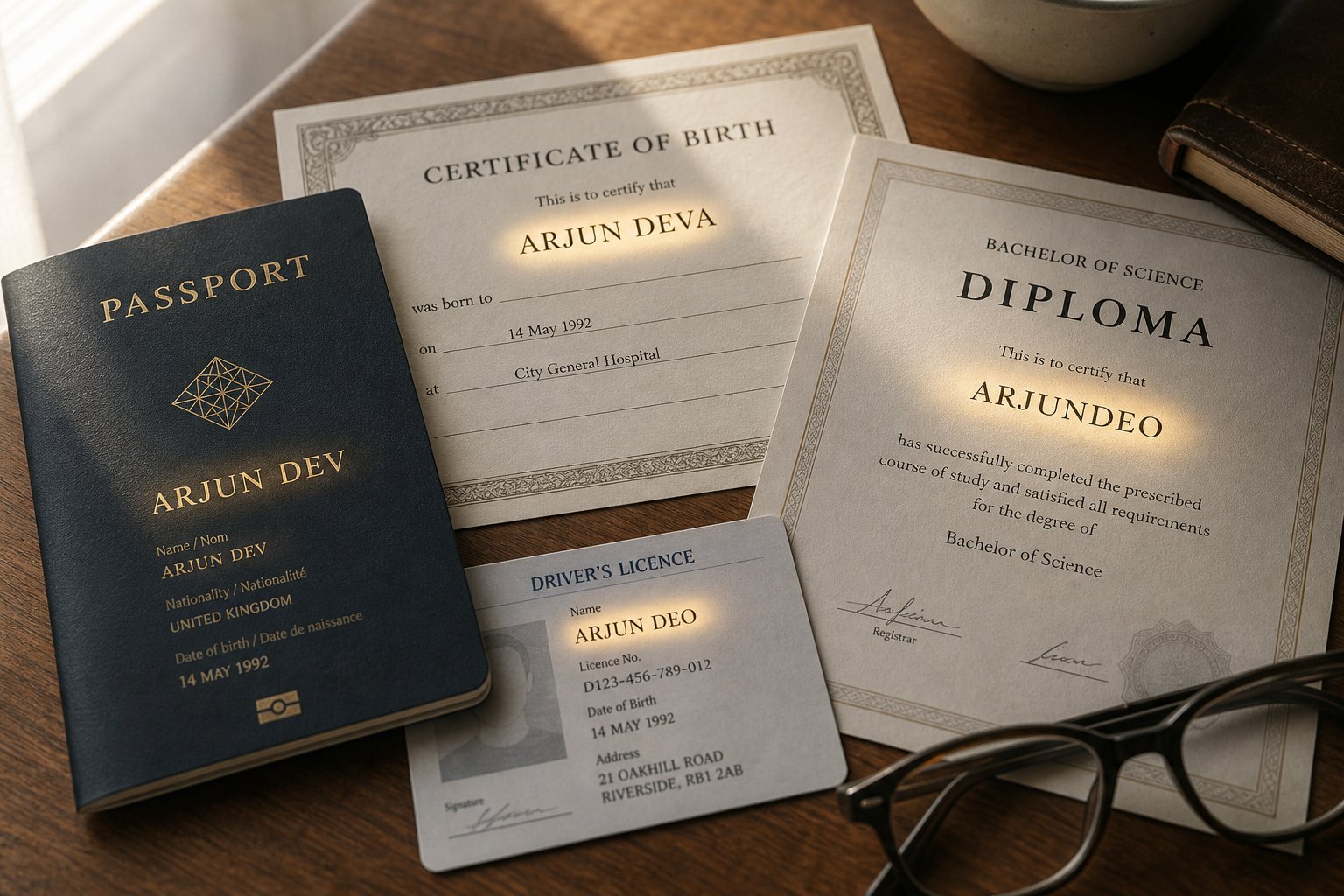
Consider someone whose full name is Zhang Weiming. On a Chinese passport, it appears exactly that way — Zhang (surname) Weiming (given name). But when this person applies for a bank account in Australia, the form asks for "First Name" and "Last Name." Which is which? If they write "Zhang" in the first name field because it literally comes first in their name, the system records their surname as "Weiming." If they understand the Western convention and reverse the order, they end up as "Weiming Zhang" — correct in intent, but now their name appears differently than on their passport.
This mismatch cascades across documents. A university transcript might read "Weiming Zhang," a driver's license might say "Zhang, Weiming," and a work visa might list "ZHANG WEIMING" with no indication of which element is the first name and last name in chinese convention. The same person now appears as three slightly different identities across three systems — all technically correct, none fully consistent. For anyone trying to verify identity across documents, the confusion is immediate.
The problem intensifies with two-character given names. Is "Wei Ming" one given name or a first-plus-middle combination? Systems that split names at every space will separate it into three parts — Wei, Ming, Zhang — creating a phantom middle name that doesn't exist. Names with a hyphen like "Wei-Ming" fare slightly better in some databases but trigger errors in others that reject special characters entirely.
Character Limits and System Constraints
Beyond name order, the technical infrastructure of modern bureaucracy introduces its own distortions. Government forms, airline booking platforms, and financial databases were built with Anglo-Saxon naming assumptions: a first name of reasonable length, a last name of reasonable length, and maybe a middle initial. Chinese names — especially when romanized — don't always fit these boxes.
Airline booking systems illustrate this perfectly. Traveloka's help center, for instance, provides specific instructions for passengers with chinese first and last names: users must identify their first and last name using the Machine Readable Zone (MRZ) on their passport, where everything to the left of the double chevron (<<) represents the last name in chinese convention, and the remaining part goes in the first name column. The fact that a major travel platform needs a dedicated section explaining how to enter a Chinese name tells you everything about how poorly standard systems accommodate these naming structures.
The problems multiply from there. Name chinese characters cannot be entered into most Western databases at all — only romanized versions are accepted. Single-character surnames like "O" or "Ng" sometimes get rejected by systems requiring a minimum character count. Some platforms cannot process surnames without a vowel. Others truncate long romanized names that exceed field limits, turning "CHEN SHI YAN" into "CHEN SHI" and dropping the rest.
For diaspora communities in Singapore, Malaysia, and the Philippines, there's an additional wrinkle: some individuals genuinely have no surname in the Western sense, or their name doesn't divide neatly into first-and-last components. Booking systems handle this differently by country — in some regions, you repeat your first name in the last name field; in others, you tick a box declaring "this person has no last name." Either workaround creates a legal name on the ticket that doesn't match the name on the passport, potentially causing problems at check-in or immigration.
Surname Variation Within a Single Family
Perhaps the most disorienting consequence of bureaucratic naming systems is what happens within families. When there's no standardized way to determine first name last name chinese order — and no consistent romanization system applied across time — siblings and parent-child pairs can end up with different official surnames.
Imagine a family where the father emigrated in the 1970s and had his Cantonese-pronounced surname recorded as "Chan" by an immigration officer. Twenty years later, his adult son applies for citizenship independently, and a different clerk — now using Mandarin Pinyin as the reference — records the same character as "Chen." Father and son share the surname character 陈, but their passports say different things. Legally, they appear to have different family names.
This isn't hypothetical. It happens routinely in families where members emigrated at different times, through different countries, or dealt with different administrative systems. A mother registered in British colonial Malaya might be "Tan." Her daughter, born in independent Singapore, might also be "Tan." But her grandson, born in Australia to a father who re-romanized using Pinyin, might be "Chen." Three generations, one character, three surnames on three passports.
Administrative systems don't just record names — they create them. Every form field, character limit, and romanization choice made by a clerk or a database becomes a permanent identity marker that the person must carry forward, defend at borders, and explain to institutions for the rest of their life.
The practical fallout is real. Families face complications with inheritance documents, property transfers, and sponsorship applications where officials question whether differently-surnamed individuals are actually related. Proving that "Chan," "Chen," and "Tan" are the same family requires producing original-language documents, statutory declarations, or genealogical evidence — bureaucratic labor that families with Anglo-Saxon surnames never encounter.
These aren't problems that any individual can solve through better personal choices. They're structural — built into systems that treat a romanized spelling as a fixed identity rather than one possible rendering of an underlying character. And they compound over time, because each generation inherits not just a name but whatever administrative decisions were made about that name decades earlier.
Generational Naming Shifts from Immigrants to Local-Born
Bureaucratic systems may freeze a name in place, but families themselves keep evolving. Each generation born into the diaspora makes different calculations about naming — shaped by how much Chinese they speak, how connected they feel to ancestral villages, and what social pressures surround them. The result is a predictable arc: chinese first names that once carried deep familial significance gradually give way to Western names, local conventions, and eventually, in some families, no Chinese name at all. Tracking this progression reveals how diaspora naming patterns aren't static — they're generational stories unfolding in real time.
First Generation Naming Decisions and Their Legacy
When a first-generation immigrant steps off a ship or through an airport, the name that gets recorded in that moment becomes the foundation for every descendant who follows. Whether it was the immigrant themselves who chose a romanization, or an immigration officer who guessed at the spelling, that initial decision locks in permanently.
Consider the 19th-century Cantonese laborers who arrived in California or Australia. Most were illiterate in English. A clerk heard their surname — perhaps 黄, pronounced "Wong" in Cantonese — and wrote it down however it sounded. That spelling became the family's legal identity. Every child, grandchild, and great-grandchild born afterward inherited "Wong" regardless of whether they spoke Cantonese, Mandarin, or only English. The original character 黄 might be forgotten within two generations, but the clerk's phonetic guess persists on birth certificates indefinitely.
Mid-20th-century refugees from political upheaval — fleeing the Chinese Civil War, the Cultural Revolution, or Southeast Asian anti-Chinese violence — faced similar moments of naming crystallization. A family arriving in the UK from Hong Kong in 1962 had their Cantonese pronunciation recorded. A family fleeing Vietnam in 1979 might have already carried a Vietnamese-adapted version of their Chinese surname, which then got filtered through yet another layer of romanization upon resettlement in France or the United States. Each transit point added a layer of phonetic distortion, and the final recorded version became permanent.
What makes these first-generation decisions so consequential is their irreversibility in practice. Legally changing a surname is possible but socially and administratively burdensome. Most families simply accept whatever was recorded and pass it forward — meaning a split-second decision made under stressful circumstances in 1885 or 1975 still determines how a family identifies itself today.
Second and Third Generation Naming Shifts
Locally-born generations face a different naming landscape entirely. They grow up speaking English, Malay, Thai, or whatever the dominant local language is — often with limited or no Chinese language ability. Their relationship to Chinese naming traditions becomes increasingly abstract.
The most visible shift is the near-universal adoption of Western given names. While first-generation immigrants might have used their Chinese given name daily and adopted an English name only for workplace convenience, second-generation children often receive a Western name as their primary identity from birth. The Chinese name — if one is given at all — becomes a middle name on legal documents or exists only within the family home. Do chinese people have middle names in the Western sense? Not traditionally, but the diaspora hybrid formula effectively creates one by slotting the Chinese given name into the middle-name position on birth certificates.
Generation-name traditions erode fastest in this transition. Research from the National University of Singapore documents this decline clearly. Associate Professor Lee Cher Leng, who surveys undergraduate students about generational naming practices, finds that only a small handful have been named according to their family's genealogy books. Most students are thoroughly unfamiliar with the tradition. Dr. Peter Tan's research confirms that the majority of young Singaporeans surveyed don't have a generation name at all — modern parents, primarily English-speaking, view long-term traditions like generation names as outdated.
The loss isn't just linguistic. Generation names once served as a built-in system for identifying family relationships — you could tell at a glance whether two people were cousins of the same generation simply by the shared character in their names. Without them, as the NUS researchers note, "everyone is uncle or auntie" — the relational specificity that naming once provided disappears, and with it, a tool for maintaining family cohesion across distance.
By the third generation, some families stop giving chinese baby names entirely. Children receive only Western names, and the Chinese surname — still carried forward legally — becomes the sole remaining marker of Chinese heritage in their official identity. Chinese nicknames for children might persist informally among grandparents, but these rarely make it onto any document. The naming thread connecting a family to its ancestral village grows thinner with each generation until, for some, it snaps entirely.
Contemporary Migration Waves and New Patterns
Against this backdrop of gradual assimilation, a new wave of Chinese emigrants has arrived since the 1980s — and their naming patterns look strikingly different from established diaspora communities. These contemporary migrants come predominantly from mainland China, are often highly educated, and arrive with names already standardized in Hanyu Pinyin. They carry surnames like Chen, Wang, Zhang, and Liu — spelled exactly as the PRC government prescribes.
This creates a visible split within Chinese communities abroad. A third-generation Chinese Australian named "Kevin Chan" and a recently arrived mainland professional named "Chen Wei" might share the surname character 陈, but their names signal completely different migration histories. The Cantonese romanization marks older diaspora roots; the Pinyin spelling marks recent mainland origin. Within Chinese communities, these spelling differences function as generational and class markers — sometimes creating social distance between "old" and "new" Chinese populations in the same city.
Contemporary migrants also approach given names differently. Chinese first names male immigrants carry today — names like Hao, Jun, or Wei — tend to arrive already romanized in Pinyin and often stay that way. Unlike earlier generations who might have immediately adopted a Western name upon arrival, many post-1980s migrants maintain their Chinese given names in professional contexts, particularly in fields like technology and academia where international names are more normalized. Chinese first names female migrants carry — names like Xin, Yue, or Jing — similarly persist without Western substitution more often than in previous decades.
The contrast extends to how these groups name their children. Established diaspora families choosing chinese baby names today often select characters that work phonetically in both English and Chinese — names like Kai, Mei, or Leo that sound natural in either language. Recent mainland emigrants, by contrast, are more likely to give children distinctly Chinese given names male or female — names like Zihan, Yuxuan, or Minghao — that make no concession to English phonetics. Some add a Western name as well; others don't bother. The assumption that a Chinese name needs an English equivalent is weaker among this newer cohort.
Dr. Peter Tan from NUS suggests that young parents may adapt naming traditions within their immediate families — choosing common characters or initials for their children's names rather than following a formal generation poem. This represents a middle path: the ancient tradition of shared naming elements survives in spirit, even as its formal structure dissolves.
The typical generational progression of naming patterns follows a recognizable arc from immigration through subsequent generations:
- First generation (immigrants): Full Chinese name used daily; romanization determined by dialect and the moment of registration; Western name adopted reluctantly or not at all; generation-name tradition still active; chinese middle names may reflect the family poem
- Second generation (locally born): Western first name becomes primary identity; Chinese name preserved as middle name or home name; generation-name tradition weakens significantly; bilingual naming — switching between Chinese and Western names by context
- Third generation: Western name dominant in all contexts; Chinese name may or may not be given at birth; generation-name tradition largely abandoned; surname remains the primary Chinese naming element; limited Chinese language ability makes character selection less meaningful
- Fourth generation and beyond: Chinese surname persists legally but may carry no felt cultural weight; Chinese given name rarely assigned; connection to original characters often lost entirely; some individuals in this generation begin reclamation — researching family naming history and restoring Chinese names as an act of identity recovery
This progression isn't inevitable — families with strong ties to Chinese-language communities, those who maintain regular contact with relatives in China, or those living in majority-Chinese cities like Singapore may slow or reverse the trajectory. But across most diaspora contexts, the pattern holds: each generation moves further from the naming conventions their ancestors carried, until the surname itself becomes the last visible thread connecting a family to its Chinese origins.
That thread, thin as it may become, still carries information. For anyone trying to trace family connections across borders and generations — to understand why cousins in different countries carry different surnames, or to reconnect branches of a family separated by decades of migration — these generational naming shifts aren't just cultural observations. They're practical clues that can unlock genealogical puzzles spanning continents.

Tracing Family Connections Through Diaspora Name Variations
That single surname thread — however frayed by generations of adaptation — still holds genealogical power. For anyone researching family history across borders, understanding chinese surnames and meanings isn't just academic. It's the difference between finding your relatives in foreign records and missing them entirely because their name looks nothing like yours. The same forces that created diaspora naming diversity — dialect, colonial policy, generational drift — also created a puzzle that genealogists must solve in reverse.
Why the Same Family Has Different Surnames
Imagine searching for your great-uncle who emigrated to the Philippines in the 1930s. Your family in Singapore spells the surname "Tan." His descendants in Manila carry the surname "Tantoco." A cousin who resettled in Indonesia goes by "Hartono." Another branch in Canada is recorded as "Chen." All four families descend from the same grandfather, share the same character 陈, and would recognize each other at a family altar — yet no database search connecting these surnames would ever return them as matches.
This is the core genealogical challenge. As the Vancouver Public Library's Chinese Canadian Genealogy guide documents, a single individual like the merchant Chan Toy appeared in records under at least five different name forms — Chang Toy, Chan Doe Gee, Chan Chang-Jin, Chen Chang-Jin, and Sam Kee. Tracking one person through historical records becomes extraordinarily difficult when their name shifts across documents. Now multiply that complexity across an entire extended family scattered through different countries, dialect regions, and colonial systems, and you begin to see why chinese family names and meanings can diverge so dramatically within a single lineage.
The causes stack on top of each other. Dialect romanization splits the family at the point of emigration — one brother goes to Hong Kong and becomes "Chan," another goes to Penang and becomes "Tan." Colonial policy adds another layer — descendants in Indonesia lose the Chinese surname entirely. Generational change adds a third — grandchildren in Australia re-romanize using Pinyin and become "Chen." Each split is logical in context, but the cumulative effect is a family tree where branches appear completely unrelated on paper.
Strategies for Tracing Names Across Diaspora Regions
The good news is that these transformations follow patterns. They're not random — and once you understand the system, you can work backward from a romanized surname to identify the possible Chinese characters behind it. Translating chinese names back to their source characters is the single most important step in cross-border genealogical research.
Start with dialect geography. If your ancestor emigrated to a specific region, you can narrow down which dialect group likely produced their surname spelling. A "Tan" in Singapore almost certainly represents 陈 (Chen in Mandarin) filtered through Hokkien pronunciation. A "Wong" in San Francisco is most likely 黄 (Huang) via Cantonese. Knowing the meaning of chinese last names in their original characters — and which dialect systems produce which romanizations — lets you generate a list of possible character matches for any romanized surname you encounter in records.
Generation names offer another powerful clue. If you know your family followed a 字辈 poem, the shared character across siblings or cousins becomes a search key. Even when surnames have diverged through different romanization systems, a generation name appearing in records from two different countries can confirm a family connection that surname spelling alone would never reveal. Understanding chinese surname meanings and the generational naming structure together gives you two independent threads to pull.
The mandarin name meaning encoded in given-name characters also helps. Parents in the same family often chose thematically related characters for their children — names suggesting scholarly achievement, natural beauty, or moral virtue drawn from the same conceptual pool. Recognizing these patterns in records, even when the romanization differs, can flag potential family connections worth investigating further.
Preserving Naming Heritage for Future Generations
Genealogical research is retrospective — but preservation is forward-looking. For diaspora families who want future generations to understand their chinese last names and meanings, documentation now prevents the kind of information loss that makes research so difficult later.
The Vancouver Public Library's genealogy guide offers a principle worth adopting universally: when recording a Chinese surname as part of any genealogical project, always include the Chinese character. The romanized spelling alone is ambiguous — "Lee" could represent 李, 黎, or 利, each a completely different surname with different chinese surnames meaning and different ancestral origins. The character is the anchor. Without it, future researchers face the same disambiguation problem that makes cross-border family tracing so challenging today.
Here are practical steps for researching and preserving diaspora family name connections:
- Record the original Chinese characters for every family surname and given name — don't rely solely on romanized spellings, which are ambiguous across dialect systems
- Document which dialect produced your romanization — knowing whether your "Wong" is Cantonese or Hakka narrows the character possibilities and connects you to the right migration stream
- Map your family's migration path — identify which country, which port, and which era each branch emigrated through, since these determine which romanization system was applied
- Preserve any generation poem (字辈) your family used — even partial knowledge of the sequence helps identify relatives across different surname spellings
- Cross-reference dialect romanization tables — use resources that show how the same character appears in Cantonese, Hokkien, Teochew, Hakka, and Mandarin to generate alternate surname spellings for record searches
- Interview older family members about naming decisions — first-generation immigrants often remember why a particular spelling was chosen or imposed, information that disappears when they pass
- Check for colonial-era naming policies in your ancestor's country of settlement — understanding whether names were voluntarily romanized or administratively assigned changes how you interpret records
- Search records under multiple spelling variants — if your surname is "Chan," also search for Chen, Tan, Chin, and Tran, since related family members in different countries may appear under any of these
Chinese diaspora naming patterns aren't just a cultural curiosity — they're a living record of migration, adaptation, and survival. Every spelling variant preserves a specific moment: a dialect spoken, a clerk's interpretation, a policy imposed, a generation's choice. Understanding these patterns transforms what looks like confusion into a readable map — one that connects families across oceans, decades, and alphabets back to shared characters that still mean the same thing, no matter how differently they've been spelled along the way.
Frequently Asked Questions About Chinese Diaspora Naming Patterns
1. Why do Chinese people with the same surname character have different spelled last names?
The same Chinese character produces different romanized spellings because each dialect group pronounces it differently. For example, the character 陈 is pronounced Chen in Mandarin, Chan in Cantonese, Tan in Hokkien, and Chin in Hakka. When families emigrated to different countries speaking different dialects, immigration clerks recorded whatever pronunciation they heard. That spelling became the family's permanent legal surname, passed down to all descendants regardless of what language they later spoke.
2. How can I tell which Chinese dialect group a surname comes from?
The romanized spelling of a Chinese surname acts as a dialect fingerprint. Cantonese romanizations include Chan, Wong, Ng, Lau, and Cheung — common in Hong Kong, the US, UK, and Australia. Hokkien spellings like Tan, Lim, Ong, and Goh dominate in Singapore, Malaysia, and the Philippines. Teochew produces variants like Heng for Wang. Knowing which dialect group dominated migration to a specific country helps you identify the likely origin of any romanized Chinese surname you encounter.
3. Why do many Chinese people adopt Western first names in English-speaking countries?
Diaspora Chinese adopt Western names for a mix of practical and social reasons. Research shows resumes with anglicized names receive significantly more interview callbacks. Beyond career concerns, Western names reduce the daily friction of mispronunciation and repeated explanations. However, this practice also connects to a centuries-old Chinese tradition of carrying multiple names throughout life — including self-chosen names meant to express personality — making Western name adoption less of a cultural break than it might appear.
4. What is a Chinese generation name and why is it disappearing in the diaspora?
A generation name (字辈) comes from a pre-composed poem written by ancestors, where each character in sequence is assigned to a successive generation. All cousins of the same generation share one character in their given name. This tradition is fading in diaspora communities because younger generations often lack Chinese language ability, modern parents view the practice as outdated, and the original family poems were frequently lost during migration. Research from the National University of Singapore confirms that very few young Singaporeans today carry generation names.
5. How do I trace Chinese family connections when relatives in different countries have different surnames?
Start by identifying the original Chinese character behind each romanized surname using dialect romanization tables. Map your family's migration path to determine which dialect system and colonial administration shaped each branch's spelling. Generation names — shared characters among cousins — serve as powerful cross-border identifiers even when surnames diverge. Always record the Chinese character alongside any romanized spelling, since a single romanization like Lee could represent multiple unrelated characters. Interview older family members about naming decisions before that knowledge is lost.