What Is a Chinese Name in Pinyin and Why It Matters
You see a name on a business card: Zhāng Wěi. Or maybe you need to fill out an international form and aren't sure how your Chinese name should appear in Roman letters. Either way, you're dealing with a Chinese name in pinyin, and knowing how it works makes cross-cultural communication far smoother.
What Pinyin Actually Is
Pinyin is the official romanization system for Mandarin Chinese, developed in the 1950s and based on the pronunciation of the Beijing dialect. Unlike English, Chinese is not a phonetic language. Its written characters don't reveal how a word sounds. Pinyin bridges that gap by transcribing Chinese characters into the Latin alphabet so people can read and pronounce them.
A pinyin syllable has three parts: an initial consonant, a final vowel sound, and a tone mark that indicates pitch. When applied to names, pinyin gives you a reliable pronunciation guide for every character in a person's name. It's not a translation. It doesn't tell you what a name means. It tells you how to say it.
Pinyin is a pronunciation guide, not a translation. It shows you how a Chinese name sounds, not what it means.
Why Chinese Names in Pinyin Matter
Imagine you're preparing for a meeting with a colleague named Liú Xiǎoyàn. Without understanding Chinese name romanization, you might mispronounce every syllable or even confuse the surname with the given name. These situations come up constantly in professional and personal life:
- Reading names on business cards and email signatures
- Citing authors correctly in academic papers
- Addressing colleagues and clients in international workplaces
- Introducing yourself to Mandarin speakers using proper formatting
- Filling out visa applications or official documents
Whether you want to learn how to read Chinese names in pinyin or need to write your own name for an international audience, the underlying skill is the same. You need to understand how characters map to pinyin syllables, how tones shape meaning, and how formatting conventions like capitalization and spacing work.
The good news is that pinyin follows consistent, learnable rules. Once you grasp the structure behind a Chinese name in pinyin, you'll stop guessing and start reading names with confidence. That structure starts with something fundamental: the order in which Chinese names are arranged and how each character becomes a syllable.
Understanding Chinese Name Structure in Pinyin
Every Chinese name follows a predictable blueprint, and that blueprint determines exactly how the name looks when written in pinyin. Get the structure right, and the formatting rules become intuitive.
Surname First, Then Given Name
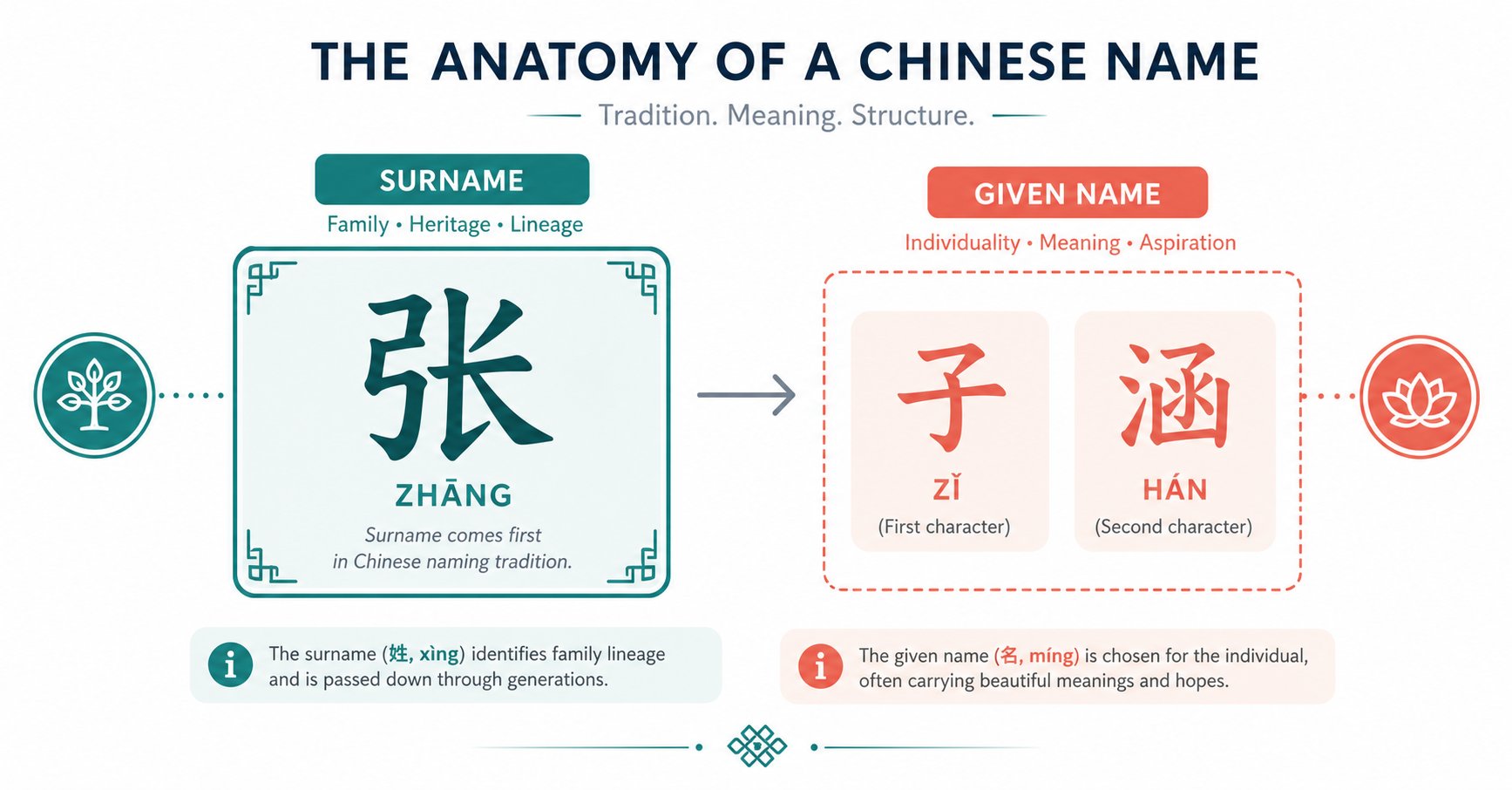
In Western naming conventions, you introduce yourself with your given name first: "Hi, I'm Michael Zhang." Chinese names flip that order entirely. The surname (family name) always comes first, followed by the given name. So the Chinese name order is surname first, reflecting a cultural emphasis on family identity before individual identity.
Consider the name 李明. The character 李 is the surname (Lǐ), and 明 is the given name (Míng). Written in pinyin, it becomes Lǐ Míng, not Míng Lǐ. This holds true regardless of context. As Columbia University's Asia for Educators explains, what matters most in Chinese culture is that a person belongs to a family, so the family name leads.
Most Chinese surnames are a single character, though a small number are two characters, like 司马 (Sīmǎ) or 欧阳 (Ōuyáng). Given names, on the other hand, are typically one or two characters. The most common modern format is a one-character surname plus a two-character given name, such as 孙中山 becoming Sūn Zhōngshān.
How Characters Become Pinyin Syllables
Each Chinese character maps to exactly one pinyin syllable. A three-character name produces three syllables. A two-character name produces two. The conversion is direct and consistent.
Here's how it works with real examples:
| Chinese Characters | Pinyin | Structure |
|---|---|---|
| 李明 | Lǐ Míng | 1-character surname + 1-character given name |
| 王小丽 | Wáng Xiǎolì | 1-character surname + 2-character given name |
| 欧阳海 | Ōuyáng Hǎi | 2-character surname + 1-character given name |
| 司马相如 | Sīmǎ Xiàngrú | 2-character surname + 2-character given name |
You'll notice that the two-character given name in Wáng Xiǎolì is written as a single unit, not separated into two words. This is one of the details people often get wrong when learning how to write a Chinese name in pinyin format. The official Hanyu Pinyin orthography rules treat the given name as one entity, regardless of how many characters it contains.
Here are the key formatting rules for pinyin capitalization and spacing:
- Capitalize the first letter of the surname (e.g., Zhāng, not zhāng)
- Capitalize the first letter of the given name (e.g., Wěi, not wěi)
- Write a two-character given name as one continuous unit with no space or hyphen (e.g., Xiǎolì, not Xiǎo Lì or Xiǎo-lì)
- Separate the surname from the given name with a single space
- For two-character surnames, write them as one unit (e.g., Sīmǎ, not Sī Mǎ)
One common source of confusion: older texts sometimes hyphenate two-character given names, like Zhōu Ēn-lái. This is no longer considered standard. Modern Hanyu Pinyin treats the given name as a single, unbroken word, so the correct form is Zhōu Enlái.
These formatting conventions keep things consistent, but they also create a practical challenge. When you encounter a pinyin name without context, how do you know which part is the surname and which is the given name? A name like Fāng Yáng could easily be misread by English speakers who assume the last word is the family name. That ambiguity is exactly why understanding the conversion process, step by step, matters so much.
How to Convert a Chinese Name Into Pinyin Step by Step
You know the structure. You understand the formatting rules. But what do you actually do when someone hands you a Chinese name written in characters and you need to produce the correct pinyin? The step-by-step Chinese name pinyin conversion process is more straightforward than it looks, once you break it into manageable pieces.
Here's the complete process for how to convert Chinese characters to a pinyin name:
- Identify and separate each character in the name
- Determine which character is the surname and which characters form the given name
- Look up the pinyin pronunciation for each individual character
- Apply the correct tone mark to each syllable
- Assemble the full name using proper spacing and capitalization
Let's walk through each step in detail.
Identifying Each Character in the Name
Chinese characters are uniform in size and spacing, which makes them easy to count. Each character occupies the same amount of visual space, whether it has three strokes or thirty. When you look at a name like 陈晓明, you can immediately see three distinct characters: 陈, 晓, and 明.
Your first task is simply counting. Most Chinese names contain two or three characters total. A two-character name means one character for the surname and one for the given name. A three-character name almost always means one surname character followed by a two-character given name. Rare cases involve a two-character surname plus a one- or two-character given name, but these are uncommon enough that the one-plus-two pattern is your safest default assumption.
If you're working from a digital source, you can copy and paste individual characters into a dictionary tool. If you're working from a printed document or handwriting, you may need to use a handwriting recognition app to isolate each character before moving to the next step.
Looking Up Pronunciation and Adding Tone Marks
Here's where the real work happens. You need to find the pinyin for each Chinese name character, and there are several reliable methods to do this.
Digital tools are the fastest option. Online dictionaries like MDBG, Pleco (a mobile app), or the built-in dictionary in most Chinese input methods let you paste a character and instantly see its pinyin with tone marks. Google Translate also displays pinyin when you input Chinese text. These function as a Chinese name to pinyin translator method that requires no prior knowledge of the language.
For those who know some Chinese, radical-based lookup in a traditional dictionary is another path. As Berlitz notes, if you recognize some Chinese radicals, you may be able to guess the pinyin based on the phonetic component of a character. However, for names specifically, digital lookup is more reliable since names can use uncommon character readings.
One critical detail: some characters have multiple pronunciations depending on context. The character 乐 can be read as "le" or "yue." In names, the intended reading is fixed by the person who chose the name, so if you're unsure, asking the name's owner is the most respectful approach.
Once you have the base pinyin syllable for each character, you need to add the correct tone mark. Every syllable in Mandarin carries one of four tones (or occasionally a neutral tone), and the mark goes over a vowel. The placement rules are consistent:
- If the syllable contains an "a" or "e," the tone mark always goes on that vowel
- In the combination "ou," the mark goes on the "o"
- In all other cases, the tone mark goes on the final vowel in the string
So for the name character 怀 (huai, fourth tone), the mark lands on the "a" because "a" trumps all other vowels: huai becomes huài.
Assembling the Complete Pinyin Name
With each character's pinyin and tone identified, you assemble the full name by applying the formatting conventions covered earlier. Let's trace through a complete example using the name 陈晓明:
- Characters identified: 陈 (surname), 晓明 (given name)
- Pinyin looked up: 陈 = chen (second tone), 晓 = xiao (third tone), 明 = ming (second tone)
- Tone marks applied: chen becomes chen, xiao becomes xiǎo, ming becomes ming
- Final assembly: Capitalize the surname, capitalize the first letter of the given name, join the two given-name syllables into one unit with no space
- Result: Chen Xiǎoming
Notice that the given name xiǎoming is written as a single word. The capital letter only appears at the start of each name unit: one capital for the surname, one capital for the given name.
If you're producing pinyin for informal use, like an email signature or a social media profile, you might drop the tone marks entirely. This is common practice and still perfectly readable. But for academic work, language learning materials, or any context where pronunciation precision matters, keeping the tone marks is worth the extra effort.
The conversion process is the same whether you're working with a common name or an unusual one. What changes is the difficulty of the lookup step. Common surnames like 王, 李, and 张 appear in every dictionary instantly. Less common characters might require a handwriting input tool or an OCR scanner. Either way, the method stays consistent.
Of course, producing technically correct pinyin is only half the challenge. Two names can share identical pinyin spellings yet refer to completely different people, because the tone marks, those small diacritics sitting above the vowels, carry enormous weight in distinguishing one character from another.
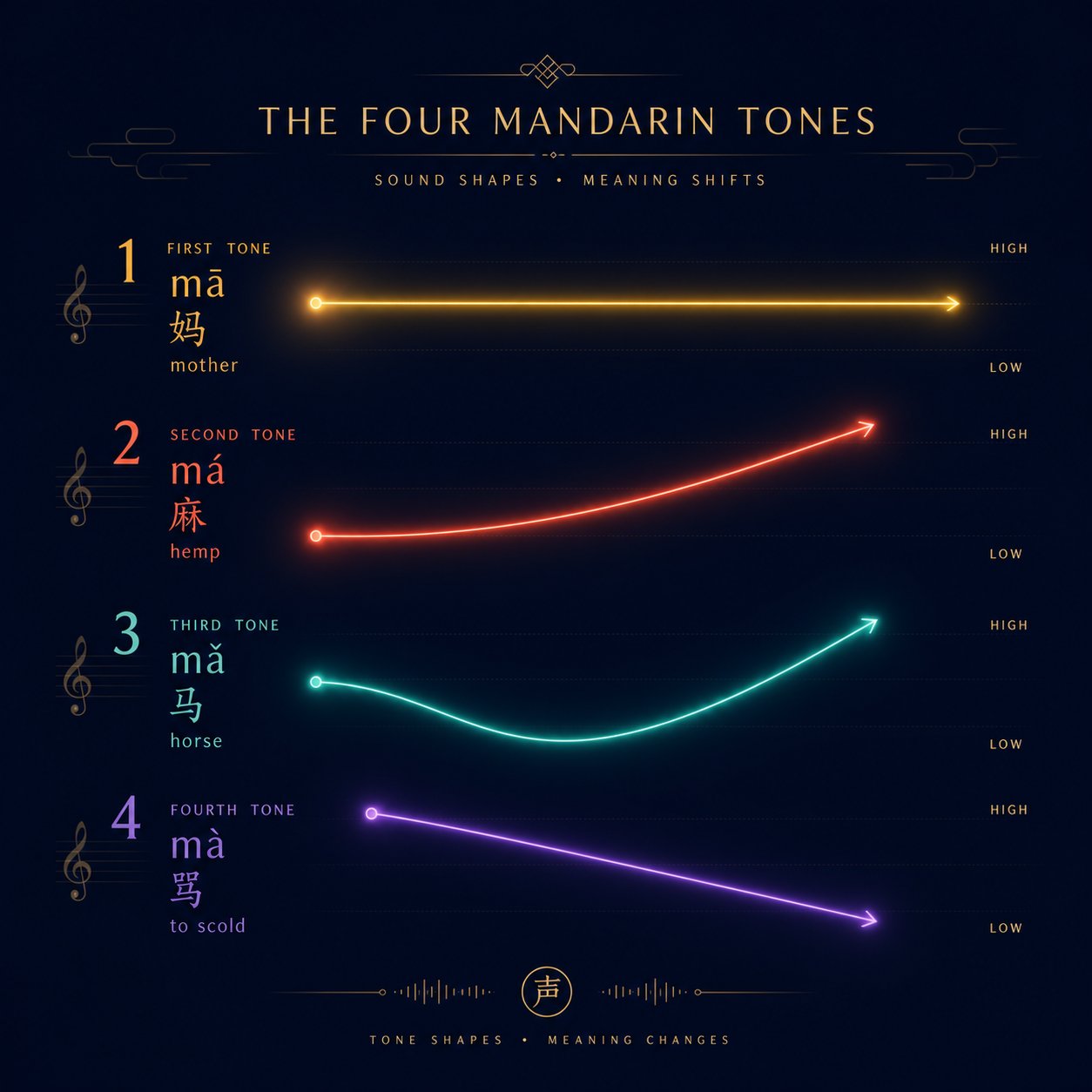
Why Tone Marks Change Everything in Chinese Names
Two people introduce themselves at a conference. Both hand you business cards that read "Wang" in English. Are they related? Do they share a surname? Not necessarily. One might be Wang (second tone), meaning "king," while the other could be Wang (third tone), an entirely different character and lineage. Without tone marks, you'd never know the difference from the spelling alone. This is exactly how tones change Chinese name meaning in ways that matter.
The Four Tones and How They Change Name Meaning
Mandarin Chinese uses four distinct tones, each changing the pitch contour of a syllable and, with it, the meaning of the character. When you're reading pinyin tone marks in Chinese names, those small diacritics above the vowels aren't decorative. They're doing critical work.
Here's how the four tones function:
- First tone (macron: ā) - a high, flat pitch held steady. Think of humming a single note.
- Second tone (acute accent: á) - a rising pitch, like the inflection in an English question: "What?"
- Third tone (caron: ǎ) - a dipping pitch that falls then rises, like a drawn-out "well..."
- Fourth tone (grave accent: à) - a sharp, falling pitch, like a firm command: "Stop."
Applied to names, these tonal differences create entirely separate identities. Consider the syllable "wang." Pronounced with the second tone, Wáng (王) is the most common surname in China, shared by over 100 million people and meaning "king." Pronounced with the third tone, Wǎng (网) means "net" and represents a completely different, far rarer surname. Same letters, different person, different family history.
The same pattern repeats across countless name syllables. The given name character Méi (second tone, 梅) means "plum blossom," while Měi (third tone, 美) means "beautiful." As the Asia Media Centre notes, names with the same spelling can have different tones and different meanings, making tone marks essential for accurate identification.
This isn't a minor academic point. Imagine addressing a formal letter to someone named Lì (fourth tone, a surname meaning "power") and accidentally using Lí (second tone, which maps to an entirely different family name). In Chinese culture, getting someone's name right signals respect. Tones are part of getting it right.
When Tone Marks Are Used and When They Are Dropped
Here's the practical tension: formal pinyin always includes tone marks, but most real-world contexts strip them away. Chinese passports print names without tones. Email addresses can't accommodate diacritics. International airline systems, hotel bookings, and government databases all flatten pinyin into plain ASCII text. The result is that a Chinese surname with different tones but the same spelling becomes indistinguishable in writing.
So when should you use tone marks in pinyin names? A few guidelines:
- Academic papers, language textbooks, and linguistic references always include them
- Formal pinyin transcriptions for dictionaries and educational materials require them
- Passports, visas, and international IDs omit them entirely
- Business cards and email signatures rarely include them
- Social media profiles and informal contexts typically leave them off
The ambiguity this creates is real. Without tone marks, the pinyin "Li" could represent 李 (Lǐ, third tone, meaning "plum"), 黎 (Lí, second tone, meaning "dawn"), or 厉 (Lì, fourth tone, meaning "stern"). All three are legitimate Chinese surnames belonging to different families with different ancestral histories.
The table below shows how common pinyin syllables map to different surnames depending on tone:
| Pinyin (no tone) | First Tone | Second Tone | Third Tone | Fourth Tone |
|---|---|---|---|---|
| Wang | - | 王 (Wáng) - king | 汪 (Wāng) / 网 (Wǎng) | - |
| Li | - | 黎 (Lí) - dawn | 李 (Lǐ) - plum | 厉 (Lì) - stern |
| Zhang | 张 (Zhāng) - stretch | - | 掌 (Zhǎng) - palm | - |
| Liu | - | 刘 (Liú) - kill (archaic) | 柳 (Liǔ) - willow | - |
| Mei | - | 梅 (Méi) - plum blossom | 美 (Měi) - beautiful | - |
Each row represents a single spelling that hides multiple identities. When you encounter these names on a passport or in an email, context and conversation become your only tools for disambiguation.
This tonal ambiguity is one reason why learning the most common Chinese surnames, along with their correct tones and approximate pronunciations, gives you a practical advantage in any cross-cultural setting.
Common Chinese Surnames and Their Pinyin Pronunciation
A handful of surnames dominate the Chinese-speaking world. Roughly 85% of China's population shares fewer than 100 family names, and the top 20 alone cover hundreds of millions of people. Familiarizing yourself with this short list of Chinese family names with pinyin gives you a realistic head start for recognizing and pronouncing the vast majority of names you'll encounter.
Most Common Chinese Surnames in Pinyin
The table below presents the most frequently occurring surnames, drawn from Mandarin House's list of 100 common Chinese family names. Each entry includes the character, its pinyin with tone mark, an approximate English pronunciation, and any alternate romanizations you might see in different regions.
| Character | Pinyin (with tone) | Approximate English Sound | Alternate Spellings |
|---|---|---|---|
| 王 | Wang | "wahng" (rhymes with "song" but starts with w) | Wong (Cantonese) |
| 李 | Lǐ | "lee" | Lee, Lei |
| 张 | Zhāng | "jahng" (j as in "jerk," not "zoo") | Chang (Wade-Giles) |
| 刘 | Liu | "lyo" (like "Leo" but with lips more rounded) | Lau (Cantonese) |
| 陈 | Chen | "chuhn" (vowel like "again," not like "hen") | Chan (Cantonese), Tan (Hokkien) |
| 杨 | Yang | "yahng" | Yeung (Cantonese) |
| 赵 | Zhao | "jow" (rhymes with "cow") | Chao (Wade-Giles) |
| 黄 | Huang | "hwahng" | Wong (Cantonese), Ng (Hokkien) |
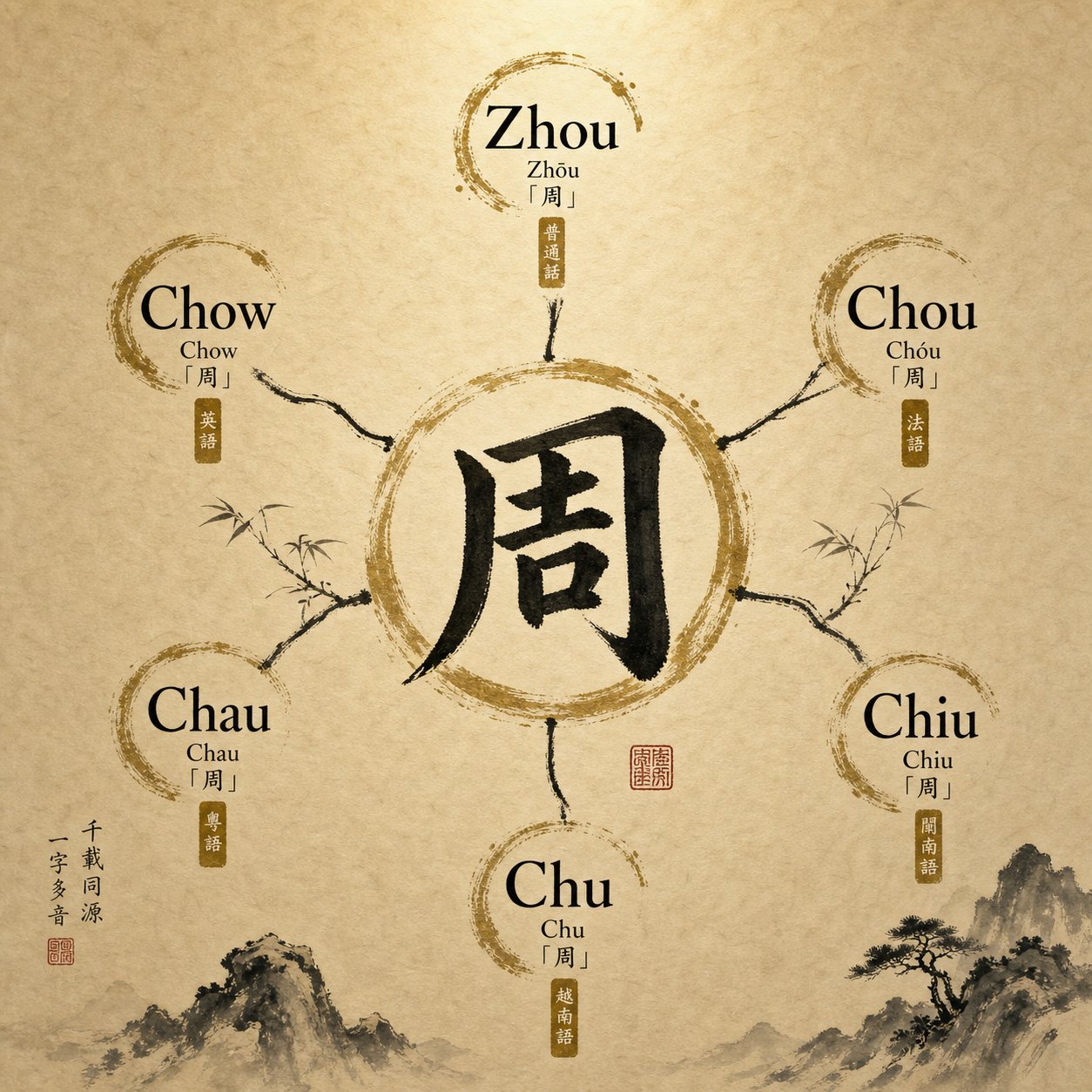
| 周 | Zhōu | "joe" (with the tongue curled back) | Chow, Chou |
| 吴 | Wu | "woo" | Ng (Cantonese), Goh (Hokkien) |
| 徐 | Xu | "shyu" (see pronunciation tips below) | Hsu (Wade-Giles), Tsui (Cantonese) |
| 孙 | Sūn | "swun" (like "soon" but shorter) | Sun |
| 朱 | Zhū | "joo" (tongue curled back) | Chu |
| 高 | Gāo | "gow" (rhymes with "cow") | Ko (Cantonese) |
| 林 | Lin | "lin" (like the name Lynn) | Lam (Cantonese), Lim (Hokkien) |
| 何 | He | "huh" (vowel like "the") | Ho (Cantonese) |
| 郭 | Guō | "gwaw" | Kwok (Cantonese) |
| 马 | Mǎ | "mah" | Ma |
| 谢 | Xie | "shyeh" (see tips below) | Hsieh (Wade-Giles), Tse (Cantonese) |
| 郑 | Zhèng | "juhng" (tongue curled back) | Cheng (Wade-Giles), Cheung (Cantonese) |
Even memorizing the top five gives you coverage over a significant portion of any Chinese name list you'll encounter in business, academia, or daily life.
Pronunciation Tips for English Speakers
Several pinyin consonants don't map neatly to English sounds, and they show up constantly in surnames. Here's a Chinese surname pinyin pronunciation guide for the sounds that trip people up most often.
- zh (as in Zhāng, Zhào, Zhōu): Sounds close to the "j" in "jerk," but with your tongue curled back toward the roof of your mouth. ASU's pronunciation guide suggests saying "jerk" and stopping before the "rk." It is not a "z" sound.
- x (as in Xu, Xie, Xiè): Similar to "sh" in "sheep," but with your tongue flat and low, its tip resting behind your lower front teeth. The result is a softer, more hissing "sh" sound. Think "shyu" for Xu and "shyeh" for Xie as rough starting points.
- q (as in Qin, Qiū): Close to "ch" in "cheese," but again with the tongue positioned forward and flat. Imagine adding a slight "t" before the "x" sound described above. Qin sounds roughly like "chin."
- c (as in Cai, Cáo): Not a "k" sound. It's the "ts" at the end of "boots" or "pants," moved to the beginning of the syllable. Cai sounds like "tsai."
- r (as in Rén): Not the English "r" at all. It's closer to the "s" in "pleasure" or "vision," with the tongue curled slightly upward. A French "j" is a reasonable approximation.
- -ang (as in Wáng, Zhāng, Yáng): The "a" here is open and broad, like "father." The whole ending sounds like "ahng," not like the English word "bang."
- -iu (as in Liú): Sounds like "lyo" or the "io" in "trio," not like the English word "lieu."
One general principle ties these together: pinyin letters don't always produce the sounds English speakers expect. As Peng Qi's pinyin cheatsheet emphasizes, there is not a one-to-one mapping between each Latin letter and the corresponding sound. The consonants zh, ch, and sh all involve a curled-back tongue that English doesn't use, while j, q, and x use a flat, forward tongue position that's equally unfamiliar.
A practical shortcut: if you can get zh, x, and q roughly right, you'll handle the majority of Chinese surname sounds for English speakers. Most other consonants, like l, m, g, h, and w, behave almost identically to their English counterparts.
These pronunciation patterns hold steady whether you're reading a name on a conference badge or hearing it introduced aloud. But here's a wrinkle you'll notice quickly in real life: the same surname often appears spelled differently depending on where the person is from. A 陈 might show up as Chen, Chan, or Tan, and all three are correct within their own systems.
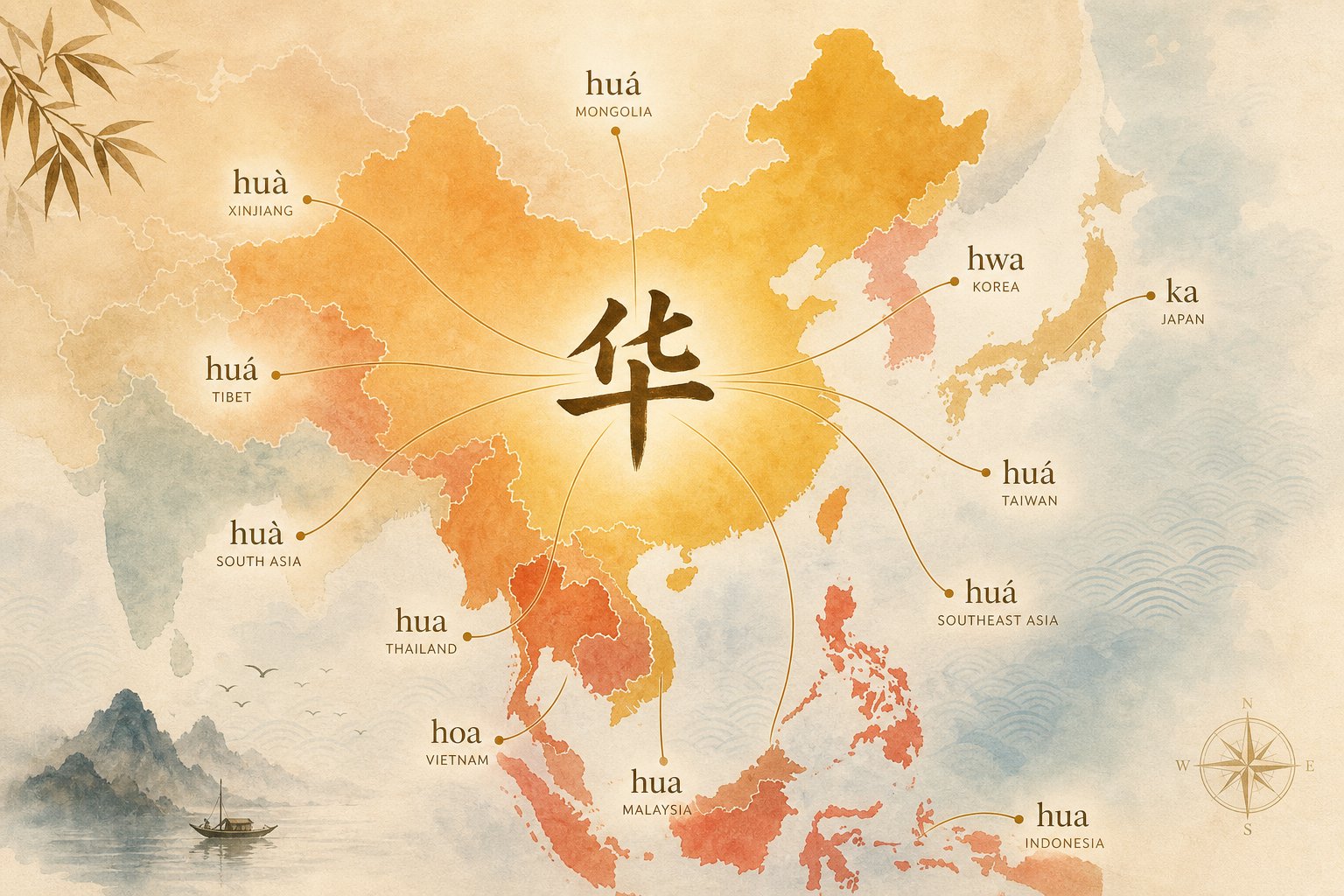
Why Chinese Names Are Spelled Differently Across Regions
That spelling inconsistency isn't a mistake. It's the result of multiple romanization systems coexisting across the Chinese-speaking world, each one reflecting a different dialect, a different era, or a different political context. Understanding why Chinese names are spelled differently is the key to recognizing that Chen, Chan, and Tan all point back to the same character: 陈.
Why the Same Name Looks Different Across Regions
Chinese is not a single spoken language. It's a family of related languages and dialects that share a written script but sound dramatically different when spoken aloud. The character 王 is pronounced "Wang" in Mandarin, "Wong" in Cantonese, "Ong" in Hokkien, and "Heng" in Teochew. When people romanize their names, they transcribe the sounds of their own dialect, not a universal pronunciation.
This means a person's romanized surname often reveals their regional and linguistic heritage. As the Asia Media Centre explains, in territories with a sizeable Chinese diaspora like Singapore and Malaysia, the way a family name is spelled can be a signifier of the region a person's ancestors come from. A surname spelled "Wong" signals Cantonese heritage, likely from Guangdong province or Hong Kong. The same character spelled "Ong" points to Hokkien-speaking roots in Fujian or Southeast Asia.
The confusion multiplies when you consider that immigration officials historically had no standardized system for transcribing Chinese sounds. According to My China Roots, the surname 陈 alone has been romanized as Chen, Chan, Chin, Chinn, Ching, Tan, Tang, Tchen, Tin, Tjin, and Jin, among others. Each spelling reflects a different dialect pronunciation filtered through a different listener's ear.
Major Romanization Systems for Chinese Names
Four systems account for the vast majority of Chinese name romanization differences by region:
- Hanyu Pinyin (mainland China): The current international standard, based on Mandarin pronunciation. Adopted in the 1950s and now used on all mainland Chinese passports, in the United Nations, and by most international media. This is the system covered throughout this article.
- Wade-Giles (Taiwan, older texts): Developed in the 19th century by British diplomats, this system also represents Mandarin sounds but uses different letter combinations. It's recognizable by its use of apostrophes and combinations like "hs" for the pinyin "x" and "ch'" for the pinyin "q." Many older academic texts and Taiwanese official documents still use it.
- Jyutping and Yale Cantonese (Hong Kong, Macau): These systems romanize Cantonese pronunciation rather than Mandarin. Since Cantonese has different sounds, the same character produces a completely different spelling. Hong Kong names are not standardized to a single system, so spellings can vary even within the same city.
- Hokkien and Teochew romanizations (Southeast Asia): Chinese communities in Singapore, Malaysia, Indonesia, and the Philippines often trace their roots to southern Fujian or eastern Guangdong. Their surnames reflect Hokkien or Teochew pronunciation, producing spellings like Tan, Ong, Lim, and Goh that look nothing like their Mandarin pinyin equivalents.
When comparing Wade-Giles vs pinyin for Chinese names, the differences can be stark. A name that looks like "Xie" in pinyin becomes "Hsieh" in Wade-Giles and "Tse" in Cantonese. Without context, you might assume these are three unrelated families. They're not. They all share the character 谢.
The table below shows how several common surnames appear across these systems, making the Cantonese vs Mandarin name spelling differences immediately visible:
| Character | Hanyu Pinyin (Mainland) | Wade-Giles (Taiwan) | Cantonese (Hong Kong) | Hokkien (SE Asia) |
|---|---|---|---|---|
| 王 | Wang | Wang | Wong | Ong |
| 李 | Li | Li | Lee / Lei | Lee |
| 张 | Zhang | Chang | Cheung | Teo / Teoh |
| 陈 | Chen | Ch'en | Chan | Tan |
| 黄 | Huang | Huang | Wong | Ng / Ong |
| 林 | Lin | Lin | Lam | Lim |
| 刘 | Liu | Liu | Lau | Low / Lew |
| 谢 | Xie | Hsieh | Tse | Chia |
| 蕭 | Xiao | Hsiao | Siu | Siau |
| 郑 | Zheng | Cheng | Cheng / Cheung | Tay / Tee |
You'll notice that some entries, like 王 (Wang in both pinyin and Wade-Giles), happen to align between systems. Others, like 张 appearing as Zhang, Chang, Cheung, and Teo, diverge so completely that only the shared character connects them.
This regional variation has a direct practical consequence. When a Chinese name appears on an official document, the romanization system used depends on where that document was issued, not on any universal standard. A passport from Beijing will show pinyin. A passport from Taipei may show Wade-Giles or a local variant. A Hong Kong ID card will reflect Cantonese pronunciation. Knowing which system you're looking at helps you read the name correctly and, just as importantly, helps you understand how that same name will appear when formatted for international use.
Chinese Names in Pinyin on Passports and Official Documents
Regional romanization systems explain why the same character gets spelled differently across borders. But even within a single system like Hanyu Pinyin, the way a name appears on your passport doesn't look quite like the pinyin you'd find in a textbook. Official documents follow their own formatting rules, and those rules strip away some of the information that makes pinyin useful as a pronunciation guide.
Passport and Visa Formatting Rules
When you look at a mainland Chinese passport, you'll notice the pinyin name format looks different from standard written pinyin. There are no tone marks. The surname is printed separately from the given name, often in a distinct field. And the given name, regardless of how many characters it contains, appears as a single unbroken string of letters with no space or hyphen.
For example, a person named 王小丽 (Wang Xiaoli in standard pinyin) would see their passport printed as:
- Surname field: WANG
- Given name field: XIAOLI
Not XIAO LI. Not XIAO-LI. Just XIAOLI as one continuous block. This is the Chinese given name no space passport rule in action, and it catches many people off guard when they first apply for travel documents.
Here are the key formatting rules for how Chinese names appear on official documents issued by mainland China:
- All letters are capitalized (machine-readable zone uses uppercase throughout)
- No tone marks are included anywhere on the document
- The surname and given name occupy separate designated fields
- Two-character given names are joined into one word with no space, hyphen, or separator
- Two-character surnames like Ouyang or Sima are also written as a single unit: OUYANG, SIMA
- The name order follows international passport standards: surname field first, given name field second
Taiwan handles things differently. Taiwanese passports historically used Wade-Giles romanization, though applicants can now choose Hanyu Pinyin or other systems. A person surnamed 张 might appear as CHANG on a Taiwanese passport but ZHANG on a mainland one. Taiwan also permits hyphens in given names, so you might see HSIAO-MING rather than XIAOMING, depending on the applicant's preference and the era the passport was issued.
Hong Kong adds another layer of variation. Since Hong Kong uses Cantonese pronunciation rather than Mandarin, passports reflect Cantonese romanization without following any single standardized system. A name like 陈大文 could appear as CHAN TAI MAN, with each character of the given name separated, which is the opposite of mainland convention. There's no official requirement to merge given name characters in Hong Kong documents.
Handling Your Chinese Name in International Contexts
The pinyin name formatting rules for visa applications and international forms create a recurring headache: name order confusion. Western systems assume the first name listed is the given name and the last name listed is the surname. Chinese convention puts the surname first. When these two expectations collide on a form, mistakes happen.
Imagine filling out a hotel booking or airline reservation. The form asks for "First Name" and "Last Name." If your name is 李明 (Li Ming), do you put Li in the "Last Name" field because it's your surname? Or do you put it in the "First Name" field because it appears first in your full name? The correct answer is to place your surname (Li) in the "Last Name" or "Family Name" field, matching how it appears on your passport. But the ambiguity trips people up constantly, especially when different documents end up with the name in different orders.
Consistency across documents matters more than most people realize. Immigration officers, visa processors, and airline check-in systems compare names character by character. A mismatch between your passport (WANG XIAOLI), your visa application (Xiao Li Wang), and your flight booking (Xiaoli Wang) can trigger delays or even denials at border control.
A few practical guidelines help avoid these problems:
- Always use your passport as the reference document for how your name should appear on all other forms
- When a form asks for "First Name," enter your given name as it appears on your passport (e.g., XIAOLI)
- When a form asks for "Last Name" or "Family Name," enter your surname (e.g., WANG)
- If a system doesn't accept names without spaces and your given name is a single block like XIAOLI, try entering it exactly as printed on your passport before adding any separators
- Keep a consistent romanization across all travel documents, bank accounts, and professional credentials
For people who use an English name alongside their Chinese name, the passport won't reflect that English name unless it was formally registered. This means your professional identity (say, "David Wang") and your legal travel identity (WANG XIAOLI) may look completely unrelated on paper. Carrying both versions consistently in professional profiles and email signatures helps bridge that gap for international colleagues.
These document-level conventions govern how your name looks in print. But names aren't just printed. They're spoken aloud in meetings, introductions, and phone calls, which raises a different kind of question: how do you actually ask someone for the correct pronunciation of their name, and how do you share yours?

How to Ask and Say Names in Chinese Pinyin
Knowing the rules on paper is one thing. Using them in a live conversation, where someone is standing in front of you waiting for an introduction, is another challenge entirely. Whether you're meeting a new colleague, greeting a client, or simply making friends, a few key phrases in pinyin give you the confidence to ask for and share names correctly.
How to Ask for and Share Names in Pinyin
The most versatile phrase for asking someone their Chinese name in pinyin is also the simplest:
Ni jiao shenme mingzi? (You are called what name?) - What is your name?
This works in nearly any casual or semi-formal situation. You'll hear it at parties, in classrooms, and during everyday introductions. The structure is straightforward: ni (you) + jiao (called) + shenme (what) + mingzi (name).
But context matters. In a business meeting or when speaking to someone older, you'll want to show more respect. That's where formality levels come in. As DigMandarin explains, Chinese offers multiple ways to ask the same question, each calibrated to a different social register.
Here are the most useful phrases for Chinese name pronunciation in conversation, arranged from casual to formal:
- Ni jiao shenme? (Ni jiao shenme?) - What are you called? Very informal, best for peers and friends.
- Ni jiao shenme mingzi? (Ni jiao shenme mingzi?) - What is your name? The standard, all-purpose version.
- Qingwen ni jiao shenme mingzi? (Qingwen ni jiao shenme mingzi?) - May I ask what your name is? Adds a polite "may I ask" prefix, suitable for first meetings at events.
- Nin guixing? (Nin guixing?) - What is your honorable surname? Formal and respectful, ideal for business settings or when addressing elders.
- Qingwen nin zenme chenghu? (Qingwen nin zenme chenghu?) - How should I address you? The most formal option, used with high-ranking professionals or in very polite contexts.
To introduce yourself in Chinese pinyin phrases, the pattern is equally direct. Say "Wo jiao" followed by your name. For example: "Wo jiao Zhang Wei" (My name is Zhang Wei). If you want to offer just your surname, use "Wo xing" plus the surname: "Wo xing Wang" (My surname is Wang).
A useful follow-up when you didn't catch someone's name clearly: "Qing zai shuo yi bian" (Please say it once more). This politely asks for a repetition without making the interaction awkward. People appreciate the effort far more than they mind the extra moment it takes.
Using Chinese Names Correctly in Professional Settings
Professional etiquette for Chinese names extends beyond pronunciation. In business correspondence, the safest approach is to use the person's surname plus a title: "Wang Jingli" (Manager Wang), "Li Laoshi" (Teacher Li), or "Chen Xiansheng" (Mr. Chen). Using someone's given name without invitation signals a level of familiarity that may feel presumptuous in Chinese professional culture.
In academic citations, Chinese names follow the surname-first format. A paper by 李明 is cited as "Li Ming," not "Ming Li." Most major style guides, including APA and Chicago, now recognize this convention and instruct authors to preserve the original name order for Chinese authors rather than inverting it to match Western surname-last patterns.
A few practical tips for getting names right in professional interactions:
- When you receive a business card, read the name aloud and confirm pronunciation. A simple "Nin shi Wang Jingli, dui ma?" (You are Manager Wang, correct?) shows respect.
- If a colleague offers an English name ("Call me David"), use it in English-language contexts but learn their Chinese name too. Switching to their Chinese name when appropriate signals cultural awareness.
- In email signatures, many Chinese professionals list both formats: "Wang Xiaoli (David Wang)." Mirror whichever format they use when replying.
- When introducing a Chinese colleague to others, lead with their preferred name and clarify the surname if needed: "This is Wang Xiaoli. Wang is her family name."
The underlying principle is simple: ask, listen, and confirm. Linda Mandarin notes that Chinese culture places strong emphasis on politeness and social hierarchy in name usage, so choosing the right level of formality matters as much as getting the pronunciation right. When in doubt, err on the side of formality. You can always relax once the other person invites you to.
Names are the first bridge between languages. Getting a Chinese name right in pinyin, whether you're reading it on a document, typing it in an email, or saying it across a conference table, tells the other person that you see them clearly. And that's worth far more than perfect tones.
Frequently Asked Questions About Chinese Names in Pinyin
1. How do you write a Chinese name in pinyin correctly?
To write a Chinese name in pinyin, place the surname first followed by the given name, separated by a single space. Capitalize the first letter of both the surname and the given name. If the given name has two characters, join them into one word with no space or hyphen. For example, the name 王小丽 becomes Wang Xiaoli. On official documents like passports, tone marks are omitted and all letters are capitalized.
2. Why are Chinese names spelled differently in different countries?
Chinese names appear with different spellings because multiple romanization systems exist across regions. Mainland China uses Hanyu Pinyin based on Mandarin pronunciation, Taiwan historically uses Wade-Giles, Hong Kong uses Cantonese-based romanization, and Southeast Asian Chinese communities use Hokkien or Teochew spellings. For example, the character 陈 appears as Chen in pinyin, Chan in Cantonese, and Tan in Hokkien. The spelling reflects the dialect and system used locally, not a universal standard.
3. Do tone marks matter in Chinese pinyin names?
Tone marks are critical for distinguishing Chinese names because the same pinyin spelling with different tones represents entirely different characters and surnames. For instance, Wang with a second tone (王) means king and is China's most common surname, while Wang with a third tone (汪) is a completely different and much rarer family name. However, tone marks are omitted on passports, in email addresses, and in most international systems, which creates ambiguity that can only be resolved through context or direct conversation.
4. What is the correct name order for Chinese names in pinyin?
Chinese names always place the surname (family name) first, followed by the given name. This is the opposite of Western naming conventions. So a person named 李明 is written as Li Ming in pinyin, where Li is the surname and Ming is the given name. When filling out international forms, place your surname in the Last Name or Family Name field and your given name in the First Name field, matching your passport formatting to avoid document inconsistencies.
5. How do you pronounce tricky pinyin sounds like zh, x, and q in Chinese names?
The pinyin consonant zh (as in Zhang) sounds like the English j in jerk but with the tongue curled back toward the roof of the mouth. The x sound (as in Xu or Xie) is similar to sh in sheep but softer, with the tongue flat and low behind the lower front teeth. The q sound (as in Qin) resembles ch in cheese but with the tongue positioned forward. These three sounds appear in many common Chinese surnames, so mastering them covers a large portion of names you will encounter in professional and social settings.