Why Chinese Names and Seasons Are Deeply Connected
Imagine meeting someone named Xiaochun, meaning "Little Spring," or Hanmei, meaning "Cold Plum Blossom." These aren't random poetic choices. They reflect a tradition stretching back thousands of years, where parents embed seasonal meaning directly into their children's identities. In Chinese culture, the four seasons aren't just weather patterns on a calendar. They're a philosophical framework for understanding life, growth, and human character.
This connection between seasons in Chinese and personal identity runs deeper than most learners realize. Spring signals hope and fresh beginnings. Winter reveals resilience. A name carrying one of these characters tells you something about what a family values, when a child was born, or what qualities parents wished for their son or daughter.
Why Seasons Matter More in Chinese Culture
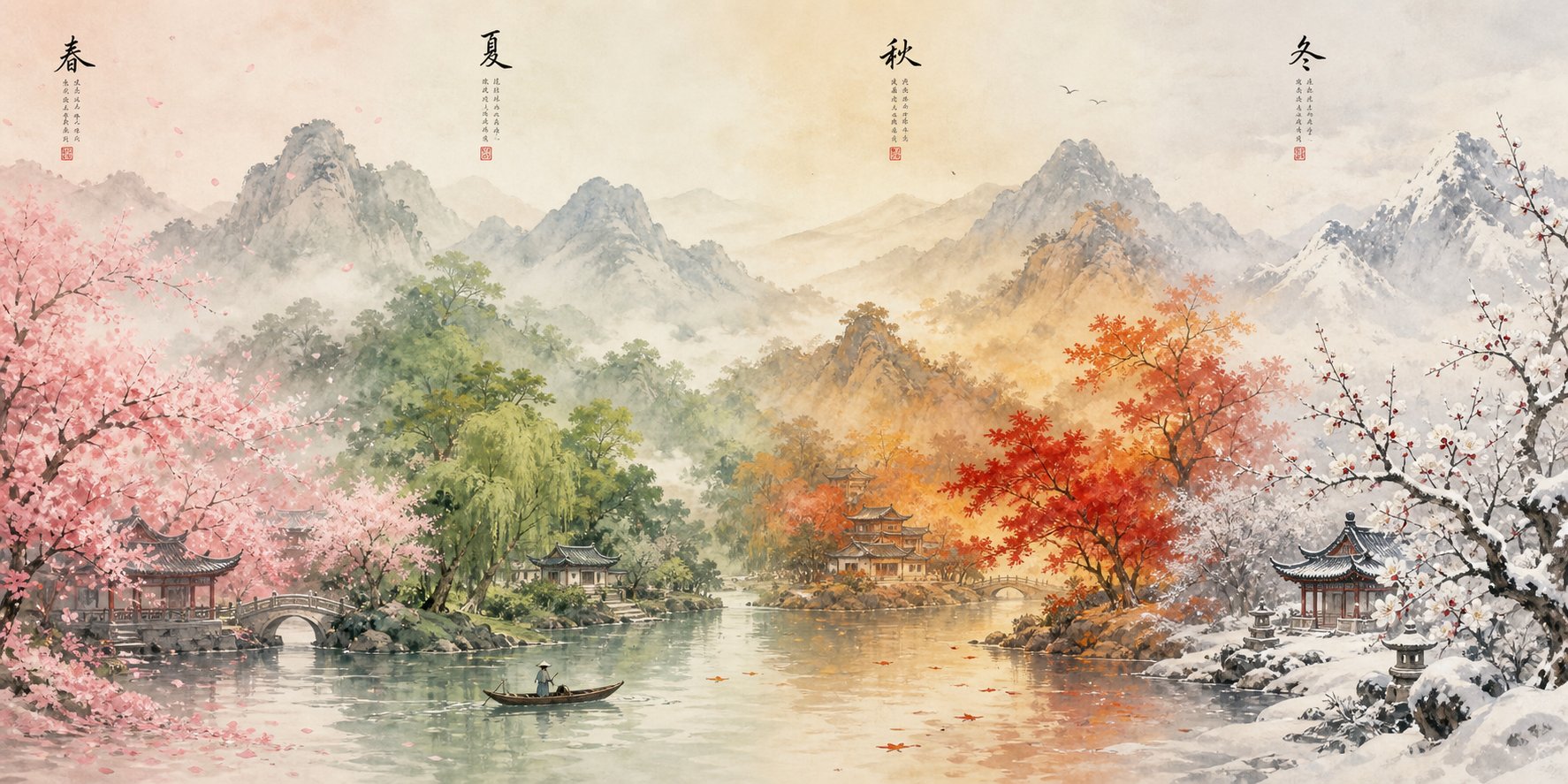
Western cultures divide the year into four meteorological blocks. Chinese tradition goes further, linking each season to elements, directions, colors, and moral virtues through a cosmological system called wuxing (Five Elements). The chinese four seasons map onto Wood, Fire, Metal, and Water, with Earth governing a transitional fifth period. This means seasonal vocabulary carries layers of symbolic weight that simple translation misses entirely. When you learn the chinese seasons, you're learning a worldview.
What This Guide Covers for Learners
This guide follows a natural progression: basic season vocabulary and pinyin, then character etymology showing how each character tells a visual story, followed by naming traditions, the 24 solar terms, seasonal idioms, philosophical connections, and practical sentences. Each layer builds on the last.
Season characters like 春, 夏, 秋, and 冬 appear in millions of Chinese personal names, making this one of the few vocabulary topics that doubles as a key to understanding Chinese identity and culture.
The characters themselves hold clues. Each one is built from radicals that paint a picture of what that season means, and those same components show up across the Chinese writing system. Learning them unlocks far more than four words.
The Chinese Four Seasons in Characters and Pinyin
Those four characters hold layers of meaning, but before you can decode them, you need solid pronunciation and recognition skills. Whether you're studying Simplified characters for Mainland China or Traditional characters for Taiwan and Hong Kong, the seasons chinese learners encounter first are the same four core words. Getting their tones and sounds right from the start saves you from confusion later, especially when you hear these characters embedded in people's names.
Spring Summer Autumn Winter in Chinese Characters
Let's break down each season one at a time, starting with how they sound and how to produce each tone correctly.
- 春 (chun, first tone) - Spring. The "ch" is a retroflex sound, meaning your tongue curls back slightly toward the roof of your mouth. The first tone (high and flat) stays level, like holding a musical note steady. Think of it as a calm, even pitch. In the spring in chinese language context, this is the character you'll see most often in names and poetry.
- 夏 (xia, fourth tone) - Summer. The "x" sound doesn't exist in English. Place your tongue where you'd say "sh," but flatten it against your lower teeth instead. The fourth tone drops sharply, like saying "no" with emphasis. It's short and decisive.
- 秋 (qiu, first tone) - Autumn. The "q" is similar to "ch" but produced with the tongue flat against the lower teeth, not curled back. The vowel combination "iu" sounds close to "yo" in English. Keep that first tone steady and level, just like 春.
- 冬 (dong, first tone) - Winter. The "d" is unaspirated, meaning less air puffs out compared to an English "d." The "ong" rhymes roughly with "oo" plus "ng." For winter in mandarin, you'll notice the first tone dominates. Three of the four seasons use tone one, which makes the set easier to memorize as a group.
You'll notice a helpful pattern here. Three out of four season characters carry the first tone (high, flat pitch). Only summer breaks the pattern with a sharp fourth tone. This makes the set relatively forgiving for beginners, since first-tone words are the easiest to produce consistently.
Essential Season Vocabulary Beyond the Basics
Knowing the single-character forms is a starting point. In everyday conversation, Chinese speakers rarely use a bare character like 春 on its own to mean "spring." Instead, they attach a suffix. The most common structure adds 天 (tian, meaning "day" or "sky") or 季 (ji, meaning "season") to form natural-sounding words.
Here's how this works in practice:
- 季节 (jijie, fourth tone + second tone) - The general word for "seasons." You'll use this when talking about seasons as a concept, like asking "What's your favorite season?"
- 春天 (chuntian) - Springtime. The most natural way to say "spring" in conversation.
- 夏天 (xiatian) - Summertime.
- 秋天 (qiutian) - Autumn/fall. This is the chinese for spring's counterpart on the opposite side of the year.
- 冬天 (dongtian) - Wintertime.
- 春季 (chunji) - Spring season. Slightly more formal, often used in writing or weather reports.
Seasonal weather vocabulary builds naturally from here. Words like 暖和 (nuanhuo, warm), 炎热 (yanre, scorching hot), 凉爽 (liangshuang, cool and refreshing), and 寒冷 (hanleng, bitterly cold) pair with each season to describe climate. These combinations appear constantly in daily speech, news broadcasts, and the kind of small talk that makes your Chinese sound lived-in rather than textbook-flat.
| Season | Simplified Character | Traditional Character | Pinyin with Tones | Literal Meaning |
|---|---|---|---|---|
| Spring | 春 | 春 | chun (1st tone) | Sun pushing through, new growth |
| Summer | 夏 | 夏 | xia (4th tone) | Grandness, the great season |
| Autumn | 秋 | 秋 | qiu (1st tone) | Grain ripening under fire/sun |
| Winter | 冬 | 冬 | dong (1st tone) | End, conclusion of the cycle |
| Springtime | 春天 | 春天 | chuntian (1st + 1st) | Spring sky/day |
| Summertime | 夏天 | 夏天 | xiatian (4th + 1st) | Summer sky/day |
| Autumn/Fall | 秋天 | 秋天 | qiutian (1st + 1st) | Autumn sky/day |
| Wintertime | 冬天 | 冬天 | dongtian (1st + 1st) | Winter sky/day |
| Season (general) | 季节 | 季節 | jijie (4th + 2nd) | Period/segment of time |
Notice that the four core season characters remain identical in Simplified and Traditional Chinese. This is one of the rare cases where learners targeting either system share the exact same written forms. The difference only appears in compound words like 季節 (Traditional) versus 季节 (Simplified), where the second character 节/節 changes form.
Each of these characters carries visual clues about its meaning, built from smaller components called radicals. Those internal structures do more than aid memorization. They reveal how ancient Chinese speakers understood the natural world, and they connect directly to why certain characters became so popular in personal names.
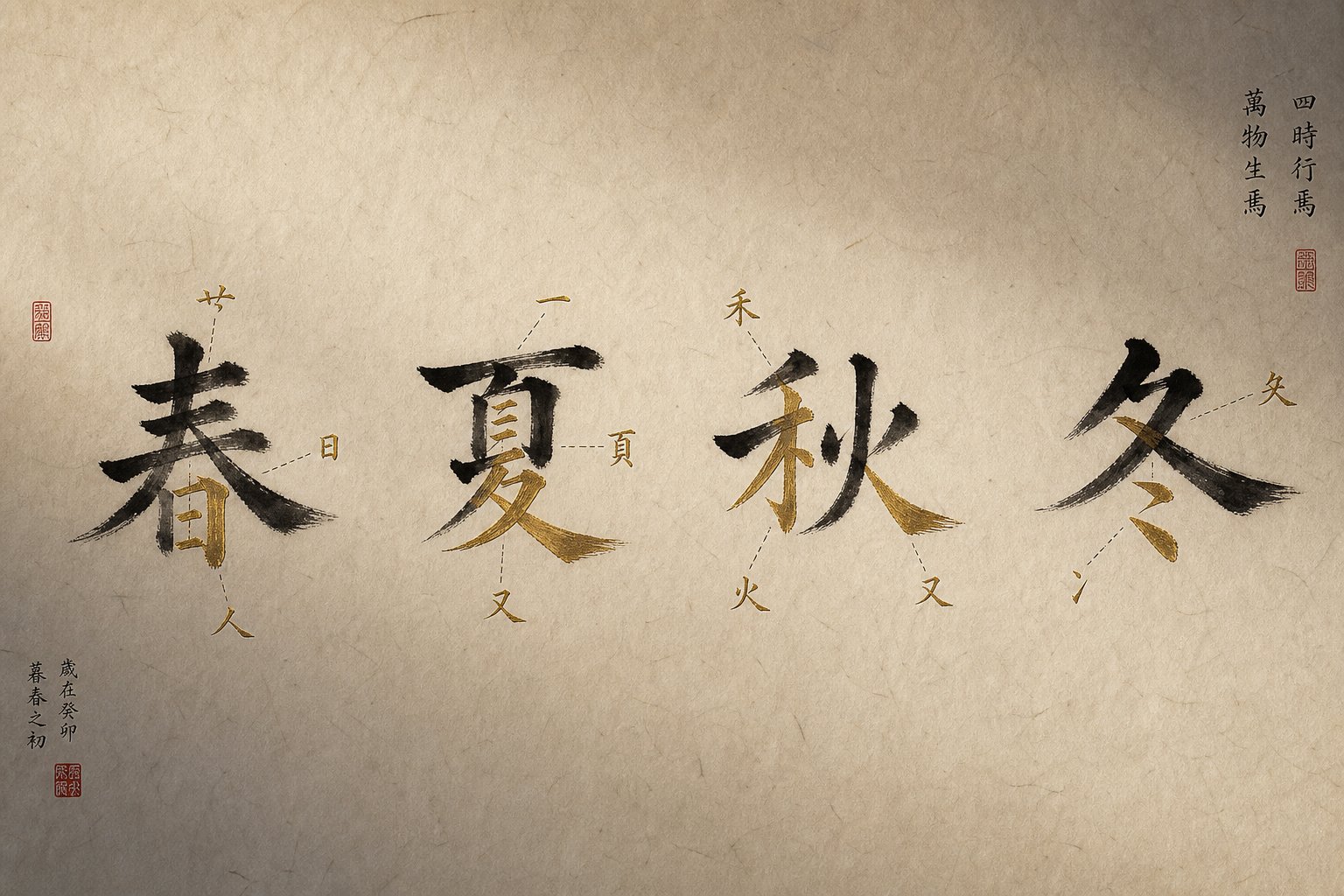
How Season Characters Are Built and What They Mean
Every chinese season character is a tiny picture, assembled from smaller meaningful parts called radicals. When you understand what's inside each character, you stop memorizing shapes and start reading stories. This is one of the most effective memory techniques for learning season in chinese, and it connects directly to why these characters carry so much weight in personal names.
How Each Season Character Tells a Story
Think of each character as a visual equation. Ancient scribes combined simple pictographs to capture what a season felt like, looked like, or meant to daily life. Here's what's hiding inside each one:
- 春 (chun) - Spring: The bottom component is 日 (ri, sun). Above it sit strokes that originally depicted sprouting plants pushing upward. The visual logic is clear: the sun returns, and life pushes through the soil. You're literally looking at a picture of warmth making things grow.
- 夏 (xia) - Summer: This character historically depicted a grand figure, a person shown large and full. The bottom component 夊 (sui) suggests slow, deliberate movement. The overall impression is one of fullness and abundance, capturing summer as the season when everything reaches its peak size and energy.
- 秋 (qiu) - Autumn: The left side is 禾 (he, grain on a stalk), and the right side is 火 (huo, fire). Why fire next to grain? After the autumn harvest, farmers burned their fields to clear stubble and return nutrients to the soil. This single character preserves an ancient agricultural practice in two brushstrokes.
- 冬 (dong) - Winter: The top portion 夂 represents an ending or arrival, while the two small dots at the bottom evolved from the ice radical 冫 (bingpang). Together they say: the cycle concludes, and ice arrives. It's a picture of finality and cold.
Notice how each character encodes a sensory experience rather than an abstract label. Spring shows you growth. Autumn shows you harvest and fire. This is why season 中文 characters stick in memory once you see their internal logic.
Season Radicals in Other Chinese Characters
These same building blocks appear across hundreds of other characters. Recognizing them inside the season characters gives you a head start on reading the broader writing system.
- 日 (sun), found in 春: Also appears in 晴 (qing, clear weather), 暖 (nuan, warm), 明 (ming, bright), and 时 (shi, time). Any character with 日 usually relates to sunlight, time, or warmth.
- 禾 (grain), found in 秋: Shows up in 种 (zhong, to plant), 稻 (dao, rice paddy), 秧 (yang, seedling), and 积 (ji, to accumulate). Characters with 禾 connect to agriculture and crops.
- 火 (fire), found in 秋: Appears in 炎 (yan, scorching), 烧 (shao, to burn), 烤 (kao, to roast), and 灯 (deng, lamp). The fire radical signals heat, burning, or light.
- 冫 (ice), found in 冬: Present in 冷 (leng, cold), 冰 (bing, ice), 凉 (liang, cool), and 冻 (dong, to freeze). This two-dot radical is your reliable marker for anything related to cold temperatures.
Once you spot 禾 inside 秋, you'll start noticing it everywhere, in restaurant menus, street signs, and the names of people around you. The same goes for 日 and 冫. These radicals become a decoding toolkit that makes unfamiliar characters feel less foreign.
This visual richness is exactly what makes season characters so appealing for personal names. A parent choosing 秋 for a daughter's name isn't just picking a sound. They're embedding images of golden grain and harvest abundance into her identity, a choice shaped by centuries of cultural symbolism around what each season represents.
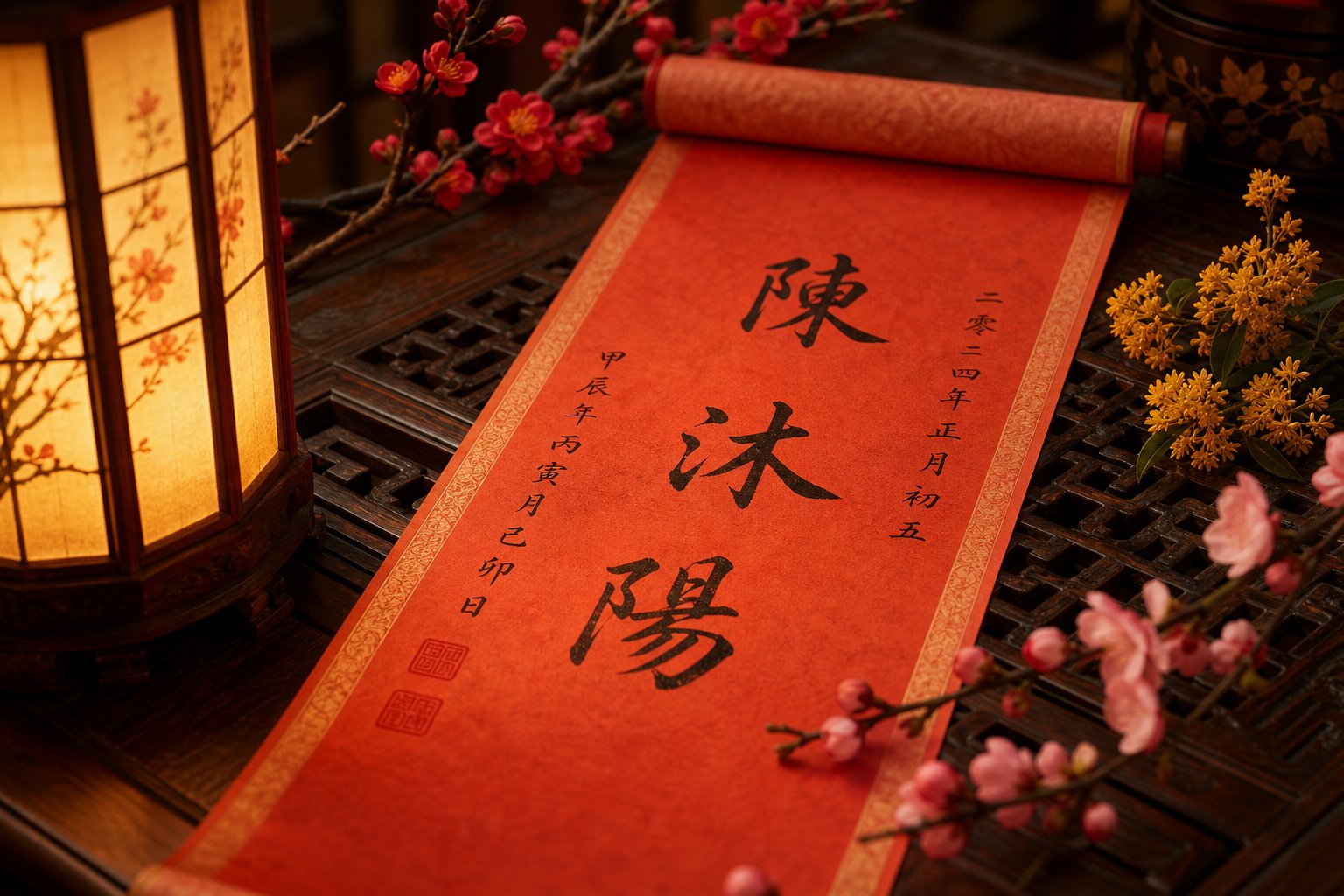
Chinese Personal Names Inspired by the Seasons
A parent choosing 秋 for a daughter's name isn't making a casual decision. They're selecting from a symbolic vocabulary that has guided Chinese naming for centuries, one where each season carries specific hopes, virtues, and aspirations for a child's life. Understanding how season characters function inside personal names gives you a cultural lens that vocabulary lists alone can't provide.
How Chinese Parents Choose Season-Inspired Names
Chinese naming tradition treats the four seasons as personality blueprints. Each season maps onto a set of qualities parents hope their child will embody. The choice often reflects the child's birth season, but just as frequently, it expresses a wish for their character regardless of when they arrived.
Here's what each season communicates when it appears in a name:
- 春 (chun) - Hope and new beginnings. Spring in mandarin carries the energy of fresh starts. A child named with 春 is associated with optimism, renewal, and the idea that everything good is still ahead. Parents choose this when they want a name that feels bright and forward-looking.
- 夏 (xia) - Vitality and fullness. Summer names suggest someone who grows boldly, who reaches their peak with confidence. There's an intensity to 夏 names, a sense of life lived at full volume.
- 秋 (qiu) - Maturity and abundance. What is autumn in chinese naming culture? It's the season of harvest, of work paying off. Autumn in chinese names signals quiet confidence, wisdom earned through experience, and the satisfaction of things coming together. Fall in chinese culture doesn't carry the Western melancholy of endings. Instead, it represents fulfillment.
- 冬 (dong) - Resilience and inner strength. Winter names are about character revealed under pressure. The tradition draws from classical poetry where plum blossoms blooming in cold symbolize people who thrive precisely when circumstances are hardest.
Popular Name Combinations for Each Season
Season characters rarely stand alone in names. They pair with a second character that sharpens the meaning, creating combinations that read like compressed poetry. Some lean feminine, others masculine, and many work for either gender depending on the companion character.
| Season Character | Example Names | Meaning | Cultural Symbolism |
|---|---|---|---|
| 春 (chun) | 春华 (Chunhua), 晓春 (Xiaochun) | Spring splendor; Dawn of spring | New beginnings, youthful energy, hope for a flourishing life |
| 夏 (xia) | 夏雨 (Xiayu), 清和 (Qinghe) | Summer rain; Clear and mild | Vitality, growth, calm strength amid intensity |
| 秋 (qiu) | 秋月 (Qiuyue), 桂月 (Guiyue) | Autumn moon; Osmanthus month | Maturity, luminous presence, quiet elegance |
| 冬 (dong) | 冬梅 (Dongmei), 寒梅 (Hanmei) | Winter plum; Cold plum blossom | Resilience, blooming against adversity, steadfast character |
Consider 冬梅 (Dongmei). This name pairs winter with the plum blossom, a flower famous for blooming when everything else has gone dormant. The poet Wang Anshi wrote about plum blossoms "凌寒独自开" (blooming alone against the cold), and that image lives inside this name. It's overwhelmingly feminine and suggests a woman of quiet toughness.
夏雨 (Xiayu, "summer rain") works differently. It evokes the sudden, generous downpours that nourish crops in June and July. This name leans masculine and suggests someone whose energy arrives powerfully and brings growth to those around them.
秋月 (Qiuyue, "autumn moon") draws on the Mid-Autumn Festival tradition of moon-gazing. The full moon in the eighth lunar month is the brightest and most celebrated of the year. A woman named Qiuyue carries associations of luminous beauty and completeness, the kind of presence that draws attention without demanding it.
Season Characters in Place Names and Literary Names
The same characters extend beyond personal names into geography and literature. 春 appears in city names like 长春 (Changchun, "Eternal Spring"), the capital of Jilin Province. 秋 shows up in 秋浦 (Qiupu), a river that inspired Li Bai's poetry. These place names reinforce the same symbolic logic: spring places suggest perpetual renewal, autumn places suggest richness and depth.
In classical literature, pen names and courtesy names followed identical patterns. A scholar choosing 秋水 (Qiushui, "Autumn Waters") as a literary name was signaling philosophical depth, referencing the famous Zhuangzi chapter about the limits of knowledge. These naming choices created a shared cultural shorthand that educated readers recognized instantly.
The seasonal naming tradition doesn't exist in isolation. It connects to a much older system of dividing the year, one that goes far beyond four simple categories. China's 24 solar terms slice each season into six precise segments, each with its own character, meaning, and influence on naming practices.
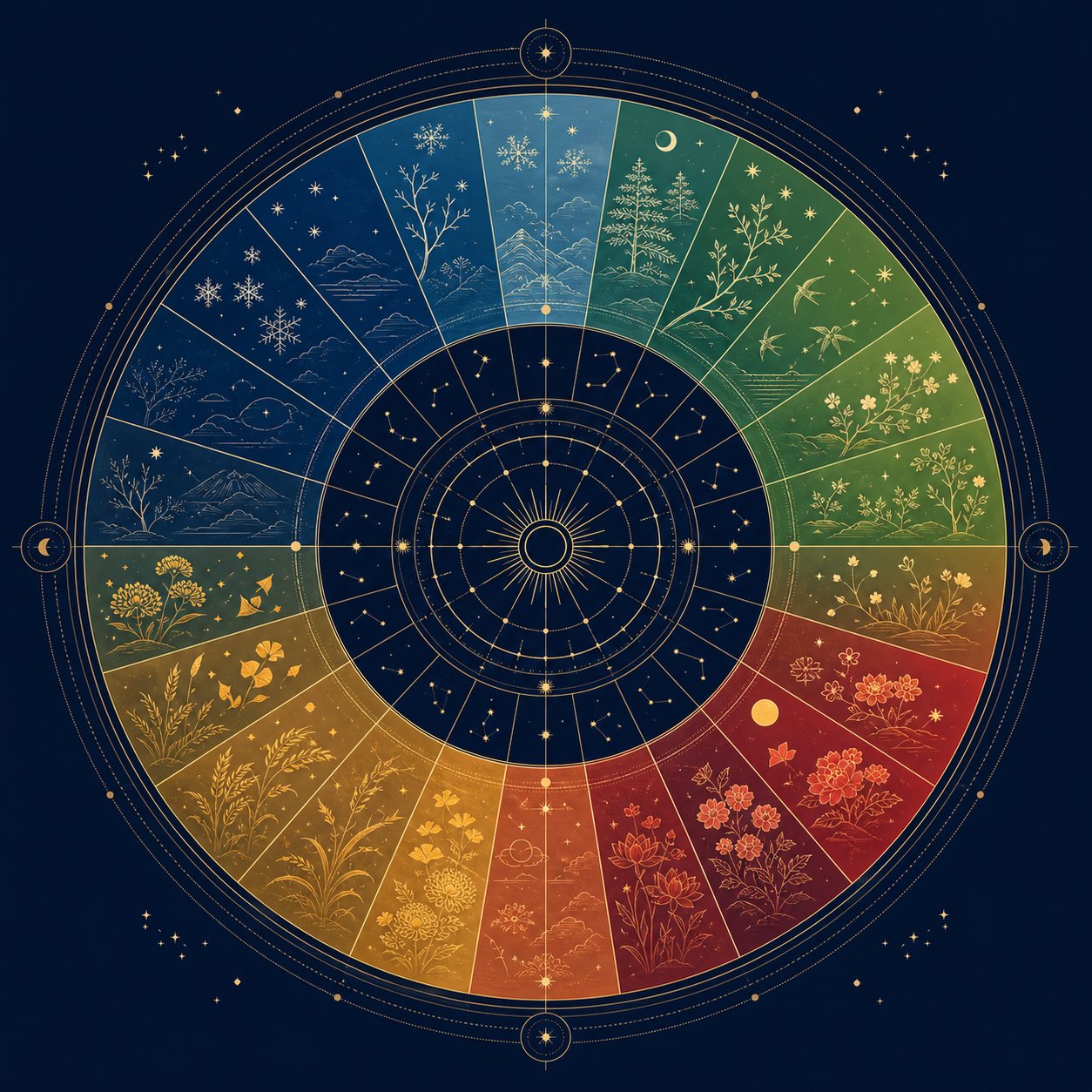
The 24 Solar Terms and Their Seasonal Significance
Four seasons give you a broad framework. But Chinese tradition doesn't stop there. It divides the year into 24 precise segments called solar terms, or 二十四节气 (ershisi jieqi). Each term lasts roughly 15 days and captures a specific shift in climate, agriculture, or natural phenomena. If you've ever wondered when is spring in china, the answer depends on which system you're using, and the chinese solar terms offer a far more granular answer than any Western calendar.
Understanding the 24 Solar Terms System
Here's where the chinese 24 solar terms diverge sharply from Western meteorological seasons. In the West, spring starts on a fixed date (March 1 meteorologically, or the March equinox astronomically). The Chinese system works differently. Each solar term is determined by the sun's position along the ecliptic longitude, divided into 15-degree increments. When the sun reaches 315 degrees, that's 立春 (Lichun), the Start of Spring, typically falling around February 4th.
This means the Chinese year doesn't split into four equal blocks. It flows through 24 distinct micro-seasons, each marking a real, observable change in the natural world: when insects awaken, when frost first appears, when grain fills on the stalk. The system originated during the Shang Dynasty (17th century BC to 1046 BC) and was fully codified during the Han Dynasty, when all 24 terms were officially incorporated into the Chinese calendar.
So how many months in a chinese year? The traditional lunisolar calendar has 12 months in a regular year and 13 in a leap year (with an intercalary month added roughly every three years to stay synchronized with the solar cycle). The 24 solar terms act as anchor points that keep this lunar-based system aligned with actual seasonal changes, ensuring farmers always knew the right time to plant, harvest, or prepare for cold.
All 24 Solar Terms with Characters and Dates
The table below gives you a complete reference. You'll notice familiar season characters (春, 夏, 秋, 冬) embedded throughout these terms, and many of these compound words also appear in personal names. A child born during 清明 (Qingming) might carry 明 in their name. Someone born near 谷雨 (Guyu) could be named 雨 (rain). The naming connection runs through the entire system.
| Solar Term Name | Chinese Characters | Pinyin with Tones | English Translation | Approximate Dates | Associated Season |
|---|---|---|---|---|---|
| Lichun | 立春 | Lichun (4th + 1st) | Start of Spring | Feb 4 | Spring |
| Yushui | 雨水 | Yushui (3rd + 3rd) | Rain Water | Feb 19 | Spring |
| Jingzhe | 惊蛰 | Jingzhe (1st + 2nd) | Insects Awaken | Mar 5 | Spring |
| Chunfen | 春分 | Chunfen (1st + 1st) | Spring Equinox | Mar 20 | Spring |
| Qingming | 清明 | Qingming (1st + 2nd) | Clear and Bright | Apr 4 | Spring |
| Guyu | 谷雨 | Guyu (3rd + 3rd) | Grain Rain | Apr 19 | Spring |
| Lixia | 立夏 | Lixia (4th + 4th) | Start of Summer | May 5 | Summer |
| Xiaoman | 小满 | Xiaoman (3rd + 3rd) | Lesser Full Grain | May 20 | Summer |
| Mangzhong | 芒种 | Mangzhong (2nd + 4th) | Grain in Ear | Jun 5 | Summer |
| Xiazhi | 夏至 | Xiazhi (4th + 4th) | Summer Solstice | Jun 21 | Summer |
| Xiaoshu | 小暑 | Xiaoshu (3rd + 3rd) | Lesser Heat | Jul 6 | Summer |
| Dashu | 大暑 | Dashu (4th + 3rd) | Greater Heat | Jul 22 | Summer |
| Liqiu | 立秋 | Liqiu (4th + 1st) | Start of Autumn | Aug 7 | Autumn |
| Chushu | 处暑 | Chushu (3rd + 3rd) | End of Heat | Aug 22 | Autumn |
| Bailu | 白露 | Bailu (2nd + 4th) | White Dew | Sep 7 | Autumn |
| Qiufen | 秋分 | Qiufen (1st + 1st) | Autumn Equinox | Sep 22 | Autumn |
| Hanlu | 寒露 | Hanlu (2nd + 4th) | Cold Dew | Oct 8 | Autumn |
| Shuangjian | 霜降 | Shuangjiang (1st + 4th) | Frost Descends | Oct 23 | Autumn |
| Lidong | 立冬 | Lidong (4th + 1st) | Start of Winter | Nov 7 | Winter |
| Xiaoxue | 小雪 | Xiaoxue (3rd + 3rd) | Minor Snow | Nov 22 | Winter |
| Daxue | 大雪 | Daxue (4th + 3rd) | Major Snow | Dec 6 | Winter |
| Dongzhi | 冬至 | Dongzhi (1st + 4th) | Winter Solstice | Dec 21 | Winter |
| Xiaohan | 小寒 | Xiaohan (3rd + 2nd) | Lesser Cold | Jan 5 | Winter |
| Dahan | 大寒 | Dahan (4th + 2nd) | Greater Cold | Jan 20 | Winter |
A few terms deserve special attention for learners. 清明 (Qingming, Clear and Bright) is both a solar term and a major Chinese holiday, Tomb Sweeping Day, when families honor ancestors. 冬至 (Dongzhi, Winter Solstice) marks the shortest day of the year and carries its own food traditions: dumplings in the north, sweet rice balls in the south. These aren't just calendar markers. They're living cultural events that shape how Chinese people experience time.
The naming connection is worth emphasizing. Characters like 露 (lu, dew), 雪 (xue, snow), 雨 (yu, rain), and 明 (ming, bright) all appear in solar term names and double as popular elements in personal names. A woman named 白露 (Bailu) carries the poetry of early autumn mornings when dew glistens on grass. A man named 清明 (Qingming) evokes clarity and moral brightness. The 24 solar terms function as a naming reservoir that extends far beyond the four basic season characters.
These terms also generated centuries of proverbs, idioms, and poetic expressions tied to specific moments in the seasonal cycle. Many of those phrases remain part of everyday conversation, giving learners a way to sound natural while referencing the same seasonal wisdom that shapes Chinese identity.
Seasonal Idioms and Proverbs in Daily Chinese
Proverbs and idioms grew directly out of those seasonal rhythms. Chinese speakers didn't just observe the 24 solar terms and move on. They compressed centuries of seasonal experience into four-character expressions called 成语 (chengyu) that remain part of everyday speech. These idioms give you something vocabulary lists can't: the ability to describe a feeling, a scene, or a moment the way a native speaker would. For learners exploring the fall season in chinese or any other part of the year, idioms are where language meets lived experience.
There are over 5,000 chengyu in common use, with nature and seasonal themes among the most frequently encountered. The four-character structure creates a rhythmic balance rooted in Classical Chinese, and many of these expressions trace directly back to Tang and Song dynasty poetry.
Spring and Summer Idioms in Everyday Chinese
Spring idioms tend to carry warmth and optimism. Summer ones lean toward intensity and abundance. You'll hear these in casual conversation, weather commentary, and social media captions alike.
- 春暖花开 (chun nuan hua kai) - Literal meaning: Spring warms, flowers bloom. Usage: Describes beautiful spring scenery, but also serves as a metaphor for good times arriving or a joyful turning point. The poet Haizi immortalized this phrase in his famous 1989 poem "Facing the Sea, With Spring Flowers Blossoming" (面朝大海,春暖花开), making it one of the most recognized lines in modern Chinese poetry. Example sentence: 等到春暖花开的时候,我们去公园野餐吧。(When spring warms and flowers bloom, let's have a picnic in the park.)
- 春风化雨 (chun feng hua yu) - Literal meaning: Spring breeze transforms into rain. Usage: Describes the nurturing influence of a good teacher or mentor, someone whose guidance feels as natural and life-giving as spring weather nourishing plants. Example sentence: 王老师春风化雨的教学方式深受学生喜爱。(Teacher Wang's nurturing teaching style is deeply loved by students.)
- 烈日炎炎 (lie ri yan yan) - Literal meaning: Fierce sun, blazing and scorching. Usage: Describes the oppressive heat of midsummer. You'll hear this in weather reports and daily complaints about heat. Example sentence: 烈日炎炎的夏天,大家都不想出门。(Under the scorching summer sun, nobody wants to go outside.)
- 雨后春笋 (yu hou chun sun) - Literal meaning: Bamboo shoots after spring rain. Usage: Describes things appearing rapidly and in great numbers, similar to "springing up like mushrooms" in English. Example sentence: 随着旅游业的繁荣,民宿像雨后春笋一般涌现。(As tourism flourishes, homestays are springing up like bamboo shoots after rain.)
Autumn and Winter Proverbs and Their Meanings
The fall season in mandarin carries a different emotional register. Autumn idioms often evoke clarity, crispness, and reflective beauty. Winter expressions lean into endurance and the starkness of cold. If you've ever looked up autumn in mandarin and wondered how the season feels in Chinese culture, these idioms capture it far better than any single word can. While learners often research autumn in different languages to compare cultural associations, Chinese stands out for how many idioms treat fall as a season of elevated spirit rather than decline.
- 秋高气爽 (qiu gao qi shuang) - Literal meaning: Autumn sky high, air crisp and refreshing. Usage: The go-to expression for describing perfect autumn weather, clear blue skies with cool, comfortable air. Song dynasty poets used this image repeatedly to set scenes of clarity and intellectual sharpness. Example sentence: 秋高气爽的日子最适合爬山。(Days when the autumn sky is high and air is crisp are perfect for hiking.)
- 春兰秋菊 (chun lan qiu ju) - Literal meaning: Spring orchids and autumn chrysanthemums. Usage: Expresses that different people or things each have their own unique strengths, like orchids blooming in spring and chrysanthemums thriving in fall. Neither is superior. Example sentence: 她擅长书法,她姐姐精于绘画,可谓是春兰秋菊,各擅胜场。(She excels at calligraphy while her sister masters painting. Like spring orchids and autumn chrysanthemums, each has their own talent.)
- 寒冬腊月 (han dong la yue) - Literal meaning: Cold winter, twelfth lunar month. Usage: Refers to the bitterest, coldest stretch of winter. 腊月 specifically means the twelfth month of the lunar calendar, traditionally the harshest period. Example sentence: 寒冬腊月里,奶奶总会炖一锅热汤。(In the bitter winter months, Grandma always stews a pot of hot soup.)
- 冰天雪地 (bing tian xue di) - Literal meaning: Icy sky, snowy ground. Usage: Paints a picture of a world completely covered in ice and snow, used for extreme winter conditions. Tang dynasty frontier poets deployed this image to convey the harshness soldiers faced at northern borders. Example sentence: 东北的冬天冰天雪地,但人们依然热情好客。(Winters in the Northeast are all ice and snow, but the people remain warm and hospitable.)
Notice how these idioms do more than describe weather. They carry emotional and philosophical weight. 秋高气爽 isn't just "nice autumn day." It implies mental clarity and elevated mood. 寒冬腊月 isn't just "cold." It evokes family gathering close, warm food, and endurance through hardship. When you study autumn in different languages, you'll find that Chinese seasonal idioms pack cultural narrative into remarkably few syllables.
These expressions also reveal something about how Chinese philosophy organizes the natural world. Each season maps onto specific elements, directions, and virtues in a cosmological system that has guided everything from medicine to architecture for over two thousand years.
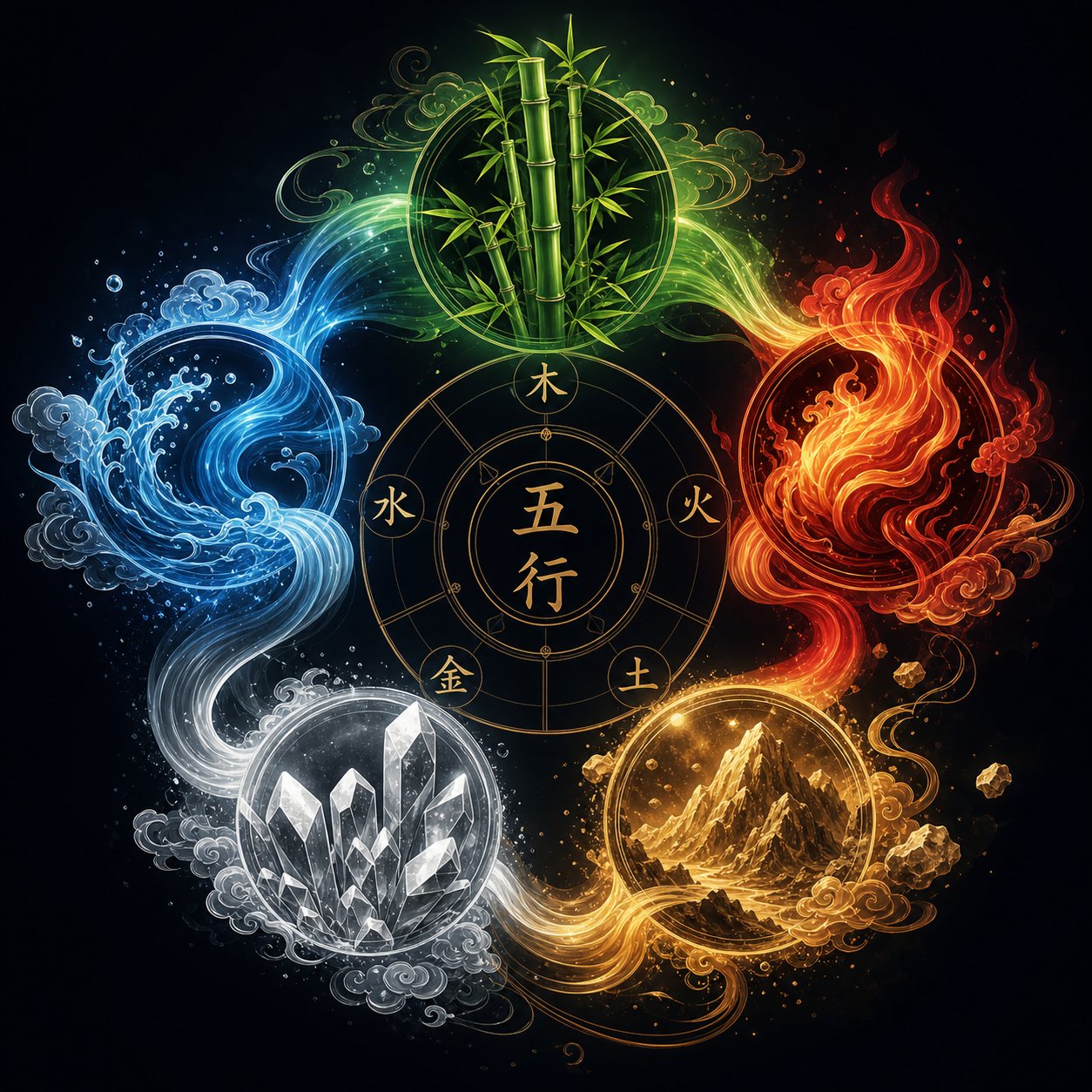
Seasons in Chinese Philosophy and the Five Elements
That cosmological system has a name: 五行 (wuxing), or the Five Elements. It organizes all natural phenomena into five master groups — Wood, Fire, Earth, Metal, and Water — each linked to a season, a direction, a color, and a set of human qualities. For learners trying to understand why the china four seasons carry so much symbolic weight in naming, medicine, and daily life, wuxing is the underlying logic that ties everything together.
Seasons and the Five Elements Connection
Imagine the year as a cycle where energy transforms through five distinct phases. Each season of china corresponds to one element, and that element shapes what the season means at a philosophical level:
- Spring → Wood (木, mu). Wood energy rises upward and outward, like a tree pushing new branches. Spring embodies growth, flexibility, and creative expansion. Its direction is East (where the sun rises), and its color is green.
- Summer → Fire (火, huo). Fire energy radiates outward at maximum intensity. Summer represents peak vitality, joy, and outward expression. Its direction is South, and its color is red.
- Late Summer → Earth (土, tu). Earth occupies the transitional center between seasons. It represents stability, nourishment, and grounding. Its direction is Center, and its color is yellow. This fifth phase explains why Chinese cosmology doesn't map neatly onto a simple four-season model.
- Autumn → Metal (金, jin). Metal energy contracts and consolidates. Autumn represents refinement, precision, and letting go of what's no longer needed. Its direction is West, and its color is white.
- Winter → Water (水, shui). Water energy sinks inward and stores. Winter represents rest, reflection, and hidden potential waiting to emerge. Its direction is North, and its color is black.
These five elements don't exist in isolation. They follow a generating and overcoming cycle: Water generates Wood (nourishing growth), Wood generates Fire (fuel for flames), Fire generates Earth (ash enriches soil), Earth generates Metal (minerals form underground), and Metal generates Water (condensation on metal surfaces). Each element also has an overcoming relationship — Water extinguishes Fire, Fire melts Metal, and so on.
| Season | Element | Direction | Color | Symbolic Meaning |
|---|---|---|---|---|
| Spring (春) | Wood (木) | East | Green | Growth, flexibility, new beginnings |
| Summer (夏) | Fire (火) | South | Red | Vitality, joy, peak energy |
| Late Summer | Earth (土) | Center | Yellow | Stability, nourishment, balance |
| Autumn (秋) | Metal (金) | West | White | Refinement, clarity, consolidation |
| Winter (冬) | Water (水) | North | Black | Rest, wisdom, stored potential |
How Philosophy Shapes Seasonal Naming Choices
Here's where this gets practical for understanding chinese names and seasons. Traditional naming practice doesn't just pick a season character because it sounds nice. Parents — especially those who consult a fortune teller or use Bazi (八字, Eight Characters) astrology — analyze which elements are strong or weak in a child's birth chart. If a child's chart lacks Water energy, a parent might choose a winter-associated name containing 冬 or 雪 (snow) to restore balance. A child born with excessive Fire might receive a name with Metal or Water associations to counteract that intensity.
This means two children born in summer could receive completely different seasonal names. One whose chart already overflows with Fire energy might get an autumn name (Metal overcomes Wood, and Metal's contracting quality tempers Fire's expansion). Another whose chart needs more warmth might receive 夏 directly. The system is about balance, not literal birth-season labeling.
The practice remains common across Chinese-speaking communities, though its intensity varies. In Taiwan and parts of southern China, consulting a naming master who reads elemental charts is still standard for many families. In urban Mainland China, younger parents may choose season names for aesthetic reasons while older generations maintain the cosmological approach.
Regional climate also shapes how people experience and talk about the seasons in china. Northern cities like Harbin endure winters where temperatures drop below -30°C, making winter vocabulary visceral and immediate. Southern cities like Guangzhou barely experience winter at all — residents there might use 冬天 (winter) to describe what northerners would call a cool autumn day. The china seasons vocabulary stays the same nationwide, but the lived reality behind each word shifts dramatically depending on latitude. A person named 冬梅 (Winter Plum) from Hainan Island carries the same symbolic meaning as one from Beijing, but their physical experience of the season that inspired their name couldn't be more different.
This philosophical framework doesn't just explain naming. It shapes how Chinese speakers use seasonal language in everyday sentences, from describing weather to expressing emotions. The practical side of that — how to actually construct natural-sounding sentences about seasons — is where vocabulary, philosophy, and real conversation finally come together.
Practical Sentences Using Season Vocabulary
Philosophy gives you the "why" behind seasonal language. Conversation gives you the "how." Knowing that autumn connects to Metal energy is fascinating, but what really matters at a dinner table in Shanghai or a video call with a language partner is whether you can describe the weather, ask about someone's favorite season, or comment on what's happening outside your window. These sentences bridge the gap between cultural knowledge and spoken fluency.
Weather and Activity Sentences for Each Season
The sentences below progress from beginner-friendly structures to intermediate patterns. You'll notice that natural Chinese often drops subjects, uses sentence-final particles for tone, and places time words at the beginning. Try reading each one aloud, paying attention to how the season word fits into the sentence's rhythm.
- Beginner: Simple descriptions
- 春天很暖和。(Chuntian hen nuanhuo.) — Spring is warm.
- 夏天太热了!(Xiatian tai re le!) — Summer is too hot!
- 秋天很凉快。(Qiutian hen liangkuai.) — Autumn is cool and pleasant.
- 冬天很冷。(Dongtian hen leng.) — Winter is cold.
- Beginner: Preferences and questions
- 你最喜欢哪个季节?(Ni zui xihuan nage jijie?) — Which season do you like best?
- 我最喜欢秋天。(Wo zui xihuan qiutian.) — I like autumn best.
- 你喜欢冬天吗?(Ni xihuan dongtian ma?) — Do you like winter?
- Intermediate: Activities and plans
- 春天的时候,我喜欢去公园看花。(Chuntian de shihou, wo xihuan qu gongyuan kan hua.) — In spring, I like going to the park to see flowers.
- 夏天我们经常去游泳。(Xiatian women jingchang qu youyong.) — In summer we often go swimming.
- 秋天的时候,北京的叶子特别漂亮。(Qiutian de shihou, Beijing de yezi tebie piaoliang.) — In autumn, the leaves in Beijing are especially beautiful.
- 冬天我喜欢在家喝热茶。(Dongtian wo xihuan zai jia he re cha.) — In winter I like drinking hot tea at home.
- Intermediate: Cultural references and comparisons
- 中国的春天从立春开始,大概在二月初。(Zhongguo de chuntian cong Lichun kaishi, dagai zai eryue chu.) — Spring in China starts from Lichun, around early February.
- 南方的冬天不下雪,但是很潮湿。(Nanfang de dongtian bu xia xue, danshi hen chaoshi.) — Southern winters don't have snow, but they're very humid.
- 她叫冬梅,因为她是冬天出生的。(Ta jiao Dongmei, yinwei ta shi dongtian chusheng de.) — Her name is Dongmei because she was born in winter.
Notice how the intermediate sentences use 的时候 (de shihou, "when it's...") to frame seasonal activities. This is one of the most versatile patterns for talking about what you do in each season. You can swap in any season word before 的时候 and follow it with any activity.
How to Talk About Seasons Like a Native Speaker
A few common mistakes trip up learners when discussing what season is it in china or describing seasonal experiences. Avoiding these will immediately make your Chinese sound more natural.
Mistake 1: Forgetting 了 (le) for current changes. When spring has just arrived, Chinese speakers say 春天来了 (Chuntian lai le) — "Spring has come." The particle 了 signals a change of state. Saying 春天来 without 了 sounds incomplete, like something is missing from the sentence.
Mistake 2: Using the wrong calendar. If someone asks what season is it in china right now, the answer depends on which system you reference. The traditional Chinese calendar (based on solar terms) starts spring around February 4 with 立春. The Western meteorological system starts spring on March 1. The Gregorian astronomical system uses the March equinox (around March 20). A Chinese speaker saying 现在是春天 in mid-February is perfectly correct by traditional standards, even though Western calendars still call it winter. Understanding this difference prevents confusion in real conversations.
Mistake 3: Overusing 的 (de) in simple weather statements. You need 的 when a season modifies a noun (秋天的天空, "autumn's sky"). But for basic descriptions, skip it: say 冬天很冷 (Dongtian hen leng), not 冬天的很冷. The structure is simply [season] + 很 + [adjective].
What are china's seasons in terms of actual timing? Here's a quick comparison that clears up the calendar confusion:
- Chinese traditional spring: 立春 (Feb 4) through 立夏 (May 5)
- Western meteorological spring: March 1 through May 31
- Chinese traditional winter: 立冬 (Nov 7) through 立春 (Feb 4)
- Western meteorological winter: December 1 through February 28
This means Chinese spring starts nearly a full month earlier than its Western counterpart. When a Chinese friend says 春天到了 in early February, they're not being premature — they're following a system that has tracked seasonal shifts for over two thousand years.
From basic vocabulary and character etymology to naming traditions, solar terms, idioms, and philosophical frameworks, seasonal language in Chinese is a single thread that connects pronunciation skills to cultural fluency. Master the four characters, understand what's inside them, and you unlock not just words but an entire worldview.
The progression works like this: learn the sounds, see the stories inside the characters, recognize those characters in names and places around you, then use idioms and natural sentence patterns to speak about seasons the way Chinese people actually do. Each layer reinforces the last, turning four simple vocabulary words into a gateway for deeper cultural understanding.
Frequently Asked Questions About Chinese Names and Seasons
1. Why do Chinese parents use season characters in their children's names?
Chinese parents choose season characters like 春 (spring), 夏 (summer), 秋 (autumn), and 冬 (winter) because each season carries specific symbolic meanings. Spring represents hope and new beginnings, summer signals vitality, autumn conveys maturity and abundance, and winter embodies resilience. Parents may select a season based on when the child was born or based on qualities they wish the child to develop. In traditional practice, parents also consult Five Elements (wuxing) astrology to determine which seasonal energy balances the child's birth chart, making the choice both poetic and cosmologically intentional.
2. What are the four seasons in Chinese characters and how do you pronounce them?
The four seasons in Chinese are 春 (chun, 1st tone) for spring, 夏 (xia, 4th tone) for summer, 秋 (qiu, 1st tone) for autumn, and 冬 (dong, 1st tone) for winter. Three of the four use the first tone (high and flat), while only summer uses the sharp falling fourth tone. In everyday conversation, Chinese speakers typically add the suffix 天 (tian) to form 春天, 夏天, 秋天, and 冬天, which sound more natural than the single-character forms used alone.
3. When does spring start in China compared to Western countries?
In the traditional Chinese calendar, spring begins with the solar term 立春 (Lichun) around February 4, nearly a full month earlier than the Western meteorological start date of March 1. This difference stems from the 24 solar terms system, which tracks the sun's position along the ecliptic in 15-degree increments rather than using fixed calendar dates. So when a Chinese speaker says spring has arrived in early February, they are following a system that has measured seasonal shifts for over two thousand years.
4. What are the 24 solar terms and how do they relate to Chinese names?
The 24 solar terms (二十四节气) divide the Chinese year into precise 15-day segments, each marking a specific natural change like insects awakening, frost appearing, or grain ripening. Characters from these terms frequently appear in personal names. For example, a child born during 清明 (Qingming, Clear and Bright) might carry 明 in their name, while someone born near 白露 (Bailu, White Dew) could be named 露. The system functions as an extended naming reservoir beyond the four basic season characters, offering parents dozens of poetic options tied to specific moments in the yearly cycle.
5. How do the Five Elements connect to seasonal naming in Chinese culture?
The Five Elements system (五行) maps each season to an element: spring to Wood, summer to Fire, late summer to Earth, autumn to Metal, and winter to Water. In traditional naming practice, parents or naming masters analyze a child's birth chart to identify which elements are strong or weak. If a child lacks Water energy, they might receive a winter-associated name like 冬 or 雪 (snow) to restore balance. This means two children born in the same season could receive different seasonal names depending on their individual elemental needs, making the practice about cosmic harmony rather than simple birth-season labeling.