More Than Just Jiejie — Understanding Chinese Nicknames for Older Sister
In English, you call your older sister by her name, maybe tack on "sis," and that's about it. Chinese works differently. The language offers dozens of ways to address an older sister, and each one carries a distinct emotional charge. Your choice of term tells the listener how close you are, how formal the moment is, and even what region your family comes from.
When you study family in Mandarin, you quickly realize that kinship terms are not just labels. They are social signals. The word 姐姐 (jiějie) might be the textbook answer for "older sister in chinese," but real families rarely stop there. Depending on personality, birth order, dialect, and sheer affection, Chinese speakers draw from a rich pool of nicknames that range from deeply respectful to hilariously irreverent.
Why Chinese Has So Many Ways to Say Older Sister
Chinese culture places enormous weight on hierarchy within the family. As CLI's guide to the Chinese family tree explains, Confucian values like 孝顺 (xiàoshun, filial piety) shaped a system where age, gender, and lineage all demand distinct vocabulary. Older and younger siblings are never interchangeable in Chinese the way "sibling" is in English. That structural precision, combined with regional dialects and internet-era creativity, has produced a spectrum of sister terms you won't find in any single vocabulary list.
In Chinese culture, how you address your older sister reveals your relationship dynamic — whether you see her as an authority figure, a best friend, or something playfully in between.
What This Guide Covers
This article is the only dedicated resource for Chinese nicknames for older sister specifically, going far beyond generic lists of family in chinese letters. Here is what you'll find:
- The full formality spectrum from literary 姊姊 to casual 老姐
- Personalized nicknames built with name characters and affectionate prefixes
- Birth-order terms like 大姐 and 二姐 and the cultural weight they carry
- Dialect-specific forms in Cantonese, Hokkien, and Shanghainese
- Modern internet slang like 小姐姐 and fan-culture uses of 姐姐
- Common mistakes that can turn a compliment into an insult
Whether you are learning how to say sister in Chinese for the first time or looking for the perfect chinese for older sister that matches your family's vibe, this guide maps every option and shows you exactly when each one fits.
The Formality Spectrum from Formal to Casual
Imagine you're greeting your older sister at a family banquet versus yelling at her from across the apartment to pass the remote. You wouldn't use the same word in both moments, right? Chinese gives you a dedicated term for each level of formality, and picking the right one is second nature to native speakers. Here's how the full spectrum works when you say older sister in Mandarin.
The Formality Spectrum from 姊姊 to 老姐
Four main forms cover the range from literary to playful. Each one is a valid way to say elder sister in Mandarin, but they land very differently in conversation.
| Characters | Pinyin | Formality Level | Typical Context |
|---|---|---|---|
| 姊姊 | zǐzi | Formal / Literary | Written Chinese, classical texts, some Taiwanese Mandarin households |
| 姐姐 | jiějie | Standard / Neutral | Everyday family use, speaking to or about your older sister chinese style |
| 姐 | jiě | Casual | Quick address when calling out to her, texting, or mid-sentence references |
| 老姐 | lǎojiě | Playful / Irreverent | Close siblings joking around, informal storytelling among friends |
A few things to notice. 姊姊 (zǐzi) appears mostly in formal writing or in families that preserve older literary vocabulary — you'll hear it more often in Taiwan than in mainland China. 姐姐 (jiějie) is the workhorse. If you've ever looked up jie jie in Chinese, this is the term every textbook teaches first, and for good reason: it works in nearly any family setting without sounding too stiff or too casual.
Drop one syllable and you get 姐 (jiě), which feels like the English equivalent of calling out "sis" while multitasking. Then there's 老姐 (lǎojiě) — the 老 prefix here doesn't mean "old" in a disrespectful way. It adds a teasing, familiar edge, the kind of tone you'd use with a sister you grew up wrestling over the last dumpling with.
When to Use Each Form
Context drives everything. Here are natural sentence-level examples showing each term in action:
- 姊姊 — 姊姊从小就很照顾我。(Zǐzi cóngxiǎo jiù hěn zhàogù wǒ.) "My older sister has taken care of me since we were little." — Suitable for a written essay or a formal speech at a wedding.
- 姐姐 — 姐姐,晚饭好了吗?(Jiějie, wǎnfàn hǎo le ma?) "Sis, is dinner ready?" — The default at home, warm and respectful without being stiff.
- 姐 — 姐,帮我拿一下。(Jiě, bāng wǒ ná yíxià.) "Sis, grab that for me." — Fast, efficient, no ceremony needed.
- 老姐 — 我老姐又在催我了。(Wǒ lǎojiě yòu zài cuī wǒ le.) "My sis is nagging me again." — Playful complaint to a friend, never said to a stranger's sister.
The pattern is straightforward: the more syllables and the more traditional the character, the higher the formality. As you move down the spectrum, affection stays constant but reverence gives way to camaraderie. Knowing where each term sits helps you sound natural rather than robotic when addressing an older sister in any Chinese-speaking environment.
Of course, these four forms are just the starting framework. Many families go further, weaving a sister's actual name into the term itself to create something entirely personal.
Personalized Nicknames Using Name Characters and Prefixes
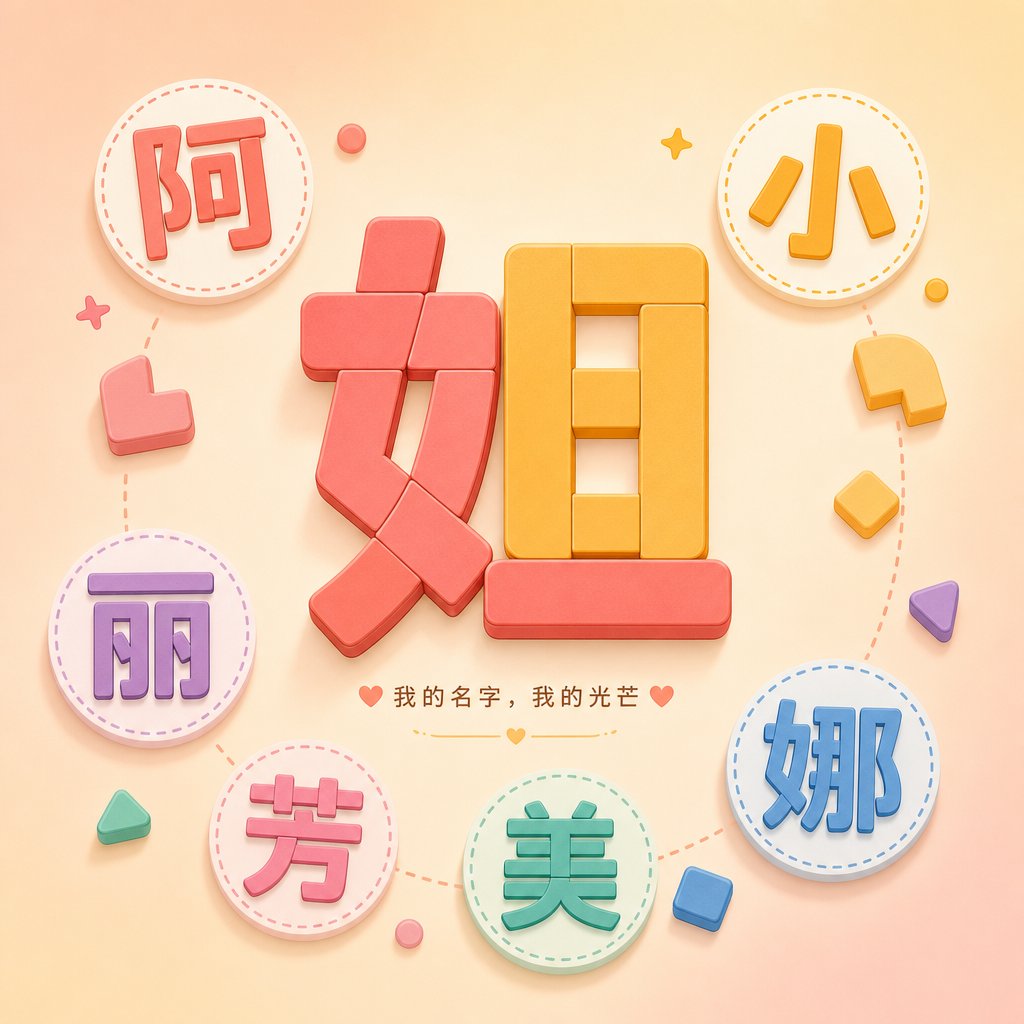
Every family has its own shorthand. Rather than relying on generic terms, Chinese households routinely build custom nicknames by attaching 姐 to a character pulled straight from the sister's given name. The result is a term that belongs to one person and one person only — a kind of chinese symbol for sister that doubles as a personal signature.
Combining 姐 with Given Name Characters
The most common formation pattern is simple: take one character from your sister's name and pair it with 姐. If your older sister's name is 王丽华 (Wang Lihua), family members might call her 丽姐 (Lijiě) or 华姐 (Huajiě). The character chosen usually depends on which syllable sounds most natural or which one the family latched onto during childhood.
Here are the typical formation patterns you'll encounter:
- Single name character + 姐 — 丽姐 (Lijiě): used when the sister's name is short or one character stands out. Example sentence: 丽姐,你今天下班早吗?(Lijiě, nǐ jīntiān xiàbān zǎo ma?) "Li-jie, are you getting off work early today?"
- Full given name + 姐 — 小芳姐 (Xiǎofāngjiě): common when the given name is two characters and both flow well together. Example: 小芳姐做的菜最好吃。(Xiǎofāngjiě zuò de cài zuì hǎochī.) "Xiaofang-jie's cooking is the best."
- 姐 + name character (reversed order) — 姐丽 (Jiělì): less common but heard in some southern families. The reversed structure feels slightly more playful.
This pattern is how many people first learn how to write sister in Chinese beyond the textbook — not as a standalone character, but as part of a living, personalized name.
How the 阿 Prefix Creates Warmth
The prefix 阿 (ā) is one of the most affectionate building blocks in Chinese. It carries no independent meaning on its own, but when placed before a kinship term or name character, it instantly signals closeness and emotional warmth. In southern China, Hong Kong, and Taiwan especially, 阿姐 (ājiě) is a go-to way to address an older sister with casual tenderness.
You can also combine 阿 directly with a name character: if your sister's name contains 玲 (líng), she might become 阿玲 (Ālíng) at home. This form suggests familiarity built over years — the kind of nickname that sticks from toddlerhood through adulthood.
- 阿姐 (ājiě) — warm, familiar "sis." Example: 阿姐,帮我看看这个。(Ājiě, bāng wǒ kànkan zhège.) "Sis, take a look at this for me."
- 阿 + name character — 阿玲 (Ālíng), 阿慧 (Āhuì). Example: 阿慧姐今天来吃饭。(Āhuìjiě jīntiān lái chīfàn.) "Ah-Hui jie is coming for dinner today."
The 小 Prefix for Affectionate Nicknames
Where 阿 signals time-tested closeness, 小 (xiǎo) adds a layer of youthful affection. Literally meaning "little" or "small," 小 doesn't imply your sister is younger — it functions as a diminutive that softens the tone and makes the nickname feel endearing. Think of it as the Chinese equivalent of adding "-ie" to an English name.
In practice, 小 pairs with a sister's name character to create terms like 小丽 (Xiǎolì) or 小芳 (Xiǎofāng). These are used by parents, grandparents, and sometimes close friends rather than by younger siblings directly — since calling your older sister "little" can feel cheeky depending on family dynamics.
- 小 + name character — 小丽 (Xiǎolì), 小雪 (Xiǎoxuě). Example: 小雪姐,电话找你。(Xiǎoxuějiě, diànhuà zhǎo nǐ.) "Xiaoxue-jie, phone call for you."
- 小姐姐 (xiǎojiějie) — a modern affectionate form that blends the 小 prefix with the standard sister in Mandarin term. More on this one later, as it has taken on a life of its own online.
These prefix-based formations give every family a toolkit for crafting nicknames that feel personal rather than generic. The chinese for sister you'll hear in real households is almost never the plain textbook term — it's layered with name characters, prefixes, and years of shared history. And in larger families with multiple older sisters, personalization becomes even more essential, because birth order itself turns into a naming system.
Birth-Order Nicknames and What They Signal
In families with multiple sisters, personalized name-based nicknames aren't always enough. When three or four older sisters share the dinner table, you need a system that instantly tells everyone who you're talking to. That's where birth-order numbering comes in — a clean, intuitive structure that doubles as an everyday nickname for millions of Chinese families.
大姐 二姐 三姐 — The Birth-Order System
The logic is simple: pair a number with 姐 to indicate each sister's position among the siblings in Chinese family hierarchy. The oldest in Chinese birth order gets the number 大 (da, meaning "big" or "first"), and the rest follow sequentially with standard numerals.
- 大姐 (dajiě) — the eldest sister, literally "big sister in chinese" terms. She holds the top position among all 兄弟 姐妹 (xiōngdi jiěmei, brothers and sisters).
- 二姐 (erjiě) — the second-oldest sister. 二 (er) means "two" or "second."
- 三姐 (sānjiě) — the third-oldest sister.
- 四姐 (sijiě) — the fourth-oldest sister, and so on for larger families.
You'll notice the system skips "一姐" (yījiě, "first sister"). That slot is filled by 大姐 instead, because 大 carries a weight that a plain numeral cannot — it implies leadership, not just sequence. This mirrors how 大哥 (dagē) works for the eldest brother. The pattern is consistent across the entire sibling chinese naming system.
These terms function as real, daily-use nicknames. In a household with three sisters, the youngest sibling might never use given names at all. 大姐, 二姐, and 三姐 become the primary way each sister is addressed at home, sometimes for an entire lifetime.
Cultural Weight of Being the 大姐
Being called 大姐 is not just a label — it's a role. In traditional Chinese families, the eldest sister often shoulders responsibilities that go beyond her years. She mediates sibling disputes, helps with younger children's homework, and sometimes acts as a second mother when parents are working. The term 大姐 encodes all of that expectation into two syllables.
Outside the family, 大姐 also carries authority. When someone refers to a woman as 大姐 in a social or professional context, it can signal respect for her competence and decisiveness. However, as Everyday Chinese notes, calling a stranger 大姐 can backfire if she perceives it as implying she looks older — so the term works best within families or among people who already share a close bond.
Here's how the same sister gets referenced differently depending on the audience:
| Situation | What You Say | Pinyin | English |
|---|---|---|---|
| Calling her at the dinner table | 二姐,再来点汤吗? | Erjiě, zai lai diǎn tāng ma? | Second sis, want more soup? |
| Telling a friend about her | 我二姐下周结婚。 | Wǒ erjiě xia zhōu jiehūn. | My second-oldest sister is getting married next week. |
| Introducing her formally | 这是我姐姐,排行老二。 | Zhe shi wǒ jiějie, paihang lǎo er. | This is my older sister, the second-born. |
Notice the shift: at home, 二姐 is direct and warm. With outsiders, you might switch to the more neutral 姐姐 and add context about birth order separately. This flexibility is part of what makes the sibling chinese naming system so expressive — the same person can be referenced with different levels of intimacy depending on who's listening.
One more nuance worth knowing: in some families, the birth-order number counts only sisters, while in others it counts all siblings regardless of gender. A family with an older brother and two older sisters might call the first sister 大姐 (since she's the eldest female) or 二姐 (since she's the second-oldest child overall). There's no universal rule — each household develops its own convention, and that convention becomes family law.
These numbered nicknames work beautifully within the family circle. But what happens when you step outside Mandarin entirely? Across China's many dialect regions, the word for older sister changes shape completely — and with it, the nicknames shift too.
Regional and Dialect Variations Across Chinese Languages
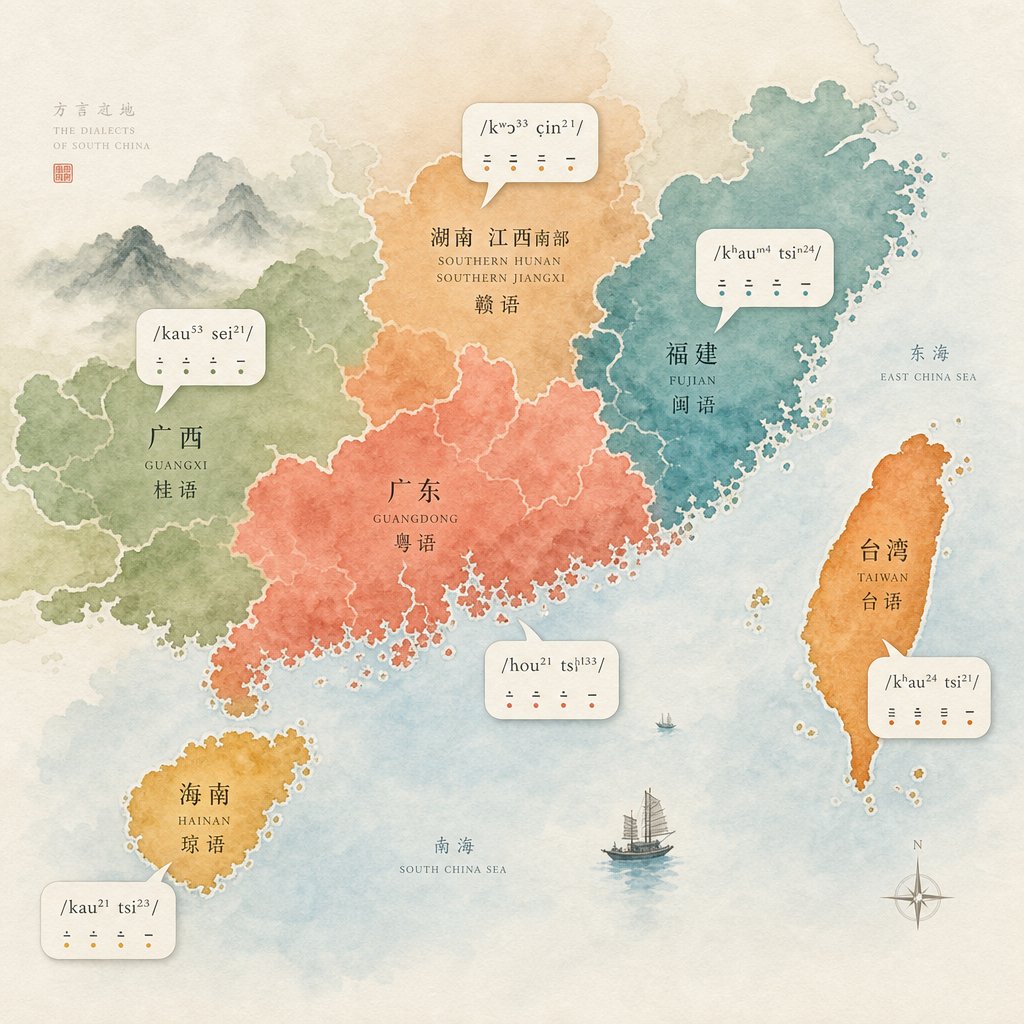
Mandarin gets most of the attention in language-learning circles, but it represents only one branch of the Chinese language family. When you explore how to say older sister in Chinese Cantonese, Hokkien, or Shanghainese, you'll find entirely different words — not just different pronunciations of the same characters. The affectionate intent stays constant, but the sounds, tones, and even the characters themselves shift dramatically from region to region.
Cantonese Terms for Older Sister
If you've spent time around Cantonese-speaking families in Hong Kong, Guangzhou, or overseas communities, you've likely heard 家姐 (gaa1 ze2) rather than 姐姐. This is the standard Cantonese term for older sister in many families, and it's the form you'd use when speaking to outsiders about your own sister. The character 家 (gaa1, "family/home") signals that you're referring to your own household member — a distinction Cantonese makes more explicitly than Mandarin.
For direct address, 阿姐 (aa3 ze2) is the warm, face-to-face form. Wiktionary's dialect survey confirms that 阿姐 appears as the primary vocative across dozens of Cantonese-speaking areas, from Guangzhou's Huadu and Conghua districts to Jiangmen, Zhuhai, and even overseas communities in Singapore and Vietnam. You call out 阿姐 when she's in the next room; you say 家姐 when telling a coworker about her.
Interestingly, while sister Cantonese terms focus on 姐 (ze2), the younger sister in Cantonese is typically 阿妹 (aa3 mui1) or 细妹 (sai3 mui1) — a completely different character set that reinforces how sharply Cantonese distinguishes elder from younger siblings.
Hokkien and Taiwanese Variations
Hokkien — spoken across Fujian, Taiwan, and Southeast Asian Chinese communities — uses a different character entirely. The standard term is 阿姊 (a-chi or a-che), written with 姊 rather than 姐. As documented in Wikipedia's overview of Hokkien honorifics, the prefix 阿 (a-) functions as a familial honorific that younger members attach when addressing elders, making 阿姊 the natural way a younger sibling calls their older sister.
In Taiwanese Mandarin, the literary form 姊姊 (zǐzi) remains common in everyday speech — a notable difference from mainland Mandarin, where 姐姐 dominates. Many Taiwanese families use 姊姊 at home and reserve 姐姐 for more casual or mainland-influenced contexts. This means the same older sister in Chinese language terms can sound quite different depending on whether you're in Taipei or Beijing.
Some Hokkien speakers in Kinmen use the variant 俺姊 (an-chi), where 俺 (an) means "my" — a possessive prefix that makes the term feel even more personal.
Shanghainese and Other Regional Forms
Shanghainese (a Wu dialect) offers its own mix. Speakers in Shanghai commonly use 阿姐 (pronounced closer to "ah-tsia" in local phonology), alongside 姐姐 and the older literary form 阿姊. The Wiktionary dialect data lists all four variants — 姐姐, 阿姐, 姊姊, and 阿姊 — as active in Shanghai, reflecting how this cosmopolitan city blends traditional and modern forms.
Here's a comparison table showing how the concept of "older sister" maps across major Chinese language varieties:
| Dialect/Variety | Characters | Romanization | Usage Notes |
|---|---|---|---|
| Standard Mandarin | 姐姐 | jiějie | Universal default; works in any mainland context |
| Taiwanese Mandarin | 姊姊 | zǐzi | Preferred literary form in many Taiwanese households |
| Cantonese (reference) | 家姐 | gaa1 ze2 | Standard when referring to your own older sister |
| Cantonese (address) | 阿姐 | aa3 ze2 | Direct, face-to-face address; warm and familiar |
| Hokkien / Taiwanese | 阿姊 | a-chi / a-che | Primary form across Taiwan and Fujian; uses 姊 not 姐 |
| Shanghainese (Wu) | 阿姐 / 阿姊 | ah-tsia / ah-tsi | Both forms coexist; 阿姐 slightly more common in modern usage |
| Teochew (Chaozhou) | 阿姐 | a-ze | Used across Chaoshan region and Thai-Chinese communities |
What's striking across all these varieties is the persistence of the 阿 prefix. Whether it's Cantonese aa3, Hokkien a-, or Shanghainese ah-, this single syllable does the same emotional work everywhere: it transforms a kinship label into a term of address that feels lived-in and affectionate. The sister in Chinese Mandarin might be 姐姐, but the underlying impulse — to soften a title into something personal — is shared across every dialect family.
These regional forms rarely appear in standard textbooks, which means learners often miss them entirely. Yet they're exactly what you'll hear in real households, dim sum restaurants, and family WeChat groups. And as Chinese internet culture has exploded in recent years, some of these traditional terms have collided with brand-new slang to produce nicknames that would puzzle even native speakers from an older generation.

Modern Slang and Social Media Nicknames for Older Sister Figures
Traditional dialect terms evolved over centuries. Internet slang moves at a completely different speed. Over the past decade, Chinese social media has taken the familiar 姐姐 framework and remixed it into a set of nicknames that have nothing to do with actual siblings — and everything to do with social dynamics, attractiveness, and online persona.
小姐姐 — From Family Term to Internet Compliment
If you spend any time on Douyin, Weibo, or Bilibili, you'll encounter 小姐姐 (xiǎojiějie) constantly. Literally, it combines the diminutive 小 (little) with 姐姐 (older sister), but its modern meaning has drifted far from family vocabulary. Online, 小姐姐 is a flattering way to address or describe a young woman who looks attractive, stylish, or approachable — regardless of whether she's actually older than the speaker.
As Maayot's guide to Chinese slang explains, when a lady looks young but is older than you, calling her 小姐姐 is both cute and complimentary. Women in their thirties or even forties appreciate the term because it implies youthfulness. You might hear someone say: 你认识她吗?她是个程序员小姐姐。(Nǐ rènshi tā ma? Tā shì gè chéngxùyuán xiǎojiějie.) — "Do you know her? She's a programmer xiaojiejie."
The key distinction: 小姐姐 feels warm and admiring, while 大姐 (dàjiě) used for a stranger can imply she looks older — potentially offensive. And plain 姐姐 from a stranger sounds overly familiar without the softening effect of 小. The 小 prefix does real social work here, keeping the tone light and flattering rather than presumptuous.
Fan Culture and Celebrity 姐姐 Nicknames
Chinese fan culture has turned 姐姐 into a title of devotion. When fans address female idols and celebrities, 姐姐 signals admiration mixed with affectionate closeness — as if the celebrity were a beloved older sister figure. The hit variety show 乘风破浪的姐姐 (Sisters Who Make Waves) cemented this usage, celebrating women over 30 who embrace confidence and maturity rather than chasing youthful aesthetics.
Popular internet variations you'll see in fan communities include:
- XX姐姐 — celebrity's name + 姐姐, used by fans as a term of endearment (e.g., 丽颖姐姐 for actress Zhao Liying)
- 小姐姐 — used in comment sections to compliment female content creators on their appearance or talent
- 神仙姐姐 (shénxiān jiějie) — "fairy sister," reserved for women considered extraordinarily beautiful, originally a nickname for actress Liu Yifei
- 国民姐姐 (guómín jiějie) — "nation's older sister," for universally beloved female public figures
This fan-driven usage creates an interesting contrast with family life. At home, 姐姐 implies a real hierarchical relationship. Online, it's aspirational — fans position themselves as the adoring younger sibling, and the celebrity becomes the idealized older sister everyone wishes they had.
御姐 and Other Archetype Labels
Beyond direct address, Chinese internet culture has developed archetype labels that categorize "older sister" energy into distinct personality types. The most prominent is 御姐 (yùjiě), borrowed from the Japanese concept of "onee-sama." A 御姐 is a mature, confident, often commanding woman — think sharp fashion, decisive personality, and an aura of cool authority. It's less a nickname you'd call someone to her face and more a label fans and netizens apply when describing a type.
Other archetype-adjacent terms include:
- 御姐 (yùjiě) — mature, confident, slightly intimidating older-sister archetype; used in anime communities, dating discussions, and celebrity commentary
- 霸道姐姐 (bàdào jiějie) — "domineering sister," describing women with strong leadership presence
- 温柔姐姐 (wēnróu jiějie) — "gentle sister," the nurturing, soft-spoken counterpart to 御姐
These labels reveal a generational shift. Older Chinese speakers use 姐姐 and its variants strictly within relational contexts — you are someone's sister, or you are not. Younger speakers treat the same vocabulary as a flexible social tool, applying it to strangers, celebrities, and fictional characters based on perceived personality rather than actual kinship.
It's worth noting how this contrasts with terms on the other end of the age spectrum. The chinese for little sister is 妹妹 (mèimei), and the younger sister in Chinese internet culture gets her own slang treatment: 小妹妹 (xiǎo mèimei, the xiao mei mei meaning being a cute or innocent young girl) functions as the mirror image of 小姐姐. Where 小姐姐 flatters by implying maturity-with-youth, the chinese younger sister equivalent 小妹妹 emphasizes innocence and sweetness. Together, these terms form a complete social vocabulary that maps age, attractiveness, and personality onto the traditional sibling framework — all without a single actual family member involved.
This creative flexibility is part of what makes Chinese nicknames for older sister so rich. But with creativity comes risk. Some of these terms sit dangerously close to others that carry very different — even offensive — connotations, and mixing them up is one of the most common mistakes learners make.
Common Mistakes to Avoid with Older Sister Terms
The gap between 小姐姐 (safe, flattering) and 小姐 (potentially offensive) is exactly two characters wide — but the social consequences of confusing them can be enormous. Chinese nicknames for older sister come with landmines that no textbook adequately warns you about. Some mistakes merely sound awkward. Others can genuinely insult someone. Here are the ones that trip up learners most often.
The 小姐 Trap — Why Context Matters
Never use 小姐 (xiǎojiě) alone to address a woman in mainland China unless you pair it with her surname. In many regions, the standalone term has become associated with sex workers — a meaning shift that shocks learners who encounter it in older textbooks or Taiwanese media where 小姐 remains perfectly polite.
How did this happen? Historically, 小姐 was the standard respectful address for a young woman — the Chinese equivalent of "Miss." In Taiwan, it still functions this way. A waiter in Taipei might call you 小姐 without anyone blinking. But across much of mainland China, the term gradually took on seedy connotations through its association with nightlife establishments. The result is a regional split that catches learners off guard.
The safe alternatives are clear. If you want to compliment a young woman online or in casual conversation, 小姐姐 (xiǎojiějie) works perfectly — the added 姐 transforms the meaning entirely into something warm and admiring. If you need a formal address, pair the surname: 李小姐 (Lǐ xiǎojiě, "Miss Li") remains acceptable in most professional contexts. Or use 女士 (nǚshì, "Ms.") for formal situations where you want zero ambiguity.
This distinction matters beyond just how do you say sister in Chinese. It's a lesson in how regional usage can flip a word's connotation entirely. Learners studying how to say little sister in Chinese face a similar but less dangerous issue: 小妹 (xiǎomèi) is generally safe, but in certain contexts it can sound overly familiar or patronizing. The principle is the same — always consider your audience and region.
Tone Mistakes That Change Everything
Mandarin's four tones mean that mispronouncing a single syllable can turn a family term into something unrelated or embarrassing. With sister-related vocabulary, the most common tone errors include:
- 姐 (jiě, third tone) vs. 借 (jiè, fourth tone) — "older sister" vs. "to borrow." Flattening the third tone into a fourth makes "Sis, help me" sound like "Borrow, help me."
- 姐姐 (jiějie) vs. 结结 (jiējie) — mispronouncing both syllables in the first tone produces nonsense that confuses listeners.
- 大姐 (dàjiě) — getting the tones backward as dǎjiè sounds like a garbled version of "to fight" plus "to borrow," which is meaningless but jarring.
The fix is straightforward: drill the third tone on 姐 until it's automatic. Record yourself, compare with native audio, and pay special attention to the third-tone sandhi rule — when two third tones appear together (as in 姐姐's full pronunciation), the first one shifts to a rising second tone in natural speech. Knowing this rule helps you sound natural rather than robotic.
Formality Errors with Other People's Sisters
Here's a mistake that's social rather than linguistic: using casual forms like 老姐 or bare 姐 when referring to someone else's older sister. These terms signal intimacy. They belong inside your own family circle. When you're talking about a friend's sister or addressing a colleague's older sibling, the appropriate choice is 姐姐 or, better yet, her surname plus 姐 — like 王姐 (Wángjiě).
Imagine a coworker introduces you to his older sister. Calling her 老姐 would be like greeting your boss's mother with "hey, old lady" in English. The intent might be friendly, but the register is wrong. Similarly, if you're learning how to write little sister in Chinese for a letter or message, you'd never use the casual 小妹 for someone else's younger sibling — you'd use the full 妹妹 or her name. The same principle applies upward: respect the formality boundary when the sister isn't yours.
This table summarizes the most critical dos and don'ts:
| Correct Usage | Common Mistake | Why It Matters |
|---|---|---|
| 小姐姐 (xiǎojiějie) — compliment for a young woman | 小姐 (xiǎojiě) alone in mainland China | Standalone 小姐 carries offensive connotations in many mainland regions |
| 李小姐 (Lǐ xiǎojiě) — surname + 小姐 for formal address | Dropping the surname in professional settings | Without the surname, the term loses its formal anchor and risks misinterpretation |
| 姐姐 or 王姐 for someone else's sister | 老姐 or bare 姐 for a non-family member's sister | Casual forms imply a closeness you haven't earned; can seem disrespectful |
| 姐 (jiě) with correct third tone | Pronouncing as jiè (fourth tone) | Wrong tone produces a different word entirely; listeners hear "borrow" not "sister" |
| Chinese for younger sister: 妹妹 (mèimei) in polite contexts | Using 小妹 for a stranger's younger sister | 小妹 sounds overly familiar or patronizing outside close relationships |
The little sister in Mandarin — 妹妹 (mèimei) — follows the same formality logic as 姐姐. Both terms have casual short forms (妹, 姐) and affectionate variants (小妹妹, 小姐姐), but the rules about when to deploy each version mirror each other. Master the boundaries for one, and you've essentially learned them for both.
These pitfalls might seem daunting, but they share a single underlying principle: match your term to your relationship and your region. Once that instinct clicks, choosing the right nickname becomes less about memorizing rules and more about reading the room — which is exactly what the next section helps you practice with real conversational examples.
Choosing the Right Nickname for Every Situation
Knowing the vocabulary is one thing. Knowing which term to pull out at the right moment is what makes you sound like a native speaker rather than a textbook. The difference between how to say older sister in Chinese at a family dinner versus in a WeChat message to a colleague comes down to reading the social context — closeness, setting, and audience.
Here's a quick-reference list matching common situations to the recommended nickname:
- At home, calling your own sister directly — 姐姐 (jiějie), 姐 (jiě), or her personalized name-based nickname (e.g., 丽姐)
- Talking about your sister to friends — 我姐 (wǒ jiě), 我老姐 (wǒ lǎojiě), or birth-order terms like 我二姐
- Addressing an older-sister figure at work or school — Surname + 姐 (e.g., 王姐 Wángjiě), or 姐姐 if the relationship is warm
- Complimenting or addressing a slightly older female friend or partner — 小姐姐 (xiǎojiějie) online, 姐 (jiě) in person if you're close
- Speaking to elders about your sister formally — 姐姐 or 姊姊 (zǐzi) in Taiwanese Mandarin contexts
At Home with Your Own Older Sister
Home is where formality drops to its lowest. You'll cycle between several terms depending on mood, urgency, and whether you need a favor. Here's how to say sister in Chinese in the most natural domestic contexts:
- 姐姐,你能帮我检查一下作业吗?
(Jiějie, nǐ néng bāng wǒ jiǎnchá yíxià zuòyè ma?)
"Sis, can you check my homework for me?" — Standard, respectful, works in any family. - 姐,快来看这个!
(Jiě, kuài lái kàn zhège!)
"Sis, come look at this!" — Casual and urgent, the single-syllable form you'd shout across the room. - 丽姐,妈叫你吃饭了。
(Lìjiě, mā jiào nǐ chīfàn le.)
"Li-jie, Mom says dinner's ready." — Personalized name-based nickname, common in families where multiple siblings in Mandarin terms would otherwise get confusing. - 大姐,你今天怎么回来这么早?
(Dàjiě, nǐ jīntiān zěnme huílái zhème zǎo?)
"Big sis, how come you're home so early today?" — Birth-order nickname, natural in multi-sister households.
You'll notice the emotional range here. 姐姐 carries warmth and a touch of deference. Bare 姐 is efficient and equal. The personalized forms feel intimate — they belong to your family and no one else's.
Talking About Your Sister to Others
When your older sister isn't in the room, the terms shift. You're no longer addressing her directly — you're referencing her for an outside audience. This is where how do you say older sister in Chinese depends heavily on who's listening.
- 我姐在北京工作,做设计的。
(Wǒ jiě zài Běijīng gōngzuò, zuò shèjì de.)
"My sister works in Beijing, she's a designer." — Casual, conversational, perfect for chatting with friends. - 我老姐又给我发了十条语音。
(Wǒ lǎojiě yòu gěi wǒ fā le shí tiáo yǔyīn.)
"My sis sent me ten voice messages again." — Playful, slightly exasperated, signals a close and easygoing sibling bond. - 我二姐下个月从上海过来看我们。
(Wǒ èrjiě xià gè yuè cóng Shànghǎi guòlái kàn wǒmen.)
"My second-oldest sister is coming from Shanghai to visit us next month." — Clear, informative, uses birth-order for precision. - 我姐姐比我大五岁,从小就很照顾我。
(Wǒ jiějie bǐ wǒ dà wǔ suì, cóngxiǎo jiù hěn zhàogù wǒ.)
"My older sister is five years older than me and has looked after me since we were kids." — Slightly more formal, appropriate when speaking to someone you don't know well or in a professional setting.
The pattern: 我姐 and 我老姐 work with friends. 我姐姐 works with acquaintances and in semi-formal contexts. Birth-order terms like 我二姐 add specificity when you have multiple sisters and need to distinguish between them — something that's common when discussing siblings in Mandarin with people outside your family circle.
Addressing Older-Sister Figures Outside the Family
Chinese older sister terms extend well beyond blood relatives. A colleague a few years your senior, a neighbor you grew up around, a senior student who mentors you — all of these people might earn a 姐-based nickname if the relationship is warm enough. The trick is calibrating formality so you don't overstep.
- 王姐,这个文件需要你签字。
(Wángjiě, zhège wénjiàn xūyào nǐ qiānzì.)
"Wang-jie, this document needs your signature." — Professional but friendly, the surname + 姐 formula is the safest choice for workplace older-sister figures. - 学姐,能问你一个问题吗?
(Xuéjiě, néng wèn nǐ yí gè wèntí ma?)
"Senior sister, can I ask you a question?" — 学姐 (xuéjiě) is specifically for older female students at your school or university. It's respectful and expected in academic settings. - 小姐姐,你这件衣服在哪买的?
(Xiǎojiějie, nǐ zhè jiàn yīfu zài nǎ mǎi de?)
"Hey miss, where did you get that outfit?" — Casual, complimentary, appropriate between strangers in relaxed social settings or online. - 阿姐,好久不见了!
(Ājiě, hǎojiǔ bú jiàn le!)
"Sis, long time no see!" — 阿姐 for a close family friend or neighbor you've known since childhood, especially in southern Chinese or Cantonese-influenced communities.
Notice how each term encodes a different relationship. 王姐 says "I respect your seniority but we're on friendly terms." 学姐 says "you're above me in the academic hierarchy." 小姐姐 says "I'm being friendly and you look great." And 阿姐 says "we go way back." Choosing wrong doesn't always cause offense, but choosing right makes you sound socially fluent.
One more scenario worth mentioning: close friends or romantic partners sometimes use 姐姐 affectionately when the woman is slightly older. A boyfriend might call his girlfriend 姐姐 as a sweet, slightly playful acknowledgment of her age — it's endearing rather than hierarchical in that context. This mirrors how younger sister Chinese terms like 妹妹 get used between couples when the woman is younger. The sibling vocabulary becomes a tool for expressing tenderness rather than literal family structure.
So how do you decide which term fits your situation? Three factors guide the choice:
- Closeness — The more intimate the relationship, the more casual the term. 老姐 and bare 姐 are reserved for people you'd share a couch with. 姐姐 and surname + 姐 work for everyone else.
- Age gap — A small gap (2-5 years) allows for playful terms like 小姐姐 or 姐. A larger gap calls for more respectful forms like 姐姐 or 阿姐, which acknowledge the seniority without making it awkward.
- Regional background — If your family speaks Cantonese, 阿姐 and 家姐 are your defaults. Hokkien speakers reach for 阿姊. Mandarin speakers in northern China lean toward 姐姐 and 姐. Knowing your audience's dialect background helps you pick a term that resonates rather than confuses.
Ultimately, the right chinese older sister nickname is the one that matches how you actually feel about the person. Chinese gives you the vocabulary to be precise about that feeling — whether it's deep respect, casual affection, playful teasing, or admiring warmth. The system isn't complicated once you internalize the principle: closeness down, formality down; distance up, formality up. Everything else is just picking the flavor.
Frequently Asked Questions About Chinese Nicknames for Older Sister
1. What is the most common way to say older sister in Chinese?
The most common term is 姐姐 (jiějie), which works as a neutral, everyday address in nearly any Mandarin-speaking family. It strikes a balance between respectful and warm without sounding overly formal or too casual. For quicker, more relaxed situations, many speakers shorten it to just 姐 (jiě). In Taiwanese Mandarin, the literary form 姊姊 (zǐzi) is also widely used in daily speech.
2. What is the difference between 小姐姐 and 小姐 in Chinese?
小姐姐 (xiǎojiějie) is a modern, flattering term used on social media to compliment a young woman's appearance or style — it is always safe and positive. 小姐 (xiǎojiě) used alone, however, has developed offensive connotations in mainland China due to its association with sex workers. In Taiwan, 小姐 remains a polite equivalent of 'Miss.' To stay safe in mainland contexts, always use 小姐姐 for compliments or pair 小姐 with a surname (e.g., 李小姐) for formal address.
3. How do you say older sister in Cantonese?
Cantonese uses two main terms depending on context. 家姐 (gaa1 ze2) is the standard reference form used when talking about your own older sister to others — the character 家 signals she belongs to your household. For direct, face-to-face address, Cantonese speakers use 阿姐 (aa3 ze2), which carries a warm, familiar tone similar to calling out 'sis' in English. Both terms are distinct from the Mandarin 姐姐 and reflect Cantonese's unique kinship vocabulary.
4. What does 大姐 mean in Chinese culture?
大姐 (dàjiě) literally means 'big sister' and refers to the eldest sister in a family's birth-order system. Beyond just a label, it carries cultural weight — the 大姐 is traditionally expected to take on leadership responsibilities, mediate sibling conflicts, and sometimes act as a second caretaker. Outside the family, calling someone 大姐 can signal respect for her authority and competence, though using it with a stranger may unintentionally imply she looks older, so context matters.
5. Can you use 姐姐 for someone who is not your real sister?
Yes, 姐姐 and its variants are commonly used for non-family members in Chinese. A slightly older female colleague might be addressed as surname + 姐 (e.g., 王姐). Senior female students are called 学姐 (xuéjiě). In fan culture, 姐姐 is used as a term of admiration for female celebrities. Close friends and romantic partners also use it affectionately. The key is matching the specific variant to your relationship — 小姐姐 for casual compliments to strangers, surname + 姐 for professional warmth, and 阿姐 for longtime family friends.