Understanding the Chinese Surname Distribution Map
Imagine 1.28 billion people sharing just over 7,000 surnames. That is the reality in China, where the 100 most common names account for roughly 85% of the entire population. Your Chinese last name is not just a label. It is a geographic fingerprint, pointing back to a specific region your ancestors called home centuries ago.
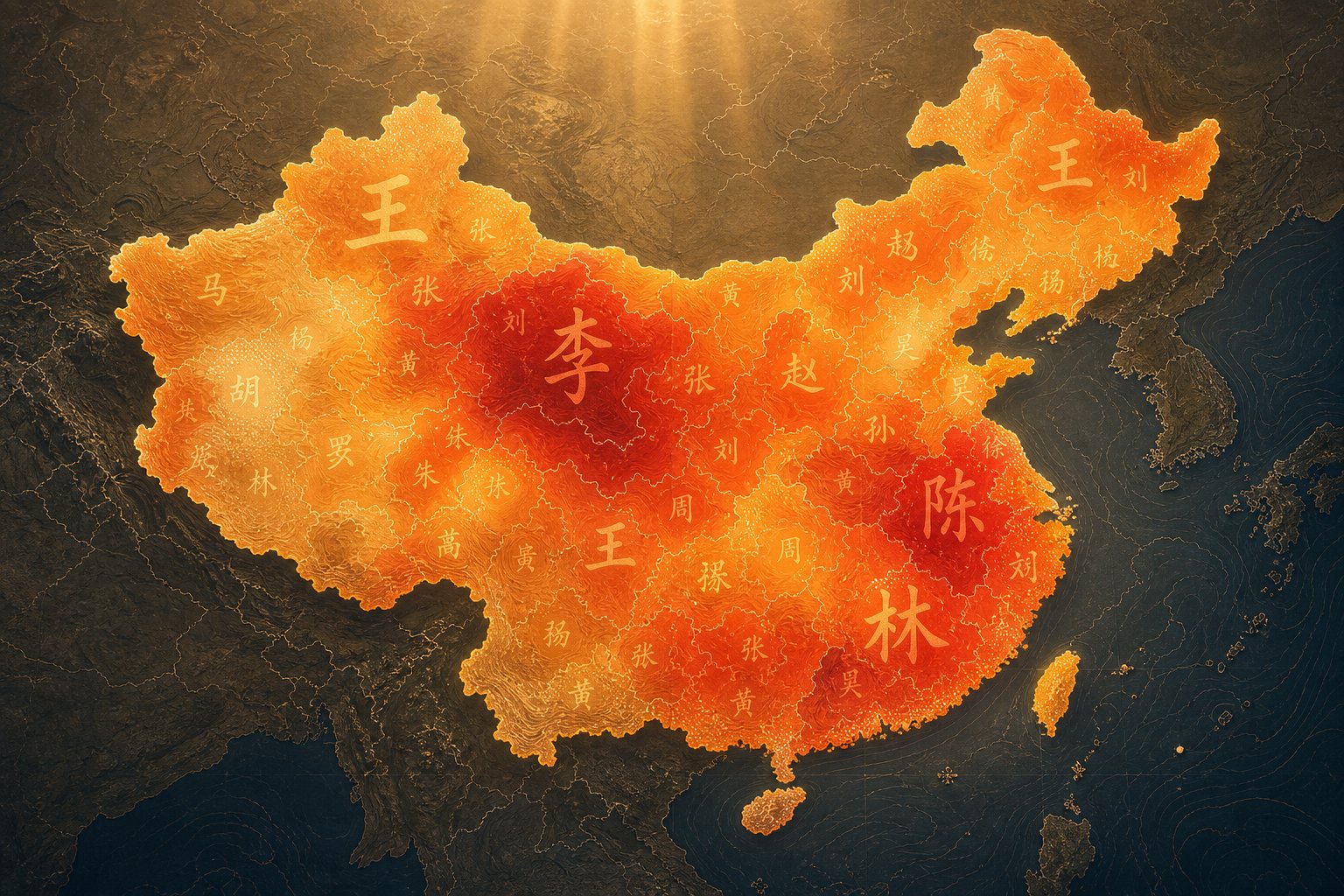
A Chinese surname distribution map visualizes exactly where specific chinese family names concentrate across the country. Rather than spreading evenly, these surnames cluster in distinct zones, painting a picture of migration waves, clan settlements, and regional identity that stretches back thousands of years. Among asian last names, Chinese surnames stand out for how tightly they bind to geography.
Surname geography is a living record of population movement. Each cluster on the map marks where clans settled, where refugees fled, and where empires relocated entire communities.
What a Surname Distribution Map Reveals
When you plot chinese surnames by province and county, patterns emerge that census numbers alone cannot show. Northern plains are dominated by Wang and Li. The southeastern coast belongs to Chen and Lin. These are not random distributions. They reflect specific historical events, from dynastic collapses that pushed millions southward to government-ordered relocations that reshuffled populations across the north.
Why Chinese Surnames Cluster Geographically
Unlike Western surname patterns shaped by diverse linguistic origins and occupational naming, chinese last names cluster because of clan-based settlement. Families sharing a surname often descended from a common ancestor and settled together in the same region for generations. Research from Beijing Normal University confirms that prefectures with similar surname structures tend to adjoin each other geographically, forming distinct regional zones shaped by terrain, dialect, and historical migration.
This article breaks down the most common surnames and their regional strongholds, the historical migrations that created these patterns, how dialect romanization reveals geographic origins, and practical steps for using surname maps in genealogy research.
How Chinese Names and Surnames Work
You hear a name like "Zhang Wei" and might assume Zhang is the given name. It is not. In Chinese naming conventions, the family name always comes first, followed by the given name. So Zhang is the chinese surname, and Wei is the personal name. This reversed order compared to Western conventions is not just a quirk of language. It reflects a cultural priority: family identity before individual identity.
Understanding how do chinese names work starts with three structural rules. The surname is almost always a single character. It passes down patrilineally from father to child. And women traditionally keep their birth surname after marriage. These mechanics seem simple, but they created the geographic concentration patterns visible on every distribution map today.
How the Chinese Naming System Creates Geographic Patterns
Here is where the math gets interesting. With most chinese names limited to single-character surnames, and Chinese having roughly 7,000 characters commonly used as family names, the pool is inherently small. Combine that with strict patrilineal inheritance, meaning surnames never merge or change through marriage, and you get inevitable concentration. Over centuries, a single clan bearing one surname would multiply in the same region, generation after generation, until that name dominated the local population.
This differs sharply from other Asian naming systems. Korean surnames also concentrate heavily, but with even fewer options (roughly 280 surnames for 50 million people). Japanese surnames, by contrast, number over 100,000 because they were largely created during the Meiji era when commoners were required to adopt family names and often chose geographic features near their homes. The Chinese system sits in between: enough surnames to create regional variety, but few enough that clear geographic clusters form. The term surname in chinese is "xing" (姓), and the concept of surname 中文 carries deep ancestral weight that goes far beyond simple identification.
Historical Origins of Surname Formation
Chinese surnames did not appear randomly. During the Zhou Dynasty (1046-256 BC), they emerged from specific sources:
- Feudal territories — Nobles took the name of the state they governed. The surname Chen (陈) traces to the ancient state of Chen in modern Henan.
- Royal grants — Emperors bestowed surnames on loyal subjects, sometimes changing a clan's name entirely.
- Occupations — The surname Tao (陶) connects to pottery-making, while Wu (巫) relates to shamanism.
- Ancestral states — When kingdoms fell, their populations often adopted the state name as a surname to preserve identity.
By the Song Dynasty (960-1279 AD), surname awareness had become so culturally embedded that it produced the Baijiaxing, or Hundred Family Surnames. This poem listed 504 surnames in 564 characters and became a standard text for teaching children to read. It was so widely recognized that the Chinese expression for ordinary people, laobaixing (meaning "one hundred old surnames"), derives directly from it. Among common chinese names, the ones listed earliest in the Baijiaxing held the highest social prestige at the time of writing.
From Ancient Clans to Modern Census Data
Out of roughly 12,000 family names recorded throughout Chinese history, about 25 percent remain in use today. The Chinese government's national census, conducted every ten years, now provides the statistical backbone for modern distribution mapping. Census data reveals not just how many people carry each surname, but precisely where they live at the county and prefecture level.
This data transforms the ancient clan system into something measurable. When researchers overlay census surname counts onto geographic maps and normalize for population density, the result is a chinese surname distribution map that makes invisible history visible. Each colored cluster represents not just a name, but a lineage rooted in a specific place for hundreds or even thousands of years.
The geographic patterns these maps reveal did not form gradually or evenly. They were shaped by sudden, dramatic events: rebellions that sent millions fleeing south, imperial decrees that forcibly relocated entire populations, and dynastic collapses that redrew the demographic map of China in a single generation.
Most Common Chinese Surnames and Their Regional Clusters
Which surname holds the title of most common last name in China? The answer depends on where you look. Nationally, Wang tops the list with roughly 93 million bearers. But zoom into Guangdong province, and Chen dominates. Head to Sichuan, and Li takes the lead. This geographic variability is exactly what makes the distribution map so revealing.
China's Ministry of Public Security reports that the top five most common chinese surnames — Wang, Li, Zhang, Liu, and Chen — together account for more people than the entire population of Indonesia. The next tier, including Yang, Huang, Zhao, Wu, and Zhou, each claim over 20 million bearers. You'll notice these names are not spread uniformly. Each one anchors itself to specific provinces, creating the regional clusters that define the chinese surname distribution map.
Northern China Surname Dominance Patterns
Northern China's vast plains tell a story of three surnames above all others. The wang last name reigns supreme across Henan, Shandong, and Hebei, where it consistently ranks first or second in every prefecture. A 2007 survey counted approximately 92.9 million Wangs nationwide, representing 7.25% of the population, with the heaviest concentration in these northern provinces.
Li follows closely at 92 million, strongest in Sichuan, Hebei, and Henan. Zhang, with roughly 87.5 million bearers, concentrates in Henan and Hebei as well. The liu last name, carried by over 70 million people, clusters in Shandong, Henan, and Sichuan. These four surnames together blanket the northern plains so thoroughly that in some counties, Wang and Li alone account for over 20% of the local population.
What explains this northern dominance? The Yellow River basin served as the cradle of Chinese civilization and the political center of most dynasties before the Song era. Clans bearing these surnames multiplied in place for millennia, and the flat terrain allowed populations to spread across connected provinces without natural barriers fragmenting them into isolated pockets.
Southern Coastal Surname Concentrations
The southeastern coast operates under entirely different surname rules. The chen surname dominates Guangdong and Fujian so completely that in some Fujian counties, one in five residents carries it. Nationally, Chen ranks fifth with over 70 million people, but its geographic weight tilts heavily toward the south.
Lin, Huang, and Zheng follow a similar coastal pattern. Lin concentrates in Fujian and Guangdong, Huang spreads across Guangdong, Guangxi, and Fujian, and Zheng anchors in Fujian and Zhejiang. These surnames trace their southern presence to specific migration waves from the north during periods of dynastic collapse, a topic explored in detail later.
Here is a breakdown of the most common chinese last names, their estimated populations, and where they concentrate most heavily:
| Rank | Surname | Estimated Population (millions) | Primary Provinces of Concentration | Strongest Region |
|---|---|---|---|---|
| 1 | Wang (王) | ~93 | Henan, Shandong, Hebei | Northern Plains |
| 2 | Li (李) | ~92 | Sichuan, Hebei, Henan | North / Southwest |
| 3 | Zhang (张) | ~87.5 | Henan, Hebei, Shandong | Northern Plains |
| 4 | Liu (刘) | ~72 | Shandong, Henan, Sichuan | North / Southwest |
| 5 | Chen (陈) | ~70 | Guangdong, Fujian, Zhejiang | Southeast Coast |
| 6 | Yang (杨) | ~40 | Sichuan, Guizhou, Yunnan | Southwest |
| 7 | Huang (黄) | ~33 | Guangdong, Guangxi, Fujian | South / Southeast |
| 8 | Zhao (赵) | ~27 | Henan, Hebei, Shandong | Northern Plains |
| 9 | Wu (吴) | ~26 | Jiangsu, Zhejiang, Guangdong | East / Southeast |
| 10 | Zhou (周) | ~25 | Hunan, Sichuan, Jiangsu | Central / Southwest |
| 11 | Xu (徐) | ~20 | Jiangsu, Zhejiang, Anhui | East China |
| 12 | Sun (孙) | ~19 | Shandong, Henan, Heilongjiang | North / Northeast |
| 13 | Ma (马) | ~18 | Henan, Hebei, Ningxia, Gansu | North / Northwest |
| 14 | Zhu (朱) | ~17 | Jiangsu, Anhui, Henan | East / Central |
| 15 | Hu (胡) | ~16 | Hubei, Hunan, Sichuan | Central / Southwest |
| 16 | Guo (郭) | ~15 | Henan, Hebei, Shanxi | North / Central |
| 17 | He (何) | ~14 | Sichuan, Guangdong, Hunan | Southwest / South |
| 18 | Lin (林) | ~14 | Fujian, Guangdong, Zhejiang | Southeast Coast |
| 19 | Gao (高) | ~13 | Shandong, Henan, Hebei | Northern Plains |
| 20 | Luo (罗) | ~13 | Sichuan, Guangdong, Hunan | Southwest / South |
The North-South Surname Divide
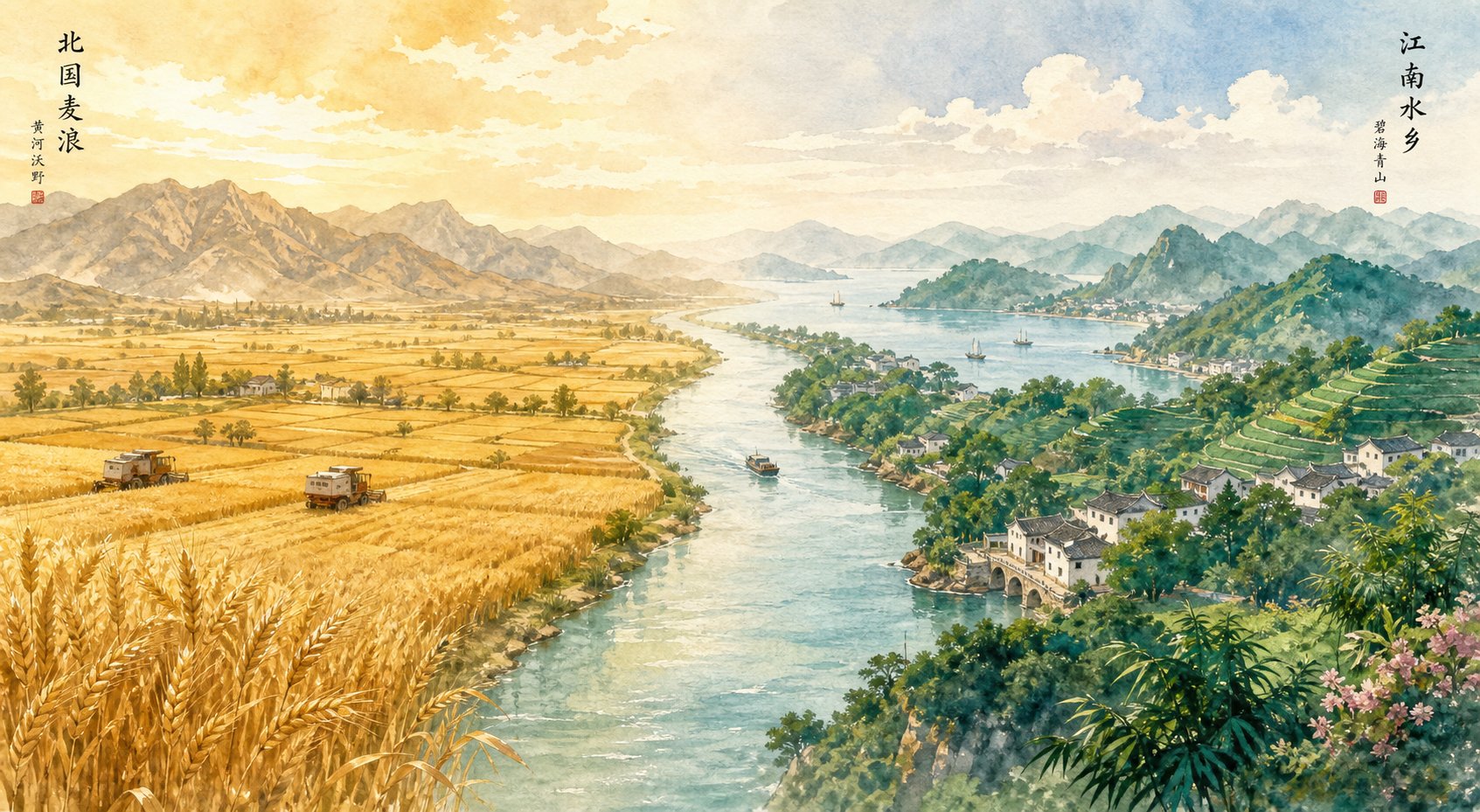
A clear boundary runs roughly along the Yangtze River, splitting China's surname landscape into two distinct zones. North of this line, Wang, Li, Zhang, and Liu dominate with such consistency that research on surname distribution classifies the Yellow River basin as an "Emigration Region" — the origin point from which populations dispersed outward over centuries. South of the line, Chen, Lin, Huang, and Zheng hold disproportionate weight relative to their national rankings.
This divide is not subtle. In Shandong province, the top three surnames are Wang, Li, and Zhang, mirroring the national order almost exactly. In Fujian province, the top three shift to Chen, Lin, and Huang — a completely different set. The same study found that southern prefectures, particularly in mountainous or coastal areas, tend to be more "isolated" in their surname structures, meaning their surname profiles look less like the national average and more like unique local compositions shaped by centuries of limited migration.
Ma offers an interesting case that cuts across the north-south divide. While most common chinese surnames cluster by geography alone, Ma concentrates in both northern provinces like Henan and Hebei and in northwestern regions like Ningxia and Gansu. This reflects its strong association with China's Hui Muslim population, which settled along historic trade routes rather than following the typical Han migration patterns.
The surname Sun provides another geographic clue. It concentrates in Shandong and the northeastern provinces, a pattern that traces directly to the massive "Rush to the Northeast" migration of the 19th and 20th centuries, when millions of Shandong residents moved to Manchuria seeking farmland. Their surnames traveled with them, creating a northeastern surname profile that mirrors Shandong's rather than developing independently.
These regional clusters did not form in a vacuum. Behind every concentration on the map lies a specific historical event — a rebellion, a famine, an imperial decree — that pushed or pulled populations across China's landscape and locked their surnames into new geographic homes.
Historical Migrations That Shaped Surname Geography
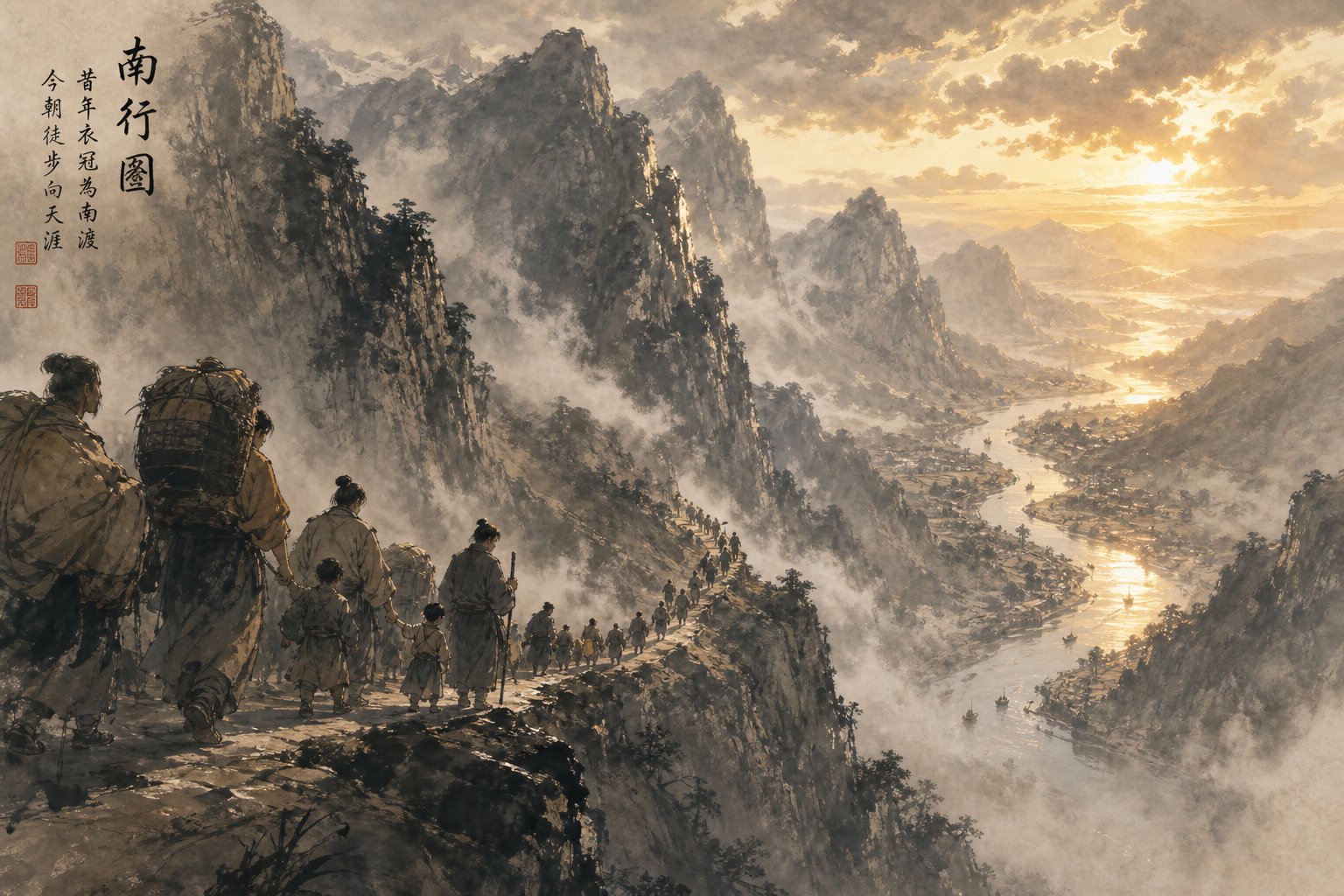
Rebellions, invasions, and imperial decrees did not just reshape political boundaries. They physically moved millions of people, and their surnames traveled with them. Understanding where surnames originate from in China means tracing a series of catastrophic events that sent wave after wave of northern families flooding into the south. Each migration deposited specific clans in specific regions, and those deposits hardened into the geographic clusters still visible on distribution maps today.
The Great Southward Migrations
Picture northern China in 311 CE. The Western Jin Dynasty is collapsing under attacks from nomadic groups. The Yongjia Rebellion forces Emperor Huai to flee, and he is eventually captured and killed. Millions of northern Chinese, particularly educated elites and established clans, abandon their ancestral homes in Henan, Shandong, and Shanxi. They cross the Yangtze River into Jiangxi, Zhejiang, and Fujian. According to historical records from Fujian provincial annals, "the intelligentsia from Zhongyuan coming to Fujian numbered eight clans" during this period, bringing ancient chinese names like Lin, Chen, and Huang into regions where they would eventually dominate.
This was not a one-time event. The pattern repeated with devastating regularity. The An Lushan Rebellion of 755 CE shattered the Tang Dynasty's golden age and triggered another massive southward push. Northern families who had rebuilt over four centuries were uprooted again, many settling deeper into Fujian and Jiangxi. Then came the final blow: in 1127 CE, Jurchen invaders captured the Northern Song capital of Kaifeng and carried the emperor into captivity. A Song prince fled south and established the Southern Song Dynasty at Hangzhou, and enormous numbers of loyal subjects followed. This migration shifted China's demographic center of gravity permanently southward, with the Southern Song empire holding 60 million people compared to 40 million in the Jurchen-controlled north.
Each wave deposited specific surname clusters in new territory. Chen and Lin, originally northern names, became southeastern coastal surnames through these migrations. Huang settled across Guangdong and Guangxi. The chinese roots of these southern families trace directly back to the Yellow River basin, even though their descendants have lived in the south for over a thousand years.
Forced Relocations and Surname Redistribution
Not all migration was voluntary flight. The Ming Dynasty's founding emperor, Hongwu, inherited a devastated northern China after decades of Mongol rule and plague. His solution was blunt: forced relocation on a massive scale. Between 1370 and 1417, the government organized repeated transfers of population from Shanxi province, which had been relatively spared by war, into the depopulated plains of Henan, Hebei, and Shandong.
The staging point for these relocations was a large pagoda tree in Hongdong County, Shanxi. Millions of people passed through this checkpoint before being dispersed across northern China. Today, hundreds of surnames trace their northern distribution to this single event. The phrase "our ancestors came from the big pagoda tree in Hongdong" remains one of the most common origin stories in northern Chinese families, and it explains why so many surnames in Henan and Hebei share Shanxi as a common source.
The Hakka people represent yet another layer of migration complexity. Originally northern Chinese who fled south during the Jin and Tang collapses, they settled in the mountainous border regions between Jiangxi and Fujian. Census records from Meizhou show the transformation: in 976 CE there were just 367 "alien" families alongside 1,210 "native" ones, but by 1078 the newcomers numbered 6,548 families against 5,824 natives. The Hakka eventually dominated these regions entirely, creating distinct surname pockets where names like Zhong, Qiu, and Lai concentrate in ways found nowhere else in China.
How Migration Waves Created Modern Clusters
When you overlay these events onto a timeline, the logic behind modern surname geography becomes clear. Here is the chronological sequence that built the distribution patterns still visible in census data:
- Yongjia Rebellion, 311 CE — Northern elites flee to Jiangxi and Fujian, establishing Chen, Lin, and Huang as southeastern surnames for the first time.
- An Lushan Rebellion, 755 CE — A second wave pushes deeper into Fujian's interior and southern Jiangxi, reinforcing earlier settlements and spreading surnames into more remote mountain valleys.
- Fall of Northern Song, 1127 CE — The largest single migration event sends millions across the Yangtze. Southern Jiangxi and Fujian receive massive population influxes, and surnames like Zheng and Ye become permanently anchored in the southeast.
- Hakka expansion into Guangdong, 1280-1400 CE — Populations compressed in Fujian and Jiangxi spill over mountain borders into northeastern Guangdong, creating the Hakka surname belt that persists today.
- Ming Dynasty Hongwu relocations, 1370-1417 CE — Forced transfers from Shanxi redistribute surnames across the depopulated northern plains, homogenizing the surname landscape of Henan, Hebei, and Shandong.
Among surnames in asia, few carry such precise geographic timestamps. A Chen in Fujian and a Chen in Henan may share the same character, but their families likely arrived in those regions during entirely different centuries and through entirely different circumstances. The distribution map captures this layered history in a single image, but each colored cluster represents a specific chapter of movement.
These migration patterns did not just create national-level clusters. They produced micro-level variation between neighboring provinces, and even between adjacent counties within the same province, that reveals exactly which migration wave settled where.
Province-by-Province Surname Concentration Breakdown
Zoom into any single province on the distribution map, and you will find a surname fingerprint unlike any other. The national rankings of Wang, Li, and Zhang tell one story, but provincial rankings tell a far more specific one. Each province's top five surnames reflect the particular migration waves, geographic barriers, and clan histories that shaped its population over centuries.
Coastal Provinces and Their Surname Signatures
The southeastern coast operates almost as a separate surname universe from the rest of China. In Guangdong, Chen leads decisively, followed by Li, Huang, Lin, and Zhang. Fujian's profile looks strikingly similar: Chen, Lin, Huang, Zhang, and Wu dominate. The lin surname carries particular weight along this coast, ranking second in Fujian and fourth in Guangdong, a concentration that traces directly to the Jin Dynasty migrations that brought the Lin clan south from Henan over 1,700 years ago.
Zhejiang sits at the transition zone between northern and southern surname patterns. Its top five — Chen, Wang, Lin, Zhang, and Li — blend elements of both regions. Chen's first-place ranking here reflects southern coastal influence, while Wang and Li maintain their northern presence. Moving further north to Shandong, the profile flips entirely: Wang, Li, Zhang, Liu, and Sun mirror the national top five almost exactly, confirming Shandong's role as a core region for China's most common chinese surnames.
Interior and Northern Province Patterns
Interior provinces reveal their own distinct compositions. Sichuan's top surnames — Li, Zhang, Wang, Liu, and Chen — reflect its history as a destination for migrants from multiple directions. Henan, often called the ancestral homeland of Chinese civilization, is dominated by Wang, Zhang, Li, Liu, and Yang. Its surname profile served as the "source code" that later migrations carried outward to other provinces.
Here is a regional breakdown showing the top five surnames per province and their approximate share of the local population:
| Province/Region | #1 Surname | #2 Surname | #3 Surname | #4 Surname | #5 Surname | Top 5 Combined Share |
|---|---|---|---|---|---|---|
| Guangdong | Chen | Li | Huang | Lin | Zhang | ~26% |
| Fujian | Chen | Lin | Huang | Zhang | Wu | ~33% |
| Taiwan | Chen | Lin | Huang | Zhang | Li | ~30% |
| Shandong | Wang | Li | Zhang | Liu | Sun | ~30% |
| Sichuan | Li | Zhang | Wang | Liu | Chen | ~25% |
| Henan | Wang | Zhang | Li | Liu | Yang | ~28% |
| Zhejiang | Chen | Wang | Lin | Zhang | Li | ~22% |
Taiwan as a Mirror of Fujian Migration
Compare Taiwan's top surnames to Fujian's, and the overlap is almost exact. Chen, Lin, and Huang hold the top three positions in both places. This is no coincidence. The vast majority of Taiwan's population traces its ancestry to Fujian and Guangdong provinces, with migration peaking between the 17th and 19th centuries. Taiwanese last names are essentially a snapshot of Fujian's surname profile from that era, preserved across the strait.
This connection remains culturally alive. Cross-strait cultural initiatives have highlighted how taiwanese surnames serve as a bridge between the island and the mainland. As one Taiwan compatriot noted, "Through our surnames, we find that our roots lead back to the mainland." The hsu last name (a common romanization of 許 in Taiwan's Wade-Giles system, equivalent to Xu in pinyin) ranks among the top taiwan last names and traces its Fujian origins through the same migration channels.
Urbanization is beginning to complicate these clean provincial patterns. Megacities like Shanghai and Shenzhen now attract internal migrants from every province, creating surname profiles that look increasingly like the national average rather than reflecting local history. Shenzhen, built almost entirely by migrants since the 1980s, has a surname distribution that mirrors Guangdong's Chen-heavy profile less and less each decade. These cities are becoming surname melting pots, blurring the geographic boundaries that held firm for centuries.
Yet the same surnames that cluster by province also carry different pronunciations and romanizations depending on which dialect region they belong to — a layer of geographic information that reveals even more specific origins than province-level data alone.
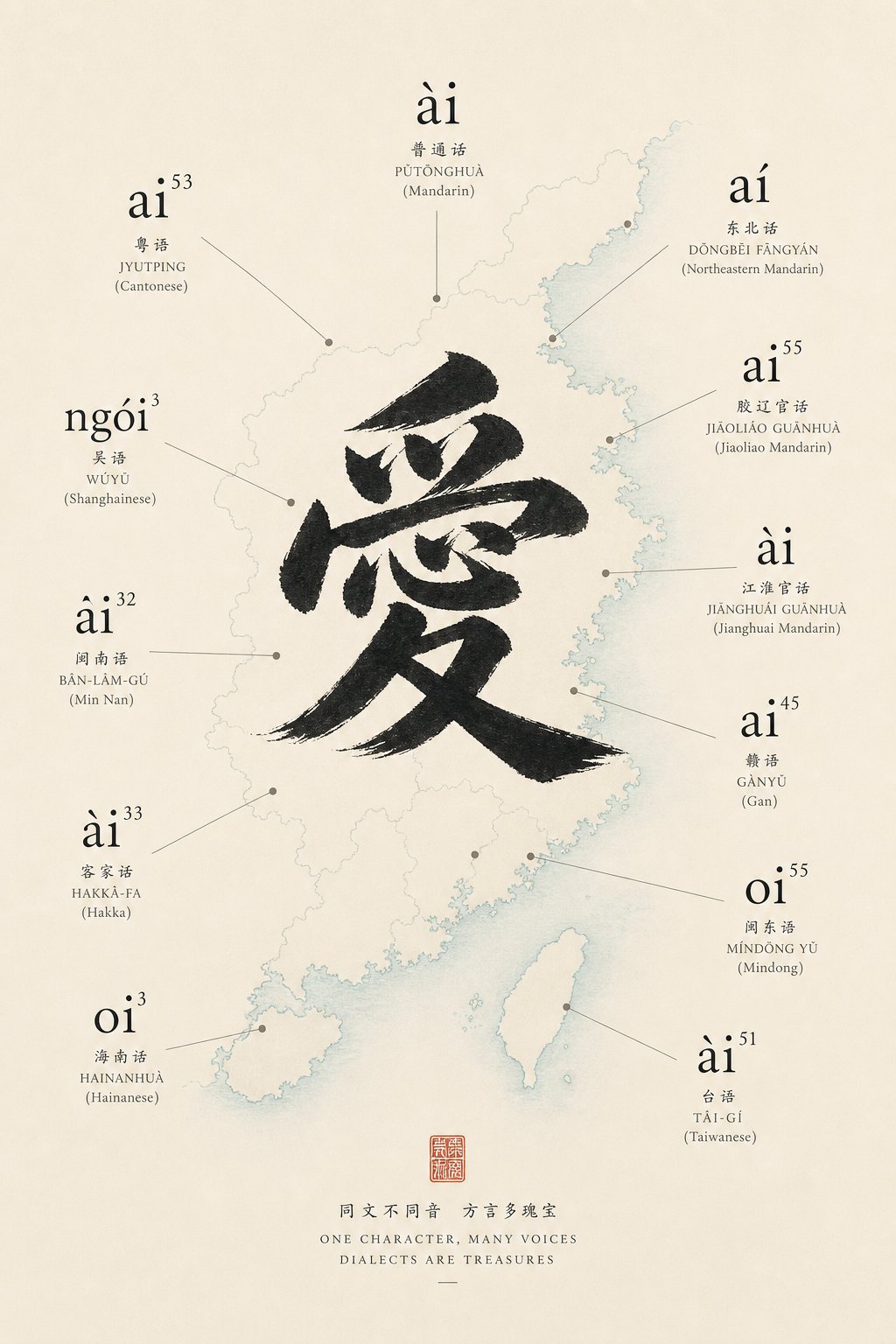
Dialect Romanization Reveals Regional Origins
A person surnamed Chen and a person surnamed Chan share the exact same Chinese character: 陈. So do Tan and Chin. These are not different surnames. They are the same surname filtered through different dialect pronunciations and romanization systems. When you encounter a Chinese surname spelled in English, that spelling is not random. It is a geographic marker, pointing to the specific dialect region the family came from before emigrating.
This layer of information adds precision that even a province-level distribution map cannot match. Knowing someone's surname is Chen tells you they likely have roots in Fujian or Guangdong. But knowing whether they spell it Chan, Tan, or Chin narrows the origin to a specific dialect community within those provinces.
One Surname, Multiple Romanizations
Chinese has dozens of regional languages and dialects, each pronouncing the same written characters differently. When families emigrated and needed to render their surnames in the Latin alphabet, they spelled them according to how they actually spoke — not according to Mandarin pinyin, which only became China's official romanization system in 1958. The result is a patchwork of spellings that directly reflects ancestral dialect and region of origin.
Take the character 王. It is pronounced Wang in Mandarin, Wong in Cantonese, Ong in Hokkien, and Heng in Teochew. The character 陈 becomes Chen in Mandarin, Chan in Cantonese, Tan in Hokkien and Teochew, and Chin in Hakka. The chen last name origin traces to the ancient state of Chen in Henan, but its modern bearers are scattered across southern China and Southeast Asia — and their spelling tells you exactly which community they belong to.
Here is a comparison chart showing how major cantonese surnames and their equivalents appear across dialect romanization systems:
| Chinese Character | Mandarin (Pinyin) | Cantonese | Hokkien/Teochew | Hakka |
|---|---|---|---|---|
| 陈 / 陳 | Chen | Chan | Tan | Chin |
| 王 | Wang | Wong | Ong / Heng | Wong |
| 黄 / 黃 | Huang | Wong | Ng / Ooi | Wong |
| 林 | Lin | Lam | Lim | Lim |
| 李 | Li | Lee / Lei | Lee | Li |
| 刘 / 劉 | Liu | Lau / Low | Lau | Liew / Lew |
| 张 / 張 | Zhang | Cheung / Cheong | Teo / Teoh | Chong |
| 吴 / 吳 | Wu | Ng | Goh | Ng |
Dialect Romanization as a Geographic Marker
In territories with large Chinese diaspora populations — Singapore, Malaysia, the Philippines, Indonesia — the spelling of a family name functions almost like a postal code. A person surnamed Wong could carry either 王 or 黄, but the Cantonese romanization immediately signals Guangdong or Hong Kong heritage. The wong last name origin, whether it represents Wang or Huang, points to Cantonese-speaking regions in either case.
The chan last name origin follows the same logic. Seeing "Chan" on a business card in Singapore or Vancouver tells you the family likely came from Guangdong's Cantonese-speaking areas. Seeing "Tan" for the same character signals Hokkien or Teochew roots, meaning the family probably traces to Fujian province or the Chaoshan region of eastern Guangdong. These are not guesses. They are reliable linguistic fingerprints preserved through generations of diaspora life.
Among cantonese last names, the Ng spelling deserves special attention. The ng last name origin is particularly interesting because it can represent two entirely different characters: 吴 (Wu in Mandarin) or 黄 (Huang in Mandarin). In Cantonese, both characters are pronounced similarly, leading to the same romanization. But in Hokkien, 吴 becomes "Goh" while 黄 becomes "Ng" or "Ooi" — a distinction that only dialect-aware readers can parse. This ambiguity makes Ng one of the most geographically informative yet confusing cantonese surnames for genealogy researchers.
Overseas Chinese Surname Spelling Patterns
When Chinese immigrants arrived in Southeast Asia, North America, and Australia across different centuries, they carried their dialect pronunciations with them — and those pronunciations froze in place. Research on Chinese American naming practices shows that the romanization of a surname can indicate not only the family's dialect background but also the approximate era of immigration. Early Chinese Americans from the 1850s to 1970s overwhelmingly came from the Szeyap (Four Districts) region of Guangdong, and their surname spellings reflect Hoisan-wa pronunciation rather than standard Cantonese or Mandarin.
This means a Chinese American surnamed "Louie" (刘) likely has roots in the Taishan area of Guangdong and ancestors who arrived before the 1970s. A "Liu" with the same character probably has family from mainland China who arrived more recently. A "Lau" suggests Hong Kong Cantonese heritage. The same academic study notes that spellings like "Chew, Dear, Gee, Lee, Louie, Lowe, Mark, and Young" among older Chinese American families correspond directly to Hoisan-wa readings of their characters — distinct from both standard Cantonese and Mandarin romanizations.
This frozen-in-time quality makes overseas surname spellings invaluable for genealogy. A family that spells their name in Hokkien romanization almost certainly traces to Fujian or to Hokkien-speaking communities in Southeast Asia. A family using Cantonese romanization points to Guangdong or Hong Kong. And a family using pinyin likely arrived from mainland China after 1958, when pinyin became the official system. The spelling itself becomes a timestamp and a geographic coordinate, adding a dimension to the distribution map that raw census data cannot capture.
These dialect-based spelling patterns work well for tracing the major surname clusters. But what about the thousands of rare surnames that never made it into the top 100 — names that survive in single villages or belong to ethnic minorities with entirely different naming traditions?
Rare and Minority Surnames on the Map
The top 100 surnames may cover 85% of China's population, but the remaining 15% carry over 7,000 uncommon surnames — many of which survive in remarkably small geographic pockets. These rare last names are not random statistical noise. They are living fossils, preserving the names of ancient kingdoms, absorbed ethnic groups, and isolated communities that mainstream history often overlooks. On a distribution map, they appear as tiny, intense dots rather than broad regional washes, and they tell stories the dominant surnames cannot.
Geographically Isolated Rare Surnames
Research using China's national identity database identified 7,184 distinct surnames among 1.28 billion citizens, yet the roughly 7,000 less popular ones account for only about 6.7% of the total population. Many of these cluster in mountainous or geographically isolated prefectures — areas the same study classifies as "Isolated Regions" where drift and mutation, rather than migration, drove population dynamics for centuries.
What does that mean in practical terms? It means a surname that exists nowhere else in China might thrive in a single valley in Guizhou or a remote county in Yunnan. These names often trace to ancient feudal states that disappeared over two thousand years ago, their populations absorbed into surrounding Han communities but their surnames quietly persisting.
- Situ (司徒) — Concentrated in Guangdong's Kaiping county. Traces to an ancient Zhou Dynasty official title that became hereditary.
- Ouyang (欧阳) — One of China's few surviving two-character surnames, concentrated in Hunan and Jiangxi. Named after a geographic feature near the ancient state of Yue.
- Nangong (南宫) — Extremely rare, found primarily in Hebei. Derives from a location near the ancient capital of the Zhou kings.
- Xiahou (夏侯) — Survives in scattered pockets of Shandong and Anhui, tracing to the royal house of the Xia Dynasty's descendants.
- Shan (单/善) — Concentrated in specific counties of Henan, preserving the name of the ancient state of Shan that existed during the Spring and Autumn period.
- Qiu (仇) — Found primarily in Hakka regions of Guangdong and Jiangxi, where it arrived with northern migrants during the Song Dynasty collapse.
These last names uncommon in national statistics can be dominant within their home village. A single county might have 30% of its population carrying a surname that barely registers at the provincial level. This hyper-local concentration is what makes them so valuable for genealogy — if you carry one of these names, your ancestral origin is often pinpointed to a single county rather than a broad region.
Minority Ethnic Surname Distributions
China's 55 officially recognized ethnic minorities add an entirely different layer to the surname map. Most analyses focus on Han Chinese naming patterns, but minority groups often follow distinct systems that create their own geographic signatures.
In Inner Mongolia, Mongolian families historically used patronymic naming rather than fixed surnames. When the modern identity system required a surname field, many adopted the first syllable of their clan name or chose a Chinese character that approximated their Mongolian family identifier. The result is a cluster of surnames in Inner Mongolia — like Bao (包), Sa (萨), and Ha (哈) — that appear rarely elsewhere in China.
Tibetan naming conventions in Tibet and Qinghai present an even more complex case. Traditional Tibetan names carry no surname at all, consisting instead of auspicious words often chosen by a lama. When registered in the national system, the first character of a Tibetan name gets treated as a surname, creating artificial "surnames" that do not function the way Han surnames do. This means surname distribution data for these regions reflects administrative convention more than actual lineage patterns.
The Zhuang people of Guangxi, China's largest ethnic minority, largely adopted Han-style surnames centuries ago through cultural assimilation. Surnames like Huang, Wei (韦), Nong (农), and Mo (莫) concentrate heavily in Guangxi, with Wei and Nong serving as strong indicators of Zhuang heritage. In Xinjiang, Uyghur naming traditions use patronymics without fixed family names, similar to the Mongolian pattern. Characters like Mai (买), Re (热), and A (阿) appear with unusual frequency in Xinjiang's surname data as artifacts of this conversion process.
The academic study from Beijing Normal University found that prefectures with more than 60% ethnic minorities appear as extraordinary outliers in surname similarity analyses, sitting far from all other prefectures in statistical distance. Their surname profiles are so distinct that they essentially form their own islands on the distribution map, disconnected from the patterns that link Han-majority regions together.
Surnames That Survived in Single Villages
Perhaps the most remarkable cases are surnames that exist in only one village or a handful of families nationwide. These are not errors in the census data. They represent lineages that survived in extreme isolation, often in mountainous terrain where outside contact was minimal for centuries. Some are ancient surnames that disappeared everywhere else through assimilation or name changes but persisted in a single protected pocket.
Shanxi province offers a striking example. Despite sitting in northern China's "Emigration Region," certain prefectures within Shanxi behave statistically like isolated southern mountain communities. The province's terrain — surrounded by five mountain ranges with separate internal basins — protected local populations from the wars and migrations that reshuffled surnames elsewhere. Rare surnames that vanished from neighboring Henan and Hebei during centuries of upheaval survived quietly behind Shanxi's natural barriers.
These micro-distributions matter because they represent the oldest, least disturbed layer of China's surname geography. While the dominant surnames tell a story of movement and mixing, the rare ones tell a story of staying put — of communities so isolated that their names drifted into uniqueness over millennia. For anyone carrying an uncommon surname, this isolation is actually good news: it means your ancestral village is likely still identifiable, waiting to be found through the same distribution data that maps the movements of millions.
Connecting these rare and minority surname patterns to practical genealogy research requires understanding how distribution maps are built, what their limitations are, and how to use them as a starting point for tracing your own family's geographic origins.
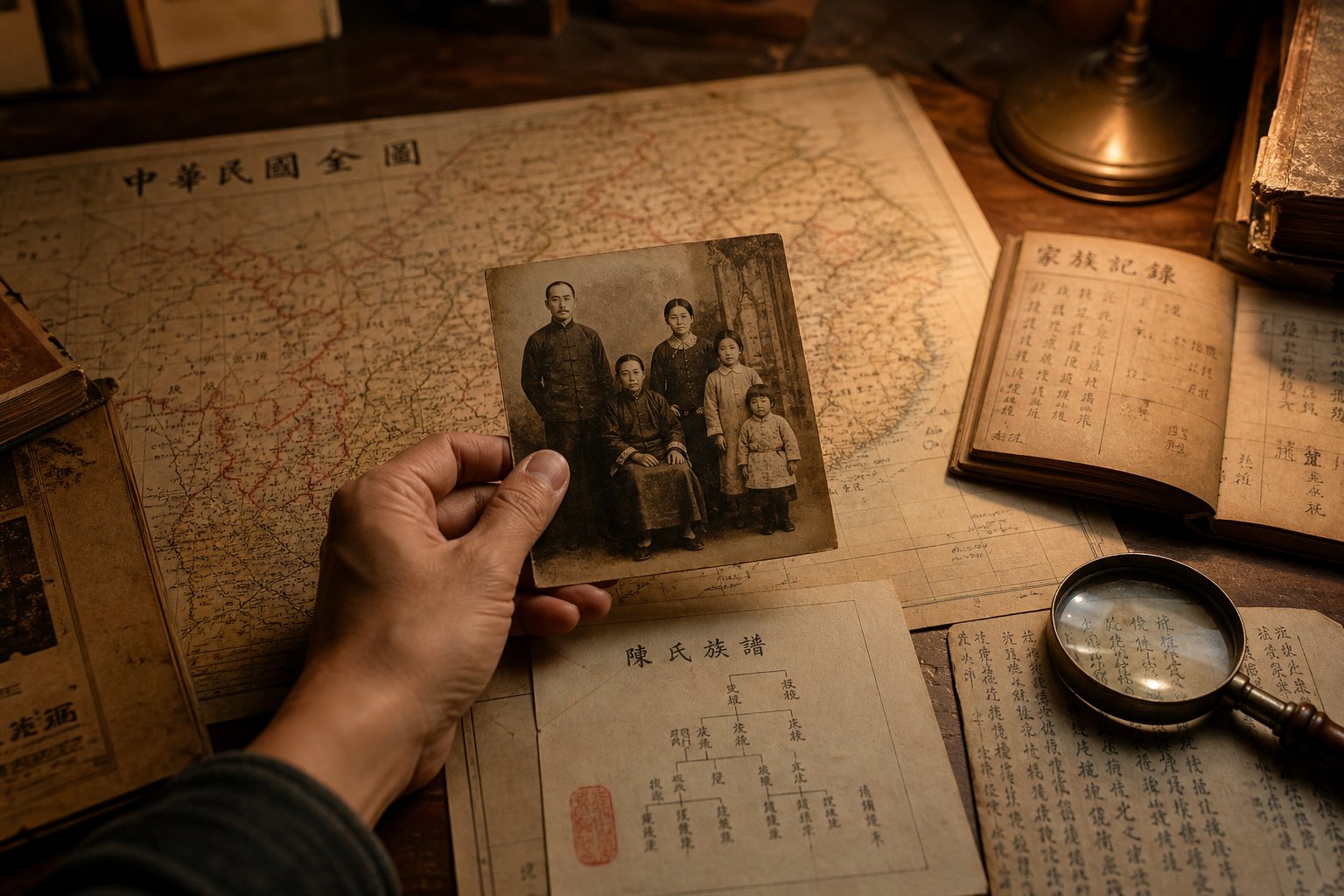
Using Surname Maps to Trace Your Ancestral Origins
You know your chinese last name. You might even know the character it corresponds to. But can that single piece of information actually lead you back to a specific province, county, or village where your ancestors lived? In many cases, yes. A surname distribution map is not just an academic curiosity. It is a practical genealogy tool that narrows your search area from an entire country of 9.6 million square kilometers down to a handful of provinces or even a single prefecture.
For overseas Chinese families who left the mainland generations ago, this geographic narrowing can be the difference between a dead-end search and a breakthrough. When combined with the dialect romanization patterns covered earlier, surname concentration data becomes a two-coordinate system: the name tells you the region, and the spelling tells you the dialect community within that region.
Tracing Ancestral Provinces Through Surname Data
Imagine you carry the surname Lin and your family has been in Southeast Asia for four generations. Nobody remembers which province the original immigrant came from. A distribution map immediately tells you that Lin concentrates overwhelmingly in Fujian and Guangdong. If your family spells it "Lim," the Hokkien romanization points specifically to Fujian or a Hokkien-speaking community in eastern Guangdong. If they spell it "Lam," the Cantonese pronunciation narrows it to Guangdong proper or Hong Kong.
This same logic applies to chinese surnames and meanings at every level. The meaning of chinese last names often traces to a specific origin location. Chen derives from the ancient state of Chen in Henan. Zhao traces to the state of Zhao in modern Shanxi and Hebei. These etymological origins do not always match modern concentrations — Chen is now a southern surname despite its northern origin — but they add another data point for triangulating ancestral geography.
Chinese last name meanings carry genealogical weight because they frequently encode the original homeland. When you research chinese family names and meanings together with geographic distribution data, you build a layered picture: where the surname was born, where it migrated, and where it ultimately settled. A surname like Zheng, meaning "solemn" or "proper," traces to the ancient state of Zheng in Henan but now concentrates in Fujian — a trajectory that maps perfectly onto the Southern Song migration of 1127 CE.
Methodology and Limitations of Distribution Maps
How are these maps actually built? The primary data source is China's national census, conducted every ten years, which records the surname of every registered citizen at the county level. Researchers then normalize this raw count against local population density. This step is critical. Without normalization, a map would simply show that Shanghai has many Wangs — because Shanghai has many people. Normalized data reveals concentration: the proportion of a local population carrying a specific surname compared to the national average.
The methodology typically involves calculating a surname's frequency in each prefecture, dividing by the national frequency, and mapping the resulting ratio. A ratio above 1.0 means the surname is overrepresented locally. Studies using this approach have identified clear regional clusters that align with known historical migration corridors, validating the method against independent historical evidence.
That said, several limitations deserve attention:
- Urban migration blur — Megacities like Shenzhen, Shanghai, and Beijing attract migrants from every province. Their surname profiles increasingly reflect the national average rather than local history, making urban data less useful for ancestral research.
- Minority underrepresentation — Ethnic minorities whose naming systems were forced into Han-style surname fields produce data that looks like surname information but does not function the same way genealogically.
- Historical depth — Census data captures a snapshot of where people live now, not where their families lived 500 years ago. Recent internal migration (especially post-1950) has shifted millions of people away from ancestral regions.
- Patrilineal bias — Because surnames pass through the male line, distribution maps trace only paternal ancestry. Maternal lineages remain invisible in this data.
Despite these constraints, the maps remain remarkably useful for chinese last names and meanings research. Rural areas, which still hold the majority of China's population, have experienced far less surname mixing than cities. A surname's concentration in a rural prefecture today likely reflects patterns that have been stable for centuries.
Practical Steps for Genealogy Research
Ready to use distribution data for your own family research? Here is a step-by-step process that combines surname geography with the dialect and historical knowledge covered throughout this article:
- Identify your surname character — If your family uses a romanized spelling, determine which Chinese character it represents. Remember that some spellings (like Ng) can correspond to multiple characters. Family documents, ancestral tablets, or older relatives may clarify this.
- Check the national distribution map — Look up your surname's geographic concentration across China. Tools like Forebears provide global surname distribution data, while Chinese-language resources from census data offer province and county-level detail. Identify the two or three provinces where your surname is most overrepresented.
- Cross-reference with dialect romanization — Match your family's spelling against the dialect chart. A Cantonese romanization points to Guangdong; Hokkien points to Fujian; pinyin suggests post-1958 mainland origin. This narrows your search from a province to a dialect region within that province.
- Layer in migration history — If your family emigrated to Southeast Asia, Taiwan, or the Americas, research the historical migration patterns for that destination. Most Taiwanese families trace to southern Fujian. Most older Chinese American families trace to Guangdong's Siyi region. This adds a temporal dimension to your geographic search.
- Narrow to the county level — Using county-level distribution data, identify the specific counties within your target province where your surname concentrates most heavily. For common surnames, look for counties where your name ranks unusually high relative to the provincial average.
- Search for clan genealogies (zupu) — Once you have a target county, search for published clan genealogies from that area. Many Chinese lineage organizations maintain records going back 20 or more generations. Libraries, genealogy societies, and online databases index thousands of these documents by surname and location.
This process works particularly well for less common surnames, where geographic concentration is tighter and the signal is clearer. As genealogy researchers have noted, surname distribution mapping "works particularly well for less-common surnames and among families that have stayed in the same locations for centuries" — a description that fits many Chinese lineages precisely.
For those researching chinese surname meanings alongside geographic data, the combination is powerful. A surname's etymology tells you where the name was born. Its distribution tells you where the family ended up. And its romanization tells you which dialect community carried it forward. Together, these three coordinates can transform a single chinese last name into a roadmap stretching back centuries, connecting you to a specific place your ancestors once called home.
Frequently Asked Questions About Chinese Surname Distribution
1. What is the most common surname in China?
Wang (王) holds the top position nationally with approximately 93 million bearers, representing about 7.25% of China's population. However, regional rankings vary significantly. In southern provinces like Guangdong and Fujian, Chen (陈) dominates instead. The most common surname in any given area depends heavily on historical migration patterns and clan settlement history specific to that region.
2. Why do Chinese surnames cluster in specific geographic regions?
Chinese surnames cluster geographically due to clan-based settlement patterns reinforced over centuries. Families sharing a surname often descended from a common ancestor and remained in the same region for generations. The patrilineal inheritance system meant surnames never merged through marriage, so a single clan could multiply in one area until their name dominated the local population. Major historical events like dynastic collapses and forced relocations further concentrated specific surnames in particular provinces.
3. How can I use a Chinese surname distribution map for genealogy research?
Start by identifying the Chinese character for your surname, then check its geographic concentration across provinces. Cross-reference your family's romanized spelling with dialect charts to narrow the origin to a specific dialect community. For example, spelling 'Lim' points to Hokkien-speaking Fujian, while 'Lam' indicates Cantonese-speaking Guangdong. Layer in historical migration patterns for your diaspora destination, then search county-level data and published clan genealogies (zupu) from the identified region.
4. Why do the same Chinese surnames have different English spellings?
Different English spellings reflect different Chinese dialect pronunciations. When families emigrated, they romanized their surnames based on how they actually spoke rather than standard Mandarin. For instance, the character 陈 becomes Chen in Mandarin, Chan in Cantonese, Tan in Hokkien, and Chin in Hakka. These spelling variations serve as geographic markers, indicating the specific dialect region and community the family originated from before emigrating.
5. What caused the north-south divide in Chinese surname distribution?
The north-south surname divide was created by a series of massive southward migrations triggered by northern invasions and dynastic collapses. The Yongjia Rebellion (311 CE), An Lushan Rebellion (755 CE), and fall of the Northern Song (1127 CE) each pushed millions of northern families across the Yangtze River into southern provinces. These migrants brought surnames like Chen, Lin, and Huang south, where they eventually dominated coastal regions while Wang, Li, and Zhang remained strongest in the northern plains.