Chinese Surnames That Are Actually Colors
Imagine carrying a color in your name, not as a nickname or a poetic flourish, but as your actual family identity passed down through centuries. That is exactly the case for millions of people whose Chinese surnames literally translate to colors like white, yellow, blue, black, and even purple.
Chinese surnames are far more than labels. With a history stretching back thousands of years, they encode ancestry, geography, and cultural identity into a single character. Among the more than 7,000 Chinese family names still in use today, a small but fascinating group carries the meaning of a specific color. These color surnames span the full spectrum, from the extremely common (Huang, meaning yellow, ranks among the top ten nationwide) to the exceptionally rare (Zi, meaning purple, surfaces only in scattered regional pockets).
What Makes a Surname a Color Surname
The criteria here are straightforward. A surname qualifies as a "color surname" when the Chinese character's primary or historical meaning is a color. The character 白 (Bai), for instance, means "white" as its core definition. That is different from a surname like 金 (Jin), where the primary meaning is "metal" and "gold" functions as a secondary association. This distinction matters when exploring chinese surnames and meanings, because it separates names that are genuinely color words from those that merely evoke a color through loose interpretation.
Why Color Surnames Matter in Chinese Culture
Colors in Chinese tradition carry enormous symbolic weight. Yellow connects to imperial authority. Red signals joy and good fortune. White is tied to mourning. Black represents water and the north in Five Elements philosophy. When you encounter these colors embedded in chinese surnames meaning a specific hue, you are looking at families whose very identity intersects with some of the deepest cultural symbols in Chinese civilization.
No single resource currently catalogs all Chinese color surnames comprehensively, distinguishing primary color meanings from secondary associations and tracing their origins across dynasties and dialect groups.
This article serves as that definitive reference for chinese surname meanings, covering every verified color-based surname with its character, pronunciation, cultural symbolism, and historical roots. The story of how these colors became family names reaches back to the earliest dynasties and the mechanisms that shaped the entire Chinese naming system.
Historical Origins of Color-Based Chinese Surnames
Color surnames did not appear overnight. They emerged through the same forces that shaped all ancient chinese names: migration, politics, geography, and myth. Tracing these origins reveals how a simple color word became a family's permanent identity marker across dozens of generations.
The Hundred Family Surnames as a Historical Source
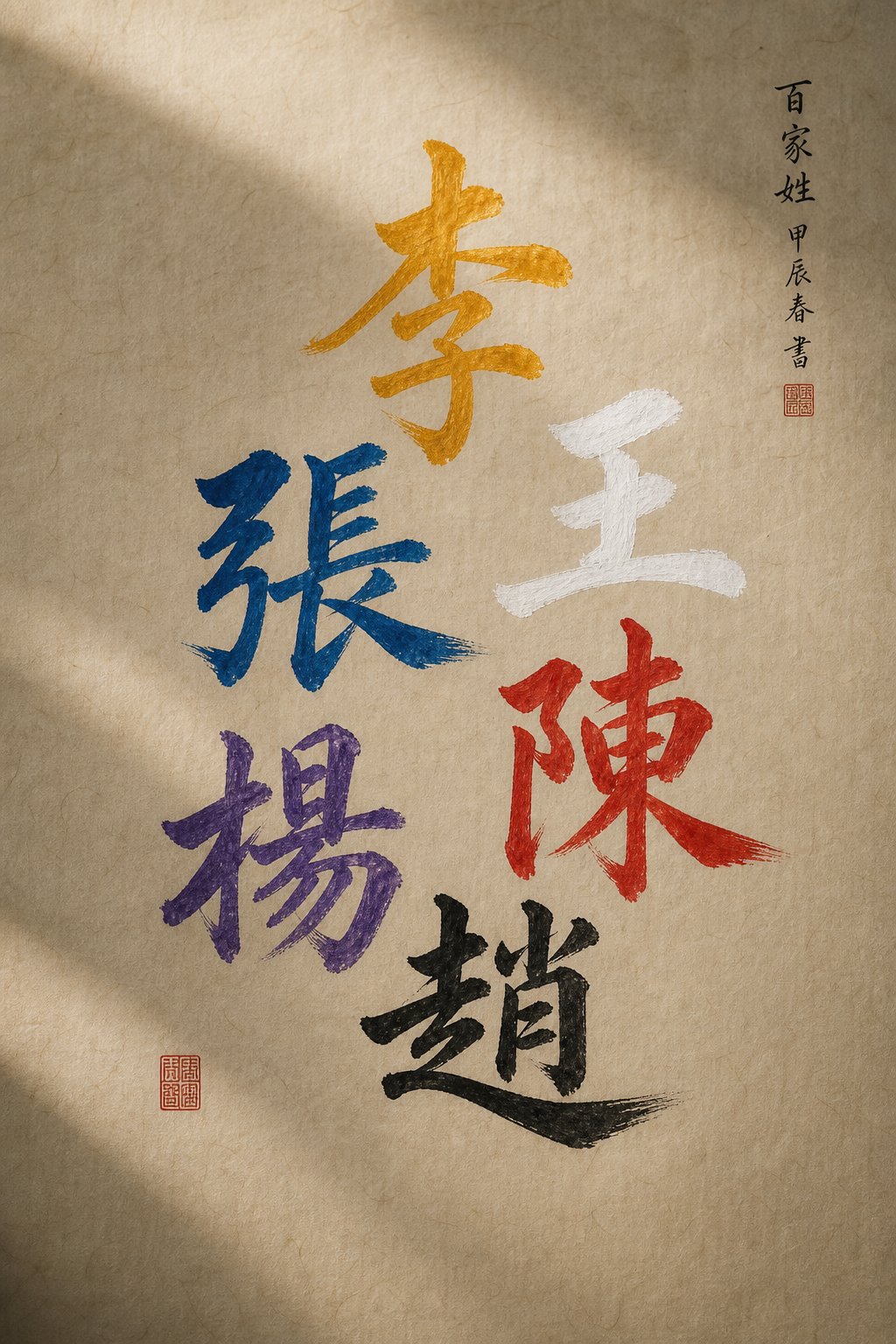
The foundational text for understanding the Chinese surname system is the Hundred Family Surnames (百家姓, Bai Jia Xing), compiled during the early Song Dynasty (960-1279). Despite its name, the text actually catalogs far more than one hundred surnames. It served as a literacy primer for children while simultaneously codifying the most recognized family names of the era. According to HanNames, these surnames still represent approximately 85% of China's population today.
Several color surnames appear within this classic text. 黄 (Huang, yellow) ranks 7th among the most common chinese surname entries nationwide. 白 (Bai, white) sits at rank 70, while 金 (Jin, gold/metal) holds rank 62. Their inclusion in this Song Dynasty document confirms that color-based family names were already well-established over a thousand years ago, placing them firmly among the ancient last names still in active use.
How Colors Became Family Names
So how does a color become a family's identity? Four main pathways explain the process:
- Imperial bestowal: Emperors granted surnames to loyal subjects or conquered peoples as a political tool. During the Ming Dynasty, founder Zhu Yuanzhang (whose own surname means vermillion) bestowed Han surnames on Mongol nobles who surrendered to his rule. This practice created new surname lineages with a single decree.
- Geographic origin: Families living near colored landmarks adopted those colors as identifiers. The Huang surname connects directly to the Yellow River (黄河), whose sediment-rich waters gave the surrounding region its name and whose fertile banks became the birthplace of ancient Chinese civilizations.
- Totemic association: Early tribal groups used animals or natural symbols as clan emblems. The Dong Yi tribe's Huang Yi branch bore the motif of the yellow oriole (黄莺) as their tribal totem, and this color identity eventually crystallized into the Huang chinese surname carried by their descendants.
- Occupational derivation: Families involved in producing dyes, pigments, or colored goods sometimes adopted the color they worked with. Clans processing indigo plant material for blue dye, for example, developed associations with 蓝 (Lan, blue) that eventually became hereditary.
Dynastic Shifts and Surname Adoption
Political upheaval reshaped the surname landscape repeatedly across chinese dynasty names and eras. When kingdoms fell, surviving royal families often changed their surnames to avoid persecution. Some adopted color-based names because they were common enough to blend in yet distinctive enough to preserve a coded link to their heritage.
The Huang clan's history illustrates this pattern clearly. During the Jin Dynasty (266-420), northern invasions drove Huang families southward into modern Fujian province. Later Tang Dynasty (618-907) upheavals pushed branches further into Guangdong and eventually Southeast Asia. Each migration wave sometimes produced surname variations or adoptions among allied families who merged into the clan structure.
These ancient surnames were never static. They evolved through conquest, migration, and reinvention, carrying their color meanings into new territories and new centuries. The characters themselves, though, held steady, preserving the original color at the heart of each family's identity.
Primary Color Surnames and Their Meanings
The pathways that turned colors into family names produced a specific set of surnames where the character's core definition is, unmistakably, a color. These are not metaphorical associations or poetic stretches. When you look up these characters in any dictionary, the first entry is a color word. Understanding chinese last names and meanings at this level separates casual curiosity from genuine literacy in the naming system.
Eight surnames meet this strict criterion. Some appear on every chinese surnames list as common entries; others are so rare they surprise even native speakers. Here is the complete breakdown.
White, Yellow, and Blue Surnames
白 Bai (tone 2, rising pitch like asking a question) means "white" and extends to meanings of purity, clarity, and plainness. As a chinese last name, it ranks approximately 75th nationwide with around 3.74 million bearers, concentrated most heavily in Hebei province. The character is also one of the simplest among color surnames, consisting of a single uncompounded form that has remained visually stable for millennia.
黄 Huang (tone 2, rising) means "yellow" and carries extended associations with earth, maturity, and imperial authority. This is where the numbers get striking. Huang ranks 7th among the most common chinese surnames, with approximately 32.6 million people bearing this name in mainland China alone, representing 2.45% of the total population. Its highest concentration sits in Guangdong province. Among all color surnames, Huang dominates so thoroughly that it accounts for more people than many countries have citizens.
蓝/藍 Lan (tone 2, rising) means "blue" and etymologically connects to the indigo plant used for dyeing. Ranking around 164th with roughly 960,000 bearers, Lan is most prevalent in Guangxi province. The traditional character 藍 contains the grass radical (艹), reflecting the plant-based origin of blue pigment in ancient China.
Black, Green, and Red Surnames
黑 Hei (tone 1, high and flat) means "black" and extends to darkness and depth. This surname falls outside the top 400 common chinese last names, making it genuinely rare. It appears primarily in northwestern China, particularly among families with historical ties to ethnic minority communities along the Silk Road.
绿/綠 Lü (tone 4, sharp falling pitch) means "green" and is among the rarest color surnames in existence. You will not find it on standard frequency lists. Scattered records place it in isolated pockets of central China, where it likely originated from geographic associations with lush, forested terrain.
赤 Chi (tone 4, falling) means "red" or more precisely "bare, unadorned red" as distinct from the brighter ceremonial reds. As a surname, Chi is uncommon and carries a raw, elemental quality. Its extended meanings include sincerity and loyalty, reflecting the cultural association between red and truthfulness in classical Chinese thought.
Purple and Grey-Green Surnames
紫 Zi (tone 3, dipping then rising) means "purple" and historically connected to nobility and spiritual authority. In imperial China, purple held a status second only to yellow. The Forbidden City was originally called the "Purple Forbidden City" (紫禁城). Despite this prestige, Zi as a surname is exceptionally rare, appearing only in scattered regional records without significant population clusters.
苍/蒼 Cang (tone 1, high and flat) means "grey-green" or "dark blue-green," the color of aged pine needles or an overcast sky. It extends to meanings of age, vastness, and the heavens. Like Zi, Cang exists as a verified surname but remains extremely uncommon in modern census data.
When exploring the meaning of chinese last names tied to color, the prevalence gap between these eight surnames is enormous. Huang alone outnumbers all other color surnames combined by a factor of roughly eight to one. This table captures the full picture of chinese family names and meanings in the color category:
| Character | Pinyin | Color Meaning | Extended Meaning | Approx. Prevalence Ranking |
|---|---|---|---|---|
| 黄 | Huang (tone 2) | Yellow | Earth, imperial authority, maturity | #7 (~32.6 million) |
| 白 | Bai (tone 2) | White | Purity, clarity, plainness | #75 (~3.74 million) |
| 蓝/藍 | Lan (tone 2) | Blue | Indigo plant, depth, calm | #164 (~960,000) |
| 黑 | Hei (tone 1) | Black | Darkness, depth, mystery | Outside top 400 |
| 赤 | Chi (tone 4) | Red (bare red) | Sincerity, loyalty, bareness | Outside top 400 |
| 绿/綠 | Lü (tone 4) | Green | Vegetation, vitality, growth | Extremely rare |
| 紫 | Zi (tone 3) | Purple | Nobility, spiritual authority | Extremely rare |
| 苍/蒼 | Cang (tone 1) | Grey-green | Aged, vast, heavenly | Extremely rare |
You'll notice a sharp dividing line in this table. The top three color surnames (Huang, Bai, Lan) all carry millions of bearers and appear in standard chinese last name meanings references. The bottom five barely register in modern population data. This gap raises an interesting question: what about surnames where color is present but not the primary meaning? Characters like 朱 (vermillion), 金 (gold), and 银 (silver) hover in a gray zone between color and non-color classification, and that distinction changes how native speakers actually perceive these names.
Surnames With Secondary or Archaic Color Meanings
That gray zone between color and non-color surnames is not just an academic curiosity. It shapes how native speakers actually hear and interpret a family name. When someone introduces themselves as 朱 (Zhu), a Chinese listener does not immediately picture the color vermillion. They think of the Ming Dynasty, of royalty, of a specific historical lineage. The color sits underneath, present but secondary. This distinction is something no standard reference on chinese names and meanings bothers to clarify, yet it fundamentally changes how these surnames function in everyday life.
Surnames Where Color Is a Secondary Meaning
朱 Zhu (tone 1, high and flat) is one of the most historically significant Chinese surnames, carried by approximately 16.6 million people. Its original meaning was a type of tree (the vermillion tree, a species with reddish wood). Over time, the character became associated with the color vermillion red, but that color meaning developed as an extension of the tree's appearance rather than as the word's primary function. The Ming Dynasty (1368-1644) cemented this surname's prestige, since founder Zhu Yuanzhang made it the imperial family name for nearly three centuries.
金 Jin (tone 1, high and flat) ranks around 62nd nationally with roughly 4.5 million bearers. Its primary meaning is "metal" as one of the Five Elements (五行). The association with gold color comes from the specific metal the character most commonly references. Jin is particularly prevalent among Korean-Chinese (朝鲜族) families, where it serves as the Mandarin rendering of the Korean surname Kim. This cross-cultural adoption makes Jin one of the most internationally recognized chinese names with meaning tied to both metallic luster and wealth.
银/銀 Yin (tone 2, rising) means "silver" but functions primarily as a reference to the metal element rather than the color. It is far rarer than Jin as a surname, appearing outside the top 300. Similarly, 丹 Dan (tone 1) originally referred to cinnabar, the mineral from which red pigment was extracted, but its primary meanings in classical usage lean toward "pellet," "elixir," and "sincerity." 褐 He (tone 4, falling) now means "brown," yet its earliest meaning was "coarse hemp cloth," with the brown color association arriving later from the fabric's natural hue.
Why This Distinction Matters for Understanding Chinese Names
When you encounter chinese name meanings in reference guides, the primary-versus-secondary distinction tells you what a name actually communicates to its bearers and their community. A person surnamed 黄 (Huang) carries "yellow" as the immediate, unavoidable meaning. A person surnamed 金 (Jin) carries "metal" first and "gold" second. The cultural resonance differs entirely.
Here is how the two categories break down:
- Primary color surnames (color is the first dictionary definition): 白 (white), 黄 (yellow), 蓝 (blue), 黑 (black), 绿 (green), 赤 (red), 紫 (purple), 苍 (grey-green)
- Secondary color surnames (color is a derived or extended meaning): 朱 (vermillion, from tree), 金 (gold, from metal), 银 (silver, from metal), 丹 (cinnabar red, from mineral/elixir), 褐 (brown, from coarse cloth)
Here is the irony worth noting: the secondary-color surnames are often far more common than the primary ones. 朱 at 16.6 million bearers dwarfs every primary color surname except 黄. 金 at 4.5 million exceeds 白. The meaning chinese names carry is not always the meaning that made them popular. Political power, dynastic prestige, and cross-ethnic adoption drove these surnames to prominence, while their color associations remained a quiet undertone rather than the defining feature.
This layered quality is precisely what makes studying chinese names meaning so rewarding. The same character can speak to botany, metallurgy, imperial history, and color simultaneously, with each listener hearing a different note depending on their own cultural context. That cultural context, especially the symbolic weight each color carries in Chinese tradition, adds yet another dimension to how these surnames resonate.
Cultural Symbolism Behind Each Color Surname
That cultural context is not a minor footnote. In Chinese tradition, colors function almost like a second language, encoding power, fortune, grief, and cosmic order into visual signals that everyone recognizes instinctively. When a color also happens to be someone's family name, the symbolism does not stay abstract. It becomes personal, shaping how others perceive the family and how the family perceives itself across generations.
Imperial Yellow and the Huang Surname
Yellow occupies the highest symbolic position in traditional chinese names and identity. It is the color of the emperor, the center of the compass, and the earth element that holds all other elements in balance. This status traces back to the Yellow Emperor (黄帝), the mythological ancestor of the Han Chinese people, and extends through the Yellow River (黄河) as the cradle of Chinese civilization itself.
For the 32.6 million people surnamed Huang, this symbolism is not incidental. According to the Five Elements framework outlined in The Rites of Zhou, yellow represents earth, centrality, balance, and stability. Emperors wore yellow dragon robes. Imperial palace rooftops gleamed with golden-yellow glazed tiles. Commoners were historically forbidden from wearing the color. Carrying Huang as a surname meant carrying an echo of that supreme authority, a built-in prestige that no amount of political change fully erased.
Auspicious Red and Mourning White
Red is the color of celebration in Chinese culture. Weddings, New Year festivals, and business openings all drape themselves in red to attract good fortune and ward off evil. Surnames like 赤 (Chi) and the secondary-color surname 朱 (Zhu) benefit from this association. A name connected to red carries warmth, vitality, and auspiciousness in the ears of a Chinese listener.
White tells a more complicated story. In Western cultures, white signals purity, innocence, and new beginnings. In Chinese tradition, white is the color of funerals. Mourners wear white. White flowers mark death. White envelopes contain condolence money. Yet 白 (Bai) as a surname also connects to meanings of clarity, honesty, and brightness. The chinese name interpretation of Bai depends entirely on context. No one hears the surname and thinks of death, but the cultural undercurrent is there, giving the name a layered complexity that single-meaning translations miss entirely.
The same color can carry opposite meanings across cultural boundaries. White means celebration in the West and mourning in China. Red means danger in Western signage and supreme good fortune in Chinese tradition. These reversals make color surnames culturally untranslatable in the deepest sense.
Five Elements Theory and Color Surnames
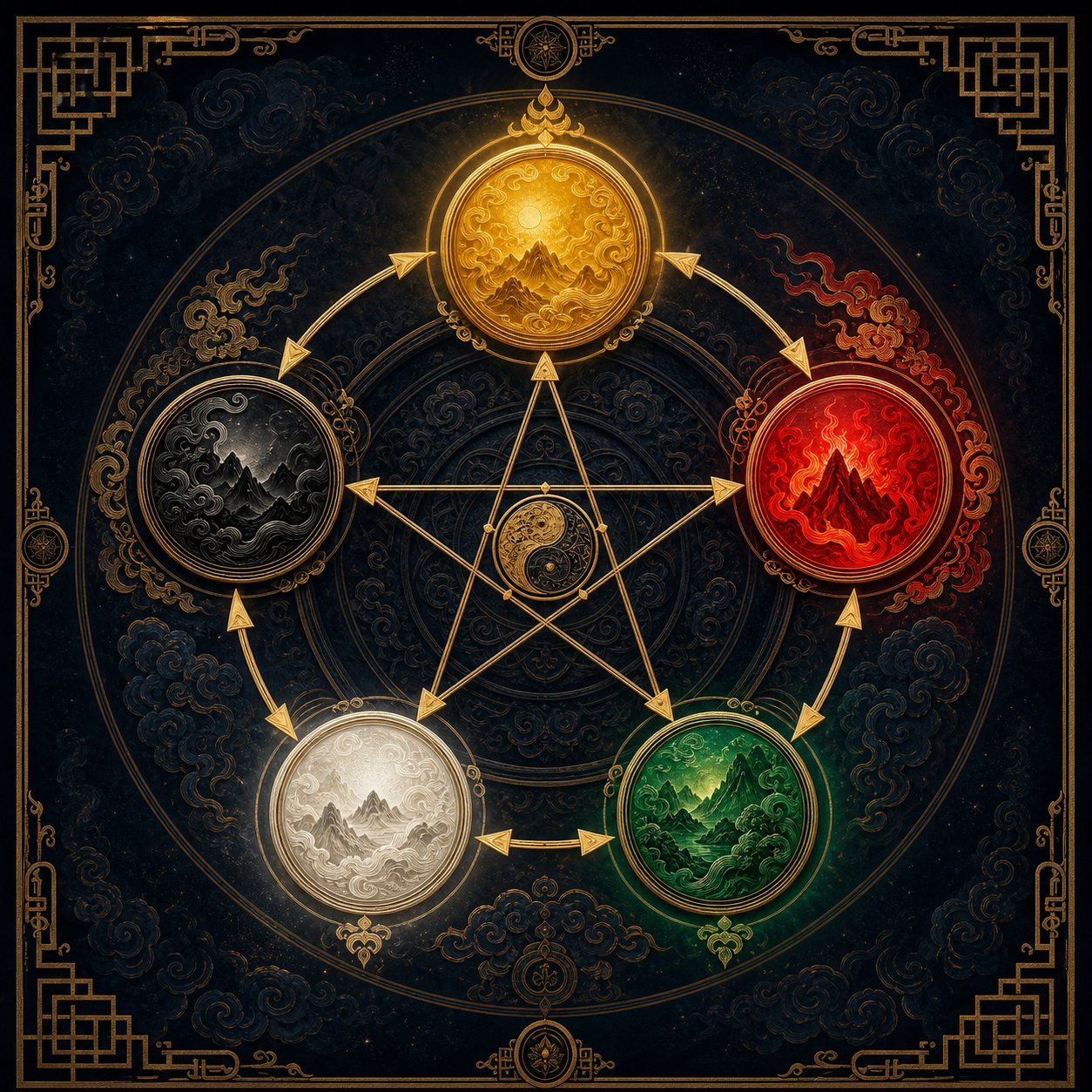
The wuxing (五行) system maps five colors to five elements, five directions, and five seasons. Red corresponds to fire, the south, and summer. Yellow corresponds to earth and the center. Blue-green corresponds to wood, the east, and spring. White corresponds to metal, the west, and autumn. Black corresponds to water, the north, and winter.
Every primary color surname slots into this cosmic framework:
- 黄 Huang (yellow): Earth element, center, stability and nourishment
- 赤 Chi (red): Fire element, south, passion and transformation
- 蓝 Lan (blue-green): Wood element, east, growth and renewal
- 白 Bai (white): Metal element, west, precision and endings
- 黑 Hei (black): Water element, north, depth and hidden power
This means a color surname is never just a color. It is an element, a direction, a season, and a set of personality associations all compressed into a single character. Among chinese names popular in genealogical research, these Five Elements connections often surface in naming practices where parents choose given names that harmonize with or complement the elemental energy already present in the surname.
The symbolic weight these colors carry also lives inside the physical structure of the characters themselves. Each surname character is built from component parts, radicals and phonetic elements, that tell their own visual story about how the color meaning was encoded into written form.
How Color Surname Characters Are Built
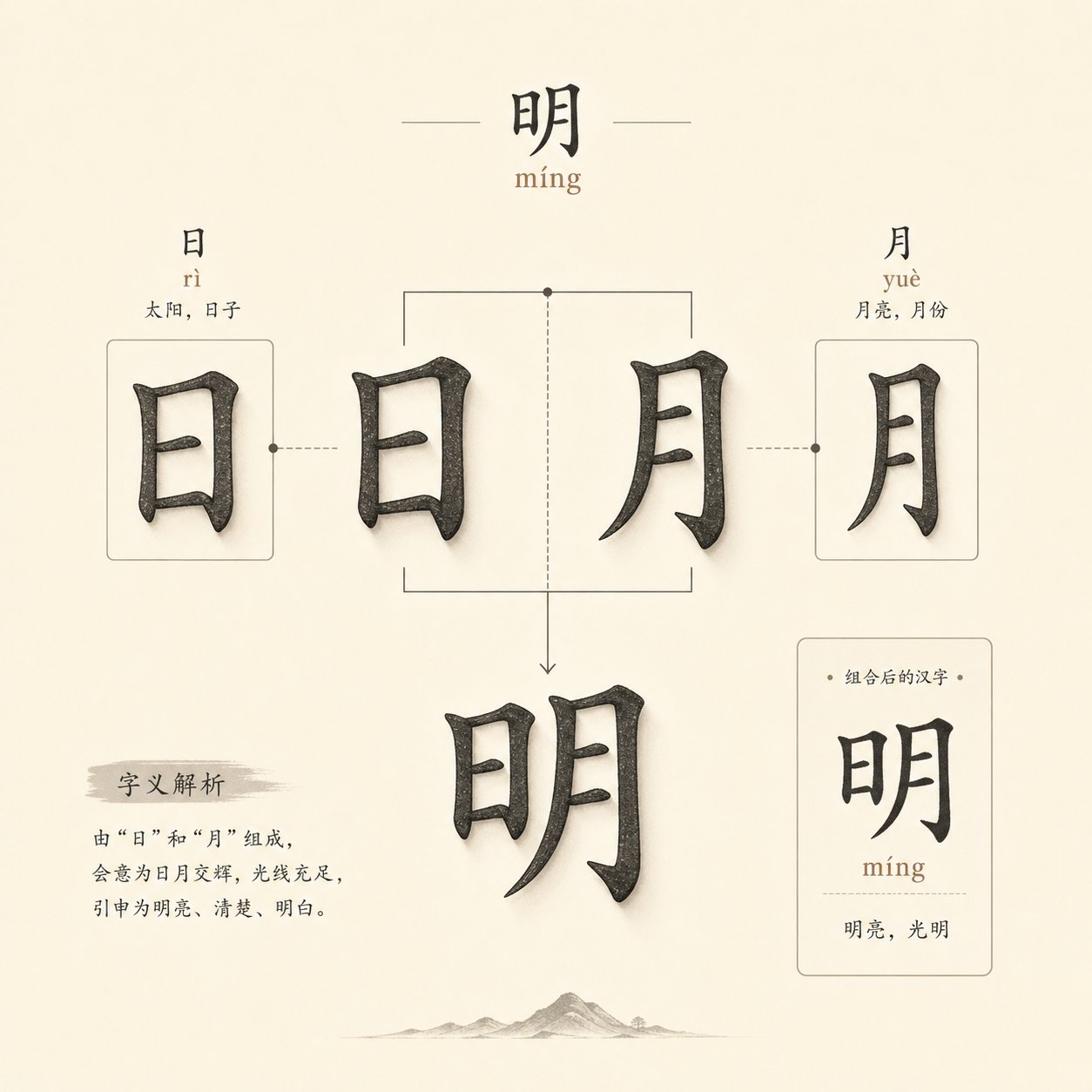
Every Chinese character is a small architecture project. Components stack, nest, and combine to produce meaning and sound simultaneously. When you look at a surname in chinese, you are not seeing an arbitrary symbol. You are seeing a visual argument about what the word means and how it should be pronounced. For color surnames, this internal structure often reveals the original source of the color itself, whether it came from a plant, a mineral, or a raw visual observation.
Understanding how chinese names and characters work at the component level gives you a framework that extends far beyond memorizing individual surnames. It turns each character into a readable story.
Radicals That Signal Color in Chinese Characters
Most Chinese characters are compounds built from smaller pieces. According to Skritter's analysis of character structure, these components typically serve one of two functions: they carry information about meaning (semantic components) or they carry information about sound (phonetic components). The semantic component is often, though not always, the character's radical, the piece used to index it in dictionaries.
Two radicals appear repeatedly across color surname characters:
- 糸/纟 (silk radical, mi): This radical appears in 紫 (purple) and 绿 (green). Listed as Kangxi radical 120, it originally depicted a skein of silk and signals fine texture or material. Its presence in color characters reflects the historical connection between dyes, textiles, and color naming. When used as a left component, it simplifies to 纟in modern Chinese.
- 艹 (grass/plant radical, cao): This radical crowns 蓝/藍 (blue) and 苍/蒼 (grey-green). It signals that the color's origin is botanical. Blue dye came from the indigo plant. Grey-green described the hue of aged vegetation. The radical tells you the color was observed in nature before it became an abstract concept.
Then there is 黑 (black), which functions as both a standalone character and a radical itself. When 黑 appears as a component in other characters, it signals darkness or ink-related meanings. As a last name in chinese, it stands alone without needing additional components because the concept of blackness was considered elemental enough to warrant its own irreducible form.
Reading Color Surname Characters as Visual Stories
Walk through a few decompositions and you will start seeing the logic embedded in each character.
蓝/藍 (Lan, blue): The top component is 艹, the grass radical, immediately signaling a plant origin. Beneath it sits 监 (jian), which serves as the phonetic component, hinting at pronunciation. As Princeton's Chinese character database confirms, the meaning radical points to the indigo plant from which blue dye was historically extracted, while the bottom component guides the sound. The character literally reads as "the plant that sounds like jian," and that plant produces blue.
紫 (Zi, purple): This character combines 此 (ci, meaning "this") on top with 糸 (silk radical) on the bottom. The silk radical connects purple to the world of dyed textiles, since purple pigment was among the most expensive and labor-intensive dyes to produce. The upper component 此 provides the phonetic clue. Together, the character says: "the silk-related thing that sounds like ci" equals purple.
苍/蒼 (Cang, grey-green): Again the grass radical 艹 sits on top, anchoring the meaning in vegetation. Below it, 仓/倉 (cang, meaning "storehouse") provides the pronunciation. The visual logic suggests the color of stored or aged plant matter, that muted grey-green of dried herbs or weathered pine.
Not every color surname character follows the phonetic-semantic compound pattern. 白 (Bai, white) and 黑 (Hei, black) are among the oldest characters in the Chinese writing system, simple enough in concept that they never required compound construction. 黄 (Huang, yellow) has a complex historical form whose original pictographic meaning is debated, but its modern structure does not decompose into a clean radical-plus-phonetic pair the way later characters do.
This table breaks down each color surname character into its structural components:
| Character | Surname | Structure Type | Semantic Component | Phonetic Component | What the Structure Reveals |
|---|---|---|---|---|---|
| 白 | Bai | Simple (non-compound) | Whole character | N/A | Ancient pictograph, possibly depicting sunlight or a blank thumb |
| 黄 | Huang | Complex historical form | Debated | Debated | Original form may depict a jade ornament; structure obscured by millennia of simplification |
| 蓝/藍 | Lan | Phonetic-semantic | 艹 (grass/plant) | 监 (jian) | Color derived from the indigo plant |
| 黑 | Hei | Simple (standalone radical) | Whole character | N/A | Depicts soot marks from fire; functions as its own radical |
| 绿/綠 | Lü | Phonetic-semantic | 糸/纟 (silk) | 录 (lu) | Color associated with dyed silk thread |
| 赤 | Chi | Compound ideograph | 大 (big) + 火 (fire) | N/A | The color of a large fire: glowing red |
| 紫 | Zi | Phonetic-semantic | 糸 (silk) | 此 (ci) | The rare, expensive dye color applied to silk |
| 苍/蒼 | Cang | Phonetic-semantic | 艹 (grass/plant) | 仓 (cang) | The grey-green hue of aged or stored vegetation |
You will notice a pattern. The phonetic-semantic compounds (蓝, 绿, 紫, 苍) all use either the silk radical or the grass radical as their meaning anchor. This is not coincidence. In ancient China, colors were understood primarily through two material domains: plants that produced dyes and the textiles those dyes colored. The characters preserve that material history in their very bones.
Knowing how to read a surname 中文 character at the component level does more than satisfy linguistic curiosity. It gives you a pronunciation approximation even for unfamiliar characters, and it reveals the cultural logic that connects a color word to the natural world. That same logic extends into how these characters sound when spoken aloud, where tones, dialect differences, and romanization systems add yet another layer of complexity to color surnames.
Pronouncing Color Surnames in Mandarin and Cantonese
Seeing a character's internal structure is one thing. Saying it out loud is another challenge entirely. Most guides for chinese first and last names stop at listing pinyin without explaining what those letters actually sound like in your mouth. Mandarin surnames use four tones that change meaning completely, and the same character sounds like a different word altogether in Cantonese. If you have ever wondered why the same family spells their name "Wong" in one country and "Huang" in another, the answer lives in these pronunciation differences.
Mandarin Pronunciation With Tone Guides
Mandarin Chinese has four main tones that function like musical pitches built into every syllable. Getting the tone wrong does not just sound odd. It can produce a completely different word. Here is how each tone works:
- Tone 1 (high and flat): Hold your voice at a steady high pitch, like humming a single note.
- Tone 2 (rising): Your pitch climbs upward, similar to the inflection when asking "Really?"
- Tone 3 (dipping): Your voice dips low then rises slightly, like a drawn-out "well..." when you are thinking.
- Tone 4 (sharp falling): A quick, decisive drop in pitch, like saying "Stop!" with authority.
For mandarin surnames tied to colors, here is what each one sounds like with English approximations. Bai (tone 2) rhymes roughly with "buy" said with a rising, questioning inflection. Huang (tone 2) sounds close to "hwong" with that same upward lift. Lan (tone 2) resembles "lahn" rising at the end. Hei (tone 1) sounds like "hay" held at a steady high pitch. Lü (tone 4) requires rounding your lips as if saying "ee" while shaping them for "oo," then dropping the pitch sharply. Chi (tone 4) sounds like "chih" with a falling tone. Zi (tone 3) dips low like "dzuh" before rising slightly. Cang (tone 1) sounds like "tsahng" held flat and high.
The trickiest sound for English speakers is Lü. The ü vowel does not exist in English. Imagine saying the word "see" but with your lips rounded into a tight circle, as if whistling. That rounded front vowel is ü.
Cantonese and Regional Variations
Cantonese uses six tones (some analyses count nine), and its pronunciation of the same characters diverges dramatically from Mandarin. As the Asia Media Centre explains, in territories with a sizeable Chinese diaspora, the way a family name is spelled often signals the region a person's ancestors came from. A person surnamed "Wong" is understood to have Cantonese heritage, while "Huang" signals Mandarin-speaking origins.
This means that when you encounter cantonese surnames or cantonese last names in English-speaking countries, you are hearing an entirely different phonetic system applied to the same written character. Cantonese color pronunciations use different initial consonants, different vowels, and different tone contours than their Mandarin equivalents. The character 白, for instance, shifts from "Bai" in Mandarin to "baak6" in Cantonese, a low-falling tone with a clipped final consonant that Mandarin lacks entirely.
Here is each color surname with its Mandarin and Cantonese pronunciations, plus the English spelling variants you are most likely to encounter in diaspora communities:
- 白 — Mandarin: Bái (tone 2, rising) | Cantonese: baak6 (low-falling, clipped) | English variants: Bai, Pak, Peh, Pek
- 黄 — Mandarin: Huáng (tone 2, rising) | Cantonese: wong4 (low-falling) | English variants: Huang, Wong, Ng, Ooi, Hwang
- 蓝/藍 — Mandarin: Lán (tone 2, rising) | Cantonese: laam4 (low-falling) | English variants: Lan, Lam, Nam
- 黑 — Mandarin: Hēi (tone 1, high flat) | Cantonese: haak1 (high, clipped) | English variants: Hei, Hak, Hek
- 绿/綠 — Mandarin: Lǜ (tone 4, falling) | Cantonese: luk6 (low, clipped) | English variants: Lu, Luk, Lok
- 赤 — Mandarin: Chì (tone 4, falling) | Cantonese: cek3 (mid-level, clipped) | English variants: Chi, Chek, Chiah
- 紫 — Mandarin: Zǐ (tone 3, dipping) | Cantonese: zi2 (rising) | English variants: Zi, Tse, Tsz
- 苍/蒼 — Mandarin: Cāng (tone 1, high flat) | Cantonese: cong1 (high, flat) | English variants: Cang, Chong, Tsang
You will notice that Cantonese preserves final consonant sounds like "-k" and "-ng" that Mandarin dropped centuries ago. This is why cantonese last names often look so different from their Mandarin pinyin equivalents in English. "Pak" for 白 and "Luk" for 绿 reflect those clipped endings that give Cantonese its distinctive rhythmic quality.
For chinese full names, remember that the surname comes first in Chinese word order. A person named 黄小明 is "Huang Xiaoming" in Mandarin or "Wong Siu-ming" in Cantonese. The color surname anchors the front of the name in both systems, but the romanized spelling tells you which dialect shaped the family's migration history. That migration history, and the romanization systems it produced, is exactly what determines whether you recognize a color surname when you encounter it in everyday English contexts.
Famous People With Color-Based Chinese Surnames
Recognizing a color surname in romanized form is one thing. Connecting it to real people whose names you might already know makes the whole system click into place. Some of the most famous chinese names in history belong to individuals whose surnames literally mean a color, from legendary generals to dynasty founders to modern film stars. These figures give color surnames a human face and a concrete place in the timeline of Chinese civilization.
Historical Figures With Color Surnames
Color surnames appear at pivotal moments across Chinese history. A few names stand out for the sheer scale of their influence.
Zhu Yuanzhang (朱元璋) is arguably the most powerful person ever to bear a color surname. Born into poverty, he rose through rebellion to found the Ming Dynasty in 1368, ruling as the Hongwu Emperor. His surname 朱 means vermillion, and this was no small detail. The Ming Dynasty adopted red as its imperial color precisely because of the founding family's name. The dynasty itself means "bright" (明), and for nearly three centuries, vermillion red dominated court robes, official seals, and palace architecture. A color surname literally colored an empire.
Huang Zhong (黄忠) earned his place among the most celebrated chinese warrior names in history. A general of the Shu Han kingdom during the Three Kingdoms period (220-280 CE), he was renowned as an expert archer and fearless fighter despite his advanced age. He is honored as one of the Five Tiger Generals under Liu Bei, immortalized in the novel Romance of the Three Kingdoms and countless films and games since.
Bai Juyi (白居易) remains one of the most widely read poets in Chinese literary history. Writing during the Tang Dynasty (772-846 CE), he championed a plain, accessible style that ordinary people could understand. His surname 白 (white) and his courtesy name 乐天 (happy heaven) together paint a portrait of clarity and ease. His poems are still memorized by schoolchildren across East Asia today.
Contemporary Figures Bearing Color Surnames
Color surnames continue to produce recognizable figures in the modern era, particularly among popular chinese names in entertainment and literature.
Jin Yong (金庸) is the pen name of Louis Cha, the martial arts novelist whose wuxia stories shaped Chinese popular culture for over half a century. His chosen pen name uses 金 (gold/metal), a secondary-color surname that carries associations of permanence and value. His novels have sold over 300 million copies and been adapted into dozens of films and television series.
Huang Xiaoming (黄晓明) is one of China's most prominent actors, known for roles in The Romance of the Condor Heroes and American Dreams in China. As a multiple Best Actor award winner, he represents the Huang surname's continued visibility in contemporary Chinese culture.
Here is a quick-scan breakdown of notable figures organized by their color surname:
- 黄 Huang (yellow): Huang Zhong (Three Kingdoms general), Huang Tingjian (Song Dynasty poet and calligrapher), Huang Gongwang (Yuan Dynasty painter), Wong Fei-hung (martial arts legend), Jensen Huang (NVIDIA CEO), Huang Xiaoming (actor)
- 白 Bai (white): Bai Juyi (Tang Dynasty poet), Bai Xingjian (Tang Dynasty writer, brother of Juyi)
- 朱 Zhu (vermillion): Zhu Yuanzhang (Ming Dynasty founder), Zhu Xi (Neo-Confucian philosopher), Zhu Da (Qing Dynasty painter), Zhu De (co-founder of the Chinese Red Army)
- 金 Jin (gold): Jin Yong (martial arts novelist), Jin Shengtan (Ming-Qing literary critic)
You'll notice that the Huang and Zhu surnames dominate this list. That is partly a numbers game, since both are among the most common surnames in China, but it also reflects how chinese famous names cluster around dynasties and cultural movements where these families held power. The Zhu clan alone produced seventeen Ming emperors across 276 years, making it one of the longest-ruling families in Chinese imperial history.
What happens, though, when these famous names cross borders? A person named 黄 might appear as Huang, Wong, Ng, or Ooi depending on where their family emigrated and which dialect shaped their romanization. That variation is not random. It maps directly onto specific regions, migration waves, and romanization systems that tell the story of the Chinese diaspora itself.
Color Surnames Across the Chinese Diaspora
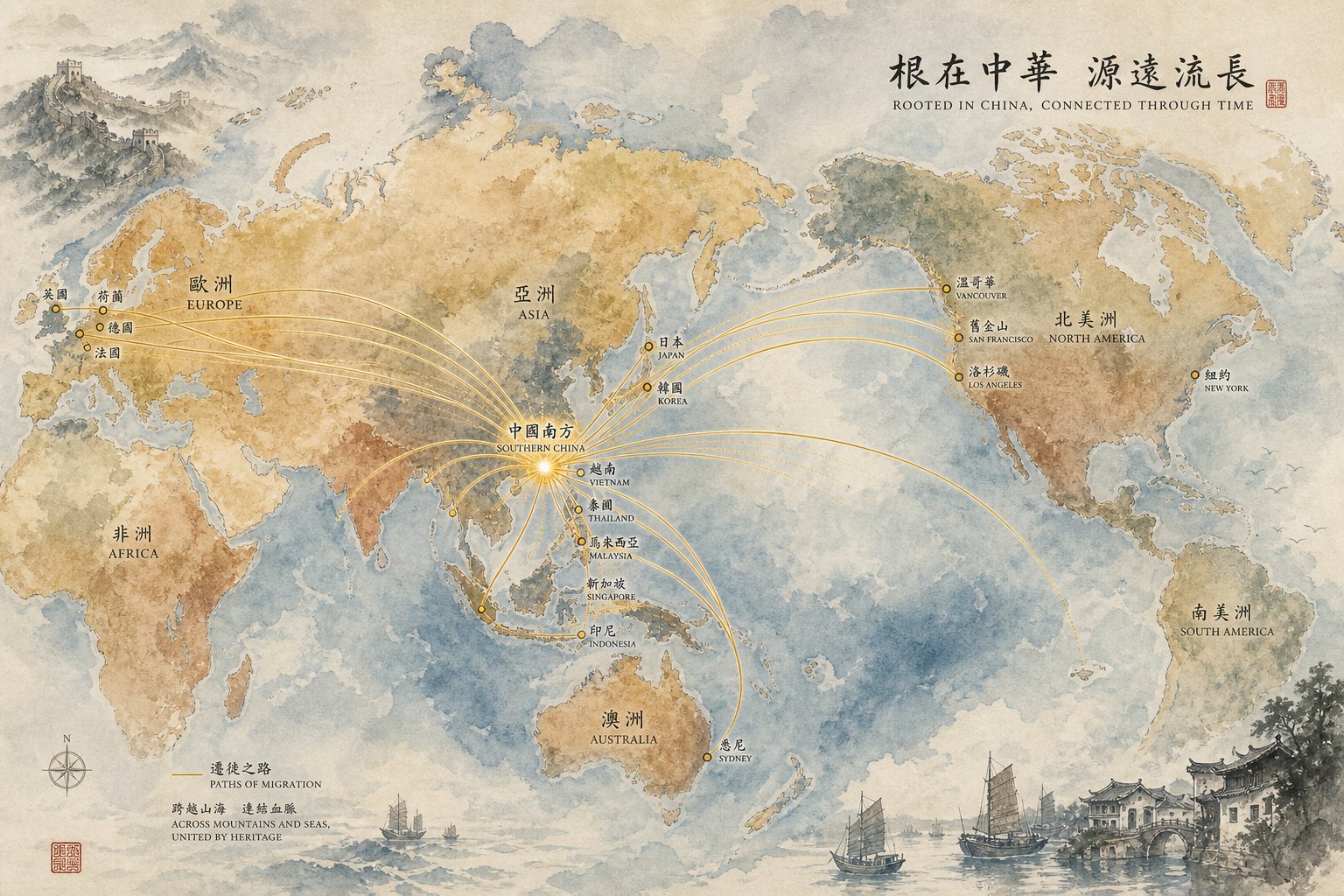
That variation is not random at all. It follows precise linguistic rules tied to dialect, geography, and the era of emigration. A single character like 黄 can appear as Huang, Wong, Ng, Ooi, Wee, Uy, or Hwang depending on which Chinese dialect the family spoke and which country's immigration officer wrote the name down. For anyone trying to identify color surnames among common asian last names encountered in English-speaking contexts, this multiplicity creates a genuine puzzle. The same family name looks like five completely different surnames on paper.
Regional Romanization Differences
Chinese is not one language but a family of mutually unintelligible dialects. Mandarin, Cantonese, Hokkien, Teochew, and Hakka each pronounce the same written character differently, and those pronunciation differences produce entirely different romanized spellings. As My China Roots documents, there was no standardized system of romanization to transcribe Chinese names into foreign languages. For many immigrants, official records depended on the translation abilities of immigration officials who may not have spoken the same dialect as the person standing in front of them.
Take 黄 as the clearest example. Research into the Huang surname alone reveals over a dozen romanized variants across the diaspora:
- Mandarin (Pinyin): Huang — standard in mainland China and increasingly recognized internationally
- Cantonese: Wong — dominant in Hong Kong, the Americas, and the UK
- Hokkien: Ng, Ooi, Wee, Oey — common in Taiwan, Singapore, Malaysia, Indonesia, and the Philippines
- Teochew: Ng, Ooi, Wee — overlapping with Hokkien variants, common in Chaozhou-origin communities
- Hakka: Wong, Vong — present in Guangdong, Taiwan, and overseas Hakka communities
- Korean-influenced: Hwang — used by Korean families sharing the same character (황)
- Vietnamese: Hoang or Huynh — a completely separate phonetic system
The same pattern applies to 白. In Mandarin it is Bai. In Cantonese it becomes Pak (from the clipped final consonant preserved in that dialect). In Hokkien it surfaces as Peh or Pek. Each spelling is a fingerprint pointing back to a specific dialect group and migration route.
Among popular asian last names in countries like Singapore and Malaysia, the English spelling of a surname reveals dialect heritage. If you meet someone surnamed Wee, Oei, or Ooi, they are almost certainly of Hokkien descent. If the spelling is Wong, Cantonese origins are the safe bet. If it is Ng, the person could be Hokkien or Teochew, since both dialect groups produce that nasal romanization for 黄.
Identifying Color Surnames in English Contexts
Why would the same family spell their surname differently across generations? Imagine a Hokkien-speaking family that emigrated from Fujian to the Philippines in the 1800s. Their name 黄 was recorded as "Uy" by Spanish colonial officials. A branch of the same family that moved to Singapore had it written as "Ooi" by British administrators. A third branch that stayed in Taiwan adopted "Huang" when the ROC government standardized Mandarin pinyin for taiwanese last names. Three spellings, one character, one family.
This is why genealogical researchers working with chinese american surnames often need to search multiple spelling variants to find all branches of a single family. The character never changed. Only the romanization did, shaped by which dialect the family spoke, which country they landed in, and which era's transliteration conventions applied.
For taiwanese surnames specifically, the situation adds another layer. Taiwan uses multiple romanization systems depending on the era and municipality. Older records may use Wade-Giles (producing "Huang"), while some local systems produce slightly different spellings. Hokkien-speaking Taiwanese families sometimes romanize 黄 as "Ng" in informal contexts while using "Huang" on official documents.
Here is the complete mapping of color surname romanizations across dialect groups and countries. If you are trying to spot color-based asian surnames in everyday life, this table is your decoder ring:
| Character | Color | Mandarin (Pinyin) | Cantonese | Hokkien | Teochew | Most Common In |
|---|---|---|---|---|---|---|
| 黄 | Yellow | Huang | Wong | Ng, Ooi, Wee, Uy | Ng, Ooi | US/UK: Wong, Huang; Singapore/Malaysia: Ng, Ooi, Wee; Philippines: Uy, Ong; Taiwan: Huang, Ng |
| 白 | White | Bai | Pak, Baak | Peh, Pek | Peh | US: Bai, Pak; Hong Kong: Pak; Singapore/Malaysia: Peh; Taiwan: Bai, Pai |
| 蓝/藍 | Blue | Lan | Lam | Lam, Na | Lam | US: Lan, Lam; Hong Kong: Lam; Singapore/Malaysia: Lam; Taiwan: Lan |
| 黑 | Black | Hei | Hak | Hek | Hek | Rare across all regions; Hei in mainland China records |
| 绿/綠 | Green | Lü | Luk | Lek, Liok | Lek | Extremely rare; scattered mainland China records only |
| 赤 | Red | Chi | Chek | Chiah, Chhek | Chiah | Rare; occasional mainland China and Taiwan records |
| 紫 | Purple | Zi | Tse, Tsz | Chi | Chi | Extremely rare across all regions |
| 苍/蒼 | Grey-green | Cang | Chong, Tsang | Chhong | Chhang | Extremely rare; occasional mainland China records |
| 朱 | Vermillion | Zhu | Chu, Jyu | Chu | Chu | US: Chu, Zhu; Hong Kong: Chu; Singapore/Malaysia: Chu; Taiwan: Chu, Zhu |
| 金 | Gold | Jin | Kam, Gam | Kim | Kim | US: Jin, Kim, Chin; Hong Kong: Kam; Singapore/Malaysia: Kim; Korea: Kim |
A few patterns emerge from this table. Cantonese romanizations dominate in Hong Kong, the US, the UK, Canada, and Australia because Cantonese speakers formed the earliest and largest waves of Chinese emigration to English-speaking countries. Hokkien and Teochew spellings dominate in Southeast Asia, particularly Singapore, Malaysia, Indonesia, and the Philippines, reflecting the southern Chinese trade networks that drove migration to those regions. Mandarin pinyin spellings are most common among recent immigrants from mainland China and among asia surnames recorded in Taiwan's official systems.
For anyone researching their own family history or simply trying to recognize color surnames in the wild, the key insight is this: do not assume a surname is unrelated to a color just because its English spelling looks unfamiliar. "Wong" is yellow. "Pak" is white. "Lam" is blue. "Kim" is gold. These are all color surnames hiding in plain sight behind dialect-specific romanizations, waiting to be recognized by anyone who knows where to look.
Frequently Asked Questions About Chinese Color Surnames
1. What is the most common Chinese surname that means a color?
Huang (黄), meaning yellow, is by far the most common color surname in China. It ranks 7th nationally with approximately 32.6 million bearers, representing about 2.45% of the total population. Its prevalence connects to the Yellow Emperor myth and the Yellow River's role as the cradle of Chinese civilization. Huang alone outnumbers all other primary color surnames combined by roughly eight to one.
2. Why does the same Chinese color surname have different English spellings?
Chinese is a family of mutually unintelligible dialects, and each dialect pronounces the same written character differently. For example, 黄 (yellow) becomes Huang in Mandarin, Wong in Cantonese, Ng or Ooi in Hokkien, and Hwang in Korean-influenced contexts. The spelling a family uses depends on which dialect they spoke, which country they emigrated to, and which era's transliteration conventions applied when their name was first recorded in English.
3. What is the difference between primary and secondary color surnames in Chinese?
Primary color surnames are characters whose first dictionary definition is a color, such as 白 (white), 黄 (yellow), or 蓝 (blue). Secondary color surnames are characters where color is a derived or extended meaning rather than the core definition. For instance, 金 (Jin) primarily means metal, with gold as a secondary association, and 朱 (Zhu) originally referred to a type of tree before becoming associated with vermillion red. Native speakers perceive these two categories quite differently.
4. How do Chinese color surnames connect to Five Elements theory?
The wuxing (Five Elements) system maps colors to elements, directions, and seasons. Yellow corresponds to earth and the center, red to fire and the south, blue-green to wood and the east, white to metal and the west, and black to water and the north. This means a color surname carries not just a hue but an entire cosmological framework of elemental associations, directional symbolism, and seasonal energy that historically influenced naming practices.
5. Are there any rare Chinese surnames that mean colors like purple or green?
Yes, both 紫 (Zi, purple) and 绿 (Lu, green) exist as verified Chinese surnames, but they are exceptionally rare. Neither appears on standard frequency lists, and they surface only in scattered regional records without significant population clusters. Similarly, 苍 (Cang, grey-green) and 赤 (Chi, red) are confirmed surnames that fall outside the top 400 in prevalence rankings, making them genuine curiosities within the Chinese naming system.