Chinese Surnames That Mean Plum
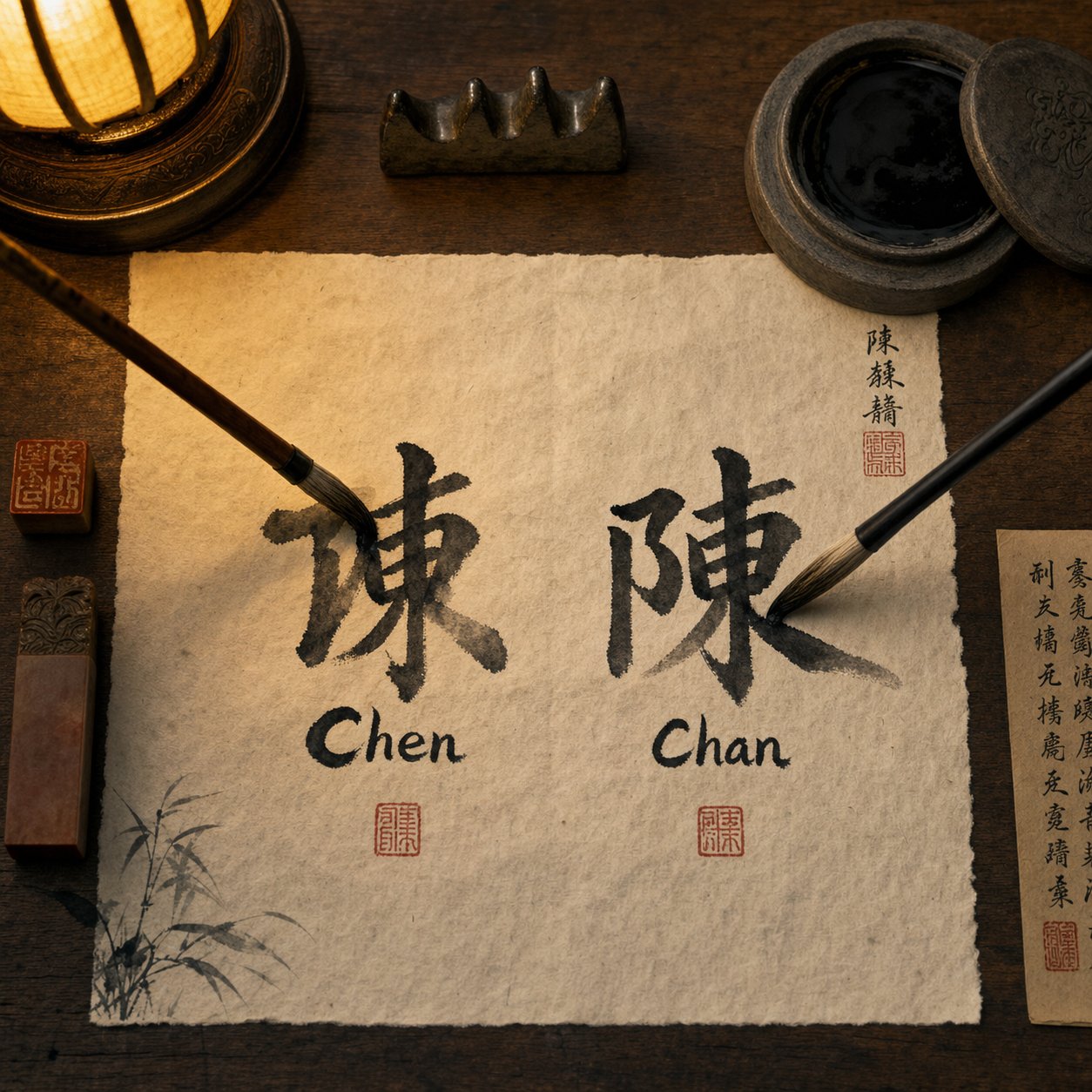
When you search for Chinese surnames meaning plum, you're actually looking at two distinct family names: 李 (Lǐ) and 梅 (Méi). Both translate to "plum" in English, but they refer to entirely different plants and carry different histories. If your last name is Lee, Li, Lim, Ly, Lei, or Mei, there's a strong chance your ancestors chose a name rooted in one of China's most symbolically rich trees.
The li surname is by far the more common of the two. It ranks as the second most common surname in China, shared by more than 93 million people in the country alone and over 100 million across Asia. That's roughly a third of the entire U.S. population carrying a single family name. The li last name appears in the famous Hundred Family Surnames as the fourth entry, and its bearers have included emperors, philosophers, and martial arts legends.
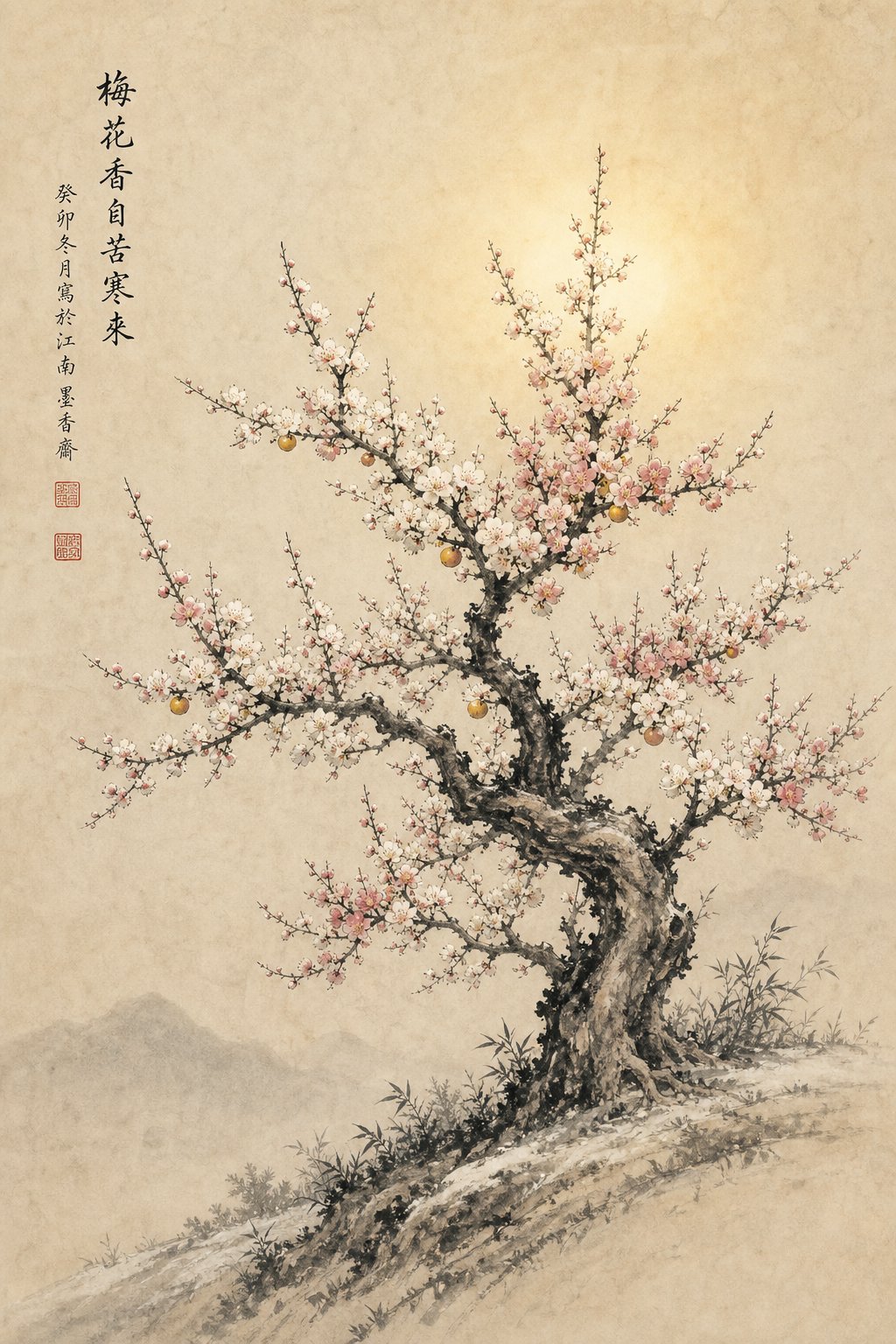
梅 (Méi), on the other hand, is far rarer. It ranks around the 130th to 150th most common surname in China, but what it lacks in numbers it makes up for in cultural weight. The Mei surname is tied to the flowering plum blossom, one of the most celebrated images in Chinese art and poetry.
Two Surnames, One English Word
Here's where English creates confusion. The word "plum" covers both plants, but Chinese botany draws a clear line between them:
李 (Lǐ) refers to Prunus salicina, the fruit-bearing Chinese plum tree cultivated for its sweet, edible fruit. 梅 (Méi) refers to Prunus mume, the flowering plum blossom prized for its delicate winter blooms rather than its fruit. Two different plants, two different surnames, unified under one English word.
So what does li mean in the context of a surname? It literally means "plum" or "plum tree," encoding an agricultural relationship with a fruit that sustained families for millennia. The character itself visually represents a tree bearing fruit, a detail we'll unpack shortly. Meanwhile, li means something slightly different from Mei: one points to sustenance and survival, the other to beauty and resilience.
Why Plum Matters in Chinese Identity
Carrying a plum-meaning surname isn't just a genealogical fact. In Chinese culture, the plum tree and plum blossom occupy a space similar to what the oak or rose represents in Western traditions, but with deeper philosophical layers. The li plum connects to stories of survival, imperial power, and Taoist philosophy. The mei plum connects to artistic refinement and moral endurance.
English speakers encounter these surnames in dozens of spellings: Lee in Hong Kong and Korea, Lei in Macau, Ly in Vietnam, Lim in parts of Southeast Asia, and Li across mainland China. Each spelling reflects a different dialect, a different migration story, and a different chapter in the life of one character. Understanding the li meaning behind these variations reveals how a single written symbol can carry the identity of over a hundred million people across borders, languages, and centuries.
The story of how that character came to represent so many people begins with its internal structure, where two simple radicals combine to paint a picture of a fruit-bearing tree.
The Character 李 and Its Structure
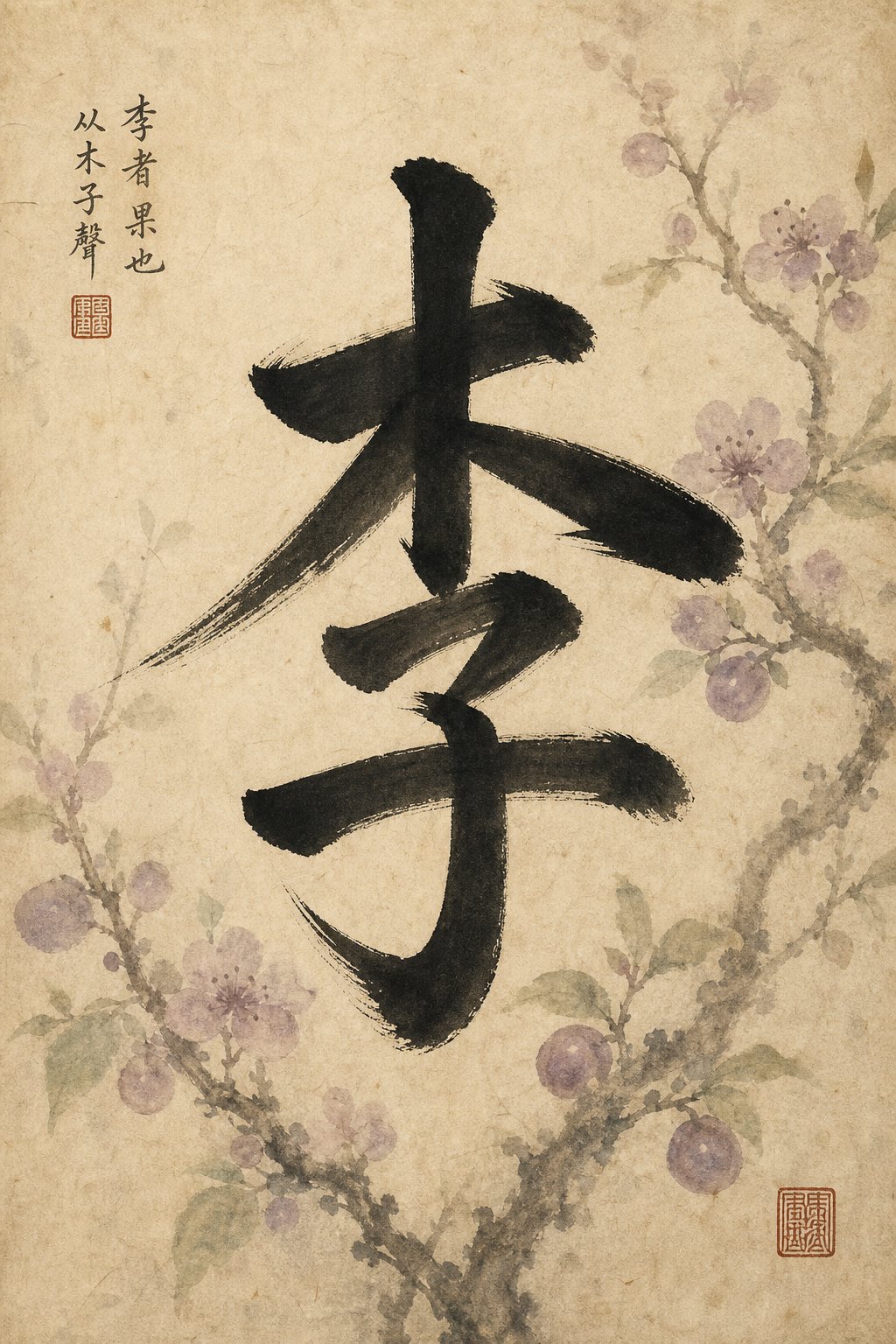
Imagine you could read a family's entire agricultural history in a single written symbol. That's exactly what the li chinese character offers. Written in just seven brushstrokes, 李 is a compact visual story about a tree that bears fruit. When you understand how the character is built, the connection between the surname and the plum tree becomes impossible to miss.
Breaking Down the Character 李
The chinese character for li is what linguists call an ideogrammic compound. It combines two simpler characters, called radicals, stacked vertically to create a new meaning. On top sits 木 (mu, meaning wood or tree). On the bottom sits 子 (zi, meaning child, seed, or offspring). Together, they paint a picture: the offspring of a tree. In other words, fruit.
The ancient Chinese dictionary Shuowen Jiezi (circa 100 AD) confirms this reading directly, defining the character as: "李, 果也" — Li is a fruit. The structure isn't abstract or metaphorical. It's a literal description of what plums are: the children that hang from a tree's branches.
Here's how the components break down:
| Component | Character | Pinyin | Meaning | Position | Role in 李 |
|---|---|---|---|---|---|
| Upper radical | 木 | mu | Tree / Wood | Top | Indicates the plant category |
| Lower radical | 子 | zi | Child / Seed / Offspring | Bottom | Indicates fruit or reproduction |
| Combined | 李 | li | Plum (tree fruit) | Full character | A tree that bears fruit — the plum |
You'll notice the logic is elegant. Rather than drawing a picture of a plum fruit (which would be difficult to standardize), the ancient scribes encoded the concept through relationship: tree plus offspring equals fruit. This structural approach appears in bronze script versions of the character dating back to the Warring States period (475-221 BC), showing that the li in chinese character form has carried this meaning for well over two thousand years.
How Radicals Reveal the Plum Tree Meaning
The 木 radical does more than signal "tree." In the Chinese writing system, it acts as a semantic classifier. Any character containing 木 belongs to the world of wood, trees, or plants. Think of 林 (lin, forest), 松 (song, pine), or 桃 (tao, peach). When you see 木 in a character, your brain immediately categorizes it within the botanical realm.
The 子 radical adds specificity. While 子 most commonly means "child" in modern Chinese, its older usage encompassed seeds, offspring, and anything produced by a parent organism. Placed beneath the tree radical, it narrows the meaning from "any tree" to "a tree defined by what it produces" — its fruit.
This matters because the 李 meaning points to a specific species: Prunus salicina, the Chinese plum. Despite being commonly called the "Japanese plum" in Western markets, this fruit tree originates from China, not Japan. It was cultivated in Chinese orchards for thousands of years before being developed further in Japan and eventually introduced to the West. The fruit is known for its larger size, juicy texture, and high sugar content compared to European plum varieties.
For anyone researching the li name chinese families carry, this botanical connection reveals something profound about the surname's origins. The people who first bore this name lived in intimate relationship with plum orchards. The tree wasn't just scenery — it was sustenance, medicine, and eventually identity. When descendants adopted 李 as their family name, they were encoding an agricultural bond into every generation that followed.
The character's seven strokes have remained remarkably stable across millennia. From bronze inscriptions through seal script, clerical script, and into the modern regular script used today, the basic structure of tree-over-seed has persisted. That continuity means a person writing the li name chinese families use today is drawing essentially the same symbol their ancestors carved into bronze vessels over two thousand years ago.
This structural permanence raises a natural question: how did a character meaning "plum fruit" become one of the most common surnames on Earth? The answer lies not in botany but in a dramatic story of survival, persecution, and an empire that changed everything.
Historical Origins of the Li Surname
Every surname has a creation story, but few are as vivid as the one behind 李. The li last name origin traces back over three thousand years to a tale of political persecution, desperate flight, and a fruit tree that saved a family from starvation. That story explains how a character meaning "plum" became permanently attached to one of the largest family lineages on Earth.
The Legend of Survival and the Plum Tree
The li name origin begins with the ancient Ying (赢) clan, descendants of the mythical Yellow Emperor. After a figure named Gao Yao served as Minister of Justice (大理) under Emperor Yao around 2300 BC, his descendants adopted the character 理 (li, meaning "reason" or "justice") as their surname. For generations, the family served as judicial officials, and the name reflected that role.
Then came the Shang dynasty's final years. A minister named Li Zheng (理徵) dared to oppose King Zhou of Shang, a ruler infamous for his cruelty and excess. Li Zheng was executed for his honesty. His wife, Qihe Shi, fled westward into Henan province with their young son, Li Lizhen, barely escaping with their lives.
During their desperate journey, mother and son faced starvation. They survived by foraging wild plums (李子) from trees along their path. In gratitude for the fruit that kept them alive, Li Lizhen changed the family surname from 理 (reason) to 李 (plum). The two characters share the same pronunciation, creating a poignant bridge between the family's judicial past and their story of survival. This single act of renaming transformed a common fruit tree into a permanent marker of identity for billions of descendants.
The Tang Dynasty and Imperial Prestige
The survival legend explains how the surname was born, but it doesn't explain how it became one of the most common in the world. That chapter belongs to the Tang Dynasty (618-907 AD).
The Li clan founded the Tang Dynasty, and all twenty of its emperors bore the surname 李. This wasn't just a matter of royal prestige. Tang emperors actively bestowed the imperial surname upon generals, officials, allied clans, and even foreign dignitaries as a mark of favor. Receiving the Li name was one of the highest honors in the empire. Entire families adopted it overnight, and the population of Li bearers exploded.
Here's how the surname's growth unfolded across key historical periods:
- Shang Dynasty (c. 1600-1046 BC) — Li Zheng's family flees persecution; the surname 李 is born from the earlier 理.
- Zhou Dynasty and Spring-Autumn Period (1046-476 BC) — The Li clan establishes itself across northern China, with branches settling in what is now Henan and Gansu.
- Warring States through Han Dynasty (475 BC-220 AD) — The surname spreads steadily; the philosopher Laozi (Li Er) becomes its most famous early bearer.
- Tang Dynasty (618-907 AD) — Imperial patronage causes massive adoption; the Longxi Li branch alone produces 67 emperors, 91 prime ministers, and 86 generals.
- Song Dynasty onward (960 AD-present) — The Hundred Family Surnames (百家姓) formally records 李 as a major surname; migration carries it across East and Southeast Asia.
The last name li origin, then, is really two stories layered on top of each other. The first is intimate and human: a mother and child eating wild plums to survive. The second is political and sweeping: an imperial dynasty turning one family name into a national identity.
Understanding the origins of the surname Lee (or Li, Lim, Ly, depending on dialect) also means recognizing that not every bearer descends from the original Ying clan. Many Li families trace their lineage to Tang-era grants rather than the ancient survival story. The last name lee origin for Korean families adds yet another layer, since the Korean 이 (Lee/Yi) adopted the same Chinese character 李 through centuries of cultural exchange with China.
Historical texts like the Hundred Family Surnames, compiled during the early Song Dynasty, document these branching origins. The text places 李 prominently among China's most established lineages, a position earned through both ancient legend and imperial power. Whether your family's connection runs through the plum trees of Henan or the court halls of Chang'an, the surname carries the weight of both survival and sovereignty.
That dual nature — humble endurance paired with imperial grandeur — mirrors something deeper in Chinese culture. The plum tree itself holds exactly this kind of symbolic tension, blooming through winter hardship while standing as a symbol of refined virtue. The cultural meaning embedded in the surname runs far beyond etymology.
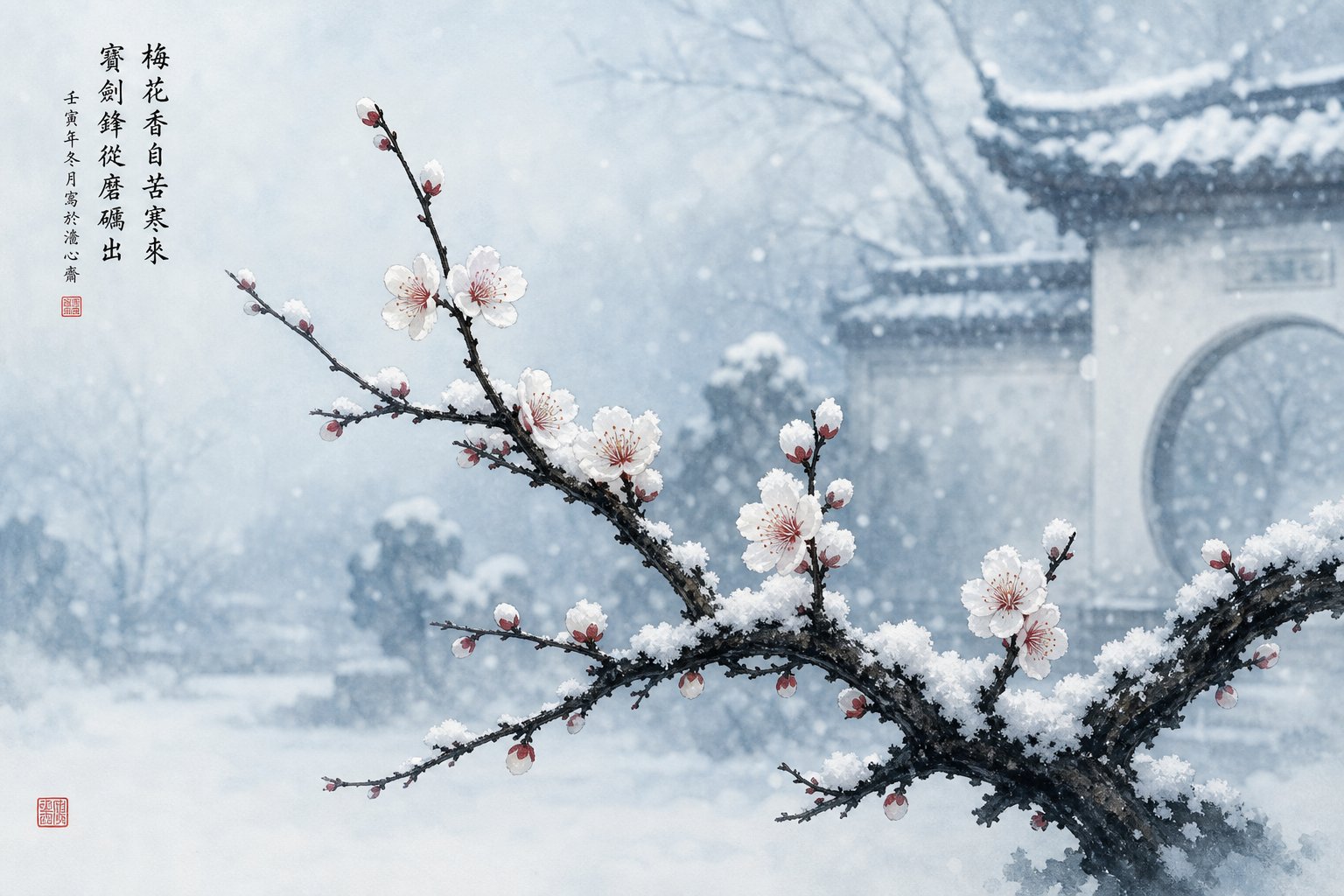
Cultural Symbolism of Plum in Chinese Tradition
A surname doesn't exist in a vacuum. It carries the cultural weight of everything its source word represents. For the millions of people whose family name traces back to the plum, that weight is considerable. The plum in Chinese culture isn't just a fruit or a flower — it's a philosophical statement about how to live.
The Plum Blossom as Cultural Symbol
The plum blossom (梅花, meihua) holds a position in Chinese aesthetics that few other plants can match. It belongs to the Four Gentlemen (四君子), a grouping of four plants — plum, orchid, bamboo, and chrysanthemum — that together represent the highest human virtues in Chinese philosophy. Each plant corresponds to a season and a moral quality. The plum claims winter, the harshest season, and the virtue of perseverance.
Why winter? Because the plum blossom is one of the earliest flowers to emerge each year, bursting into bloom while snow still covers the ground and other plants remain dormant. Imagine a landscape locked in frost, bare branches everywhere, and then a single tree erupts in delicate white or pink petals. That visual contrast — fragile beauty against brutal cold — became a powerful metaphor in Chinese thought. It represents the person who maintains integrity and grace under pressure, who refuses to wait for easy conditions before showing their true nature.
The symbolism runs even deeper. The plum blossom also belongs to the Three Friends of Winter (岁寒三友) alongside pine and bamboo, and it ranks among the Flowers of the Four Seasons as the representative of winter. As one source from the Manchester Museum's cultural collection notes, the plum's membership in all these groupings shows its extraordinary significance in Chinese tradition and culture.
In folk culture, the five petals of the plum blossom carry their own layer of meaning li families and Mei families alike can appreciate. They represent the five blessings: happiness (福), fortune (禄), longevity (寿), joy (喜), and wealth (财). A single flower encodes an entire philosophy of the good life.
The cultural status of the plum blossom wasn't always this elevated. Archaeological evidence traces plum cultivation back over 3,000 years to the Yin-Shang period, but early appreciation focused on the fruit rather than the flower. The shift toward aesthetic and philosophical reverence accelerated during the Song Dynasty (960-1279), when scholars calculated that surviving poems praising plum blossoms outnumbered those from all previous eras combined by a factor of fifty. The Southern Song poet Lin Bu wrote what many consider the definitive plum verse: "Sparse shadows slant across clear shallow water, subtle fragrance floats in the dim moonlight."
Here are the core symbolic meanings the plum carries in Chinese culture:
- Resilience in adversity — blooming in winter when all other flowers have retreated, representing courage under hardship
- Purity and integrity — the clean, simple petals against dark bare wood symbolize moral clarity uncorrupted by worldly compromise
- Renewal and hope — as the first flower of the year, the plum blossom heralds spring's return and new beginnings
- Scholarly virtue — literati across dynasties adopted the plum as their personal emblem, associating it with refined character and intellectual independence
- Modesty and inner beauty — the subtle fragrance and understated elegance represent qualities valued over outward showiness
How Symbolism Connects to Surname Pride
When you understand the li name meaning through this cultural lens, the surname becomes more than a genealogical label. It becomes an inherited statement of values. A person surnamed Li or Mei doesn't just carry a word meaning "plum" — they carry all the philosophical associations that Chinese culture has layered onto that plant across three millennia.
Think about what it means to introduce yourself with a name that evokes endurance through hardship. In Chinese social contexts, the meaning of name li resonates immediately. People hear the character and unconsciously connect it to winter blossoms, to scholarly virtue, to the idea that beauty and strength coexist. The li meaning chinese culture assigns to this character goes far beyond botany.
This connection between plant symbolism and personal identity isn't accidental. Ancient Chinese naming philosophy treated surnames as reflections of character, aspiration, or ancestral story. The plum's association with perseverance made it an especially fitting surname for a family that — according to legend — survived persecution by eating wild plums. The symbol and the story reinforce each other perfectly.
For diaspora families who may have grown up distant from Chinese cultural traditions, rediscovering the meaning li carries can be a powerful reconnection point. Your surname isn't just a sound or a spelling on a passport. It's a compact cultural inheritance, linking you to a tradition that sees beauty in difficulty and strength in gentleness. Whether spelled Lee, Li, Lim, or Ly, the plum's symbolism travels with the name across every border it crosses.
That symbolic weight, however, expresses itself differently depending on where in the world the surname landed — and which romanization system captured its sound. A single character pronounced one way in Beijing sounds entirely different in Guangzhou, Seoul, or Saigon, producing a bewildering variety of English spellings that all trace back to the same plum tree.
Romanization Variations Across Regions
You see the lee surname on a business card, a movie credit, or a classroom roster. Is it Chinese? Korean? English? The answer might be all three. The character 李 is pronounced differently across every major Chinese dialect and several East Asian languages, and each pronunciation generated its own English spelling. The result is a single plum-tree character hiding behind a dozen romanized forms.
How One Character Becomes Many Spellings
Chinese is not one spoken language — it's a family of dialects that share a writing system but diverge dramatically in pronunciation. A person from Beijing says "Lǐ." A person from Hong Kong says something closer to "Lei." A person from Fujian says "Lí" with a different tonal contour. When these speakers immigrated to English-speaking countries, they each transliterated what they heard, not what they wrote. That's why the lee last name appears in so many forms across the diaspora.
Three forces shaped these spelling differences:
- Dialect pronunciation — Cantonese, Hokkien, Teochew, and Hakka speakers all pronounce 李 differently, producing distinct romanizations at the point of immigration.
- Colonial-era transliteration systems — British officials in Hong Kong used different conventions than Portuguese administrators in Macau or Dutch colonial clerks in Indonesia. The Wade-Giles system dominated academic contexts for decades before Pinyin replaced it in 1979.
- Individual family choices — Many families simply chose the English spelling that felt right or matched what immigration officers wrote down. Once a spelling appeared on legal documents, it stuck for generations.
Here's how 李 renders across major dialect groups and neighboring languages:
| Language / Dialect | Pronunciation | Common Romanizations | Primary Regions |
|---|---|---|---|
| Mandarin (Pinyin) | Lǐ | Li | Mainland China |
| Cantonese | Lei5 | Lee, Lei | Hong Kong, Macau, Guangdong |
| Hokkien | Lí | Li, Lee | Fujian, Taiwan, Philippines |
| Teochew | Li | Li, Lee | Guangdong (Chaoshan), Thailand |
| Hakka | Li | Li, Lee | Guangdong, Taiwan |
| Korean | 이 (i) | Lee, Yi, Ri, Rhee | South Korea, North Korea |
| Vietnamese | Lý | Ly | Vietnam, diaspora communities |
| Japanese | Ri (り) | Ri, Lee | Japan (used for Chinese/Korean names) |
| Indonesian | Li | Lie | Indonesia |
The family name Lee dominates in Hong Kong, Taiwan, Korea, and among overseas Chinese communities in English-speaking countries. According to U.S. Census data, Lee ranks as the 22nd most common surname in America, with over 30% of American Lees identifying as Asian or Pacific Islander in origin. That statistic answers a question many people ask: is lee a chinese last name, or is it European? It's both. The English surname Lee derives from Old English "leah" (meadow), while the chinese lee spelling represents 李 filtered through Cantonese or Hokkien pronunciation. Two completely unrelated names converged on the same five letters.
Regional Romanization Systems Explained
The confusion deepens when you realize that even within a single dialect, multiple romanization systems competed for decades. Cantonese alone has Jyutping (Lei5), Yale (Leih), and the informal Hong Kong government system (Lee). Mandarin had Wade-Giles (Li) and Pinyin (Lǐ) running in parallel until mainland China standardized on Pinyin in 1979. Taiwan continued using Wade-Giles-influenced spellings well into the 2000s.
For Korean speakers, the situation is equally layered. The character 李 is written as 이 in Hangul and pronounced "i" (similar to the English letter E). South Korean romanization renders it as Lee, Yi, or I depending on the system used. North Korean romanization produces Ri. The lee surname in Korea is the second most common family name, carried by roughly 15% of the population — yet it traces back to the same Chinese character meaning plum.
So is lee an asian or white name? The honest answer is that the spelling alone can't tell you. Context matters — a Lee from Seoul, a Lee from Hong Kong, and a Lee from Alabama all arrived at the same spelling through entirely different linguistic paths. What unites the Asian variants is a shared origin in 李, the plum tree character. Whether your family writes it as Lee, Li, Ly, Lei, or Lie, the written Chinese form remains identical. One character, one meaning, and a diaspora of pronunciations that scattered across the globe like seeds from the plum tree itself.
Those seeds didn't just scatter randomly. They followed specific migration routes, landing in communities where dialect, colonial history, and local naming conventions shaped how the plum surname took root in new soil.
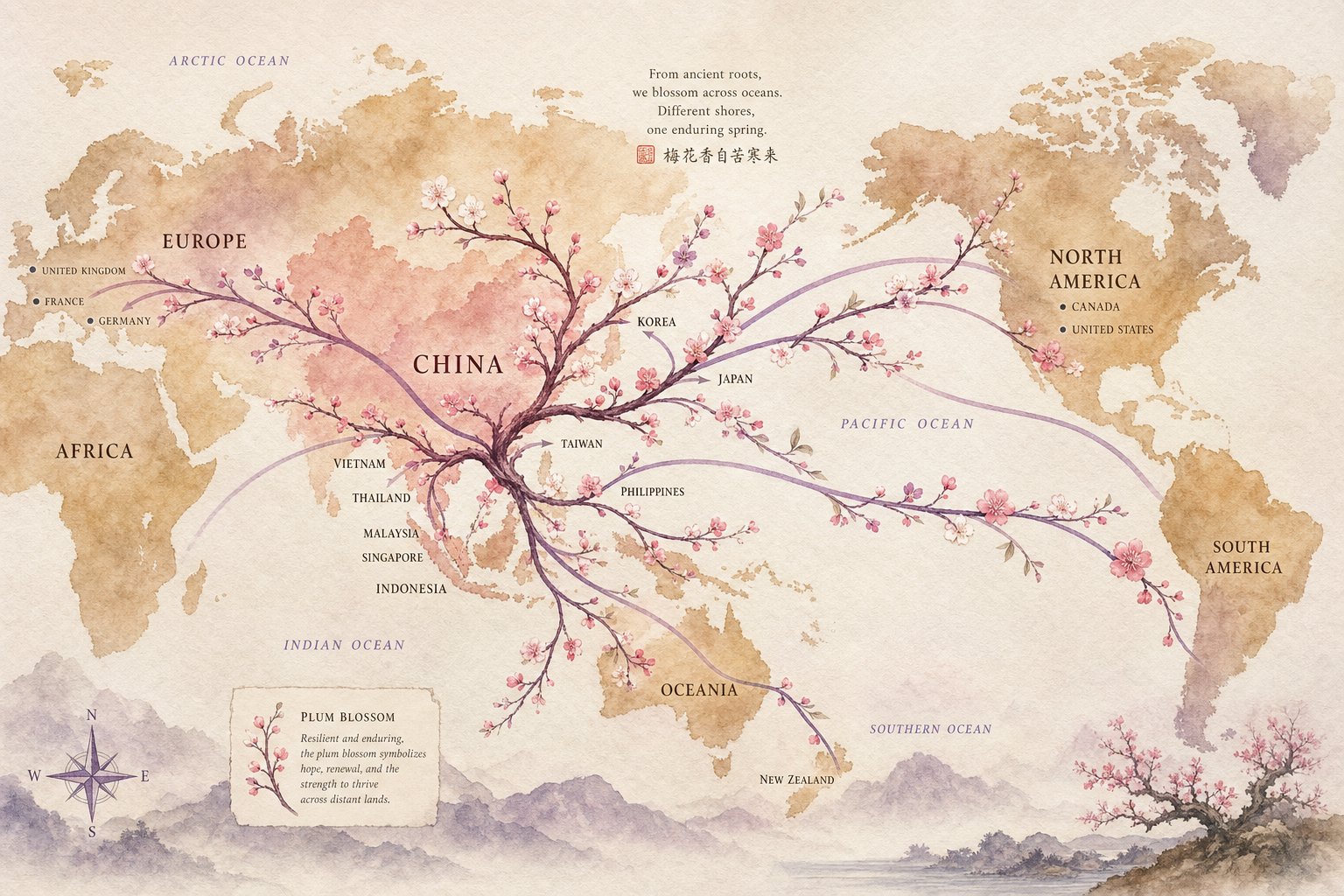
Plum Surnames in the Global Diaspora
Migration doesn't just move people — it transforms names. As Chinese communities settled across Southeast Asia, Korea, Vietnam, and eventually Western nations, the character 李 adapted to local languages, colonial spelling conventions, and immigration paperwork. The result is a global web of surnames that look nothing alike on paper yet trace back to the same plum tree.
Plum Surnames in Southeast Asia
Southeast Asia received the largest waves of Chinese emigration from the 17th through 20th centuries. Most emigrants came from southern Chinese provinces — Fujian, Guangdong, and Hainan — where dialects like Hokkien, Teochew, and Cantonese dominated. Each dialect produced its own spelling when filtered through local writing systems.
The lim surname origin traces directly to Hokkien-speaking communities in Singapore, Malaysia, and the Philippines. In Hokkien dialect, 李 can be pronounced closer to "Lim" in certain regional sub-dialects, though "Lim" more commonly represents the character 林 (forest). This overlap creates occasional confusion, but context and family records typically clarify which character a given Lim family carries. The lim last name origin for families bearing 李 reflects the specific phonetic conventions of southern Fujian emigrants who settled in the Malay Peninsula during the 18th and 19th centuries.
Here's how the plum surname appears across major diaspora regions:
- Singapore and Malaysia — Lee and Lim are both common; Lee predominates among Cantonese and Teochew speakers, while Lim appears among certain Hokkien communities. Government ID systems locked in these spellings during British colonial administration.
- Philippines — Lee and Ly appear most frequently, reflecting Hokkien influence from Fujian traders who settled in Manila as early as the 16th century.
- Thailand — Many ethnic Chinese adopted Thai surnames under nationalization policies in the 1920s-1940s, but the original 李 connection persists in family records and ancestral halls.
- Indonesia — The spelling Lie was common before the Suharto-era forced name changes of the 1960s, which pressured Chinese Indonesians to adopt Indonesian-sounding names. Some families have since reclaimed their original surnames.
- Macau and Portuguese-influenced regions — Lei became the standard romanization, shaped by Portuguese phonetic conventions rather than English ones.
What connects all these communities isn't the spelling — it's the character. A Lee in Singapore, a Lei in Macau, and a Lie in Jakarta can open the same ancestral genealogy book and find 李 written identically. The variations in spelling arose because immigration officials, colonial administrators, and local phonetic systems each captured the sound differently. Once a spelling appeared on legal documents, it became permanent for that family line.
The Western Diaspora and Spelling Choices
In the United States, Lee became the dominant spelling for Chinese Americans bearing 李. This wasn't always a deliberate choice. Early immigration records from the 19th century show that customs officials often wrote down whatever approximation they heard, and Cantonese-speaking immigrants — who made up the vast majority of early Chinese arrivals in America — pronounced 李 in a way that sounded like "Lee" to English ears. The 1904 guide to Chinese surnames by David D. Jones, the official court interpreter in San Francisco, attempted to standardize these spellings but acknowledged the inherent difficulty of mapping Chinese sounds to English letters.
The ly last name tells a different migration story. The ly surname belongs primarily to Vietnamese communities, where 李 entered the language as "Lý" centuries ago through Chinese cultural influence. The Lý dynasty (1009-1225) ruled Vietnam for over two hundred years, and the surname became thoroughly Vietnamese in identity even while retaining its Chinese character origin. Today, the ly family name appears frequently among Vietnamese Americans, particularly those who arrived after 1975. When you encounter someone with the Ly surname in the United States or France, you're almost certainly looking at Vietnamese heritage connected to the same plum character.
Is lee a korean last name? Absolutely — and it's one of the most common ones. The Korean 이 (pronounced "i" or "ee") uses the same Chinese character 李 and ranks as the second most common surname in South Korea, carried by approximately 15% of the population. Lee in Korean contexts represents a surname with deep roots in the Korean peninsula, most famously through the Joseon Dynasty's royal Yi clan (1392-1897). Korean families romanize it as Lee, Yi, Rhee, or Ri depending on personal preference and which romanization era their documents originated from. The connection to China's 李 is historical — Korean aristocratic families adopted Chinese characters for their surnames centuries ago — but Korean Lees consider their lineage distinctly Korean rather than Chinese.
This global spread creates a remarkable situation. A family reunion for all bearers of 李 would need to accommodate speakers of Mandarin, Cantonese, Hokkien, Korean, Vietnamese, Thai, Malay, and English. The attendees would spell their shared surname in at least a dozen different ways. Yet every single one could point to the same seven-stroke character and say: that's us. The plum tree planted its roots in ancient China, but its branches now stretch across every continent.
With so many spellings representing 李 worldwide, a natural question emerges: how does this plum-tree surname compare to the other Chinese surname meaning plum — the far rarer but equally fascinating 梅?
Li Versus Mei: Two Chinese Surnames That Both Mean Plum
Both 李 and 梅 translate to "plum" in English, yet they refer to entirely different species, carry different histories, and belong to different scales of population. If you're researching the chinese last name li, you're looking at a surname shared by nearly 100 million people. If you're researching Mei, you're looking at a far rarer name with its own distinct origin story. Understanding the difference between these two plum surnames clears up one of the most common points of confusion around Chinese naming.
李 The Plum Tree Surname
The li chinese surname points to Prunus salicina, the fruit-bearing Chinese plum tree. This species originated in the Yangtze River basin and has been cultivated across eastern China for several thousand years. It produces sweet, juicy stone fruit — the plums you'd find at a market or eat fresh from the branch. The tree itself is medium-sized and deciduous, thriving in temperate climates across East Asia.
When someone carries the last name Li, their surname encodes this agricultural relationship. The character's structure (木 tree + 子 fruit) literally depicts a tree defined by what it produces. With over 93 million bearers in China alone, the li chinese last name ranks as the second most common surname in the country. Its dominance traces back to Tang Dynasty imperial patronage, which transformed a regional family name into a national identity.
梅 The Plum Blossom Surname
梅 (Méi) refers to an entirely different plant: Prunus mume, often called the flowering plum or Chinese plum blossom. Unlike Prunus salicina, this species is prized for its fragrant winter blossoms rather than its fruit. The small, sour fruit of Prunus mume is occasionally pickled or used in traditional medicine, but the tree's cultural value lies almost entirely in its flowers.
The Mei surname has its own origin story, unrelated to the Li survival legend. According to historical records, the progenitor of the Mei clan was Mei Bo, the Earl of Mei, who lived during the Shang dynasty (1766-1122 BCE). The Mei clan descended from the Zi (子) family and was awarded a kingdom in the southeast of Bo County in what is now Anhui province. Mei Bo repeatedly urged the tyrannical King Zhou of Shang to abandon his cruel ways. The king, enraged by what he saw as insubordination, had Mei Bo beheaded. His descendants adopted the surname 梅 to honor his moral courage — a name drawn from the plum trees that lined the mountain near their ancestral homeland.
In Cantonese-speaking regions, 梅 romanizes as Mui or Moy. In Vietnam, it becomes Mai. In Korean, it's spelled Mae. The surname currently ranks between 126th and 150th among the most common family names in mainland China — significant enough to appear in national surname surveys, but a fraction of 李's enormous population.
Here's how the two plum surnames compare side by side:
| Feature | 李 (Lǐ) | 梅 (Méi) |
|---|---|---|
| Character meaning | Plum tree (fruit-bearing) | Plum blossom (flowering) |
| Botanical species | Prunus salicina | Prunus mume |
| Approximate bearers (China) | 93+ million | ~1-2 million |
| Surname rank (mainland China) | 2nd | ~130th-150th |
| Common romanizations | Li, Lee, Lim, Ly, Lei | Mei, Mui, Moy, Mai, Mae |
| Primary regions | All of China, Korea, Vietnam, Southeast Asia | Anhui, Zhejiang, Jiangxi, Guangdong |
| Origin period | Shang Dynasty (~1100 BCE) | Shang Dynasty (~1100 BCE) |
| Origin story | Family survived by eating wild plums | Descendants honored martyred ancestor Mei Bo |
| Cultural emphasis | Sustenance, imperial power, survival | Moral courage, artistic refinement, winter beauty |
Notice something interesting: both surnames originated during the same dynasty, both involve acts of defiance against the same tyrannical king (Zhou of Shang), and both connect to plum trees — yet through completely different species and completely different stories. The chinese surname li emerged from gratitude toward a fruit that prevented starvation. The Mei surname emerged from grief and honor for a man who chose death over silence.
Together, these two surnames capture the full spectrum of what "plum" means in Chinese culture: practical sustenance and aesthetic beauty, survival and sacrifice, the fruit you eat and the flower you admire. They remind us that a single English word can contain multitudes when translated back into its original language — and that both surnames belong to a broader tradition of Chinese family names drawn from the natural world.
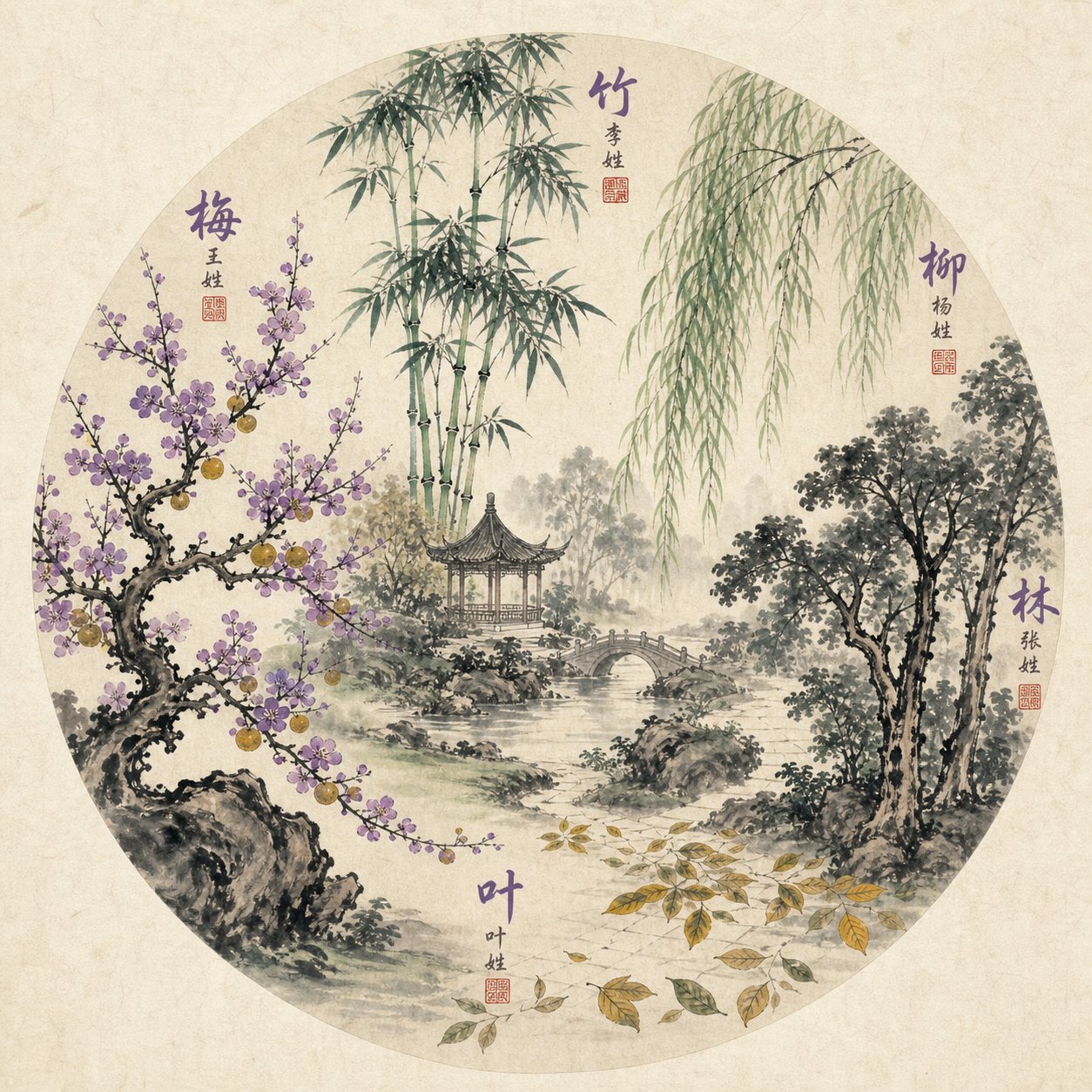
Plum Among Other Nature-Based Chinese Surnames
The family name Li doesn't exist in isolation. It belongs to a rich ecosystem of Chinese surnames rooted in the natural world — trees, flowers, landscapes, and seasons. When you step back and look at the full pattern, you'll notice that plum-meaning surnames are part of an ancient naming philosophy that treated humans and nature as inseparable.
Nature-Based Surnames in Chinese Culture
Chinese surnames drawn from plants and landscapes form one of the oldest naming categories in the tradition. According to LingoAce's research on Chinese family names, many of the 50 most common surnames carry direct references to trees, water, land, and growth. This wasn't coincidental. Ancient Chinese clans often adopted the name of a dominant natural feature near their settlement — a forest, a river, a field — or a plant that sustained their community.
Here are some of the most common nature-based Chinese surnames still in wide use today:
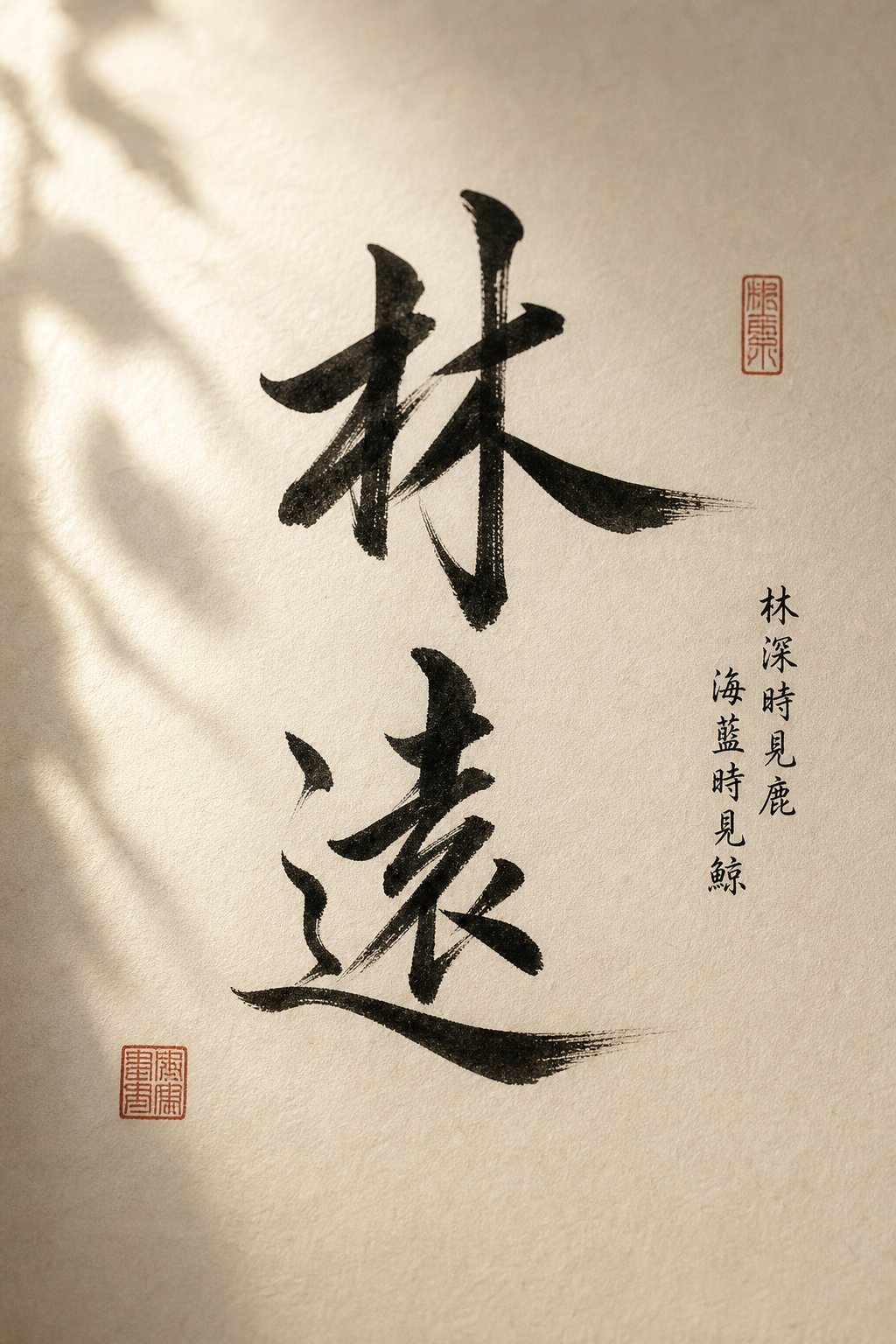
- 林 (Lin) — Forest: The lin surname ranks 19th in China, signifying a family deeply rooted with abundant growth and prosperity. The lin last name origin traces to the Shang dynasty, and the character itself doubles the tree radical (木) to depict multiple trees standing together.
- 杨 (Yang) — Willow: Embodying flexibility and adaptability, this surname connects to the poplar or willow tree and ranks among the top ten in China.
- 叶 (Ye) — Leaf: Representing growth, renewal, and the cyclical nature of life, this surname captures the idea of regeneration across generations.
- 花 (Hua) — Flower: Less common but culturally vivid, this surname evokes beauty and the fleeting nature of life.
- 柳 (Liu) — Willow: Distinct from 杨, this character refers specifically to the weeping willow, a symbol of grace and parting in Chinese poetry.
- 田 (Tian) — Field: Connecting a family to agricultural land and the earth itself.
The lin last name alone accounts for tens of millions of bearers worldwide. Like the li family name, it appears across multiple romanizations — Lam in Cantonese, Lim in Hokkien, Hayashi in Japanese — following the same dialect-driven spelling patterns that produced Lee, Ly, and Lei from 李.
What Plum Surnames Reveal About Naming Philosophy
This pattern of nature-based naming reflects something fundamental about Chinese cosmology. In traditional Chinese thought, humans don't stand apart from nature — they exist within it. The concept of tianren heyi (天人合一), or the unity of heaven and humanity, positioned people as participants in the natural order rather than masters of it. Choosing a surname from the plant world wasn't primitive or random. It was a philosophical statement: this family belongs to the landscape, and the landscape belongs to this family.
The family name Li fits perfectly within this worldview. A plum tree provides fruit, shade, and beauty across seasons. It endures winter, feeds the hungry, and blooms without fanfare. Naming a family after such a tree meant encoding those qualities into every generation that followed — a quiet aspiration written into identity itself.
For diaspora families separated from these traditions by distance and time, understanding the plum's place within this broader naming philosophy offers a meaningful reconnection. Your surname isn't just a bureaucratic label inherited through paperwork. It's a thread connecting you to an ancient way of seeing the world — one where a family's name could hold the resilience of a winter blossom, the generosity of a fruit-bearing branch, and the rootedness of a tree that has stood for three thousand years.
Frequently Asked Questions About Chinese Surnames Meaning Plum
1. What Chinese surname means plum?
Two Chinese surnames translate to plum in English. The first is 李 (Li), which refers to the fruit-bearing plum tree (Prunus salicina) and is the second most common surname in China with over 93 million bearers. The second is 梅 (Mei), which refers to the flowering plum blossom (Prunus mume) and ranks around 130th-150th in China. Despite sharing an English translation, they represent different plants, different lineages, and different origin stories rooted in the Shang dynasty era.
2. Why is Lee such a common Asian last name?
Lee is the Cantonese and Hokkien romanization of 李, a surname that exploded in popularity during the Tang Dynasty (618-907 AD). The Li imperial clan founded the dynasty and bestowed their surname on generals, officials, and allies as a mark of honor, causing mass adoption across China. The same character is also used in Korea (이, romanized as Lee or Yi), where it ranks as the second most common surname. Combined Chinese and Korean populations make Lee one of the most frequently encountered Asian surnames globally.
3. Is Lee a Chinese or Korean last name?
Lee can be both Chinese and Korean, as well as English in origin. The Chinese Lee derives from the character 李 (plum tree), typically through Cantonese pronunciation. The Korean Lee comes from 이, which uses the same Chinese character but developed independently within Korean culture, most notably through the Joseon Dynasty royal family. The English Lee comes from Old English 'leah' meaning meadow. Context such as a person's heritage determines which origin applies, since all three linguistic paths converge on the same five-letter spelling.
4. What is the origin of the Li surname?
The Li surname originated during the late Shang dynasty (around 1100 BCE). According to historical records, a minister named Li Zheng was executed for opposing the tyrannical King Zhou. His wife and son fled and survived by eating wild plums along their escape route. In gratitude, the son changed the family name from 理 (meaning reason or justice) to 李 (meaning plum), preserving the same pronunciation while honoring the tree that saved their lives. The surname later gained massive prominence when the Li clan founded the Tang Dynasty.
5. What does the Chinese character 李 literally mean?
The character 李 is composed of two radicals stacked vertically: 木 (tree or wood) on top and 子 (child, seed, or offspring) on the bottom. Together they depict a tree defined by what it produces — its fruit. The ancient dictionary Shuowen Jiezi (circa 100 AD) defines it simply as 'Li is a fruit.' It specifically refers to Prunus salicina, the Chinese plum tree cultivated for thousands of years across East Asia for its sweet, edible stone fruit.