Living Under Two Names and What It Means for Identity
Imagine this: at 9 a.m., you answer to "David" in a conference call with your London team. By evening, your mother calls and you're Wei again. Two names, two vocal registers, two slightly different versions of yourself. You don't think about it most days. But every now and then, someone from one world stumbles into the other, and for a split second, you're not sure which version of you is supposed to show up.
This is the daily reality for millions of people who maintain both Chinese and English names. It's not a quirky cultural footnote. It's a lived negotiation of selfhood that plays out in classrooms, offices, group chats, and immigration forms around the world.
What Dual Identity Naming Really Means
Dual identity naming is the practice of carrying both a Chinese name and a Western name across personal, professional, and social contexts. It goes far beyond having a nickname. Each name anchors a different set of relationships, expectations, and even personality traits. One student at Boston University described his two names as giving him "a different vibe as a character," something he actively enjoys switching between. Another student, Botai Zhou, explained that he eventually dropped his English name "Jerry" because it was chosen when he was seven years old based on a cartoon, and it no longer meant anything to him.
These aren't isolated anecdotes. They reflect a pattern shared by Chinese international students, diaspora communities, and professionals working across borders. Why do Chinese people have English names? The reasons range from avoiding daily mispronunciations to crafting an entirely new professional persona. But reducing the practice to a single motivation misses the point entirely.
A name is not a label. It is, as personality psychologist Gordon Allport put it, "the most important anchorage to our self-identity throughout life." When you carry two such anchors, you don't just have two names. You navigate two selves.
Who This Experience Belongs To
This experience belongs to the first-generation student who picks "Stan" from a dictionary page the week before flying to a new country. It belongs to the second-generation kid in Vancouver whose parents gave her both names at birth. It belongs to the Singaporean writer whose Chinese name gets mangled at every networking event, and who wonders whether an English name would make life smoother or feel like a small betrayal.
It also belongs to anyone trying to understand why a colleague goes by one name on LinkedIn and another at family dinners. If you've ever wondered about the relationship between chinese english names and the people who carry them, this piece is for you.
What follows is not a cultural curiosity piece. It's an exploration of how language, identity, and power intersect every time someone answers to a name that wasn't the one their parents whispered over their crib. The practice has deep historical roots, complex psychological dimensions, and real consequences in professional and personal life. Understanding it requires looking at naming structure, colonial history, generational shifts, and the digital platforms that now demand we pick one name and stick with it.
That story starts with how Chinese names actually work, and why their structure already contains the seeds of multiplicity.
How Chinese Names Work and Why Structure Matters
When you hear a Chinese name like Yao Ming, you're hearing something structurally opposite to English naming conventions. The family name comes first. The given name follows. There's no middle name sandwiched between them. And the entire name is typically just two or three characters long, each one carrying layers of meaning that English names rarely attempt.
Understanding how do chinese names work isn't just linguistic trivia. It reveals why carrying a second, Western name feels less like a break from tradition and more like an extension of something Chinese culture has practiced for thousands of years.
The Structure of Chinese Names Explained
A standard Chinese name is compact. The surname is almost always a single character, and the given name is one or two characters. That's it. Two or three characters total, packing in family lineage, parental hopes, tonal harmony, and sometimes even elemental balance from traditional cosmology.
But the system goes deeper than the name on your birth certificate. Traditional Chinese naming customs include several layers of identity, each used in different contexts and life stages:
- Xing (姓) - Surname: Placed first, the family name anchors a person in their ancestral lineage. There are only about 400 surnames in common use across China, with Li, Wang, and Zhang alone shared by more than 270 million people. The surname is inherited, unchangeable, and signals collective heritage before individual identity.
- Ming (名) - Given Name: Bestowed at birth, the given name is chosen with extraordinary care. Parents consider sound, visual beauty in calligraphy, literary meaning, and sometimes Five Elements (Wu Xing) balance based on the child's birth chart. In traditional families, one character of the given name might be a "generation name" shared by all siblings and cousins of the same generation.
- Zi (字) - Courtesy Name: Historically given at the coming-of-age ceremony (age 20 for men, 15 for women), the courtesy name was used by peers and acquaintances as a sign of respect. It typically expanded on or complemented the meaning of the given name. The given name itself was reserved for use by elders and for self-reference as a gesture of modesty.
- Hao (号) - Literary or Pseudonym Name: Self-chosen rather than bestowed by elders, the hao expressed personal aspirations, artistic identity, or philosophical leanings. Unlike the courtesy name, it could be changed throughout life, and a person might accumulate several.
Consider what this means in practice. A single person in classical China might be known by their ming to family, their zi to friends and colleagues, and their hao in literary or artistic circles. The calligrapher Wang Xizhi, for example, referred to himself by his given name Xizhi in personal letters, while others addressed him using his courtesy name Yishao as a mark of respect. Different names for different relationships and contexts was the norm, not the exception.
Do Chinese People Have Middle Names?
This is one of the most common questions from people unfamiliar with the system, and the short answer is no. Traditional Chinese names do not have middle names in the Western sense. When a given name has two characters, like Xiaoming in Wang Xiaoming, those two characters function together as a single unit. They aren't a first name plus a middle name. They're one given name that happens to be two syllables.
The confusion often arises when Chinese names are rendered on Western forms that demand a "first name" and "middle name" field. Some people split their two-character given name across both fields. Others leave the middle name blank. Neither approach captures how the name actually works in Chinese. It's a structural mismatch between two fundamentally different naming architectures.
Multiple Names as Cultural Tradition
Here's the insight that reframes the entire conversation about dual identity naming: Chinese culture never operated on the assumption that one person equals one name. The zi and hao traditions meant that educated people routinely carried multiple names, each activated by a specific social context. Emperors took this even further, accumulating reign titles, posthumous titles, and temple titles that could only be used under precise circumstances.
This matters because outsiders often frame the adoption of a Western name as cultural loss, as if a person named Wei who also goes by David has somehow surrendered part of their heritage. But viewed through the lens of Chinese naming customs, maintaining context-dependent names is deeply traditional. The practice of switching between a name used at home and a name used in public life has roots stretching back millennia.
The difference, of course, is that a courtesy name and a literary name both existed within the same linguistic and cultural system. A Western name introduces a second language, a second set of cultural associations, and often a second audience entirely. The structural precedent is there, but the stakes have shifted. What was once a movement between formality levels within one culture becomes a movement between cultures themselves.
That shift didn't happen overnight. It has a specific history, shaped by colonial administration, global migration, and the uneven power dynamics of which languages get to be "international."

The Historical Evolution of Adopting Western Names
The pairing of a chinese name and english name didn't emerge from a single moment or a single motivation. It grew out of colonial bureaucracy, economic ambition, and eventually personal creativity. Tracing that arc reveals something important: the practice means very different things depending on when and where it started for a given community.
Colonial Roots in Hong Kong
In colonial Hong Kong, English names first appeared as a practical necessity imposed from above. British administrators needed to process documents, manage civil records, and conduct governance in English. Chinese names, with their tonal complexity and unfamiliar characters, posed a friction that the colonial system resolved by encouraging, and sometimes requiring, English alternatives.
Over time, this administrative convenience became something more. As research on Hong Kong naming practices shows, English names evolved into symbolic capital. Having one signaled access to English-language education, professional networks, and upward mobility. Early adopters were typically elites who collaborated with the colonial government or held international business connections. As one Hong Kong student put it, the English name was originally a way to "show off" and demonstrate "higher social status than common people."
Scholars like Chan (2002) documented how English became linguistic habitus in Hong Kong society, woven so deeply into daily life that it stopped feeling foreign. Cheang (2008) explored how the choice of a foreign name functioned as a deliberate strategy for identity management, not passive assimilation. By the time of the 1997 handover, English naming had become so embedded that post-handover generations continued the practice without any colonial pressure to do so. Students raised entirely under Chinese sovereignty still found it "weird" if a Hong Kongese person lacked an English name.
Globalization and the Modern Shift
Mainland China's engagement with Western names followed a different timeline. The practice gained traction after the reform and opening-up policies of the late 1970s, accelerating through the 1990s and 2000s as international education, multinational corporations, and eventually social media created new reasons to carry china names in english alongside Chinese ones.
The motivations shifted dramatically. Where colonial Hong Kong's naming practice grew from institutional pressure, mainland adoption was driven by personal agency. Students chose English names when entering English classes, often in primary or secondary school, with teachers facilitating rather than mandating the process. Professionals adopted them when joining foreign-invested companies or building international client relationships. The name became, as researcher Wang (2009) framed it, "an investment in imagined communities" rather than a concession to colonial authority.
A common interpretation frames this trend as admiration for the West, a desire to emulate Western success. But that reading ignores something crucial: when Chinese people take English names, they don't abandon their birth names. The new name becomes an additional layer, much like the self-chosen hao of classical tradition. The concept of western in chinese culture isn't simply about imitation. It's about localization, taking a foreign element and reshaping it according to domestic logic.
This explains why naming choices that seem odd to native English speakers, names like "Strong," "Cupid," or "Seven," make perfect sense within Chinese naming culture. Chinese names prioritize lexical meaning. Each character carries specific connotations. When that principle meets English vocabulary without deep familiarity with Western naming conventions, creativity follows naturally. As journalist Wu Haiyun observed, non-native English speakers typically become familiar with the language before understanding Western naming culture, which is why some consider it perfectly acceptable to choose names based on meaning rather than convention.
The real story isn't one of cultural surrender. It's one of cultural negotiation. Hong Kong transformed a colonial imposition into local identity. Mainland China adopted a practice on its own terms, following its own timeline. In both cases, people exercised far more agency than the simplistic "wanting to be Western" narrative allows. The question that follows is more personal: once someone decides to choose a Western name, what actually drives the specific choice they make?
Why People Choose Their Western Names
Picture yourself at seventeen, about to board a plane to a country where nobody can pronounce your name. You have a week to decide what strangers will call you for the next four years. Do you pick something that echoes the sound of your Chinese name? Something that captures a quality you want to project? Or do you flip open a dictionary and point?
The answer varies wildly from person to person, and that variation is exactly what makes the practice so interesting. Choosing chinese names for english names is never a single story. It's a spectrum that runs from pure convenience all the way to deep personal reinvention.
Practical Motivations and Professional Identity
For many people, the decision starts with a simple calculation: how much energy do I want to spend correcting pronunciation every single day? Yasuko Kanno, an associate professor at Boston University, described being called "Jessica," "Yasmin," "Jasco," and even "Costco" by people attempting her Japanese first name. For Chinese names with tonal distinctions invisible to English speakers, the friction multiplies. One student compared having an English name to having a passport: "if you have one, it's going to make your life a lot easier."
Professional contexts amplify this pressure. In multinational workplaces, a name that colleagues can say confidently becomes a tool for smoother collaboration. It removes the awkward pause before someone attempts your name, the apologetic "did I say that right?" that subtly marks you as different before you've even spoken. Some professionals report that an English name on a resume or email signature reduces unconscious bias in hiring and networking, though this remains a contested and uncomfortable reality.
The motivations, however, don't stop at convenience. They layer and deepen depending on the individual. Here's how the spectrum typically unfolds, from most practical to most identity-driven:
- Pronunciation ease: Reducing daily friction when non-Chinese speakers struggle with tones, unfamiliar syllables, or character-based names that don't map neatly onto English phonetics.
- Professional efficiency: Creating a name that works seamlessly in email signatures, conference calls, and client-facing roles without requiring explanation or repetition.
- Social belonging: Fitting into peer groups, classrooms, or social circles where an English name signals participation rather than outsider status.
- Phonetic mirroring: Selecting chinese names that sound like english names, such as choosing "David" for Dawei or "Lily" for Lili, preserving a sonic thread between both identities.
- Meaning translation: Choosing a name whose English meaning echoes the Chinese name's significance, like selecting "Grace" for a name containing the character for elegance.
- Persona crafting: Picking a name that projects a desired quality, the way Yuanyuan Wu chose "Amanda" because it connotes bravery and confidence, qualities she wanted to embody in her new environment.
- Creative self-expression: Treating the name as an artistic choice, selecting something unusual, literary, or personally meaningful regardless of Western naming conventions.
Most people don't land neatly on a single point. Their motivations blend and shift over time. Someone who initially chose a name for pronunciation ease might later find that it has become a genuine part of their identity, carrying its own emotional weight.
Personal Expression and Creative Choice
Here's where the practice gets genuinely fascinating. For some people, how to choose an english name chinese becomes an act of self-authorship, a rare opportunity to name yourself rather than be named by someone else.
Think about it. Most people never get to choose their own name. Your parents decided for you before you could speak. But selecting a Western name hands that power directly to the individual. You get to decide what you sound like to the world, what associations your name carries, what first impression it creates. One BU student, Min Sung Kim, chose "Jeff" after hearing the phrase "My name is Jeff" in a movie and deciding it matched his sociable, energetic personality. Another student picked "Stanley" by pointing at a random dictionary page, then grew attached to it over years of use.
This creative freedom also explains why some choices puzzle native English speakers. Names like "Seven," "Strong," or "Cupid" seem unusual by Western standards, but they follow the logic of Chinese naming culture, where every character carries specific lexical meaning. As Wu Haiyun noted, Chinese people are rarely enthused by the idea of sharing names with someone else. When that preference for uniqueness meets English vocabulary, you get names that prioritize meaning and distinctiveness over convention.
The irony, Wu observed, is that proficient English speakers with deep understanding of Western culture often choose the simplest, most common names. They're demonstrating sensitivity to a different set of cultural prompts. Meanwhile, those less familiar with Western naming norms exercise the full creative freedom that Chinese naming tradition encourages, treating English words as raw material for self-expression rather than drawing from a fixed pool of "acceptable" options.
Reducing any of these choices to a single explanation, whether "they just want to be Western" or "they can't be bothered to teach pronunciation," flattens a deeply personal process. Each name carries a story about who someone was when they chose it, what they hoped to become, and how they wanted to move through the world. The name is not a concession. It's a declaration.
What happens after that declaration, though, is where things get psychologically complex. Carrying two names doesn't just mean switching labels. It can mean switching entire modes of being, sometimes smoothly, sometimes with a jolt of dissonance that catches you off guard.

The Psychological Weight of Answering to Two Names
You walk into a room and someone calls your English name. You respond instantly, smile, shake hands. Later that evening, your grandmother calls and uses your Chinese name. Your posture shifts. Your voice drops into a different register. The humor you reach for changes. You might not even notice it happening, but the people around you do.
This isn't imagination or performance. Research in psychology and linguistics suggests that switching between languages, and the names embedded in them, can genuinely activate different cognitive and emotional frameworks. For people carrying both a chinese name and english name, this activation happens dozens of times a day, often without conscious thought.
Code-Switching and the Two Selves
Psychologists use the term "code-switching" to describe the shift between languages or cultural modes in different social contexts. For chinese with english names, code-switching isn't just linguistic. It's identity-level. The name you answer to cues an entire set of behaviors, expectations, and self-perceptions.
Michelle Tong, a PhD candidate in psychology at Cornell University, described her Chinese name Tianyi as something that "partitions the world. It's almost a cue into which identity to activate." When people call her Michelle, she operates in one relational mode. When she's Tianyi, she's in another, one connected to family, to Mandarin, to a different set of cultural assumptions about how to behave.
This experience has scientific grounding. In 1964, sociolinguist Susan Ervin at UC Berkeley showed French-English bilinguals a series of images and asked them to tell stories, once in each language. The narratives differed dramatically in content and emotional tone depending on which language was used. Later research by Michèle Koven at the University of Illinois found that bilingual participants emphasized different personality traits depending on the language they were speaking. Women in her study came across as more assertive in French and more deferential in Portuguese, telling the same story.
The implication for dual identity bicultural naming psychology is significant. If language itself shapes how we think and present ourselves, then a name, as the most personal unit of language, acts as a kind of switch. Hearing your English name primes one cultural framework. Hearing your Chinese name primes another.
A name doesn't just identify you. It tells your brain which version of yourself to load, which cultural software to run, which relational rules apply in this moment.
This isn't about being fake in one context and real in another. Both selves are genuine. The question is how comfortably they coexist.
That's where the concept of Bicultural Identity Integration comes in. Developed by psychologist Veronica Benet-Martinez and studied using Chinese American participants, BII measures the degree to which a bicultural person perceives their two cultural identities as compatible versus oppositional. Her research found that BII isn't a single spectrum. It breaks into two independent dimensions: cultural distance, how separate the two identities feel, and cultural conflict, how much tension exists between them.
Some people experience high overlap and low conflict. Their two names feel like two comfortable outfits for different weather. Others experience high distance and high conflict. Their names feel like two rooms they can never occupy at the same time. Most people fall somewhere in between, and where they land shifts depending on life circumstances, social environment, and how much acceptance they encounter in each world.
When Names Create Identity Dissonance
Dissonance shows up in small, specific moments. You're at a party where both worlds collide, your Chinese family and your Western colleagues in the same room, and you realize you don't know which name to introduce yourself with. Or someone from your English-speaking life discovers your Chinese name and reacts with surprise: "Whoa! I didn't know you were so Chinese!" as Michelle Tong's friends once told her. Suddenly, a name you carry quietly becomes a marker of difference you didn't invite into the conversation.
Jessica Wei, a writer reflecting on her Chinese name Ning Yan, described it as "the name of a person I did not really grow up to be." She can recognize the characters on paper but can't write them from memory. When she hears the name pronounced correctly, it feels "as familiar as the name of a childhood playmate or an imaginary friend." Present but distant. Hers but not quite hers anymore.
This kind of dissonance isn't a failure of integration. It's a natural consequence of living across two linguistic worlds that don't always map onto each other. Some people resolve it by leaning fully into one name. Others find peace in the duality itself, treating each name as a genuine facet of a complex whole. And some, particularly in younger generations, are resolving it by refusing the split entirely, insisting that the world learn their one true name.
But that resolution doesn't happen in a vacuum. It's shaped by when you were born, who gave you your names, and how much choice you had in the matter. The generational dimension of this experience reveals just how much the psychology of dual naming depends on whether the names were chosen or imposed.
How Generations Differ in Their Approach to Dual Names
Whether a name was chosen or imposed changes everything about how it sits in your life. A name you picked at seventeen feels different from one a kindergarten teacher assigned because she couldn't pronounce your real one. And a name your parents gave you at birth, planning for a future they could only imagine, carries yet another emotional weight entirely. Generational differences in chinese naming practices reveal that the relationship between a person and their dual names is shaped as much by historical context as by personal preference.
First-Generation Experiences and Imposed Names
For many older immigrants, the Western name wasn't a choice. It was a condition of entry, sometimes literally, sometimes socially. In the 1980s and earlier, teachers in American and Canadian schools routinely assigned English names to children whose birth names they found difficult. Parents, eager to smooth their children's path, often went along without protest.
Mary Chao, a journalist whose birth name is Ching Hwa (meaning "celebrate China"), described the era bluntly: for Asian immigrants, adopting an anglicized name was a chance to "assimilate or vanish." The choice wasn't really a choice. It was survival math. Yu-Ying became Diana. Tai-Jen became Jane. Ruey-Der became Ray. These transformations happened quickly, quietly, and with little room for the person inside the name to object.
JiaYing Grygiel tells a similar story. Her immigrant parents chose "Caroline" for their new life in a small American town in the 1980s. As she wrote, "As a preschooler, I didn't know the words for what we did then, but what we were going for was assimilation, not ethnic identity." The name wasn't about self-expression. It was about reducing friction in a country that had little patience for difference.
This first-generation experience was defined by external pressure and limited agency. The american chinese name was often selected hastily, sometimes by the individual, sometimes by a teacher or employer, and rarely with the kind of deliberation that Chinese naming culture traditionally demands. Many people in this generation carry English names they never fully identified with but never thought to question, because questioning wasn't the point. Fitting in was.
Gen Z Reclamation and New Attitudes
Fast forward to younger generations, and the emotional landscape shifts dramatically. Millennials and Gen Z who grew up in Western countries, or who came of age during the era of global social media, approach their asian english names with far more intentionality and far less deference.
Several forces drive this shift. The cultural climate around diversity has changed. Pamela Redmond, CEO of baby names website Nameberry, observed that "there is a really strong trend for people keeping their real names, not anglicizing their names or anglicizing the spellings. I think people are prouder of their names and less willing to give up that piece of their identity to fit in with some English-centric standard."
This pride manifests in concrete ways. Some younger professionals are dropping their English names entirely and insisting on their Chinese names in workplaces and on platforms like LinkedIn. Others who were given English names at birth are choosing to go by their Chinese names for the first time. JiaYing Grygiel made this switch after 23 years as Caroline, inspired partly by the election of a president named Barack Obama. Her logic was simple: "If people could say 'Barack,' they could handle 'JiaYing.'"
Second-generation diaspora children occupy a unique position in this landscape. Pew Research Center data shows that roughly six-in-ten second-generation Asian Americans consider themselves a "typical American," about double the share of immigrants who say the same. Yet most also maintain a strong sense of identity with their ancestral roots. They inherit both names from parents who planned ahead, and they navigate the two with a fluency that first-generation immigrants often lacked. For them, the dual name isn't a survival strategy. It's a birthright they can choose to embrace, modify, or reject on their own terms.
The generational contrast becomes clearer when you map it across key dimensions:
| Dimension | Older Generations (Boomers/Gen X Immigrants) | Millennials | Gen Z |
|---|---|---|---|
| Agency in name choice | Low. Names often assigned by teachers, employers, or chosen hastily under pressure. | Moderate. More personal choice, but still influenced by professional expectations. | High. Names chosen deliberately or rejected entirely as a statement of identity. |
| Primary context of use | English name used in nearly all public contexts. Chinese name reserved for family. | English name for work, Chinese name for personal life. Some blending. | Increasingly using Chinese name across all contexts, or choosing strategically per platform. |
| Emotional relationship to English name | Functional. Often feels disconnected from true self but accepted as necessary. | Mixed. Some attachment, some ambivalence. May feel it's "part of me now." | Optional. Viewed as a tool rather than an identity requirement. |
| Emotional relationship to Chinese name | Private, intimate. Sometimes associated with vulnerability or "otherness." | Growing pride. Seen as culturally meaningful but sometimes hard to use publicly. | Source of pride and distinction. Viewed as an asset rather than an obstacle. |
| Attitude toward switching | Automatic and unquestioned. "That's just how it works here." | Conscious but accepted. Aware of the duality, sometimes uncomfortable with it. | Increasingly resistant to the expectation that they should switch at all. |
The cost of reclamation isn't zero, though. JiaYing Grygiel noted that a 2016 study by researchers at the University of Toronto and Stanford University showed companies are more than twice as likely to call minority applicants with "whitened" resumes for interviews, even with identical qualifications. Choosing to use a Chinese name professionally still carries measurable economic risk. The trend toward reclamation is real, but it exists in tension with systems that continue to reward conformity.
What's striking is that this generational shift isn't happening uniformly. A Gen Z student in Shanghai choosing an English name for international business school has a fundamentally different relationship to the practice than a Gen Z Chinese American in Los Angeles dropping the English name her parents gave her at birth. Same generation, same era, but the direction of movement is opposite. One is adding a name. The other is subtracting one. Both are exercising agency their grandparents never had.
That divergence points to something the generational lens alone can't capture: geography matters as much as age. The experience of dual naming in mainland China, Hong Kong, Taiwan, and Western diaspora communities differs not just in degree but in kind, shaped by distinct histories, power dynamics, and cultural expectations that vary from one community to the next.
Regional Perspectives from Mainland to Diaspora
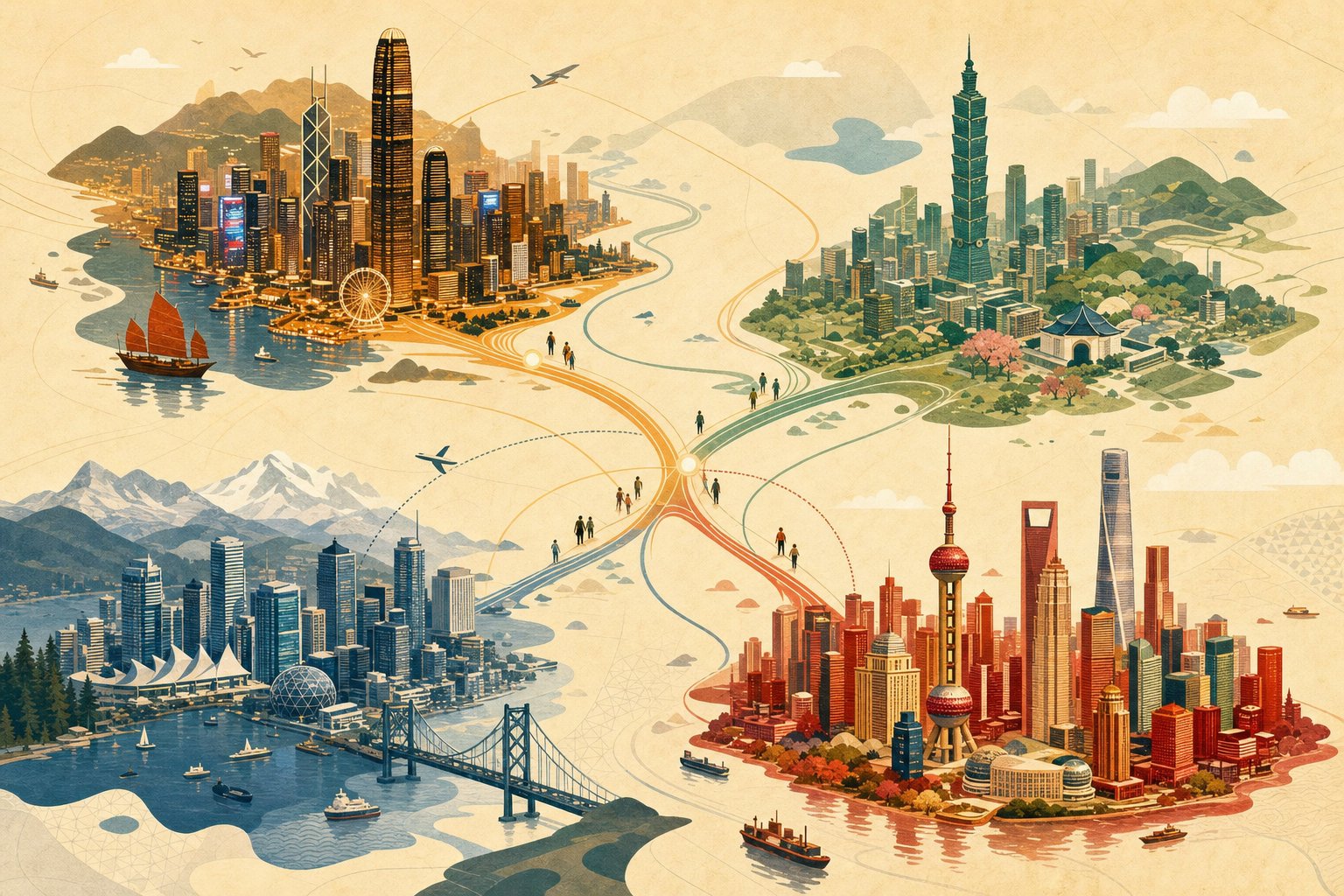
A twenty-something professional in Shenzhen choosing "Alex" for her LinkedIn profile is doing something that looks identical to a twenty-something in Toronto dropping "Alex" in favor of her birth name. Same practice, opposite directions, entirely different motivations. The geography of where you live, where your family came from, and what historical forces shaped your community's relationship to English determines not just whether you carry two names, but what those names mean to you.
Lumping all Chinese-speaking communities into a single narrative about dual naming misses the point. Hong Kong english names vs mainland china naming practices differ as sharply as the political histories that produced them. Taiwan adds a third variation. And diaspora communities in Western countries face pressures that none of the above fully share.
Mainland China vs Hong Kong vs Taiwan
Start with Hong Kong, where the practice runs deepest. As linguistic professor David C.S. Li from the Hong Kong Institute of Education explained to DW, "One consequence of British colonization in Hong Kong is the need for an English name for all kinds of education-and work-related purposes." English teachers, including Cantonese-speaking ones, expected students to adopt or accept an assigned English name to avoid switching to Chinese during class. Stephen Matthews, professor at the University of Hong Kong, noted that some students encountered teachers who couldn't pronounce a Chinese name, let alone remember it. Catholic schools assigned saint's names like Ignatius and Theophilus. The practice became so normalized that even after the 1997 handover, many Hong Kongese consider it strange not to have an English name.
The colonial factor also explains a quirk unique to Hong Kong: people change their English names casually and repeatedly. Because these names were never registered on identity documents, they carry less legal weight. Professor Li described the phenomenon plainly: "As teenage students grow up, many would feel unhappy about the English names they adopted or were assigned to them earlier, so changing their English names over time is quite common, much like fashion." In Hong Kong, your English name is closer to a living accessory than a fixed identity marker.
Taiwan tells a different story. No British colonial history here, but as Matthews observed, "there is a history of cultural colonization by the US. Students there learn American English and those I have encountered generally adopt English names." According to the Cultural Atlas, many Taiwanese have an English name they use on a regular basis, chosen by a family member, school teacher, or themselves during adolescence. Some base it on phonetic similarity to their Chinese name, like Ming-Xuan becoming "Michelle." Others treat it as a practical tool for international contexts. The practice is common enough that it's considered the most convenient name to use in educational and commercial settings, sitting comfortably between overly formal and too personal.
Mainland China arrived at the practice latest and with the least external pressure. Professor Li noted that "the absence of the British connection helps explain why their respective social context does not encourage the adoption of English names. One crucial consideration is the perceived threat to their respective Chinese identity." Yet the phenomenon is growing rapidly, especially among those educated overseas or working in multinational companies. The motivation is primarily pragmatic: many believe it's easier for non-Chinese speakers to remember and pronounce Western names. But the practice remains far less universal than in Hong Kong, and many mainland Chinese professionals operate internationally using only their Chinese names rendered in pinyin.
Here's a comparative view of how these communities differ:
| Dimension | Hong Kong | Taiwan | Mainland China | Western Diaspora |
|---|---|---|---|---|
| Historical driver | British colonial administration and English-medium education | American cultural influence and international trade orientation | Globalization, international education, and multinational employment | Immigration pressure, school systems, and workplace assimilation |
| Typical adoption context | Assigned in school, often in early childhood | Chosen in adolescence, often during English classes | Selected for English classes, study abroad, or professional use | Given at birth by parents or assigned by teachers upon arrival |
| Degree of social expectation | Very high. Considered unusual not to have one. | High in professional and educational settings. Less pressure in daily life. | Moderate. Common in international-facing roles but not expected universally. | Variable. Depends on local community and generation. |
| Relationship to identity | Deeply integrated. Often feels as natural as Chinese name. | Practical and social. A convenient buffer between formal and intimate. | Functional and aspirational. Often tied to professional persona. | Complex. Can feel imposed, chosen, or reclaimed depending on generation. |
| Flexibility of name | High. Changed frequently without social friction. | Moderate. Usually stable once chosen. | Moderate to high. May change with career shifts or personal growth. | Low for legal names. Higher for informal use. |
Diaspora Pressures and Power Dynamics
Diaspora communities face something none of the above groups contend with in quite the same way: the expectation isn't just social convenience. It's survival infrastructure. When your name determines whether a resume gets a callback, whether a substitute teacher embarrasses you in front of thirty classmates, or whether a barista writes something unrecognizable on your cup every morning, the stakes of naming shift from cultural preference to daily friction management.
But here's the question that rarely gets asked: why does the expectation to adopt a second name fall so disproportionately on Chinese people? When an American executive relocates to Shanghai, nobody expects him to go by a Chinese name in meetings. He might adopt one as a gesture of goodwill or cultural curiosity, but his career doesn't depend on it. His colleagues will learn "Michael" even if it sits awkwardly in Mandarin phonology. The accommodation flows one direction.
This asymmetry isn't accidental. It reflects what scholars of linguistic hegemony describe as the structural power of English in international spaces. As research on language and power dynamics demonstrates, "Linguistic hegemony is a form of power that empowers some while disempowering others." English operates as the unmarked default in global business, academia, and technology. Those who speak it natively never need to translate themselves. Everyone else is expected to make the effort of being legible to English speakers, including making their names pronounceable.
Professor Li's research reveals another layer. By using Western names, Chinese speakers are "actually borrowing the Western interpersonal communication system, which is different from the Chinese ones governed by Confucian paradigm." Traditional Chinese social interaction doesn't favor using given names with non-acquaintances. Chinese given names tend to be reserved for intimate others. The Western name serves as a buffer, avoiding the awkwardness of being too formal or too intimate. It speeds up the process of getting acquainted in professional settings, something traditional Chinese practice doesn't encourage.
This insight complicates the power dynamics narrative. Yes, the expectation to adopt an English name reflects English-language dominance. But the adoption also solves a genuine problem within Chinese social conventions, one that exists independently of Western pressure. The Western name occupies a social register that Chinese naming simply doesn't have: casual-but-professional, friendly-but-not-intimate. It fills a gap.
Still, filling a gap and being forced to fill it are different things. The original chinese people who first adopted English names in colonial Hong Kong had little choice. Modern professionals in Shanghai exercise genuine agency. Diaspora families navigate somewhere between the two. What unites them is that the question of what are chinese people called in international spaces remains politically charged, shaped by who holds linguistic power and who is expected to accommodate whom.
The digital world has added a new dimension to this negotiation. Platforms that demand a single "real name," algorithms that flag non-Latin characters, and professional networks built around searchability have created fresh pressures that don't map neatly onto any regional tradition. Managing two names was complex enough in physical space. Online, it becomes a daily interface problem.
Dual Names in the Digital World
Every platform asks the same question: what's your name? But when you carry a chinese name with english name, the answer depends on who you expect to find you there. A recruiter in New York? A former classmate from Guangzhou? Your grandmother who just joined WeChat? Each audience pulls toward a different answer, and digital platforms rarely make room for both.
Navigating Platforms and Professional Profiles
The friction is structural. Most platforms were built around the assumption that one person has one name. "Real name" policies, single display-name fields, and search algorithms optimized for Latin characters all push toward a single, consistent identity. For anyone managing two names on social media profiles, this creates a series of small daily decisions that add up to a fragmented digital self.
Here's what that looks like in practice. Each digital context demands its own naming calculus:
- LinkedIn: The highest-stakes choice. Many professionals use their English name as the display name for searchability and recruiter accessibility, then include their Chinese name in parentheses or in the "Other names" field. Others lead with pinyin and add the English name as a secondary identifier. The decision often depends on target industry and geography.
- Email signatures: A common format is "English Name (Chinese Name in characters)" or vice versa. Some people maintain separate email accounts for different audiences. Corporate email systems may lock in whichever name HR entered first.
- Social media (Instagram, Twitter/X): More personal, more flexible. Many people use their English name on public-facing profiles and their Chinese name on platforms like Xiaohongshu or Douyin. The handle itself becomes a third identity layer.
- WeChat: Often displays the Chinese name or a nickname. Serves as the bridge between family, Chinese-speaking friends, and professional contacts in China.
- Official documents and government portals: Legal name only, which may or may not include the English name depending on jurisdiction. Hong Kong ID cards can include an English name; mainland Chinese passports render names in pinyin without a Western alternative.
- Academic publications: A particularly thorny case. Publishing under one name and then switching creates citation fragmentation. Researchers must decide early which name builds their scholarly identity.
Digital Identity as a New Naming Frontier
The paradox is that digital spaces both constrain and liberate. On one hand, platform architecture punishes inconsistency. If your LinkedIn says "David Chen" but your published papers say "Chen Dawei," you've split your professional visibility in two. Google doesn't know they're the same person. Neither does a hiring manager cross-referencing your application.
On the other hand, digital platforms offer something physical spaces never could: the ability to maintain parallel presences without them colliding. You can be Wei on WeChat and David on Slack, and the two worlds never meet unless you choose to bridge them. Chinese name conventions that once required navigating awkward in-person introductions now play out silently across platform settings and profile fields.
Some people find this liberating. The compartmentalization that felt forced in physical life becomes a feature online, letting each name breathe in its own space. Others find it exhausting, a constant low-level administrative task of deciding which self to present where, updating names when platforms merge, and explaining discrepancies when someone from one world finds you in the other.
What's emerging among younger users is a refusal to play the game at all. Rather than maintaining two parallel digital identities, some are choosing one name and insisting on it everywhere, accepting the friction as a price worth paying for coherence. That choice, and what it costs, points toward a broader movement of people who are done switching.

Rejecting Western Names and Reclaiming Identity
For 23 years, JiaYing Grygiel was Caroline. Her immigrant parents chose the name for their new life in a small American town in the 1980s. Then she changed it back. As she explained, the decision came after Barack Obama's election: "If people could say 'Barack,' they could handle 'JiaYing.'" That logic, simple and unapologetic, captures a growing movement among Chinese people in international spaces who are choosing to stop switching.
Choosing to Use Only Your Chinese Name
The reasons vary. For some, it's cultural pride, a refusal to erase the name their parents crafted with care and intention. For others, it's fatigue, the exhaustion of maintaining a name that never quite felt like theirs. And for many, it's simply a matter of coherence. After years of answering to two names, they want to be one person in every room they enter.
Pamela Redmond, CEO of baby names website Nameberry, identified this as a clear trend: "There is a really strong trend for people keeping their real names, not anglicizing their names or anglicizing the spellings. I think people are prouder of their names and less willing to give up that piece of their identity to fit in with some English-centric standard."
Research supports this shift. In a study of Chinese multilingual students, participants who rejected imposed English names described them as lacking personal meaning, "mundane and disposable." One student, Elli, compared the experience of receiving a name from a teacher to someone flipping through a telephone book and pointing at the first entry: "This was so awkward, the name didn't have meaning for me at all." The rejection wasn't about hostility toward English. It was about reclaiming the right to self-definition.
The same study found that six out of ten participants preferred presenting their Chinese names alongside any foreign names during international encounters. Their Chinese names symbolized nationality, something they took "great pride in." They saw these names as conversation starters, as cultural bridges, and as stable sources of comfort when navigating unfamiliar environments. Protecting their Chinese names from mispronunciation wasn't avoidance. It was an active statement of membership in their community.
But this choice carries real costs. JiaYing Grygiel submitted "approximately a million resumes" before finding a job as a non-anglicized applicant. A 2016 study from the University of Toronto and Stanford confirmed what many already suspected: companies are more than twice as likely to call minority applicants with "whitened" resumes for interviews, even with identical qualifications. Choosing to use a Chinese name professionally isn't just a personal statement. It's an economic gamble. The person who insists on their birth name pays a measurable price for that insistence, one that people with names like "Michael" or "Sarah" never have to calculate.
There's also the daily friction. Spelling your name over the phone. Watching baristas write something unrecognizable on your cup. Introducing yourself with a mnemonic device because your name requires effort from others. JiaYing uses "JiaYing Grygiel, it rhymes with flying eagle." These are small things individually. Collectively, they represent a tax on time and energy that people with conventional Western names for asian people never pay.
The reverse phenomenon highlights the asymmetry. When Westerners adopt Chinese names, whether for business in China, language study, or personal connection, the power dynamics flip entirely. Nobody questions their professional competence for keeping their English name in international settings. The Chinese name is a bonus, a charming addition that signals cultural sensitivity. It never replaces their "real" name in the eyes of the world. The accommodation, once again, flows in one direction.
Reframing Dual Names as Identity Strength
So where does this leave the millions of people still navigating two names? Not in a place of deficit. The framing matters here. Dual naming isn't a problem to be solved or a compromise to be endured. It's a site of active identity negotiation, one that reflects broader questions about belonging, power, and selfhood that every globalized person faces in some form.
The research is clear on this point. Names don't just label identity. They reflect, perform, and shape it. The students in multilingual identity studies didn't experience their foreign names as erasure. They experienced them as enrichment, as "different versions of me" that allowed them to "express different personalities." One participant described her names as "gate passes" that positioned her in different contexts and conferred agency to act within them. Another found that having names in multiple languages made her feel more "diversified," not more fragmented.
This doesn't erase the real pressures. Stereotype chinese names still circulate in media and casual conversation, reducing a rich chinese naming convention to punchlines. The expectation to accommodate English speakers still falls disproportionately on those whose names don't fit Anglo phonology. And the economic penalties for non-conformity remain documented and measurable.
But the people living this reality aren't passive subjects of linguistic hegemony. They're authors. Whether they choose to maintain two names, reject one, or insist on the other, they're exercising a form of agency that most monolingual, mono-named people never need to develop. Every introduction is a micro-decision about how to present yourself to the world. Every platform profile is a statement about which audiences matter most. Every correction of a mispronunciation is a small act of insistence that you exist on your own terms.
A name is not a compromise between who you are and who the world wants you to be. It is a declaration, chosen or reclaimed, of how you intend to move through the world. The people who carry two names aren't split. They're fluent in a language most people never learn: the language of navigating selfhood across borders.
The conversation about dual identity naming is shifting. It's moving away from "why do they need English names?" and toward "why did we ever assume they should?" That shift doesn't resolve the tension. It reframes it. The tension itself, the negotiation, the switching, the choosing, is not a symptom of cultural loss. It's evidence of cultural depth. And increasingly, the people who live it are the ones defining its terms.
Frequently Asked Questions About Dual Identity Chinese Western Names
1. Why do Chinese people have English names?
The reasons span a wide spectrum. Some adopt English names to reduce daily pronunciation friction with non-Chinese speakers, while others use them to build a professional persona in international workplaces. Historical factors also play a role: in colonial Hong Kong, English names were often required for administrative purposes, while in mainland China, the practice grew alongside globalization and international education. For many, choosing an English name is an act of self-authorship, offering a rare chance to name yourself and project qualities you want to embody in a new environment.
2. Do Chinese people have middle names?
Traditional Chinese names do not include middle names in the Western sense. A standard Chinese name consists of a one-character surname followed by a one- or two-character given name. When a given name has two characters, such as Xiaoming in Wang Xiaoming, those characters function as a single unit rather than a first-plus-middle combination. The confusion typically arises when Chinese names are entered into Western forms that require separate first and middle name fields, forcing people to either split their given name or leave the middle name blank.
3. How do Chinese people choose their English names?
Methods vary widely. Some select names phonetically similar to their Chinese names, like choosing 'Lily' for Lili or 'David' for Dawei. Others pick names whose English meaning echoes their Chinese name's significance. Some choose names that project desired personality traits, such as selecting 'Amanda' for its connotations of bravery. Still others treat it as creative self-expression, choosing unconventional names based on meaning rather than Western naming conventions. The process can happen at any age, from childhood English classes to pre-departure preparation for studying abroad.
4. Is it disrespectful to only use someone's English name instead of their Chinese name?
It depends on the individual's preference. Many people genuinely identify with both names and use them in different contexts without feeling disrespected by either. However, assuming someone must have an English name, or refusing to learn their Chinese name, can signal that you expect them to do all the accommodating. The respectful approach is to ask which name someone prefers in a given context and to make a genuine effort to pronounce whichever name they offer, rather than defaulting to whatever feels easiest for you.
5. Can Chinese people legally use both their Chinese and English names?
This varies by jurisdiction. In Hong Kong, English names can be included on official identity documents alongside Chinese names. In mainland China, passports render names in pinyin without a Western alternative, so English names remain informal. In Western countries like the US, Canada, or the UK, people can legally change their name or use an English name as their legal name, though many keep their Chinese name as their legal name and use the English one informally. The legal landscape creates practical challenges for maintaining consistent identity across documents and platforms.