The Heart Radical in Chinese Characters and Why It Matters
Think about anger, fear, love, memory, and thought. In English, these concepts scatter across unrelated words with no visible thread connecting them. In Chinese, hundreds of characters tied to emotions, mental activity, and personality all share a single building block: the heart radical 心 (xīn). Recognizing this one component unlocks meaning patterns across a massive chunk of the Chinese writing system.
What Is the Heart Radical in Chinese
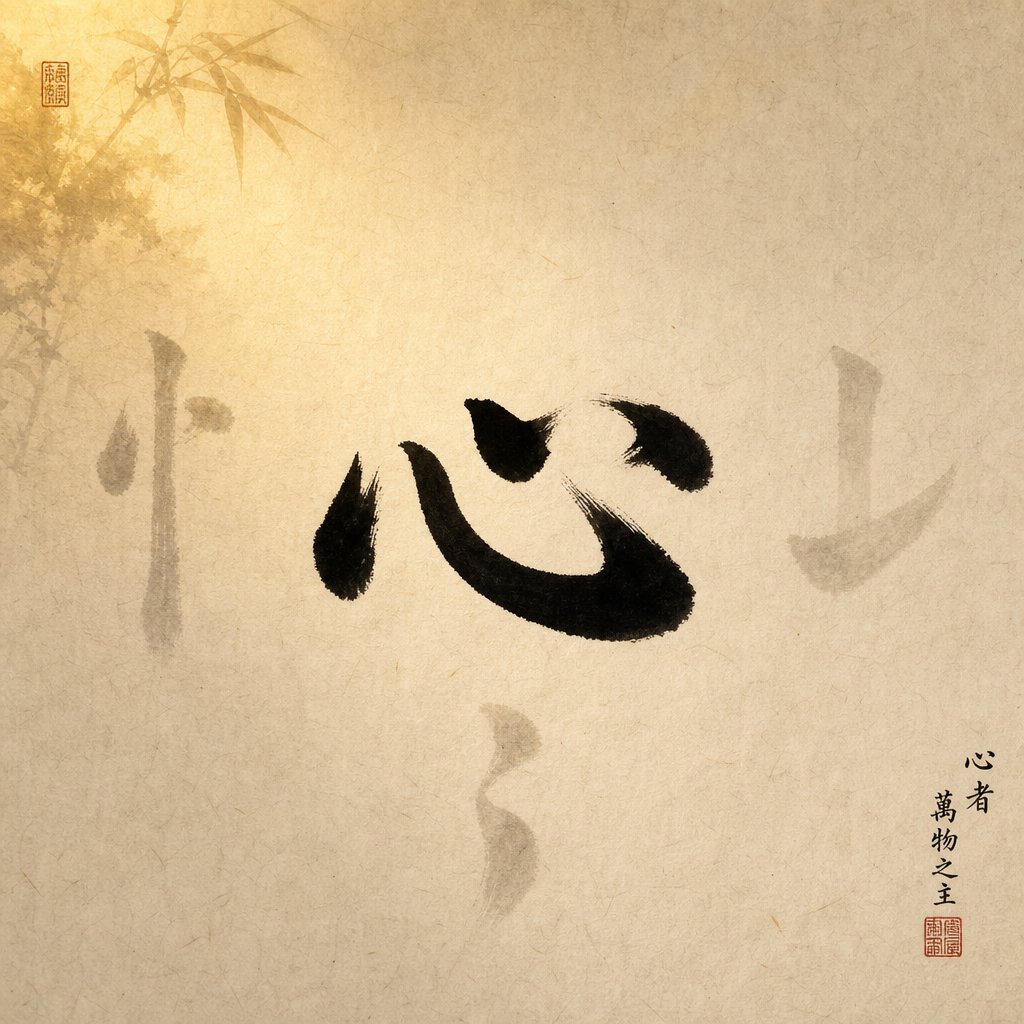
The Chinese character for heart, 心 (xīn), doubles as one of the most productive radicals in the language. It carries the designation Radical 61 in the Kangxi Dictionary system of 214 radicals, the standard classification used for organizing Chinese characters. Its original meaning covers the physical heart, but it extends far beyond anatomy to represent the mind, emotions, and inner self.
When you encounter this radical inside a compound character, it signals that the character's meaning relates to feelings, thoughts, awareness, or mental states. You'll find it in characters like 想 (xiǎng, to think), 怕 (pà, to fear), 忙 (máng, busy), 情 (qíng, emotion), and 忘 (wàng, to forget). The xin Chinese character functions as a semantic key, pointing you toward the meaning category before you even know the full character.
What makes this radical especially interesting for learners is that it appears in three distinct visual forms depending on its position within a character: the full form 心 at the bottom, the compressed vertical form 忄 on the left side (called shùxīnpáng), and the less common bottom-dot variant ⺗ beneath certain characters. Same radical, three disguises.
Why the Heart Radical Appears in So Many Characters
The heart in Chinese writing is not just an organ that pumps blood. It is the seat of consciousness itself. This single concept explains why the 心 radical shows up in characters for thinking (思 sī), remembering (忆 yì), feeling angry (怒 nù), being loyal (忠 zhōng), and even being fast (快 kuài, which originally meant "pleased" or "happy").
Unlike Western culture, which separates heart from mind and assigns emotion to one and reason to the other, Chinese characters encode the concept that 心 governs both feeling and cognition as a unified faculty.
Research in cognitive linguistics confirms this cultural distinction. The Chinese heart is traditionally regarded as the organ of thinking and reasoning as well as feeling, conceptualized as the central faculty of cognition. English literature on Chinese philosophy often translates xīn as "heart-mind" to capture this dual nature. The distinction between "heart" and "mind" in the Western sense simply does not exist in Chinese philosophy.
This is why the heart radical appears in so many characters. It is not limited to emotions. It covers every activity the ancient Chinese attributed to the heart: desire, memory, intention, moral judgment, personality, and rational thought. For learners, this means one radical opens the door to recognizing and predicting the meanings of hundreds of characters across multiple semantic categories.
The real challenge is not understanding what the radical means. It is learning to spot it in all three of its visual forms, each shaped by the structural demands of the character it inhabits.
Three Variant Forms of the Heart Radical Explained
Spotting the heart radical in Chinese characters would be straightforward if it always looked the same. It does not. Depending on where it sits inside a character, this radical character reshapes itself into one of three distinct forms. Each variant follows specific stroke rules, and knowing them gives you a reliable system for reading and writing hundreds of characters correctly.
The table below lays out all three forms side by side so you can compare their structure at a glance:
| Variant Form | Position in Character | Stroke Count | Stroke Order Description | Example Characters |
|---|---|---|---|---|
| 心 | Bottom or standalone | 4 strokes | Left dot, central hook, middle dot, right dot | 想 (xiǎng), 思 (sī), 忠 (zhōng) |
| 忄 | Left side | 3 strokes | Left dot, vertical stroke, right dot | 情 (qíng), 快 (kuài), 忆 (yì) |
| ⺗ | Bottom (spread dots) | 4 strokes | Left dot, middle-left dot, middle-right dot, right dot | 慕 (mù), 恭 (gōng), 慈 (cí) |
心 as a Standalone Character and Bottom Component
The full form 心 is the one most learners meet first. As a standalone character, it means heart, mind, or inner self. As a radical component, it sits at the bottom of characters where there is enough horizontal space for its wide, spreading shape.
Writing it correctly requires four strokes in this order:
- Stroke 1: A small dot leaning slightly left, placed on the lower-left area.
- Stroke 2: A curved hook stroke (the main body) that sweeps right and flicks upward. This is the longest stroke and forms the central spine of the character.
- Stroke 3: A small dot placed near the middle of the hook, slightly above it.
- Stroke 4: A final dot at the upper-right area of the hook.
You'll notice this form in characters like 想 (xiǎng, to think), 忘 (wàng, to forget), 怒 (nù, anger), and 意 (yì, intention). In each case, the full 心 spreads across the bottom, supporting the components stacked above it. The character 您 (nín, polite "you") also uses this bottom placement, adding a layer of heartfelt respect to the standard pronoun 你 (nǐ).
忄 The Vertical Left-Side Form
When the radical Chinese learners encounter sits in the narrow left column of a character, it compresses into 忄. This form is called 竖心旁 (shùxīnpáng), literally "vertical heart side component." It is the most common placement you will see in everyday vocabulary.
The stroke order for 忄 trips up many beginners because it does not follow the intuitive left-to-right sequence. Here is the correct order:
- Stroke 1: A dot slanting downward from right to left (on the left side of the vertical).
- Stroke 2: A vertical stroke drawn straight down through the center.
- Stroke 3: A dot slanting downward from left to right (on the right side of the vertical).
The pattern is left dot, then vertical, then right dot. Many learners mistakenly write both dots first and the vertical last, but that sequence is incorrect. Think of it as anchoring the left dot, drawing the backbone, then finishing with the right dot.
Characters using this form include 情 (qíng, emotion), 快 (kuài, fast/happy), 怕 (pà, afraid), 忙 (máng, busy), and 忆 (yì, to remember). Each one relates to an emotional or mental state, and the compressed 忄 on the left signals that connection immediately.
⺗ The Bottom Dot Variant
The third form is the one most resources skip entirely. Written as ⺗ (sometimes rendered as 㣺), this variant appears at the bottom of certain characters where four dots spread horizontally beneath the upper component. Unlike the full 心 form with its distinctive hook stroke, ⺗ flattens into a row of dots.
Its stroke order follows a simple left-to-right sequence across four dots:
- Stroke 1: Leftmost dot, angled slightly left.
- Stroke 2: Second dot, angled slightly left.
- Stroke 3: Third dot, angled slightly right.
- Stroke 4: Rightmost dot, angled slightly right.
You can see this variant in characters like 慕 (mù, to admire), 恭 (gōng, respectful), and 慈 (cí, kind/benevolent). The four-dot base in these characters is still the heart radical, classified under Radical 61 simplified into this spread form. Recognizing ⺗ as a heart radical variant rather than a random decorative element is the key insight that separates casual learners from those who can decode unfamiliar characters on sight.
All three forms carry identical meaning. They signal the same semantic territory of emotions, thoughts, and mental activity. The difference is purely structural: the character's overall architecture dictates which shape the radical takes. Understanding why each variant exists, and where it appears, turns what looks like arbitrary variation into a predictable system with clear positioning rules.
Historical Evolution From Pictograph to Modern Radical
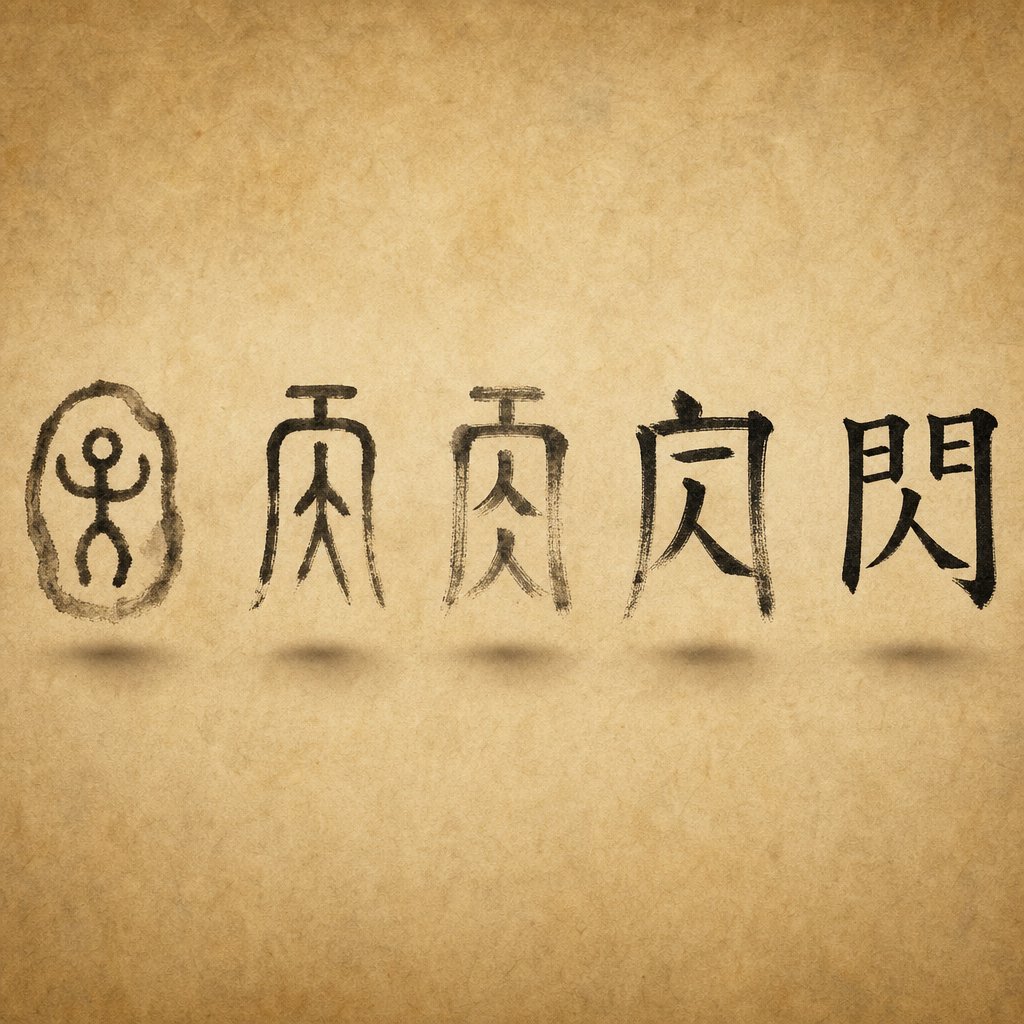
The three variant forms covered above did not appear overnight. They are the end result of roughly 3,000 years of continuous graphic change, driven by shifts in writing tools, materials, and speed. Tracing the heart Chinese character back to its earliest known appearance reveals a shape far more literal than the abstract strokes we write today.
Oracle Bone and Bronze Script Origins
Imagine carving into a turtle shell with a sharp stylus around 1200 BC. The scribes of the Shang dynasty did exactly that, and the form they carved for "heart" looked remarkably like the organ itself. In oracle bone script, the earliest verified stage of Chinese writing, 心 appeared as a small pictograph resembling an inverted vessel with a hollow center, echoing the chambers of a human heart. The design reflected a direct, physical understanding of the organ as the core of life and emotion.
Bronze inscriptions (金文 jīnwén), appearing around 1000 BC on ritual vessels cast in metal, refined this pictograph. The lines became more rounded and the overall shape more symmetrical, benefiting from the casting process that allowed smoother curves than a bone stylus could manage. The heart shape remained recognizable, but the artistic quality increased. You can still see the pictographic logic at this stage: the character looked like what it meant.
From Seal Script to Modern Simplified Forms
The real transformation began during the Qin dynasty's unification of writing. Small seal script (小篆 xiǎozhuàn) standardized the heart character into a more abstract, regularized form around 500-200 BC. The organic curves of the bronze version became controlled, even strokes with uniform line width. The pictographic resemblance to a physical heart started fading, replaced by an elegant but less literal design.
The decisive break came with clerical script (隶书 lìshū), which emerged around 200 BC and matured through the Han dynasty. Clerical script prioritized speed and efficiency over pictographic fidelity. The rounded, flowing strokes of seal script flattened into angular, rectilinear forms. For the Chinese heart character, this meant the curved vessel shape broke apart into the distinct dots and hook stroke we recognize in the modern form.
Here is the full evolutionary timeline:
- Oracle bone script (c. 1200 BC): A pictograph resembling the physical heart with visible chambers, carved into bone or shell.
- Bronze script (c. 1000 BC): Rounded, refined version of the pictograph cast onto metal vessels, retaining clear organ-like shape.
- Seal script (c. 500-200 BC): Standardized and abstracted during Qin unification, with uniform stroke width and symmetrical structure.
- Clerical script (c. 200 BC onward): Angular transformation where flowing curves became distinct strokes, laying the foundation for the modern form.
- Regular script (c. 150 AD onward): Final stabilization into the four-stroke 心 used today, with clearly separated dots and a central hook.
This progression from pictograph to abstract symbol is not unique to the heart radical, but it directly explains why three modern variants exist. As writing speed increased through the clerical and regular script periods, scribes needed to fit radicals into tight spaces within complex characters. A wide, spreading shape like 心 worked fine at the bottom of a character, but it could not squeeze into a narrow left column. The solution was compression: 忄 emerged as a vertical shorthand for the same radical, sacrificing the hook and rearranging the dots into a slim vertical stack. Similarly, ⺗ developed as a flattened dot pattern for characters where the upper component demanded a low-profile base.
The Kangxi Dictionary, compiled in 1716, formalized this system by classifying all heart-related characters under Radical 61 regardless of which variant form appeared. That numbering remains the standard reference today. Whether you encounter 心, 忄, or ⺗ in a character, the dictionary treats them as a single radical with a single number, reflecting their shared origin in that ancient pictograph of a beating heart.
This evolutionary logic gives learners a powerful mental model. The variants are not arbitrary design choices. They are practical adaptations shaped by centuries of scribes writing faster, on different materials, in tighter spaces. Each disguise the heart radical wears today traces back to a specific structural pressure in the history of Chinese for heart-related meaning.
Predicting Which Heart Radical Variant a Character Uses
Knowing that three variants exist is one thing. Knowing which one will appear in a given character before you even look it up is a different skill entirely. The good news: you do not need to memorize variant assignments character by character. A simple set of positioning rules covers nearly every case, turning what feels like guesswork into a reliable system.
Position Rules That Determine Variant Selection
Every Chinese character follows a structural blueprint. Some characters stack components vertically (top-bottom), others place them side by side (left-right), and a few use enclosure or layered arrangements. The heart radical's variant is determined entirely by which structural slot it occupies. Think of it this way: the character's architecture picks the disguise.
Here are the three rules:
- Left-right structure, radical on the left: Use 忄. When the heart radical occupies the narrow left column of a character divided into left and right halves, it compresses into the vertical three-stroke form. Characters like 情 (qing, emotion), 忆 (yi, remember), and 快 (kuai, fast/happy) all follow this pattern. The left column is too narrow for the full spreading shape of 心, so the radical slims down.
- Top-bottom structure, radical on the bottom: Use 心. When the radical sits beneath another component with enough horizontal room to spread, it keeps its full four-stroke form with the distinctive hook. Characters like 想 (xiang, to think), 思 (si, to ponder), and 忠 (zhong, loyal) place the complete heart symbol in chinese at the base, supporting the upper component like a foundation.
- Top-bottom structure, dots spread beneath a wide upper component: Use ⺗. In certain characters where the upper portion is broad and the base flattens into a row of dots rather than a hook, the heart radical takes its four-dot form. Characters like 慕 (mu, to admire), 恭 (gong, respectful), and 恩 (en, grace) use this variant.
The table below organizes these rules with examples so you can reference them quickly:
| Character Structure | Variant Used | Positioning Logic | Example Characters |
|---|---|---|---|
| Left-right (radical on left) | 忄 | Narrow left column requires vertical compression; no room for the full hook shape | 情 (qing), 忆 (yi), 快 (kuai) |
| Top-bottom (radical at base) | 心 | Full horizontal space available at the bottom; hook stroke can spread naturally | 想 (xiang), 思 (si), 忠 (zhong) |
| Top-bottom (wide upper, dot base) | ⺗ | Upper component is broad; base flattens into spread dots beneath it | 慕 (mu), 恭 (gong), 恩 (en) |
How to Apply These Rules When Writing
When you encounter an unfamiliar character and need to decide which heart symbol in Chinese to write, ask yourself two questions. First: where does the radical sit in the character's layout? If it is on the left side, write 忄. If it is at the bottom, you are choosing between 心 and ⺗. Second: does the bottom portion have a central hook stroke, or does it flatten into a row of dots? If you see or expect a hook, write 心. If the base is purely dots spreading beneath a wide top, write ⺗.
This logic works because the variants are not different radicals. They are the same radical adapting to spatial constraints. The compressed 忄 exists because the full 心 simply cannot fit in a narrow left column without colliding with the right-side component. Imagine trying to write that wide hook stroke in a space half the character's width. It would look cramped and illegible. The vertical form solves this by stacking the essential elements (two dots and a vertical stroke) into a slim column.
Similarly, ⺗ exists because certain character compositions place a broad, heavy component on top. The hook stroke of 心 would compete visually with the upper structure, so the radical flattens into dots that sit quietly beneath it, providing a stable visual base without vertical bulk.
A practical tip: when reading, train yourself to check the left edge of any unfamiliar character first. If you spot the dot-vertical-dot pattern of 忄, you immediately know the character relates to emotions or mental states. When scanning the bottom of a character, look for either the hook of 心 or the spread dots of ⺗. Either one tells you the same thing: this character belongs to the heart radical family, and its meaning likely involves feelings, thoughts, or inner qualities.
This structural logic eliminates rote memorization. You are not learning three separate radicals. You are learning one radical with three predictable shapes, each triggered by the architecture of the character it inhabits. Once this clicks, you can confidently write and recognize the heart radical in any position, across any character you encounter.
The real payoff comes when you combine this positional knowledge with meaning prediction. Knowing where the radical sits tells you which form to write. Knowing that it is the heart radical at all tells you what semantic territory the character occupies, a topic that opens up entire families of related characters grouped by meaning.
Semantic Families and Meaning Categories of Heart Radical Characters
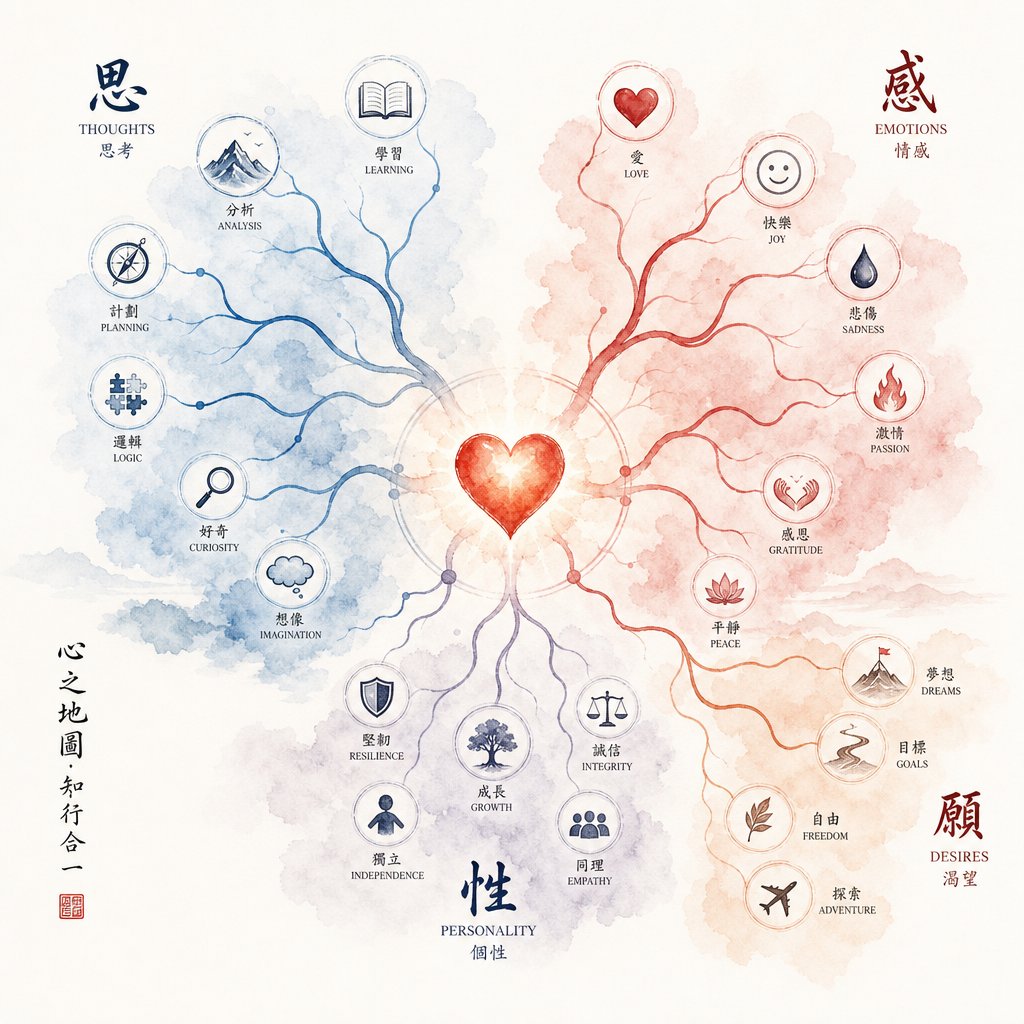
Positional rules tell you which variant to write. Semantic families tell you what the character probably means. This is where the heart radical becomes a genuine reading shortcut: once you spot 心, 忄, or ⺗ inside an unfamiliar character, you can narrow its meaning to a specific category before reaching for a dictionary. The heart in Chinese writing functions as a semantic tag, grouping hundreds of characters into predictable meaning clusters.
Research published in Frontiers in Psychology confirms that learners who understand semantic radical categories can successfully infer the meanings of unfamiliar characters in context. The study found that even a short instructional session on semantic radicals enabled foreign language learners to transfer that strategy to characters they had never been taught. The heart radical is one of the most productive radicals for this approach because its semantic territory is broad, consistent, and intuitive.
Below, you will find heart radical characters organized into five distinct meaning families. Each group shares a common thread: the character describes something happening inside a person, whether that is an emotion, a thought process, a personality trait, a moral quality, or a desire.
Emotion Characters Built on the Heart Radical
The most obvious family. When you feel something, the Chinese symbol for heart is almost certainly embedded in the character describing that feeling. Emotions are internal experiences, and the heart radical marks them as such.
- 怒 (nu, anger) - rage or fury, the fire of the heart
- 恐 (kong, fear) - deep dread or terror
- 悲 (bei, sorrow) - grief or sadness
- 愉 (yu, joy) - pleasure or delight
- 怕 (pa, afraid) - to fear something specific
- 惊 (jing, startled) - shock or surprise
- 恨 (hen, hatred) - resentment or intense dislike
- 悔 (hui, regret) - remorse over a past action
- 愁 (chou, worry) - anxious sadness
- 惭 (can, ashamed) - feeling of shame or embarrassment
Notice the range. Positive emotions, negative emotions, mild feelings, and intense ones all carry the same radical marker. The heart in Mandarin does not distinguish between pleasant and unpleasant feelings. It simply signals: this is something felt internally.
Cognition and Mental State Characters
Here is where the heart radical diverges most sharply from Western expectations. Characters for thinking, remembering, forgetting, and understanding all contain the heart radical because classical Chinese treats cognition as a heart activity, not a brain activity.
- 想 (xiang, think) - to think about or miss someone
- 思 (si, ponder) - to contemplate or reflect deeply
- 忆 (yi, remember) - to recall or recollect
- 忘 (wang, forget) - to lose from memory
- 悟 (wu, realize) - to awaken to understanding
- 惑 (huo, confused) - bewildered or perplexed
- 念 (nian, miss/think of) - to think of someone or read aloud
- 感 (gan, feel/sense) - to perceive or be moved by something
- 意 (yi, intention) - meaning, idea, or purpose
- 息 (xi, rest/breath) - to cease activity, take a break
When you encounter an unknown character with 忄 on the left or 心 at the bottom and the surrounding text discusses learning, decision-making, or awareness, you can reasonably guess the character describes a mental process. This strategy works because the heart Chinese character system treats mind and heart as one unified organ of consciousness.
Personality and Moral Quality Characters
Beyond momentary emotions and active thought, the heart radical also marks stable traits, the qualities that define a person's character over time. This family splits naturally into personality descriptions and moral virtues.
Personality traits:
- 慈 (ci, kind) - compassionate, benevolent
- 惰 (duo, lazy) - idle or sluggish by disposition
- 恒 (heng, persistent) - constant, persevering
- 憨 (han, naive) - simple-minded or guileless
- 悍 (han, fierce) - bold and tough in temperament
- 恬 (tian, tranquil) - calm and untroubled by nature
Moral qualities:
- 忠 (zhong, loyal) - faithful devotion to a person or cause
- 恕 (shu, forgiveness) - to pardon, the Confucian virtue of empathy
- 慎 (shen, cautious) - careful and deliberate in action
- 惭 (can, ashamed) - moral awareness of wrongdoing
- 忍 (ren, endure) - to bear hardship with patience
- 恩 (en, grace) - kindness or favor received
The logic is consistent: if a quality lives inside a person and defines who they are at their core, the heart radical marks it. Loyalty is not an action you perform once. It is a state of the heart. Laziness is not a single choice. It is a disposition rooted in one's inner nature.
Desires and aspirations:
- 愿 (yuan, wish) - a hope or willingness
- 慕 (mu, admire) - to long for or look up to someone
- 憧 (chong, longing) - to yearn for a future possibility
- 愧 (kui, ashamed) - guilt from failing one's own standards
- 恋 (lian, love/attached) - romantic attachment or reluctance to leave
Desires sit at the intersection of emotion and thought. You feel them, but they also involve intention and imagination. The heart radical captures this perfectly because it does not separate feeling from thinking in the first place.
So how does this help in practice? Imagine you are reading a Chinese text and encounter a character you have never seen before. You notice 忄 on the left side. Even without knowing the pronunciation or exact definition, you can immediately eliminate most meaning categories. The character almost certainly does not refer to water, wood, metal, food, or physical objects. It describes something internal: a feeling, a thought, a trait, or a desire. Combined with sentence context, this narrows your options dramatically.
A study on CFL learners demonstrated that students trained in semantic radical recognition improved their accuracy from around 50% to 86% on tasks requiring them to infer unfamiliar character meanings in sentences. The transfer effect was significant even for radicals the students had never been explicitly taught. The heart radical, with its large family of transparent characters, is one of the strongest candidates for this kind of radical-based reading strategy.
This semantic grouping also reveals something deeper about how Chinese encodes human experience. Physical actions get radicals like 手 (hand) or 足 (foot). Spoken communication gets 言 (speech). But everything that happens inside a person, every flicker of emotion, every act of reasoning, every moral judgment, routes through the heart. The radical is not just a writing convention. It is a philosophical statement embedded in the structure of the language itself, one that connects directly to centuries of Chinese thought about what the heart truly governs.
Cultural Philosophy Behind the Heart as Organ of Thinking and Feeling
The semantic families above reveal a pattern that goes far beyond writing conventions. Characters for thinking, feeling, enduring, and judging all route through the heart radical because Chinese civilization built its entire model of consciousness around a single premise: the heart is where both emotion and reason live. This is not a quirk of the writing system. It is a philosophical commitment stretching back over two thousand years, woven into medicine, ethics, and literature.
The Heart as Seat of Thought in Chinese Philosophy
In classical Chinese philosophy, 心 (xin) is not merely the organ that pumps blood. It is the center of consciousness, the faculty responsible for thinking, feeling, perceiving, and making moral judgments. English needs separate words for heart, mind, and soul. Chinese collapses all three into one character. Sinologists regularly translate xin as "heart-mind" to capture this unified concept, and the Neo-Confucian philosophers of the Song and Ming dynasties built entire schools of thought around it.
Mencius (孟子 Mengzi, 372-289 BC) placed the heart at the top of a hierarchy within the human body. He argued that the heart's primary function is to think, and that without this capacity, a person becomes entirely driven by sensory desires. As he put it: the organs of sight and hearing cannot think and are misled by external things, but the heart organ can think, and it will find the answer only if it does think. For Mencius, the heart was not just an emotional center. It was the faculty that distinguished humans from animals.
This explains why characters like 想 (xiang, to think), 忘 (wang, to forget), 感 (gan, to feel), and 忍 (ren, to endure) all contain the heart radical. Each one describes an activity that classical Chinese philosophy assigned to the heart. Thinking is a heart activity. Memory is a heart activity. Even moral endurance is a heart activity. The writing system simply reflects what the philosophers taught.
The Confucian tradition took this further with the concept of 修心 (xiuxin), cultivating the heart. This practice meant refining both emotional responses and intellectual capacities simultaneously, because the two were never separate to begin with. Xun Zi (310-220 BC) described the heart as "the lord of the body and master of the spiritual intelligence," issuing commands on its own authority, forbidding or ordering, renouncing or selecting. Wang Yang Ming (1472-1529), the great Ming dynasty philosopher, went even further, declaring that xin is the ultimate reality itself: "Under Heaven and Earth, is there anything that exists beyond the Mind, or any principle that exists beyond the Mind?"
In the classical Chinese worldview, the cognitive is inseparable from the affective. The Mind cannot be divorced from the Heart. Characters built on the heart radical encode this unity in every stroke.
Connections to Traditional Chinese Medicine and Literature
Traditional Chinese Medicine (TCM) inherited this philosophical framework directly. In TCM, the Heart is not just a pump. It is the "Emperor" of the organs, housing what is called 神 (shen, spirit or consciousness). The Heart governs shen, which encompasses mental clarity, emotional stability, sleep, awareness, and the capacity to connect with others. When shen is balanced, a person thinks clearly, feels appropriately, and sleeps well. When shen is disturbed, anxiety, insomnia, confusion, and emotional withdrawal follow.
The classical medical texts describe shen as the most subtle and non-material type of Qi, responsible for thinking, consciousness, self-identity, emotional life, memory, and volition. The Chinese characters for "thought" (意 yi), "to think" (想 xiang), and "pensiveness" (思 si) all carry the heart as their radical, a linguistic fact that TCM practitioners point to as evidence of the heart-mind unity embedded in the language itself.
The Daoist tradition adds another layer. The Nei Ye, an early Daoist text on cultivating life, instructs practitioners to "enlarge your mind (心 xin) and let go of it" and to "relax your vital breath and expand it." Here, xin is the seat of meditation, the faculty that must be stilled for spiritual development. The text also describes a "numinous" (神 shen) power naturally residing within, one that brings order when attained and disorder when lost. The heart, in this framework, is both the organ of daily thought and the gateway to transcendent awareness.
This philosophical weight did not stay confined to China. When the character 心 traveled to Japan, it carried its philosophical depth intact. In Japanese, 心 is read as kokoro, a word that implies one's intellectual responses, emotional reactions, and the mental, emotional, and spiritual states of all sentient beings. Professor Emeritus Kimiko Gunji of the University of Illinois notes that kokoro is so difficult to define even in Japanese that English translations using "mind," "heart," "feelings," "soul," or "spirit" all leave much to be desired. The heart kanji encompasses all of these simultaneously.
Lafcadio Hearn, writing in 1898, chose Kokoro as the title of his book on Japanese inner life precisely because no English word could capture its scope. He explained that the character 心 "signifies also mind, in the emotional sense; spirit; courage; resolve; sentiment, affection; and inner meaning." The Japanese heart symbol carries the same philosophical unity as its Chinese source: thinking and feeling are not separate activities performed by separate organs. They are one process, housed in one place, written with one radical.
This cultural context transforms how you read heart radical characters. When you see 忄 or 心 inside a character, you are not just seeing a dictionary classification marker. You are seeing a philosophical claim preserved in ink: that human consciousness is unified, that thought cannot be separated from feeling, and that the heart governs both. Every character in the heart radical family carries this ancient argument within its structure, connecting modern readers to a tradition that predates the Western separation of reason and emotion by centuries.
Understanding this philosophy also reshapes how learners approach vocabulary. Characters are not arbitrary pairings of sound and meaning. They are arguments about how the world works, encoded at the level of individual strokes. The heart radical characters form a map of Chinese psychology, one that groups thinking with feeling, loyalty with love, and memory with desire, all under the governance of a single organ that Western medicine would reduce to a pump.
This philosophical foundation also has practical implications for how heart radical characters are organized by difficulty and frequency, a structure that helps learners build vocabulary systematically from the most common characters outward.
Heart Radical Characters Organized by Learning Level
Philosophy and history give you the "why" behind the heart radical. Frequency data gives you the "what to learn first." Not all heart radical characters carry equal weight in daily reading. Some appear in elementary textbooks and everyday conversation. Others show up only in literary essays or classical poetry. Organizing them by difficulty level lets you build vocabulary in layers, starting with the characters you will encounter most often and expanding outward as your reading ability grows.
The kanji for heart in Japanese follows a similar frequency pattern, with 心 (kokoro) and common compounds appearing early in study while rarer characters surface at advanced levels. Whether you are studying Chinese or reviewing the kanji heart system in Japanese, the principle holds: learn high-frequency characters first, then branch into specialized vocabulary.
Essential Heart Radical Characters for Beginners
These characters appear in HSK 1-3 vocabulary lists and basic conversational Chinese. You will see them in signs, text messages, and simple reading materials within your first months of study.
| Character | Pinyin | Meaning | Variant Form | Usage Context |
|---|---|---|---|---|
| 心 | xīn | heart, mind | 心 (standalone) | Core vocabulary; appears in dozens of compound words like 开心 (kāixīn, happy) |
| 想 | xiǎng | to think, to miss | 心 (bottom) | Extremely common; used for both "I think..." and "I miss you" |
| 快 | kuài | fast, happy | 忄 (left side) | Daily use for speed and mood; 快乐 (kuàilè, joyful) |
| 忙 | máng | busy | 忄 (left side) | One of the first adjectives learned; 我很忙 (wǒ hěn máng, I am busy) |
| 忘 | wàng | to forget | 心 (bottom) | High frequency; 忘记 (wàngjì, to forget) appears constantly in conversation |
| 怕 | pà | to fear, afraid | 忄 (left side) | Basic emotion word; 害怕 (hàipà, scared) |
Notice that even at the beginner level, you encounter both the 忄 left-side form and the full 心 bottom form. The ⺗ variant tends to appear in more complex characters that surface later in study.
Intermediate and Advanced Characters Worth Learning
Intermediate characters (HSK 4-5 range) appear in news articles, workplace communication, and longer written texts. Advanced characters show up in literature, formal writing, and classical references.
| Character | Pinyin | Meaning | Variant Form | Usage Context |
|---|---|---|---|---|
| 感 | gǎn | to feel, sense | 心 (bottom) | Versatile; 感觉 (gǎnjué, feeling), 感谢 (gǎnxiè, thank) |
| 情 | qíng | emotion, situation | 忄 (left side) | Appears in 事情 (shìqing, matter), 爱情 (àiqíng, romantic love) |
| 愿 | yuàn | to wish, willing | 心 (bottom) | Formal contexts; 愿意 (yuànyì, willing), 志愿 (zhìyuàn, volunteer) |
| 惯 | guàn | accustomed to | 忄 (left side) | 习惯 (xíguàn, habit) is essential intermediate vocabulary |
| 恐 | kǒng | fear, dread | 心 (bottom) | More literary than 怕; 恐怕 (kǒngpà, I'm afraid that...) |
| 懊 | ào | regretful, annoyed | 忄 (left side) | Written/literary; 懊悔 (àohuǐ, deep regret) |
| 懈 | xiè | to slack off | 忄 (left side) | Formal; 松懈 (sōngxiè, to relax vigilance) |
| 憧 | chōng | to long for | 忄 (left side) | Literary; 憧憬 (chōngjǐng, to yearn for a bright future) |
| 懽 | huān | joyful (archaic) | 忄 (left side) | Classical variant of 欢; found in pre-modern texts and some traditional character sets |
| 懌 | yì | pleased, contented | 忄 (left side) | Rare literary character; appears in classical Chinese poetry and formal prose |
Characters like 懽 and 懌 are uncommon in modern simplified Chinese but still appear in classical texts, traditional character environments, and historical documents. If you study the heart in kanji through Japanese materials, you may also encounter these characters in older literary works where they retain their original forms.
A practical reading strategy emerges from this table. When you spot an unfamiliar character with 忄 on its left side or 心 at its base, follow these steps:
- Assume the character relates to an emotion, mental state, personality trait, or inner experience.
- Read the surrounding sentence for context clues. Is the passage discussing how someone feels? What someone thinks? How someone behaves?
- Narrow the meaning category based on context. A character with 忄 in a sentence about relationships likely describes a feeling. The same radical in a sentence about work habits likely describes a disposition.
- Check your guess against a dictionary only after forming a hypothesis. This active prediction strengthens retention far more than passive lookup.
This radical recognition approach works because the heart radical is remarkably consistent in its semantic signaling. Unlike some radicals that have drifted far from their original meaning in certain characters, the heart radical almost always delivers on its promise: the character describes something happening inside a person. Building this reflex early, starting with the beginner characters and reinforcing it through intermediate and advanced encounters, turns every new heart radical character into a partially solved puzzle rather than a blank wall.
The gap between recognizing a radical and writing it correctly, however, is where most learners stumble. Stroke order errors and visual confusion with similar-looking radicals can undermine even strong radical knowledge, especially when the heart radical's left-side form 忄 looks deceptively similar to other three-stroke components.
Common Mistakes and Easily Confused Heart Radical Characters
Radical knowledge only pays off if you can write and identify the correct form under pressure. The heart radical's left-side variant 忄 is where most errors cluster, partly because its three strokes look deceptively simple and partly because another common radical sits in the same position with a suspiciously similar appearance. Catching these mistakes early prevents them from hardening into habits that slow down both reading and writing.
Stroke Order Mistakes and How to Fix Them
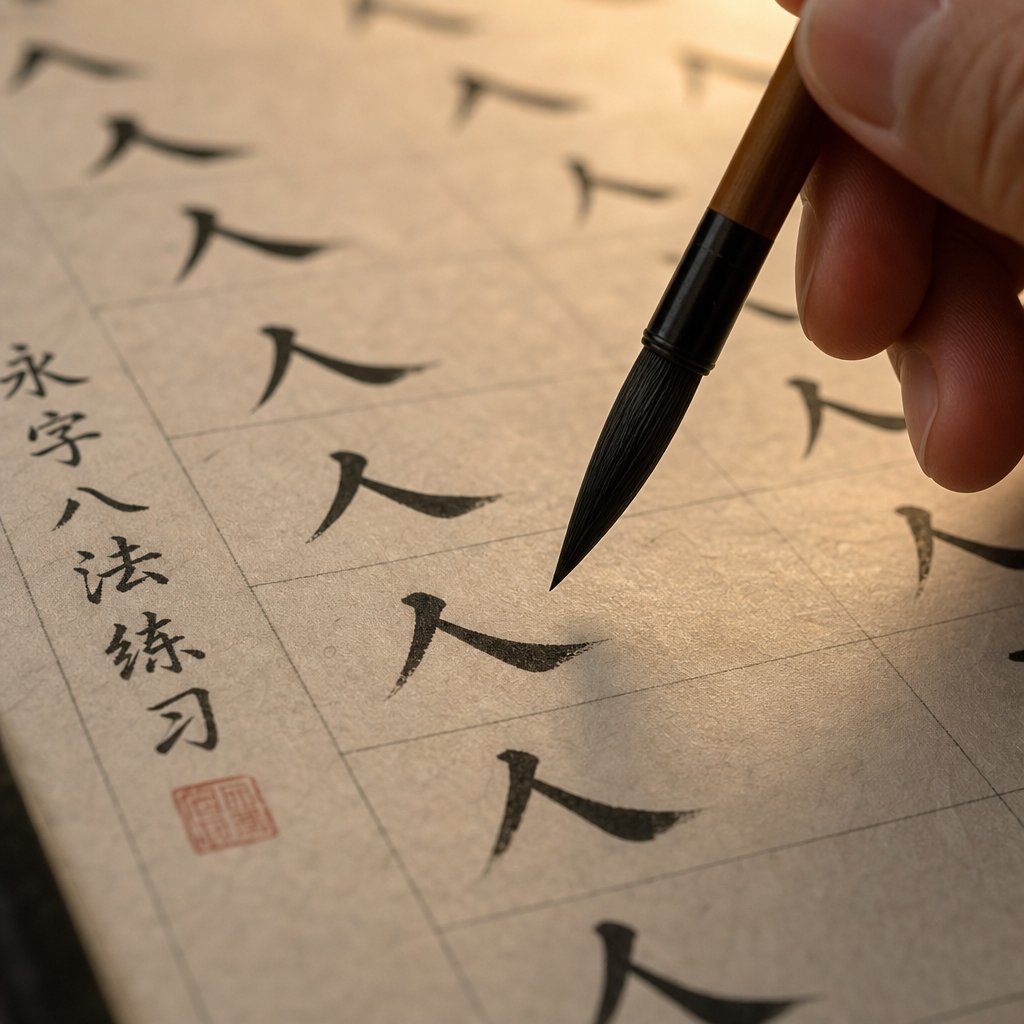
The most widespread error with 忄 involves stroke sequence. Many learners assume the two dots come first, followed by the vertical stroke. This feels intuitive because the dots sit on either side of the vertical, and left-to-right logic suggests starting with the left dot, then jumping to the right dot, then drawing the line between them. That sequence is wrong.
The correct stroke order for 忄 is:
- Stroke 1: Left dot, drawn with a slight downward-left slant.
- Stroke 2: Vertical stroke, drawn straight down through the center.
- Stroke 3: Right dot, drawn with a slight downward-right slant.
Think of it as: anchor, backbone, finish. The left dot anchors the position. The vertical establishes the structure. The right dot completes the form. Writing both dots first and the vertical last produces a visually similar result, but it disrupts the natural flow of the brush and creates inconsistent spacing in handwritten text. If you have been writing it dot-dot-vertical, retrain the sequence now before it becomes automatic.
A second common stroke error involves the full 心 form at the bottom of characters. Learners sometimes draw the central hook stroke last, treating the three dots as the starting point. The correct order begins with the left dot, moves to the hook (the longest and most structurally important stroke), then places the two remaining dots above and to the right of the hook. The hook is stroke two, not stroke four.
Easily Confused Characters With and Without the Heart Radical
Visual confusion between 忄 and the water radical 氵 (three dots of water, called sāndiǎnshuǐ) is the single most common recognition error for learners at every level. Both radicals sit on the left side of characters. Both consist of three short strokes. At a glance, especially in small font sizes or fast handwriting, they can look nearly identical.
Here is the structural difference: 氵 consists of three dots arranged in a vertical column, all angled in roughly the same direction (top-right to bottom-left). There is no vertical stroke. The radical 忄 has a full vertical stroke running through the center, with one dot on each side. The vertical line is the key distinguishing feature. If you see a straight vertical backbone between two dots, it is the heart radical. If you see three dots stacked without a connecting line, it is water.
This distinction matters because confusing the two radicals leads to entirely different characters with unrelated meanings:
| Heart Radical 忄 | Pinyin | Meaning | Water Radical 氵 | Pinyin | Meaning |
|---|---|---|---|---|---|
| 情 | qíng | emotion, feeling | 清 | qīng | clear, clean |
| 快 | kuài | fast, happy | 块 | kuài | piece, chunk (uses 土 not 氵) |
| 忆 | yì | to remember | 汇 | huì | to gather, remit |
| 惊 | jīng | startled, shocked | 泾 | jīng | name of a river |
| 悄 | qiāo | quiet, secretly | 消 | xiāo | to disappear, cancel |
Another pair that trips learners up involves the ice radical 冫 (two strokes, called liǎngdiǎnshuǐ). Compare 快 (kuài, fast/happy, with 忄) against 决 (jué, to decide, with 冫). The right-side component 夬 is identical in both characters. Only the left radical differs, and that difference changes the meaning completely. One describes an emotional state. The other describes a logical action. Recognizing what radical means in each case is the difference between reading accurately and guessing wrong.
A useful memory aid: if the character's meaning involves something you feel or think, look for the vertical stroke of 忄. If the meaning involves water, liquid, or flow, expect the three stacked dots of 氵. If it involves cold or freezing, look for the two-stroke 冫. The semantic content confirms the visual identification.
For learners studying both Chinese and Japanese, the same visual confusion applies. The radical in Japanese works identically: 忄 marks emotional and cognitive characters in kanji just as it does in Chinese. The radicals in Japanese follow the same structural logic, so the recognition strategies you build for Chinese transfer directly to reading kanji. A radical kanji like 情 carries the same left-side 忄 in both writing systems, and the Japanese radical classification mirrors the Kangxi system that Chinese uses.
One question learners frequently ask: do simplified and traditional Chinese use the same variant rules? The short answer is yes. The three positional variants (心 at the bottom, 忄 on the left, ⺗ as spread dots) remain consistent across both systems. Simplification reforms primarily targeted the phonetic components of characters, not the radical positioning logic. A character like 憶 (traditional) simplifies to 忆 (simplified) by reducing the right-side phonetic component, but the 忄 radical on the left stays unchanged in both form and position. You can rely on the same variant rules regardless of whether you are reading simplified or traditional text.
To reinforce correct identification through handwriting practice, try these approaches:
- Practice writing 忄 and 氵 side by side in alternating rows. Exaggerate the vertical stroke in 忄 to build muscle memory for the structural difference.
- Write confused pairs together: 情 next to 清, 悄 next to 消. Say the meaning aloud as you write each one. Pairing the visual form with its semantic category strengthens both recognition and recall.
- When reviewing new vocabulary, circle or highlight the radical before writing the full character. This forces you to consciously identify which radical is present rather than copying the character as an undifferentiated shape.
- Use grid paper that divides each character square into quadrants. Place 忄 consistently in the left half, checking that your vertical stroke sits clearly in the center of that space with dots balanced on either side.
The goal is not perfection on day one. It is building a recognition reflex that fires automatically when you encounter these radicals in real text. Every time you correctly distinguish 忄 from 氵 in a new character, you reinforce the pattern. Every time you write the stroke order correctly, your hand remembers. Over time, the heart radical in all three of its forms becomes as instantly recognizable as a familiar face in a crowd, no conscious analysis required.
Frequently Asked Questions About the Heart Radical in Chinese Characters
1. What are the three forms of the heart radical in Chinese?
The heart radical appears in three variant forms based on its position within a character. The full form 心 appears at the bottom of top-bottom structured characters like 想 and 思. The compressed vertical form 忄 (called shuxinpang) sits on the left side of left-right structured characters like 情 and 快. The spread-dot variant ⺗ appears at the bottom of certain characters where four dots spread beneath a wide upper component, as in 慕 and 恭. All three forms carry the same meaning and are classified under Radical 61 in the Kangxi Dictionary system.
2. What is the correct stroke order for the heart radical 忄?
The correct stroke order for 忄 is left dot first, then the vertical stroke down the center, then the right dot. A common mistake is writing both dots before the vertical stroke, but the proper sequence is anchor (left dot), backbone (vertical), finish (right dot). This order ensures natural brush flow and consistent spacing in handwriting. The full form 心 follows a different sequence: left dot, central hook stroke, middle dot above the hook, then right dot.
3. Why does the heart radical appear in Chinese characters for thinking and memory?
In classical Chinese philosophy, the heart (心 xin) is considered the unified seat of both emotion and cognition, unlike Western culture which separates heart from mind. Mencius argued that the heart's primary function is to think, making it the faculty that distinguishes humans from animals. This philosophical tradition explains why characters for thinking (想), remembering (忆), forgetting (忘), and realizing (悟) all contain the heart radical. The writing system directly reflects the ancient belief that mental processes are heart activities, not brain activities.
4. How do you tell the difference between the heart radical 忄 and the water radical 氵?
The key distinguishing feature is the vertical stroke. The heart radical 忄 has a clear vertical stroke running through the center with one dot on each side. The water radical 氵 consists of three dots stacked vertically without any connecting line, all angled in roughly the same direction. Confusing them changes meaning entirely: 情 (qing, emotion) uses the heart radical while 清 (qing, clear) uses the water radical. A helpful rule is that if the character's meaning involves feelings or thoughts, expect the vertical stroke of 忄; if it involves liquid or flow, expect the three stacked dots of 氵.
5. How can recognizing the heart radical help me learn Chinese characters faster?
When you spot 心, 忄, or ⺗ inside an unfamiliar character, you can immediately narrow its meaning to emotions, mental states, personality traits, or inner experiences. Research published in Frontiers in Psychology found that learners trained in semantic radical recognition improved their accuracy from around 50% to 86% when inferring unfamiliar character meanings in context. This radical-based reading strategy works because the heart radical is remarkably consistent in its semantic signaling across hundreds of characters, letting you form educated guesses before consulting a dictionary.