What Chinese Name Luck Scoring Means and Why It Matters
Imagine you could decode the hidden fortune embedded in any Chinese name using nothing more than a pen and some basic arithmetic. That is exactly what Chinese name luck scoring offers: a structured, number-based system for evaluating whether a name carries auspicious energy or potential obstacles.
This practice, known formally as the Five Grid Analysis Method (五格剖象法), treats every Chinese character as a container of numerical energy. The stroke count of each character becomes a building block, and the relationships between those numbers across a name reveal patterns of luck, personality, and life trajectory. Millions of Chinese-speaking families still consult this system when naming a baby or evaluating whether an existing name supports their goals.
Every Chinese character carries numerical energy through its stroke count. The relationships between these numbers, when arranged according to the Five Grid formulas, reveal luck patterns that influence different stages of life.
What Is Chinese Name Luck Scoring
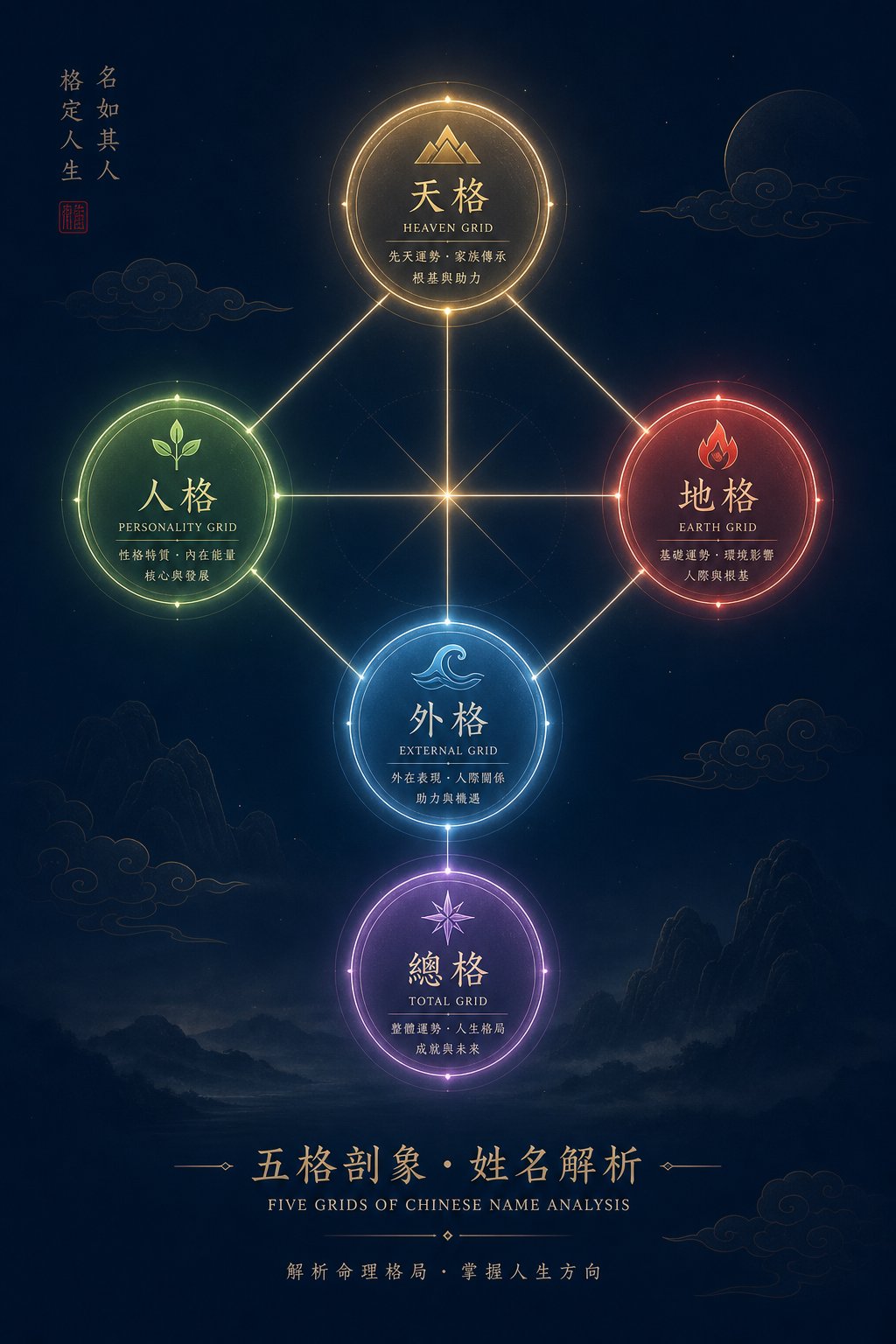
Chinese name luck scoring is a branch of nameology rooted in the idea that numbers hold predictive power. The system divides a full name into five numerical grids: Heaven Grid, Personality Grid, Earth Grid, External Grid, and Total Grid. Each grid is calculated from the stroke counts of the surname and given name characters using specific formulas. The resulting numbers are then evaluated against an 81-number luck chart that classifies each value as auspicious, semi-auspicious, or inauspicious.
The method was initially created in 1918 by the Japanese scholar Kumazaki Ken'o, who drew on Chinese I-Ching numerology to build a systematic framework for analyzing names. In 1936, a Taiwanese student named Bai Yuguang brought the system back from Japan and translated it for Chinese audiences. It spread through Taiwan, Hong Kong, South Korea, and Southeast Asia before gaining popularity in mainland China during the 1990s, where scholars integrated it with traditional Chinese Five Elements theory.
Why Stroke Counts Determine Fortune in a Name
Why strokes and not, say, the meaning of a character? The logic comes from I-Ching philosophy, where numbers are considered the fundamental language of the universe. Each stroke count maps to one of the Five Elements (Wood, Fire, Earth, Metal, Water), and the interactions between elements across a name's grids create either harmony or conflict.
Chinese characters are also classified as Yin or Yang based on their stroke count. Characters with an even number of strokes are Yin, and those with an odd number are Yang. A well-constructed name balances these polarities. The ideal patterns include combinations like Yang-Yang-Yin or Yin-Yang-Yang across the three characters of a typical Chinese name. When yin and yang fall out of balance, the system flags potential disharmony in the bearer's fortune.
This is what makes stroke-based scoring different from simply picking characters with positive meanings. Two names can share beautiful meanings yet produce very different luck profiles once you run the numbers.
Who Should Use This Guide
This guide walks you through the complete manual calculation method, step by step. You will learn how to:
- Find the correct traditional stroke count for any character
- Compute all five grids from a name's stroke values
- Derive the Three Talents configuration and its Five Elements mapping
- Look up each grid number in the 81-number luck system
- Interpret combined results for an overall assessment
Whether you are checking your own name out of curiosity, evaluating potential baby names, or simply want to understand how stroke counts affect name fortune, this process gives you full transparency. No black-box online calculator required. You will understand exactly where each number comes from and what it means.
The first thing you need, though, is the right stroke count, and that is less straightforward than it sounds. Modern simplified characters often have fewer strokes than their traditional counterparts, and the system demands a very specific standard for counting.
Step 1 Find the Correct Kang Xi Stroke Count for Each Character
Getting the stroke count wrong at this stage means every calculation that follows will be off. The entire Five Grid system rests on one specific counting standard, and it is not the one you learned in modern Chinese class.
Why Kang Xi Dictionary Strokes Are the Standard
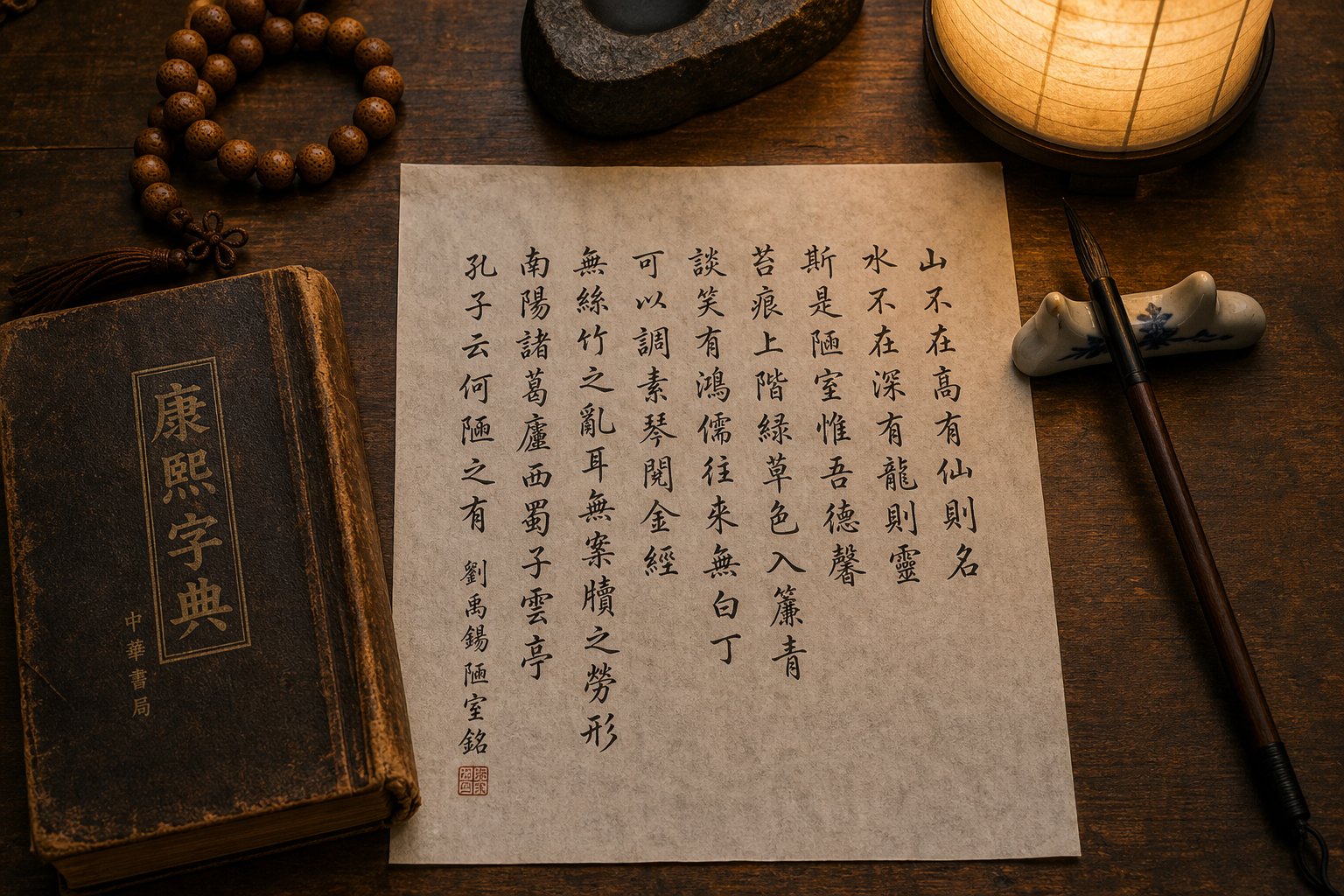
The Kang Xi Dictionary (康熙字典), compiled in 1716 during the Qing Dynasty, cataloged over 47,000 characters using traditional (unsimplified) forms. Name analysis practitioners adopted this dictionary as the universal reference because it predates all modern simplification reforms and provides a single, consistent stroke count for every character.
Why does this matter? When China introduced simplified characters in the 1950s and 1960s, many characters lost strokes. The character for "dragon" went from 龍 (16 strokes) to 龙 (5 strokes). The character for "gate" dropped from 門 (8 strokes) to 门 (3 strokes). If you used the simplified count, you would get completely different grid numbers and a completely different luck reading.
The Kang Xi Dictionary standard is what name analysis masters universally follow when computing stroke totals. Even if your legal name is written in simplified Chinese, the scoring system traces each character back to its traditional form and counts from there.
How to Convert Simplified Characters to Traditional Stroke Counts
If you grew up writing simplified characters, you will need to find the traditional equivalent for each character in your name. Here is the process:
- Identify the simplified character in your name.
- Look up its traditional form using a dictionary or online conversion tool.
- Count the strokes of the traditional form according to Kang Xi rules.
The trickiest part is not the full characters themselves but the radicals. Many radicals appear visually as two or three strokes in their abbreviated form, yet the Kang Xi standard counts them based on the original, unabbreviated radical. This is where most counting errors happen.
For example, the three-dot water radical (氵) looks like 3 strokes when you write it. But in the Kang Xi system, it represents the full character 水 (water), which carries 4 strokes. Similarly, the grass radical (艹) appears to have 3 or 4 strokes visually, but the traditional radical table assigns it 6 strokes based on its original form 艸.
| Radical | Visual Appearance | Apparent Strokes | Kang Xi Stroke Count | Reason |
|---|---|---|---|---|
| 氵 (water) | Three dots | 3 | 4 | Derived from 水 (4 strokes) |
| 艹 (grass) | Horizontal with two downstrokes | 3 or 4 | 6 | Derived from 艸 (6 strokes) |
| 忄 (heart) | Vertical with two dots | 3 | 4 | Derived from 心 (4 strokes) |
| 犭 (dog) | Curved stroke with hook | 3 | 4 | Derived from 犬 (4 strokes) |
| 礻 (spirit) | Dot, horizontal, vertical, dot | 4 | 5 | Derived from 示 (5 strokes) |
| 衤 (clothes) | Similar to 礻 with extra dot | 5 | 6 | Derived from 衣 (6 strokes) |
| 王 (jade radical) | Three horizontals, one vertical | 4 | 5 | Represents 玉 (5 strokes) when used as radical |
This table is not exhaustive, but it covers the radicals that trip people up most often. When you encounter a character containing any of these radicals, remember to use the Kang Xi count for the radical portion, not the visual shorthand.
Stroke Count Method vs Letter Count Method
You might have seen online tools that analyze English names or romanized Chinese names by counting letters rather than strokes. This is a different system entirely. The letter-count method assigns numerical values based on the number of letters in each name segment, then maps those totals to the same 81-number chart. Some practitioners use I-Ching numerology principles to assign values to individual letters.
The two methods are not interchangeable. The stroke-count method applies specifically to Chinese characters and relies on the physical structure of each character. The letter-count method is an adaptation for alphabetic scripts. If your goal is to score a Chinese name, you need the stroke-count approach with Kang Xi values. Using letter counts on a Pinyin romanization of your name will produce a meaningless result in this context.
With the correct stroke count for each character in hand, the next step is arithmetic: plugging those numbers into the Five Grid formulas to generate the values you will eventually look up in the 81-number system.
Step 2 Compute the Five Grids From Your Name Stroke Counts
You have your Kang Xi stroke counts. Each character in the name is now a number. The five grid calculation formula for a Chinese name turns those raw numbers into five distinct values, each representing a different dimension of fortune. The arithmetic is simple addition, but the rules differ depending on whether the surname has one character or two.
To keep things clear, imagine a standard three-character Chinese name: one surname character (A) followed by two given name characters (B and C). The stroke counts for these characters are what you plug into the formulas below. For a compound surname, you have two surname characters (A and B) plus one or two given name characters.
The Five Grid Formulas for Single Character Surnames
Most Chinese names use a single-character surname. Think of names like Li Shimin or Wang Xiaoming. Here is how to compute Tian Ge, Ren Ge, Di Ge, Wai Ge, and Zong Ge for this name structure:
- Tian Ge (Heaven Grid) = Surname strokes + 1
- Ren Ge (Personality Grid) = Surname strokes + First given name character strokes
- Di Ge (Earth Grid) = First given name character strokes + Second given name character strokes
- Zong Ge (Total Grid) = All character strokes added together
- Wai Ge (External Grid) = Zong Ge - Ren Ge + 1
One special case: if the given name has only one character (a two-character name total), the Di Ge formula becomes that single given name character's strokes + 1. And for a single-surname, single-given-name combination, the Wai Ge is always 2.
Why add 1 to the surname for Tian Ge? The system treats the surname as inherited and unchangeable. The added 1 represents a mathematical placeholder that completes the grid structure. It does not correspond to any actual character. You will notice this same "+1" logic appears in other edge cases throughout the formulas.
The Five Grid Formulas for Double Character Surnames
Compound surnames like Sima (司马), Ouyang (欧阳), or Zhuge (诸葛) follow slightly different rules. With two surname characters (A and B) and given name characters (C and possibly D), the formulas shift:
- Tian Ge (Heaven Grid) = First surname character strokes + Second surname character strokes
- Ren Ge (Personality Grid) = Second surname character strokes + First given name character strokes
- Di Ge (Earth Grid) = First given name character strokes + Second given name character strokes (or first given name strokes + 1 if single given name)
- Zong Ge (Total Grid) = All character strokes added together
- Wai Ge (External Grid) = Zong Ge - Ren Ge (for double given name) or Zong Ge - Ren Ge + 1 (for single given name)
Notice the key difference: compound surnames do not add 1 for Tian Ge. The two surname characters already produce a complete number on their own. The Ren Ge calculation also shifts, using only the second surname character rather than the full surname.
Here is the complete formula reference in one place:
| Grid Name | Chinese Term | Single Surname + Double Given Name | Single Surname + Single Given Name | Compound Surname + Double Given Name | Compound Surname + Single Given Name |
|---|---|---|---|---|---|
| Tian Ge (Heaven) | 天格 | A + 1 | A + 1 | A + B | A + B |
| Ren Ge (Personality) | 人格 | A + B | A + B | B + C | B + C |
| Di Ge (Earth) | 地格 | B + C | B + 1 | C + D | C + 1 |
| Wai Ge (External) | 外格 | Zong Ge - Ren Ge + 1 | 2 | Zong Ge - Ren Ge | Zong Ge - Ren Ge + 1 |
| Zong Ge (Total) | 總格 | A + B + C | A + B | A + B + C + D | A + B + C |
In this table, A represents the surname (or first surname character for compound surnames), B represents the first given name character (or second surname character for compound surnames), and so on. Keep this reference handy as you work through your own name.
Understanding What Each Grid Represents
Each grid governs a different sphere of influence. Knowing what they represent helps you understand why certain grids matter more at certain life stages when you eventually look up your numbers.
Tian Ge (Heaven Grid) reflects inherited fortune from your family lineage. Since it is derived from the surname, which you cannot choose, practitioners generally consider it the least actionable grid. It sets the foundation but does not single-handedly determine personal destiny.
Ren Ge (Personality Grid) is the central grid and the most important one. It governs your main life fortune, personality tendencies, and overall trajectory. This is the grid that name analysts pay closest attention to because it sits at the intersection of surname and given name, bridging inherited energy with personal identity.
Di Ge (Earth Grid) represents early life fortune, typically covering the period before age 36 to 38. It also reflects relationships with children, subordinates, and peers. For baby names, this grid carries extra weight because it shapes the formative years.
Wai Ge (External Grid) governs social relationships and the external environment. It hints at how harmoniously a person interacts with the outside world, including colleagues, friends, and broader social circles. Think of it as the "副运" or secondary fortune.
Zong Ge (Total Grid) represents later life fortune, generally influencing the period after age 36 to 38 through old age. It is the sum of all characters, reflecting the cumulative energy of the entire name as life matures.
A quick example to ground this: the name Li Shimin (李世民) has stroke counts of 7, 5, and 5 respectively. The five grids step by step would be: Tian Ge = 7 + 1 = 8, Ren Ge = 7 + 5 = 12, Di Ge = 5 + 5 = 10, Zong Ge = 7 + 5 + 5 = 17, and Wai Ge = 17 - 12 + 1 = 6. Five numbers, each carrying a distinct meaning.
These five numbers are not your final answer, though. They are inputs for the next layer of analysis: mapping them to the Five Elements through the Three Talents configuration, which reveals whether the elemental forces in your name work together or against each other.
Step 3 Derive the Three Talents Configuration and Five Elements
Five grid numbers sitting on a page do not tell you much until you translate them into elemental language. The Three Talents (三才, San Cai) configuration takes three of those grids, Tian Ge, Ren Ge, and Di Ge, and converts them into a sequence of Five Elements. That sequence is where the real luck judgment lives, because it reveals whether the elemental forces in your name support each other or clash.
How to Derive Three Talents From the Five Grids
The three talents san cai name calculation uses only the Heaven, Personality, and Earth grids. You ignore Wai Ge and Zong Ge for this step. The process reduces each grid number to a single digit, then maps that digit to one of the Five Elements. Here is exactly how to do it:
- Take the Tian Ge number and look at its ones digit (the last digit). For example, if Tian Ge is 15, the ones digit is 5.
- Do the same for Ren Ge and Di Ge.
- If the ones digit is 0, treat it as 10 rather than zero. This is a specific rule in the system: the number 10 maps to Water, not to a null value.
- Match each ones digit to its corresponding element using the mapping table below.
- Write out the three elements in order: Heaven element, Personality element, Earth element. This sequence is your Three Talents configuration.
Using the Li Shimin example from the previous step: Tian Ge = 8 (ones digit 8), Ren Ge = 12 (ones digit 2), Di Ge = 10 (ones digit 0, treated as 10). The Three Talents would be Metal-Wood-Water.
Mapping Grid Numbers to the Five Elements
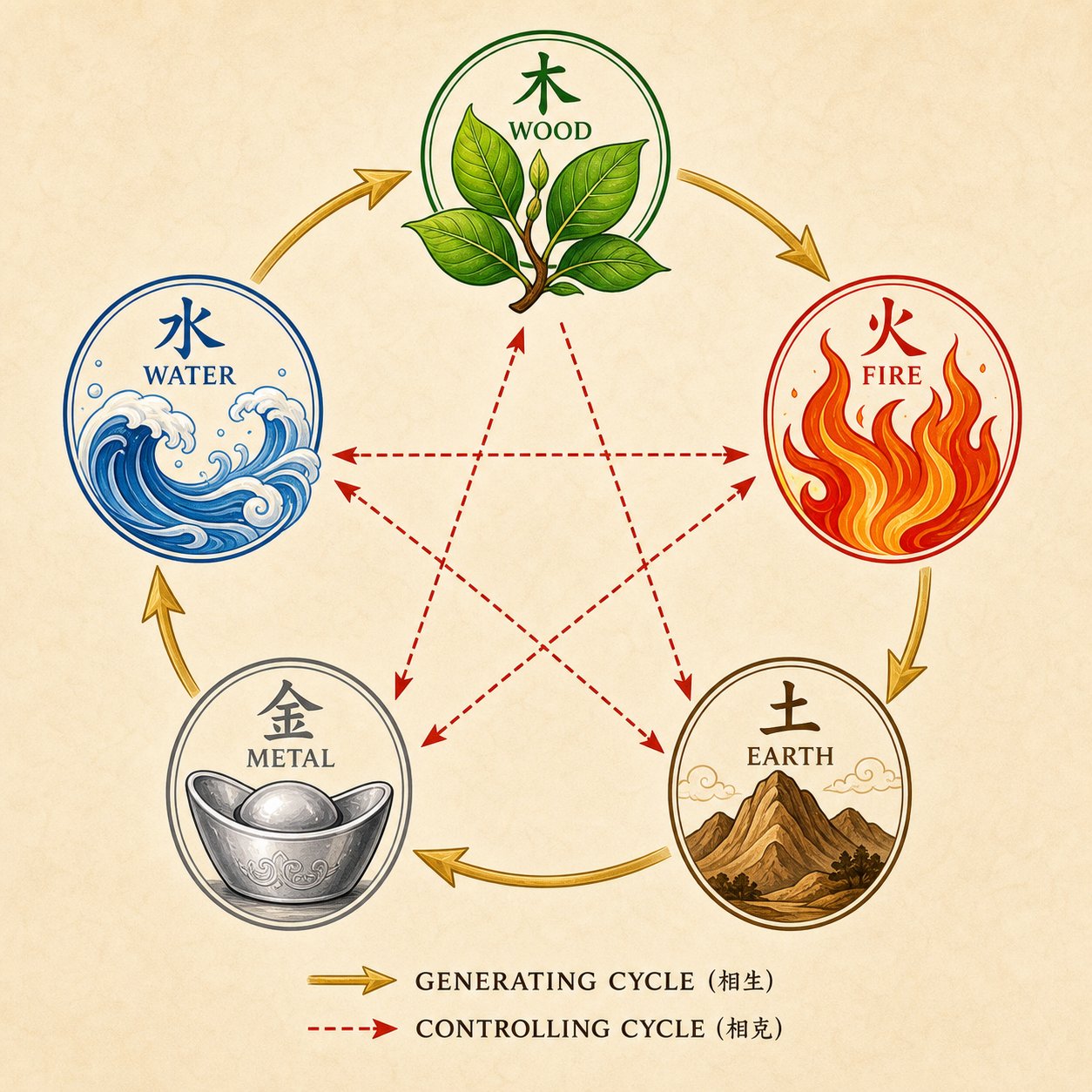
The five elements mapping for name scoring follows the sequence of the Ten Heavenly Stems (十天干), a foundational ordering system in Chinese metaphysics. Each pair of consecutive numbers corresponds to one element:
| Ones Digit | Element | Heavenly Stem Basis |
|---|---|---|
| 1, 2 | Wood (木) | 甲, 乙 |
| 3, 4 | Fire (火) | 丙, 丁 |
| 5, 6 | Earth (土) | 戊, 己 |
| 7, 8 | Metal (金) | 庚, 辛 |
| 9, 10 (0) | Water (水) | 壬, 癸 |
So a grid number of 23 has a ones digit of 3, which maps to Fire. A grid number of 30 has a ones digit of 0, treated as 10, which maps to Water. This mapping is consistent across all practitioners who use the Five Grid method.
Productive and Destructive Element Cycles in Name Analysis
Once you have your three-element sequence, you evaluate how those elements interact. The Wu Xing productive and destructive cycle for names works the same way it does everywhere else in Chinese metaphysics:
The Productive Cycle (相生): Wood feeds Fire, Fire creates Earth (ash), Earth bears Metal (ore), Metal collects Water (condensation), Water nourishes Wood. When adjacent elements in your Three Talents follow this generative flow, the configuration is considered harmonious.
The Destructive Cycle (相剋): Wood parts Earth, Earth dams Water, Water extinguishes Fire, Fire melts Metal, Metal chops Wood. When your Three Talents contain elements in a restraining relationship, especially if the Personality element is being restrained, the configuration signals friction or obstacles.
The ideal scenario is a Three Talents sequence where all three elements either match or flow in a productive chain. For instance, Wood-Fire-Earth follows the generative order perfectly. Fire-Earth-Metal does the same. These configurations are rated as highly auspicious (大吉) in traditional reference tables.
Configurations where the middle element (Ren Ge) is restrained by the top element (Tian Ge) tend to be the most problematic. Since Ren Ge represents your core personality and main fortune, having it suppressed by the Heaven element suggests external pressures working against your natural strengths. A configuration like Metal-Wood-Fire, where Metal chops Wood at the top position, would flag concern even if the lower pair (Wood feeding Fire) is productive.
Practitioners have compiled complete lookup tables covering all 125 possible three-element combinations (5 x 5 x 5), rating each from highly auspicious to highly inauspicious. You do not need to memorize the interactions. Simply identify your three elements, then check whether each adjacent pair is generative, neutral, or destructive. The more generative relationships present, the stronger your Three Talents harmony.
This elemental layer adds depth to the raw grid numbers, but it still does not give you the final verdict. Each grid number also carries its own independent luck rating within the 81-number system, a classification that tells you whether a specific number is inherently fortunate or carries warnings regardless of its elemental context.
Step 4 Look Up Your Grid Numbers in the 81 Luck Scoring System
Each of your five grid numbers now needs a verdict. Is it lucky or unlucky? The 81 number luck scoring system for Chinese names provides exactly that: a classification for every number from 1 through 81, telling you whether the energy it carries is auspicious, mixed, or harmful.
How the 81 Number Luck System Works
The system assigns a luck rating to each integer from 1 to 81. Every number carries a poetic name, an elemental association, and a fortune description covering career, family, and health. Number 1, for instance, is called "Universe Origin" (宇宙起源) and represents the ultimate auspicious beginning. Number 2, by contrast, is labeled "Solitary" (一身孤节) and signals instability and separation.
When your grid calculation produces a number, you simply look it up in the 81 strokes number meaning chart to find its rating. If any grid produces a number higher than 81, you cycle it back by subtracting 80.
Numbers cycle back after 81. A grid value of 82 is treated as 2, a value of 83 becomes 3, and so on. The system operates on a closed loop of 81 positions.
This cycling rule rarely applies in practice since most names produce grid values well under 81, but it matters for compound surnames with high stroke counts.
Auspicious Neutral and Inauspicious Number Categories
Rather than memorizing all 81 descriptions, you can use this categorized reference to quickly identify which grid number is lucky or unlucky. The following table groups all numbers into four tiers based on the consolidated 81-number reference chart compiled from multiple regional sources:
| Category | Numbers |
|---|---|
| Auspicious (吉) | 1, 3, 5, 6, 11, 13, 15, 16, 21, 23, 24, 31, 32, 33, 35, 37, 41, 47, 48, 52, 63, 65, 67, 68, 81 |
| Semi-Auspicious (半吉) | 7, 8, 17, 18, 25, 29, 38, 39, 45, 57, 58, 61, 71, 72, 73, 75 |
| Mixed / Neutral (半吉半凶) | 9, 30, 36, 49, 50, 51, 55, 77, 78 |
| Inauspicious (凶) | 2, 4, 10, 12, 14, 19, 20, 22, 26, 27, 28, 34, 40, 42, 43, 44, 46, 53, 54, 56, 59, 60, 62, 64, 66, 69, 70, 74, 76, 79, 80 |
A few patterns stand out. Numbers ending in 1, 3, 5 tend to appear more often in the auspicious category, while numbers ending in 0, 4, 2 lean inauspicious. But this is a tendency, not a rule. Number 21 is auspicious while 41 is also auspicious, yet 51 falls into the mixed category. You need to check each number individually rather than relying on digit patterns alone.
Which Grid Matters Most at Each Life Stage
Not all five grids carry equal weight at the same time. The system assigns temporal influence to different grids across a person's lifespan:
- Di Ge (Earth Grid) governs youth and early adulthood, roughly birth through the mid-30s. For baby names, this is the grid parents should scrutinize most carefully since it shapes the formative years.
- Ren Ge (Personality Grid) dominates the middle years, approximately ages 36 to 55. This is the most important grid overall because it covers the peak period of career, family building, and personal achievement.
- Zong Ge (Total Grid) influences later life, from the mid-50s onward. A strong Zong Ge suggests stability and comfort in old age.
- Tian Ge (Heaven Grid) reflects inherited family fortune and operates as background energy throughout life. Since it derives from the surname alone, it is not something you can optimize when choosing a given name.
- Wai Ge (External Grid) affects social relationships and external opportunities across all stages, though its influence is considered secondary to Ren Ge.
What counts as a good score threshold? Ideally, you want auspicious numbers for Chinese name grids in at least Ren Ge and Di Ge (or Zong Ge, depending on the person's current life stage). A name where all five grids land in the auspicious tier is rare. Most real names produce a mix of results, which raises the practical question: what do you do when some grids score well and others do not?
Step 5 Interpret Combined Results and Determine Overall Luck
You have five grid numbers, each with its own luck rating. You have a Three Talents configuration with an elemental harmony verdict. Chances are, the results are not uniformly glowing. Maybe your Ren Ge landed on an auspicious number but your Wai Ge came back inauspicious. Or your Three Talents flow beautifully while one grid sits in the "mixed" category. How do you interpret Chinese name luck score results when the picture is this uneven?
The short answer: not all grids carry equal weight, and harmony between grids can matter more than any single number in isolation.
How to Weigh Conflicting Grid Scores
When conflicting grid scores appear, the question becomes which grids deserve your attention and which ones you can reasonably accept as imperfect. Practitioners follow a clear priority hierarchy:
- Ren Ge (Personality Grid) carries the highest weight. It governs core fortune and personality across the most productive years of life. An auspicious Ren Ge can anchor an otherwise mixed name.
- Di Ge (Earth Grid) ranks second, especially for children and young adults. It shapes early opportunities, peer relationships, and foundational experiences.
- Zong Ge (Total Grid) comes third. It reflects cumulative life energy and later-year stability.
- Wai Ge (External Grid) is secondary. It influences social dynamics but rarely overrides the core grids.
- Tian Ge (Heaven Grid) is the least actionable. Since it derives from the surname alone, you cannot change it without changing your family name. Practitioners generally treat an inauspicious Tian Ge as inherited background noise rather than a dealbreaker.
Imagine a name where Ren Ge scores 16 (auspicious, "great fortune through noble assistance") but Tian Ge scores 14 (inauspicious). That Tian Ge result is essentially cosmetic. The name still reads as strong because the grid that matters most is solid. Flip the scenario, a lucky Tian Ge with an inauspicious Ren Ge, and the assessment shifts dramatically toward concern.
The reference material from Meimingteng's naming analysis confirms this weighting approach: the Five Grid system (五格) uses the 81-number chart to evaluate life fortune, but the stroke combinations that produce high scores differ by surname. A name scoring 98 out of 100 on Five Grid analysis, like the example name "Li Junlin" (李俊霖), achieves that score precisely because Ren Ge (16, great fortune) and Di Ge (25, auspicious) both land in strong positions, even though Tian Ge (8) is merely semi-auspicious.
When Three Talents Harmony Overrides Weak Grids
Here is where interpretation gets nuanced. A name can have one or two grids in the semi-auspicious or even mixed category yet still receive a favorable overall reading if the Three Talents configuration is harmonious.
Why? The Three Talents represent the dynamic relationship between Heaven, Person, and Earth. When those three elements flow in a productive cycle, the system interprets it as a supportive life environment: external conditions (Heaven) nurture personal ability (Person), which in turn generates stable foundations (Earth). This relational harmony can compensate for a mediocre individual grid number because it signals that the overall energy pattern works cooperatively rather than at cross-purposes.
Consider the example name "Yang Shuya" (杨舒雅) from the same reference. Its Tian Ge is 14, which falls squarely in the inauspicious category. Yet the name scores 98 on Five Grid analysis overall. The reason: its Three Talents configuration (Fire-Earth-Fire) is rated as auspicious, and both Ren Ge (25) and Zong Ge (37) are strong. The harmonious Three Talents effectively neutralize the weak Tian Ge.
Conversely, a name where all five grids land on decent numbers but the Three Talents clash destructively will receive a lower overall assessment. Elemental conflict between Heaven and Person (the top two positions) is particularly damaging because it suggests external forces suppressing personal potential.
Score Thresholds for Existing Names vs New Baby Names
The acceptable name luck score threshold depends on whether you are evaluating a name already in use or selecting a new one.
For existing names: A name where Ren Ge is auspicious or semi-auspicious, the Three Talents are harmonious, and at least two other grids score favorably is considered solid. Most practitioners would not recommend a name change unless Ren Ge itself is inauspicious and the Three Talents configuration is destructive simultaneously. One weak grid in isolation, particularly Tian Ge or Wai Ge, is not grounds for concern.
For new baby names: You have more freedom to optimize. The standard here is higher because you are choosing from scratch. Aim for auspicious ratings on Ren Ge, Di Ge, and Zong Ge, with a harmonious Three Talents configuration. If you can also land Wai Ge in the auspicious or semi-auspicious range, that is ideal. Tian Ge is fixed by the surname, so accept whatever it produces and focus your energy on the grids you can influence through given name character selection.
No name scores perfectly across all dimensions. The goal is not five auspicious grids plus a perfect Three Talents. The goal is strength where it matters most: Ren Ge, Three Talents harmony, and the grid that corresponds to the bearer's current life stage.
A practical rule of thumb: if three out of five grids are auspicious, the Three Talents are harmonious, and Ren Ge is not inauspicious, the name is working in your favor. Perfection is a mathematical rarity given the constraints that surname stroke counts impose on available combinations.
Theory and priority rules are useful, but nothing clarifies a method like watching it work from start to finish on an actual name. A complete worked example pulls every step together: stroke counts, grid formulas, Three Talents derivation, 81-number lookup, and the final combined interpretation all in one continuous calculation.
Step 6 Full Worked Example With a Real Chinese Name
Celebrity Chinese name luck score analysis is a staple on nameology sites across Asia, and for good reason. Seeing the method applied to a familiar name makes the abstract formulas click. Let's walk through the complete process using the name Liu Dehua (刘德华), the legal name of Hong Kong superstar Andy Lau, as our step by step name scoring calculation example.
Choosing a Sample Name and Finding Stroke Counts
The name 刘德华 is a single-surname, double-given-name structure. The first task is converting each character to its Kang Xi stroke count. Remember, simplified forms do not apply here.
- 刘 (Liú) — The traditional form is 劉. Kang Xi stroke count: 15
- 德 (Dé) — Same in traditional and simplified. Kang Xi stroke count: 15
- 华 (Huá) — The traditional form is 華. Kang Xi stroke count: 14
Notice that 刘 jumps from 6 strokes in simplified to 15 in traditional, and 华 goes from 6 to 14. If you used simplified counts, every grid number would be wrong. This is exactly why the Kang Xi standard matters.
Computing All Five Grids Step by Step
With stroke counts of 15, 15, and 14 in hand, here is how to calculate five grids for this real name using the single-surname formulas:
| Grid | Formula | Calculation | Result |
|---|---|---|---|
| Tian Ge (天格) | Surname + 1 | 15 + 1 | 16 |
| Ren Ge (人格) | Surname + 1st given name char | 15 + 15 | 30 |
| Di Ge (地格) | 1st given name + 2nd given name | 15 + 14 | 29 |
| Zong Ge (總格) | All strokes combined | 15 + 15 + 14 | 44 |
| Wai Ge (外格) | Zong Ge - Ren Ge + 1 | 44 - 30 + 1 | 15 |
Five numbers: 16, 30, 29, 44, 15. Each one now needs two layers of evaluation: the Three Talents elemental mapping and the 81-number luck lookup.
Three Talents derivation:
- Tian Ge 16 → ones digit 6 → Earth (土)
- Ren Ge 30 → ones digit 0 → Water (水)
- Di Ge 29 → ones digit 9 → Water (水)
The Three Talents configuration is Earth — Water — Water.
Elemental relationships: Earth and Water sit in a destructive cycle (Earth dams Water), meaning the Heaven position restrains the Personality position. Water and Water at the lower pair are the same element, which is neutral and cooperative. This configuration carries tension at the top but stability at the base.
81-number lookup for each grid:
| Grid | Number | Category | Interpretation |
|---|---|---|---|
| Tian Ge | 16 | Auspicious (吉) | Noble assistance, great fortune through leadership |
| Ren Ge | 30 | Mixed (半吉半凶) | Fluctuating fortune, highs and lows alternate |
| Di Ge | 29 | Semi-Auspicious (半吉) | Strong ambition, success through effort |
| Zong Ge | 44 | Inauspicious (凶) | Obstacles and setbacks in later years |
| Wai Ge | 15 | Auspicious (吉) | Blessed social connections, benefactors appear |
Final Interpretation and Luck Assessment
Here is where the Chinese name luck score worked example gets interesting. The results are mixed, which is typical of real names.
Strengths: Tian Ge (16) and Wai Ge (15) are both solidly auspicious. The external environment and social relationships favor this name's bearer. Di Ge (29) is semi-auspicious, suggesting a strong early life foundation built through personal drive.
Weaknesses: Ren Ge (30) lands in the mixed category, indicating a life of dramatic peaks and valleys rather than smooth sailing. Zong Ge (44) is inauspicious, flagging potential challenges in later years. The Three Talents configuration shows Earth restraining Water at the top, adding pressure on the core personality grid.
Overall assessment: Applying the priority hierarchy from the previous chapter, the most critical grid (Ren Ge) is mixed rather than outright inauspicious, and the Three Talents show only partial conflict. The strong Wai Ge (15) suggests powerful external support, which aligns with Andy Lau's well-documented reputation for industry relationships and loyal collaborators. A practitioner would rate this name as functional but imperfect, perhaps a 65-70 out of 100 on a composite scale.
Would a nameologist recommend changing it? Probably not. The Ren Ge is not in the inauspicious tier, the social grid is excellent, and the early-life grid supported the career-building years. The Zong Ge weakness is a caution flag, not a crisis.
You can replicate this exact process with your own name. Grab the Kang Xi stroke counts, run the five formulas, derive the Three Talents, check the 81-number chart, and weigh the results using the priority system. The arithmetic takes five minutes. The interpretation is where judgment and nuance come in, and where the most common calculation errors can throw everything off.
Common Mistakes to Avoid When Counting Name Strokes
A single stroke miscounted at the beginning cascades through every grid, every element mapping, and every luck rating that follows. The most common mistakes in Chinese name stroke counting are not random arithmetic errors. They fall into predictable categories, and once you know where the traps are, you can sidestep them entirely.
Radical Variants That Change Your Stroke Count
Radicals are the number one source of radical stroke count errors in the Kang Xi dictionary system. The problem is visual: you see a radical written in its abbreviated form and count what your eyes tell you. But the Kang Xi standard counts the radical based on its original, unabbreviated character. The gap between appearance and official count ranges from one to four strokes per radical.
Here are the radicals that cause the most trouble, with their correct Kang Xi values versus what most people assume:
| Radical | Appears As | What People Count | Correct Kang Xi Count | Original Character |
|---|---|---|---|---|
| 艹 (grass) | Flat top with two short strokes | 3 or 4 | 6 | 艸 |
| 辶 (walk) | Sweeping bottom stroke | 3 or 4 | 7 | 辵 |
| 阝 left (mound) | Curved ear shape, left side | 2 or 3 | 8 | 阜 |
| 阝 right (city) | Curved ear shape, right side | 2 or 3 | 7 | 邑 |
| 氵 (water) | Three dots | 3 | 4 | 水 |
| 忄 (heart) | Vertical with two dots | 3 | 4 | 心 |
| 扌 (hand) | Horizontal, vertical, hook | 3 | 4 | 手 |
| 衤 (clothes) | Similar to 礻 with extra dot | 5 | 6 | 衣 |
| 礻 (spirit/altar) | Dot, horizontal, vertical, dot | 4 | 5 | 示 |
Notice that the left ear radical (阝) and right ear radical (阝) look identical but derive from different characters with different stroke counts. A name like 陈 (Chén) uses the left ear (8 strokes for the radical), while 郑 (Zhèng) uses the right ear (7 strokes). Mixing these up is one of the subtlest errors in the system.
The grass radical (艹) deserves special attention. Characters like 萱, 芳, 荣, 莉, and 菲are extremely popular in given names, and every single one of them carries two to three extra strokes that people routinely miss. If you are scoring a name with any grass-radical character, add 6 for that component, not the 3 or 4 your hand naturally writes.
Traditional vs Simplified Counting Errors
Beyond radicals, the second major trap is forgetting to convert simplified characters to their traditional forms before counting. Some differences are dramatic enough to shift a grid number by ten or more positions on the 81-number chart.
Consider these real scenarios where traditional vs simplified counting errors derail an analysis:
- 泽 vs 澤 — Simplified is 8 strokes. Traditional is 17 strokes. A nine-stroke gap that completely changes Ren Ge and Zong Ge.
- 丽 vs 麗 — Simplified is 7 strokes. Traditional is 19 strokes. Twelve strokes of difference, the largest common gap.
- 龙 vs 龍 — Simplified is 5 strokes. Traditional is 16 strokes. An eleven-stroke difference that would produce an entirely different luck profile.
- 书 vs 書 — Simplified is 4 strokes. Traditional is 10 strokes. Six strokes apart.
A less obvious mistake: assuming that characters which look the same in simplified and traditional actually share the same stroke count. The character 杰 (8 strokes) is the simplified form, but the correct traditional form for name scoring is 傑 (12 strokes). They do not even share the same radical structure. Always verify, even when a character appears unchanged.
Two other formula-level errors trip people up repeatedly. Forgetting to add 1 to the surname stroke count for Tian Ge is common, especially after spending time on the more intuitive Ren Ge and Di Ge calculations. And for compound surnames, people sometimes add 1 to Tian Ge out of habit when the double-surname formula does not require it. Both mistakes propagate into the Wai Ge calculation since Wai Ge depends on Zong Ge minus Ren Ge plus 1.
Why Online Tools Sometimes Disagree With Manual Counts
You run your name through two different websites and get two different scores. Which one is right? Understanding why online name scoring tools give different results helps you troubleshoot rather than just picking the answer you prefer.
The most common reasons for discrepancies:
- Different stroke databases. Some tools use modern standard stroke counts rather than Kang Xi values. If a site does not explicitly state it follows the Kang Xi dictionary, its radical handling may differ.
- Variant character forms. Characters like 岳/嶽 have multiple traditional forms with different stroke counts. Tools may default to different variants.
- Radical interpretation disagreements. A small number of radicals have disputed counts across different editions of reference materials. The 月 radical (is it "moon" at 4 strokes or "flesh" at 4 strokes?) rarely causes numeric differences, but 王 as a radical (4 or 5 strokes depending on whether it represents 玉) can split tools.
- Formula variations for edge cases. Some tools calculate Wai Ge differently for two-character names or handle compound surnames with non-standard formulas.
When results conflict, here is a checklist to verify your correct stroke count for each name character:
- Confirm you are using the traditional (繁体) form of each character, not simplified.
- Check every radical against the Kang Xi restoration rules. Count the radical at its original character value, not its visual shorthand.
- Verify the total by cross-referencing at least two Kang Xi stroke count databases or dictionaries.
- Double-check whether your surname is single or compound, and confirm you applied the correct formula set.
- Ensure you added 1 for Tian Ge (single surname only) and did not accidentally add 1 where it does not belong.
- Recalculate Wai Ge last, since it depends on Zong Ge and Ren Ge both being correct first.
If your manual calculation still disagrees with an online tool after this verification, trust your manual count, provided you followed Kang Xi rules precisely. Many popular free tools cut corners on radical restoration or use mixed stroke databases to simplify their backend logic.
Accuracy in stroke counting is a technical skill. But even a perfectly calculated score raises a broader question: how much weight should you actually give this system when making real naming decisions? The 81-number method has a specific historical origin and specific limitations that are worth understanding before you treat any score as final.

Is the 81 Strokes System Reliable and Should You Trust Your Score
You have run the numbers, checked the chart, and arrived at a score. But here is a question worth sitting with: how much authority should that score actually carry? The 81 strokes name system has a specific history, and understanding where it came from helps you decide how much weight to give it.
The Japanese Origins and Adaptation Debate
The Five Grid method was not born in China. It was created in 1918 by Japanese scholar Kumazaki Ken'o (熊崎健翁), who built the system around Japanese kanji and numerological principles drawn partly from Chinese I-Ching philosophy. The 81-number classification, the grid formulas, the Three Talents mapping: all of it originated in a Japanese cultural context where kanji usage, naming conventions, and phonetic structures differ from Chinese.
When Bai Yuguang brought the system to Taiwan in 1936, he adapted it for Chinese names. But critics point out that the adaptation was largely mechanical. The formulas transferred directly. The 81-number meanings transferred directly. What did not transfer was any deep recalibration for the structural differences between Japanese and Chinese naming. Japanese names typically have longer given names with more characters, different surname distributions, and kanji readings that carry phonetic values absent in Chinese.
Does this Japanese origin make the system invalid? Not necessarily. But it does mean the 81-number meanings were not derived from centuries of Chinese naming observation. They were imported. Some practitioners in mainland China and Hong Kong treat the system as fully authoritative. Others, particularly those trained in classical Chinese metaphysics, view it as a modern addition that lacks the deep empirical roots of older systems like BaZi (八字) or Zi Wei Dou Shu (紫微斗数).
What the Stroke System Does Not Account For
Even if you accept the system's validity on its own terms, it operates within a narrow band of analysis. The stroke-count method evaluates numerical relationships only. It is completely silent on several dimensions that traditional Chinese naming considers essential:
- Character meaning. A character with a beautiful stroke count but a negative or violent meaning would score well numerically while being a poor name choice. The system cannot distinguish between 华 (splendor) and a hypothetical character with the same stroke count but an unfavorable connotation.
- Phonetic harmony. Tonal flow, homophone avoidance, and how a name sounds when spoken aloud are invisible to stroke-based scoring. A name that sounds awkward or carries embarrassing phonetic associations gets no penalty in this system.
- BaZi compatibility. The Four Pillars birth chart identifies which of the Five Elements a person needs strengthened based on their exact birth time. The stroke system's Five Elements mapping is generic. It does not personalize to the individual's elemental deficiencies.
- Visual and calligraphic balance. How characters look together when written, their structural density, and their aesthetic harmony are dimensions that traditional Chinese naming takes seriously but stroke scoring ignores entirely.
In other words, a name can score 95 on the Five Grid system and still be a mediocre name if it sounds clumsy, looks unbalanced, or clashes with the bearer's birth chart. The score captures one layer of a multi-layered decision.
How to Use Your Score as One Factor Among Many
The most productive stance is treating your stroke-based score as a reference point rather than a verdict. It highlights potential numerical harmony or friction. It does not tell you whether a name is holistically good or bad.
A name luck score is one lens among several. It reveals numerical patterns but cannot evaluate meaning, sound, elemental fit to your birth chart, or visual beauty. Use it as a data point, not a final judgment.
If you want a more complete picture, consider exploring complementary systems alongside stroke-based scoring:
- BaZi (八字) Four Pillars analysis — identifies your personal elemental needs based on birth time, allowing character selection that compensates for specific weaknesses.
- Zi Wei Dou Shu (紫微斗数) — a fate-mapping system that can inform which life areas need support, guiding name character choices toward relevant themes.
- Character meaning and literary analysis — evaluating the cultural resonance, classical allusions, and semantic weight of each character independent of stroke count.
- Phonetic and tonal analysis — ensuring the name flows naturally across Mandarin's four tones and avoids unfortunate homophones.
- Wu Xing (五行) radical analysis — selecting characters whose radicals directly represent needed elements (water radical for Water, wood radical for Wood) rather than relying solely on numerical element mapping.
For parents choosing a baby name, the practical approach is to use the stroke score as a filter: eliminate candidates that produce clearly inauspicious Ren Ge numbers or destructive Three Talents configurations, then make your final choice based on meaning, sound, and birth chart fit among the remaining options. For adults checking an existing name, a mixed score is normal and not cause for alarm unless the core grids are deeply problematic.
The 81-number system gives you structure and specificity. It turns a subjective question into arithmetic you can verify. That is its strength. Its limitation is pretending that arithmetic alone can capture everything a name carries. The best use of your score is knowing what it measures, knowing what it misses, and letting both inform your decision.
Frequently Asked Questions About Chinese Name Luck Scoring
1. How many strokes should I count for simplified Chinese characters in name scoring?
You should not use simplified stroke counts. The Five Grid system requires Kang Xi Dictionary stroke counts, which are based on traditional character forms. For example, the simplified character 龙 has 5 strokes, but its traditional form 龍 has 16 strokes. Always convert each character to its traditional equivalent and count radicals at their original unabbreviated values before running any grid calculations.
2. What is the most important grid in the Five Grid name analysis?
Ren Ge (人格, Personality Grid) is considered the most important grid because it governs core life fortune and personality during the most productive years, roughly ages 36 to 55. It sits at the intersection of surname and given name, bridging inherited energy with personal identity. An auspicious Ren Ge can anchor an otherwise mixed name, while an inauspicious Ren Ge raises concern regardless of how other grids perform.
3. Can a Chinese name score perfectly across all five grids?
A perfect score across all five grids is extremely rare due to the mathematical constraints that surname stroke counts impose on available combinations. Since Tian Ge is fixed by the surname and cannot be changed, most real names produce a mix of auspicious and less favorable results. Practitioners consider a name strong if three out of five grids are auspicious, the Three Talents configuration is harmonious, and Ren Ge is not inauspicious.
4. Why do different online Chinese name scoring tools give different results?
Discrepancies between online tools typically stem from different stroke databases (some use modern counts instead of Kang Xi values), variant character forms with different stroke totals, disagreements on radical interpretation, or non-standard formula handling for edge cases like two-character names. To verify accuracy, confirm you are using traditional character forms, check radicals against Kang Xi restoration rules, and cross-reference at least two reliable stroke count databases.
5. Should I change my name if the luck score is low?
Most practitioners would not recommend a name change unless Ren Ge itself is inauspicious and the Three Talents configuration is simultaneously destructive. A single weak grid, particularly Tian Ge or Wai Ge, is not grounds for concern. The stroke-based score is also just one analytical layer. It does not account for character meaning, phonetic harmony, or birth chart compatibility, so a low score alone should not drive a major life decision.