Why Your Birth Date Holds the Key to a Meaningful Chinese Name
Imagine two babies born on the same day but at different hours. In Chinese naming tradition, those two children would receive entirely different names, each tailored to the unique elemental fingerprint encoded in their exact moment of birth. This is the foundation of BaZi naming (八字取名), a centuries-old practice that treats your birth date and time as a blueprint for selecting characters that bring balance to your life.
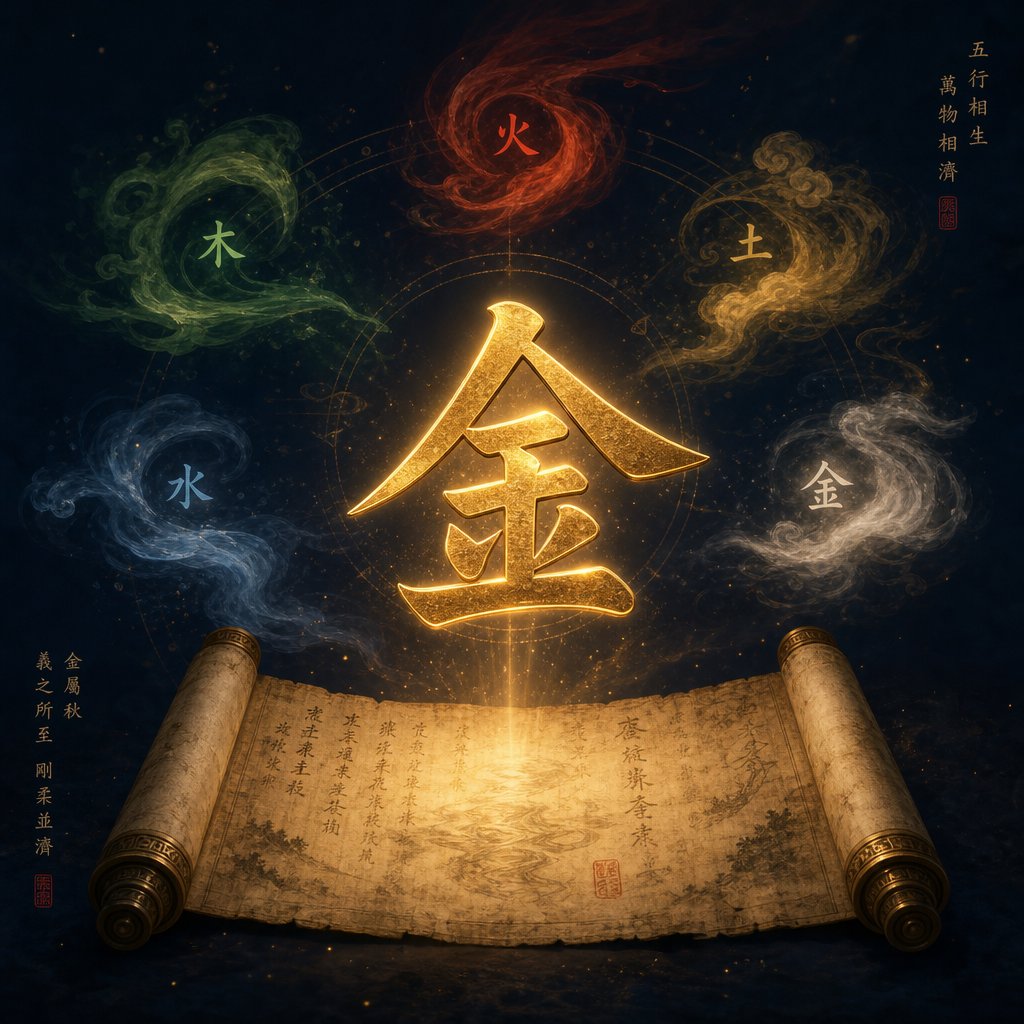
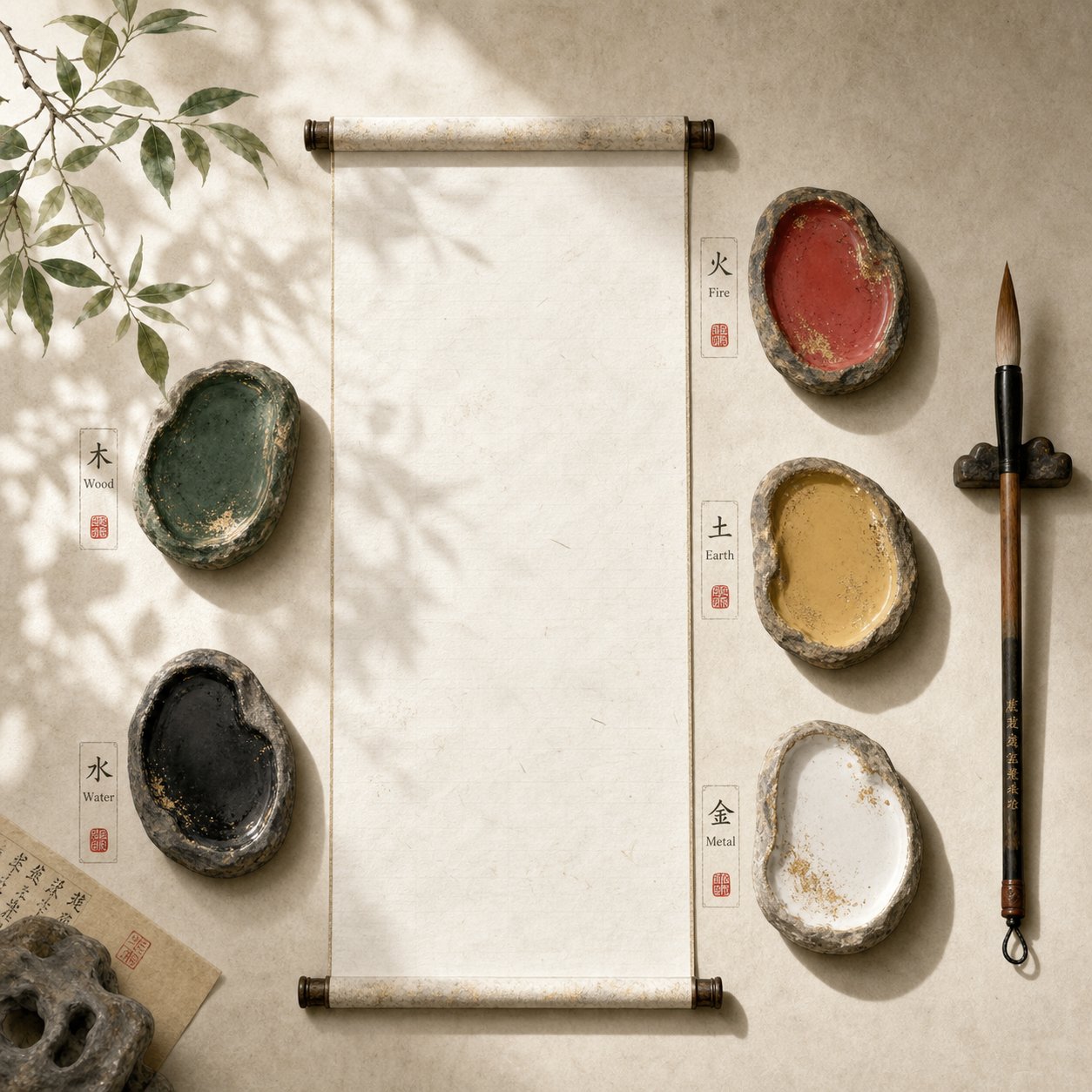
The method works like this: your birth year, month, day, and hour are each converted into pairs of Heavenly Stems and Earthly Branches, producing eight characters total. Each character carries one of the Five Elements: Wood, Fire, Earth, Metal, or Water. Some elements will appear multiple times in your chart, others may be weak or completely absent. The name you receive is designed to compensate for what your chart lacks and reinforce what supports your core identity, known as the Day Master.
This guide walks you through the actual traditional methodology step by step, from converting your Gregorian birth date into the Chinese calendar system, to tallying your elemental balance, identifying your favorable element, and finally selecting characters that restore harmony. It is rigorous, but you do not need to be a metaphysics scholar to follow along.
What Makes Birth-Date-Based Naming Different from Random Generators
If you have ever typed "what is my chinese name" into a search engine, you have likely encountered a chinese name generator that assigns a name based on your English name's phonetics or your zodiac animal. These tools are fun, but they skip the analytical core of traditional naming entirely. They cannot tell you whether your birth chart is dominated by Fire or starved of Water, and they certainly cannot identify which specific element would strengthen your personal Day Master.
The BaZi method is fundamentally different. It does not start with what sounds nice or what your zodiac animal suggests. It starts with a precise diagnosis of your elemental composition and builds the name as a corrective prescription. A name chosen through this process is believed to harmonize with a person's destiny rather than simply label them.
Who This Guide Is For
Whether you are curious about the theory behind how to find your chinese name through traditional methods, attempting a basic self-analysis for yourself or a newborn, or trying to evaluate the work a professional nameologist has done for your family, this guide gives you the framework to understand each step. You will know what questions to ask, what calculations matter, and where the process demands expert judgment versus where you can verify results on your own.
For anyone wondering "what's my chinese name" according to authentic tradition, the answer is never random. It is calculated.
A name chosen by birth date aims to strengthen what the birth chart lacks, creating elemental balance that supports the person throughout life.
The starting point for all of this is your birth data, translated into a language the Five Elements system can read. That translation begins with converting your familiar calendar date into Heavenly Stems and Earthly Branches, the building blocks of your entire BaZi chart.
Step 1 Convert Your Birth Date to Heavenly Stems and Earthly Branches
Your Gregorian birth date, say June 12, 1990, means nothing to the Five Elements system on its own. The entire BaZi naming framework operates on a different calendar altogether, one built from cyclical pairs of symbols rather than months and days. Before any elemental analysis can happen, your familiar date needs to be translated into the language of Heavenly Stems (天干) and Earthly Branches (地支). Think of this step as converting currencies: you cannot spend dollars in a system that only accepts yuan.
Gregorian to Lunar Calendar Conversion
The Chinese lunar calendar tracks the moon's orbit around the earth, with each month beginning when the moon aligns between the earth and sun. This means lunar months contain either 29 or 30 days, and a lunar year typically holds only 354 or 355 days. To compensate for the roughly 11-day annual gap with the Gregorian calendar, a leap month is inserted every 32 or 33 months, giving some years 13 months instead of 12.
The practical consequence? A birth date of March 15 in one year may fall in the second lunar month, while March 15 the following year lands in the third lunar month. The two dates carry completely different Stem-Branch assignments and therefore different elemental profiles. You cannot simply look at the Gregorian month and assume you know the lunar month.
For accurate chinese name conversion from a Western date, use established conversion tables or a trusted online BaZi calculator. Manual calculation requires access to historical almanac data going back decades, so digital tools save significant effort here. Just confirm that the tool accounts for leap months and uses the correct year boundaries, since the lunar new year falls on a different Gregorian date each January or February.
Understanding Heavenly Stems and Earthly Branches
The Stem-Branch system is a counting method that has been in use for thousands of years. As early as about 2700 BC, ancient Chinese scholars created ten Heavenly Stems and twelve Earthly Branches that combine into a repeating 60-unit cycle. This cycle applies to years, months, days, and hours, meaning every moment in time receives a unique Stem-Branch label.
Each of the 10 Heavenly Stems carries a fixed elemental identity and a Yin or Yang polarity. These are not arbitrary assignments. They follow the natural progression of a plant's life cycle through the seasons, from sprouting (Wood) through flourishing (Fire and Earth) to harvest (Metal) and dormancy (Water). Here is the complete set:
| Order | Chinese Character | Pinyin | Element | Polarity |
|---|---|---|---|---|
| 1 | 甲 | Jia | Wood | Yang |
| 2 | 乙 | Yi | Wood | Yin |
| 3 | 丙 | Bing | Fire | Yang |
| 4 | 丁 | Ding | Fire | Yin |
| 5 | 戊 | Wu | Earth | Yang |
| 6 | 己 | Ji | Earth | Yin |
| 7 | 庚 | Geng | Metal | Yang |
| 8 | 辛 | Xin | Metal | Yin |
| 9 | 壬 | Ren | Water | Yang |
| 10 | 癸 | Gui | Water | Yin |
The 12 Earthly Branches work similarly, each paired with a zodiac animal and carrying its own elemental weight. When a Stem and a Branch combine, they form one pillar. Your birth year gets one pillar, your birth month another, your birth day a third, and your birth hour a fourth. That gives you four Stem-Branch pairs, or eight characters total, which is exactly why the system is called BaZi (八字, "eight characters").
A chinese name translator tool or BaZi calculator can perform this conversion in seconds, but understanding the underlying logic matters. If you know that Jia and Yi are always Wood, and Bing and Ding are always Fire, you can immediately spot-check any calculator's output. You will also recognize why two people born just one day apart might have very different elemental profiles: the Day Stem rotates through all ten stems in a ten-day cycle, shifting the core element of the Day Pillar with each new day.
With your birth date fully converted into four Stem-Branch pairs, you now have the raw data the Five Elements analysis requires. The next layer of depth comes from understanding what each of those four pillars actually represents, and why the hour pillar in particular can shift your entire elemental balance.

Step 2 Calculate Your Four Pillars Including the Birth Hour
Four Stem-Branch pairs sit in front of you. Each one represents a different dimension of your life, and together they form the complete BaZi chart (生辰八字) that drives every naming decision. But these pillars are not equal in weight or function. Understanding what each pillar governs helps you see why the Day Pillar anchors the entire analysis, and why skipping the Hour Pillar leaves a quarter of your elemental picture in the dark.
The Four Pillars Explained
Think of the four pillars as four chapters of a biography, each covering a different life domain and time period:
- Year Pillar (年柱) relates to ancestry, family heritage, and early childhood. It reflects the social environment you were born into and your public reputation in the broader world.
- Month Pillar (月柱) governs parents, career direction, and the formative years of young adulthood. The Month Branch is especially powerful because it reveals the season of birth, which directly affects how strong or weak your core element is.
- Day Pillar (日柱) represents you. Specifically, the Heavenly Stem of the Day Pillar is your Day Master (日主), the single character that stands for your core identity. Every other element in the chart is interpreted relative to this one character: does it support the Day Master, drain it, or control it?
- Hour Pillar (时柱) connects to children, creative output, and later life. It also reveals inner ambitions and the legacy you leave behind.
The Day Master is the protagonist of your chart. When you ask "what would my chinese name be" according to traditional methodology, the answer depends entirely on what your Day Master needs. A weak Wood Day Master needs different support than a strong Metal Day Master, and the name is built to serve that specific need.
Why Birth Hour Cannot Be Skipped
Here is where many simplified guides fall short. They calculate three pillars from the year, month, and day, then stop. But the Hour Pillar accounts for two of your eight characters, meaning it carries 25% of your total elemental data. Dropping it is like diagnosing a patient after examining only three of their four limbs.
Traditional Chinese timekeeping divides the day into 12 two-hour segments called shichen (时辰), each governed by one Earthly Branch. A person born at 2:00 AM falls in the Chou (丑) period, while someone born at 2:00 PM on the same day falls in the Wei (未) period. Different Branch, different element, different Hour Pillar entirely. The complete schedule looks like this:
- Zi (子) — 23:00 to 01:00
- Chou (丑) — 01:00 to 03:00
- Yin (寅) — 03:00 to 05:00
- Mao (卯) — 05:00 to 07:00
- Chen (辰) — 07:00 to 09:00
- Si (巳) — 09:00 to 11:00
- Wu (午) — 11:00 to 13:00
- Wei (未) — 13:00 to 15:00
- Shen (申) — 15:00 to 17:00
- You (酉) — 17:00 to 19:00
- Xu (戌) — 19:00 to 21:00
- Hai (亥) — 21:00 to 23:00
Notice that the Zi hour straddles midnight, which creates a well-known debate among practitioners about whether the day pillar flips at 23:00 or at midnight. Most modern BaZi software uses a compromise approach: the day pillar changes at midnight (00:00), but the hour stem already follows the next day's derivation from 23:00 onward. If your birth falls between 23:00 and 01:00, double-check which convention your calculator uses.
For anyone wondering what would be my chinese name if I do not know my exact birth time, the honest answer is that precision drops significantly. Some practitioners will run the chart for two adjacent shichen and look for overlapping recommendations, but the result is inherently less targeted.
How the Chinese Zodiac Animal Connects to Your Pillars
You probably already know your Chinese zodiac animal. What you may not realize is that it is simply the Earthly Branch of your Year Pillar wearing a familiar costume. The Rat is Zi, the Ox is Chou, the Tiger is Yin, and so on through all twelve animals. This makes the zodiac animal one data point out of eight in your full chart, not a standalone naming system.
When someone asks "what is my mandarin name" and expects the answer to come from their zodiac sign alone, they are working with roughly 12.5% of the available information. A Tiger-year person shares their Year Branch with hundreds of millions of people born in the same year. The Month, Day, and Hour Pillars are what differentiate one Tiger from another, and the Day Master is what determines what the name actually needs to accomplish.
With all four pillars mapped out, you have the complete eight-character dataset. The real analytical work begins when you tally the elements across those characters and measure which ones dominate, which ones barely register, and which ones are missing entirely.
Step 3 Assess the Five Elements Balance in Your Birth Chart
You have eight characters laid out across four pillars. Each one carries an elemental identity. But here is what catches most beginners off guard: the surface-level count is only part of the picture. Earthly Branches contain hidden stems (藏干) that embed additional elemental energy beneath what you can see at first glance. A thorough tally accounts for both the visible and the concealed, giving you the full elemental landscape of your chart.
This is the step that answers the question "what is my chinese element" in a meaningful way. Your element is not just your zodiac year or your Day Master in isolation. It is the entire distribution of Wood, Fire, Earth, Metal, and Water across all layers of your birth chart, measured against what your Day Master actually needs.
Counting Elements Across All Eight Characters
Start with the straightforward part. List your four Heavenly Stems and note each one's element directly from the table in Step 1. Jia is Wood, Bing is Fire, Geng is Metal, and so on. No ambiguity there.
The Earthly Branches require more attention. Each Branch has a primary element (its Main Qi), but most also contain one or two hidden stems that carry secondary elements. For example, the Branch Yin (寅, Tiger) has Jia Wood as its Main Qi, but it also hides Bing Fire and Wu Earth. Only four branches are "pure" with a single hidden stem: Zi (Rat, pure Water), Mao (Rabbit, pure Wood), Wu (Horse, dominated by Fire), and You (Rooster, pure Metal). Every other branch introduces multiple elements into your count.
The Main Qi of each branch carries roughly 60-70% of that branch's elemental influence, the Middle Qi is secondary, and the Residual Qi is a trace presence. When tallying, give the Main Qi full weight and note the secondary stems as partial contributions. Here is a sample format for organizing your count:
| Source | Wood | Fire | Earth | Metal | Water |
|---|---|---|---|---|---|
| 4 Heavenly Stems | 1 | 1 | 0 | 1 | 1 |
| 4 Earthly Branches (Main Qi) | 1 | 2 | 0 | 1 | 0 |
| Hidden Stems (Middle/Residual Qi) | 0 | 1 | 2 | 0 | 1 |
| Total | 2 | 4 | 2 | 2 | 2 |
In this hypothetical chart, Fire dominates with four appearances while all other elements sit at two. The distribution tells a story, but the raw numbers alone do not tell you what to do about it. That depends on which element is your Day Master and whether Fire is helping or hurting it.
Identifying Strong, Weak, and Missing Elements
A general rule of thumb: an element appearing three or more times across all sources is considered strong in the chart. An element appearing only once is weak. An element with zero representation is missing entirely. But these labels only matter in relation to your Day Master.
The Day Master's strength is not determined by counting how many times its own element appears. It is assessed relative to the balance between elements that support it and elements that oppose it. Supporting elements include the Day Master's own element (Companion Stars) and the element that generates it (Resource Stars). Opposing elements include those that drain the Day Master (its output), those it must control (Wealth Stars), and those that control it (Officer/Kill Stars).
If supporting elements outnumber opposing ones and the Day Master is born in a favorable season, the Day Master is strong. A strong Day Master needs to be drained or controlled, so the name should introduce elements that channel its excess energy. If opposing elements dominate and the season works against the Day Master, it is weak and needs reinforcement through elements that generate or match it.
When someone asks "what element am i chinese" expecting a single-word answer, the reality is more layered. You are your Day Master element, but your chart's overall balance determines whether that element needs strengthening or tempering. A person whose Day Master is Fire but whose chart is already overloaded with Fire energy does not need chinese names meaning fire. They need the opposite.
Common Misconceptions About Element Balance
The most widespread myth in popular BaZi naming is this: whatever element is missing from your chart, put it in your name. It sounds logical, but classical BaZi texts have long established that a missing element is not automatically a beneficial one. Sometimes an element is absent precisely because it would be harmful to the Day Master. Its absence keeps the chart pattern clean.
Imagine a chart where the Day Master is strong Wood and Metal is completely missing. Metal controls Wood, so adding Metal might seem like a good idea to restrain the excess. But if the chart has a special "dominant Wood" pattern (专旺格) where the strength itself forms a coherent structure, introducing Metal could disrupt rather than balance. The chart was functioning well without it.
The correct approach is not "supplement what is missing" but "supplement what helps the Day Master." That helpful element is called the Yong Shen (用神), and identifying it is the single most important analytical step in the entire naming process. A chinese name maker with meaning that simply fills in missing elements without this deeper analysis may produce a name that works against the chart rather than for it.
This distinction between "missing" and "needed" is exactly why the next step, identifying your Yong Shen, carries more weight than any other part of the process. The element count gives you raw data. The Yong Shen tells you what to actually do with it.
Step 4 Identify Your Yong Shen the Favorable Element for Your Name
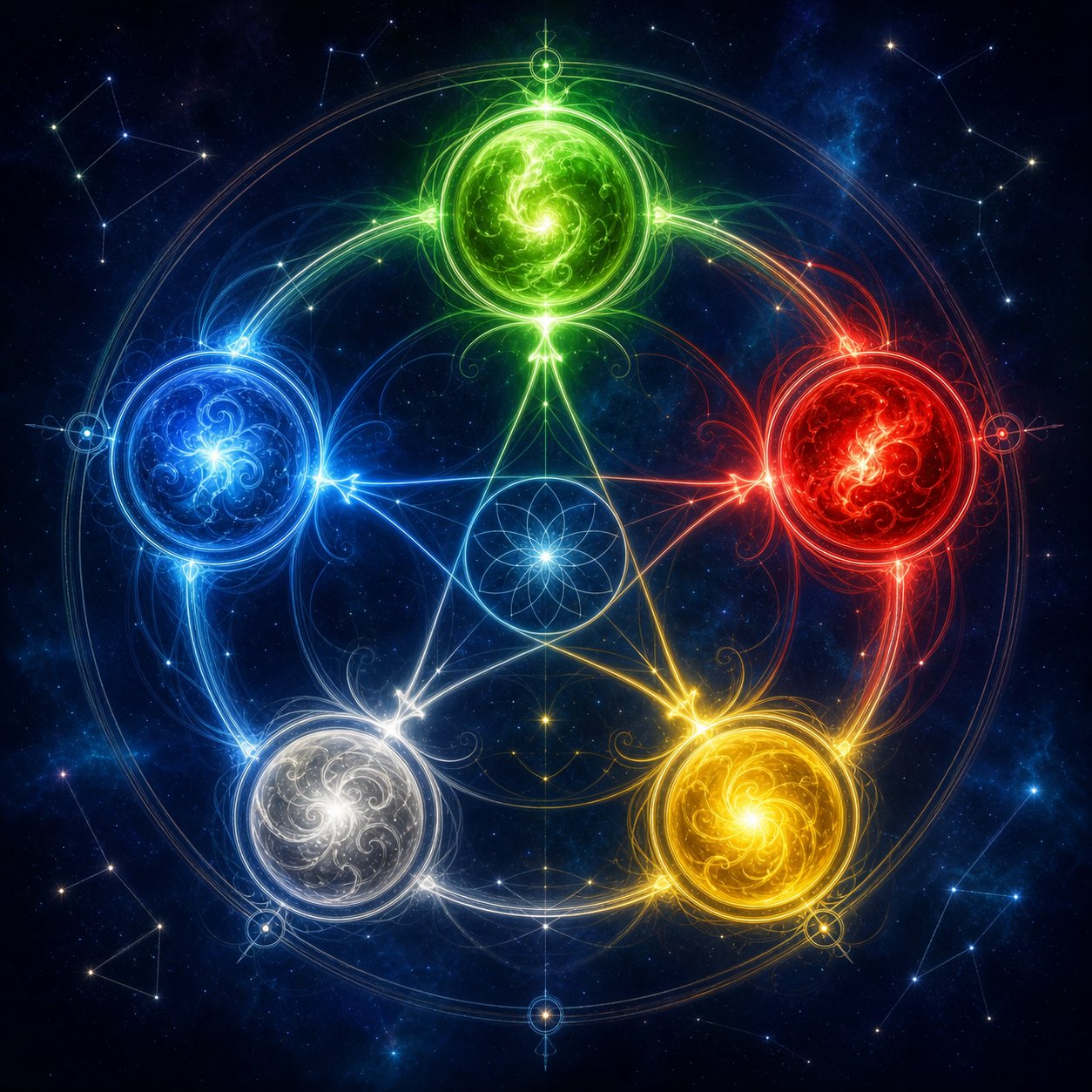
Raw element counts tell you what your chart contains. They do not tell you what your name should contain. That answer comes from a single concept that sits at the heart of traditional BaZi naming: the Yong Shen (用神), often translated as "Useful God" or "favorable element." This is the specific element that most effectively balances your Day Master and brings the chart into harmony. Every character you select for the name should serve this element.
If you want to find a chinese name that genuinely aligns with your birth chart rather than just filling in blanks, the Yong Shen is where the real decision-making happens.
What Is Yong Shen and Why It Matters More Than Missing Elements
The Yong Shen is not simply whichever element is absent from your chart. It is the element that, when introduced or strengthened, rectifies the inherent flaws and imbalances of your specific BaZi configuration. Its role is strategic, not arithmetic.
Consider this scenario: a person's Day Master is weak Yin Wood (乙), born in autumn when Metal is strongest. Water is completely missing from the chart. Since Water generates Wood in the productive cycle, Water seems like the obvious Yong Shen. And in many cases, it would be. But imagine the same chart also has excessive Earth and Metal creating a cold, dense environment. Adding Water might nourish the Wood, but if the chart is already too cold and damp from the autumn Metal energy, Water could worsen the chill rather than help the Day Master thrive. In that case, Fire, which warms the environment and controls the excess Metal, might be the true Yong Shen.
This is why the "just add what is missing" approach fails. The Yong Shen is determined by what helps the Day Master function at its best, not by what happens to be absent. As BaZi Advisor's framework explains, the Useful God sustains the chart's internal order, ensuring the Day Master can operate optimally within its environment.
Basic Rules for Determining Your Favorable Element
The logic follows two primary scenarios. If your Day Master is weak, it needs reinforcement. If your Day Master is strong, it needs to be channeled or restrained. Here is the simplified decision path:
Weak Day Master: The Yong Shen is typically the element that generates the Day Master (Resource element) or the same element as the Day Master (Companion element) for direct support.
Strong Day Master: The Yong Shen is typically the element that drains the Day Master (Output element), the element the Day Master controls (Wealth element), or the element that controls the Day Master (Officer element).
To trace these relationships, you need to know both the productive cycle and the controlling cycle of the Five Elements:
- Productive Cycle (generating): Wood feeds Fire, Fire creates Earth, Earth produces Metal, Metal generates Water, Water nourishes Wood
- Controlling Cycle (restraining): Wood controls Earth, Earth controls Water, Water controls Fire, Fire controls Metal, Metal controls Wood
A third consideration, often overlooked in English-language guides, is seasonal climate adjustment (调侯). A chart born in deep winter may need Fire not because the Day Master is weak, but because the environment is too cold for any element to function well. Similarly, a midsummer chart may need Water to cool things down. This type of Yong Shen addresses the chart's climate rather than the Day Master's raw strength.
When you set out to generate a chinese name based on birth data, the Yong Shen is your compass. Every character choice flows from it. A name that carries the correct Yong Shen element is believed to provide lifelong support, while a name carrying the wrong element can work against the chart's natural balance.
When Analysis Gets Complex
Some charts do not yield a clean answer. Competing factors, like a Day Master that appears weak by count but is supported by seasonal energy, or a chart where two elements are equally viable candidates, make Yong Shen identification genuinely difficult. Special chart structures like Follow patterns (从格), where the Day Master is so weak it "follows" the dominant element rather than resisting it, flip the normal logic entirely.
If you are trying to figure out how to find my chinese name through self-analysis and your chart presents conflicting signals, this is the point where professional consultation adds the most value. A skilled practitioner can weigh factors like Branch interactions, hidden stem activations, and Void Emptiness (空亡) that simplified rules cannot capture. The mechanical steps of how to make a chinese name, converting dates and counting elements, are learnable. But interpreting a complex Yong Shen requires pattern recognition built from years of chart reading.
With your Yong Shen identified, the abstract analysis phase ends and the creative phase begins. You now know which elemental energy your name must carry. The question becomes: which specific Chinese characters deliver that energy while also sounding good, carrying auspicious meaning, and respecting cultural conventions?
Step 5 Choose Characters That Strengthen Your Favorable Element
You know which element your name needs to carry. The challenge shifts from analysis to selection: which specific characters deliver that elemental energy while also working as an actual name someone will carry for life? Chinese characters are not arbitrary symbols. They embed elemental identity through their structural components, their meanings, and even their stroke counts. Understanding these three channels gives you a systematic way to build a shortlist of candidates rather than scrolling through thousands of characters hoping something clicks.
How Characters Carry Elemental Energy
Characters communicate their elemental association through three primary methods, each offering a different level of directness:
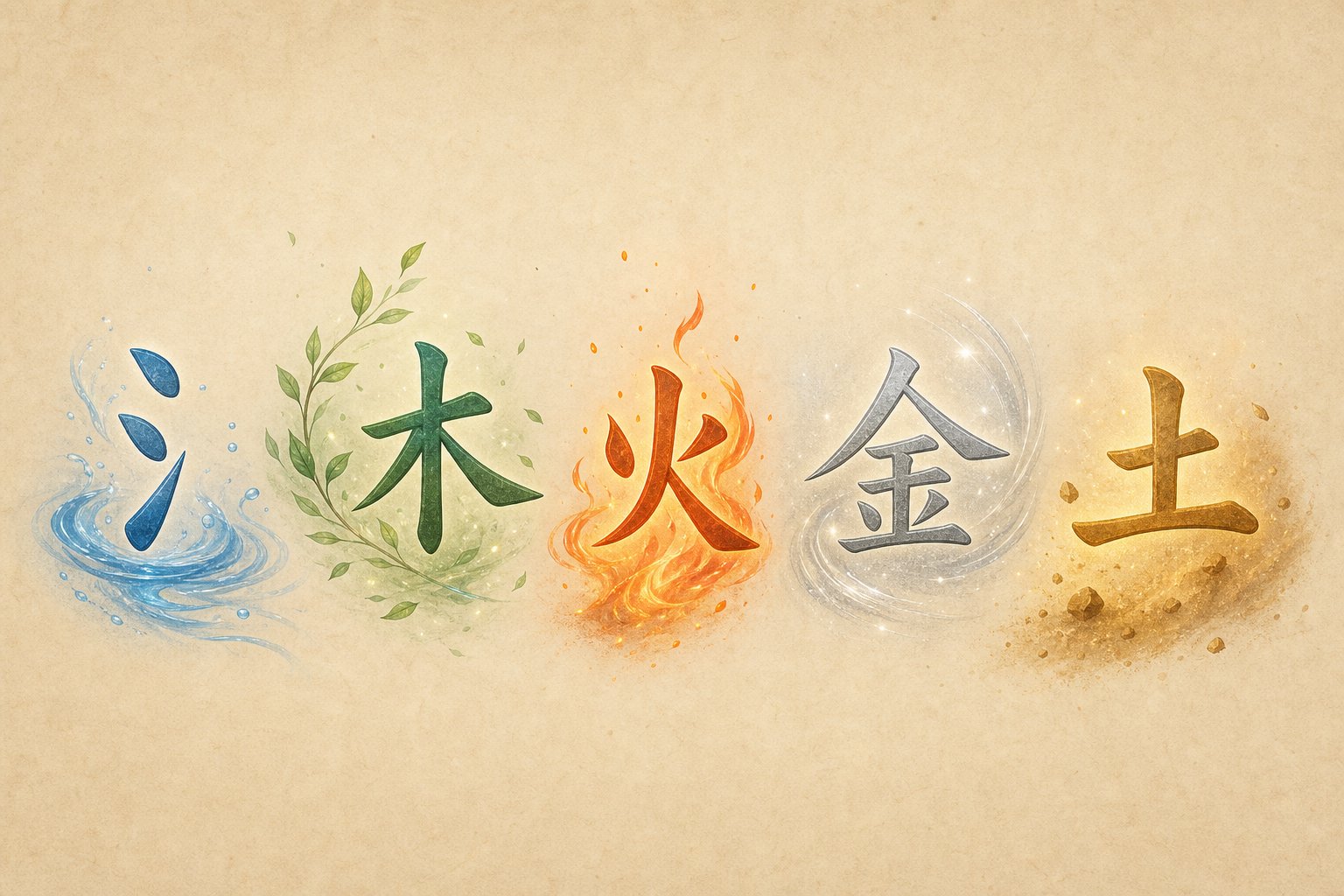
Radical-based association is the most visible. Chinese characters are built from component parts, and the radical (部首) often signals the character's semantic category. A character containing the water radical 氵 inherently carries Water energy. One built around the wood radical 木 carries Wood. This is the most straightforward way to identify a character's element at a glance. As Chinese Name Translator's guide to Wu Xing naming explains, these radicals indicate a direct connection to the element's domain, whether that is liquids, trees, metals, flames, or soil.
Meaning-based association works when the character's definition relates to an element even without the corresponding radical. The character 焱 (yan, meaning "blazing flames") obviously carries Fire, but so does 晨 (chen, meaning "morning") because dawn is associated with rising warmth and light. Similarly, 霖 (lin, meaning "continuous rain") carries Water energy through its meaning despite using the rain radical 雨 rather than the water radical.
Stroke-count classification assigns elements based on the total number of strokes in a character, following a numerical mapping system. This method is secondary to radical and meaning but becomes relevant when fine-tuning between candidates that are otherwise equal.
Here are the most common radicals for each element, along with example characters frequently used in names:
| Element | Key Radicals | Example Characters | Meanings |
|---|---|---|---|
| Wood | 木, 艹, 竹 | 梓, 柏, 林, 芷 | catalpa tree, cypress, forest, angelica |
| Fire | 火, 灬, 日 | 煜, 灿, 炎, 晗 | shine, brilliant, flame, dawn light |
| Earth | 土, 山, 石 | 坤, 安, 岚, 磊 | earth/receptive, peace, mountain mist, stacked stones |
| Metal | 钅, 金, 刂 | 铭, 钧, 锦, 鑫 | engrave, weight, brocade, prosperity |
| Water | 氵, 雨, 冫 | 泽, 润, 清, 涵 | grace, nourish, clear, contain |
When searching for characters, start with the radical that matches your Yong Shen element. This gives you the strongest and most unambiguous elemental signal. Then expand to meaning-based options if you need more variety or if the radical-based characters do not pair well with your surname.
Balancing Sound, Meaning, and Elemental Fit
A name that carries the correct element but sounds awkward or means something unfortunate is not a good name. The character selection process requires balancing multiple criteria simultaneously:
- Elemental alignment: The character must carry your Yong Shen element through radical, meaning, or both.
- Auspicious meaning: The character's definition should be positive, aspirational, or at minimum neutral. Characters meaning "swamp" technically carry Water energy, but few parents want that connotation.
- Phonetic harmony: The character's pronunciation should flow naturally after the surname. Tonal variety matters: a name where every syllable shares the same tone sounds flat and monotonous in Mandarin.
- Surname compatibility: Your surname itself carries elemental weight. A surname like 林 (Lin) is pure Wood. If your Yong Shen is also Wood, the surname already contributes, and your given name characters can either reinforce Wood or introduce the element Wood generates (Fire) for a productive flow. If your Yong Shen conflicts with your surname's element, the given name needs to carry enough corrective energy to compensate.
Imagine your Yong Shen is Water and your surname is 李 (Li), which contains the Wood radical. Wood drains Water in the controlling cycle, so your given name characters need to deliver strong Water energy to offset the surname's draw. A character like 涵 (han, meaning "to contain" with the water radical) paired with 泽 (ze, meaning "grace/nourishment" with the water radical) creates a name, 李涵泽, where both given name characters reinforce the needed element.
Selecting Characters for Male and Female Names
Elemental requirements apply identically regardless of gender. A girl whose chart needs Metal energy and a boy whose chart needs Metal energy follow the same analytical logic. The difference lies in cultural conventions around which characters are typically used for each gender, though these conventions have loosened considerably in modern naming practice.
Traditional tendencies look like this: characters suggesting strength, ambition, and vastness (like 浩 hao, meaning "vast," or 铭 ming, meaning "engrave") appear more often in male names. Characters evoking grace, beauty, and gentleness (like 涵 han, meaning "contain," or 琳 lin, meaning "fine jade") lean toward female names. But plenty of characters work beautifully for anyone: 清 (qing, "clear"), 安 (an, "peace"), and 林 (lin, "forest") carry no strong gender association.
If you have used a chinese male name generator or a chinese girl name generator online, you have likely noticed they sort suggestions by gender based on these cultural patterns. That sorting is useful as a starting filter, but it should never override elemental fit. A chinese female names generator might suggest characters that sound feminine but carry the wrong element for the chart. The Yong Shen always takes priority over aesthetic preference.
Given names in Chinese typically consist of one or two characters. A single-character given name must carry the full elemental load on its own, which limits your options but creates a clean, strong impression. A two-character given name offers more flexibility: ideally both characters support the Yong Shen, but at minimum the primary character (the one immediately following the surname) should align with it, while the second character should not actively conflict. Two Water characters in a row, for instance, deliver concentrated Water energy. One Water character paired with a Wood character creates a productive flow, since Water nourishes Wood, which can work if Wood is a secondary beneficial element in your chart.
With a shortlist of elementally sound, meaningful, and phonetically pleasing characters in hand, one more traditional layer of verification remains. Stroke count rules and the Three Talents framework provide a structural check that can confirm or challenge your selections before you commit to a final name.
Step 6 Apply Stroke Count Rules and the Three Talents Framework
Selecting characters with the right radical and meaning gets you most of the way to a solid name. But traditional nameology does not stop there. A second verification layer exists, one that evaluates the numerical structure of your name through stroke counts and their elemental mappings. Think of it as a quality control checkpoint: your character choices passed the elemental and semantic tests, and now they need to pass the structural test too.
This is where the process of learning how to make a chinese name shifts from creative selection to mathematical confirmation.
Stroke Count and the Five Elements Connection
Every Chinese character has a specific stroke count, and in traditional nameology, that number carries its own Five Elements identity. The mapping follows the final digit of the stroke count:
| Final Digit | Element | Examples |
|---|---|---|
| 1 or 2 | Wood | 11 strokes = Wood, 22 strokes = Wood |
| 3 or 4 | Fire | 13 strokes = Fire, 4 strokes = Fire |
| 5 or 6 | Earth | 15 strokes = Earth, 6 strokes = Earth |
| 7 or 8 | Metal | 7 strokes = Metal, 18 strokes = Metal |
| 9 or 0 | Water | 9 strokes = Water, 10 strokes = Water |
This means a character can carry one element through its radical and a different element through its stroke count. The character 涵 (han, water radical, meaning "contain") has 11 strokes in its traditional form, making its stroke-count element Wood rather than Water. These layers can either reinforce each other or create subtle tension, and skilled practitioners weigh both.
One critical rule: stroke counting in nameology always uses the traditional character forms (繁体字) based on the Kangxi Dictionary standard, even if the person will write their name in simplified characters daily. Certain radicals have different stroke values under this system. For instance, the water radical 氵 counts as four strokes (restored to its full form 水), the grass radical 艹 counts as six strokes, and the movement radical 辶 counts as seven strokes. Using simplified stroke counts produces incorrect Five Elements assignments and throws off every subsequent calculation.
If you are using a chinese name creator tool or software, verify that it applies Kangxi stroke counts rather than modern simplified counts. This single discrepancy is one of the most common sources of error in automated naming systems.
The Three Talents Framework for Name Evaluation
The Three Talents (天地人三才) framework takes the stroke counts of your full name and derives three "personality" numbers representing Heaven, Human, and Earth. Each number maps to a Five Elements attribute using the same final-digit rule above, and the relationships between these three elements reveal whether the name's internal structure is harmonious or conflicted.
Here is how the three values are calculated for the most common name structure, a single-character surname with a two-character given name:
- Heaven Personality (天格): Surname's Kangxi stroke count + 1
- Human Personality (人格): Surname's stroke count + first given name character's stroke count
- Earth Personality (地格): Sum of both given name characters' stroke counts
For a single-character given name, the Earth Personality equals the given name's stroke count plus one. The "+1" convention in both the Heaven and Earth calculations maintains structural symmetry within the system, representing the primordial unity from which all things emerge.
The Human Personality is considered the most important of the three because it sits at the junction between surname and given name, representing the person's core character and primary life fortune. The Heaven Personality reflects inherited conditions, while the Earth Personality governs early development and foundational luck.
The ideal configuration places all three talents in a productive (generating) cycle, where each element nourishes the next. The five most auspicious sequential combinations are:
- Wood → Fire → Earth (Wood feeds Fire, Fire creates Earth)
- Fire → Earth → Metal (Fire creates Earth, Earth produces Metal)
- Earth → Metal → Water (Earth produces Metal, Metal generates Water)
- Metal → Water → Wood (Metal generates Water, Water nourishes Wood)
- Water → Wood → Fire (Water nourishes Wood, Wood feeds Fire)
When the Heaven Personality generates the Human Personality, and the Human Personality generates the Earth Personality, the name flows in a cascading productive sequence. Conversely, if the elements form a controlling relationship, particularly if both Heaven and Earth control the Human Personality, the configuration is considered unfavorable because it symbolizes pressure from above and below simultaneously.
A chinese surname generator or chinese last name generator cannot change your surname's stroke count, which means the Heaven Personality is fixed. Your creative freedom lies entirely in the given name characters, whose stroke counts determine both the Human and Earth Personalities. This constraint is why surname analysis must come first: different surnames create different starting conditions, and a stroke combination that produces a beautiful Three Talents flow for the surname 王 (4 strokes) may produce a conflicting pattern for the surname 陈 (16 strokes in Kangxi form).
How to Use Stroke Count as a Filter
The practical workflow treats stroke count and Three Talents as a secondary filter, not a primary selection criterion. Here is the sequence:
- Identify your Yong Shen element from BaZi analysis (completed in Step 4).
- Build a shortlist of characters whose radicals and meanings align with that element (completed in Step 5).
- Look up the Kangxi stroke count for each candidate character.
- Calculate the Heaven, Human, and Earth Personalities for each possible name combination.
- Check whether the Three Talents form a productive cycle or at minimum avoid a destructive one.
- Eliminate combinations where the Three Talents conflict, and prioritize those where all three flow productively.
Imagine you are working with the surname 李 (7 strokes in Kangxi form) and your Yong Shen is Water. You have shortlisted 泽 (17 strokes) and 涵 (12 strokes) as potential given name characters. Running the Three Talents calculation: Heaven = 7 + 1 = 8 (Metal), Human = 7 + 12 = 19 (Water), Earth = 12 + 17 = 29 (Water). The configuration is Metal → Water → Water. Metal generates Water, which is productive. Water and Water are the same element, which is neutral to supportive. This combination passes the Three Talents check.
If instead you paired 李 with 润 (16 strokes) and 清 (12 strokes): Heaven = 8 (Metal), Human = 7 + 16 = 23 (Fire), Earth = 16 + 12 = 28 (Metal). The configuration is Metal → Fire → Metal. Fire controls Metal and Metal is controlled by Fire, creating tension in the Human position. Despite both characters carrying Water energy through their radicals, their stroke counts produce an unfavorable Three Talents pattern. You would deprioritize this combination.
This filtering process is where a chinese last names generator or naming software can save hours of manual calculation. The tool handles the arithmetic while you retain decision-making authority over which characters best serve the Yong Shen. The stroke count layer does not override elemental fit from radicals and meaning. It refines your shortlist, helping you choose between equally strong candidates.
A name that passes both the elemental analysis and the Three Talents structural check has cleared the technical hurdles. What remains are the cultural and phonetic considerations, the naming taboos and social conventions that can disqualify a technically perfect name for reasons no calculator can detect.
Step 7 Check Naming Taboos and Cultural Considerations
A name can score perfectly on elemental alignment, pass the Three Talents check, and still be unusable. Cultural rules operate on a different axis than metaphysical calculations, and they carry veto power. These are the filters that no BaZi calculator applies automatically, the ones that require human judgment and cultural literacy to catch.
Traditional Naming Taboos to Avoid
Chinese naming taboos have deep roots in Confucian respect hierarchies and folk belief. Violating them does not just produce a bad name. It signals cultural ignorance or, worse, disrespect toward family and ancestors. Here are the key prohibitions to check every candidate name against:
- Ancestor name avoidance (避讳): Never use a character that appears in the names of parents, grandparents, or earlier ancestors. This taboo extends to same-generation elders in some families. Even a homophone of an ancestor's name character can be considered inappropriate.
- Unlucky homophones: Characters whose pronunciation overlaps with negative words create unintended associations. As common naming mistake guides note, a combination like Si (思, to think) and Wang (旺, prosperous) sounds nearly identical to Siwang (死亡, death). Always speak the full name aloud and listen for unfortunate echoes.
- Overly grandiose characters: Characters like 天 (heaven), 皇 (emperor), or 龙 (dragon) are considered too heavy for a child to "carry." Traditional belief holds that an excessively powerful name invites hardship because the child's fortune cannot match the name's weight.
- Historical villains and negative figures: Sharing characters with infamous figures creates unwanted associations. Just as you would not name a Western child "Judas," Chinese naming avoids characters strongly linked to treacherous or disgraced historical personalities.
Phonetic and Tonal Harmony
Mandarin has four tones plus a neutral tone, and the tonal pattern of a full name affects how it sounds when spoken aloud. Four consecutive fourth-tone syllables (the sharp, falling tone) sound harsh and aggressive. Three first-tone syllables in a row feel flat and monotonous. The ideal name mixes tones to create a natural rise and fall, almost like a short melody.
Beyond tones, watch for unintentional puns that emerge when the surname and given name are spoken together quickly. A surname like 杜 (Du) paired with a given name starting with 子 (Zi) produces "Duzi," which sounds like the word for "stomach" (肚子). These collisions are invisible on paper but immediately obvious to any native speaker's ear. Say the full name aloud at conversational speed, multiple times, and listen for anything that makes you pause.
Making the Name Work in International Contexts
For anyone living between cultures, the name needs to function in both Chinese and non-Chinese environments. This is a modern consideration that traditional nameology never addressed, but it matters enormously for people who will use their Chinese name on international documents, in business introductions, or alongside an English name.
A few practical guidelines help here. Choose characters whose pinyin romanization does not produce awkward letter combinations in English. Characters romanized as "Shi," "Xi," or "Zhi" are perfectly natural in Mandarin but trip up English speakers consistently. If ease of international pronunciation matters to you, lean toward characters with pinyin like "Ming," "Lin," "An," or "Kai" that cross linguistic boundaries more smoothly.
Also consider how the pinyin spelling looks written out. Some romanizations unfortunately resemble English words with negative connotations. A name to chinese characters conversion works in one direction, but the reverse matters too: how does the Chinese name read when converted back to Roman letters on a passport or email signature?
People who want to convert their name to chinese or pair a Chinese name with an existing English name should think about phonetic echoes between the two. A person named "David" might choose a Chinese name starting with "Da" or "De" to create a subtle sonic link, making both names feel like they belong to the same person. A chinese name generator from english can suggest these phonetic bridges, but the elemental requirements from your BaZi analysis still take priority over sound matching. A name that sounds like your English name but carries the wrong element defeats the purpose of birth-date-based naming.
If you are trying to convert your name to chinese purely for cultural connection without BaZi considerations, phonetic matching is fine. But within the framework this guide covers, the english to chinese name conversion is a secondary aesthetic layer, not the driving logic. The Yong Shen element comes first. Phonetic compatibility with an English name is a bonus, not a requirement.
With taboos cleared, tonal harmony confirmed, and international usability considered, your candidate name has survived every filter in the traditional process. The final step is verification: mapping the chosen characters back to the birth chart to confirm the name actually delivers the elemental correction it was designed to provide.
Step 8 Verify Your Name Choice and Know When to Seek Expert Help
You have a candidate name. It carries the right elemental radical, sounds pleasant with your surname, clears the taboo list, and passes the Three Talents check. But does it actually accomplish what it was designed to do? Verification is the step that closes the loop, mapping your chosen characters back to the original birth chart to confirm the elemental correction lands where it should.
How to Verify Your Chosen Name Against the Birth Chart
The verification process reverses the analytical direction. Instead of moving from chart to characters, you move from characters back to chart. Take each character in your proposed name and identify every elemental signal it carries: the radical's element, the meaning's elemental association, and the stroke-count element derived from the Kangxi count. Then add these elements to your original birth chart tally from Step 3 and ask one question: is the Yong Shen element now adequately represented without tipping the balance too far in the other direction?
A name that introduces three Water signals into a chart that only needed a mild Water boost might overcorrect, flooding the chart with the very element that was supposed to restore equilibrium. The goal is supplementation, not domination. Your final name should bring the Yong Shen element into comfortable presence without drowning out the elements that were already functioning well.
Run through this checklist before committing to your final choice:
- Elemental alignment confirmed: The primary given name character carries the Yong Shen element through its radical or meaning. The secondary character either supports the same element or belongs to an element in a productive relationship with it.
- Three Talents in productive cycle: The Heaven, Human, and Earth Personalities form a generating sequence or at minimum avoid mutual destruction.
- No taboo violations: No ancestor name conflicts, no unlucky homophones, no overly grandiose characters.
- Phonetic harmony passes: The full name spoken aloud at natural speed flows smoothly, with tonal variety and no unintended puns.
- Meaning is auspicious: Both characters individually and the name as a combined phrase carry positive or aspirational connotations.
If your candidate passes all five points, you have a name that satisfies both the metaphysical framework and the practical requirements of daily use. If it fails on one or two points, revisit your shortlist from Step 5 and test the next candidate through the same checklist.
When to Consult a Professional Nameologist
Self-analysis works well for charts with clear elemental imbalances and straightforward Day Master strength assessments. But some charts resist simple interpretation, and forcing a conclusion in those cases can produce a name built on a flawed foundation.
Consider professional consultation if any of these situations apply to your chart:
- Competing Yong Shen candidates: Two elements seem equally viable, and you cannot determine which one truly serves the Day Master better.
- Special BaZi structures: Charts exhibiting Follow patterns (从格) or Dominant patterns (专旺格) operate under completely different analytical logic. A Follow pattern means the Day Master has abandoned its own identity and aligned with the dominant force in the chart. Normal Yong Shen rules do not apply, and misidentifying a Follow pattern as an ordinary weak chart leads to selecting exactly the wrong element for the name.
- Ambiguous Day Master strength: The Day Master appears borderline, neither clearly strong nor clearly weak, with seasonal energy and Branch interactions pulling in opposite directions.
When evaluating a professional, look for practitioners who explain their reasoning rather than simply handing you a name. A credible nameologist will walk you through the Yong Shen determination, show you why specific characters were chosen, and address how the name interacts with your surname's elemental weight. A typical consultation involves providing your exact birth date and time, receiving a full Four Pillars analysis, discussing two to three name options with explanations, and making a final selection together.
Using Online Tools as a Starting Point
BaZi calculators and a random chinese name generator each serve different purposes, and neither replaces the other. Calculators handle the mechanical conversion steps flawlessly: Gregorian-to-lunar date translation, Stem-Branch assignment, hidden stem lookup, and stroke count tallying. These are arithmetic operations where software outperforms manual calculation every time. Use them freely for Steps 1 through 3.
The interpretive steps are where tools hit their ceiling. Determining the Yong Shen, evaluating whether a chart has a special pattern, weighing competing elemental influences, and selecting characters that balance sound, meaning, and elemental fit all require contextual judgment that no random name generator chinese tool can replicate. A tool might suggest chinese name ideas based on your missing element, but as this guide has emphasized repeatedly, the missing element is not always the needed element.
The most effective workflow combines both: use calculators for data generation and verification arithmetic, then apply the principles from this guide for every decision that requires interpretation. If you want to find your chinese name through the traditional method, the tools give you speed while the framework gives you accuracy. When the two align and your verification checklist comes back clean, you can be confident the name does what birth-date-based naming is designed to do: strengthen what the chart lacks and support the Day Master through the characters you will carry for life.
Frequently Asked Questions About Picking a Chinese Name by Birth Date
1. Can I pick a Chinese name by birth date without knowing my exact birth hour?
You can still perform a partial analysis using three pillars (year, month, and day), but accuracy drops significantly since the Hour Pillar accounts for 25% of your elemental data. Some practitioners run charts for two adjacent two-hour periods and look for overlapping recommendations. However, the result will be less targeted than a full four-pillar analysis, and the Yong Shen determination may be ambiguous without the complete picture.
2. What is the difference between a missing element and the Yong Shen in BaZi naming?
A missing element is simply one that does not appear in your birth chart, while the Yong Shen is the specific element that most effectively supports your Day Master. These are not always the same. Sometimes an element is absent because its presence would harm the chart's balance. The Yong Shen is determined by analyzing what the Day Master actually needs for optimal function, which requires evaluating seasonal influence, elemental interactions, and chart structure rather than just counting what is missing.
3. Do I need to use traditional Chinese characters for stroke count calculations even if I write in simplified Chinese?
Yes. Traditional nameology requires Kangxi Dictionary stroke counts based on traditional character forms (繁体字), regardless of which script you use daily. Certain radicals have different stroke values under this system. For example, the water radical counts as four strokes and the grass radical counts as six. Using simplified stroke counts produces incorrect Five Elements assignments and invalidates the Three Talents framework calculations that follow.
4. How does the surname affect the Five Elements balance when choosing a Chinese name?
Your surname carries its own elemental weight through its radical and stroke count, and it factors into the overall balance of the name. A surname like Lin (林) is pure Wood energy. If your Yong Shen is Water, the Wood surname drains Water in the elemental cycle, meaning your given name characters need stronger Water energy to compensate. The surname also determines the Heaven Personality in the Three Talents framework, which constrains which stroke-count combinations produce harmonious results.
5. When should I consult a professional nameologist instead of doing BaZi naming myself?
Professional help is most valuable when your chart has competing Yong Shen candidates where two elements seem equally viable, when it exhibits special structures like Follow patterns or Dominant patterns that flip normal analytical rules, or when the Day Master strength is ambiguous with seasonal energy pulling in opposite directions. A credible practitioner will explain their reasoning, walk you through the Yong Shen determination, and discuss multiple name options rather than simply handing you a result without context.