What Tracing Your Chinese Surname Origin Actually Involves
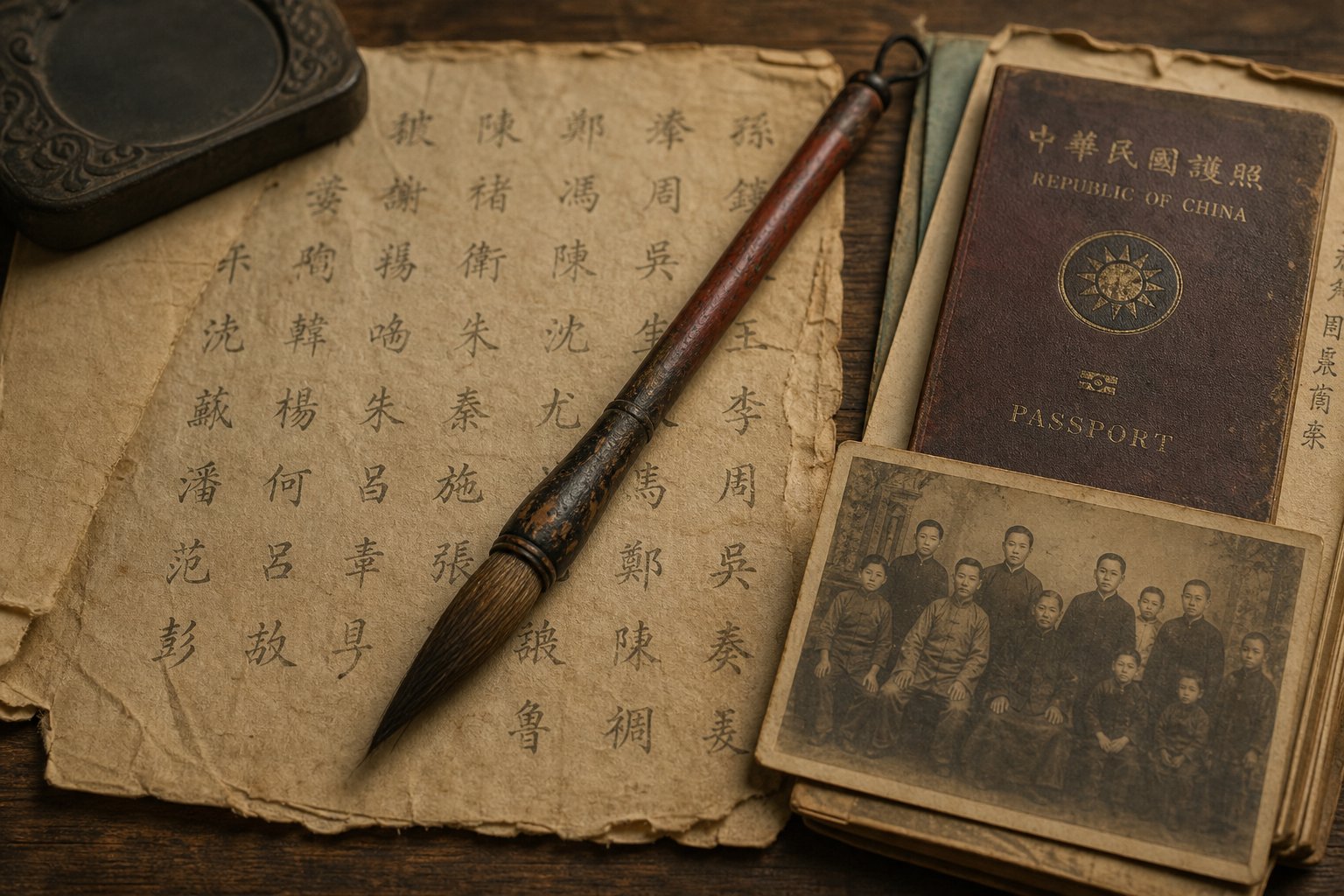
Imagine holding a faded passport or a creased immigration form. The only link to your ancestral past is a single romanized spelling: maybe it reads "Wong," "Chan," or "Goh." That handful of letters is your starting point, yet behind it lies a Chinese family name with roots stretching back over 4,000 years, tied to feudal states, royal grants, and specific geographic regions. For diaspora researchers, this gap between a westernized spelling and thousands of years of recorded history can feel enormous.
Chinese surnames are among the world's oldest continuous naming systems. They emerged from matrilineal clan identifiers during the Shang dynasty, evolved through aristocratic lineage markers in the Zhou period, and eventually spread to the broader population by the Qin and Han eras. Understanding how do chinese names work, with the family name always placed first and carrying collective identity, is the foundation of this research. Each surname holds encoded information about where surnames originate from: a lost kingdom, a royal title, an ancient occupation, or a river that once bordered an ancestor's village.
This guide bridges the gap between academic surname history and hands-on genealogy. You will follow a cohesive, step-by-step process that combines linguistic detective work, historical research, and document analysis. By the end, you will know how to move from a romanized spelling on paper to a specific Chinese character, a dialect group, a regional origin, and potentially an ancestral village.
Why Chinese Surname Origins Are Worth Tracing
Chinese names carry more than personal identity. They preserve centuries of cultural memory, migration patterns, and social history. A surname like Wang (meaning "king") traces back to a disgraced prince in the 6th century BCE whose descendants adopted the name as a permanent marker of royal lineage. Surnames such as Zhao or Wei memorialize ancient states and the ancestors who once ruled them. When you trace your Chinese name origin, you are recovering a specific thread in a vast historical tapestry, one that connects your family to particular clans, regions, and eras.
For Chinese family names in the diaspora, this research also reveals migration stories. The specific romanization your family uses is itself a clue, pointing to a dialect group, a departure port, and a generation of emigrants. Tracing these Chinese last names backward through time transforms a flat spelling into a living narrative.
What You Need Before You Start
You do not need Chinese language fluency to begin. Many researchers start with nothing more than fragments, and those fragments are enough to open doors. Gather whatever you have:
- Any known romanized spelling of your Chinese surname (from passports, immigration papers, or family documents)
- Oral family history, even partial details about dialect, hometown, or migration stories
- Old documents, photos, gravestones, or heirlooms that may contain Chinese characters
- An approximate region of origin, if known (southern China, Taiwan, Southeast Asia)
Even a single piece from this list gives you a working foundation. Each step in this guide builds on the last, turning scattered clues into a coherent research trail. The process starts where most diaspora families must start: figuring out which Chinese character hides behind that romanized spelling.
Step 1 - Identify the Correct Chinese Character for Your Surname
A romanized spelling on an old document is not a direct translation. It is a phonetic approximation, shaped by which dialect the original speaker used, which clerk wrote it down, and which romanization system was in play at the time. The same Chinese character can appear as dozens of different English spellings depending on these variables. Your first task is to work backward from that spelling to the actual Chinese character it represents, because the character is the key that unlocks everything else: historical records, clan genealogies, and surname origin texts.
Consider this: the character 陳 (the chen surname) can show up as Chan in Cantonese, Tan in Hokkien, Tang in Teochew, Chin in Hakka, or Chen in Mandarin Pinyin. If your family spells it "Tan," you are likely looking at Hokkien-speaking ancestors from Fujian province or Southeast Asia. If it reads "Chan," Cantonese-speaking roots in Guangdong or Hong Kong become the stronger lead. A single character, five or more spellings, each one pointing to a different dialect group and geographic origin.
Matching Romanized Spellings to Chinese Characters
The confusion multiplies when you realize that different characters can also produce identical romanizations. The wang last name, for instance, could refer to 王 (meaning "king") or 汪 (a less common surname meaning "vast" or "deep water"). Both are romanized as "Wang" in Mandarin Pinyin. Similarly, "Wong" in Cantonese could represent either 王 or 黃. The huang surname (黃, meaning "yellow") becomes "Wong" in Cantonese, the same spelling used for 王 in that dialect. Context clues from family history, region, and additional documentation help you distinguish between these possibilities.
A practical starting point is FamilySearch's Chinese surname finder, which maps romanized spellings across multiple dialect systems and shows the corresponding Chinese characters. You enter the spelling your family uses, and the tool returns possible character matches along with their Mandarin, Cantonese, Hakka, and regional variants. This cross-referencing process narrows your options quickly.
Using Dialect Clues to Narrow Your Search
The specific romanization your family carries is itself a diagnostic tool. It reveals which Chinese dialect your ancestors spoke, and that dialect points directly to a geographic region. In territories with a sizable Chinese diaspora, such as Singapore and Malaysia, the way a family name is spelled is a signifier of the region a person's ancestors hail from. A person surnamed "Wong" is understood to have Cantonese heritage, linking them to Guangdong province or Hong Kong. Someone spelled "Ong" likely has Hokkien roots in Fujian or Southeast Asia.
The table below shows how the top 10 Chinese surnames appear across four major dialect groups. Use it to match your family's spelling to a character and a dialect:
| Chinese Character | Mandarin Pinyin | Cantonese | Hokkien | Hakka |
|---|---|---|---|---|
| 王 | Wang | Wong | Ong, Heng | Vong, Wong |
| 李 | Li | Lei, Lee | Lee, Li | Li |
| 張/张 | Zhang, Chang | Cheung, Zoeng | Teo, Teoh | Chong, Zong |
| 劉/刘 | Liu | Lau | Lao, Low | Lew, Liew |
| 陳/陈 | Chen | Chan | Tan | Chin |
| 楊/杨 | Yang | Yeung | Yeo, Yeoh | Yong |
| 黃/黄 | Huang | Wong | Ng, Wee, Ooi | Vong, Wong |
| 趙/赵 | Zhao | Chiu, Chow | Teoh, Tio | Chau |
| 吳/吴 | Wu | Ng | Goh, Go | Ng |
| 周 | Zhou | Chow, Jau | Chew, Chiu | Chu, Zu |
Notice the patterns. Cantonese romanizations tend to use "Ch," "W," and "ng" endings. Hokkien spellings often feature "T," "Eo," or "Oh" combinations. Hakka variants frequently include "V" or "ng" sounds. When you spot your family's surname in chinese on this table, you have not only identified the character but also gained your first geographic lead.
This dialect-to-region connection is powerful. A surname in chinese spelled with Cantonese phonetics almost certainly traces to Guangdong, Hong Kong, or Macau. Hokkien spellings point to Fujian, Taiwan, or the Chinese communities of Southeast Asia. Hakka variants suggest origins in the mountainous border regions of Guangdong, Fujian, and Jiangxi. Even before you open a single historical record, the romanization itself has narrowed your ancestral search area from all of China to a specific province or dialect region.
With the correct character identified and a dialect group established, the romanization variants themselves become a deeper research tool, one that can pinpoint not just a province but a specific sub-region within it.
Step 2 - Use Romanization Variants to Pinpoint Your Ancestral Region
Identifying the correct Chinese character is only half the equation. The specific romanization your family carries does more than confirm a character. It functions as a geographic fingerprint, encoding dialect information that maps directly onto provinces, sub-regions, and even individual counties. Each dialect group in China occupies a distinct territory, and because romanized spellings reflect pronunciation, they act as coordinates pointing back to a homeland.
Romanization Systems as Geographic Indicators
China's linguistic landscape is not a single language with minor accents. It contains seven to ten major dialect groups, many of them mutually unintelligible, each rooted in a specific region. When you know which dialect produced your family's spelling, you know where to look. Cantonese surnames like "Cheung," "Lau," or "Ng" point squarely to Guangdong province, Hong Kong, or Macau. Hokkien-derived spellings such as "Goh," "Tan," or "Ong" trace to Fujian province, Taiwan, or Chinese communities across Southeast Asia. Hakka variants featuring "Vong," "Liew," or "Chong" suggest the mountainous border regions where Guangdong, Fujian, and Jiangxi meet, areas historically settled by Hakka-speaking communities.
Mandarin surnames romanized in Pinyin, like "Zhang," "Liu," or "Huang," typically indicate either a post-1949 mainland origin or a more recent emigration wave. Mandarin last names in official records from the People's Republic always use Pinyin, the standardized romanization system adopted in 1958. By contrast, taiwanese last names almost universally appear in Wade-Giles romanization, the older system used during the Republic of China era. A surname spelled "Chang" (Wade-Giles) rather than "Zhang" (Pinyin) strongly suggests Taiwanese or pre-1949 mainland documentation. This single distinction helps researchers identify which side of the Taiwan Strait their ancestors emigrated from and which archives to search.
Teochew spellings add another layer. This sub-group of Min Chinese, spoken in the Chaoshan region of eastern Guangdong, produces distinctive romanizations like "Teo" for 張, "Seah" for 謝, or "Goh" for 吳. Recognizing a Teochew variant narrows your search from all of southern China to a handful of specific counties.
Building a Variant Table for Your Surname
A practical next step is creating a personal romanization variant table for your surname. Check how your character appears across all major systems: Mandarin Pinyin, Wade-Giles, Cantonese Jyutping, Hokkien POJ (Pe̍h-ōe-jī), and Hakka romanization. Comparing these variants side by side reveals which system your family's spelling matches most closely, and that match confirms the dialect and region.
You do not need specialized software to build this table. Several free online tools handle the conversion:
- Pin1yin1.com - converts Chinese characters to Pinyin, Wade-Giles, and other Mandarin romanizations
- CantoDict (cantonese.sheik.co.uk) - provides Jyutping and Yale romanization for cantonese last names
- iTaigi (itaigi.tw) - covers Taiwanese Hokkien pronunciations and POJ romanization for taiwanese surnames
- Hakka Dictionary (hakkadict.com) - offers Hakka romanization across multiple sub-dialects
- Wikipedia's comparative romanization tables - useful for cross-referencing mandarin surnames against southern dialect variants
Enter your confirmed Chinese character into each tool and record every variant spelling it produces. Then compare those outputs against the romanization your family actually uses. The closest match identifies your dialect group, and that dialect group identifies your ancestral region with surprising precision. A family using "Lim" for 林 is almost certainly Hokkien, pointing to Fujian or Taiwan. The same character romanized as "Lam" indicates Cantonese roots in Guangdong. Spelled "Lin" in Pinyin, it suggests either a northern Chinese origin or a more recent standardized record.
This variant table becomes a living research document. As you uncover new family records or connect with distant relatives, you can cross-check their spellings against your table to confirm shared origins or identify branch migrations. The romanization trail has now given you a character, a dialect, and a region. The next layer of depth comes from the surname's historical origin story itself, which reveals when and why your ancestors first carried that name.

Step 3 - Research the Historical Origins of Your Surname
Every Chinese surname carries a creation story. Some were born from the collapse of ancient kingdoms. Others were handed down by emperors as rewards for loyalty. A few emerged from the daily work of potters, fishermen, or blacksmiths. Knowing which category your surname belongs to does more than satisfy curiosity. It anchors your family line to a specific historical period, a geographic region, and often a founding ancestor whose name appears in classical texts. This is where chinese surnames and meanings intersect with practical genealogy research.
The Five Categories of Chinese Surname Origins
Scholars of ancient chinese surnames generally classify them into five major formation categories. Each category tells you something different about your earliest ancestors: their social status, their occupation, their homeland, or their relationship to political power. Understanding chinese last names and meanings through these categories gives you a framework for interpreting everything you find in later research stages.
| Origin Category | How It Formed | Example Surname | Historical Context |
|---|---|---|---|
| State-Derived | Named after a feudal state the ancestor ruled or inhabited | 陈/Chen - from the State of Chen | Zhou Dynasty (1046-256 BCE), when China was divided into vassal states |
| Ancestral/Totemic | Named after a legendary ancestor or clan totem | 黄/Huang - linked to the Yellow Emperor (Huangdi) | Pre-dynastic period, reaching back to mythological origins |
| Occupation-Based | Named after the trade or craft an ancestor practiced | 陶/Tao - from pottery makers (tao means "pottery") | Early agricultural and artisan societies |
| Geographic | Named after a river, mountain, or landscape feature near the ancestral home | 江/Jiang - from the Yangtze River (jiang means "river") | Varies; tied to settlement patterns across different eras |
| Granted/Bestowed | Given by a ruler as an honor or imposed during political upheaval | 刘/Liu - bestowed by royalty during the Han Dynasty | Imperial periods, especially Han (206 BCE-220 CE) and Tang (618-907 CE) |
These categories are not always clean-cut. Some surnames shifted categories over time. The Liu (刘) surname, for instance, has both geographic and royal-grant origin stories depending on which branch of the clan you trace. Still, identifying the primary category narrows your historical window considerably. A state-derived surname like Chen (陈) points you toward the Spring and Autumn period (770-476 BCE) and the territory of the State of Chen in modern-day Henan province. An occupation-based surname like Tao sends you looking at artisan communities rather than aristocratic lineages.
The meaning of chinese last names often becomes clearer once you know the formation category. Geographic surnames are the most literal: Jiang means river, Shan means mountain, Lin means forest. Ancestral surnames tend to reference legendary figures or clan totems from China's earliest recorded history. State-derived surnames, the largest category among common chinese family names and meanings, map directly onto the political geography of the Zhou Dynasty, when hundreds of small states dotted the landscape.
How the Baijiaxing Reveals Surname History
Where do you look to find your surname's category and origin story? One of the oldest and most accessible starting points is the Baijiaxing (百家姓), or Hundred Family Surnames. Compiled during the early Song Dynasty (around 960 CE), this text lists 504 surnames in 564 characters, arranged in rhyming couplets that were originally used to teach children to read. The poem became so culturally embedded that the Chinese expression for ordinary people, laobaixing (meaning "one hundred old surnames"), derives directly from it.
The Baijiaxing is more than a list. Its ordering reflects the political landscape of the Song Dynasty: the surname Zhao (赵) appears first because it was the imperial family's name, followed by Qian (钱), the surname of the king of Wuyue, the state that peacefully surrendered to the Song. These rankings encode power relationships and regional alliances from over a thousand years ago. For researchers exploring chinese surname meanings, the Baijiaxing provides a snapshot of which names held prominence and how they clustered geographically during a pivotal era.
Out of the roughly 12,000 Chinese family names recorded throughout history, about 25 percent remain in use today. The Baijiaxing captures the most enduring of these, and for each surname listed, centuries of scholarly commentary have accumulated, documenting origin stories, founding ancestors, and migration routes. Resources like the Song Dynasty text Xingshi Ji Jiu Pian (《姓氏急就篇》), available digitally at ctext.org, expand on these origin narratives with detailed historical citations.
For researchers working with ancient chinese names and their modern descendants, the practical value is clear. Once you identify your surname's formation category and its Baijiaxing context, you gain a historical anchor point: a dynasty, a region, and often a specific founding ancestor. That anchor transforms your research from a broad search across all of Chinese history into a focused investigation within a defined time period and geography. Chinese last name meanings stop being abstract etymology and start functioning as genealogical coordinates.
This historical layer, however, tells you where your surname began, not necessarily where your specific branch of the family ended up centuries later. Clans migrated, split, and resettled across China's vast territory over dozens of generations. The records that track those movements, the clan genealogy registers known as jiapu, hold the next piece of the puzzle.
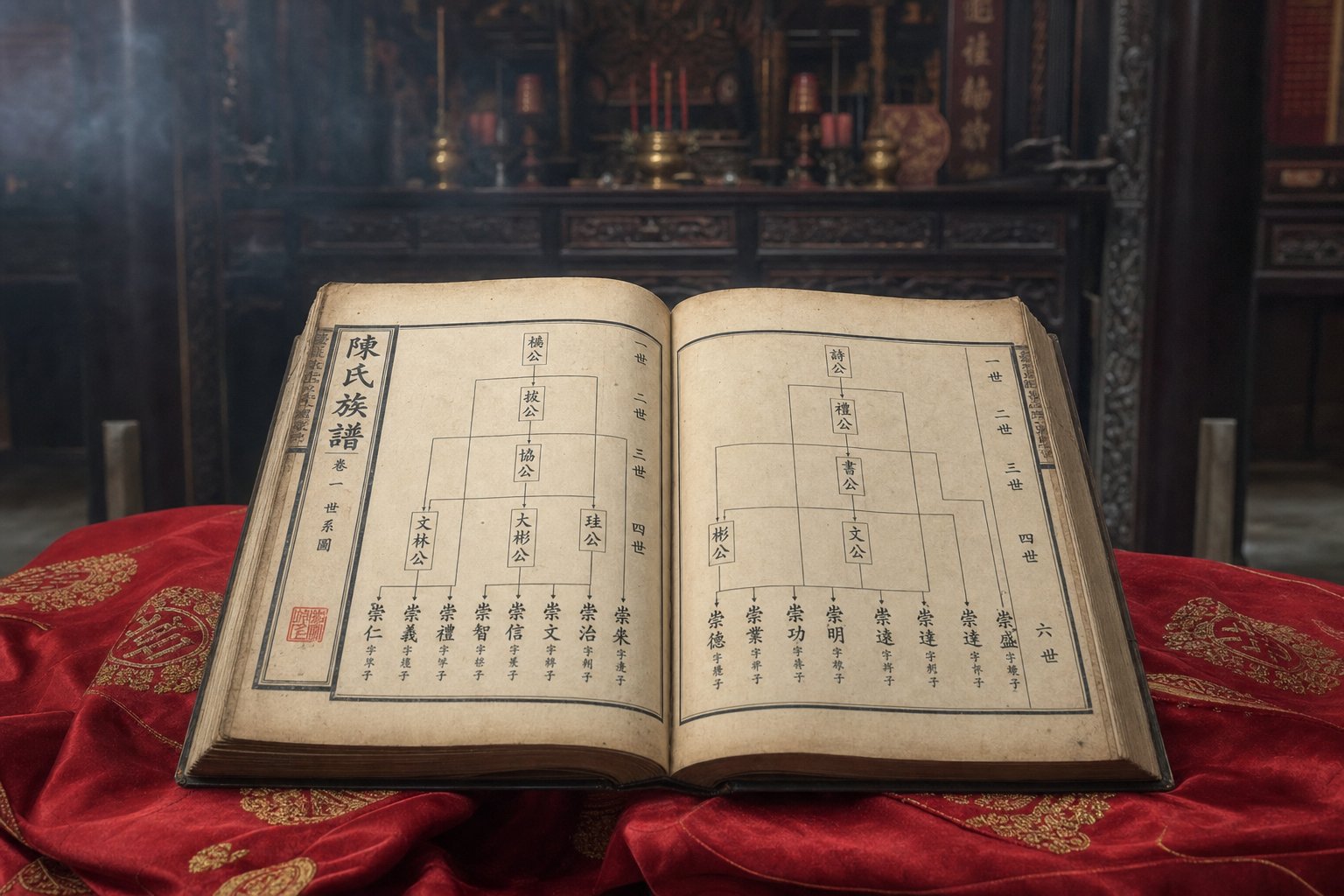
Step 4 - Locate and Interpret Clan Genealogy Records
Historical origin categories and Baijiaxing entries tell you where a surname began in the abstract. But your family did not stay in one place for three thousand years. Clans split, migrated south during wars, resettled in coastal villages, and eventually sent members overseas. The records that document those specific movements, generation by generation, are called jiapu (家谱) or zupu (族谱). These clan genealogy registers are often described as the holy grail of Chinese genealogy research, and for good reason. A single jiapu can trace a family tree in chinese names back twenty, thirty, or even fifty generations, connecting a diaspora descendant to a specific village, a specific ancestor, and a specific branch of a larger surname group.
Unlike Western genealogy, where churches and governments maintained birth, marriage, and death records, Chinese genealogy was traditionally the duty of the individual family or clan. Most Chinese archives do not hold documents about individuals. Instead, private records and lineage information were kept by the clan in the family's ancestral home. This means jiapu records are not sitting in a centralized government database. They exist in village ancestral halls, private family collections, and increasingly in digitized library holdings. Finding yours requires knowing where to look and what to look for.
What Jiapu Records Contain and How to Read Them
A typical jiapu is not a simple list of chinese surnames or a bare family tree. It is a comprehensive clan document, sometimes spanning multiple bound volumes, that weaves together several types of information:
- Surname origin narrative - A written account of how the chinese family name originated, which historical figure founded the lineage, and how the clan migrated to its current ancestral village
- Lineage charts - Generation-by-generation diagrams showing parent-child relationships, often spanning 500 to 1,000 years of recorded ancestry in chinese clan history
- Generational naming poems (字辈/排行) - A sequence of characters, one assigned to each generation, used as part of given names to mark a person's place in the lineage
- Migration records - Notes on when and why branches of the clan relocated, including overseas emigration
- Clan rules and achievements - Ethical guidelines, records of imperial examination successes, and notable members
- Property and ancestral hall records - Documentation of communal land, temples, and burial sites
The generational naming poem deserves special attention because it functions as a built-in verification tool. Imagine a poem of twenty characters. The first generation after the poem was composed uses the first character as part of every male child's given name. The next generation uses the second character, and so on. If your grandfather's Chinese name contains the fourteenth character of the poem and your father's contains the fifteenth, you can confirm your lineage position and identify exactly which branch of the clan you belong to. Even without a complete jiapu in hand, knowing your family's generational character lets you cross-reference against other branches that share the same poem.
You might wonder whether jiapu records mention anything resembling a chinese family crest. Traditional Chinese clans did not use heraldic crests in the European sense. However, many jiapu include illustrations of ancestral halls, clan seals, or symbolic motifs associated with the surname's origin story. These visual markers served a similar identity function within the clan, distinguishing one lineage branch from another.
Even without reading Chinese, the structural patterns in jiapu are recognizable. Lineage charts use consistent tabular layouts with names arranged hierarchically. Generational poems appear as distinct blocks of evenly spaced characters. Dates follow a predictable format referencing imperial reign years. With translation assistance, whether from a bilingual relative, a professional researcher, or AI translation tools, these structural cues make jiapu far more accessible than their classical Chinese text might suggest.
Finding Digitized Clan Records Online
Locating a jiapu that includes your specific family branch requires a targeted search strategy. Not every clan's records survived the upheavals of the twentieth century, but millions of volumes do exist in libraries, private collections, and growing digital databases. The following steps give you the best chance of finding relevant records:
- Search the Shanghai Library's genealogy collection - This is the largest repository of Chinese clan genealogies in the world, holding over 30,000 titles covering thousands of surnames. Their catalog is partially searchable online, and staff can assist with remote inquiries if you provide your surname character and suspected ancestral region.
- Check FamilySearch's digitized Chinese records - FamilySearch has partnered with Chinese institutions to digitize genealogical materials. Their catalog includes jiapu from multiple provinces, searchable by surname and locality.
- Query the China Genealogy Research Center (中国家谱研究中心) - Based in Shanghai, this center maintains a growing database of clan records and can direct researchers to relevant holdings.
- Search My China Roots' zupu database - My China Roots maintains a searchable zupu database that indexes clan genealogies by surname and ancestral village, making it one of the more accessible starting points for overseas researchers.
- Contact county-level archives in your suspected ancestral region - Local archives and cultural bureaus in Chinese counties often hold jiapu that never made it into national collections. If your earlier research identified a specific province or county, a direct inquiry (in Chinese) to the local archive can yield results unavailable anywhere else.
A practical tip: when searching any of these resources, use your confirmed Chinese character rather than the romanized spelling. A list of chinese surnames in character form, cross-referenced against your dialect research from earlier steps, ensures you are searching the correct records. Many databases also allow filtering by province, which is where your romanization-based regional identification pays off directly.
Keep in mind that jiapu were traditionally updated every few decades, so multiple editions may exist for the same clan. Earlier editions might contain origin narratives and migration records that later versions condensed or omitted. If you find a reference to your surname's jiapu but cannot access the physical volume, even a table of contents or a photographed page of the generational poem gives you actionable data to verify your chinese roots and connect with other researchers tracing the same lineage.
Jiapu records represent the internal memory of a clan, documenting who belonged and where they went. But not every family's story stayed neatly within those pages. For diaspora families whose surnames were altered, simplified, or replaced during immigration, a different set of records preserves the original connection, one created not by the clan itself but by the bureaucratic machinery of border crossings and exclusion-era enforcement.
Step 5 - Mine Immigration Records for Original Surname Evidence
For many diaspora families, the surname written on a modern ID card is not the one their ancestors carried when they left China. Somewhere between the departure port and the destination country, the original chinese name surname was altered, shortened, or replaced entirely. These changes were rarely voluntary. They happened at the hands of immigration clerks who could not read Chinese characters, through deliberate strategies to navigate exclusion laws, or as survival adaptations in hostile political environments. The good news: the bureaucratic systems that changed these names also preserved the originals in their own paperwork.
Immigration Documents That Preserve Original Surnames
Immigration enforcement during the exclusion era (1882-1943 in the United States) generated enormous paper trails. Ironically, the same discriminatory system that forced surname changes also created detailed records containing original Chinese characters, dialect notations, and village-of-origin information. These documents are now among the most valuable resources for recovering an authentic surname chinese families carried before arrival.
The key document types to search include:
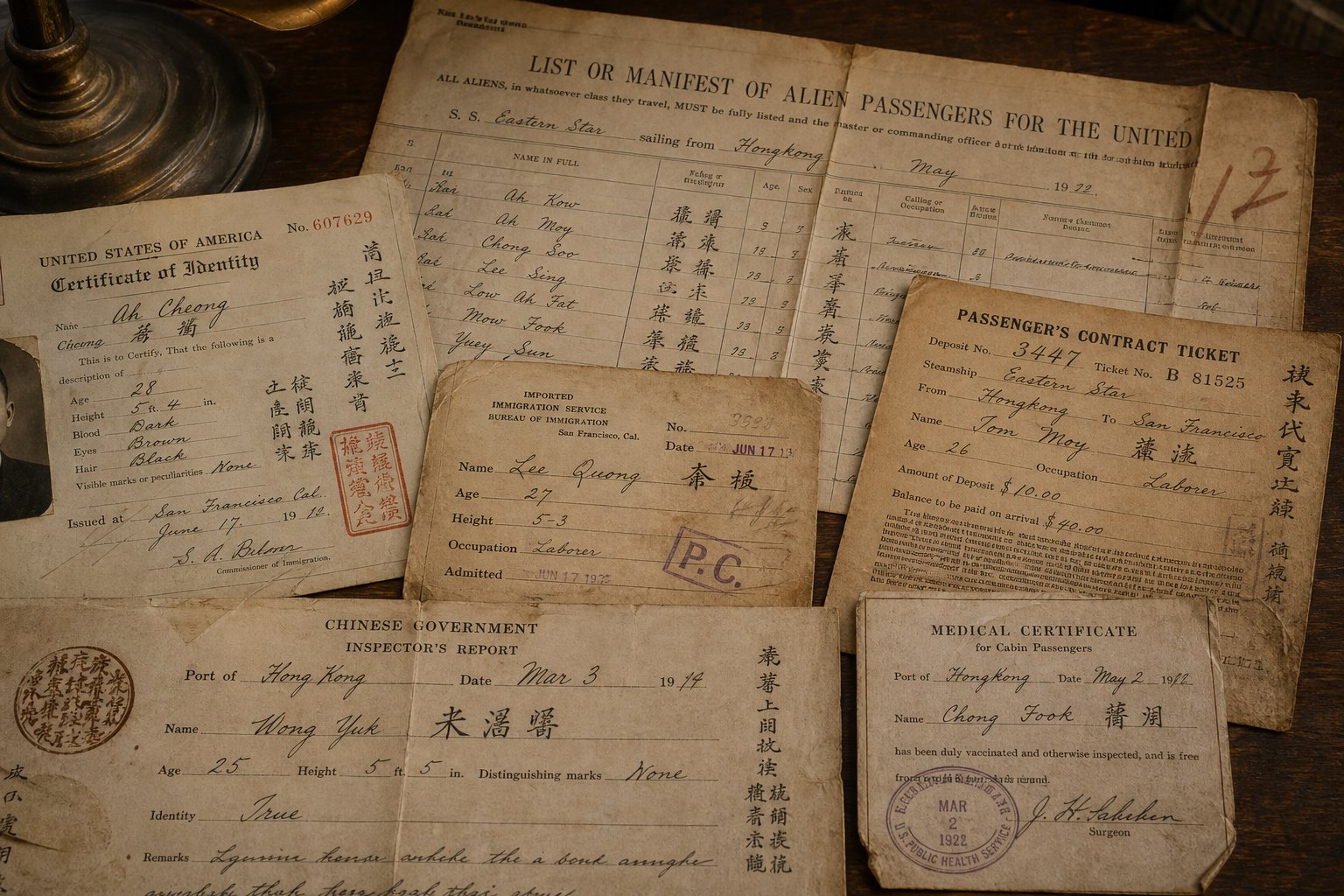
- Ship manifests and passenger lists - Often recorded both the romanized name and the Chinese characters, sometimes with village and district information written by interpreters aboard the vessel
- Angel Island detention records - Interrogation transcripts from the Angel Island Immigration Station (1910-1940) contain detailed family information, including original surnames chinese immigrants provided under questioning, their father's name, and ancestral village
- Chinese Exclusion Act case files - These thick files frequently include photographs, sworn testimony about family relationships, and Chinese-language documents submitted as evidence, all preserving the original last name chinese families used
- Naturalization papers - Later naturalization applications sometimes reference earlier entry documents, creating a chain back to the original spelling or character
- Paper son documentation - Coaching papers and identity documents used by "paper sons" (immigrants who purchased false identities) often contain both the assumed name and clues to the real surname, especially in later confession program files from the 1950s and 1960s
What makes these records particularly powerful is that immigration interpreters, many of them Chinese themselves, frequently wrote the original characters alongside the romanized version. A ship manifest might show "Lee" in the clerk's handwriting and 李 in the interpreter's notation. An exclusion case file might contain a sworn statement listing the applicant's "true family name" in both English and Chinese. These dual-language entries provide a direct, documented link between the anglicized spelling and the authentic character.
Tracing Surname Changes Through Paper Trails
Not all surname changes happened the same way, and understanding the mechanism behind your family's change determines which research strategy will recover the original. Three primary patterns account for most alterations to china surnames during immigration:
Phonetic approximation by clerks. An immigration officer heard a spoken surname and wrote down the closest English approximation. "Ng" might become "Eng" or "Ing." "Xie" might be recorded as "Shea" or "Hsieh." In these cases, the change is purely phonetic, and working backward through dialect pronunciation tables (from Step 2) usually reveals the original character. The research strategy here is straightforward: identify the dialect, map the anglicized spelling back to its phonetic source, and confirm against passenger lists or entry documents.
Deliberate anglicization. Some families intentionally adopted English-sounding surnames to reduce discrimination or simplify daily life. A family surnamed 黃 (Wong) might become "Young" or "King." The connection between the original and adopted name is not phonetic but strategic, making it harder to reverse-engineer from spelling alone. For these cases, look for naturalization records, name-change petitions filed in county courts, or earlier documents (school enrollments, business licenses) that predate the change.
Paper son name adoption. During the exclusion era, thousands of Chinese immigrants entered the United States using purchased identities. A person surnamed 林 (Lim/Lin) might enter the country as a "son" of someone surnamed 陈 (Chan/Chen), adopting that surname permanently. The real surname effectively disappeared from official records. Recovering it requires locating confession program files (if the individual later confessed to being a paper son) or cross-referencing Angel Island interrogation transcripts where inconsistencies in family knowledge sometimes reveal the deception.
The archives holding these records are accessible to researchers:
- National Archives (NARA) - Holds Chinese Exclusion Act case files, arrival investigation files, and partnership/business records organized by port of entry (San Francisco, Seattle, New York, and others)
- Angel Island Immigration Station Foundation - Maintains records and research resources specific to detainees processed through the San Francisco Bay facility
- Local county court naturalization indexes - Name-change petitions and naturalization applications filed at the county level, often containing earlier surname variants
- National Archives regional branches - San Bruno (California), Seattle, and New York branches hold port-specific immigration files that may not be duplicated in the main Washington, D.C. collection
When searching these archives, try every spelling variant you have identified in earlier steps. A family that uses "Chan" today might appear as "Chin," "Chen," or "Chun" in older records, depending on which clerk transcribed the name and which dialect the ancestor spoke. Cross-referencing chinese names and last names across multiple documents from different dates often reveals the progression of changes, letting you trace backward from the current spelling to the original character.
Immigration records capture a surname at a specific moment of transition. They document what was carried across an ocean and what was lost or altered in transit. But for researchers who want to go beyond documentary evidence and confirm biological lineage connections, a different kind of evidence exists, one written not in ink but in DNA.
Step 6 - Use DNA Testing to Confirm Surname Lineage Connections
Documents can be forged, oral histories can drift over generations, and paper son identities can obscure biological truth. DNA, however, carries an uneditable record of patrilineal descent that mirrors the transmission of Chinese surnames themselves. Because both the Y chromosome and the family name pass from father to son, Y-DNA testing offers a uniquely powerful way to verify whether your surname lineage connects to the broader clan you believe you belong to.
Y-DNA Haplogroups and Surname Cluster Connections
The Y chromosome passes virtually unchanged from father to son, accumulating small mutations over thousands of years. These mutations define haplogroups, which are essentially branches on a vast family tree of all human males. Among Han Chinese men, research from Fudan University analyzing over 18,600 individuals found that the O haplogroup accounts for approximately 78% of all patrilineal Han Chinese, with the O2a2 sub-branch alone representing roughly 36% of the male population. This means an estimated 240 million men in China share that single patrilineal branch.
Why does this matter for surname research? Certain haplogroups cluster strongly with specific surname groups due to shared patrilineal descent stretching back thousands of years. When a feudal lord founded a lineage during the Zhou Dynasty, his Y-DNA haplogroup passed to every male descendant who also inherited his surname. Over centuries, that correlation between haplogroup and surname persisted, especially in clans that remained geographically concentrated. If your Y-DNA result places you in a sub-branch that correlates with a known surname cluster, you gain biological confirmation of your documentary research.
The same Fudan University study revealed that patrilineal Han Chinese can be divided into five distinct geographic subgroups based on Y-chromosome haplogroup frequencies: Northern China, Eastern Coast, Upper and Middle Yangtze River, Lingnan, and Min-Tai (Fujian and Taiwan). This geographic structuring means your haplogroup result does not just confirm a surname. It also points toward a region of origin, reinforcing or challenging the dialect-based geographic conclusions you reached in earlier steps.
For researchers tracing rare chinese last names or uncommon chinese surnames, Y-DNA testing is especially valuable. Common surnames like Li or Wang encompass millions of unrelated lineages that adopted the same name through different historical pathways. But rare last names and uncommon surnames often trace to a single founding ancestor, making the haplogroup correlation much tighter. If you carry an unusual surname and your Y-DNA matches others with the same name, the probability of genuine shared ancestry is significantly higher than it would be for a common surname.
Choosing the Right DNA Test for Surname Research
Not all DNA tests serve the same purpose. Each type reveals a different slice of your ancestry, and choosing the right one depends on what question you are trying to answer:
- Y-DNA testing - Traces the direct patrilineal line (father's father's father, etc.). Because Chinese surnames follow this same path, Y-DNA is the most directly relevant test for surname origin confirmation. Higher-resolution tests (such as Big Y from FamilyTree DNA) provide finer haplogroup classification, increasing the chance of matching with specific surname clusters.
- Autosomal DNA testing - Examines DNA inherited from all ancestors across all lines. Useful for finding cousins and confirming broader family connections, but it dilutes by half each generation, making it less effective beyond five or six generations. For asian last names research, autosomal databases have historically been smaller than European ones, though they are growing rapidly as more people of East Asian descent participate.
- Mitochondrial DNA (mtDNA) testing - Traces the direct maternal line (mother's mother's mother, etc.). While it does not follow the surname path, mtDNA provides context about maternal ancestry and can help distinguish between surname groups that share similar Y-DNA but differ in maternal origins due to regional intermarriage patterns.
A practical limitation to acknowledge: DNA reference databases for asia surnames remain smaller than those for European populations. The Fudan University research noted that only about 8.8% of the 1000 Genomes Project samples are Han Chinese, a proportion grossly disproportionate to the population's global share. This means autosomal cousin-matching yields fewer hits for people of Chinese descent compared to those of European ancestry. The gap is closing as testing companies expand their East Asian reference panels and more diaspora families participate, but results today may be thinner than expected.
For researchers working with asian names and surnames, joining a surname-specific DNA project amplifies your results considerably. Platforms like FamilyTree DNA host surname projects where participants who share a family name compare Y-DNA results. If multiple participants with your surname cluster into the same haplogroup sub-branch, that pattern confirms a shared biological ancestor. If your result falls outside the cluster, it may indicate a historical surname adoption, a paper son identity, or a branch that joined the clan through a different mechanism like royal bestowal or ethnic assimilation.
Think of DNA evidence as a confirmation layer rather than a standalone answer. It works best when combined with the documentary research from earlier steps. A Y-DNA match with someone who shares your surname and traces their lineage to the same ancestral village in a jiapu record creates a powerful convergence of evidence. The documents say you are connected, and the biology agrees. Conversely, a DNA mismatch does not necessarily invalidate your research. It might reveal a previously unknown adoption, a maternal surname inheritance, or a name change that documentary records failed to capture.
DNA testing confirms biological lineage. Documentary research confirms historical narrative. Together, they build a case strong enough to take the final step: connecting your surname branch to a specific ancestral village and the living community that still calls it home.
Step 7 - Connect Your Surname Origin to an Ancestral Village
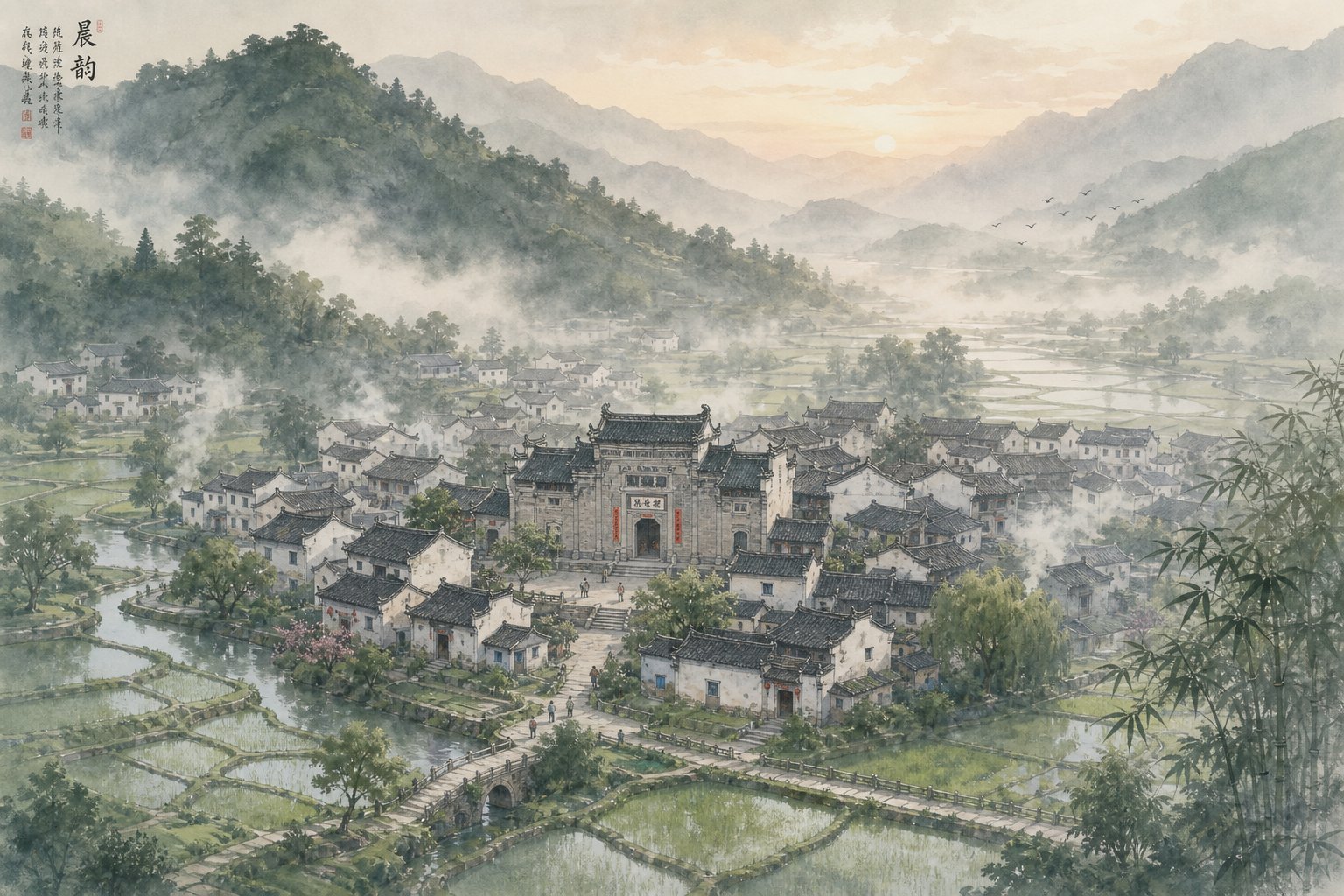
Every step so far has been building toward one destination: a specific village. Not a province, not a county, but the actual settlement your ancestors walked out of when they left China. This is where surname research transforms from historical exercise into something deeply personal. And here is what makes the final connection possible: most Chinese villages historically contained only one or two dominant surname groups. A village was not a random collection of unrelated families. It was a clan settlement, often founded by a single ancestor whose descendants filled every house for generations.
This pattern means that once you have confirmed your surname character, identified your dialect group, narrowed your region, and located a relevant jiapu branch, the number of candidate villages shrinks dramatically. Among the most common chinese surnames like Li, Wang, and Zhang, dozens or even hundreds of single-surname villages exist within a single county. But your dialect, your generational poem, and your DNA results collectively filter those options down to a manageable handful. For less common surnames, the village may be immediately identifiable once the county is confirmed.
Connecting Your Surname Branch to a Specific Village
The Friends of Roots Village Database is one of the most practical tools for this final step. It catalogs over 4,000 villages across the Wuyi region of Guangdong, the area that produced the majority of early Chinese emigrants to North America. Each entry lists the dominant surname for that village, alternative romanizations, and the administrative township. You search by your confirmed Chinese character and county, and the database returns every village associated with your name.
Even the most popular last names in china narrow quickly at the village level. Wang may be the most common chinese surname nationally, but within a specific township of Taishan or Kaiping, only certain villages carry that name. Cross-reference the village candidates against your jiapu's migration notes, your immigration documents' township references, or your DNA matches' known origins, and the list collapses to one or two possibilities.
For researchers whose ancestors came from outside the Wuyi region, county-level gazetteers (地方志) serve a similar function. These local histories, many now digitized, record which surname groups settled which villages within a county's boundaries. A common surname in china like Chen might dominate dozens of villages in Fujian, but your Hokkien dialect variant and generational poem narrow the search to a specific cluster.
Tracing a surname's general historical origin and tracing your specific family branch's migration path are two distinct but complementary efforts. The first tells you where the name began thousands of years ago. The second tells you where your particular ancestors lived in the centuries before emigration. Together, they form a complete picture: the ancient root and the recent departure point.
Reaching Out to Surname Associations and Living Relatives
With a candidate village identified, the research shifts from archives to living communities. Overseas Chinese associations, organized by surname and region, exist in nearly every city with a significant Chinese diaspora population. These organizations, sometimes called clan associations or benevolent societies, maintain membership records, sponsor ancestral hall restorations in China, and connect members who share common chinese last names and regional origins. Reaching out to the association matching your surname and county often connects you with members who have already completed the village identification journey.
Inside China, village committees (村委会) and local cultural bureaus can confirm whether your surname still has a presence in a specific settlement. Some researchers hire local genealogy services to visit candidate villages, photograph ancestral halls, and check whether the village's jiapu includes your family branch. Online platforms like the Chinese Family History Group and WeChat-based genealogy communities also connect diaspora researchers with village contacts and others tracing the most common chinese last names through the same regions.
The complete research pathway, from a romanized spelling on a faded document to a confirmed ancestral village, follows a logical sequence. Each step builds evidence that the next step refines:
- Identify the correct Chinese character behind your romanized surname using dialect comparison tables and FamilySearch tools
- Use the specific romanization variant to determine your dialect group and narrow the ancestral region to a province or sub-region
- Research your surname's historical origin category to establish the dynasty, founding ancestor, and original geographic base
- Locate clan genealogy records (jiapu) that document your specific branch's migration history and generational naming poem
- Mine immigration records for original surname evidence, especially exclusion-era case files that preserve Chinese characters and village names
- Use Y-DNA testing to confirm patrilineal connections to known surname clusters and verify biological lineage
- Cross-reference all accumulated evidence against village databases and surname association records to identify the specific ancestral settlement
Not every researcher will complete all seven steps. Some will find their village name written clearly on a tombstone or in an exclusion case file, jumping straight to confirmation. Others, working with the most popular chinese last names shared by millions, may need every layer of evidence to distinguish their branch from countless others. The process is flexible. Start with whatever you have, follow the evidence where it leads, and let each discovery inform the next question. The village is there in the records, waiting to be found.
Frequently Asked Questions About Tracing Chinese Family Name Origins
1. How do I find the Chinese character for my romanized surname?
Start by comparing your family's romanized spelling against dialect-specific romanization tables. The same Chinese character can appear as many different English spellings depending on whether your ancestors spoke Cantonese, Hokkien, Hakka, or Mandarin. For example, the character 陳 appears as Chan (Cantonese), Tan (Hokkien), Chin (Hakka), or Chen (Mandarin). Tools like FamilySearch's Chinese surname finder let you input your spelling and return possible character matches across multiple dialect systems, helping you identify the correct character and your ancestral dialect group simultaneously.
2. What are jiapu records and how do I access them for my family research?
Jiapu (家谱) or zupu (族谱) are clan genealogy registers maintained by Chinese families for centuries. They typically contain surname origin narratives, generation-by-generation lineage charts, generational naming poems, migration records, and clan rules. The Shanghai Library holds the world's largest collection with over 30,000 titles. You can also search FamilySearch's digitized Chinese records, the My China Roots zupu database, or contact county-level archives in your suspected ancestral region. Even without Chinese fluency, the tabular layouts and hierarchical structures in these documents can be interpreted with translation assistance.
3. Can DNA testing help trace my Chinese surname origin?
Y-DNA testing is particularly useful because the Y chromosome passes from father to son, mirroring how Chinese surnames are inherited. Certain Y-DNA haplogroups cluster strongly with specific surname groups due to shared patrilineal descent over thousands of years. Research from Fudan University shows that Han Chinese patrilineal lines divide into five geographic subgroups based on haplogroup frequencies. However, DNA works best as a confirmation tool alongside documentary evidence rather than a standalone method, especially since East Asian reference databases remain smaller than European ones.
4. Why does the same Chinese surname have so many different English spellings?
Chinese surnames get romanized differently based on two factors: the dialect spoken by the original immigrant and the romanization system used at the time of recording. China has seven to ten major dialect groups, each with distinct pronunciations. Additionally, multiple romanization systems exist, including Pinyin, Wade-Giles, Jyutping, and POJ. A single character like 黃 becomes Huang in Mandarin Pinyin, Wong in Cantonese, Ng or Ooi in Hokkien, and Vong in Hakka. Each variant serves as a geographic clue pointing to a specific ancestral region.
5. How do I connect my Chinese surname research to a specific ancestral village?
Most Chinese villages historically contained only one or two dominant surname groups, so confirming your surname character, dialect group, and clan branch dramatically narrows candidate villages. Use resources like the Friends of Roots Village Database for Guangdong origins, or county-level gazetteers for other regions. Cross-reference village candidates against your jiapu migration notes, immigration documents listing township names, and DNA matches with known origins. Overseas Chinese surname associations and village committees in China can also confirm whether your family branch connects to a specific settlement.