The Liang Surname and Its Place Among China's Great Family Names
Imagine a surname so old that it predates most modern nations, one rooted in the physical image of a bridge beam spanning water. That's the Liang surname (梁) in a nutshell. Ranked as the 22nd most common surname in mainland China and the 7th most common in Hong Kong, the Liang last name connects tens of millions of people to a shared ancestry stretching back nearly three thousand years. Its liang surname origin traces to ancient feudal states, royal bloodlines, and the collapse of kingdoms during China's Spring and Autumn Period.
This isn't just a name you'll find in a database. The story behind the Liang surname weaves together etymology, dynastic politics, migration patterns, and a global diaspora that spans every continent. From a fallen state in Shaanxi province around 641 BC to bustling communities in Hong Kong, Kuala Lumpur, Ho Chi Minh City, and San Francisco, this single ancestral line has traveled far.
Why the Liang Surname Matters in Chinese History
Few Chinese surnames carry as much historical weight as Liang. It produced an entire dynasty (the Liang Dynasty, 502-557 AD), legendary scholars whose stories became idioms, and reformist thinkers who shaped modern China. The character itself, 梁, tells a story of structural support, of bridging gaps, which feels fitting for a family name that has connected cultures across Asia and beyond for millennia.
A Surname with Many Faces Across the World
Here's something that surprises many people researching their family history: the Leung last name in Hong Kong, the Leong in Malaysia, and the Neo in Singapore all point back to the same ancestral character, 梁.
The same surname appears as Liang, Leung, Leong, Neo, Liong, and Luong depending on dialect and region, meaning millions of people worldwide share a common ancestry without immediately recognizing it from spelling alone.
These variations aren't errors or separate names. They reflect centuries of migration and the rich diversity of Chinese dialects, from Cantonese and Hokkien to Teochew and Vietnamese adaptations. If your family name is any of these variants, you're looking at the same bridge, just from a different riverbank.
The character 梁 itself holds the key to understanding why this surname exists at all. Its very structure, combining elements of wood and water, points to its original meaning and the geographic features that gave a feudal state its name.
What the Character 梁 Actually Means and How It Evolved
The liang surname meaning is literally built into the character itself. When you look at 梁 in Chinese, you're not seeing an abstract symbol. You're seeing a picture of a bridge, a wooden beam stretching over water. That physical image became a place name, and that place name became a family identity carried by millions of people across thirty centuries.
Breaking Down the Character 梁 Radical by Radical
Chinese characters aren't random squiggles. They're assembled from smaller components called radicals, each contributing meaning or sound. The character 梁 is classified as a phonosemantic compound, meaning part of it tells you what it means and part tells you how it sounds.
Here's how it breaks down:
- 氵 (water) - This three-stroke radical on the left side represents water. It signals that the character's meaning relates to something involving water.
- 木 (wood/tree) - Sitting at the bottom, this radical represents wood or timber. Combined with the water element, it paints a clear picture: a wooden structure associated with water.
- 刅 (chuang) - This component contributes the sound rather than the meaning. It guided ancient readers toward the pronunciation.
Put them together and you get the original meaning of liang in Chinese: a wooden beam that spans water. A bridge. The ancient dictionary Shuowen Jiezi (circa 100 AD) defines it plainly: "梁, 水橋也" meaning "liang is a water bridge." From that core meaning, the character expanded to cover roof beams, structural supports, and ridges, anything that bridges a gap or holds weight from above.
The character's evolution is well documented. Bronze script versions from the Late Western Zhou period (around 800 BC) show a more pictographic form where the water and wood elements are clearly visible. By the time of seal script in the Han Dynasty, the structure had become more standardized. The clerical script of the Western Jin Dynasty (266-316 AD) brought it closer to the modern form you'll recognize today. Through all these transformations, the core components of water, wood, and sound stayed intact.
Four Different Characters All Romanized as Liang
Here's where things get confusing for anyone researching the meaning of liang without reading Chinese. The romanization "Liang" in Mandarin pinyin maps to at least four completely different characters, each with its own history, meaning, and radical structure. They sound identical in modern Mandarin (all pronounced liáng or liàng) but share nothing else in common.
| Character | Meaning | Key Radical | Usage Context |
|---|---|---|---|
| 梁 | Bridge, beam, ridge | 木 (wood) + 氵 (water) | Surname, architecture, anatomy (bridge of nose) |
| 良 | Good, virtuous, fine | 艮 (root/stillness) | Moral quality, medicine (benign), food (good grain) |
| 亮 | Bright, clear, loud | 亠 (lid) + 几 (table) | Light, clarity, the name Zhuge Liang |
| 凉/涼 | Cool, cold, disappointed | 冫 (ice) or 氵 (water) | Temperature, emotions, the historical Liang Province |
This distinction matters. If you're researching liang in mandarin as a surname, you're almost certainly dealing with 梁 (bridge/beam). The character 良 does appear as a rare surname, but it's a completely separate lineage with different ancestral origins. Someone named Liang with the character 亮 would be using a given name, not a surname. And 凉 connects to geographic names like the ancient Liang Province in Gansu, not to the Liang clan discussed here.
When you encounter the meaning of liang in genealogical records, context and the actual Chinese character are everything. The romanization alone tells you almost nothing about which family line you're tracing.
From Bridge Beams to Family Identity
So how does a word meaning "bridge" become a surname carried by over 11 million people? The answer lies in ancient Chinese naming conventions. During the Zhou Dynasty, feudal states were often named after geographic features of their territory. A state built around a notable bridge or river crossing could easily take 梁 as its name. When that state fell, its people carried the name forward as a family identifier, a permanent reminder of the land they once called home.
The liang meaning embedded in the character, that image of structural support bridging a divide, became something more than architecture. It became identity. And the specific historical events that turned a place name into a surname unfolded during one of China's most turbulent eras.

Ancient Origin Stories from the Spring and Autumn Period
A bridge gave the character its meaning. A kingdom gave the character its people. The transition from geographic label to family name happened during one of the most politically violent centuries in Chinese history, when dozens of small feudal states were swallowed by larger, more aggressive neighbors. The liang last name origin traces directly to this era of collapse and survival.
Most Chinese surname scholars identify at least two distinct origin points for the surname Liang, both rooted in the Spring and Autumn Period (770-476 BC). These aren't competing theories so much as parallel histories. Two separate states named Liang existed simultaneously in different parts of China, and both produced descendants who carried the name forward after their states were destroyed.
The State of Liang in Shaanxi and Its Fall to Qin
The primary and most widely accepted origin begins around 822 BC. King Xuan of Zhou, the eleventh king of the Western Zhou Dynasty, enfeoffed one of his sons (known as Ji Tang or, in some genealogical records, a descendant of the legendary figure Bo Yi) to a territory in what is now Hancheng, Shaanxi province. This territory sat near a major river crossing, a liang, and took that geographic feature as its state name: the State of Liang (梁国).
For nearly two centuries, this small state operated as a vassal under the Zhou feudal system. It controlled a strategically important stretch of the Wei River valley, managing trade routes and river crossings that connected the Zhou heartland to territories further west. But size and geography worked against it.
By the seventh century BC, the State of Qin had grown powerful and expansionist. In 641 BC, Duke Mu of Qin conquered the State of Liang, absorbing its territory and scattering its ruling class. The displaced nobles and commoners of Liang did what countless other families in this era did: they adopted their fallen state's name as a permanent surname. The last name Liang was born from political extinction.
This origin carries a direct bloodline connection to the Zhou royal house. Because King Xuan belonged to the Ji (姬) surname, the royal family of Zhou, the Liang descendants from this line trace their ancestry through one of China's most prestigious lineages. Many traditional genealogy books (族谱) maintained by Liang clans explicitly claim this Ji surname royal connection.
A Second State of Liang in Henan
Here's where the story branches. A separate State of Liang existed in what is now Kaifeng, Henan province, roughly 500 kilometers east of the Shaanxi state. This eastern Liang was associated with the state of Wei (魏), which later relocated its capital there and renamed it Daliang (大梁), meaning "Great Bridge."
Around 645 BC, just a few years before the Shaanxi state fell, this Henan-based Liang territory also experienced political upheaval. Descendants from this region similarly adopted Liang as their surname. Some genealogical sources trace this branch not to the Zhou royal line but to different noble families associated with the state of Wei or earlier Shang Dynasty lineages.
The result? Two geographically and genealogically distinct groups both legitimately carrying the surname Liang, their lines eventually blending over centuries of migration and intermarriage until distinguishing between them became nearly impossible without detailed clan records.
How Feudal Collapse Created Permanent Surnames
To understand why so many Chinese surnames originate from this specific era, you need to picture the feudal system that made it possible. The Zhou Dynasty operated on a decentralized model: the king parceled out land to relatives and loyal supporters, creating hundreds of small vassal states. Each state had its own name, its own ruling family, and its own identity.
When the Zhou central authority weakened after 770 BC, these states began competing, conquering, and absorbing each other. The Spring and Autumn Period saw the number of recognized states shrink from over a hundred to fewer than twenty. Every time a state fell, its people needed a way to preserve their identity and lineage. The state name became that marker.
This pattern produced dozens of modern Chinese surnames beyond just Liang. The surnames Song, Chen, Cai, Zheng, Wu, and Xu all follow the same formula: a feudal state destroyed, its name carried forward by displaced descendants. The surname Liang fits squarely within this broader historical mechanism.
- ~1046 BC - Zhou Dynasty established; feudal enfeoffment system begins distributing territory to royal relatives
- ~822 BC - King Xuan of Zhou grants territory in Shaanxi to his son, establishing the State of Liang
- 770 BC - Western Zhou collapses; Spring and Autumn Period begins as central authority weakens
- ~645 BC - Second State of Liang in Henan experiences political disruption; some descendants adopt the surname
- 641 BC - Duke Mu of Qin conquers the State of Liang in Shaanxi; displaced people permanently adopt Liang as their surname
- 453-221 BC - Warring States Period further scatters Liang families as Qin eventually unifies China
The feudal collapse didn't just create the surname Liang. It scattered its bearers. As Qin expanded and eventually unified China in 221 BC, Liang families dispersed further from their original homeland. Some remained in the Wei River valley. Others moved east toward the Central Plains. A few found positions in the new imperial bureaucracy, ensuring the name survived not just as a memory of loss but as a living, evolving identity.
These scattered families would eventually produce scholars, generals, and even an emperor. The surname that began as a geographic label for a river crossing grew into something far more powerful: a dynasty name.
The Liang Dynasty and Famous Bearers Through History
A surname born from a fallen state eventually gave its name to an entire dynasty. That's a rare arc in Chinese history, and it tells you something about the resilience and ambition of the families who carried the name forward. The Liang Dynasty (502-557 AD) didn't just put the surname on the imperial throne. It cemented the name's prestige across all of liang china for centuries to come.
Emperor Wu and the Southern Liang Dynasty
In 502 AD, a military commander named Xiao Yan overthrew the Southern Qi Dynasty and established his own ruling house. He chose the dynastic name Liang (梁), founding what historians call the Southern Liang Dynasty or simply the liang dynasty. As Emperor Wu, he would reign for an extraordinary 48 years, making him one of the longest-ruling emperors in Chinese history.
Here's an important distinction: Xiao Yan's personal surname was Xiao (萧), not Liang. He selected "Liang" as his dynastic title because his ancestral fief was in the Liang commandery region (in modern Hubei province). This means the dynasty didn't directly create new bearers of the Liang surname through royal lineage the way the Zhou enfeoffment had. Instead, it elevated the cultural weight of the name itself.
What did this mean for existing Liang families? Prestige by association. During the 55 years of Liang rule, the character 梁 appeared on official documents, coins, government seals, and historical records as a symbol of imperial authority. Liang clans across southern China benefited from this reflected glory, and many genealogy books from this era show increased record-keeping and ancestral hall construction, signs that families were investing in their lineage identity while the name carried imperial cachet.
Emperor Wu himself was a fascinating figure. A devout Buddhist who reportedly took monastic vows multiple times (forcing his ministers to "ransom" him back to the throne), he presided over a golden age of arts, literature, and religious scholarship in southern China. The dynasty eventually fell to the rebellion of general Hou Jing in 557 AD, but its cultural legacy endured far longer than its political power.
Liang Hong and the Legacy of Virtue
Centuries before the dynasty existed, the surname had already produced one of China's most beloved moral exemplars. Liang Hong (梁鸿) was an Eastern Han Dynasty scholar who lived during the first century AD, and his story became so famous that it generated a Chinese idiom still used today: 举案齐眉 (ju an qi mei), meaning "raising the tray to eyebrow level."
The story goes like this. Liang Hong was a man of great learning but modest means who rejected offers of official positions. He married a woman named Meng Guang, who was described as plain in appearance but extraordinary in virtue and intellect. The couple lived in deliberate simplicity, and Meng Guang demonstrated her respect for her husband through a daily ritual.
Each time Meng Guang served Liang Hong his meal, she would raise the food tray to the level of her eyebrows as a gesture of deep respect, and he would receive it with equal reverence. This mutual devotion became the idiom 举案齐眉, still used in modern Chinese to describe a marriage built on genuine equality and admiration.
What makes this story significant for the surname's legacy isn't just the romance. Liang Hong represented a specific ideal in Chinese culture: the incorruptible scholar who chooses poverty and integrity over wealth and compromise. His refusal to serve a government he considered corrupt, combined with his harmonious marriage, made him a moral touchstone. For Liang families tracing their ancestry, claiming connection to Liang Hong meant claiming a lineage of principled character, not just political power.
How Dynastic Power Shaped Clan Prestige
The Later Liang (907-923 AD), founded by Zhu Wen during the chaotic Five Dynasties and Ten Kingdoms period, adds another layer to this story. Like the Southern Liang, this dynasty took its name from a geographic association rather than the founder's surname (Zhu Wen's family name was Zhu). It reinforced the pattern: the name Liang carried enough historical weight that ambitious rulers chose it to legitimize their power.
For actual Liang surname bearers, these dynastic associations created a compound effect. Their name wasn't just tied to an ancient fallen state. It was connected to imperial courts, legendary scholars, and cultural ideals. Clan genealogies from the Tang and Song dynasties show Liang families actively curating these connections, listing both the Zhou royal lineage and figures like Liang Hong as part of their collective identity.
This prestige had practical consequences. In imperial China, a surname's reputation influenced marriage alliances, examination opportunities, and social standing. The Liang surname, bolstered by dynastic glory and moral exemplars, carried weight that opened doors across southern China, particularly in Guangdong and Fujian, where many Liang clans had settled by the Tang Dynasty.
Those southern settlements would become launching points for something even larger. As Liang families concentrated in coastal provinces, they positioned themselves at the edge of China's maritime world, ready for waves of migration that would carry the surname across oceans and into dozens of new countries.
Every Way to Spell and Pronounce the Same Surname
Coastal Guangdong and Fujian didn't just give Liang families a geographic home. These provinces gave the surname its voice, or rather, its many voices. Because Chinese dialects differ as dramatically as Spanish differs from French, the single character 梁 sounds completely different depending on which community is speaking it. Each sound became a distinct spelling when families emigrated and registered their names in local scripts abroad.
If you've ever wondered why a Leung in Toronto and a Neo in Jakarta could be distant cousins, the answer lies in dialect phonology. Same character, same ancestry, radically different pronunciation.
Complete Romanization Table by Dialect and Region
The table below maps every major romanization of 梁 to its dialect group, primary region of use, and the linguistic reason behind the sound shift. This is the clearest way to see how one surname fractured into half a dozen spellings.
| Romanization | Dialect Group | Primary Region | Phonological Explanation |
|---|---|---|---|
| Liang | Mandarin (Pinyin) | Mainland China, Taiwan | Standard Mandarin pronunciation with the medial -ia- glide and nasal -ng ending |
| Leung | Cantonese (Jyutping: loeng4) | Hong Kong, Macau, older diaspora communities | Cantonese preserves the Middle Chinese -ng final and shifts the vowel to a rounded "eu" sound |
| Leong | Cantonese (alternative romanization) | Malaysia, Singapore, some Western countries | Same Cantonese pronunciation as Leung, but romanized using a different colonial-era spelling convention |
| Neo | Hokkien / Teochew | Singapore, Indonesia, parts of Malaysia | Southern Min dialects dropped the initial L- and nasal ending entirely, producing a short open syllable |
| Liong | Hokkien (variant sub-dialect) | Parts of Fujian, Philippines, Indonesia | Some Hokkien sub-dialects retain the L- initial but shift the vowel and preserve a nasal ending as -ong |
| Niu / Nio | Hokkien / Teochew (sub-dialect variant) | Certain communities in Indonesia and Malaysia | Further vowel reduction from the Neo form, influenced by local Malay phonology during registration |
| Luong / Lương | Sino-Vietnamese | Vietnam, Vietnamese diaspora worldwide | Vietnamese adapted Middle Chinese readings with tonal marks and modified vowel clusters |
You'll notice that the most dramatic shifts happen in the Southern Min (Hokkien/Teochew) dialects. The jump from "Liang" to "Neo" looks impossible on paper, but it follows consistent phonological rules within that dialect family. The initial L- weakened to an N- sound, the medial vowel simplified, and the final nasal consonant dropped entirely. Each step is small; the cumulative result just looks dramatic to outsiders.
Why Cantonese Says Leung While Mandarin Says Liang
The difference between liang pronunciation in Mandarin and how to pronounce leung in Cantonese comes down to historical sound preservation. Cantonese is often described as a more "conservative" dialect because it retains features of Middle Chinese (the prestige language of the Tang Dynasty, roughly 600-900 AD) that Mandarin later simplified.
Two key differences stand out:
- The vowel shift: Middle Chinese had a vowel in this character closer to the Cantonese "eu" (a rounded sound, similar to the French "eu" in "peu"). Mandarin shifted this to the more open "-ia-" glide over centuries. Cantonese kept the older vowel.
- The final consonant: Both dialects actually preserve the -ng ending in this character. But Mandarin pairs it with the -iang rhyme while Cantonese pairs it with -eung, making the overall syllable sound quite different despite sharing that nasal tail.
This is why someone trying to pronounce Liang in Mandarin says something close to "lee-AHNG" (two syllables blended quickly, rhyming with "young" but with an "ee" onset), while the Cantonese version sounds more like "luh-NG" with a single rounded vowel flowing directly into the nasal.
Pronouncing Liang, Leung, and Leong Correctly
Getting these right matters, especially if you're reconnecting with family or introducing yourself in a professional context. Here's a practical guide:
- Liang (Mandarin): Say "lee" then immediately glide into "ahng" (like the "ong" in "song" but more open). It's one smooth syllable: lee-ahng. The tone in Mandarin is second tone, a rising pitch like asking a question.
- Leung (Cantonese): To pronounce Leung correctly, start with an "L" sound, then produce a vowel similar to the "ur" in "fur" but shorter and more rounded, and finish with a clear "-ng" nasal. Think "lurng" compressed into one beat. Many English speakers instinctively say "LOONG" which is close enough for casual use but technically off.
- Leong (Cantonese, alternate spelling): Identical in pronunciation to Leung. The spelling difference reflects Malaysian and Singaporean romanization conventions rather than any sound difference. If you know how to say Leung, you already know Leong.
- Neo (Hokkien/Teochew): Simply "nee-oh" blended into one syllable, with a slight nasal quality. Much shorter and simpler than the Mandarin or Cantonese forms.
- Liong (Hokkien variant): "Lee-ong" as one syllable, rhyming with the English word "long" but with an "ee" onset. The liong spelling captures this Hokkien sub-dialect pronunciation faithfully.
A common question people search is how to say Leung when they encounter the name in a Western context. The simplest English approximation is "lurng" (rhyming with "young" but starting with L and using a more closed vowel). It won't be perfect Cantonese, but it's respectful and recognizable.
These pronunciation differences aren't just linguistic curiosities. They're geographic fingerprints. When you know that your family spells it Leong rather than Leung, you're holding a clue that points toward Malaysia or Singapore rather than Hong Kong. That single spelling choice narrows your ancestral search by thousands of kilometers, which matters enormously when you're trying to trace where your specific branch of the family actually lived before emigrating.

How Liang Families Spread from Northern China to the World
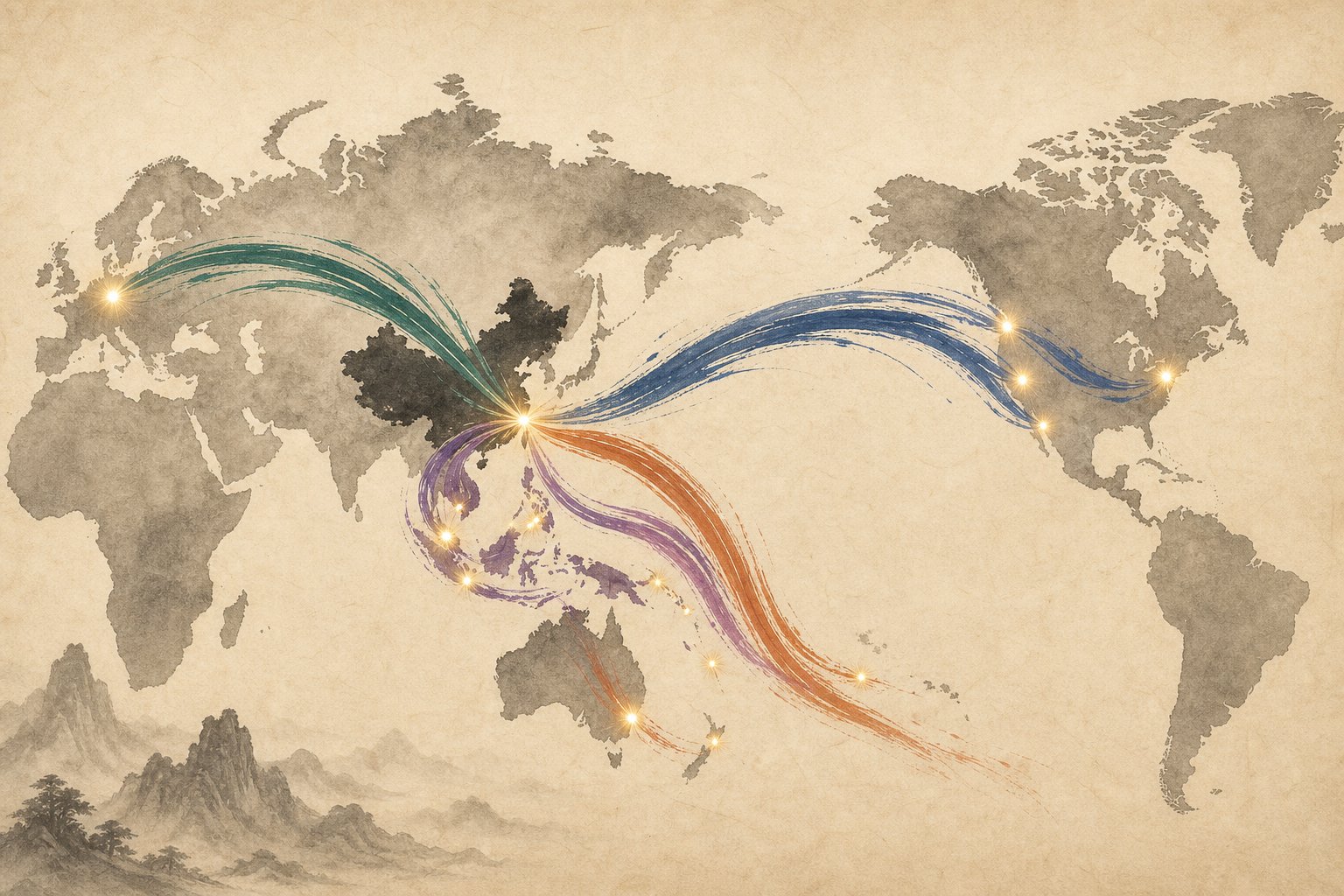
Those geographic fingerprints encoded in dialect spellings didn't appear randomly. Each variant, whether Leung, Leong, or Luong, marks a specific stop along a migration route that took nearly two thousand years to complete. The leung name origin traces back through Hong Kong and Guangdong. The leong name origin points to Cantonese-speaking communities that settled in British Malaya. The luong last name origin connects to families who crossed into Vietnam centuries ago. Every spelling is a breadcrumb on a trail that leads back to the same starting point: the Wei River valley in Shaanxi.
From Shaanxi Southward During Dynastic Upheaval
After the State of Liang fell in 641 BC, its people scattered across the Central Plains. For centuries, most Liang families remained in northern China, concentrated in areas around modern Shaanxi, Henan, and Shandong. But northern China was rarely peaceful for long. Each major period of instability pushed populations southward in massive waves, and Liang families moved with them.
The major migration triggers followed a clear pattern: northern collapse, southern refuge.
- Western Jin collapse (311-317 AD): Nomadic invasions destroyed the northern capital Luoyang. Millions of Han Chinese fled south across the Yangtze River in what historians call the "Crossing to the South" (衣冠南渡). Liang families relocated to the Jiangnan region, modern Jiangsu and Zhejiang.
- An Lushan Rebellion (755-763 AD): This devastating Tang Dynasty civil war killed tens of millions and shattered northern stability. A second massive wave of southward migration carried Liang clans deeper into Jiangxi and Fujian provinces.
- Song-Yuan transition (1127-1279 AD): The Jurchen conquest of northern Song, followed by the Mongol conquest of southern Song, triggered the largest southward migration in Chinese history. Liang families pushed all the way to Guangdong and the Pearl River Delta.
- Ming-Qing transition (1644 AD): The Manchu conquest drove additional waves of refugees into the far south, consolidating Liang populations in coastal Guangdong and Fujian.
Each wave didn't replace the previous one. It layered on top. Liang families who arrived in Guangdong during the Song Dynasty were joined by later arrivals during the Ming, creating deep-rooted communities with centuries of continuous presence in the same villages.
Guangdong and Fujian as Secondary Homelands
By the Ming Dynasty (1368-1644), Guangdong and Fujian had become the demographic center of gravity for Liang families. This concentration wasn't accidental. These coastal provinces offered fertile agricultural land, thriving trade ports, and enough distance from northern political chaos to allow communities to stabilize and grow.
Guangdong province, particularly the Pearl River Delta region around Guangzhou, Foshan, and Zhongshan, became the single largest concentration of Liang surname bearers in China. The Cantonese dialect spoken there is why so many overseas Liang families spell their name Leung or Leong rather than the Mandarin pinyin form. Fujian province, especially the southern Hokkien-speaking areas around Xiamen and Quanzhou, produced the Neo and Liong variants that dominate Southeast Asian communities.
These weren't just residential clusters. They were launching pads. Both provinces faced the South China Sea, and their residents had centuries of maritime trading experience. When economic pressure, famine, or political instability made staying untenable, the ocean offered a path forward rather than a barrier.
Overseas Migration to Southeast Asia and Beyond
Chinese migration to Southeast Asia has ancient roots. UNESCO research traces the earliest movements to the opening of the maritime Silk Road over 2,000 years ago, with established Chinatowns in Sumatra and Java by the early fifteenth century. Liang families from Guangdong and Fujian participated in these trade networks, initially as merchants and sailors, later as permanent settlers.
The real acceleration came in the mid-nineteenth century. European colonial powers in Southeast Asia created enormous demand for Chinese labor to work tin mines, rubber plantations, and port infrastructure. The Opium Wars forced the Qing government to authorize mass emigration of Chinese laborers. Liang families from Guangdong headed to British Malaya (modern Malaysia and Singapore), while Hokkien-speaking Liang families from Fujian gravitated toward the Dutch East Indies (Indonesia) and Siam (Thailand). Those who crossed into Vietnam, adapting the luong last name to Vietnamese phonology, often came from border regions of Guangxi and Guangdong where trade routes connected the two countries.
By the early 1940s, approximately 8.5 million Chinese expatriates lived abroad, over ninety percent of them in Southeast Asia. Liang families formed a significant portion of these communities, particularly in Malaya and Indonesia where Cantonese and Hokkien speakers dominated.
Later waves carried the surname further:
- Gold Rush era (1850s-1880s): Cantonese laborers, including Leung families, migrated to California, Australia, and British Columbia for mining and railroad construction.
- Post-1949 diaspora: Political upheaval following the founding of the People's Republic interrupted large-scale emigration for decades, but families already in Hong Kong, Taiwan, and Southeast Asia continued secondary migrations to Western countries.
- 1980s onward: China's reopening triggered a third major wave. Liang families from mainland China migrated directly to the United States, Canada, Australia, and Europe, this time often as students, professionals, and investors rather than laborers.
The result is a surname scattered across every inhabited continent, with each community's spelling preserving the dialect and departure point of their specific ancestors. A Leung family in Vancouver likely traces through Hong Kong. A Leong family in Kuala Lumpur probably descends from Cantonese migrants who arrived during British colonial rule. A family carrying the luong last name in Houston almost certainly connects to Vietnamese communities with roots in southern China.
These migration patterns didn't just move people. They created entirely new demographic realities, reshaping where the surname is most common and how it ranks against other Chinese family names in countries around the world.
Global Distribution and Demographics of the Liang Surname
Migration patterns tell you where families went. Distribution data tells you where they stayed, grew, and built lasting communities. The Liang surname didn't just scatter randomly across the globe. It concentrated in specific countries for specific historical reasons, and those concentrations are still visible today in population statistics, surname rankings, and community organizations.
Where Liang Families Live Today by Country
The overwhelming majority of people carrying the surname 梁, regardless of spelling, still live in China. But the overseas populations are substantial and growing. The table below shows where the surname appears most frequently, which romanization dominates in each country, and the historical migration wave that planted the community there.
| Country/Region | Predominant Spelling | Estimated Population | Historical Connection |
|---|---|---|---|
| China (mainland) | Liang | ~11 million+ | Original homeland; strongest in Guangdong, Guangxi, Fujian |
| Hong Kong | Leung | ~500,000+ | Cantonese-speaking families from Guangdong; 7th most common surname locally |
| Malaysia | Leong / Liang | ~70,000+ (Leong alone) | British colonial-era labor migration from Guangdong and Fujian |
| Singapore | Leong / Neo | ~10,000-15,000 | Hokkien and Cantonese trade communities from the 19th century |
| Indonesia | Neo / Liong / Nio | Significant (exact figures unclear) | Hokkien traders in Dutch East Indies; many adopted Indonesian names post-1965 |
| Vietnam | Lương (Luong) | Significant | Cross-border migration from Guangxi and Guangdong over centuries |
| United States | Liang / Leung / Leong | ~13,000-15,000 (Leong); growing Liang population | Gold Rush era laborers; post-1965 immigration reform; post-1980s professionals |
| Canada | Leung / Liang | ~5,000-8,000 | Railroad construction era; Hong Kong handover migration (1990s) |
| Australia | Leong / Liang | ~4,000-5,000 | Gold Rush era; post-White Australia policy migration from Southeast Asia |
| United Kingdom | Leung / Leong | ~1,000-2,000 | Hong Kong diaspora; post-1997 and post-2020 waves |
| Thailand | Leong (Thai transcription varies) | ~3,000+ | Teochew and Cantonese trade migration |
Notice the pattern. Countries with the leong surname or leong last name as the dominant spelling, like Malaysia and Singapore, received their Liang populations primarily from Cantonese-speaking Guangdong during the British colonial period. Countries where the last name Leung dominates, like Hong Kong and parts of Canada, reflect direct Cantonese migration from the Pearl River Delta. And countries where you find Neo or Liong received Hokkien-speaking families from Fujian.
The luong last name nationality question has a clear answer: Vietnamese. Families carrying the Luong spelling are overwhelmingly of Vietnamese nationality, though their deeper ancestry traces to southern Chinese provinces. This makes the Luong spelling a two-step geographic marker, pointing first to Vietnam and then back to Guangdong or Guangxi.
Understanding Surname Rankings in China and Abroad
Within China, the surname's distribution isn't even. Guangdong province alone accounts for a disproportionate share of all Liang surname bearers. Guangxi, the neighboring autonomous region, ranks second. Fujian comes third. Together, these three southern provinces hold the majority of China's Liang population, a direct legacy of the southward migrations described earlier.
The leung surname ranks 22nd among all surnames in mainland China and 7th in Hong Kong. That gap tells a story. Cantonese-speaking regions have a much higher concentration of Liang families than the national average, which makes sense given that Guangdong became the surname's secondary homeland over a thousand years ago.
In the United States, the picture is more fragmented because the same surname appears under multiple spellings in census data. Leong alone accounts for roughly 13,694 people according to global surname databases, but this doesn't capture families registered as Liang, Leung, Neo, or Luong. Combined, the actual population of 梁 surname bearers in America is considerably larger than any single spelling suggests. The Leong population in the U.S. grew by over 6,800 percent between 1880 and 2014, reflecting successive waves of Chinese immigration from the Gold Rush through modern professional migration.
One Ancestry Under Many Spellings
Here's what the distribution data makes clear: a person named Leung in Hong Kong, Neo in Indonesia, and Liang in Beijing all share the same ancestral surname. They trace back to the same character, 梁, the same fallen state in Shaanxi, and the same Zhou Dynasty royal lineage. The spelling differences are artifacts of dialect and colonial-era registration systems, not indicators of separate origins.
This creates both a challenge and an opportunity for anyone researching their family history. The challenge is that standard database searches won't connect these variants automatically. Searching for "Leung" won't return results filed under "Leong" or "Neo." The opportunity is that once you understand the dialect-to-spelling mapping, you can cast a much wider net. A Leong family in Kuala Lumpur and a Leung family in Vancouver might share a common ancestor just a few generations back in Guangdong, even though their names look completely different on paper.
Knowing where your branch of the family concentrated, and which spelling they used, gives you the starting coordinates for tracing your specific lineage back through the centuries of migration that brought the surname from its ancient homeland to wherever you are reading this today.

Practical Steps for Tracing Your Liang Family History
Starting coordinates are only useful if you know what to do with them. Whether your family spells it Leung, Leong, Neo, or Luong, the path from a surname on a passport to a documented ancestral lineage follows a surprisingly consistent set of steps. The tools range from centuries-old handwritten genealogy books to modern DNA kits, and the best results come from combining both.
Ancestral Halls and Genealogy Books as Primary Sources
Chinese clan culture produced something remarkable for genealogists: a tradition of meticulous record-keeping that stretches back over a thousand years. Two institutions sit at the center of this tradition, and both remain active for Liang families today.
Ancestral halls (宗祠) are physical buildings maintained by clan associations, dedicated to honoring shared ancestors and preserving lineage records. Major Liang ancestral halls still operate in Guangdong, Guangxi, and Fujian provinces. These aren't museums. They're living institutions that host annual ceremonies, maintain membership rolls, and most importantly, store genealogy books that document family lines going back dozens of generations. The Liang clan hall in Foshan, Guangdong, for example, holds records connecting local families to the original Zhou Dynasty lineage.
Genealogy books (族谱, zupu) are the single most valuable documentary source for Chinese family research. These handwritten or printed volumes record births, deaths, marriages, migration events, and generational naming patterns for an entire clan branch. A well-maintained zupu can trace a family line back 20 to 30 generations, sometimes further. The challenge? They're written in classical Chinese, organized by generation rather than chronology, and often held privately by clan elders or deposited in ancestral halls rather than public libraries.
The good news is that many zupu have been microfilmed or digitized. The Family History Library in Salt Lake City, Utah holds one of the world's largest collections of Chinese genealogical records, including clan genealogies, gazetteers, and vital records indexes. Their Chinese collection includes microfilmed zupu from various provinces and time periods. FamilySearch.org also provides online access to portions of this collection, making it possible to search for Liang clan records without traveling to Utah.
Matching Your Dialect Variant to a Region of Origin
Your specific spelling is a research compass. It tells you which province, which dialect group, and which migration wave your family likely belongs to. Use it to narrow your search before diving into records.
Here's how to match your variant to a starting point:
- Surname Leung: The leung last name origin points directly to Cantonese-speaking Guangdong, particularly the Pearl River Delta counties around Guangzhou, Foshan, Zhongshan, and Taishan. Start your search in Guangdong provincial archives and Liang clan halls in these cities.
- Surname Leong: The leong last name origin also traces to Cantonese Guangdong, but the spelling convention suggests your family registered their name in Malaysia, Singapore, or another Southeast Asian country using colonial-era romanization. Look for intermediate records in those countries first, then trace backward to Guangdong.
- Surname Neo or Liong: Focus on southern Fujian province, particularly Xiamen, Quanzhou, and Zhangzhou. These Hokkien-speaking regions produced the families who settled in Indonesia, Singapore, and the Philippines.
- Surname Luong (Lương): Begin with Vietnamese civil records, then trace the family's entry point from China. Most Vietnamese Luong families connect back to Guangxi or northern Guangdong border regions.
- Surname Liang (Pinyin): If your family emigrated directly from mainland China after 1949, the Pinyin spelling doesn't narrow geography as precisely. You'll need oral family history or immigration documents to identify the specific province.
The liang name meaning, that image of a bridge, connects all these variants to the same ancestral root. But for practical research, treating each spelling as a distinct geographic clue will save you months of unfocused searching.
Combining Traditional Records with Modern Tools
Documentary research and DNA testing answer different questions. Genealogy books tell you who your ancestors were, where they lived, and what they did. DNA tells you which populations you're genetically connected to and can confirm or challenge what the paper trail says. The strongest family history research uses both.
DNA testing is particularly useful for Liang surname research in two scenarios. First, if your paper trail dead-ends at an immigration event and you can't identify the specific village of origin, DNA ethnicity estimates and cousin matching can point you toward a geographic region. Second, if you suspect your family's surname Leung or Leong connects to a specific clan branch but can't prove it documentarily, shared DNA with other tested members of that branch provides biological confirmation.
Here's a practical sequence for getting started:
- Step 1: Interview living relatives. Record every detail they remember: village names, dialect spoken at home, names of grandparents and great-grandparents, approximate dates of emigration. Even partial or phonetic spellings of Chinese place names are valuable.
- Step 2: Gather immigration and civil documents. Ship manifests, immigration cards, naturalization papers, and birth certificates often contain birthplace information that connects to a specific Chinese county or village.
- Step 3: Identify your dialect group and target province. Use the spelling-to-region mapping above to focus your search geographically.
- Step 4: Search digitized genealogy collections. Check FamilySearch.org for Liang clan zupu from your target province. Search using both the Chinese character 梁 and romanized spellings.
- Step 5: Contact relevant clan associations. Liang surname associations exist in most countries with significant Chinese populations. They often maintain member directories and can connect you with clan elders who hold genealogy books.
- Step 6: Take a DNA test. Services like AncestryDNA, 23andMe, or WeGene (which specializes in East Asian populations) can provide ethnicity breakdowns and match you with genetic relatives who may have already documented shared lineage.
- Step 7: Plan onsite research if possible. If your documentary and DNA evidence points to a specific village or county, visiting the ancestral hall in person remains the most effective way to access records that haven't been digitized.
One important note: Chinese genealogical records use characters, not romanized spellings. If you don't read Chinese, you'll need translation assistance at some point. The Family History Library employs volunteers who can help identify names and locations in Chinese-language records, and professional genealogists specializing in Chinese ancestry can conduct research on your behalf in both overseas archives and mainland Chinese repositories.
The liang surname origin story spans nearly three thousand years, from a bridge over a river in Shaanxi to millions of people on every continent. Your specific branch of that story is waiting in a genealogy book, a clan hall registry, or a DNA match list. The bridge character that started it all was about connection, about spanning a gap between two sides. Tracing your ancestry is the same kind of work: building a bridge between who you are now and where your family began.
Frequently Asked Questions About the Liang Surname Origin
1. What does the Chinese character 梁 (Liang) literally mean?
The character 梁 combines radicals for water (氵) and wood (木), representing a wooden beam or bridge spanning water. The ancient dictionary Shuowen Jiezi defines it as 'a water bridge.' Over time, the meaning expanded to include roof beams, structural ridges, and anything that bridges a gap. This architectural meaning became a geographic label for a territory near a river crossing, which eventually became the surname carried by millions of descendants after the state fell to Qin in 641 BC.
2. Are Leung, Leong, Neo, and Liang the same surname?
Yes, they all represent the same Chinese character 梁. The spelling differences reflect regional dialects and colonial-era romanization systems. Leung comes from Cantonese pronunciation used in Hong Kong, Leong uses Malaysian and Singaporean romanization conventions for the same Cantonese sound, Neo derives from Hokkien and Teochew dialects spoken in Singapore and Indonesia, and Liang is the standard Mandarin Pinyin spelling used in mainland China and Taiwan. All trace back to the same ancestral lineage.
3. How did the Liang surname originate in ancient China?
The primary origin dates to around 822 BC when King Xuan of Zhou granted territory in modern Shaanxi province to his son, establishing the State of Liang near a major river crossing. The state survived for nearly two centuries until Duke Mu of Qin conquered it in 641 BC. After the state's destruction, displaced nobles and commoners adopted their fallen state's name as a permanent family surname. A second origin involves a separate State of Liang in modern Henan province that experienced similar political collapse around 645 BC.
4. How do I trace my Liang family ancestry based on my surname spelling?
Your spelling variant serves as a geographic compass. If your surname is Leung, begin research in Cantonese-speaking Guangdong province, particularly the Pearl River Delta. Leong points to Guangdong families who registered in Malaysia or Singapore. Neo or Liong indicates Hokkien-speaking roots in southern Fujian province. Luong connects to Vietnamese records with deeper roots in Guangxi or northern Guangdong. Start by interviewing relatives, gathering immigration documents, then search digitized genealogy collections on FamilySearch.org or contact Liang clan associations in your country.
5. How is the surname Leung correctly pronounced?
In Cantonese, Leung is pronounced as a single syllable starting with an L sound, followed by a rounded vowel similar to the 'ur' in 'fur' but shorter, and ending with a clear nasal -ng sound. The closest English approximation is 'lurng,' rhyming with 'young' but with a more closed vowel. It differs from the Mandarin pronunciation 'Liang' (lee-ahng) because Cantonese preserves older Middle Chinese vowel sounds that Mandarin simplified over centuries.