Why Lucky Numbers Are Central to Chinese Naming
Imagine paying over $280,000 for a phone number. That is exactly what happened when Sichuan Airlines purchased the number +86 28 8888 8888, packed with eights, because of its association with prosperity. In Chinese culture, numbers are far more than digits on a page. They carry meaning, emotion, and even destiny, especially when it comes to choosing a name for a child or a business.
The connection between lucky chinese numbers and naming runs deep. Parents spend weeks consulting charts, counting brushstrokes, and weighing phonetic associations before settling on a name. Business owners do the same when registering a company. A chinese name related to luck is not a casual preference. It reflects a belief system where sound, structure, and symbolism converge to shape a person's fortune from birth.
Why Numbers Carry Weight in Chinese Names
Chinese is a tonal language rich in homophones, words that sound identical or nearly identical but carry completely different meanings. This linguistic feature turns numbers into powerful symbols. The number 8 sounds like the word for "prosper." The number 4 sounds like "death." These are not loose associations. They are phonetic overlaps so close that the emotional weight of one word transfers directly onto the number.
This is why luck in chinese culture is so tightly bound to pronunciation. The chinese word for lucky, ji (吉), itself appears in countless naming guides and fortune-telling manuals. When parents select characters for a name, they are listening for echoes of prosperity, longevity, and harmony in every syllable and stroke count.
Two Systems at Work in Chinese Naming
What makes lucky numbers chinese naming especially layered is that two distinct systems operate simultaneously. The first is the cultural-phonetic system, where numbers gain power because they sound like auspicious words. You will encounter this in everyday life: prices ending in 8, wedding dates loaded with 6s and 9s, and names chosen because their pronunciation echoes something lucky in chinese tradition.
The second is a formal numerological system based on stroke count calculations. Here, each character in a name is reduced to its stroke count, and those counts are evaluated against classical charts that assign fortune values to specific numbers. Professional naming consultants use this method to assess whether a name's total numerical profile is harmonious.
In 2003, a single phone number sold for CN¥2.33 million because it contained eight consecutive 8s. The Beijing Olympics opening ceremony launched at 8:08 p.m. on 08/08/08. When numbers carry this much cultural and financial weight in everyday life, their influence on naming decisions is not superstition. It is standard practice.
These two systems sometimes agree and sometimes conflict, which is precisely what makes the topic worth understanding in full. The phonetic associations tell you which sounds feel lucky in chinese culture, while the stroke-count system tells you whether the math behind a name supports long-term fortune. Together, they form the complete framework behind how numbers shape Chinese names.
The Phonetic Foundation of Number Luck in Chinese
The power behind number symbolism in Chinese is not mystical. It is linguistic. Chinese is a tonal language with a limited number of syllables, which means many words share identical or near-identical pronunciations. When you learn asian numbers 1-10, you are also learning sounds that overlap with words for wealth, death, smoothness, and eternity. That overlap is the engine driving every naming decision tied to numbers.
How Tonal Language Creates Number Symbolism
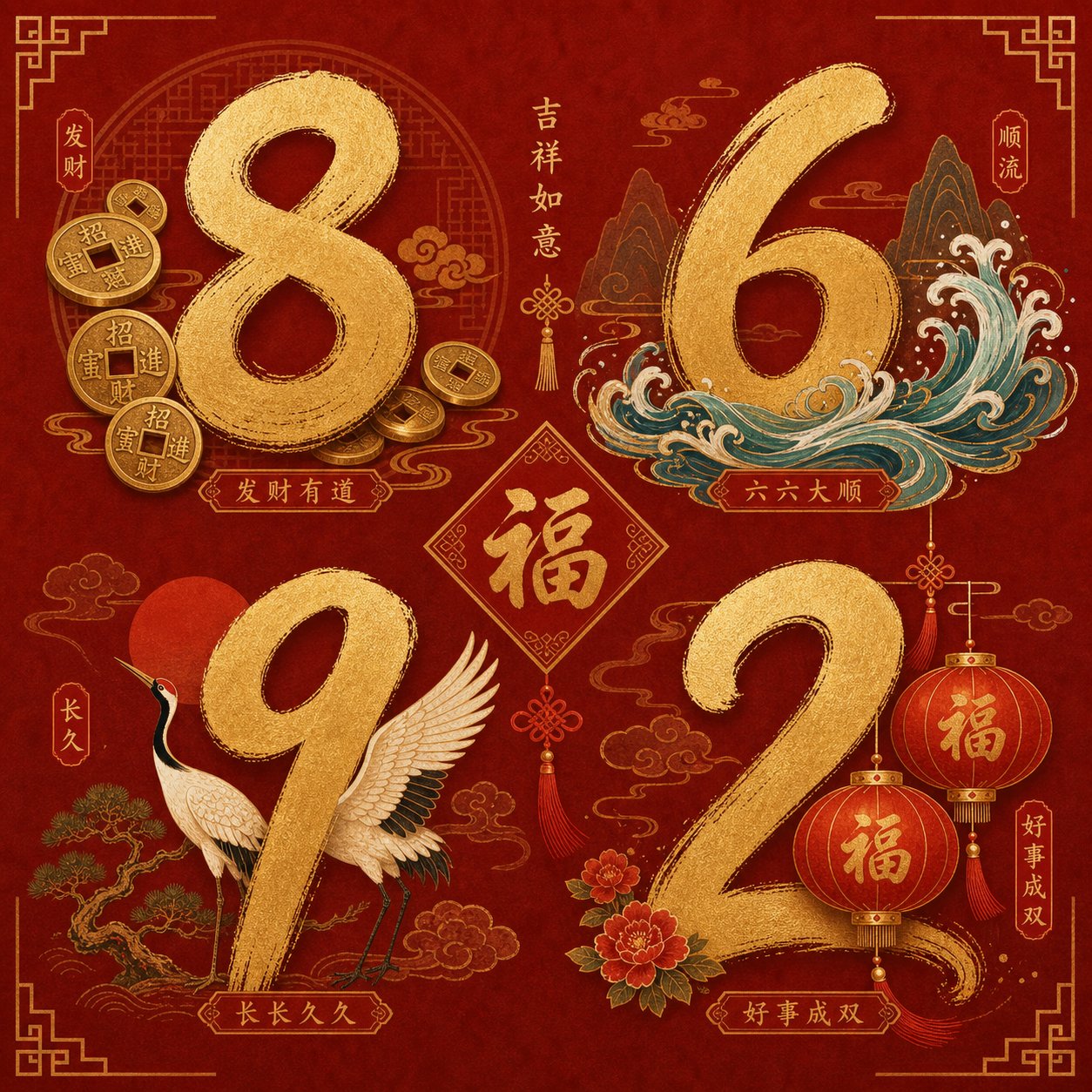
Each number in Mandarin Chinese is a single syllable, and each syllable echoes other meaningful words. The number 8 in chinese is ba (八), which sounds strikingly close to fa (發), meaning "to prosper" or "to generate wealth." Say them aloud and you will hear why the connection feels almost inevitable to native speakers.
The number four in chinese, si (四), carries the opposite weight. Its pronunciation nearly mirrors si (死), the word for "death." The tonal difference is minimal: 4 in chinese is a falling tone (sì), while death is a falling-then-rising tone (sǐ). That razor-thin gap is enough to make the number deeply uncomfortable in naming contexts.
The number 6, liu (六), echoes liu (流), meaning "flow" or "smooth," and connects to the blessing 六六大顺, "everything goes smoothly." The number 9, jiu (九), is a near-perfect homophone of jiu (久), meaning "long-lasting" or "eternal," making it a favorite for weddings and names meant to invoke longevity.
Even romantic expressions rely on this phonetic logic. The sequence 520 sounds like "wo ai ni" (I love you) in Mandarin, showing how deeply the "i love u in numbers" concept is embedded in Chinese digital culture. Numbers become language, and language becomes destiny.
From Everyday Superstition to Naming Practice
These phonetic associations do not stay in the realm of phone numbers and license plates. They migrate directly into naming. Parents select characters whose stroke counts align with auspicious numbers, or whose phonetic values echo lucky number sounds. A name with a total stroke count of 8 or 16 (a multiple of 8) carries the resonance of prosperity. A name totaling 4 or 14 strokes triggers the same discomfort as saying "death" aloud.
The table below maps the core lucky numbers to their homophones, meanings, and practical relevance when choosing a Chinese name:
| Number | Chinese Character | Pinyin | Sounds Like | Meaning | Naming Relevance |
|---|---|---|---|---|---|
| 2 | 二 | er | 双 (shuang) | Pairs, harmony, double happiness | Characters with paired strokes or names suggesting balance |
| 6 | 六 | liu | 流 (liu) / 溜 (liu) | Smooth, flowing, well-off | Stroke counts of 6 or 16 suggest smooth life progress |
| 8 | 八 | ba | 發 (fa) | Prosperity, wealth, fortune | Most sought-after stroke count; multiples of 8 prized |
| 9 | 九 | jiu | 久 (jiu) | Longevity, eternity, permanence | Favored for names wishing long life and enduring success |
The concept of "i love u in numbers" through sequences like 520 and 1314 (meaning "one lifetime") demonstrates how naturally Chinese speakers convert sound into meaning. In naming, this same instinct drives parents to hear fortune or misfortune in every stroke count and syllable, turning a simple number into a lifelong blessing or a subtle curse.
The Luckiest Numbers and What They Mean for Names
Knowing that numbers carry phonetic weight is one thing. Knowing exactly how to apply that weight when choosing a name is another. Each lucky number offers a distinct blessing, and parents who understand the differences can target specific qualities they want encoded into their child's identity. Here is how the most auspicious numbers translate into real naming decisions.
Number 8 and Prosperity in Names
Ask anyone familiar with Chinese culture what does number 8 symbolize, and the answer comes instantly: wealth. The lucky number 8 dominates naming culture because its phonetic link to prosperity (發, fa) is unmistakable. Parents actively seek characters with exactly 8 strokes, or they engineer total name stroke counts that land on multiples of 8, such as 16, 24, or 32.
The cultural commitment to 8 symbolism goes far beyond baby names. The Beijing Olympics opening ceremony began at precisely 8:08 p.m. on August 8, 2008 (08/08/08). Businesses pay enormous premiums for addresses and phone numbers loaded with eights. When a nation schedules its most important global event around a single digit, you can see why parents treat the chinese 8 as non-negotiable in naming.
In practice, characters like 明 (ming, bright, 8 strokes) and 佳 (jia, excellent, 8 strokes) appear frequently in names partly because their stroke count aligns with this most prized number. The word eight in chinese, ba (八), echoes through every naming consultation where prosperity is the goal.
Numbers 6 and 9 for Smooth Fortune and Longevity
Is 6 a lucky number? In Chinese naming, absolutely. The number 6 represents smooth, unobstructed progress through life. Its connection to the phrase 六六大顺 (everything goes smoothly) makes it a favorite for parents who want their child's path to be free of major obstacles. Characters with 6 strokes, like 安 (an, peace) and 吉 (ji, auspicious), carry this sense of effortless flow.
The number 9 holds a different kind of power. As a homophone of 久 (jiu, long-lasting), it represents permanence and longevity. Historically, 9 was also the emperor's number, associated with supreme authority and completeness. Parents choosing characters with 9 strokes, such as 信 (xin, trust) or 勇 (yong, courage), are encoding a wish for enduring success and a long, full life.
Number 2 and Harmonious Pairs
The number 2 connects to the deeply rooted Chinese belief that good things come in pairs. The concept of 双喜 (double happiness) appears at weddings, festivals, and celebrations. In naming, 2 represents balance and harmony, qualities that suggest a life of stable relationships and emotional equilibrium. Characters with 2 strokes are rare in given names, but the principle of pairing, using two-character given names where both characters complement each other numerologically, reflects this value.
Here is a breakdown of each lucky number with its specific naming application:
- 8 (八, ba): Symbolizes prosperity and wealth. Parents target characters with 8 strokes or total name counts of 16, 24, or 32. Example characters: 明 (bright), 佳 (excellent), 坤 (earth/feminine force).
- 6 (六, liu): Represents smooth progress and ease. Stroke counts of 6 or 16 are favored. Example characters: 安 (peace), 吉 (auspicious), 旭 (rising sun).
- 9 (九, jiu): Encodes longevity and permanence. Characters with 9 strokes suggest enduring fortune. Example characters: 信 (trust), 勇 (courage), 春 (spring).
- 2 (二, er): Reflects harmony and balance. Applied through paired character selection and complementary stroke counts. The principle of doubles reinforces stability in a name's overall structure.
One number deserves special attention for its cross-cultural confusion. In Western culture, 666 triggers associations with evil or the devil. In China, 666 in chinese internet culture means the exact opposite. It is slang for 溜溜溜 (liu liu liu), an expression of admiration meaning "smooth" or "impressive." Seeing 666 in china, whether in a username, a gaming chat, or a gift amount, is a compliment. This stark contrast highlights how number symbolism is entirely language-dependent, not universal.
The same logic applies to naming. A name whose total stroke count lands on 66 would feel deeply auspicious to Chinese parents, carrying a double dose of smooth fortune. Understanding these individual number meanings gives you the building blocks, but lucky numbers do not exist in isolation. Some combinations amplify fortune while others quietly cancel it out, especially when a name's stroke count falls into patterns that traditional numerological systems flag as unfavorable.
Unlucky Numbers Every Chinese Name Should Avoid
Favorable numbers attract fortune into a name, but their counterparts can quietly embed misfortune. Chinese parents are just as deliberate about what they avoid as what they pursue, and the chinese bad luck number list starts with one digit that overshadows all others.
Why Number 4 Is Feared in Chinese Naming
The number 4 in chinese, si (四), is pronounced almost identically to the word for death, si (死). The tonal difference is negligible in casual speech, and that phonetic overlap makes 4 the most feared unlucky number in china. The avoidance is so widespread it has a clinical name: tetraphobia.
You have probably noticed elevator panels in Chinese-speaking cities that skip from floor 3 directly to floor 5. Some buildings omit every floor containing the digit 4, meaning no 4th, 14th, 24th, or 40th floor. Hotels avoid room 404. Hospitals skip bed number 4. This same instinct carries directly into naming.
Parents avoid characters with exactly 4 strokes when building a name. They also steer away from total name stroke counts that land on 4, 14, or 24. In Cantonese-speaking regions, 14 is considered even worse because it sounds like "will certainly die," intensifying the taboo. The number 4 in chinese culture is not merely disliked. It is actively engineered out of daily life, and naming is no exception.
Other Numbers That Carry Negative Weight
While 4 dominates the list of unlucky chinese numbers, other digits carry context-dependent risks. The number 7 is not universally negative, but it connects to the 7th lunar month, traditionally associated with ghosts and mourning. In some naming contexts, characters with 7 strokes are avoided for children born during that period. The association is situational rather than absolute.
The number 5 can sound like "wu" (无), meaning "nothing" or "without," which some parents interpret as emptiness. And 250 (二百五) functions as slang for "fool" in Mandarin, making it a number people avoid in pricing and, by extension, any visible numerical context. Among numbers associated with death, though, nothing rivals 4 for the sheer consistency of its avoidance across all Chinese-speaking regions.
The Simplified vs Traditional Stroke Count Problem
Here is a complication that most naming guides overlook entirely: simplified Chinese characters and traditional Chinese characters often have different stroke counts. A character that counts as 8 strokes in simplified form might count as 12 in traditional form, or vice versa. This means a name could be numerologically lucky in one writing system and unlucky in another.
The split exists because simplified Chinese was established in 1949 when the government reduced stroke counts to encourage literacy. Traditional characters, still used in Hong Kong and Taiwan, retain their original complexity. The two systems continue to diverge as new vocabulary develops differently in each region.
Which system should you use for stroke count calculations? The answer depends on geography:
- Mainland China and Singapore: Most modern naming consultants use simplified character stroke counts for everyday purposes, though some traditional practitioners insist on traditional counts even for simplified names.
- Hong Kong and Taiwan: Traditional character stroke counts are the standard. Names are evaluated against numerological charts using the original, unreduced forms.
- Diaspora families: If the name will primarily be used in a traditional-character context (family registry, ancestral records), use traditional counts. For mainland-oriented families, simplified counts apply.
The table below summarizes the key unlucky numbers, their associations, and what they mean for naming decisions:
| Number | Pronunciation | Negative Association | Naming Implication |
|---|---|---|---|
| 4 | si (四) | Sounds like death (死, si) | Avoid characters with 4 strokes; avoid total counts of 4, 14, 24, 44 |
| 14 | shi si (十四) | "Will certainly die" in Cantonese | Especially avoided in Cantonese-speaking naming traditions |
| 7 | qi (七) | Ghost Month, mourning, abandonment | Context-sensitive; some avoid for children born in the 7th lunar month |
| 5 | wu (五) | Sounds like "nothing" (无, wu) | Mild avoidance; less consistent than 4 |
| 250 | er bai wu (二百五) | Slang for "fool" | Avoided in any visible numerical context, including combined stroke totals |
The simplified versus traditional discrepancy creates a real dilemma for families who straddle both systems. A child registered in mainland China with a simplified-character name might later discover that the traditional stroke count, used by grandparents in Taiwan, places their name squarely on an unlucky number. This is why serious naming consultants ask which writing system the family uses before running any calculations, and why understanding the formal numerological framework behind those calculations matters just as much as knowing which numbers to fear.
The 81-Number Dayan System Behind Chinese Name Numerology
Phonetic associations and stroke count avoidance give you a surface-level filter for Chinese names. But beneath the popular belief that 8 means wealth and 4 means death, there is an entire formal system that professional naming consultants rely on, one rooted not in sound but in cosmological mathematics. This is the 81-Number Dayan System, and it operates on principles most parents never encounter unless they hire a specialist.
What Is the 81-Number Dayan System
The Dayan system assigns a fortune number to every integer from 1 through 81. Each number is categorized as auspicious (吉, ji), inauspicious (凶, xiong), or neutral (半吉, ban ji). When a naming consultant calculates the stroke counts of a Chinese name and derives its numerical profile, those totals are evaluated against this 81-number chart to determine whether the name carries favorable energy.
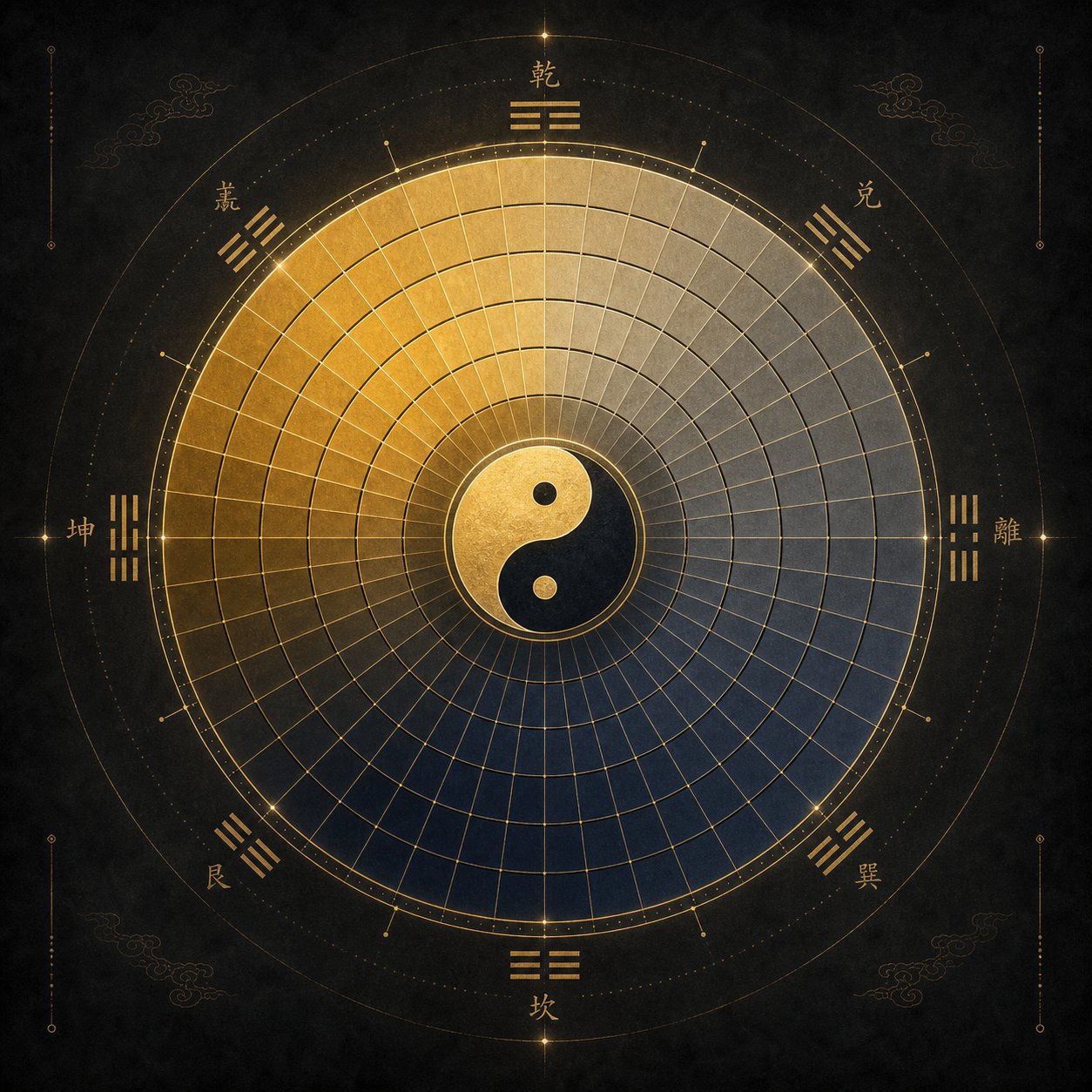
Where does the number 81 come from? The system draws its philosophical foundation from the I-Ching (易经), the ancient Book of Changes. In I-Ching cosmology, the universe operates in cycles, and 81 represents the full completion of one grand cycle. The reasoning is mathematical: 9 multiplied by 9 equals 81, and since 9 is the highest single yang digit (representing maximum positive force), its square represents the totality of all possible transformations. After 81, the cycle resets to 1, mirroring the I-Ching principle that all things return to their origin after reaching fullness.
This is why the system contains exactly 81 stages rather than 100 or some other round number. It reflects a cosmological model where fortune is not linear but cyclical. A name that lands on number 81 is not "the best." It sits at the point of completion, which carries its own specific meaning within the cycle.
So why are certain numbers lucky in this system? The reasoning goes beyond phonetics entirely. Numbers in the Dayan chart are evaluated based on their position within the cosmic cycle:
- Numbers in the ascending phase (1, 3, 5, 11, 13, 15, 16, 21, 23, 24, 25, 31, 32, 33, 35, 37, 41, 45, 47, 48, 52, 57, 61, 63, 65, 67, 68, 81): These represent growth, expansion, and creative force. They are classified as auspicious because they correspond to stages where energy is building.
- Numbers in the declining or stagnant phase (2, 4, 9, 10, 12, 14, 19, 20, 22, 26, 27, 28, 34, 36, 42, 43, 44, 46, 49, 50, 53, 54, 56, 58, 59, 60, 62, 64, 66, 69, 70, 71, 72, 74, 76, 77, 78, 79, 80): These represent contraction, loss, or instability. They are classified as inauspicious or mixed.
- Numbers in transitional positions: Some numbers are classified as half-lucky (半吉), meaning their fortune depends on context, the surrounding numbers in the name's grid, and the individual's birth chart.
The cosmological logic is that certain positions in the 81-stage cycle correspond to moments of natural flourishing (like spring in a seasonal cycle), while others correspond to dormancy or decay. A fortune number landing on 15, for example, is considered highly auspicious because it represents the midpoint of growth in the first major cycle, a position of balanced abundance. Meanwhile, 14 is inauspicious not because it sounds like anything negative, but because it occupies a position of dissipation in the cosmic sequence.
This distinction matters enormously. In the Dayan system, the numbers chinese meaning is determined by position in a cycle, not by pronunciation. A number can be phonetically neutral yet cosmologically devastating, or phonetically unlucky yet positionally favorable.
How the Dayan System Differs from Cultural Symbolism
Imagine two parents evaluating the same name. One parent checks whether the stroke counts sound like lucky words. The other parent plots those stroke counts onto a 81-number grid and evaluates their cyclical positions. These are fundamentally different operations, and they can produce contradictory results.
The cultural-phonetic system is intuitive. You hear 8 and think "prosper." You hear 4 and think "death." It requires no specialized knowledge beyond basic Mandarin pronunciation. This is the system most everyday parents in china numerology discussions rely on. It is accessible, emotionally resonant, and deeply embedded in popular culture.
The Dayan system is technical. It requires calculating stroke counts for each character, deriving grid values through specific formulas, and then cross-referencing those values against the 81-number chart. Professional naming consultants, the kind families pay hundreds or thousands of yuan to consult, use this system as their primary tool. They treat the phonetic associations as secondary, a nice bonus when they align, but not the foundation of a name's fortune.
The critical difference? In the cultural system, 8 is always lucky. In the Dayan system, whether a stroke count of 8 brings fortune depends entirely on which grid position it occupies. The same number can be the luckiest numerology number in one position and mediocre in another. Context within the name's full numerical structure determines everything.
A character with 8 strokes might fall into an unlucky position in the Dayan chart depending on its grid placement. The number 8 in the Earth Grid could yield a different fortune rating than 8 in the Personality Grid. This is why the two systems sometimes conflict, and why a name that feels phonetically perfect can still fail a professional numerological evaluation.
For families seeking the luckiest numerology number for a name, this creates a layered challenge. The phonetic system says "load the name with 8s." The Dayan system says "it depends on where those 8s land in the Five Grids calculation." Serious practitioners reconcile both, seeking names where the phonetic associations and the positional fortune values align. That reconciliation requires understanding exactly how the Five Grids are calculated, which grid governs which aspect of life, and how the numbers interact with each other through elemental cycles.
How to Calculate the Five Grids for Any Chinese Name
The Dayan system tells you whether a number is lucky or unlucky. But how do you get those numbers from an actual name? That is where the Five Grids method (五格剖象法) comes in. It is the calculation engine that transforms a name's stroke counts into five distinct fortune values, each governing a different dimension of life. Think of it as the bridge between raw character data and meaningful numerological evaluation.
Most naming guides mention the Five Grids in passing. Few walk you through the actual math. Here is the complete methodology, step by step, so you can evaluate any Chinese name yourself.
The Five Grids Explained
The Five Grids system, developed by scholar Xiong Chongliang in the early twentieth century, breaks a Chinese name into five numerical positions. Each position is called a "grid" (格), and each grid maps to a specific area of a person's life. When you understand what is a lucky number in each grid position, you can assess whether a name supports or undermines the person carrying it.
Here is what each grid represents:
| Grid | Chinese Name | Life Dimension | Timing |
|---|---|---|---|
| Heaven Grid | 天格 (Tian Ge) | Inherited fortune, family lineage, ancestral influence | Background foundation |
| Personality Grid | 人格 (Ren Ge) | Core character, primary life trajectory, career | Entire lifespan (central influence) |
| Earth Grid | 地格 (Di Ge) | Early-life fortune, health foundation, relationships with children | Youth through early adulthood |
| External Grid | 外格 (Wai Ge) | Social connections, interpersonal luck, external environment | Social interactions throughout life |
| Total Grid | 总格 (Zong Ge) | Overall life fortune, later-life trajectory | Middle age onward |
The Personality Grid sits at the center and carries the most weight. Even if every other grid lands on a feng shui lucky numbers value, an inauspicious Personality Grid undermines the entire name. Professional consultants prioritize this grid above all others when selecting characters.
The Heaven Grid is unique because it is determined entirely by the surname, which you inherit from your parents. Since everyone sharing the same surname has an identical Heaven Grid, its independent influence on personal destiny is limited. However, it plays a critical role in the Three Talents configuration, which evaluates how the top three grids interact elementally.
Step-by-Step Calculation Method
Sounds complex? The formulas are actually straightforward once you know the pattern. Every grid is derived from adding the stroke counts of characters in adjacent positions within the name. You will need the Kangxi Dictionary stroke count for each character, not the simplified stroke count used in everyday writing.
Here is the complete calculation sequence for the most common name structure, a single-character surname with a two-character given name:
- Determine Kangxi stroke counts. Look up each character in your name using the Kangxi Dictionary standard. Remember that certain radicals have restored stroke counts: "氵" counts as 4 strokes (restored to 水), "艹" counts as 6 strokes, and "辶" counts as 7 strokes (restored to 辵). This step is non-negotiable for accurate results.
- Calculate the Heaven Grid (天格). For a single-character surname: surname stroke count + 1. For a compound surname: add the stroke counts of both surname characters together. The added "1" for single surnames represents the Taiji, the primordial origin in Chinese cosmology.
- Calculate the Personality Grid (人格). Add the stroke count of the last surname character to the stroke count of the first given name character. This grid bridges the inherited (surname) and the chosen (given name), which is why it represents your core self.
- Calculate the Earth Grid (地格). For a two-character given name: add both given name characters' stroke counts together. For a single-character given name: given name stroke count + 1.
- Calculate the Total Grid (总格). Add the Kangxi stroke counts of every character in the full name together. This is the simplest calculation and represents your overall life fortune.
- Calculate the External Grid (外格). Subtract the Personality Grid from the Total Grid. For single-surname, single-given-name structures, the External Grid is fixed at 2.
Let's walk through a concrete example. Take the name 王文昭 (Wang Wenzhao): 王 has 4 strokes, 文 has 4 strokes, and 昭 has 9 strokes.
- Heaven Grid: 4 + 1 = 5
- Personality Grid: 4 + 4 = 8
- Earth Grid: 4 + 9 = 13
- Total Grid: 4 + 4 + 9 = 17
- External Grid: 17 - 8 = 9
Each of these numbers (5, 8, 13, 17, 9) is then checked against the 81-Number Dayan chart from the previous section. In this case, 5 is auspicious, 8 is auspicious, 13 is auspicious, 17 is semi-auspicious, and 9 is inauspicious. You can see how a name that feels perfectly fine phonetically might reveal hidden weaknesses when the full grid calculation is performed.
Understanding the meaning of numbers 1-8 in the Dayan chart is particularly useful because most single-character surnames produce Heaven Grids in this range. For instance, surnames with 7 strokes (like 李, Li) yield a Heaven Grid of 8, which is auspicious. Surnames with 3 strokes (like 小, Xiao) yield a Heaven Grid of 4, which is inauspicious, though since the Heaven Grid reflects inherited fortune rather than personal destiny, this alone does not doom a name.
The Three Talents Configuration
Calculating five separate grid numbers is only half the work. The real power of the system emerges when you examine how the top three grids, Heaven, Personality, and Earth, interact with each other through the Five Elements cycle. This interaction is called the Three Talents (三才) configuration, and it determines whether a name's feng shui numbers work in harmony or conflict.
To find the Five Elements attribute of each grid, look at the last digit of the grid number:
- Last digit 1 or 2 = Wood
- Last digit 3 or 4 = Fire
- Last digit 5 or 6 = Earth
- Last digit 7 or 8 = Metal
- Last digit 9 or 0 = Water
Returning to our example of 王文昭: the Heaven Grid is 5 (Earth), the Personality Grid is 8 (Metal), and the Earth Grid is 13 (Fire). The Three Talents configuration is Earth-Metal-Fire.
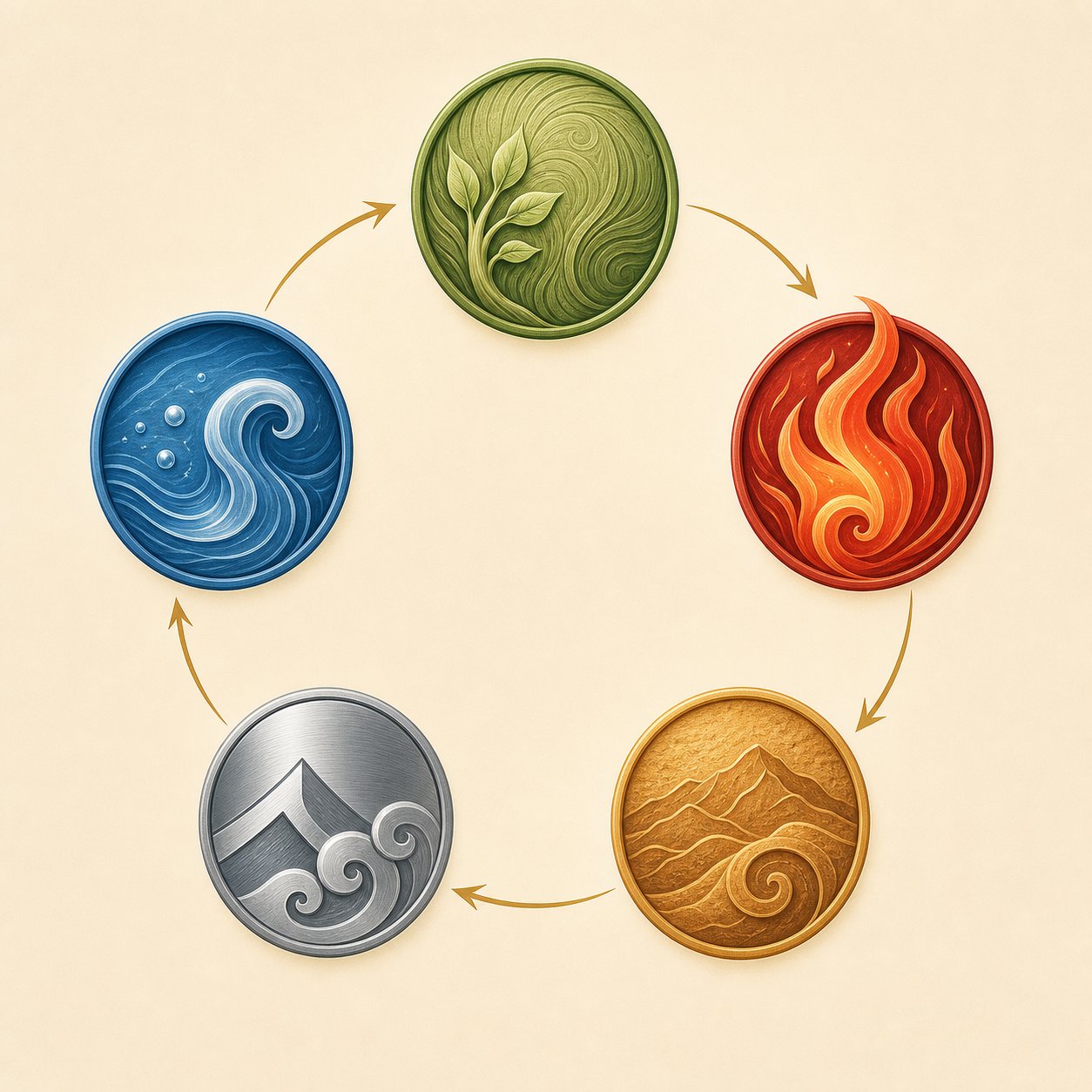
The Five Elements follow two cycles. The productive cycle (相生) flows: Wood feeds Fire, Fire creates Earth, Earth bears Metal, Metal collects Water, Water nourishes Wood. The destructive cycle (相克) flows: Wood parts Earth, Earth dams Water, Water extinguishes Fire, Fire melts Metal, Metal chops Wood.
For 王文昭's configuration:
- Heaven Grid (Earth) → Personality Grid (Metal): Earth generates Metal. This is a productive relationship, meaning inherited fortune supports the core self. Favorable.
- Personality Grid (Metal) → Earth Grid (Fire): Fire overcomes Metal. The Earth Grid exerts destructive pressure on the Personality Grid. Unfavorable.
The ideal Three Talents configuration shows sequential generation flowing downward: Heaven generates Personality, and Personality generates Earth. This creates a cascading flow of good numbers supporting each life dimension. The worst configuration occurs when both the Heaven Grid and Earth Grid overcome the Personality Grid, squeezing the core self from above and below simultaneously.
A name with all five grids landing on individually auspicious numbers can still receive a poor evaluation if the Three Talents configuration shows destructive elemental relationships. Conversely, a name with mediocre individual grid numbers can perform well if the Three Talents flow productively. This is why professional naming consultants do not simply chase good numbers in isolation. They engineer the elemental relationships between grids, ensuring that the Heaven-Personality-Earth sequence supports rather than undermines the person carrying the name.
The Five Grids method gives you a systematic framework for evaluating any Chinese name against numerological principles. But the system assumes universal rules: the same grid values apply to everyone regardless of when they were born. In reality, Chinese naming tradition holds that each person has unique elemental needs determined by their exact birth date and time, needs that can shift which numbers count as truly fortunate for that specific individual.
Using BaZi to Personalize Lucky Numbers in Names
The Five Grids system treats every name the same way regardless of who carries it. A stroke count of 16 is auspicious whether the name belongs to a child born in January or July, in a Fire year or a Water year. But Chinese naming tradition does not stop at universal rules. It goes deeper, using BaZi (八字, Four Pillars of Destiny) analysis to determine which numbers are specifically fortunate for a particular individual based on their exact moment of birth.
This is where naming shifts from general numerology into personalized prescription. Two children born a day apart might need completely different stroke counts in their names because their elemental profiles differ. Understanding BaZi turns lucky numbers from a one-size-fits-all list into a tailored formula.
How Birth Date Determines Your Lucky Numbers
BaZi converts your birth year, month, day, and hour into eight characters (four pairs of Heavenly Stems and Earthly Branches). Each of these eight characters carries a Five Elements attribute: Wood, Fire, Earth, Metal, or Water. When a practitioner reads the full chart, they identify which elements are overrepresented and which are weak or entirely absent.
The element represented by the Day Stem, called the Day Master (日主), defines your core identity. Everything else in the chart either supports, drains, or conflicts with that Day Master. A professional BaZi reading determines your "Useful God" (用神), the element your chart most needs to achieve balance. This Useful God becomes the foundation for selecting name characters.
Here is how it works in practice. Imagine a baby whose BaZi chart shows overwhelming Wood and Water energy but almost no Fire. The chart is cold and damp. The Useful God is Fire, meaning this child benefits from names containing characters associated with the Fire element. Since each element corresponds to specific numbers, the naming consultant targets stroke counts that align with Fire energy.
The Five Elements number correspondences follow a fixed pattern rooted in the Hetu (河图) diagram, one of the oldest cosmological maps in Chinese metaphysics:
- Water: Numbers 1 and 6. A person weak in Water benefits from characters with stroke counts of 1, 6, 11, 16, or 21.
- Fire: Numbers 2 and 7. Fire-deficient charts call for stroke counts of 2, 7, 12, 17, or 22.
- Wood: Numbers 3 and 8. Wood-deficient individuals benefit from stroke counts of 3, 8, 13, 18, or 23.
- Metal: Numbers 4 and 9. When Metal is the Useful God, stroke counts of 4, 9, 14, 19, or 24 are targeted.
- Earth: Numbers 5 and 10. Earth-weak charts benefit from stroke counts of 5, 10, 15, 20, or 25.
Notice something interesting? In the cultural-phonetic system, 4 is universally feared because it sounds like death. But in BaZi-based naming, a person whose chart desperately needs Metal energy might actually benefit from a stroke count of 4 or 14. The personalized system can override the cultural taboo when elemental balance demands it. This is one reason professional consultants sometimes recommend names that seem counterintuitive to parents relying solely on popular number symbolism.
Connecting Zodiac Year to Name Stroke Counts
Your Chinese zodiac year is not just a personality label. It carries elemental information that directly influences which zodiac lucky numbers apply to your name. Each of the twelve zodiac animals is paired with one of the Five Elements in a rotating sixty-year cycle, creating combinations like the metal dragon (2000), the wood snake 2025, or the fire horse (1966).
The year of the dragon 2024 was a Wood Dragon year (甲辰). Children born in that year carry strong Wood and Earth energy from their year pillar alone. The snake year 2025 is a Wood Snake year (乙巳), combining Wood from the Heavenly Stem with Fire from the Earthly Branch. A wood snake 2025 baby already has Wood and Fire present in their birth year, which means their name might need to compensate with Earth, Metal, or Water characters depending on what the remaining three pillars reveal.
This zodiac-element pairing interacts with the Five Grids system in a specific way. The Three Talents configuration (Heaven-Personality-Earth) should ideally generate or support the element that the child's BaZi chart needs most. If a metal dragon child's chart is already heavy in Earth and Metal, a Three Talents configuration of Water-Wood-Fire would introduce the missing elements and create balance. If instead the Three Talents configuration adds more Earth and Metal, it amplifies an existing imbalance.
Among lucky chinese signs, some zodiac-element combinations are considered inherently strong. A Fire Snake, for example, is seen as doubly powerful because the Snake's native element is already Fire. These individuals may need less Fire supplementation in their names and more of the elements that keep Fire in check, like Water or Earth. Conversely, a Water Snake is considered elementally conflicted (Water extinguishes Fire), and naming becomes a more delicate balancing act.
The table below maps each element to its corresponding numbers, favorable stroke counts, and zodiac associations:
| Element | Core Numbers | Favorable Stroke Counts | Yin Zodiac Signs | Yang Zodiac Signs | Year Digit Ending |
|---|---|---|---|---|---|
| Water | 1, 6 | 1, 6, 11, 16, 21, 31 | Rat | Boar (Pig) | 2, 3 |
| Wood | 3, 8 | 3, 8, 13, 18, 23, 33 | Rabbit | Tiger | 4, 5 |
| Fire | 2, 7 | 2, 7, 12, 17, 22, 32 | Snake | Horse | 6, 7 |
| Earth | 5, 10 | 5, 10, 15, 20, 25, 35 | Ox, Sheep | Dragon, Dog | 8, 9 |
| Metal | 4, 9 | 4, 9, 14, 19, 24, 29 | Rooster | Monkey | 0, 1 |
A quick way to identify the elemental influence of any birth year: look at the last digit. Years ending in 4 or 5 carry Wood energy. Years ending in 6 or 7 carry Fire. Years ending in 8 or 9 carry Earth. Years ending in 0 or 1 carry Metal. Years ending in 2 or 3 carry Water. This gives you a starting point, though a complete BaZi reading examines all four pillars, not just the year.
The interplay between zodiac elements and name numerology explains why two children born in the same year can still receive very different name recommendations. Their month, day, and hour pillars shift the elemental balance, changing which numbers serve as their personal lucky chinese signs. A child born in the morning of a summer day in a Fire year has radically different needs than one born at midnight in winter of the same year, even though both share the same zodiac animal.
BaZi personalization adds a layer of precision that universal number rules cannot provide. It also explains why families who consult professional naming masters receive recommendations that sometimes contradict popular expectations. The master is not ignoring cultural symbolism. They are prioritizing elemental harmony for that specific child, using numbers as medicine rather than decoration. This same principle of targeted numerological strategy extends beyond individual names into the commercial world, where businesses apply lucky number logic at even higher financial stakes.
Lucky Numbers in Business and Brand Naming Across Regions
Personal names carry fortune for a lifetime. Brand names carry fortune for an entire company. The financial stakes multiply when lucky number principles move from nurseries into boardrooms, and Chinese businesses treat numerological alignment as a competitive advantage worth paying for.
Why Businesses Pay Premium for Lucky Number Names
A study published in The North American Journal of Economics and Finance examined Chinese corporate branding strategy and found that over 50% of bank brand names involved a lucky number of total strokes. This is not coincidence. Companies deliberately engineer brand names so their total stroke counts land on good luck numbers in the Dayan system, treating numerological positioning as a marketing tool.
The logic is straightforward. If consumers subconsciously associate certain lucky chinese letters and stroke patterns with prosperity, a brand name carrying those patterns starts with a psychological advantage. Phone numbers packed with 8s sell for tens of thousands of dollars. Office addresses on the 8th or 18th floor command rental premiums. The luckiest 4 digit number for a business phone line, something like 8868 or 6688, can cost more than the office furniture inside.
This extends to domain names, product SKUs, and even pricing. You will notice Chinese e-commerce prices ending in 8 or 88 far more often than statistical chance would predict. The entire commercial ecosystem is shaped by number symbolism, and brand naming sits at the center of that ecosystem.
Regional and Dialect Variations in Business Naming
Here is where things get complicated for businesses operating across Chinese-speaking markets. Lucky numbers in asian culture are not uniform. The phonetic associations that drive number symbolism shift dramatically between dialects, and a number that feels auspicious in Mandarin might carry different weight in Cantonese or Hokkien.
In Cantonese, the number 3 (三, saam) sounds like 生 (saang), meaning "life" or "birth," giving it a vitality that it lacks in Mandarin. Hong Kong businesses favor 3 in ways that would puzzle a Shanghai entrepreneur. Similarly, 2 (二, yi in Cantonese) echoes 易 (yi, easy), making it more desirable in southern markets. The number 9 in Cantonese sounds like 狗 (gau, dog) in certain tonal contexts, which can create awkward associations that do not exist in Mandarin.
Taiwanese Hokkien adds another layer. The ong number concept, where "ong" (旺) means prosperous or thriving, influences which numerical combinations feel lucky in Taiwanese business culture. Numbers that phonetically suggest "ong" energy are prized in ways unique to that dialect group.
A multinational brand entering all three markets faces a genuine dilemma. The same stroke count or numerical branding that resonates in Beijing might fall flat or even backfire in Hong Kong or Taipei. Here are the key regional differences:
- Mainland Mandarin: 8 dominates as the supreme good luck number. 6 signals smooth progress. 4 is universally avoided. 666 is positive, meaning "impressive" or "skilled," which surprises Westerners who ask what culture treats 666 as a lucky number.
- Cantonese (Hong Kong): 3 gains extra power through its "life/birth" homophone. 2 benefits from sounding like "easy." 14 is especially toxic (sounds like "certain death"). 9 requires careful context due to potential dog-related puns.
- Taiwanese Hokkien: Prosperity-related sounds (ong/wang) drive preferences. 168 is extremely popular because it sounds like "all the way to prosperity" (一路發). 4 avoidance is strong but slightly less absolute than in Cantonese regions.
These dialect variations explain why pan-Asian brands sometimes use purely visual or abstract naming strategies rather than relying on phonetic luck. A number that works across all three systems is rare and valuable.
The regional complexity also connects to broader patterns of lucky and unlucky numbers in japan and Korea, where Chinese-derived number symbolism took root centuries ago but evolved independently. Japanese tetraphobia (fear of 4) mirrors the Chinese original, but Japanese also avoids 9 because "ku" sounds like suffering, a concern absent in Mandarin. Businesses with pan-Asian ambitions must navigate all these overlapping systems simultaneously.
For companies willing to invest in proper numerological branding, the payoff is measurable. Consumer trust, brand recall, and perceived quality all benefit when a name feels inherently fortunate to its target audience. The challenge is that "fortunate" means different things in different cities, and a brand name optimized for one dialect region might need a completely different character set for another. This regional fragmentation is one reason why modern naming, whether for babies or brands, increasingly demands not just knowledge of universal number rules but sensitivity to the specific linguistic community where the name will live.
Practical Tips for Applying Lucky Numbers to Name Choices
Regional dialect systems, BaZi charts, Five Grids calculations, and the 81-Number Dayan system — the sheer volume of numerological considerations can paralyze anyone trying to choose a name. Whether you are a first-time parent in Shenzhen, a diaspora family in Vancouver, or a non-Chinese speaker selecting a name for an adopted child, the practical question remains the same: how do you actually use all of this without making costly errors?
Common Mistakes When Applying Lucky Numbers to Names
The most frequent mistake is using the wrong stroke count system. Parents in mainland China sometimes calculate strokes using simplified characters, then evaluate those numbers against charts designed for traditional (Kangxi Dictionary) stroke counts. The result is a name that looks numerologically sound on paper but fails under the system the charts were built for. Always confirm which stroke count standard your reference chart uses before running any calculations.
Another common error is fixating on a single lucky number while ignoring elemental balance. A parent who hears "is 8 a lucky number in chinese?" and answers yes might load every character with 8 strokes, only to discover that the resulting Three Talents configuration creates destructive elemental clashes. A name where every grid lands on 8 produces a Metal-Metal-Metal configuration — stagnant and imbalanced, no matter how individually auspicious each number appears.
The third pitfall is choosing characters solely for their stroke count while ignoring meaning and pronunciation. A character with the perfect number of strokes might carry an outdated, awkward, or unintentionally negative meaning. Chinese is rich in homophones, and a character that satisfies numerology can still sound like something embarrassing in casual speech. Stroke count should filter your options, not dictate them entirely.
Guidance for Non-Chinese Speakers and Diaspora Families
If you do not read Chinese, the systems covered in this article can feel inaccessible. But you can still apply the core principles without fluency. Start by understanding what are lucky numbers and what are unlucky numbers at the cultural level: favor names associated with 8, 6, and 9 energy while avoiding stroke counts tied to 4. This phonetic layer requires no calculation skill, just awareness.
For the formal numerological layer, online Five Grids calculators exist in both Chinese and English. You input the characters, and the tool returns grid values and Dayan chart ratings. These tools handle the stroke counting and arithmetic for you. Your job is interpreting the output: are the grid numbers auspicious? Does the Three Talents configuration show productive elemental flow?
When should you consult a professional? If the name will appear on official Chinese documents, if the family maintains ancestral naming traditions, or if you want BaZi-personalized recommendations, a naming consultant is worth the investment. They reconcile the cultural, numerological, and elemental systems simultaneously — something that takes years of study to do confidently on your own. Is 4 a lucky number in any context? A skilled consultant might say yes for a specific child whose BaZi desperately needs Metal energy, a nuance that general guides cannot capture.
Balancing Numerology with Modern Naming Preferences
Younger Chinese parents increasingly weigh traditional numerology against personal taste. They want names that sound contemporary, carry beautiful meaning, and work well in international contexts — not just names that score perfectly on a Five Grids chart. The question "is 5 a lucky number?" matters less to them than whether the name feels right when spoken aloud in both Mandarin and English.
The most successful names satisfy multiple criteria simultaneously. They honor the lucky and unlucky numbers framework without sacrificing character meaning or phonetic elegance. Think of numerology as one filter among several, powerful but not absolute. A name that scores perfectly on every grid but sounds clunky or carries a bland meaning will not serve a child well in modern life. Conversely, a poetic name with terrible numerology may nag at traditional family members for decades.
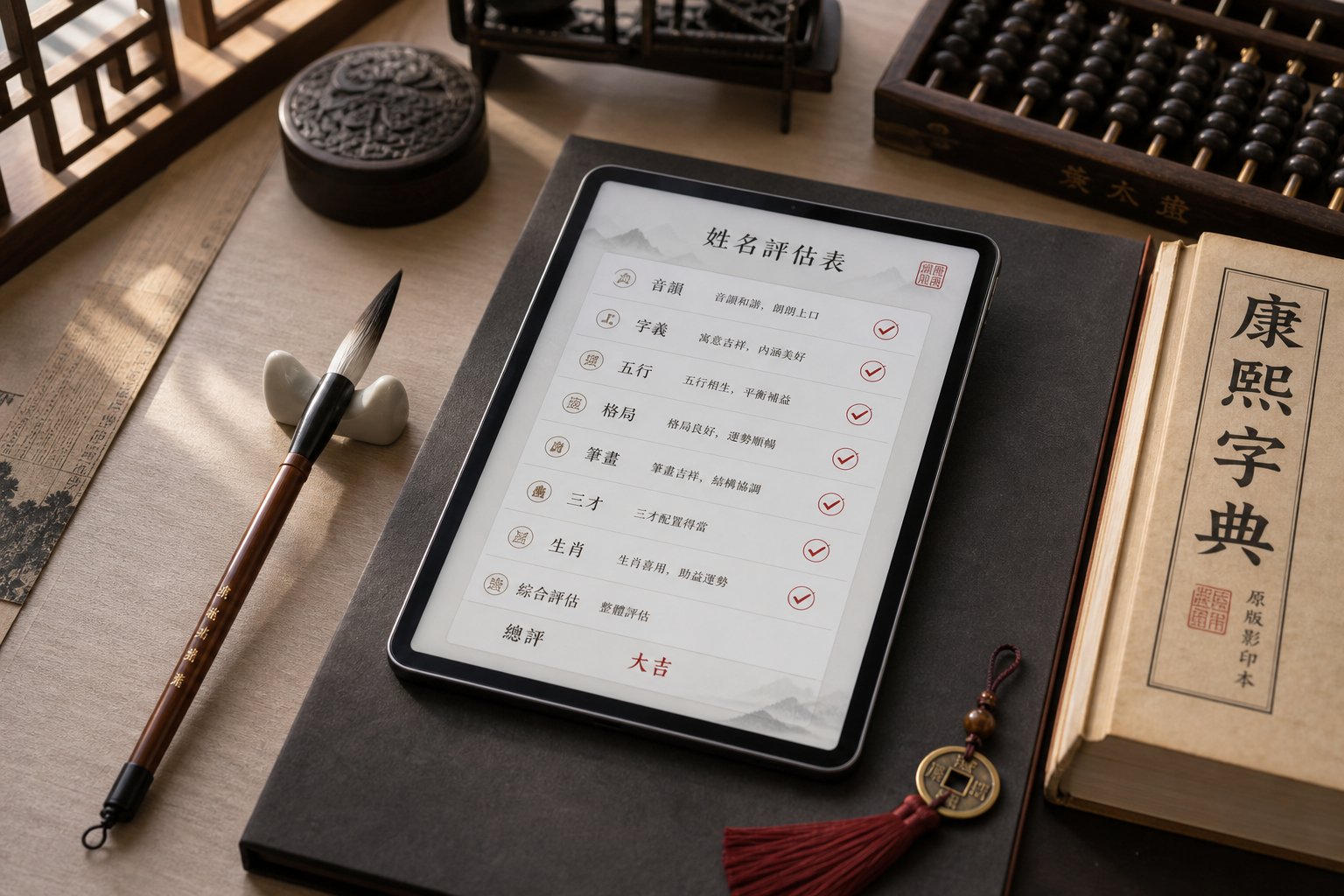
Here is a practical checklist for evaluating any potential Chinese name against lucky number principles:
- Confirm your stroke count standard. Decide whether you are using Kangxi Dictionary (traditional) or simplified counts, and stick with one system throughout all calculations.
- Calculate all Five Grids. Derive the Heaven, Personality, Earth, External, and Total Grid values. Check each against the 81-Number Dayan chart for auspicious ratings.
- Evaluate the Three Talents configuration. Determine the elemental attributes of the Heaven, Personality, and Earth Grids. Confirm that the sequence flows productively rather than destructively.
- Check for cultural number taboos. Ensure no individual grid value or total stroke count lands on 4, 14, or other numbers your regional tradition considers unlucky.
- Cross-reference with BaZi if available. If you have the child's birth chart, verify that the name's dominant element supports the Useful God rather than amplifying an existing imbalance.
- Test pronunciation and meaning independently. Read the name aloud. Check for homophone conflicts. Confirm the characters carry meanings you genuinely want associated with your child, not just lucky in chinese writing stroke counts.
- Verify across dialects if relevant. If the family speaks Cantonese, Hokkien, or another dialect alongside Mandarin, check that the name does not carry negative phonetic associations in the secondary language.
- Get native speaker feedback. Share the name with at least two or three native speakers who are not involved in the selection process. Ask whether anything sounds odd, dated, or unintentionally humorous.
No name will score perfectly on every dimension. The goal is not perfection but informed balance — a name where the lucky in chinese letters tradition, the formal numerological system, the elemental profile, and the human ear all agree that this is a name worth carrying. When those layers align, you have not just picked a name. You have given someone a foundation that honors thousands of years of linguistic wisdom while still sounding like it belongs in the present.
Frequently Asked Questions About Lucky Numbers in Chinese Naming
1. What is the luckiest number for a Chinese name?
The number 8 is widely considered the luckiest for Chinese names because it sounds like 'fa' (發), meaning prosperity. Parents often seek characters with 8 strokes or engineer total name stroke counts that land on multiples of 8, such as 16, 24, or 32. However, in the formal Dayan numerological system, whether 8 is truly lucky depends on which grid position it occupies within the name's Five Grids calculation. A personalized BaZi analysis may also identify different numbers as more beneficial for a specific individual based on their birth chart's elemental needs.
2. Why is the number 4 avoided in Chinese names?
The number 4 (四, si) is avoided because its pronunciation nearly mirrors the Chinese word for death (死, si). The tonal difference between them is minimal in everyday speech, creating an uncomfortable phonetic overlap. This avoidance, called tetraphobia, extends beyond naming into architecture (buildings skip the 4th floor), hospitals (no bed number 4), and hotels (no room 404). In naming specifically, parents avoid characters with exactly 4 strokes and steer away from total name stroke counts containing 4, 14, or 24. In Cantonese regions, 14 is considered even worse because it sounds like 'will certainly die.'
3. How do you calculate lucky numbers for a Chinese name using the Five Grids method?
The Five Grids method derives five numerical values from a name's Kangxi Dictionary stroke counts. For a single-character surname with a two-character given name: the Heaven Grid equals the surname strokes plus 1; the Personality Grid equals the surname strokes plus the first given name character's strokes; the Earth Grid equals both given name characters' strokes added together; the Total Grid equals all characters' strokes combined; and the External Grid equals the Total Grid minus the Personality Grid. Each resulting number is then checked against the 81-Number Dayan chart to determine whether it is auspicious, inauspicious, or neutral.
4. Does the Chinese zodiac year affect which numbers are lucky in a name?
Yes, each zodiac year carries a specific Five Elements attribute that influences naming numerology. For example, a Wood Snake year (2025) combines Wood and Fire energy, meaning babies born that year may need names with Earth, Metal, or Water stroke counts to achieve elemental balance. The element of your birth year is determined by its last digit: years ending in 4-5 carry Wood, 6-7 carry Fire, 8-9 carry Earth, 0-1 carry Metal, and 2-3 carry Water. A complete BaZi reading examines all four pillars (year, month, day, hour) to determine which element the name should strengthen.
5. Should I use simplified or traditional character stroke counts for name numerology?
The correct system depends on your regional context. In mainland China and Singapore, some modern consultants use simplified counts, though traditional practitioners still insist on Kangxi Dictionary (traditional) stroke counts even for simplified names. In Hong Kong and Taiwan, traditional character stroke counts are the standard. For diaspora families, use traditional counts if the name will appear in traditional-character contexts like family registries or ancestral records. The key rule is to pick one system and apply it consistently throughout all Five Grids calculations, never mixing the two.