What Is Pinyin Middle Name Format and Why It Confuses Everyone
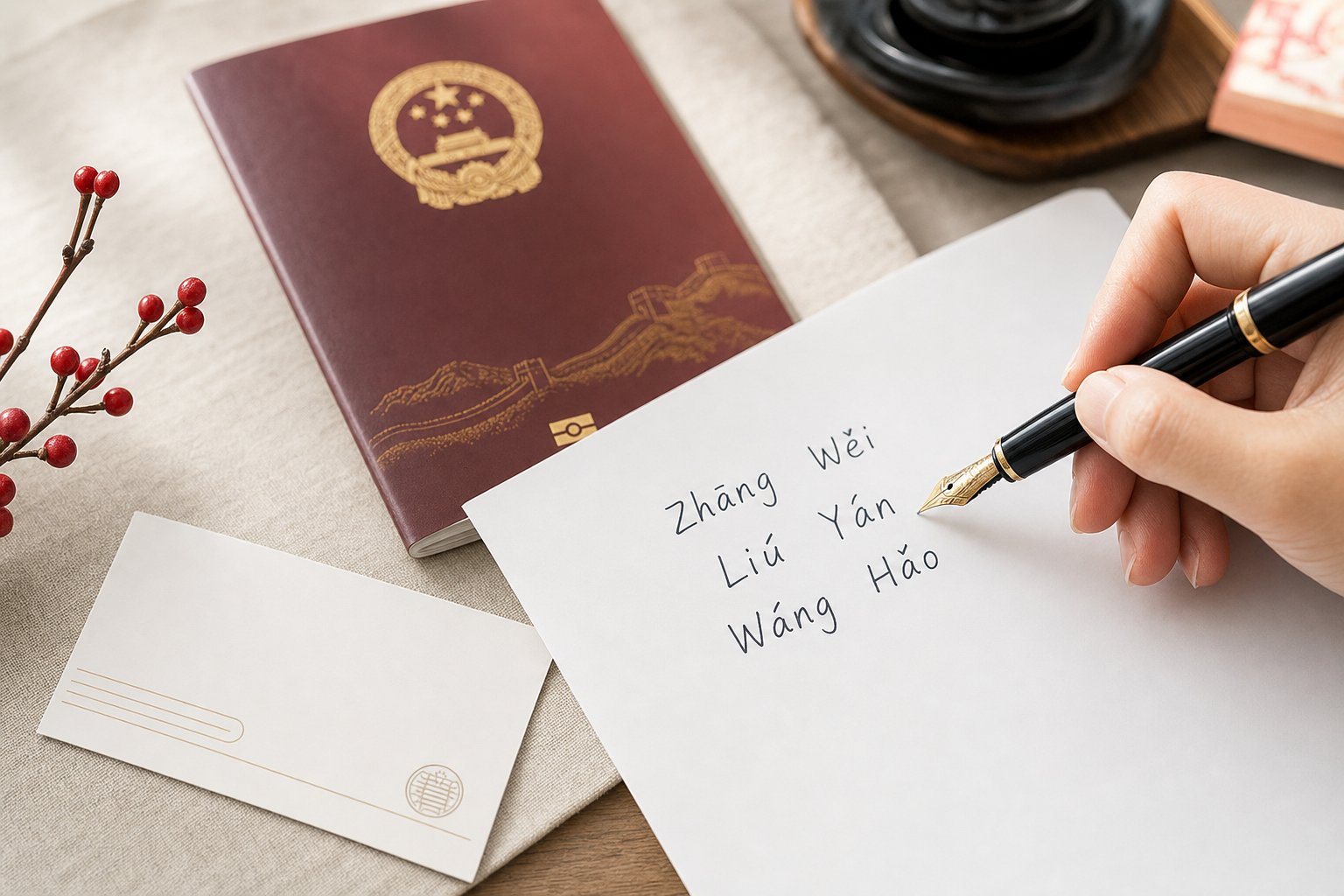
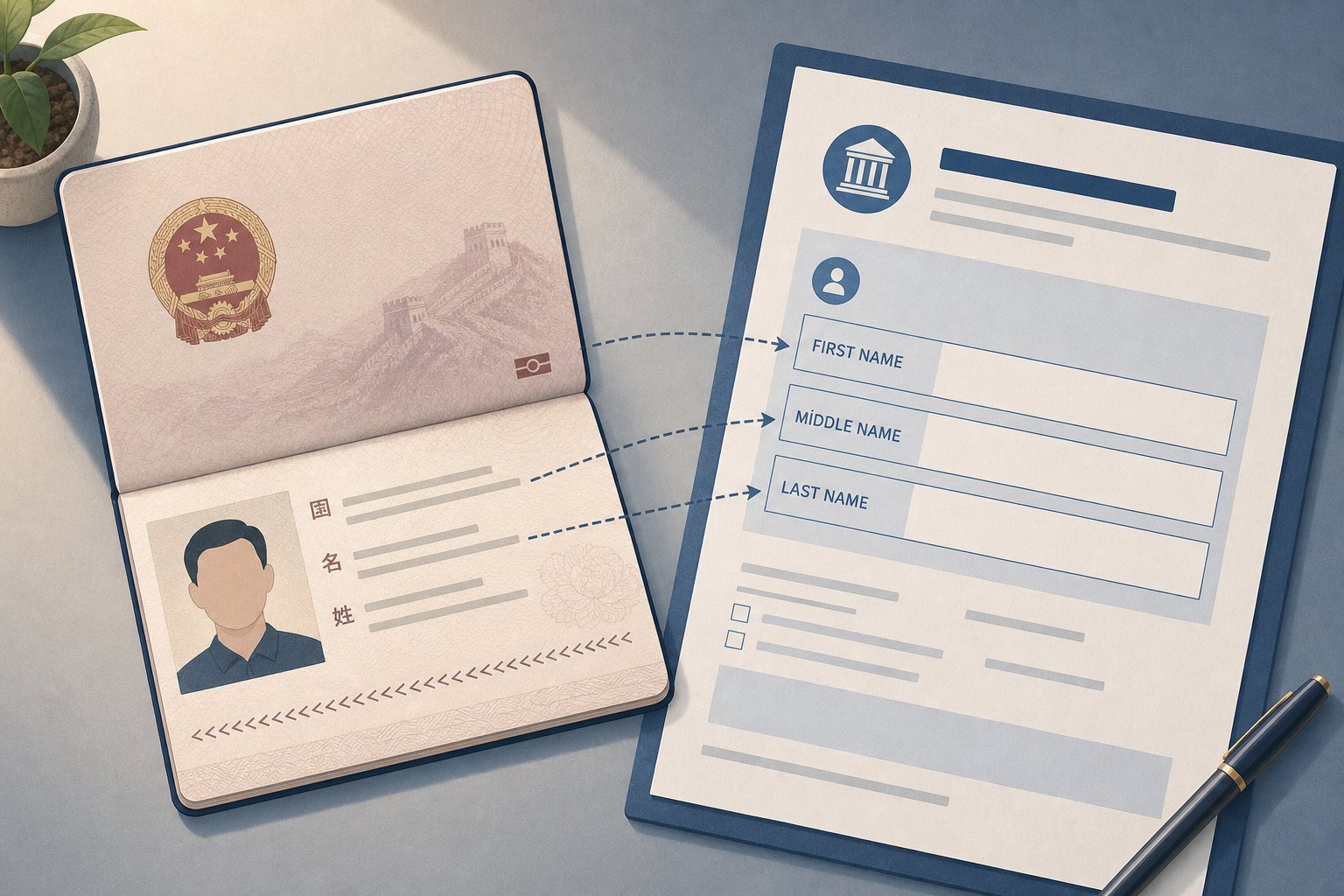
You are filling out a visa application, and the form demands a first name, a middle name, and a last name. Your Chinese passport says WANG XIAOMING. So where does the middle name go? This is the exact friction that pinyin middle name format describes: the collision between a Chinese name structure and a Western form that was never designed for it.
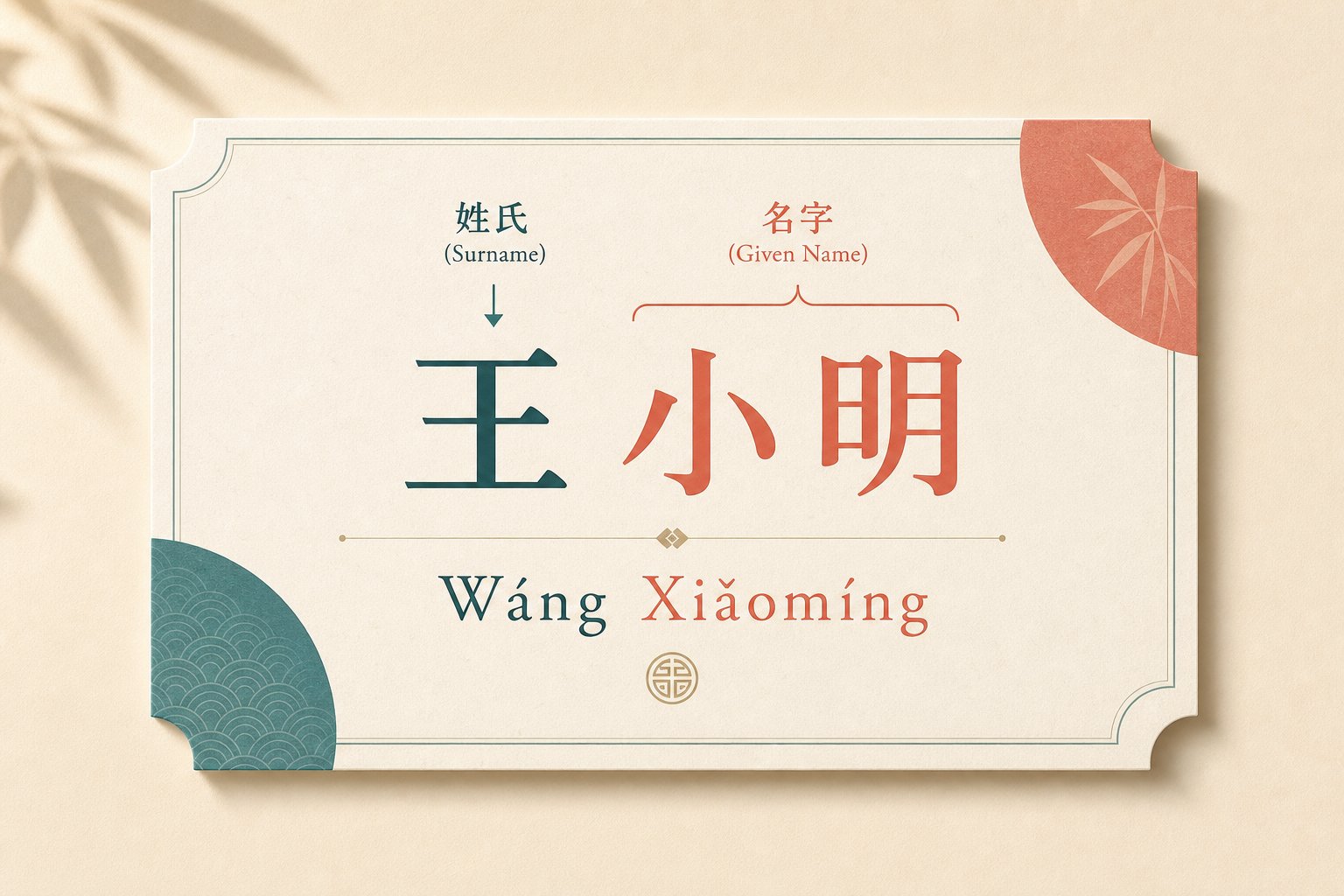
Here is the core issue. Chinese names do not have a middle name. The traditional structure is simple: a surname followed by a given name of one or two characters. When that name is romanized into pinyin for international use, a two-character given name like 小明 (Xiaoming) looks to Western eyes like two separate words that should be split across first and middle fields. It is not. It is one given name written as a single unit.
What Pinyin Middle Name Format Actually Means
The phrase refers to how a romanized Chinese given name gets handled when a form forces a first/middle/last framework. If you have ever wondered how do Chinese names work in English-language systems, the answer is: awkwardly. The chinese name definition most people carry, surname plus given name, has no slot for a middle element. The "middle name" concept only surfaces when someone tries to squeeze a name in chinese into a box built for Western naming conventions. Understanding the chinese name meaning behind each character helps clarify why splitting them apart distorts the name entirely.
Why This Formatting Question Matters
Most formatting confusion stems from forcing a Chinese name structure into a Western first/middle/last framework, not from any ambiguity in the name itself.
Getting this wrong has real consequences. Mismatched names across a passport, university enrollment, and bank account can trigger identity verification failures, visa delays, and academic record collisions. The problem is not cultural. It is structural. Chinese names follow a clear pattern. Western forms simply were not built to receive them.
This guide covers the international standards that govern pinyin formatting, how Chinese passports display names, definitive rules for capitalization and hyphenation, and step-by-step instructions for filling out forms correctly. Whether you are romanizing your own name for the first time or an administrator entering someone else's, the goal is the same: consistency without distortion.
How Chinese Names Are Structured Without a Middle Name
The formatting confusion only makes sense once you see how Chinese names actually work from the inside. There is no hidden middle element waiting to be extracted. The chinese name structure is fundamentally different from the Western model, and understanding that difference is the first step toward filling out any form correctly.
Surname Plus Given Name Structure
A Chinese name has two parts: the surname (姓 xing) comes first, followed by the given name (名 ming). That is it. No middle name slot exists in the traditional system.
Most common chinese names are either two or three characters total. A one-character surname pairs with a one- or two-character given name. Think of Wang Xiaoming (王小明): Wang is the surname, Xiaoming is the complete given name. Three characters, two components. The Asia Media Centre notes that the top 100 chinese last names all have a single syllable, and these character surnames cover roughly 85 percent of China's population. Compound surnames like Ouyang (欧阳) or Zhuge (诸葛) do exist, but they are rare, accounting for only 81 out of approximately 400 surnames in chinese still in active use.
The given name carries the personal meaning. Families choose characters that reflect aspirations, virtues, or circumstances surrounding a child's birth. Names for boys often symbolize strength and power, while girls' names frequently represent beauty and wisdom. Each character is selected for both its sound and its semantic weight, making the given name a deliberate, unified choice rather than two separable pieces.
Where the Middle Name Concept Enters
If there is no middle name in the traditional system, why does the idea keep surfacing? The answer lies in a specific naming tradition called the generational name (字辈 zibei). In many families, one character of the given name is shared among all siblings or patrilineal cousins of the same generation. This shared character creates a visible thread linking relatives together.
Consider this example from Temple University's EDVICE Exchange: siblings named Jia Zhenni and Jia Zhenhai share the character "Zhen" with their cousins Jia Zhenhua, Jia Zhendong, Jia Zhenguo, and Jia Zhenxing. The generational element "Zhen" appears in every name, functioning almost like a family marker within the given name. When romanized, this shared character sometimes gets interpreted as a middle name by Western systems, especially when it occupies the first position of a two-character given name.
Not every family uses generational names. Some lineages have lost the tradition over time, and smaller families without extensive genealogical records may choose not to adopt the practice at all. But when the tradition is present, it creates the illusion of a separable "middle" element that Western forms are eager to capture.
The reality is more nuanced. What people call a "middle name" in the context of a romanized Chinese name can actually refer to several different things:
- A generational name functioning as a perceived middle name — one character of the given name is shared across a generation, and Western systems split it off into the middle name field
- A two-character given name split into two fields — the form forces a division that does not exist in the original name, turning one given name into a "first" and a "middle"
- An adopted Western middle name used by overseas Chinese — some people add an English name (e.g., David) as a first name and shift their Chinese given name into the middle position
- A courtesy name (字 zi) — a traditional alternative name given at adulthood, historically used among peers as a sign of respect, entirely separate from the given name and not a middle name in any modern sense
The courtesy name deserves a brief note. In classical Chinese culture, a person received a style name (字 zi) at the age of 20 during a coming-of-age ceremony. Peers would address each other by this name rather than the given name, as using someone's given name implied authority over them. This tradition, deeply tied to chinese honorifics and Confucian social hierarchy, faded after the fall of Imperial China and has no bearing on modern document formatting. Yet it occasionally appears in discussions about Chinese naming layers, adding another source of confusion for people trying to understand what counts as a "middle name."
The key takeaway is simple: these are four distinct situations, not four versions of the same thing. Treating a generational character as a middle name, splitting a unified given name across two fields, adopting a Western name, and referencing a historical courtesy name are all different phenomena. Lumping them together under "middle name" is exactly how formatting errors begin, and why international standards had to step in with explicit rules for how pinyin names should be written.
International Standards That Govern Pinyin Name Formatting
Those explicit rules for writing name pinyin did not emerge in a vacuum. Three major standards define exactly how a multi-syllable Chinese given name should appear in romanized form. They do not always agree with each other in presentation, but they share a common principle: the given name is one unit, not two.
ISO 7098 and Hanyu Pinyin Orthography Rules
The international baseline is ISO 7098:2015, which specifies how to romanize Chinese using Hanyu Pinyin. For personal names, the rule is straightforward: a two-syllable given name is written as one word with no space and no hyphen. The surname is capitalized and separated from the given name by a single space.
So for 王小明, the correct ISO rendering is Wang Xiaoming, not Wang Xiao Ming or Wang Xiao-Ming. The given name stays whole. As the Hanyu Pinyin orthography guidelines state directly: "The given name is a single entity and should not be broken up; moreover, use of the hyphen to clarify syllable boundaries is entirely superfluous." This applies whether you are performing a chinese name translation for academic publishing or simply filling out a conference badge.
When tone marks are included, the format becomes Wang Xiaoming with diacritics on the appropriate vowels. Capitalization follows a simple pattern: first letter of the surname, first letter of the given name. Nothing else gets capitalized mid-word. For situations where the surname might be confused with the given name, ISO 7098 permits writing the entire surname in capitals (WANG Xiaoming) to eliminate ambiguity.
China's GB/T 28039-2011 National Standard
While ISO 7098 governs international romanization, China's own national standard, GB/T 28039-2011, controls how names appear on domestic identity documents and passports. This is the standard that directly shapes how millions of people encounter their name in chinese language systems abroad.
The rules are strict. Given name syllables merge into one continuous uppercase string without tone marks. No spaces between syllables, no hyphens, no diacritics. The National Immigration Administration references this standard explicitly when explaining formatting rules for exit-entry documents, including how special cases like the letter "U" in names containing LU or NU are handled on passports.
The result is a name like WANG XIAOMING: surname and given name in separate fields, both fully capitalized, given name syllables fused together. This format prioritizes machine readability and consistency across international travel documents. It also means that when naming chinese characters in pinyin for official purposes, the output strips away the tonal and visual cues that might otherwise help a foreign reader parse the syllable boundary.
UN/GEGN Recommendations
The United Nations Group of Experts on Geographical Names (GEGN) endorses Hanyu Pinyin as the standard romanization system for Chinese. While their primary focus is place names, the endorsement reinforces Hanyu Pinyin's authority for all Chinese-to-Latin script conversion, including personal names. This means the same orthographic principles from ISO 7098 carry weight in international contexts beyond just passports and academic papers.
For anyone trying to understand chinese names in chinese letters and their romanized equivalents, these three standards form the authoritative framework. They converge on one point: the given name stays together.
How the Same Name Appears Under Each Standard
Imagine you need to write 王小明 in every major format. Here is what that looks like in practice:
| Standard | Full Name Display | Key Features |
|---|---|---|
| ISO 7098 (with tone marks) | Wang Xiaoming | Surname + given name as one word; tone marks on vowels; initial caps only |
| GB/T 28039-2011 (passport) | WANG XIAOMING | All uppercase; no tone marks; syllables merged; surname and given name in separate fields |
| Common Western adaptation | Xiaoming Wang or Xiao-Ming Wang | Name order reversed (given name first); hyphenation optional and informal |
Notice the pattern. The first two standards keep the given name as a single block. The Western adaptation sometimes introduces a hyphen for readability, but this is a convenience, not a rule. It is also where the pinyin middle name format problem begins: a hyphenated form like Xiao-Ming invites someone to split it across two fields, turning one name into two.
The gap between what these standards prescribe and what Western forms actually accept is where most real-world confusion lives. A passport says XIAOMING. A university enrollment system wants a first name and a middle name. The standard is clear. The form is not.
Chinese Passport Formatting and International Document Conflicts
A passport is supposed to be the anchor document, the one source of truth that every other system references. For Chinese passport holders, it is. The problem is what happens after the passport is issued, when that cleanly formatted name enters foreign systems that were never designed to receive it.
How Chinese Passports Display Pinyin Names
Open a Chinese passport and you will see two fields on the data page: surname and given name. Both are printed in uppercase Latin letters without tone marks, and the given name syllables are merged into a single unbroken string. No space, no hyphen, no separation of any kind between syllables.
For someone named 王小明, the passport reads:
- Surname: WANG
- Given name: XIAOMING
That is it. Two fields, two entries. The format follows GB/T 28039-2011 exactly, and it leaves zero ambiguity about how the name should be parsed: WANG is the family name, XIAOMING is the complete given name. There is no middle name field on a Chinese passport because the naming system does not require one.
This formatting applies universally. Whether the given name is one syllable (e.g., WEI) or two syllables (e.g., XIAOMING), it occupies a single field. The passport does not hint at syllable boundaries, does not suggest where one character ends and another begins. For the purposes of the document, XIAOMING is one indivisible name, just as CHRISTOPHER would be on a British passport.
The Downstream Document Mismatch Problem
The trouble starts the moment that passport name leaves China. Imagine arriving at a foreign university, opening an enrollment form, and seeing three mandatory fields: First Name, Middle Name, Last Name. Your passport says WANG XIAOMING. Where does each piece go?
The instinct many people have, and the mistake many administrators make, is to split XIAOMING into XIAO (first name) and MING (middle name). It looks like two words fused together, so why not separate them? The answer: because doing so creates a legal name that does not match your passport, and that mismatch will follow you through every system that references the original entry.
When you need to chinese name convert from the passport format into a Western form, the correct approach is to enter XIAOMING as the first name and leave the middle name field blank or mark it N/A. But this is counterintuitive to administrators trained to fill every field, and many systems flag an empty middle name as an error or incomplete entry.
The result is inconsistency. One system records XIAOMING as a first name. Another splits it into XIAO and MING. A third drops MING entirely because it was entered as a middle initial. Each variation creates a slightly different identity in a slightly different database, and none of them talk to each other.
Consistency across all documents is more important than any single "correct" format. A name entered the same way everywhere will cause fewer problems than a theoretically perfect format applied inconsistently.
Real-World Consequences of Name Splitting
This is not an abstract formatting debate. The downstream effects of splitting a merged given name are concrete and well-documented.
Academic name collisions. Research published under abbreviated Chinese names creates massive ambiguity. When XIAOMING becomes X. as a middle initial, the author appears as "X. Wang" in citation databases, a name shared by thousands of researchers. One study found that "Y. Wang" appeared in the bylines of 3,926 publications, with an apparent publication rate of almost 11 papers per day, simply because dozens of different researchers were collapsed into the same abbreviated name. Splitting a given name and then abbreviating the second half compounds this problem exponentially.
Health record errors. A patient registered as XIAO MING WANG at one clinic and XIAOMING WANG at another may appear as two different people in a hospital system. Medication histories, allergy records, and test results do not transfer between duplicate profiles. For anyone trying to name translate chinese into English-language medical systems, inconsistent formatting is not just inconvenient, it is a patient safety issue.
Visa and immigration processing delays. Immigration authorities cross-reference names across multiple documents: passport, visa application, travel history, biometric records. A name that appears as XIAOMING on the passport but XIAO MING on the visa application triggers a manual review. TropicalHainan.com reports that even within China, a single name discrepancy can halt a work permit renewal, a tax audit, or a bank review until it is resolved. The same principle applies internationally: mismatched names mean delayed processing while officials verify that two different-looking entries refer to the same person.
Banking and financial verification failures. International wire transfers require exact name matching between the sending and receiving institutions. If your bank account says XIAO MING WANG but your passport says XIAOMING WANG, the transfer may be rejected or flagged for anti-money laundering review. Under tightened cross-border remittance rules, even minor formatting differences can block transactions entirely.
The common thread across all these scenarios is the same: someone, at some point, decided to split a merged given name into two pieces. Every system that inherited that split then propagated the error forward. Fixing it requires contacting each institution individually, often with supporting documentation proving that XIAOMING and XIAO MING refer to the same person.
For anyone who needs to name convert to chinese or from Chinese into Western systems, the lesson is clear. The passport format is the baseline. XIAOMING stays as XIAOMING. The middle name field stays empty. Every document that follows should mirror that choice exactly, because the cost of inconsistency is always higher than the cost of an unfilled field.
Knowing what the passport says and why it matters is one thing. Knowing exactly how to capitalize, hyphenate, and place tone marks when you do have formatting flexibility is another, and the rules are more specific than most people realize.

Definitive Formatting Rules for Pinyin Middle Names
Formatting flexibility does not mean formatting freedom. When you move beyond the rigid passport standard and into academic papers, professional directories, or informal contexts, specific rules still govern how chinese name letters should appear. Getting capitalization, spacing, or tone marks wrong does not just look sloppy. It can change how systems parse your name and whether documents match each other downstream.
Here are the authoritative rules, drawn directly from Hanyu Pinyin orthography standards, with clear before-and-after examples so you can spot errors at a glance.
Capitalization Rules for Pinyin Names
The principle is simple: capitalize the first letter of the surname and the first letter of the given name. Nothing else. For a 3 letter chinese name like 王飞 (Wang Fei), you capitalize the W and the F. For a two-syllable given name like 小明 (Xiaoming), you capitalize only the X. The second syllable does not get its own capital letter because it is not a separate word.
This means Wang Xiaoming is correct. Wang XiaoMing is wrong. The intercap (capital M in the middle) implies two distinct names fused together, which is exactly the misreading that causes middle name field confusion in the first place. The Hanyu Pinyin orthography guidelines are explicit: "two-syllable given names should be written as one word (no space), with no intercaps, and not hyphenated."
When ambiguity about which part is the surname might arise, especially with monosyllabic given names, you can write the entire surname in capitals: WANG Fei or OUYANG Xiaoming. This convention is recognized in international academic and diplomatic circles and eliminates the guessing game for non-Chinese readers trying to identify the family name among unfamiliar chinese letters for names.
Hyphenation and Spacing Decisions
Three approaches exist for writing a two-syllable given name, and only one is officially standard:
- Merged (Xiaoming) — the official Hanyu Pinyin standard. Both syllables form one word with no visual break. This is what ISO 7098 and GB/T 28039 prescribe.
- Hyphenated (Xiao-Ming) — a common informal convention, especially in overseas Chinese communities and older publications. Names with a hyphen signal syllable boundaries for non-Chinese readers, but the hyphen has no basis in the official standard. The orthography rules state that "use of the hyphen to clarify syllable boundaries is entirely superfluous."
- Spaced (Xiao Ming) — generally discouraged. A space between syllables implies two separate names, which is precisely what invites systems to split them across first and middle fields. This format actively creates the pinyin middle name format problem rather than solving it.
So which should you use? For legal documents, always merge. Match your passport. For academic publications, merge and add tone marks. For informal Western contexts, a hyphenated form is acceptable as a personal preference, but understand that it introduces a visual split that some systems will interpret as two names. If you choose to hyphenate, do so consistently everywhere or not at all.
One important note: the hyphenated style capitalizes the letter after the hyphen in some traditions (Xiao-Ming) and lowercases it in others (Xiao-ming). Neither is officially standard, but if you adopt hyphenation, pick one convention and stick with it across every document.
Tone Mark Placement in Names
Tone marks follow a fixed rule in Hanyu Pinyin. The mark always sits above a vowel, and when a syllable contains multiple vowels, the placement follows a specific priority sequence: a and e always take the mark. If neither is present, the mark goes on the last vowel in the cluster. The University of Kansas Pinyin module summarizes the rule as: the vowel listed earliest in the sequence a-o-e-i-u-u gets the tone mark, with the exception that when i and u occur together, the last one takes it.
For names, this means:
- Xiaoming becomes Xiǎomíng (mark on the a in xiao, mark on the i in ming)
- Xiaolong becomes Xiǎolong (mark on the a in xiao, mark on the o in long)
- Guifang becomes Guifāng (mark on the i in gui because u and i together means the last vowel wins, mark on the a in fang)
When are tone marks required? In academic and linguistic writing, always. In a chinese name in chinese letters alongside its pinyin gloss, always. On passports and most official Western documents, never. The GB/T 28039 standard strips tone marks entirely for machine readability. Most international forms, airline tickets, and banking systems also omit them because their character sets do not support diacritics.
The practical rule: include tone marks when writing for an audience that reads pinyin as pinyin (linguists, students, academic citations). Omit them when the name enters a system that treats it as a plain Latin-alphabet string.
Format Variation Reference Table
Here is the same name, 李小龙 (Li Xiaolong), rendered in every common format with a clear correct or incorrect label:
| Format | Rendering | Status | Why |
|---|---|---|---|
| ISO 7098 with tone marks | Li Xiǎolong | Correct | Surname capitalized, given name as one word, tone marks on correct vowels |
| Passport (GB/T 28039) | LI XIAOLONG | Correct | All caps, no tone marks, syllables merged, matches official document format |
| Surname fully capitalized | LI Xiaolong | Correct | Acceptable international convention to clarify which part is the surname |
| Hyphenated informal | Li Xiao-Long | Acceptable (informal only) | Not standard but widely used; keep consistent if chosen |
| Intercap mid-name | Li XiaoLong | Incorrect | Intercap implies two separate names; violates orthography rules |
| Spaced given name | Li Xiao Long | Incorrect | Space creates three apparent names; invites middle name field splitting |
| Reversed with hyphen | Xiao-Long Li | Acceptable (Western order, informal) | Given name first for Western contexts; hyphen optional but consistent |
| Reversed and spaced | Xiao Long Li | Incorrect | Looks like first name "Xiao," middle name "Long," last name "Li" |
Notice the pattern. Every incorrect format introduces a visual break, whether a space or an intercap, that makes the given name look like two separate pieces. Every correct format keeps the given name visually unified, even when the overall name order is reversed for Western audiences.
These rules give you the tools to format any pinyin name correctly in isolation. The harder question is what to do when a form will not cooperate, when the middle name field is mandatory, when the system rejects a blank entry, or when your university wants something different from your passport. That is where practical form-filling strategy takes over from formatting theory.

How to Fill Out Western Forms With a Chinese Pinyin Name
Forms do not bend to fit your name. You have to know how to bend your entry to fit the form without breaking your identity across systems. Whether you are wondering how to write your name in chinese on a visa application or trying to help a student register correctly, the strategy is the same: start with the passport, stay consistent, and resist the urge to fill every blank field.
Filling Out Passport and Visa Applications
Your Chinese passport is the anchor. If it says XIAOMING in the given name field, that is your first name on every downstream form. Full stop. The middle name field gets left blank or marked N/A.
The China Online VISA Application (COVA) system illustrates this clearly. Its form asks for surnames and given names as two fields, matching the passport layout exactly. When you fill out a foreign visa application like the U.S. DS-160, the same principle applies: enter your surname in the Surnames field and your full given name in the Given Names field. Do not split XIAOMING into XIAO and MING just because the form has a middle name box waiting to be filled.
What if the form makes the middle name field mandatory? Some systems do. In that case, enter "N/A" or "NMN" (No Middle Name) if the system accepts text, or a single dash if it requires at least one character. U.S. government guidance explicitly states that the passport name is the authoritative source. Splitting a merged given name to satisfy a form field creates a legal name that does not exist on any official document.
University Enrollment and Professional Documents
University systems often have two layers: a legal name field and a preferred name field. Use them strategically. Your legal name matches the passport. Your preferred name is where you can use a hyphenated form like Xiao-Ming for readability, or even an adopted English name, without creating a document mismatch.
If you are figuring out how to spell name in chinese for an academic profile or professional directory, keep the legal entry clean and consistent. Save stylistic choices for the preferred or display name. This way, your transcript, diploma, and visa documents all reference the same string, while your email signature and conference badge can reflect how you actually want to be addressed.
For anyone deriving a chinese name from english name or adopting a Western first name like David, the cleanest approach is: legal first name stays as your passport given name, legal middle name stays blank, and the English name lives in the preferred name field. If you later formalize the English name legally, update all records at once.
Guidance for Different User Perspectives
Three groups face this problem from different angles, and each needs slightly different advice.
Mainland Chinese citizens romanizing for the first time. You are learning how to write your name in mandarin's romanized form for international use. Your passport has already made the decision for you. Copy it exactly. Do not experiment with spacing or hyphenation on legal forms.
Overseas Chinese choosing a presentation style. You may have grown up writing your name with a hyphen or a space. That is fine for informal use. But when a form asks for your legal name, revert to the passport format. Consistency protects you from verification failures across banking, immigration, and academic systems.
Non-Chinese administrators entering names. If someone hands you a passport that says WANG XIAOMING, enter XIAOMING as the first name and WANG as the last name. Do not split the given name. Do not guess at syllable boundaries. If your system demands a middle name, enter N/A rather than inventing one.
Regardless of which group you fall into, the decision process is the same:
- Check your passport format — note exactly how the surname and given name appear
- Use that as your legal baseline — this is the name that exists in official systems
- Keep all official documents consistent — visa applications, bank accounts, university enrollment, and employer records should all mirror the passport
- Use your preferred informal format only in non-legal contexts — email signatures, social media, business cards, and preferred name fields are where personal style belongs
This four-step approach works whether you are trying to figure out how do i write my name in chinese on a foreign form or helping someone else navigate the process. The passport is always the starting point, and consistency is always the goal.
Following these steps eliminates most problems before they start. But what about the errors that have already crept in, the inconsistencies already living in your records? Recognizing the most common formatting mistakes is the fastest way to audit what you have and fix it before it causes real damage.
Common Pinyin Middle Name Formatting Mistakes and Fixes
Errors rarely announce themselves. They sit quietly in a database until a renewal, a transfer, or a background check surfaces the mismatch. If you have ever struggled with how to write name in chinese for an official form, chances are at least one of the mistakes below has already made its way into your records. Here are the most frequent ones, why they happen, and exactly how to correct them.
Splitting a Given Name Into First and Middle Incorrectly
This is the single most common formatting error. Someone sees XIAOMING on a passport and enters XIAO as the first name and MING as the middle name. It feels logical. It is wrong.
The problem is not just aesthetic. Once a system records your given name as two separate pieces, every document that pulls from that record inherits the split. Your university transcript says "Xiao M. Wang." Your bank account says "Xiaoming Wang." Your employer's payroll system says "Xiao Ming Wang." Now you have three different identities across three institutions, and reconciling them requires contacting each one individually with supporting documentation. ASAP Translate notes that name discrepancies across documents are one of the most common causes of immigration processing delays, Requests for Evidence, and even outright application rejections.
The fix is preventive: enter the full given name as one string in the first name field. Leave the middle name blank. If the system forces a middle name entry, use N/A. Never split a merged given name to fill an empty box.
Inconsistent Capitalization and Hyphenation Across Documents
Imagine this scenario. Your visa application says Xiao Ming. Your university enrollment says Xiaoming. Your professional license says XIAO-MING. Each document was filled out at a different time, by a different person, using a different interpretation of how do you write names in chinese for Western systems. The result is three records that look like three different people.
Inconsistency is the real enemy here, not any single format choice. A person who uses Xiao-Ming everywhere will have fewer problems than someone who alternates between Xiaoming, Xiao Ming, and Xiao-Ming depending on the day. TropicalHainan.com reports that even within China, a single name discrepancy between systems can halt a work permit renewal or freeze a bank account until the mismatch is resolved. Internationally, the stakes are identical.
The fix: audit every active record. Pull up your bank account, tax registration, employer records, and any immigration documents. Compare the name on each one to your passport. Anything that deviates needs correction, starting with the most consequential system first.
Omitting or Misplacing Tone Marks in Academic Contexts
Tone marks are irrelevant on passports and banking forms. But in academic writing, names in chinese writing should carry correct diacritics when pinyin is being used as pinyin rather than as a plain Latin string. The most common errors are placing the mark on the wrong vowel or omitting marks entirely in contexts where they are expected.
For example, writing "Xiǎomíng" requires the mark on the a in "xiao" (because a always takes priority) and on the i in "ming." Writing "Xīaoming" or "Xiaōming" places the mark on the wrong vowel and misrepresents the pronunciation. When writing chinese names in academic citations or linguistic papers, incorrect tone placement is treated as a factual error, not a stylistic choice.
Quick-Reference Correction Table
Use this table to spot and fix the most frequent name chinese writing errors at a glance:
| Common Mistake | Correct Format |
|---|---|
| Splitting given name into first and middle: First: XIAO, Middle: MING | First: XIAOMING, Middle: N/A |
| Random intercap mid-name: Wang XiaoMing | Wang Xiaoming (only initial letter of each name component capitalized) |
| Adding a space between given name syllables: Wang Xiao Ming | Wang Xiaoming (syllables merged per ISO 7098) |
| Using a hyphen on legal documents when passport has none: WANG XIAO-MING | WANG XIAOMING (match passport exactly on legal forms) |
| Reversing surname and given name without indication: Xiaoming Wang (unclear which is surname) | WANG Xiaoming (capitalize full surname) or Xiaoming WANG |
| Placing tone mark on wrong vowel: Wáng Xīaomíng | Wang Xiaoming (tone mark on a in xiao, not on i) |
Every error in this table shares a root cause: someone applied a formatting choice inconsistently or guessed at a rule instead of checking the standard. If you are unsure how any specific name should appear, the passport is always the tiebreaker for legal contexts, and ISO 7098 is the authority for academic ones.
Spotting individual mistakes is useful. But seeing every format side by side, mapped to the exact context where each one belongs, makes the full picture click into place.

Formatting Comparison Table for Every Major Convention
Individual rules are helpful. A complete side-by-side view is better. When you can see every format laid out next to each other, mapped to the exact form fields they produce, the differences stop being abstract and start being actionable. This section gives you that single reference point, using one name across every convention so the contrasts are unmistakable.
The example throughout is 李小龙 (Li Xiaolong), a typical chinese name with a one-character surname and a two-character given name. This is the most popular chinese names structure: three characters total, surname first, given name second. If you can format this name correctly in every context, you can format any standard Chinese name.
Side-by-Side Format Comparison Table
Here is how Li Xiaolong appears under each major convention, broken down by what goes into each form field:
| Format Convention | Full Name Display | First Name Field | Middle Name Field | Last Name Field |
|---|---|---|---|---|
| Chinese passport (GB/T 28039) | LI XIAOLONG | XIAOLONG | (blank / N/A) | LI |
| ISO 7098 standard (with tone marks) | Li Xiaolong | Xiaolong | (blank / N/A) | Li |
| Hyphenated informal | Xiao-Long Li | Xiao-Long | (blank / N/A) | Li |
| Spaced informal (discouraged) | Xiao Long Li | Xiao | Long | Li |
| Common Western adaptation (reversed order, merged) | Xiaolong Li | Xiaolong | (blank / N/A) | Li |
Notice what happens in the spaced informal row. The moment a space appears between syllables, the name fragments into three apparent parts, and a system reading left to right will slot "Xiao" as first, "Long" as middle, and "Li" as last. That is exactly how common chinese name entries get mangled in databases. Every other convention keeps the given name intact, whether merged or hyphenated, and leaves the middle name field empty.
This table works for any typical chinese names following the one-character-surname, two-character-given-name pattern. For chinese male given names like Xiaolong, Jianming, or Guowei, the logic is identical. For chinese first names male or female with a single-character given name (e.g., 李伟 Li Wei), the table simplifies further: Wei goes in the first name field, the middle name stays blank, and Li goes in the last name field. No splitting required.
Which Format to Use When
No single format is universally correct. The right choice depends entirely on context and, more importantly, on staying consistent within that context. Here is the match:
- Legal documents (passports, visas, immigration forms, bank accounts) — use the Chinese passport format exactly. All caps, syllables merged, no tone marks, no hyphen. XIAOLONG in the first name field, LI in the last name field, middle name blank or N/A.
- Academic papers and linguistic publications — use ISO 7098 with tone marks. Li Xiaolong in Chinese name order, or Xiaolong Li in Western name order if the journal requires it. Surname may be fully capitalized (LI Xiaolong) to clarify structure for international readers.
- Informal Western use (email signatures, social media, business cards) — hyphenated or merged, per personal preference. Xiao-Long Li or Xiaolong Li both work. Pick one and use it everywhere informally.
- Internal databases and HR systems — mirror the passport. If the system demands a middle name, enter N/A. Do not invent a split that does not exist on the source document.
- Academic citations and bibliographies — follow the journal's style guide, but default to merged given name. Li, X. is acceptable as an abbreviated form, though it shares space with thousands of other researchers, which is why many journals now encourage full given names.
The most popular chinese names, the ones shared by millions of people, make this consistency even more critical. When your surname is Li, Wang, or Zhang, the given name is the only element that distinguishes you from countless others in any database. Splitting it, abbreviating it, or formatting it inconsistently erases the one piece of identifying information that sets you apart.
Think of it this way: the format you choose is less important than the discipline of applying it the same way every time. A person who writes Xiao-Long Li on every informal document and XIAOLONG LI on every legal one will never trigger a mismatch. A person who alternates between Xiaolong, Xiao Long, Xiao-Long, and XIAO LONG depending on the form will spend hours untangling verification failures.
Context determines format. Consistency determines whether it works. Keep both principles in view, and the pinyin middle name format question stops being a recurring headache and becomes a solved problem you reference once and move on from.
Final Takeaways and Edge Cases for Pinyin Name Formatting
Context and consistency. Those two words summarize everything above. But real life has a way of throwing situations that do not fit neatly into the standard framework: compound surnames that look like given names, adopted English names that shift everything one field to the right, and dialect romanizations that do not follow Hanyu Pinyin at all. Before you close this guide, let's address those edge cases and lock in the principles that apply no matter what form lands in front of you.
Key Principles to Remember
Match your passport, then stay consistent everywhere. Every other formatting decision is secondary to this single rule.
If you take nothing else from this article, take that. The passport is the legal anchor. Every downstream system, whether a bank, a university, or an immigration authority, will eventually cross-reference back to it. A name that matches the passport in every record will never trigger a verification failure. A name that deviates, even in small ways, eventually will.
Beyond the passport rule, three supporting principles hold across every scenario:
- The given name is one unit. Do not split it across first and middle fields regardless of how many syllables it contains.
- An empty middle name field is always better than an invented one. N/A causes zero downstream problems. A fabricated split causes many.
- Informal preferences belong in informal contexts only. Hyphenation, Western name order, and adopted English names are fine for business cards and email signatures, but legal forms get the passport format.
Edge Cases and Special Situations
Compound surnames and the middle name field. About 0.11% of people in China carry a two-syllable surname like Ouyang (欧阳), Shangguan (上官), or Zhuge (诸葛). Ouyang alone accounts for over 1.1 million people. On a Chinese passport, the compound surname appears as a single merged string in the surname field: OUYANG. The given name occupies its own field as usual. The problem arises when a Western form encounters OUYANG and assumes it must be two names, slotting OU into the last name and YANG into a middle name, or worse, treating YANG as part of the given name. The fix is the same as always: enter the full compound surname exactly as the passport prints it. If the system cannot accommodate a multi-syllable last name, contact the institution rather than splitting the surname yourself. Among asian names, compound surnames are uncommon but not rare, and any system handling international records should be able to store them intact.
Adopted Western first names. Many overseas Chinese adopt an English given name and restructure their name into a Western format: David Xiaoming Wang. In this arrangement, the Chinese given name genuinely functions as a middle name by choice, not by forced splitting. This is a deliberate personal decision, not a formatting error. If you have legally adopted a Western name, your documents should reflect the full chosen structure: first name David, middle name Xiaoming, last name Wang. The key distinction is intent. Choosing to place your Chinese given name in the middle position is valid. Having a system arbitrarily split your given name into that position is not. For people selecting one syllable middle names or shorter elements from their Chinese given name to use in this slot, the same principle applies: it should be a conscious choice reflected consistently across all records, not an accident of form design.
Cantonese and other dialect romanizations. Everything discussed so far assumes Hanyu Pinyin, the standard romanization for Mandarin. But Cantonese names use entirely different romanization systems. Jyutping is the linguistic standard for Cantonese, but most Hong Kong residents use informal romanizations that predate any standardized system. A name like 陈大文 might appear as Chan Tai Man in Cantonese romanization versus Chen Dawen in Mandarin pinyin. The same person, the same characters, two completely different spellings. Hong Kong and Macau passports print cantonese names in their local romanization, not in Hanyu Pinyin. If your passport says CHAN TAI MAN, that is your legal name in romanized form, and the same rules apply: enter it consistently, do not split it arbitrarily, and match the passport on every legal document. The formatting principles are universal even when the romanization system changes. Chinese last name meanings and chinese surnames meaning remain the same regardless of whether the surname is romanized as Wong (Cantonese) or Wang (Mandarin). Only the spelling shifts.
One syllable middle names from split given names. Occasionally, someone whose given name was split years ago across first and middle fields now has an established paper trail with that split baked in. Correcting it means amending records at every institution. If the split is already embedded in your legal identity across multiple countries and systems, the pragmatic choice may be to maintain it consistently rather than attempting a correction that creates yet another mismatch. Consistency still wins, even when the consistent format is not the theoretically ideal one.
Your Three Action Steps
- Audit your records now. Pull up your passport, bank account, employer file, and any immigration documents. Compare the name on each one. Flag any discrepancies and start correction requests with the most consequential system first.
- Set your legal baseline in writing. Write down your name exactly as it appears on your passport. Store it where you can copy-paste it into future forms. This eliminates the temptation to retype from memory and introduce variation.
- Bookmark this guide. The next time you encounter an unfamiliar form, a mandatory middle name field, or an administrator who wants to split your asian name into pieces it was never meant to have, come back here. The standards have not changed. The rules are the same. Match the passport, stay consistent, and leave the middle name field empty.
Pinyin middle name format confusion exists because two naming systems collide at a form field. You cannot fix the forms. But you can control what goes into them. Armed with the standards, the formatting rules, and the practical strategies in this guide, you will never have to guess again.
Frequently Asked Questions About Pinyin Middle Name Format
1. Do Chinese names have a middle name?
Traditional Chinese names do not include a middle name. They consist of a surname followed by a given name of one or two characters. The middle name concept only appears when a Chinese name is entered into Western systems that require a first/middle/last structure. A two-character given name like Xiaoming is a single unit and should not be split across two fields. If a form requires a middle name entry, use N/A or leave it blank rather than artificially dividing the given name.
2. How should I enter my Chinese name on a visa application with a middle name field?
Enter your given name exactly as it appears on your Chinese passport in the first name field. If your passport shows XIAOMING as one merged string, that entire string is your first name. Leave the middle name field blank or enter N/A. Splitting the given name into two parts creates a legal name that does not match your passport, which can cause visa processing delays, identity verification failures, and document mismatches across institutions.
3. Should I hyphenate my Chinese given name in pinyin?
The official Hanyu Pinyin standard (ISO 7098) merges both syllables into one word without a hyphen, making Xiaoming the correct form rather than Xiao-Ming. Hyphenation is an informal convention used for readability in Western contexts but has no basis in the official standard. For legal documents, always use the merged format matching your passport. If you choose to hyphenate informally, apply it consistently across all non-legal contexts to avoid creating multiple name variations in different systems.
4. Why does my name appear differently across my bank, university, and visa records?
Name inconsistencies typically occur because different administrators or forms handled your two-syllable given name differently. One system may have merged it (Xiaoming), another split it with a space (Xiao Ming), and a third hyphenated it (Xiao-Ming). Each variation creates a slightly different identity in each database. To fix this, audit all active records, compare each to your passport, and request corrections starting with the most consequential system. Going forward, always copy the passport format exactly for legal entries.
5. How do compound Chinese surnames like Ouyang work with Western name forms?
Compound surnames such as Ouyang, Shangguan, or Zhuge appear as a single merged string in the surname field of a Chinese passport (e.g., OUYANG). Enter the full compound surname in the last name field of any Western form exactly as the passport prints it. Do not split it into separate fields or allow part of it to be interpreted as a middle name. If a system cannot accommodate a multi-syllable last name, contact the institution directly rather than breaking the surname apart yourself.