What Pinyin Name Format Means for Academic Publishing
Imagine publishing a groundbreaking paper, only to discover that half your citations are attributed to someone who doesn't exist. Not because of plagiarism or fraud, but because your name was formatted inconsistently across journals. For researchers with Chinese names, this scenario is surprisingly common. The pinyin name format for academic publications refers to the standardized way Chinese personal names are romanized and presented in English-language scholarly work, covering everything from journal articles and conference proceedings to book chapters and patent filings.
Getting this format right isn't a minor stylistic preference. It directly determines whether citation databases can link your publications together, whether colleagues can find your complete body of work, and whether your h-index accurately reflects your contributions. A single misplaced space, an inconsistent hyphen, or a swapped name order can split one researcher into two or three phantom identities across indexing systems.
Why Pinyin Name Formatting Matters in Scholarly Publishing
Chinese name formatting in scholarly journals carries weight far beyond aesthetics. Citation metrics drive funding decisions, tenure reviews, and collaborative opportunities. When your name appears as "Wang Mingkai" in one database, "Mingkai Wang" in another, and "M. Wang" in a third, algorithms treat these as separate individuals. Your citation count fragments. Your visibility drops. Colleagues searching for your work may only find a fraction of it.
This problem scales across the global research community. China produces more scientific papers annually than any other country, meaning millions of author records depend on correct pinyin romanization. For editors, reviewers, and co-authors unfamiliar with Chinese naming conventions, the question of how to format pinyin names in citations becomes a daily operational challenge, not just an academic curiosity.
The Core Challenge of Cross-Cultural Name Conventions
Here's where the confusion starts. Chinese names place the surname first and the given name second. In contrast, most Western naming systems lead with the given name. So when a Chinese researcher named 李思远 romanizes their name as "Li Siyuan," a Western editor might reasonably assume "Li" is a first name and "Siyuan" is the family name. The result? A reference list entry that inverts the author's identity entirely.
A single formatting inconsistency in pinyin name order can fragment an author's citation record across databases, effectively erasing years of published work from their professional profile.
This isn't a niche problem. It affects every stage of scholarly communication: manuscript submission systems, peer review assignments, reference list compilation, and database indexing. Understanding why pinyin name order matters for publishing is the first step toward protecting your academic identity and ensuring your work receives proper attribution.
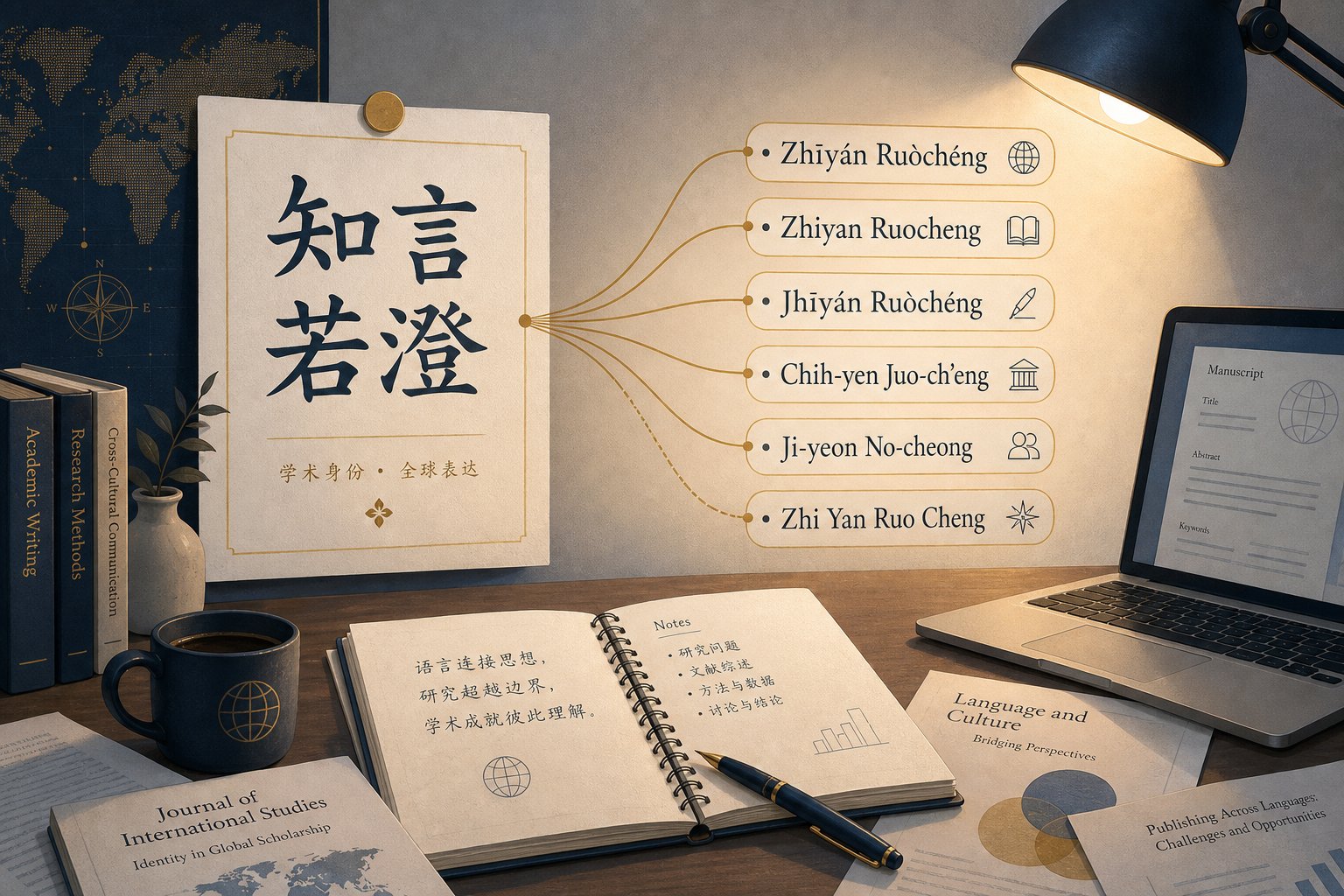
The challenge deepens when you consider that Chinese names don't follow a single universal romanization pattern. Regional conventions, personal preferences, and evolving international standards all introduce variation, and each variation creates another potential point of fragmentation in the global research record.
Understanding Chinese Name Structure and Order
That cross-cultural confusion doesn't emerge from thin air. It's rooted in a fundamental structural difference between Chinese and Western personal names. To format or cite a Chinese name correctly, you first need to understand how these names are built, what each component represents, and where ambiguity creeps in during romanization.
How Chinese Names Are Structured
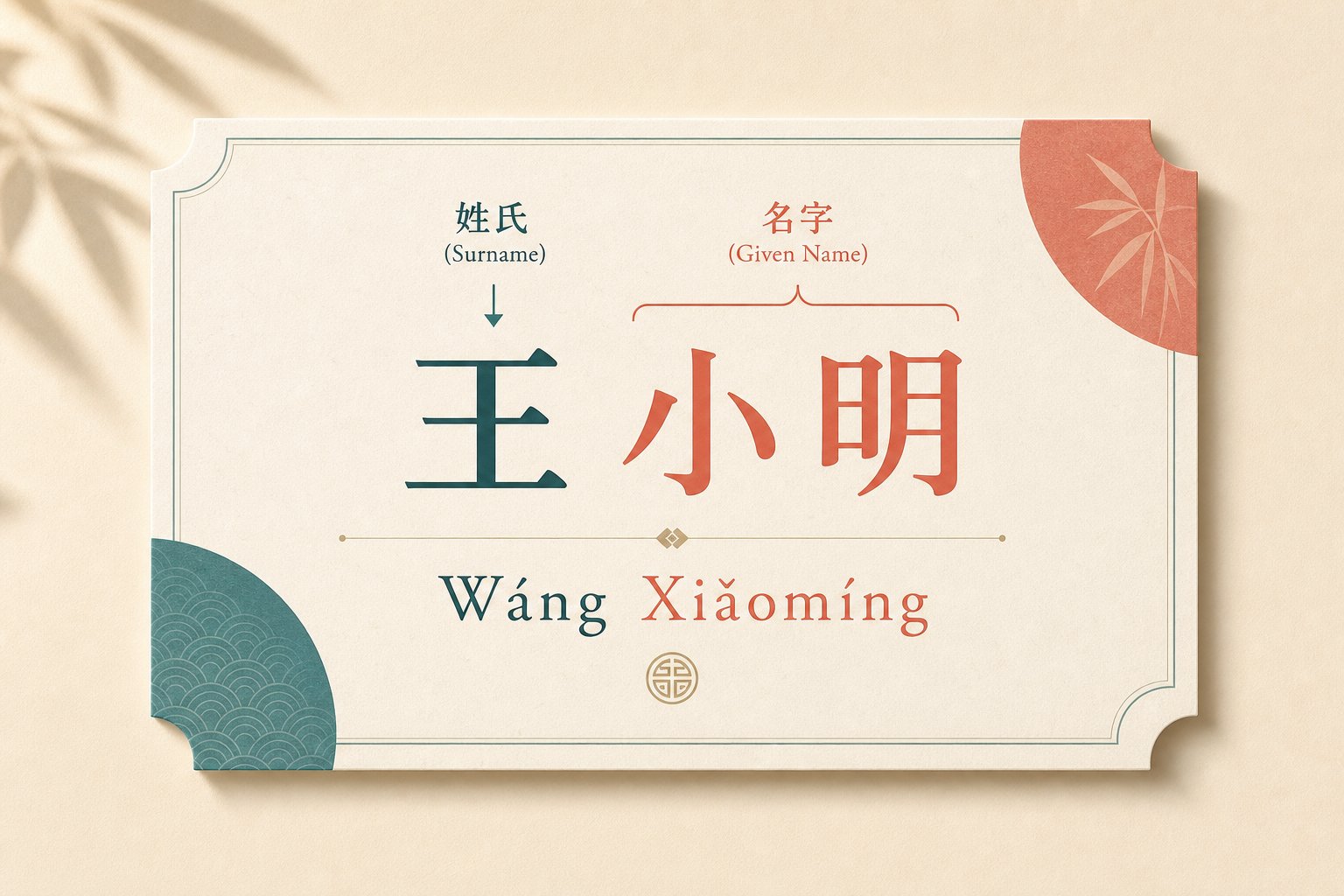
A Chinese personal name consists of two parts: a surname (family name) followed by a given name. This surname-first order is the default in Chinese culture and has been for thousands of years. Unlike many Western names, there is no middle name in the traditional sense.
Here's what makes the Chinese name structure for English publications tricky. Most Chinese surnames are a single character, while given names are typically one or two characters. A name written in Chinese characters carries clear visual boundaries. Take 王明凯 as an example: 王 is the one-character surname, and 明凯 is the two-character given name. Native Chinese readers identify this instantly because they recognize 王 as one of the most common surnames in China, shared by over 100 million people according to research on author name ambiguity.
When this name is romanized into pinyin, it becomes Wang Mingkai. And that's where the trouble begins for non-Chinese readers. Without knowledge of Chinese naming conventions, there's no obvious marker indicating which element is the surname and which is the given name.
The most common structural patterns in Chinese names include:
- Single-character surname + two-character given name (most common, roughly 80-90% of names): e.g., 李思远 becomes Li Siyuan
- Single-character surname + single-character given name: e.g., 张伟 becomes Zhang Wei
- Double-character surname + single-character given name: e.g., 欧阳明 becomes Ouyang Ming
- Double-character surname + two-character given name: e.g., 司马相如 becomes Sima Xiangru
The overwhelming majority of Chinese names follow the first pattern. Only about 60 double-character surnames historically existed, and fewer than 10 remain in common use. This means that in most cases, the first syllable of a romanized Chinese name is the surname, but this rule isn't absolute, and that uncertainty is exactly what causes misidentification.
Surname and Given Name Identification in Pinyin
When you encounter the pinyin name "Wang Mingkai," how do you identify the surname? If you're familiar with Chinese naming conventions, you'll recognize Wang as the surname and Mingkai as the given name. But imagine seeing "Sima Xiangru" for the first time. Is "Sima" a two-character surname, or is "Si" the surname and "Ma Xiangru" a three-syllable given name? Without context, it's genuinely ambiguous.
This ambiguity intensifies when names are reordered for Western-style publications. If a journal requires the given-name-first format, Wang Mingkai becomes Mingkai Wang. A Western reader now sees "Mingkai" and might assume it's a first name followed by a last name, which happens to be correct in this reordered form. But what about Zhang Wei? Reordered as Wei Zhang, a reader unfamiliar with Chinese names might wonder whether "Wei" or "Zhang" is the family name, since both are single syllables and both happen to be common Chinese surnames.
The problem compounds when given names are separated into individual syllables. If "Wang Mingkai" appears as "Wang Ming Kai," a reader or database algorithm might interpret "Kai" as the surname, "Ming" as a middle name, and "Wang" as a given name. Research published in Accountability in Research documents cases where separating a given name's two syllables led to the second syllable being misidentified as a surname entirely, creating ghost author records that fragment citation histories.
Consider this real-world scenario: the name Xu Shaoxiong, when presented as "Xu Shao Xiong," could be misread as a person surnamed Xiong with the given name Shao Xu. That single formatting choice creates an entirely different identity in a citation database.
This structural reality explains why the pinyin romanization of Chinese personal names demands more care than a simple transliteration exercise. Every space, every capital letter, and every ordering decision carries information about identity. Get it wrong, and you're not just making a typographical error. You're potentially splitting one researcher into multiple database entries or merging two different people into one.
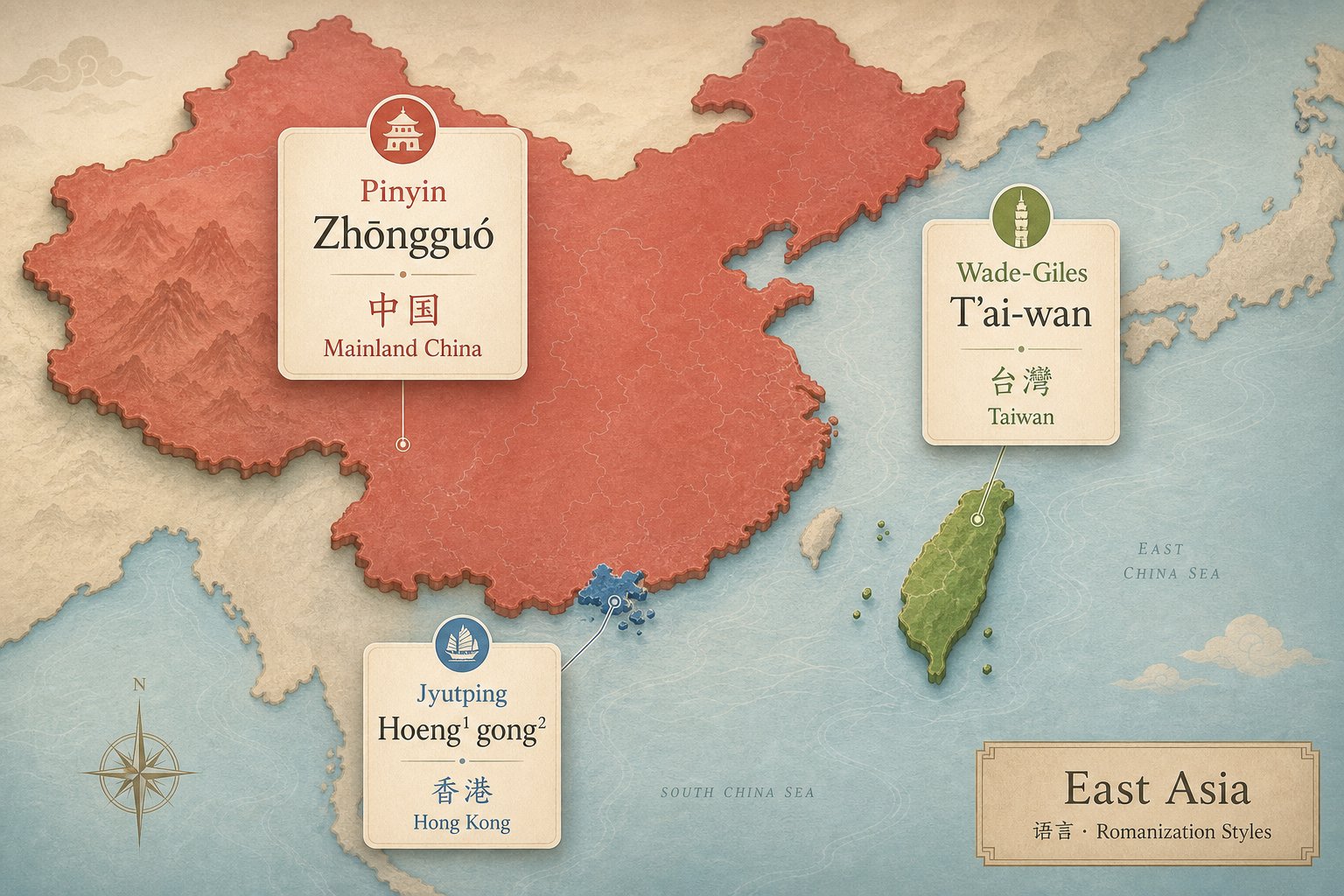
These structural ambiguities become even more complex when you factor in regional differences. Mainland China, Taiwan, and Hong Kong each follow distinct romanization conventions, meaning the same Chinese name can appear in legitimately different forms depending on where the author is based.
Regional Romanization Systems and Their Publication Impact
Those regional differences aren't just a matter of local flavor. They produce entirely different spellings of the same person's name, and when those spellings land in citation databases, they create separate author profiles that never merge. A researcher who publishes early-career work in Taiwan and later moves to a mainland institution may find their publication record split across two identities, not because of any error, but because two legitimate romanization systems produced two different name forms.
Mainland China Pinyin Conventions
Mainland China follows Hanyu Pinyin as its sole official romanization system. The national standard GB/T 28039-2011 governs how personal names are romanized, and the rules are straightforward: the surname is written first, followed by the given name, with only the initial letter of each part capitalized. Critically, the two syllables of a given name are joined together without a space or hyphen. So 陈志明 becomes Chen Zhiming, not Chen Zhi Ming or Chen Zhi-Ming.
This joined format eliminates the ambiguity problem discussed earlier. When you see "Zhiming" written as a single unit, there's no question that it's one given name rather than a surname plus a separate element. The international standard ISO 7098, which governs romanization of Chinese using Hanyu Pinyin, aligns with this approach. For academic publications, this means mainland Chinese authors typically present their names in a clean, predictable format: surname followed by a single joined given-name block.
Taiwan and Hong Kong Romanization Differences
Taiwan's situation is far more complex. Although the government officially adopted Hanyu Pinyin for romanization in 2008, the reality on the ground remains inconsistent. Many Taiwanese scholars still use Wade-Giles spellings that were standard for decades before the policy change. Others use Tongyong Pinyin, a Taiwan-specific variant introduced in 2002 that differs from Hanyu Pinyin in roughly 15% of syllables. As documented by language researchers, local governments and institutions often follow their own preferences regardless of national policy.
For Taiwan name romanization in academic papers, you'll commonly encounter hyphenated given names like "Zhi-Ming" or Wade-Giles legacy forms like "Chih-Ming" for the same characters that a mainland author would write as "Zhiming." The Taiwan Ministry of Education guidelines state that citizens' personal choice overrides standard rules, meaning individual authors may legitimately use any romanization they prefer.
Hong Kong adds another layer entirely. Because Cantonese, not Mandarin, is the dominant spoken language, names are romanized according to Cantonese pronunciation rather than Mandarin-based pinyin. Hong Kong has no single official romanization system. Instead, names follow loose Cantonese conventions that have evolved through colonial-era practices. The surname 陈 that becomes "Chen" in Hanyu Pinyin appears as "Chan" in Hong Kong. 王 shifts from "Wang" to "Wong." Given names often appear as separate capitalized syllables: "Chi Ming" rather than "Zhiming."
The practical consequence? A single researcher named 陈志明 could legitimately appear in publications as any of the following, depending on regional background and personal history:
| Region | System | Given Name Format | Full Name Example |
|---|---|---|---|
| Mainland China | Hanyu Pinyin (GB/T 28039-2011) | Joined, no hyphen (Zhiming) | Chen Zhiming |
| Taiwan | Hanyu Pinyin / Wade-Giles / Tongyong | Hyphenated (Zhi-Ming) or variant spelling | Chen Zhi-Ming or Chen Chih-Ming |
| Hong Kong | Cantonese romanization (no single standard) | Spaced, both capitalized (Chi Ming) | Chan Chi Ming |
How ISO 7098 and National Standards Apply
The ISO 7098 Chinese name romanization standard provides a clear international baseline: use Hanyu Pinyin, place the surname first, and join given-name syllables. For academic publishing, this standard theoretically resolves all ambiguity. In practice, though, it only applies cleanly to authors from mainland China who have consistently used Hanyu Pinyin throughout their careers.
For authors from Taiwan or Hong Kong, the regional differences in Chinese name spelling mean that Hanyu Pinyin vs Wade-Giles for publications isn't just a formatting preference. It's a question of identity. An author who has published twenty papers as "Tsai Chih-Ming" (Wade-Giles) cannot simply switch to "Cai Zhiming" (Hanyu Pinyin) without fracturing their citation record. The two forms look nothing alike to a database algorithm, even though they represent the same person writing the same characters.
This regional fragmentation creates a hidden cost that compounds over time. Every style guide, every journal submission system, and every database handles these variants differently, which is precisely why understanding how each major style guide treats pinyin names becomes essential for protecting your citation continuity.
How Every Major Style Guide Handles Pinyin Names
Each style guide imposes its own logic on author names, and those rules interact with Chinese naming conventions in different ways. The same researcher can appear as "Wang, M.K.," "Mingkai Wang," or "Wang MK" depending entirely on which citation format a journal requires. If you're trying to figure out how to cite Chinese names in MLA format versus APA or IEEE, you'll find that no two systems agree on every detail. Here's how the major guides compare.
APA and Chicago Style Pinyin Formatting Rules
The APA format for Chinese pinyin names follows a strict pattern: surname first, followed by a comma, then initials for the given name with periods after each. A name like Wang Mingkai becomes "Wang, M." in the reference list. If the given name is hyphenated (as common with Taiwanese authors), both parts are initialized: Zhi-Ming becomes "Z.-M." The Yale University Library citation guide demonstrates this pattern with examples like "Hao, C." and "Hua, L.F." for Chinese authors. APA doesn't distinguish between Chinese and Western names structurally. It simply reduces all given names to initials, which means the surname-first order in the reference list actually aligns naturally with Chinese convention.
Chicago style Chinese author name citation offers more flexibility. The Chicago Manual of Style (17th edition) allows given names to be spelled out in full within the bibliography. Wang Mingkai appears as "Wang, Mingkai" with the complete given name preserved. Chicago also respects the author's preferred romanization, meaning hyphenated forms like "Wang, Zhi-Ming" remain intact rather than being reduced to initials. This fuller representation helps with author identification but requires editors to know the correct given-name form.
MLA IEEE and Vancouver Name Conventions
MLA mirrors Chicago's approach in one key respect: given names are spelled out in the Works Cited list. The format is "Surname, Given Name." so Wang Mingkai becomes "Wang, Mingkai." MLA preserves whatever form appears on the source, making author preference the deciding factor.
The IEEE reference format for pinyin author names flips the visual order. IEEE places initials before the surname: "M. Wang" or "M. K. Wang." This given-name-first display creates the exact ambiguity problem discussed earlier, since readers unfamiliar with Chinese names may not realize "Wang" is the surname when it appears last.
AMA/Vancouver style, dominant in biomedical publishing, uses the most compressed form: surname followed by initials with no periods, commas, or spaces between them. Wang Mingkai becomes "Wang MK." Hyphens disappear entirely. This extreme abbreviation makes it nearly impossible to reconstruct the original name form or distinguish between authors who share a surname.
Harvard referencing Chinese name order follows a pattern similar to APA: "Wang, M.K." with surname first and initialized given names. Institutional variations exist, but the core structure remains consistent.
Key Differences That Affect Your Citations
| Style Guide | Name Order in References | Given Name Treatment | Hyphenation Rule | Example Citation |
|---|---|---|---|---|
| APA (7th ed.) | Surname first | Initials only | Initialize both parts (Z.-M.) | Wang, M. K. |
| Chicago (17th ed.) | Surname first | Spelled out in full | Preserved as written | Wang, Mingkai |
| MLA (9th ed.) | Surname first | Spelled out in full | Preserved as written | Wang, Mingkai. |
| AMA/Vancouver | Surname first | Initials, no periods | Removed entirely | Wang MK. |
| IEEE | Given name first (initials) | Initials before surname | Initialize both parts | M. K. Wang |
| Harvard | Surname first | Initials with periods | Initialize both parts | Wang, M.K. |
Notice the critical split: most guides place the surname first in reference lists, which aligns with Chinese convention. IEEE is the outlier, displaying initials before the surname. This means an author publishing across engineering and medical journals will appear in fundamentally different name orders depending on the venue.
The given-name treatment creates another layer of inconsistency. Chicago and MLA preserve the full given name, making it possible to distinguish "Wang Mingkai" from "Wang Mingke." APA, AMA, and Harvard reduce both to "Wang, M." or "Wang MK," collapsing distinct individuals into identical-looking entries. For Chinese authors, where surname diversity is low and many researchers share common family names, this abbreviation dramatically increases the risk of misattribution.
These style-level differences explain why the same author can accumulate fragmented records across disciplines. But formatting rules only tell part of the story. Certain edge cases, particularly compound surnames and multi-syllable given names, introduce additional complications that even experienced editors routinely mishandle.
Compound Surnames and Multi-Syllable Given Name Rules
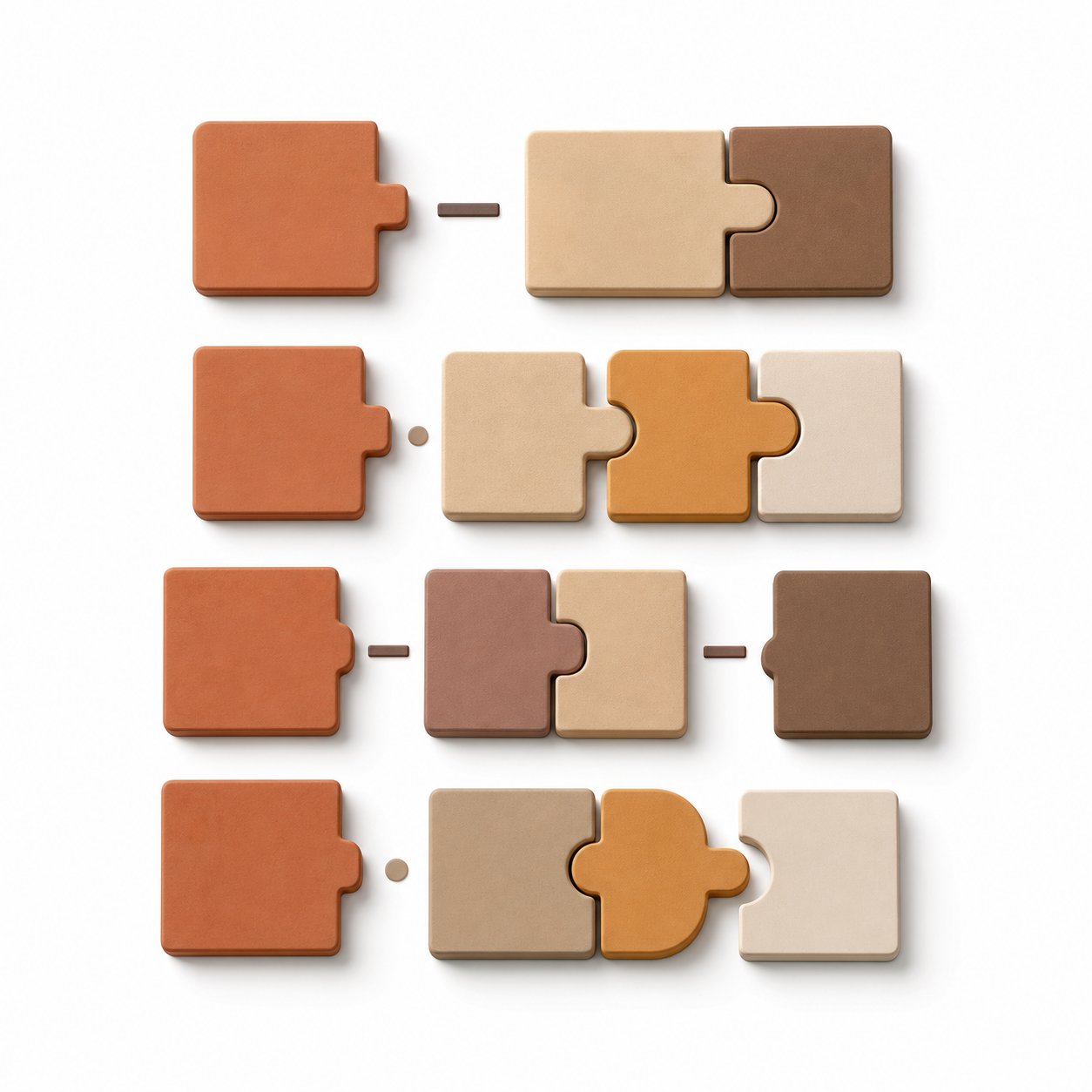
Style guides provide the general framework, but they rarely address the edge cases that cause the most confusion. Two formatting challenges trip up authors and editors more than any others: compound surnames that look like given names, and multi-syllable given names that can be joined, spaced, or hyphenated. Getting these wrong doesn't just violate a style rule. It misidentifies who the author actually is.
Formatting Compound and Double-Character Surnames
Most Chinese surnames are a single character, a single syllable in pinyin. Compound surnames break that expectation. When you encounter "Ouyang Nana" in a reference list, is "Ouyang" the full surname, or is "Ou" the surname and "Yang Nana" the given name? For readers unfamiliar with Chinese naming conventions, there's no obvious way to tell.
China currently has fewer than 100 compound surnames still in active use. The most common ones you'll encounter in academic publications include:
- Ouyang (欧阳) - the most widely used, with over 1.1 million bearers
- Shangguan (上官) - approximately 88,000 bearers
- Huangfu (皇甫)
- Linghu (令狐)
- Zhuge (诸葛)
- Situ (司徒)
- Sima (司马)
- Nangong (南宫)
- Dongfang (东方)
The challenge for editors is distinguishing these from two-syllable given names. Consider the name "Sima Qian." Is "Sima" a compound surname with "Qian" as the given name, or is "Si" the surname with "Ma Qian" as a two-syllable given name? The answer here is that Sima is indeed a compound surname, but you'd only know that from familiarity with the Chinese compound surname list for publications or by verifying against authority records.
How should you format two character Chinese surnames in citations? The key rule is simple: treat the compound surname as a single unit. In APA, it appears as "Ouyang, N." In Chicago, "Ouyang, Nana." The Library of Congress NACO authority files record compound surnames as a unified element before the comma, following the pattern "Ouyang, Ming" rather than splitting them into separate fields. This cataloging practice ensures that library systems and databases treat the full compound surname as the family name identifier.
Spacing Hyphenation and Joining Rules for Given Names
The second major stumbling block involves how to handle the two syllables of a given name. You'll see the same name written three different ways across publications: joined (Mingkai), spaced (Ming Kai), or hyphenated (Ming-Kai). Each form carries different implications for database indexing and author identification.
The pinyin given name spacing rules for citations depend on context. Naming convention research notes that while all three forms exist, writing both syllables as a single joined unit most clearly signals that the element is one given name rather than a middle name plus a separate name. Here's how each format functions in practice:
| Format | Example | When to Use | Risk Level |
|---|---|---|---|
| Joined (no space or hyphen) | Wang Mingkai | Mainland China standard (GB/T 28039-2011); ISO 7098; most international journals | Lowest - clearly identifies one given name |
| Hyphenated | Wang Ming-Kai | Taiwan convention; some journals following author preference; common in older publications | Moderate - preserves syllable boundary but may be initialized as two separate elements (M.-K.) |
| Spaced | Wang Ming Kai | Hong Kong convention; some informal contexts | Highest - databases may misread "Kai" as surname or "Ming" as middle name |
The hyphen vs space in pinyin given names question matters most for database indexing. A spaced form like "Wang Ming Kai" invites misinterpretation by automated systems that parse names by whitespace. Citation software may assign "Kai" as the surname, creating a phantom author record. The hyphenated form "Wang Ming-Kai" reduces this risk because the hyphen signals connection, but some style guides (particularly AMA/Vancouver) strip hyphens during abbreviation, collapsing "Ming-Kai" into "MK" without any trace of the original structure.
The Library of Congress approach offers a practical model. In NACO authority records, Chinese given names are recorded as a single joined unit following the surname and a comma: "Wang, Mingkai." Variant forms are captured as cross-references, so a search for "Wang, Ming-Kai" or "Wang, Ming Kai" still resolves to the correct authority record. This layered approach acknowledges that multiple legitimate forms exist while establishing one canonical version for retrieval.
For authors making a choice about their own name, the safest strategy is clear: use the joined form for maximum consistency and minimum ambiguity. If you've already published under a hyphenated or spaced variant, maintain that form going forward rather than switching mid-career. The consistency matters more than which specific format you choose.
These formatting decisions don't exist in isolation. They feed directly into how databases index, retrieve, and cluster your publications, which determines whether your complete body of work is visible to the researchers and committees evaluating it.

How Databases Index Pinyin Names and Why It Affects Your Citations
Every formatting decision you make, whether joining your given name, hyphenating it, or spacing it out, eventually lands in a database algorithm that decides whether your publications belong to one person or several. The gap between how you think of your name and how a machine parses it determines whether your citation record stays intact or fractures into disconnected fragments. Understanding how Scopus indexes Chinese author names, how PubMed processes metadata, and how Google Scholar clusters publications gives you the leverage to protect your academic identity.
How Databases Index and Retrieve Pinyin Names
Each major academic database handles author names through its own parsing logic, and none of them were originally designed with Chinese naming conventions in mind.
PubMed indexes author names in a "Surname Initials" format without periods: "Wang MK" for Wang Mingkai. The system treats whitespace as a delimiter between name components, which means a spaced given name like "Ming Kai" gets split into what the algorithm interprets as a middle name and a possible additional surname element. Chinese author name discoverability in PubMed depends heavily on whether the submitting journal correctly identified the surname before sending metadata to the National Library of Medicine. Once an incorrect parse enters the system, it propagates through every downstream service that pulls from PubMed's records.
Scopus uses its Author Identifier system to group publications by the same person. The algorithm considers name variants, institutional affiliation, co-author networks, subject area, and citation patterns to cluster records. When a Chinese author publishes as "Chen Zhiming" in one journal and "Chen Z.M." in another, Scopus can usually link these. But when the same author appears as "Chan Chi Ming" (Hong Kong romanization) in earlier publications and "Chen Zhiming" (Hanyu Pinyin) in later ones, the system often creates two separate profiles. Research documented in Biochemia Medica confirms that the Scopus Author Identifier "incorporates different name formats of the same author within a single digital identifier, which partly resolves the issue of author name disambiguation," but only when the variants are close enough for the algorithm to detect a connection.
Web of Science faces similar challenges. Its Distinct Author Identification System attempts to disambiguate authors, but the sheer volume of Chinese researchers sharing common surnames like Wang, Li, Zhang, and Liu overwhelms pattern-matching approaches. A 2008 Nature report highlighted this identity crisis, noting that similarly abbreviated but different first names among Chinese authors created widespread confusion in bibliographic records.
Google Scholar takes the most permissive approach, relying on author-claimed profiles and broad text matching. This flexibility means it catches more variants but also introduces more false merges, where publications by two different people with similar names get attributed to one profile.
ORCID and Digital Identifiers for Citation Continuity
The most robust solution to name fragmentation isn't better formatting alone. It's a persistent digital identifier that follows you regardless of how your name appears in any given publication. This is precisely what ORCID was designed to solve.
ORCID registration for Chinese pinyin names works like an anchor. You register once, receive a unique 16-digit identifier, and then link that identifier to every publication, grant application, and peer review activity throughout your career. The system doesn't care whether your name appears as "Wang Mingkai," "M.K. Wang," or "Wang, Ming-Kai" across different journals. All records point back to the same ORCID iD.
The scale of this problem for Chinese researchers is significant. As Xiaolin Zhang, Director of the National Science Library of the Chinese Academy of Sciences, noted when launching the iAuthor platform in partnership with ORCID: "There are over 90 million people with my surname, Zhang." The iAuthor system was developed specifically as a Chinese-language gateway for researchers to register ORCID identifiers and interoperate with Chinese journals and citation databases like the Chinese Science Citation Database (CSCD).
Beyond ORCID, other identifier systems contribute to disambiguation. The Scopus Author Identifier and Web of Science's ResearcherID (now integrated into Clarivate's profile system) each maintain their own clustering logic. The key insight is that none of these systems replace the others. They complement each other, and Chinese-named authors benefit most from maintaining active profiles across all of them.
An ORCID iD doesn't fix inconsistent name formatting retroactively, but it creates a single point of truth that databases can reference when their algorithms fail to connect variant name forms on their own.
Managing Multiple Name Variants Across a Career
What if you've already published under multiple romanization variants? Maybe your early papers used Wade-Giles because your Taiwanese university defaulted to that system, and your recent work uses Hanyu Pinyin after moving to a mainland institution. Or perhaps a journal editor split your given name without asking, creating a variant you never intended. Consolidating name variants in academic databases requires a systematic approach.
Here's a step-by-step process for auditing and unifying your author records:
- Search for all possible variants of your name across PubMed, Scopus, Web of Science, and Google Scholar. Include joined, hyphenated, and spaced given-name forms, as well as any regional romanization variants (Wade-Giles, Cantonese) you may have used.
- Register for an ORCID iD if you haven't already, and add every known name variant to your profile's "Also known as" field. This helps databases cross-reference your identity.
- Claim your Scopus Author Profile. If the system has created multiple profiles for you, submit a merge request through Scopus's author feedback wizard, providing evidence that the separate profiles belong to one person.
- Set up or update your Google Scholar profile. Manually add any publications that weren't automatically detected due to name inconsistencies.
- Contact journals directly for publications where your name was incorrectly formatted. Many publishers now participate in the CrossMark initiative, which allows post-publication corrections to author metadata.
- Include your ORCID iD in every future manuscript submission, grant application, and conference registration. Most major publishers now integrate ORCID into their submission systems, automatically linking new publications to your identifier.
- Establish a single canonical name form going forward and communicate it explicitly in your author byline, correspondence with editors, and institutional profiles. Consistency from this point forward prevents new fragments from forming.
The effort required for this audit increases with career length. An early-career researcher with five publications can resolve inconsistencies in an afternoon. A senior scholar with decades of work across multiple regional systems may need weeks. But the payoff is direct: a unified citation record that accurately reflects your full body of work, visible to tenure committees, funding agencies, and collaborators searching for your expertise.
Metadata consistency isn't just an author's responsibility, though. Editors, reviewers, and co-authors all play a role in how names enter the system. The question of how to verify and correctly format an unfamiliar Chinese name during manuscript processing is one that every editorial team encounters, and getting it right requires specific strategies that go beyond simply following a style guide.
How Editors Should Format Chinese Author Names Correctly
Verifying Chinese name order in manuscripts isn't something most editorial training covers. You're reviewing a submission, the reference list includes "Ming Li" and "Li Ming" as separate entries, and you're not sure whether they're the same person or two different researchers. Or an author's byline reads "David Wang," and you need to determine whether the reference list entry should be "Wang, David" or "Wang, D." or something else entirely. These situations arise constantly in cross-disciplinary publishing, and handling them well protects both the author's identity and your journal's citation accuracy.
A Practical Guide for Editors and Reviewers
The first challenge is identification. When you encounter an unfamiliar Chinese name, how do you determine which element is the surname? A few reliable signals help. Single-syllable elements like Wang, Li, Zhang, Chen, Liu, and Zhao are almost always surnames. If a name has three syllables total with one syllable followed by two joined syllables (e.g., "Chen Minghua"), the single syllable is nearly always the family name. Two-syllable elements at the start of a name could be either a compound surname or the first syllable of a given name placed before the surname in Western order.
When you're unsure, don't guess. Use these verification steps before finalizing any name formatting:
- Check the author's institutional affiliation page. University faculty profiles typically display names in a consistent format, often with the surname clearly identified.
- Search for the author's ORCID profile, which lists preferred name forms and "also known as" variants.
- Look at the author's prior publications in the same field. Consistent formatting across multiple journals suggests an established preference.
- Check whether the manuscript's cover letter or submission metadata specifies a preferred citation form. Many submission systems now include a "family name" field separate from "given name."
- Cross-reference against the journal's own database or Scopus Author Profiles to see how the name has been indexed previously.
- When all else fails, contact the author directly. A brief email asking "Could you confirm which part of your name is your family name for our reference list?" takes seconds and prevents permanent errors in the published record.
The anglicized Chinese name vs pinyin in publications question adds another layer. Many Chinese researchers working in Western institutions adopt an English given name for daily use. "David Wang" might be Wang Dawei in pinyin, but the author publishes exclusively as David Wang. In these cases, respect the author's established publication identity. If they've built a citation record under "David Wang," reformatting their name as "Wang, Dawei" in your reference list creates a disconnect between your citation and their indexed publications.
The MCLC style guide offers a practical model: "Chinese names in the reference list should follow the default order, putting the family name first. Since the order is not inverted, no comma should be inserted. If the source lists the author's given name first, then invert name order and insert a comma as usual." This approach respects both Chinese convention and Western-adapted forms without forcing a single template onto every author.
Hybrid names present a specific editorial challenge. Researchers like "Shaoxiong Brian Xu" or "Andy Xuesong Gao" combine Chinese and Western given names into a single authorial identity. As research on author name ambiguity documents, these hybrid forms actually help with disambiguation because the additional name element reduces the chance of being confused with namesakes. When you encounter a hybrid name, preserve it in full rather than abbreviating or dropping elements.
How Authors Should Communicate Their Preferred Format
Editors can only respect your preferences if you make those preferences visible. The author preferred name format for journal submission should be communicated proactively, not left to chance. Here's how to take control of your name's presentation across publications:
Start at the submission stage. Most manuscript handling systems now separate "family name" from "given name" in distinct fields. Fill these in carefully. If your system doesn't offer separate fields, include a brief note in your cover letter: "For citation purposes, my family name is Wang and my given name is Mingkai." This single sentence eliminates all ambiguity for the editorial team.
Choose one canonical form and use it everywhere. Whether you prefer "Mingkai Wang," "Wang Mingkai," or "Ming-Kai Wang," the critical factor is consistency across your entire publication record. If you've already published under a specific variant, stick with it. Switching formats mid-career splits your citation history in ways that are difficult to repair.
If you use an anglicized given name, decide whether it replaces or supplements your pinyin name. "David Wang" and "Dawei Wang" will be indexed as different people unless you link them through ORCID or explicit metadata. Some researchers solve this by using both: "Dawei (David) Wang" on their first publication, then consistently using whichever form they prefer going forward.
Include your ORCID iD on every submission. This is the single most effective action you can take. Regardless of how a journal's production team formats your name, the ORCID link ensures that the publication connects to your unified record. The Academy of Management style guide and most major publishers now integrate ORCID into their submission workflows, making this step straightforward.
Finally, review your proofs carefully. The copy-editing stage is where names most often get reformatted without author input. If a production editor has changed your name to match their style guide in a way that conflicts with your established publication identity, flag it immediately. Most journals will accommodate author preferences on name formatting when asked, especially if you can point to a consistent record in major databases.
Both sides of this equation, editors verifying names and authors communicating preferences, feed into a larger goal: building a publication record that remains coherent across decades, disciplines, and databases. The final piece is knowing how to make quick formatting decisions when time is short and the stakes are high.

Your Pinyin Name Formatting Decision Framework
Quick decisions under deadline pressure are where most formatting errors happen. You're submitting a manuscript tonight, citing an unfamiliar Chinese-named author, or setting up your profile on a new journal's submission system. You don't have time to re-read five style guides and cross-reference regional conventions. What you need is a pinyin name format quick reference guide that points you to the right answer based on your specific situation.
Quick-Reference Decision Framework
The correct format depends on three variables: your role (author or citing researcher), the style guide governing your publication, and the regional conventions that apply to the name in question. This decision matrix covers the most common scenarios:
| Situation | Recommended Format | Rationale |
|---|---|---|
| You are a mainland Chinese author submitting a new manuscript | Surname + joined given name (Wang Mingkai) | Follows GB/T 28039-2011 and ISO 7098; minimizes database parsing errors |
| You are a Taiwanese author with an established Wade-Giles record | Keep your existing form (e.g., Wang Ming-Kai) | Switching mid-career fragments citations; consistency outweighs standardization |
| You are a Hong Kong author using Cantonese romanization | Maintain your established Cantonese form (e.g., Wong Ming Hoi) | Cantonese pronunciation reflects your identity; link variants via ORCID |
| You are citing a Chinese author in APA or Harvard format | Surname, Initials (Wang, M.K.) | Style guide requires initials; preserve hyphen if present in source (Z.-M.) |
| You are citing a Chinese author in Chicago or MLA format | Surname, Full Given Name (Wang, Mingkai) | These guides spell out given names; copy the form used in the source publication |
| You are citing a Chinese author in IEEE format | Initials + Surname (M. K. Wang) | IEEE places initials first; verify surname position against the original source |
| You are citing a Chinese author in AMA/Vancouver format | Surname + Initials, no periods (Wang MK) | Most compressed form; hyphens are removed entirely |
| You are an editor unsure which element is the surname | Verify before formatting (check ORCID, affiliation page, or ask the author) | Guessing risks permanent misattribution in the published record |
| You are setting up your first academic profile | Choose one canonical form, register ORCID, and use it everywhere | Early consistency prevents the fragmentation that senior researchers spend weeks repairing |
Which pinyin name format should I use? If you're asking this question for the first time, the joined given-name form (Wang Mingkai) paired with an ORCID iD gives you the strongest foundation. It aligns with international standards, reduces parsing ambiguity, and works cleanly across the widest range of style guides. But if you've already built a record under a different variant, don't switch. The format you've used consistently is the right one for you.
Building Long-Term Name Consistency in Publishing
A pinyin name decision framework for researchers ultimately comes down to one principle that overrides every style guide, regional convention, and database algorithm:
Consistency across your entire publication career matters more than any single formatting choice. A researcher who always uses the same name form, even an imperfect one, will have a more coherent citation record than someone who switches between the "correct" format for each context.
Consistent Chinese name formatting across publications means applying the same logic at every touchpoint: journal submissions, conference registrations, grant applications, institutional profiles, preprint servers, and data repositories. Every system that records your name is a potential point of fragmentation, and every point of fragmentation is a citation you might lose.
The practical steps are straightforward. Pick your canonical form. Register your ORCID iD. Add all known variants to your "also known as" fields. Include your identifier on every submission. Review your proofs for unauthorized name changes. These actions take minutes but compound over a career spanning decades.
For editors and citing researchers, the framework is equally simple: respect the form the author uses, verify when uncertain, and never assume you know which element is the surname. A UCL study on name romanization found that standardized systems achieved over 95% recall in data linkage, while non-standardized approaches managed only 68.8%. The difference between those numbers represents real researchers whose work becomes invisible when their names are handled carelessly.
Your name is your scholarly identity. Format it once, format it well, and then defend that format at every stage of the publication process. The citations will follow.
Frequently Asked Questions About Pinyin Name Format for Publications
1. Should I join or hyphenate my Chinese given name in academic publications?
The joined form (e.g., Wang Mingkai) is recommended for most international publications because it follows the ISO 7098 standard and China's GB/T 28039-2011 national standard. Joining the two syllables clearly signals that the element is a single given name, reducing the risk of databases misinterpreting the second syllable as a separate surname. However, if you are a Taiwanese author with an established hyphenated form (e.g., Wang Ming-Kai), maintain that format for citation continuity rather than switching mid-career.
2. How do I prevent my citation record from being split across multiple databases?
Register for an ORCID iD and link it to every publication, grant application, and institutional profile. Add all known name variants to your ORCID 'Also known as' field. Then claim your Scopus Author Profile and Google Scholar profile, merging any duplicate records. Include your ORCID iD on every future manuscript submission so databases can connect your work regardless of how individual journals format your name.
3. How do I cite a Chinese author's name in APA format?
In APA 7th edition, place the surname first followed by a comma, then initialize the given name with periods. Wang Mingkai becomes 'Wang, M. K.' If the author uses a hyphenated given name like Zhi-Ming, initialize both parts as 'Z.-M.' APA treats Chinese names the same as Western names structurally, reducing all given names to initials in the reference list.
4. How can editors verify which part of a Chinese name is the surname?
Check the author's institutional affiliation page, search for their ORCID profile, review prior publications for consistent formatting, or look at the manuscript submission metadata where family name and given name fields are often separated. Single-syllable elements like Wang, Li, Zhang, and Chen are almost always surnames. If uncertainty remains, contact the author directly to confirm rather than guessing and risking permanent misattribution.
5. Why do the same Chinese author's names appear differently across publications from different regions?
Mainland China uses Hanyu Pinyin with joined given names (Chen Zhiming), Taiwan often uses hyphenated forms or Wade-Giles legacy spellings (Chen Zhi-Ming or Chen Chih-Ming), and Hong Kong uses Cantonese romanization (Chan Chi Ming). These are all legitimate systems reflecting regional linguistic conventions. The same Chinese characters produce entirely different romanized spellings depending on the system used, which is why authors from these regions may have fragmented citation records across databases.