Why Reading Chinese Names in Pinyin Feels So Difficult
Imagine you receive an email from a new colleague named Xu Qiuyi. You stare at it. Is the X silent? Does Xu rhyme with "zoo"? Is Qiu pronounced like "queue"? You default to something vaguely English-sounding and hope for the best. Sound familiar?
You are not alone. Millions of professionals encounter Chinese names in pinyin every day in emails, research papers, news articles, and meeting invites. And most have no idea how to pronounce them, because the spelling looks nothing like it sounds to an English-trained eye.
Why Pinyin Names Confuse English Speakers
The root of the problem is simple. The hanyu pinyin system (han yu pin yin, literally "spell-sound for Chinese") was adopted in 1958 as the official romanization standard of the People's Republic of China. It uses the same 26 Latin letters you already know, but maps them to Mandarin sounds in ways that frequently clash with English phonetics. The letter "x" represents a hissing "sh"-like sound. The letter "q" sounds closer to "ch." The combination "zh" is not a "z" at all.
Pinyin was designed to represent Mandarin sounds for Chinese speakers — not as a pronunciation guide for English speakers, which is why so many name spellings look counterintuitive.
When you wonder how do you spell Chinese names in the Latin alphabet, pinyin is the answer. But reading those spellings correctly requires a different mental framework than English gives you.
What This Guide Covers
This guide takes a name-first approach. Rather than walking you through a full Mandarin phonetics course, it teaches only the pinyin name reading rules you need to correctly parse and pronounce the Chinese names you encounter in daily life. You will learn how to break a name into its surname and given name components, avoid the most common pronunciation traps, understand tone marks when they appear, and recognize when a name uses a different romanization system entirely. Each section builds on the last, moving from structure to sound to real-world application.
The goal is practical confidence, not perfection. And it starts with understanding what you are actually looking at when a pinyin name lands in your inbox.
Anatomy of a Chinese Name in Pinyin
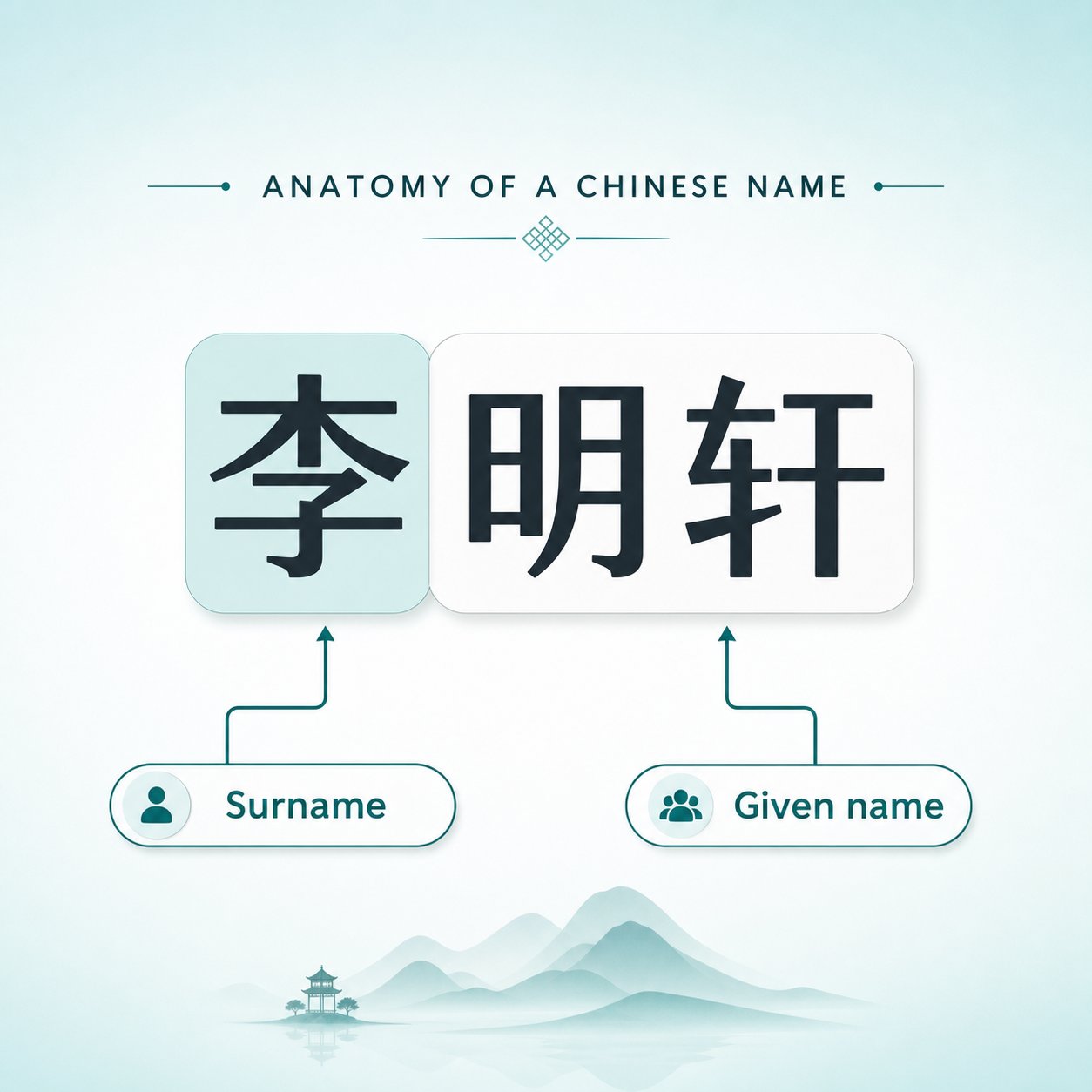
Every pinyin name you encounter has an internal logic. The trick is knowing where to split it. Unlike English names, where "first name" means given name and "last name" means family name, the chinese name structure pinyin follows the opposite order: family name comes first, given name follows. Once you internalize this single rule, parsing any name becomes far more predictable.
Surname and Given Name Order
In Chinese convention, the surname (family name) always leads. When you see "Wang Xiaoming," Wang is the surname and Xiaoming is the given name. This mirrors how Chinese culture prioritizes family identity: the collective before the individual.
The confusion arises because many Chinese people reverse the order when writing their names in Western contexts. The same person might appear as "Xiaoming Wang" on a LinkedIn profile or "Wang, Xiaoming" in an academic citation. You will encounter both formats constantly, so the real skill is identifying which part is the surname regardless of position.
Here is a reliable shortcut: the vast majority of Chinese surnames are a single syllable. If you see a three-syllable name, the lone syllable is almost certainly the surname. The top 100 Chinese family names are all single-syllable and cover roughly 85 percent of China's population. Names like Li, Wang, Zhang, Chen, and Liu each represent tens of millions of people.
Given names, on the other hand, are typically one or two mandarin syllables. Two-character given names are the most common in modern China, which is why a standard full name often has three syllables total: one for the surname, two for the given name.
- Wang Xiaoming — surname Wang + two-character given name Xiaoming (Xiao + Ming)
- Li Na — surname Li + single-character given name Na
- Zhang Wei — surname Zhang + single-character given name Wei
- Chen Jianguo — surname Chen + two-character given name Jianguo (Jian + Guo)
Notice how the two-character given name is written as one continuous word (Xiaoming, not Xiao Ming). This is the official standard, though you will sometimes see hyphens or spaces in informal usage.
Compound Surnames and Special Structures
Not every surname is a single syllable. China has roughly 81 compound surnames (fuXing) that use two characters. These are far less common but important to recognize so you do not accidentally split them wrong.
The most well-known compound surnames include Ouyang, Shangguan, Sima, Zhuge, and Huangfu. Among these, Ouyang is by far the most prevalent, with over one million bearers, while others like Sima and Zhuge number only in the tens of thousands.
- Ouyang Xiu — compound surname Ouyang + single-character given name Xiu
- Sima Qian — compound surname Sima + single-character given name Qian
- Zhuge Liang — compound surname Zhuge + single-character given name Liang
- Shangguan Wan'er — compound surname Shangguan + two-character given name Wan'er
When you encounter a four-syllable Chinese name, consider whether the first two chinese syllables form a compound surname. If the first two syllables match a known compound surname (Ouyang, Sima, Zhuge, Huangfu, Xiahuo, Shangguan), treat them as a unit. Otherwise, the name likely follows the standard one-syllable surname plus two-syllable given name pattern.
Parsing Names of Different Lengths
Here is a quick mental framework for breaking down names by total syllable count:
| Total Syllables | Most Likely Structure | Example |
|---|---|---|
| 2 | 1 surname + 1 given name | Li Na (surname Li, given name Na) |
| 3 | 1 surname + 2 given name | Wang Xiaoming (surname Wang, given name Xiaoming) |
| 3 | 2 compound surname + 1 given name | Sima Qian (surname Sima, given name Qian) |
| 4 | 2 compound surname + 2 given name | Ouyang Nana (surname Ouyang, given name Nana) |
The three-syllable case is the only ambiguous one. Context usually resolves it: if the first two syllables match a recognized compound surname, split there. If not, the first syllable is the surname.
One more detail worth noting: minority ethnic names within China sometimes appear transliterated into pinyin but follow entirely different structural conventions. Mongolian names, for instance, traditionally use a patronymic (father's given name) rather than a family surname. A name like "Tsakhia Elbegdorj" places the patronymic first and the personal name second, but neither element functions like a Chinese surname. In official Chinese documents, the first syllable of a Mongolian name is sometimes reanalyzed as a surname to fit the standard format, which can create confusion.
Uyghur and Tibetan names follow their own patterns as well. Uyghur names typically place the given name before the father's name, while Tibetan names often consist of two or four syllables with no surname component at all. When these names are rendered in pinyin on Chinese documents, they may look like standard Chinese names but cannot be parsed using the same rules.
The takeaway: if a name looks unusually long, uses unfamiliar syllable combinations, or does not seem to fit the patterns above, it may belong to one of China's 55 officially recognized minority groups. In those cases, the standard surname-first parsing may not apply.
With the structural anatomy clear, the next question becomes formatting. The same name can look surprisingly different depending on whether it appears on a passport, in a journal article, or on a business card, and each format has its own capitalization and spacing conventions that affect how you identify the surname.
Capitalization and Spacing Rules for Pinyin Names
You know the structure of a Chinese name. But the same name can look wildly different depending on where you encounter it. A passport, an academic journal, and a WeChat profile each follow their own formatting logic. Understanding the official rules helps you reverse-engineer any format and correctly identify the surname, no matter how the name is presented.
Official Capitalization Standards for Pinyin Names
Should Chinese names be capitalized in pinyin? Yes, and the rules are straightforward. China's national standard GB/T 16159 lays out clear guidelines for writing personal names:
- The surname is capitalized (first letter uppercase): Wang, Li, Zhuge
- The given name is capitalized (first letter uppercase): Jianguo, Xiaoming, Xiu
- A two-character given name is written as one continuous word with no internal capital: Xiaoming, not Xiao Ming or XiaoMing
So the correct standard form is: Wang Jianguo, Zhuge Kongming, Lu Xun. Each name has exactly two capitalized elements: one for the surname, one for the given name. This is true whether the given name has one syllable or two.
Is Mandarin capitalized differently from other languages in this regard? Not really. The principle mirrors English: proper nouns get initial capitals. The difference is that pinyin treats the multi-syllable given name as a single word, so only the first syllable gets the uppercase letter.
Titles and forms of address follow the name and remain entirely lowercase: Wang buzhang (Minister Wang), Li xiansheng (Mr. Li). However, informal address terms like Lao (Old), Xiao (Young), and Da (Big) are capitalized when they precede a surname: Xiao Liu, Lao Qian.
Spacing and Hyphenation Rules with Examples
Spacing is simple: one space separates the surname from the given name. That single space is the only visual boundary in a correctly written pinyin name.
What about hyphens? In the official standard, personal names do not use hyphens. The two syllables of a given name are joined directly: Jianguo, not Jian-guo. You will still encounter hyphenated forms in older publications, informal writing, and names from Taiwan (where hyphenation is a common convention), but mainland China's standard avoids them.
The apostrophe, however, does appear in names when needed to prevent ambiguity between syllable boundaries. A name like Xi'an uses the apostrophe to show that the syllables are Xi + an, not Xian. In personal names, this is rare but possible: Shangguan Wan'er separates Wan and er clearly.
How Names Appear Across Different Contexts
Here is where things get practical. The same person's name can appear in at least four different formats depending on the document or platform. Knowing the conventions for each helps you identify the surname every time.
| Context | Format | Example | How to Identify the Surname |
|---|---|---|---|
| Chinese passport (MRZ) | ALL CAPS, surname first | WANG XIAOMING | First word is the surname |
| Official Chinese document | Standard pinyin | Wang Xiaoming | First capitalized word is the surname |
| Academic paper (Western order) | Given name first, surname last | Xiaoming Wang | Last word is the surname |
| Academic citation | Surname, comma, given name | Wang, Xiaoming | Word before the comma is the surname |
| Social media / informal | Varies widely | xiaoming.wang, XM Wang, Ming | Context-dependent; ask if unsure |
Passports follow international machine-readable standards that strip out tone marks, hyphens, and mixed case. Everything appears in uppercase Roman letters with spaces between name components. The surname always comes first in the machine-readable zone, which is why WANG XIAOMING places the family name at the front.
Academic papers in English-language journals typically reverse the order to match Western conventions. If you see a single-syllable word at the end of a name (Wang, Li, Chen, Zhang), that is almost certainly the surname moved to final position. The comma-last-name format used in bibliographies makes this explicit.
Social media is the wild west. People abbreviate, use nicknames, adopt English first names ("Susan Zhang"), or drop capitalization entirely. When you cannot tell which part is the surname from formatting alone, the single-syllable rule from the previous section still applies: the shorter element is most likely the family name.
These formatting conventions are purely visual. They do not change how the name is pronounced. But they do determine whether you can correctly parse the name before you attempt to say it aloud, which brings us to the next challenge: actually producing the right sounds for the most common Chinese surnames.

Common Chinese Surnames and How to Pronounce Them
Parsing a name correctly is only half the battle. You also need to say it out loud without mangling it. The good news? A relatively small set of surnames covers the vast majority of Chinese people you will ever meet. Learn the common chinese surnames pronunciation for the top 20, and you will handle most real-world encounters with confidence.
The table below pairs each surname's hanyu pinyin chinese characters with an approximate English sound. Think of these approximations as a starting point, not a perfect equivalent. Mandarin has sounds that simply do not exist in English, so every approximation involves some compromise. Still, getting close is far better than guessing from the raw spelling, which is where most mispronunciations begin.
Top Chinese Surnames with Pronunciation Guide
These 20 surnames represent hundreds of millions of people. You will encounter them in workplaces, classrooms, research papers, and news headlines. The "Approximate English Sound" column gives you a practical spoken target, while the "Common Mispronunciation" column flags the mistake most English speakers make when spelling Chinese names aloud for the first time.
| Pinyin (with tone) | Character | Approximate English Sound | Common Mispronunciation to Avoid |
|---|---|---|---|
| Wang (2nd tone) | 王 | "wahng" — rhymes with "song" but starts with W | Not "wang" as in English slang; the A is open like "father" |
| Li (3rd tone) | 李 | "lee" | Straightforward; just avoid adding a hard R sound |
| Zhang (1st tone) | 张 | "jahng" — like "John" + ng ending | Not "zang"; the Zh sounds like the J in "jerk" |
| Liu (2nd tone) | 刘 | "lyoh" — L + "yo" blended together | Not "loo" or "lee-oo"; it is a single smooth syllable |
| Chen (2nd tone) | 陈 | "chun" — like "churn" without the R | Not "chen" with a clear E as in "hen"; the vowel is closer to a schwa |
| Yang (2nd tone) | 杨 | "yahng" — like "young" but with a wider A | Not "yang" rhyming with "bang"; the A is open |
| Huang (2nd tone) | 黄 | "hwahng" — H + "wong" blended | Not "hoo-ang" as two syllables; it is one syllable |
| Zhao (4th tone) | 赵 | "jow" — like "Joe" but with a slight "ow" diphthong | Not "zay-oh"; Zh = J sound, ao = "ow" as in "cow" |
| Wu (2nd tone) | 吴 | "woo" — like "wood" without the D | Fairly intuitive; avoid pronouncing it as "wuh" |
| Zhou (1st tone) | 周 | "joe" — very close to the English name Joe | Not "zoo"; Zh = J sound, ou = "oh" |
| Xu (2nd tone) | 徐 | "shoo" — lips rounded, tongue forward | Not "zoo" or "ex-oo"; the X is a hissing "sh" with rounded lips (uses the u vowel) |
| Sun (1st tone) | 孙 | "swen" — like "swoon" compressed shorter | Not "sun" as in sunshine; the U here is closer to "oo" + a nasal ending |
| Ma (3rd tone) | 马 | "mah" — like "mama" cut short | Intuitive; just keep the A open and short |
| Zhu (1st tone) | 朱 | "joo" — like "juice" without the S | Not "zoo"; Zh = J sound, so it starts like "Jew" |
| Hu (2nd tone) | 胡 | "hoo" — like "who" | Straightforward; avoid adding a hard "huh" sound |
| Guo (1st tone) | 郭 | "gwor" — G + "war" blended quickly | Not "goo-oh"; it is one syllable with a W glide |
| Lin (2nd tone) | 林 | "lin" — like "lean" but shorter | Intuitive for English speakers; keep it crisp |
| He (2nd tone) | 何 | "huh" — like the English interjection "huh" | Not "hee" or "hey"; the E in pinyin here is a schwa sound |
| Gao (1st tone) | 高 | "gow" — like "cow" but with a G | Not "gay-oh"; ao = "ow" diphthong as in "how" |
| Luo (2nd tone) | 罗 | "lwor" — L + a quick "war" sound | Not "loo-oh"; keep it as one syllable with a W glide |
A few patterns emerge from this table. The initial Zh consistently sounds like the English J (as in "jerk"), not like a Z. The vowel combination ao always produces an "ow" sound (as in "cow"), never a long A. And the pinyin letter X maps to a sound between English "sh" and "s" with the tongue positioned low and flat behind the lower teeth, as described in ASU's Chinese pronunciation guide.
How to Use This Reference Table
When you encounter an unfamiliar Chinese surname, try this three-step process:
- Identify the initial consonant. Check whether it is one of the tricky ones (Zh, X, Q, C, R) that do not map to their English equivalents. If so, mentally substitute the correct sound before proceeding.
- Identify the vowel or final. Look at the vowel combination after the initial. Remember that ao = "ow," ou = "oh," iu = "yo," and ui = "way." These are the finals that trip people up most often.
- Blend them into one syllable. Every Chinese surname is a single syllable. Resist the urge to break it into two beats. Huang is one syllable, not "hoo-ahng." Zhao is one syllable, not "zhay-oh."
Keep in mind that these English approximations sacrifice some accuracy for accessibility. The real Mandarin sounds involve tongue positions and airflow patterns that English does not use. But as a starting point for respectful pronunciation, they will get you far closer than guessing from raw pinyin spelling alone.
One practical tip: if you work with a colleague whose surname appears in this table, listen carefully the first time they introduce themselves. Your ear will catch nuances that no written approximation can convey. Use the table to get in the right neighborhood, then refine based on what you actually hear.
Surnames, though, are only one piece of the puzzle. Given names draw from the full range of Mandarin syllables, including many that contain the most counterintuitive pinyin spellings. The initials and finals that make names like Xu, Qi, and Cui so confusing deserve their own focused breakdown.

Pinyin Spelling Traps That Make Names Hard to Read
You have seen the surname table. You know that Zhang sounds like "jahng" and Zhou sounds like "joe." But what happens when you encounter a given name like Xuqian or Ruiqi? Suddenly the familiar letters on your screen produce sounds you cannot guess from English instincts alone. This is where chinese pin yin gets genuinely tricky, because the system reuses Latin letters for sounds that have no English equivalent.
The core issue is worth repeating: pinyin was built for Chinese speakers who already knew the sounds and just needed a way to write them in Roman letters. It was never intended as a pronunciation guide for outsiders. So when you wonder how to spell Chinese in Chinese using the Latin alphabet, the answer is pinyin, but the spelling conventions prioritize internal consistency over intuitive readability for English speakers. That mismatch creates a predictable set of traps, and they show up constantly in personal names.
Initials That Trick English Speakers
Pinyin initials are the consonant sounds that begin a syllable. Most behave roughly like their English counterparts: B, P, M, F, D, T, N, L, G, K, and H are all close enough that you can read them at face value. The problems cluster around a specific group of initials that look familiar but sound completely different.
- X — This is NOT the "ks" sound from English words like "box." In Mandarin, X produces a hissing sound similar to "sh" but made with the tongue flat and low, positioned behind the lower front teeth. You can approximate it by trying to say "sh" while smiling. A name like Xu sounds closer to "shoo" (with rounded lips), and Xie sounds like "shee-eh," not "zee" or "ksee." As Allset Learning's pronunciation guide notes, the X sound does not exist in English at all, so any English approximation is a compromise.
- Q — Forget everything you know about the English Q. In pinyin, Q sounds like "ch" but produced with the tongue in the same low, forward position as X. Think of it as adding a "t" to the front of the X sound. The name Qi sounds approximately like "chee," not "key" or "kwee." Qian sounds like "chee-en," not "kwy-an."
- Zh — This is a retroflex consonant, meaning the tongue curls back toward the roof of the mouth. It sounds very close to the English J in "judge" or "dream." The name Zhang starts with a J sound, not a Z. Zhu sounds like "joo," not "zoo." If you read Zh as a Z, every name containing it will be wrong.
- C — In pinyin, C is never the soft "s" of "city" or the hard "k" of "cat." It produces a "ts" sound, like the end of "pants" or "boots." The name Cui starts with "ts," making it sound roughly like "tsway," not "kwee" or "soo-ee."
- R — Pinyin R does not match the English R. It sounds closer to the "zh" in "vision" or a French J, with the tongue curled upward. The name Ren sounds more like "zhun" than "wren." Rui starts with this buzzing, retroflex sound rather than the English lip-rounded R.
A useful pattern to notice: J, Q, and X form one family of sounds (tongue low and forward), while Zh, Ch, and Sh form another (tongue curled back). English speakers tend to collapse both families into the same sounds, but they are produced in distinctly different mouth positions. For names, the practical difference is subtle enough that getting into the right neighborhood, J-like for Zh and "sh"-like for X, will serve you well.
Finals and Vowel Combinations in Names
If initials are the opening consonants, finals are everything that follows: the vowels and any trailing consonant (which in Mandarin can only be N or NG). Several finals look deceptively simple but produce unexpected sounds.
- -iu — This is actually a compressed form of "-iou." The O is dropped in writing but still partially present in pronunciation. Liu sounds like "lyoh," not "lee-oo." Jiu sounds like "jyo," not "jee-oo." The syllable rhymes with the English word "yo" preceded by the initial.
- -ui — This is a compressed form of "-uei." The E is dropped in writing. Rui sounds approximately like "rway" (with the Mandarin R), not "roo-ee." Hui sounds like "hway," not "hoo-ee." As Yoyo Chinese explains, this omission rule means that "wei" and "hui" actually rhyme, even though their spellings look completely different.
- -ian — This does NOT rhyme with English "Ian." The A here is closer to "eh," making the whole final sound like "yen." Qian sounds like "chee-en," and Tian sounds like "tee-en," not "tee-ann."
- -ong — This is not the English "ong" as in "song." The O here is closer to "oo," making it sound like "oong." Dong sounds like "doong," and Zhong sounds like "joong."
- -e (standalone or after most consonants) — Pinyin E rarely sounds like the English E in "bed." In most positions, it produces a schwa sound, like the A in "again" or the U in "duh." He (the surname) sounds like "huh," not "hee." Ge sounds like "guh," not "gay."
The omission rules in pinyin are a frequent source of confusion. When you see "-iu," mentally restore the hidden O. When you see "-ui," mentally restore the hidden E. These dropped letters still influence the pronunciation even though they vanish from the spelling.
The Most Misread Name Syllables
Certain syllables appear in Chinese given names so frequently that their mispronunciations have become almost universal among English speakers. Here are the ones that cause the most damage in real-world introductions:
- Xu — NOT "zoo" and NOT "ex-oo." The X is a hissing "sh" sound, and the U after J, Q, X, or Y is always the u vowel (a sound like pronouncing the English letter "u" or the French "tu"). Approximate it as "shoo" with very rounded, pushed-forward lips. This syllable appears in extremely common names like Xu Wei and Xu Lei.
- Qi — NOT "key" and NOT "kwee." It starts with the pinyin Q sound (tongue-forward "ch") followed by a clean "ee." Say "chee" with your tongue tip behind your lower teeth. Names like Qi Baishi and given names containing Qi are everywhere.
- Zhu — NOT "zoo." The Zh is a J sound (retroflex), and the U is a standard "oo." Say "joo," like the first syllable of "juice." Confusing Zhu with Xu is one of the most common errors, since both end in U but start with completely different sounds.
- Ci — NOT "see" and NOT "sigh." It starts with "ts" (like the end of "cats") followed by a buzzy vowel that has no English equivalent. Approximate it as "tsuh" with a very short, neutral vowel. The name Cixin (as in the science fiction author) starts with this sound.
- Rui — NOT "roo-ee." The R is the Mandarin retroflex (closer to "zh" in "vision"), and -ui is the compressed "-uei," sounding like "way." The result is approximately "rway" with a soft, buzzing R. This syllable appears in names like Ruiqi and Ruiming.
- Yue — NOT "yoo" and NOT "you." The U after Y is the u vowel (rounded, forward lips), and the E sounds like "eh." Approximate it as saying the English letter "u" followed quickly by "eh." Names like Yuehan and Yuelin contain this syllable.
A pattern runs through all of these traps: English speakers default to the most familiar sound a letter combination could represent. Xu looks like it should rhyme with "zoo" because that is what X-U would produce in English-adjacent logic. Qi looks like "key" because Q-I maps that way in English borrowings. The fix is always the same: pause, recall that pinyin letters represent Mandarin sounds rather than English ones, and apply the correct mapping.
If you remember only one rule from this section, make it this: whenever you see J, Q, X, Zh, Ch, Sh, C, Z, or R at the start of a name syllable, do not trust your English instincts. These nine initials account for nearly every mispronunciation that makes Chinese colleagues wince. Get them right, and the rest of the syllable usually falls into place.
Correct consonants and vowels, though, are only part of accurate pronunciation. Each of these syllables also carries a tone, a pitch pattern that can change meaning entirely. In names, tones interact with each other in ways that even intermediate learners find surprising, especially when two third tones land side by side in a given name.
Tone Marks and Tone Sandhi in Chinese Names
Every syllable in Mandarin carries a tone, a specific pitch pattern that is as essential to the word's identity as its consonants and vowels. Two syllables with identical spelling but different pinyin tones can refer to completely different things. In names, tones do not change meaning the way they do in vocabulary words (a person named Ma is still that person regardless of tone), but pronouncing the tone correctly is what makes a name sound like itself rather than a garbled approximation.
The Four Tones Applied to Name Syllables
Mandarin has four main tones plus a neutral (unstressed) tone. Chinese pinyin tone marks are the small diacritics written above vowels to indicate which pitch pattern a syllable uses. Here is how each tone works, illustrated with common surnames:
- First tone (high and level) — Your pitch stays flat and high, like sustaining a musical note. Surname examples: Gāo (高), Zhāng (张), Zhōu (周). Imagine holding a steady hum at the top of your comfortable range.
- Second tone (rising) — Your pitch rises from middle to high, like the intonation of an English question word "What?" Surname examples: Wáng (王), Liú (刘), Chén (陈), Yáng (杨).
- Third tone (low dipping) — Often taught as a dip-and-rise, but in connected speech it is usually just low and slightly creaky. Surname examples: Lǐ (李), Mǎ (马). This tone drops to the bottom of your range and, in isolation, rises slightly at the end.
- Fourth tone (sharp falling) — Your pitch drops quickly from high to low, like a curt English command: "Stop!" Surname examples: Zhào (赵), Wèi (魏), Dèng (邓).
The neutral tone has no mark and appears unstressed, with its pitch determined by whatever tone precedes it. In names, it is rare. You might encounter it in informal diminutive suffixes (like the "er" in some Beijing-style names), but the vast majority of name syllables carry one of the four full tones.
When you see marks in Chinese pinyin above the vowels, those small symbols are direct visual representations of pitch movement: a flat line for first tone, a rising slash for second, a dipping caret for third, and a falling slash for fourth. They are not accent marks in the European sense. They encode sound information that changes how the syllable should be spoken.
Third-Tone Sandhi in Given Names
Here is where names get interesting. Mandarin has a rule called tone sandhi: when certain tones appear next to each other, one of them shifts in pronunciation. The most important sandhi rule states that when two third tones appear consecutively, the first one is pronounced as a second tone (rising) instead.
This matters for names because two-character given names frequently contain back-to-back third tones. Consider a given name like Yǔměi (雨美). Both syllables are third tone in their dictionary form. But in actual speech, a native speaker will say "Yuměi" — the first syllable rises like a second tone, and only the final syllable retains the full third-tone dip. The written pinyin still shows Yǔměi with two third-tone marks, because standard pinyin notation preserves each character's underlying tone rather than its spoken realization.
Some real-world examples of this pattern in names:
- Hǎiyǔ (海宇) — spoken as "Haiyǔ" (first syllable shifts to rising tone)
- Yǔxǐ (雨曦, if both are 3rd tone) — spoken as "Yuxǐ"
- Xiǎoměi (小美) — spoken as "Xiaoměi" (Xiao rises to second tone)
The classic greeting nǐ hǎo follows the same rule: it is pronounced "ni hǎo" with the first syllable rising. In names, the effect is identical. If you see two third-tone marks in a row within a given name, pronounce the first syllable as if it were second tone. This is not optional or stylistic. It is how native speakers actually say the name.
When three or more third tones appear in sequence (less common in names but possible in full phrases like a title plus a name), the sandhi rule applies across word boundaries. The grouping of syllables determines which ones shift: the rule first applies within each word unit, then across the phrase. For a name like Lǐ Xiǎoměi (李小美), the surname Lǐ keeps its third tone because there is a natural word boundary (the space between surname and given name), while Xiǎo shifts to second tone because it directly precedes another third tone within the given name unit.
When Tone Marks Are Missing and What to Do
In a textbook or dictionary, every pinyin syllable carries its tone mark. In real life? Almost never. Emails, business cards, LinkedIn profiles, news articles, and passport stamps all present pinyin names without any tone marks at all. You see "Wang Xiaoming," not "Wang Xiaoming" with diacritics. This is the reality for most professionals encountering Chinese names.
So what do you do when the tonal information is simply absent? A few practical strategies help:
- Focus on consonants and vowels first. Getting the segmental sounds right (the correct initial and final for each syllable) matters more for intelligibility than nailing the exact tone. A name pronounced with correct consonants but a wrong tone is still recognizable. A name with wrong consonants is not.
- Use a dictionary app for lookup. If you need to pronounce a name in a formal setting (introducing a speaker, reading an award citation), paste the Chinese characters into a dictionary like Pleco or MDBG. The characters will give you the exact tone for each syllable.
- Learn the tones of common surnames. The surname table in the previous section includes tone information. Memorizing that Wáng is second tone, Zhāng is first tone, and Lǐ is third tone covers a huge percentage of names you will encounter.
- Ask the person directly. This is always the best option. A simple "Could you say your name for me so I get it right?" gives you the tones, the rhythm, and the correct sounds all at once.
The absence of tone marks in everyday writing is not a flaw in the system. Standard pinyin notation intentionally omits them in many contexts because native speakers already know the tones from the underlying characters. For non-Chinese speakers reading names, this creates an information gap that only listening or lookup can fill.
Tones add the final layer of accuracy to name pronunciation, but they operate within a system that already challenges English speakers at the level of spelling and sound mapping. An even broader challenge appears when the name you are looking at is not pinyin at all. Older texts, Taiwanese documents, and Hong Kong names use entirely different romanization systems, and applying pinyin reading rules to them produces results that are not just wrong but confidently wrong in a different direction.
Recognizing Non-Standard Romanization in Chinese Names
You have spent the previous sections learning how pinyin maps sounds to letters. But here is a scenario that trips up even careful readers: you encounter a name like "Hsiao" or "Cheung" and try to apply pinyin reading rules. The result sounds nothing like what the person actually goes by. The reason? Not every romanized Chinese name uses pinyin. Several competing systems exist, and each one maps the same Chinese characters to completely different letter combinations. Knowing when you are looking at pinyin versus something else prevents you from confidently mispronouncing a name using the wrong set of rules entirely.
Pinyin vs. Wade-Giles vs. Cantonese Romanization
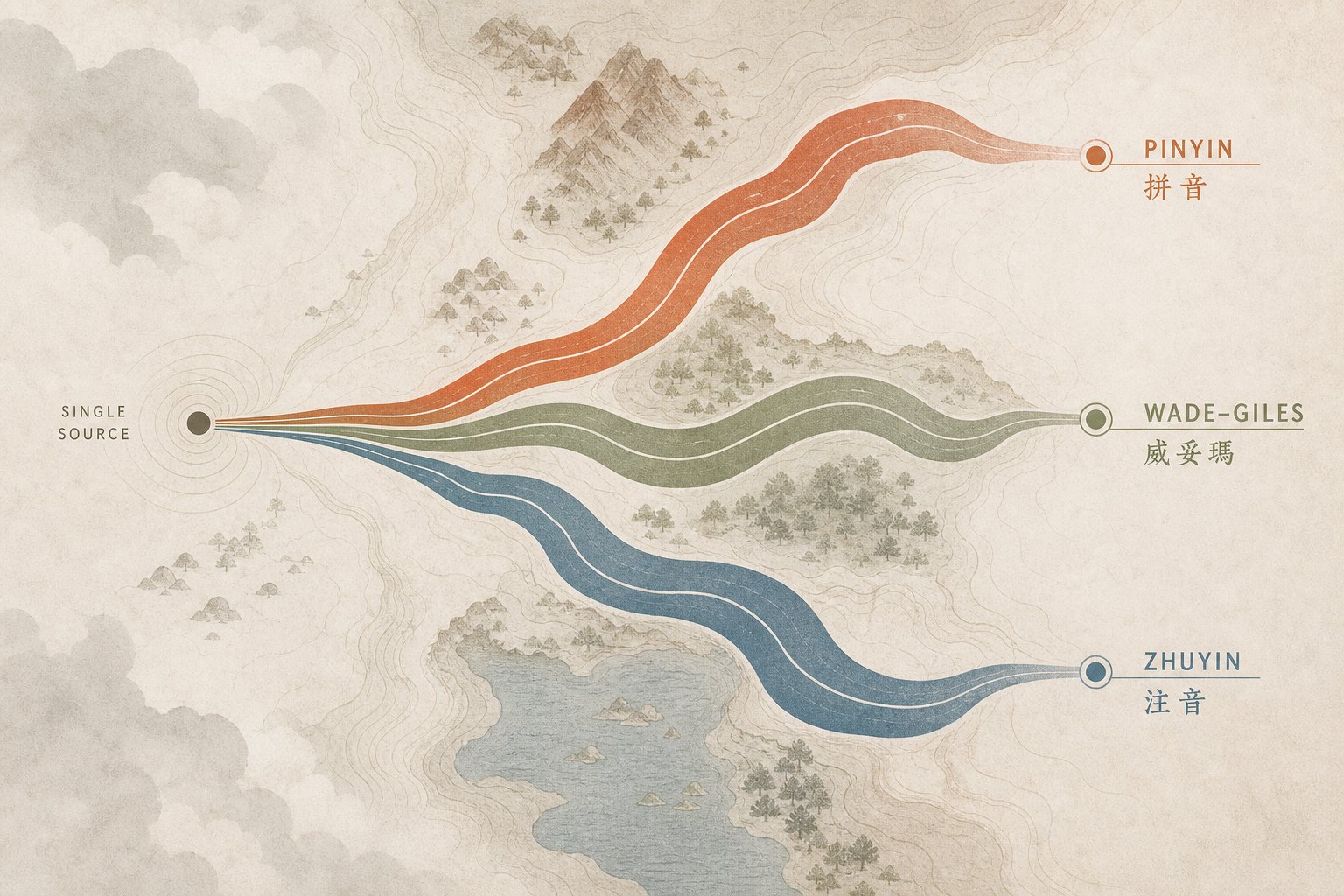
Three romanization systems account for the vast majority of Chinese names you will encounter in English-language contexts:
- Hanyu Pinyin — The official system of mainland China, adopted in 1958 and now the international standard (ISO 7098). When people type hanyu pinyin on a computer to input Chinese characters, this is the system they use. It dominates academic publishing, international media, and any name originating from the People's Republic of China after the 1980s.
- Wade-Giles — A much older system completed in 1892, still widely used in Taiwan for personal names and in older English-language scholarship. Many historical figures, place names, and Taiwanese citizens use Wade-Giles spellings to this day.
- Cantonese romanization — Not a single unified system but a family of conventions used in Hong Kong, Macau, and Cantonese-speaking diaspora communities. These romanizations represent Cantonese pronunciation rather than Mandarin, so the same Chinese character produces a fundamentally different spelling.
The critical point: these systems romanize different dialects or use different letter-to-sound mappings for the same dialect. Applying pinyin reading rules to a Wade-Giles name is like applying Spanish pronunciation rules to a French word. The letters overlap, but the sounds do not.
The wade giles vs pinyin names distinction matters practically because many prominent figures in history, politics, and culture are known exclusively by their non-pinyin romanizations. Chiang Kai-shek (Wade-Giles) would be Jiang Jieshi in pinyin. Sun Yat-sen uses a Cantonese romanization; in pinyin, the same person is Sun Zhongshan. If you see "Chiang" and try to read it as pinyin, you will produce something unrecognizable.
How to Identify Which System a Name Uses
Each system leaves distinctive fingerprints in its spelling. Once you know what to look for, you can usually identify the system at a glance:
| Clue | What It Signals | Example |
|---|---|---|
| Apostrophes in consonants (t', p', k', ch') | Wade-Giles | T'ai (= pinyin Tai), Ch'en (= pinyin Chen) |
| "Hs" at the start of a syllable | Wade-Giles | Hsu (= pinyin Xu), Hsiao (= pinyin Xiao) |
| Final consonants -k, -p, -t | Cantonese | Kwok, Ip, Yat |
| "Ng" as a standalone syllable or initial | Cantonese | Ng (a surname), Ngai |
| Double vowels (aa, eo) | Jyutping (Cantonese) | Laam, Cheung |
| "X", "Q", or "Zh" as initials | Pinyin | Xu, Qian, Zhang |
The apostrophe is the single most reliable Wade-Giles marker. In proper Wade-Giles notation, aspirated consonants (those with a puff of air) are written with an apostrophe: p' for pinyin's P, t' for pinyin's T, k' for pinyin's K, and ch' for pinyin's Q or Ch. Without the apostrophe, those same letters represent different sounds: Wade-Giles "p" equals pinyin B, "t" equals pinyin D, and "k" equals pinyin G. As the Mandarin Portal conversion reference notes, dropping apostrophes in Wade-Giles creates serious errors because the distinction between aspirated and unaspirated sounds disappears entirely.
In practice, though, many people omit the apostrophes from their Wade-Giles names in casual use. A Taiwanese person named "Tsai" might not write "Ts'ai" on their business card, even though the apostrophe is technically required. This makes identification harder, but other clues still help: if you see "ts" at the start of a name (Tsai, Tseng, Tsao), you are almost certainly looking at Wade-Giles rather than pinyin, because pinyin never uses "ts" as a written initial.
For Cantonese names, the giveaway is often the final consonant. Mandarin syllables can only end in -n or -ng (or a vowel). Cantonese preserves ancient final stops: -k, -p, and -t. If a name ends in one of these consonants, it is Cantonese romanization, not pinyin. Names like Kwok, Ip (as in Ip Man), and Yat (as in Sun Yat-sen) are immediately identifiable as non-pinyin by their endings alone.
Reading Names from Taiwan and Hong Kong
Taiwan and Hong Kong each have their own naming conventions that differ from mainland pinyin standards.
Taiwan historically used Wade-Giles for personal names, though the implementation is inconsistent. Many Taiwanese people choose their own romanization when obtaining a passport, leading to a mix of Wade-Giles, modified Wade-Giles, and occasionally pinyin. The capital itself is spelled "Taipei" (Wade-Giles-derived) rather than "Taibei" (pinyin). Yale's library romanization guide notes that well-established Wade-Giles personal names in Taiwan are not converted to pinyin even in library catalogs, preserving forms like "Lee Teng-hui" rather than converting to "Li Denghui."
Hong Kong uses Cantonese-based romanization that reflects local pronunciation rather than Mandarin. The Asia Media Centre explains that the character 王 is pronounced "Wang" in Mandarin but "Wong" in Cantonese, 陈 is "Chen" in Mandarin but "Chan" in Cantonese, and 林 is "Lin" in Mandarin but "Lam" in Cantonese. In diaspora communities across Southeast Asia, the spelling of a surname can signal ancestral origin: "Wong" suggests Cantonese heritage, "Ong" suggests Hokkien, and "Wang" suggests Mandarin.
Here is a comparison showing how the same surnames appear across different systems:
| Character | Pinyin (Mandarin) | Wade-Giles | Cantonese | Hokkien |
|---|---|---|---|---|
| 张 | Zhang | Chang | Cheung / Cheong | Teo / Teoh |
| 徐 | Xu | Hsu | Tsui / Chui | Chee |
| 陈 | Chen | Ch'en | Chan | Tan |
| 王 | Wang | Wang | Wong | Ong / Heng |
| 刘 | Liu | Liu | Lau / Low | Liew / Lew |
| 黄 | Huang | Huang | Wong | Ng / Ooi |
| 李 | Li | Li | Lee / Lei | Lee |
Notice that Wade-Giles "Chang" and pinyin "Zhang" represent the exact same character and the same Mandarin pronunciation. The difference is purely in how the romanization system spells that sound. But Cantonese "Cheung" represents a genuinely different pronunciation of the same character, because Cantonese is a different spoken language from Mandarin.
The practical takeaway: before applying any pronunciation rules to a romanized Chinese name, first determine which system it uses. If the name contains X, Q, or Zh, it is pinyin. If it contains Hs, apostrophes, or "ts" initials, it is likely Wade-Giles. If it ends in -k, -p, or -t, or uses spellings like "Wong," "Chan," or "Cheung," it is Cantonese. Only after identifying the system can you apply the correct reading rules, or recognize that you need to han yu ping ying rules aside entirely and read the name according to its own system's logic.
Getting the system right is a matter of respect as much as accuracy. A Hong Kong colleague named "Cheung" does not want to be called "Chuh-ung" (as if it were pinyin). A Taiwanese colleague named "Hsu" does not expect you to puzzle over why pinyin has no such spelling. Recognizing the system tells you which sounds the name actually represents, and that recognition opens the door to pronouncing it the way the person themselves would say it.
Cultural Etiquette and Next Steps for Pronouncing Chinese Names Correctly
Knowing the mechanics of pinyin is one thing. Putting that knowledge into practice in a way that feels respectful and natural is another. Pronouncing chinese names correctly is not just a linguistic exercise. It is a social one. Names carry family history, cultural identity, and personal meaning. When you make a genuine effort to say someone's name the way it actually sounds, you communicate something that no email or handshake can: I see you, and you matter enough for me to try.
Why Pronunciation Effort Matters Culturally
A study by NameCoach found that 74 percent of survey respondents struggle with name pronunciation at work. People whose names are consistently mispronounced report feeling alienated, unimportant, and in some cases discriminated against. As Kevin D'Arco, senior associate dean of International Students at Duke University, puts it: "Names are reflective of somebody's identity, somebody's culture and where they're from. There's family history, religious background, cultural background. There's a lot of richness behind a lot of names."
You do not need to sound like a native Mandarin speaker. What matters is the visible effort. Skipping a name entirely, substituting a nickname without permission, or mumbling past it signals indifference. Trying, even imperfectly, signals respect.
An imperfect but genuine attempt at pronouncing someone's name correctly communicates far more respect than avoiding it altogether.
How to Ask for Pronunciation Help Politely
Real-world scenarios where you need to say a Chinese name aloud, introducing a speaker at a conference, calling on a student in class, greeting a new colleague, all share one thing in common: you can ask. A simple "Could you say your name for me? I want to make sure I get it right" turns a potentially awkward moment into a connection point. Angus Bowers, a linguist at Duke's Pratt School of Engineering who leads name pronunciation workshops, recommends framing it as a learning moment: "Turn it into a moment when they can teach and you can learn. A moment of sharing and building."
After hearing the name, repeat it back. This confirms you heard correctly and gives the other person a chance to gently adjust your pronunciation. Most people appreciate the effort far more than they mind the brief pause.
Practical Strategies for Continued Improvement
Beyond this guide, a few habits will sharpen your ear and build lasting confidence with the mandarin language sound system:
- Listen before you speak. Search the person's name on YouGlish or a pinyin audio chart to hear native speakers produce the exact syllables. Even 30 seconds of listening recalibrates your mental model.
- Use audio dictionaries. Apps like Pleco let you look up individual syllables with native-speaker recordings. Paste in the Chinese characters if you have them, or search by pinyin spelling.
- Practice the specific syllables, not the whole name at once. Break the name into its initial and final components, get each piece right, then blend them together.
- Do not guess from English spelling patterns. This is the single most common source of error. Every time you encounter an unfamiliar pinyin syllable, look it up rather than defaulting to English phonetics.
As a quick-reference mental checklist, here are the core principles from this entire guide condensed into steps you can run through whenever a Chinese name appears in front of you:
- Identify the surname (usually the single syllable, usually listed first in Chinese order or last in Western order).
- Check whether the romanization is actually pinyin (look for X, Q, Zh clues) or another system.
- Map the initials correctly: Zh = J, X = hissing "sh," Q = tongue-forward "ch," C = "ts."
- Map the finals correctly: ao = "ow," ou = "oh," iu = "yo," ui = "way," ian = "yen."
- If tone marks are present, follow them. If two third tones sit side by side, shift the first to a rising tone.
- When in doubt, ask the person. Listen, repeat, and refine.
How do you spell Mandarin names in a way that honors the person behind them? You learn the system, you practice the sounds, and you show up willing to get it right. That willingness is where respect lives.
Frequently Asked Questions About Pinyin Name Reading Rules
1. How do you read a Chinese name written in pinyin?
Start by identifying the surname, which is typically the first single syllable in Chinese order or the last word in Western order. Next, determine whether the romanization is actually pinyin by looking for telltale initials like X, Q, or Zh. Then apply pinyin sound mappings rather than English phonetics: Zh sounds like J, X sounds like a hissing 'sh,' Q sounds like a tongue-forward 'ch,' and C sounds like 'ts.' Finally, read the vowel combinations correctly: ao produces an 'ow' sound, ou sounds like 'oh,' iu sounds like 'yo,' and ian sounds like 'yen.' Each Chinese name syllable should be pronounced as one beat, not broken into multiple parts.
2. Why does pinyin spelling look so different from how Chinese names actually sound?
Pinyin was designed in 1958 for Chinese speakers who already knew Mandarin sounds and simply needed a standardized way to write them using Latin letters. It was never intended as a pronunciation guide for English speakers. The system prioritizes internal consistency and one-to-one mapping between sounds and letters over intuitive readability for non-Chinese readers. This is why letters like X, Q, and C represent sounds completely different from their English equivalents, and why vowel combinations like 'iu' and 'ui' contain hidden sounds that are dropped from the written form but still present in pronunciation.
3. What is the correct order for Chinese names in pinyin — surname first or last?
In Chinese convention, the surname always comes first, followed by the given name. So in 'Wang Xiaoming,' Wang is the family name and Xiaoming is the personal name. However, many Chinese people reverse this order in Western contexts, writing 'Xiaoming Wang' on LinkedIn or 'Wang, Xiaoming' in academic citations. The key to identifying the surname regardless of format is that roughly 85 percent of Chinese surnames are a single syllable. In a three-syllable name, the lone syllable is almost always the family name.
4. How can you tell if a romanized Chinese name uses pinyin or a different system?
Look for distinctive spelling clues. Pinyin uses unique initials like X, Q, and Zh that no other system employs. Wade-Giles names often contain apostrophes in consonants (like T'ai or Ch'en) or the combination 'Hs' (like Hsu for pinyin Xu). Cantonese romanization features final consonants like -k, -p, and -t that Mandarin pinyin never uses, plus spellings like Wong, Chan, and Cheung. If a name contains 'ts' at the start (Tsai, Tseng), it is likely Wade-Giles. Identifying the correct system before attempting pronunciation prevents you from applying the wrong reading rules entirely.
5. What is tone sandhi and how does it affect Chinese name pronunciation?
Tone sandhi is a mandatory pronunciation rule in Mandarin where certain tones change when they appear next to each other. The most important rule for names states that when two third tones occur consecutively, the first one shifts to a second (rising) tone in actual speech. For example, a given name like Yumei where both syllables carry third tone is spoken as 'Yumei' with the first syllable rising. The written pinyin still shows both third-tone marks because notation preserves each character's underlying tone, but native speakers always apply this shift automatically in connected speech.