What Are Pinyin Naming Conventions and Why They Matter
Imagine filling out a passport application and realizing you're unsure whether your given name should be one word or two, hyphenated or joined, capitalized in full or only at the start. You're not alone. Millions of people face this exact confusion every year because pinyin naming conventions are rarely explained in plain terms outside of linguistics textbooks.
Pinyin naming conventions are the standardized rules that govern how Chinese personal names are written in the Latin alphabet using Hanyu Pinyin, the official romanization system for Mandarin Chinese. These rules dictate capitalization, spacing, hyphenation, syllable joining, and name order when converting Chinese characters into romanized form.
What Pinyin Naming Conventions Actually Mean
So what is pinyin in Chinese, exactly? At its core, pinyin is a phonetic system that represents Mandarin pronunciation using the Roman alphabet. The word itself literally means "spell sounds." But when we talk about naming conventions specifically, we're moving beyond simple pronunciation guides into a set of formatting decisions that affect how a person's identity appears on legal documents, academic papers, business cards, and digital platforms.
Unlike transliterating a word from one script to another, rendering a Chinese name in pinyin requires answering several questions at once: Does the surname come first or last? Are the two syllables of a given name written together as one unit or separated by a space? Is a hyphen appropriate? Which letters get capitalized? The answers depend on context, and getting them wrong can create real problems, from rejected visa applications to misattributed research papers.
For anyone wondering what is Chinese pinyin beyond classroom vocabulary drills, this is where it gets practical. The system carries official weight. It shapes how your name travels across borders and databases.
Who Needs to Understand These Rules
These conventions matter to more people than you might expect:
- Individuals romanizing their own name for passports, immigration forms, university applications, or international business profiles.
- Journalists and writers who need to render Chinese names accurately and consistently in English-language publications.
- HR professionals and administrators processing Chinese documents, verifying identities, or managing international employee records.
- Researchers and librarians cataloging works by Chinese authors under standardized systems.
What is pinyin in Mandarin usage today goes far beyond a learning tool for students. It functions as the bridge between Chinese characters and every Latin-script system in the world. And what is pinyin Mandarin speakers actually use on official documents? It's Hanyu Pinyin, governed by national and international standards that most people never read but are expected to follow.
The challenge is that these rules aren't applied uniformly everywhere. A passport office in Beijing, a university registrar in New York, and a journal editor in London may each expect slightly different formatting. Understanding the underlying conventions gives you the ability to adapt correctly regardless of context, and that's exactly what the following sections break down, starting with how we arrived at this system in the first place.
Historical Evolution of Chinese Name Romanization
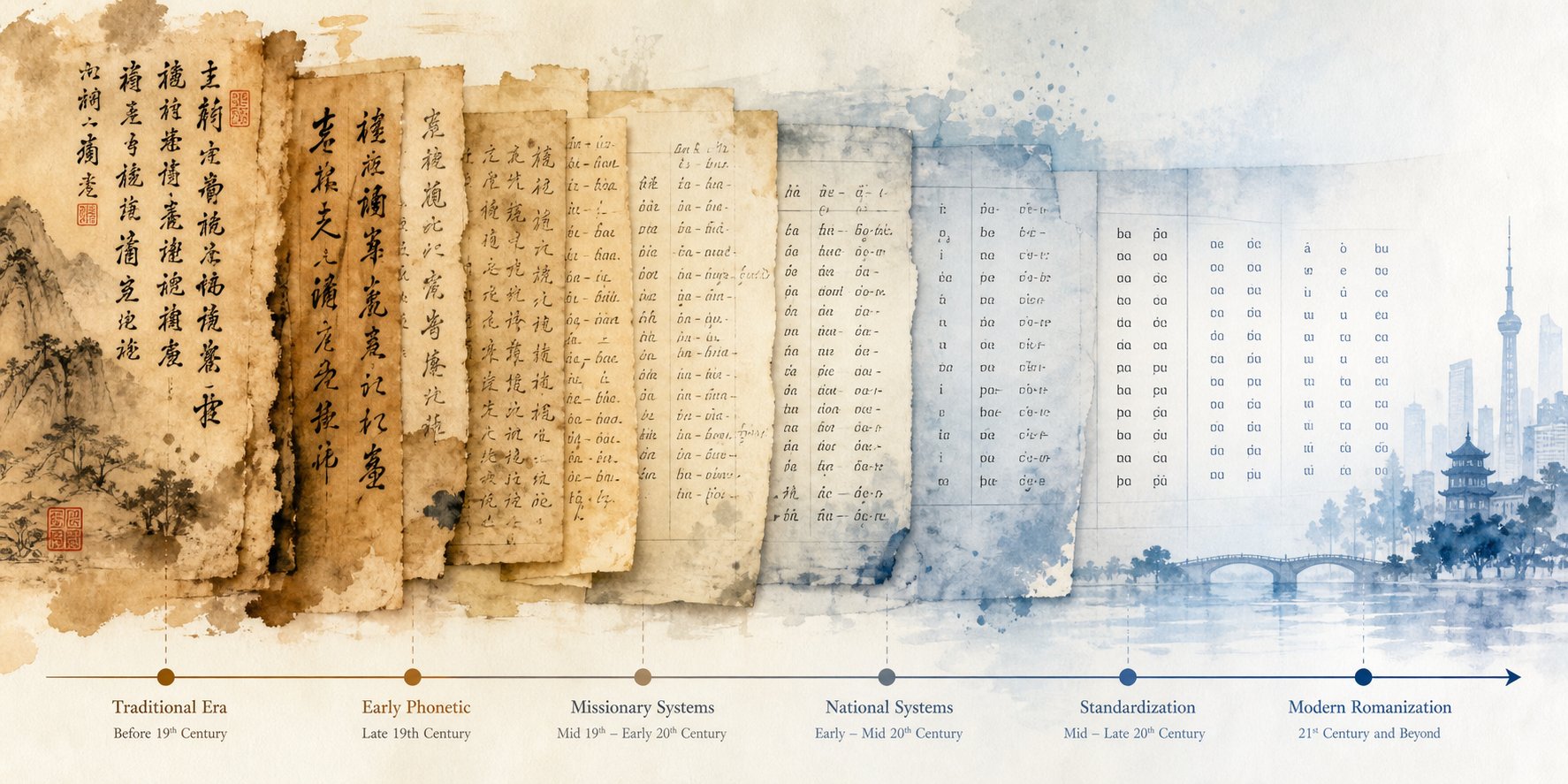
The reason pinyin naming conventions feel confusing today has everything to do with the messy path that led to their creation. For over a century, multiple competing systems existed for romanizing Chinese names, and none of them agreed on how to spell the same person's name. That legacy still haunts passports, library catalogs, and family records worldwide.
From Romanization Chaos to Standardization
Before 1958, anyone romanizing a Chinese name had to pick from a patchwork of systems. Wade-Giles, developed by British diplomats in the 19th century, dominated academic and diplomatic circles. Postal romanization, a separate system used by China's postal service, governed how place names and sometimes personal names appeared in international correspondence. Neither system was consistent, and both relied on diacritics and apostrophes that were frequently dropped in casual use.
When was pinyin invented? The hanyu pinyin system was developed between 1955 and 1957 by the Chinese Pinyin Scheme Committee, then officially approved by China's National People's Congress on February 11, 1958. The goal was straightforward: create a single, unambiguous standard for Chinese transliteration using the Latin alphabet, no special diacritics required for basic spelling.
International recognition followed gradually. In 1982, pinyin romanization became the international standard under ISO 7098 (Information and Documentation - Romanization of Chinese). The United Nations adopted it in 1986 for all Chinese geographic names. By the late 1990s, the Library of Congress began its massive conversion project from Wade-Giles to pinyin across its entire catalog.
How Historical Systems Still Affect Names Today
Here's where it gets personal. Older diaspora communities, particularly those who emigrated before the 1980s, often carry Wade-Giles or postal romanization forms on their legal documents. A family that left China in the 1960s might spell their surname "Tseng" (Wade-Giles) rather than "Zeng" (pinyin). Their children, born abroad, may have inherited that spelling on birth certificates and passports, creating a permanent split from the modern standard.
You'll notice this pattern clearly when comparing how a single name appears under each system:
| Chinese Name | Hanyu Pinyin | Wade-Giles | Postal Romanization |
|---|---|---|---|
| 毛泽东 | Mao Zedong | Mao Tse-tung | Mao Tse-tung |
| 蒋介石 | Jiang Jieshi | Chiang Chieh-shih | Chiang Kai-shek |
| 周恩来 | Zhou Enlai | Chou En-lai | Chou En-lai |
The differences are dramatic. Wade-Giles uses hyphens between given-name syllables and apostrophes to mark aspiration. Postal romanization often followed local dialect pronunciations rather than standard Mandarin. Pinyin, by contrast, joins given-name syllables and eliminates most special punctuation.
This history explains why romanizing a Chinese name is never just a technical exercise. The system you choose, or the system that was chosen for you decades ago, carries historical and sometimes political weight. It also explains why modern standards exist in the first place: to end exactly this kind of confusion. The real question becomes how those standards translate into specific formatting rules you can actually apply.
Core Rules for Formatting Chinese Names in Pinyin
Four rules. That's all it takes to correctly format a Chinese name in pinyin. The problem is that most people learn them piecemeal, if at all, and end up guessing when they convert Chinese characters by pinyin on a form or document. Here's the complete set, drawn from GB/T 16159 (the national standard for Chinese phonetic alphabet orthography), presented in the order you should apply them:
- Surname comes first. Chinese names follow a surname-given name order. The family name (usually one syllable, occasionally two) always leads.
- Capitalize the surname. The first letter of the surname is uppercase.
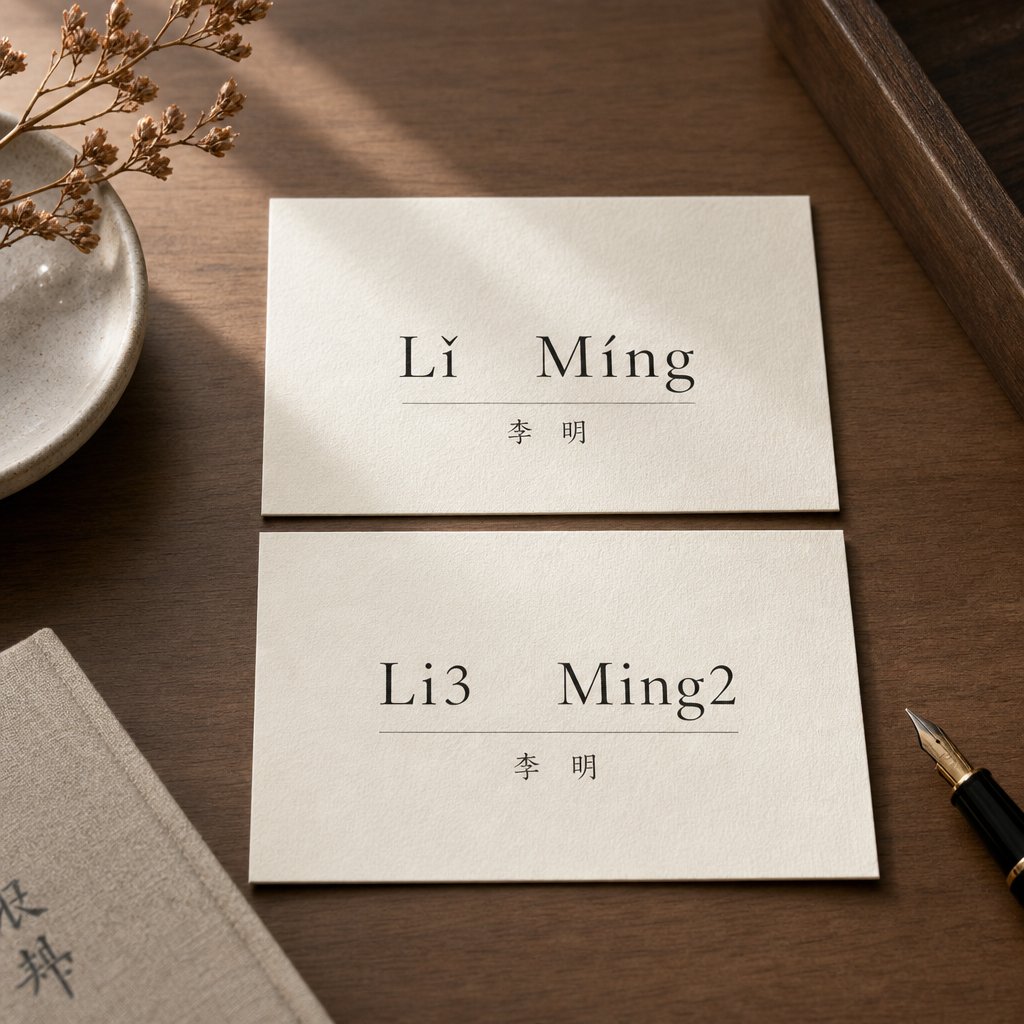
- Write given name syllables together as one unit. A two-syllable given name is joined without a space or hyphen: Xiaoming, not Xiao Ming or Xiao-Ming.
- Capitalize the first letter of the given name. Only the initial letter of the combined given name gets capitalized, not each syllable.
Applied together, these rules turn a scattered string like "zhang xiao ming" into the correct form: Zhang Xiaoming. Simple in theory, but easy to get wrong when you're staring at a blank form field.
Capitalization and Letter Case Rules
Capitalization in pinyin transliteration follows a logic similar to English proper nouns, with one key difference: the given name is treated as a single word regardless of how many syllables it contains. That means only its first letter is capitalized.
Consider the name 李晓红 (Li Xiaohong). The surname Li gets a capital L. The given name Xiaohong gets a capital X, but the "h" in "hong" stays lowercase because it's part of the same word. Writing "Li Xiao Hong" or "Li XiaoHong" with intercaps is incorrect under the standard.
When a name appears in all-caps contexts (passport headers, database fields), the entire name is uppercase: LI XIAOHONG. In these cases, spacing between surname and given name is the only visual separator, which is why the rules about joining syllables matter so much.
Spacing and Hyphenation of Given Names
This is where most confusion lives. Should a two-syllable given name be hyphenated? The short answer from GB/T 16159: no. The standard specifies that given name syllables are written as one word with no space and no hyphen.
So why do you see forms like "Xiao-Ming" everywhere? Hyphenation was common in older romanization systems like Wade-Giles, and it persists in Taiwan, where many people still use it on passports. Some international publishers also accept hyphens as a readability aid for non-Chinese readers who might not know where one syllable ends and another begins.
Here's a practical way to think about it: if you're filling out a PRC passport application or writing for a context that follows mainland Chinese standards, join the syllables. If you're in Taiwan or working with a style guide that explicitly permits hyphens, the hyphenated form is acceptable. Context decides.
The table below shows five common names as they're frequently written incorrectly alongside their correct pinyin forms. Think of it as a quick-reference chinese pinyin table for name formatting:
| Incorrect Form | Error Type | Correct Pinyin |
|---|---|---|
| zhang xiao ming | No capitalization, spaces in given name | Zhang Xiaoming |
| Wang Xiao Hong | Space between given name syllables | Wang Xiaohong |
| liu Wei | Surname not capitalized | Liu Wei |
| CHEN mei ling | Inconsistent case, spaces in given name | Chen Meiling |
| Zhao Guo-Qiang | Hyphen and intercaps in given name | Zhao Guoqiang |
Surname-Given Name Order in Different Contexts
Chinese word pinyin order keeps the surname first, and this is the default for any Chinese-language or China-facing context. But what happens when a Chinese name enters an English-language system that expects given-name-first order?
Many Chinese professionals working internationally flip the order voluntarily: Xiaoming Zhang instead of Zhang Xiaoming. Academic journals vary in their requirements. Some ask authors to maintain native name order; others impose Western order for consistency with other contributors.
The key principle: whichever order you choose, keep it consistent across all your documents. Mixing "Zhang Xiaoming" on your passport with "Xiaoming Zhang" on your publications and "X. M. Zhang" on your email signature creates exactly the kind of identity fragmentation that causes problems at border crossings and in citation databases. When converting hanyu pinyin Chinese characters to a romanized name, decide on your order once and stick with it.
These formatting rules give you a reliable foundation, but they don't exist in a vacuum. They come from specific official standards, each with its own scope and authority, and knowing which standard applies to your situation determines whether tone marks belong on your name, whether exceptions exist, and how strictly the rules are enforced.
Official Standards Behind Pinyin Name Formatting
Rules are only as useful as the authority behind them. The formatting conventions covered above didn't emerge from informal consensus. They're codified in two official standards that carry real institutional weight, one national and one international. Understanding which standard governs your situation tells you exactly how much flexibility you have, especially on the perennial question of tone marks in chinese names.
GB/T 16159 and What It Says About Names
GB/T 16159, formally titled "Basic Rules of the Chinese Phonetic Alphabet Orthography," is China's national standard for how han yu pin yin should be written. First published in 1996 and revised in 2012, it covers everything from word segmentation to capitalization. But its provisions on personal names are surprisingly concise.
Here's what GB/T 16159 specifically mandates for names:
- The surname and given name are written as separate units, each with its first letter capitalized.
- Multi-syllable given names are joined into a single word with no space or hyphen (e.g., Xiaoming, not Xiao Ming).
- Compound surnames (like Ouyang or Sima) are written as one word: Ouyang Xiu, not Ou Yang Xiu.
- When a name appears in all-caps for indexing or official documents, a space separates surname from given name: WANG XIAOMING.
- Tone marks should be included in standard orthography of the chinese phonetic alphabet.
What the standard leaves ambiguous is equally important. It doesn't address what happens when a Chinese name enters a foreign system that expects given-name-first order. It doesn't specify how to handle names that have already been romanized under older systems. And it offers no guidance on digital contexts like email addresses or usernames. These gaps are where real-world confusion thrives.
ISO 7098 for International Documents
ISO 7098 (Information and Documentation — Romanization of Chinese) extends pinyin's reach beyond China's borders. Originally adopted in 1982 and revised in 2015, this international standard governs how Chinese text, including personal names, should be romanized in libraries, academic publishing, and cross-border documentation.
Its key provisions for names include:
- Personal names follow the same surname-first, given-name-joined format as GB/T 16159.
- Tone marks are considered part of correct romanization and should be included when the writing system supports them.
- When tone marks cannot be rendered (technical limitations, system constraints), their omission is tolerated but noted as incomplete romanization.
- The standard applies specifically to Mandarin Chinese (Putonghua) and does not cover Cantonese or other dialect romanizations.
The Library of Congress adopted ISO 7098 as the basis for its cataloging rules, completing a massive conversion from Wade-Giles to pinyin between 2000 and 2001. Their implementation adds practical details the ISO standard doesn't specify, like how to handle pseudonyms and how to index names where the surname is uncertain. For researchers and librarians, the LC guidelines function as the operational manual that ISO 7098 outlines in principle.
When Do Tone Marks Belong on a Name?
This is the question no one answers clearly, so here it is broken down by context. The tones of chinese language are fundamental to pronunciation. Mandarin has four tones plus a neutral tone, and any mandarin tone chart or chinese tones chart will show how dramatically meaning shifts with tone. The surname "Ma" could be 马 (horse, third tone) or 麻 (hemp, second tone), making chinese pinyin tones essential for disambiguation in linguistic contexts.
But do tone marks belong on your name? It depends entirely on where the name appears:
| Context | Tone Marks | Reason |
|---|---|---|
| Linguistic or academic texts | Required | Precision and disambiguation are expected |
| Language textbooks and educational materials | Expected | Students need tonal information for learning |
| Library catalogs (LC standard) | Included | Full romanization per ISO 7098 implementation |
| Passports and government IDs | Omitted | Systems cannot render diacritics; ICAO standards prohibit them |
| Business cards and email signatures | Omitted | Readability and system compatibility take priority |
| Casual or informal use | Omitted | No practical need; audience unlikely to read tones |
The pattern is clear: the more formal and linguistically oriented the context, the more likely tones in chinese pinyin are expected. The more practical and system-dependent the context, the more likely they're dropped. Neither choice is wrong. It's a matter of matching the standard to the situation.
These standards provide the theoretical backbone, but they were written with mainland China's linguistic landscape in mind. Cross the border into Taiwan, Hong Kong, or Singapore, and the rules shift in ways that catch even experienced professionals off guard.
Regional Variations Across Chinese-Speaking Areas
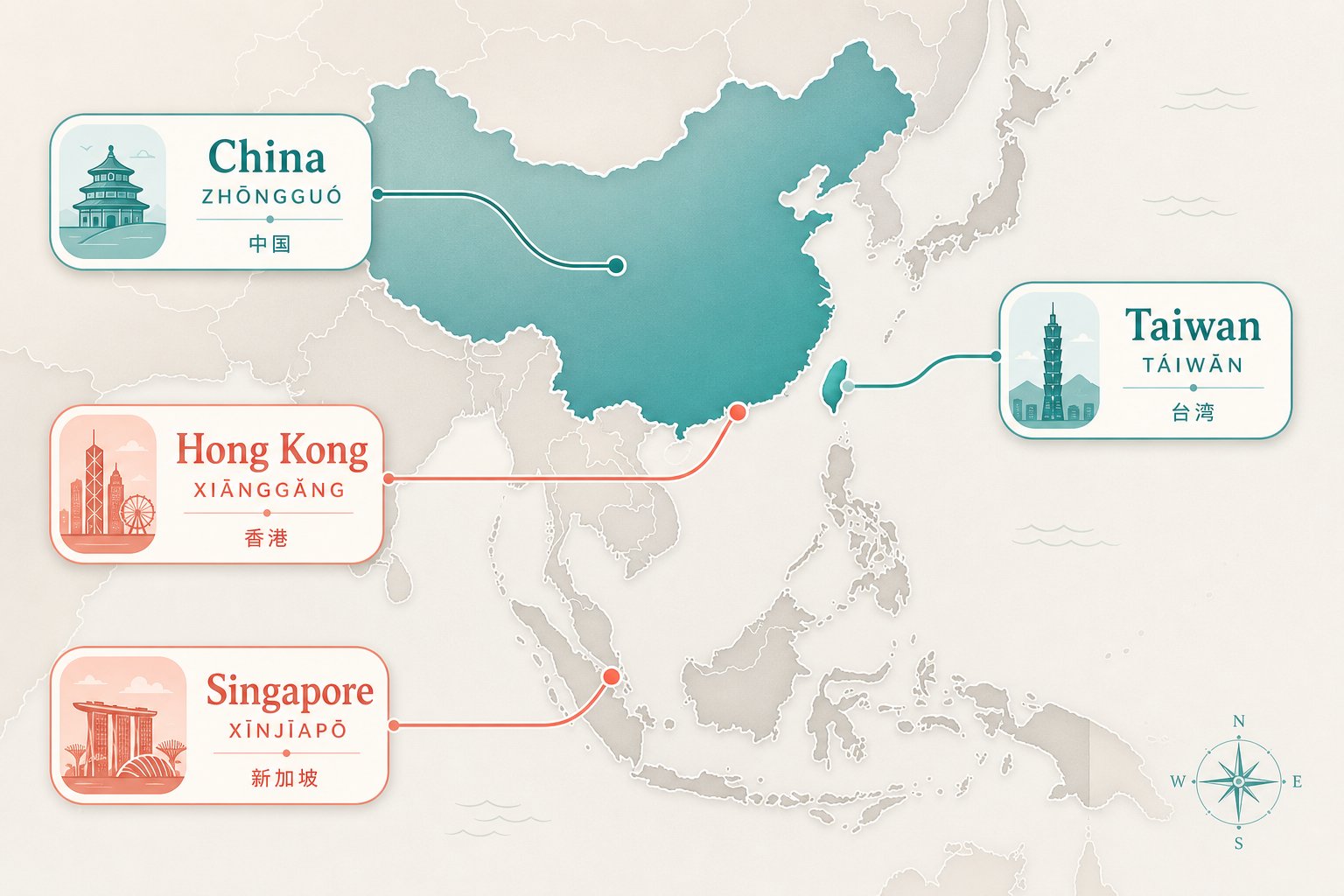
Same character, different spelling. That's the reality when a single Chinese name crosses regional borders. A person surnamed 陈 might be "Chen" in Beijing, "Ch'en" in Taipei, and "Chan" in Hong Kong. All three spellings point to the same family name, yet they look like three different people on paper. This divergence isn't random. It reflects how each Chinese-speaking region developed its own relationship with romanization, shaped by local dialects, colonial history, and political decisions about which system to adopt.
Mainland China and Standard Hanyu Pinyin
Mainland China is the simplest case. The PRC enforces mandarin chinese pinyin as the sole official romanization for personal names on all government-issued documents. There's no ambiguity, no regional opt-out, and no legacy system competing for space. If you hold a PRC passport, your name appears in Hanyu Pinyin. Period.
This uniformity means that converting chinese to mandarin pinyin for official purposes follows one set of rules nationwide. The surname 陈 is always Chen. The given name syllables are always joined. Tone marks are always omitted on travel documents. For mainland Chinese citizens, the formatting questions are largely settled by the state before you ever reach the application counter.
Taiwan and the Tongyong Pinyin Question
Taiwan's story is far messier. The island has cycled through multiple romanization systems over the past several decades, and the residue of each era still appears on passports and street signs today.
Here's the condensed timeline: Wade-Giles dominated for most of the 20th century. In 2002, the government officially adopted Tongyong Pinyin, a locally developed system that differs from Hanyu Pinyin in about 15% of its spellings. Then in 2009, Taiwan switched to Hanyu Pinyin as the national standard for public signage and official use. But the switch was never fully enforced. Cities like Kaohsiung continued using Tongyong on their MRT systems and street signs.
For personal names, the situation is even more fragmented. Most Taiwanese citizens still romanize their names using a simplified Wade-Giles that drops diacritics, tone marks, and apostrophes. Since romanization isn't taught in Taiwan's schools (students learn Mandarin pronunciation through Zhuyin/Bopomofo instead), many people rely on whatever system the passport office's reference materials happen to use. The result is that prominent figures end up with names in completely different systems: former president Tsai Ing-wen's given name follows Gwoyeu Romatzyh, while Chen Shui-bian's name most closely matches Hanyu Pinyin.
A 2019 amendment to Taiwan's Passport Act even opened the door for names to be romanized from Hoklo, Hakka, or indigenous languages, adding yet another layer of variation.
Hong Kong and Cantonese Romanization
Hong Kong operates in a different linguistic universe entirely. The dominant spoken language is Cantonese, not Mandarin, and names are romanized based on Cantonese pronunciation rather than Mandarin. This is why standard cantonese pinyin produces spellings that look nothing like their Mandarin equivalents.
There's no single mandated system for personal names in Hong Kong. The government uses a romanization loosely based on older colonial-era conventions, while Jyutping (the Linguistic Society of Hong Kong's standard for Cantonese) exists as an academic reference but isn't required for identity documents. In practice, pinyin for cantonese names follows informal conventions passed down through families and government clerks rather than any published standard.
The practical impact is significant. The character 陈 is pronounced "chan" in Cantonese and "chen" in Mandarin. Same character, same meaning, same family, but two completely different romanized spellings driven by which dialect's pronunciation gets transcribed.
Here's how that single surname looks across regions:
| Region | Character | Romanization | System Used |
|---|---|---|---|
| Mainland China | 陈 | Chen | Hanyu Pinyin (Mandarin) |
| Taiwan | 陳 | Ch'en / Chen | Wade-Giles or Hanyu Pinyin |
| Hong Kong | 陳 | Chan | Cantonese romanization |
| Singapore | 陈 | Tan / Chen | Hokkien or Hanyu Pinyin |
Singapore and Multilingual Complexity
Singapore adds another dimension. Its Chinese population descends largely from Hokkien, Teochew, Cantonese, and Hakka speakers, and older generations romanized their names according to their dialect group's pronunciation. The surname 陈 becomes "Tan" in Hokkien, "Tang" in Teochew, and "Chan" in Cantonese. Since the 1980s, Singapore's government has promoted Mandarin through the Speak Mandarin Campaign, and younger Singaporeans increasingly use Hanyu Pinyin. But legal names established decades ago remain unchanged on identity cards.
This means a Singaporean family might have grandparents surnamed "Tan," parents who go by "Tan" on official documents but use "Chen" professionally, and children whose birth certificates say "Chen." Three generations, one character, multiple spellings.
What This Means for Cross-Border Documents
The practical fallout of regional variation hits hardest when documents need to match across borders. A Hong Kong resident named Chan Tai-man applying for a mainland Chinese visa will have paperwork that doesn't visually connect to the Mandarin pinyin form Chen Dawen, even though both refer to the same person writing the same characters. Banks, immigration authorities, and universities regularly flag these mismatches as potential identity discrepancies.
There's no universal fix. The best defense is consistency within your own document set and awareness that officials in different regions may not recognize your name's romanization as equivalent to their local standard. Knowing which system produced your spelling, and being able to explain it, saves time at every checkpoint where your name crosses a regional boundary.
Regional variation explains why the same character produces different romanized names. But even within a single system, the way your name appears shifts depending on the document type: a passport, an academic paper, and a business card each follow their own formatting logic.
Pinyin Names on Passports and Official Documents
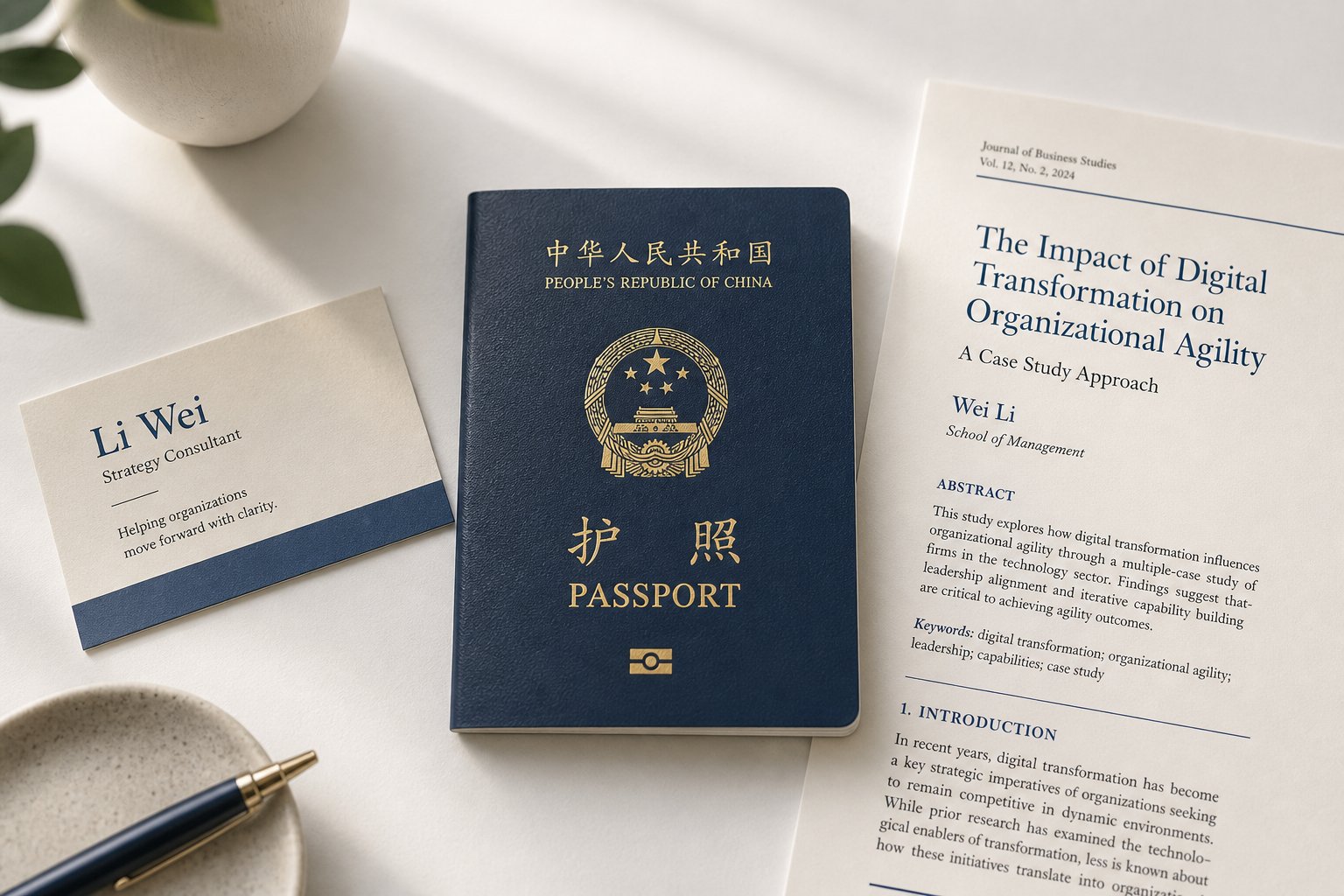
Your name in a textbook and your name on a passport are not the same thing. The careful formatting rules from GB/T 16159, the tone marks, the elegant capitalization, all of it gets stripped down the moment your name enters a machine-readable travel document. Passport systems operate under their own constraints, and those constraints create a version of your name that often looks nothing like what you'd write on a business card or academic paper.
This gap between "correct pinyin" and "passport pinyin" is where real problems start. Understanding exactly how official documents handle Chinese names, and why they do it that way, prevents the kind of mismatches that delay visa applications and trigger identity verification flags.
Passport and Visa Name Formatting Rules
PRC passports follow the International Civil Aviation Organization (ICAO) standards for machine-readable travel documents. These standards impose strict technical limitations on how any name, Chinese or otherwise, can appear in the Machine-Readable Zone (MRZ):
- All uppercase letters. No mixed case. Your name appears as ZHANG XIAOMING, not Zhang Xiaoming.
- Roman alphabet only. No diacritics, no tone marks, no special characters of any kind.
- Surname and given name in separate fields. The passport splits your name into a primary identifier (surname) and secondary identifier (given name).
- No spaces within the given name. Multi-syllable given names are joined: XIAOMING, not XIAO MING.
- No hyphens. Even if you prefer Xiao-Ming in daily life, the MRZ renders it as XIAOMING or, in some systems, XIAO
- 39-character limit on the name line. Longer names get truncated.
The result is a flattened, stripped-down version of your name optimized for machine scanning rather than human readability. A person whose name is properly written as Zhang Xiaoming (张晓明) in standard pinyin becomes ZHANG XIAOMING in the MRZ, with the chevron separator (<<) marking the boundary between surname and given name in the encoded data.
For Chinese citizens, the PRC passport office handles this conversion automatically. You provide your name in Chinese characters, and the system generates the pinyin. You don't choose your own romanization. This eliminates individual variation but also means you can't opt for a preferred spelling that differs from standard Hanyu Pinyin.
Handling Name Mismatches Across Documents
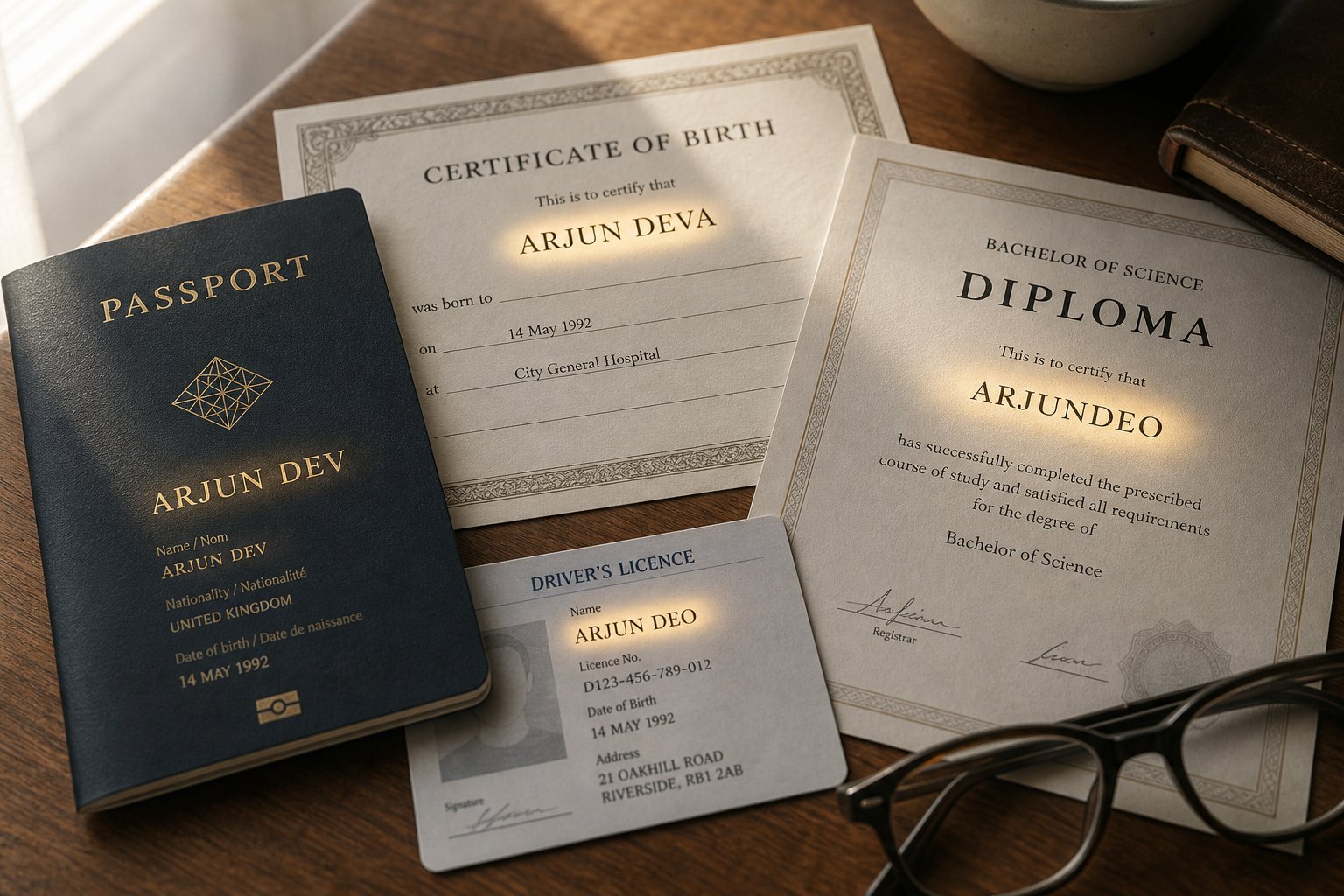
Here's where things get complicated. Imagine you emigrated from China in the 1990s using a passport that spelled your name one way. You obtained a driver's license in your new country using a slightly different romanization. Your university diploma uses yet another form. Now you're applying for citizenship or renewing a visa, and the reviewing officer sees three different spellings of what should be one person's name.
Name discrepancies across translated documents are one of the most common problems in immigration processing. They happen because:
- Different documents were issued at different times, under different romanization standards.
- Some documents were transliterated by clerks who applied local conventions rather than official pinyin rules.
- Older documents may use Wade-Giles or postal romanization while newer ones use Hanyu Pinyin.
- Regional variation means the same character was romanized differently depending on where the document was issued.
Converting pinyin to mandarin characters and back again should theoretically produce the same result every time. In practice, it doesn't, because human judgment and historical context intervene at every step. A person named 陈伟 might appear as Chen Wei on their PRC passport, Ch'en Wei on an older Taiwanese document, and Chan Wai on a Hong Kong birth certificate. All three refer to the same Chinese characters and pinyin, but they look like three different people to an immigration database.
The practical fix? Proactive disclosure. Most immigration forms include fields for "other names used" or "aliases." Listing all romanization variants in these fields, combined with a certified translator's explanatory note confirming the equivalence, transforms a potential red flag into documented transparency.
Academic Papers and Business Cards
Outside the rigid world of passports, you have more control over how your name appears, but that freedom introduces its own consistency challenges. The same person's name can legitimately look different across professional contexts:
| Document Type | Name Format | Conventions Applied |
|---|---|---|
| PRC Passport (MRZ) | ZHANG XIAOMING | All caps, no tone marks, surname first, given name joined |
| Academic Publication | Xiaoming Zhang or Zhang, X. | Western order common; journal style guide dictates |
| Business Card (bilingual) | Zhang Xiaoming / 张晓明 | Chinese order with characters; pinyin as pronunciation aid |
| Social Media Profile | Xiaoming Zhang / Ming Zhang | Informal; often given-name-first with shortened forms |
| Library Catalog (LC) | Zhang, Xiaoming | Surname first with comma separator; may include tone marks |
Notice how the same person appears as five visually distinct identities depending on context. Each format is correct for its setting, but together they create a fragmented paper trail. For anyone building an international career, the challenge is maintaining enough consistency that databases, citation indexes, and official records can link these variations back to one person.
Academic publishing presents a particular headache. Some journals require Western name order (given name first), others preserve Chinese order, and still others use initials. A researcher publishing under "X. Zhang" shares that abbreviated form with thousands of other people, because Zhang is one of the most common surnames in China, shared by roughly 90 million people. Li and Wang are similarly ubiquitous. When your surname is shared by tens of millions, the given name becomes the only disambiguator, and how it's formatted matters enormously for discoverability.
This is why many Chinese academics adopt a consistent professional name early in their careers and use it across all publications, conference registrations, and institutional profiles. The pinyin to english rendering they choose becomes, in effect, their international identity. Changing it mid-career means splitting your publication record and losing citation links.
Practical Strategies for Document Consistency
If you're managing your name across multiple official and professional contexts, a few principles help prevent the mismatch problem before it starts:
- Anchor to your passport spelling. Since passports are the foundational identity document for international purposes, use that romanization as your baseline. Build outward from there.
- Document your variants. Keep a personal record of every romanization that appears on any official document you hold. You'll need this list for immigration applications, background checks, and professional registrations.
- Choose one professional form and commit. Whether you go with Zhang Xiaoming or Xiaoming Zhang for your career, pick it once and use it everywhere: publications, LinkedIn, conference badges, email signatures.
- Understand that chinese to pinyin and english conversion isn't always reversible. Multiple Chinese characters can produce the same pinyin spelling. Zhang could be 张, 章, or 涨. Without the original characters, converting back from romanized form introduces ambiguity.
The passport office won't tell you any of this. They'll hand you a document with your name in block capitals and send you on your way. But every system your name enters after that, airline bookings, bank accounts, university registrations, employer databases, expects some version of that name to match. Knowing how each context reshapes your pinyin name, and planning for it, is the difference between smooth processing and months of correction requests.
Official documents impose their formatting from above. Digital platforms, on the other hand, impose constraints from below: character limits, banned symbols, uniqueness requirements. The way pinyin names adapt to these technical boundaries is an entirely different challenge.

Pinyin Naming in Digital and Modern Contexts
Every digital system your name touches, email servers, social platforms, domain registrars, strips away the nuances that official standards carefully preserve. No tone marks in a URL. No mixed case in most usernames. No spaces in an email address. These technical constraints force pinyin names into shapes that neither GB/T 16159 nor ISO 7098 ever anticipated, and the decisions you make here follow you across your entire online identity.
Email Addresses and Professional Usernames
When you type hanyu pinyin into an email address field, you're working within a system that allows only lowercase ASCII letters, numbers, dots, hyphens, and underscores. That's it. No diacritics, no spaces, no capitalization distinctions. A name like Zhang Xiaoming suddenly needs to become a single unbroken string, and there's no universal convention for how to do it.
You'll encounter several common patterns in the wild:
- [email protected] — Given name first, dot separator, surname last. Follows Western email conventions and reads naturally to international colleagues.
- [email protected] — Chinese order, no separator. Mirrors passport formatting but can be hard to parse visually.
- [email protected] — Initials plus surname. Compact and professional, but shares the ambiguity problem: thousands of people share the initials XM with surname Zhang.
- [email protected] — Numbered variant when the preferred form is already taken. Common at large organizations with many employees sharing similar names.
- [email protected] — Chinese order with dot separator. Preserves surname-first convention while improving readability.
Which format should you choose? It depends on your audience. If most of your professional contacts are international, the given-name-first format (xiaoming.zhang) reduces confusion because it matches what English speakers expect. If you work primarily within Chinese-speaking contexts, surname-first (zhang.xiaoming) maintains cultural consistency. The same logic applies to LinkedIn URLs, GitHub usernames, and any platform where your pinyin name becomes a permanent identifier.
The uniqueness problem deserves special attention. Common surnames like Wang, Li, and Zhang combined with popular given names create massive collision rates. A company with 10,000 employees might have dozens of people whose pinyin name produces the same email string. Corporate IT departments typically resolve this by appending numbers, middle initials, or department codes, but the result often looks impersonal. Some professionals preemptively choose a distinctive format early in their careers to avoid being assigned [email protected].
Domain Names and Online Identity
Domain registration introduces yet another layer of constraint. A domain name can contain only letters, numbers, and hyphens (no dots within the name itself, no underscores, no special characters). For Chinese businesses and individuals registering domains using pinyin, this creates a naming strategy that Chinese domain investors have systematized into categories: 1-pin (single syllable), 2-pin (two syllables), 3-pin (three syllables), and 4-pin (four syllables).
Among the top 100 Chinese internet companies, 36 use pinyin domains, with two-syllable (2-pin) domains being the most popular by far. Think of Baidu.com (百度), where the pinyin to chinese word connection is immediately clear to any Mandarin speaker. Shorter domains carry more value because they're easier to remember and type, especially on a mandarin keyboard where users are already accustomed to entering pinyin to produce Chinese characters.
For personal branding, the same principles apply. A freelancer or consultant might register their full pinyin name as a domain (zhangxiaoming.com), but readability suffers with longer names. Hyphens can help (zhang-xiaoming.com) but are generally considered less professional and harder to communicate verbally. The tradeoff between brevity and clarity mirrors the same tension that exists in every other digital context.
Programming Identifiers and Code
Software developers working in Chinese teams face a quieter version of this naming challenge every day. Variable names, function names, and class names in code are written in ASCII by convention across nearly all programming languages. Chinese developers routinely use pinyin for identifiers when English equivalents feel awkward or imprecise: getUserJifen() (get user points), dingdanStatus (order status), or chaxunYonghu() (query user).
This practice is controversial within the development community. Some teams mandate English-only identifiers for international readability. Others accept pinyin as pragmatic, especially for domain-specific terms that lose nuance in translation. The chinese typing method most developers use, a pinyin input method editor (IME), means they're already thinking in pinyin as they code. The romanized syllables are right there on screen before the IME converts them to characters, making pinyin variable names a natural extension of the workflow.
Adapting Name Order for Global Systems
Digital platforms increasingly serve as the bridge between Chinese naming conventions and international expectations. When a Chinese professional creates a LinkedIn profile, registers for a conference, or sets up a Zoom account, the system typically presents two fields: "First Name" and "Last Name." These labels assume Western name order, and there's no universal guidance on whether Zhang Xiaoming should enter "Xiaoming" as first name and "Zhang" as last, or maintain Chinese order.
The growing trend among Chinese professionals in international business is pragmatic adaptation: use given-name-first order on platforms with global audiences, and surname-first order on Chinese platforms like WeChat or Zhihu. Some adopt an English given name entirely ("David Zhang") for international contexts while keeping their full pinyin name for Chinese-facing communication. This dual-identity approach works smoothly until the two systems need to cross-reference each other, at which point the same consistency challenges from the passport world resurface in digital form.
The underlying reality is that digital systems weren't designed with Chinese naming conventions in mind. They were built around Western assumptions about name structure: one given name, one surname, given name first, everything fits in ASCII. Every adaptation Chinese users make, joining syllables, choosing name order, dropping tone marks, is a workaround for systems that never accounted for how a billion people actually name themselves.
These digital workarounds are personal choices, made one profile at a time. But some naming challenges aren't about individual preference at all. They stem from fundamental misunderstandings about how Chinese names work, mistakes that even well-intentioned professionals repeat because no one corrected them early enough.
Common Mistakes and How to Avoid Them
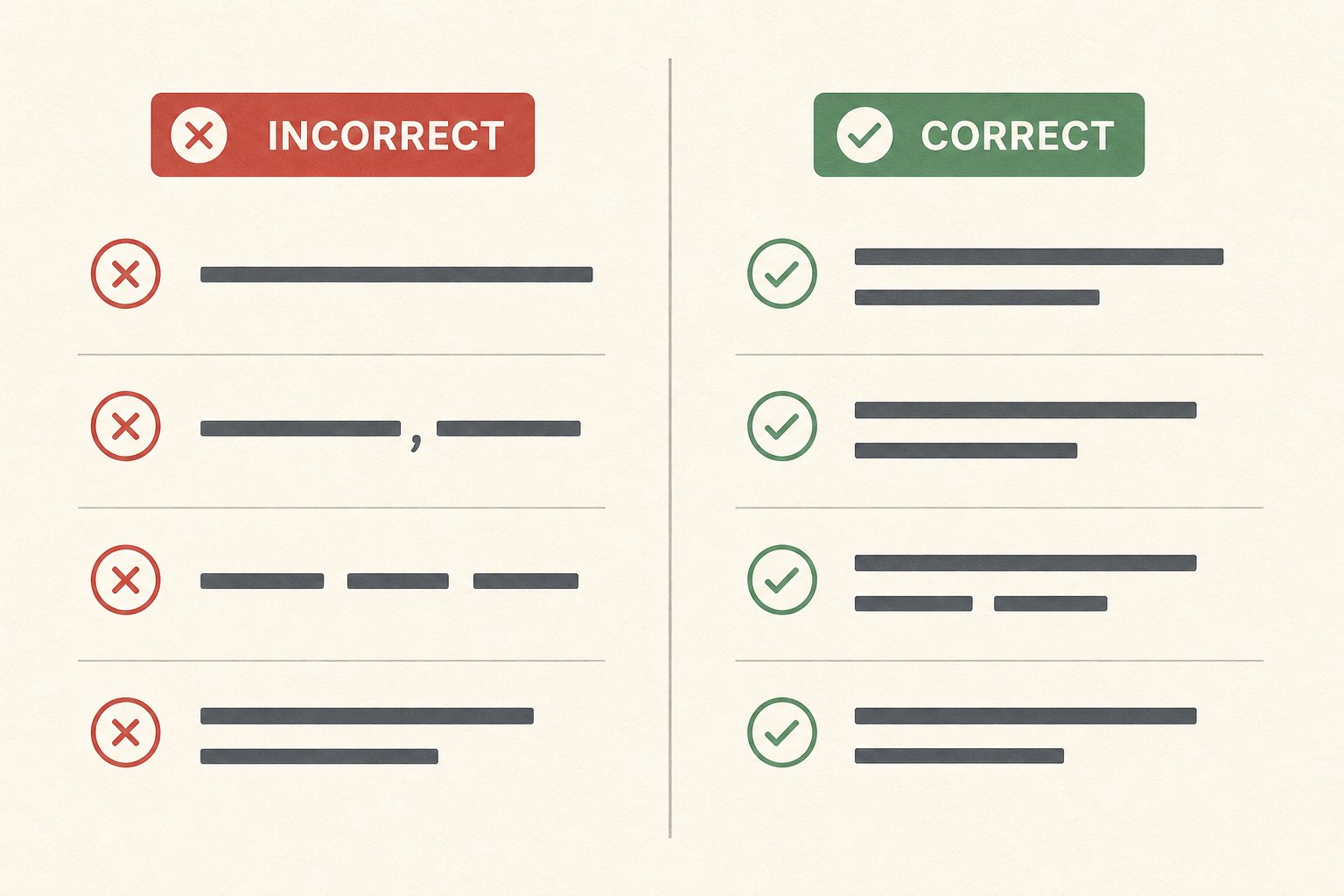
Some errors show up so frequently that they've become almost normalized. You'll find them on conference badges, in news articles, on university enrollment forms, and across HR databases. The tricky part is that many of these mistakes look plausible to anyone unfamiliar with how Chinese names actually work. Here's what goes wrong most often, and how to fix it.
Confusing Pinyin With Other Romanization Systems
The single most common mistake is treating all romanized Chinese names as if they came from the same system. When someone sees the surname "Chan" and assumes it's interchangeable with "Chen," they're conflating Cantonese romanization with Mandarin pinyin. These represent different pronunciations of the same character (陳) in different languages within the Chinese family. Calling "Chan" incorrect pinyin misunderstands the situation entirely. It's correct Cantonese romanization. It's just not Mandarin.
A related confusion involves people asking about abc in chinese or how many letters in chinese, expecting a direct parallel to the English alphabet. But what are chinese letters called? They're characters, not letters. There is no chinese alphabet in the way English has one. Pinyin uses the Latin alphabet as a pronunciation tool, but it isn't the alphabet of chinese itself. The question "how many letters in the chinese alphabet" or "how many letters in mandarin alphabet" doesn't have a straightforward answer because the writing system is logographic, not alphabetic. Pinyin borrows 25 of the 26 Latin letters (excluding V in standard use), but that's a romanization aid, not the letters of the chinese alphabet in any native sense.
This distinction matters for naming because it means pinyin is one romanization layer applied to one variety of Chinese. Treating every romanized Chinese name as pinyin leads to false corrections and unnecessary confusion.
Minority Ethnic Names and Non-Standard Structures
Not every Chinese citizen has a Han-style name. China's 55 officially recognized ethnic minorities include groups whose naming conventions bear no resemblance to the two-or-three-character surname-plus-given-name pattern. Uyghur names, for example, traditionally follow an Arabic-influenced structure where a personal name is followed by a patronymic. A name like Abdulla Ahat doesn't split into "surname" and "given name" the way a Han Chinese name does.
Tibetan and Mongolian names present similar challenges. Tibetan names often consist of two two-syllable elements with no surname at all. Mongolian names may use a patronymic prefix. As Language Log documented, Chinese authorities have struggled to standardize these names within systems designed for Han naming patterns, sometimes truncating or restructuring them to fit database fields that expect a short surname and a short given name.
If you're processing documents that include minority ethnic names from China, don't force them into the standard pinyin naming template. The surname-first, joined-given-name rules apply specifically to Han Chinese names romanized in Hanyu Pinyin.
Avoiding the Most Frequent Formatting Errors
Beyond systemic misunderstandings, there are straightforward formatting mistakes that appear constantly in professional contexts. Here's a quick-reference table:
| Common Mistake | Correct Form |
|---|---|
| Writing "Xiao Ming Zhang" (space in given name, Western order assumed to be Chinese order) | Zhang Xiaoming (surname first, given name joined) |
| Assuming "Chan" is misspelled pinyin for "Chen" | Both are correct in their respective systems (Cantonese vs. Mandarin) |
| Hyphenating a mainland Chinese given name: "Li Xiao-Hong" | Li Xiaohong (no hyphen per GB/T 16159) |
| Capitalizing each syllable of the given name: "Wang XiaoMing" | Wang Xiaoming (only first letter of given name capitalized) |
| Assuming all Chinese names are three characters (one surname + two given) | Names range from two to four+ characters; single-character given names (Li Wei) and compound surnames (Ouyang Xiu) are common |
| Reversing name order without marking it: listing "Xiaoming Zhang" in a Chinese-context database | Either maintain Chinese order (Zhang Xiaoming) or clearly mark Western reordering with a comma (Zhang, Xiaoming) |
| Adding tone marks on a passport or visa application | Omit tone marks on all travel and identity documents (ICAO standard) |
The thread connecting all these errors is the same: applying one context's rules to a different context. Pinyin naming conventions aren't a single rigid system. They're a set of principles that flex depending on whether you're filling out a PRC passport form, formatting a byline for an English-language newspaper, cataloging a book in a research library, or registering a domain name.
The right approach is always to identify your context first, then apply the matching standard. For mainland official documents, follow GB/T 16159. For international academic work, follow ISO 7098. For Cantonese names, don't use Mandarin pinyin at all. For minority ethnic names, respect their native structure rather than forcing a Han template. And when in doubt, ask the person whose name it is. They've almost certainly thought about this more than you have.
Frequently Asked Questions About Pinyin Naming Conventions
1. Should I hyphenate my two-syllable Chinese given name in pinyin?
Under China's national standard GB/T 16159, two-syllable given names should be written as one joined word without a hyphen. For example, Xiaoming is correct rather than Xiao-Ming. However, hyphenation remains acceptable in Taiwan and in some international publishing contexts where style guides explicitly permit it. The key is matching your formatting to the standard that governs your specific document or publication.
2. Why does my name look different on my passport compared to my academic papers?
Passports follow ICAO machine-readable document standards, which require all-uppercase letters, no tone marks, no hyphens, and no spaces within the given name. Academic papers typically use mixed case and may follow Western name order (given name first) per journal style guides. These are both valid representations of the same name adapted to different institutional requirements. Anchoring all variations to your passport spelling helps maintain consistency across documents.
3. What is the difference between pinyin and Wade-Giles for Chinese names?
Hanyu Pinyin and Wade-Giles are two distinct romanization systems for Mandarin Chinese. Pinyin was officially adopted by China in 1958 and uses intuitive Latin letter combinations without apostrophes for aspiration. Wade-Giles, developed in the 19th century, uses apostrophes and hyphens between given-name syllables. The same name can look dramatically different: Zhou Enlai in pinyin becomes Chou En-lai in Wade-Giles. Pinyin is now the international standard, but Wade-Giles persists in older diaspora communities and Taiwanese documents.
4. Do I need tone marks when writing my Chinese name in pinyin?
It depends on context. Tone marks are required in linguistic and academic texts where pronunciation precision matters. They are expected in language textbooks and library catalogs following ISO 7098. However, tone marks must be omitted on passports and government IDs due to ICAO technical limitations, and they are typically left off business cards, email signatures, and casual usage where system compatibility and readability take priority over phonetic accuracy.
5. Why is the same Chinese surname spelled differently in Hong Kong, Taiwan, and mainland China?
Regional spelling differences reflect different spoken languages and romanization systems. Mainland China uses Hanyu Pinyin based on Mandarin pronunciation, so the character 陈 becomes Chen. Hong Kong romanizes from Cantonese pronunciation, producing Chan. Taiwan historically used Wade-Giles, yielding Ch'en. Singapore adds further variation with dialect-based spellings like Tan from Hokkien. All these spellings represent the same Chinese character but transcribe different regional pronunciations through different systems.