What Makes Chinese Nicknames Sound So Strange to Outsiders
Imagine calling your boyfriend "old man" as a term of deep affection. Or picture a mother lovingly referring to her toddler as "stinky egg." In English, these would earn you confused stares or a trip to couples therapy. In Chinese, they are perfectly normal, even sweet.
笨蛋 (ben dan) - literal translation: "dumb egg." Used between Chinese couples and close friends as a playful, affectionate tease.
Weird Chinese nicknames have a way of stopping English speakers in their tracks. The language produces terms of endearment, insults-turned-compliments, and internet slang that sound absolutely bizarre when translated literally. Yet every single one follows an internal cultural logic that makes it perfectly sensible to over a billion people. The gap between "what it sounds like" and "what it actually means" is where all the fun lives.
What Counts as a Weird Chinese Nickname
A nickname qualifies as "weird" when it crosses a cultural boundary and loses its original emotional context. Take 小胖子 (xiao pang zi), meaning "little fatty." In English-speaking cultures, calling someone fat is a social landmine. In Chinese families, it is often a warm, teasing nickname for a chubby-cheeked child or a close friend. The weirdness is not in the name itself but in the translation gap.
Funny Chinese nicknames fall into several broad categories. Some are food-based, like 小汤圆 (xiao tang yuan), or "little glutinous rice ball," used for someone adorable. Others rely on reduplication, where a single character gets doubled to sound cuter, turning a regular word into baby-talk territory. Still others emerge from internet meme culture, gaming communities, or the creative workarounds Chinese netizens use to dodge content moderation.
This article covers the full spectrum: affectionate nicknames in chinese for lovers and family, funny chinese names born from linguistic mechanics, internet slang that went viral, cross-cultural naming disasters, and the regional dialect differences that multiply the weirdness. You will also learn where the line sits between laughing with a culture and laughing at it.
Why Chinese Nicknames Confuse English Speakers
The confusion comes down to three colliding forces. First, Chinese is a tonal language where the same syllable can mean wildly different things depending on pitch. Second, Chinese characters carry visual and semantic weight that disappears entirely in translation. When you hear that someone's nickname means "potato" or "pig dad," you lose the warmth, the wordplay, and the shared cultural shorthand baked into the original characters.
Third, Chinese naming culture has always prized creativity and meaning over convention. Unlike Western names drawn from a relatively fixed pool of saints and historical figures, nicknames in chinese are invented fresh, built from whatever a parent, friend, or internet stranger finds funny, fitting, or phonetically pleasing. That creative freedom produces results that sound alien to ears trained on "honey" and "sweetheart" as the ceiling of acceptable pet names.
The mechanics behind this strangeness are not random. They follow specific linguistic patterns that, once you understand them, make every bizarre nickname click into place.
The Linguistic Mechanics Behind Weird Chinese Nicknames
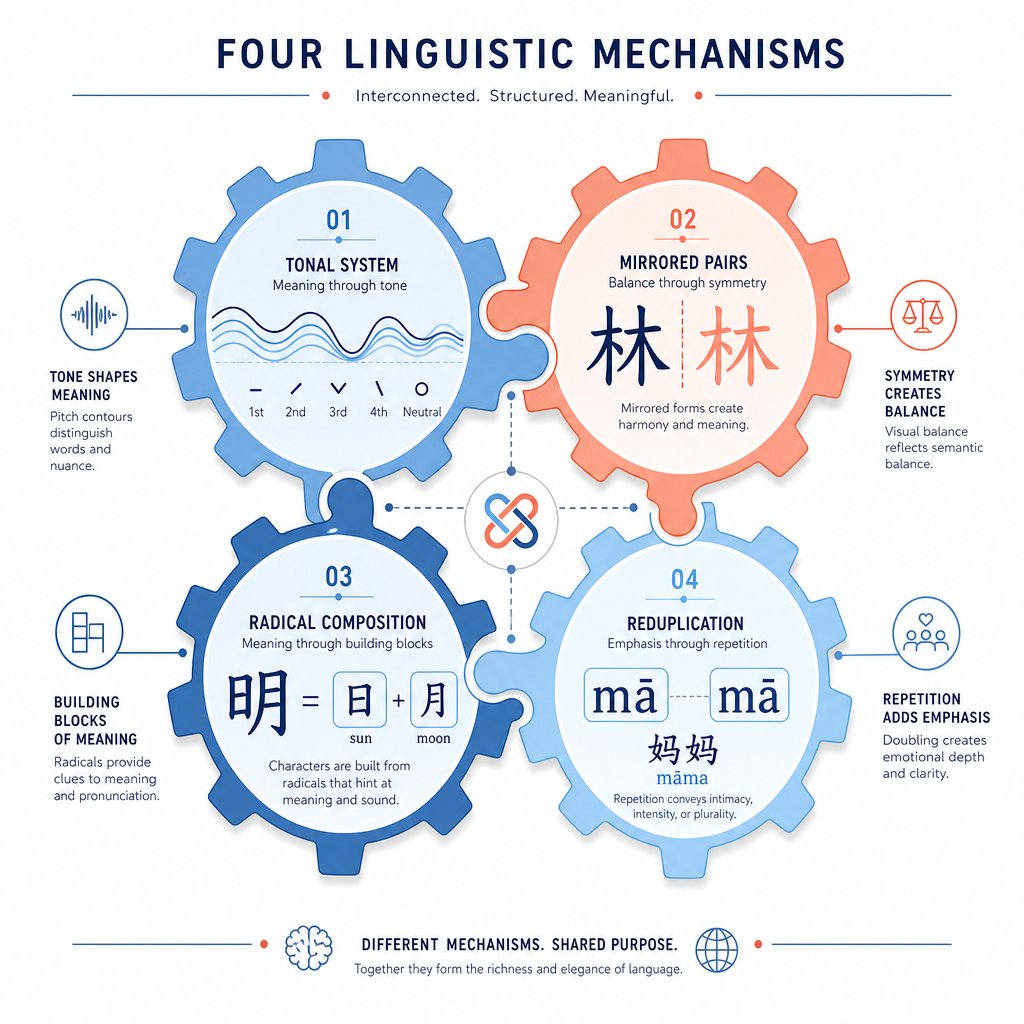
Chinese is not just any language when it comes to nickname creation. It is a nickname factory, equipped with tools that English simply does not have. Four specific linguistic mechanisms make Mandarin (and its dialect cousins) uniquely productive for generating funny names in chinese that sound absurd to outsiders but carry real affection, humor, or cleverness for native speakers.
Understanding these mechanics is the difference between laughing at a list of translations and actually getting the joke. Each mechanism exploits a different feature of the language, from its sound system to its writing system to its grammar.
Tonal Puns and Homophone Humor
Mandarin Chinese has four tones (plus a neutral tone), meaning the syllable "ma" can mean mother (妈, ma), hemp (麻, ma), horse (马, mǎ), or scold (骂, ma) depending on pitch. This tonal system creates a massive playground for puns. A nickname intended to mean one thing can, with a slight tonal shift, suggest something completely different.
But tones are only the beginning. Mandarin is one of the world's most homophone-rich languages. Hundreds of characters share identical pronunciations, even within the same tone. When you type pinyin on a Chinese keyboard, you are presented with a long list of possible characters for a single syllable. This peculiarity means that nearly any word can accidentally (or intentionally) reference something else entirely.
Consider the number 4 (四, si). It sounds nearly identical to death (死, sǐ), making it culturally unlucky. The same principle works in reverse for nicknames. The number 520 (五二零, wǔ er ling) sounds close enough to "I love you" (我爱你, wǒ ai nǐ) that it became a romantic code. Funny chinese names puns like these are not accidents. They are features of a language where sound-meaning collisions happen constantly.
A person named 诗涵 (Shi Han, meaning "poetic and inclusive") might get nicknamed 石憨 (Shi Han, "stone fool") by teasing friends, because the syllables are identical but the characters swap elegance for absurdity. The humor lands precisely because the sounds match while the meanings crash.
Character Decomposition and Visual Wordplay
Here is where Chinese does something no alphabetic language can replicate. Chinese characters are built from smaller components called radicals and strokes. You can visually break a character apart and create a nickname from its pieces.
Take the surname 张 (Zhang). It contains the components 弓 (bow) and 长 (long). A playful friend might call a person named Zhang "little bow" or reference the visual structure in a creative way. The character 明 (ming, meaning "bright") is composed of 日 (sun) and 月 (moon). Someone named Ming could be nicknamed "sun-moon" as a visual joke that only works if you can see the character on paper.
This mechanism also works in reverse. People sometimes earn nicknames because their face or body shape resembles a specific character. A round-faced person might be called 囧 (jiǒng), a character that looks like a distressed face and became one of China's earliest internet memes. The character literally means "bright" in classical Chinese, but its visual resemblance to a frowning face gave it an entirely new life as a humorous chinese names staple online.
Character decomposition makes Chinese nicknames deeply visual in a way that simply cannot survive translation. You need to see the characters to get the joke.
Reduplication and the Cuteness Factor
Reduplication, the doubling of a syllable, is one of the most common nickname-building tools in Chinese. It transforms ordinary words into something softer, cuter, and more intimate. A dog is 狗 (gǒu), but a puppy in baby talk becomes 狗狗 (gǒugǒu). The same pattern applies to people.
As linguist Victor Mair notes in his research on diminutives and reduplicatives in Chinese, young Chinese children often have nicknames consisting of repeated syllables: Baobao, Maomao, Meimei. These childhood names frequently carry into adulthood, causing a double-take when you meet a grown professional still called 乖乖 (guaiguai, "obedient-obedient") by family. The famous example of Bo Guagua (薄瓜瓜, "Melon-Melon"), son of politician Bo Xilai, shows how reduplicative baby names persist in public life.
Reduplication is not limited to baby talk. It softens verbs (看看, kankan, "take a little look"), intensifies adjectives (高高兴兴, gaogaoxingxing, "really happy"), and creates onomatopoeia. A chubby child is 胖嘟嘟 (pang dudu, literally "fat-bunch-bunch-ish"). The effect is playful and affectionate, but when translated into English, a funny chinese name like "Fatty Doo-Doo" loses all its warmth and just sounds bizarre.
| Character | Pinyin | Intended Meaning | Why It Sounds Weird in English |
|---|---|---|---|
| 蛋蛋 (Dan Dan) | dan dan | Cute baby nickname ("little egg") | "Egg Egg" sounds like a breakfast order, not a child's name |
| 瓜瓜 (Gua Gua) | gua gua | Affectionate name meaning "melon-melon" | Naming your child after a fruit sounds absurd in English |
| 520 | wǔ er ling | Homophone code for "I love you" (我爱你) | Using a number as a love nickname has no English equivalent |
| 囧 (Jiǒng) | jiǒng | Internet nickname based on character's face-like shape | A single ancient character used as a meme-name defies translation |
| 石憨 (Shi Han) | shi han | Tonal pun on an elegant name, meaning "stone fool" | "Stone Fool" sounds like an insult, but it is friendly teasing |
These four mechanisms, tonal puns, homophone humor, character decomposition, and reduplication, do not operate in isolation. They layer on top of each other. A single nickname might exploit a homophone, use reduplication for cuteness, and reference a visual joke in the character all at once. That density of meaning packed into one or two syllables is what makes humorous chinese names so compact yet so confusing when you try to unpack them in English.
The mechanics explain how these nicknames get made. But the real question is what kinds of weirdness they produce, and whether there is a pattern to the madness.
A Taxonomy of Weirdness in Chinese Naming Culture
There is a pattern to the madness. Once you sort chinese funny names into categories based on what makes them strange, you start to see the same creative impulses repeating across millions of nicknames. Think of it as a field guide: instead of laughing at one random example and moving on, you can identify the species of weirdness and predict what kind of nickname you are dealing with.
Five distinct categories cover the vast majority of hilarious chinese names you will encounter in the wild. Each one exploits a different source of humor, from linguistic coincidence to physical observation to pure internet chaos.
Phonetic Accidents and Cross-Language Confusion
Some names are perfectly normal in Chinese but become a funny chinese names joke the moment they cross a language border. The humor is not intentional. It is a collision between two sound systems that happen to share certain syllables with wildly different meanings.
- 诗婷 (Shi Ting) - A beautiful name meaning "poetic grace." Say it quickly in English and you get something far less elegant. Chinese parents choosing this name have no reason to consider English phonetics.
- 于坤 (Yu Kun) - A respectable name with classical roots. To English ears, the sounds map onto a crude word. The name is common and carries zero embarrassment in Chinese contexts.
- 王八 (Wang Ba) - While this is not typically a given name (it means "tortoise" and is slang for a cuckold), it demonstrates how innocent-sounding syllables carry hidden landmines across languages.
These phonetic accidents are not unique to Chinese. English names like "Randy" cause giggles in British English, and "Pete" sounds like a rude word in some Romance languages. The difference is that Mandarin's limited syllable inventory (roughly 400 unique syllables compared to English's 15,000+) means collisions happen far more frequently.
Food Names and Animal Names as Terms of Endearment
If you had to pick the single most common source of funny names chinese culture produces, food would win by a landslide. Calling someone a dumpling, a rice ball, or a little bun is not just acceptable. It is standard-issue affection.
- 小笼包 (xiao long bao) - "little soup dumpling." Used for someone small, round-faced, and adorable. The nickname works because the food itself is beloved and cute-looking.
- 土豆 (tu dou) - "potato." A common nickname for chubby babies or short, stocky friends. No insult intended whatsoever.
- 小熊 (xiao xiong) - "little bear." Used for someone cuddly or slightly clumsy. Animal nicknames follow the same affectionate logic as food ones.
- 小猪 (xiao zhu) - "little pig." In Chinese culture, pigs represent prosperity and contentment. Calling a partner "piggy" is sweet, not degrading.
The cultural logic here is straightforward: food is love in Chinese culture, and animals carry symbolic meanings that differ sharply from Western associations. A pig is lucky. A turtle represents longevity (unless you call someone 王八, in which case it is an insult). Context is everything.
Behavioral Quirks Turned Into Permanent Labels
Chinese nickname culture has a ruthless observational streak. If you do something memorable once, or have a persistent habit, that behavior can become your identity among friends and family forever. These are some of the funniest chinese names because they tell a story in two or three characters.
- 跳跳 (tiao tiao) - "jumpy-jumpy." Given to babies who bounce constantly in their cribs. As Yoyo Chinese documents, parents often choose nicknames based on a child's earliest behaviors, and these names stick for life.
- 话痨 (hua lao) - "chatterbox" (literally "word-sick"). Given to someone who never stops talking. It sounds harsh in translation but is used with eye-rolling affection among friends.
- 迷糊 (mi hu) - "confused" or "scatterbrained." A nickname for the friend who always forgets their keys, misses the bus, or walks into the wrong room.
What makes behavioral nicknames feel strange to outsiders is their bluntness. English-speaking cultures tend to soften observational nicknames or keep them behind someone's back. In Chinese friend groups, calling someone "Scatterbrain" to their face is a sign of closeness, not cruelty. The nickname signals that you know someone well enough to name their quirks out loud.
These categories are not mutually exclusive. A single nickname can be food-based and behavioral (calling a sleepy friend 懒蛋, lan dan, or "lazy egg") or combine phonetic humor with visual resemblance. The taxonomy helps you recognize the pattern, but real-life nicknames happily blur the lines. What every funny chinese names joke has in common, regardless of category, is that the humor comes from a place of familiarity and affection rather than malice.
That affectionate core becomes even more visible when you look at how Chinese couples and families deploy these nicknames in their closest relationships.

Funny Chinese Nicknames for Lovers and Friends
Chinese couple nicknames operate on a principle that baffles most English speakers: the weirder the literal translation, the deeper the affection. Calling your partner "dumb egg" or your child "little fatty" is not a sign of dysfunction. It is a sign of intimacy so comfortable that bluntness becomes tenderness. The logic is simple. You only give someone a ridiculous name if you are close enough that no one could possibly mistake it for an insult.
Pet names in chinese relationships draw from the same linguistic toolbox covered earlier, reduplication, food metaphors, animal imagery, but they add an extra layer of emotional context. A nickname that sounds cruel in translation carries warmth because both people understand the unspoken rule: the sillier the name, the safer the relationship feels.
Weird Pet Names Chinese Couples Actually Use
When you browse popular chinese girlfriend nicknames, you will notice a pattern. Many of them sound like mild insults or random nouns. A boyfriend might call his girlfriend 小傻瓜 (xiao sha gua), literally "little silly melon," and she will beam. A girlfriend might use 老头子 (lao tou zi), meaning "old man," for a boyfriend in his twenties, and he will take it as proof she sees a future together.
The most common chinese name for girlfriend is 老婆 (lao po), which literally translates to "wife." Unmarried couples use it freely, signaling commitment without a ring. Its male counterpart, 老公 (lao gong, "husband"), works the same way. These are chinese pet names for lovers that skip the dating phase entirely and jump straight to domestic familiarity.
Chinese pet names for boyfriend often lean into protector or family imagery. 哥哥 (ge ge, "older brother") is a popular one, not because anyone is confused about the actual relationship, but because it implies reliability and care. Meanwhile, 熊熊 (xiong xiong, "bear-bear") uses reduplication to turn a strong animal into something cuddly and safe.
Here is where the weirdness really shines. The term 心肝 (xin gan) means "heart and liver." In English, comparing your partner to internal organs sounds clinical at best. In Chinese, it conveys that someone is as essential to your survival as the organs keeping you alive. Chinese endearments like this reveal a culture that prizes directness about emotional dependency rather than dressing it up in flowers and candy metaphors.
| Chinese Nickname | Pinyin | Literal Translation | Actual Sentiment |
|---|---|---|---|
| 老婆 / 老公 | lao po / lao gong | Wife / Husband | Committed partner (used by dating couples too) |
| 小傻瓜 | xiao sha gua | Little silly melon | Playful, adoring tease |
| 笨蛋 | ben dan | Dumb egg | Affectionate "dummy" between lovers |
| 心肝 | xin gan | Heart and liver | "You are essential to me" / my everything |
| 小猪 | xiao zhu | Little pig | Cute, cuddly, prosperous (pigs = luck) |
| 臭宝 | chou bao | Stinky treasure | Trendy term of endearment (viral on Douyin) |
| 傻瓜老公 | sha gua lao gong | Silly melon husband | Teasing nickname for a goofy boyfriend |
| 宝宝 | bao bao | Baby / precious-precious | Universal pet name for partners and children |
Notice the pattern: chinese nicknames for girlfriend and boyfriend terms both lean heavily on words that would be insults in English (stupid, fat, stinky) but function as proof of closeness in Chinese. The underlying message is always "I am comfortable enough with you to say this out loud."
Silly Nicknames for Friends and Family
Romantic partners do not have a monopoly on bizarre names. Chinese friend groups and families produce equally strange labels, often with even less filter.
Among friends, 老铁 (lao tie, "old iron") signals an unbreakable bond. 死党 (si dang, "die-hard faction") means a ride-or-die friend. Parents get nicknamed too. 猪爸爸 (zhu ba ba, "pig dad") is a humorous label for a laid-back father, while 太后娘娘 (tai hou niang niang, "empress dowager") playfully acknowledges a mother who runs the household with authority. Children call their parents 粑粑 (ba ba) and 麻麻 (ma ma), deliberate tone-shifts from the standard 爸爸 and 妈妈 that add a layer of cuteness.
For children, food-based nicknames dominate. 小汤圆 (xiao tang yuan, "little glutinous rice ball") and 糯米 (nuo mi, "sticky rice") are common for toddlers. The nickname 小胖 (xiao pang, "little fatty") remains widespread despite sounding alarming in English. Parents use it because a chubby baby signals health and good fortune in traditional Chinese thinking.
There is an important distinction here between nicknames that sound weird only to non-Chinese speakers and ones that Chinese people themselves recognize as unusual. Terms like 宝贝 (bao bei, "treasure") or 亲爱的 (qin ai de, "dear") are standard endearments that carry no shock value in any language. The truly weird ones, the "dumb eggs" and "pig dads" and "stinky treasures," are the names that even Chinese speakers acknowledge as funny. They just do not find them offensive, because the cultural context makes the affection unmistakable.
This intimate, relationship-bound nickname culture exists in a private sphere. But there is another world of Chinese nicknames that lives entirely in public, moving at the speed of memes and shaped by forces no one fully controls.
Chinese Internet Slang and the Weirdest Online Nicknames
The private world of pet names and family labels evolves slowly, passed down through generations. Online nickname culture moves at a completely different speed. Platforms like Weibo, Douyin, and Bilibili generate new chinese name memes overnight, driven by viral moments, gaming culture, and a force unique to the Chinese internet: content moderation that accidentally creates new vocabulary.
A single trending video can launch a nickname that millions adopt within days. The result is a constantly shifting landscape of absurdist labels, coded references, and creative wordplay that makes even native speakers scramble to keep up.
Weibo and Douyin Meme Nicknames
Chinese social media breeds nicknames the way petri dishes breed bacteria: fast, unpredictably, and in enormous quantities. Gen Z users on Douyin and Bilibili drive most new slang creation, mixing Mandarin with English, inventing homophone puns, and constantly reinventing expressions to stay ahead of older generations.
Some of the most popular internet-born nicknames and their origin stories:
- 绝绝子 (jue jue zi) - Means "absolutely amazing" or "too much." Started as a compliment for impressive content, then became a sarcastic nickname for anything over-the-top. Calling someone 绝绝子 means they are extra in the best (or worst) way.
- 大神 (da shen) - Literally "great god." Originally reserved for expert gamers, it spread to describe anyone masterful at their craft. Your friend who always finds parking? 大神.
- 摸鱼人 (mo yu ren) - "Fish-toucher" or "fish-catcher." Refers to someone slacking off at work while pretending to be productive. Entire online communities now proudly identify as 摸鱼人, turning the nickname into a badge of honor.
- 栓Q (shuan Q) - A sarcastic homophone twist on "thank you" where 栓 means "bolt" or "plug." Used as a nickname for someone perpetually unlucky or frustrated. Originated from a viral English-learning video and exploded across platforms.
These nicknames jump from describing a behavior to becoming someone's permanent online identity. A person who posts one impressive video becomes 大神 in their comment section forever. Someone caught slacking gets tagged as 摸鱼 by coworkers in group chats. The speed at which internet slang solidifies into real nicknames is something unique to Chinese digital culture.
Chinese Gaming Names and Gamertags
Gaming culture has its own nickname ecosystem. Chinese gamertags blend classical language with internet absurdism in ways that produce genuinely strange results. Players pick chinese names for games that range from poetic four-character idioms to deliberately ridiculous phrases designed to tilt opponents.
A typical chinese game name might be 一刀999 (yi dao 999, "one slash 999 damage"), referencing old mobile game ads. Others go for dark humor: 寄了 (ji le, literally "sent/shipped") became gaming slang for "it's over" or "we're done for," and players adopt it as a fatalistic gamertag. The term 菜 (cai, "vegetable") means someone plays badly, so self-deprecating players name themselves 菜鸡 (cai ji, "vegetable chicken") as a preemptive joke.
Competitive gaming streams popularized abbreviations that became nicknames too. YYDS, short for 永远的神 (yong yuan de shen, "eternal god"), originated from esports commentary praising legendary players. Fans started calling their favorite streamers YYDS directly, and the abbreviation became a chinese name game communities use as the ultimate compliment. The crossover between chinese gamertags and everyday nicknames is constant: terms born in competitive matches leak into school group chats, office banter, and dating app profiles.
Censorship Workarounds That Became Real Nicknames
Here is where Chinese internet nicknames get truly strange. Content moderation on platforms like Weibo automatically scrubs sensitive terms, replacing flagged characters with a box that resembles 口 (kou, "mouth"). This forced substitution has spawned an entire subculture of creative workarounds that eventually become permanent slang and nicknames.
The most famous example: the word 和谐 (hexie, "harmonious") was used so often in official censorship notices that netizens began mocking it. When censors started blocking 和谐 itself, users replaced it with 河蟹 (hexie, "river crab"), a homophone. Getting your content deleted became known as being "river crabbed." The river crab evolved from a workaround into a mascot, a nickname for censorship itself.
- 河蟹 (he xie) - "river crab" - Homophone for "harmonious." Became the unofficial mascot and nickname for internet censorship.
- 草泥马 (cao ni ma) - "grass mud horse" - A fictional alpaca-like creature whose name is a homophone for a vulgar insult. Became a protest meme and a nickname people proudly adopt as avatars.
- 口口文学 (kou kou wen xue) - "mouth-mouth literature" - The practice of deliberately using 口 replacements for creative or comic effect. Users who excel at this get nicknamed 口口大师 ("mouth-mouth master").
- 淦 (gan) - A rare character meaning "water leaking into a boat," adopted as a safe replacement for the vulgar 干 (gan, "fuck") because they share the same pronunciation. Now used as a standalone exclamation and username element.
Netizens also split characters into their component radicals to dodge filters. The character 枪 (qiang, "gun") gets posted as 木仓 (mu cang, "wood warehouse"), its two visual halves. These decomposed forms sometimes stick as inside-joke nicknames within communities that share the coded language.
What makes censorship-born nicknames fascinating is their lifecycle. They start as survival tactics, become shared jokes, then harden into permanent cultural references that outlive the original censorship event. A river crab is no longer just a workaround. It is a symbol, a meme, and a nickname all at once.
This creative pressure does not stay contained within China's borders. When Chinese naming logic collides with Western names, brands, and celebrities, the results are equally unpredictable.

Cross-Cultural Naming Gone Hilariously Wrong
Chinese naming logic does not stop at China's borders. It reaches outward, assigning creative nicknames to foreign celebrities, mangling international brand names through transliteration, and producing a reverse phenomenon that confuses native English speakers just as much: Chinese people choosing English names like "Eleven," "Banana," or "Cupid" with complete sincerity.
This bidirectional collision is where weird chinese nicknames become a two-way street. The same linguistic mechanics that produce "dumb egg" as a term of endearment also produce "Sweet Tea" as a celebrity label and "bite the wax tadpole" as a brand name. The cultural logic is consistent. It just looks different depending on which direction you are watching the traffic flow.
Bizarre Chinese Nicknames for Western Celebrities
On Weibo and Douyin, Western celebrities rarely go by their actual names. Chinese fans assign nicknames based on phonetic resemblance, physical traits, personality, or pure creative whimsy. These are not insults. They are terms of familiarity, the same impulse that makes Chinese families call a child "little potato." If Chinese netizens nickname you, it means they care enough to claim you as part of their cultural conversation.
The mechanisms vary. Some nicknames are phonetic, built from how a foreign name sounds when transliterated into Mandarin syllables. Others are observational, based on what a celebrity looks like or does. A few are purely vibes-based, capturing a feeling rather than a fact.
| Celebrity | Chinese Nickname | Pinyin | Literal Translation | Why It Stuck |
|---|---|---|---|---|
| Leonardo DiCaprio | 小李子 | Xiao Lizi | Little Plum | "Leo" was transliterated as 李 (Li, "plum"); 小 added for affection |
| Taylor Swift | 霉霉 | Meimei | Moldy-Moldy | Fans joked about her early "bad luck" missing No. 1 on charts; 霉 means mold/unlucky |
| Timothee Chalamet | 甜茶 | Tian cha | Sweet Tea | "Cha" in Chalamet sounds like 茶 (tea); fans find his appearance sweet |
| Katy Perry | 水果姐 | Shuiguo jie | Fruit Sister | Her fruit-themed stage costumes made the connection obvious |
| Nicki Minaj | 麻辣鸡 | Mala ji | Spicy Chicken | Her bold persona matches Sichuan cuisine's numbing heat |
| Mariah Carey | 牛姐 | Niu jie | Cool Sister | 牛 means "cow" literally but "awesome" in slang; 姐 shows respect |
| Britney Spears | 小甜甜 | Xiao tiantian | Little Sweetie | Her youthful, sweet early image made this an instant fit |
You will notice the same patterns from earlier chapters at work here. Reduplication makes Taylor Swift's 霉霉 sound cute rather than cruel. The diminutive 小 (little) transforms DiCaprio from a Hollywood titan into something approachable and endearing. That's Mandarin notes that these nicknames are "playful and affectionate," rarely intended to offend. Even "Moldy-Moldy" is used with genuine love by millions of Chinese Swifties.
The cultural logic is identical to calling a boyfriend "dumb egg." Giving someone a silly name means you have claimed them as yours. Chinese fans nickname celebrities the same way they nickname family: with blunt, creative, slightly absurd labels that signal belonging rather than disrespect. These are some of the funniest asian names in pop culture precisely because they compress an entire persona into two or three characters.
Foreign Brand Names Gone Wrong in Chinese
Celebrities at least have fans doing the naming with affection. Brands trying to enter the Chinese market face a harder problem: transliterating a foreign name into characters that sound right, look right, and mean something positive. Get it wrong, and you become a cautionary tale shared across marketing departments worldwide.
The challenge is structural. Chinese characters each carry meaning, so a phonetic transliteration does not just produce sounds. It produces words. Every syllable you choose brings semantic baggage along for the ride.
- Coca-Cola's first attempt: The phonetic rendering 蝌蚪啃蜡 (ke dou ken la) produced something close to "bite the wax tadpole." The Drum reports that Coke eventually landed on 可口可乐 (ke kou ke le), meaning "delicious happiness," a far better outcome.
- Mercedes-Benz: The initial Chinese name 奔死 (ben si) translated to "rush to your death." The corrected version, 奔驰 (ben chi, "dashing speed"), saved the brand from becoming a morbid joke.
- Pepsi: The slogan "Come alive! You're in the Pepsi generation" reportedly became "Pepsi brings your ancestors back from the grave" in Chinese translation, turning a cheerful tagline into a ghost story.
- KFC: "Finger Lickin' Good" entered Beijing as "Eat your fingers off," transforming a promise of deliciousness into a threat of self-cannibalism.
These are not failures of Chinese. They are failures of companies underestimating how much meaning Chinese characters carry. In English, brand names can be pure sound ("Kodak," "Xerox"). In Chinese, every syllable is also a word. The brands that succeed, like 宝马 (bao ma, "precious horse") for BMW or 可口可乐 for Coca-Cola, choose characters that sound approximately right while also meaning something aspirational. The ones that fail treat Chinese like a phonetic alphabet and get bitten by the semantic layer they ignored.
This same tension between sound and meaning drives the reverse phenomenon: Chinese people choosing English names that baffle native speakers.
Why Chinese People Pick Strange English Names
If you have ever met a Chinese colleague named "Seven," "Strong," "Cupid," or "Banana," you have witnessed the same naming logic running in the opposite direction. And just like "Little Plum" for DiCaprio, these choices follow an internal cultural logic that makes perfect sense once you understand the framework.
Sixth Tone journalist Wu Haiyun explains the root cause: Chinese naming culture prioritizes meaning over convention. Every Chinese name is composed of characters chosen for their specific connotations. Parents spend weeks selecting characters that express hopes, values, or personality traits. When that same creative instinct meets English, people naturally reach for words that mean something beautiful or powerful to them, not realizing that English names operate on a completely different system of social convention.
Non-native English speakers typically become familiar with the language before understanding Western naming culture. No wonder some Chinese consider it perfectly acceptable to call oneself 'Beautiful' or 'Almighty.'
The result is names that sound like funny asian nicknames to English ears but are actually the product of a sophisticated naming tradition applied to an unfamiliar linguistic context. Consider the logic:
- "Seven" or "Eleven" - Numbers carry deep symbolic meaning in Chinese culture. Seven relates to togetherness; eight means prosperity. Choosing a number-name feels natural when your culture already uses 520 to say "I love you."
- "Banana" or "Cherry" - Food names are standard endearments in Chinese. If your family called you 小樱桃 (little cherry) your whole life, translating that into an English name feels logical.
- "Virtue" or "Moral" - Classical Chinese names often reference abstract qualities. The leap to choosing an English word with similar gravitas is small.
Wu Haiyun also draws a historical parallel. Until the mid-twentieth century, Chinese people routinely held multiple names: a surname (姓), a given name (名), an adult name (字), and a self-chosen artistic name (号). English names today fill the same role that 号 once did. They are self-selected identities meant to reveal personality, used in professional contexts but never at home with family. The tradition is ancient. Only the language is new.
There is also a practical irony at play. Chinese people with deep fluency in English and Western culture tend to choose the most conventional names possible: "David," "Lisa," "Michael." They understand the unwritten rules. Meanwhile, those still learning the language apply Chinese naming creativity to English vocabulary and produce results that native speakers find startling. The "weirdness" is really just one naming system's logic operating inside another naming system's territory.
This cross-cultural collision reveals something important: chinese nicknames in english are not random or careless. They are the product of a culture that treats naming as creative expression rather than selection from an approved list. Whether the name flows east-to-west or west-to-east, the same principle holds. Chinese naming culture is generative, inventive, and deeply personal in ways that fixed Western naming conventions simply are not.
But even within China, naming is not monolithic. Move a few hundred kilometers in any direction, and the dialect changes, the tones multiply, and an entirely different species of nickname emerges.
Regional Dialects and How They Shape Nickname Weirdness
A few hundred kilometers is all it takes. A nickname that gets belly laughs in Guangzhou might draw blank stares in Beijing, and a Shanghainese term of endearment could sound like gibberish to someone from Fujian. China is not one linguistic country. It is a patchwork of mutually unintelligible dialect groups, each with its own tonal system, slang vocabulary, and nickname-building traditions. The result is not one species of weird nick name in chinese culture but several, each shaped by the specific sounds and social norms of its region.
Cantonese Nicknames and Their Extra Tonal Weirdness
Cantonese has six tones (some analyses count nine), compared to Mandarin's four. More tones means more homophones, more puns, and more opportunities for nicknames that exploit tonal collisions. Cantonese nicknames also draw from a completely different slang vocabulary. Where nickname mandarin culture might use 小胖 (xiao pang, "little fatty"), Cantonese speakers in Hong Kong reach for 肥仔 (fei4 zai2, "fat boy") with the same affection but entirely different phonetics.
Cantonese nicknames tend to be blunter and more observational than their Mandarin equivalents. The dialect preserves final consonants (-p, -t, -k) that Mandarin lost centuries ago, giving nicknames a punchier, more percussive sound. Consider these examples unique to Cantonese-speaking communities:
- 靓仔 / 靓女 (leng3 zai2 / leng3 neoi5) - "Handsome boy / pretty girl." Used casually by strangers, shopkeepers, and taxi drivers. In Mandarin, the equivalent 帅哥/美女 (shuai ge / mei nu) exists but carries a slightly different social register.
- 死鬼 (sei2 gwai2) - "Dead ghost." A wife's affectionate-yet-exasperated nickname for her husband. Sounds horrifying in translation, but in Cantonese households it signals comfortable, long-married intimacy.
- 咸湿佬 (haam4 sap1 lou2) - "Salty-wet guy." Cantonese slang for a lecher. This term has no Mandarin equivalent that carries the same punch because the slang is rooted in Cantonese-specific imagery.
The extra tonal range also means cantonese nicknames can pack more wordplay into fewer syllables. A single syllable in Cantonese can distinguish between six different meanings, so a well-chosen nickname can simultaneously reference two or three concepts through tonal ambiguity. This density of meaning is simply impossible in Mandarin's four-tone system.
How Regional Slang Creates Local Nickname Traditions
Move beyond Cantonese and the variation multiplies further. Each dialect group has developed its own nickname conventions shaped by local culture, history, and phonology.
- Hokkien (Southern Min): Speakers in Fujian and Taiwan use 阿 (a) as a prefix for nicknames far more liberally than Mandarin speakers. 阿明 (A-Beng in Hokkien romanization) or 阿花 (A-Hue, "flower") are standard familiar forms. Hokkien also preserves archaic vocabulary, so some nicknames reference words that disappeared from Mandarin a thousand years ago.
- Shanghainese (Wu): Shanghai's nickname culture reflects the city's cosmopolitan identity. Shanghainese speakers mix dialect terms with borrowed English and Mandarin in a single nickname. The Wu dialect's extensive tone sandhi system means a nickname's tones shift depending on what words surround it, creating a musical quality that Mandarin nicknames lack entirely.
- Sichuan dialect: Known for its humor and directness, Sichuan dialect produces nicknames with a self-deprecating warmth. The merger of retroflex consonants (zh/ch/sh becoming z/c/s) gives Sichuan nicknames a softer, more playful sound that northern Mandarin speakers find inherently funny.
The practical consequence is significant. A nickname hilarious in Cantonese might be untranslatable into Mandarin, not because the concept is foreign but because the pun, the tonal trick, or the slang reference simply does not exist in another dialect's sound system. When someone asks about weird chinese nicknames as a single category, they are really asking about dozens of parallel nickname traditions that happen to share a writing system but diverge wildly in speech.
This regional complexity adds another layer to an already sensitive question: if nicknames vary this much across dialects, how do you know when one crosses the line from affectionate to offensive?

The Line Between Funny and Offensive in Chinese Nicknames
Regional variation makes one thing clear: context is not optional. It is the entire mechanism that determines whether a nickname lands as love or as harm. The same two characters can be a warm embrace between family members or a cutting insult between strangers. Understanding where that line sits matters, especially if you are an outsider encountering silly chinese names for the first time and trying to figure out whether to laugh, cringe, or stay quiet.
Many lists of chinese name jokes circulate online without any cultural framing. They present translations like "little fatty" or "egg" as punchlines, stripped of the relationships and social rules that make them function. That approach turns a living culture into a comedy set, and it misses the point entirely.
When Weird Means Affectionate in Chinese Culture
Chinese naming norms around appearance, weight, and physical traits operate on fundamentally different social rules than English-speaking cultures. Calling a child 小胖 (xiao pang, "little fatty") is not body-shaming. It is a statement of health, prosperity, and parental pride. Calling a dark-skinned friend 黑子 (hei zi, "blackie") within a close friend group may carry zero malice in its original context, even though the same words would be explosive in English.
A nickname's meaning lives in the relationship between the people using it, not in the dictionary definition of its characters. The same word that signals intimacy between friends becomes an insult the moment a stranger uses it.
Several factors determine whether a nickname is affectionate or harmful:
- Relationship closeness: The sillier and more blunt the nickname, the closer the relationship must be to support it. 笨蛋 ("dumb egg") between lovers is sweet. Between acquaintances, it is rude.
- Mutual consent: Most affectionate nicknames develop organically and are accepted (or at least tolerated) by the recipient. A nickname someone visibly dislikes is no longer a joke. It is bullying.
- Power dynamics: An older relative nicknaming a child "little fatty" carries different weight than a peer doing it. Chinese culture's hierarchical structure means the same name can be loving from above and cruel from the side.
- Tone of voice and setting: Private, playful delivery signals affection. Public, pointed delivery signals mockery. This is universal, but Chinese nickname culture relies on it more heavily because the words themselves sound harsher in translation.
The reference material from Typing Mandarin illustrates this well: the word 胖 (pang, "fat/chubby") appears in neutral descriptive sentences like "He is a bit chubby, but very likeable" (他有点胖,但是很可爱). The word carries observational weight, not moral judgment. Chinese culture historically treats physical description as factual rather than evaluative, which is why appearance-based nicknames feel less loaded to native speakers than they do to English speakers trained to treat any body commentary as taboo.
Nicknames That Cross the Line
None of this means anything goes. Chinese culture has its own boundaries, and certain nicknames are genuinely offensive regardless of context. The line exists. It just sits in a different place than English speakers expect.
Nicknames that cross the line in Chinese culture typically involve:
- Targeting someone's family: Insults referencing parents (especially mothers) are universally offensive. Terms like 王八蛋 (wang ba dan, "turtle egg," implying illegitimacy) are fighting words, not playful labels.
- Mocking disabilities or illness: While appearance-based nicknames about weight or height are often acceptable, nicknames targeting disabilities carry real stigma and cruelty.
- Using nicknames to exclude: When a group uses a nickname to mark someone as an outsider rather than to include them, the same word that could be affectionate becomes a weapon.
- Racial or ethnic slurs: China's ethnic diversity means certain terms carry deep historical pain. Nicknames referencing ethnic minorities in derogatory ways are recognized as harmful within Chinese society, even if outsiders assume "anything goes."
For non-Chinese speakers navigating this landscape, a practical rule applies: if a nickname requires insider status to use safely, you probably do not have that status. Terms like 小胖 or 笨蛋 work between people who share history, trust, and mutual understanding. Using them as an outsider, even with good intentions, strips away the relational context that makes them affectionate. What remains is just the literal meaning, and the literal meaning often sounds like an insult.
The difference between laughing with Chinese naming culture and laughing at it comes down to curiosity versus mockery. Sharing funny chinese name jokes that explain the cultural logic, the way this article attempts to do, treats the humor as a doorway into understanding. Listing asian name jokes without context, treating the names as inherently ridiculous rather than culturally situated, reduces a rich tradition to a punchline. One approach builds bridges. The other reinforces the idea that unfamiliar equals inferior.
Understanding these boundaries does not mean tiptoeing around Chinese nickname culture as if it were fragile. It is not. It is robust, creative, and deeply self-aware. Chinese speakers make fun of their own naming conventions constantly. The invitation is to join that conversation with enough knowledge to get the joke, not just to point at the translation and laugh at what you do not understand.
With that cultural grounding in place, the natural next step is putting all these principles to work: building your own nickname using the linguistic tools and cultural awareness you have picked up along the way.
How to Make Your Own Weird Chinese Nickname
All the linguistic mechanics, cultural context, and regional flavor covered so far point toward one satisfying conclusion: you can build your own. Whether you want cool chinese nicknames for a friend group, playful code names for crushes chinese style, or genuine chinese pet names for girlfriend or boyfriend, the same toolkit applies. You just need to pick your mechanism and commit to the bit.
How to Create Your Own Weird Chinese Nickname
Here is a step-by-step guide based on the patterns that make authentic Chinese nicknames work:
- Pick your base word. Start with something meaningful: a personality trait, a favorite food, an animal that fits the person, or a syllable from their real name. Chinese nicknames are built on observation, so think about what makes this person distinctly themselves.
- Apply a modifier. Add 小 (xiao, "little") for instant affection, 老 (lao, "old") for familiar warmth, or 大 (da, "big") for emphasis. These prefixes transform any noun into a nickname. 小星星 (xiao xingxing, "little star") works for someone who lights up a room.
- Try reduplication. Double a syllable to make it cuter. If your person's name contains 明 (ming), calling them 明明 (mingming) instantly softens it. Food words work especially well here: 糖糖 (tangtang, "sugar-sugar") or 豆豆 (doudou, "bean-bean").
- Layer in a pun or homophone. If you are studying Chinese, look for characters that sound like something meaningful to your relationship. The number 56 (五六, wu liu) sounds close to 我溜 (wo liu, "I'm smooth/cool"), making it a playful self-nickname.
- Test the tone. Say it out loud. Does it feel warm? Silly? Intimate? A good Chinese nickname should make both people smile. If it only makes one person laugh, revisit step one.
For chinese names for boyfriend, consider 熊猫 (xiong mao, "panda") for someone cuddly and slightly lazy, or 大树 (da shu, "big tree") for someone steady and reliable. Chinese nicknames for boyfriend work best when they capture a quality you genuinely admire, wrapped in enough absurdity to feel playful. For a girlfriend, 小月亮 (xiao yueliang, "little moon") or 草莓 (caomei, "strawberry") blend sweetness with the food-and-nature imagery Chinese culture favors.
Using Chinese Nicknames in Real Relationships
A nickname only works if both people are in on it. The best chinese couple nicknames emerge naturally from shared moments, inside jokes, or a trait that became obvious over time. You do not announce a nickname. You let it stick.
If you are in a cross-cultural relationship, introducing a Chinese nickname can signal genuine interest in your partner's language and heritage. Start simple. 宝贝 (baobei, "treasure") is universally safe. 亲爱的 (qin ai de, "dear") carries no risk of misinterpretation. From there, as LingoAce's guide to Chinese pet names suggests, you can graduate to playful terms like 傻瓜 (shagua, "silly melon") once the relationship has enough trust to support bluntness disguised as love.
For friend groups, the behavioral-quirk approach produces the most memorable results. Observe, name, and let the group decide if it sticks. The best nicknames are earned, not assigned.
Ultimately, every weird Chinese nickname in this article exists because someone cared enough to get creative. The strangeness is not a bug. It is proof that naming, in Chinese culture, is an act of attention. Learning to build and use these names is not just a language exercise. It is a way of participating in a tradition that treats every relationship as worthy of its own word, however bizarre that word might sound when you try to explain it in English.
Frequently Asked Questions About Weird Chinese Nicknames
1. Why do Chinese people use food names as nicknames?
Food holds deep cultural significance in Chinese society, representing love, care, and prosperity. Calling someone 'little dumpling' or 'potato' draws on the same emotional warmth associated with sharing meals. Foods like glutinous rice balls and soup dumplings are considered cute in appearance, making them natural choices for affectionate labels. Unlike English, where food-based names might sound dismissive, Chinese food nicknames signal that someone is cherished and nourishing to be around.
2. Is it rude to call someone 'little fatty' in Chinese?
In most Chinese family and close-friend contexts, 小胖 (xiao pang, 'little fatty') is an affectionate nickname rather than an insult. Chinese culture historically treats physical descriptions as observational rather than judgmental, and a chubby baby or child signals health and good fortune. However, context matters enormously. The nickname requires genuine closeness between the people involved. A stranger or casual acquaintance using it would be considered rude, just as the same word shifts from loving to hurtful when the relationship does not support that level of bluntness.
3. What are common Chinese pet names couples use for each other?
Chinese couples frequently use terms that sound bizarre in English translation but carry deep affection. Popular choices include 老婆/老公 (lao po/lao gong, 'wife/husband') even among unmarried partners, 宝贝 (baobei, 'treasure'), 笨蛋 (ben dan, 'dumb egg'), and 小猪 (xiao zhu, 'little pig'). The trending term 臭宝 (chou bao, 'stinky treasure') went viral on Douyin. The underlying principle is that sillier and more blunt nicknames signal greater intimacy and comfort in the relationship.
4. How does Chinese internet censorship create new nicknames?
When content moderation systems block sensitive words on platforms like Weibo, users invent homophones and visual workarounds to communicate. These substitutions often become permanent slang and nicknames. The most famous example is 河蟹 (hexie, 'river crab'), a homophone for 和谐 ('harmonious'), which became the mascot for censorship itself. Similarly, 草泥马 ('grass mud horse') uses innocent characters that sound like a vulgar phrase. Over time, these survival tactics harden into cultural references that outlive the original censorship events.
5. Why do Chinese people choose unusual English names like 'Banana' or 'Seven'?
Chinese naming culture prioritizes meaning over convention. Every Chinese name uses characters chosen for specific connotations, so when Chinese speakers select English names, they naturally gravitate toward words with beautiful or powerful meanings rather than pulling from a conventional pool of Western names. Numbers carry symbolic weight in Chinese culture, food names are standard endearments, and abstract qualities like 'Virtue' mirror classical naming traditions. The practice reflects a sophisticated naming system applied to an unfamiliar linguistic context, not randomness or carelessness.