The Literary Power Behind Wuxia Character Names
Consider the name Dugu Qiubai (独孤求败). Two characters for the surname: "solitary." Two characters for the given name: "seeking defeat." In just four syllables, you know this figure stands alone, has surpassed all rivals, and now searches for the one opponent who might finally bring him down. His social isolation, his martial supremacy, his tragic loneliness, and the arc of his entire legend are compressed into a single name. That is not a label. That is a narrative weapon.
Why Wuxia Names Are More Than Labels
Wuxia character names meaning runs far deeper than identification. In Western fantasy, a name like "Aragorn" carries phonetic weight and etymological roots, but it rarely tells you the character's moral alignment or predicts his fate on first encounter. Chinese martial arts novel naming conventions operate differently. Each character (hanzi) in a name carries independent semantic meaning, and the combination of those characters creates layered readings that encode social status, philosophical allegiance, martial destiny, and narrative foreshadowing simultaneously.
Imagine meeting a character named Xiao Se (萧瑟), meaning "bleak" or "desolate." Before a single line of dialogue, you sense melancholy, decline, perhaps a fall from grace. And indeed, in The Blood of Youth, this name belongs to an exiled prince who has abandoned his birth name to reflect his diminished circumstances. The literary significance of wuxia names lies in this precision. Authors do not name characters casually. They engineer names the way poets engineer couplets.
Wuxia Naming as a Distinct Literary System
General Chinese naming conventions already carry more semantic weight than most Western naming traditions. Parents select characters for their children based on meaning, tonal balance, and generational markers. Wuxia fiction takes this cultural foundation and intensifies it into a deliberate literary system. Where a real-world Chinese name might express parental hope, a wuxia name encodes character identity at every level: philosophical roots drawn from Confucianism, Daoism, or Buddhism; elemental affinities tied to martial arts styles; and intertextual echoes of classical poetry and historical figures.
In wuxia fiction, a name functions as compressed storytelling. It is prophecy, social positioning, and thematic argument delivered before the character ever draws a sword.
This distinction matters. A regular name like Li Ming (李明, "bright") could belong to anyone. A wuxia name like Linghu Chong (令狐冲, "lonely fox soaring") immediately signals a free-spirited, unconventional figure who defies orthodoxy. How wuxia names encode character identity is not incidental. It is the genre's most efficient narrative tool.
The analysis that follows examines this tool through four lenses: the historical evolution of naming conventions across eras of wuxia fiction, a structural taxonomy of name types and their functions, comparative study of how master authors deploy naming as artistic signature, and the narrative mechanics through which names foreshadow fate, encode gender, and build entire fictional worlds.
How Wuxia Naming Conventions Evolved Across Eras
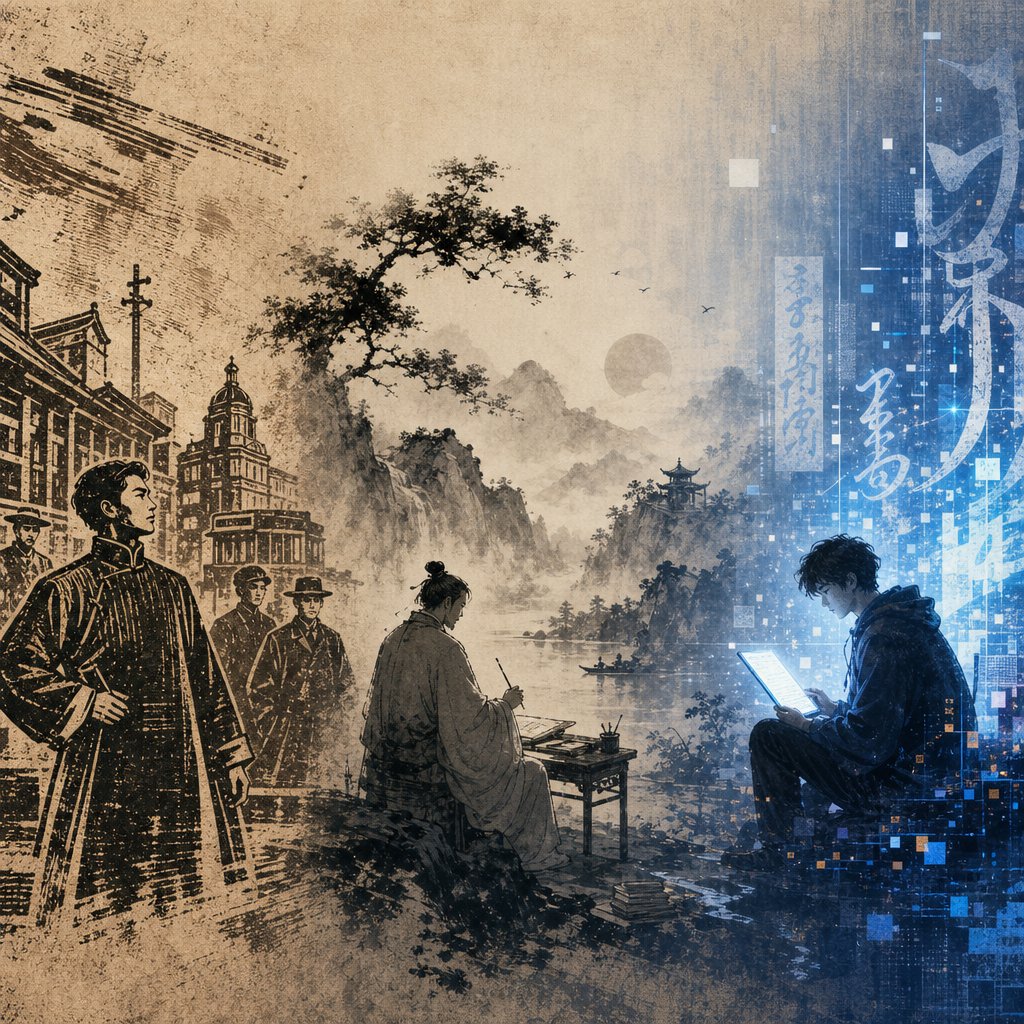
Naming in wuxia fiction did not arrive fully formed. Like the genre itself, the history of wuxia naming conventions traces a clear arc from functional simplicity toward literary sophistication, and then into a new kind of complexity shaped by digital serialization. Each era produced names that reflected not only the stories being told but the audiences reading them and the publishing conditions shaping them.
Early Wuxia and the Roots of Naming Convention
The Republican era (1920s-1950s) gave birth to wuxia as a popular fiction genre. Writers like Xiang Kairan (向恺然), Huanzhu Louzhu (还珠楼主), and Wang Dulu (王度庐) established the earliest naming patterns. Their approach leaned toward directness. Republican era wuxia novel names often functioned as transparent descriptors of martial identity. A swordsman might carry a name that literally referenced his weapon or fighting style. Epithets like Huo Zhentian (霍震天, "Huo Who Shakes the Heavens") or Tie Feilong (铁飞龙, "Iron Flying Dragon") told readers exactly what kind of fighter they were encountering.
These names prioritized immediate legibility. Serialized in newspapers and consumed by broad popular audiences, early wuxia needed names that announced a character's role without requiring deep literary knowledge to decode. Surnames were common ones, given names were bold and martial, and subtlety was secondary to impact.
The Golden Age Revolution in Character Naming
The golden age wuxia naming styles that emerged in the 1950s through 1980s transformed the genre's relationship with language. Jin Yong character naming evolution is the clearest example of this shift. Where earlier authors named warriors, Jin Yong named people. His characters carry names drawn from classical poetry, philosophical texts, and historical allusion. Guo Jing (郭靖) references the Jingkang Incident, a national humiliation. Huang Rong (黄蓉) evokes the lotus (furong), suggesting beauty and intelligence rooted in nature.
Gu Long pushed in a different direction. His names became shorter, sharper, and more atmospheric. A character named Ximen Chuixue (西门吹雪, "Westgate Blowing Snow") communicates cold lethality through imagery rather than allusion. Liang Yusheng, meanwhile, maintained a scholarly elegance, drawing names from Tang and Song dynasty poetry with careful attention to tonal balance.
The golden age made naming a site of artistic competition. Each author's naming philosophy became a signature, distinguishable at a glance.
Modern Web Novel Naming Patterns
Contemporary web novel wuxia naming patterns reflect a different set of pressures. Serialized daily on platforms like Qidian, these stories must introduce large casts quickly and make names memorable across thousands of chapters. The result is a hybrid approach: names often combine classical-sounding elements with more exaggerated or fantastical components. Compound surnames have become more common, power-level signifiers appear more frequently, and names sometimes function as genre markers that signal to readers whether a character belongs to a cultivation system, a mortal jianghu, or a divine realm.
Web novels also introduced naming as reader engagement. Authors sometimes poll audiences on character names, and popular naming tropes get recycled across works, creating a shared vocabulary that earlier eras never had.
| Era | Representative Author | Example Name | Structural Features |
|---|---|---|---|
| Republican (1920s-1950s) | Huanzhu Louzhu | Tie Feilong (铁飞龙) | Literal martial descriptor, common surname, bold imagery |
| Golden Age (1950s-1980s) | Jin Yong | Linghu Chong (令狐冲) | Rare compound surname, poetic given name, philosophical layering |
| Golden Age (1950s-1980s) | Gu Long | Ximen Chuixue (西门吹雪) | Compound surname, atmospheric imagery, phonetic rhythm |
| Golden Age (1950s-1980s) | Liang Yusheng | Zhang Danfeng (张丹枫) | Common surname, classical poetic imagery, tonal elegance |
| Modern Web Novel (2000s-present) | Various | Ye Chen (叶尘) / Su Mo (苏墨) | Short, punchy, power-suggestive elements, rapid memorability |
This evolutionary trajectory reveals something important: naming conventions do not just reflect literary taste. They reflect the material conditions of storytelling. Newspaper serialization demanded clarity. Dedicated novel readerships rewarded complexity. Digital platforms incentivize memorability and genre signaling. Each era's names are perfectly adapted to their ecosystem, and understanding that context is essential before attempting to classify the types of names these systems produce.
A Complete Taxonomy of Wuxia Name Types
A single wuxia character rarely carries just one name. Across the span of a novel, the same person might be introduced by a birth name, addressed by a courtesy name, feared under a jianghu alias, and remembered by a posthumous title. Each layer encodes different information and operates in different social contexts. Understanding the types of names in wuxia fiction means understanding that identity in this genre is not fixed. It is relational, contextual, and earned.
Think of it this way: a character's birth name tells you where they came from. Their courtesy name tells you who they became. Their alias tells you what the world made of them. This wuxia character name taxonomy is not just academic classification. It is the architecture through which authors control how much readers know about a character at any given moment.
Birth Names and the Weight of Family Expectation
The birth name, or ming (名), is the foundation. In traditional Chinese culture, a father bestowed the ming when a child was roughly three months old, once the infant could respond to sound and make eye contact. As the classical dictionary Shuowen Jiezi explains, the original function of the ming was to announce identity when people encountered each other in darkness. It is the most intimate, most personal layer of naming.
In wuxia fiction, birth names carry the weight of parental aspiration. Guo Jing (郭靖) bears a name chosen by his mother to remember a national tragedy. Yang Guo (杨过) carries the character "过" (mistake or excess) because his father's sins haunt the family. You'll notice that authors use birth names strategically: they reveal family values, foreshadow burdens the character must carry, and establish the emotional baseline from which a character's arc departs.
Crucially, who uses a character's ming matters. Elders and superiors call someone by their birth name. Peers using it signals either deep intimacy or deliberate disrespect. When a villain addresses a hero by their ming in front of the jianghu, it is a power move, an assertion of superiority.
Courtesy Names and Social Identity
The courtesy name, or zi (字), marks the transition from child to adult. Rooted in Zhou dynasty etiquette, young men received their zi during the capping ceremony at age twenty, while women received theirs during the hair-pinning ceremony at fifteen. The distinction between birth name versus courtesy name in wuxia reflects a fundamental social boundary: the ming belongs to family, while the zi belongs to the world.
Chinese courtesy names in martial arts novels function as social passports. They typically expand upon or complement the birth name's meaning. The famous strategist Zhuge Liang, whose ming means "bright," carried the zi Kongming (孔明), meaning "wise as Confucius." Sometimes the relationship is antonymous: the Tang dynasty scholar Han Yu, whose name means "progress," took the zi Tuizhi (退之, "stepping back"), expressing the Confucian virtue of modesty.
Wuxia authors exploit this system to create layered characterization. A character's zi might reveal virtues they aspire to but have not yet achieved, or it might ironically contradict their actual behavior, creating tension the reader feels before the plot confirms it.
Beyond ming and zi, the literary name or hao (号) is self-chosen. It expresses personal philosophy or artistic identity. Jianghu aliases operate differently still. They are bestowed by the martial world itself, earned through deeds or reputation, and function as public-facing brands. Sect titles encode organizational rank. Posthumous names summarize a life after death.
How Social Class Shapes Naming Patterns
The jianghu alias naming system explained above applies primarily to those with status. Social hierarchy determines not just what names a character carries but how many naming layers they possess. A nobleman might hold a birth name, courtesy name, literary name, and multiple aliases. A servant might have only a single-character name, or worse, a number.
Servants and slaves in wuxia fiction often carry diminutive names: single characters, animal references, or simple descriptors like Xiao (小, "little") followed by a common word. This naming poverty signals their lack of social personhood. When a servant character earns a full name or an alias, it marks a genuine transformation in status.
Courtesans occupy a fascinating middle ground. They adopt elegant, poetic names drawn from flower imagery, classical verse, or musical terminology. These names are professional constructions, beautiful surfaces that simultaneously grant cultural capital and erase personal history. A courtesan named Lian Xing (怜星, "pitying the stars") carries aesthetic weight but no family lineage, no generational marker, no ancestral claim.
| Name Type | Chinese Term | Function | Who Uses It | Narrative Appearance | Canonical Example |
|---|---|---|---|---|---|
| Birth Name (Ming) | 名 | Core identity, family aspiration | Elders, superiors, intimates | Introduction, private scenes | Guo Jing (郭靖) |
| Courtesy Name (Zi) | 字 | Social adult identity, virtue signaling | Peers, formal address | Social interactions, formal contexts | Kongming (孔明) |
| Literary Name (Hao) | 号 | Self-expression, philosophical stance | Self-reference, admirers | Scholarly or artistic contexts | Dongpo Jushi (东坡居士) |
| Jianghu Alias | 绰号/外号 | Reputation, martial identity, fear | The martial world at large | Introductions, combat, legend | Dongxie (东邪, Eastern Heretic) |
| Sect Title | 门派称号 | Organizational rank, lineage | Disciples, rivals, narration | Sect politics, hierarchical scenes | Wudang Zhang Zhangjiao (武当张掌教) |
| Posthumous Name | 谥号 | Legacy summary, moral judgment | Later generations | Epilogues, historical framing | Jian Mo (剑魔, Sword Demon) |
Each naming layer gives authors a different tool for controlling information flow. Revealing a character's true ming after chapters of knowing them only by alias creates dramatic weight. Stripping a character of their courtesy name signals social exile. The taxonomy is not static classification. It is a dynamic system that authors manipulate to generate tension, surprise, and emotional resonance. And nowhere is that manipulation more visible than in the jianghu alias, where names are not inherited or bestowed by family but forged in the fires of reputation.
Jianghu Aliases and Titles That Build Worlds
Reputation in the martial world is not self-declared. It is collectively authored. A jianghu alias does not come from a parent's hope or a scholar's ceremony. It emerges from the accumulated weight of deeds witnessed, battles survived, and legends retold across teahouses and mountain passes. This makes aliases fundamentally different from every other name type in wuxia fiction. They are living names, shaped by public perception, and they can evolve, shift, or be stripped away entirely.
The Four Cardinal Masters and Alias Architecture
No example illustrates the architecture of jianghu aliases better than Jin Yong's Five Greats (天下五绝, Tianxia Wujue) from The Legend of the Condor Heroes. Each title compresses geographic identity, moral alignment, and martial reputation into just two characters:
- 东邪 (Dongxie) - Eastern Heretic: Huang Yaoshi. "East" marks his island domain. "Heretic" captures his rejection of Confucian orthodoxy.
- 西毒 (Xidu) - Western Venom: Ouyang Feng. "West" signals his origin in the White Camel Mountain region. "Venom" encodes both his poison-based martial arts and his moral corruption.
- 南帝 (Nandi) - Southern Emperor: Duan Zhixing. "South" places him in the Dali Kingdom. "Emperor" is literal. He is actual royalty who later renounces his throne.
- 北丐 (Beigai) - Northern Beggar: Hong Qigong. "North" marks his roaming territory. "Beggar" identifies his role as chief of the Beggars Gang while subverting expectations. The most powerful martial artist in the north is a homeless wanderer.
- 中神通 (Zhong Shentong) - Central Divinity: Wang Chongyang. "Central" claims the geographic and philosophical center. "Divinity" reflects his Daoist mastery.
You'll notice the pattern: direction plus defining trait. This formula maps the entire martial world onto a compass, turning five individuals into a cosmological system. The Eastern Heretic Western Poison naming analysis reveals that Jin Yong was not simply labeling characters. He was building a spatial mythology where each cardinal direction carries philosophical weight.
How Aliases Encode Reputation and Power
What makes the wuxia title and epithet system so narratively powerful is that aliases carry social proof. When someone whispers "Western Venom is coming," the name itself does the work of a hundred pages of backstory. It communicates danger, specialty, and moral alignment in a breath. This is how wuxia characters earn their names: through deeds so distinctive that the community crystallizes them into a permanent label.
Aliases also encode power hierarchies. The Five Greats hold their titles because they competed on Mount Hua and proved their supremacy. In the sequel, The Return of the Condor Heroes, a second generation inherits the structure but with shifted titles: Guo Jing becomes "Northern Hero" (北侠, Beixia), Zhou Botong becomes "Central Urchin" (中顽童, Zhong Wantong), and Yang Guo becomes "Western Eccentric" (西狂, Xikuang). The geographic framework persists, but the moral descriptors change to reflect new personalities. The system is stable. The individuals within it are not.
Earned Names Versus Given Names in Narrative
This distinction between earned and given names creates one of wuxia fiction's richest narrative tensions. A birth name is fixed at infancy. An alias is fluid, contingent, and revocable. Characters can outgrow their aliases, be haunted by them, or spend entire arcs trying to live up to them.
The jianghu aliases meaning in wuxia extends across several distinct categories, each encoding different aspects of identity:
- Geographic-based: Dongxie (东邪, Eastern Heretic), Ximen Chuixue (西门吹雪, Westgate Blowing Snow). Territory as identity.
- Weapon-based: Jian Shen (剑神, Sword God), Jin Mao Shi Wang (金毛狮王, Golden-Maned Lion King). Martial specialty made visible.
- Technique-based: Tie Zhang Shui Shang Piao (铁掌水上漂, Iron Palm Skimming the Water). The signature move becomes the name.
- Moral-alignment-based: Xie (邪, Heretic), Du (毒, Venom), Xia (侠, Hero). Ethical positioning declared publicly.
- Appearance-based: Mei Chaofeng (梅超风, Plum Beyond the Wind), whose blindness and wild hair earned her the alias "Iron Corpse" (铁尸). The body becomes the brand.
Each category reveals what the martial world values most about a person. Some fighters are defined by where they stand. Others by what they wield. Still others by what they look like or what moral line they cross. The alias is a mirror held up by the collective, and it reflects not just the individual but the community's priorities and fears.
This collective authorship of identity points toward something larger. If aliases reflect how the world sees a character, then the naming philosophies of different authors reveal how those authors see the world. The same martial archetype, named by Jin Yong, Gu Long, or Liang Yusheng, becomes three entirely different literary creatures.
Naming Signatures of Jin Yong, Gu Long, and Liang Yusheng
Three authors dominated the golden age of wuxia fiction. All three wrote about swordsmen, vengeance, love, and honor. Yet you can identify which author created a character by reading the name alone. That is because comparing wuxia author naming techniques reveals not just personal preference but fundamentally different artistic philosophies about what a name should do, what it should sound like, and how much work it should perform before the story even begins.
Jin Yong and the Poetry of Names
Jin Yong naming style analysis starts with one observation: his names are dense with classical poetry references in wuxia names. He treated naming as an act of literary composition, embedding allusions that reward readers who recognize the source material. Consider the couple Yang Guo (杨过) and Xiaolongnü (小龙女). Yang Guo's name, meaning "to surpass" or "to err," was chosen by the character Guo Jing specifically to remind the boy of his father's moral failures. The name is a burden disguised as a gift.
His approach goes deeper than individual characters. In The Legend of the Condor Heroes, the names Guo Jing (郭靖) and Yang Kang (杨康) together reference the Jingkang Incident (靖康之变) of 1127, when the Jin dynasty captured two Song emperors. Two boys, one destined for patriotism and one for betrayal, carry a national humiliation split between them. The historical allusion predicts their diverging fates from the moment they are named.
Jin Yong also drew from the Book of Changes, Buddhist scripture, and Tang poetry. Mu Nianci (穆念慈) evokes compassion. Ren Yingying (任盈盈) references the Shijing (Book of Songs), where "yingying" describes graceful movement. As Liang Yusheng himself observed, Jin Yong was a "modern Westernized intellectual" in his storytelling techniques, yet his naming drew from the deepest wells of Chinese literary tradition. The result is names that function like compressed poems: beautiful on the surface, layered underneath.
Gu Long and Phonetic Minimalism
Gu Long character name philosophy could not be more different. Where Jin Yong layered allusion upon allusion, Gu Long stripped names down to mood and sound. His names prioritize atmosphere over scholarship. They hit the ear before they reach the mind.
Take Li Xunhuan (李寻欢). "Seeking joy." Two characters that immediately communicate a man chasing something he cannot find. Or Lu Xiaofeng (陆小凤), "little phoenix," a name that sounds almost playful for a legendary detective. Gu Long's genius was in the gap between the lightness of the name and the weight of the character. His names feel modern, almost cinematic. They are short, rhythmic, and designed for impact.
His villain names are equally distinctive. Xie Xiaofeng (谢晓峰, "dawn peak") sounds almost gentle for the deadliest swordsman alive. Yan Shisan (燕十三, "Swallow Thirteen") reduces identity to a surname and a number, stripping away ornamentation entirely. Where Jin Yong's antagonists carry names heavy with moral judgment, Gu Long's carry ambiguity. You cannot tell hero from villain by name alone, and that is deliberate. His naming mirrors his narrative philosophy: nothing is what it first appears.
Liang Yusheng and Classical Elegance
Liang Yusheng naming conventions occupy a third position. His names are scholarly without being cryptic, elegant without being austere. Deeply rooted in traditional Chinese literary aesthetics, Liang drew from Tang and Song dynasty poetry with careful attention to tonal balance and visual beauty. His characters' names read like lines extracted from classical verse.
Zhang Danfeng (张丹枫, "crimson maple") evokes autumn landscapes and poetic melancholy. Lian Nichang (练霓裳, "rainbow garment") directly references Bai Juyi's famous poem Song of Everlasting Sorrow and its "Rainbow Skirt and Feathered Garment Dance." Jin Shiyi (金世遗, "gold left to the world") carries both material and philosophical weight. Liang Yusheng's essay under the pen name Tong Shuozhi acknowledged that his work carried a "strong scholarly flavor" and was "more deeply influenced by traditional Chinese culture, including poetry, novels, and history." His naming practice is the purest expression of that influence.
Where Jin Yong hid allusions for attentive readers to discover, Liang Yusheng wore his classical learning openly. His names announce their literary heritage. They do not puzzle. They resonate.
| Category | Jin Yong | Gu Long | Liang Yusheng |
|---|---|---|---|
| Protagonist Style | Linghu Chong (令狐冲) - rare surname, philosophical depth, freedom implied | Chu Liuxiang (楚留香) - "lingering fragrance," sensory and atmospheric | Zhang Danfeng (张丹枫) - common surname, poetic nature imagery |
| Antagonist Style | Ouyang Feng (欧阳锋) - compound surname, "sharp" radical, moral weight encoded | Xie Xiaofeng (谢晓峰) - deceptively gentle, ambiguity as design | Meng Shentong (孟神通) - "divine mastery," power stated directly |
| Female Lead Style | Ren Yingying (任盈盈) - Shijing allusion, grace and fullness | Lin Xian'er (林仙儿) - "little fairy," surface beauty masking danger | Lian Nichang (练霓裳) - Tang poetry reference, visual splendor |
| Naming Priority | Semantic density, historical allusion, intertextuality | Phonetic rhythm, mood, atmospheric compression | Tonal elegance, classical resonance, visual beauty |
| Shared Element Usage (e.g., 剑/sword) | Embedded in context: Dugu Jiujian (独孤九剑) as technique, not name | Used as atmosphere: Jian Shen (剑神) as earned title, stark and absolute | Woven into poetry: characters named around sword imagery with lyrical framing |
The table reveals a pattern that goes beyond personal taste. Jin Yong built names as puzzles to be decoded. Gu Long built names as sensations to be felt. Liang Yusheng built names as verses to be admired. Each approach reflects a broader artistic worldview: Jin Yong the novelist-scholar, Gu Long the poet-filmmaker, Liang Yusheng the classical literatus. And each approach carries different implications for how gender, expectation, and social role get encoded into the characters who bear those names.
Gender and Naming in the Wuxia Tradition
The authorial signatures explored above do not operate in a vacuum. They intersect with one of the genre's most revealing fault lines: how gender affects wuxia character naming. Scan a cast list from any major wuxia novel and a pattern emerges almost immediately. Male names cluster around martial force, cosmic scale, and philosophical ambition. Female names gravitate toward natural beauty, sensory delicacy, and aesthetic refinement. This split is not accidental. It encodes assumptions about what men and women are for within the jianghu, and the moments when authors break the pattern tell us as much as the moments they follow it.
Gendered Elements in Wuxia Name Construction
Female character names in wuxia novels draw from a remarkably consistent palette. Flowers, jade, moonlight, mist, fragrance, and color dominate. Huang Rong (黄蓉) carries the lotus. Xiao Longnu (小龙女) is the "little dragon maiden," but her identity is defined by the word nü (女, girl/woman) appended to a mythical creature. Wang Yuyan (王语嫣) means "speaking of beauty." Ren Yingying (任盈盈) evokes graceful fullness. The wuxia heroine name meanings tend to position women as objects of perception rather than agents of action.
Male names operate differently. Guo Jing (靖) means "pacify" — a verb of national consequence. Xiao Feng (萧峰) carries "peak," suggesting summit and dominance. Zhang Wuji (张无忌) means "without taboo," implying fearlessness. Linghu Chong (令狐冲) means "to rush forward." These names encode movement, force, and will. The gendered naming conventions in Chinese fiction become visible when you line the elements side by side.
| Chinese Character | Meaning | Frequency in Male Names | Frequency in Female Names |
|---|---|---|---|
| 龙 (long) | Dragon | High | Low (usually modified by 女/小) |
| 剑 (jian) | Sword | High | Rare |
| 铁 (tie) | Iron | High | Very rare |
| 峰 (feng) | Peak / Summit | High | Low |
| 蓉/莲 (rong/lian) | Lotus | Very rare | High |
| 玉 (yu) | Jade | Moderate | High |
| 月 (yue) | Moon | Low | High |
| 烟/霞 (yan/xia) | Mist / Rosy clouds | Very rare | High |
| 天 (tian) | Sky / Heaven | High | Low |
| 香 (xiang) | Fragrance | Low (Gu Long exception) | High |
The pattern is clear. Male names claim the vertical axis: sky, peak, dragon. Female names occupy the sensory plane: fragrance, moonlight, jade. This is not unique to wuxia — it reflects broader Chinese literary tradition — but the martial arts genre amplifies the divide because the central question of the genre is who fights and how.
Subversive Naming and Gender Expectation
The most interesting cases are the subversive female names in martial arts fiction — characters whose names deliberately violate gendered expectations. When an author gives a woman a "male" name, or gives a man a "female" name, the dissonance is always narratively purposeful.
Gu Long named his deadliest female assassin Lin Xian'er (林仙儿, "little fairy") — a name so delicate it becomes a weapon. Every man who underestimates her because of that name dies for it. The sweetness is the trap.
Jin Yong's Mu Nianci (穆念慈, "thinking of compassion") carries a name that sounds passive and gentle, yet she is one of the most emotionally resilient characters in The Legend of the Condor Heroes, surviving abandonment and raising a child alone in a hostile world. The gap between the softness of her name and the steel of her actions creates a quiet tension that runs through her entire arc.
Conversely, consider Dongfang Bubai (东方不败, "Invincible East"). This character's name is maximally masculine — geographic dominance plus absolute martial supremacy — yet the character undergoes a gender transformation through practicing a forbidden technique. The hyper-masculine name becomes ironic, then tragic, then something else entirely. The name does not change. The person beneath it does.
What Female Names Reveal About Authorial Intent
How an author names female characters reveals whether those characters exist as full participants in the narrative or as aesthetic objects within it. When every woman in a novel carries a flower-and-jade name while every man carries a sword-and-sky name, the naming system itself enforces a hierarchy: men act, women are perceived.
Jin Yong partially escaped this trap. Huang Rong's lotus name might suggest decorative beauty, but her character is the sharpest strategist in the novel. The name sets up an expectation that the character then demolishes. Zhao Min (赵敏, "quick/sharp") in The Heaven Sword and Dragon Saber carries a name with no floral softness at all — just intellectual acuity. These choices signal that Jin Yong saw his heroines as minds, not ornaments.
Gu Long's approach is more ambivalent. His female names tend toward the ethereal and seductive — Xian'er (fairy), Lian (lotus), Feng (phoenix) — and his female characters often function as mysteries to be decoded by male protagonists. The names are beautiful, but they frequently serve the male gaze rather than granting independent identity.
Liang Yusheng occupies a middle ground. His heroines carry classically elegant names, but many are also martial equals to his heroes. Lian Nichang (练霓裳) bears a name of extraordinary poetic beauty, yet she is the deadliest swordswoman in her novel. The elegance of the name does not diminish her lethality. It coexists with it.
These gendered patterns are not merely cosmetic. They shape how readers perceive characters before a single action is taken, and they reveal the degree to which each author imagined women as subjects of their own stories or as reflections in someone else's. The naming system, in this sense, is a diagnostic tool for literary ideology. And it operates not just at the level of individual characters but at the level of entire organizations — sects and clans whose naming architectures encode collective identity, hierarchy, and belonging.
When Names Foreshadow Fate and Story Arcs
Names in wuxia fiction do not merely describe who a character is at the moment of introduction. They describe who that character will become. The genre treats naming as a form of narrative foreshadowing so precise that attentive readers can predict a character's trajectory from the first time their name appears on the page. This is not coincidence or retrospective interpretation. Wuxia authors deliberately embed destiny into nomenclature, planting seeds in syllables that bloom only at climactic moments. Understanding how wuxia names predict story outcomes transforms the reading experience from passive consumption into active decoding.
Names That Predict Character Destiny
The most direct form of name-based foreshadowing involves characters whose names contain elements of their eventual fate. Consider Yang Kang (杨康) from Jin Yong's The Legend of the Condor Heroes. His name references the Jingkang Incident, a moment of national betrayal and collapse. Paired with Guo Jing (郭靖), whose name references the same event but from the side of resistance, the two boys carry a split prophecy from birth. One will be loyal. One will betray. The names told you before the plot did.
This technique runs throughout the genre. A character named Xue Feng (血风, "Blood Wind") is not destined for a quiet retirement. A warrior called Mu Can (暮残, "fading dusk") carries decline in every stroke of his name. As one analysis of wuxia naming conventions puts it, "a well-crafted name isn't just poetic — it's a prophecy." The character named Tian Wu (天无, "Heavenly Void") may struggle with emptiness and existential crisis. The character named Duan Chang (断肠, "severed intestines," a classical idiom for heartbreak) will suffer devastating loss. These are not subtle hints. They are declarations written in a language the reader may not fully decode until the story confirms them.
Wuxia names that foreshadow character fate work because Chinese characters carry independent semantic weight. Every syllable is a meaning-unit. English names can obscure their etymology behind centuries of phonetic drift, but a Chinese reader encounters the literal meaning of a name every single time they read it. The foreshadowing is always visible. It simply waits for the narrative to catch up.
Hidden Meanings Revealed at Climactic Moments
More sophisticated than direct prediction is the technique of concealed meaning — names whose full significance only becomes apparent at a turning point in the story. This is narrative foreshadowing through character names at its most elegant. The reader sees the name early, registers it as a name, and only later realizes it was a spoiler hiding in plain sight.
Jin Yong's Wu Xin (无心, "Heartless") from The Blood of Youth illustrates this layering. The name appears to describe a Buddhist monk's detachment from worldly emotion. Simple enough. But as the story unfolds and reveals his birth name — Ye An Shi (叶安世, "Leaf of Peaceful World") — the gap between the two names becomes the entire emotional architecture of his arc. He was born into peace. He chose heartlessness. The hidden meanings in wuxia character names emerge not through external revelation but through the accumulation of narrative context that reframes what was always there.
Xiao Se (萧瑟) means "bleak" and "desolate." For most of the story, this reads as melancholy — a fallen prince wearing his sadness as a name. Only when his true identity as Xiao Chu He (萧楚河) resurfaces does the reader understand: the bleakness was not just mood. It was exile made literal. He erased his river-and-kingdom name and replaced it with the sound of wind through dead leaves.
This technique depends on the reader's growing literacy. Early in a novel, names register as sounds. By the midpoint, readers have absorbed enough context to start hearing the meanings. The climactic revelation does not introduce new information. It activates information that was dormant all along. The name was always a spoiler. The reader simply was not yet equipped to read it.
Name Changes as Markers of Transformation
Perhaps the most powerful use of naming as narrative device occurs when characters change their names entirely. In wuxia fiction, a name change is never cosmetic. It signals a fundamental rupture in identity — a death of the old self and birth of something new. Name changes in wuxia character arcs function as structural markers that divide a character's story into distinct phases.
The pattern typically unfolds in a recognizable sequence:
- Introduction under a false or partial name. The character enters the story with a name that feels complete but is actually a mask. Readers accept it as identity.
- Accumulation of contradictions. The character's actions, relationships, or abilities begin to strain against what their name implies. Something does not fit.
- Crisis of identity. An external event — betrayal, revelation, loss — forces the character to confront the gap between name and self.
- Name revelation or name change. The true name surfaces, or a new name is claimed. This moment carries the weight of the entire preceding arc.
- Reintegration. The character moves forward under their true or new name, and the narrative treats them differently. Other characters may literally address them differently. The world reorganizes around the renamed person.
Xiao Se's arc in The Blood of Youth follows this structure precisely. He enters as Xiao Se (bleak). He lives as a seemingly powerless innkeeper. His true name, Xiao Chu He, and his title, Prince Yong An (永安王, "Prince of Eternal Peace"), surface only when the story demands he reclaim his identity. The deep irony — a prince of "eternal peace" living in a world of constant violence — becomes legible only at the moment of revelation.
Concealment works in the opposite direction too. When a character's true name is hidden from the reader, the withholding itself generates tension. You sense the gap. You know something is being kept from you. Every scene carries the unspoken question: who is this person really? The eventual naming becomes a release of narrative pressure that has been building for chapters or even volumes.
This technique also applies to villains whose birth names reveal sympathetic origins. A terrifying antagonist known only by a fearsome alias — say, "Blood Demon" or "Soul Reaper" — becomes a different kind of tragic when their birth name surfaces and it means something like "hoping for spring" or "cherishing peace." The distance between the birth name and the earned name maps the entire moral fall. The reader does not need a flashback. The two names are the flashback, compressed into syllables.
Naming as foreshadowing works because wuxia authors understand that readers process names differently at different points in a story. A name encountered on page one is furniture. The same name, reexamined on page five hundred after everything it predicted has come true, is architecture. The craft lies in building names that function at both scales — legible enough to feel natural on first encounter, dense enough to reward retrospective analysis. And this individual-level technique scales upward. When entire organizations adopt shared naming systems, the same principles of encoded meaning and structural foreshadowing operate collectively, shaping not just single characters but the identity architecture of sects and clans.
Sect and Clan Names as Identity Architecture
Individual names encode individual destiny. But wuxia characters rarely exist in isolation. They belong to sects, clans, schools, and orders whose names function as philosophical declarations, geographic claims, and martial manifestos all at once. The organizational name is the first thing a character inherits upon joining, and often the last thing stripped from them upon exile. Wuxia worldbuilding through organizational names creates an entire layer of meaning that sits above individual identity, shaping how characters are perceived, how they perceive themselves, and how rival factions define themselves in opposition.
Sect Names as Philosophical Statements
Consider the most iconic Wudang Shaolin naming patterns. Shaolin (少林) means "young forest," referencing the wooded slopes of Song Mountain where the temple sits. But the name also carries Buddhist resonance: the forest as a place of retreat, simplicity, and discipline. Wudang (武当) combines "martial" (武) with "appropriate" or "match" (当), implying martial arts practiced in proper balance — a Daoist principle made visible in two characters. These are not arbitrary labels. They are condensed ideological statements.
The anatomy of a sect name typically follows recognizable structural patterns that signal hierarchy, philosophy, and alignment. A suffix like Temple (寺) or Monastery (庵) marks Buddhist affiliation. Sect (宗) or School (派) indicates structured martial lineage. Cult (教) or Order (帮) often signals outlawed or heterodox factions. The suffix alone tells you where an organization sits on the moral spectrum before you learn anything about its members.
How sect names reflect martial philosophy becomes especially clear in contrasting pairs. Wudang's Daoist balance opposes Shaolin's Buddhist discipline. The Heavenly Demon Sect (天魔教) announces transgression in its very name, positioning itself against orthodox schools through linguistic opposition. Snow Moon City (雪月城) evokes poetic beauty, signaling a faction that values elegance alongside lethality. Rival sects do not just fight with different techniques. They fight with different aesthetics, and those aesthetics begin at the level of the name.
Individual Names Within Organizational Identity
Joining a sect means accepting its naming architecture. Wuxia sect naming conventions extend beyond the organization's title into the names of every disciple within it. In many traditions, a master bestows a new name upon accepting a student, effectively overwriting the individual's family identity with an organizational one. The disciple's name becomes a subset of the sect's name — a branch growing from the same root.
This is why exile from a sect carries such narrative weight. When a character is expelled, they lose not just training and community but a piece of their name. The sect-given identity is revoked. They must rebuild selfhood from whatever remains — their birth name, an alias earned in the wilderness, or sometimes nothing at all. Linghu Chong's expulsion from Huashan in The Smiling, Proud Wanderer strips him of his place within a naming lineage, forcing him to exist as an individual in a world that organizes identity collectively.
Naming Hierarchies and Generational Characters
The most systematic expression of organizational naming is generational character naming in wuxia clans. This practice assigns a shared character to all disciples of the same generation, creating visible cohorts within the sect's history. Imagine meeting three characters named Yuanxin, Yuanming, and Yuanzhi. The shared "Yuan" (元) immediately tells you they trained together, entered the sect in the same era, and hold equivalent rank. Without a word of exposition, the naming system has communicated organizational structure.
Major sect naming patterns with generational elements include:
- Shaolin Temple: Disciples share a generational character drawn from a Buddhist poem or sutra. Characters like Yuanyin (圆音), Yuanjue (圆觉), and Yuanzhen (圆真) all belong to the "Yuan" generation, marking them as peers in the monastic hierarchy.
- Wudang Sect: Generational characters often draw from Daoist cosmological terms. A generation might share "Chong" (冲, emptiness) or "Song" (松, pine/relaxation), embedding Daoist philosophy into every disciple's identity.
- Huashan Sect: In Jin Yong's novels, the sect splits into Sword and Qi factions, and naming patterns diverge along factional lines — the names themselves become battlegrounds for ideological control.
- Emei Sect: Female-dominated in many novels, Emei naming often draws from Buddhist and nature imagery, with generational characters like "Jing" (静, stillness) or "Miao" (妙, wondrous) reflecting contemplative values.
- Clan families (e.g., Murong, Duan): Blood clans use generational characters tied to ancestral poems that predetermine naming for centuries. Each generation's shared character is the next word in the poem, creating a living timeline encoded in names.
This system means that a character's name reveals their approximate age, their rank relative to other sect members, and their place in the organization's history. A senior disciple from an earlier generation carries a different shared character than a junior one, and any reader familiar with the sect's naming poem can place them precisely. The hierarchy is not just social. It is linguistic.
The collective dimension of naming also explains why rogue characters feel so disruptive. A wanderer with no generational character, no sect suffix, no organizational marker in their name exists outside the system entirely. They cannot be placed, ranked, or predicted. In a world where names encode belonging, namelessness — or a name that belongs to no lineage — is its own form of power and its own form of threat. That unplaceable quality is precisely what makes translation so difficult. When these layered naming systems cross into English, entire dimensions of meaning collapse into flat romanization, and the architecture becomes invisible.
What Gets Lost When Wuxia Names Are Translated
Every naming system discussed so far — the generational characters, the gendered elements, the foreshadowing, the philosophical layering — operates in Chinese. The moment a name crosses into English, something breaks. Sometimes it is the meaning. Sometimes it is the sound. Often it is both. The wuxia name translation challenges facing readers, translators, and writers are not merely technical. They are structural. An entire dimension of literary craft becomes invisible when names are flattened into romanization or converted into English equivalents that carry different cultural weight.
The Phonetic Dimension Lost in Romanization
Chinese is a tonal language. The same syllable pronounced in different tones carries entirely different meanings. Beyond semantics, tonal patterns create aesthetic texture. A name like Xiao Feng (萧峰) drops from a falling tone into a rising one, mimicking the arc of something that descends and then soars — fitting for a character who falls from grace and rises again. Linghu Chong (令狐冲) moves through tones that feel restless, unresolved, matching the character's refusal to settle into orthodoxy.
English readers processing pinyin hear none of this. "Xiao Feng" becomes two flat syllables with no tonal movement, no phonetic meaning lost in wuxia name romanization recovered. The music disappears. Chinese readers experience names as sound-meaning composites where the auditory shape reinforces the semantic content. English readers experience them as opaque letter clusters that must be memorized rather than felt.
Authors also exploit homophones and near-homophones for wordplay that vanishes entirely in translation. A character whose name sounds identical to a word meaning "death" or "separation" carries an ominous resonance that no romanization system can preserve. The phonetic dimension is not decoration. It is a narrative channel that goes silent the moment a name leaves Chinese.
Translation Strategies and Their Tradeoffs
Translators working on how to translate Chinese character names to English face an impossible choice. Every strategy preserves something and sacrifices something else. Anna Holmwood's landmark 2018 translation of Jin Yong's Legends of the Condor Heroes (A Hero Born) illustrates the full spectrum of approaches — and the debates they generate.
Holmwood kept some names in pinyin (Guo Jing), translated others into English meaning (Ironheart Yang for Yang Tiexin), created hybrid forms (Lotus Huang for Huang Rong), and even substituted culturally equivalent names (Kholjin for Huazheng). Her reasoning was contextual: "For me it was more about creating a feel across the whole text and taking into the needs within the context of a paragraph. Do I go for something poetic, or something that is accurate?"
The pinyin versus translated wuxia names debate reveals a fundamental tension. Pinyin preserves the original sound and cultural authenticity but renders meaning invisible to non-Chinese readers. Direct translation makes meaning accessible but often sounds clunky or loses tonal beauty. As translator Nick Stember noted in discussing the same translation, "Chinese has no verb tenses, no subject, and has lots of freedom. English has more synonyms, more words. Chinese is more concise." That concision is precisely what makes wuxia names so powerful — and so resistant to translation.
Holmwood's choice to render Huang Rong (黄蓉) as "Lotus Huang" was driven by a cultural adaptation strategy. The character "蓉" more precisely means hibiscus, but Holmwood chose "Lotus" because it sounded more like a name in English, carried feminine associations that signaled the character's gender (important for a plot point where she disguises herself as a boy), and evoked similar aesthetic qualities. Similarly, Ouyang Feng became "Viper Ouyang" — not a translation of his given name "锋" (sharpness) but an adaptation of his moral character into a natural image familiar to Western readers.
| Method | Example | What Is Preserved | What Is Lost |
|---|---|---|---|
| Pure Pinyin | Guo Jing (郭靖) | Original sound, cultural authenticity, tonal structure | Semantic meaning, emotional resonance, foreshadowing |
| Direct Meaning Translation | Ironheart Yang (杨铁心) | Character trait, immediate comprehension | Chinese phonetic beauty, cultural register, subtlety |
| Hybrid (Meaning + Surname) | Lotus Huang (黄蓉) | Gender signal, partial meaning, surname authenticity | Precise botanical reference, tonal aesthetics, naming conventions |
| Cultural Adaptation | Viper Ouyang (欧阳锋) | Moral alignment, character essence, readability | Original meaning of given name, literary allusion, phonetic identity |
| Full Substitution | Kholjin (华筝/Huazheng) | Historical authenticity of ethnic origin | Original Chinese name entirely, author's chosen sound |
No single approach wins. Each translation decision is a triage — deciding which dimension of the name matters most for that particular character in that particular narrative moment. The controversy surrounding Holmwood's choices (some readers praised the accessibility, others felt the names became "clunky" or reduced characters to "kitschy monikers") demonstrates that this triage is inherently subjective. A translation is never finished, as Holmwood herself acknowledged.
Building Authentic Names Through Understanding
Name generators and reference tools have proliferated online, offering writers quick access to Chinese character combinations sorted by meaning, element, or genre convention. These tools serve a purpose: they lower the barrier to engagement and help non-Chinese speakers avoid obvious errors like combining characters that sound awkward together or carry unintended meanings.
But generators operate at the surface level. They can combine "sword" with "shadow" or "moon" with "frost" and produce something that looks like a wuxia name. What they cannot do is embed the kind of layered literary craft this analysis has explored — the historical allusions, the generational markers, the gendered subversions, the foreshadowing that only resolves hundreds of pages later. A generator does not know that your character's name should echo a Tang dynasty poem because her arc parallels a classical tragedy. It does not know that giving a villain a gentle birth name will make his fall more devastating when revealed.
The difference between a generated name and a crafted name is the difference between a word and a sentence. One fills a slot. The other tells a story. Understanding the literary principles behind wuxia naming — the taxonomy of name types, the authorial signatures, the narrative mechanics of concealment and revelation — equips readers to hear what translations cannot fully convey and equips writers to build names that function the way the masters intended: as compressed narratives, as prophecies, as weapons drawn before the first chapter ends.
Every name in wuxia fiction is doing work. The richer your understanding of that work, the more the genre gives back — whether you are reading in Chinese, reading in translation, or building a martial world of your own.
Frequently Asked Questions About Wuxia Character Names
1. Why are wuxia character names so meaningful compared to Western fantasy names?
Chinese characters (hanzi) each carry independent semantic meaning, so combining them in a name creates layered readings that simultaneously encode social status, moral alignment, martial specialty, and narrative foreshadowing. Unlike English names where etymology is often hidden behind centuries of phonetic drift, Chinese readers encounter the literal meaning of every syllable each time they read a name. This makes wuxia naming a uniquely efficient storytelling tool where a two-to-four character name can function as compressed prophecy, philosophical statement, and character summary all at once.
2. What is the difference between a birth name, courtesy name, and jianghu alias in wuxia fiction?
A birth name (ming) is given by parents and encodes family aspiration and lineage. It is the most intimate naming layer, used only by elders, superiors, or close intimates. A courtesy name (zi) is received during a coming-of-age ceremony and serves as the social adult identity used by peers in formal settings. A jianghu alias, by contrast, is earned through deeds and bestowed by the martial world community. It encodes public reputation, martial specialty, and moral alignment as perceived by others. Each layer operates in different social contexts and reveals different facets of identity.
3. How do Jin Yong, Gu Long, and Liang Yusheng differ in their character naming styles?
Jin Yong embeds classical poetry references, historical allusions, and philosophical layering into names that reward literary knowledge to decode. Gu Long prioritizes phonetic rhythm, atmospheric mood, and minimalist impact, creating names that hit the ear before they reach the mind. Liang Yusheng draws from Tang and Song dynasty poetry with careful attention to tonal balance and visual beauty, producing names that read like extracted lines of classical verse. These differences reflect their broader artistic philosophies: Jin Yong the novelist-scholar, Gu Long the poet-filmmaker, and Liang Yusheng the classical literatus.
4. How do wuxia authors use character names to foreshadow plot outcomes?
Authors embed destiny into names through characters whose semantic meaning predicts their trajectory. Yang Kang's name references the Jingkang Incident of national betrayal, foreshadowing his eventual treachery. More sophisticated techniques include concealed meanings that only become apparent at climactic moments, and name changes that mark fundamental identity transformations. A character might enter a story under a partial or false name, accumulate contradictions between their actions and their name's implications, then experience a revelation where the true name surfaces and reframes everything the reader thought they knew.
5. What challenges arise when translating wuxia character names into English?
Translation forces an impossible triage between preserving sound, meaning, and cultural context. Pure pinyin keeps the original phonetics but renders semantic meaning invisible. Direct meaning translation makes names comprehensible but often sounds clunky and loses tonal beauty. Hybrid approaches like 'Lotus Huang' for Huang Rong preserve partial meaning and gender signals but sacrifice precise botanical references and naming convention context. Additionally, tonal patterns that reinforce character traits, homophone wordplay, and generational naming markers all vanish entirely in romanization, collapsing multiple dimensions of literary craft into flat letter clusters.