Chen and Chan Are Not What You Think
Imagine two cousins at a family reunion. One has "Chen" on their passport, the other has "Chan." They share the same grandparents, the same ancestral village, even the same Chinese character on the family altar. Yet their official documents tell a different story. Is chen a chinese last name, a Cantonese one, or something else entirely? And why does the same family end up with two different spellings?
This is one of the most common points of confusion among Chinese surnames worldwide. The chen surname and the chan surname appear constantly in phone directories, school rosters, and immigration records across dozens of countries. People wonder whether these are two separate family lines or simply two versions of the same name. The short answer surprises most people.
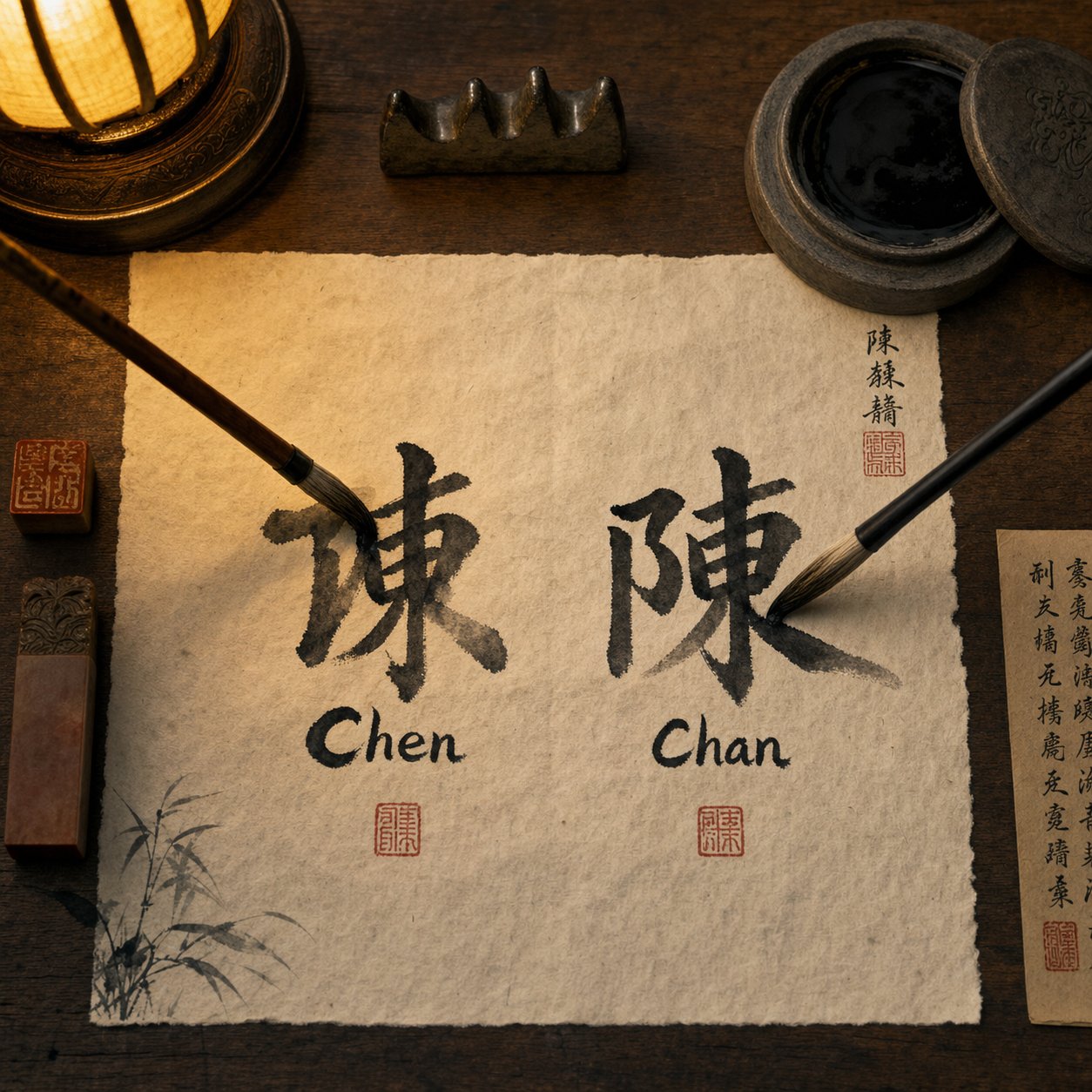
Both Chen and Chan most often derive from the exact same Chinese character: 陈 (simplified) or 陳 (traditional). The difference in spelling comes from dialect and romanization system, not from a different family origin.
Why Chen and Chan Cause So Much Confusion
The confusion runs deep because Chinese surnames work differently from Western ones. A single written character like 陈 can be pronounced in completely different ways depending on whether your family speaks Mandarin, Cantonese, Hokkien, or Teochew. When those pronunciations get transcribed into English letters, you end up with Chen, Chan, Tan, Chin, and even Dan, all from the same source. Understanding chinese last name meanings requires looking past the English spelling and back to the original character.
The character 陈/陳 is ranked #5 among the top 100 most common Chinese surnames, with tens of millions of bearers spread across Mainland China, Taiwan, Hong Kong, Singapore, and diaspora communities on every continent. That sheer scale means the spelling variations touch an enormous number of families.
What This Comparison Covers
This article ranks the five most important differences between Chen and Chan, from the most critical linguistic distinction down to the subtler historical and genealogical factors. You will learn exactly why your family spells it one way while your relatives spell it another, how geography and migration era locked in those differences, and when Chan and Chen actually refer to completely different surnames from unrelated characters. Each difference is ranked by its practical relevance for anyone researching their own ancestry or trying to understand someone else's family name.
How We Evaluated Chen vs Chan Differences
Ranking these differences requires more than personal opinion. Each distinction between Chen and Chan carries a different weight depending on whether you are a linguist, a genealogist, or simply someone trying to figure out why your cousin's last name looks different on their driver's license. So how do you decide which difference matters most?
How We Ranked These Differences
We evaluated each distinction using four criteria, listed here from most to least important:
- Linguistic significance - Does this difference stem from a fundamental structural feature of the Chinese language, such as dialect variation or romanization standards? Factors rooted in how the language itself works carry the most weight.
- Frequency of confusion - How often does this particular difference cause real misunderstandings among families, researchers, and institutions? The more people it trips up, the higher it ranks.
- Practical relevance for ancestry research - Can understanding this difference help someone trace their genealogy, reconnect with relatives, or correctly identify shared lineage?
- Historical impact - Did this factor shape how millions of people ended up with a particular spelling permanently fixed in official records?
These four criteria overlap in places, but separating them helps clarify why some distinctions deserve top billing while others serve as useful context.
Sources and Linguistic Frameworks Referenced
The comparison draws on established romanization standards: Pinyin (the official system for Mandarin in Mainland China), Jyutping (the standard for Cantonese), Wade-Giles (the older system still seen on many Taiwanese passports), and POJ or Pe̍h-oe-ji (used for Hokkien). Each system translates the same character 陈/陳 into a different English spelling, and understanding those systems is the backbone of this analysis.
Demographic data also plays a role. Chen is the 4th most common surname in the world, borne by roughly 75 million people under that specific spelling alone. When you add Chan, Tan, Tran, and other variants, the total climbs toward 80 to 100 million. That makes it one of the most common last names in China and globally, which means even small points of confusion affect an enormous population. Historical migration records from Guangdong, Fujian, and other emigration hubs round out the picture, showing how timing and geography permanently shaped which spelling a family carries today.
With these criteria and sources in place, the most fundamental distinction rises clearly to the top: the romanization system itself.
Difference 1 - Romanization Systems Create Different Spellings
The single biggest reason the family name Chen and the last name Chan look different on paper has nothing to do with ancestry, family splits, or clerical errors. It comes down to which system was used to convert a Chinese character into English letters. That process, called romanization, is where the entire confusion begins and where it can be resolved.
Pinyin vs Jyutping and What They Produce
Mandarin and Cantonese are both Chinese languages, but they sound as different from each other as Spanish does from Portuguese. Each has its own official romanization standard designed to capture its unique sounds in the Latin alphabet:
- Pinyin - The official romanization for Mandarin Chinese, adopted by the People's Republic of China in 1958 and later by international bodies. Under Pinyin, the character 陈/陳 becomes Chen.
- Jyutping - The linguistic standard for Cantonese, widely used in Hong Kong and academic contexts. Under Jyutping, the same character becomes Chan (spelled Can4 in strict Jyutping notation, but popularly written as Chan).
- Wade-Giles - An older system developed in the 19th century for Mandarin. It renders the character as Ch'en, which you still see on some Taiwanese passports.
- POJ (Pe̍h-oe-ji) - The romanization for Hokkien and other Southern Min dialects. It produces Tan from the identical character.
Each system is doing its job correctly. None of them is wrong. They simply serve different spoken languages that share the same writing system. When you see Chinese Chen on a document, you are looking at a Mandarin-based transcription. When you see Chan, you are almost always looking at a Cantonese-based one.
How One Character Becomes Multiple Spellings
Think of it this way. The character 陈/陳 is like a single musical note written on a page. A Mandarin speaker "plays" that note one way, a Cantonese speaker plays it another, and a Hokkien speaker plays it yet another. Romanization is simply the recording method for each performance. The table below shows how one character fans out into completely different English spellings depending on the language and system applied:
| Romanization System | Language/Dialect | Resulting Spelling | Primary Region |
|---|---|---|---|
| Pinyin | Mandarin | Chen | Mainland China, Singapore (official) |
| Jyutping / Yale | Cantonese | Chan | Hong Kong, Macau, Cantonese diaspora |
| Wade-Giles | Mandarin (older) | Ch'en | Taiwan (older passports) |
| POJ (Pe̍h-oe-ji) | Hokkien / Teochew | Tan | Singapore, Malaysia, Philippines |
| Quốc Ngữ | Vietnamese | Tran (Trần) | Vietnam |
The tan surname you encounter across Southeast Asia and the surname Tran common in Vietnam both trace back to this same character 陈/陳. Tran in english is simply the Vietnamese romanization of the identical root. The surname tran origin lies in Chinese migrants, particularly from Fujian, who settled in Vietnam centuries ago and whose descendants eventually founded the Tran dynasty, a golden era in Vietnamese history.
This means a person named Chen, a person named Chan, a person named Tan, and a person named Tran could all share the exact same ancestral character. The spelling difference is a product of language and geography, not lineage. Once you understand that romanization is a translation layer sitting between the Chinese character and the English alphabet, the apparent confusion dissolves into a straightforward linguistic fact.
Spelling, however, only tells you which system was applied. It does not tell you how the name actually sounds when spoken aloud, and that distinction matters more than most people realize.
Difference 2 - Mandarin vs Cantonese Pronunciation
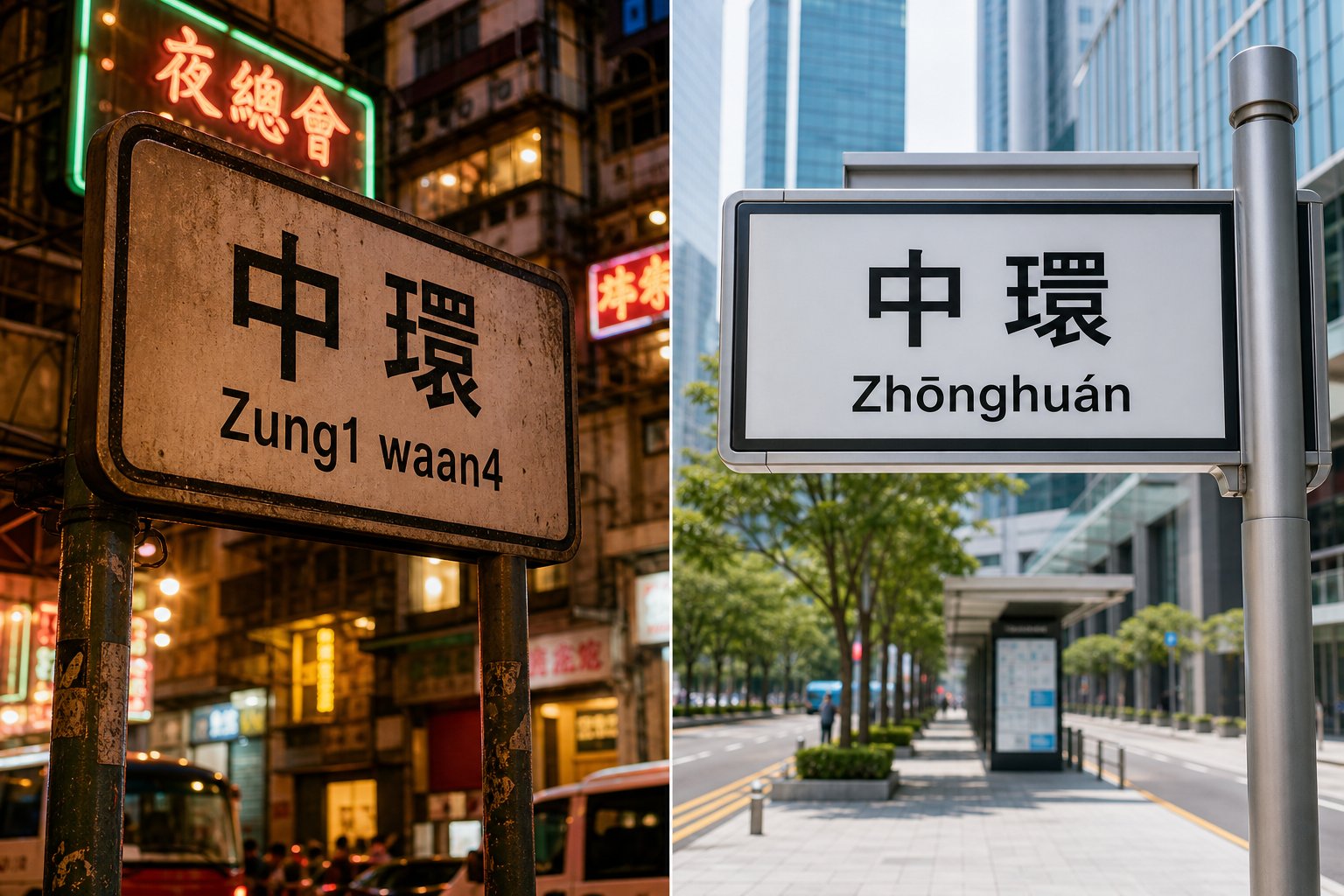
Romanization explains why the spellings differ on paper. But here is what catches people off guard: the chen last name and the chan last name do not just look different. They sound different. These are two distinct spoken words, each with its own vowel quality, consonant release, and tonal contour. A Mandarin speaker saying their surname and a Cantonese speaker saying theirs are producing genuinely different sounds from the same written character.
Mandarin Chen - How It Sounds and Where It Is Used
In Mandarin, the character 陈/陳 is pronounced Chen with a second tone (rising pitch, like the intonation of a question in English). The vowel sits somewhere between the "u" in "fun" and the "e" in "taken." If you have ever heard someone say the word chen in chinese word contexts, you will notice it rhymes roughly with the English word "nun" spoken with a rising inflection, not with "hen" as many English speakers assume.
The initial consonant is a retroflex "ch" sound, meaning the tongue curls slightly backward. This is standard across Mainland China, Taiwan, and Singapore's Mandarin-speaking communities. Whenever you meet someone whose family registered their name through a Mandarin-based system, this is the sound behind the spelling.
Cantonese Chahn - The Sound Behind the Chan Spelling
In Cantonese, the same character produces a noticeably different sound. The Jyutping notation is can4, and in Yale romanization it appears as Chahn. The tone is low and falling, giving it a deeper, more grounded quality compared to Mandarin's rising pitch. The vowel is a broad, open "ah" sound, closer to the "a" in "father." The final consonant is a clear nasal "n" that English speakers can hear distinctly.
Put simply: Mandarin Chen sounds compact and rises in pitch. Cantonese Chan sounds broader and drops in pitch. If you heard both spoken back to back without context, you might not immediately recognize them as the same surname. That is because, phonetically, they are not the same word. They are two dialect-specific pronunciations of one shared written character, each as legitimate as the other.
These two are the most widely known variants, but they are far from the only ones. Chen in chinese is read differently across every major dialect group:
- Hokkien (Southern Min) - Pronounced Tan (written as Tan in POJ romanization), with a high level tone and a clean "t" onset instead of "ch"
- Teochew - Pronounced Dang or Tang, with a voiced initial consonant that sounds nothing like either Mandarin or Cantonese
- Hakka - Pronounced Chhin (or Chin), with an aspirated "ch" and a vowel closer to the "i" in "thin"
- Hainanese - Pronounced Dan or Sin, depending on the sub-dialect
- Wu (Shanghainese) - Pronounced Zen, with a voiced initial that Mandarin speakers find unfamiliar
Every one of these is a correct reading of the character 陈/陳 within its own linguistic system. The tonal and phonetic differences are real linguistic variations rooted in centuries of independent dialect evolution, not errors or corruptions. A Hokkien speaker saying "Tan" is no more wrong than a Mandarin speaker saying "Chen." They are simply speaking different branches of the Chinese language family.
This matters for practical reasons. When families from different dialect backgrounds meet and compare surnames, pronunciation alone can be misleading. Two people who sound completely different when they say their name aloud may share the exact same character and the exact same ancestry. The reverse is also true: similar-sounding names from different characters can trick people into assuming a connection that does not exist. That geographic dimension, where each pronunciation dominates and why, shapes the next major difference.
Difference 3 - Geographic Distribution and Regional Patterns
Pronunciation tells you which dialect someone speaks. Geography tells you why they speak it. The surname Chen, the surname Chan, and the last name Tan each dominate in specific regions because those regions historically spoke different Chinese dialects and adopted different romanization standards. If you know where a family emigrated from, you can almost always predict which spelling they carry.
Where You Will Find Chen - Mainland China and Taiwan
The spelling Chen overwhelmingly belongs to Mainland China, where Pinyin has been the official romanization system since 1958. With over 71 million bearers in China alone, the chen family is staggeringly large. Global surname data ranks Chen as the 4th most common surname in the world, with approximately 75 million people carrying this exact spelling. Chen in china accounts for the vast majority of that figure, where roughly 1 in every 19 people shares this name.
Taiwan presents an interesting case. The surname Chen is the single most common surname on the island, carried by over 2.5 million people, roughly 11 percent of the population according to census data. Taiwanese names historically used Wade-Giles romanization, producing the spelling Ch'en on older passports and official documents. Since Taiwan adopted a modified Pinyin system for passport romanization, many newer documents now show Chen instead. You will still encounter both spellings among Taiwanese families depending on when their documents were issued.
Where Chan Dominates - Hong Kong and the Cantonese Diaspora
The surname Chan is the signature spelling of Hong Kong, Macau, and Cantonese-speaking communities worldwide. Hong Kong never adopted Pinyin. Its romanization conventions grew organically from Cantonese pronunciation, and Chan became the standard way to render 陈/陳 on identity cards, birth certificates, and passports. The same pattern extends to Cantonese diaspora communities in Canada, Australia, the United Kingdom, and the United States, particularly among families who emigrated before the 1980s.
Because Hong Kong was a major emigration hub throughout the 20th century, the Chan spelling spread far beyond its geographic origin. Cities like Vancouver, Sydney, and San Francisco have large populations of Chans whose families trace back to Guangdong province or Hong Kong itself.
Tan and Tran - Southeast Asian Variants
In Singapore and Malaysia, the tan family name dominates among ethnic Chinese with Hokkien or Teochew heritage. As dialect research from Singapore confirms, both Hokkien and Teochew speakers pronounce 陈 as Tan, and that pronunciation became the registered English spelling for generations of families. Meanwhile, Cantonese speakers in the same countries registered as Chan, creating a situation where neighbors with the same Chinese character carry visibly different English surnames.
Vietnam adds another layer. The surname Tran (Trần) is the fourth most common in Vietnam, borne by millions. It traces directly to the same character 陈/陳, carried into Vietnam by Chinese migrants centuries ago. The Tran dynasty (1225-1400) cemented the name's prominence in Vietnamese culture permanently.
The table below maps each spelling to its primary region and approximate population:
| Spelling | Primary Region(s) | Dialect/Language | Approximate Bearers |
|---|---|---|---|
| Chen | Mainland China, Taiwan, Singapore (official) | Mandarin (Pinyin) | ~75 million |
| Chan | Hong Kong, Macau, Cantonese diaspora | Cantonese | ~10 million+ |
| Tan | Singapore, Malaysia, Philippines | Hokkien / Teochew | ~5 million+ |
| Tran (Trần) | Vietnam | Vietnamese | ~7 million+ |
| Ch'en | Taiwan (older documents) | Mandarin (Wade-Giles) | Declining (merged into Chen) |
| Chin | Older diaspora communities (US, Canada) | Hakka / early Cantonese | ~500,000+ |
These numbers reveal something important: the chen family, when you combine every romanized variant of the character 陈/陳, likely exceeds 90 million people worldwide. That makes it not just one of the most common surnames in any single country but one of the most common on Earth, period.
Geography explains which spelling a family received. But it does not fully explain why that spelling became permanent, even when families later moved to countries that use different systems. That permanence has everything to do with when a family emigrated and which era's bureaucratic norms stamped their documents.

Difference 4 - Migration History Locked In Different Spellings
A family's surname spelling was rarely a deliberate choice. It was a product of timing. The decade a family left China, the port they departed from, and the immigration clerk who processed their paperwork all played a role in which English spelling became their permanent legal identity. Once that spelling hit an official document, it stuck, regardless of what happened to romanization standards afterward.
Pre-Pinyin Emigrants and the Chan Legacy
From the mid-1800s through the 1970s, the overwhelming majority of Chinese emigrants to the United States, Canada, the United Kingdom, and Australia came from Guangdong province. These were Cantonese, Hoisan-wa (Taishanese), and Hakka speakers. Pinyin did not exist yet as an international standard, and even after its creation in 1958, it took decades before Western governments recognized it. So when these families arrived at immigration counters, their names were transcribed based on how they sounded when spoken aloud in their native dialect.
The result? Cantonese speakers from Hong Kong and the Pearl River Delta registered as Chan. Hakka speakers often became Chin. Hoisan-wa speakers from the Taishan region sometimes registered as Chin, Chun, or even Chinn, depending on how the immigration officer interpreted their pronunciation. As research on Chinese American naming practices documents, the first hundred years of Chinese immigration saw most surnames spelled according to Cantonese dialect sounds, and exclusion-era laws essentially froze those spellings in place for generations.
The chin last name is a perfect example. Many families carrying the last name Chin today trace their chin last name origin to Hakka-speaking ancestors who emigrated in the early 20th century. Their pronunciation of 陈/陳 naturally produced something closer to "Chin" than "Chen" or "Chan." Others with the surname Chin came from Hoisan-wa communities where the vowel shifted even further. Either way, the spelling was locked in by whichever clerk filled out the paperwork.
Post-1979 Standardization and the Rise of Chen
Everything shifted after China's opening-up reforms in 1979. Mainland Chinese citizens began emigrating in larger numbers, and their passports used Pinyin as the official romanization. The last name chen origin for most post-1979 emigrants is straightforward: the Chinese government issued their documents with the Pinyin spelling, and that is what foreign immigration systems recorded.
This created a clear generational divide. Consider these common scenarios:
- A Hong Kong family settles in Vancouver, Canada in 1965. Their immigration papers read Chan, based on Cantonese pronunciation. Their descendants carry the Chan spelling permanently.
- A Hakka-speaking family from rural Guangdong arrives in San Francisco in 1920. The immigration officer writes Chin. Three generations later, the family is still Chin.
- A Beijing family moves to Los Angeles in 1995. Their Chinese passports already say Chen in Pinyin. That spelling transfers directly to their US green cards and naturalization certificates.
- A Taiwanese family emigrates to New York in 1975. Their Republic of China passport uses Wade-Giles, so they register as Ch'en. Over time, the apostrophe gets dropped in everyday use, and the family becomes Chen by default.
- A Hoisan-wa speaker arrives in Australia in 1950. His name is recorded as Chun based on his village pronunciation. His cousins who stayed in China and later emigrated in the 1990s arrive as Chen.
You will notice the pattern: the chen last name origin for any given family is inseparable from the era they left and the bureaucratic system that processed them. Two branches of the same family, sharing the same ancestral village and the same character 陈/陳, can end up with completely different legal surnames simply because one branch left in 1960 and the other in 1990.
This is not a minor footnote. It shapes how families relate to their own identity. A third-generation Chinese American with the surname Chin may feel disconnected from recently arrived immigrants named Chen, even though they share the same ancestral character and potentially the same lineage. The spelling on a birth certificate or naturalization document becomes a fixed marker of family identity, one that persists across generations regardless of later standardization changes.
Immigration systems compound the permanence. Once a surname appears on a passport, driver's license, or social security record, changing it requires legal proceedings. Most families never bother. The spelling becomes who they are, a historical artifact embedded in everyday life. Two siblings who emigrated in different decades from the same household could theoretically carry different romanized surnames if their documents were processed under different systems.
Migration timing explains why the same ancestral name fractures into Chen, Chan, Chin, and other variants within a single extended family. But there is a deeper trap waiting for anyone who assumes all these spellings point back to the same character. Sometimes they do not, and that distinction is the most consequential one of all.
Difference 5 - When Chan and Chen Are Actually Different Surnames
Here is the trap that catches even experienced genealogists: not every person surnamed Chan shares a drop of ancestral blood with someone surnamed Chen. The English spelling "Chan" can originate from completely different Chinese characters with completely different meanings, histories, and family lines. Assuming a shared origin based on the romanized spelling alone is one of the most common mistakes in Chinese surname research.
When Chan Comes From a Completely Different Character
Is chan a chinese name? Absolutely. But which Chinese name it represents depends entirely on the character behind it. The romanization "Chan" serves as a catch-all English spelling for multiple unrelated surnames because different Chinese characters, when filtered through Cantonese, Hokkien, or older romanization systems, happen to produce the same or very similar sounds.
According to genealogical records from MyChinaroots, the spelling Chan can represent at least 14 different Chinese characters. The most commonly encountered ones include:
| Chinese Character | Mandarin (Pinyin) | Romanized as Chan via | Meaning |
|---|---|---|---|
| 陈 / 陳 | Chen | Cantonese, Hakka, Hainanese | Ancient state of Chen; "exhibit, display, old" |
| 曾 | Zeng | Hokkien (Singapore, Malaysia) | Ancient state of Zeng; "once, former" |
| 詹 | Zhan | Wade-Giles transcription | "Verbose, excellent" |
| 赵 / 趙 | Zhao | Hakka | Ancient state of Zhao |
| 周 | Zhou | Regional variants (Peru) | Zhou Dynasty; "circle, complete" |
| 秦 | Qin | Regional variants (US) | Qin Dynasty |
Look at the first two rows. A person surnamed Chan from a Cantonese-speaking family likely carries the character 陈/陳 and shares ancestry with people named Chen. But a person surnamed Chan from a Hokkien family in Singapore might carry the character 曾, which is an entirely different surname, Zeng in Mandarin, with a completely separate lineage tracing back to the ancient state of Zeng in what is now Hubei province. These two Chan families have no more in common than a Smith descended from blacksmiths and a Smith descended from silversmiths. The English spelling is identical, but the chinese character chan represents is not.
The Behind the Name surname database explicitly lists three separate entries for Chan: Chan 1 (陈/陳, Cantonese romanization of Chen), Chan 2 (曾, Hokkien romanization of Zeng), and Chan 3 (詹, a Wade-Giles variant of Zhan). Each points to a different origin, a different ancestral homeland, and a different family tree.
How to Tell If Chan and Chen Share the Same Origin
The chan surname meaning and the chan last name meaning cannot be determined from the English spelling. You need the original Chinese character. Here is how to find it:
- Ask family elders directly. Older relatives often know the character even if they cannot write it. They may have it on ancestral tablets, family altars, or old documents from China.
- Check original immigration documents. Many early immigration records, particularly Chinese Exclusion Act files in the US and Canada, include the Chinese character alongside the romanized name.
- Identify the dialect region. If your family speaks Cantonese and comes from Guangdong, Chan almost certainly represents 陈/陳. If your family speaks Hokkien and comes from Fujian or Southeast Asia, Chan might represent 曾 (Zeng) instead.
- Look at genealogical books (zupus). Clan genealogy records are organized by character, not by romanized spelling, making them the most reliable source for confirming which surname you actually carry.
The practical takeaway is straightforward: two people both named Chan in English might share the same ancestor, or they might belong to completely unrelated family lines. The only reliable way to confirm a connection is to look past the English letters and identify the specific Chinese character. Is chan a chinese name that always means the same thing? No. It is a romanized spelling that can mask several distinct surnames, each with its own history and meaning.
This disambiguation matters enormously for anyone building a family tree or connecting with distant relatives. Relying on English spelling alone can send you down the wrong genealogical branch entirely. With this critical distinction in mind, a side-by-side summary of all five differences brings the full picture into focus.
Complete Chen vs Chan Side-by-Side Comparison
Five differences, multiple romanization systems, dozens of dialect pronunciations, and centuries of migration history. That is a lot of ground to cover. If you have been reading through each distinction and thinking "I need a single reference I can come back to," this is it. The table below consolidates everything into one view so you can see exactly how the last name Chen and the chan family name compare across every major category.
Complete Chen vs Chan Comparison at a Glance
Each row represents one of the key dimensions that separates these two spellings. Remember: in most cases, both derive from the same character. The differences are about how that character gets expressed in English, not whether the families are related.
| Category | Chen | Chan |
|---|---|---|
| Romanization System | Pinyin (standard Mandarin) | Jyutping / Yale (standard Cantonese) |
| Dialect Origin | Mandarin (Guoyu / Putonghua) | Cantonese (Yue Chinese) |
| Primary Regions | Mainland China, Taiwan, Singapore (official) | Hong Kong, Macau, Cantonese diaspora (Canada, UK, Australia, US) |
| Era of Widespread Adoption | Post-1958 (Pinyin creation), dominant post-1979 | Pre-1979 emigration era, ongoing in Hong Kong |
| Ancestral Character | 陈 (simplified) / 陳 (traditional) | 陈 / 陳 (same character in most cases) |
| Pronunciation | Rising tone (2nd tone), retroflex "ch," compact vowel | Low falling tone (4th tone in Jyutping), open "ah" vowel |
| Possible Alternate Origins | Almost always 陈/陳 exclusively | Can also represent 曾, 詹, or other characters |
The chen family name and the Chan spelling share the same origin in the overwhelming majority of cases. The meaning of the name Chen traces back to the ancient state of Chen in present-day Henan province, granted to Gui Man, a descendant of the legendary Emperor Shun, after the founding of the Zhou dynasty around 1045 BC. That origin story applies equally whether your family spells it Chen, Chan, Tan, or Tran. The chen surname meaning, the chen surname origin, and the ancestral narrative are identical across all these variants because they all flow from the same character written in chinese writing as 陈 or 陳.
The critical exception sits in the last row. While Chen almost exclusively represents the character 陈/陳, the spelling Chan can sometimes mask entirely different surnames. That asymmetry is worth keeping in mind whenever you encounter someone named Chan and want to determine whether you share a family connection.
Shared Ancestry Checklist
So how do you actually determine whether your Chen and Chan relatives belong to the same lineage? Spelling alone cannot answer that question. Use this step-by-step checklist to work toward a reliable answer:
- Check the Chinese character. This is the single most important step. If both families use 陈/陳 (chen in chinese writing), they share the same surname regardless of how it is romanized. Ask elders, look at ancestral tablets, or check old documents for the original character.
- Identify the dialect region of origin. Determine which province, city, or village each family emigrated from. A Chen from Fujian and a Chan from Guangdong who both carry the character 陈/陳 share the same surname. A Chan from a Hokkien family might carry 曾 instead, pointing to a completely different lineage.
- Research the emigration era. Families who left before Pinyin standardization (pre-1958 or pre-1979 for international adoption) typically carry dialect-based spellings. Families who left afterward almost always carry Pinyin spellings. Knowing the era helps explain the spelling without requiring it to indicate a different origin.
- Confirm through genealogical records. Clan genealogy books (zupus) organize families by Chinese character and ancestral village, not by romanized spelling. These records can confirm or rule out a shared lineage definitively where English spellings cannot.
If you complete all four steps and find that both families share the character 陈/陳, originate from the same region, and appear in overlapping genealogical records, you can be confident the connection is real. If the characters differ, the connection does not exist regardless of how similar the English spellings look.
Spelling differences alone cannot confirm or deny shared ancestry. The only reliable proof is the Chinese character itself, verified through family knowledge, historical documents, or genealogical records.
This checklist works whether you are reconnecting with distant relatives, building a family tree, or simply satisfying your curiosity about why two branches of the same family carry different names on their passports. The English spelling is a clue, not a conclusion. It points you in a direction, but the character and the records are what close the case.
Final Verdict on Whether Chen and Chan Are the Same Surname
After ranking five distinct differences, from romanization systems and dialect pronunciation to geographic patterns, migration timing, and character disambiguation, the answer to the core question is clear.
The Definitive Answer to Chen vs Chan
Yes, Chen and Chan are the same surname in the vast majority of cases. Both derive from the Chinese character 陈 (simplified) or 陳 (traditional), and the chen name origin traces back to the ancient state of Chen in Henan province, over 3,000 years ago. The origin of last name Chen applies equally to families who spell it Chan, Tan, Chin, or Tran. These are not separate family lines. They are one enormous clan whose name fractured into different English spellings because of dialect, geography, and bureaucratic timing.
The chen meaning chinese speakers recognize, often glossed as "exhibit," "display," or "old/ancient," remains constant across every romanized variant. Whether you look up the chen def in a Mandarin dictionary or hear it spoken in Cantonese, the underlying character and its historical meaning do not change. What does chen mean in chinese? It points to the same ancestral state, the same founding figure (Gui Man, descendant of Emperor Shun), and the same 3,000-year lineage regardless of how the English letters are arranged.
If two families both carry the character 陈/陳, they share the same surname and the same deep ancestry, no matter whether their passports say Chen, Chan, Tan, Chin, or Tran.
The important exception: when Chan derives from a different character entirely, such as 曾 (Zeng) or 詹 (Zhan), there is no shared ancestry with someone named Chen. English spelling alone cannot tell you which situation applies. Is chen a chinese name that always connects to Chan? Only when the underlying character matches.
What to Do Next If You Are Researching Your Surname
If this article has sparked questions about your own family, here are concrete steps you can take right now:
- Talk to family elders. Ask grandparents, great-aunts, or older cousins whether they know the original Chinese character for your surname. Many families preserve it on ancestral tablets, old letters, or grave inscriptions even if no one in the household reads Chinese fluently anymore.
- Identify your dialect region. Find out which province or city your earliest emigrating ancestor came from. Guangdong points toward Chan or Chin. Fujian points toward Tan. Mainland China post-1979 points toward Chen. This context narrows the possibilities immediately.
- Use character-based genealogical resources. Databases like FamilySearch and clan genealogy books (zupus) organize records by Chinese character rather than romanized spelling. Searching by character connects you to relatives across every spelling variant, something an English-only search cannot do.
- Check historical immigration records. Many exclusion-era case files, ship manifests, and naturalization documents include the Chinese character alongside the English name. The US National Archives holds thousands of such records.
The chan last name origin and the chen meaning both lead back to the same place for most families. The spelling on your passport is a historical artifact, a snapshot of which dialect your ancestor spoke and which decade they crossed a border. It does not define your lineage. The character does. Start there, and the rest of the story will follow.
Frequently Asked Questions About Chen vs Chan Surname
1. Are Chen and Chan the same last name?
In most cases, yes. Both Chen and Chan derive from the same Chinese character 陈 (simplified) or 陳 (traditional). The spelling difference exists because Chen is the Mandarin Pinyin romanization while Chan is the Cantonese romanization. They represent the same surname pronounced differently across Chinese dialect groups. However, the spelling Chan can occasionally represent entirely different characters like 曾 (Zeng) or 詹 (Zhan), so confirming the original Chinese character is essential to verify shared ancestry.
2. Why do some Chinese families spell their name Chen and others spell it Chan?
The spelling depends on two main factors: which Chinese dialect the family speaks and when they emigrated. Mandarin-speaking families from Mainland China use Chen (Pinyin system), while Cantonese-speaking families from Hong Kong or Guangdong use Chan. Migration timing also matters because families who left China before Pinyin became standard in 1958 had their names transcribed phonetically by immigration clerks based on dialect pronunciation. Once recorded on official documents, the spelling became permanent for future generations.
3. What is the origin of the surname Chen?
The surname Chen traces back over 3,000 years to the ancient state of Chen in present-day Henan province, China. It was granted to Gui Man, a descendant of the legendary Emperor Shun, after the founding of the Zhou dynasty around 1045 BC. The character 陈/陳 carries meanings related to 'exhibit,' 'display,' or 'old/ancient.' Today it ranks as one of the most common surnames globally, with approximately 75 million bearers under the Chen spelling alone and over 90 million when all romanized variants are combined.
4. Is the Vietnamese surname Tran related to Chen and Chan?
Yes, the Vietnamese surname Tran (Trần) derives from the same Chinese character 陈/陳. Chinese migrants, particularly from Fujian province, carried this surname into Vietnam centuries ago. The Tran dynasty (1225-1400) was one of Vietnam's most prominent ruling families and cemented the name's importance in Vietnamese culture. Despite looking completely different in English, Tran shares the same ancestral origin as Chen, Chan, and Tan.
5. How can I find out if my Chan relatives are related to someone named Chen?
The most reliable method is to identify the original Chinese character behind each family's surname. Ask older family members, check ancestral tablets or old immigration documents, and look for the character 陈/陳 specifically. If both families carry this character, they share the same surname regardless of English spelling. Additionally, research the dialect region each family emigrated from and consult clan genealogy books (zupus), which organize records by Chinese character rather than romanized spelling, connecting relatives across all spelling variants.