Understanding Chinese Calligraphy Seal Carving as a Living Art
Imagine holding a small stone in one hand and a sharp blade in the other, carving ancient characters in reverse so they appear perfectly when pressed into red ink paste. This is Chinese calligraphy seal carving — known in Chinese as 篆刻 (zhuanke) — an art form where the discipline of the brush meets the precision of the knife. It sits at the crossroads of writing and sculpture, demanding mastery of both calligraphic form and stone carving technique to produce personal seals (印章, yinzhang) used across painting, official documents, and artistic expression.
What Is Chinese Seal Carving
At its core, Chinese seal carving is the practice of engraving characters and designs into stone, creating a stamp that functions as a signature, a mark of identity, or a philosophical statement. The artist sketches a design on paper, transfers it in mirror image onto the stone's face, then carves it with a knife. Every curve and line thickness matters on such a small surface. The result is a Chinese seal — sometimes called a Chinese chop in English — that produces a distinctive red impression when stamped onto paper or silk.
What separates this from simple stamp-making is the depth of skill involved. A seal carver must understand traditional calligraphy, particularly seal script (篆书, zhuan shu), before ever picking up a blade. The art requires virtuosity in reading, writing, composing, and carving ancient characters that most people today cannot decipher without study.
Where Calligraphy Meets Sculpture
Seal art occupies a unique position among Chinese fine arts. Calligraphy is two-dimensional — ink on paper. Sculpture is three-dimensional — form in space. Seal carving lives between these worlds. The carver thinks like a calligrapher when designing characters but works like a sculptor when cutting stone. Brush stroke theory translates directly into knife stroke technique: the energy, rhythm, and balance that make calligraphy beautiful are the same qualities that make a carved seal compelling.
This dual nature is why practitioners often describe the discipline as combining the "four arts" of a single seal: calligraphy in the character forms, painting in the composition, literature in the content, and craftsmanship in the carving itself.
Why This Art Form Endures
In 2009, UNESCO inscribed the Art of Chinese Seal Engraving on the Representative List of the Intangible Cultural Heritage of Humanity (reference number 00217), recognizing it as a cornerstone of Chinese fine arts that expresses an entire culture's ideas about humankind and nature.
This international recognition reflects what practitioners have known for centuries: seal carving is far more than a craft. It carries cultural memory, philosophical thought, and artistic identity in a form small enough to fit in your palm. Seals continue to be used in official documents and private correspondence today, and the art is practiced by both professionals and amateurs worldwide.
For English-speaking readers interested in Chinese calligraphy, painting, or material culture, understanding seal carving opens a door into how these traditions connect. The seal on a painting is not decoration — it is authorship, philosophy, and art compressed into a single red impression. The story of how it got there stretches back thousands of years.
Historical Evolution of Seal Carving Across Chinese Dynasties
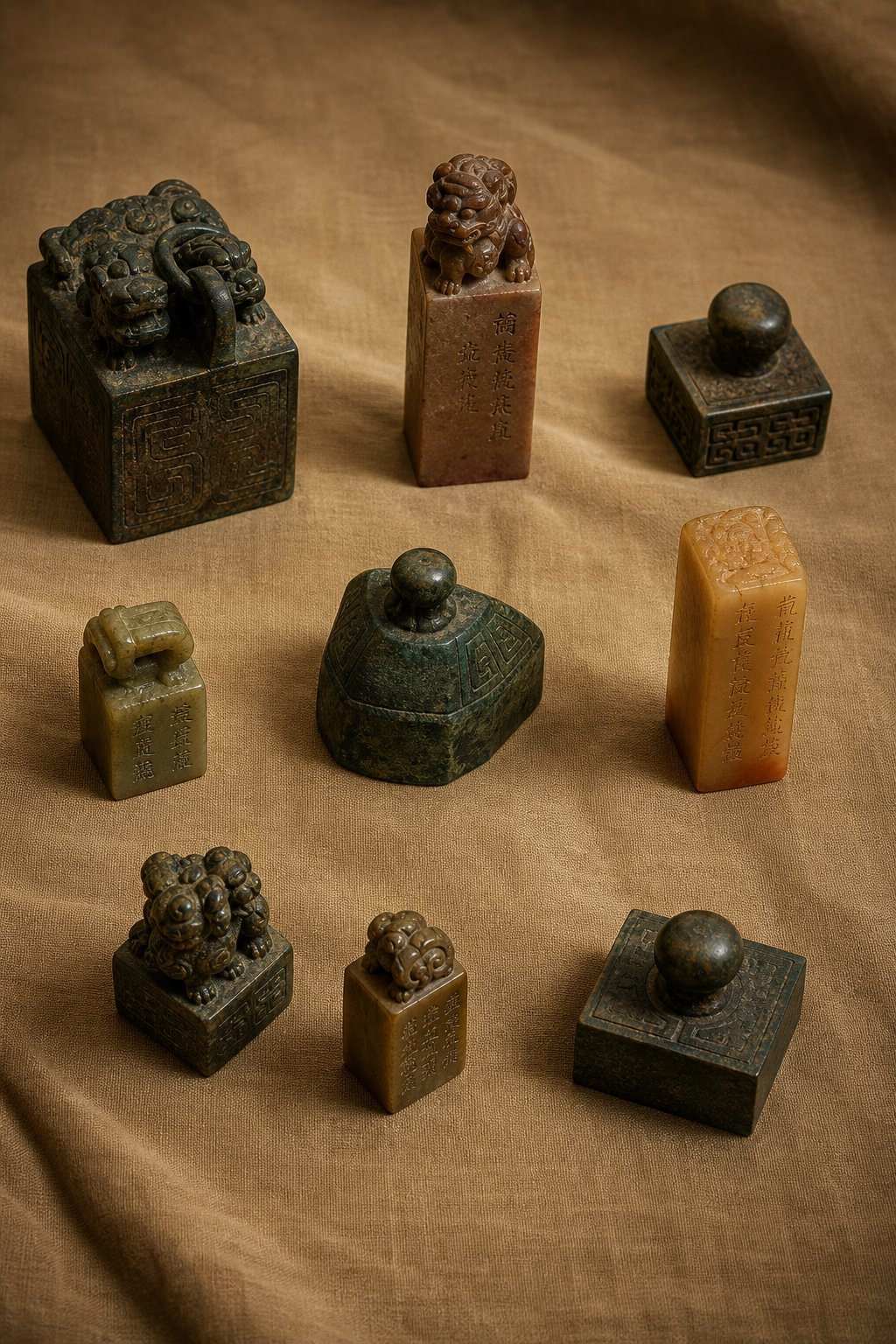
Those thousands of years are not abstract. They left behind physical evidence — old Chinese seals unearthed from tombs, pressed into clay documents, and stamped across imperial edicts. The history of Chinese seals tracks a remarkable transformation: from bureaucratic tools of state power to intimate expressions of artistic identity.
Here is a condensed timeline of that journey:
- Shang and Zhou dynasties (ca. 1500-256 BCE) — The earliest seals (玺, xi) appear as clan identifiers and tokens of authority. Only the state and high officials possess them.
- Qin dynasty (221-207 BCE) — Qin Shi Huang unifies script and establishes a formal seal system. Imperial seals are carved in jade; officials receive bronze seals ranked by status.
- Han dynasty (206 BCE-220 CE) — Seal art reaches its first golden age. A dedicated Department of Seals (印曹, yincao) produces thousands of official and military seals, establishing aesthetic standards still revered today.
- Tang and Song dynasties (618-1279) — Literati begin using personal seals on calligraphy and paintings. The Song court publishes the Xuanhe Yinpu (宣和印谱), a catalogue of ancient seal impressions that sparks collecting culture.
- Ming and Qing dynasties (1368-1911) — Scholars carve their own seals in soft stone, transforming the craft into a fine art with competing schools and master lineages.
Seals as Tools of Imperial Authority
In the Qin dynasty, seals were instruments of governance, not art. When Qin Shi Huang unified China, he standardized the written script into small seal script (小篆, xiao zhuan) and ordered six imperial seals carved to symbolize his mandate. The emperor's seal alone carried the character 玺 (xi); all others were designated 印 (yin). This distinction — material, size, script, and terminology — encoded political hierarchy directly into the seal system.
The Han dynasty inherited and expanded this framework. According to the Shanghai Museum's Chinese Seal Gallery, the artistic style and craftsmanship of official and private seals reached their peak during the Qin and Han period, a time now considered the most splendid era in the history of Chinese seals. An elaborate system of colored cords (绶, shou) and carved knobs (钮, niu) further distinguished rank — turtle knobs for ministers, camel knobs for princes. Every ancient chinese stamp from this period tells you exactly where its owner stood in the imperial hierarchy.
The Literati Revolution in Seal Art
The shift from state tool to personal art happened gradually. During the Tang and Song dynasties, scholars began stamping seals bearing studio names and poetic phrases onto their calligraphy and paintings — functions well beyond simple verification. But the real breakthrough came in the late Ming dynasty, when literati like Wen Peng (文彭, 1498-1573) and He Zhen (何震) started carving their own seals rather than commissioning craftsmen.
This was revolutionary. As documented in China Heritage Quarterly, Wen Peng studied directly from old Han seals and elevated the practice from a mere craft to a respected scholarly pursuit. He and He Zhen are regarded as the fathers of modern Chinese seal engraving. Their circle of literati in Suzhou and Nanjing — painters, poets, calligraphers — treated seal carving as equal in stature to painting and calligraphy itself.
From Bureaucratic Stamp to Artistic Statement
By the Qing dynasty, multiple competing schools had emerged. The Zhejiang School (浙派), founded by Ding Jing (丁敬, 1697-1768), championed a return to the bold simplicity of Han-era seals. The Anhui School (皖派), led by Deng Shiru (邓石如, 1743-1805), favored curved, flowing lines. These schools debated aesthetics with the same intensity that Western art movements argued over form and color.
What collectors today recognize as an antique chinese stamp seal from the Qing period often carries side inscriptions (边款, biankuan) — miniature essays carved into the stone's edges, recording the artist's name, the date, and sometimes a dedication or poem. These seals of Chinese civilization are not just functional objects. They are complete artworks: calligraphy on the face, literature on the sides, sculpture in the knob.
The founding of the Xiling Seal Society (西泠印社) in Hangzhou in 1904 formalized this artistic legacy, gathering master carvers to preserve and advance the tradition. Their work ensured that seal carving entered the modern era not as a relic but as a living discipline — one that still demands the same deep knowledge of ancient scripts that made it an art in the first place.
How Calligraphy and Seal Carving Inform Each Other
That deep knowledge of ancient scripts is not optional background reading — it is the living foundation of every seal cut. A carver who cannot write seal script with a brush has no business picking up a knife. The two disciplines share the same DNA: line quality, spatial balance, and the flow of energy through each stroke. Understanding how they feed each other is what separates a skilled practitioner from someone merely cutting seal characters into stone.
How Brush Strokes Translate to Knife Strokes
When you write a character with a brush, you control pressure, speed, and angle to produce lines with specific qualities — thick or thin, tense or relaxed, heavy or light. Carving Chinese characters into stone demands the same awareness, just through a different instrument. The flat carving knife replaces the brush tip, and the resistance of stone replaces the absorbency of paper. But the underlying logic is identical.
Consider how a calligrapher begins a horizontal stroke: the brush enters the paper at an angle, pauses briefly to "conceal the tip" (藏锋, cang feng), then travels steadily before lifting. A seal carver replicates this rhythm with the knife. The initial entry angle, the controlled travel through stone, and the deliberate ending all mirror brush technique. As one detailed study of seal aesthetics puts it, "A good calligrapher writes with his bones" — and a good carver cuts with that same skeletal confidence, producing lines that feel alive rather than mechanical.
The traditional vocabulary for describing carved lines reinforces this connection. Thin lines are called "spider's web" or "mosquito leg." Thick, forceful lines carry "buffalo energy." These are not engineering terms — they are calligraphic terms applied to carved stone, because the aesthetic judgment is the same in both disciplines.
Seal Script as the Shared Foundation
Why seal script specifically? Why not regular script (楷书, kai shu) or running script (行书, xing shu)? The answer is both historical and practical. Seal script (篆书, zhuan shu) became the standard for sealing cutting because its line qualities — uniform thickness, rounded ends, symmetrical structure — translate naturally to the constraints of carving. The strokes are either straight or curved, with no hooks, flicks, or abrupt directional changes that would be difficult to execute cleanly in stone.
Practitioners who want to produce carved 中文 characters on a seal face must first spend considerable time writing those characters with brush and ink. This is not merely practice — it builds the muscle memory and spatial understanding needed to compose characters within a tiny square or rectangular space. You cannot design what you cannot write. And you cannot write seal script without studying its two major historical forms.
The two styles differ significantly in character, origin, and application:
| Feature | Da Zhuan (大篆) — Large Seal Script | Xiao Zhuan (小篆) — Small Seal Script |
|---|---|---|
| Historical Period | Zhou dynasty (ca. 1046-256 BCE) | Qin dynasty (221-207 BCE) onward |
| Visual Character | Archaic, pictographic, irregular; retains visible connection to the objects characters represent | Standardized, elegant, highly regular; abstract and geometric |
| Line Quality | Variable thickness; more organic and spontaneous | Uniform thickness throughout; wire-like precision |
| Symmetry | Approximate; local variations common | Strict bilateral symmetry; characters fit a tall rectangular cell (roughly 3:5 width-to-height ratio) |
| Character Shape | Wider, more square; dense overall | Tall and narrow; top-heavy with trailing lower strokes |
| Standardization | Not standardized; regional and period variations exist (Jin Wen, Shi Gu Wen) | Fully standardized after Qin unification; consistent across all uses |
| Appropriate Uses in Seal Carving | Expressive, artistic seals; leisure seals seeking an archaic or bold aesthetic | Formal name seals; official seals; any context requiring clarity and classical elegance |
| Difficulty for Beginners | Moderate — more forgiving of slight irregularities | High — demands extraordinary consistency stroke to stroke |
Da zhuan encompasses several sub-scripts: Jin Wen (金文, Bronze Script) from ceremonial vessels and Shi Gu Wen (石鼓文, Stone Drum Script) from monumental inscriptions. These were never fully standardized — Zhou-era scribes relied on local custom and invented characters as needed. This irregularity gives da zhuan its raw, expressive power, which is why many modern artists choose it for carved 中文 seals that prioritize personality over formality.
Xiao zhuan, by contrast, emerged from Emperor Qin Shi Huang's political unification. Prime Minister Li Si oversaw the standardization of all regional scripts into one coherent system. The result is a script of extraordinary discipline — every stroke uniform, every character symmetrical, every form fitting neatly into its rectangular cell. Writing it demands what practitioners call "intense control," and carving it demands even more.
Reading Calligraphic Energy in Carved Stone
Sounds technical? Here is where it becomes intuitive. In Chinese calligraphy, the concept of qi (气) — energy or breath — describes how a character feels alive on the page. Strokes connect to each other through invisible momentum, even when the brush lifts between them. A well-written character breathes. A poorly written one feels dead.
The same principle governs seal carving. Each line in a seal conveys its own energy while contributing to what one analysis describes as "the overall calm, silence, delicacy, life and energy of the seal." The carver must think about how lines interact — how a vertical stroke anchors the composition like "the roots of an ancient tree," how dots sit "like a stone on a mountain-top" with stable solidity. These are calligraphic metaphors applied directly to the knife.
The practical implication is clear: cutting a seal is not a mechanical act of removal. It is a calligraphic performance in a different medium. The carver's knife must move with the same contained energy and controlled spontaneity that a master calligrapher brings to the brush. Each movement carries "a carefully measured amount of contained energy" — not aggressive force, but balanced internal equilibrium.
This is why traditional training always begins with the brush, not the blade. You learn to feel qi in ink before you attempt to express it in stone. The seal carver is, first and always, a calligrapher — one who has simply extended the art of the line from paper into a harder, more permanent material.
Seal Stone Types and How to Choose the Right Material
That harder, more permanent material is not just any rock. The stone you carve determines how your knife behaves, how fine your lines can be, and whether your first seal ends in satisfaction or frustration. Among the many traditions of asian stone carvings, Chinese seal carving is uniquely demanding about material quality — the stone must be soft enough to cut by hand yet dense enough to hold crisp detail across thousands of impressions.
Seal stones generally fall between 2 and 4 on the Mohs hardness scale. For context, your fingernail rates about 2.5 and a copper coin about 3.5. This narrow range matters enormously in practice: a stone at 2 on the scale lets the knife glide almost too freely, while one approaching 4 resists every stroke. Grain structure matters equally. A fine, uniform grain allows smooth, predictable cuts. Coarse or uneven grain causes the knife to skip or catch, producing ragged lines that no amount of skill can fully control.
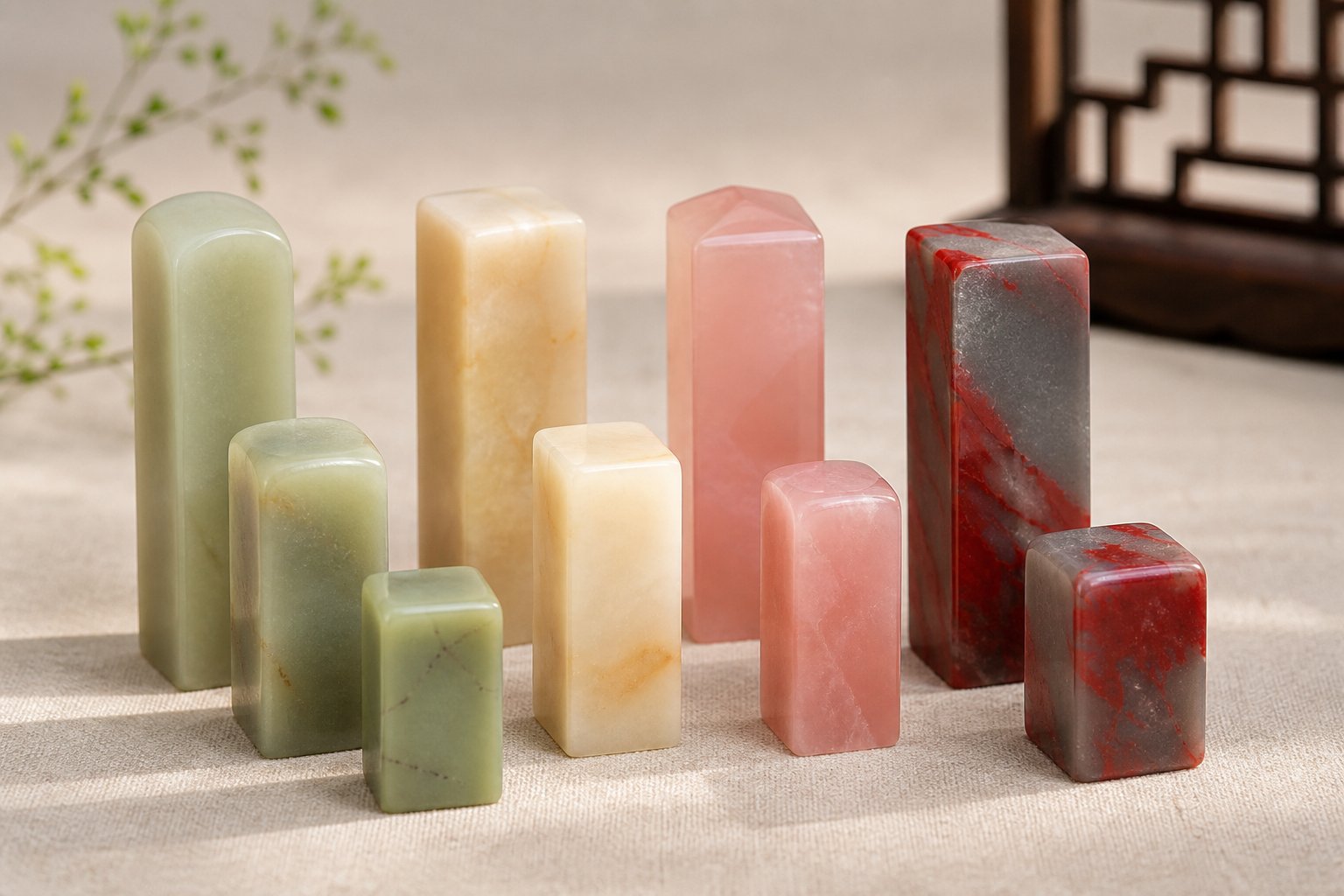
China has four historically celebrated stone types, each named for its region of origin. These are the materials that define the tradition of china stone carving for seals.
Qingtian and Shoushan Stones for Beginners
Qingtian stone (青田石) comes from Qingtian county in Zhejiang province and has a documented history of over 1,700 years in seal use. It is a volcanic rock composed primarily of pyrophyllite (Al2[Si4O10](OH)2) and silica. Qingtian stone is the most affordable chinese seal stone on the market — often just a few dollars per piece — making it a natural starting point. Its colors tend toward pale greens, greys, and whites. The famous Deng Guang Dong (灯光冻) and Feng Men Qing (封门青) varieties are prized collectors' items, but standard Qingtian frequently contains cracks or impurities that make detailed carving challenging. If you plan to carve archaic oracle-bone or large seal script styles that benefit from a slightly rough, weathered aesthetic, these imperfections can actually work in your favor.
Shoushan stone (寿山石) is excavated near Shoushan village in Fujian province, with over 1,500 years of recorded use. This chinese carving stone comes in a wide spectrum — white, milky grey, red, pink, even pale blue — across more than ten subcategories. Its hardness is moderate (roughly 2.5-3 Mohs), and its grain is remarkably pure, almost free of cracks or impurity substances. This purity makes it ideal for detailed work. A shoushan stone seal responds predictably to the knife, letting you focus on design rather than fighting the material. The most valuable varieties — Tian Huang (田黄) and Fu Rong (芙蓉) — are rare and command extraordinary prices, but standard Shoushan remains accessible and suitable for all skill levels.
Balin Stone and Rare Varieties
Balin stone (巴林石) originates from Inner Mongolia and was first massively excavated in the 1970s, though it was discovered over 800 years ago and historically reserved for royal use. Legend holds that Genghis Khan named it "stone granted by god." Balin stone combines the best qualities of the other three famous seal stones: moderate hardness, fine grain, minimal impurities, and a beautiful creamy, jade-like texture. Colors range from green and white to yellow and pink, with pink varieties being the most precious. For practitioners with limited access to cheap, high-quality stone seals, Balin offers an excellent price-to-quality ratio — typically starting around six to eight dollars per piece.
Chicken blood stone (鸡血石, jixue shi) is the most dramatic variety of Changhua stone (昌化石) from Zhejiang province. Its name comes from vivid red cinnabar inclusions that streak through the stone like splashes of blood — a visual effect that makes it highly collectible. However, most Changhua stones are harder than other seal stones and prone to cracking during carving. This is not a beginner's material. High-grade chicken blood stone is rare, beautiful, and expensive, sought after more as a collector's item than a practical chinese stone seal for everyday use.
| Stone Type | Mohs Hardness | Color Range | Price Accessibility | Recommended Skill Level |
|---|---|---|---|---|
| Qingtian (青田石) | 1.5 - 2.5 | Pale greens, greys, whites | Very affordable ($1-3 per stone) | Beginner to intermediate (best for bold, archaic styles) |
| Shoushan (寿山石) | 2.5 - 3.0 | White, red, pink, grey, pale blue | Moderate ($5-15 for standard grades) | All levels (ideal for detailed work) |
| Balin (巴林石) | 2.0 - 3.0 | Green, white, yellow, pink | Moderate ($6-10 per stone) | All levels (best overall value) |
| Chicken Blood / Changhua (昌化石) | 3.0 - 4.0 | Grey-white with red cinnabar streaks | Expensive (collectible grades $50+) | Advanced to professional only |
How to Select Your First Seal Stone
When you are choosing your first chinese seal stone, keep these practical principles in mind:
- Avoid cracks and impurities. Any flaw in the stone can cause it to chip or split under your knife, especially while you are still learning to control pressure. A smooth, pure stone forgives inconsistent technique.
- Choose natural, uncolored stones. Some vendors artificially dye stones to mimic expensive varieties. Natural color is a sign of structural integrity.
- Look for even color distribution. Uniform color generally indicates stable, consistent grain throughout the stone. If a stone has decorative patterns, carve on the side with the most even tone.
- Start with a 2 x 2 cm to 3 x 3 cm face. This size range gives beginners enough room to carve two to four characters without requiring extremely fine knife control. Smaller faces demand precision that takes time to develop.
- Test hardness with your knife before committing. If possible, make a small test cut on the stone's base. The knife should enter smoothly with moderate pressure — not skid across the surface or sink in with no resistance.
Avoid the temptation to start with jade, crystal, or other hard materials. These require machine tools or extraordinary skill. Stick to the four traditional seal stones — they exist in this tradition precisely because their physical properties match what a hand-held knife can achieve. The right stone does not fight you. It collaborates, letting your calligraphic intention flow through the blade and into permanent form.
Essential Tools Every Seal Carver Needs
The right stone collaborates with your knife — but what about the knife itself? A seal carver's toolkit is surprisingly compact. You do not need a workshop full of equipment to produce a beautiful chinese stamp seal. A few well-chosen tools, each serving a specific purpose in the workflow, will carry you from blank stone to finished impression.
Carving Knives and Their Specific Uses
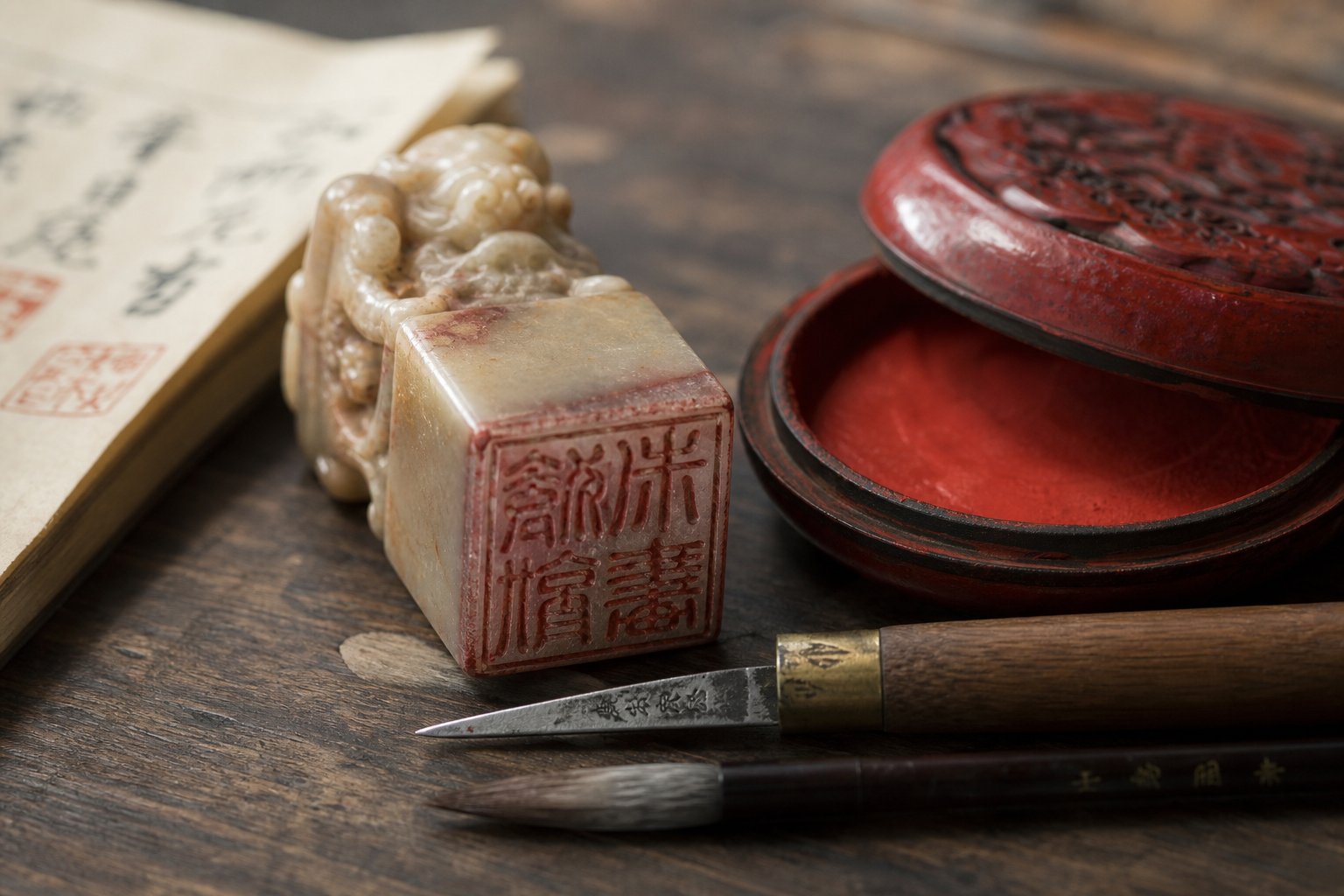
The carving knife (刻刀, ke dao) is your primary instrument. Unlike woodworking chisels or sculpting tools, seal carving knives are short, rigid blades designed for precise, controlled cuts in soft stone. Two types cover nearly every situation:
Flat knife (平刀, ping dao) — This blade has a straight, flat cutting edge. You'll use it for removing larger areas of material, creating clean straight lines, and establishing the main structure of characters. Think of it as your workhorse. Most beginners start here because the flat edge produces predictable results and teaches fundamental pressure control.
Angled knife (斜刀, xie dao) — This blade has a beveled or pointed tip. It excels at detailed work: curved strokes, tight corners, fine adjustments, and cleaning up edges after the flat knife has done the heavy lifting. When carving small seal script characters with their uniform, wire-like strokes, the angled knife gives you the precision to maintain consistent line width through curves.
Some practitioners use a single knife for everything, holding it at different angles to achieve both functions. Others prefer dedicated blades. A good beginner set includes one flat knife and one angled knife, both with blades around 5-8mm wide and handles that sit comfortably in the hand. Traditional bamboo-handled knives offer an authentic feel, while modern rubber-grip versions reduce hand fatigue during longer sessions. Unlike a wood carved seal — where softer material allows more forgiving cuts — stone demands a blade that holds its edge. Look for tungsten steel or high-carbon steel blades that stay sharp through extended use.
Brushes, Mirrors, and Transfer Tools
The knife does the carving, but several supporting tools make the process possible:
- Small writing brush (毛笔, maobi) — Used to write your design on paper, then to paint the mirror-image transfer directly onto the stone face using ink or cinnabar paste. A fine-tipped brush gives you the control needed for small characters.
- Mirror — Essential for checking your reversed design. Since every character must be carved in mirror image to print correctly, you'll constantly hold your stone up to a mirror to verify legibility. Some carvers use a small handheld mirror at their workstation; others photograph the stone and flip the image digitally.
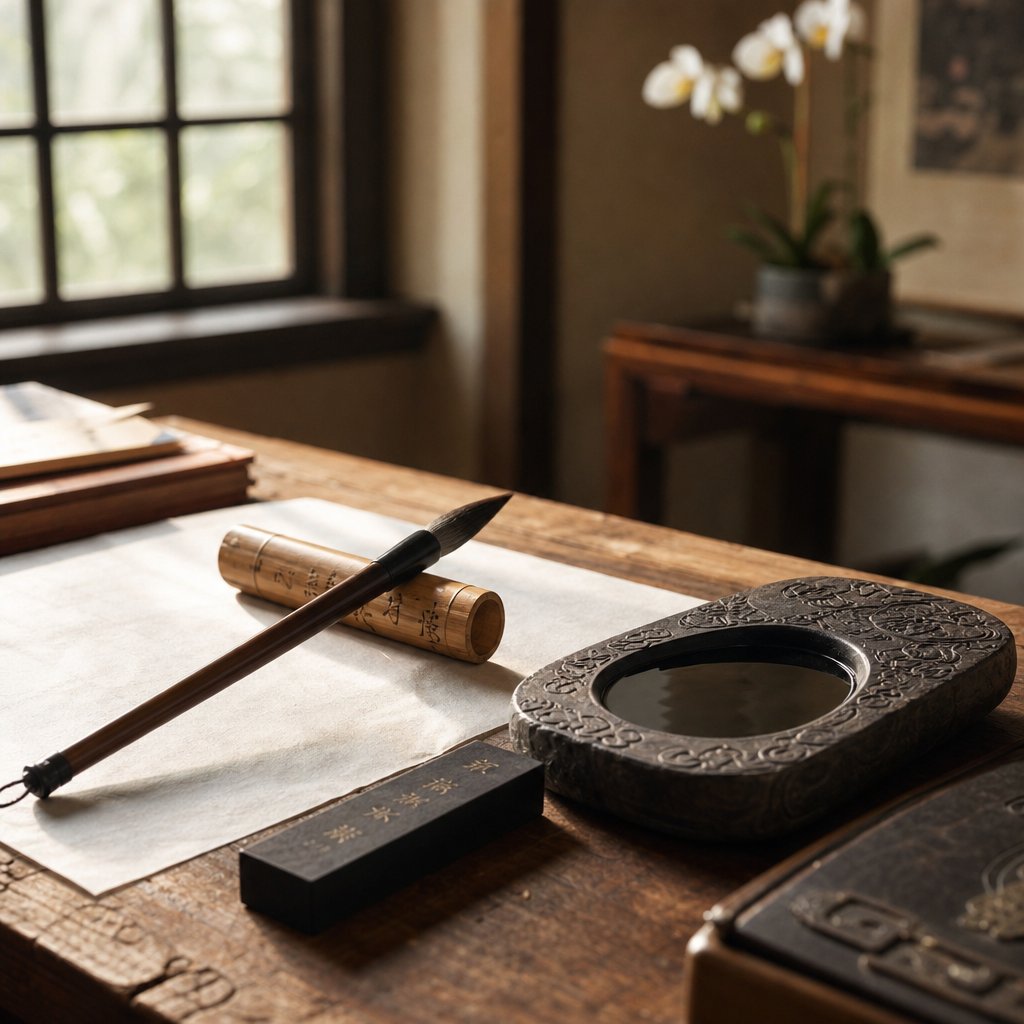
- Ink stick and inkstone (墨, mo / 砚, yan) — For grinding fresh ink to write your initial design and paint the transfer onto stone. Bottled ink works in a pinch, but ground ink adheres better to polished stone surfaces.
- Sandpaper (various grits) — For flattening and polishing the stone face before carving. Start with 400-grit to level the surface, then move to 800 or 1000-grit for a smooth finish that accepts ink transfer cleanly.
- Brush for clearing debris — A stiff, dry brush (an old toothbrush works) sweeps stone dust from carved channels so you can see your progress clearly.
- Seal bed or clamp (印床, yin chuang) — A small vise that holds the stone steady while you carve. Not strictly necessary — many experienced carvers hold the stone in their non-dominant hand — but helpful for beginners who need both hands free to control the knife.
A wood carved seal requires similar transfer tools but different cutting instruments. Stone, however, remains the standard material for serious practice because it holds finer detail and produces crisper impressions over time.
Understanding Ink Paste Quality and Types
Your seal is only as good as the impression it leaves. This is where ink paste (印泥, yinni) becomes critical — and where many beginners unknowingly undermine their work by using cheap, low-quality paste.
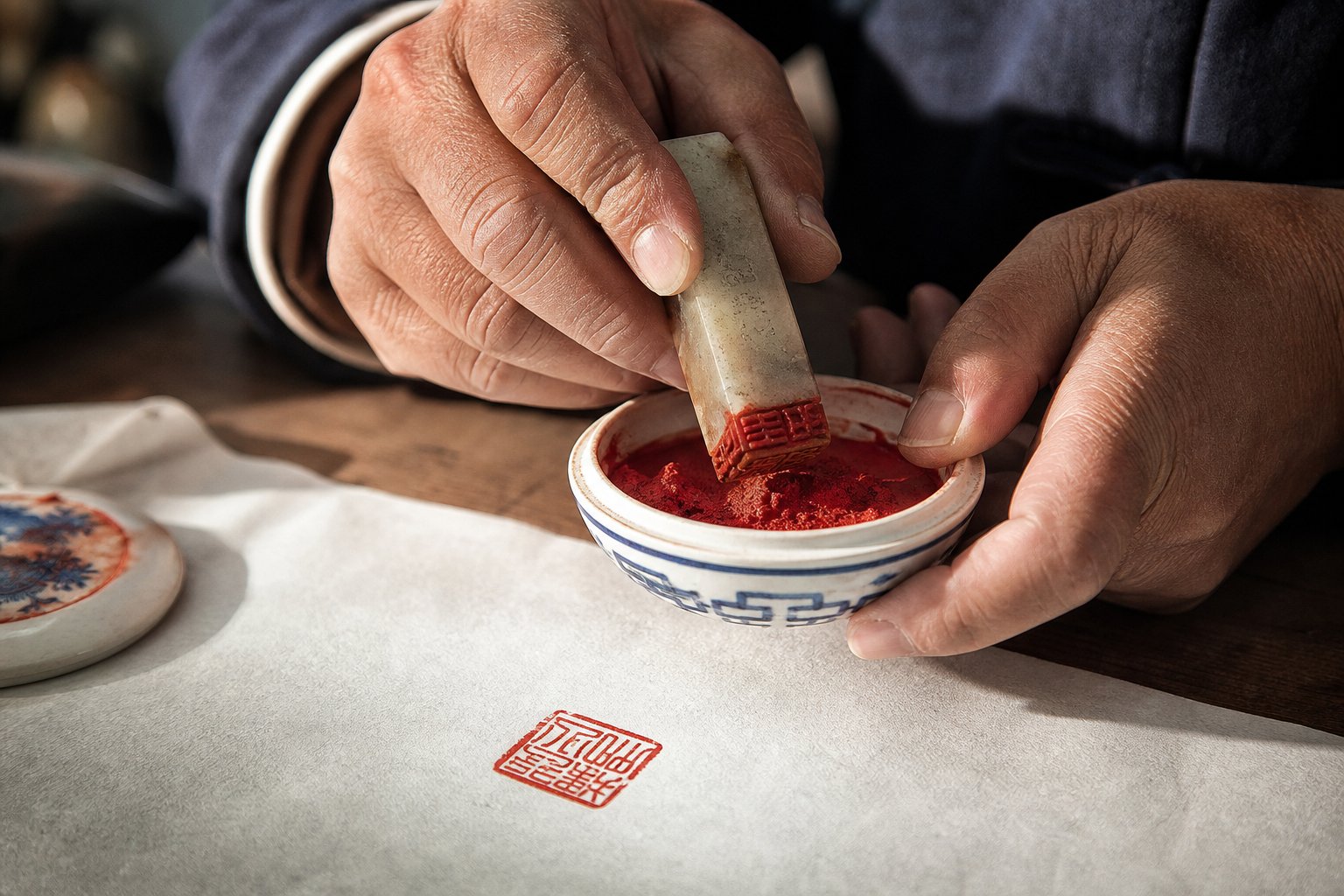
Traditional chinese ink stamps use cinnabar-based paste (朱砂印泥, zhusha yinni), a handmade mixture of three core ingredients: cinnabar pigment, castor oil, and artemisia argyi (mugwort) fiber. The cinnabar provides that distinctive bright red color. The castor oil binds the mixture and keeps it workable. The mugwort fiber acts as a structural matrix, holding pigment particles together so the impression transfers cleanly to paper without bleeding or leaving oily halos.
High-grade cinnabar paste produces impressions that are vivid, sharp, and remarkably long-lasting — centuries, in the case of historical seals. The color remains stable because cinnabar (mercuric sulfide) is chemically inert once applied. Premium formulations may also include gold, silver, pearl, or silk to enhance texture and longevity, which is why specialty pastes can cost upward of $400 for just 30 grams.
Synthetic alternatives use chemical dyes instead of cinnabar and cotton or synthetic fibers instead of mugwort. They are far cheaper and more widely available. For practice impressions and casual use, synthetic paste is perfectly adequate. But for finished artwork — a chop stamp impression on a painting you intend to keep or sell — the difference is visible. Synthetic paste tends to fade over time, bleed slightly on absorbent papers, and leave oily marks around the impression edges. It also lacks the three-dimensional texture of cinnabar paste, which sits slightly raised on the paper surface like a tiny relief print.
A few practical notes on paste quality and care:
- Color shade matters. Dark red paste suits larger seals; more orange-red tones work better for small chinese stone seal stamps where fine detail needs to remain legible.
- Stir every few months. Seal paste is a physical mixture that separates over time. Oil rises to the surface and can oxidize if left unmixed. Stir gently in one direction — clockwise or counterclockwise — using a bamboo or plastic tool. Never use metal, which can contaminate the paste.
- Store in ceramic. Keep paste in a ceramic container with an airtight seal. Avoid metal containers entirely.
- Warm it in winter. Cold paste becomes stiff and does not transfer evenly. A brief warming with a hair dryer restores workability.
The best-regarded producers of traditional cinnabar paste include Xi Ling Seal Society (西泠印社) in Shanghai, Zhangzhou Eight Treasures (漳州八宝印泥), and Jiang SiXu Tang (姜思序堂) from Suzhou. For beginners assembling their first toolkit, a mid-range cinnabar paste in the $20-30 range offers a meaningful step up from synthetic options without a major investment.
With stone selected and tools assembled, the real creative work begins: deciding what your seal will say, how those characters will fill the space, and which carving style will bring them to life.
The Four Categories of Chinese Seals and Their Purposes
What your seal says depends entirely on what role it plays. A single painting might carry three or four different seals, each serving a distinct function — identifying the artist, naming the studio, expressing a philosophical sentiment, or recording ownership. These are not random decorations. Each category of seal has its own conventions for content, placement, and visual weight. Understanding them is essential for anyone who wants to use a chinese name seal correctly on finished artwork.
Here are the four functional categories that define how seals operate within Chinese calligraphy and painting:
- Name seal (名印, ming yin) — Identifies the artist by personal name, courtesy name, or pen name. Functions as the primary chinese signature stamp on any work.
- Studio seal (斋馆印, zhai guan yin) — Bears the name of the artist's studio, study, or workspace. Adds a layer of identity and cultural context.
- Leisure seal (闲章, xian zhang) — Carries a poetic phrase, philosophical motto, or auspicious saying. Expresses the artist's inner world beyond mere identification.
- Collection seal (鉴藏印, jian cang yin) — Marks ownership or authentication by a collector, connoisseur, or institution. Records the artwork's provenance over time.
Name Seals and Studio Seals in Practice
The name seal is the most fundamental. No work of Chinese calligraphy or painting is considered complete without one. It functions exactly like a Western artist's signature — except it carries more visual weight and follows stricter placement rules. A chinese name stamp typically appears at the end of an inscription or in the lower-left area of a painting, following the final line of text. If the work has a colophon (a written inscription by the artist), the seal goes directly beneath it.
Artists often maintain multiple name seals. One might bear their given name (名, ming), another their courtesy name (字, zi), and a third their artistic pseudonym (号, hao). As noted in historical practice, Chinese calligraphers and painters always apply a name seal to complete their work — if there is an inscription, the seal follows it. Using two name seals together (one in relief, one in intaglio) is a common convention that creates visual rhythm through the contrast of red-on-white and white-on-red impressions.
The studio seal adds another dimension. Imagine a painter whose workspace is called "Hall of Quiet Listening" (静听堂, Jing Ting Tang). Stamping this name onto a painting tells the viewer something about the artist's self-image and aesthetic values — the kind of environment they cultivate for creative work. Studio seals typically appear near the name seal, either above or beside it, functioning as an extra layer of authentication and personal branding. A chinese artist stamp bearing a studio name signals that the work emerged from a dedicated practice, not casual effort.
Leisure Seals as Philosophical Expression
Leisure seals are where the art form becomes truly literary. Unlike name seals, which serve identification, xian zhang express ideas. They might carry a line from a Tang poem, a Daoist aphorism, a Buddhist concept, or a personal motto. Common examples include phrases like "following nature" (师法自然), "heart at peace" (心静), or "ten thousand mountains in autumn color" (万山秋色).
Placement is flexible — and that flexibility is the point. A leisure seal can appear at the beginning of a work (called a "head seal" or 引首章, yin shou zhang), in an empty corner to balance the composition, or alongside the name seal at the end. The artist decides based on visual rhythm. A large empty space in the upper-right corner of a painting might call for a small leisure seal to anchor the eye. A dense calligraphic work might need one at the bottom to provide a resting point.
This is where chinese painting signatures become more than identification — they become composition. The red impression of a leisure seal interacts with the ink and blank space of the artwork, adding color, weight, and meaning simultaneously. A well-placed leisure seal can transform the visual balance of an entire piece.
Collection Seals and Their Role in Art History
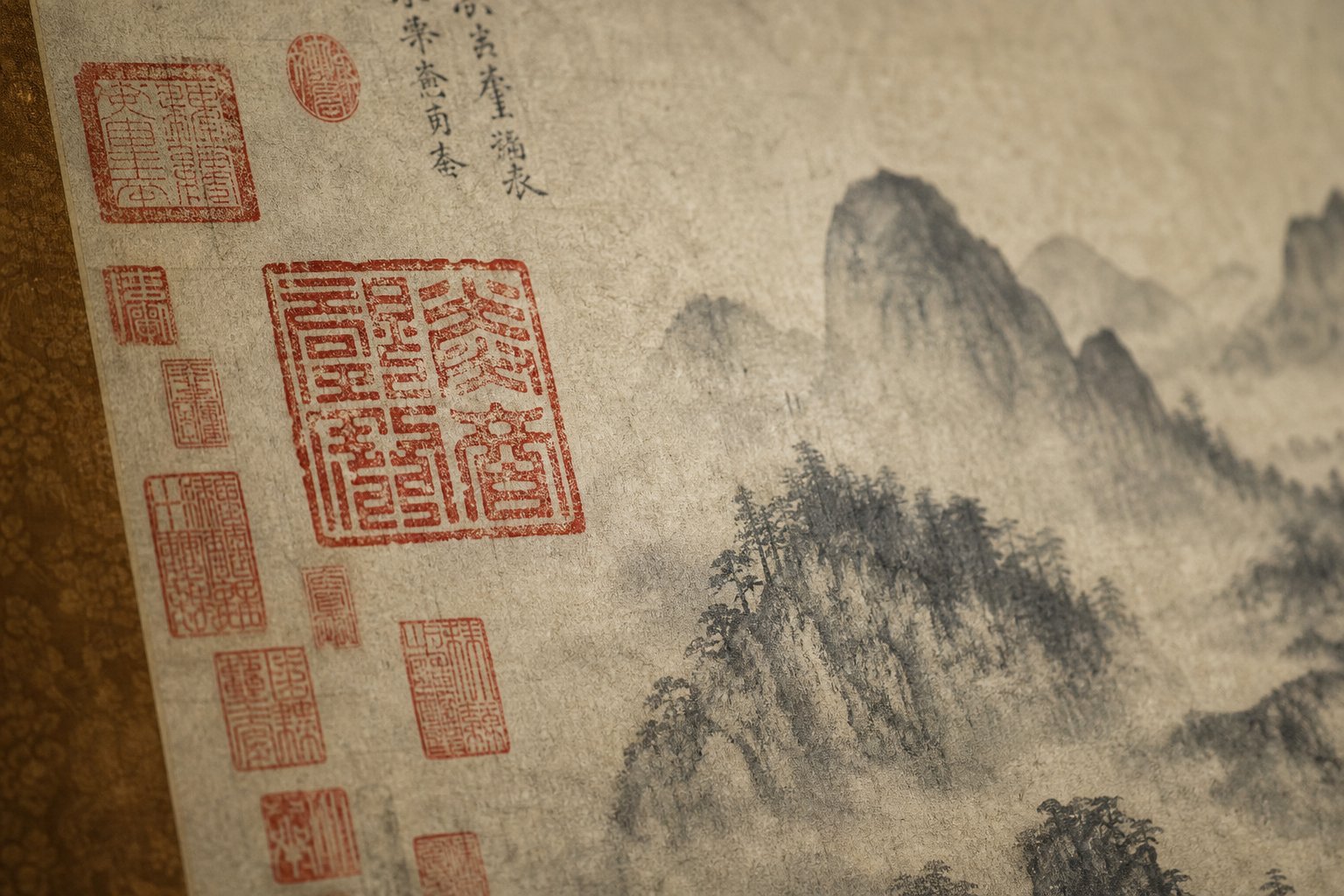
Collection seals tell a different story entirely. They record not who made the work, but who owned it, admired it, and authenticated it over centuries. When a connoisseur or emperor stamped their seal onto a painting, they were writing themselves into its history — declaring "I saw this, I valued this, I vouch for this."
This practice dates back to at least the Tang dynasty. Historical records show that connoisseurs applied their own seals to important works to certify authenticity, and emperors did the same to celebrate or promote certain pieces. The result is that many ancient masterworks carry dozens of collection seals accumulated over a thousand years. Rather than diminishing the artwork, these seals increase its value — each one documents a link in the chain of custody and appreciation.
The Qianlong Emperor (r. 1735-1796) was particularly prolific, stamping his seals across hundreds of works in the imperial collection. Some paintings from the Song dynasty now carry more seal impressions than brushwork. For collectors and art historians, reading these seals is like reading a biography of the artwork itself — where it traveled, who treasured it, and how its reputation grew.
Multiple seals on a single artwork are not accidents or afterthoughts. They work together as a system. The name seal anchors identity. The studio seal adds context. The leisure seal introduces philosophy. And collection seals, added over generations, weave the work into the larger fabric of Chinese art history. Each red impression occupies its position with intention, contributing to the visual balance and layered meaning that make a finished piece feel complete.
Knowing what each seal category communicates is one thing. Designing the seal itself — arranging characters within a confined space, balancing carved and uncarved areas, choosing between relief and intaglio — requires a different set of principles entirely.
Design Composition and Aesthetic Philosophy of Seal Art
Arranging characters within a confined space, balancing carved and uncarved areas, choosing between relief and intaglio — these decisions define the visual identity of every art seal. A seal face is rarely larger than a few square centimeters, yet within that tiny field, the carver must achieve the same compositional harmony that a painter pursues across an entire scroll. The principles governing this process are not arbitrary. They emerge from centuries of aesthetic philosophy rooted in the interplay of opposites: solid and void, presence and absence, red and white.
Red and White Space Balance in Seal Design
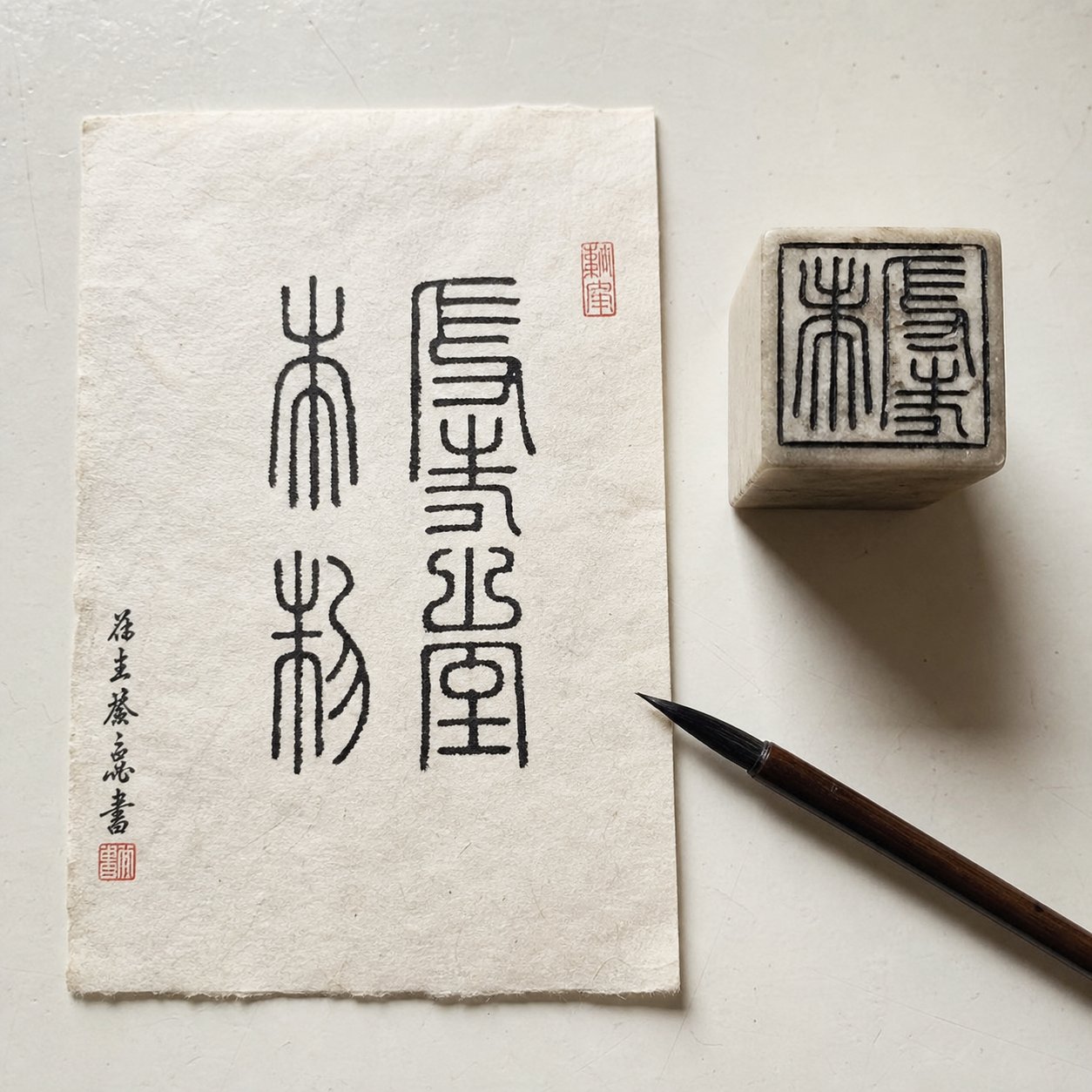
The foundational concept in seal composition is called fen zhu bu bai (分朱布白) — literally "dividing red and arranging white." When you press a chinese seal chop into ink paste and stamp it onto paper, two things appear: red areas (where the paste transferred) and white areas (where it did not). The relationship between these two zones determines whether the seal feels balanced, dynamic, cramped, or empty.
This is not simply about filling space evenly. A skilled designer manipulates the ratio of red to white to create visual tension and resolution — dense clusters of strokes in one area balanced by open breathing room in another. As one detailed analysis of seal aesthetics explains, the carver must "give each item its own space and from there work towards a general impression of tranquillity." Complex characters with many strokes need room to breathe. Simple characters need visual weight added through thicker lines or tighter spacing to avoid looking lost in the field.
The contrast between solid and void in seal design echoes the Chinese philosophy of yin and yang — balance and opposition in harmony. Every carved line defines not only itself but the empty space around it, and both carry equal aesthetic weight.
This principle connects seal composition directly to broader Chinese artistic philosophy. In landscape painting, empty space represents mist, water, or sky — it is not "nothing" but an active compositional element. The same logic applies to the white space within a chop seal. Uncarved areas are not leftover material. They are deliberate design choices that shape how the eye moves across the impression.
Character Layout and Composition Rules
How do you arrange one, two, four, or more characters within a square or rectangular format? The answer depends on character count, stroke density, and the seal's intended function.
For a single-character seal, the character typically fills the entire field. The challenge is preventing it from looking either cramped or floating. Thick borders can frame a simple character, while a complex one might extend to the edges with minimal border.
For two-character seals — the most common format for name seals — characters are arranged either side by side (read right to left) or stacked vertically (read top to bottom). The carver must equalize visual weight between the two characters even when their stroke counts differ dramatically. A character with three strokes needs to occupy the same spatial footprint as one with fifteen. This is achieved by adjusting line thickness, spacing, and the degree to which strokes extend toward the boundaries.
For four-character seals, the standard layout divides the field into quadrants, read from top-right to top-left, then bottom-right to bottom-left. This grid structure provides natural balance but demands careful attention to how characters interact across the central dividing lines. The best compositions create subtle visual connections — a horizontal stroke in one quadrant aligning with a stroke in the adjacent one, linking the characters into a unified whole rather than four isolated boxes.
Seals with more than four characters — common in leisure seals bearing poetic phrases — require the carver to divide the field into columns read from right to left. Here, the challenge multiplies. Characters must be stretched or compressed to fit their allotted rectangles while maintaining legibility. As noted in discussions of seal script, characters can be stretched or compressed to fit into a confined space, allowing artists to play with form to evoke feeling and thought. This flexibility is a feature of seal script, not a flaw — it gives the designer room to prioritize composition over rigid uniformity.
The detailed analysis of Yi Da An's five-character seal illustrates these principles in action. The seal divides its surface into six equal rectangles: four characters each occupy one-sixth of the space, while the final compound character — being more complex — takes up two-sixths. The result is a two-to-one ratio between occupied and empty space that produces "a general impression of balance and harmony" despite the unequal character complexity.
Mirror Writing and Border Design Techniques
Every character on a chinese chop seal must be carved in reverse. When the seal presses into paste and stamps onto paper, the mirror image flips back to its correct orientation. This means the carver must think, design, and cut backwards — a skill that feels deeply unnatural at first but becomes intuitive with practice.
The practical workflow involves writing your design correctly on thin paper, then flipping the paper face-down onto the stone so the ink transfers in mirror image. Alternatively, you can write directly onto the stone while checking constantly with a handheld mirror. Either way, you'll verify the reversed design before committing a single knife stroke. One reversed character in a four-character seal ruins the entire piece.
Borders frame the composition and influence its visual character significantly:
- Thick borders — Create a sense of solidity and containment. They work well for formal name seals and official chinese chops where gravitas matters. The thick frame holds the characters firmly within the field.
- Thin borders — Feel lighter and more elegant. They suit leisure seals and artistic compositions where the characters themselves should dominate visually.
- No border — The most daring choice. Characters extend to the very edge of the stone face, and the impression relies entirely on the natural boundary of the ink transfer. This approach works best for expressive, archaic-style seals where deliberate roughness is part of the aesthetic.
- Broken or irregular borders — Intentionally damaged edges that suggest age, naturalness, or spontaneity. Master carvers sometimes chip the border after carving to avoid a mechanical, overly perfect appearance.
The two main carving styles determine whether your characters appear red or white in the final impression:
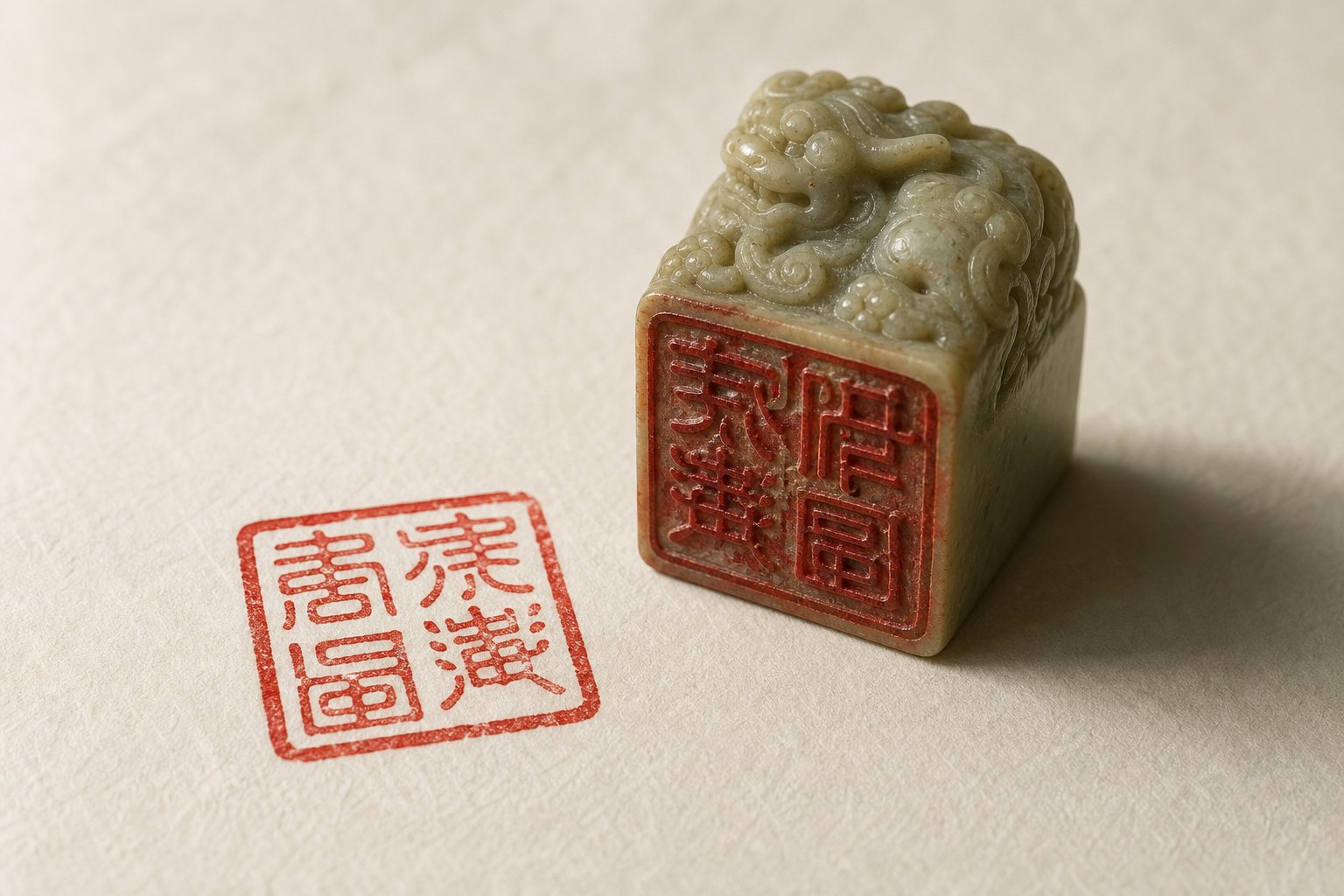
Zhu wen (朱文) — also called yang wen (阳文) or relief carving. The carver removes the background material, leaving the characters raised. When stamped, the characters print red against a white background. This style demands more material removal and greater precision, since any slip of the knife damages the character itself. Zhu wen is traditionally used for name seals and formal applications where clarity and elegance are paramount.
Bai wen (白文) — also called yin wen (阴文) or intaglio carving. The carver cuts directly into the characters, leaving the background intact. When stamped, the characters appear white against a solid red field. Bai wen is generally easier for beginners because the knife cuts into the character lines rather than around them — small imperfections are less visible against the dominant red background. This style carries a bolder, more archaic feel and is traditionally associated with Han dynasty aesthetics.
Many practitioners create paired seals — one in zhu wen and one in bai wen — to use together on artwork. The visual contrast between a red-character impression and a white-character impression creates rhythm and variety, much like alternating between bold and light typefaces in Western design. This pairing convention is one reason serious artists maintain collections of multiple chinese chops rather than relying on a single seal for all purposes.
These design principles — space balance, character layout, mirror orientation, border treatment, and carving style — are not separate decisions made in isolation. They interact as a system. A four-character bai wen seal with a thick border and compressed characters produces a completely different visual effect than a two-character zhu wen seal with no border and generous spacing. The carver's job is to match all these variables to the seal's intended purpose and the personality of its owner. Getting from philosophy to finished stone requires a clear, repeatable process — one that transforms these abstract principles into physical cuts.
Step by Step Process of Carving a Chinese Seal
Getting from philosophy to finished stone requires a clear, repeatable process — one that transforms abstract principles into physical cuts. Every seal carver, whether a first-year student or a master with decades of experience, follows essentially the same workflow. The steps are simple to describe but demand patience and attention at every stage. Rushing any single phase compromises the final impression.
If you are carving your first seal, start with a two-character name seal in bai wen (intaglio) style. Why? Bai wen requires you to cut directly into the character strokes rather than carving away the entire background. Small imperfections disappear into the dominant red field of the impression, giving beginners a more forgiving entry point. Two characters keep the composition manageable while still teaching you the fundamentals of layout, spacing, and mirror reversal.
Here is the complete workflow from blank stone to finished chinese stone stamp:
- Select and inspect your stone. Choose a stone appropriate to your skill level — Qingtian or Shoushan for beginners. Examine it for cracks, impurities, or uneven grain that could cause problems during carving. Hold it up to the light and run your fingernail across the carving face to feel for hidden flaws.
- Flatten and prepare the carving face. Place 400-grit sandpaper on a flat surface (a piece of glass works well). Press the stone face down and move it in figure-eight patterns until the entire surface contacts the paper evenly. Progress to 800-grit for a smooth finish. The face must be perfectly flat — any unevenness causes incomplete impressions.
- Design your composition on paper. Write your characters in seal script at the exact size of the stone face. Experiment with layout, stroke thickness, and spacing. Try multiple versions. This is where you make compositional decisions — not on the stone itself.
- Transfer the mirror-image design onto stone. Paint your final design onto the prepared stone face using a fine brush and ink. The most reliable method: write the design on thin paper with fresh ink, then press the paper face-down onto the stone before the ink dries. The wet ink transfers in reverse. Alternatively, paint directly onto the stone while checking with a mirror after every few strokes.
- Carve the characters. Hold the knife at approximately 30-45 degrees to the stone surface. For bai wen, cut along both sides of each stroke, then remove the material between the cuts. Work systematically — complete one character before moving to the next. Control depth by controlling pressure, not by making repeated passes in the same groove.
- Clear debris and check progress. Brush stone dust from the carved channels frequently. Press the stone lightly into ink paste and stamp a test impression on scrap paper. Compare the result to your original design. Identify areas that need deepening, cleaning, or correction.
- Refine and adjust. Use the angled knife to clean up rough edges, deepen shallow areas, and sharpen corners. Make multiple test impressions between adjustments. Each refinement should be small and deliberate — removing stone is irreversible.
- Finalize the seal. Once the impression matches your design intent, clean the stone face thoroughly. Apply a thin coat of wax or camellia oil to the carved surface to protect it from moisture and oxidation over time.
Preparing the Stone Surface
This first physical step seems minor but determines everything that follows. An uneven carving face produces an uneven impression — some areas stamp clearly while others barely register. Imagine spending an hour on detailed knife work only to discover that the upper-left corner of your chinese carved stone never contacts the paper properly. That frustration is entirely preventable.
The flattening process also reveals the stone's true character. As you sand, you'll see the grain structure emerge — whether it runs uniformly or shifts direction in certain areas. Spots where the grain changes are harder to carve predictably. Knowing where they are before you start lets you position your design to avoid them or work with them intentionally.
For the sides of the stone, light sanding with fine-grit paper removes rough edges and prepares the surface for side inscriptions (biankuan) if you choose to add them later. Some carvers also polish the top and sides to a smooth finish for aesthetic reasons, though this is optional for practice pieces.
Transferring Your Design to Stone
The transfer stage is where most beginners encounter their first real challenge. You've designed beautiful characters on paper — but now they need to appear backwards on stone, at a tiny scale, with enough clarity to guide your knife. Several methods work:
Wet ink transfer — Write your design on thin, semi-transparent paper using slightly wetter ink than normal. While the ink is still damp, flip the paper onto the stone face and press firmly with your palm or a smooth tool. Peel the paper away carefully. The reversed characters now appear on the stone in faint but legible ink lines. This method is fast but requires timing — too dry and nothing transfers, too wet and the image smears.
Direct painting — Using a fine brush, paint the reversed design directly onto the stone while referencing your paper design in a mirror. This gives you the most control over line quality but demands comfort with mirror-writing. Many experienced seal carvers prefer this method because it lets them adjust the design in real time as they see how characters interact with the stone's specific dimensions.
Pencil outline — For absolute beginners, lightly penciling the reversed design onto the stone provides a guide without the pressure of working in ink. The pencil lines are easy to erase and redo. Once you're satisfied, trace over them with brush and ink to create permanent guide lines for carving.
Whichever method you choose, verify the transfer with a mirror before picking up your knife. Read every character. Check the reading order. Confirm that nothing is accidentally correct-reading (which would print backwards). This two-minute check saves hours of wasted carving.
Carving Technique and Testing Your Impression
The knife enters the stone. This is the moment where a seal carver's calligraphic training either shows or doesn't. Three variables control every cut: angle, pressure, and direction.
Angle determines line character. A knife held nearly vertical produces narrow, deep cuts with sharp edges. A knife held at a shallow angle creates wider, shallower grooves with softer edges. For bai wen carving, most cuts work best at 30-45 degrees — steep enough for clean walls but angled enough to prevent the knife from catching and chipping the stone unpredictably.
Pressure controls depth. Consistent pressure produces consistent line depth, which translates to even ink coverage in the final impression. Beginners tend to press too hard, gouging deeply in some areas and skipping across others. The goal is moderate, steady force — let the blade's sharpness do the work rather than muscling through the stone. A well-sharpened knife on properly selected stone should cut with surprisingly little effort.
Direction matters because stone grain has orientation. Cutting with the grain feels smooth; cutting against it feels resistant and can cause chipping. You'll quickly learn your stone's grain direction through feel. When a stroke requires cutting against the grain, reduce pressure and take multiple lighter passes rather than forcing a single deep cut.
A practical tip: carve the outer edges of strokes first, establishing boundaries, then remove interior material. This approach — called "outlining then clearing" — gives you defined edges to work against and reduces the risk of accidentally cutting into adjacent strokes.
Testing impressions throughout the process is not optional. Press the chinese carved stone stamp into paste and stamp after completing each character, or even after major strokes within a character. These interim impressions reveal problems invisible to the naked eye: uneven depth, rough edges that trap paste, or spacing issues that only become apparent in the positive image. Keep scrap paper and paste at your workstation at all times.
Refinement is where a good seal becomes a great one. After your first complete test impression, you'll likely see areas that need attention — a stroke that's too thin, a corner that's rounded when it should be sharp, or background material that wasn't fully cleared. Address these with the angled knife, working carefully and testing again after each adjustment. Three to five rounds of test-and-refine is normal, even for experienced practitioners.
A common question arises about how to seal painted stones or protect finished carved surfaces from wear. The answer is straightforward: after final cleaning, apply a thin layer of protective wax or camellia oil to the carved face. This prevents moisture from entering micro-cracks in the stone and keeps the carved channels clean between uses. For decorative stones that have been painted or sealed with artistic designs, a clear lacquer or specialized stone sealant serves the same protective function — the principle is identical whether you're preserving carved characters or painted imagery. Understanding how to seal painted stones properly ensures your work remains crisp and legible for decades.
Store finished seals upright or in padded boxes with the carved face protected from contact with hard surfaces. Over time, regular use actually improves a seal — the paste seasons the stone slightly, and minor wear softens edges in ways that add character to impressions. A well-used seal, like a well-used brush, develops personality that no amount of deliberate technique can replicate.
The physical process is learnable. What takes longer to develop is the artistic judgment behind each decision — which characters to carve, which style to use, and how to express something personal through an ancient form. That journey from technical competence to genuine artistic voice is what draws modern practitioners into this tradition.
Getting Started With Seal Carving Today
That journey from technical competence to genuine artistic voice is not one you have to take alone — or figure out from scratch. Chinese calligraphy seal carving has survived for millennia precisely because each generation found ways to pass it forward. The tradition is alive, accessible, and actively evolving. Whether you are a calligraphy student looking to complete your practice, a printmaker drawn to the precision of asian stone carving, or someone seeking a meditative discipline rooted in deep cultural history, there is a clear path into this art form.
Learning Seal Carving as a Modern Practitioner
Why do people pick up a carving knife today? The reasons vary, but a few patterns emerge. For serious practitioners of Chinese brush painting or calligraphy, seal carving is not optional — it is the final piece of a complete artistic practice. A painting without a seal is unsigned. A calligraphy work without a chinese stamp is unfinished. Learning to carve your own seal means you control every element of your artistic identity rather than relying on a commercial stamp maker who may not understand the aesthetic you are building.
Beyond practical necessity, many modern practitioners describe the process as deeply meditative. The scale is intimate — a few square centimeters. The focus is absolute — one slip ruins hours of work. The pace is slow and deliberate. In a world saturated with screens and speed, sitting with a stone and a blade for an afternoon offers something increasingly rare: sustained, embodied attention directed at a single creative act. You cannot multitask while carving. The stone demands your full presence.
There is also a philosophical dimension that attracts people who might never have considered themselves artists. Each seal carries content — a name, a phrase, a philosophical statement. Choosing what to carve forces you to ask what you want to say. What two or four characters represent your identity, your values, your aspiration? The constraint of the form — ancient script, tiny space, permanent medium — distills that question to its essence.
Resources and Pathways for Beginners
If you are ready to start, here is a realistic progression from first stone to developing a personal style:
- Phase 1: Study seal script with a brush. Before touching a knife, spend several weeks writing xiao zhuan (small seal script) characters with brush and ink. Use a classical seal dictionary — the Shuowen Jiezi (说文解字) is the foundational reference — to learn correct character forms. This builds the calligraphic foundation that every carved line depends on.
- Phase 2: Carve simple bai wen seals. Start with two-character name seals in intaglio style on inexpensive Qingtian stone. Focus on clean, consistent cuts rather than artistic expression. Carve ten to twenty practice seals before worrying about aesthetics. This phase builds knife control and teaches you how stone behaves.
- Phase 3: Study classical seal impressions. Collect seal impression catalogues (印谱, yinpu) — reproductions of historical seals from the Han dynasty through the Qing masters. Analyze how great carvers handled spacing, line weight, and composition. Copy their work directly onto stone as a learning exercise, the same way calligraphy students copy model texts.
- Phase 4: Attempt zhu wen and multi-character compositions. Relief carving demands more precision and material removal. Four-character leisure seals introduce complex layout challenges. This is where your calligraphic training and compositional study begin to merge into real design skill.
- Phase 5: Develop personal style. After carving fifty to one hundred seals across both styles, you will notice preferences emerging — thicker or thinner lines, archaic or refined script, bold borders or none. Follow those instincts. Personal style in chinese stone carving is not invented; it is discovered through sustained practice.
For learning resources, several pathways exist depending on your circumstances:
Self-study with classical references — The Shuowen Jiezi provides correct seal script forms for nearly every character. Modern reprints of historical yinpu collections let you study thousands of masterwork impressions. Online databases now make many of these references searchable by character, eliminating the need to own expensive physical volumes.
Online communities and video instruction — Video platforms host detailed demonstrations of carving technique that would have been impossible to access outside a master's studio a generation ago. Chinese-language channels offer the deepest content, but English-language instructors have grown significantly in number. Online forums and social media groups provide feedback on your impressions from experienced practitioners worldwide.
Workshops and short courses — Many Chinese cultural centers, art schools, and calligraphy societies offer introductory seal carving workshops ranging from a single afternoon to multi-week courses. These provide hands-on guidance through the critical early stages where bad habits form most easily. Even one session with an experienced carver can correct knife-holding technique or design approach in ways that save months of self-taught frustration.
Formal apprenticeship — The traditional model. Studying under a master carver (师父, shifu) over months or years remains the gold standard for serious practitioners. A teacher provides not just technical correction but aesthetic education — training your eye to see what makes a seal composition succeed or fail. The Xiling Seal Society and regional calligraphy associations maintain networks of qualified instructors for those seeking this depth of training.
Seal Carving in Contemporary Art Practice
The tradition is not frozen in the Qing dynasty. Contemporary artists push the boundaries of what a chinese seal stamp can be — experimenting with abstract compositions, non-traditional materials, oversized formats, and content that engages with modern life rather than classical poetry alone. Some incorporate seal impressions into mixed-media installations. Others use the visual language of seal carving in graphic design, branding, and digital art.
Yet even the most experimental practitioners maintain the core discipline: mastery of ancient script, understanding of compositional principles, and respect for the relationship between knife and stone. Innovation in this tradition does not mean abandoning foundations. It means building on them with enough skill and knowledge to push meaningfully beyond what came before.
For anyone practicing Chinese calligraphy or brush painting, owning and using a personally carved chinese chop stamp remains a mark of serious commitment. It signals that you understand the full ecosystem of Chinese literati arts — not just the brush on paper, but the seal that completes it, the paste that colors it, and the centuries of aesthetic philosophy that inform every decision.
The stone is small. The tradition behind it is vast. And the entry point is remarkably simple: one inexpensive stone, one sharp knife, a brush, some ink, and the willingness to sit quietly and carve. Everything else — the history, the philosophy, the aesthetic refinement — unfolds naturally from that first cut. What began as a bureaucratic tool in the Qin dynasty, evolved into a literati art in the Ming, and earned UNESCO recognition in the twenty-first century continues to welcome new practitioners into a living lineage of blade meeting brushwork, one seal at a time.
Frequently Asked Questions About Chinese Calligraphy Seal Carving
1. What is the difference between zhu wen and bai wen in Chinese seal carving?
Zhu wen (relief carving) removes the background material so characters print red on white paper. Bai wen (intaglio carving) cuts into the characters themselves, producing white characters against a solid red field. Beginners typically start with bai wen because small imperfections are less visible against the dominant red background, while zhu wen demands greater precision since any knife slip damages the raised character directly.
2. What stone should I use for my first Chinese seal?
Qingtian stone and Shoushan stone are the best options for beginners. Qingtian is the most affordable (often just a few dollars per piece) and works well for bold, archaic styles. Shoushan stone has a purer grain with fewer cracks, making it more predictable under the knife and ideal for detailed work. Both fall in the 1.5 to 3.0 Mohs hardness range, which allows comfortable hand carving without machine tools.
3. Do I need to learn calligraphy before starting seal carving?
Yes, calligraphic training is considered essential in traditional practice. Seal carving relies on seal script (zhuan shu) as its foundation, and practitioners must understand stroke structure, spatial balance, and energy flow before translating those qualities into knife work. Spending several weeks writing small seal script with brush and ink builds the muscle memory and character knowledge needed to design and carve seals effectively.
4. What are the four types of Chinese seals used on paintings?
The four categories are name seals (ming yin) identifying the artist, studio seals (zhai guan yin) indicating the workspace, leisure seals (xian zhang) expressing philosophical sentiments or poetic phrases, and collection seals (jian cang yin) marking ownership by collectors over time. Each type has specific placement conventions on artwork and serves a distinct function in authentication, identity, and compositional balance.
5. How long does it take to carve a Chinese seal from start to finish?
A simple two-character bai wen seal can take a beginner two to four hours from stone preparation through final refinement. Experienced carvers may complete a similar seal in under an hour. Complex multi-character compositions, especially in zhu wen style, can require a full day or more. The process includes flattening the stone, designing the composition, transferring the mirror-image design, carving, and multiple rounds of test impressions and adjustments.