The Art and Meaning Behind Chinese Flower Names for Girls
When English-speaking parents name a daughter Lily or Rose, the connection is straightforward: the name evokes a beautiful flower. Chinese flower names for girls operate on an entirely different level. Each character carries centuries of poetry, philosophy, and parental aspiration compressed into a single brushstroke. A name like 梅 (plum blossom) doesn't just reference a pretty tree. It tells the world this girl is expected to persevere through hardship and emerge stronger, just as plum blossoms push through winter snow.
That depth is what draws so many families toward Chinese girl names rooted in the natural world. Whether you're exploring your heritage or searching for unique girl names that hold real substance, understanding how these names work unlocks a richer selection process.
Why Chinese Flower Names Carry Deeper Meaning
Unlike most Western flower names, Chinese names for girls built around flowers operate on three simultaneous layers of meaning:
Every Chinese flower name encodes three layers at once: the literal botanical reference (what the flower is), the symbolic cultural meaning (what the flower represents in art, poetry, and philosophy), and the aspirational meaning (what quality parents hope their daughter will embody).
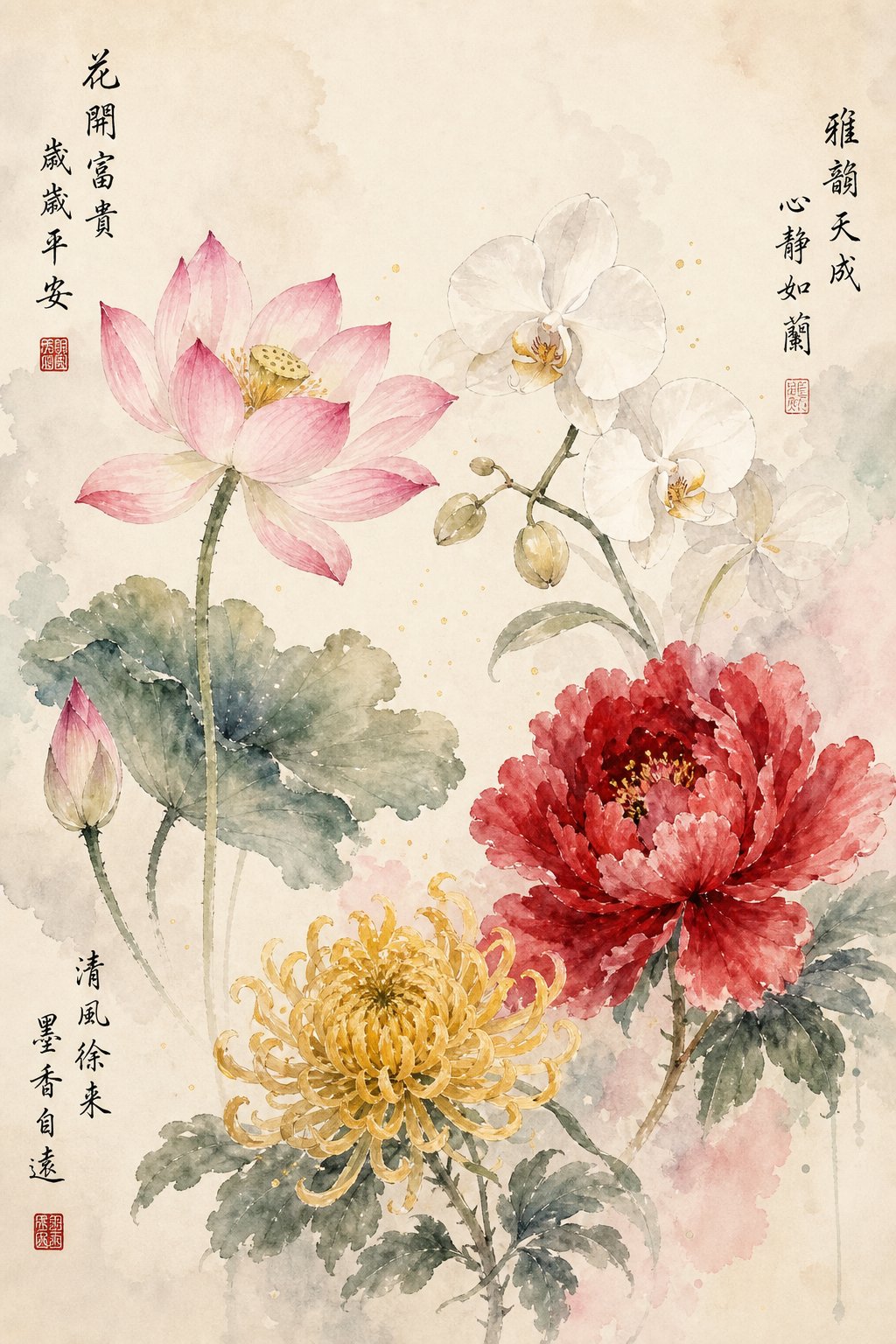
Imagine naming your daughter after the lotus. Botanically, you're referencing a water flower. Culturally, you're invoking a Buddhist symbol of purity rising from mud. Aspirationally, you're expressing the hope that she'll remain untouched by corruption no matter her surroundings. All three meanings live inside a single character. This layered structure is what makes Chinese flower names so compelling for parents who want a name that grows with their child.
How Flower Characters Work in Chinese Names
So how do you say flower in Chinese? The word is 花 (huā), pronounced with a high, level first tone. Understanding the hua name meaning is your starting point: it literally translates to "flower" or "blossom" and appears in compound words like 荷花 (lotus) and 菊花 (chrysanthemum).
You'll notice something visual connecting most flower-related characters. Look at 莲 (lotus), 兰 (orchid), 茉 (jasmine), and 菊 (chrysanthemum). They all share the grass radical 艹 sitting at the top of the character. This radical, called cao zi tou, signals that the character relates to plants or vegetation. When browsing chinese for flower characters to use in a name, spotting this radical is a quick way to identify botanical connections.
In the sections ahead, you'll find complete name examples organized by cultural tradition, flower type, and birth season, each with pinyin pronunciation, phonetic guides, and the layered meanings that make these names resonate across generations.
How Chinese Flower Naming Conventions Work
A beautiful flower character means little if it clashes with the family name or sits awkwardly within the name's structure. Chinese names follow specific architectural rules, and understanding them is the difference between a chinese flower name that flows naturally and one that sounds off to native speakers.
How Chinese Names Are Structured With Flower Characters
Every Chinese name follows a surname-first order. The family name (usually one character) comes first, followed by a given name of one or two characters. A complete name is typically two or three characters total. So when you see a chinese name flower combination like 林兰 (Lin Lan), 林 is the surname and 兰 (orchid) is the single-character given name.
Where does the flower character sit within the given name? In two-character given names, it can appear in either position, but placement changes the emphasis:
- Flower character first (e.g., 莲清 Lianqing) — the flower leads, making the botanical image dominant while the second character refines it
- Flower character second (e.g., 雅兰 Yalan) — the first character sets a quality like elegance or clarity, and the flower character anchors the image
- Flower character as sole given name (e.g., 王菊 Wang Ju) — direct and classical, common with chinese surnames of one syllable that pair well tonally
- Two flower-related characters together (e.g., 芷兰 Zhilan) — both characters reference plants, creating a layered botanical name
Each pattern produces a different rhythm and visual weight when written. Parents choosing chinese names with flower elements typically test several structural arrangements before settling on one that balances sound and meaning.
Single Character vs Full Flower Name in Given Names
Here's where things get interesting. Many names of flowers in chinese are two-character compounds: 茉莉 (jasmine), 牡丹 (peony), 芙蓉 (hibiscus). But given names rarely use the full compound. Instead, parents select a single character from the compound that carries the strongest connotation.
The lotus illustrates this perfectly. The full chinese name for flower is either 荷花 (hehua) or 莲花 (lianhua), but in naming, parents choose between 荷 (he) and 莲 (lian) as standalone characters. The difference matters: 荷 feels more colloquial and fresh, evoking summer ponds and natural beauty. 莲 carries a stronger Buddhist resonance, suggesting spiritual purity and transcendence. Same flower, different character, entirely different personality in the name.
For traditional characters that differ from simplified forms, consider 兰 (simplified) versus 蘭 (traditional) for orchid. Families in Taiwan, Hong Kong, or those maintaining heritage calligraphy may prefer the traditional form, which carries more visual weight on paper. The flower in chinese character form often looks more elaborate in traditional script, adding calligraphic beauty.
Tonal Harmony and Family Name Pairing
Mandarin has four tones, and a name's characters should move through contrasting tones to create a pleasing rhythm. A name where all characters share the same tone sounds flat and monotonous.
Consider the surname 王 (Wang, second tone). Pairing it with 梅 (Mei, second tone) creates 王梅 — two rising tones in a row that feel rushed. But 王若梅 (Wang Ruomei) introduces a fourth-tone character between them, giving the name a natural rise and fall. The test is simple: say the full name aloud as if introducing yourself across a room. If it flows without effort, the tonal pairing works.
This tonal dimension is why the same flower character pairs beautifully with some chinese surnames but awkwardly with others. A family named 李 (Li, third tone) might find that 兰 (Lan, second tone) creates a smooth falling-then-rising pattern in 李兰, while a family named 陈 (Chen, second tone) might prefer 菊 (Ju, second tone) less and lean toward 荷 (He, second tone) paired with a contrasting middle character instead.
These structural and tonal considerations form the foundation. With them in place, the real creative work begins: selecting which flower, and which specific character for that flower, carries the cultural weight you want your daughter's name to hold.
The Four Gentlemen Names From Classical Chinese Culture
Among all the names of chinese flowers used in naming traditions, four hold a status above the rest. They form a philosophical framework that has shaped Chinese art, poetry, and identity for over a thousand years, and they remain some of the most meaningful sources for girl names today.
The Four Gentlemen and Their Influence on Girl Names
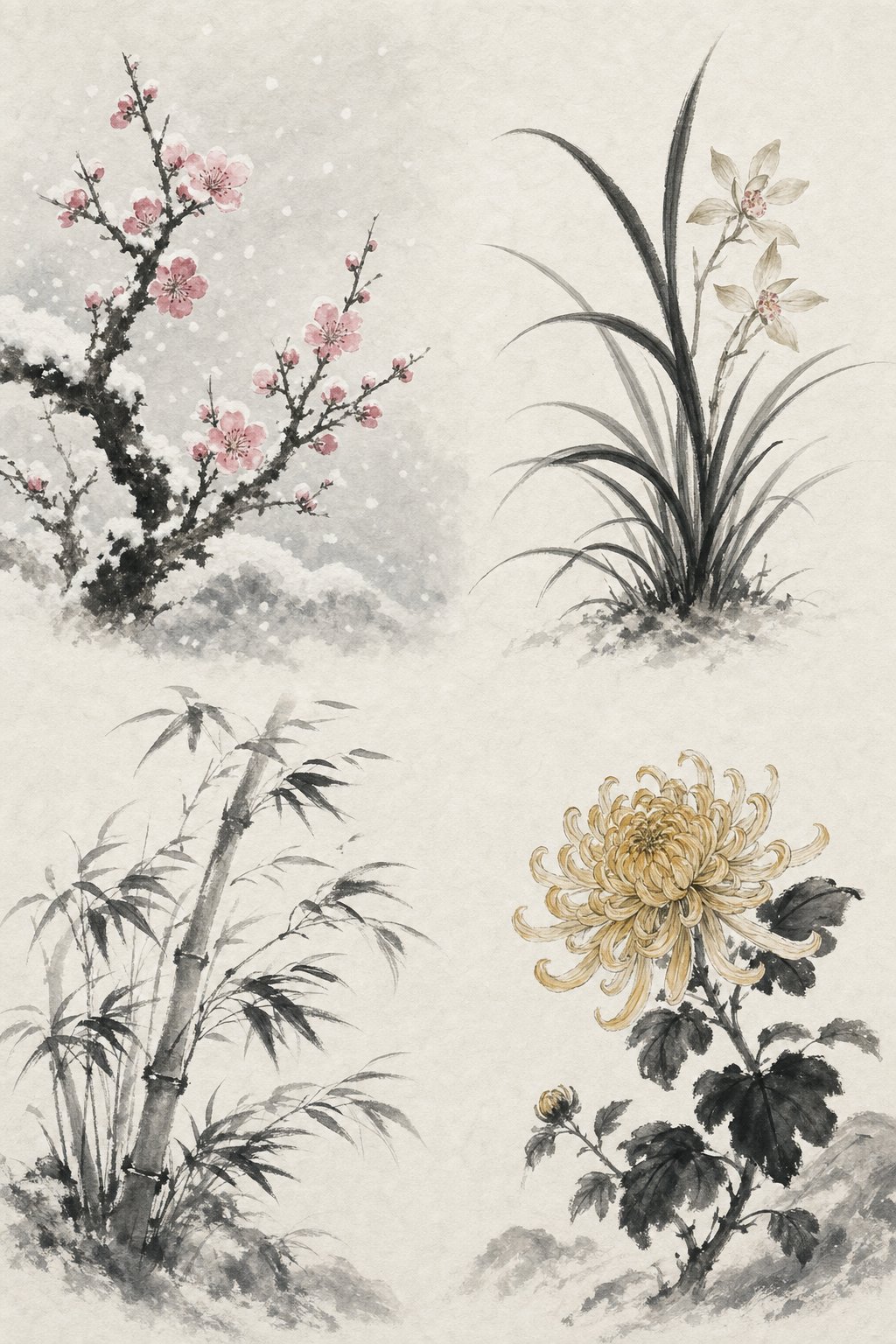
The Four Gentlemen, or 四君子 (si junzi), are plum blossom, orchid, bamboo, and chrysanthemum. Each represents a season and a set of moral virtues celebrated in Chinese brush painting and poetry. Originally associated with the noble character of a scholar-gentleman, these flowers in mandarin have been adopted into girl naming traditions precisely because the virtues they represent — resilience, grace, integrity, wisdom — are qualities parents aspire to see in their daughters.
Here's a quick reference for how each of the Four Gentlemen translates into naming material:
| Character | Pinyin | English Phonetic | Season | Meaning & Virtues | Example Names |
|---|---|---|---|---|---|
| 梅 | mei (second tone) | "may" | Winter | Perseverance, strength through adversity | 梅玲, 艺梅, 若梅 |
| 兰 | lan (second tone) | "lahn" | Spring | Purity, elegance, modesty | 秦兰, 兰燕, 慧兰 |
| 竹 | zhu (second tone) | "joo" | Summer | Integrity, flexibility, uprightness | 竹青, 竹君 |
| 菊 | ju (second tone) | "jyoo" | Autumn | Longevity, wisdom, steadfastness | 秋菊, 雅菊, 菊芳 |
You'll notice bamboo (竹) appears less frequently in girl names compared to the other three. Because it lacks the grass radical 艹 and carries a more masculine association, parents tend to favor plum blossom, orchid, and chrysanthemum for daughters. Still, 竹 appears in names like 竹青 (Zhu Qing, meaning "green bamboo" — evoking youthful integrity) for families drawn to its symbolism of moral strength.
Plum Blossom and Orchid Names With Pinyin
The plum blossom blooms in late winter when every other flower has retreated. This is why 梅 carries such powerful symbolism: it represents a person who thrives precisely when conditions are harshest. In Tang and Song dynasty poetry, plum blossoms appear constantly as metaphors for scholars who maintain their principles despite political hardship.
For girl names, 梅 pairs beautifully with characters that amplify different facets of its meaning:
- 梅玲 (Mei Ling) — 玲 means "delicate jade sound," creating a name that balances toughness with refinement. One of the most recognizable Chinese girl names internationally.
- 艺梅 (Yi Mei) — 艺 means "art" or "skill," suggesting someone whose perseverance is channeled into creative mastery.
- 若梅 (Ruo Mei) — 若 means "like" or "as if," giving the name a poetic, literary quality: "like a plum blossom."
Orchid names carry a different energy. The orchid grows quietly in secluded valleys, associated with scholars and poets who cultivate inner refinement rather than seeking public attention. Where plum blossom is outward strength, orchid is inward grace.
- 秦兰 (Qin Lan) — 秦 is both a surname and a character evoking ancient Chinese culture, paired with orchid to suggest classical elegance.
- 兰燕 (Lan Yan) — 燕 means "swallow" (the bird), combining the orchid's stillness with the swallow's freedom and lightness.
- 慧兰 (Hui Lan) — 慧 means "wisdom" or "intelligence," reinforcing the orchid's association with intellectual refinement.
Chrysanthemum Names and Their Literary Roots
Chrysanthemum holds a special place in Chinese literary tradition thanks largely to the poet Tao Yuanming (365-427 CE), who famously wrote of picking chrysanthemums by his eastern fence after retiring from public life. The flower became a symbol of someone who chooses authenticity over ambition, who ages with dignity and wisdom rather than chasing status.
This literary weight makes 菊 a thoughtful choice among flowers in mandarin used for naming. It suggests a girl who will value substance over appearance:
- 秋菊 (Qiu Ju) — 秋 means "autumn," directly linking the name to the chrysanthemum's blooming season and reinforcing its association with maturity and harvest.
- 雅菊 (Ya Ju) — 雅 means "refined" or "elegant," pairing the chrysanthemum's steadfastness with cultivated grace.
- 菊芳 (Ju Fang) — 芳 means "fragrance" or "virtuous reputation," suggesting that her character, like the chrysanthemum's scent, will be noticed and remembered.
Each of the Four Gentlemen offers a distinct personality blueprint. Plum blossom names suit families who value resilience. Orchid names speak to those who prize quiet refinement. Chrysanthemum names resonate with parents who hope their daughter will find contentment in authenticity. The choice between them often comes down to which virtue feels most essential to carry forward.
Of course, the Four Gentlemen represent the classical tradition. Two other flowers — lotus and peony — dominate Chinese naming culture with equal force, carrying their own rich layers of Buddhist spirituality and imperial beauty.
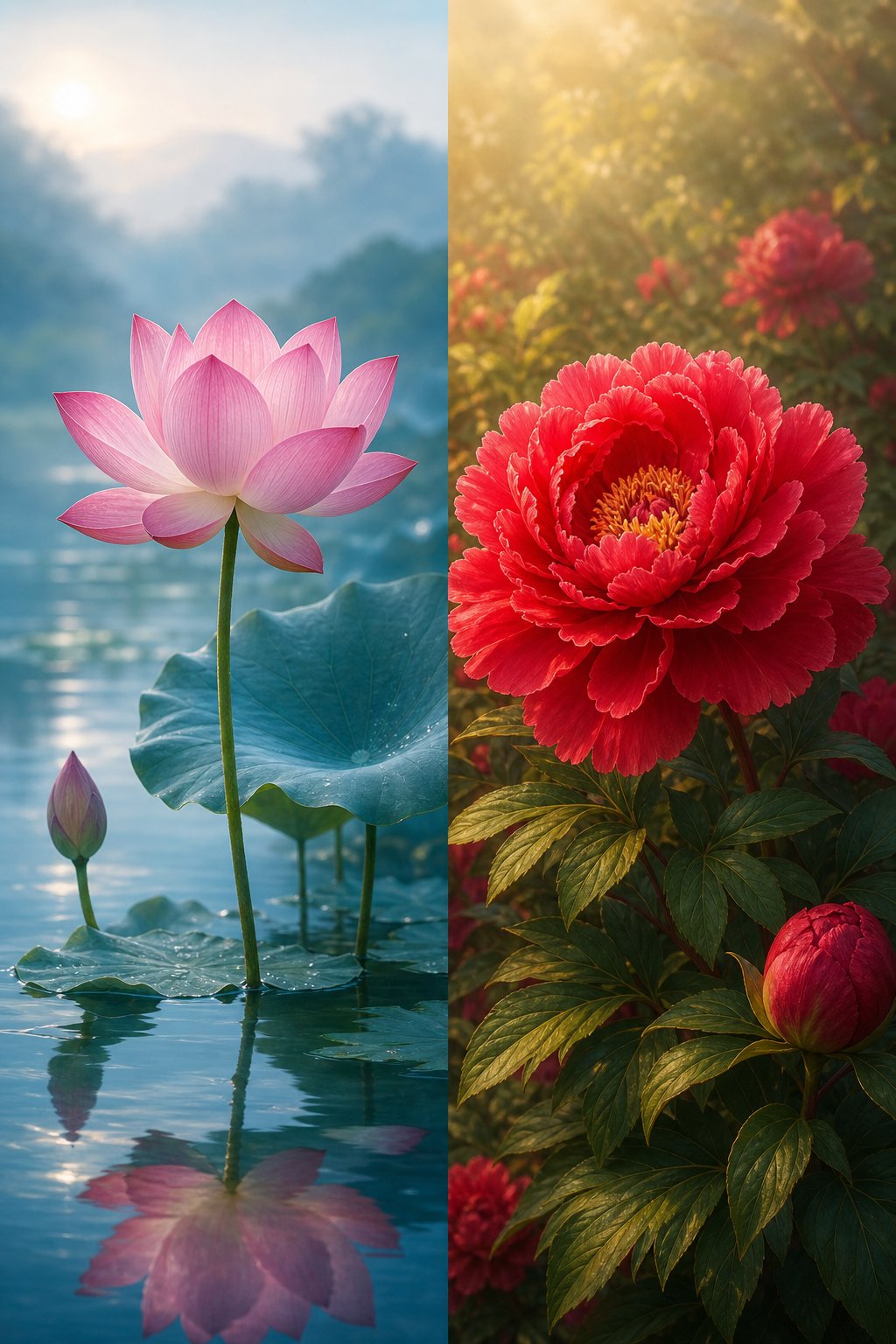
Lotus and Peony Girl Names With Pronunciation Guides
Lotus and peony sit at the heart of Chinese naming culture. Where the Four Gentlemen represent philosophical ideals drawn from scholarly tradition, these two flowers speak to something more visceral: spiritual purity and worldly abundance. Together, they cover the full spectrum of what parents hope for a daughter's life. One rises clean from muddy water. The other blooms in full, unapologetic splendor. Both produce some of the most beloved chinese flower names girl families have chosen for centuries.
Lotus Names Using 荷 and 莲 Characters
The lotus has been cultivated in China for over 3,000 years, and its symbolism runs deep. In Buddhism, it represents one who comes out of mire but is not sullied — inwardly empty, outwardly upright. For a girl's name, this translates into a wish that she remain pure and respected regardless of her circumstances.
Two characters represent the lotus in naming, and they carry different emotional weight. The character 荷 (he, second tone, pronounced "huh") feels fresh and natural, evoking summer ponds and open water. It also sounds like 和 (he), meaning harmony and union. The character 莲 (lian, second tone, pronounced "lee-en") leans toward the spiritual. It's used more frequently in Buddhist contexts and sounds similar to 廉 (lian, modesty) and 联 (lian, connection). Some parents drawn to names that mean water find the lotus especially fitting, since the flower is inseparable from the element it grows in.
Here are complete girl names using 荷, showing how each pairing shifts the name's personality:
| Full Name | Characters | Pinyin With Tones | Phonetic Guide | Meaning |
|---|---|---|---|---|
| Wang Heqing | 王荷清 | Wang Heqing (2-2-1) | wahng huh-ching | Lotus clarity — purity as clear as a lotus pond |
| Li Hefang | 李荷芳 | Li Hefang (3-2-1) | lee huh-fahng | Lotus fragrance — natural grace that draws others in |
| Zhang Ruohe | 张若荷 | Zhang Ruohe (1-4-2) | jahng rwoh-huh | Like a lotus — poetic and literary in tone |
| Chen Heying | 陈荷颖 | Chen Heying (2-2-3) | chuhn huh-eeng | Lotus intelligence — beauty paired with sharp wit |
| Lin Hexin | 林荷心 | Lin Hexin (2-2-1) | lin huh-shin | Lotus heart — inner purity and sincerity |
Names using 莲 tend to feel more traditional and carry a precious meaning rooted in spiritual aspiration:
| Full Name | Characters | Pinyin With Tones | Phonetic Guide | Meaning |
|---|---|---|---|---|
| Liu Lianyu | 刘莲玉 | Liu Lianyu (2-2-4) | lee-oh lee-en yoo | Lotus jade — spiritual purity with precious refinement |
| Wang Jinlian | 王金莲 | Wang Jinlian (2-1-2) | wahng jin lee-en | Golden lotus — radiance and Buddhist transcendence |
| Zhao Lianhui | 赵莲慧 | Zhao Lianhui (4-2-4) | jaow lee-en hway | Lotus wisdom — enlightenment through purity |
| Yang Bilian | 杨碧莲 | Yang Bilian (2-4-2) | yahng bee lee-en | Jade-green lotus — vivid natural beauty |
| Sun Lianxin | 孙莲心 | Sun Lianxin (1-2-1) | soon lee-en shin | Lotus heart — devotion and inner calm |
Notice how the surname pairing affects tonal flow. Wang Jinlian moves through second, first, and second tones, creating a gentle wave pattern. Zhao Lianhui drops from fourth to second then back to fourth, producing a more dramatic rhythm. Both work because they avoid monotone repetition.
Peony Names Symbolizing Beauty and Prosperity
If the lotus is spiritual, the peony is gloriously worldly. Known as the "king of flowers" (花王), the peony (牡丹, mudan) has been China's unofficial national flower for centuries. It symbolizes wealth, honor, and feminine beauty at its most confident. These are rich girl names in the truest cultural sense — not about money, but about fullness of life and unapologetic flourishing.
The full word 牡丹 rarely appears in given names because 牡 (mu) carries a masculine connotation (it means "male" in animal contexts). Instead, parents use 丹 (dan, first tone, pronounced "dahn"), which means "red" or "cinnabar" and evokes the peony's signature color. The character also suggests sincerity and devotion through the idiom 丹心 (a loyal heart). Related characters include 芍 (shao, from 芍药, the herbaceous peony) and 蕊 (rui, meaning "flower pistil"), both carrying an elegant meaning tied to feminine beauty.
| Full Name | Characters | Pinyin With Tones | Phonetic Guide | Meaning |
|---|---|---|---|---|
| Li Mudan | 李牡丹 | Li Mudan (3-4-1) | lee moo-dahn | Peony — bold beauty and prosperity (uses full flower name) |
| Wang Danqing | 王丹青 | Wang Danqing (2-1-1) | wahng dahn-ching | Cinnabar and blue-green — artistry and vivid beauty |
| Zhang Danrui | 张丹蕊 | Zhang Danrui (1-1-3) | jahng dahn-rway | Red blossom pistil — delicate beauty at its core |
| Chen Yadan | 陈雅丹 | Chen Yadan (2-3-1) | chuhn yah-dahn | Elegant red — refined confidence and warmth |
| Zhao Danxia | 赵丹霞 | Zhao Danxia (4-1-2) | jaow dahn-shyah | Red clouds at sunset — radiant and expansive beauty |
Among elegant girl names in the peony family, 陈雅丹 (Chen Yadan) stands out for its tonal balance: the second tone of Chen rises, the third tone of Ya dips, and the first tone of Dan holds steady. That contour gives the name a natural musicality when spoken aloud.
Chinese female names built around peony characters tend to project confidence. Where lotus names whisper, peony names declare. A girl named 丹霞 carries the image of sunset clouds — impossible to overlook, warm rather than cold, expansive rather than contained. Parents who want their daughter's name to radiate self-assurance often gravitate here.
The choice between lotus and peony often reflects a family's core values. Lotus names suit parents who prize inner character over outward display. Peony names resonate with those who want their daughter to move through the world with visible confidence and abundance. Many families find the decision comes down to a simple question: do you want her name to evoke quiet depth or radiant presence?
Beyond these two iconic flowers, modern Chinese naming draws heavily from a third group — jasmine, lily, and hibiscus — flowers that bridge traditional symbolism with contemporary popularity and cross-cultural accessibility.
Jasmine, Lily, and Hibiscus Names for Girls
Lotus and peony carry the weight of imperial history and Buddhist philosophy. Jasmine, lily, and hibiscus occupy a different space — they're the flowers that feel approachable, modern, and warm. For families seeking asian flower names that balance cultural depth with contemporary appeal, this trio offers some of the most versatile options in Chinese naming today.
Jasmine and Lily Names Popular in Modern China
Jasmine (茉莉, moli, fourth-fourth tone, pronounced "maw-lee") arrived in China via trade routes from South Asia and became deeply embedded in Chinese culture through folk song, tea, and daily life. The famous folk melody "Mo Li Hua" (Jasmine Flower) has made this china flower name recognizable worldwide. In naming, jasmine symbolizes warmth, approachability, and quiet grace — a girl who puts others at ease.
The character 莉 (li, fourth tone, pronounced "lee") is the workhorse here. It's one of the most popular single characters in modern female chinese names, appearing in millions of registrations across mainland China. Why? It sounds pleasant, pairs smoothly with almost any surname, and carries just enough floral association without feeling old-fashioned. The character 茉 (mo) appears less often alone because its meaning is incomplete without 莉 — it exists primarily as part of the jasmine compound.
Lily in Chinese is 百合 (baihe, third-second tone, pronounced "bye-huh"), meaning literally "hundred unions" — a symbol of harmony and lasting bonds. In naming, parents rarely use the full compound. Instead, 莉 does double duty, referencing both jasmine and the Western lily through phonetic association, which makes it especially popular among diaspora families seeking flower girl names that resonate in both languages.
| Full Name | Characters | Pinyin With Tones | Phonetic Guide | Meaning | Popularity |
|---|---|---|---|---|---|
| Zhang Moli | 张茉莉 | Zhang Moli (1-4-4) | jahng maw-lee | Full jasmine — warm, musical, and familiar | Common (modern) |
| Li Jiali | 李佳莉 | Li Jiali (3-1-4) | lee jyah-lee | Beautiful jasmine — loveliness paired with grace | Very popular |
| Wang Xinli | 王馨莉 | Wang Xinli (2-1-4) | wahng shin-lee | Fragrant jasmine — sweetness that lingers | Popular |
| Chen Yali | 陈雅莉 | Chen Yali (2-3-4) | chuhn yah-lee | Elegant jasmine — refined warmth | Popular |
| Liu Baihe | 刘百合 | Liu Baihe (2-3-2) | lee-oh bye-huh | Lily — harmony and unity in relationships | Moderate (literary) |
| Zhao Hejun | 赵合君 | Zhao Hejun (4-2-1) | jaow huh-jyoon | Union and nobility — lily-inspired harmony | Rare (distinctive) |
The pattern is clear: 莉 dominates modern naming because it's phonetically smooth, visually balanced (the grass radical 艹 gives it botanical identity at a glance), and tonally flexible. It works as a china flower name element that feels fresh rather than antiquated.
Hibiscus Names and Their Warm Symbolism
Hibiscus in Chinese takes two forms: 芙蓉 (furong, second-second tone, pronounced "foo-rohng") and 木槿 (mujin). The flower meanings hibiscus carries in Chinese culture center on warmth, beauty, and the fleeting preciousness of youth — hibiscus blooms are famously short-lived, opening in the morning and closing by evening. This gives hibiscus names a bittersweet quality: beauty that should be cherished because it won't last forever.
The character 芙 (fu, second tone, pronounced "foo") appears in names evoking the lotus-hibiscus overlap, since 芙蓉 historically referred to both flowers depending on context. The character 槿 (jin, third tone, pronounced "jin") is rarer and more distinctive, drawn from 木槿 (Rose of Sharon). Parents choosing 槿 signal literary awareness and a preference for the uncommon.
| Full Name | Characters | Pinyin With Tones | Phonetic Guide | Meaning | Popularity |
|---|---|---|---|---|---|
| Lin Furong | 林芙蓉 | Lin Furong (2-2-2) | lin foo-rohng | Full hibiscus — radiant natural beauty | Traditional |
| Wang Fuya | 王芙雅 | Wang Fuya (2-2-3) | wahng foo-yah | Hibiscus elegance — graceful and warm | Moderate |
| Chen Jinxi | 陈槿溪 | Chen Jinxi (2-3-1) | chuhn jin-shee | Hibiscus stream — rare beauty flowing naturally | Rare (literary) |
| Zhang Jinyan | 张槿言 | Zhang Jinyan (1-3-2) | jahng jin-yen | Hibiscus words — beauty expressed through speech | Rare (modern creative) |
Hibiscus names occupy a niche space among asian flower names. They're neither as ubiquitous as jasmine names nor as classical as lotus names, which gives them a distinctive quality that appeals to parents wanting something recognizable yet uncommon.
Understanding Name Popularity and Social Perception
Popularity matters in Chinese naming more than many Western parents realize. A name that's too common (like certain 莉 combinations in the 1980s and 1990s) can feel generic, similar to how "Jennifer" peaked in English-speaking countries. A name that's too rare might seem pretentious or cause confusion.
Here's how these flower girl names break down by social perception in contemporary China:
- Very common (may feel dated): 茉莉 as a full given name, 丽莉, 小莉 — these peaked a generation ago and now carry a "mom's name" association for younger Chinese speakers
- Currently popular (fresh but not rare): 佳莉, 馨莉, 芙雅 — modern combinations that feel polished and intentional
- Distinctive (literary or creative): 槿溪, 槿言, 百合 as a given name — these stand out and signal parents with literary taste
- Cross-culturally accessible: Names with 莉 work especially well for diaspora families because "Li" or "Lee" integrates smoothly into English pronunciation
The takeaway for parents browsing female chinese names: 莉 remains a safe, beautiful choice, but the characters you pair it with determine whether the name feels contemporary or dated. Hibiscus characters like 槿 offer distinctiveness for families comfortable with a less common path. And lily (百合) names, while less frequent, carry a meaning of unity that resonates across cultures.
These popularity dynamics shift with the seasons — literally. Chinese tradition ties flower names not just to symbolism but to the time of year a child is born, creating a seasonal framework that adds another layer of intentionality to the naming process.
Choosing a Flower Name Based on Birth Season
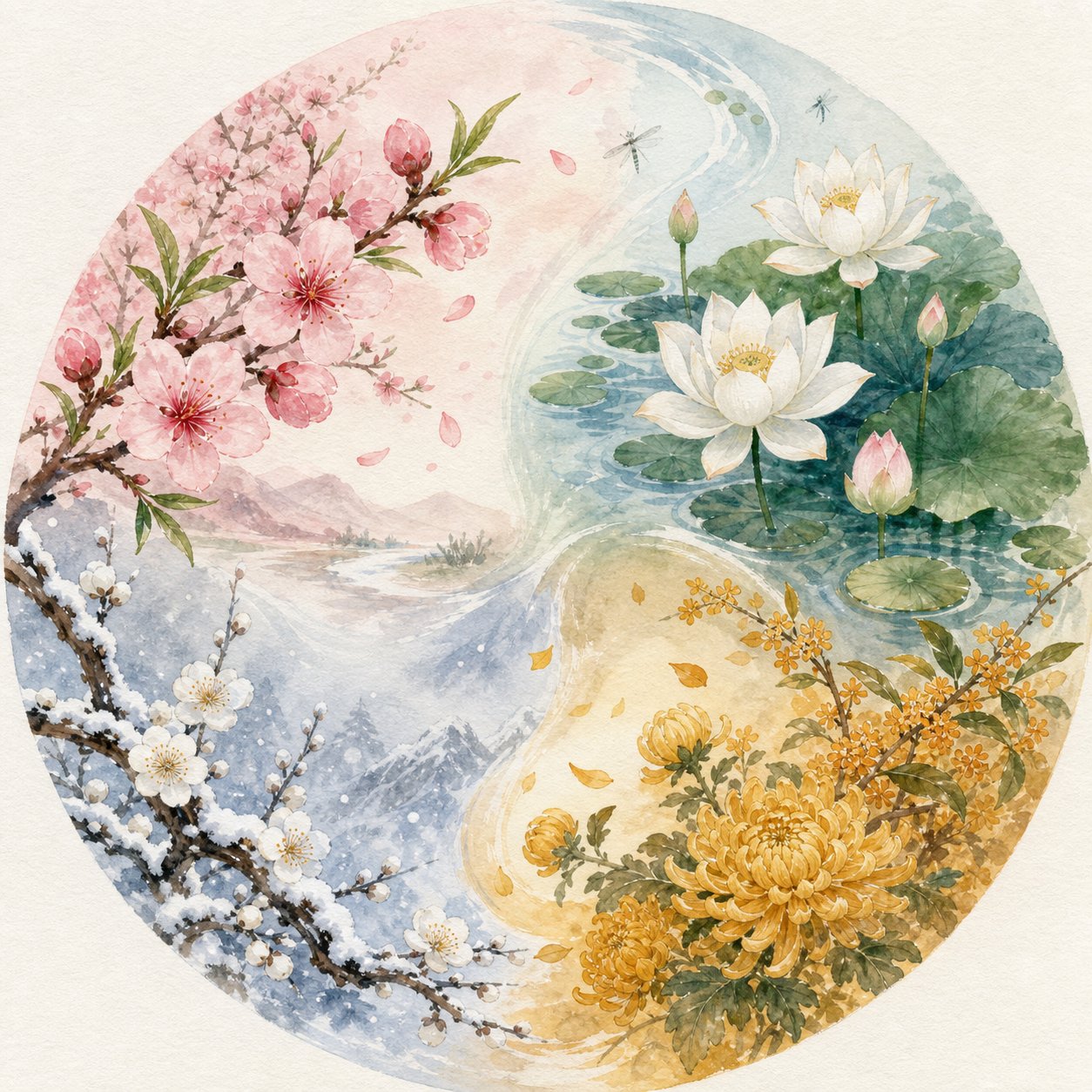
In traditional Chinese culture, the relationship between a person and the natural world isn't decorative — it's foundational. Parents have long believed that a child born in a particular season carries something of that season's energy, and the name should reflect it. A spring baby arrives with the world waking up, so her name might reference peach blossoms opening in warm air. A winter baby enters during stillness and stored strength, so plum blossom feels right. This seasonal framework gives families a practical starting point when the sheer number of chinese names that mean flower feels overwhelming.
The logic is intuitive: match the flower's blooming season to your daughter's birth time, and the name gains an extra layer of nature and meaning. It's not a rigid rule, but a guiding principle rooted in the idea that harmony between a person and their environment begins at birth. For a chinese baby born in autumn, a chrysanthemum name connects her identity to harvest, maturity, and golden light. For a summer arrival, lotus and jasmine evoke warmth and abundance.
Spring and Summer Flower Names by Birth Season
Spring is revival. Everything pushes upward — buds open, colors return, and the world feels full of potential. The signature spring flowers for naming are peach blossom (桃, tao) and magnolia (玉兰, yulan). Peach blossom symbolizes youthful beauty and romance, while magnolia represents dignity and purity. Parents drawn to names with sun meaning often pair spring flowers with characters like 阳 (yang, sunshine) or 晓 (xiao, dawn) to amplify that sense of bright new beginnings.
Summer burns with energy. Lotus (荷) and jasmine (茉) dominate this season, both thriving in heat and carrying associations of vitality and fragrance. Names with meaning of sun work naturally here too — characters like 旭 (xu, rising sun) or 晴 (qing, clear sky) pair well with summer blooms to capture that radiant intensity.
| Season | Flower | Character | Example Name | Pinyin | Phonetic Guide | Meaning |
|---|---|---|---|---|---|---|
| Spring | Peach Blossom | 桃 | 李桃夭 (Li Taoyao) | Li Taoyao (3-2-1) | lee taow-yaow | Peach in full bloom — youthful radiance from the Book of Songs |
| Spring | Peach Blossom | 桃 | 王桃芳 (Wang Taofang) | Wang Taofang (2-2-1) | wahng taow-fahng | Peach fragrance — beauty that announces spring's arrival |
| Spring | Magnolia | 玉兰 | 张玉兰 (Zhang Yulan) | Zhang Yulan (1-4-2) | jahng yoo-lahn | Jade orchid — dignified purity and noble bearing |
| Spring | Magnolia | 兰 | 陈兰晓 (Chen Lanxiao) | Chen Lanxiao (2-2-3) | chuhn lahn-shyaow | Orchid at dawn — elegance greeting a new day |
| Summer | Lotus | 荷 | 吴荷晴 (Wu Heqing) | Wu Heqing (2-2-2) | woo huh-ching | Lotus on a clear day — purity under bright summer skies |
| Summer | Lotus | 荷 | 林夏荷 (Lin Xiahe) | Lin Xiahe (2-4-2) | lin shyah-huh | Summer lotus — blooming at the peak of warmth |
| Summer | Jasmine | 茉 | 黄熙茉 (Huang Ximo) | Huang Ximo (2-1-4) | hwahng shee-maw | Prosperous jasmine — harmonious warmth and fragrance |
| Summer | Jasmine | 茉 | 赵茉晴 (Zhao Moqing) | Zhao Moqing (4-4-2) | jaow maw-ching | Jasmine under clear skies — bright and inviting |
The spring name 李桃夭 draws directly from the Book of Songs (诗经), where "桃之夭夭" describes a peach tree in gorgeous bloom — one of the oldest literary references used in Chinese girl naming.
Autumn and Winter Flower Names by Birth Season
Autumn carries a different emotional register. The light turns golden, the air cools, and there's a sense of gathering in rather than pushing out. Chrysanthemum (菊) and osmanthus (桂, gui, fourth tone, pronounced "gway") define this season. Osmanthus is particularly evocative — its tiny golden flowers release an intense sweet fragrance in September and October, and the character 桂 also connects to the moon through the legend of the osmanthus tree growing on the lunar surface. Parents seeking names that mean moon often pair 桂 with lunar characters to create a moon blossom effect: 桂月 (Guiyue) literally means "osmanthus moon."
Winter strips everything back to essentials. Only the strongest flowers bloom when frost arrives. Plum blossom (梅) is the undisputed queen of winter naming, but camellia (茶花, chahua) offers a softer alternative. The character 茶 (cha, second tone) is less common in names but carries associations of warmth, contemplation, and quiet beauty — a cup of tea on a cold day.
| Season | Flower | Character | Example Name | Pinyin | Phonetic Guide | Meaning |
|---|---|---|---|---|---|---|
| Autumn | Chrysanthemum | 菊 | 张秋菊 (Zhang Qiuju) | Zhang Qiuju (1-1-2) | jahng chyoh-jyoo | Autumn chrysanthemum — maturity and quiet wisdom |
| Autumn | Osmanthus | 桂 | 赵桂芳 (Zhao Guifang) | Zhao Guifang (4-4-1) | jaow gway-fahng | Osmanthus fragrance — sweetness that fills the harvest air |
| Autumn | Osmanthus | 桂 | 周桂月 (Zhou Guiyue) | Zhou Guiyue (1-4-4) | joh gway-yweh | Osmanthus moon — lunar beauty and autumn romance |
| Autumn | Chrysanthemum | 菊 | 孙菊穗 (Sun Jusui) | Sun Jusui (1-2-4) | soon jyoo-sway | Chrysanthemum and grain — abundance and steadfastness |
| Winter | Plum Blossom | 梅 | 王冰梅 (Wang Bingmei) | Wang Bingmei (2-1-2) | wahng bing-may | Plum in ice — strength that blooms through hardship |
| Winter | Plum Blossom | 梅 | 刘雪梅 (Liu Xuemei) | Liu Xuemei (2-3-2) | lee-oh shweh-may | Snow plum — beauty against a white winter backdrop |
| Winter | Camellia | 茶 | 林茶韵 (Lin Chayun) | Lin Chayun (2-2-4) | lin chah-yoon | Camellia rhythm — quiet warmth and contemplative grace |
| Winter | Plum Blossom | 梅 | 马霜梅 (Ma Shuangmei) | Ma Shuangmei (3-1-2) | mah shwahng-may | Frost plum — resilience meeting the coldest challenge |
You'll notice how the seasonal framework narrows the field. Instead of choosing from dozens of flower characters, you start with your daughter's birth season and work outward from there. A September baby? Osmanthus and chrysanthemum become your primary palette. A February arrival? Plum blossom is almost inevitable, and the name practically writes itself once you select the right companion character.
This approach also helps with the aspirational layer. Spring names carry hope and freshness. Summer names project confidence and warmth. Autumn names suggest wisdom beyond her years. Winter names promise inner strength. The season becomes a shorthand for the personality you're naming into existence.
Of course, choosing the right seasonal flower is only part of the equation. For families living between cultures — raising a chinese baby in an English-speaking country — practical considerations around pronunciation, documentation, and cross-cultural accessibility shape the final decision just as much as symbolism does.
Practical Tips for Diaspora Families Choosing Flower Names
Selecting a flower name rooted in Chinese tradition is one thing when your daughter will grow up in Beijing or Shanghai. It's a different challenge entirely when she'll introduce herself in classrooms, doctor's offices, and job interviews conducted in English. For families raising children between cultures, the naming process involves an extra set of questions: How will this name appear on a passport? Can her kindergarten teacher pronounce it? Will it pair naturally with an English first name?
These aren't minor concerns. As one Chinese-American pastor described his family's approach, they settled on "an English first name plus a Chinese middle name" — a structure that preserves cultural identity while easing daily interactions. Many diaspora families browsing a chinese names list female options follow this same pattern, and flower names are especially well-suited to it because of their inherent beauty and positive associations.
Pairing Chinese Flower Names With English Names
The most common structure for bicultural families looks like this: English first name + Chinese flower name as middle name + family surname. On official documents, this typically appears as "Lily Mei Zhang" or "Grace Lian Chen." The Chinese name lives on the birth certificate and passport, available for family use and cultural contexts, while the English name handles everyday Western interactions.
When pairing, consider how the names sound together as a full sequence. A few strategies that work well:
- Phonetic echo: Choose an English name that shares a sound with the Chinese flower name. Lily pairs naturally with 莉 (li), Mei with 梅 (mei), and Rose with 蓉 (rong). The repetition creates cohesion rather than feeling like two unrelated names stitched together.
- Meaning mirror: Match the English name's meaning to the Chinese name's symbolism. Grace + 兰 (orchid, representing elegance) or Joy + 荷 (lotus, representing harmony) creates thematic unity across languages.
- Contrast for completeness: Some parents deliberately choose names that complement rather than repeat. A strong English name like Victoria paired with the gentle 茉 (jasmine) gives the child range — assertiveness in one cultural context, warmth in another.
For families where asian surnames names carry one or two syllables — Li, Wang, Chen, Zhang, Park, Kim — shorter Chinese given names (one character) often produce a smoother full-name rhythm on English documents. "Emma Lan Li" flows more easily than "Emma Lianyu Li" in Western administrative contexts, though both are perfectly valid.
Avoiding Common Naming Pitfalls and Homophones
Chinese is a tonal language, and a single syllable can mean wildly different things depending on its tone. The character 花 (hua, first tone) means "flower," but 画 (hua, fourth tone) means "painting" — a common homophone pair that illustrates how tonal slips change meaning entirely. In naming, this creates real risks. A name that looks beautiful on paper might sound unfortunate when spoken aloud, especially across different Chinese dialects.
Here are specific pitfalls to watch for when choosing asian girl names with flower characters:
- Dialect pronunciation shifts: A name that sounds lovely in Mandarin may carry negative associations in Cantonese, Hokkien, or other dialects. One father discovered his preferred girl name 恒莹 (Heng Ying, "forever bright") sounded exactly like the Cantonese word for "execution" (行刑) — a discovery he made just in time to reject it.
- Tone-pair homophones: 梅 (mei, second tone, plum blossom) sounds close to 霉 (mei, second tone, mold/bad luck). Context usually clarifies, but the association lingers for some listeners. Pairing 梅 with a clearly positive second character helps override this.
- English mispronunciation creating unintended words: 菊 (ju) may be mispronounced as "joo" or slurred into something resembling an English profanity by unfamiliar speakers. 芙 (fu) can sound like an English expletive to untrained ears. Consider how non-Chinese speakers will attempt the name.
- Characters too complex to write: 蕊 (rui, flower pistil) has 18 strokes. 薇 (wei, fern/rose) has 16. A child who needs to write her Chinese name on school forms or practice calligraphy may struggle with highly complex characters. Simpler options like 兰 (5 strokes in simplified) or 莉 (10 strokes) are more practical for daily use.
- Surnames creating unfortunate compounds: The surname 吴 (Wu) combined with certain flower characters can produce unintended readings. 吴莲 (Wu Lian) sounds like 无脸 (wulian, "no face/shameless") in casual speech. Always test the full name — surname included — for homophone collisions.
The safest approach is to say the complete name aloud in every dialect your family speaks, then ask native speakers from different regions for their honest reaction. What reads beautifully may sound problematic in a dialect you hadn't considered.
Names That Work Across Cultures
Some flower characters naturally bridge the gap between Chinese and English-speaking environments. These tend to share a few qualities: they're phonetically accessible to English speakers, they don't produce awkward homophone collisions, and they carry positive associations in both cultural contexts.
Among all asian names with flower connections, these characters consistently perform well cross-culturally:
- 莉 (li): Pronounced like the English name "Lee." Universally easy to say, familiar as a standalone name or surname element in English. Works for families with surnames asian communities share across multiple countries.
- 兰 (lan): Pronounced like "Lahn." Simple, elegant, and close enough to English names like "Lana" that non-Chinese speakers grasp it immediately.
- 梅 (mei): Pronounced like "May." Functions as both a Chinese flower name and an English name, making it one of the most seamless bicultural choices available.
- 丹 (dan): Pronounced like the English name "Don" with a shorter vowel. Familiar, easy, and carries no negative English associations.
Characters like 菊 (ju), 蕊 (rui), and 槿 (jin) are harder for English speakers to pronounce correctly on first attempt. They're still beautiful names — they just require more patience in cross-cultural settings. Families who prioritize pronunciation accessibility tend to gravitate toward the first group, while those who prioritize cultural distinctiveness embrace the second.
The goal isn't to flatten a Chinese name into something that "sounds English." It's to find the sweet spot where heritage stays intact and daily life stays smooth. A baby in chinese culture receives a name meant to carry her through an entire lifetime — and for diaspora families, that lifetime will span multiple languages, communities, and cultural expectations. The best flower names honor all of those realities at once.

How to Choose the Perfect Chinese Flower Name for Your Daughter
You've explored the flowers, learned the characters, and considered pronunciation across cultures. The question remains: which name is right for your daughter? Rather than scrolling endlessly through chinese names girl lists, start with something more personal — the qualities you hope she'll carry through life.
Matching Flower Names to Desired Qualities
Every flower maps to a distinct personality blueprint. Think of it less as picking a pretty word and more as choosing a direction. What kind of woman do you imagine your daughter becoming? The answer points you toward the right bloom.
| Flower | Character | Personality Traits | Core Virtues | Ideal Family Values |
|---|---|---|---|---|
| Lotus | 荷 / 莲 | Calm, principled, spiritually grounded | Purity, resilience, inner peace | Integrity above status, faith, compassion |
| Orchid | 兰 | Refined, intellectual, quietly confident | Elegance, modesty, integrity | Education, cultural depth, self-cultivation |
| Peony | 丹 / 蕊 | Bold, warm, self-assured | Confidence, beauty, abundance | Ambition, generosity, celebrating life fully |
| Plum Blossom | 梅 | Determined, independent, courageous | Perseverance, strength, hope | Resilience through hardship, moral courage |
| Jasmine | 莉 / 茉 | Approachable, graceful, emotionally warm | Grace, kindness, harmony | Connection, hospitality, gentle strength |
| Chrysanthemum | 菊 | Wise, authentic, content | Longevity, wisdom, steadfastness | Authenticity over ambition, inner richness |
| Osmanthus | 桂 | Sweet-natured, luminous, romantic | Sweetness, nobility, lunar beauty | Romance, family warmth, quiet achievement |
Notice how the table reveals distinct paths. Parents seeking strong female names gravitate toward plum blossom and lotus — flowers that thrive under pressure. Those drawn to elegant female names find orchid and jasmine more fitting, where the elegant definition centers on refinement rather than force. And families who value both? Plum blossom names carry the spirit of names of strong woman traditions while remaining unmistakably feminine. They're not female warrior names in the combative sense, but they encode the same core message: she will not break.
A Framework for Making Your Final Choice
When you've narrowed your options to two or three flowers, run each candidate through these filters:
- Meaning alignment: Does the chinese name meaning flower match what you genuinely value, not just what sounds impressive?
- Tonal harmony: Say the full name — surname included — aloud. Does it rise and fall naturally?
- Character simplicity: Can your daughter write it by age seven without frustration?
- Cross-cultural sound: If she'll live between languages, can non-Chinese speakers attempt it respectfully?
- Dialect safety: Have you tested it in every dialect your family speaks?
The best name that means flower isn't the one with the most poetic backstory — it's the one where botanical beauty, cultural symbolism, and your family's deepest hopes converge into a single, speakable truth your daughter will carry proudly for life.
Chinese flower naming is ultimately an act of faith. You're planting a seed in language, trusting that the meaning will grow alongside her. Whether you choose the quiet resilience of lotus, the radiant confidence of peony, or the gentle warmth of jasmine, you're giving her something no ordinary name provides: a story that unfolds in layers, revealing new depth at every stage of her life.
Frequently Asked Questions About Chinese Flower Names for Girls
1. What is the most popular Chinese flower name for girls?
The character 莉 (li), derived from jasmine (茉莉), is one of the most widely used flower characters in modern Chinese girl names. It pairs smoothly with nearly any surname, sounds pleasant in both Mandarin and English, and carries associations of warmth and grace. Popular combinations include 佳莉 (Jiali, beautiful jasmine) and 馨莉 (Xinli, fragrant jasmine). However, some combinations peaked in the 1980s-90s and may feel dated to younger Chinese speakers, so pairing 莉 with a fresh secondary character keeps the name contemporary.
2. What is the difference between 荷 and 莲 for lotus in Chinese girl names?
Both characters represent the lotus, but they carry different emotional tones. 荷 (he) feels more colloquial and fresh, evoking summer ponds and natural beauty. It also sounds like 和 (harmony), adding a peaceful undertone. 莲 (lian) carries a stronger Buddhist and spiritual resonance, suggesting transcendence and purity of spirit. Parents who want a nature-forward, lighthearted feel tend to choose 荷, while those drawn to deeper philosophical or religious symbolism prefer 莲.
3. How do you choose a Chinese flower name that works in English-speaking countries?
Focus on characters that are phonetically accessible to English speakers without losing cultural meaning. Characters like 梅 (mei, sounds like 'May'), 莉 (li, sounds like 'Lee'), 兰 (lan, sounds like 'Lahn'), and 丹 (dan, sounds like 'Don') integrate smoothly into English pronunciation. Many diaspora families use a structure of English first name plus Chinese flower middle name plus surname. Testing the full name aloud in every dialect your family speaks and checking for homophone collisions with the surname are essential steps before finalizing.
4. Can you pick a Chinese flower name based on the baby's birth season?
Yes, this is a traditional Chinese naming practice. Spring babies pair well with peach blossom (桃) or magnolia (玉兰) names representing new beginnings. Summer births align with lotus (荷) and jasmine (茉) for warmth and vitality. Autumn arrivals suit chrysanthemum (菊) or osmanthus (桂) for wisdom and sweetness. Winter babies connect naturally with plum blossom (梅) for resilience. This framework narrows your options meaningfully and adds an extra layer of harmony between the child and the natural world.
5. What are the Four Gentlemen flowers and why do they matter for Chinese girl names?
The Four Gentlemen (四君子) are plum blossom (梅), orchid (兰), bamboo (竹), and chrysanthemum (菊). They form a philosophical framework from Chinese brush painting and poetry, each representing a season and a set of moral virtues: perseverance, elegance, integrity, and wisdom respectively. Though originally associated with male scholarly ideals, three of the four — plum blossom, orchid, and chrysanthemum — are widely used in girl names because the virtues they encode are qualities parents aspire to see in their daughters. Bamboo is less common for girls due to its more masculine associations.