The Art and Philosophy Behind Traditional Chinese Baby Names
When English-speaking parents choose a name, they often pick something that sounds pleasant or honors a relative. The story behind a Western name might take a few seconds to tell. Traditional Chinese baby names work on an entirely different level. Each character is a deliberate philosophical choice, carrying independent meaning, tonal beauty, and centuries of cultural weight. A name is not simply a label. It is a tiny, meaningful phrase that encodes a family's deepest hopes for their child.
Why Traditional Chinese Names Are More Than Labels
Imagine selecting a name where every syllable holds its own definition, where the visual strokes of the written character matter as much as the sound, and where the combination of two or three characters creates a unique aspiration. That is the reality of Chinese baby names and meanings. The name "Wan Yan" (婉嫣), for example, does not simply sound pretty. Each character independently means "graceful" and "beautiful like a flower," combining into a wish for the child to blossom in spirit and personality. This layered construction is what makes Chinese names so distinct from their Western counterparts.
Every Chinese character in a name carries independent meaning. When two characters join together, they do not merely form a word. They create a unique aspiration, a compressed poem that a child carries for life.
The process of naming a baby in Chinese culture has historically involved consulting elders, analyzing birth charts, and weighing philosophical traditions spanning Confucianism, Taoism, and Buddhism. Parents consider tonal harmony, stroke count, elemental balance, and even how the characters look when written side by side. It is, in every sense, a deliberate act of creation.
What This Guide Covers for Every Family
This guide is built as a single comprehensive resource for anyone exploring Chinese names, whether you are choosing a name for a boy, a girl, or seeking something gender-neutral. You will find structural breakdowns of how these names work, curated lists organized by theme and meaning, and the cultural rules that shape every decision. From the philosophical roots behind character selection to the naming taboos that families still observe, each section gives you the context needed to understand and appreciate this tradition fully. The goal is simple: help every family navigate this rich naming heritage with clarity and confidence.
How Traditional Chinese Names Are Structured
So how do all those meaningful characters actually fit together? Chinese names follow a precise architecture that reverses the Western order and packs far more information into fewer syllables. Understanding this structure is the first step toward choosing or appreciating any name rooted in this tradition.
Surname Plus Given Name Structure Explained
In Chinese naming, the surname (姓, xìng) always comes first, followed by the given name (名, míng). This order reflects a cultural priority: family identity precedes individual identity. If you see a three-syllable name like Wang Xiaoming (王晓明), the single syllable "Wang" is the family name and "Xiaoming" is the given name. Among common chinese names, this pattern holds almost universally.
Chinese surnames are overwhelmingly one syllable. The top 100 chinese surnames cover roughly 85 percent of the population in mainland China, with Li (李), Wang (王), and Zhang (张) alone shared by more than 270 million people. Compared to the vast pool of Western family names, this concentrated set of asian surnames means the given name carries even more weight in distinguishing one person from another.
Chinese given names typically consist of one or two characters. Many local Chinese use a single-character given name, while diaspora families often favor two characters. Each character is chosen for its individual meaning, and together they form a compressed aspiration. For instance, in the name Jia Zhenni (贾振妮), "Jia" is the surname, and "Zhenni" is the two-character given name where each character contributes its own significance.
Milk Names and Courtesy Names in Chinese Tradition
A formal registered name is only one layer. In traditional Chinese society, a person could carry several names across their lifetime. The milk name (乳名, rǔmíng) is a childhood nickname given at birth, often intentionally humble or playful to ward off evil spirits. You might hear names prefixed with "Ah" (啊), like "Ah Qiang," which takes the last character of a given name and adds this familiar prefix. These nicknames are used by close family and friends throughout childhood.
Historically, men also received a courtesy name (字, zì) upon reaching adulthood. This formal name was used by peers and colleagues, while the birth name became almost taboo for others to speak aloud. Some men accumulated as many as five different names over a lifetime, including pen names (号, hào) and posthumous names (谥号, shì hào). While courtesy names have largely faded from modern practice, milk names remain common across Chinese-speaking families today.
Generational Characters That Connect Family Lines
One of the most distinctive features of chinese first names is the generational name (字辈, zìbèi). In this tradition, all siblings and patrilineal cousins of the same generation share one character in their given names. This shared character is predetermined, often drawn from a generational poem composed by ancestors long ago. Each line of the poem assigns a character to a successive generation, creating a naming sequence that can stretch across centuries.
Consider this: if the generational character for a particular generation is "Zhen" (振), then siblings might be named Jia Zhenni (贾振妮), Jia Zhenhai (贾振海), and cousins named Jia Zhenhua (贾振华) or Jia Zhenguo (贾振国). When spoken together, the shared syllable is immediately audible, signaling kinship. The second character in the given name is the personal character, chosen uniquely for each child.
The table below breaks down how these components work together in practice:
| Full Name | Surname | Generation Character | Personal Character | Combined Meaning |
|---|---|---|---|---|
| 王晓明 (Wáng Xiǎomíng) | 王 (Wáng) — King | 晓 (Xiǎo) — Dawn | 明 (Míng) — Bright | Bright as the dawn |
| 贾振海 (Jiǎ Zhènhǎi) | 贾 (Jiǎ) — Merchant | 振 (Zhèn) — Uplift | 海 (Hǎi) — Sea | Vast and uplifting spirit |
| 李文芳 (Lǐ Wénfāng) | 李 (Lǐ) — Plum | 文 (Wén) — Literature | 芳 (Fāng) — Fragrant | Elegant literary grace |
| 陈世杰 (Chén Shìjié) | 陈 (Chén) — Ancient state | 世 (Shì) — Generation | 杰 (Jié) — Outstanding | Outstanding across generations |
Not every family still follows the generational naming system. In mainland China, the practice declined during the mid-twentieth century when revolutionary-sounding names became fashionable. Smaller families who cannot trace their lineage may also skip it. Still, among asian surnames and naming traditions that persist in diaspora communities, generational characters remain a powerful way to map family connections and honor ancestral continuity.
With the structural blueprint clear, the deeper question emerges: what guides the actual choice of characters? The answer lies in philosophical traditions that have shaped Chinese culture for millennia.
The Philosophical Roots of Chinese Naming Traditions
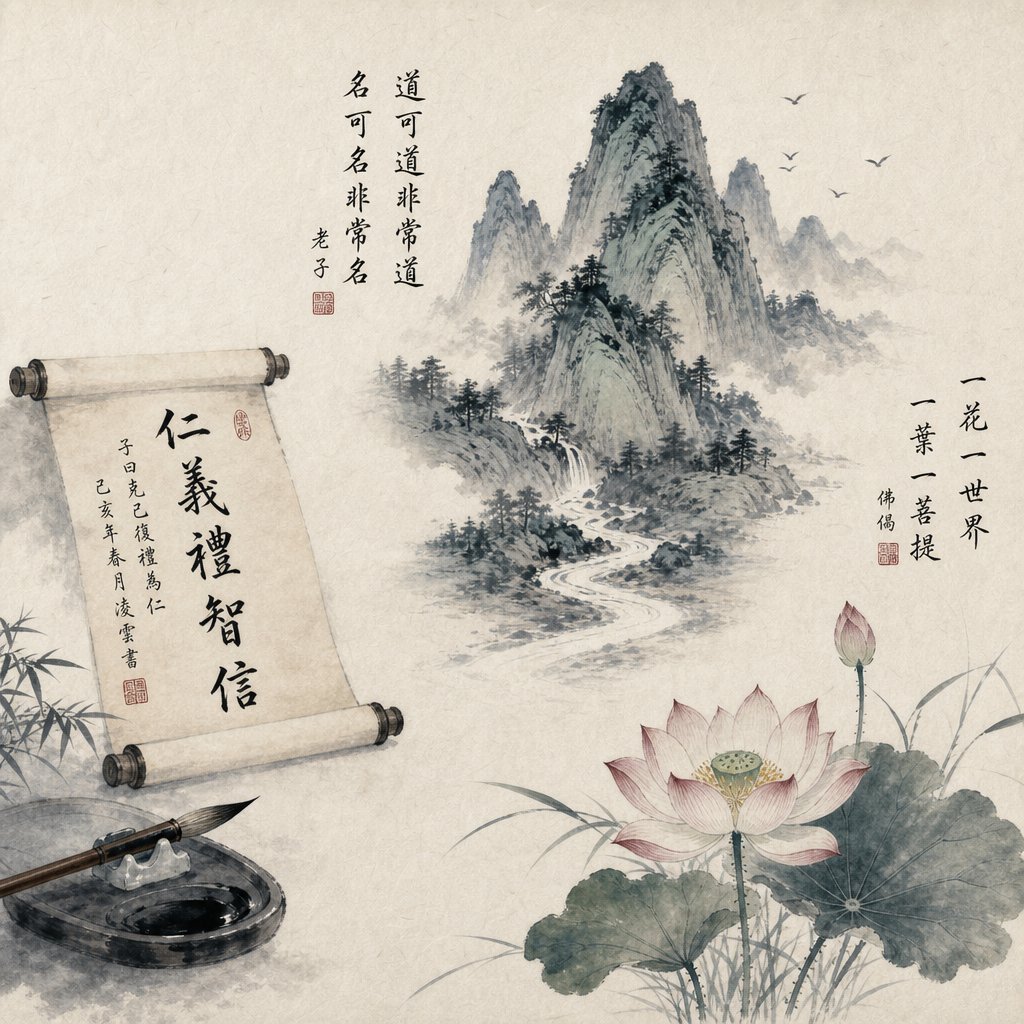
Chinese names and meanings are never arbitrary. Behind every character chosen for a child lies a philosophical tradition stretching back over two thousand years. Three major schools of thought have shaped how families select names: Confucianism, Taoism, and Buddhism. Each offers a distinct lens for understanding what a name should accomplish, whether it instills moral character, harmonizes with nature, or points toward inner peace. Together, these traditions explain why certain categories of names, virtue-themed, nature-themed, and aspiration-themed, are considered deeply traditional rather than merely fashionable.
Confucian Virtues as Naming Inspiration
Confucianism treats naming as a child's first moral lesson. When parents embed a virtue character into a name, they are compressing an entire ethical framework into something the child will hear, write, and carry every single day. The practice reflects Confucius's own emphasis on cultivating moral character through constant awareness and self-reflection.
The most revered virtue characters in Chinese naming include:
- 仁 (Ren) — Benevolence or humanity. The character combines "person" and "two," suggesting that humanity exists in relationship. Confucius taught that "the benevolent person loves others" (仁者爱人), making this one of the most enduring name characters across generations.
- 德 (De) — Virtue or moral integrity. This character contains the radical for "walk," implying that virtue is a path, not a destination. Names like 明德 (Mingde, "clear virtue") or 修德 (Xiude, "cultivating virtue") are common combinations.
- 智 (Zhi) — Wisdom. Combining "knowledge" with "sun," this character evokes clarity cutting through confusion. It appears frequently in families that value education and sound judgment.
- 信 (Xin) — Trustworthiness. Literally "person" standing next to "speech," it captures the idea that your word defines your character.
- 礼 (Li) — Propriety or ritual correctness. This character reflects the Confucian emphasis on social harmony through proper conduct.
- 勇 (Yong) — Courage. Strength applied purposefully, often paired with other characters to balance boldness with wisdom.
What makes these names distinctly Confucian is their focus on relational ethics. The chinese name meaning embedded in characters like 仁 or 信 is never about individual glory. It is about how the child will treat others, how they will contribute to social harmony. Parents who choose these characters are saying something specific: that moral substance matters more than surface achievement.
Taoist Nature Harmony in Name Selection
Where Confucianism looks inward to human relationships, Taoism looks outward to the natural world. Taoist-inspired names draw from water, mountains, clouds, wind, and celestial bodies, reflecting the philosophy's core belief that humans thrive when they align with nature's rhythms rather than fighting against them.
The Taoist classic Daode Jing famously praises water for its ability to find the lowest path and overcome obstacles through softness rather than force. This philosophy directly influences naming. Characters associated with water, like 溪 (Xi, "stream") or 泽 (Ze, "marsh" or "grace"), carry the aspiration that a child will navigate life with flexibility and quiet persistence.
Common Taoist-influenced name elements include:
- 云 (Yun) — Cloud. Suggests freedom, natural movement, and detachment from worldly concerns.
- 风 (Feng) — Wind. Represents invisible power and the ability to move through the world without resistance.
- 岚 (Lan) — Mountain mist. Evokes the mysterious beauty of nature at dawn.
- 月 (Yue) — Moon. Among names that mean moon, this character carries associations of gentle illumination, cyclical renewal, and quiet beauty. It appears in both male and female names.
- 松 (Song) — Pine tree. Symbolizes endurance and integrity through harsh seasons.
- 泉 (Quan) — Spring or fountain. Represents an inexhaustible source of life and renewal.
Taoist naming philosophy also embraces the concept of 自然 (ziran), meaning "self-so" or naturalness. A name rooted in this tradition does not impose an identity on the child. Instead, it invites the child to unfold according to their own nature, much like water finding its own course downhill. This stands in gentle contrast to the Confucian approach, which actively directs the child toward specific virtues.
Literary Allusions and Poetic References
Beyond the philosophical schools, a rich tradition of literary naming draws from classical poetry, historical texts, and Buddhist scripture. Parents who choose names from these sources are signaling cultural literacy and connecting their child to China's vast literary heritage.
Buddhist-influenced names tend toward concepts of compassion, enlightenment, and inner stillness. Characters like 慧 (Hui, "wisdom" in the spiritual sense), 静 (Jing, "tranquility"), and 慈 (Ci, "compassion") reflect the Buddhist aspiration toward liberation from suffering. The character 悟 (Wu, "awakening" or "enlightenment") appears in names that express hope for deep understanding. Even the chinese symbol for love, 爱 (ai), carries Buddhist overtones of universal compassion when used in naming contexts, extending beyond romantic attachment to encompass loving-kindness toward all beings.
Literary allusions add another layer. The Book of Songs (诗经, Shijing), China's oldest poetry anthology, has served as a naming source for over two millennia. A name like 婉如 (Wanru) references a line praising a woman's grace, while 思齐 (Siqi) alludes to a poem about moral aspiration. The Chu Ci (楚辞), an anthology of southern poetry, provides names rich in botanical imagery. Flower-related characters are especially popular for daughters, as they suggest beauty, resilience, and natural elegance. While Western gardeners might explore flower meanings like hibiscus representing delicate beauty, Chinese naming traditions draw from a parallel botanical vocabulary: lotus for purity, plum blossom for perseverance, and orchid for refinement.
What unites all three philosophical streams is a shared conviction that names in chinese and meanings are inseparable. A name is never decoration. Whether it channels Confucian moral weight, Taoist natural harmony, or Buddhist spiritual depth, every character chosen for a child reflects a worldview, a set of values, and a hope for who that child might become. The meaning chinese names carry is, in this sense, always philosophical before it is personal.
These philosophical ideals do not exist in isolation. They intersect with another ancient system that adds a cosmological dimension to name selection: the Five Elements theory, which maps a child's birth chart to specific character choices.
Five Elements and Birth Charts in Traditional Naming
Philosophical ideals give a name its soul, but traditional Chinese families have long relied on a cosmological system to give it precision. The Five Elements framework, known as Wuxing (五行), maps a child's birth moment to specific energetic patterns and uses that reading to guide character selection. Think of it as a diagnostic tool: it identifies what a child's life energy might lack and prescribes characters to restore balance.
Understanding the Five Elements in Name Selection
Wuxing does not refer to physical materials like those on a periodic table. The Chinese character Xing (行) means "movement" or "phase." These are five patterns of energy, each associated with a season, a set of qualities, and a direction of flow:
- Wood (木, Mu) — Expanding, growing upward. The energy of spring, vitality, and benevolence.
- Fire (火, Huo) — Ascending, radiating outward. The energy of summer, passion, and visibility. Names with meaning of sun often carry Fire associations, channeling brightness and warmth.
- Earth (土, Tu) — Stabilizing, centering. The transitional energy of harvest, trust, and grounding.
- Metal (金, Jin) — Contracting, refining. The energy of autumn, discipline, and clarity.
- Water (水, Shui) — Descending, flowing. The energy of winter, wisdom, and deep contemplation.
These five phases exist in dynamic relationship. Wood feeds Fire, Fire creates Earth, Earth bears Metal, Metal collects Water, and Water nourishes Wood. A healthy name, like a healthy system, respects these cycles of generation and control.
How Birth Charts Guide Character Choices
So how does a family know which element their child needs? The answer lies in the Bazi (八字), or Eight Characters birth chart. Calculated from the baby's exact birth year, month, day, and hour, this chart maps the elemental energies present at the moment of arrival. A naming specialist reads the chart looking for three things: which elements dominate, which are missing, and how strong the Day Master (the core element representing the child) appears.
When a chart reveals imbalance, the name becomes a corrective tool. A baby born with very little Water energy might receive a chinese name related to luck through water-associated characters, ones suggesting rivers, rain, clarity, or depth. A child whose chart shows weak Wood might get characters linked to growth, spring, or learning. The goal is not to mechanically patch a gap but to support the overall chart in a way that feels meaningful and sounds natural with the family surname.
Historically, families consulted naming masters or feng shui practitioners for this analysis. As BBC reported, this belief remains active across Chinese communities today. Some adults even change their legal names later in life to rebalance elements after periods of misfortune, reflecting how seriously the tradition is taken. The practice is not limited to birth. It is a lifelong relationship between identity and elemental harmony.
Matching Radicals to Elemental Needs
Here is where the Chinese writing system becomes uniquely powerful for elemental naming. Chinese characters contain radicals, structural components that signal meaning categories. Many radicals correspond directly to one of the five elements, giving naming specialists a practical way to embed elemental energy into a name visually and semantically.
When a Bazi reading calls for Water, a namer looks for characters built with the water radical (氵) or rain radical (雨). Names that mean water do not always spell it out literally. A character like 涵 (Han, "contain" or "encompass") carries the water radical while suggesting intellectual depth. Similarly, names with sun meaning often use the Fire element through characters containing the sun radical (日) or fire radical (火), channeling brightness and warmth without being overly literal.
The table below shows how each element connects to specific radicals and name characters:
| Element | Associated Qualities | Common Radicals | Sample Name Characters |
|---|---|---|---|
| Wood (木) | Growth, vitality, flexibility | 木 (wood), 艹 (grass) | 林 (Lin, forest), 芳 (Fang, fragrant), 桐 (Tong, paulownia tree) |
| Fire (火) | Passion, brightness, leadership | 火 (fire), 灬 (fire dots), 日 (sun) | 煜 (Yu, radiant), 炎 (Yan, flame), 照 (Zhao, illuminate) |
| Earth (土) | Stability, trust, nurturing | 土 (earth), 山 (mountain) | 坤 (Kun, earth/feminine), 岳 (Yue, peak), 城 (Cheng, city) |
| Metal (金) | Discipline, clarity, resilience | 金 (metal), 钅 (metal variant) | 鑫 (Xin, prosperity), 铭 (Ming, inscription), 锐 (Rui, sharp) |
| Water (水) | Wisdom, adaptability, depth | 氵 (water), 雨 (rain) | 涵 (Han, encompass), 泽 (Ze, marsh/grace), 润 (Run, moist/smooth) |
A skilled namer does not stop at matching radicals. The chosen character must also sound harmonious with the surname, look balanced in calligraphy, and carry a culturally positive meaning. For example, 泽 (Ze), meaning "marsh" or "beneficence," is a Water character with strong semantic value. It suggests generosity and nourishment, like water flowing to sustain fertile land. That layered quality, elemental correctness plus beautiful meaning, is what separates a thoughtful name from a mechanical formula.
With the cosmological framework in place, the real question for most parents becomes practical: which specific characters work beautifully for daughters, for sons, and for any child regardless of gender?
Traditional Chinese Girl Names With Beautiful Meanings
Elemental balance and philosophical depth set the foundation, but when parents sit down to choose actual characters for a daughter, the process becomes deeply personal. Chinese girl names draw from a rich palette of imagery: blossoming flowers, luminous moons, moral strength, and classical poetry. What makes these names powerful is not just their sound but the way individual character meanings layer together into a single aspiration.
When exploring chinese names for girls, you will notice that certain character pairings are considered especially auspicious. Characters that combine natural beauty with inner virtue, like pairing "jade" with "fragrance" or "orchid" with "wisdom," create a balanced name suggesting both external grace and internal substance. This dual quality is what families traditionally seek in female chinese names: not beauty alone, but beauty anchored in character.
Nature and Beauty Names for Girls
Nature-themed names remain among the most beloved chinese girl names because they connect a child to timeless imagery. Flowers, seasons, celestial bodies, and water all carry specific symbolic weight. A lotus name suggests purity rising from adversity. A plum blossom name signals resilience through hardship. These are not decorative choices. They are compressed stories about the kind of life a family hopes their daughter will lead.
| Chinese Characters | Pinyin | Individual Character Meanings | Combined Meaning |
|---|---|---|---|
| 雪梅 | Xuě Méi | 雪 (snow) + 梅 (plum blossom) | Resilient beauty that blooms in winter's harshest cold |
| 秋月 | Qiū Yuè | 秋 (autumn) + 月 (moon) | Serene luminance of the harvest moon |
| 莲花 | Lián Huā | 莲 (lotus) + 花 (flower) | Purity rising gracefully above murky waters |
| 云溪 | Yún Xī | 云 (cloud) + 溪 (stream) | Free-flowing spirit, gentle and unhurried |
| 桂兰 | Guì Lán | 桂 (osmanthus) + 兰 (orchid) | Noble fragrance paired with refined elegance |
Notice how each pairing balances visual imagery with emotional resonance. A name like Xue Mei (雪梅) does not just describe a winter scene. It references the plum blossom's cultural symbolism as the flower that endures freezing temperatures, making it a wish for a daughter who thrives under pressure.
Virtue and Strength Names for Girls
Not all chinese girl names and meanings center on delicacy. A strong tradition of virtue-based and warrior-inspired names exists for daughters, reflecting qualities like courage, wisdom, and moral clarity. These names push back against the assumption that female chinese names must be soft. Characters like 英 (heroic), 慧 (wise), and 贞 (faithful) carry real weight.
| Chinese Characters | Pinyin | Individual Character Meanings | Combined Meaning |
|---|---|---|---|
| 秀英 | Xiù Yīng | 秀 (elegant) + 英 (heroic, brave) | Elegant courage, grace combined with strength |
| 淑珍 | Shū Zhēn | 淑 (kind, pure) + 珍 (precious, treasure) | A gentle spirit of rare and precious worth |
| 慧珍 | Huì Zhēn | 慧 (wisdom) + 珍 (precious) | Wisdom treasured above material wealth |
| 德华 | Dé Huá | 德 (virtue) + 华 (magnificent) | Moral splendor that radiates outward |
| 飞燕 | Fēi Yàn | 飞 (fly) + 燕 (swallow bird) | Swift freedom and fearless movement through the world |
Fei Yan (飞燕) is a particularly striking example. It references the swallow in flight, a symbol of agility and independence. Historically, it also alludes to Zhao Feiyan, a Han Dynasty empress known for her extraordinary grace and determination. Chinese names girl families choose often carry these layered historical echoes, connecting a daughter to powerful women of the past.
Poetic and Literary Girl Names
For families who value literary heritage, names drawn from classical poetry offer a beautiful chinese names for girl with meaning that resonates across centuries. These names reference specific poems, philosophical texts, or artistic traditions, signaling cultural depth alongside aesthetic beauty.
| Chinese Characters | Pinyin | Individual Character Meanings | Combined Meaning |
|---|---|---|---|
| 婉如 | Wǎn Rú | 婉 (graceful) + 如 (like, as) | Graceful as described in the Book of Songs |
| 静雅 | Jìng Yǎ | 静 (serene) + 雅 (elegant, refined) | Quiet refinement of a scholar's temperament |
| 芷若 | Zhǐ Ruò | 芷 (angelica herb) + 若 (like, as if) | Delicate as the fragrant angelica of Chu poetry |
| 兰心 | Lán Xīn | 兰 (orchid) + 心 (heart) | An orchid's purity dwelling within the heart |
| 诗姬 | Shī Jī | 诗 (poetry) + 姬 (lady, beauty) | A woman of poetic grace and creative spirit |
Zhi Ruo (芷若) is a name steeped in literary tradition. The angelica herb appears repeatedly in the Chu Ci anthology as a metaphor for moral purity, and the character 若 adds a quality of gentle comparison, as if the child embodies that ancient ideal without forcing it. When parents explore chinese names female and meanings rooted in literature, they are choosing names that carry the weight of an entire poetic tradition.
What makes any of these names truly successful is not just the meaning of individual characters but how they sound together, how the tones rise and fall, and how the strokes look when written in calligraphy. The same attention to harmony, balance, and layered aspiration applies when families turn to selecting names for sons.
Traditional Chinese Boy Names With Powerful Meanings
Where girl names often weave beauty and virtue into a single phrase, chinese baby boy names tend to channel a different energy. They lean toward moral strength, intellectual ambition, and the vastness of the natural world. This does not mean boy names lack poetry. It means the poetry points in a different direction: toward resilience, toward leadership, toward a mind sharp enough to navigate complexity.
When you explore male chinese names and meanings, you will notice a pattern. Characters like 浩 (vast), 博 (broad), 毅 (perseverance), and 睿 (wise) appear again and again across generations. These are not trendy picks. They reflect a centuries-old belief that a son's name should encode the qualities his family hopes he will embody: courage tempered by wisdom, ambition grounded in integrity.
Traditional preferences for a chinese name boy families choose often fall into three broad categories. Strength and ambition names express the hope that a son will face adversity without flinching. Scholarly names reflect the Confucian ideal that true power comes from knowledge and moral cultivation. Nature-inspired names connect a boy to forces larger than himself, mountains, rivers, and sky, suggesting both grandeur and humility.
Strength and Ambition Names for Boys
These names carry the weight of expectation. They express a family's wish for a son who is resilient, determined, and capable of shouldering responsibility. Characters in this category often reference physical power, unyielding will, or triumphant achievement. According to LTL Language School's survey of 17 Chinese teachers, names emphasizing strength and success are among the most consistently popular choices for boys.
| Chinese Characters | Pinyin | Individual Character Meanings | Combined Meaning |
|---|---|---|---|
| 弘毅 | Hong Yi | 弘 (grand, expand) + 毅 (perseverance, tenacity) | Grand determination to achieve one's highest goals |
| 天翊 | Tian Yi | 天 (heaven, sky) + 翊 (assist, soar) | Soaring ambition supported by heavenly purpose |
| 威航 | Wei Hang | 威 (majesty, awe-inspiring) + 航 (navigate, voyage) | Commanding presence navigating life's vast waters |
| 毅航 | Yi Hang | 毅 (perseverance) + 航 (voyage) | Unwavering resolve on the journey ahead |
| 一搏 | Yi Bo | 一 (one, whole) + 搏 (fight, strive) | A boy who gives everything in pursuit of excellence |
Notice how many of these names pair an abstract quality with a concrete image. 威航 (Wei Hang) combines the concept of majesty with the physical act of navigation, creating a name that feels both powerful and purposeful. The character 毅 (Yi), meaning perseverance, is drawn from Confucian classics and represents the ability to hold steady when facing setbacks. As LingoAce notes, it conveys foundational resilience rather than brute force.
Scholarly and Wisdom Names for Boys
In Chinese culture, the scholar has always held a position of deep respect. Male chinese first names in this category reflect the belief that intellectual cultivation is the truest form of strength. These names carry what Chinese speakers call 书卷气 (shujuan qi), a scholarly elegance that signals refinement and depth.
| Chinese Characters | Pinyin | Individual Character Meanings | Combined Meaning |
|---|---|---|---|
| 博文 | Bo Wen | 博 (extensive, broad) + 文 (literature, culture) | Vast knowledge and cultural sophistication |
| 睿哲 | Rui Zhe | 睿 (sage-like wisdom) + 哲 (philosophy, discernment) | Deep wisdom paired with philosophical clarity |
| 书砚 | Shu Yan | 书 (book, writing) + 砚 (inkstone) | A life devoted to learning and scholarly pursuit |
| 修文 | Xiu Wen | 修 (cultivate, refine) + 文 (literature) | Cultivating both blessings and wisdom through study |
| 子衿 | Zi Jin | 子 (scholar) + 衿 (collar of a scholar's robe) | Literary accomplishment drawn from the Book of Songs |
子衿 (Zi Jin) deserves special attention. It comes directly from China's earliest poetry collection, the Shijing, where the phrase "青青子衿" (qingqing zijin) describes the collar of a scholar's robe. Choosing this name signals deep literary awareness. Similarly, 书砚 (Shu Yan) pairs "book" with "inkstone," the essential tool of classical calligraphy, implying someone who is quick to learn, well-read, and resolute in their intellectual pursuits.
Understanding chinese male names meaning in this category helps you see why scholarship is never treated as passive. Characters like 睿 (Rui) and 哲 (Zhe) suggest active discernment, the ability to see through complexity and arrive at truth. These are names for boys expected to think deeply and lead wisely.
Nature-Inspired Boy Names
Nature-themed chinese name for boys choices draw from the same Taoist tradition discussed earlier, but with a distinctly masculine emphasis. Where girl names might reference flowers and moonlight, boy names in this category tend toward vast landscapes: oceans, mountains, expansive skies, and powerful weather. The imagery suggests both grandeur and groundedness.
| Chinese Characters | Pinyin | Individual Character Meanings | Combined Meaning |
|---|---|---|---|
| 浩然 | Hao Ran | 浩 (vast, grand) + 然 (so, correct) | Righteous vastness, moral integrity on a grand scale |
| 浩宇 | Hao Yu | 浩 (vast) + 宇 (universe, cosmos) | Boundless potential stretching across the universe |
| 泽川 | Ze Chuan | 泽 (marsh, grace) + 川 (river, plain) | Kindness flowing like a river through open land |
| 震云 | Zhen Yun | 震 (thunder, shake) + 云 (cloud) | Powerful and majestic as thunder rolling through clouds |
| 昊辰 | Hao Chen | 昊 (vast sky) + 辰 (celestial bodies, morning) | Expansive as the sky at dawn, calm and goal-oriented |
浩然 (Hao Ran) is one of the most enduring chinese boy names and meanings in this category. It originates from the philosopher Mencius, who described 浩然之气 (haoran zhi qi) as a "flood-like energy" that fills a person who lives with moral courage. The name pairs cosmic vastness with ethical uprightness, making it simultaneously a nature name and a virtue name. Pampers' naming guide highlights it as a name that makes a boy "feel empowered," and its popularity across generations confirms that resonance.
泽川 (Ze Chuan) offers a gentler alternative. The character 泽 carries the water radical and suggests nourishment and generosity, while 川 evokes the steady flow of a river. Together they paint a picture of kindness expressed through consistent, quiet action rather than dramatic force.
Whether a family gravitates toward strength, scholarship, or nature, the best chinese male names and meanings share a common thread: they balance aspiration with harmony. The characters must sound right together, look balanced when written, and carry meanings that complement rather than contradict each other. A name like 弘毅 works because "grand" and "perseverance" reinforce each other. A pairing where the characters pulled in opposite directions would feel unstable, no matter how individually beautiful each character might be.
Of course, not every family wants a name that signals a specific gender. Many of the most timeless characters in Chinese naming, jade, light, wisdom, harmony, belong equally to sons and daughters.
Gender-Neutral Traditional Chinese Names
Jade, light, wisdom, harmony. These concepts do not belong to one gender. In Chinese naming tradition, many of the most revered characters have always moved fluidly between sons and daughters because they reference universal qualities rather than gendered imagery. A character like 明 (bright) says nothing about whether the child is male or female. It simply expresses a hope for clarity and illumination, a wish any parent might hold.
This is what makes gender neutral chinese names feel so natural within the tradition. Unlike English, where names like "James" or "Emily" carry strong gender associations through cultural habit, Chinese characters derive their meaning from the concept they represent. When that concept is abstract, elemental, or philosophical, the name transcends gender entirely. Research published in Sociolinguistic Studies confirms that the most commonly used chinese gender neutral names feature characters with less gendered connotations, often incorporating functional words or metaphoric usage not conventionally tied to either gender.
Modern families increasingly embrace these names. Some parents prefer not to signal gender before a child has defined their own identity. Others simply find that the most unique chinese names, the ones that feel fresh and timeless simultaneously, happen to be unisex. Whatever the motivation, the tradition supports it fully.
Unisex Names Inspired by Nature and Elements
Nature does not distinguish between genders, and neither do names drawn from its vocabulary. Characters referencing seasons, celestial bodies, water, and light work beautifully for any child. Some of the most cute chinese names fall into this category precisely because they evoke vivid imagery without limiting who can carry them.
- 晨 (Chen) — Break of day. The first light before sunrise, suggesting new beginnings and quiet promise.
- 秋 (Qiu) — Autumn. Carries associations of maturity, harvest, and golden beauty.
- 林 (Lin) — Forest. Two tree characters side by side, evoking depth, shelter, and natural abundance.
- 阳 (Yang) — Sun. Warmth, openness, and positive energy. A name with sun meaning that works across genders.
- 江 (Jiang) — River. Steady flow, quiet power, and the ability to carve one's own path.
- 春 (Chun) — Spring. Renewal, youth, and vitality. Equally fitting for a son or daughter.
- 波 (Bo) — Wave. Rhythmic movement and natural force, suggesting someone who makes an impact.
- 熙 (Xi) — Bright, joyful. A warm radiance that suggests both happiness and prosperity.
A name like 映月 (Yingyue), meaning "reflection of the moon," carries the cherished associations of beauty and harmony found in moon blossom imagery. It works for any child because moonlight itself is universal, illuminating without distinction.
Virtue-Based Names That Transcend Gender
Virtues belong to everyone. Characters expressing wisdom, peace, promise, and integrity have served as chinese name for beautiful aspirations regardless of the child's gender. These names carry moral weight without the gendered expectations that sometimes accompany strength-themed or beauty-themed characters.
- 安 (An) — Peace, tranquility. One of the most enduring unisex characters, suggesting inner calm and stability.
- 慧 (Hui) — Wisdom, cleverness. Spiritual and intellectual clarity in a single character.
- 诺 (Nuo) — Promise. A person whose word carries weight, who honors commitments.
- 恒 (Heng) — Eternal, constant. Steadfastness that endures through changing circumstances.
- 文 (Wen) — Literature, culture. Refinement and learning, valued equally in sons and daughters.
- 聪 (Cong) — Clever, perceptive. Quick intelligence and sharp awareness.
- 善 (Shan) — Goodness, kindness. Moral warmth expressed through action.
- 玉 (Yu) — Jade. Moral perfection, purity, and enduring value.
Jade (玉/yu) has been used across genders for centuries as a symbol of moral perfection. In Chinese philosophy, jade represents the five virtues: benevolence, righteousness, wisdom, courage, and purity. The jade name meaning transcends gender because these qualities belong to every person striving toward their best self.
What unites all these names is their refusal to limit a child before life has begun. A character like 恒 (eternal) or 安 (peace) does not predict who the child will become. It simply offers a quality worth aspiring toward, a compass point rather than a cage. For families seeking names that honor tradition while leaving space for individual identity, these characters represent the best of both worlds.
Choosing any name, gendered or neutral, also means navigating a set of cultural rules that can make or break a selection. Some characters are off-limits entirely, and certain sound combinations carry meanings no parent would want attached to their child.
Naming Taboos and Cultural Rules Every Parent Should Know
A name can carry beautiful chinese name meanings and still be completely wrong. In Chinese culture, what you avoid matters just as much as what you choose. Some characters are off-limits because of who used them before. Others sound too close to words no parent wants associated with their child. Getting this wrong does not just produce an awkward name. Historically, it could bring shame, social consequences, or worse.
Names You Must Never Use in Chinese Tradition
The most serious naming prohibition in Chinese history was the naming taboo of the state (国讳, guohui). Using characters from an emperor's given name was not merely rude. It was punishable by law. During the Qin dynasty, the first emperor's name character 政 (zheng) forced the pronunciation of the first month, 正月 (Zhengyue), to be altered entirely. In 1777, scholar Wang Xihou wrote the Qianlong Emperor's name without omitting the required stroke and was executed along with his family. While imperial naming taboos no longer carry legal weight, the cultural instinct behind them persists.
Beyond emperors, traditional families observe several other prohibitions:
- Elders' name characters are off-limits. Using any character from a living grandparent's, parent's, or uncle's name is considered disrespectful. This taboo (家讳, jiahui) traditionally extended back seven generations. Even characters with the same pronunciation as an elder's name should be avoided.
- Recently deceased relatives' names are avoided. Using a departed family member's name character too soon can be seen as invoking their spirit or showing contempt for their memory.
- Famous political leaders' names are restricted. In modern China, naming a child after figures like Mao Zedong or Zhou Enlai is considered inappropriate. Using a single character from their given name with a different surname is generally acceptable, but the full combination is not.
- Characters with negative meanings are rejected outright. Characters like 死 (death), 病 (illness), or 坏 (bad) never appear in names in China, regardless of how they might sound or look aesthetically.
- Overly rare or unreadable characters cause practical problems. Some parents choose obscure characters to ensure uniqueness, but if teachers, doctors, and government clerks cannot read or type the name, it creates lifelong friction.
The underlying principle across all these rules is the same: a name exists within a web of relationships. It must respect the people who came before, avoid invoking harm, and function smoothly in social life.
How Homophones and Tones Affect Name Choices
Here is where the meaning of chinese names gets tricky. Mandarin Chinese has only about 400 distinct syllables, which means homophones are everywhere. Two characters can look completely different on paper but sound identical when spoken aloud. Parents must consider not just what a name means when written, but what it sounds like when called across a playground.
Consider this example: 思 (si, "to think") and 旺 (wang, "prosperous") are both positive characters individually. Combined as a name, though, 思旺 (siwang) sounds dangerously close to 死亡 (siwang, "death"). No amount of beautiful calligraphy can rescue a name that makes listeners wince every time they hear it.
Other homophone pitfalls include:
- The number four (四, si) sounds like 死 (death), making any name that echoes this pronunciation problematic.
- Characters sounding like 苦 (ku, "bitter") or 哭 (ku, "cry") should be avoided in combination.
- Regional slang adds hidden dangers. The character 日 (ri) means "sun" in standard usage, but in some regions it carries vulgar connotations. Similarly, 草 (cao, "grass") can be offensive in certain colloquial contexts.
- Tonal differences create separate meanings. A common given name like 美 (mei) means "beautiful" in the third tone but "plum blossom" in the second tone. When exploring mandarin names and meanings, always verify which tone a character carries, because the wrong tone can shift a name's entire significance.
The safest approach is to say the full name aloud, quickly and repeatedly, listening for any unintended words or phrases that emerge from the sound combinations. Many families also ask friends and relatives from different regions to listen, catching associations that might not be obvious in one's own dialect.
Mandarin Versus Cantonese Naming Considerations
Chinese names with meaning that works perfectly in Mandarin can stumble in Cantonese, and vice versa. The same written character produces different sounds depending on the dialect, and those different sounds carry different homophone risks.
The character 王 illustrates this clearly. It is pronounced "Wang" in Mandarin, "Wong" in Cantonese, "Ong" in Hokkien, and "Heng" in Teochew. A name that avoids all negative homophones in Mandarin might accidentally echo an unlucky word in Cantonese. For diaspora families with roots in Guangdong or Hong Kong, checking pronunciation across relevant dialects is essential.
Mandarin names follow pinyin romanization, which mainland Chinese families use as the standard system. Cantonese names use different romanization systems like Jyutping or Yale, producing spellings that look unfamiliar to Mandarin speakers. The surname Chen (陈) in Mandarin becomes "Chan" in Cantonese and "Tan" in Hokkien. These differences matter when registering mandarin names or Cantonese names in English-speaking countries, where officials may not recognize that different spellings represent the same character.
Tonal systems also differ. Mandarin has four main tones, while Cantonese has six (some analyses count nine). A name with pleasing tonal flow in Mandarin's four-tone system might sound flat or awkward in Cantonese's more complex tonal landscape. Families who move between dialect communities, or who want a name that honors multiple regional identities, often test their chosen characters in both systems before committing.
These regional and phonetic considerations add a practical layer to what might otherwise seem like a purely philosophical process. A name must work not just on paper, not just in one city, but everywhere the child might live, study, or build relationships. For multicultural families navigating between Chinese and English-speaking worlds, the challenges multiply further.
Adapting Traditional Chinese Names for Multicultural Families
Phonetic pitfalls and cultural taboos are challenging enough within a single language. For families raising children between Chinese and English-speaking worlds, the naming process carries an additional layer of complexity: the name must function across two entirely different linguistic systems. It needs to honor ancestral traditions while also working smoothly in classrooms, doctor's offices, and social settings where no one reads Chinese characters.
This is not a niche concern. Research on Chinese American naming practices found that parents actively consider both Mandarin and English linguistic features, traditional and pop culture, and the transnational identity of their children when making naming decisions. The result is a thoughtful negotiation rather than a simple choice between one culture or the other.
Choosing Names That Work in Both Languages
The most common strategy is selecting Chinese characters whose pinyin pronunciation approximates an English name or sounds natural to English speakers. Characters like 丽 (Li), 美 (Mei), 凯 (Kai), and 安 (An) produce sounds that cross linguistic boundaries without friction. A name like 凯文 (Kaiwen) maps closely to "Kevin," while 丽莎 (Lisha) echoes "Lisa." These are not random matches. They are deliberate choices where chinese names in english retain both phonetic accessibility and meaningful characters.
Another approach works in reverse: parents start with a list of chinese names they love for their meanings, then check whether the pinyin sounds comfortable in English conversation. Simple chinese names with one or two clean syllables, like 明 (Ming), 林 (Lin), or 乐 (Le), tend to travel well because they do not contain sounds that English speakers struggle to pronounce, such as the "x" or "zh" initials in Mandarin.
A study of mainland Chinese students' English naming practices found that uniqueness was a key factor in name choice, with students demonstrating high agency and creativity in selecting names that distinguished them from peers while expressing their identity. This same impulse drives parents who want their child's name to stand out meaningfully in both languages rather than defaulting to the most common options.
Balancing Tradition With Modern Life
Many multicultural families maintain two names: a formal Chinese name used within the family and on official documents, and an English name used in school and professional life. How families decide which appears on the birth certificate varies. Some register the Chinese name legally and use the English name socially. Others do the reverse, keeping the Chinese name as a cherished family identifier.
The key is that neither name needs to be sacrificed. When you explore chinese names and their meanings alongside English options, you often find complementary pairings. A child named 志远 (Zhiyuan, "far-reaching ambition") might go by "Ian" in English, a name that shares the final syllable. The Chinese name carries the philosophical weight; the English name provides everyday ease. Both are real. Both matter.
For families who want a single name that works everywhere, the selection narrows but does not disappear. Sample chinese names like 安娜 (Anna), 马克 (Make/Mark), or 乐 (Le/Joy) function in both worlds without requiring explanation or translation. The tradeoff is that these crossover names sometimes limit the depth of chinese names with meanings you can embed, since the characters must serve phonetic duty first.
Registering Chinese Names in English-Speaking Countries
Practical registration issues catch many families off guard. English-language birth certificates require romanized spellings, and the system used, pinyin, Wade-Giles, Cantonese romanization, or a family's own preferred spelling, determines how the name appears on every official document going forward. A child named 陈晓明 might be registered as "Chen Xiaoming," "Chan Siu Ming," or "Tan Siao Ming" depending on dialect and family preference.
Here is a step-by-step approach for multicultural families navigating this process:
- Consult family elders early. Grandparents may have generational characters, elemental requirements, or specific taboos that must be honored. Starting here prevents conflicts later.
- List chinese names that carry the meanings you value most. Write down characters that reflect your aspirations, whether drawn from virtue, nature, or literary traditions.
- Test pronunciation across languages. Say each candidate name aloud in both Mandarin (or your family's dialect) and English. Listen for awkward sounds, unintended homophones, or syllables that English speakers consistently mispronounce.
- Check the romanized spelling for confusion. Will teachers read it correctly? Does it accidentally spell an English word? Names like "Shi" or "Dong" can trigger unintended associations in English-speaking environments.
- Decide on your registration strategy. Choose whether the Chinese name, the English name, or both will appear on official documents. Some jurisdictions allow hyphenated or combined formats.
- Verify consistency across documents. Ensure the same romanization appears on the birth certificate, passport application, and any other legal paperwork. Inconsistencies create bureaucratic headaches for years.
The goal is not to dilute tradition for convenience. It is to find the intersection where cultural depth and practical function meet. A well-chosen name can carry the full weight of chinese names with meanings rooted in philosophy, elemental balance, and family history while still rolling easily off an English-speaking teacher's tongue. That intersection exists for every family willing to search for it.
Frequently Asked Questions About Traditional Chinese Baby Names
1. How are traditional Chinese baby names structured differently from Western names?
Chinese names place the surname first, followed by a one or two-character given name. Each character carries its own independent meaning, and together they form a compressed aspiration for the child. Many families also use generational characters shared among siblings and cousins to signal kinship, plus informal milk names used in childhood. This layered system means a single person might carry multiple names across their lifetime, each serving a different social function.
2. What role do the Five Elements play in choosing a Chinese baby name?
The Five Elements system (Wuxing) uses a child's birth chart, calculated from the exact year, month, day, and hour of birth, to identify which elemental energies are strong or lacking. If a chart shows weak Water energy, for example, parents select characters containing the water radical to restore balance. Specific radicals in Chinese characters correspond directly to Wood, Fire, Earth, Metal, or Water, giving naming specialists a practical way to embed elemental correction into the name both visually and semantically.
3. What naming taboos should parents avoid when choosing a Chinese name?
Key taboos include never using characters from living elders' names (considered deeply disrespectful), avoiding characters that sound like unlucky words such as death or illness, and steering clear of names belonging to political leaders or historical emperors. Parents should also test the full name aloud to catch unintended homophones, since Mandarin's limited syllable inventory means positive characters can accidentally echo negative words when combined.
4. Can traditional Chinese names work for multicultural families in English-speaking countries?
Yes. Common strategies include choosing characters whose pinyin pronunciation approximates English sounds, like Kai, An, or Lin, or maintaining two names: a formal Chinese name for family use and an English name for school and professional settings. Parents should test pronunciation across both languages, check that the romanized spelling does not create awkward English associations, and ensure consistent romanization across all legal documents to avoid bureaucratic issues.
5. Are there traditional Chinese names that work for any gender?
Many traditional Chinese characters are inherently unisex because they reference universal concepts rather than gendered imagery. Characters like jade (yu), peace (an), wisdom (hui), and forest (lin) have been used across genders for centuries. These names work because Chinese characters derive meaning from the concept they represent, and when that concept is abstract or philosophical, it transcends gender entirely. Modern families increasingly favor these options for their flexibility and timeless quality.