What a Chinese Male Name Generator Actually Does
You type in a few preferences, hit a button, and out comes a Chinese name. Sounds simple, right? Here is the problem: most results from a chinese male name generator are shallow at best and culturally awkward at worst. That is because Chinese naming is not a one-dimensional exercise. It operates across four simultaneous layers — sound, visual form, meaning, and elemental balance — and a name that fails on even one of those layers is considered incomplete.
In English, choosing a name is largely about phonetic appeal. "Oliver" sounds pleasant. "Xylophone" does not. End of analysis. In Chinese, every character is a word carrying its own pronunciation, semantic weight, and visual composition. A two- or three-character name is essentially a compressed poem, and each piece must harmonize with the others. When you ask "what would my chinese name be," the honest answer depends on far more than matching syllables to your English name.
A Chinese name is a poem written in four languages at once — sound, image, meaning, and energy. All four must rhyme.
This article is your comprehensive guide to understanding how meaningful Chinese male names actually work. Rather than handing you a random string of characters, it teaches you the mechanics behind every quality name so you can evaluate, customize, or create one yourself. Think of it as the difference between copying someone else's homework and actually learning the subject.
Why Chinese Male Names Require More Than Random Selection
Imagine picking a name where the wrong tone turns "wisdom" into "pig," or where two perfectly fine characters placed side by side accidentally spell out a vulgar phrase. Chinese is a tonal language with massive homophone overlap — the syllable "shi" alone maps to dozens of distinct characters. A chinese name generator that ignores tonal flow, homophone collisions, and cultural connotations is essentially rolling dice in a minefield.
Beyond pronunciation, there is the visual dimension. Chinese characters are not abstract letters. They are compositions of strokes that occupy a square space, and a name's characters must look balanced when written together. Then there is the meaning layer, where characters are chosen not just for dictionary definitions but for literary allusions and cultural resonance drawn from classical texts like the Book of Songs or Tang dynasty poetry. Finally, traditional naming considers the Five Elements (Wu Xing) system, matching characters to a person's birth chart for elemental harmony. A tool that skips three of these four dimensions is not generating a real name — it is generating a label.
Who Benefits from a Chinese Male Name Generator
Several groups find themselves searching for how to find my chinese name, each with different stakes:
- Parents naming a baby boy — balancing family tradition, generational naming practices, and modern appeal while satisfying tonal and elemental requirements.
- Fiction writers — creating authentic male characters for wuxia, xianxia, or contemporary stories where a poorly chosen name breaks immersion for Chinese-speaking readers.
- Non-native speakers — professionals working with Chinese partners, students studying abroad, or anyone looking to get a chinese name that communicates cultural respect rather than tourist-level effort.
- Gamers and content creators — seeking culturally grounded usernames or character names that carry genuine weight.
No matter which category fits you, the underlying challenge is identical: a chinese name generator male output is only as good as the cultural logic behind it. The sections ahead break down that logic piece by piece — starting with the structural anatomy of how surname, given name, and meaning interlock to form a complete identity.
The Anatomy of a Chinese Male Name
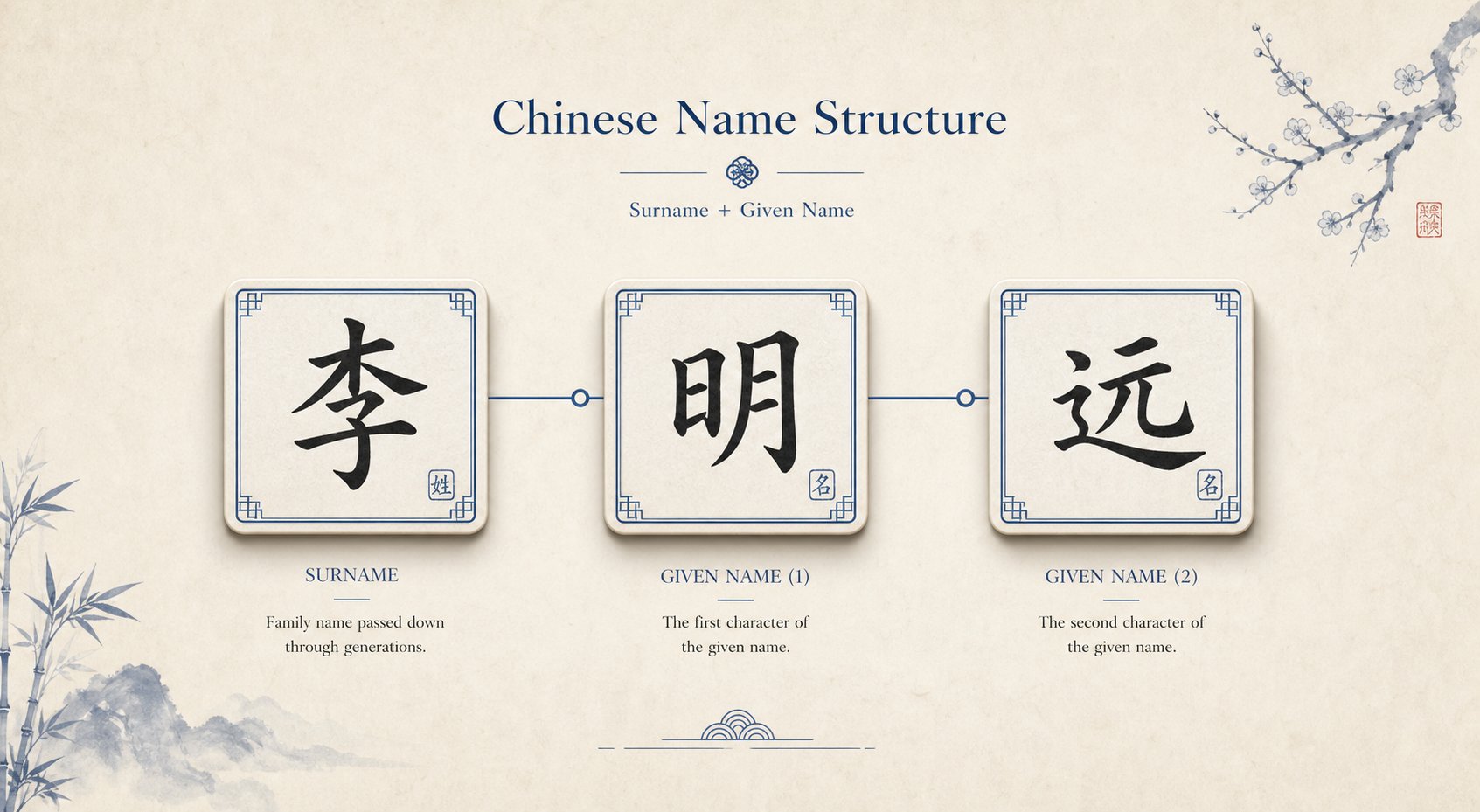
Every Chinese male name follows a precise structural formula: surname first, given name second. This is not a stylistic preference — it reflects a cultural emphasis on family heritage preceding individual identity. In the name Yao Ming (姚明), "Yao" is the family name and "Ming" is the given name. Reverse that order and you have introduced yourself incorrectly to over a billion people.
A standard Chinese name consists of two or three characters total. The chinese surname is almost always a single character, though rare compound surnames like Ouyang (欧阳) exist. The given name is one or two characters, and when it has two, they function together as a unified first name — not a first and middle name in the Western sense.
Surname Structure and the Most Common Chinese Family Names
Chinese family names, or "xing" (姓), trace back thousands of years to ancient clans, states, and occupations. What surprises most people is how concentrated the distribution is. The most common chinese last names — Wang (王), Li (李), Zhang (张), and Liu (刘) — account for nearly 300 million people in China alone. About 100 to 200 surnames cover over 80% of the entire population.
Here are some frequently encountered chinese surnames and meanings that any name generator should draw from:
- 王 (Wang) — King; reflects regality within the family lineage
- 李 (Li) — Plum; symbolizes strength and resilience
- 张 (Zhang) — Stretch; represents expansive reach and influence
- 刘 (Liu) — Derived from ancient weapon characters; symbolizes martial valor
- 陈 (Chen) — Morning; signifies new beginnings
- 杨 (Yang) — Willow; embodies flexibility and adaptability
- 黄 (Huang) — Yellow; symbolizes warmth and prosperity
- 赵 (Zhao) — Shine; reflects radiance and positive influence
These eight are sometimes called "The Big 8" of chinese family names. Since you typically cannot change your surname, the real creative work happens in the given name — but the surname still matters because it sets the tonal and visual foundation that the given name must complement.
Single-Character vs Two-Character Given Names for Males
When building chinese male names, one of the first decisions is length. Should the given name be one character or two? Each option carries distinct advantages depending on context.
| Feature | Single-Character Given Name | Two-Character Given Name |
|---|---|---|
| Total name length | 2 characters (e.g., Li Wei 李伟) | 3 characters (e.g., Li Jinze 李金泽) |
| Pros | Concise, punchy, easy to remember; common in modern urban naming | More room for layered meaning; allows tonal variety and elemental balance |
| Cons | Higher chance of duplicate names; limited space for meaning | Slightly more complex; requires harmony between both characters |
| Best use case | Professional contexts, modern minimalist style | Traditional families, literary or aspirational naming, generational naming systems |
| Tonal flexibility | Only one tone to pair with surname | Two tones create a melodic three-tone sequence |
Two-character given names offer more creative space, which is why traditional naming practices and most male chinese given names in literature use them. A single character must carry all the semantic and elemental weight alone, while two characters can divide the labor — one for meaning, one for elemental balance, or one shared generational character plus one unique identifier.
How Male Names Differ from Female Names in Character Choice
Chinese naming conventions draw a clear thematic line between masculine and feminine names, and understanding this distinction is essential for any generator producing common chinese last names paired with appropriate given names.
Male names gravitate toward characters expressing strength, ambition, moral virtue, and grandeur. You will frequently encounter characters like:
- 力 (li) — power
- 伟 (wei) — great, mighty
- 宏 (hong) — grand, vast
- 成 (cheng) — succeed, accomplish
- 雄 (xiong) — heroic, male
- 子 (zi) — son, scholar
Boy names also favor the "tree" radical (木) in characters like 楠 and 杨, the "man" radical (亻) in characters like 伟 and 佳, and the "metal" radical (钅) — all signaling traditionally masculine qualities.
Female names, by contrast, lean toward beauty, grace, and natural delicacy. They often feature the "flower" radical (艹) in characters like 蓉 and 薇, the "female" radical (女) in characters like 婷 and 婉, and the "jade" radical (王) in characters like 琪 and 瑶.
This is not an absolute rule — modern households increasingly blur these lines — but it remains the dominant pattern. A chinese male name generator that pulls characters indiscriminately from both pools will produce names that sound off to any native speaker, the same way naming a boy "Angelica" would raise eyebrows in English.
With the structural blueprint clear — surname anchoring lineage, given name carrying meaning, and character choice signaling gender — the next question becomes practical: how do you actually assemble these pieces into a name that sounds right, looks balanced, and avoids hidden pitfalls?
How to Construct a Chinese Male Name Step by Step
Knowing the anatomy of a name is one thing. Actually building one that sounds natural, carries weight, and avoids embarrassing pitfalls is another challenge entirely. Whether you are using a chinese name creator tool or assembling characters manually, the construction process follows a specific sequence — skip a step and you risk a name that looks fine on paper but falls apart when spoken aloud.
Here is the complete process for how to make a chinese name that holds up under scrutiny:
- Lock in your surname. If you already have a Chinese family name, start there. If not, choose one that phonetically mirrors your existing last name or select from the common pool (Wang, Li, Zhang, Chen). The surname sets the tonal starting point for everything that follows.
- Define your naming intent. Decide what qualities the name should express — strength, wisdom, ambition, moral integrity, or connection to nature. This intent narrows your character search from thousands of options to a manageable shortlist.
- Select given name characters with appropriate meanings. Using a dictionary or a chinese name generator with meaning, identify characters that match your intent and carry traditionally masculine connotations.
- Check tonal harmony across all syllables. Write out the full name in pinyin with tone marks and evaluate the melodic flow. Adjust characters if the tonal sequence feels flat or clashing.
- Screen for homophone collisions and negative associations. Say the full name aloud and check whether it sounds like any common words with unfortunate meanings.
- Verify visual balance. Write the characters together and confirm they look proportionate in stroke density — one extremely simple character next to an extremely complex one can feel visually lopsided.
Selecting Characters with Strong Masculine Meanings
When you generate chinese name options for a male, character selection is where meaning lives. The goal is not just picking a "good" character in isolation — it is finding one that pairs well with your surname and, if using a two-character given name, with the other given name character.
Think of it as naming chinese characters in a story: each one needs to pull its weight within the ensemble. A character like 志 (zhi, ambition) works differently beside 远 (yuan, far-reaching) than beside 刚 (gang, firm). The first combination — Zhiyuan — suggests expansive aspiration. The second — Zhigang — leans toward determined toughness. Same lead character, different personality.
Strong masculine characters tend to cluster around a few thematic families:
- Ambition and achievement: 志 (zhi), 成 (cheng), 达 (da)
- Strength and resilience: 刚 (gang), 坚 (jian), 毅 (yi)
- Wisdom and scholarship: 文 (wen), 博 (bo), 哲 (zhe)
- Nature and grandeur: 山 (shan), 海 (hai), 天 (tian)
- Moral virtue: 仁 (ren), 义 (yi), 信 (xin)
A reliable approach when learning how to choose chinese name characters is to pick one "anchor" character that carries your primary meaning, then pair it with a second character that adds tonal variety and complementary nuance.
Checking Tonal Harmony Across Your Full Name
Mandarin has four tones: first tone (high and flat), second tone (rising), third tone (low or dipping), and fourth tone (falling). Every syllable in a Chinese name carries one of these tones, and the sequence matters enormously for how pleasant the name sounds when spoken.
Imagine calling someone's name across a room. A name like "Zhang Haoran" (张浩然, tones 1-4-2) rolls naturally because the pitch moves — high, then drops, then rises. Compare that to a name where all three syllables share the same tone: the result sounds monotone and flat, like a stuck note.
General guidelines for tonal flow in male names:
- Avoid three consecutive identical tones — they create a droning effect.
- A falling tone (fourth tone) in the final syllable gives the name a decisive, assertive ending — popular in male names.
- Mixing a rising tone with a falling tone creates dynamic contrast that sounds confident.
- Two consecutive third tones trigger a tone sandhi rule where the first one shifts to a rising tone — not wrong, but worth knowing so the spoken result matches your intent.
To evaluate this yourself, write the full name in pinyin with diacritical marks. For example: Zhang Mingyuan (zhāng míng yuǎn) gives you tones 1-2-3, a descending staircase pattern that flows smoothly. Any chinese character generator or pinyin tool can help you identify the tone of each character if you are unsure.
Verifying Character Combinations for Unintended Meanings
This is the step most people skip — and the one that causes the most regret. Chinese is dense with homophones. The syllable "si" can mean poetry (诗), four (四), or death (死) depending on the tone and character. A name that reads beautifully in written form might sound identical to something embarrassing when spoken quickly.
Practical verification steps:
- Say the full name fast, three times. Does it accidentally sound like a common phrase or slang term?
- Check each syllable's homophones. If your chosen character shares a pronunciation with a negative word, consider whether context makes the association unavoidable.
- Read the name backwards. Some character combinations form unintended words when reversed — and nicknames often flip name order.
- Search the name online. If it already belongs to a controversial public figure or fictional villain, you may want to adjust.
Converting your name to chinese characters — or evaluating a name to chinese characters output from a tool — always requires this final sanity check. As naming guides emphasize, you should read the full two-character combination as a unit, not just each character's dictionary gloss in isolation.
A name that passes all six steps — surname foundation, clear intent, meaningful characters, tonal harmony, homophone screening, and visual balance — is a name built to last. But construction technique is only half the picture. The other half is cultural context: the traditional systems that have governed Chinese male naming for centuries and still influence how names are perceived today.
Traditional Naming Conventions for Chinese Boys
Construction technique gives you a mechanically sound name. Tradition gives it a soul. For centuries, chinese boy names have been shaped by systems far older than any generator — systems that encode family lineage, cosmic balance, and social etiquette into a handful of characters. Understanding these conventions separates a name that merely works from one that resonates across generations.
Generational Names and Patrilineal Naming Traditions
Imagine opening a family registry and being able to identify exactly which generation someone belongs to just by reading one character in their name. That is the power of the generational name, or zibei (字辈) — a practice where all males within a patrilineal family's generation share a specific character in their given name.
How did families keep track of these characters across dozens of generations? Through generation poems — carefully composed verses where each successive character represents the generational marker for one generation. These poems could range from a dozen characters to hundreds, and they were typically composed by a committee of family elders whenever a new lineage branch was established.
The shared character often carried virtuous ideals for clan members to embody. You will frequently see characters like 俊 (jun, meaning talented) or 豪 (hao, meaning heroic) woven into these poems. Families sharing a common generation poem are considered to share a common ancestor and typically originated from the same geographical location — making the poem both a naming tool and a genealogical map.
In practice, this means one character of a boy's two-character given name is predetermined by family tradition, while the other character is chosen freely by parents. This is why two-character given names dominate traditional chinese names for boys — they need the extra space to accommodate both the generational marker and a personalized element.
Five Elements and Zodiac in Male Name Selection
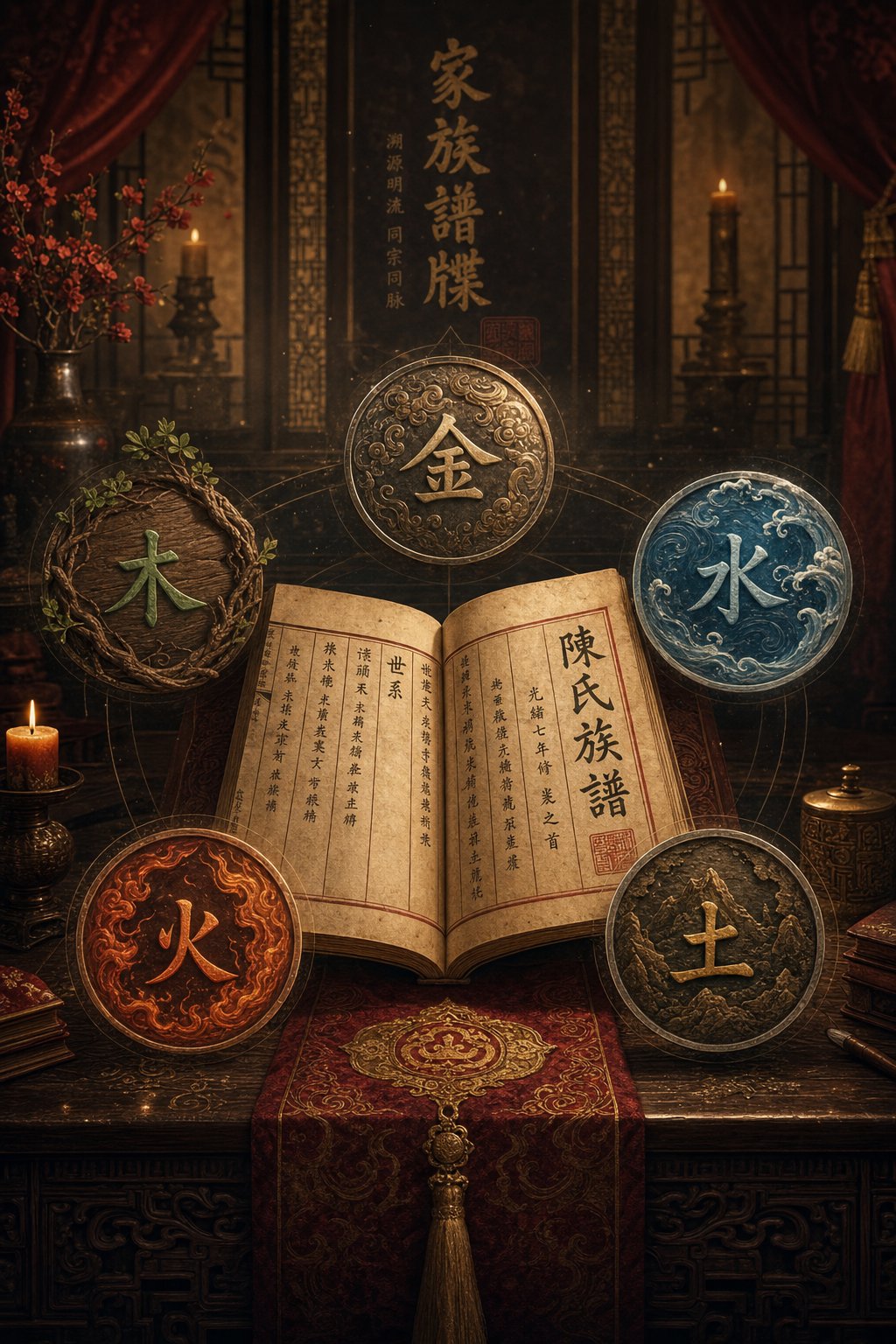
Beyond lineage, traditional naming draws on the Five Elements system (Wu Xing, 五行) to align a child's name with their birth chart. The method, rooted in BaZi (Eight Characters of Destiny), calculates the elemental balance present at the exact time of birth — year, month, day, and hour — then identifies which element the child needs more of.
Each element corresponds to specific chinese hanzi commonly used in male names:
- Metal (金, Jin) — Characters like 锋 (feng, sharp edge), 铭 (ming, inscribe), 鑫 (xin, prosperous). Conveys decisiveness and strength.
- Wood (木, Mu) — Characters like 林 (lin, forest), 松 (song, pine), 楠 (nan, cedar). Suggests growth, learning, and vitality.
- Water (水, Shui) — Characters like 浩 (hao, vast), 泽 (ze, marsh/grace), 涛 (tao, waves). Implies wisdom, depth, and adaptability.
- Fire (火, Huo) — Characters like 炎 (yan, flame), 烨 (ye, brilliant), 辉 (hui, radiance). Represents courage, warmth, and ambition.
- Earth (土, Tu) — Characters like 坤 (kun, earth), 城 (cheng, city/fortress), 磊 (lei, stacked stones). Signals stability, reliability, and groundedness.
A child whose chart lacks Water might receive a name with 泽 or 浩. One who benefits from Wood might get 林 or 松. The key insight is that traditional naming does not simply patch in a missing element — it checks what the overall chart needs for balance. A good name supports the Day Master (the element representing the child) rather than mechanically filling a gap.
Zodiac considerations add another layer. Parents may choose characters that harmonize with the child's birth year animal — avoiding characters containing radicals associated with clashing animals. Feng shui practitioners sometimes evaluate stroke counts for auspicious numerology, though this practice varies widely by region and family.
Courtesy Names and Their Historical Role
Here is something that surprises most people learning about chinese names and meanings: historically, a man's birth name was not the name anyone actually used in public. The ming (名) — the birth name given by parents — was considered private. Its ming meaning was literally "to call one's name at night to identify yourself," and using it in public was a grave insult.
Instead, at around age twenty, a man received a courtesy name called zi (字). Peers, colleagues, and juniors used this name as the standard form of respectful address. The zi was typically connected to the ming through wordplay — synonyms, antonyms, or thematic extensions. The famous strategist Zhuge Liang (诸葛亮) had the courtesy name Kongming (孔明); both 亮 and 明 mean "bright."
Beyond the zi, men could also adopt a hao (号) — a self-chosen literary alias functioning like an ancient username. The poet Tao Yuanming called himself "Mr. Five Willows" after the trees near his home. These layers meant a single person might carry four or five different names across different social contexts.
While courtesy names have largely fallen out of daily use in modern China, their influence persists. Many common chinese names today echo the character choices and thematic pairings that once defined zi construction. Writers creating period-appropriate characters — and anyone exploring the jade name meaning tradition where characters like 瑜 (yu, fine jade) symbolized moral purity in men — benefit from understanding this layered system.
These traditional frameworks did not exist in a vacuum. They evolved alongside Chinese society itself, shifting dramatically across imperial dynasties, revolutionary upheavals, and modern globalization — each era leaving its fingerprint on what a "good" male name looked like.
How Chinese Male Names Have Evolved Across Eras
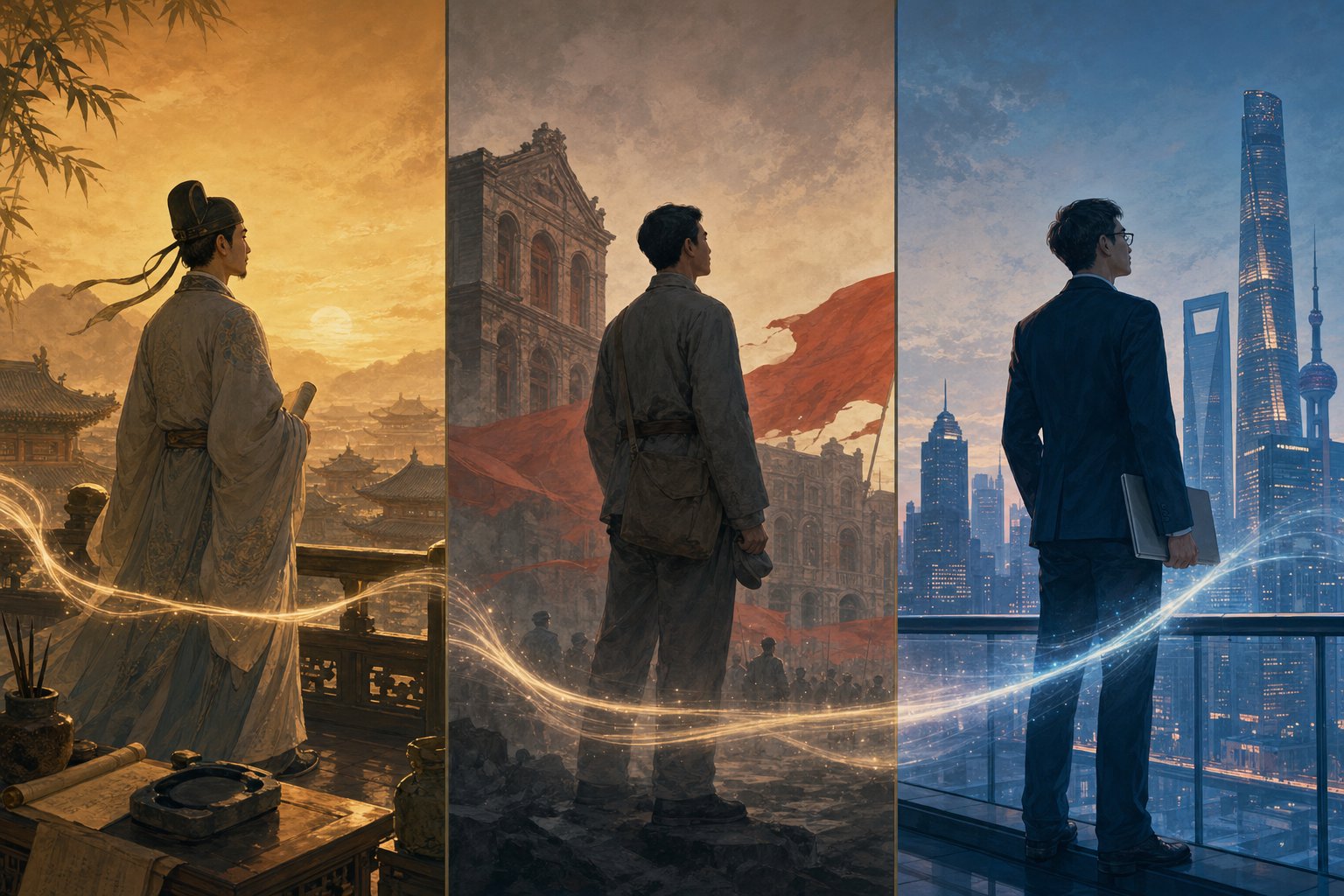
A name that sounds perfectly natural in a Tang dynasty poem would feel bizarre on a modern Shanghai business card. Chinese male naming is not static — it shifts with politics, philosophy, and cultural mood. If you are using an ancient chinese name generator for a historical fiction project or picking a modern name for professional use, era matters. A name plucked from the wrong century breaks authenticity the same way a medieval knight wearing sneakers would.
Classical and Imperial Era Male Names
During the imperial period — roughly from the Han dynasty through the Qing — male names drew heavily from Confucian texts, classical poetry, and philosophical ideals. Parents mined the Book of Songs, the Analerta, and Tang poetry for characters that signaled scholarly refinement and moral cultivation.
Common themes included literary virtue (文, wen), brightness and clarity (明, ming), and moral uprightness (正, zheng). Two-character names often formed miniature allusions: a name like 子谦 (Ziqian, "humble scholar") or 德远 (Deyuan, "far-reaching virtue") communicated that the family valued education and ethical conduct above martial prowess.
This is the naming landscape that writers working in xianxia and wuxia fiction need to understand. Wuxia names for martial heroes tend toward bold, nature-invoking characters — think swords, mountains, and wind. Xianxia names lean more ethereal, favoring characters related to jade, clouds, and celestial phenomena. Understanding wuxia vs xianxia naming conventions helps a chinese name generator fantasy tool produce characters that actually fit the genre rather than sounding generically "old." A jianghu wanderer named something like 风无痕 (Feng Wuhen, "Wind Without Trace") carries a different weight than a cultivator named 云清 (Yun Qing, "Clear Cloud").
Revolutionary and Mid-Century Naming Patterns
The 20th century rewrote the naming playbook entirely. After decades of colonial humiliation and civil war, Mao's China channeled national identity directly into children's names. Research covering 1.2 billion Han Chinese individuals born between 1930 and 2008 reveals how dramatically political events shaped naming trends.
In the pre-1960s cohort, names reflected nation-building: 建国 (Jianguo, "build the nation"), 建军 (Jianjun, "build the army"), and 国强 (Guoqiang, "nation's strength") dominated. By the 1960s, military reverence peaked after Mao called on citizens to "learn from the PLA" — names like 卫东 (Weidong, "defend the East") and 红军 (Hongjun, "Red Army") became common for boys.
The Cultural Revolution era (1966-1976) intensified this pattern. Sons were named after revolutionary ideals: loyalty (忠, zhong), redness (红, hong), and victory (胜, sheng). These names functioned almost as political declarations — parents signaling allegiance through their children's identities.
Modern Chinese Male Naming Trends
After Deng Xiaoping's economic reforms in the 1980s, naming shifted toward individual aspiration. The same research shows that characters connoting warmth began outscoring those connoting pure competence from the 1970s onward. Boys born in the 1980s and 1990s received names emphasizing personal success — 俊杰 (Junjie, "talented and outstanding"), 浩然 (Haoran, "vast and righteous"), and 子轩 (Zixuan, "scholarly elegance").
The one-child policy also left its mark. Single-character given names peaked in the 1980s as parents no longer needed to accommodate generational characters shared among siblings. But this trend reversed quickly once families realized how many duplicates it created — the "market name" problem where calling out a common name turns heads across a crowded room.
By the 2000s, names became more individualistic and gender-neutral. Characters like 宇 (yu, universe) and 轩 (xuan, lofty) surged in popularity, reflecting a confident, globally-oriented generation.
| Era | Common Themes | Example Characters | Typical Meanings |
|---|---|---|---|
| Imperial/Classical (pre-1900s) | Confucian virtue, literary allusion, nature | 文 (wen), 德 (de), 子 (zi), 远 (yuan) | Cultured, virtuous, scholarly, far-reaching |
| Revolutionary (1930s-1970s) | Nation-building, military honor, political loyalty | 建 (jian), 军 (jun), 国 (guo), 红 (hong) | Build, army, nation, red/revolutionary |
| Modern (1980s-present) | Individual success, elegance, cosmic scope | 俊 (jun), 浩 (hao), 宇 (yu), 轩 (xuan) | Talented, vast, universe, lofty |
For writers crafting danmei fiction or building characters for period dramas, this timeline is essential. A wuxia name generator that outputs 建军-style names for a Song dynasty swordsman immediately signals inauthenticity to readers familiar with the genre. Matching your character's name to the correct historical register — whether classical, revolutionary, or modern — is what separates research-backed naming from random output.
Of course, knowing which era to draw from is only useful if you also know which combinations to avoid. Even historically appropriate characters can collide in ways that produce unintended — and sometimes embarrassing — results.
Common Pitfalls When Generating Chinese Male Names
A name can pass every structural test — correct surname, masculine characters, balanced tones — and still blow up in practice because of a single overlooked homophone or an unfortunate character pairing. These pitfalls trip up automated tools and humans alike, and they are the reason a raw chinese name converter output should never be used without manual review.
Homophone Traps and Negative Sound Associations
Mandarin has roughly 400 distinct syllables spread across four tones. That means dozens of characters share identical pronunciations, and your carefully chosen name might sound exactly like something you would never want to be called.
Consider the characters 思 (si, "to think") and 旺 (wang, "prosperous"). Individually, both carry positive weight. Spoken together, "Siwang" is nearly indistinguishable from 死亡 — the word for death. Another classic trap: the character 日 (ri) means "sun," but in colloquial speech it doubles as a vulgar expletive. Any mandarin name converter that suggests characters purely based on meaning without screening pronunciation is setting users up for embarrassment.
Here are the most common pitfall categories to watch for:
- Death homophones — Any syllable combination resembling 死 (si, death) or 亡 (wang, perish), especially in sequence.
- Vulgar slang overlap — Characters whose pronunciations double as profanity or sexual slang in regional dialects.
- Animal insults — Combinations sounding like 猪 (zhu, pig), 狗 (gou, dog), or 龟 (gui, turtle — a cuckold insult).
- Number associations — The syllable "si" (four) echoes death; "er bai wu" (250) means fool. Avoid names that phonetically invoke these.
- Tone-shifted meanings — A character in one tone is fine, but mispronounced in another tone becomes problematic. If your name relies on a listener hitting the exact right tone, it is fragile.
Character Combinations That Create Unintended Meanings
Sometimes each character is perfectly respectable on its own, but the pair forms an existing word or phrase with an unwanted meaning. This is the trap that catches people who translate name into chinese character by character without reading the result as a unit.
The name "Caihua" (采花) literally combines "pick" and "flower" — innocent enough until you learn it is a euphemism for sexual assault in Chinese. Similarly, names like "Wangcai" (旺财, "prosperous wealth") are traditionally reserved for dogs, not people. A name converter chinese tool that lacks this cultural database will happily serve these up as valid options.
The fix is straightforward: always search your proposed two-character combination in a Chinese dictionary and on social media. If it returns a standalone word — especially slang — reconsider. Chinese name interpretation requires reading the characters together, not just individually.
Native Speaker Names vs Names for Non-Native Speakers
There is a meaningful difference between a chinese name from english name adaptation and a name chosen within a native Chinese family. Native families operate with built-in cultural guardrails — generational poems, elder consultation, dialect awareness. Non-native speakers lack these safety nets, which is why mistakes cluster disproportionately in this group.
When you chinese name convert from an English source, you face a choice between two approaches:
- Phonetic adaptation (diaspora context) — Selecting characters that approximate your English name's sound while carrying acceptable meanings. Common among overseas Chinese families maintaining dual-language identity. The priority is recognizability across both languages.
- Meaning-first adoption (cultural context) — Choosing a name based entirely on Chinese naming logic, with no phonetic link to your birth name. This approach produces more authentic-sounding results but requires deeper cultural knowledge to execute well.
Neither approach is wrong, but mixing them carelessly creates problems. A phonetic adaptation that ignores meaning produces names like "Xialuote" (夏洛特, a transliteration of Charlotte) — which unfortunately sounds like "sha le ta" (kill him/her). A meaning-first name chosen without consulting native speakers might accidentally use characters from a revered historical figure, which feels presumptuous.
The safest path for non-native speakers: pick your approach deliberately, run the result through homophone and combination checks, and — before committing — ask at least one native speaker to react honestly. A chinese name conversion done well signals cultural respect. One done carelessly signals the opposite, no matter how good your intentions were.
These pitfalls are universal, but the specific strategies for avoiding them shift depending on your use case. A fiction writer naming a wuxia protagonist faces different constraints than a professional adopting a name for business meetings in Shenzhen — and both differ from a gamer building a character handle.

Practical Use Cases for Every Naming Scenario
A wuxia swordsman, a newborn baby boy, a Roblox avatar, and a finance executive walk into a naming session. They all need a Chinese male name — but the criteria for each could not be more different. The right mandarin name generator approach depends entirely on what the name needs to accomplish, who will read or hear it, and how long it needs to last.
Here is how to tailor your strategy to the scenario that actually matches yours.
Naming Characters for Wuxia and Xianxia Fiction
Fiction writers face a unique constraint: the name must feel authentic to readers who know the genre conventions cold. A wuxia hero named something modern like 子轩 (Zixuan) immediately breaks immersion — it is the equivalent of a medieval knight named "Tyler." Genre-appropriate naming requires matching character choices to the fictional world's register.
- Wuxia protagonists — Favor nature imagery and martial concepts. Characters like 风 (feng, wind), 剑 (jian, sword), 影 (ying, shadow), and 云 (yun, cloud) signal the jianghu wanderer archetype. Pair them with abstract qualities: 无痕 (Wuhen, "without trace"), 孤鸿 (Guhong, "lone swan"). Keep surnames classical — 萧 (Xiao), 叶 (Ye), 楚 (Chu) carry more literary weight than common surnames like Wang or Li.
- Xianxia cultivators — Lean toward celestial and elemental imagery. Characters like 玄 (xuan, mysterious), 清 (qing, pure), 墨 (mo, ink), and 尘 (chen, dust/mortal world) work well. Daoist concepts — 道 (dao, the Way), 虚 (xu, void) — add genre-specific flavor. Names should sound ethereal when spoken aloud.
- Danmei characters — Often blend scholarly elegance with subtle emotional resonance. Characters suggesting refinement — 瑾 (jin, fine jade), 琅 (lang, jade-like stone), 昀 (yun, sunlight) — are popular in the genre. The name should hint at the character's inner world without being overtly sentimental.
- Villains and antagonists — Darker imagery works here: shadow (暗, an), cold (寒, han), domination (霸, ba). Sharp-sounding syllables in the fourth tone reinforce menace.
A general asian name generator will not distinguish between these registers. If you are writing genre fiction, build names manually using era-appropriate characters rather than trusting randomized output.
Choosing a Chinese Name for Professional or Personal Use
Professionals working in Chinese-speaking markets need names that project competence and cultural fluency. The stakes are different from fiction — this name goes on business cards, email signatures, and introductions where first impressions matter.
- Business and finance — Characters conveying trust and stability work best: 诚 (cheng, sincerity), 恒 (heng, perseverance), 毅 (yi, determination), 骏 (jun, vigor). A name like 李诚骏 (Li Chengjun) signals reliability without being flashy.
- Technology — Innovation-forward characters suit this sector: 拓 (tuo, explore), 新 (xin, new), 睿 (rui, insightful), 航 (hang, navigate). These suggest forward momentum and analytical thinking.
- Education and academia — Scholarly characters like 文 (wen, literature), 博 (bo, erudite), 哲 (zhe, philosophy) project intellectual depth. Keep the tone elegant rather than bold.
- Personal adoption — If you are not tied to a specific industry, choose characters reflecting qualities you genuinely value. Authenticity matters more than optimization here. A name you connect with personally will feel more natural in conversation.
Regardless of field, keep pronunciation clean and avoid rare characters that colleagues will struggle to write or type. Your name should be easy to remember after a single introduction.
Creating Chinese-Inspired Usernames and Gaming Names
Gamers and content creators operate under completely different rules. A username does not need to pass the "could a real person have this name" test — it needs to be memorable, visually distinctive, and available on the platform. Still, grounding your handle in actual Chinese naming logic gives it more weight than random character strings.
- Pinyin-based handles — Take a two-character name and use its pinyin as your username. "Haoran," "Yunfei," or "Mingze" read as chinese usernames that sound intentional rather than random. Add numbers or underscores only if the base is taken.
- Character + concept mashups — Combine a surname with an evocative word: "XiaoShadow," "LinStorm," "YeVoid." This hybrid approach works for platforms like Roblox where roblox usernames need to be unique but recognizable.
- Title-style names — Borrow from wuxia conventions: "LoneWolf_Feng," "JadeSword," "SilentBlade." These translate martial arts naming logic into English-friendly formats while keeping the cultural DNA intact.
- Full character names for Asian-language platforms — If the platform supports Chinese characters, use a proper two- or three-character name. A username generator that pulls from authentic naming pools will outperform one that strings together random cool-sounding syllables.
The key difference between gaming names and real names: gaming names can break conventions intentionally for effect. A villain-coded username using dark characters is fine. An overly long four-character name that would be wrong in real life can work as a stylistic choice in a game. The rules become guidelines you can bend — but only if you understand them first.
For parents choosing asian boy names, the calculus flips back toward longevity. A baby's name needs to work at age five, twenty-five, and seventy-five. Trendy characters that peak in one decade may feel dated in the next. The safest approach combines one timeless character (virtue, nature, or wisdom-themed) with one that reflects modern sensibility — giving the name both roots and relevance.
Whether you are building a character for fiction, establishing a professional identity, or crafting a gaming handle, the underlying question remains the same: which tool or method gives you the most control over the result? Not all asian names generator approaches are equal — and the right one depends on how much cultural precision your scenario demands.
Choosing the Right Chinese Male Name Generator Approach
Not every naming method delivers the same depth. A random name generator chinese tool that spits out syllable combinations in seconds operates on fundamentally different logic than a native speaker spending an afternoon weighing tonal harmony and elemental balance. Both produce a name — but the gap in quality can be enormous.
The real question is not "which tool is best" in the abstract. It is which approach matches your specific needs, timeline, and tolerance for cultural risk. Here is how the main options stack up.
Random Generators vs AI-Powered Name Tools
The simplest china names generator tools work like slot machines. They pull a surname from one column, a given name character from another, and combine them without checking whether the result sounds natural, carries unintended meanings, or fits any cultural context. You get speed and zero effort — but also zero quality control.
These randomized tools have a narrow legitimate use: brainstorming. If you need a quick placeholder name for a game character or want to see what combinations exist before refining manually, random output gives you raw material to react to. The problem starts when people treat that raw material as a finished product.
AI-powered tools represent a significant step up. The better ones evaluate tonal flow, screen for homophone collisions, and allow you to specify meaning preferences or elemental requirements. Some incorporate BaZi analysis, matching characters to a birth chart the way a traditional naming consultation would. The tradeoff is that AI tools vary wildly in sophistication — a chinese name gen tool built on shallow databases performs barely better than random, while one trained on naming conventions across all four dimensions (sound, form, meaning, element) can produce genuinely usable results.
What to look for in an AI-powered tool:
- Does it let you specify gender, meaning themes, and elemental preferences?
- Does it show pinyin with tone marks so you can evaluate pronunciation?
- Does it flag potential homophone issues or negative associations?
- Does it explain why it chose specific characters, or just output a name without reasoning?
If the tool cannot answer yes to at least the first two, you are still working with a glorified random chinese name generator wearing a smarter interface.
Manual Name Construction Using Character Dictionaries
For maximum control, nothing beats building a name yourself using character dictionaries, classical texts, and pinyin references. This is the approach serious fiction writers, naming consultants, and culturally invested parents tend to favor.
The process looks like this: you start with a shortlist of characters matching your desired meaning, cross-reference their tones against your chosen surname, check stroke counts for visual balance, and verify the full combination against homophone databases. It is slower — sometimes taking days or weeks — but the result is a name you understand completely, from its literary allusions down to its elemental composition.
Resources that support manual construction include:
- MDBG or Pleco dictionaries — Search characters by radical, meaning, or pronunciation to build your candidate list.
- Classical text databases — The Book of Songs, Chu Ci, and Tang poetry collections provide historically grounded character pairings.
- Pinyin charts with tone marks — Essential for mapping tonal flow across the full name.
- Stroke order tools — Help you evaluate visual density and calligraphic balance between characters.
The downside is obvious: this method requires at least intermediate Chinese literacy. If you cannot read characters or evaluate tonal patterns, manual construction without guidance is like tuning a piano by ear when you have never heard one played. A chinese nickname generator might handle casual contexts, but for formal names, the manual route demands real knowledge or a knowledgeable partner.
When to Consult a Native Speaker
Here is the uncomfortable truth that no tool wants to admit: consulting a native Chinese speaker remains the gold standard for cultural authenticity. A native speaker catches dialect-specific slang that no database covers, recognizes generational connotations that shift by decade, and intuitively feels whether a name sounds like a real person or a textbook exercise.
When is native consultation worth the effort?
- Professional names — If this name goes on business cards or formal introductions, a native check prevents subtle embarrassments that tools miss.
- Baby names — The stakes are lifelong. Even parents who are native speakers typically consult elders or naming specialists.
- Published fiction — Chinese-speaking readers will notice inauthentic names immediately. A sensitivity reader or cultural consultant catches what generators cannot.
For casual use — gaming handles, brainstorming sessions, early-draft character names — native consultation is optional. But for anything permanent or public-facing, treat it as a final verification step rather than a luxury.
| Approach | Cultural Accuracy | Customization Level | Effort Required | Best Use Case |
|---|---|---|---|---|
| Random generator | Low — no context awareness | Minimal (surname + random characters) | Seconds | Brainstorming, placeholders, casual gaming |
| AI-powered tool | Medium to high — depends on training data | Moderate (meaning, tone, element filters) | Minutes | Serious personal names, fiction characters, professional adoption |
| Manual construction | High — full control over every dimension | Maximum (you choose everything) | Hours to days | Published fiction, baby naming, cultural projects |
| Native speaker consultation | Highest — intuitive cultural fluency | High (collaborative refinement) | Variable (one conversation to multiple sessions) | Final verification, permanent names, professional contexts |
The most reliable path combines methods rather than relying on any single one. Use a name generator chinese tool to produce initial candidates, refine them manually using dictionaries and tonal checks, then run your top choices past a native speaker for a gut-check. This layered approach gives you the speed of automation, the precision of manual work, and the cultural safety net of human judgment.
A male chinese name generator is a starting point — not a destination. The names that hold up over time, whether on a book cover, a birth certificate, or a WeChat profile, are the ones that passed through multiple filters before anyone committed to them. Skip the layers and you get a label. Complete them and you get a name worth carrying.
Frequently Asked Questions About Chinese Male Name Generators
1. How do I find my Chinese name if I don't speak Mandarin?
Start by deciding whether you want a phonetic adaptation that mirrors your English name's sound or a meaning-first name built entirely on Chinese naming logic. For phonetic adaptations, select characters that approximate your name's syllables while carrying positive meanings. For meaning-first names, identify qualities you value — strength, wisdom, creativity — and find characters expressing those themes. Either way, run your final choice through a homophone check and ask a native speaker to confirm it sounds natural and avoids unintended associations.
2. What is the difference between a Chinese surname and a given name?
In Chinese naming, the surname (xing) always comes first and represents family lineage — it is typically one character, though rare compound surnames like Ouyang exist. The given name (ming) follows and consists of one or two characters chosen by parents to express aspirations, elemental balance, or generational identity. Unlike Western naming where the family name is secondary, Chinese structure places collective identity before individual identity. About 100 to 200 surnames cover over 80% of China's population, so the given name carries most of the creative and cultural weight.
3. Why do Chinese male names sound different from female names?
Chinese male names favor characters expressing strength, ambition, moral virtue, and natural grandeur — think mountains, metal, and scholarly achievement. Common masculine characters include 伟 (great), 刚 (firm), and 博 (erudite). Female names lean toward beauty, grace, and delicacy, using characters with radicals for flowers, jade, or femininity. This distinction is rooted in traditional character selection patterns rather than grammatical gender rules. While modern naming increasingly blurs these lines, most native speakers can still identify a name's intended gender based on character choice alone.
4. Can I use a Chinese name generator for fiction writing?
You can, but generic generators rarely produce genre-appropriate results. Wuxia fiction demands nature imagery and martial concepts — wind, sword, shadow — paired with classical surnames like Xiao or Ye. Xianxia names need celestial and Daoist elements like jade, clouds, or void. Danmei characters benefit from scholarly elegance. The key is matching your character's name to the correct historical and genre register. Use a generator for initial brainstorming, then refine manually using era-appropriate character pools and verify with readers familiar with the genre.
5. What are the most common mistakes when choosing a Chinese male name?
The top pitfalls include homophone traps where your name sounds identical to words meaning death, vulgarity, or animal insults; character combinations that form unintended phrases when read together; using characters from the wrong historical era for your context; and ignoring tonal harmony so the name sounds flat or awkward when spoken aloud. Another frequent error is treating each character's meaning in isolation without checking what the full combination implies as a unit. Always say the complete name aloud quickly, search it online, and verify it does not belong to a controversial figure or carry slang meanings.