What Chinese Middle Name Feng Shui Actually Means
Imagine giving your child a name that does more than sound beautiful. A name designed to balance their inner elemental makeup, rooted in a metaphysical system refined over a thousand years. That is the core idea behind applying feng shui principles for Chinese middle names within a Western naming structure.
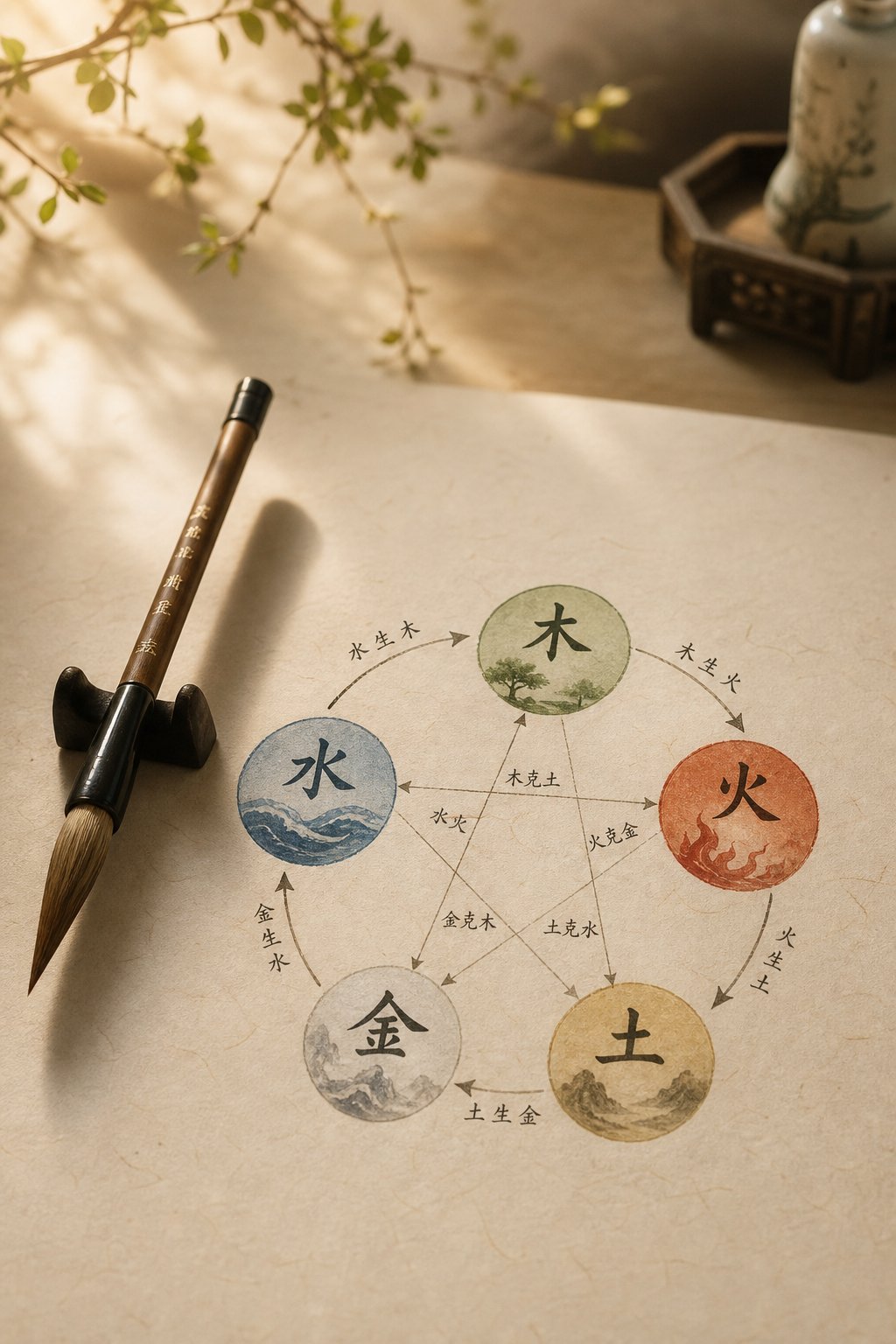
This practice draws on BaZi (八字), or the "Eight Characters" system, which maps a person's elemental blueprint based on their exact birth date and time. A practitioner reads this chart, identifies which of the Five Elements (Wood, Fire, Earth, Metal, Water) are weak or missing, and then selects Chinese characters whose energy compensates for those gaps. The chosen character becomes the child's middle name, sitting between a Western first name and a family surname.
赐子千金,不如教子一艺;教子一艺,不如赐子好名 — "Giving a child a thousand pieces of gold is not as good as giving them a good name."
What Makes Middle Name Feng Shui Different From General Chinese Naming
In a fully Chinese naming context, the given name works as a unit with the surname. Both characters are chosen together, evaluated for tonal flow, stroke count harmony, and elemental balance as a pair. The middle name scenario is different. Here, the Chinese character must coexist with a Western first name and a surname that may not be Chinese at all. It needs to carry Chinese middle name meaning and energy on its own while sounding natural in everyday English-speaking contexts.
As the Cultural Atlas notes, many Chinese families already use a format like [Western given name] [Chinese given name] [family name] when adapting to international settings. Feng shui naming adds a deliberate metaphysical layer to that structure, turning the middle name slot into a space for elemental calibration.
Why Families Choose Feng Shui for Chinese Middle Names
Two groups tend to seek out this practice. Chinese heritage families living abroad often want to preserve cultural depth without requiring their child to navigate a fully Chinese name in Western institutions. BaZi naming for multicultural families offers a way to honor tradition in a single, intentional character. Non-Chinese parents drawn to feng shui baby naming traditions may also explore this path as a meaningful cultural bridge, selecting a character that carries both personal significance and elemental purpose.
In both cases, the goal is the same: a name that feels harmonious across languages and carries energetic intention rooted in the child's own birth chart. The question, then, is how that birth chart actually works and what it reveals about your child's elemental needs.
How BaZi Birth Charts Guide Your Name Selection
Your child's BaZi birth chart is essentially a snapshot of elemental energy frozen at the moment of their first breath. Think of it as a diagnostic map. It tells a practitioner exactly which forces were present, which were abundant, and which were absent when your baby arrived. That map becomes the foundation for choosing a Chinese middle name that fills in what the chart lacks.
So how does a BaZi birth chart for baby naming actually work? It starts with four data points you already know: the year, month, day, and hour of birth.
The Four Pillars and Their Elemental Assignments
Each of those four data points generates one "pillar." Every pillar contains two characters: a Heavenly Stem (天干) on top and an Earthly Branch (地支) on the bottom. Four pillars, two characters each, gives you eight characters total, which is why the system is called BaZi, literally "eight characters."
Each Heavenly Stem and Earthly Branch carries the energy of one of the Five Elements. Here is what those elements represent:
- Wood (木) — growth, creativity, flexibility, upward movement
- Fire (火) — warmth, expression, visibility, passion
- Earth (土) — stability, nourishment, grounding, reliability
- Metal (金) — precision, structure, clarity, determination
- Water (水) — wisdom, adaptability, flow, introspection
The four pillars name selection process in Chinese metaphysics reads these elements as an interconnected system. The Year Pillar reflects ancestral and environmental energy. The Month Pillar governs seasonal influence and is one of the most decisive factors in elemental balance. The Day Pillar houses the Daymaster, the core reference point representing the child themselves. The Hour Pillar shapes output and later-life energy.
No single pillar tells the full story. A practitioner reads the relationships between all eight characters to understand the overall elemental landscape.
Identifying Weak or Missing Elements in Your Child's Chart
Once the chart is plotted, the practitioner tallies which elements appear and how strongly they show up. Some charts are heavy in Wood and Fire but contain no Water at all. Others might have abundant Metal with very little Earth to support it. The goal is to spot which of the five elements is missing in the birth chart or present only in a weak, unsupported position.
That deficiency becomes the starting point for how to use BaZi for choosing a name. If a child's chart lacks Water energy, the practitioner looks for Chinese characters that carry Water essence, whether through their radical, meaning, or associated imagery. The middle name becomes a deliberate elemental supplement, designed to restore what the chart is missing.
This is not about stacking as much of the missing element as possible. A skilled practitioner considers the producing and controlling cycles between elements to ensure the chosen character supports the Daymaster without creating new imbalances.
Why Exact Birth Time Matters for Accurate Analysis
Here is where timing becomes critical. The Hour Pillar changes every two hours in the traditional Chinese time-keeping system. A baby born at 12:50 PM and one born at 1:10 PM could land in different Hour Pillars, producing entirely different charts.
Beyond clock time, experienced practitioners convert the recorded birth time to real solar time based on the birth location's longitude. Standard time zones are administrative conveniences. Solar time reflects the actual position of the sun at the moment of birth, which is what classical BaZi was designed to use. Even a 15 to 45 minute difference can shift the Hour Pillar and change the chart's elemental composition entirely.
For families planning a feng shui-aligned middle name, this creates a practical reality: the full analysis cannot be completed until after the baby is born and the exact time is recorded. Some families prepare shortlists based on the expected birth month, but the final character selection waits until the complete four-pillar chart can be plotted with precision.
With the elemental gaps identified, the next question becomes concrete: which specific Chinese characters carry the right elemental energy, and how do you match radicals and meanings to what the chart needs?
Five Elements and the Art of Character Selection
Knowing your child's chart has a Water deficiency is one thing. Translating that into a specific Chinese character suitable for a middle name is where the real craft begins. In feng shui naming, the bridge between elemental analysis and actual character selection runs through radicals, the structural building blocks embedded in Chinese characters that signal elemental identity.
Matching Element Deficiencies to Character Radicals
Every Chinese character is built from components, and many contain a radical that ties it to one of the Five Elements. When a practitioner identifies a weak or missing element in the birth chart, they look for characters whose radicals carry that element's energy. The connection is direct and visual: you can often see the elemental association right in the character's structure.
The Water element, for example, links to the three-dot water radical (氵). Characters like 涵 (han, meaning "to contain" or "cultivated") and 淳 (chun, meaning "pure" or "honest") both carry this radical and bring Water energy into a name. The Wood element connects to the tree radical (木), appearing in characters like 桐 (tong, the paulownia tree, symbolizing nobility) and 楷 (kai, meaning "model" or "standard").
Here is a reference showing how Chinese character radicals for five elements map to naming choices:
| Element | Primary Radicals | Character Examples | Qualities Brought to a Name |
|---|---|---|---|
| Wood (木) | 木 (tree), 艹 (grass) | 林 (lin, forest), 芷 (zhi, angelica herb) | Growth, creativity, vitality, kindness |
| Fire (火) | 火 (fire), 灬 (four dots of fire) | 煜 (yu, brilliant light), 烨 (ye, splendor) | Warmth, expression, brightness, passion |
| Earth (土) | 土 (earth), 山 (mountain) | 坤 (kun, earth/receptive), 峻 (jun, lofty) | Stability, nourishment, reliability, groundedness |
| Metal (金) | 金/钅 (gold/metal) | 铭 (ming, inscribe/remember), 锦 (jin, brocade) | Precision, clarity, determination, structure |
| Water (水) | 氵 (three-dot water), 冫 (ice) | 涵 (han, cultivated), 澄 (cheng, clear) | Wisdom, adaptability, depth, introspection |
A character does not need to contain the radical to carry elemental energy. Meaning and symbolic association also count. The character 慧 (hui, meaning "wisdom") is traditionally associated with Water through its meaning, even though its radical structure is more complex. Still, radical-based selection gives families a clear, verifiable starting point for choosing Chinese characters based on BaZi elements.
Productive and Destructive Element Cycles in Naming
Element balancing in Chinese name selection is not as simple as finding a missing element and plugging it in. The Five Elements interact through two fundamental cycles that every practitioner considers before finalizing a character.
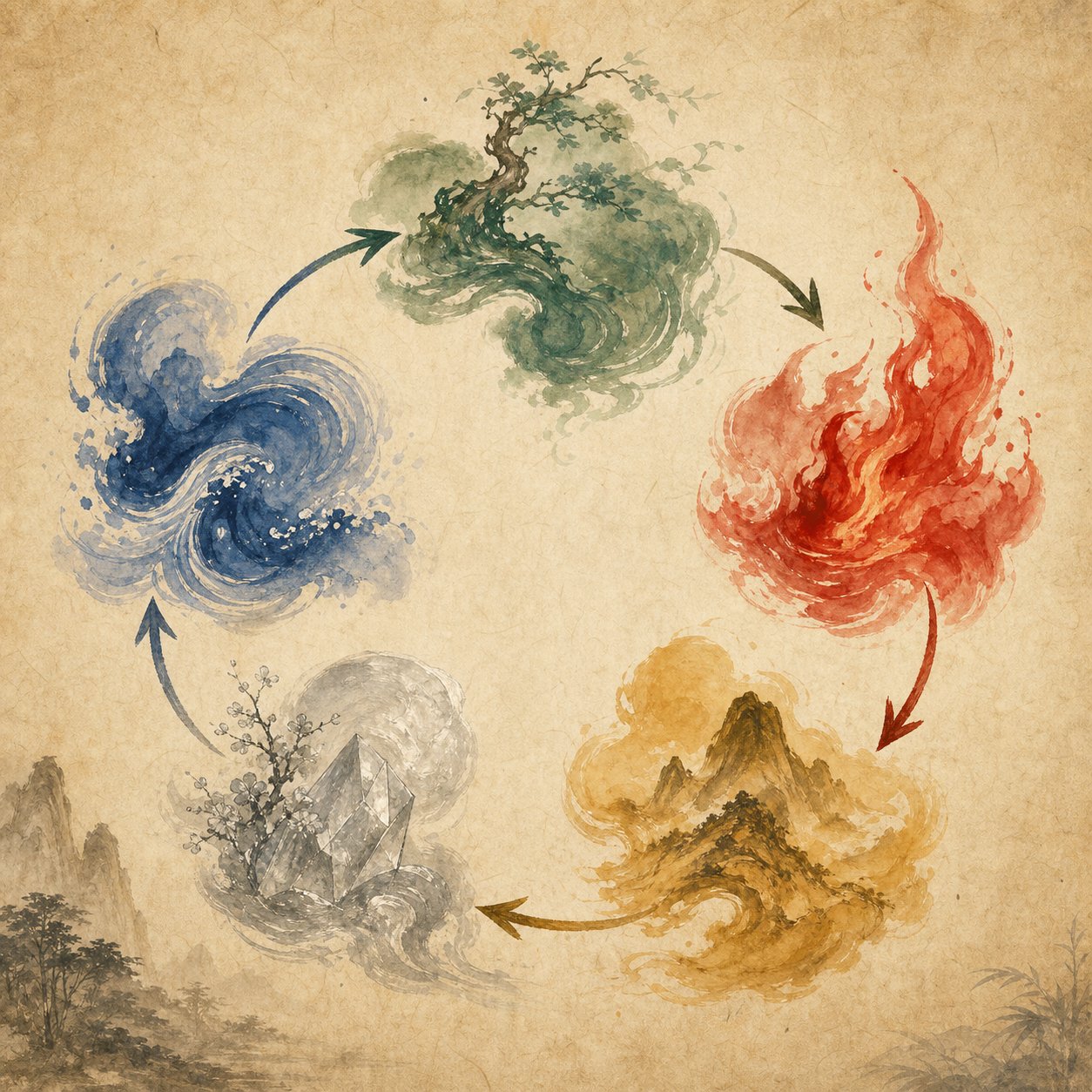
The productive cycle (also called the generating cycle) describes how each element nourishes the next: Wood feeds Fire, Fire creates Earth (ash), Earth produces Metal (ore), Metal generates Water (condensation), and Water nourishes Wood. This cycle matters because sometimes the best support for a weak element is not the element itself but the one that produces it. A chart weak in Fire might benefit from a Wood-radical character, since Wood generates Fire naturally.
The destructive cycle (or controlling cycle) works in the opposite direction: Wood parts Earth, Earth dams Water, Water extinguishes Fire, Fire melts Metal, and Metal cuts Wood. If a child's chart already has strong Metal energy and you introduce a Wood-element character, you may be placing the name character in direct conflict with the chart's dominant force. That tension can undermine the balance you are trying to create.
Productive cycle elements naming means thinking one step ahead. You are not just asking "what is missing?" but "what will support what is missing without clashing with what is already strong?"
Selecting Characters That Strengthen Without Overpowering
A common mistake is overcompensating. Imagine a chart with very little Water and dominant Earth. Earth controls Water in the destructive cycle, so simply adding a strong Water character might create a direct clash rather than gentle balance. A skilled practitioner might instead choose a Metal-element character, since Metal produces Water in the generating cycle and is itself produced by Earth. This creates a smooth energetic bridge rather than a head-on collision.
The principle behind BaZi naming is to support the Daymaster, the element representing the child. The name should strengthen the child's core position in their chart, not simply patch a gap mechanically. A chart that benefits from Water does not always need the water radical literally. Meaning, sound, and symbolic association can carry the direction just as effectively.
One critical point: the name should balance the child's own chart, not the parents' charts or the child's zodiac animal. Your BaZi profile is yours. Your child's is theirs. Choosing a character because it matches your own elemental makeup or because a zodiac compatibility list recommends it misses the entire purpose of individualized elemental analysis.
With the right character identified through radical, meaning, and cycle analysis, another layer of traditional evaluation comes into play: how many strokes that character contains, and what those numbers signify in classical naming numerology.
Stroke Count Analysis in Feng Shui Naming
You have found a character with the right elemental radical, a beautiful meaning, and a sound that flows well. But in traditional feng shui naming, that character still needs to pass a numerical test. Stroke count analysis, known as bi hua (笔画), evaluates the energetic quality of a name based on how many individual pen strokes its characters require. Think of it as a second filter layered on top of elemental selection, one rooted in numerology rather than the Five Elements directly.
This system, formally called the Five Grids Analysis Method (五格剖象法), was systematized in the early 20th century and uses the principles of Yin-Yang and the Five Elements applied to numbers. It divides a full name into several numerical "grids," each governing a different aspect of fortune. The logic is straightforward: every number from 1 to 81 carries a specific energetic signature, and the stroke totals in your child's name should land on favorable numbers.
How Stroke Counts Are Calculated Using Traditional Forms
Here is a detail that trips up many families doing their own research: the bi hua naming calculation method uses traditional character stroke count naming standards, not simplified forms. The reference dictionary is the Kangxi Dictionary (康熙字典), compiled during the Qing Dynasty. Even if your family uses simplified Chinese daily, the stroke count for naming purposes follows the traditional form of each character.
Why does this matter? The character 龙 (dragon) has 5 strokes in its simplified form but 16 strokes in its traditional form 龍. That difference completely changes which numerical grid the character falls into and whether the resulting total is considered auspicious. Some radicals also follow special counting rules. The three-dot water radical (氵), for instance, is counted as 4 strokes because it derives from the full character 水 (water), which has 4 strokes in its traditional form.
If you are using an online calculator for stroke count analysis Chinese name feng shui, verify that it references Kangxi Dictionary standards. Tools that default to simplified stroke counts will produce inaccurate grid calculations.
Auspicious Stroke Count Categories and Their Meanings
The system maps numbers 1 through 81 onto distinct fortune categories. After 81, the cycle repeats (82 is treated as 1, 83 as 2, and so on). Each number is classified as auspicious, sub-auspicious, or inauspicious, with some numbers carrying additional specialized meanings like leadership potential or artistic talent.
The general groupings look like this:
- Auspicious numbers (representing soundness, happiness, and prosperity): 1, 3, 5, 7, 8, 11, 13, 15, 16, 18, 21, 23, 24, 25, 31, 32, 33, 35, 37, 39, 41, 45, 47, 48, 52, 57, 61, 63, 65, 67, 68, 81
- Sub-auspicious numbers (some obstacles but still able to obtain good fortune): 6, 17, 26, 27, 29, 30, 38, 49, 51, 55, 58, 71, 73, 75
- Inauspicious numbers (representing adversity, weakness, or hardship): 2, 4, 9, 10, 12, 14, 19, 20, 22, 28, 34, 36, 40, 42, 43, 44, 46, 50, 53, 54, 56, 59, 60, 62, 64, 66, 69, 70, 72, 74, 76-80
- Leadership numbers (wisdom, benevolence, ability to lead): 3, 13, 16, 21, 23, 29, 31, 37, 39, 41, 45, 47
- Wealth numbers (financial abundance and prosperity): 15, 16, 24, 29, 32, 33, 41, 52
When selecting an auspicious stroke count for a baby name, practitioners aim for the key grid totals to land on favorable numbers. A character that scores well on elemental balance but produces an inauspicious grid total may be passed over in favor of a synonym with a better stroke count.
Combining Stroke Counts Between Middle Name and Surname
Stroke count analysis does not evaluate the middle name character in isolation. The system examines how the character's strokes interact with the surname to form specific grids. In the traditional naming structure, a Chinese name is divided into several numerical relationships:
- Personality Grid (人格) — surname strokes + first given name character strokes. This grid governs overall life fortune.
- Earth Grid (地格) — the sum of the given name characters' strokes. This reflects early-life circumstances.
- Total Grid (总格) — all strokes in the full name added together. This shapes fortune from middle age onward.
Each grid total is then checked against the 81-number classification. The ideal outcome is for all grids to land on auspicious or sub-auspicious numbers simultaneously. Beyond raw totals, practitioners also evaluate whether the characters create a balanced Yin-Yang pattern. Characters with even stroke counts are considered Yin, and those with odd counts are Yang. A harmonious name alternates between them rather than clustering all Yin or all Yang characters together.
Sounds complex? It is. This is precisely why online calculators exist for this layer of analysis. They automate the arithmetic and flag which combinations produce favorable grid numbers. But understanding the underlying logic helps you evaluate whether a tool is using the correct Kangxi Dictionary standards and whether it accounts for special radical counting rules.
Keep in mind that stroke count is one dimension of a multi-layered process. A character that produces perfect grid numbers but clashes elementally with the child's BaZi chart is not a good choice. The strongest selections satisfy both the elemental and numerical criteria together. And once you have a character that passes both tests, another consideration emerges: how that character actually sounds when spoken aloud alongside a Western first name.
Tonal Harmony Between Chinese and Western Names
A character can carry perfect elemental balance and ideal stroke counts, yet still feel awkward when spoken as part of a full name. Say it out loud: "Emily Xuan Rodriguez" versus "Emily Cheng Rodriguez." You will notice the phonetic flow Chinese and English names together create differs dramatically depending on the tonal quality of the Chinese character. Feng shui practitioners treat this sonic dimension as energetic, not merely aesthetic. The way a name moves through the mouth and lands on the ear carries its own kind of qi.
Tonal Patterns Across Mandarin and Cantonese Systems
Chinese is a tonal language, meaning the pitch pattern of a syllable changes its meaning entirely. Two syllables with identical consonants and vowels become completely different words depending on tone. Mandarin uses four primary tones plus a neutral tone: a high flat pitch (first tone), a rising pitch (second tone), a dipping pitch that falls then rises (third tone), and a sharp falling pitch (fourth tone).
Cantonese is more complex, distinguishing six tones in modern usage (historically up to nine when entering tones are counted separately). Hokkien operates with seven or eight tones depending on the dialect. The same Chinese character can sound melodically different across these systems because each dialect assigns its own tonal realization to the same underlying tone category.
Why does this matter for naming? Feng shui practitioners evaluate the tonal contour of a full name as a melodic sequence. A name where every syllable sits on the same flat tone feels monotonous and energetically stagnant. A name that alternates between rising and falling tones creates movement and vitality. In classical Chinese poetry, this principle is formalized as the contrast between "even" (ping) and "oblique" (ze) tones, a pattern that naming practitioners borrow when assessing tonal harmony in a Chinese middle name paired with a Western name.
The practical implication: families should decide which dialect they will primarily use when speaking the child's name. A character chosen for its Mandarin tonal flow may produce a very different melodic effect in Cantonese. If grandparents will call the child by their Chinese name in Cantonese while parents use Mandarin, both tonal profiles deserve consideration.
How Western Names Interact Phonetically With Chinese Characters
English is a stress-timed language, not a tonal one. It uses emphasis and rhythm rather than pitch to convey meaning. When a Chinese middle name sits between an English first name and surname, two phonetic systems collide. The English syllables carry stress patterns while the Chinese syllable carries tone.
In practice, English speakers tend to flatten the tonal quality of a Chinese syllable, reading it with the stress pattern of the surrounding English name. A fourth-tone character like 瑞 (rui, falling sharply) may lose its tonal sharpness when sandwiched between "Oliver" and "Chen." Feng shui practitioners who evaluate Mandarin and Cantonese tones in naming recommend testing the full name spoken aloud in both languages. The character should sound intentional and fluid in the dialect context where it will be used most, while remaining pronounceable in English without distortion.
Some phonetic combinations create natural ease. A Chinese syllable ending in an open vowel (like "yi" or "hao") tends to flow more smoothly after English names than one ending in a nasal (like "ming" or "cheng"), which can bump against English consonant clusters. Saying the full name rapidly, as a teacher calling attendance might, reveals whether the combination trips the tongue.
Choosing a Romanization That Preserves Tonal Intent
The romanization system you choose for official documents shapes how others will attempt to pronounce your child's middle name. Three major systems exist, each with different conventions:
- Pinyin — the standard romanization for Mandarin in mainland China and Singapore. Uses letters like Q, X, and Zh that do not map intuitively to English pronunciation (Q sounds like "ch," X like "sh"). Most widely recognized internationally.
- Wade-Giles — an older system still seen in Taiwanese names and historical texts. Uses apostrophes to mark aspiration (e.g., "Ch'en" vs. "Chen"). Distinguishable from Pinyin by its use of hyphens in given names and syllables beginning with HS or TS.
- Jyutping — the standard romanization for Cantonese, used primarily in Hong Kong. Appends a number (1-6) to indicate tone, which is typically dropped in casual usage on legal documents.
Your romanization choices for a Chinese middle name carry long-term consequences. A name romanized as "Xuan" in Pinyin will be mispronounced as "ex-you-ann" by most English speakers unfamiliar with the system. The same character romanized as "Hsuan" in Wade-Giles or given a phonetic approximation like "Shwen" might get closer to the intended sound in daily life, but departs from official standards.
There is no universally correct answer here. Families prioritizing accuracy within the Chinese-speaking community often choose Pinyin or Jyutping. Those prioritizing ease of pronunciation in English-dominant environments sometimes opt for phonetic spellings that sacrifice systematic accuracy for practical clarity. The feng shui consideration is whether the name's intended tonal energy survives the romanization. If the character was chosen partly for its rising-tone quality and the romanized spelling consistently triggers a flat pronunciation, some of that sonic intention is lost in everyday use.
Tonal harmony is the audible layer of a multi-dimensional naming process. But for many families, the character selection is not entirely free. Generational naming traditions and the timing constraints of BaZi analysis introduce their own boundaries around what characters are even available to choose from.
Generational Names and Timing Your Selection
Some families approach the naming process with complete freedom, choosing any character that satisfies elemental, numerical, and tonal criteria. Others do not have that luxury. A generational name tradition may already dictate one character in the child's name, narrowing the field before any BaZi analysis even begins. Balancing family naming tradition with BaZi requirements is one of the more nuanced challenges in feng shui middle name selection.
Understanding the Generational Name Poem Tradition
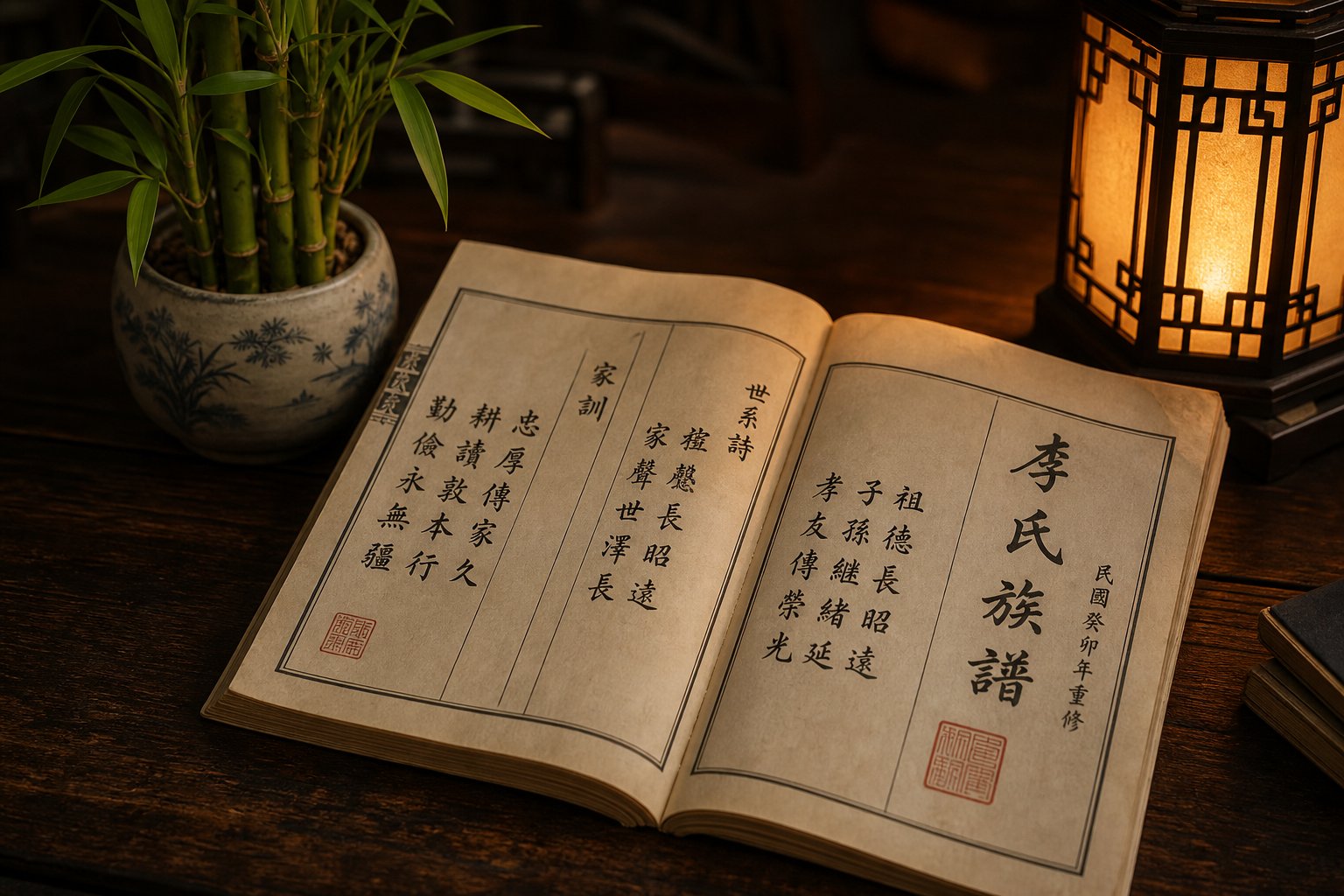
The generational name, or zi bei (字辈), is a character shared by all members of the same generation within a patrilineal family. It functions like a built-in identifier: when you meet someone with the same surname and the same generational character, you know exactly where they sit in the family tree relative to you.
How do families keep track of these characters across dozens of generations? Through a generational poem. Each successive character in the poem represents the zi bei for one generation. When the poem's final character is reached, it can be repeated or extended, usually by the clan association governing that branch. These poems vary in length from around a dozen characters to hundreds, and they often contain aspirational language: characters meaning "smart," "heroic," "virtuous," or "grand." A committee of family elders typically composed the poem when a new lineage was established through emigration or social elevation.
Families sharing a common generational poem are considered to share a common ancestor and geographical origin. For diaspora families, the zi bei poem carries particular emotional weight. It is a thread connecting children born in Toronto or Sydney back to a village in Guangdong or Fujian, linking them to cousins they may never meet but who carry the same generational character in their names.
Balancing Zi Bei Requirements With Elemental Needs
Here is where the tension emerges. Imagine your family's generational poem assigns the character 志 (zhi, meaning "ambition" or "will") to your child's generation. That character carries Fire energy through its heart radical (心/忄). But your child's BaZi chart shows abundant Fire and a critical deficiency in Water. The zi bei poem and feng shui naming goals are pulling in opposite directions.
Practitioners handle this conflict in several ways:
- Compensate with the second character. In a traditional two-character given name, the generational character occupies one position. The other character can be chosen specifically to address the elemental gap. If the zi bei character brings Fire, the companion character can carry strong Water energy to restore balance.
- Reinterpret the character's elemental weight. Some characters carry multiple elemental associations depending on meaning, radical layers, and phonetic components. A practitioner may find a secondary elemental reading that softens the conflict.
- Use the zi bei character in the formal Chinese name while selecting a different feng shui-optimized character for the Western middle name slot. This approach separates the two naming systems, honoring family tradition in one context and elemental balance in another.
The key principle: the generational name tradition for a Chinese middle name does not have to override BaZi analysis entirely, nor does BaZi need to override family obligation. The two systems can coexist when you treat the name as a multi-character composition rather than placing all the elemental burden on a single character.
Timing adds another layer of complexity. Since BaZi requires the exact birth date and time, the full elemental analysis cannot happen until after the baby arrives. Yet families with zi bei obligations already know one character in advance. This actually creates a strategic advantage: you can begin evaluating companion characters months before birth, testing which options pair well with the fixed generational character across multiple possible birth charts.
Experienced families often prepare a shortlist during pregnancy. They calculate preliminary charts based on the expected birth month, identify which elements are likely to be strong or weak during that season, and draft two or three character options for each scenario. A baby expected in winter (Water-dominant season) will likely need different elemental support than one arriving in summer (Fire-dominant). Once the actual birth time is recorded, the final selection narrows quickly because the groundwork is already done.
As one BaZi naming resource notes, if the birth time is uncertain, the name can still draw on meaning and Five Elements with a lighter BaZi judgment. Families who cannot record the exact minute of birth can work with the two-hour window of the traditional time system, accepting a slightly broader elemental reading rather than abandoning the process entirely.
This timing reality means that for many families, the naming journey has two distinct phases: preparation before birth and finalization after. The pre-birth phase handles research, family consultation, zi bei confirmation, and shortlisting. The post-birth phase runs the precise BaZi chart, confirms elemental needs, and selects the final character from the prepared options. Families who understand this two-phase rhythm avoid the pressure of making a rushed decision in the hospital while still honoring the tradition's requirement for birth-time accuracy.
With the character selected and the metaphysical layers satisfied, a different kind of challenge awaits: getting that carefully chosen name onto official documents in a country whose legal systems were not designed for Chinese characters.
Legal and Practical Steps for Western Countries
You have spent weeks, maybe months, aligning elements, evaluating stroke counts, and testing tonal flow. The character is chosen. And then a hospital registrar hands you a form that only accepts the Latin alphabet. The legal requirements for Chinese characters in Western countries rarely accommodate the characters themselves, which means your carefully selected name must pass through one more translation before it becomes official.
Birth Certificate and Legal Document Formatting
Most Western jurisdictions require names on birth certificates to be written in Latin script. The United States, Canada, the United Kingdom, and Australia all follow this standard. Chinese characters cannot appear as the legal name on these documents. What gets recorded is the romanized version of the character, not the character itself.
The U.S. Embassy's CRBA checklist makes this explicit for births abroad: the name on the Consular Report of Birth Abroad must match the official birth certificate, and phonetic romanization of Chinese characters is acceptable. This same principle applies domestically. Hospital staff entering the name into vital records systems will type the romanized spelling you provide. They will not verify tonal marks, character accuracy, or whether your romanization follows Pinyin, Wade-Giles, or another system. What you write on the form is what appears on the certificate.
Some jurisdictions allow diacritical marks (like the tone marks in Pinyin), but many systems strip them during data entry. A name submitted as "Ruì" may appear as "Rui" on the printed certificate. This is worth confirming with your local vital records office before the birth, since correcting a birth certificate after issuance involves paperwork and fees.
Romanization Choices and Their Long-Term Implications
The romanization you choose when registering a Chinese middle name on the birth certificate follows your child through every official document for the rest of their life. Passports, school enrollment forms, driver's licenses, university applications, and employment records will all reference this spelling. Changing it later requires a legal name change process, which varies in complexity by jurisdiction.
A romanized Chinese name on a passport must match the birth certificate exactly. If you register "Xuan" but later wish it had been "Hsuan" for pronunciation clarity, that discrepancy between documents creates complications at border crossings and background checks. Consistency matters more than perfection here.
Families navigating how to register a Chinese middle name officially should consider these practical steps:
- Decide on your romanization system (Pinyin, Wade-Giles, Jyutping, or phonetic approximation) before arriving at the hospital
- Confirm with your local vital records office whether diacritical marks and tone numbers are supported in their system
- Write the romanized name clearly on all hospital forms, including any hyphens if using a two-character given name (e.g., "Zi-Han" vs. "Zihan")
- Keep a separate record of the Chinese character, its meaning, elemental association, and stroke count for family reference
- Request a certified copy of the birth certificate promptly and verify the spelling before leaving the hospital or registration office
- If applying for dual citizenship or consular registration, check whether the other country's documents can display the Chinese character alongside the romanized form
Does romanization dilute the feng shui intention behind the name? Practitioners generally hold that the energetic essence lives in the character itself, not in its phonetic transcription. The character 瑞 carries its elemental signature whether you write "Rui," "Jui," or any other romanized form. The feng shui work was done at the level of radical, stroke count, and elemental alignment. What appears on the birth certificate is an administrative representation, not the metaphysical object itself.
Many families maintain a dual-layer approach: the romanized version serves legal and institutional purposes, while the Chinese character lives in family documents, calligraphy art in the child's room, or a formal naming certificate created by the practitioner who performed the analysis. The child grows up knowing both versions, understanding that their legal middle name points to a deeper character with intentional meaning.
This practical reality is worth embracing rather than resisting. The legal system and the metaphysical system operate on different planes. One governs paperwork. The other governs energy. They do not need to be identical to both function as intended.
With the administrative side handled, families sometimes encounter a different obstacle: well-meaning advice based on naming myths that can steer the entire process off course.
Common Myths About Chinese Name Feng Shui Debunked
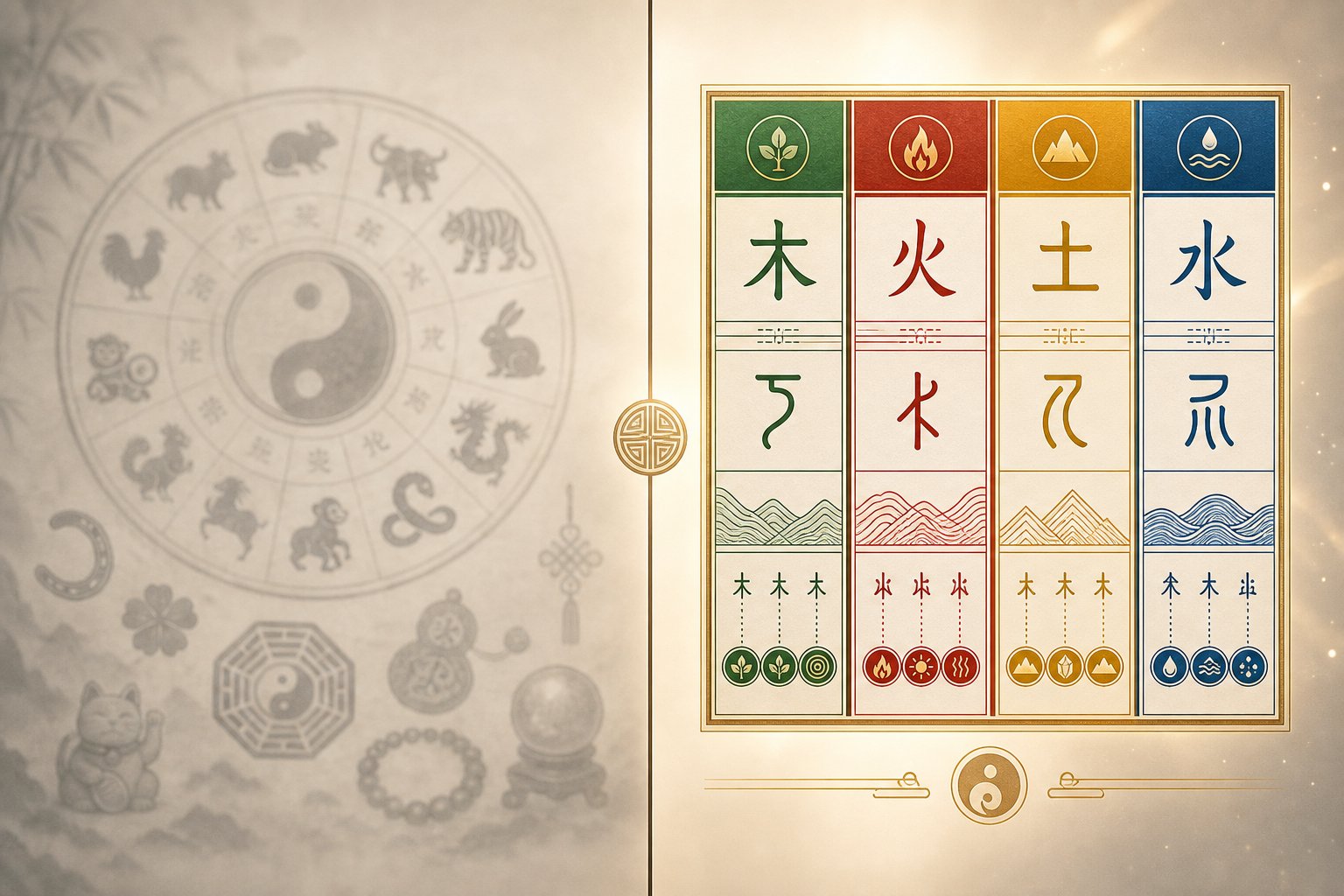
A grandmother insists the baby cannot have a Water-radical character because the child is born in the Year of the Horse, and "horses fear water." A well-meaning friend shares a list of "universally lucky" characters from a social media post. An online calculator spits out a name in seconds and declares it perfectly balanced. Each of these scenarios reflects a widespread misconception that can derail an otherwise thoughtful naming process. Getting Chinese name feng shui myths debunked before you commit to a character saves time, family arguments, and potential energetic misalignment.
Myth vs Reality in Zodiac-Based Name Selection
The zodiac animal name compatibility myth is perhaps the most persistent misunderstanding in Chinese naming culture. It works like this: people assume that because a child is born in the Year of the Rabbit, their name should contain characters with grass radicals (rabbits eat grass) and avoid characters associated with the Rooster (because Rabbit and Rooster "clash"). The logic sounds intuitive, which is exactly why it spreads so easily.
The problem? This approach reduces an eight-character system to a single character. BaZi literally means "eight characters." The zodiac animal represents only one Earthly Branch in the Year Pillar, which is one-eighth of the full chart. As BaZi practitioner Master Sean Chan explains, trying to compress everything Chinese metaphysics offers into something as reductive as one zodiac sign is fundamentally flawed. A single Branch clash or harmony tells you almost nothing without the context of the remaining seven characters.
The same logic applies to naming. A child born in the Year of the Snake does not automatically need characters with cave or grass radicals. Their actual elemental needs depend on the full interplay of all four pillars, the strength of their Day Master, and which elements function as their favorable "Useful God." Two children born in the same zodiac year but on different days and hours can have completely opposite elemental requirements.
Another layer of this myth involves "clash" avoidance. Families sometimes reject perfectly suitable characters because the radical appears to conflict with the zodiac animal. In reality, clashes in Chinese metaphysics are not inherently negative. They represent dynamic tension and change, which can be beneficial depending on the chart's overall structure. A clash in one position might actually activate positive energy elsewhere in the chart.
Why Generic Lucky Characters Do Not Work for Everyone
Search "lucky Chinese baby names" online and you will find lists of characters marketed as universally auspicious: 福 (fu, blessing), 瑞 (rui, auspicious), 嘉 (jia, excellent), 祥 (xiang, fortunate). These characters carry positive meanings, certainly. But the generic lucky Chinese characters naming mistake is assuming that positive meaning equals positive energy for every individual child.
Consider this: the character 瑞 carries Metal energy. For a child whose chart already overflows with Metal and desperately needs Wood, adding more Metal through the name actively worsens the imbalance. The character's dictionary meaning is lovely, but its elemental effect on that specific chart is counterproductive. As BaZi naming methodology clarifies, professional practitioners look for the "Useful God" (用神), the specific element most beneficial to the individual chart. A chart freezing cold with strong Water does not need more Water even if it seems "balanced" on paper; it needs Fire for warmth.
The same principle applies to characters chosen from parents' own names or BaZi profiles. Your elemental makeup is yours. Your child's is theirs. A father with a strong Wood chart might love the character 森 (sen, forest), but if his daughter's chart is already Wood-dominant, that character amplifies an excess rather than creating balance. The correct methodology always starts from the child's own birth chart, never the parents'.
Here is a comparison of common myths against the correct feng shui approach:
| Common Myth | Correct Methodology | What to Do Instead |
|---|---|---|
| Choose characters based on the child's zodiac animal preferences (e.g., grass radicals for Rabbits) | The zodiac is one-eighth of the chart; elemental needs come from the full BaZi analysis of all four pillars | Calculate the complete birth chart and identify the Useful God element before selecting radicals |
| Avoid characters that "clash" with the zodiac sign | Clashes are not inherently negative; they can activate positive dynamics depending on chart context | Evaluate character elements against the full chart structure, not just the Year Branch |
| Use parents' BaZi profiles or favorite elements to guide the child's name | Each person's chart is individual; the child's Day Master and elemental balance are independent of the parents' | Run the child's own BaZi chart after birth and base all character selection on their unique elemental needs |
| Pick from lists of "universally lucky" characters like 福, 瑞, or 祥 | A character's elemental energy may conflict with the child's chart regardless of its positive dictionary meaning | Match character radicals and elemental associations to the specific element the child's chart needs most |
| Simply count which elements are missing and add them to the name | The Useful God is not always the missing element; a weak chart may need support, not just gap-filling | Assess Day Master strength first, then determine which element genuinely supports the chart's balance |
What Calculators Can and Cannot Tell You
Online Chinese name calculator accuracy is a question that comes up constantly, and the honest answer is: they handle arithmetic well but interpretation poorly. A calculator can tally stroke counts, identify which elements correspond to specific radicals, and flag whether grid numbers fall in auspicious or inauspicious categories. That mechanical layer is genuinely useful and saves hours of manual counting.
What calculators cannot do is assess the strength of the Day Master, determine whether the chart is "following" or "opposing" its dominant element, or evaluate how Luck Pillars (ten-year elemental cycles) will interact with the name's energy over time. These are interpretive judgments that require understanding the relationships between all eight characters simultaneously. A calculator sees each element as a discrete unit. A practitioner sees a dynamic system where the same element can be helpful in one chart configuration and harmful in another.
The most common calculator error is the "missing element" fallacy. The tool counts elements, finds that Water appears zero times, and recommends Water characters. But if the chart's Day Master is weak Earth being overwhelmed by strong Wood, adding Water (which nourishes Wood) would make things worse, not better. The chart needs Fire (which controls Wood and supports Earth) or more Earth (which strengthens the Day Master directly). No calculator currently available to the public performs this level of contextual analysis reliably.
Does that mean calculators are useless? Not at all. They serve well as a first-pass filter. Use them to verify stroke counts against Kangxi Dictionary standards, check grid number classifications, and confirm a character's elemental radical association. Then bring that shortlist to a practitioner, or deepen your own study of Day Master strength analysis, for the interpretive layer that turns raw data into a genuinely balanced name.
Understanding what these myths get wrong clarifies what the correct process actually looks like. The real methodology is sequential, individualized, and layered, building from birth chart analysis through character selection to final verification. That complete framework is what ties every principle discussed so far into a single, actionable path forward.
Bringing It All Together for Your Family
Elements, radicals, stroke counts, tonal flow, generational poems, legal paperwork. Each layer matters, but none of them works in isolation. The real power of this process comes from stacking them in the right sequence so that each decision builds on the one before it. Here is the step by step feng shui Chinese middle name process distilled into a framework you can actually follow.
A Practical Framework for Your Naming Journey
Whether you are months from your due date or days away from a birth certificate deadline, this sequence keeps the process organized and grounded:
- Confirm family obligations first. Check whether your family follows a generational poem (zi bei). If a character is already assigned to your child's generation, that becomes a fixed variable everything else works around.
- Record the exact birth time. Ask hospital staff to note the precise minute of delivery. Convert to solar time based on your birth location's longitude if working with a classical practitioner.
- Plot the full BaZi chart. Use all four pillars to identify the Day Master element, assess its strength, and determine the Useful God, the element that most benefits the chart's overall balance.
- Identify candidate characters by radical and meaning. Select characters whose elemental energy matches the Useful God. Verify that the element supports the Day Master through the productive cycle rather than clashing with dominant chart forces.
- Run stroke count analysis. Check each candidate character against Kangxi Dictionary stroke standards. Calculate the Personality Grid, Earth Grid, and Total Grid to confirm auspicious number combinations with your surname.
- Test tonal harmony. Say the full name aloud in both English and your primary Chinese dialect. Listen for melodic flow, tongue-tripping consonant clusters, and tonal monotony. Eliminate characters that sound awkward in daily use.
- Choose your romanization. Decide on Pinyin, Wade-Giles, Jyutping, or a phonetic approximation before hospital registration. Confirm that your local vital records office supports any diacritical marks you plan to include.
- Register and preserve. Submit the romanized form on official documents. Keep a separate family record of the Chinese character, its elemental purpose, stroke count, and the reasoning behind its selection.
Families who begin during pregnancy can complete steps one through four in preliminary form, preparing shortlists for different seasonal birth scenarios. Steps five through eight finalize after the baby arrives and the exact birth time locks in the chart.
When to Seek Professional Guidance
Can you do this yourself? Partially. The arithmetic of stroke counts and the identification of radicals are learnable skills. Online tools handle those layers competently. But the interpretive core of the process, determining Day Master strength, reading element interactions across all eight characters, and identifying the true Useful God, requires training that goes beyond what a calculator or blog post can provide.
Consider hiring a feng shui naming practitioner when:
- The birth chart contains complex configurations like multiple clashes or combinations that transform elements
- Your family's generational character conflicts elementally with the child's apparent needs
- You want the name evaluated against upcoming Luck Pillars (ten-year elemental cycles) for long-term harmony
- You are choosing between several strong candidates and need an expert eye to distinguish subtle differences
A professional consultation typically involves providing the child's birth details, receiving a full chart analysis, and getting a shortlist of recommended characters with explanations for each. Expect the practitioner to explain why a character suits your child's specific chart rather than simply handing you a name without context. If they cannot articulate the reasoning, that is a signal to look elsewhere.
For families weighing feng shui naming consultation vs DIY research, a middle path works well: do your own preliminary research to understand the principles, prepare informed questions, and then use a professional session to validate or refine your shortlist rather than starting from zero.
One more thing worth knowing: a Chinese name is not necessarily permanent. If circumstances change, if you later gain access to a more skilled practitioner, or if your child grows up and wants a name that reflects their own evolving identity, renaming is culturally acceptable. Many Chinese adults adopt new names at significant life transitions. The feng shui intention you set at birth is meaningful and powerful, but it is not a cage. It is a foundation.
The goal throughout this entire process is harmony, not perfection. No single character will score flawlessly across every dimension simultaneously. What matters is that your choice reflects genuine understanding: of your child's elemental blueprint, of your family's traditions, and of the practical world where the name will live. Cultural respect and personal meaning should walk alongside the metaphysical analysis, not be sacrificed to it.
Understanding these principles does not require you to become a BaZi master. It empowers you to ask better questions, evaluate advice critically, and make a naming decision that is intentional rather than arbitrary. Your child's middle name becomes more than a placeholder on a birth certificate. It becomes a deliberate act of care, shaped by centuries of wisdom and grounded in who they actually are.
Frequently Asked Questions About Chinese Middle Name Feng Shui
1. Can I choose a Chinese middle name based on feng shui before my baby is born?
You can begin preliminary research during pregnancy but cannot finalize the selection until after birth. BaZi analysis requires the exact birth date and time to plot the four pillars accurately. Many families prepare shortlists based on the expected birth month and seasonal elemental tendencies, then narrow down to a final character once the precise birth time is recorded. This two-phase approach avoids rushed decisions while respecting the system's requirement for birth-time precision.
2. Do online Chinese name calculators provide accurate feng shui results?
Online calculators handle mechanical tasks well, such as tallying stroke counts and identifying radical-based elemental associations. However, they cannot assess Day Master strength, determine whether a chart follows or opposes its dominant element, or evaluate how ten-year Luck Pillars interact with the name over time. The most common error is recommending the missing element without considering whether that element actually benefits the chart's overall balance. Use calculators as a first-pass filter for stroke counts and grid numbers, then seek deeper interpretive analysis for the elemental layer.
3. Should I base my child's Chinese middle name on their zodiac animal?
No. The zodiac animal represents only one Earthly Branch in the Year Pillar, which is one-eighth of the full BaZi chart. Selecting characters based solely on zodiac animal preferences, such as grass radicals for Rabbit-year babies, ignores the other seven characters that shape the child's elemental needs. Two children born in the same zodiac year but on different days and hours can require completely opposite elemental support. Always base character selection on the complete four-pillar analysis rather than the zodiac sign alone.
4. How do I legally register a Chinese character as a middle name in Western countries?
Most Western jurisdictions require birth certificates to use Latin script only, so you register the romanized version of the character rather than the character itself. Choose your romanization system (Pinyin, Wade-Giles, Jyutping, or phonetic approximation) before arriving at the hospital, confirm whether your local vital records office supports diacritical marks, and verify the spelling on the certificate before leaving. The Chinese character can be preserved in family records, calligraphy art, or a formal naming certificate, while the romanized form serves all legal and institutional purposes.
5. What is the difference between stroke count analysis and Five Elements analysis in feng shui naming?
Five Elements analysis addresses the energetic content of a character, matching its radical and meaning to the element your child's BaZi chart needs most. Stroke count analysis (bi hua) evaluates the numerical quality of the name by calculating how character stroke totals interact with the surname to form auspicious or inauspicious grid numbers. The two systems operate as complementary layers. A strong name satisfies both: its elemental energy supports the child's chart while its stroke count combinations produce favorable numerical patterns across all grids.