The Cultural Power of Moon Names in Chinese Tradition
Imagine gazing at a full autumn moon and knowing that for thousands of years, Chinese families have looked at that same light and seen femininity, grace, and quiet strength reflected back. The moon (月, yuè) is not just a celestial body in Chinese culture. It is a living symbol woven into poetry, philosophy, and the deeply personal act of naming a daughter.
Chinese moon names for girls draw from this rich well of meaning. Where Western naming traditions might treat "Luna" as a standalone choice, the Chinese approach layers character, tone, and literary resonance into every syllable. Luna in Chinese carries far more weight than a simple translation. The character 月 connects a girl's identity to cycles of renewal, the soft power of reflected light, and centuries of artistic reverence for the feminine.
Why the Moon Holds Special Meaning in Chinese Naming
In Chinese cosmology, the moon represents yin energy, the complementary force associated with femininity, intuition, and receptive strength. This isn't passive or diminished. It's the quiet pull that moves oceans. When parents choose names that mean moon for their daughters, they're invoking beauty that renews itself, elegance that doesn't fade with a single season, and a presence that illuminates without burning.
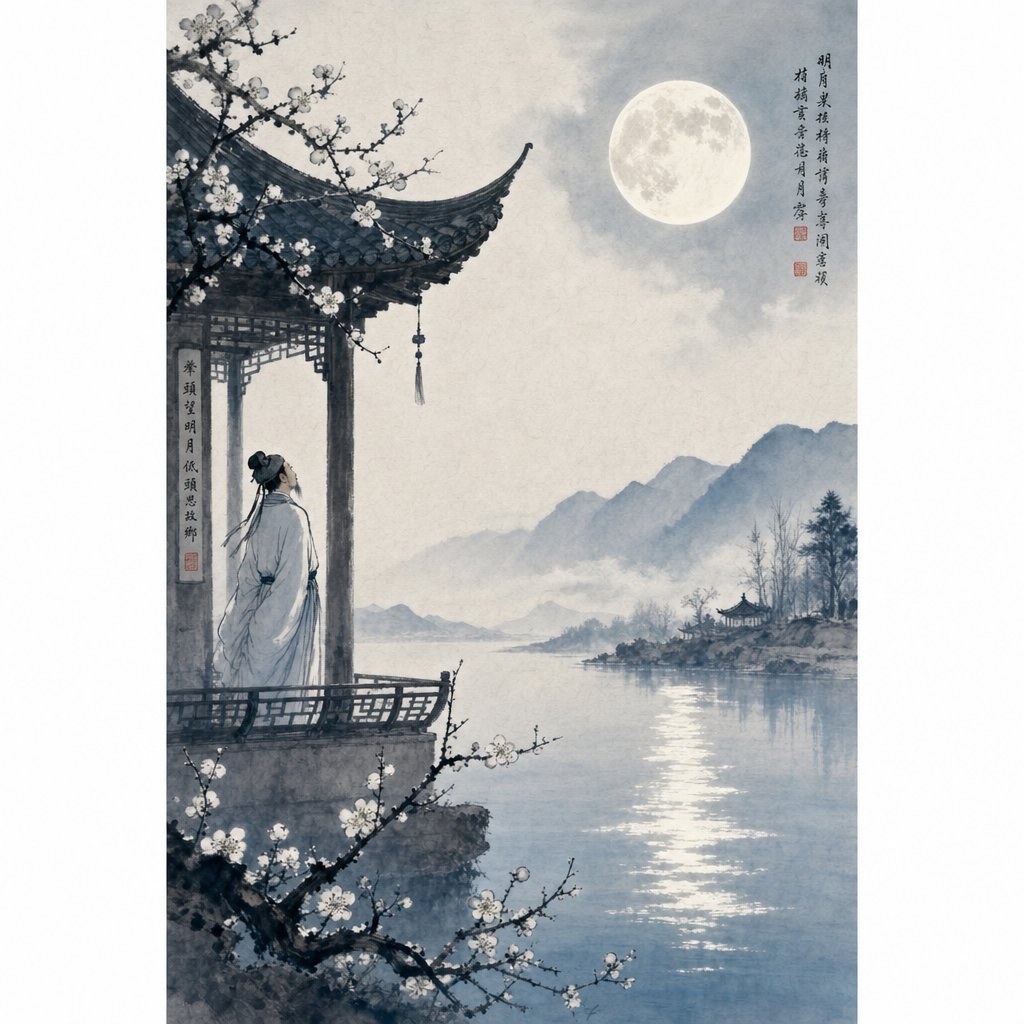
The moon also carries deep emotional resonance. For over a millennium, poets have used it as a mirror for longing, connection, and home. Li Bai, the Tang Dynasty's most celebrated poet, captured this perfectly in his Quiet Night Thought:
Lifting my head I gaze at the bright moon; bowing my head, thinking of home.
That single image, a person looking up at the moon and feeling connected to loved ones far away, has shaped how Chinese families think about lunar symbolism. A moon name ties a girl to family, to heritage, and to something larger than herself.
Among asian girl names, those rooted in lunar imagery stand apart for this layered cultural depth. They carry stories, not just sounds.
What This Guide Covers
This guide goes beyond the generic lists of chinese girl names you'll find recycled across baby name databases. You'll find names organized into clear categories:
- Direct moon names using the character 月 (yuè)
- Mythology-inspired names drawn from the Chang'e legend and lunar folklore
- Indirect moon names that evoke moonlight, radiance, and luminosity
- Poetic names pulled from classical Tang and Song Dynasty literature
- Compound name-building techniques for creating something truly unique
Each name entry includes Chinese characters, pinyin with tone guidance, literal meaning, and cultural connotation. This consistent formatting addresses a gap you'll notice in most chinese names for girls resources, where entries are incomplete or lack the context needed to make an informed choice. Whether you're a Chinese diaspora family honoring heritage or simply drawn to the depth these names carry, you'll have everything needed to choose with confidence.
The richness of these names starts with understanding how Chinese name structure works, and how the tonal quality of 月 interacts with different surnames to create harmony or tension.
Understanding Chinese Name Structure for Moon Names
A beautiful moon character means little if it clashes with the surname sitting in front of it. Chinese names operate as compact systems where every element, sound, stroke, and meaning, must work together. Before diving into specific name options, you'll want to understand the architecture that holds them.
How Chinese Names Are Structured
Chinese names follow a surname-first order. The family name (姓, xìng) comes before the given name (名, míng), the reverse of most Western naming conventions. So in the name Wang Yuèhuá (王月华), Wang is the surname and Yuèhuá is the given name.
Here's where it gets interesting for moon-themed naming. Given names are typically one or two characters long. A single-character given name like 月 (yuè) on its own is direct and bold, but a two-character given name opens up far more creative territory. With two characters, you can pair 月 with a second character that adds nuance: grace, nature imagery, virtue, or literary allusion. Think of it as the difference between saying "moon" and saying "moonlit orchid" or "moon radiance." That second character transforms a symbol into a story.
Among asian names, this compact structure is distinctive. A full Chinese name is usually just two or three characters total, yet it packs layers of meaning into that small space. As MingShu's naming guide explains, a serious Chinese given name must satisfy four dimensions simultaneously: sound, form, meaning, and elemental balance. This is why choosing chinese names requires more than picking characters from a list.
Tonal Harmony Between Surnames and Moon Characters
Mandarin Chinese has four main tones, and the character 月 (yuè) carries the fourth tone, a sharp falling pitch that drops from high to low. When you pair this with a surname, the tonal sequence matters. Two fourth-tone characters in a row can sound abrupt. A first-tone surname followed by the falling fourth tone of yuè creates a smooth descent. A second-tone surname rising into the fourth tone's fall produces a pleasing wave pattern.
Sounds complex? It's really about rhythm. Say the name aloud. Does it flow naturally, or does it feel like your voice is tripping? That instinct is tonal harmony at work.
The table below shows how common chinese surnames pair with moon characters, demonstrating tonal flow and stroke count balance:
| Surname (Characters) | Pinyin + Tone | Moon Name Pairing | Full Name Pinyin | Tonal Pattern | Stroke Balance |
|---|---|---|---|---|---|
| 王 | Wáng (2nd) | 月婷 (yuètíng) | Wáng Yuètíng | Rising → Falling → Rising | 4 + 4 + 12 strokes |
| 李 | Lǐ (3rd) | 月华 (yuèhuá) | Lǐ Yuèhuá | Dipping → Falling → Rising | 7 + 4 + 6 strokes |
| 陈 | Chén (2nd) | 月兰 (yuèlán) | Chén Yuèlán | Rising → Falling → Rising | 7 + 4 + 5 strokes |
| 林 | Lín (2nd) | 皎月 (jiǎoyuè) | Lín Jiǎoyuè | Rising → Dipping → Falling | 8 + 8 + 4 strokes |
| 张 | Zhāng (1st) | 月琴 (yuèqín) | Zhāng Yuèqín | High → Falling → Rising | 7 + 4 + 12 strokes |
| 刘 | Liú (2nd) | 明月 (míngyuè) | Liú Míngyuè | Rising → Rising → Falling | 6 + 8 + 4 strokes |
Notice how the best pairings avoid stacking identical tones. The surname Zhāng (first tone, high and steady) flows naturally into the falling fourth tone of yuè, then lifts again with the rising second tone of qín. That wave-like motion is what native speakers recognize as a well-crafted name. Asian surnames names like these top six cover roughly 30% of the Chinese population, so understanding their tonal behavior gives you a practical foundation for most naming scenarios.
Mandarin Versus Cantonese Pronunciation Differences
If your family speaks Cantonese rather than Mandarin, the same characters will sound quite different. This matters for diaspora families who may use Cantonese at home while their children encounter Mandarin in school or community settings.
The character 月 is pronounced yuè in Han Mandarin but jyut6 in Cantonese (Jyutping romanization). That's a significant shift. Similarly, the brightness character 明 is míng in Mandarin but ming4 in Cantonese. The moon goddess character 嫦 is cháng in Mandarin and soeng4 in Cantonese.
Cantonese carries six basic tones compared to Mandarin's four, which means tonal harmony calculations shift entirely between the two systems. A name that flows beautifully in Mandarin might feel tonally flat in Cantonese, and vice versa. Surnames also change: Wang becomes Wong, Li becomes Lei, Chen becomes Chan, and Zhang becomes Cheung.
For families navigating both systems, the safest approach is to test a name aloud in whichever dialect you'll use most at home. The written characters remain identical regardless of dialect, so the visual beauty and meaning hold steady. It's the spoken music that changes. If you want a moon name that works across both Mandarin and Cantonese contexts, prioritize characters whose tonal positions create pleasant flow in both systems, and consult a native speaker of each dialect before finalizing your choice.
With this structural foundation in place, the real exploration begins: the specific moon characters themselves and the imagery they carry into a girl's name.
Names That Use the Moon Character Directly
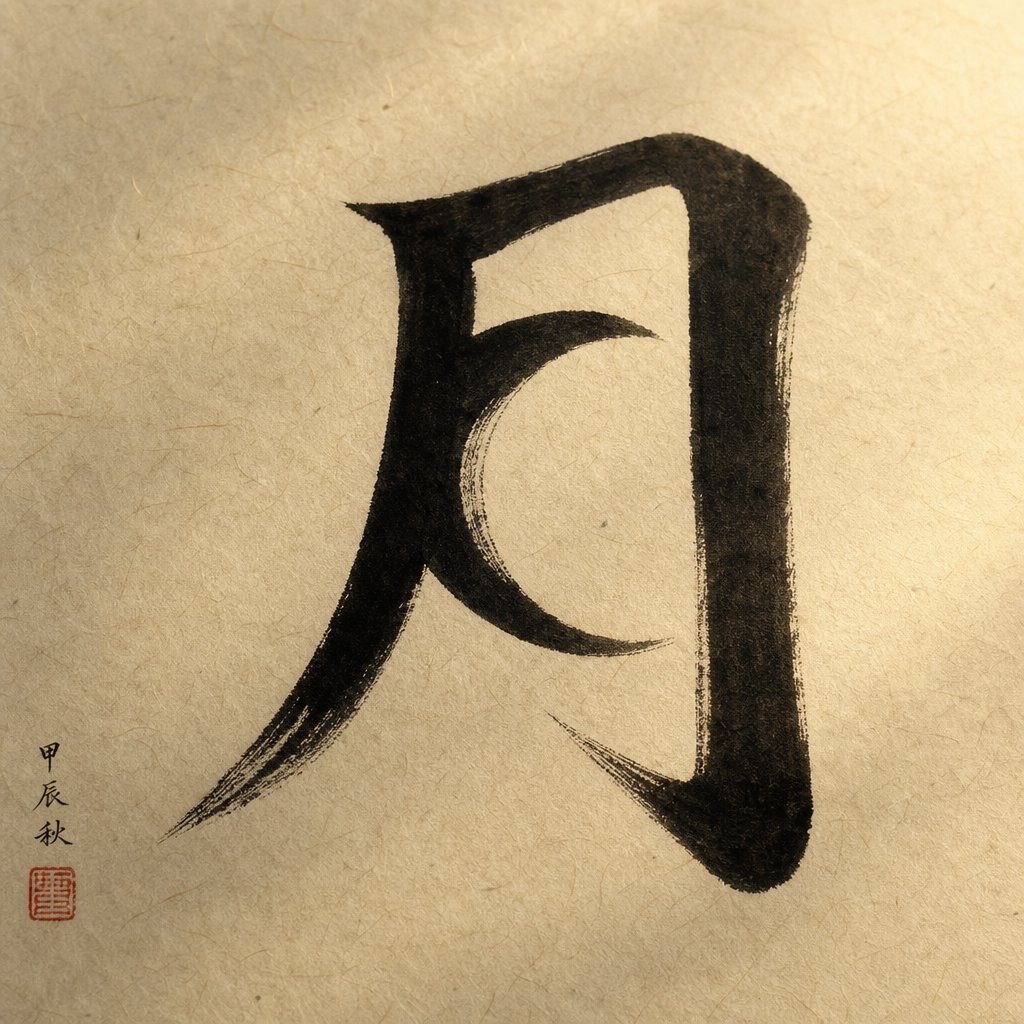
The chinese word for moon is 月 (yuè), and it's one of the most visually elegant characters in the language. Four simple strokes form a crescent shape that has remained nearly unchanged for thousands of years. When this character appears in a girl's name, there's no ambiguity about the lunar connection. It's direct, unmistakable, and carries the full weight of everything the moon represents in Chinese culture.
But how you use 月 in a name, where you place it, and what you pair it with, creates dramatically different impressions. Let's break down the options.
Single-Character Moon Name Yue
Using 月 alone as a given name is the boldest choice. It's unadorned, confident, and lets the moon imagery speak entirely for itself. A girl named Li Yuè (李月) carries a name that's clean and striking.
However, single-character given names are relatively uncommon in modern China. Most parents prefer two-character given names for their richer meaning and better tonal flow. There's also a practical consideration: with only one character, the name offers less uniqueness. You'll notice that the yue name meaning stays powerful on its own, but pairing it with a second character allows parents to personalize the lunar symbolism.
It's worth noting a close relative: 玥 (yuè), a different character with the same pronunciation. According to LTL Mandarin School's survey of Chinese teachers, 玥 represents "a divine pearl bestowed by the heavens" and carries moon-like brightness and beauty. This character ranked among their top recommended girl names for its elegance and mythological depth. While 玥 isn't technically the moon character, its identical pronunciation and lunar associations make it a compelling alternative for families seeking girl names that mean moon without using the literal 月.
Two-Character Names Beginning with Yue
When 月 leads the name, it sets the dominant tone. The moon becomes the primary image, and the second character refines or extends it. Imagine the moon as the subject of a painting, with the second character adding color, texture, or setting.
Here's a detailed look at names where 月 takes the opening position:
| Chinese Characters | Pinyin (Tone) | Literal Meaning | Cultural Connotation | Usage Context |
|---|---|---|---|---|
| 月华 | Yuèhuá (4th + 2nd) | Moon + splendor/radiance | Evokes the luminous halo around a full moon; suggests brilliance that is soft rather than harsh | Classical; literary and poetic feel |
| 月琴 | Yuèqín (4th + 2nd) | Moon + stringed instrument | References the moon lute, a traditional Chinese instrument; implies artistic refinement and musicality | Traditional; less common in modern naming |
| 月婷 | Yuètíng (4th + 2nd) | Moon + graceful | Combines lunar beauty with physical elegance; suggests a poised, refined presence | Modern; popular in contemporary China |
| 月兰 | Yuèlán (4th + 2nd) | Moon + orchid | Pairs celestial imagery with the orchid, a symbol of integrity and quiet virtue in Chinese culture | Classical; carries a scholarly, traditional tone |
| 月盈 | Yuèyíng (4th + 2nd) | Moon + fullness/abundance | Evokes the full moon at its peak; implies completeness, fulfillment, and a resolute character | Modern; recommended by native Chinese teachers |
| 月瑶 | Yuèyáo (4th + 2nd) | Moon + precious jade | Combines lunar purity with the value of jade; suggests something rare and treasured | Modern; elegant and currently fashionable |
| 月清 | Yuèqīng (4th + 1st) | Moon + clear/pure | Evokes a clear autumn moon; implies moral clarity and unclouded beauty | Literary; classical poetry associations |
Notice the tonal patterns. Because 月 is a fourth tone (falling), pairing it with a second-tone character (rising) creates that pleasing wave motion discussed earlier. Names like 月华, 月琴, and 月盈 all follow this pattern, which is one reason they sound so natural to native speakers.
The name 月盈 deserves special attention. Chinese language teachers at LTL specifically highlighted this name, noting that 月 as a naming element "represents the moon which is a symbol of purity, wisdom, love and beauty" and that the full name "implies a resolute character and the ability to make decisions." It's a name that balances softness with inner strength.
Names Where Yue Appears as the Second Character
Placing 月 in the second position shifts the emphasis entirely. The first character now sets the scene, and the moon becomes the destination, the thing being described or reached toward. These names feel less like declarations and more like discoveries.
| Chinese Characters | Pinyin (Tone) | Literal Meaning | Cultural Connotation | Usage Context |
|---|---|---|---|---|
| 映月 | Yìngyuè (4th + 4th) | Reflection + moon | The moon's reflection on water; suggests contemplative beauty and depth beneath the surface | Classical; poetic and literary |
| 星月 | Xīngyuè (1st + 4th) | Star + moon | The night sky in its fullness; implies brightness, wisdom, and a broad, luminous presence | Modern; currently popular in China |
| 皎月 | Jiǎoyuè (3rd + 4th) | Bright/clear + moon | Specifically describes the moon's white brilliance; a literary term for pure, unclouded moonlight | Literary; rare and distinctive |
| 秋月 | Qiūyuè (1st + 4th) | Autumn + moon | The harvest moon, brightest of the year; connects to Mid-Autumn Festival and family reunion | Traditional; warm and nostalgic |
| 霜月 | Shuāngyuè (1st + 4th) | Frost + moon | A cold, luminous winter moon; suggests striking beauty with an edge of solitude | Literary; poetic and uncommon |
| 心月 | Xīnyuè (1st + 4th) | Heart + moon | The moon held in one's heart; implies inner peace, emotional depth, and cherished beauty | Modern; gentle and contemporary |
The yue chinese name meaning shifts depending on what precedes it. In 映月 (reflection of the moon), the name paints a scene. China Highlights lists 映月 among the most beautiful Chinese names, noting it carries "cherished meanings of beauty and harmony." In 星月 (star and moon), the name captures the entire night sky. Chinese teachers surveyed by LTL included 星月 in their recommended names, observing that both 星 and 月 "are usually used in girl names" and that 星 "means bright and brilliant and is often used to symbolize beauty, prosperity and wisdom."
Here's the key distinction to remember: names for moon that begin with 月 announce the lunar connection immediately. The moon is the identity. Names where 月 appears second treat the moon as a quality being attributed to something else, a heart, a season, a reflection. The first approach is bolder. The second is more atmospheric and suggestive.
For families searching for names mean moon in a direct, unmistakable way, any name in these tables delivers that connection. The choice comes down to whether you want the moon to lead the story or complete it.
The moon character itself is just one thread in a much larger tapestry. Some of the most compelling lunar names for girls don't use 月 at all. Instead, they draw from the mythology that has surrounded the moon for millennia, beginning with the goddess who lives there.
Moon Goddess and Mythology-Inspired Girl Names
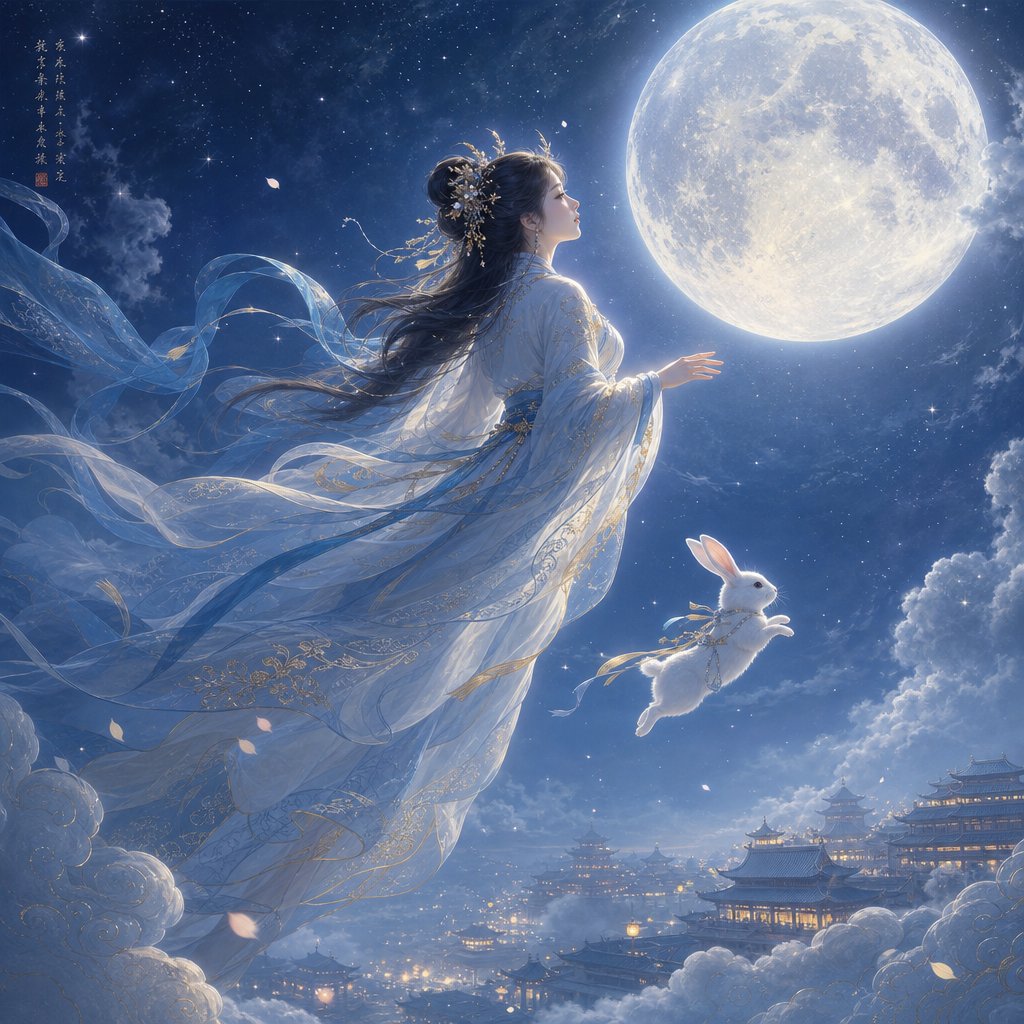
Every culture has its fairy names drawn from legend, but few carry the emotional weight of China's lunar mythology. The goddess who lives on the moon isn't a distant, abstract figure. She's a woman who made a choice, gained immortality, and became the most celebrated feminine presence in the night sky. Her story has shaped moon related names for thousands of years, and the characters from her legend remain powerful naming choices today.
The Legend of Chang'e and the Moon Palace
The myth goes like this. When ten suns scorched the earth, a skilled archer named Hou Yi (后羿) shot down nine of them, saving humanity. As a reward, the goddess Xiwangmu (西王母) gave him an elixir of immortality, but only enough for one person. Hou Yi couldn't bear to live forever without his wife, Chang'e (嫦娥), so he hid the potion at home.
Chang'e discovered the elixir and drank it. She floated upward into the sky and chose the moon as her home, where she lives in the Guanghan Palace (广寒宫, the "Cold, Vast Palace"). Heartbroken, Hou Yi began leaving her favorite fruits and cakes outside each night. This tradition evolved into the Mid-Autumn Festival, where families still place offerings under the full moon and share mooncakes in her honor.
What makes this legend so rich for naming is its emotional complexity. Chang'e isn't simply a fairy tale princess. Depending on the version, she's selfless, cunning, or tragic. That layered humanity gives her name, and names drawn from her story, real depth.
Names Inspired by the Moon Goddess
The characters from Chang'e's name and her story offer several distinctive moon based names for girls:
- 嫦娥 (Cháng'é) — The full name of the moon goddess herself. While using both characters together is rare as a given name (it feels like naming a child "Aphrodite"), it carries unmatched lunar mythology weight. The character 嫦 (cháng) is entirely unique to her name and has no other meaning in Chinese.
- 娥 (É) — Meaning "pretty, young woman," this character works beautifully as part of a two-character given name. It carries an echo of the goddess without being as overt as using her full name.
- 嫦 (Cháng) — Bold and unmistakable. Anyone familiar with Chinese mythology will immediately recognize the moon goddess connection. It's a statement name, best suited for families who want the mythological reference front and center.
- 广寒 (Guǎnghán) — Literally "vast and cold," this references the Moon Palace where Chang'e resides. As a name, it evokes solitary elegance and otherworldly beauty. Uncommon but striking.
- 秋月 (Qiūyuè) — "Autumn moon." While this appeared in the previous section, its deepest resonance comes from the Mid-Autumn Festival connection. This name ties a girl to the annual celebration of Chang'e, family reunion, and harvest gratitude.
- 仙娥 (Xiān'é) — "Immortal beauty" or "celestial maiden." Combines the character for immortal/fairy with the second character of Chang'e's name. Among fairy names rooted in Chinese tradition, this one bridges the mythological and the elegant.
The character Princess Yue from popular media has introduced many Western audiences to the idea of lunar royalty in East Asian naming. But the original source runs far deeper. Chang'e isn't a princess. She's a goddess who chose her own fate, and names drawn from her story carry that self-determination.
Jade Rabbit and Other Lunar Mythology Names
Chang'e isn't alone on the moon. According to legend, a rabbit so selfless it offered its own life to feed hungry strangers was rewarded with immortality and sent to the moon as her companion. This Jade Rabbit (玉兔, yùtù) spends eternity grinding the elixir of immortality with a mortar and pestle.
Names inspired by this part of the mythology include:
- 玉 (Yù) — "Jade." The jade name meaning encompasses purity, moral virtue, and preciousness in Chinese culture. Jade is considered the most noble of stones, and 玉 appears in countless girl names as a marker of value and refinement.
- 玉兔 (Yùtù) — "Jade Rabbit." More commonly used as a cultural reference than a given name, but the individual characters work well in combinations like 玉婷 (yùtíng, "jade grace") or 玉清 (yùqīng, "jade purity").
- 桂 (Guì) — "Cassia" or "osmanthus." In lunar mythology, Wu Gang endlessly chops a self-healing cassia tree on the moon. The character 桂 connects to this story while also evoking the sweet osmanthus flowers that bloom during the Mid-Autumn Festival.
- 瑶 (Yáo) — "Precious jade" or "mythical beauty." Often associated with celestial palaces and immortal realms in Chinese literature, making it a subtle nod to the Moon Palace without being overtly mythological.
These mythology-rooted names carry something that database-style name lists can never convey: narrative. When a girl carries a name connected to Chang'e's legend, she carries a story about choice, beauty, and transcendence. That story gives the name weight beyond its literal meaning.
Mythology offers one path to lunar naming. But there's another, equally rich tradition that approaches the moon sideways, through characters that capture its light without ever writing the word "moon" itself.
Indirect Moon Names Through Light and Radiance
Not every girl names that mean moonlight needs to spell it out literally. Some of the most elegant lunar names in Chinese work by implication, capturing the quality of moonlight rather than naming the moon itself. These characters evoke brightness, glow, and luminosity in ways that carry a quiet lunar connection beneath the surface.
The difference is one of directness. A name with 月 announces its moon connection openly. A name built from characters like 明, 皎, or 辉 whispers it. Both approaches are valid, but the indirect path offers something extra: versatility. These names carry broader meanings of clarity, brilliance, and inner light while still nodding to the moon for anyone who knows where to look.
Names Using Ming for Brightness
The character 明 (míng) is a perfect example of how Chinese characters encode meaning visually. Look at its structure: the left side is 日 (rì, sun) and the right side is 月 (yuè, moon). As Mandarin Blueprint explains, these are the two things that make the world "bright" and "clear," and the character's meaning is apparent from its component parts. The ming meaning encompasses brightness, clarity, and understanding all at once.
This makes 明 one of the rare girl names that mean sun and moon simultaneously. It holds both celestial bodies in a single character, representing the full cycle of light. For families drawn to names with sun meaning who also want that lunar thread, 明 delivers both without compromise.
As a naming element, 明 appears in combinations like:
- 明月 (Míngyuè) — "Bright moon." This pairing doubles down on the lunar connection, making the moon explicit while 明 adds radiance. It's one of the most iconic moon phrases in Chinese poetry.
- 明珠 (Míngzhū) — "Bright pearl." Evokes a luminous pearl glowing like moonlight. Suggests something precious and self-illuminating.
- 明霞 (Míngxiá) — "Bright clouds at dawn or dusk." Captures the moment when light transforms the sky, blending solar and lunar imagery.
- 明熙 (Míngxī) — "Bright and prosperous." The combination Ming Xi carries a modern, polished feel while retaining classical roots. The character 熙 (xī) adds warmth and flourishing energy to the brightness of 明.
The Keats School notes that when you put 日 and 月 together to form 明, "as there has sun and moon, so the world is bright." That poetic logic, two sources of light creating total illumination, gives names with meaning of sun and moon a philosophical depth that single-element names can't match.
Characters That Evoke Moonlight and Glow
Beyond 明, several characters specifically describe the quality of moonlight without using 月 directly. These are names related to moonlight in their essence, capturing how the moon's light feels rather than what it is.
| Chinese Characters | Pinyin (Tone) | Literal Meaning | Lunar Connection | Usage Context |
|---|---|---|---|---|
| 皎洁 | Jiǎojié (3rd + 2nd) | Bright and pure | 皎 specifically describes the white brilliance of moonlight; classical poetry uses 皎皎 for the moon's glow | Literary; elegant and uncommon |
| 皎皎 | Jiǎojiǎo (3rd + 3rd) | Brilliantly white | Directly from the Book of Songs (诗经): "皎皎白驹" — used to describe pure, radiant moonlight | Classical; rare as a given name but deeply poetic |
| 朗月 | Lǎngyuè (3rd + 4th) | Clear/bright + moon | 朗 describes the clarity of an unclouded night sky; implies openness and transparency | Traditional; warm and clear-sounding |
| 辉映 | Huīyìng (1st + 4th) | Radiance + reflection | 辉 captures the spreading glow of light; paired with 映 (reflection), it paints moonlight on water | Modern; strong and luminous |
| 清辉 | Qīnghuī (1st + 1st) | Clear radiance | A classical term for moonlight in Tang poetry; 清 adds purity and coolness to the glow | Literary; directly from classical moon poetry |
| 莹月 | Yíngyuè (2nd + 4th) | Lustrous + moon | 莹 describes the translucent gleam of polished jade or crystal; suggests soft, refined light | Modern; popular and feminine |
| 晖 | Huī (1st) | Sunlight/radiance | Though often associated with sunlight, 晖 in evening contexts evokes lingering twilight glow merging into moonrise | Modern; versatile single character |
The character 皎 (jiǎo) deserves special attention. If you're wondering what names mean moonlight in the most precise sense, 皎 is your answer. It doesn't mean "moon" and it doesn't mean generic "brightness." It specifically describes the white, clean brilliance of moonlight. In classical Chinese poetry, 皎月 (jiǎoyuè) is the standard literary term for a bright moon. Using 皎 in a name signals both lunar connection and literary sophistication.
Luminous Names with Subtle Moon Connections
Some characters carry moonlight associations through cultural context rather than literal definition. These are the subtlest choices, names that a Chinese reader would associate with lunar imagery through poetic tradition rather than dictionary meaning.
- 莹 (Yíng) — "Lustrous, translucent." Describes the quality of light passing through jade or crystal. In poetry, it's used for moonlight filtering through clouds.
- 澄 (Chéng) — "Clear, limpid." Often describes still water reflecting moonlight. A name like 澄月 (Chéngyuè) paints a scene of perfect calm.
- 素 (Sù) — "Plain, white, unadorned." In classical poetry, 素月 (sùyuè) means "white moon." The character carries connotations of purity and simplicity.
- 瑩 (Yíng) — The traditional form of 莹, carrying identical meaning but with more visual complexity in its strokes. Preferred in Taiwan and Hong Kong.
- 曦 (Xī) — "First light of dawn." While technically solar, it captures that liminal moment when moonlight yields to sunrise, making it a bridge between lunar and solar imagery.
These luminous names work beautifully for families who want a moon connection that doesn't announce itself to everyone. A girl named 清辉 (Qīnghuī, "clear radiance") carries moonlight in her name, but only those familiar with classical Chinese poetry will catch the reference immediately. It's an insider's nod rather than a billboard.
The versatility here is the real advantage. Names built from light and radiance characters function on multiple levels. They mean "bright" and "clear" in everyday contexts while carrying lunar poetry for those who know where to look. That layered quality is exactly what classical Chinese poets aimed for, and it's where the richest moon names in literature come from.
Poetic Moon Names from Classical Chinese Literature
Characters that evoke radiance and glow carry lunar beauty on their own. But some chinese names that mean moon gain their power not from the dictionary, but from the poems that made them immortal. In Chinese culture, a name drawn from a famous verse carries the emotional weight of that entire poem. It's like naming a child after a song everyone knows by heart. The name becomes a doorway into a shared cultural memory.
Classical Chinese poetry is saturated with moon imagery. Poets used the moon to express longing, solitude, philosophical wonder, and the ache of separation. Certain phrases from these poems have become so iconic that they function as standalone names, instantly recognizable to any educated Chinese speaker. These are girl moon names that come pre-loaded with centuries of emotional resonance.
Moon Names from Tang Dynasty Poetry
The Tang Dynasty (618-907 AD) was the golden age of Chinese poetry, and no poet captured the moon more memorably than Li Bai (李白). His Quiet Night Thought (静夜思) is arguably the most famous poem in the Chinese language, memorized by virtually every Chinese child:
床前明月光,疑是地上霜。举头望明月,低头思故乡。
"Bright moonlight before my bed; I suppose it is frost on the ground. I raise my head to view the bright moon, then lower it, thinking of my home village." The phrase 明月光 (míngyuèguāng, "bright moonlight") from this poem has inspired naming for over a thousand years.
Names rooted in Tang Dynasty moon poetry include:
- 明月 (Míngyuè) — "Bright moon." This phrase appears in Li Bai's poetry so frequently it's almost his signature image. As a name, it carries the full emotional landscape of Tang poetry: homesickness transformed into beauty, solitude made luminous. Among female names that mean moon, few carry this level of instant literary recognition.
- 霜月 (Shuāngyuè) — "Frost moon." Drawn from the imagery in Li Bai's poem where moonlight is mistaken for frost on the ground. The name captures that cold, crystalline beauty of a winter moon, suggesting a girl who is striking and self-possessed.
- 月影 (Yuèyǐng) — "Moon shadow." Li Bai's Drinking Alone Under the Moon (月下独酌) famously describes dancing with his own moon-cast shadow. The name evokes grace, independence, and a poetic spirit.
- 清影 (Qīngyǐng) — "Clear shadow." From the line "起舞弄清影" ("rising to dance with one's clear shadow") in Su Shi's later poem, but rooted in Tang-era imagery of moonlit silhouettes. It suggests elegance in motion.
Li Bai also wrote in Drinking Alone Under the Moon: "举杯邀明月,对影成三人" — "Raising my cup, I invite the moon, and turn to my shadow, which makes us three." This image of the moon as a companion, a presence you can speak to and share a drink with, gives moon girl names from his work an intimacy that purely descriptive names lack.
Song Dynasty Literary Moon References
If Tang poetry gave the moon its visual brilliance, Song Dynasty (960-1279) poetry gave it philosophical depth. Su Shi's (苏轼) Prelude to Water Melody (水调歌头) is the definitive moon poem of this era, written during the Mid-Autumn Festival of 1076 while he longed for his brother. Its closing line has become one of the most quoted phrases in the Chinese language:
但愿人长久,千里共婵娟。
"May we all be blessed with longevity, and share the beauty of Chan Juan though a thousand miles apart." The term 婵娟 (chánjuān) here refers to the moon's beauty, but its meaning runs deeper. According to Baidu Encyclopedia's entry on Chan Juan, this term originally described a graceful posture before extending to encompass the elegant appearance of women, the bright moon, and beautiful flowers. Its earliest documented use appears in Zhang Heng's Western Capital Fu during the Eastern Han Dynasty.
This layered history makes 婵娟 extraordinary as a name. It simultaneously means "graceful beauty," "the bright moon," and "the wish that loved ones stay connected across distance." For families seeking names that mean luna with emotional depth beyond a simple translation, 婵娟 delivers something no single-word equivalent can match.
Other chinese names meaning moon drawn from Song Dynasty literature:
- 婵娟 (Chánjuān) — The name carries Su Shi's entire poem within it. Anyone hearing this name will think of shared moonlight, enduring love, and the hope that distance cannot diminish connection. It's both a name and a blessing.
- 清辉 (Qīnghuī) — "Clear radiance." A classical term for moonlight that appears throughout Song Dynasty ci poetry. The combination of 清 (pure, cool) with 辉 (radiance) paints moonlight as something refined rather than overwhelming.
- 婵月 (Chányuè) — Takes the first character of 婵娟 and pairs it directly with 月. This creates a name that references Su Shi's poem while making the moon connection explicit. Less common than 婵娟 but equally literary.
- 长久 (Chángjiǔ) — "Longevity" or "enduring." Drawn directly from "但愿人长久" ("may we be blessed with longevity"). While not a moon character itself, this name carries the poem's lunar context for anyone who recognizes the reference.
Su Shi's poem also contains the line "人有悲欢离合,月有阴晴圆缺" — "People have sorrow and joy, parting and reunion; the moon is dark, bright, waxes or wanes." This philosophical acceptance of life's cycles gives Song Dynasty moon names a maturity that Tang Dynasty names, with their more romantic imagery, don't always carry.
Modern Literary Names with Classical Roots
Contemporary Chinese parents haven't abandoned these poetic traditions. They've adapted them. Modern literary names often take a classical moon phrase and pair it with a character that feels fresh, creating something that honors tradition without sounding dated.
Here are names that have to do with the moon through literary lineage while feeling current:
| Chinese Characters | Pinyin (Tone) | Literary Source | Meaning | Modern Feel |
|---|---|---|---|---|
| 婵娟 | Chánjuān (2nd + 1st) | Su Shi, Water Melody | Graceful beauty; the moon | Classical but widely recognized; carries warmth |
| 清辉 | Qīnghuī (1st + 1st) | Tang/Song moon poetry tradition | Clear, cool moonlight | Elegant; works in both traditional and modern contexts |
| 霜月 | Shuāngyuè (1st + 4th) | Li Bai, Quiet Night Thought imagery | Frost moon; cold brilliance | Distinctive; slightly edgy for a girl's name |
| 月华 | Yuèhuá (4th + 2nd) | Multiple Tang/Song poems | Moonlight; lunar splendor | Timeless; neither old-fashioned nor trendy |
| 素月 | Sùyuè (4th + 4th) | Classical poetry term for white moon | Plain, unadorned moon | Minimalist; appeals to modern aesthetic sensibility |
| 疏影 | Shūyǐng (1st + 3rd) | Lin Bu, Ode to Plum Blossoms | Sparse shadows (moonlit branches) | Artistic; favored by literary-minded families |
The name 疏影 (Shūyǐng) deserves a note. It comes from Lin Bu's famous couplet about plum blossoms: "疏影横斜水清浅,暗香浮动月黄昏" — "Sparse shadows slant across clear, shallow water; hidden fragrance drifts in the yellow dusk of moonlight." The name doesn't contain the moon character at all, yet it's inseparable from moonlit imagery. This is the deepest level of poetic naming: the moon is present in the scene the name evokes, not in the characters themselves.
What separates these literary names from the direct 月 names covered earlier is their resonance. A name like 月婷 (Yuètíng, "moon grace") is beautiful and clear. A name like 婵娟 (Chánjuān) is beautiful, clear, and carries a thousand-year-old poem about love surviving distance. Both are valid choices. The literary names simply offer an additional dimension, a story that unfolds when someone asks, "Where does your name come from?"
For parents drawn to names that mean luna but want something richer than a direct translation, these poetry-rooted options provide exactly that depth. They connect a girl not just to the moon, but to the human emotions the moon has inspired across centuries of Chinese literary tradition.
Poetry gives names their stories. But what if you want to write a new one? The building blocks of Chinese moon naming, individual characters and their combinations, offer a creative toolkit for crafting something entirely original.
How to Create Unique Compound Moon Names
Listing finished names is useful. But understanding how those names are built gives you something more powerful: the ability to create unique girl names that no database has catalogued. Chinese two-character given names work like small equations. You take 月 (yuè) and pair it with a second character that adds a specific quality, nature, virtue, beauty, or strength. The result is a name that feels both rooted in tradition and entirely your own.
Think of it as choosing two brushstrokes for a painting. The moon is your first stroke. The second determines whether you're painting a garden scene, a portrait of inner strength, or a vision of quiet elegance.
Pairing Moon with Nature Characters
Nature imagery is the most traditional pairing for 月. These combinations evoke specific scenes: moonlight falling on blossoms, the moon rising over bamboo, or a winter moon above fresh snow. Among flower girl names in Chinese tradition, those paired with 月 carry an added layer of nighttime beauty, flowers seen by moonlight rather than sunlight.
| Character Pairing | Pinyin | Combined Meaning | Imagery Evoked | Modern vs. Classical |
|---|---|---|---|---|
| 月花 (yuèhuā) | Yuèhuā (4th + 1st) | Moon + flower | A moon blossom scene; flowers illuminated by moonlight | Classical; poetic but less common today |
| 月雪 (yuèxuě) | Yuèxuě (4th + 3rd) | Moon + snow | A winter moon over a snow-covered landscape; purity doubled | Classical; striking but rare in modern use |
| 月竹 (yuèzhú) | Yuèzhú (4th + 2nd) | Moon + bamboo | Moonlight filtering through bamboo groves; resilience and grace | Classical; scholarly associations |
| 月荷 (yuèhé) | Yuèhé (4th + 2nd) | Moon + lotus | The moon reflected in a lotus pond; spiritual purity | Traditional; elegant and timeless |
| 月桐 (yuètóng) | Yuètóng (4th + 2nd) | Moon + paulownia tree | Moonlight through paulownia leaves; nobility and artistic spirit | Modern revival; currently fashionable |
| 月溪 (yuèxī) | Yuèxī (4th + 1st) | Moon + stream | Moonlight on flowing water; gentle movement and clarity | Modern; fresh and nature-forward |
Notice that 月溪 brings water imagery into the name. For families drawn to names that mean water alongside lunar symbolism, pairing 月 with characters like 溪 (stream), 泉 (spring), or 澜 (ripple) creates names that flow in both meaning and sound. The combination captures moonlight dancing on water, one of the most beloved images in Chinese poetry.
The moon blossom pairing (月花) feels distinctly classical, something you'd encounter in a Tang Dynasty poem rather than a modern birth certificate. But 月桐 and 月溪 have gained traction among contemporary parents who want nature imagery without the old-fashioned weight.
Moon Combined with Virtue and Elegance Characters
Where nature pairings paint scenes, virtue pairings build character. These combinations say something about who the parents hope their daughter will become. They're among the most popular choices for elegant female names in modern China because they balance beauty with substance.
| Character Pairing | Pinyin | Combined Meaning | Quality Expressed | Modern vs. Classical |
|---|---|---|---|---|
| 月慧 (yuèhuì) | Yuèhuì (4th + 4th) | Moon + wisdom | Luminous intelligence; wisdom that illuminates like moonlight | Modern; popular and well-balanced |
| 月静 (yuèjìng) | Yuèjìng (4th + 4th) | Moon + serenity | The stillness of a moonlit night; calm inner strength | Traditional; carries quiet dignity |
| 月雅 (yuèyǎ) | Yuèyǎ (4th + 3rd) | Moon + elegance | Refined beauty with lunar grace; cultured and poised | Modern; widely appealing |
| 月琳 (yuèlín) | Yuèlín (4th + 2nd) | Moon + beautiful jade | Precious and luminous; combines celestial and earthly beauty | Modern; currently fashionable |
| 月婷 (yuètíng) | Yuètíng (4th + 2nd) | Moon + graceful | Physical grace paired with lunar beauty; poise and presence | Modern; one of the most popular moon combinations |
| 月毅 (yuèyì) | Yuèyì (4th + 4th) | Moon + determination | Soft beauty with iron resolve; gentle appearance, strong will | Modern; unconventional for girls but rising |
A note on 月毅 (yuèyì): this combination breaks the traditional mold. Pairing the feminine moon with 毅 (determination, perseverance) creates one of those strong female names that challenge the expectation that lunar names must be soft. It says: beautiful like the moon, unyielding like stone. Parents in urban China are increasingly drawn to these contrasting pairings that give daughters both grace and grit.
Among elegant girl names, 月雅 and 月琳 hit the sweet spot between classical beauty and modern sensibility. As Style Vanity's analysis of modern Chinese naming trends notes, contemporary parents look for characters that represent both natural beauty and inner strength, moving away from purely decorative choices.
Creating Balanced Two-Character Moon Names
Building a name isn't just about meaning. You need tonal balance, stroke count harmony, and a sense of whether the combination reads as contemporary or dated. Here are the practical principles:
Tonal balance: Since 月 is a fourth tone (falling), pairing it with a first or second tone character (high or rising) creates the most natural rhythm. Two fourth-tone characters in a row, like 月慧 or 月静, can sound clipped. They work, but they require a surname with a contrasting tone to smooth the flow.
Stroke count: 月 has only four strokes, making it visually light. Pairing it with a complex character (12+ strokes) like 慧 creates visual contrast on paper. Pairing it with another simple character like 竹 (6 strokes) keeps the name airy and minimal. Neither is wrong, but the choice should be intentional. As MingShu's naming framework emphasizes, a name's characters must be visually balanced when written together, considering how they'll appear on documents, seals, and signatures.
Modern versus old-fashioned: Combinations that feel dated in China today tend to be those overused in the 1960s-80s, like 月英 (yuèyīng, "moon hero") or 月娥 (yuè'é, "moon beauty"). They're not wrong, but they carry generational associations similar to "Linda" or "Barbara" in English. Fresher combinations use characters that entered popular naming more recently: 琳, 瑶, 桐, 溪.
For families specifically searching for names that mean blood moon for girl, consider pairing 月 with characters that evoke intensity and rarity: 月丹 (yuèdān, "moon + vermillion red"), 月绛 (yuèjiàng, "moon + deep crimson"), or 赤月 (chìyuè, "scarlet moon"). These combinations capture the dramatic visual of a lunar eclipse, the rare blood moon, and carry connotations of passion, courage, and extraordinary beauty. They're unconventional choices that stand out sharply from the softer lunar names.
The real power of understanding these building blocks is freedom. You're no longer limited to names someone else assembled. You can take 月, pair it with a character that means something personal to your family, check the tonal flow against your surname, and create a name that carries both cultural weight and individual significance. That's the difference between choosing from a menu and cooking from scratch.
Of course, creative freedom comes with responsibility. Knowing how to build a name is one thing. Knowing how to choose one with cultural sensitivity, practical awareness, and respect for the tradition you're drawing from is another consideration entirely.
Practical Guide to Choosing the Perfect Moon Name
Knowing how to build a name and knowing how to carry one through real life are different skills. A beautifully constructed chinese moon name still needs to work in doctor's offices, classrooms, and across cultural contexts. Whether you're a non-Chinese family drawn to lunar naming traditions or a diaspora family reconnecting with heritage, the practical side matters as much as the poetic one.
Guidance for Non-Chinese Families Choosing Moon Names
When you're drawn to chinese names girl traditions from outside the culture, the line between appreciation and appropriation deserves honest thought. The key distinction is depth of engagement. Picking a character because it "looks cool" without understanding its meaning, tone, or cultural weight falls on the wrong side. Researching the name's history, learning its correct pronunciation, and understanding what it communicates to Chinese speakers demonstrates genuine respect.
Chinese names carry more weight than many Western names do. As Temple University's Center for Chinese Language Instruction explains, a Chinese name tells the story of parents' ideals and hopes, aspirations that the bearer often embraces throughout their life. These names are "more than just labels." Choosing one for your daughter means entering a naming tradition where every character, tone, and stroke carries intentional meaning.
Practical steps for non-Chinese families:
- Consult a native Mandarin or Cantonese speaker before finalizing any name. What reads beautifully on paper might sound awkward, unintentionally humorous, or carry associations you can't detect from a dictionary alone.
- Learn the correct tonal pronunciation. A mispronounced tone doesn't just sound wrong, it can change the meaning entirely. Temple University's research notes that mispronouncing a tone in a name can shift its meaning from something admirable to something embarrassing.
- Consider whether you'll use the name as a legal first name, a middle name, or a meaningful family name. Each context carries different practical implications.
- Understand that Chinese speakers who hear the name will read cultural signals into it. A name like 婵娟 communicates literary education. A name like 月毅 signals modern, progressive values. Choose with awareness of what you're communicating.
Tips for Diaspora Families Honoring Heritage
For Chinese diaspora families, the challenge is different. You're not borrowing from another culture. You're navigating your own heritage across two linguistic worlds. The question isn't whether you have the right to use these names. It's how to choose one that works in both your Chinese baby's home language and the English-speaking environment they'll grow up in.
A name like 月琴 (Yuèqín) is gorgeous in Mandarin but may trip up English-speaking teachers and classmates. Meanwhile, 明月 (Míngyuè) offers slightly easier phonetics for non-Chinese speakers while remaining unmistakably Chinese. As LTL Language School's naming guide demonstrates through real examples, the best approach is asking native speakers to help craft something that balances meaning, sound, and cross-cultural usability.
Research from the University of Nottingham Ningbo shows that mainland Chinese students increasingly value uniqueness in their naming choices, using names to distinguish themselves and express identity. This same principle applies when choosing chinese female names for a baby in chinese diaspora communities. The name should feel distinctive and personal, not generic.
Here's a step-by-step process for selecting the right moon name:
- Decide on your priority: Do you want the moon connection to be immediately obvious (月-based names) or subtly embedded (light and radiance characters)?
- Check the name against your family surname for tonal harmony. Say the full name aloud five times quickly. If it flows without stumbling, the tones work together.
- Verify stroke count balance. Write the full name by hand. Does it look visually proportional, or does one character overwhelm the others?
- Test pronunciation in both Mandarin and your local language. Can English speakers approximate it without mangling the meaning?
- Ask at least two native Chinese speakers for their honest reaction. As LTL's naming experiment showed, different native speakers will catch different nuances, from regional associations to generational connotations.
- Research whether the name has any unintended homophones or cultural associations in the specific dialect your family uses.
- Consider how the name will age. A name that suits a baby in chinese family contexts should still feel dignified on a professional adult.
Final Considerations for Stroke Count and Character Balance
In traditional Chinese naming practice, stroke count isn't just aesthetic. Some families consult numerological systems where total stroke counts carry auspicious or inauspicious meanings. The LTL naming guide shares an example where a teacher specifically chose characters totaling 24 strokes because, according to the Chinese calendar (黄历), that number represents 吉 (jí), meaning lucky.
You don't need to follow numerology to benefit from stroke awareness. A female chinese name with wildly unbalanced strokes, say 月 (4 strokes) paired with 馨 (20 strokes), looks lopsided when written. The visual harmony of characters matters in a culture where names are regularly handwritten on documents, red envelopes, and artwork.
For families browsing any chinese names list female resources will offer, remember that the "perfect" name satisfies multiple dimensions simultaneously: it sounds right when spoken, looks balanced when written, carries meaningful symbolism, and works within the practical realities of your family's life. A girl name meaning moon connects your daughter to one of humanity's oldest symbols of feminine beauty and renewal. The right version of that connection is the one that honors both the tradition it comes from and the individual life it will accompany.
No list, however comprehensive, can replace the insight of a native speaker who understands your family's specific dialect, surname, and values. The names in this guide are starting points. The final choice is a conversation between heritage, meaning, and the life your daughter will build around the name you give her.
Frequently Asked Questions About Chinese Moon Names for Girls
1. What does the Chinese character for moon (月) symbolize in girl names?
The character 月 (yuè) symbolizes femininity, cyclical renewal, elegance, and quiet strength in Chinese naming traditions. Rooted in yin energy from Chinese cosmology, it represents the complementary force associated with intuition and receptive power. Parents who choose moon-based names invoke beauty that renews itself each month, connecting their daughter to centuries of poetic and philosophical reverence for the feminine.
2. How do you pronounce Yue in Chinese and what tone does it use?
Yue (月) is pronounced with the fourth tone in Mandarin, which is a sharp falling pitch dropping from high to low. In Cantonese, the same character is pronounced 'jyut6' using Jyutping romanization. When building a name, the fourth tone of yuè pairs best with first-tone (high) or second-tone (rising) characters to create a pleasing wave-like tonal rhythm rather than stacking identical falling tones.
3. What is the difference between 月 (yuè) and 玥 (yuè) in Chinese girl names?
Both characters share the same pronunciation (yuè, fourth tone), but they carry different meanings. 月 is the literal character for moon, while 玥 refers to a divine pearl bestowed by the heavens according to Chinese mythology. The character 玥 carries moon-like brightness and celestial beauty without being the literal moon character, making it a popular alternative for families who want lunar associations with added mythological depth.
4. Can non-Chinese families use Chinese moon names for their daughters?
Yes, but meaningful engagement with the culture is essential. The key distinction is depth: researching the name's history, learning correct tonal pronunciation, and consulting native Mandarin or Cantonese speakers demonstrates genuine respect. Mispronouncing a tone can change a name's meaning entirely, so families should verify pronunciation and cultural associations before finalizing their choice. Using the name as a middle name is one approach that honors the tradition while acknowledging cultural context.
5. What are the most popular Chinese moon names for girls used today?
Among currently popular choices in China, 月婷 (yuètíng, moon + graceful), 星月 (xīngyuè, star + moon), 月瑶 (yuèyáo, moon + precious jade), and 月盈 (yuèyíng, moon + fullness) rank highly with modern parents. The literary name 婵娟 (chánjuān), drawn from Su Shi's famous poem, remains widely recognized and beloved. For subtler lunar connections, 明月 (míngyuè, bright moon) and 莹月 (yíngyuè, lustrous moon) offer elegant alternatives that balance tradition with contemporary taste.