Why Time of Birth Holds the Key to Your Chinese Name
Imagine two babies born in the same hospital, on the same date, to families who both consult a traditional naming master. One arrives at 4 AM. The other at 10 AM. Despite sharing a birthday, these two children receive completely different names — different characters, different meanings, different elemental foundations. To someone unfamiliar with the tradition, this seems arbitrary. Within the system itself, it is entirely logical.
In Chinese culture, birth time is not a footnote on a certificate. It is a structural pillar of identity. The hour you were born determines one of the eight characters in your personal birth chart, directly shaping which cosmic elements are present, which are absent, and which need reinforcement. Your name becomes the tool for that reinforcement. This is why asking "what is my Chinese name" is never a simple translation exercise — it is a question that requires your exact time of birth to answer properly.
More Than Just a Pretty Sound
In English, naming is largely a one-dimensional choice: does it sound good? Parents might weigh family tradition or cultural origin, but the primary filter is phonetic appeal. Chinese naming operates differently. It integrates astronomy, philosophy, and linguistics into a unified four-dimensional practice — evaluating sound, visual form, literary meaning, and elemental balance simultaneously. A character might sound beautiful but add Fire to an already overheated birth chart, disqualifying it entirely. Another might balance the elements perfectly but clash visually with the surname in calligraphy.
This is why, in traditional Chinese families, naming a child can take weeks or even months of deliberation. It is also why no online translator can give you a real Chinese name. The process demands data that a translation tool never asks for — specifically, the hour you entered the world.
What Makes Birth Time So Critical
The Chinese birth chart system, known as BaZi, maps four time coordinates: year, month, day, and hour. Each coordinate produces two characters — a Heavenly Stem and an Earthly Branch — totaling eight characters that form your elemental profile. The hour of birth fills one full quarter of that profile. Change the hour, and you change the elemental composition. Change the composition, and the naming prescription shifts with it.
Whether or not you personally subscribe to this metaphysical framework, understanding the system reveals something profound about how Chinese culture connects identity, language, and time. It treats a name not as a label but as a calibrated instrument — one tuned to the specific moment a person begins their life. As Confucius argued in the Analects, precision in naming is the foundation of all coherent action:
If names are not correct, speech will not accord with reality; when speech does not accord with reality, things will not be successfully accomplished. (名不正,则言不顺)
For anyone curious about what your Chinese name might be — or why two people born hours apart carry names with entirely different characters — the answer lies in a system that has been refining itself for centuries. It begins with a birth chart, and that chart begins with the hour.
Understanding the BaZi Birth Chart System
The birth chart at the heart of Chinese naming has a formal name: BaZi (八字), which literally translates to "eight characters." It is also called the Four Pillars of Destiny. Dating back to the Han Dynasty (206 BC - 220 AD), this system maps the elemental energy present at the exact moment of your birth across four time coordinates — year, month, day, and hour. Each coordinate forms one pillar, and each pillar contains two characters: a Heavenly Stem and an Earthly Branch. Four pillars, two characters each, eight characters total. That is your BaZi.
Sounds complex? The core logic is straightforward. Every one of those eight characters carries an elemental association — Wood, Fire, Earth, Metal, or Water. Together, they create a unique elemental fingerprint that belongs only to you. When practitioners want to find your Chinese name, they read this fingerprint to determine which elements are strong, which are weak, and which need support through carefully chosen name characters.
Here is where a common misconception needs correcting. Many people equate Chinese astrology with the zodiac animal of their birth year — "I'm a Dragon" or "I'm a Rabbit." That approach uses only the Year Pillar, which is one-quarter of the picture. It is like diagnosing your health with one out of four test results. The comprehensive BaZi method requires all four pillars, including the Hour Pillar, to produce an accurate elemental profile. Anyone trying to find out your Chinese name using only a birth year is working with incomplete data.
The Four Pillars Explained
Each pillar governs a different dimension of life and contributes distinct elemental energy to the chart:
- Year Pillar (年柱) — Derived from your birth year. It represents the broadest layer of influence: ancestral energy, family background, and the external environment of the era you were born into.
- Month Pillar (月柱) — Derived from your birth month. It governs seasonal energy and has a decisive influence on the chart's elemental temperature. Many practitioners consider this one of the most important pillars in analysis.
- Day Pillar (日柱) — Derived from your birth day. The Heavenly Stem of this pillar is your Day Master (日主) — the core reference point that represents you. Everything else in the chart is read in relation to it.
- Hour Pillar (時柱) — Derived from your birth hour. It influences output, ambitions, hidden talents, and the later stages of life. For naming purposes, it often tips the elemental balance in a decisive direction.
These four pillars do not operate in isolation. The elements within each pillar support, clash with, or regulate the elements in the others. A practitioner reads the web of interactions between all of them to determine what the chart needs — and what the name should provide.
Why the Hour Pillar Cannot Be Ignored
Consider the math. The Hour Pillar represents a full 25% of your entire birth chart. Its Heavenly Stem and Earthly Branch each carry elemental weight that directly affects the balance of Wood, Fire, Earth, Metal, and Water across the whole profile. Remove it, and you are reading a fundamentally incomplete map.
The table below illustrates how a four-pillar chart is structured. Each column is one pillar, and each cell contains a character with its own elemental association:
| Component | Hour Pillar (時柱) | Day Pillar (日柱) | Month Pillar (月柱) | Year Pillar (年柱) |
|---|---|---|---|---|
| Heavenly Stem | 庚 (Geng - Metal) | 丙 (Bing - Fire) | 甲 (Jia - Wood) | 壬 (Ren - Water) |
| Earthly Branch | 寅 (Yin - Wood) | 午 (Wu - Fire) | 子 (Zi - Water) | 辰 (Chen - Earth) |
| Element Summary | Metal + Wood | Fire + Fire | Wood + Water | Water + Earth |
In this sample chart, you'll notice the Hour Pillar introduces both Metal and Wood energy. If this person had been born two hours later, that pillar would change entirely — different Stem, different Branch, different elements. The overall balance shifts, the Day Master's strength assessment changes, and the naming strategy follows suit.
This is precisely why anyone serious about wanting to how to find your Chinese name through traditional methods needs an accurate birth time. Without it, the Hour Pillar remains blank — and a quarter of the elemental equation goes unsolved. The naming characters chosen to restore balance would be based on guesswork rather than the full picture the system was designed to read.
The Twelve Shi Chen and Their Earthly Branches
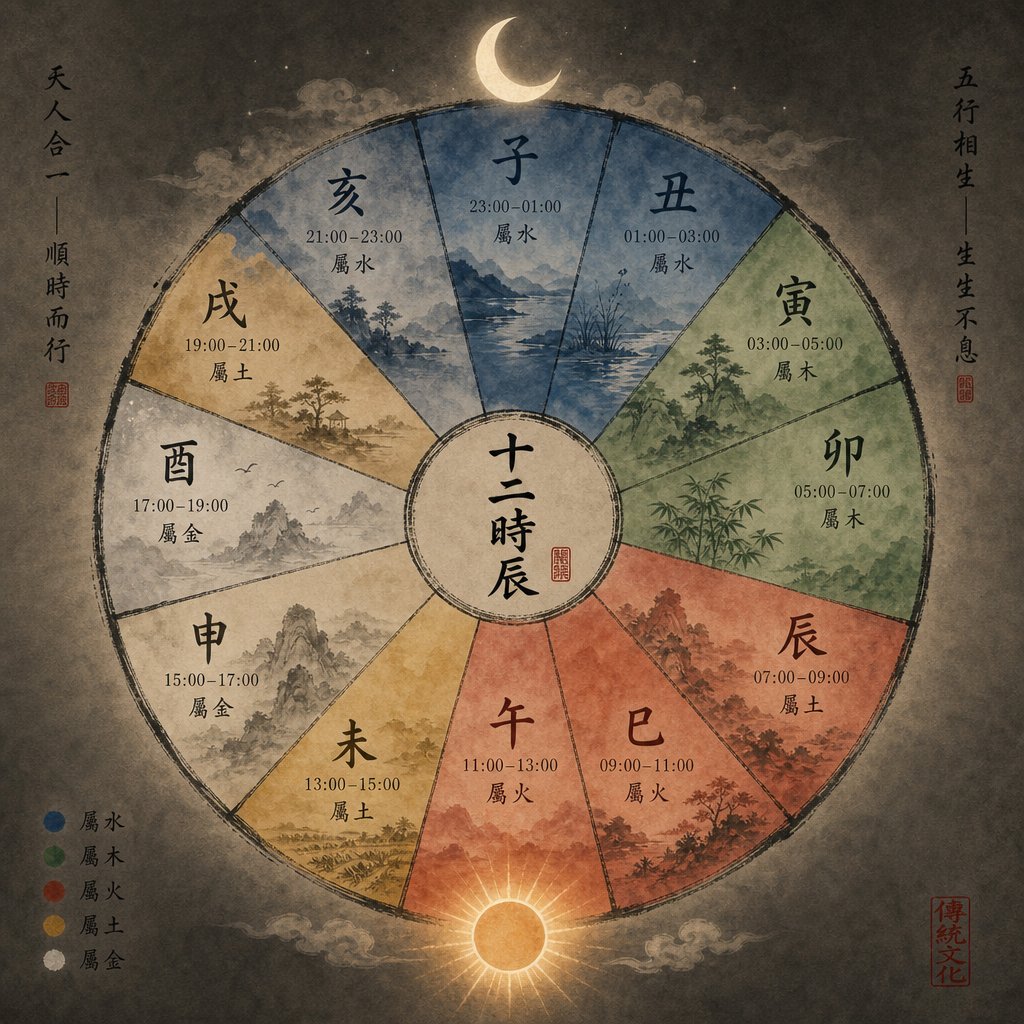
That blank Hour Pillar needs a specific input — but it is not a number from a 24-hour clock. Traditional Chinese timekeeping divides the day into twelve segments, not twenty-four. Each segment spans two modern hours and carries its own Earthly Branch, elemental association, and zodiac animal. To understand what is your Chinese element based on birth time, you first need to know which of these twelve periods you were born in.
The Twelve Two-Hour Periods
Ancient Chinese astronomers observed that celestial energy shifts in roughly two-hour cycles across the day. Rather than slicing time into the narrow one-hour units we use today, they grouped it into twelve broader windows called shi chen (时辰). This system traces back to the late Warring States period and became fully standardized during the Northern and Southern Dynasties, eventually evolving into the primary timekeeping method across the Tang, Song, and later dynasties.
Each shi chen is named after one of the twelve Earthly Branches — the same branches that appear in the Hour Pillar of a BaZi chart. When a naming practitioner asks for your birth time, they are converting your clock time into the corresponding shi chen to identify which Earthly Branch occupies your Hour Pillar. That branch carries a fixed elemental value, and that value becomes part of your elemental fingerprint.
Think of it this way: if you were born at 2 AM, you did not simply arrive "early in the morning." You arrived during Chou hour, under the Earthly Branch 丑, carrying Earth energy. Someone born at 10 AM arrived during Si hour, under the branch 巳, carrying Fire energy. Same calendar date, completely different elemental contribution to the birth chart.
Mapping Each Shi Chen to Its Element and Branch
The table below maps all twelve shi chen periods to their modern time equivalents, Earthly Branches, associated elements, and zodiac animals. If you are curious about what your Chinese element might be based on birth hour alone, this is your starting reference:
| Shi Chen | Modern Time | Earthly Branch | Element | Animal Sign |
|---|---|---|---|---|
| Zi | 23:00 - 01:00 | 子 | Water | Rat |
| Chou | 01:00 - 03:00 | 丑 | Earth | Ox |
| Yin | 03:00 - 05:00 | 寅 | Wood | Tiger |
| Mao | 05:00 - 07:00 | 卯 | Wood | Rabbit |
| Chen | 07:00 - 09:00 | 辰 | Earth | Dragon |
| Si | 09:00 - 11:00 | 巳 | Fire | Snake |
| Wu | 11:00 - 13:00 | 午 | Fire | Horse |
| Wei | 13:00 - 15:00 | 未 | Earth | Goat |
| Shen | 15:00 - 17:00 | 申 | Metal | Monkey |
| You | 17:00 - 19:00 | 酉 | Metal | Rooster |
| Xu | 19:00 - 21:00 | 戌 | Earth | Dog |
| Hai | 21:00 - 23:00 | 亥 | Water | Pig |
You'll notice a pattern in the elemental distribution. Water bookends the day (Zi and Hai), Fire dominates midday (Si and Wu), and Earth appears four times — anchoring the transitions between seasons and energy shifts. Metal concentrates in the late afternoon and early evening (Shen and You), while Wood governs the pre-dawn and dawn hours (Yin and Mao).
This distribution is not random. It reflects the ancient Chinese observation that natural energy flows in cycles: Water energy peaks in the deep stillness of night, Wood rises with the stirring of dawn, Fire blazes at the sun's zenith, Metal condenses as daylight retreats, and Earth stabilizes the transitions between each phase.
For naming purposes, the practical implication is immediate. A person born at 3 AM — during Yin hour — brings Wood energy into their Hour Pillar. A person born at 4 PM — during Shen hour — brings Metal. If both share the same Year, Month, and Day pillars, their charts still differ by one full element in the Hour Pillar. That single difference can shift the overall elemental balance enough to change which characters a practitioner recommends for their name.
This is also why an ancient chinese name generator that only asks for your birth date without specifying the hour cannot produce a meaningful result. The shi chen is not optional context — it is the raw data that populates one-quarter of the chart. Without it, the elemental profile remains incomplete, and any name built on that incomplete profile lacks the precision the system demands.
The elemental value carried by your birth hour, however, is only one piece of the puzzle. What matters even more is how that element interacts with the central character in your chart — the Day Master — which determines whether your overall energy profile reads as strong or weak, and therefore which direction the naming strategy should take.
How the Day Master Anchors Your Name
Every BaZi chart has a focal point — a single character that represents you. It is called the Day Master (日主, ri zhu), and it is the Heavenly Stem of your Day Pillar. While all eight characters contribute to the elemental landscape, the Day Master is the reference point against which everything else is measured. Think of it as the protagonist of your chart. The other seven characters are the supporting cast, the antagonists, and the environment — all evaluated by how they relate to this one central element.
This is why two people wondering "whats my Chinese name" can receive entirely different answers even when their charts look superficially similar. The naming strategy does not revolve around the chart as a whole in isolation — it revolves around what the Day Master specifically needs.
Identifying Your Day Master
Your Day Master is one of ten Heavenly Stems, each tied to one of the five elements in either its Yang or Yin polarity:
- Wood: Jia (甲, Yang) and Yi (乙, Yin)
- Fire: Bing (丙, Yang) and Ding (丁, Yin)
- Earth: Wu (戊, Yang) and Ji (己, Yin)
- Metal: Geng (庚, Yang) and Xin (辛, Yin)
- Water: Ren (壬, Yang) and Gui (癸, Yin)
If your Day Master is Bing (丙), you are Yang Fire — symbolically like the sun: bright, expansive, generous. If it is Gui (癸), you are Yin Water — like rain or mist: adaptable, subtle, fluid. Each Day Master carries distinct personality associations, but for naming purposes, what matters most is its strength.
Practitioners assess strength by examining how much support or opposition the Day Master receives from the other seven characters. A Day Master born in its favorable season, with matching elements in the Branches below it (called "roots"), is considered strong. One born out of season, surrounded by elements that drain or control it, is considered weak. This assessment is the turning point of the entire naming process.
Why Strength Assessment Matters for Naming
Here is where the naming prescription splits into two opposite directions. A strong Day Master favors elements that control and drain it — keeping its energy in check. A weak Day Master favors elements that support and produce it — giving it the strength it lacks. The name characters chosen must align with whichever direction the chart requires.
And this is exactly where birth time becomes decisive. The Hour Pillar contributes an element that either reinforces or undermines the Day Master. Imagine a Jia Wood (甲) Day Master born in spring — Wood's strongest season. The chart already leans toward a strong Day Master. If the birth hour falls during Yin (寅, 3-5 AM), it adds even more Wood, confirming the Day Master as strong and calling for Metal or Fire characters in the name. But shift that birth to You hour (酉, 5-7 PM), which carries Metal energy, and suddenly the Day Master faces opposition. It may now read as weak — requiring Wood or Water characters instead.
The same person born two hours earlier or later may receive an opposite naming prescription — not because the system is arbitrary, but because the Hour Pillar shifted the Day Master from strong to weak, reversing the entire elemental strategy.
This is why anyone genuinely asking "how to find my Chinese name" through traditional methods cannot skip the birth hour. It is not supplementary information. It is the variable that can flip the Day Master's strength classification — and with it, every character recommendation that follows. What would my Chinese name be if I were born at dawn versus dusk? Potentially the complete opposite, built from different elements, carrying different meanings, serving a different corrective purpose.
The Day Master tells you who you are in the chart. Its strength tells you what you need. But the specific element that fulfills that need — the one a practitioner actively seeks when selecting name characters — has its own formal designation within the system.
The Five Elements Cycle in Chinese Naming
Before a practitioner can select the right element for a name, they need to understand how elements relate to each other. The Five Elements — Wu Xing (五行) — are not isolated categories sitting in a list. They exist in constant motion, feeding one another, restraining one another, and cycling through phases of creation and control. The character Xing (行) itself means "movement" or "phase," not "element" in the static Western sense. As the classical framework documented in the Book of Documents (尚书) around 1000 BCE describes, these are five fundamental patterns of energy governing how the universe transforms.
So what is your element in Chinese philosophy? It depends on your birth chart. But more importantly, it depends on how that element interacts with the others present. A chart heavy in Water is not simply "a Water person" — it is a system where Water's relationships with Wood, Fire, Earth, and Metal determine whether balance exists or whether correction is needed. The naming process operates within these relationships, not outside them.
The Generating and Overcoming Cycles
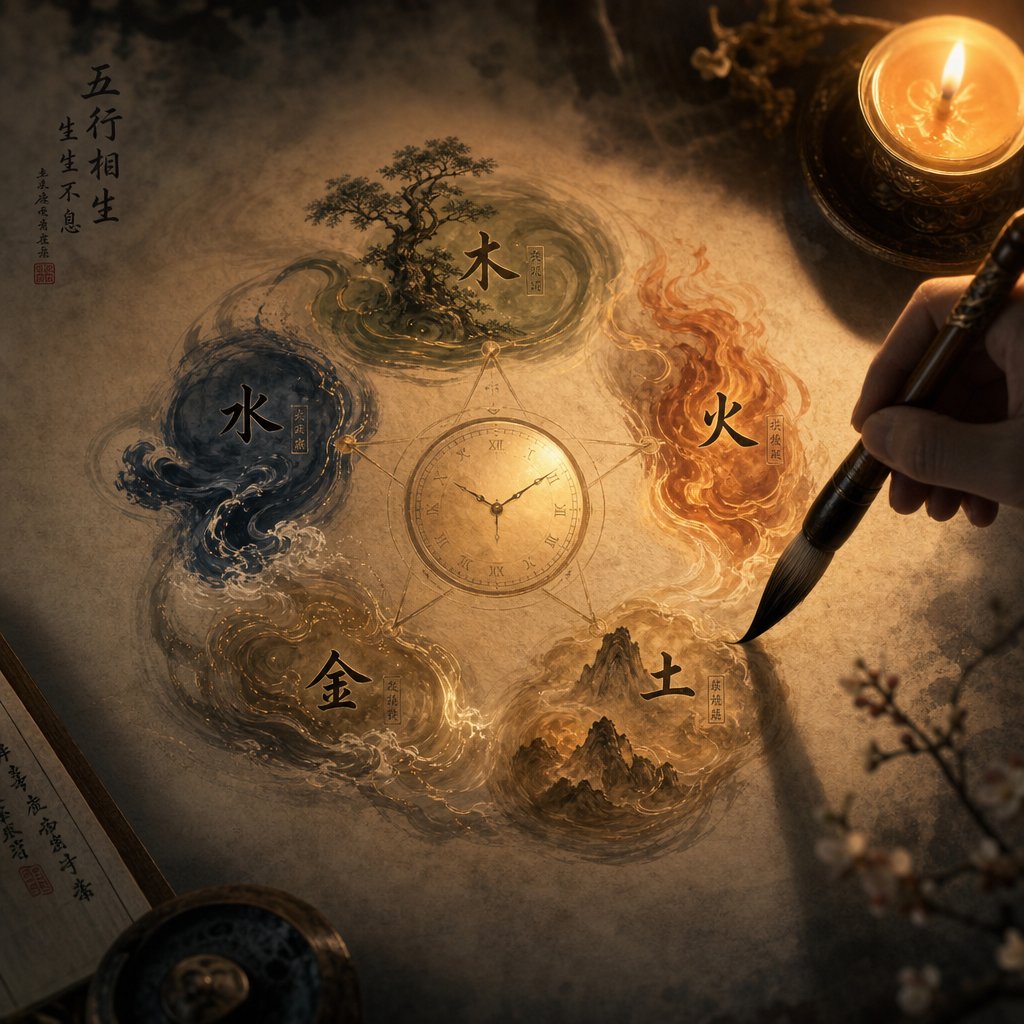
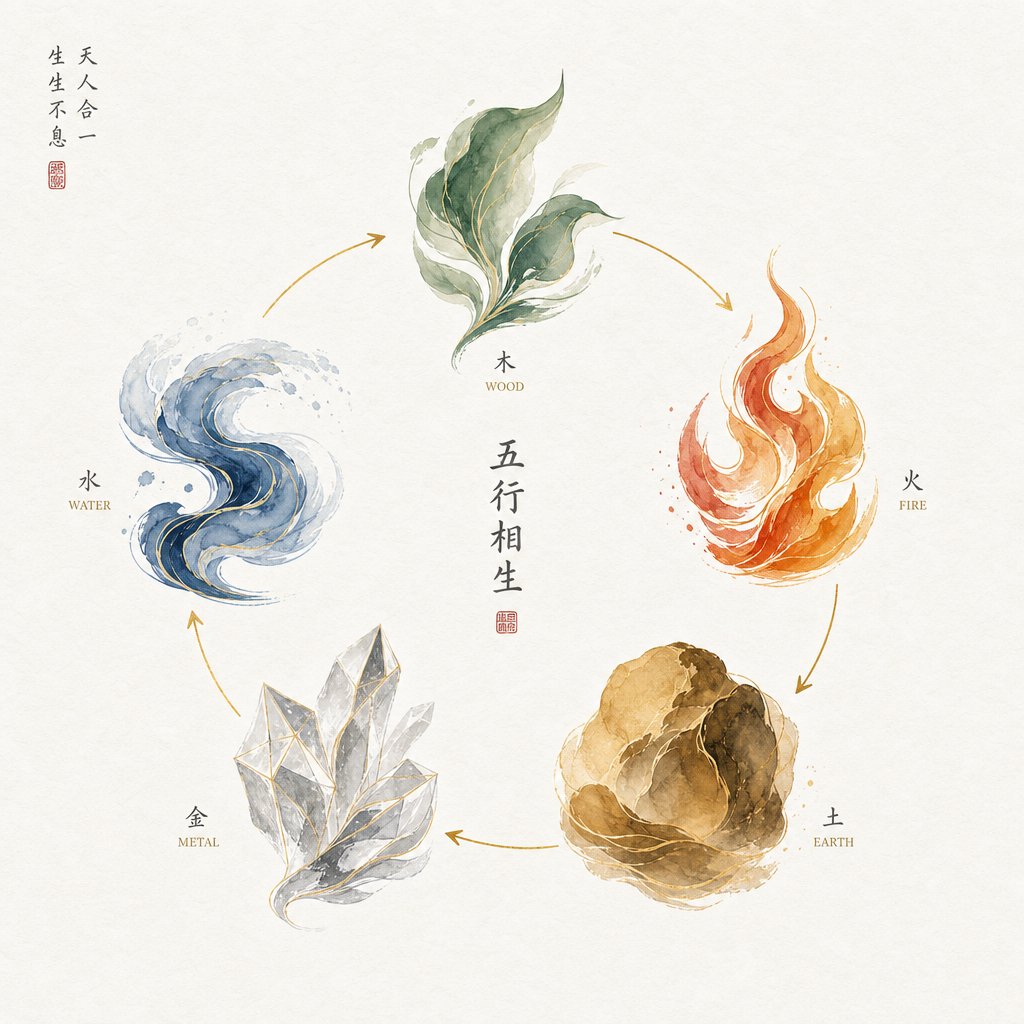
Two fundamental cycles govern how the five phases interact. The first is the Generating Cycle (相生, xiang sheng) — a continuous loop where each element nourishes and creates the next:
- Wood feeds Fire — Wood provides fuel for Fire to burn and expand.
- Fire creates Earth — Fire burns material into ash, which returns to the ground as Earth.
- Earth bears Metal — Earth compresses over time to form Metal ores within its depths.
- Metal collects Water — Metal surfaces attract condensation, producing Water.
- Water nourishes Wood — Water irrigates the soil, allowing Wood to grow upward.
This cycle flows in one direction: Wood, Fire, Earth, Metal, Water, and back to Wood. Each phase gives life to the next. If your chart lacks Fire and you introduce Wood energy, you are indirectly supporting Fire through generation — Wood feeds it into existence.
The second cycle is the Overcoming Cycle (相克, xiang ke), sometimes called the Controlling Cycle. Here, each element restrains or diminishes another, preventing any single phase from overwhelming the system:
- Wood parts Earth — Tree roots break through soil, dominating and holding the ground.
- Earth dams Water — Earthen banks absorb and block the flow of Water.
- Water quenches Fire — Water extinguishes flames and cools excessive heat.
- Fire melts Metal — Intense heat softens and reshapes rigid Metal.
- Metal cuts Wood — An axe chops down trees and shapes Wood.
In a healthy BaZi chart, both cycles operate simultaneously. Generation without control leads to excess — imagine unchecked Fire burning everything in its path. Control without generation leads to stagnation — Metal cutting Wood with nothing to replenish the growth. Balance requires both forces working together.
This dual-cycle framework is exactly why naming is never as simple as "add whatever is missing." A practitioner must consider not only which element is absent but how introducing it will ripple through both cycles, affecting every other element in the chart.
Balancing Elements Through Character Selection
Imagine a birth chart where the Day Master is weak Fire, and the overall elemental profile shows a deficiency in Fire energy. The practitioner's goal is to strengthen Fire — but they have options. They can select characters directly associated with Fire, or they can choose Wood characters that generate Fire through the productive cycle. The decision depends on what else is happening in the chart.
When looking for chinese names meaning fire, you will find characters built around the fire radical (火) or its variant form (灬). Characters like Yu (煜, meaning "to illuminate"), Can (灿, meaning "brilliant"), and Yan (炎, meaning "flame") all carry strong Fire energy through their radical structure. These are direct Fire supplements — they add the element explicitly.
But elemental classification goes beyond radicals alone. Characters related to sunlight, warmth, or summer can carry Fire associations even without the fire radical present. Experienced practitioners weigh both the structural radical and the semantic meaning when determining a character's elemental value.
The critical point is this: balancing elements through naming is not about filling every gap arbitrarily. A chart missing Metal does not automatically need Metal characters. If the Day Master is strong and Metal would drain it further, adding Metal could worsen the imbalance rather than correct it. The corrective strategy always serves the chart's overall configuration — specifically, it serves whatever element the Day Master needs most. That element has a name in BaZi practice, and identifying it is the single most consequential step in the entire naming process.
Discovering Your Useful God
That single most consequential element — the one the Day Master needs above all others — is called the Useful God (用神, yong shen). Despite the name, it is not a deity. It is the element within the Five Elements framework that brings balance and harmony to a specific birth chart. Every decision about which characters belong in a name flows from this identification. Get the Useful God right, and the name supports the individual's elemental structure. Get it wrong, and the name works against it.
If you have ever wondered what would be my Chinese name, the honest answer is: it depends entirely on which element your chart identifies as the Useful God. Two people can share the same surname, the same birth year, even the same aesthetic preferences — and still require completely different name characters because their charts point to different Useful Gods.
What the Useful God Represents
The Useful God is not simply "the element you are missing." It is the element that most effectively regulates the relationships between all elements in your chart and restores equilibrium to the Day Master. A practitioner arrives at it through a layered analysis:
- Day Master strength — Is the Day Master too strong and needing to be drained or controlled? Or too weak and needing support?
- Seasonal climate — Was the person born in a cold month that needs warming (Fire), or a hot month that needs cooling (Water)?
- Overall elemental distribution — Which elements dominate the chart, and which are absent or suppressed?
A weak Day Master typically needs elements that generate or support it — following the productive cycle. A strong Day Master needs elements that drain or control it — following the overcoming cycle. But the seasonal factor adds nuance. A Yin Wood Day Master born in the Snake month (early summer) faces scorching heat. Even if the Day Master reads as moderately strong, the chart still needs Yin Water to cool and moisten — making Water the Useful God despite Wood's apparent strength.
This is why the Useful God functions as a guiding compass for character selection. Once identified, it tells the practitioner exactly which elemental energy the name should carry. A chinese name related to luck, in this tradition, is not one that sounds fortunate — it is one whose characters align with the Useful God, reinforcing the element the chart needs most.
How Birth Hour Influences the Useful God
Here is where the connection between birth time and naming becomes undeniable. The Hour Pillar contributes a Heavenly Stem and an Earthly Branch — two characters, each carrying elemental weight. That contribution can tip the entire analysis in a new direction.
Imagine two people sharing identical Year, Month, and Day pillars. Their first six characters are the same. Person A is born during Zi hour (23:00-01:00), adding Water energy to the chart. Person B is born during Wu hour (11:00-13:00), adding Fire energy. Those different Hour Pillars can produce cascading effects:
- Person A's extra Water may weaken a Fire Day Master, shifting it from strong to weak — calling for Wood or Fire support in the name.
- Person B's extra Fire may reinforce that same Fire Day Master, confirming it as strong — calling for Water or Earth to drain it.
- Person A's Useful God becomes Wood (to generate the weakened Fire).
- Person B's Useful God becomes Water (to control the excessive Fire).
Same birthday. Different hour. Opposite Useful Gods. Entirely different name characters.
This is the core reason birth time is indispensable in Chinese naming: the Hour Pillar can shift which element is identified as the Useful God, and the Useful God determines every character recommendation that follows.
The Useful God also exists within a broader framework called Xi Ji (喜忌) — favorable and unfavorable elements. The Useful God is the primary favorable element, but the chart may also identify secondary supportive elements (those that generate or assist the Useful God) and unfavorable elements (those that weaken or clash with it). When a practitioner selects name characters, they draw from the favorable category and avoid the unfavorable one. A name built on an unfavorable element — no matter how beautiful its meaning or sound — would work against the chart's natural balance.
This is why getting a Chinese name through traditional methods is never a quick exercise. The practitioner must first build the full eight-character chart, assess the Day Master's strength, factor in seasonal climate, and only then identify the Useful God. Skip the birth hour, and that identification rests on incomplete data — potentially pointing to the wrong element entirely.
The Useful God tells you which element to seek. The next question is practical: how do you find characters that actually carry that element? The answer lies in the internal structure of Chinese characters themselves — specifically, in the radicals that signal elemental identity at a glance.
Selecting Characters Through Radicals and Elements
You know which element your chart needs. The Useful God has been identified. The naming strategy is clear. But how does a practitioner — or a curious reader — actually find characters that carry the right elemental energy? The answer is built into the architecture of Chinese characters themselves.
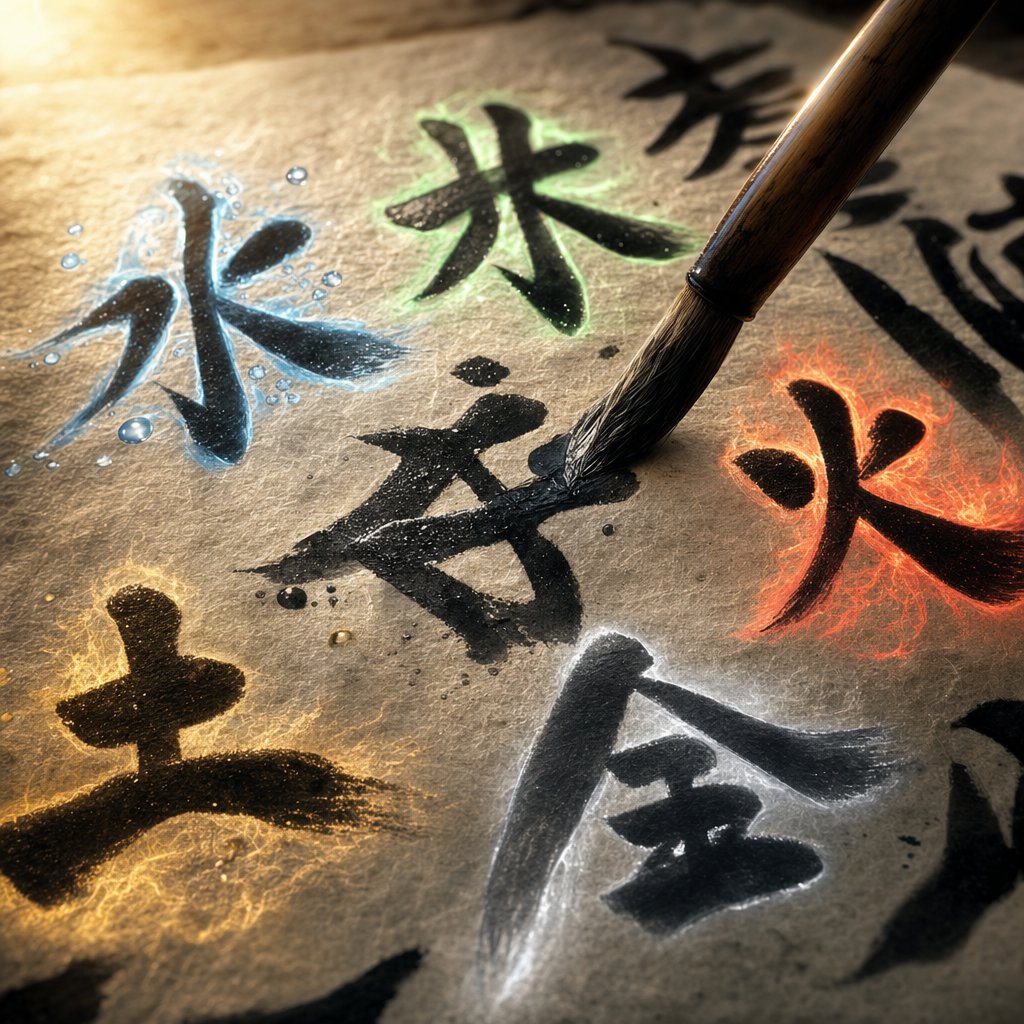
Every Chinese character is constructed from smaller components. Among these, radicals (部首, bu shou) serve as semantic signposts. They tell you what category a character belongs to — whether it relates to water, fire, wood, metal, earth, speech, movement, or dozens of other concepts. For naming purposes, radicals function as elemental labels. Spot the right radical, and you immediately know which of the Five Elements that character carries. This is the practical bridge between birth chart analysis and actual character selection — the step where theory becomes a name written on paper.
The Radical Classification System
Each of the Five Elements has at least one primary radical associated with it. Some have variant forms that appear in different positions within a character — left side, bottom, or embedded within the structure. Here is how the system maps out:
- Water (水) — The three-dot water radical 氵 appears on the left side of characters. The full form 水 sometimes appears at the bottom. A two-dot variant 冫 (associated with ice) also carries Water energy.
- Wood (木) — The wood radical 木 appears on the left side or at the bottom. Characters with this radical typically relate to trees, plants, or organic growth.
- Fire (火) — The fire radical 火 appears on the left side, while its four-dot variant 灬 sits at the bottom of characters. Both signal Fire element energy.
- Earth (土) — The earth radical 土 appears on the left side or at the bottom. Characters carrying it relate to ground, terrain, or stability.
- Metal (金) — The full form 金 or its simplified left-side variant 钅 indicates Metal. Characters with this radical often relate to metals, sharpness, or precious materials.
When a female chinese name generator or any naming tool suggests characters, it is drawing from these radical-based categories — matching the Useful God's element to characters that structurally contain it. The table below shows common naming characters organized by their elemental radical, giving you a practical reference for recognizing these associations independently:
| Element | Radical | Character | Pinyin | Meaning |
|---|---|---|---|---|
| Water | 氵 | 涵 | Han | To contain, cultivated |
| Water | 氵 | 洁 | Jie | Pure, clean |
| Water | 氵 | 泽 | Ze | Marsh, grace, luster |
| Wood | 木 | 桐 | Tong | Paulownia tree |
| Wood | 木 | 林 | Lin | Forest, grove |
| Wood | 木 | 梓 | Zi | Catalpa tree, homeland |
| Fire | 火 | 煜 | Yu | To illuminate, radiant |
| Fire | 灬 | 熙 | Xi | Bright, prosperous |
| Fire | 火 | 灿 | Can | Brilliant, splendid |
| Earth | 土 | 坤 | Kun | Earth, feminine principle |
| Earth | 土 | 培 | Pei | To nurture, cultivate |
| Earth | 土 | 垚 | Yao | High, lofty (triple earth) |
| Metal | 钅 | 锦 | Jin | Brocade, splendid |
| Metal | 钅 | 铭 | Ming | Inscription, to engrave |
| Metal | 金 | 鑫 | Xin | Prosperous (triple gold) |
You'll notice that some characters are especially popular in naming — 梓 (Zi) for Wood, 涵 (Han) for Water, 煜 (Yu) for Fire. These are favored because they carry both strong elemental energy through their radical and positive literary meaning. A good name character does double duty: it satisfies the elemental prescription while also conveying something beautiful or aspirational in its definition.
Beyond Radicals — Meaning-Based Classification
Radicals provide the most visible elemental signal, but they are not the only one. Experienced practitioners also classify characters by their semantic meaning — what the character represents conceptually, regardless of its structural components.
Consider the character 雨 (yu, rain). Its radical is not the water radical 氵 — it is actually its own radical category. Yet rain is fundamentally a Water phenomenon. A practitioner would classify 雨 and characters containing it (like 霖, lin, meaning "continuous rain" or 霏, fei, meaning "misty rain") as Water element characters based on meaning rather than radical structure alone.
The same principle applies across all five elements:
- Water by meaning: Characters related to rivers (川, chuan), oceans (海, hai), clouds (云, yun), snow (雪, xue), or dew (露, lu) carry Water energy even when their radical is not 氵.
- Wood by meaning: Characters evoking growth (茂, mao), flowers (芳, fang with the grass radical 艹), or spring (春, chun) align with Wood energy through association.
- Fire by meaning: Characters connected to sunlight (晨, chen, meaning "morning"), brightness (明, ming), or warmth (暖, nuan) carry Fire associations through their solar or luminous meaning.
- Earth by meaning: Characters suggesting mountains (岳, yue), stones (磊, lei), or vastness (宇, yu, meaning "universe/roof") connect to Earth energy conceptually.
- Metal by meaning: Characters implying sharpness (锐, rui), preciousness (珍, zhen with the jade radical), or firmness (刚, gang) align with Metal through their connotations of hardness and value.
This dual-layer classification — radical structure plus semantic meaning — is what separates a skilled practitioner from a simple chinese last names generator or automated tool. Software can scan for radicals. It takes human judgment to recognize that 晨 (morning) carries Fire energy because dawn represents the sun's return, or that 川 (river) is Water despite having no water radical at all.
For readers exploring their own names or trying to understand a name given to them, this framework offers a starting point. Look at the characters in a Chinese name and ask: does the radical point to an element? Does the meaning reinforce that association or suggest a different one? In most well-chosen names, both layers align — the radical and the meaning work together to deliver a concentrated dose of the element the birth chart identified as needed.
Recognizing elemental associations in individual characters is one skill. Seeing how those characters produce different naming outcomes depending on birth time — watching the entire system work from chart to character — is where the full picture comes together.
How Different Birth Hours Lead to Different Names
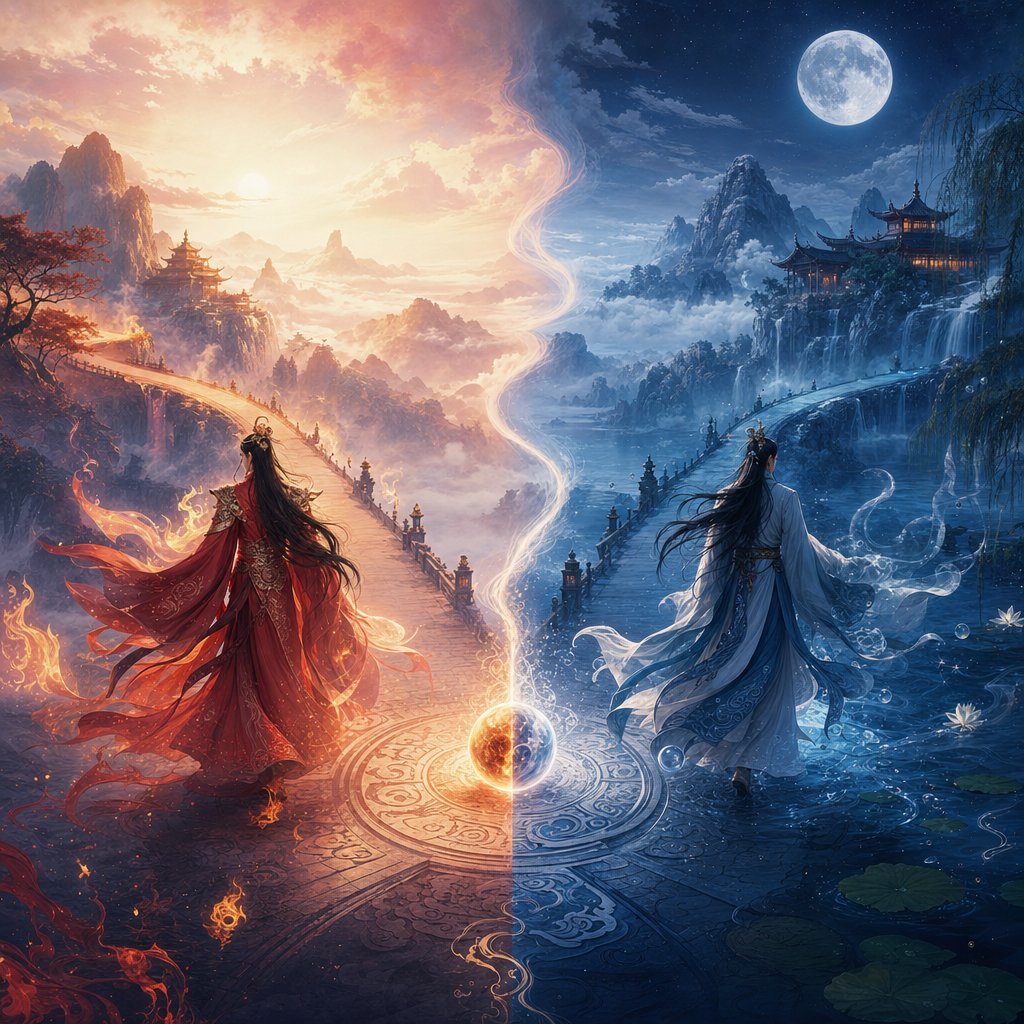
Every concept covered so far — the BaZi chart, the twelve shi chen, the Day Master, the Five Elements cycles, the Useful God, and radical-based character selection — converges on a single practical reality. Two people born on the same calendar date but at different hours can end up with names built from opposite elements, carrying entirely different meanings, serving completely different corrective purposes. This is not a theoretical edge case. It is the normal outcome of the system working as designed.
To see why, imagine walking through the full naming process for two hypothetical individuals who share a birthday but arrive at different hours.
Same Day, Different Hour, Different Name
Picture two children born on the same date — same year, same month, same day. Their first three pillars (Year, Month, and Day) are identical. The Day Master is the same for both: let's say it is Yi Wood (乙), Yin Wood, representing flexible growth like a vine or a flower. The Year and Month pillars contribute a mix of Earth and Metal energy. So far, the charts are mirrors of each other.
Child A arrives at 5 AM — during Mao hour (卯), which carries Wood energy. Child B arrives at 5 PM — during You hour (酉), which carries Metal energy. From this single difference, the naming paths diverge completely:
- Different Hour Pillar elements enter the chart. Child A gains additional Wood from the Mao branch. Child B gains Metal from the You branch. The elemental composition of their charts is no longer the same.
- The Day Master's strength shifts. Child A's Yi Wood Day Master receives support from the Wood in the Hour Pillar — it has a "root" and reads as moderately strong. Child B's identical Yi Wood Day Master faces Metal in the Hour Pillar — Metal cuts Wood in the overcoming cycle, weakening it. The Day Master now reads as weak.
- The Useful God identification diverges. For Child A (strong Day Master), the practitioner identifies an element that drains or controls Wood — perhaps Fire (which Wood generates, thereby exhausting it) or Metal (which directly controls it). For Child B (weak Day Master), the practitioner identifies an element that supports Wood — Water (which generates Wood) or more Wood itself.
- Character recommendations follow opposite directions. Child A might receive a name containing characters with the fire radical (火 or 灬) — perhaps 煜 (Yu, radiant) or 灿 (Can, brilliant) — to channel the strong Wood's excess energy into productive output. Child B might receive characters with the water radical (氵) — perhaps 涵 (Han, cultivated) or 泽 (Ze, grace) — to nourish and strengthen the vulnerable Wood.
- The final names carry different meanings, sounds, and visual forms. Not because the parents had different taste, but because the birth chart demanded different elemental medicine.
Same birthday. Twelve hours apart. Two names that share nothing in common except the surname. This is the system responding precisely to the data it was given — and the Hour Pillar is the variable that split the outcome in two.
Practical Steps to Explore Your Own Chinese Name
If you want to find your Chinese name through this traditional framework — or simply understand the one you already have — here is where to begin:
- Gather your exact birth time. Not an approximation. The shi chen system operates in two-hour windows, so even a rough estimate helps, but precision matters. Ask family members, check hospital records, or look at a birth certificate that includes the hour.
- Identify your shi chen period. Use the twelve-period table from earlier in this article to convert your clock time into the corresponding Earthly Branch. A birth at 2:30 AM falls in Chou hour (丑, Earth). A birth at 8:45 PM falls in Xu hour (戌, Earth). This gives you the element your Hour Pillar contributes.
- Understand that the Hour Pillar is one piece of four. Knowing your birth hour's element is valuable context, but it does not tell you your Useful God on its own. The full analysis requires all four pillars working together — the interactions between Year, Month, Day, and Hour determine the Day Master's strength and the chart's overall needs.
- Recognize the limits of automated tools. Online BaZi calculators can generate your four pillars accurately — the math is fixed and formulaic. But interpreting those pillars, assessing Day Master strength, and identifying the Useful God involves nuanced judgment about element interactions, seasonal factors, and hidden stems within the Branches. This is where experienced practitioners add value that software cannot replicate.
- Look at existing names with fresh eyes. If you already have a Chinese name, examine its characters. Do they contain radicals associated with a specific element? Does the meaning reinforce that elemental association? You may discover that your name was chosen to address a specific gap in your birth chart — a quiet act of calibration performed before you could speak your first word.
Whether you approach this system as a believer, a skeptic, or simply someone with cultural curiosity, the framework rewards engagement. You do not need to accept its metaphysical claims to appreciate its internal logic — the way it transforms a moment in time into a linguistic prescription, connecting the hour of your birth to the strokes of your name through a chain of reasoning that has been refined across centuries.
Chinese naming tradition treats identity as something that begins before choice — before personality forms, before preferences develop, before a child can express who they are. The birth chart captures the raw conditions of arrival: what energy was present, what was absent, what needed balancing. The name becomes the first deliberate act of correction, a parent's attempt to give their child not just a label but an elemental advantage calibrated to the exact window of time in which life began.
This is what makes the relationship between chinese names and time of birth so much more than a cultural curiosity. It reveals a worldview where language, time, and identity are not separate domains but a single integrated system — where the hour you were born shapes the characters you carry, and those characters, in turn, are meant to shape the life that follows.
Frequently Asked Questions About Chinese Names and Time of Birth
1. Why does birth time matter when choosing a Chinese name?
Birth time determines the Hour Pillar in the BaZi (Eight Characters) system, which accounts for 25% of a person's elemental profile. The Hour Pillar introduces specific elemental energy — Wood, Fire, Earth, Metal, or Water — that directly affects the Day Master's strength assessment. This assessment dictates which elements should be reinforced through name characters. Two people born on the same date but at different hours can have opposite naming prescriptions because their Hour Pillars shift the elemental balance in different directions.
2. How do I find out what my Chinese element is based on birth time?
Traditional Chinese timekeeping divides the day into twelve two-hour periods called shi chen, each linked to an Earthly Branch and a fixed element. For example, birth between 23:00-01:00 falls under Zi hour (Water), 09:00-11:00 falls under Si hour (Fire), and 15:00-17:00 falls under Shen hour (Metal). Converting your birth time to the corresponding shi chen reveals the element your Hour Pillar contributes. However, your full elemental profile requires analyzing all four pillars together — Year, Month, Day, and Hour.
3. What is the Useful God in Chinese naming and how does it affect name selection?
The Useful God (yong shen) is the specific element identified from a birth chart that most effectively restores balance to the Day Master. It is determined by evaluating the Day Master's strength, seasonal climate at birth, and overall elemental distribution. Once identified, the Useful God becomes the guiding principle for character selection — practitioners choose name characters whose radicals or meanings align with this element. Because the Hour Pillar can shift which element becomes the Useful God, birth time directly controls which characters are recommended.
4. Can two people born on the same day have completely different Chinese names?
Yes, and this is a normal outcome of the BaZi naming system. Two people sharing the same Year, Month, and Day pillars but born at different hours will have different Hour Pillars contributing different elements. This can change the Day Master's strength classification from strong to weak, shift the Useful God identification to an entirely different element, and result in name characters drawn from opposite elemental categories. A morning birth might call for Fire characters while an evening birth on the same date calls for Water characters.
5. How are Chinese characters classified by element for naming purposes?
Characters are classified through two methods. The primary method uses radicals — structural components that signal elemental association. The water radical (three dots on the left) indicates Water, the wood radical indicates Wood, the fire radical or its four-dot variant indicates Fire, the earth radical indicates Earth, and the metal radical indicates Metal. The secondary method uses semantic meaning: characters related to rivers or rain carry Water energy even without the water radical, and characters evoking sunlight carry Fire energy regardless of their radical structure. Skilled practitioners evaluate both layers when selecting name characters.