Beyond Binary in Chinese Naming Traditions
When you search for chinese names, you'll notice something immediately: nearly every guide splits results into two columns. One side lists chinese names for boys filled with characters meaning "strong" or "heroic." The other offers chinese girl names built from characters meaning "beautiful" or "graceful." If you don't fit neatly into either column, you're left scrolling with no clear path forward.
For non-binary individuals seeking a Chinese name, this binary framework creates a real problem. The concept of 非二元性别 (non-binary gender) exists, the language has room for it, yet the naming resources haven't caught up.
Why Existing Chinese Name Guides Miss the Mark
Most chinese baby names lists treat gender neutrality as an afterthought. You might find a short section labeled "unisex names," but these are typically characters parents chose for aesthetic balance, not names intentionally crafted to sit outside the gender binary. There's a meaningful difference between a parent picking a nature-themed name because it sounds pleasant and a person deliberately selecting characters that reflect a non-binary identity. As linguist Victor Mair has noted, you often cannot determine a person's gender simply by hearing their Chinese name spoken aloud. Gender signals in Chinese names live primarily in the written characters, their radicals, and cultural associations, not in phonetics alone. This creates a unique opportunity.
Chinese naming philosophy encodes gender visually and semantically rather than phonetically, giving non-binary people creative flexibility that few other naming traditions offer.
Who This Resource Is For
This guide serves three groups. First, non-binary Chinese heritage speakers who want to reclaim or change a name that feels misaligned with their identity. Second, non-binary learners of Mandarin who need a Chinese name for class, work, or social contexts and refuse to pick from a list of chinese names girl or boy options that don't represent them. Third, parents choosing a name for a non-binary child who want something intentional rather than accidentally neutral.
Each situation carries different weight. A heritage speaker navigates family expectations and legal documents. A language learner faces classroom introductions. A parent thinks decades ahead. The characters you choose, and the radicals hidden inside them, shape how gender is read into your name before a single word is spoken.
How Gender Works in Chinese Character Names
Imagine looking at an English name like "Jordan" or "Taylor." Nothing in the letters themselves signals gender. You only know the association through cultural convention. Chinese names operate on a completely different principle. Gender isn't just suggested by tradition; it's structurally embedded in the characters themselves, woven into their visual components, semantic roots, and layered meanings.
For non-binary individuals, understanding this encoding system is essential. You can't sidestep gendered expectations in a Chinese name without first seeing exactly where those signals live.
How Chinese Characters Encode Gender
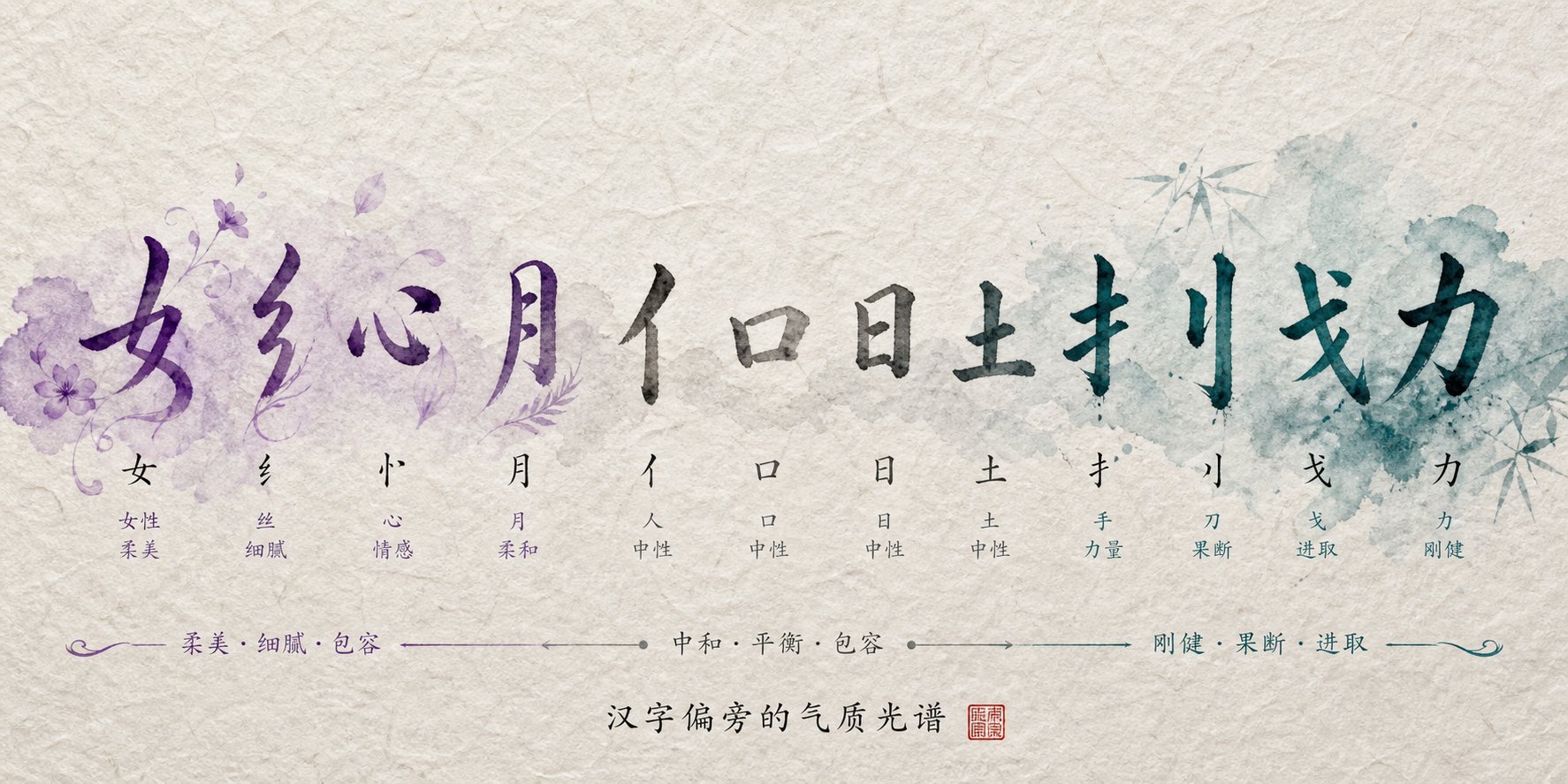
Every Chinese character is built from smaller components called radicals. These radicals carry meaning, and some of them act as immediate gender markers. When a Chinese reader sees certain radicals, they register gender associations before they even process the full character's meaning. It's almost like a visual shorthand baked into the writing system itself.
The most obvious example is the 女 (nu, "woman") radical. Characters containing this radical are overwhelmingly read as feminine chinese names material. Think of 婷 (ting, graceful), 娜 (na, elegant), 妍 (yan, beautiful), or 婉 (wan, gentle). These characters don't just happen to be popular in female chinese names. Their very structure announces femininity through that left-side radical.
On the masculine side, the signals are less concentrated in a single radical but still recognizable. Characters featuring 力 (li, strength), 刂 (the knife radical), 金 (jin, metal), or 马 (ma, horse) tend to skew toward chinese male names. Characters like 刚 (gang, firm), 勇 (yong, brave), and 锋 (feng, sharp edge) carry masculine weight through both their radicals and their meanings.
Radicals and Their Hidden Gender Signals
Here's where it gets practical. The table below breaks down common gendered radicals alongside neutral alternatives that carry no strong gender association:
| Radical | Gender Signal | Example Characters | Neutral Alternatives (No Gendered Radical) |
|---|---|---|---|
| 女 (nu) | Feminine | 婷, 娜, 妍, 婉, 娟 | 清 (qing, clear), 宁 (ning, tranquil) |
| 王/玉 (jade) | Feminine-leaning | 瑶, 琳, 珊, 瑾 | 璞 (pu, uncarved jade - more neutral) |
| 力 (strength) | Masculine | 勇, 劲, 勋 | 恒 (heng, perseverance) |
| 刂 (knife) | Masculine | 刚, 利, 锋 | 锐 context-dependent; 明 (ming, bright) as alternative |
| 艹 (grass/plant) | Neutral | 芮, 茗, 蕴, 荷 | Broadly usable across genders |
| 氵 (water) | Neutral | 涵, 泽, 溪, 澄 | Broadly usable across genders |
| 木 (wood) | Neutral | 林, 桐, 楠, 柏 | Broadly usable across genders |
You'll notice that nature-based radicals like water (氵), wood (木), and grass (艹) tend to sit in neutral territory. This is one reason nature-themed characters appear so frequently in gender-neutral naming discussions.
Meaning Layers That Carry Gendered Weight
Radicals aren't the only place gender hides. The semantic meaning of a character adds another layer. Chinese names for girls have traditionally drawn from beauty and softness: flowers, moonlight, jade, fragrance. Lists of chinese names male options lean toward ambition, strength, and legacy: mountains, dragons, achievement, governance.
These meaning categories break down roughly like this:
- Feminine-coded meanings: beauty (美, 丽), flowers (芳, 兰), gentleness (柔, 婉), precious stones (瑶, 琳)
- Masculine-coded meanings: strength (强, 伟), ambition (志, 鹏), military valor (武, 威), vastness (宏, 浩)
- Neutral meanings: wisdom (智, 慧), light (明, 曦), peace (安, 宁), nature elements (云, 川, 林)
The challenge for non-binary people is that these layers stack. A character might have a neutral radical but a strongly gendered meaning, or vice versa. The character 慧 (hui, wisdom) contains no gendered radical, yet it appears far more often in feminine chinese names due to cultural usage patterns. Meanwhile, 浩 (hao, vast) uses the neutral water radical but reads as overwhelmingly masculine because of its semantic associations with grandeur and scale.
This layered system means choosing a truly gender-neutral Chinese name requires attention to both structure and cultural context. A character that looks neutral on paper might still trigger gendered readings in practice. The good news? Once you understand where gender lives in the system, you can deliberately choose characters where neither the radical nor the meaning pushes toward a binary reading, opening up a rich space for authentic self-expression.
Principles for Choosing Gender-Neutral Chinese Characters
Knowing where gender hides in a character is only half the equation. The real question is: how do you actively choose characters that refuse to land on either side of the binary? Rather than handing you a flat list of "safe" options, this section lays out a framework, a set of principles you can apply to any character you're considering. Think of it as a filter system. Run a character through these categories, and you'll quickly see whether it carries gendered baggage or sits comfortably in neutral space.
The strongest gender-neutral characters tend to cluster around three domains: nature imagery, abstract virtues, and cosmic or elemental references. Each domain offers distinct tonal qualities and mandarin name meaning possibilities that sidestep binary expectations entirely.
Nature Characters That Transcend Gender
Nature is the most reliable source of gender-neutral naming material in Chinese. Why? Because rivers, clouds, and forests don't have gender. They exist beyond human social categories, and the characters that represent them carry that same openness.
When you explore chinese names and meanings rooted in the natural world, you'll find characters that feel expansive without defaulting to the "delicate flower" femininity or "towering mountain" masculinity that gendered nature names rely on. The key is choosing natural phenomena that evoke movement, atmosphere, or quiet presence rather than size or beauty.
- 云 (yun, 2nd tone) - cloud: Suggests freedom, lightness, and constant transformation. No gendered associations. Works beautifully as a standalone or paired character.
- 林 (lin, 2nd tone) - forest: Evokes community, depth, and groundedness. The doubled-tree structure feels balanced and self-contained.
- 川 (chuan, 1st tone) - river: Carries a sense of steady flow and quiet persistence. Three simple strokes make it visually clean.
- 岚 (lan, 2nd tone) - mountain mist: Combines mountain (山) and wind (风) imagery. Atmospheric rather than gendered.
- 泉 (quan, 2nd tone) - spring/source: Suggests origin, purity, and renewal without leaning feminine or masculine.
- 霖 (lin, 2nd tone) - sustained rain: The rain radical (雨) over forest (林) creates a layered image of nourishment. Gender-neutral in both radical and meaning.
- 屿 (yu, 3rd tone) - islet: A small island. Suggests independence and self-sufficiency in a compact form.
Notice the tonal pattern here. Many strong nature characters sit in the 2nd tone (rising), which phonetically reads as neither soft nor aggressive. This isn't a rule, but it's a useful observation when you're building names in chinese and meanings that feel balanced when spoken aloud.
Abstract Virtue Characters for Non-Binary Names
Virtue names have deep roots in Chinese naming philosophy. Parents have always named children after qualities they hope to cultivate. The trick for non-binary naming is selecting virtues that aren't culturally coded as masculine ambition or feminine grace.
Some virtues read as universal. Others have been claimed by gendered tradition over centuries of use. Here's where understanding the chinese name meaning behind each character matters more than its dictionary definition alone:
- 安 (an, 1st tone) - peace, stability: A roof (宀) over a woman (女) etymologically, but its modern usage is thoroughly gender-neutral. One of the most versatile naming characters available.
- 信 (xin, 4th tone) - trust, integrity: Person (亻) plus speech (言). Suggests someone whose words match their actions. No gendered weight.
- 明 (ming, 2nd tone) - bright, clear: Sun (日) and moon (月) together. The balance of two celestial bodies makes this inherently non-binary in its visual logic.
- 诚 (cheng, 2nd tone) - sincerity: Speech radical with a meaning of wholeness and honesty. Reads as a character trait rather than a gendered aspiration.
- 恒 (heng, 2nd tone) - perseverance, constancy: Heart radical (忄) with a sense of endurance. Neutral in both structure and cultural use.
- 谦 (qian, 1st tone) - humility: Speech radical paired with a meaning that transcends gender expectations. Valued equally across traditions.
- 知 (zhi, 1st tone) - knowledge, awareness: Arrow (矢) meeting mouth (口). Direct, clean, and universally applicable.
The pattern here is clear. Virtues that describe internal character, how a person relates to truth, consistency, and awareness, tend to be gender-neutral. Virtues that describe external presentation, beauty, strength, dominance, gentleness, tend to be gendered. When exploring meaning chinese names carry, focus on the internal over the external.
Using Five Elements Philosophy Without Gender
The 五行 (wuxing) system of Wood, Fire, Earth, Metal, and Water offers another framework for character selection that operates entirely outside gender. Traditionally, a person's BaZi birth chart reveals which elemental energies are weak or missing, and name characters are chosen to restore balance.
Here's what makes this approach valuable for non-binary naming: the Five Elements don't care about gender. They care about balance. A chart that needs Water doesn't need "feminine Water" or "masculine Water." It just needs Water. This gives you a principled, philosophically grounded reason to choose specific characters without ever engaging with the gender question at all.
Each element connects to specific radicals and character families:
- Wood (木): Characters like 林 (forest), 桐 (paulownia tree), 楷 (model/standard). Growth energy, spring associations.
- Fire (火): Characters like 曦 (dawn light), 晖 (radiance), 煦 (warm). Illumination without aggression.
- Earth (土): Characters like 均 (equal), 坦 (level/open), 垣 (wall/boundary). Stability and groundedness.
- Metal (金): Characters like 铭 (inscription), 鉴 (mirror/discernment). Clarity and refinement.
- Water (水): Characters like 涵 (contain), 澄 (clear/settle), 润 (moist/smooth). Depth and adaptability.
The generating cycle (Wood feeds Fire, Fire creates Earth, Earth bears Metal, Metal collects Water, Water nourishes Wood) also guides character pairing. If your name has two given-name characters, choosing one from a generating element and one from the element it produces creates internal harmony. This approach gives you a mandarin name meaning rooted in cosmological balance rather than social gender norms.
Stroke count plays a supporting role here too. Traditional naming practice considers the total stroke count of a name for numerological balance. More practically, stroke density affects how a name "feels" visually. A name built from characters with 6-12 strokes each tends to look balanced on paper, neither too sparse nor too heavy. Extremely simple characters (1-4 strokes) can read as casual or incomplete, while very complex characters (15+ strokes) can feel weighty. Neither carries inherent gender, but awareness of visual density helps you craft a name that feels intentional.
One final structural consideration: two-character names (surname plus one given-name character) versus three-character names (surname plus two given-name characters) affect gender perception differently. Research on naming practices in Taiwan found that gender-neutral names often feature characters with less gendered connotations, sometimes incorporating functional words or metaphoric usage not conventionally tied to either gender. Two-character names tend to feel more modern and ambiguous. Three-character names offer more room to layer meaning but also more opportunities for gendered readings to creep in through character combinations. If you're aiming for maximum neutrality, a single well-chosen given-name character paired with your surname can be the cleanest path forward.
Gender-Neutral Chinese Names With Meanings Explained
Principles are useful, but at some point you need actual names to work with. The selections below aren't random picks from a unisex baby name database. Each one has been evaluated for radical composition, semantic meaning, tonal flow, and real-world cultural perception. When you look at chinese names with meaning breakdowns elsewhere online, you'll typically get a character, a one-word translation, and nothing else. Here, the goal is deeper chinese name interpretation: understanding why a name reads as neutral and what it evokes in a native speaker's mind.
These names are organized into three categories that emerged from the principles covered earlier: nature, virtue, and literary or artistic tradition.
Nature-Inspired Non-Binary Chinese Names
Nature names work because they point outward, toward landscapes and phenomena that exist beyond human gender categories. The names below pair two characters that reinforce each other's neutrality while creating vivid imagery.
| Characters | Pinyin | Meaning | Why It Reads as Gender-Neutral |
|---|---|---|---|
| 若溪 | Ruoxi | Like a stream | 若 (like/as if) is a functional word with no gender coding. 溪 (stream) uses the water radical and evokes gentle movement without femininity or masculinity. |
| 云舒 | Yunshu | Clouds unfurling | 云 (cloud) is one of the most reliably neutral nature characters. 舒 (unfold/relax) describes a state of ease rather than a gendered quality. |
| 林野 | Linye | Forest and open fields | Both characters use nature imagery without size or beauty connotations. The pairing suggests expansiveness and groundedness equally. |
| 岚清 | Lanqing | Mountain mist, clear | 岚 (mountain mist) combines mountain and wind. 清 (clear/pure) uses the water radical and carries no gendered weight in modern usage. |
| 霖泽 | Linze | Sustained rain nourishing marshlands | Both characters use the water-related radical system. The imagery is atmospheric and elemental rather than personal or aesthetic. |
You'll notice these names avoid the trap of "pretty nature" (flowers, moonlight) or "powerful nature" (mountains, thunder). They sit in the middle ground: weather, water, forests, mist. That middle ground is where gender neutrality lives most comfortably in chinese names meaning systems.
Virtue and Philosophy Names
Virtue names carry weight in Chinese culture. Some of the most famous chinese names in history belong to philosophers and scholars whose names expressed ideals rather than gender. That tradition offers rich material for non-binary naming.
| Characters | Pinyin | Meaning | Why It Reads as Gender-Neutral |
|---|---|---|---|
| 思远 | Siyuan | Thinking far/deep reflection | 思 (thought) uses the heart radical in a cerebral context. 远 (far/distant) is spatial rather than gendered. The combination suggests philosophical depth without coding masculine ambition or feminine introspection. |
| 知行 | Zhixing | Knowledge and action | A direct reference to Wang Yangming's 知行合一 (unity of knowledge and action). Both characters are structurally and semantically neutral. The philosophical weight gives it gravitas without gendering. |
| 承安 | Cheng'an | Upholding peace | 承 (uphold/inherit) and 安 (peace) are both thoroughly neutral in modern usage. The name suggests responsibility and calm in equal measure. |
| 以诚 | Yicheng | With sincerity | 以 (with/by means of) is a grammatical particle that adds elegance without gender. 诚 (sincerity) describes internal character rather than external presentation. |
| 恒一 | Hengyi | Constant and unified | 恒 (constancy) and 一 (one/unity) are among the most gender-free characters available. The name reads as a philosophical statement about integrity. |
These names draw from ancient chinese names traditions where scholars chose courtesy names (字) based on ideals they aspired to. That practice was historically gendered male, but the characters themselves hold no inherent gender. Reclaiming them for non-binary use is both linguistically sound and culturally resonant.
Literary and Artistic Names
Art and literature offer another path. Characters associated with ink, writing, music, and craftsmanship tend to be beautiful chinese names material that sidesteps gender entirely. Creativity, after all, belongs to no single gender.
| Characters | Pinyin | Meaning | Why It Reads as Gender-Neutral |
|---|---|---|---|
| 墨言 | Moyan | Ink and words | 墨 (ink) connects to calligraphy and painting traditions. 言 (speech/words) is a fundamental radical character with zero gender association. Together they suggest someone who creates through language. |
| 书瑾 | Shujin | Books and fine jade | 书 (book/writing) is gender-neutral. 瑾 (fine jade) uses the jade radical, which can lean feminine, but paired with 书 it reads as refined rather than gendered. The combination evokes a scholar-artist. |
| 清韵 | Qingyun | Clear resonance | 清 (clear) and 韵 (rhythm/rhyme) together suggest musical or poetic sensibility. 韵 appears in both masculine and feminine famous chinese names from literary history, making it genuinely ambiguous. |
| 逸尘 | Yichen | Transcending the mundane | 逸 (escape/transcend) and 尘 (dust/worldly matters) create a Daoist-flavored name about rising above convention. The imagery is spiritual rather than gendered. |
| 予白 | Yubai | Offering blankness/purity | 予 (to give) and 白 (white/blank) are both structurally simple and semantically open. The name suggests a canvas, potential, and generosity without any gendered reading. |
Literary names carry a particular advantage: they signal education and intentionality. In Chinese culture, a name that references artistic tradition communicates that the bearer (or their family) chose carefully and thoughtfully. For non-binary individuals, this intentionality itself becomes part of the name's meaning. It says: this name was chosen with purpose, not assigned by default.
Of course, a name on paper is only part of the story. How these characters sound when spoken aloud, how they translate into romanized pinyin, and how they're perceived across different Chinese-speaking regions all shape the lived experience of carrying that name daily.
Regional Differences Across Chinese-Speaking Communities
The same characters can land very differently depending on where you are. A name that feels comfortably neutral in Taipei might raise eyebrows in Beijing, and a name chosen for its Mandarin pronunciation might carry unexpected gendered weight when spoken in Cantonese. For non-binary individuals navigating chinese names in chinese-speaking societies, geography matters as much as character choice.
Each region brings its own legal frameworks, social attitudes, and linguistic textures to the question of naming. Understanding these differences helps you choose a name that works in the contexts where you actually live and interact.
Taiwan and Progressive Naming Frameworks
Taiwan stands out among Chinese-speaking regions for its relatively progressive approach to gender recognition. Legal name changes are accessible through the household registration system, and while the process still requires documentation, it doesn't demand the same level of justification found elsewhere. Adults can change their given name up to three times through straightforward administrative procedures.
What does this mean practically? Non-binary individuals in Taiwan face fewer bureaucratic barriers when adopting a name that better reflects their identity. The cultural climate in urban centers like Taipei and Kaohsiung has also shifted. Gender-neutral naming is increasingly visible in younger generations, and traditional chinese names are being reinterpreted through contemporary lenses. You'll find online communities where people share naming choices, discuss character combinations, and workshop options together.
Taiwan's naming trends also show a broader cultural shift. Some of the most popular chinese names among younger Taiwanese already lean toward nature imagery and abstract concepts rather than overtly gendered characters. This cultural momentum means a gender-neutral name draws less scrutiny here than in more conservative contexts.
Navigating Names in Mainland China
Mainland China presents a more complex landscape. The legal system recognizes only male and female gender categories, and official documentation requires alignment with one of these two options. Name changes are possible but involve more bureaucratic friction, typically requiring approval from local public security bureaus and valid justification.
Socially, awareness of non-binary identity varies enormously between urban and rural areas, between generations, and between online and offline spaces. In cities like Shanghai, Guangzhou, and Chengdu, younger communities engage with gender diversity openly in digital spaces. Offline, the conversation remains more constrained.
The practical reality for non-binary people choosing names in mainland China often involves a dual strategy:
- Official name: A name that passes without friction in bureaucratic and professional contexts, often using characters that are technically neutral but don't actively challenge expectations.
- Social name: A chosen name used among friends, in online communities, and in personal contexts where gender expression is understood and respected.
- Character selection strategy: Choosing characters that are ambiguous enough to avoid forced gendering on documents while still feeling authentic. Names built from nature or virtue characters work well here because they don't trigger immediate questions.
Among the most common chinese names registered in recent years, there's a noticeable trend toward characters like 宇 (yu, universe), 子 (zi, child/seed), and 晨 (chen, morning) that sit in genuinely neutral territory. This broader cultural shift toward less rigidly gendered naming provides cover for non-binary individuals whose choices might otherwise stand out.
Diaspora Communities and Bilingual Identity
For Chinese diaspora communities in North America, Europe, Australia, and Southeast Asia, naming operates across two systems simultaneously. A non-binary person might carry a legal English name, a Chinese name on family documents, and a social name that differs from both. This layering creates complexity but also freedom.
Bilingual naming means you can choose a Chinese name that works independently of your English name, or you can seek phonetic or thematic harmony between the two. Some non-binary individuals in diaspora settings select Chinese characters that echo the sound of their chosen English name. Others treat the two names as separate expressions of different facets of identity.
Hong Kong adds another dimension entirely. Cantonese pronunciation can shift the gender perception of characters that read as neutral in Mandarin. The character 嘉 (jia in Mandarin, gaa in Cantonese) reads as more feminine in Cantonese-speaking contexts due to its phonetic similarity to common women's names, while in Mandarin it sits more neutrally. Similarly, 俊 (jun in Mandarin, zeon in Cantonese) carries stronger masculine coding in Cantonese usage patterns than its Mandarin equivalent might suggest.
This phonetic dimension matters. If you're choosing a name that will be spoken primarily in Cantonese, you need to test how it sounds and what associations it triggers in that specific linguistic context, not just how it reads on paper or sounds in Mandarin. Chinese names popular in one dialect community may carry entirely different gender weight in another.
The key regional differences break down like this:
- Taiwan: Easier legal name changes, growing cultural acceptance, active online naming communities, trend toward neutral characters already visible in popular naming data.
- Mainland China: Binary-only legal framework, name changes possible but bureaucratically heavy, dual naming strategies common, urban-rural divide in social acceptance.
- Hong Kong: Cantonese pronunciation shifts gender perception, English-Chinese dual naming standard, legal name changes possible through deed poll, social attitudes vary by generation.
- Diaspora: Maximum naming freedom due to distance from family naming pressures, bilingual layering allows separate gender expressions in each language, community support available through online networks.
Regional context shapes not just which names are available to you, but how much social negotiation a name requires. A name is never just characters on paper. It lives in conversations, on forms, in the mouths of family members and coworkers. How those people respond depends heavily on where they are and what naming conventions they consider normal. That social dimension, the daily reality of introducing yourself and being addressed, is where family expectations and community dynamics come into sharpest focus.
Navigating Family Expectations and Social Contexts
Choosing characters that feel right is one thing. Carrying that name into family dinners, workplace introductions, and government offices is something else entirely. For non-binary individuals, the social dimension of a Chinese name often presents more friction than the linguistic one. Family naming traditions carry generational weight, and stepping outside them, or finding creative ways to work within them, requires both strategy and emotional resilience.
Working With or Around Generational Naming Rules
Many Chinese families follow a practice called 辈分 (beifèn), where each generation shares a designated character in their given name. Your grandfather's generation might all share the character 德 (de, virtue), your parent's generation 建 (jian, build), and yours 文 (wen, literature). This shared character typically occupies one position in the given name, leaving the other position open for individual expression.
For non-binary individuals, generational naming creates a specific tension. What if your generation's designated character is strongly gendered? What if 婷 (ting, graceful) was assigned to daughters in your generation while 伟 (wei, great) went to sons? You're left navigating a system that assumed binary gender before you were born.
Here's the reality, though: research from NUS shows that generational naming practices have been declining significantly, particularly among younger Chinese families. Associate Professor Lee Cher Leng found that only a small handful of students in her courses had been named according to their family's genealogy books (家谱 or 族谱). Most were thoroughly unfamiliar with the practice. Modern parents increasingly name children based on values they want them to embody rather than following predetermined generational characters.
This cultural shift works in your favor. If your family still observes 辈分 naming, you have several options:
- Keep the generational character, change the personal one: If your generation's shared character is neutral (many are, like 文, 志, or 永), retain it and select a gender-neutral character for the other position. This respects the family system while asserting your identity.
- Reinterpret the tradition within your immediate family: Dr. Peter Tan from NUS suggests that young parents are adapting generational naming by choosing common characters or initials within their immediate family rather than following extended clan genealogies. You can propose a similar adaptation, keeping the spirit of connection without the gendered constraints.
- Step outside the system with explanation: If your generational character is unavoidably gendered, a respectful conversation about choosing a name that reflects your identity can be more productive than silent departure. Frame it as continuing the family's values through different characters rather than rejecting the family itself.
Understanding chinese family names and meanings in your specific lineage gives you leverage. When you can articulate what the tradition means and show how your chosen name honors its intent, even if not its exact form, family members often respond better than they would to an unexplained change.
Introducing Your Name to Family and Community
Sounds straightforward in theory. In practice, introducing a new name involves navigating layers of relationship, formality, and cultural expectation. The approach that works with a supportive cousin won't necessarily work with a traditional grandparent.
Consider the different contexts where your name lives:
- Formal family contexts (holidays, ancestral ceremonies): These settings carry the most traditional weight. Some non-binary individuals maintain their birth name in these contexts while using their chosen name everywhere else. Others introduce the change gradually, starting with younger family members who then normalize it for older ones.
- Professional settings: In workplaces across Chinese-speaking regions, a typical chinese names expectation exists. Colleagues may assume gender from your name before meeting you. A well-chosen neutral name can sidestep this entirely, requiring no explanation because it simply doesn't trigger gendered assumptions.
- Casual and peer contexts: Friends and age-peers are usually the easiest audience. Starting here builds confidence and creates a support network before tackling harder conversations.
One practical strategy: introduce your name through its meaning rather than its gender implications. Instead of saying "I chose this name because it's gender-neutral," try "I chose 承安 because I value steadiness and peace." This shifts the conversation from identity politics to personal philosophy, which many family members find easier to engage with. The name's neutrality does its work quietly, without requiring anyone to have a conversation they're not ready for.
The distinction between legal and social name use matters enormously here. In Chinese cultural contexts, your legal name (on your 身份证 or household registration) and your daily-use name don't have to match. Nicknames, courtesy names, and chosen names have coexisted with official names throughout Chinese history. A common chinese name on your documents doesn't prevent you from being known by your chosen name in every other context. This separation gives non-binary individuals room to move at their own pace, adopting a social name immediately while handling legal changes on a longer timeline if needed.
Online Non-Binary Chinese Naming Communities
Digital spaces have become where much of the creative work around non-binary Chinese naming actually happens. On platforms like Douban, Xiaohongshu, and various Discord servers, Chinese-speaking non-binary communities share naming resources, workshop character combinations, and develop new conventions together.
These communities have produced notable linguistic innovations. Research surveying over 100 queer Chinese speakers across 12 countries found that the romanized pronoun "TA" has emerged as the overwhelmingly preferred gender-inclusive pronoun, used by 70% of gender-diverse respondents. Unlike proposed new characters like 「⿰无也」or「⿰㐅也」, which fewer than 8% of respondents had encountered, TA works because it mirrors how spoken Mandarin already functions. Since 他 (he) and 她 (she) are both pronounced ta, the written form "TA" simply makes the spoken ambiguity visible on screen.
This pronoun innovation connects directly to naming practices. In online spaces, non-binary Chinese speakers often introduce themselves with their chosen name followed by "TA" as their pronoun, creating a complete identity presentation that didn't exist a decade ago. Community members also share lists of characters they've tested in daily life, reporting back on which combinations triggered gendered assumptions and which passed without comment.
The naming conventions emerging from these communities tend to favor:
- Single-character given names for maximum ambiguity
- Nature and elemental characters over virtue characters (which can carry generational associations with most common chinese names patterns)
- Characters with balanced stroke counts that look visually harmonious without leaning toward the ornate (feminine-coded) or the angular (masculine-coded)
- Names that work across both simplified and traditional character systems, important for communities spanning mainland China and Taiwan
These online spaces also serve as testing grounds. Before committing to a name in offline life, many non-binary individuals use it in digital contexts first, seeing how it feels to be addressed that way, whether it attracts unwanted gendered assumptions, and how others respond to it. This low-stakes experimentation is invaluable. A name that looked perfect on paper might feel wrong when someone actually calls you by it, and discovering that in a supportive online community is far easier than discovering it at a family reunion.
What these communities demonstrate is that non-binary Chinese naming isn't happening in isolation. It's a collective, evolving practice with its own emerging norms and shared knowledge. The question of how a name functions socially, in families, workplaces, and communities, is inseparable from the question of how it functions linguistically. But there's one more dimension that shapes daily experience: how your carefully chosen characters translate when they cross from one script to another.
Romanization and How Gender Reads Across Scripts
You've chosen characters that feel balanced, neutral, and intentional. Then someone asks you to write your name in pinyin on a form, or you introduce yourself in an English-speaking context, and suddenly the gender perception shifts. The careful neutrality you built in characters doesn't always survive the translation into Latin letters. This gap between scripts is one of the least discussed challenges for non-binary individuals navigating names in chinese and English simultaneously.
Gender Perception in Characters Versus Pinyin
When you answer the question "what is your name in chinese," you're operating in a system where gender lives in visual structure: radicals, stroke patterns, and semantic layers. Strip all of that away by converting to pinyin, and you're left with pure sound. That sound carries its own gendered associations, sometimes reinforcing the neutrality of your characters, sometimes undermining it.
Here's why this happens. A study published in Scientific Data found that converting Chinese names from characters to pinyin significantly reduces gender prediction accuracy. In character form, over 80% of individuals could be assigned a gender using statistical thresholds. In pinyin, that number dropped to around 65%. The reason? Multiple distinct characters collapse into identical pinyin spellings. The character 俊 (handsome, masculine-coded) and 君 (sovereign, more neutral) both become "jun." The character 婷 (graceful, strongly feminine) and 庭 (courtyard, neutral) both become "ting."
For non-binary people, this information loss can actually work in your favor. A name that might trigger a gendered reading in characters becomes ambiguous in pinyin. But it cuts both ways. A name you chose for its neutral characters might sound, in pinyin, identical to a strongly gendered name that English speakers have encountered before.
Consider how these specific names read differently across scripts:
| Characters | Pinyin | English Transliteration | Gender Read in Characters | Gender Read in Pinyin/English |
|---|---|---|---|---|
| 若溪 | Ruoxi | Ruo-shee | Neutral (functional word + water imagery) | Slightly feminine to English ears due to soft sounds |
| 知行 | Zhixing | Jir-shing | Neutral (philosophy reference) | Neutral to masculine; unfamiliar to most English speakers |
| 云舒 | Yunshu | Yoon-shoo | Neutral (cloud + unfurling) | Ambiguous; no strong English gender association |
| 思远 | Siyuan | Suh-ywen | Neutral (thought + distance) | Slightly masculine; "Yuan" echoes male names English speakers know |
| 墨言 | Moyan | Mwo-yen | Neutral (ink + words) | Neutral; may remind English speakers of author Mo Yan |
The pattern is revealing. Names with softer consonants and open vowels (Ruoxi, Yunshu) tend to read as more feminine to English-speaking ears, regardless of what the characters actually convey. Names with harder consonants and closed syllables (Zhixing, Moyan) lean masculine in English perception. This phonetic bias has nothing to do with the chinese names english translation of meaning. It's purely about how English speakers map unfamiliar sounds onto their existing gender frameworks.
If maintaining neutrality across both systems matters to you, look for names where the pinyin contains a mix of soft and hard sounds. Names like 承安 (Cheng'an) or 恒一 (Hengyi) balance harder initial consonants with open vowel endings, resisting easy categorization in either direction.
Pairing Chinese and English Non-Binary Names
For non-binary individuals in diaspora settings, the question often isn't just "which Chinese name?" but "how does my Chinese name relate to my English name?" When choosing chinese names for english names, three strategies emerge:
- Phonetic echo: Select Chinese characters whose pinyin sounds similar to your English name. If your English name is "Sage," characters like 思 (si) or 赛 (sai) create a loose phonetic bridge. The advantage is memorability. The risk is that phonetic matching can accidentally pull in gendered characters.
- Thematic parallel: Choose Chinese characters that carry the same meaning or feeling as your English name without matching the sound. An English name meaning "light" pairs thematically with 曦 (xi, dawn light) or 明 (ming, bright). This approach gives you full freedom to select neutral characters.
- Independent identity: Treat your Chinese and English names as separate expressions. Many non-binary people find that having two distinct names, each neutral in its own linguistic system, feels more authentic than forcing a connection between them. Your Chinese name doesn't need to be a translation of your English one.
The independent approach often works best for gender neutrality because it removes the constraint of phonetic matching. When you're not limited to characters that sound like "Alex" or "River," you can choose purely based on radical composition, meaning, and tonal balance.
One practical consideration: if you frequently move between Chinese-speaking and English-speaking contexts, test how your full name sounds when someone switches languages mid-conversation. A name that flows naturally in both contexts reduces the friction of daily life. Names with two to three syllables in pinyin tend to integrate most smoothly into English speech patterns, while single-syllable given names can feel abrupt when English speakers try to use them.
The script your name lives in shapes how people read your gender before they ever meet you. Characters, pinyin, and English transliteration each activate different cognitive frameworks in the reader. Awareness of these shifts doesn't mean you need to optimize for every possible audience. It means you can make informed choices about which contexts matter most to you, and build a name that holds its ground where it counts. That intentionality is exactly what the next step requires: a concrete process for bringing all these considerations together into a name that's truly yours.
How to Create Your Own Non-Binary Chinese Name
You've explored the principles, studied the characters, and considered how region and script shape perception. The question now is practical: how do you actually build a name from scratch? Whether you're selecting chinese first names for yourself or helping someone else through the process, the steps below turn everything covered so far into a concrete workflow.
Step-by-Step Name Creation Process
This process works whether you're creating a 3 letter chinese name (surname plus two given-name characters) or a two-character name. Follow it sequentially, but expect to loop back as you refine.
- Identify your core themes. What do you want your name to express? Pick two or three concepts that resonate: a natural element, a virtue, an aspiration. Write them down in English first if that's easier. These themes become your search filter.
- Select candidate characters. For each theme, find three to five characters that express it. Cross-reference against the gendered radical list from earlier. Eliminate characters containing 女 (woman), 力 (strength), or other radicals that push toward binary readings. Prioritize characters with neutral radicals like 氵 (water), 木 (wood), or 心/忄 (heart).
- Check tonal flow. Write out the pinyin with tone marks for your surname plus each candidate combination. Avoid three consecutive characters in the same tone. A mix of tones, particularly alternating between level (1st), rising (2nd), and falling (4th), creates natural rhythm when spoken aloud.
- Evaluate stroke balance. Count the strokes in each character. Aim for visual harmony: if your surname is complex (12+ strokes), pair it with simpler given-name characters (6-10 strokes), and vice versa. The four dimensions of Chinese name structure, sound, form, meaning, and element, all need to work together.
- Screen for unintended meanings. Search your character combination in a dictionary to confirm it doesn't form an existing word with negative connotations. Check homophones in both Mandarin and Cantonese if you'll use the name in multiple dialect contexts. Ask a native speaker to say the full name aloud and report their first impression.
- Consider elemental alignment (optional). If Five Elements philosophy resonates with you, check whether your chosen characters supply elements your BaZi chart needs. This step isn't required, but it adds a layer of intentional harmony.
- Verify cultural associations. Search the character combination online. Does it belong to a celebrity, a fictional character, or a brand? A name for chinese identity expression should feel distinctly yours, not borrowed from someone else's fame.
Testing and Refining Your Chosen Name
A name that looks perfect in a notebook might feel different when someone actually calls you by it. Before committing, test it in low-stakes environments:
- Use it as your display name in online Chinese-speaking communities for a few weeks. Notice whether people assume your gender from it.
- Ask a trusted friend to address you by the name in conversation. Pay attention to how it feels in your body when you hear it spoken.
- Write it by hand repeatedly. Does it flow? Does it feel like yours? Chinese names live on paper as much as in speech.
- If you're wondering what does my chinese name mean to others, ask two or three native speakers to share their first associations when they see the characters cold, without context. Their responses reveal whether the name carries the neutrality you intended.
Give yourself permission to iterate. Changing your mind isn't failure. It's refinement. Many people cycle through two or three options before landing on the name that sticks.
Embracing Your Name as Part of a Living Tradition
Here's what matters most: Chinese naming has never been static. Characters shift meaning across centuries. Naming conventions that feel ancient were once innovations. The literary names drawn from Tang poetry were radical in their era. The generational naming system emerged, evolved, and is now fading. Every generation reshapes what a chinese name mean within its cultural moment.
Non-binary people choosing names today aren't breaking tradition. They're continuing it. The same creative principles that guided scholars choosing courtesy names, poets selecting pen names, and parents dreaming futures into characters are available to you. The tradition doesn't belong to any single gender. It belongs to anyone willing to engage with it seriously: studying the radicals, respecting the tonal system, honoring the interplay of meaning and form.
Lists of chinese given names male and chinese given names female will always exist. They serve their purpose. But the richest territory in Chinese naming has always been the space between categories, where characters combine in unexpected ways and meaning emerges from the relationship between strokes, sounds, and intentions. That space is yours to inhabit.
Your name is not a concession to a system that didn't account for you. It is a composition, crafted with the same care and creativity that has defined Chinese naming for thousands of years.
FAQs About Chinese Names for Non-Binary People
1. Are there gender-neutral Chinese names?
Yes. Chinese characters built from nature radicals (water, wood, grass) and abstract virtue meanings (peace, trust, clarity) carry no inherent gender signal. Names like 云舒 (Yunshu, clouds unfurling), 知行 (Zhixing, knowledge and action), and 承安 (Cheng'an, upholding peace) read as genuinely neutral because their radicals, semantic meanings, and cultural usage patterns avoid binary associations. The key is selecting characters where neither the internal radical structure nor the layered meaning pushes toward masculine or feminine readings.
2. How is gender encoded in Chinese names differently from English names?
English names signal gender through cultural convention alone. The letters in 'Jessica' or 'James' carry no structural gender marker. Chinese names work differently because gender is embedded visually in the characters through radical components. The 女 (woman) radical marks characters as feminine, while radicals like 力 (strength) or 刂 (knife) skew masculine. Meaning layers add further coding: flowers and jade lean feminine, while military and vastness imagery lean masculine. This structural encoding gives non-binary people both a challenge to navigate and creative tools to work with.
3. Can I legally change my name to a gender-neutral one in Chinese-speaking regions?
It depends on the region. Taiwan allows adults to change their given name up to three times through straightforward administrative procedures at household registration offices, with relatively few barriers. Mainland China permits name changes but requires approval from local public security bureaus and valid justification, making the process more bureaucratically demanding. Hong Kong allows changes through deed poll. In all regions, many non-binary individuals adopt a social name for daily use while managing legal documentation on a separate timeline.
4. What Chinese characters work best for non-binary names?
The strongest options come from three categories. Nature characters like 云 (cloud), 林 (forest), 川 (river), and 霖 (sustained rain) point to phenomena beyond human gender. Abstract virtues like 安 (peace), 信 (trust), 明 (bright), and 恒 (perseverance) describe internal character rather than gendered external traits. Cosmic and elemental references like 星 (star), 辰 (celestial), and 曦 (dawn light) connect to universal forces. Avoid characters containing the 女 radical or those with strong cultural associations to beauty (feminine) or military power (masculine).
5. Does a Chinese name sound gendered differently in pinyin versus characters?
Yes, and significantly so. Research shows that gender prediction accuracy drops from over 80% in character form to around 65% in pinyin because multiple distinct characters collapse into identical spellings. For example, the masculine-coded 俊 and the neutral 君 both become 'jun' in pinyin. However, English speakers apply their own phonetic biases: names with softer sounds like Ruoxi may read as feminine to English ears regardless of the neutral characters behind them. Testing how your name sounds across both systems helps you anticipate and manage these perception shifts.