How Chinese and Indian Naming Systems Shape Identity
Imagine meeting someone named Wang Xiaoming and someone named V. Rudrakumaran in the same week. Both are Asian names, yet they follow completely different rules for structure, order, and meaning. One places the family name first as a single syllable. The other might compress a village name, a father's name, and a caste identifier into a string of initials. These aren't random quirks. They reflect entire philosophies about who a person is and where they belong.
Together, Chinese and Indian naming traditions represent over 2.8 billion people. Yet despite their global reach, these two systems are rarely examined side by side. Most guides cover one or the other. Few ask what the differences and similarities between them actually reveal about culture, family, and identity.
Why Naming Traditions Matter Across Cultures
Chinese names and meanings aren't just linguistic labels. They carry aspirations, family history, and philosophical weight in every character. The same is true across India's dozens of languages and religious traditions. In both cultures, a name is a statement about the past and a hope for the future.
In both Chinese and Indian traditions, a name is never just a name. It encodes lineage, cultural philosophy, and the family's deepest aspirations for a child's life.
For multicultural professionals, writers building authentic characters, or anyone navigating cross-cultural relationships, understanding how these naming systems work isn't optional anymore. It's a basic form of respect.
What This Comparison Covers
This article breaks down the structural, ceremonial, and practical differences between Chinese names and Indian names across six key dimensions: name structure, surname systems, gender encoding, naming rituals, generational patterns, and modern diaspora adaptations. No single resource currently delivers this kind of true comparative analysis, and that gap is exactly what we're filling here.
The differences start at the most basic level: how many parts a name has and what order they appear in.
How We Compare Two Vastly Different Naming Systems
Comparing these two traditions fairly requires a clear framework. You can't just line up a Chinese name next to an Indian name and point out surface differences. One system is relatively uniform across a billion-plus speakers of related dialects. The other fragments into dozens of distinct conventions shaped by region, religion, and language.
Understanding Structural Asymmetry
Here's the core challenge: understanding how Chinese names work means learning one dominant system with regional variations. A Chinese name definition stays fairly consistent whether the family is from Beijing, Guangzhou, or Taipei. Indian naming, by contrast, shifts dramatically between a Tamil family in Chennai, a Sikh family in Punjab, and a Bengali family in Kolkata. As research on cultural name variations has documented, South Indian names alone can include patronymics, place-of-origin markers, and caste identifiers in various combinations, with no single format considered standard.
This asymmetry doesn't make comparison impossible. It just means we need to evaluate each tradition across consistent dimensions rather than forcing a one-to-one match.
Dimensions of Comparison
Throughout this article, every section maps to one of six analytical lenses. These give us a structured way to interpret both systems without flattening their complexity:
- Structural format - how many parts a name contains, their order, and their function
- Surname origin and meaning - what family names encode about history, clan, or social position
- Gender conventions - how each tradition signals gender through name elements
- Ceremonial practices - the rituals and timing around formally naming a child
- Generational patterns - how names embed family lineage across generations
- Modern adaptations - how diaspora life and globalization reshape naming choices
Each dimension reveals something different about how these cultures think about identity, family, and belonging. The structural mechanics alone hold enough surprises to challenge most assumptions about how Asian names are organized.
Name Structure and Order Differences That Surprise Most People
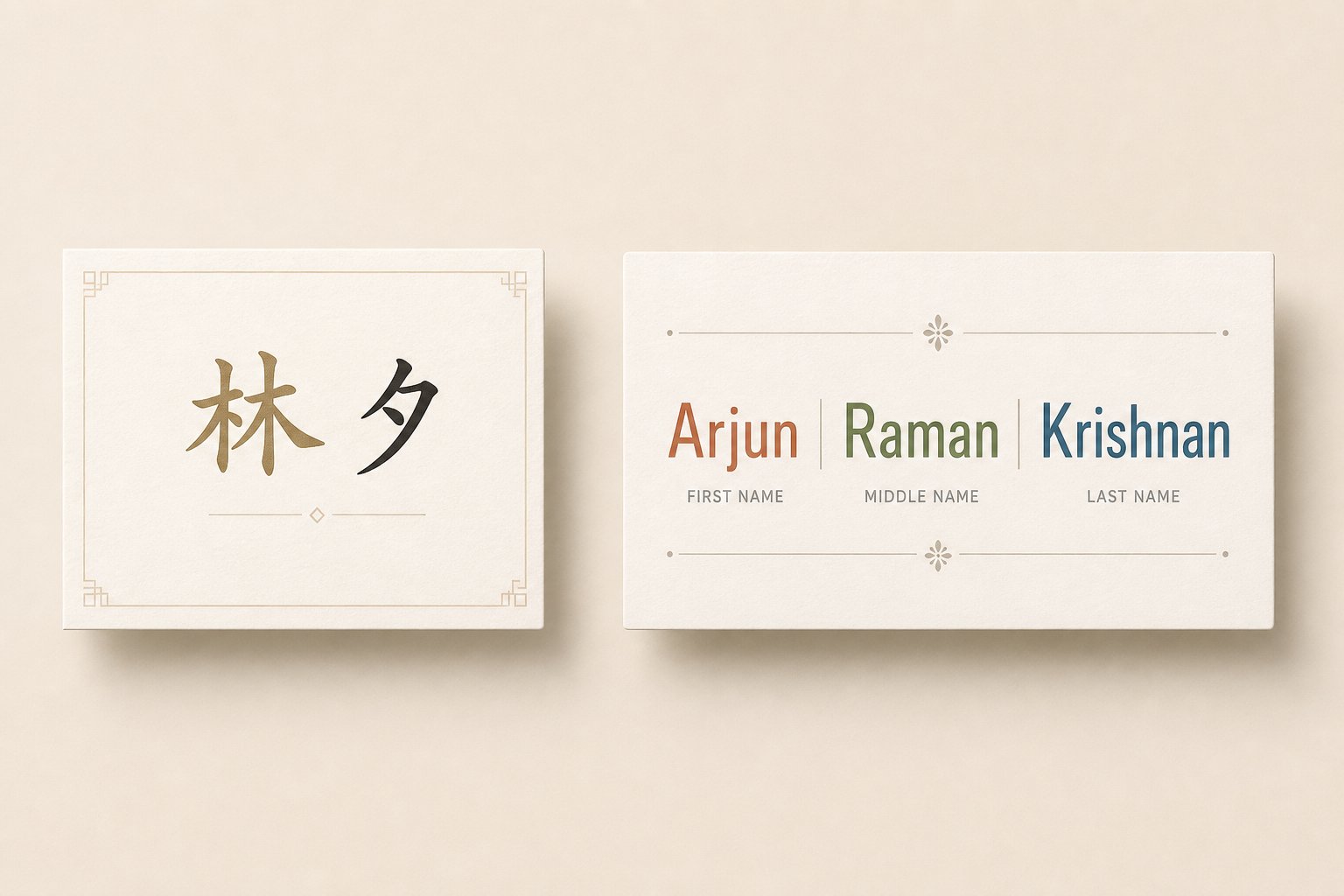
Pick up any Chinese business card and you'll notice a predictable pattern. The family name comes first, the given name follows, and the whole thing fits into two or three characters. Simple. Consistent. Now try the same exercise with ten Indian business cards from different states. You might find a father's initial before the first name, a village abbreviation, a caste suffix, or no family surname at all. The structural gap between these two systems is wider than most people expect.
Chinese Name Structure Explained
A name in Chinese follows a strict formula: surname first, given name second. The surname is almost always one character (one syllable), while the given name is typically one or two characters. That gives you a total of two or three characters for the full name. A 3 letter Chinese name like "Li Wei" or "Wang Fang" uses a single-character given name, while a three-character name like "Zhang Xiaoming" uses a two-character given name. Both formats are common.
Chinese last names are drawn from a relatively small pool. The same hundred or so surnames cover the vast majority of the population. Chinese first names, by contrast, offer enormous creative freedom. Parents select characters based on meaning, sound, stroke count, and sometimes astrological considerations. Two people with the surname Chen might have completely unrelated given names, each chosen to express a unique aspiration or family value.
The order never reverses in Chinese-language contexts. Surname always leads. This isn't a stylistic choice. It reflects a cultural priority: the family precedes the individual. When Chinese names are romanized for international use, some people flip the order to match Western conventions, which creates confusion about which part is the family name and which is the given name.
Indian Name Structure by Region
Indian naming structure doesn't follow a single national pattern. It shifts based on language, religion, region, and family tradition. According to FamilySearch's documentation on Indian naming customs, Indian names are based on a variety of systems and naming conventions that vary from region to region, influenced by religion, caste, and linguistic tradition.
Here's how the structure changes across major regions:
- Northern India typically follows a pattern closest to Western conventions: given name, middle name (often the father's first name), and a surname that usually indicates caste or clan. Example: Manohar Lal Khattar.
- Gujarati names follow the format of given name, father's first name, and family name. Narendra Damodardas Modi uses this structure, where Damodardas is his father's name and Modi is the family surname.
- Tamil names often use initials rather than full surnames. A name like "R. Karthik" expands to "Karthik son of Ravichandran." The father's name functions as a rolling patronymic rather than a fixed family surname.
- Telugu names place the family name first, followed by the given name, a pattern that actually mirrors Chinese name order. "Neelam Sanjiva Reddy" puts the family name (Neelam) before the personal name (Sanjiva).
- South Karnataka names can stack village name, father's name, and personal name. H. D. Kumaraswamy breaks down as Haradanahalli (village), Devegowda (father), Kumaraswamy (given name).
Sikh names add another layer. The format is typically given name, followed by the religious identifier Singh (for men) or Kaur (for women), and optionally a family name. Since Sikhism opposes caste distinctions, many Sikhs historically dropped family surnames entirely.
Common Misconceptions About Name Order
Two assumptions trip people up repeatedly. The first: that all Indian names follow a Western first-last format. They don't. Tamil patronymics, Telugu surname-first ordering, and South Indian initial systems all break that expectation. As the Cultural Atlas notes, the use of surnames in India is a relatively new convention introduced during British colonisation, and southern India in particular may not follow the given-name-then-surname pattern at all.
The second misconception: that Chinese given names are always one character. In reality, two-character given names are extremely common and have been for centuries. A name like "Liu Yifei" has a two-character given name (Yifei), not a middle name and a first name. There's no middle name concept in traditional Chinese naming.
| Structural Element | Chinese Names | Indian Names |
|---|---|---|
| Number of parts | 2 (surname + given name) | 2 to 4 (varies by region and religion) |
| Typical total length | 2-3 characters / syllables | 2-5 words or more |
| Name order | Always surname first | Varies: surname first (Telugu), surname last (North), initials (Tamil) |
| Regional variation | Low - consistent across China | Extremely high - differs by state, language, and religion |
| Patronymic use | Not used | Common in South India (father's name as surname) |
| Middle name | Not a traditional concept | Often father's name or a religious identifier |
These structural differences aren't just academic. They shape how names get recorded on passports, how databases handle them, and how colleagues address each other in international workplaces. A Tamil professional whose name reads "S. Venkatesh" isn't withholding a surname. That initial is the family identifier, compressed from a father's name or village of origin.
Structure tells you how a naming system is organized. But the real cultural weight sits in what surnames themselves encode, which varies just as dramatically between these two traditions.
Surname Systems That Reveal Social History
A Chinese surname tells you which ancient clan a person descends from. An Indian surname might tell you their ancestor's profession, their caste position, their home region, or their religious community. Both carry centuries of social history in a single word, but they encode that history in fundamentally different ways.
The contrast is also one of scale. China's surname pool is remarkably concentrated: roughly 100 surnames cover almost 86% of the population, according to China's Ministry of Public Security. India, by contrast, has nearly 4 million unique last names, as documented by Ancestry. That difference alone reveals how each culture organized its social fabric over millennia.
The Hundred Family Surnames and Chinese Clan Identity
Every Chinese surname traces back to an origin story rooted in ancient clan systems. The tradition of hereditary family names stretches back over 4,000 years, with legend attributing the practice to the Yellow Emperor himself. By the Song Dynasty (960-1279 AD), the most important surnames had been compiled into a classic text called the Baijiaxing, or "Hundred Family Surnames." This poem listed 504 surnames and became a standard teaching tool for young scholars learning to read.
The text was so culturally embedded that it gave rise to the Chinese expression laobaixing, meaning "one hundred old surnames," which became the colloquial term for ordinary people. When someone in China says "the common folk," they're literally referencing this surname tradition.
Here's what makes the Chinese surname system distinctive: its extreme concentration. The five most common surnames alone (Wang, Li, Zhang, Liu, and Chen) are shared by more than 433 million people, roughly 30% of the entire population. Only about 6,000 surnames remain in active use today, despite more than 20,000 having been recorded throughout history. Many disappeared through natural demographic processes, political upheaval, and migration patterns that favored larger clans.
Chinese last name meanings often connect to geography, ancient states, or ancestral occupations, but these origins are so old that the connection is primarily historical rather than socially functional. The surname in Chinese culture functions as a clan marker. It tells you which lineage you belong to, which ancestral hall your family maintains, and which genealogical records document your history. Two strangers sharing the surname Zhong, for instance, can trace their connection back to a single ancestor named Qi who adopted the name from Zhongli Mountain during the late Qin Dynasty (221-206 BC).
Chinese surnames meaning and identity are inseparable. Families and clans kept their own documentation for centuries, making the surname the first key to unlocking any family history research. Unlike Western societies where church or state authorities maintained identity records, Chinese families relied on clan-based genealogies organized entirely around the shared surname.
How Indian Surnames Encode Caste and Occupation
Indian surnames names work on an entirely different principle. Rather than connecting people to a single ancient clan, they encode multiple layers of social information simultaneously. A single Indian surname can reveal caste position, ancestral occupation, geographic origin, and religious affiliation.
Consider these examples:
- Sharma (approximately 5 million bearers) - traditionally indicates Brahmin caste, the priestly and scholarly class. The word derives from Sanskrit meaning "joy" or "shelter."
- Patel (over 4.2 million bearers) - means "village headman" in Sanskrit, indicating a family's historical role as local administrators, particularly in Gujarat.
- Iyer - identifies Tamil Brahmins specifically, combining caste and regional information in one word.
- Khan (over 4.5 million bearers) - a Muslim surname meaning "military ruler," signaling both religious community and historical status.
- Singh (nearly 35 million bearers) - adopted by Sikhs in 1699 when Guru Gobind Singh instructed followers to add the suffix to their names, deliberately rejecting caste-based surnames.
The sheer diversity is staggering. Where China concentrates its population into a few thousand active surnames, India spreads across nearly 4 million unique ones. This reflects India's extraordinary linguistic, religious, and regional fragmentation. A surname that's common in Maharashtra might be unrecognizable in Tamil Nadu.
Location plays a particularly significant role. Surnames like Mukherjee (from Bengal), Reddy (from Andhra Pradesh and Telangana), and Nair (from Kerala) immediately place a family geographically. Occupational origins are equally transparent: Dhobi (washerman), Lohar (blacksmith), and Gandhi (greengrocer) all preserve the ancestor's trade in the family name.
There's also a deliberate rejection happening. Because some surnames clearly indicate caste, many Indians have chosen to drop or change their surnames to dissociate from the caste system. The surname Devi, which is the most common in India with over 70 million bearers, is often adopted as a neutral alternative. Kumar serves a similar function, used widely across caste lines as a non-specific identifier.
Structural Parallels Between Both Systems
Despite their differences, both surname traditions share a core function: they anchor individuals within a larger social group. A Chinese surname connects you to a clan with shared ancestors, shared genealogies, and often shared ancestral halls. An Indian surname connects you to a community defined by occupation, faith, or regional identity. Both systems answer the same fundamental question: "Where do you come from?"
Both systems also face modern pressures. Chinese rare surnames are disappearing as digital systems can't process uncommon characters. Indian caste-indicating surnames are being abandoned by families seeking to escape social stigma. In each case, the surname's social encoding, once a source of belonging, becomes a liability in changed circumstances.
| Characteristic | Chinese Surnames | Indian Surnames |
|---|---|---|
| Number in common use | Approximately 6,000 (100 cover 86% of population) | Nearly 4 million unique surnames |
| What they encode | Ancient clan lineage and ancestral origin | Caste, occupation, religion, region, or a combination |
| Historical origin | Clan systems dating back 4,000+ years; codified in Song Dynasty Baijiaxing | Evolved from varna/caste system, occupational guilds, and regional identities |
| Social function | Clan identification and genealogical continuity | Social positioning across caste, faith, and geography |
| Concentration | Extremely high (top 5 surnames cover 30% of population) | Highly dispersed across regions and communities |
| Modern pressures | Rare surnames lost to digital incompatibility | Caste surnames dropped to resist social stratification |
The surname tells you where someone fits in the social architecture of their culture. But within that architecture, given names carry a different kind of weight. They express not group belonging but individual identity, and in both traditions, one of the strongest signals a given name carries is gender.
Gender Encoding in Names Across Both Traditions
Given names do more than distinguish one person from another. In both Chinese and Indian cultures, they often signal gender through specific characters, sounds, or suffixes. But the mechanisms differ sharply. Chinese names embed gender through the meaning of individual characters. Indian names rely on phonetic patterns, grammatical endings, and in some cases, explicit religious identifiers that leave no ambiguity at all.
Gender Markers in Chinese Given Names
Chinese names for boys and Chinese names male traditions draw from a distinct pool of characters associated with strength, ambition, and the natural world's more imposing elements. Chinese feminine names, by contrast, lean toward beauty, grace, and delicacy. This isn't a rigid rule, but a strong cultural tendency that has shaped naming for centuries.
Here are character elements traditionally associated with each gender:
Traditionally masculine Chinese name elements:
- Wei (meaning great, mighty)
- Qiang (strong)
- Jun (army, military)
- Zhi (ambition, will)
- Shan (mountain)
- Long (dragon)
- Gang (steel, firm)
Traditionally feminine Chinese name elements:
- Mei (beauty, plum blossom)
- Hua (flower)
- Xiu (elegant, graceful)
- Fang (fragrant)
- Yan (swallow bird, or beautiful)
- Jing (quiet, gentle)
- Yue (moon)
A 2025 dataset study published in Scientific Data analyzed over 30 million Chinese names and found that more than 80% of individuals could have their gender correctly predicted from their given name characters alone, using a high-confidence threshold. Only about 4.82% of Chinese names in characters fell into a truly gender-neutral zone. This confirms that character choice remains a strong gender signal in Chinese naming, even if the boundaries are culturally constructed rather than grammatically enforced.
The key distinction: nothing in the Chinese language grammatically requires a name to match a person's gender. Chinese first names female and male categories exist by convention, not by rule. A character like "Yu" (jade) appears in both masculine and feminine names depending on context and pairing.
How Indian Languages Signal Gender Through Names
Indian naming traditions encode gender through linguistic grammar, phonetic endings, and religious markers, creating a more structurally embedded system than Chinese. The signals vary by language:
- Hindi and Sanskrit-derived names - female names typically end in vowel sounds like "-a" or "-i" (Sunita, Priya, Kavita), while male names often end in consonants or the vowel "-a" with different stress (Rahul, Vikram, Suresh)
- Tamil names - may use suffixes like "-ammal" or "-lakshmi" for women and "-an" or "-am" for men
- Bengali names - female names frequently end in "-i" or "-a" (Anindita, Swati), while male names end in "-o" or consonants (Subho, Arnab)
- Sikh names - use Kaur (meaning princess) for women and Singh (meaning lion) for men as a universal gender identifier attached after the given name
The Sikh system is particularly distinctive. As the SikhiCouncil explains, most Sikh first names are actually gender-neutral because they derive from spiritual writings (Gurbani) that don't distinguish between genders. Names like Harpreet, Gurdeep, or Jaspreet work for anyone. It's the addition of Singh or Kaur that clarifies gender. This means a Sikh family doesn't need to choose a gender-specific first name at all. If a boy is born instead of a girl, the same first name works with Singh replacing Kaur.
Modern Shifts in Gendered Naming
Both traditions are evolving. Chinese parents increasingly choose characters that don't fall neatly into masculine or feminine categories. Names built around concepts like wisdom (Zhi), rain (Yu), or morning (Chen) appear across genders with growing frequency. The same dataset study noted that converting Chinese names to Pinyin (romanized spelling) makes gender prediction significantly harder, partly because gender-neutral naming trends blur the traditional character associations.
In India, urban families are gravitating toward shorter, phonetically softer names that work across languages and don't immediately signal caste or region. Names like Arya, Kiran, and Noor function as gender-neutral choices in many Indian communities. The Sikh tradition, which built gender-neutrality into its first-name system over 300 years ago, now looks remarkably forward-thinking in this context.
Gender encoding reveals how deeply cultural values are woven into the act of naming. But the name itself is only part of the story. The rituals surrounding when and how a child receives that name carry their own layers of meaning, and they differ just as dramatically between these two traditions.
Naming Ceremonies and Rituals Compared
A name doesn't just appear on a birth certificate and call it done. In both Chinese and Indian cultures, the moment a child receives a name is wrapped in ceremony, symbolism, and spiritual intention. The rituals differ in timing, participants, and guiding philosophy, but they share a common belief: that the act of naming is sacred enough to deserve its own formal event.
Chinese Full-Month Naming Celebrations
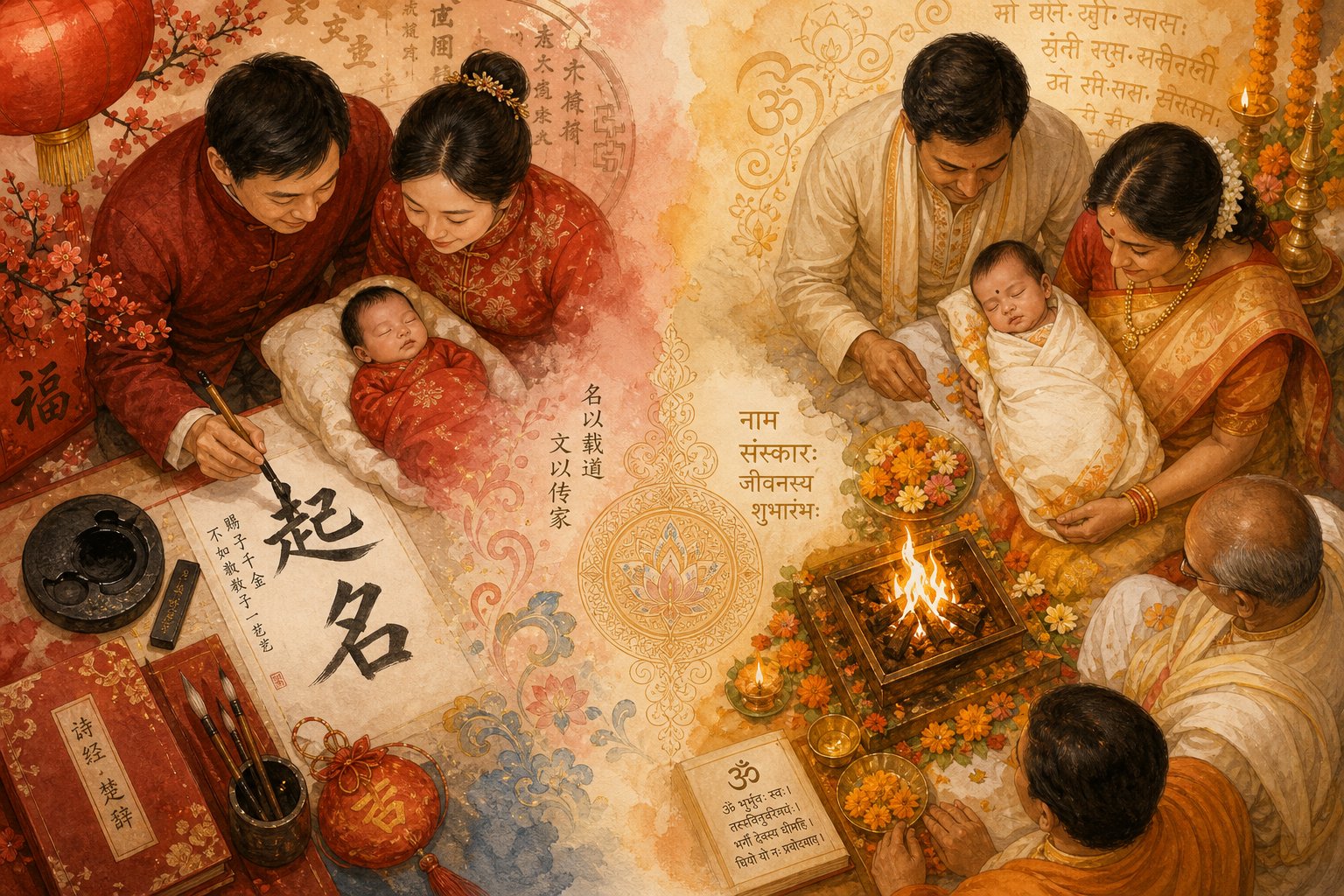
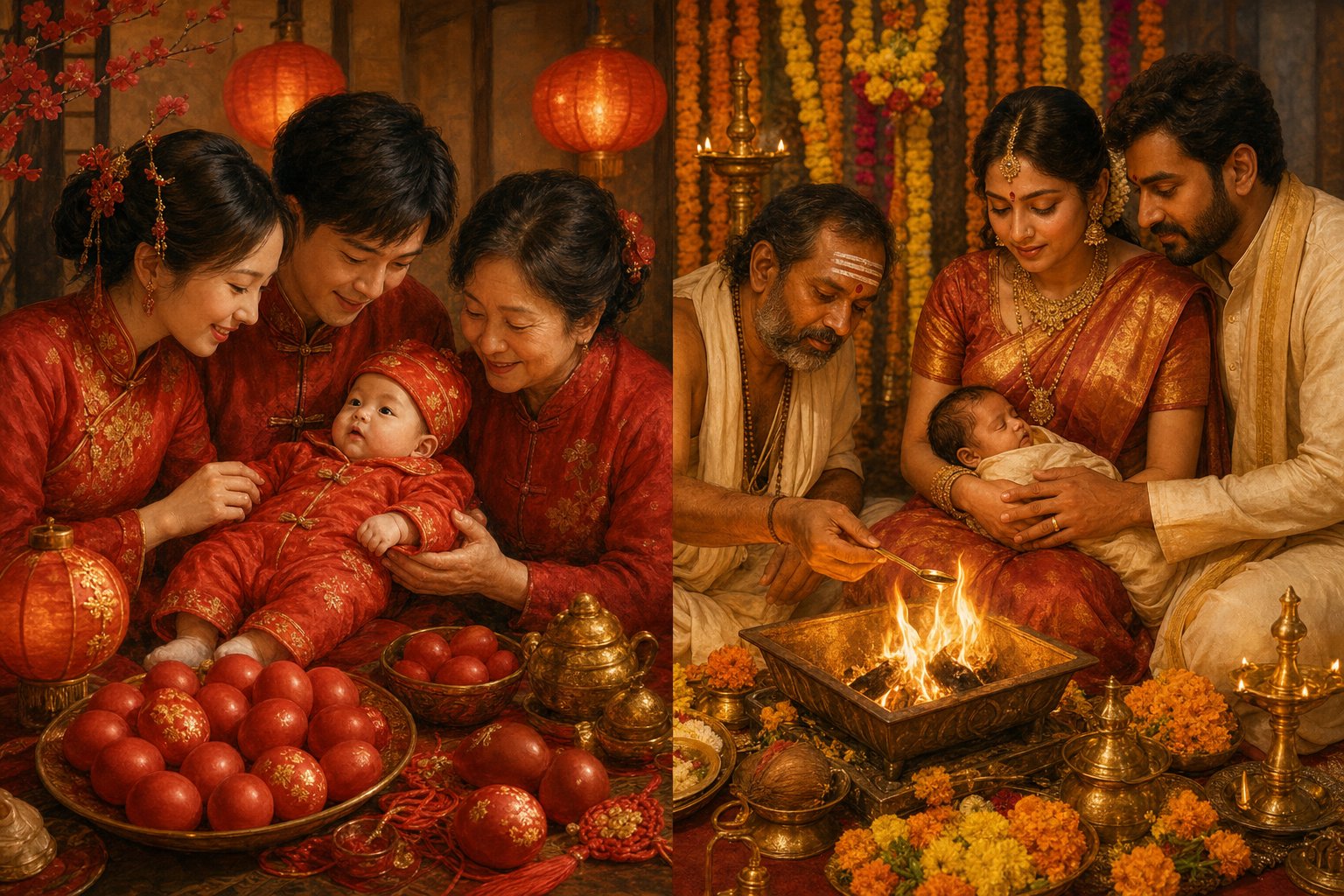
In Chinese tradition, a baby's name is formally announced during the full-month celebration, known as the manyue ceremony. This event marks the child's first 30 days of life and historically served a practical purpose: infant mortality was high, so families waited a full month before publicly celebrating the birth and revealing the chosen name.
The ceremony itself is rich with symbolic objects and blessings. According to traditional custom guides, the ritual involves rolling a red chicken egg over the baby's face (wishing for a smooth complexion), placing a stone on the child's chest (for courage), sliding green onions over the head (for intelligence), and patting celery on the arms (for diligence). Each item carries a specific blessing tied to the child's future character.
The baby's first haircut also happens during this ceremony, symbolizing the shedding of misfortune and the start of a fresh path. The child's footprint is pressed into red ink, representing career advancement and steady progress. Family elders lead the blessings, and the event doubles as a community gathering where relatives and friends formally meet the newest family member.
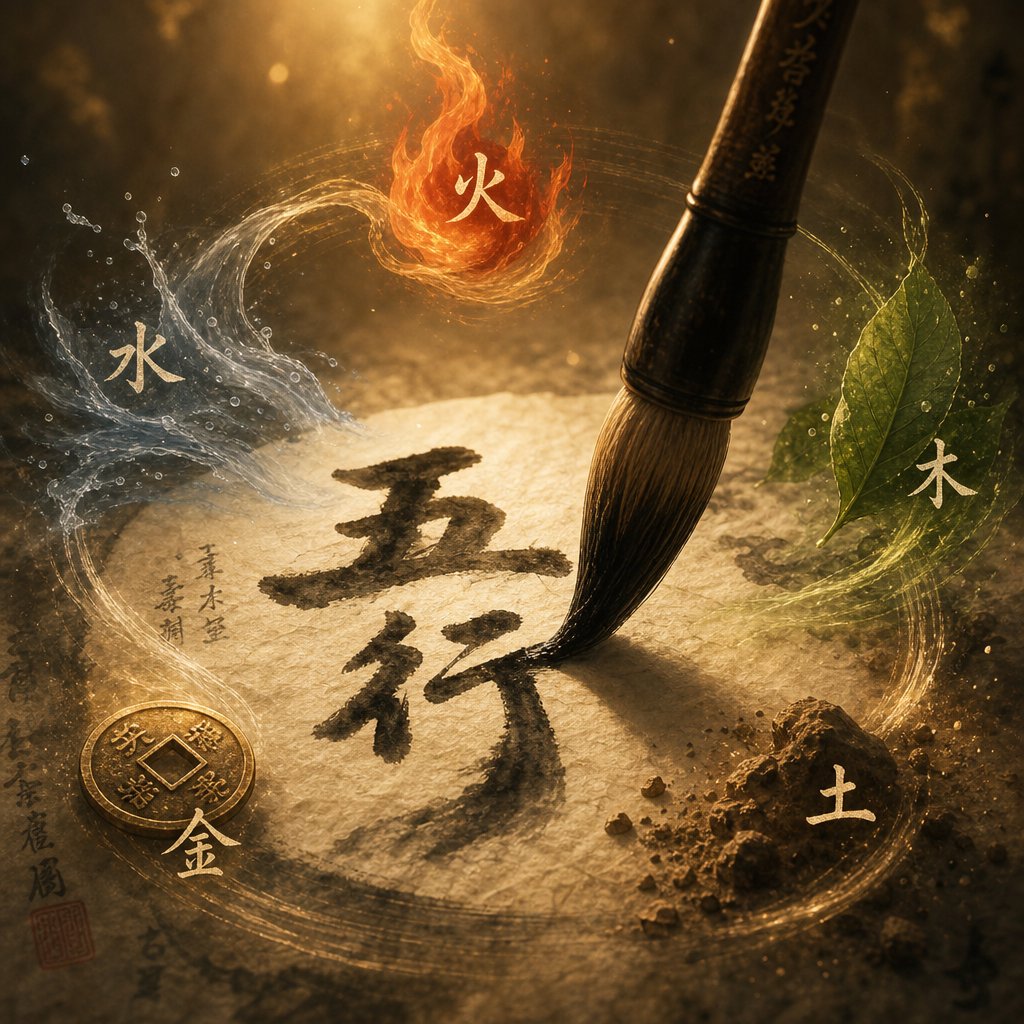
But the name itself? That's often decided well before the ceremony. Historically, parents consulted fortune tellers or naming specialists who analyzed the baby's birth time using the bazi system (eight characters representing year, month, day, and hour of birth). Each chinese baby name carries weight in this framework. The goal is to select characters that balance the child's elemental composition: fire, water, wood, metal, and earth. A child born with too much fire energy, for example, might receive a name containing water-related characters to restore harmony. Every mandarin name meaning is evaluated not just for its dictionary definition but for its energetic compatibility with the child's birth chart.
Hindu Namkaran and Astrological Guidance
The Hindu naming ceremony, called Namkaran Sanskar, is one of the sixteen essential rituals (samskaras) in Vedic culture. It typically takes place on the 12th day after birth, though some families choose other auspicious dates based on the priest's guidance.
Here's where the astrological dimension gets specific. The baby's birth chart is analyzed to determine the Moon's position within a particular Nakshatra (lunar constellation). Each Nakshatra corresponds to specific syllables, and the child's name should begin with one of these auspicious letters. This isn't a casual suggestion. Vedic astrology holds that a name aligned with the Moon's Nakshatra activates the energy of the birth chart, guiding the child toward favorable outcomes throughout life.
The ceremony itself involves a fire ritual (havan) performed by a priest, invocations of ancestors, and the formal announcement of the chosen name in the presence of family members. The mother holds the child while the priest recites mantras, energizing the five elements (fire, earth, water, metal, and wood) within the newborn. The name in chinese meaning traditions carries elemental weight too, but the Hindu system ties the name directly to a specific celestial position at the moment of birth, making it arguably more astronomically precise.
Gifts are exchanged, and the event becomes a celebration of the family's newest member. Clothes, toys, and baby care items are common offerings from guests who attend the Namkaran.
Religious Diversity in Indian Naming Rituals
India's naming ceremonies aren't limited to the Hindu tradition. The country's religious diversity means multiple distinct rituals coexist:
- Sikh naming uses the Hukamnama, a random reading from the Guru Granth Sahib (the holy scripture). The first letter of the hymn that appears becomes the starting letter of the child's name. This happens at the Gurdwara (Sikh temple), making the naming a communal and spiritually guided act rather than a family-only decision.
- Muslim Indian families often perform the Aqiqah, traditionally held on the seventh day after birth (though it may be postponed to the 14th or 21st day). The ceremony involves the sacrifice of one or two sheep or goats, with one-third of the meat given to the poor as charity. The baby's head is shaved, and the weight of the hair in gold or silver is donated. The child's name is officially announced during this event.
- Christian Indian families typically name the child at baptism, following the broader Christian tradition of combining a saint's name or biblical name with the family surname.
The contrast is striking. Chinese naming ritual is culturally uniform: one ceremony, one timing, one set of symbolic objects, regardless of whether the family is Buddhist, Taoist, or non-religious. Indian naming ritual fragments along religious lines, with each community maintaining its own timing, authority figures, and spiritual logic.
| Element | Chinese Full-Month Ceremony | Hindu Namkaran | Sikh Naming | Muslim Aqiqah |
|---|---|---|---|---|
| Timing | 30 days after birth | 12th day after birth (varies) | Within days or weeks at Gurdwara | 7th day (or 14th/21st day) |
| Key participants | Family elders, relatives, community | Priest, mother, family members | Granthi (scripture reader), congregation | Parents, extended family, community |
| Guiding principle | Elemental balance (bazi), auspicious characters | Moon's Nakshatra position at birth | Random scripture reading (Hukamnama) | Sunnah tradition, gratitude to Allah |
| Religious element | Cultural/folk spiritual (not tied to one religion) | Vedic mantras and fire ritual | Guru Granth Sahib reading | Animal sacrifice, charitable donation |
| Name selection method | Meaning, sound, stroke count, elemental harmony | Astrologer determines auspicious first letter | First letter from random hymn | Family choice (often Prophet's companions' names) |
What unites all these ceremonies is the conviction that naming isn't a bureaucratic act. It's a spiritual one. Both Chinese and Indian traditions treat the chinese name meaning or the Sanskrit syllable as something that shapes a child's destiny, not merely labels it. The difference lies in who holds the authority: in Chinese tradition, it's the family consulting specialists; in Indian traditions, it's a priest, a scripture, or the stars themselves.
These ceremonies mark the beginning of a child's named identity. But names don't exist in isolation. They connect to the generation before and the generation after, and both cultures have developed elegant systems for embedding that continuity directly into the name itself.
Generational Naming Patterns and Family Lineage
A name can do more than identify one person. It can map an entire family tree. Both Chinese and Indian cultures embed generational information directly into names, but they achieve this through opposite mechanisms. Chinese families lock a shared character across an entire generation of cousins. South Indian families roll the father's personal name forward into the child's surname. One system is horizontal, linking siblings and cousins. The other is vertical, linking parent to child in a continuous chain.
Chinese Generation Poems and Shared Characters
Imagine a poem written centuries ago that still determines what character appears in your child's name today. That's exactly how Chinese generation poems work. A clan composes a poem, typically four to eight lines, and each character in the poem corresponds to one generation. All children born into that generation share the designated character as part of their given name.
The tradition of generational names and characters began roughly 2,000 years ago during the Han Dynasty (206 BC - 220 AD). Just prior to the Song Dynasty (960-1276 AD), Chinese families formalized the practice by composing dedicated generational poems. These poems typically praise ancestors while voicing hope and prosperity for future generations. The Gom Benn Wong family, for example, used a poem written by Ming Dynasty scholar Wong Shi Jun around the 1600s that guided naming for nearly 300 years across more than a dozen generations.
Here's how it works in practice. If the poem's third line reads "world, pass, etiquette, righteousness, weight," then the 22nd generation uses the character for "world," the 23rd uses "pass," the 24th uses "etiquette," and so on. All cousins in the 23rd generation, even very distant ones, share that same character in their given name. You could meet a stranger with your surname and generation character and immediately know your exact familial relationship.
This system creates an embedded family tree within names themselves. Two people named Wong Chun Fot and Wong Chun Sing instantly recognize each other as belonging to the same generation because they share the "Chun" character. No genealogy book required.
The practice declined in the early 20th century as urbanization pulled families away from ancestral villages. As researchers Li Zhonghua and Edwin D. Lawson noted, the generation name system depended on rural clan life where members lived together and needed marks to distinguish genealogical hierarchy. City life eroded that foundation. Yet their 2015 survey found that roughly 20-30% of Chinese university students still carried a generational name, suggesting a quiet revival tied to renewed interest in traditional culture.
South Indian Patronymics and Rolling Surnames
South Indian naming takes the opposite approach. Rather than fixing a shared character across one generation, it creates a rolling link between parent and child. In Tamil tradition, the father's given name becomes the child's surname or initial. When that child grows up and has children of their own, their given name becomes the next generation's surname.
Consider this sequence: a man named Govindasamy names his daughter Mahalakshmi. Her full name becomes Mahalakshmi Govindasamy. If Mahalakshmi has a son named Karthik, he becomes Karthik Mahalakshmi's-husband's-name, continuing the chain. As the Library Association of Singapore's research documents, Tamil names traditionally don't include a fixed family surname at all. Both males and females use their father's name as their first initial or prefix.
The former Indian President A.P.J. Abdul Kalam illustrates this beautifully. The initials encode three generations: A for his great-grandfather Avul, P for his grandfather Pakir, and J for his father Jainulabdeen. His name is literally a compressed genealogy.
North Indian families use a different mechanism: the gotra system. A gotra connects a family to one of the ancient Vedic sages believed to be the original ancestor of the lineage. While gotra names don't appear in everyday use the way generation characters or patronymics do, they govern marriage rules (you cannot marry within the same gotra) and surface during religious ceremonies. The gotra functions as an invisible lineage thread running beneath the visible name.
How Both Systems Embed Family History
The Chinese courtesy name tradition adds another layer to this generational architecture. Historically, when a young man reached adulthood (around age 20), he received a zi, or courtesy name, used by peers and colleagues as a mark of respect. The original given name became reserved for elders and the individual himself. Chinese honorifics and naming etiquette meant that using someone's given name directly could be considered rude. The courtesy name served as a social buffer, a public-facing identity distinct from the intimate family name.
This practice has largely faded in modern China, but it reveals something important: Chinese naming historically wasn't a one-time event. Identity accumulated across life stages, with names layered on at birth, at generational assignment, and at adulthood.
Both Chinese and Indian traditions prioritize family continuity in names, but they achieve it through opposite mechanisms. Chinese generation poems link sideways across cousins. Indian patronymics link downward from parent to child. One creates a generational snapshot. The other creates a rolling chain.
What's remarkable is that both systems solve the same problem: how do you encode belonging across time? The Chinese answer is synchronic, marking everyone alive in the same generation with a shared identifier. The Indian answer is diachronic, passing identity forward one link at a time. Neither approach is better. Both ensure that a name carries more than individual identity. It carries history.
These generational systems evolved within cultures that stayed geographically rooted for centuries. But what happens when families cross oceans and settle in countries where neither system is understood? The pressures of diaspora life are reshaping both traditions in ways their ancestors never anticipated.
How Globalization Is Changing Both Naming Traditions
Move to a new country and your name becomes a daily negotiation. Do you keep it intact and correct people for years? Do you shorten it? Do you adopt an entirely new name for professional life? Chinese and Indian diaspora families answer these questions differently, but both face the same underlying tension: how much of your naming tradition do you preserve when the surrounding culture can't pronounce, spell, or understand it?
Chinese Western Name Adoption in Diaspora
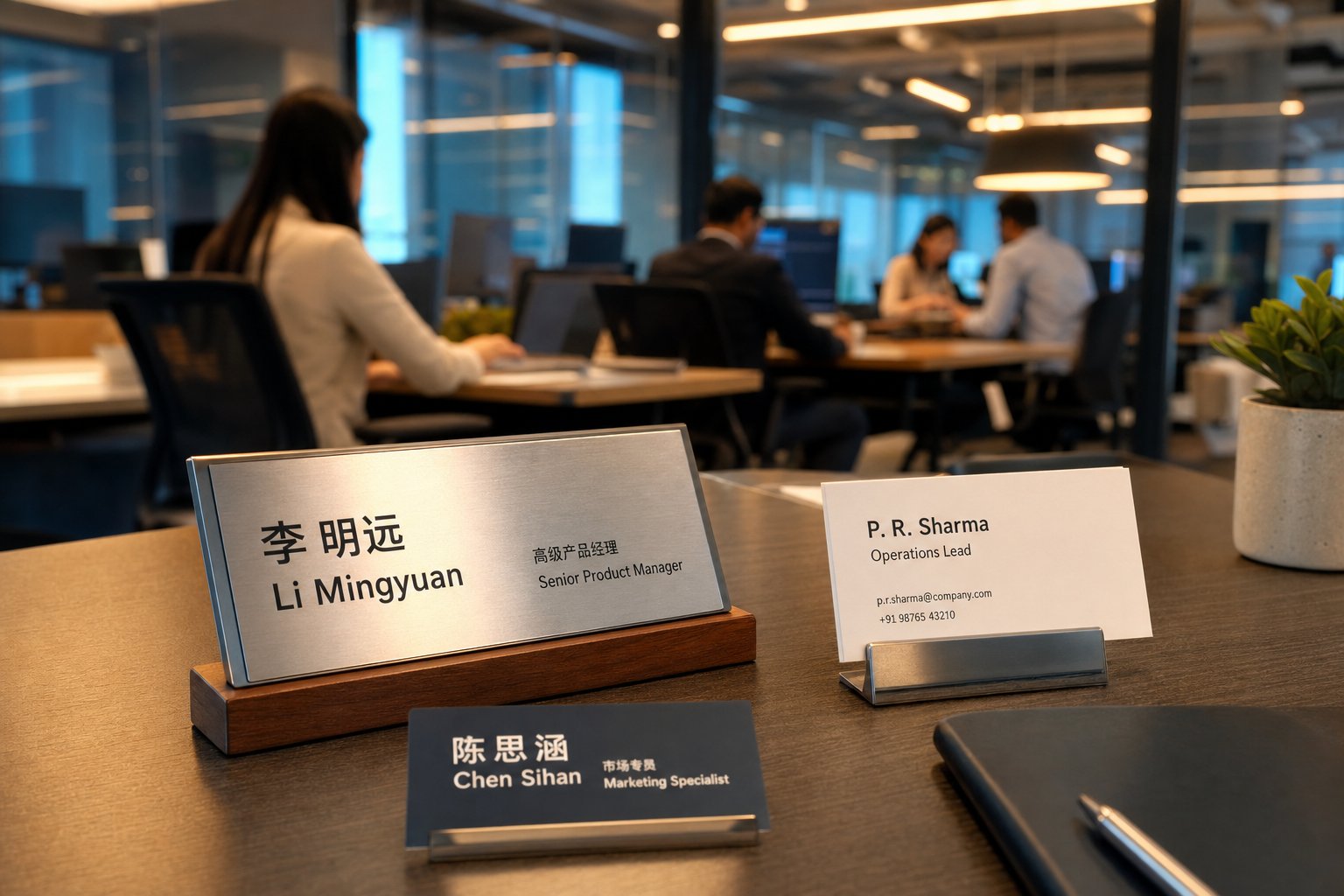
Walk into any multinational office in Toronto, Sydney, or San Francisco and you'll meet people who go by "Kevin" at work and "Jiahao" at home. The practice of choosing an english name chinese name pair is so widespread among Chinese immigrants and international students that it's become a cultural norm rather than an exception.
The process of converting an english to chinese name or selecting chinese names for english names doesn't follow a single formula. Some families pick a Western name that phonetically echoes their Chinese given name. A person named "Wei" might choose "Wayne" or "Vivian." Others select a name purely for its meaning, finding an English equivalent that carries similar aspirations. Still others simply pick a name they like from a movie, a teacher, or a list their English tutor provided in school.
This creates a dual-name identity that operates across contexts. The Chinese name remains the legal name on passports and family documents. The English name appears on business cards, email signatures, and coffee orders. Neither name is fake. Both are real, serving different social functions. The chinese name from english name relationship isn't a translation. It's a parallel identity.
What's interesting is the direction of this adaptation. Chinese names into english contexts rarely involve changing the actual Chinese name. The original stays intact for family use, ancestral records, and cultural continuity. The Western name is additive, layered on top without erasing what's underneath. This preserves the generational poems, the elemental balance, and the family meaning embedded in the original characters.
For second and third-generation Chinese diaspora families, the calculation shifts. Many parents now give their children a legal Western first name with a Chinese middle name, reversing the priority. The child grows up using the English name daily while the Chinese name surfaces during family gatherings, cultural celebrations, and visits to grandparents.
Indian Name Simplification Trends Abroad
Indian diaspora families face a different set of pressures. The challenge isn't just pronunciation. It's length, structure, and the social information that surnames carry into new contexts.
A South Indian name like Venkatanarasimharajuvaripeta Subramanyam doesn't fit neatly into Western database fields, airline booking systems, or workplace name badges. Families make pragmatic choices: shortening patronymics to initials, dropping village-name prefixes, or selecting a single element from a multi-part name to serve as the official surname abroad.
The surname question cuts deeper for many Indian families. As research on Indian diaspora communities documents, surnames remain a primary mechanism for caste identification even outside India. In one of the first caste surveys conducted in the US in 2018, 59% of the 1,200 South Asian participants reported experiencing casteist insults and jokes. Surnames function as the entry point for this identification. Asking "What's your last name?" in diaspora settings often serves as a coded inquiry into caste position.
This reality pushes some families toward deliberate surname changes. Dropping a caste-indicating surname like Iyer or Chamar in favor of a neutral alternative (Kumar, Raj, or simply using a first-name-only format) becomes an act of self-protection. Others retain their surnames as a point of pride or cultural continuity, accepting the social weight that comes with them.
Younger generations face additional pressures around pronunciation accessibility. Parents increasingly choose shorter names that work phonetically across English, Hindi, and other languages: Ria instead of Rishika, Dev instead of Devendra, Nia instead of Niharika. The goal is a name that doesn't require repeated spelling or correction in school roll calls and job interviews.
Practical Tips for Cross-Cultural Name Etiquette
Sounds complex? In practice, most naming mistakes in multicultural workplaces come down to a handful of recurring errors. As workplace diversity research emphasizes, mispronouncing someone's name isn't a minor slip. It signals that their identity isn't worth the effort of learning. People who experience repeated mispronunciation often disengage, stop correcting others, and participate less in group settings.
Here are the most common mistakes people make with Chinese and Indian names, and how to avoid them:
- Assuming the first word is always the given name. For Chinese names written in traditional order (surname first) and some Telugu names, the first element is the family name. Ask which name the person prefers to be called rather than guessing.
- Shortening a name without permission. Calling "Subramanyam" just "Sub" or reducing "Xiaoming" to "Xiao" without asking treats the name as an inconvenience rather than an identity. Always ask before abbreviating.
- Assuming the English name is the "real" name. When a Chinese colleague introduces themselves as "David," their Chinese name isn't a secret or lesser identity. If they share it, use it correctly in appropriate contexts.
- Asking an Indian person's surname to determine their caste or community. This practice, common in South Asian social settings, carries discriminatory undertones even when the intent seems casual. Avoid probing questions about last names beyond what's needed for professional purposes.
- Treating initials as incomplete information. A Tamil colleague whose name reads "S. Venkatesh" isn't missing a surname. The initial represents a patronymic system. Don't press for "the full name" as if something is being withheld.
- Mispronouncing and never correcting yourself. Research before meeting someone. YouTube pronunciation channels and sites like PronounceNames.com exist specifically for this purpose. If you're unsure, open with "Am I pronouncing your name correctly?" rather than guessing repeatedly.
- Defaulting to nicknames to avoid discomfort. Calling someone "buddy" or "mate" because their name feels difficult centers your comfort over their identity. Practice the pronunciation until it becomes natural.
The workplace etiquette extends to documentation too. HR systems, email directories, and official records should accommodate names that don't fit a first-middle-last template. A single "name" field works better than rigid boxes that force South Indian patronymics or Chinese two-character given names into structures designed for Anglo-Saxon naming conventions.
Both Chinese and Indian naming traditions are adapting to globalization without abandoning their roots. The adaptations look different: Chinese families add a parallel Western name while preserving the original. Indian families simplify, shorten, or strategically modify surnames to navigate new social landscapes. But in both cases, the core cultural values encoded in names, family continuity, aspiration, and belonging, persist beneath whatever surface adjustments diaspora life demands.
With all these dimensions explored individually, the full picture of how these two traditions compare becomes clearer. A side-by-side summary reveals not just the differences, but the surprising parallels that connect them.
Side-by-Side Comparison of Every Key Difference
You've seen how each dimension plays out individually. Here's the full picture in one place. Whether you're a writer building authentic characters, a professional navigating multicultural teams, or simply curious about how the most popular Chinese names and common Indian names carry cultural DNA, this matrix distills everything into a single scannable reference.
Complete Comparison Matrix
| Dimension | Chinese Naming Tradition | Indian Naming Tradition |
|---|---|---|
| Name structure | 2-3 characters; surname always first, given name second | 2-5 words; order varies by region (surname first in Telugu, last in North India, initials in Tamil) |
| Surname count | ~6,000 active; top 100 cover 86% of population | ~4 million unique surnames across religions, castes, and regions |
| Gender encoding | Character meaning signals gender (strength vs. beauty); no grammatical rule | Phonetic endings, linguistic suffixes, and religious identifiers (Singh/Kaur) signal gender |
| Naming ceremony | Full-month celebration (manyue); culturally uniform across religions | Varies by faith: Hindu Namkaran (12th day), Sikh Hukamnama, Muslim Aqiqah (7th day) |
| Generational patterns | Generation poems assign a shared character across all cousins in one generation (horizontal linking) | Patronymics pass father's name to child as surname (vertical linking); gotra for deep lineage |
| Diaspora adaptation | Additive: Western name layered on top; original Chinese name preserved intact | Subtractive: names shortened, initials compressed, caste surnames sometimes dropped |
| Name meaning philosophy | Characters chosen for aspiration, elemental balance, and phonetic harmony with surname | Names chosen for astrological alignment (Nakshatra syllable), religious devotion, or aspirational meaning |
| Astrological influence | Bazi system (birth time elements) guides character selection for balance | Moon's Nakshatra position determines auspicious starting letter |
| Regional variation | Low: one dominant system with minor romanization differences | Extremely high: conventions shift by state, language, and religious community |
Key Similarities Often Overlooked
The differences are obvious. The parallels are more revealing. Both traditions treat naming as a deliberate, meaning-laden act rather than a casual preference. Typical Chinese names encode parental hopes through character meaning. Common Indian names do the same through Sanskrit roots, divine references, or nature imagery. Neither culture treats a name as arbitrary sound.
Both systems also rely on astrology to guide name selection, just through different frameworks. The Chinese bazi system and the Hindu Nakshatra system both analyze the moment of birth to determine which name elements will bring harmony to the child's life. Both cultures consult specialists (fortune tellers in China, priests or astrologers in India) rather than leaving the decision entirely to parental taste.
And both face the same modernization pressures: younger generations choosing shorter names, gender-neutral options gaining ground, and digital systems forcing simplification of complex naming structures. The meaning of Chinese names and the significance of Indian names are both being renegotiated in real time, shaped by the same global forces even as they respond in culturally distinct ways.
These parallels matter because they reveal a shared human impulse beneath the structural differences. Every family, regardless of tradition, wants a name that carries weight, connects to something larger, and sets a child on a good path. The mechanics differ. The motivation doesn't.
Practical Takeaways for Understanding Both Traditions
Shared motivation doesn't eliminate the need for specific, practical knowledge. Whether you're writing a novel, onboarding a colleague from Chennai, or exploring what is my chinese name through a chinese name translation service, the details matter. Here's how to apply everything covered in this comparison to real situations.
For Writers and Creators
Building authentic multicultural characters means getting naming conventions right at the structural level. A Chinese character named "Ming Zhang" has their name reversed from how it would appear in China. A Tamil character with a Western-style surname might be misrepresenting how South Indian names actually work. Small details like these signal to readers whether the author did their research.
When writing Chinese characters, remember that the surname leads and the given name follows. A two-character given name is just as common as a single character. Cantonese names romanize differently from Mandarin ones (Wong vs. Wang, Chan vs. Chen), so the character's regional background should match their name's spelling. For Indian characters, decide which region, religion, and language community they belong to first. That single decision determines whether they use a patronymic initial, a caste surname, a religious identifier like Singh, or no family name at all.
For Multicultural Professionals
Cross-cultural name etiquette isn't about memorizing rules for every culture. It's about replacing assumptions with questions. As National Training's guide on respectful introductions emphasizes, starting formal and letting the other person guide you toward informality is the safest default across cultures. Ask "What would you like me to call you?" rather than guessing which part of a name is the given name and which is the family name.
For HR teams and system designers, the practical implication is clear: rigid first-middle-last name fields fail both traditions. A flexible name system that accommodates initials, single-word names, surname-first ordering, and dual-language entries respects the actual diversity of how an asian name functions in the real world.
Respecting Naming Traditions in Practice
Neither Chinese nor Indian naming is monolithic. Treating either as a single system flattens centuries of regional, religious, and generational variation. A Cantonese family in Hong Kong names differently from a Mandarin family in Beijing. A Sikh family in Punjab names differently from a Hindu family in Tamil Nadu. The specifics always matter more than the generalizations.
Here are the five most actionable takeaways from this entire comparison:
- Never assume name order. Chinese names place the surname first. Some Indian names do too (Telugu). Others use initials, patronymics, or no surname at all. Ask rather than guess.
- Recognize that a Western name isn't a replacement. A Chinese colleague's English name and their Chinese name are parallel identities, not a real name and a fake one. Both deserve respect.
- Don't probe surnames for social information. Indian surnames can encode caste, and asking about them in social settings carries discriminatory weight even when the intent seems innocent.
- Understand that naming ceremonies carry spiritual significance. Whether it's a Chinese full-month celebration or a Hindu Namkaran, these rituals aren't quaint traditions. They reflect deeply held beliefs about how names shape destiny.
- Accept complexity rather than forcing simplification. A name that doesn't fit your database schema or your pronunciation comfort zone isn't broken. The system that can't accommodate it is.
Both traditions continue to evolve. Chinese parents experiment with rare characters and gender-neutral meanings. Indian families choose shorter, cross-linguistic names that travel well across borders. Generation poems fade in some clans and revive in others. Caste surnames get dropped by one family and reclaimed with pride by the next. The traditions aren't frozen artifacts. They're living systems responding to the same pressures of globalization, technology, and shifting values that reshape every culture.
What remains constant is the underlying conviction that names carry weight. They aren't arbitrary labels assigned for administrative convenience. In both Chinese and Indian traditions, a name is a gift, a blessing, and a map. It tells you where someone comes from, what their family hopes for them, and how they fit into a story much larger than themselves.
Frequently Asked Questions About Chinese and Indian Naming Traditions
1. What is the main structural difference between Chinese and Indian names?
Chinese names follow a consistent two-to-three character format with the surname always placed first and the given name second. Indian names vary dramatically by region, religion, and language, ranging from two to five or more words. Some Indian naming systems use patronymics (father's name as surname), initials representing village or ancestral names, or place the surname first (as in Telugu tradition). This means Chinese naming is relatively uniform across the country, while Indian naming can shift entirely depending on whether a family is Tamil, Sikh, Gujarati, or Bengali.
2. How do Chinese and Indian naming ceremonies differ?
Chinese families formally announce a baby's name during the full-month (manyue) celebration, held 30 days after birth. This ceremony is culturally uniform regardless of religious background and involves symbolic rituals like rolling a red egg over the baby's face and the first haircut. Indian naming ceremonies vary by religion: Hindu families hold the Namkaran on the 12th day guided by the Moon's Nakshatra position, Sikh families use a random reading from the Guru Granth Sahib to determine the name's first letter, and Muslim families perform the Aqiqah on the 7th day with animal sacrifice and charitable donation.
3. Why do Chinese people adopt Western names while Indian people typically do not?
Chinese diaspora members commonly adopt a parallel Western name for professional and social use because Chinese names use characters and tonal pronunciation that are difficult for non-Chinese speakers to read or say correctly. The Western name is additive, layered on top of the original Chinese name which remains intact for family and legal use. Indian names, while sometimes long or unfamiliar, are already written in the Latin alphabet when romanized and are phonetically accessible to English speakers. Indian families tend to simplify or shorten existing names rather than adopting entirely new Western ones.
4. How do surnames encode social information differently in China versus India?
Chinese surnames connect individuals to ancient clan lineages dating back over 4,000 years, with roughly 100 surnames covering 86% of the population. They primarily function as clan identifiers without revealing occupation or social class. Indian surnames encode multiple layers simultaneously: caste position (Sharma indicates Brahmin), ancestral occupation (Patel means village headman), geographic origin (Mukherjee signals Bengali roots), and religious community (Khan indicates Muslim heritage). India has nearly 4 million unique surnames compared to China's approximately 6,000 active ones.
5. Do both Chinese and Indian cultures use astrology in naming?
Yes, both traditions incorporate astrological systems into name selection, though through different frameworks. Chinese naming uses the bazi system, which analyzes the eight characters representing a child's birth year, month, day, and hour to determine elemental balance. Parents then choose name characters that compensate for any elemental deficiency. Hindu naming uses the Nakshatra system, where the Moon's position in one of 27 lunar constellations at the time of birth determines which syllable the child's name should begin with. Both systems require consultation with specialists such as fortune tellers or priests.