Why Chinese Pet Naming Is a Cultural Art Form
Chinese pet naming culture is the practice of selecting animal names based on the interplay of sound, meaning, and the visual form of Chinese characters, guided by centuries of philosophical tradition, linguistic patterns, and cultural beliefs about fortune and energy. It goes far beyond picking something that sounds cute.
What Makes Chinese Pet Naming Unique
When you name a pet in English, you might choose a word you like the sound of. In Chinese, every name operates on three levels simultaneously. There is the tonal sound of the syllable, the semantic meaning embedded in the character, and the visual aesthetics of how that character looks when written. A single poorly chosen sound can invoke homophones linked to death or illness. A visually unbalanced character can feel "heavy" for a small animal. These are not minor preferences. They are deeply rooted cultural principles that shape how millions of pet owners in China, Taiwan, and diaspora communities approach naming.
In Chinese culture, a pet's name is not merely a label — it carries energy, intention, and a wish for the animal's life.
Chinese pet names like "Wangcai" (prosperous wealth) or "Fufu" (good fortune) are not random endearments. They reflect a naming tradition where owners deliberately channel blessings, personality traits, or protective energy into the words they call out every day.
More Than a Name List
Most guides to pet names in chinese hand you a vocabulary sheet and move on. This article takes a different approach. You will learn the philosophy that drives name selection, the historical shifts from imperial palaces to modern apartments, the linguistic mechanics behind asian pet names, the role of zodiac and numerology, and the taboos that can turn a well-meaning name into a cultural misstep. The goal is to help you understand the "why" so you can make choices that genuinely resonate, whether you are a native speaker or someone drawn to the richness of this tradition.
The Philosophy Behind Choosing a Chinese Pet Name
In English, naming a pet is largely a one-dimensional exercise: does it sound good when you call it across the park? A chinese pet name, by contrast, must satisfy three dimensions at once. Think of it like a song that needs a beautiful melody, meaningful lyrics, and an appealing album cover all working together. If one dimension fails, the name feels incomplete to a Chinese speaker, even if they cannot articulate exactly why.
The Three Pillars of Sound, Meaning, and Form
Every name in Chinese operates across what linguists and naming practitioners call the trinity of naming: sound (音 yin), meaning (义 yi), and visual form (形 xing). These are not optional layers you can skip. They function as a unified system where each pillar supports the others.
- Sound (音 yin) — The tonal melody of the name when spoken aloud. A pet name like Duoduo (朵朵, meaning "blossom") uses a repeated first-tone syllable that sounds light and bouncy, like a small animal trotting. Compare that to a name with clashing low tones that might sound sluggish or heavy when called repeatedly.
- Meaning (义 yi) — The semantic weight carried by each character. The character 福 (fu, "fortune") does not just denote luck; it evokes red paper cuttings on doorways, family gatherings, and centuries of cultural association. Choosing it for a pet channels all of that resonance into a daily name.
- Visual Form (形 xing) — How the characters look when written together. A name composed of two visually dense characters with 15+ strokes each can feel overwhelming for a tiny kitten. A name with balanced, open strokes feels lighter and more fitting. In Chinese culture, names are written on tags, vet records, and social media posts, so their visual impression carries real weight.
When you choose asian names for pets without considering all three pillars, you risk selecting something that looks beautiful on paper but sounds awkward when called out, or something that sounds lovely but carries an unintended meaning through its characters.
How Tonal Language Shapes Name Choices
Sounds complex? Here is the key concept: Mandarin Chinese has four tones that change the meaning of every syllable. The same sound "ma" can mean mother (first tone, high and flat), hemp (second tone, rising), horse (third tone, low and dipping), or scold (fourth tone, sharp and falling). A pet name must navigate these tonal waters carefully.
Imagine calling your dog's name across a busy park. You need a name that flows naturally when repeated, that does not collide tonally with common words, and that sounds pleasant at volume. Chinese pet owners instinctively test this by saying a potential name out loud several times in a row. If the tones create an awkward rhythm or the mouth feels clumsy producing the sounds, the name gets rejected.
For English speakers, here is a practical way to think about tones in pet names:
- First tone (high, flat) — Like sustaining the note when you say "ahhh" at the dentist. Example: Fei (飞, "fly"). Rhymes with "fay," held steady and high.
- Second tone (rising) — Like the upward inflection when you ask "Really?" in surprise. Example: Mei (梅, "plum blossom"). Say "may" with a questioning lilt.
- Third tone (low, dipping) — Like the drawn-out "well..." when you are thinking. Example: Xiao (小, "little"). Say "shee-ow" starting low, dipping lower, then rising slightly.
- Fourth tone (falling) — Like a firm "No!" said to a misbehaving child. Example: Da (大, "big"). Say "dah" with a sharp downward pitch.
A well-crafted pet in chinese naming avoids stacking two third tones together, which creates a stumbling rhythm. It also avoids sequences that sound like unlucky words when spoken quickly. The name Mimi (咪咪), popular for cats, works partly because its repeated first-tone syllable is effortless to call out and phonetically mimics the sound a cat makes.
Auspicious Sounds and Character Aesthetics
Beyond tonal flow, certain sounds carry cultural weight regardless of which character they represent. The sound "fu" immediately evokes fortune. The sound "si" triggers discomfort because it is a homophone for death (死). This is not superstition in the casual Western sense. It is a deeply embedded linguistic reflex that shapes everything from building floor numbers to phone number pricing in Chinese-speaking societies.
For a chinese pet, this means owners actively seek names whose sounds echo prosperity, health, or joy, while avoiding any phonetic overlap with illness, loss, or hardship. A name like Wangcai (旺财) works on every level: "wang" sounds like barking, "cai" means wealth, and together the characters are visually balanced with moderate stroke counts.
Visual aesthetics matter more than most non-Chinese speakers realize. Each Chinese character occupies a uniform square space, and its strokes form a visual composition. Stroke count influences whether a name feels heavy or light, and the balance between characters affects how the full name looks when written together. A name pairing one simple character (three strokes) with one complex character (fifteen strokes) can feel visually lopsided. Traditional naming practice seeks harmony: characters that complement each other in density, that share a visual rhythm, and that look elegant side by side on a pet tag or veterinary form.
This three-dimensional approach is what separates a thoughtfully chosen name from a random selection off a list. It is also what makes the historical evolution of these naming practices so fascinating, because the weight given to each pillar has shifted dramatically across different eras of Chinese history.
From Imperial Palaces to Modern Apartments
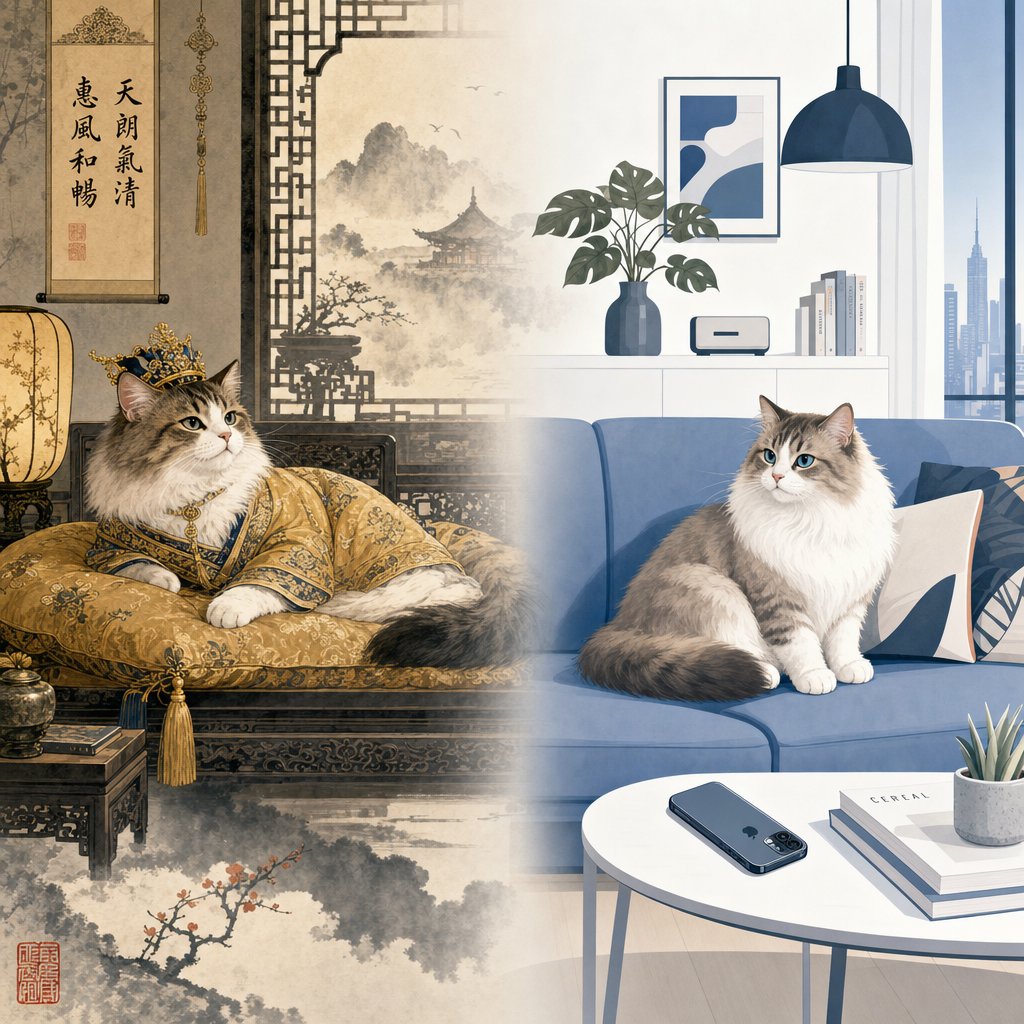
That three-dimensional naming philosophy did not emerge in a vacuum. It evolved across centuries of shifting cultural priorities, from the literary courts of imperial China to the smartphone-lit apartments of today's urban pet owners. Each era left its fingerprint on how chinese pets received their names, and tracing that arc reveals why modern naming trends look the way they do.
Imperial Era and Literary Naming Traditions
Picture a palace cat lounging in the halls of the Song dynasty court. This was not an animal called "Kitty." Imperial-era cats received names drawn from poetry, seasonal imagery, and literary allusion. The tradition, documented in classical texts like the Qing Yi Lu and the Book of Rites, treated cat naming as a miniature art form. Orange cats earned names like "Golden Silk Tiger" (金丝虎), linking their striped coats to both majesty and wealth. Black cats received names such as "Dark Cloud" (乌云) or "Roaring Iron" (啸铁), reflecting their perceived power to ward off evil spirits.
These were not random poetic flourishes. The Book of Rites described rituals honoring cats as "guardians of crops," elevating them to near-divine status. Naming them with literary weight matched that elevated role. A palace cat named after a line of verse carried the cultural prestige of the poem itself.
Dogs occupied a different cultural lane. Working dogs in rural and military contexts received functional, descriptive names: "Black Ear" (黑耳), "Iron Back" (铁背), or simply "Big Yellow" (大黄). These oriental dog names prioritized quick recognition and practical clarity over poetic resonance. The divide was clear: cats were literary companions; dogs were valued workers whose names reflected their appearance or role.
Folk Traditions and Protective Names
Outside palace walls, folk naming traditions operated on a different logic entirely. Rural families named animals to manipulate fate. A common practice involved giving pets deliberately humble or ugly-sounding names, believing that evil spirits would overlook an animal with an unappealing name. Calling a dog "Cheap" (贱) or "Leftovers" (剩儿) was not cruelty. It was protection, rooted in the same folk belief that led parents to give children "milk names" meant to trick malevolent forces.
Other folk names worked in the opposite direction, actively inviting good fortune. Names like "Wangcai" (旺财, "prosperous wealth") and "Lafu" (来福, "fortune arrives") turned a pet into a living talisman. Every time you called the dog, you were verbally summoning prosperity to your household. This practice persists in rural communities and among older generations who still view oriental names for dogs as functional tools for shaping luck.
The Modern Pet Culture Revolution
The shift from protective talismans to humanized companions happened fast. China's pet economy has moved through three distinct phases: a 1.0 era where pets served practical purposes, a 2.0 era of companionship starting in the 2000s, and the current 3.0 era where pets hold the emotional status of children. With 120 million pets in urban China and a market exceeding 300 billion yuan, the naming culture has transformed accordingly.
Young owners now give pets human-style names, ironic food names like "Tangyuan" (汤圆, glutinous rice ball) or "Xiaolong Bao" (小笼包, soup dumpling), and pop-culture references pulled from C-dramas and trending memes. The throughline from ancient to modern is still visible, though. A cat named "Mochi" (麻薯) carries the same affectionate energy as a Song dynasty cat named "Jade Ruler" (尺玉). Both reflect what the owner values most in their era: literary refinement then, playful warmth now.
- Pre-imperial era (before 221 BCE) — Animals named for spiritual function; cats honored as crop guardians in ritual texts.
- Imperial era (221 BCE - 1912 CE) — Palace cats received literary and poetic names; working dogs got descriptive, functional names based on appearance.
- Folk tradition (ongoing, strongest pre-1950s) — Protective "ugly" names to ward off evil; auspicious names to attract wealth and luck.
- Pet economy 1.0 (20th century) — Practical naming for practical animals: guard dogs, mousing cats, egg-laying chickens.
- Pet economy 2.0 (2000s) — Shift toward companionship; names begin reflecting emotional bonds rather than function.
- Pet economy 3.0 (2015 - present) — Pets treated as family members; humanized names, food names, internet culture references, and ironic humor dominate.
What connects all these eras is the underlying belief that a name does something. It protects, it blesses, it reflects status, or it expresses love. The vehicle changes, but the engine remains the same. And the specific linguistic tools Chinese speakers use to build these names — the prefixes, suffixes, and sound patterns — have their own fascinating mechanics worth understanding.
Linguistic Patterns That Shape Chinese Pet Names
Those prefixes, suffixes, and sound patterns are not random quirks of the language. They form a structured system of diminutives and endearment markers that Chinese speakers deploy instinctively, whether naming a golden retriever or texting a romantic partner at midnight. Understanding these mechanics gives you the toolkit to build names that feel authentically Chinese rather than awkwardly borrowed.
Four core patterns dominate chinese pet naming culture. Each one transforms an ordinary character into something warm, small, and affectionate. You will notice these same patterns everywhere once you know what to look for: on pet tags, in WeChat messages between couples, and shouted across dog parks in Shanghai.
| Pattern | Structure | Pronunciation Guide | Example Pet Names | English Equivalent Feeling |
|---|---|---|---|---|
| Xiao prefix (小) | 小 + character | "shee-OW" (third tone: starts low, dips, rises slightly) | 小白 Xiaobai (Little White), 小黑 Xiaohei (Little Black), 小花 Xiaohua (Little Flower) | Like adding "Little" as a term of endearment, not size |
| Reduplication | Character + same character | Repeat the syllable twice; second syllable often softens to neutral tone | 豆豆 Doudou (Bean-bean), 球球 Qiuqiu (Ball-ball), 毛毛 Maomao (Fur-fur) | Like saying "Lulu" or "Coco" — rhythmic, musical, inherently cute |
| A prefix (阿) | 阿 + character | "ah" (neutral/first tone: open, relaxed, like a sigh) | 阿黄 A Huang (Ah Yellow), 阿花 A Hua (Ah Flower), 阿宝 A Bao (Ah Treasure) | Like "ol' buddy" — familiar, warm, time-tested closeness |
| Endearment suffixes | Character + 宝/仔/儿 | 宝 "bow" (third tone), 仔 "zai" (third tone), 儿 "er" (neutral) | 猫宝 Maobao (Cat-treasure), 狗仔 Gouzai (Pup-little one), 球儿 Qiuer (Ball-er) | Like "-kins" or "-ling" — tiny, precious, protected |
The Xiao Prefix and Why It Dominates
If you learn only one naming pattern, make it this one. The character 小 (xiao, meaning "little" or "small") placed before a name or descriptor is the single most common way to create a chinese pet name. It works the same way English speakers might say "Little Bear" for a dog, except xiao carries a deeper connotation. It signals affection, approachability, and a gentle hierarchy where the speaker is the caretaker and the named creature is something small and cherished.
Say it like this: start with "shee," then glide into "ow" (rhymes with "cow"). Your voice should dip low and rise slightly, like the drawn-out "well..." you say when thinking. That dipping-rising motion is the third tone, and it gives xiao its soft, tender quality.
In northern China especially, xiao dominates casual address among friends and colleagues. Walk into a Beijing veterinary clinic and you will hear owners calling "Xiao Bai!" (Little White) or "Xiao Hu!" (Little Tiger) without a second thought. The pattern works with colors (小灰 Xiaohui, "Little Gray"), personality traits (小乖 Xiaoguai, "Little Well-Behaved"), and even food words (小饼 Xiaobing, "Little Cookie"). Its flexibility is why it dominates: virtually any single character becomes an instant pet name when xiao precedes it.
Reduplication and Double-Character Sweetness
Imagine doubling any syllable and instantly making it sound adorable. That is exactly what reduplication does in Chinese. Take the character 豆 (dou, "bean"), double it to 豆豆 (Doudou), and you have one of the most popular pet names in China. The repetition creates a bouncy, musical rhythm that sounds inherently affectionate, like a verbal pat on the head.
This pattern works because of how Chinese phonetics function. The language is syllable-timed, meaning each character receives roughly equal weight. When you repeat a syllable, you create a rhythmic, musical quality that sounds inherently affectionate — the verbal equivalent of a gentle touch. The second syllable often softens to a neutral tone in casual speech, making the name feel even lighter.
Popular reduplicated pet names you will hear constantly:
- 豆豆 Doudou — "Bean-bean." Say "doh-doh" with a falling tone on each. Works for any small, round pet.
- 球球 Qiuqiu — "Ball-ball." Say "chee-oh, chee-oh" (second tone, rising). Perfect for fluffy, round dogs.
- 毛毛 Maomao — "Fur-fur." Say "mow-mow" (second tone). Ideal for long-haired cats or dogs.
- 乖乖 Guaiguai — "Good-good." Say "gwai-gwai" (first tone, high and flat). For well-behaved pets.
- 点点 Diandian — "Dot-dot." Say "dee-en, dee-en" (third tone). Great for spotted animals.
There is something almost childlike about doubled names, and that is intentional. They evoke the simplicity of childhood, stripping away formality. When someone calls their cat Maomao instead of using a literary name, they are granting themselves permission to be playful and unguarded with their animal.
Endearment Suffixes From Pets to Partners
Here is where chinese pet names for lovers and actual pet names blur into the same linguistic territory. The suffixes 宝 (bao, "treasure"), 仔 (zai, "little one"), and 儿 (er, a softening suffix) appear in both contexts with identical emotional logic. A cat named 猫宝 (Maobao, "cat-treasure") and a girlfriend called 宝贝 (baobei, "baby/treasure") draw from the same well of affection.
The character 宝 (bao) is particularly versatile. Pronounce it like "bow" (as in taking a bow), starting low, dipping, then rising — that third tone again. In romantic contexts, 宝贝 (baobei) is one of the most common chinese pet names for girlfriend or boyfriend, functioning like "baby" or "treasure" in English. For actual pets, 宝 attaches to any descriptor: 小宝 (Xiaobao, "little treasure"), 金宝 (Jinbao, "golden treasure"), or simply 宝宝 (Baobao, "baby").
The suffix 仔 (zai) carries a southern Chinese flavor, particularly Cantonese. Say "zai" with a third tone (dipping low). It means "little one" or "young creature" and appears in names like 狗仔 (Gouzai, "puppy/little dog") and 猫仔 (Maozai, "kitten/little cat"). Among friends, playful nicknames like 胖仔 (Pangzai, "chubby boy") use the same suffix to tease with warmth.
Chinese pet names for boyfriend often follow these identical structures. A girlfriend might call her partner 小猪 (Xiao Zhu, "little pig") using the xiao prefix, or 猪猪 (Zhuzhu) using reduplication, or 猪宝 (Zhubao) using the treasure suffix. The same three patterns, the same affectionate logic, applied to a human instead of an animal. This crossover is not coincidental. In Chinese linguistic culture, expressing love means making someone small, precious, and protected through language — whether that someone has four legs or two.
What makes these patterns powerful is their combinability. You can stack them: 小豆豆 (Xiao Doudou) uses the xiao prefix plus reduplication. You can swap suffixes: 豆宝 (Doubao) takes the same root character and adds the treasure suffix instead of doubling. This modular system means a single base character can generate half a dozen name variants, each with a slightly different shade of warmth. And that flexibility becomes especially useful when you start matching names to specific animals — dogs and cats each carry their own naming traditions and cultural expectations.
Meaningful Chinese Dog Names and Their Stories
Dogs carry a different cultural weight than cats in Chinese naming tradition. Where cats earned literary names in imperial courts, dogs historically received names rooted in function, fortune, and physical description. That legacy still shapes how chinese dog names work today — even the trendiest modern picks echo patterns established centuries ago. The linguistic tools from the previous section (xiao prefixes, reduplication, endearment suffixes) all apply here, but dogs also have their own naming logic tied to loyalty, protection, and the specific role a dog plays in a household.
Rather than overwhelming you with a list of 200 names stripped of context, here is a curated selection organized by theme. Each name comes with the cultural story behind it, so you understand not just what it means but why it resonates.
Nature and Element Inspired Dog Names
Nature-based chinese names for dogs draw from the same landscape imagery that fills classical poetry. Mountains, rivers, seasons, and celestial bodies all appear in dog names, but each carries specific connotations that go beyond the literal translation. A dog named "Mountain" is not just named after a geographic feature — the name invokes stability, permanence, and quiet strength.
| Chinese Characters | Pinyin (Tone Guide) | Literal Meaning | Cultural Resonance | Suggested Breed Fit |
|---|---|---|---|---|
| 山山 Shānshān | "shahn-shahn" (first tone: high and flat, like humming a steady note) | Mountain-mountain | Evokes immovable strength and reliability. Mountains are symbols of endurance in Chinese philosophy. The reduplication softens the grandeur into something affectionate. | Large, sturdy breeds: Tibetan Mastiff, Chow Chow, Akita |
| 海 Hǎi | "hi" (third tone: dip low then rise, like saying "hi?" with uncertainty) | Sea / Ocean | Represents vastness, depth, and an adventurous spirit. Often chosen for dogs with boundless energy or deep, soulful eyes. | Retrievers, water-loving breeds, large active dogs |
| 小雪 Xiǎo Xuě | "shee-ow shweh" (both third tone; in sequence, first shifts to second tone for flow) | Little Snow | Snow symbolizes purity and fresh beginnings. The xiao prefix makes it intimate rather than grand. Popular for white-coated dogs born in winter months. | Samoyed, white Pomeranian, Maltese, Japanese Spitz |
| 松松 Sōngsōng | "soong-soong" (first tone: steady and high) | Pine-pine | Pine trees represent longevity and resilience in Chinese culture — they stay green through harsh winters. A wish for a long, healthy life. | Loyal, steady-tempered breeds: Labrador, Golden Retriever |
| 云 Yún | "yoon" (second tone: rising, like asking a question) | Cloud | Clouds suggest freedom, lightness, and a wandering spirit. Also carries poetic associations with immortals riding clouds in Daoist mythology. | Fluffy, light-colored dogs: Bichon Frise, Poodle, Samoyed |
You will notice these nature names tend toward single characters or reduplicated forms. That is deliberate. In Chinese naming philosophy, nature concepts already carry enormous weight — adding extra characters can make the name feel overwrought for a pet. A single character like 云 (Yun, "Cloud") says everything it needs to say.
Food and Personality Based Dog Names
Food-inspired chinese puppy names have exploded in popularity over the past decade, driven by China's foodie culture and the inherent cuteness of naming a round puppy after a round dumpling. But these names are not purely whimsical. Food in Chinese culture carries deep associations with comfort, family, and celebration. Naming a dog after a beloved dish is a way of saying: this animal brings me the same warmth as my favorite meal.
| Chinese Characters | Pinyin (Tone Guide) | Literal Meaning | Cultural Resonance | Suggested Breed Fit |
|---|---|---|---|---|
| 包子 Bāozi | "bow-zuh" (first tone + neutral tone: say "bow" high and flat, then "zuh" lightly) | Steamed bun | Baozi are round, soft, and filled with good things. The name suggests a dog who looks unassuming but has a rich inner life. Also implies warmth — baozi are comfort food. | Round-faced breeds: Pug, French Bulldog, Shar-Pei |
| 年糕 Niángāo | "nee-en-gow" (second tone + first tone: rising then steady) | New Year rice cake | Eaten during Spring Festival, niangao symbolizes rising prosperity (the word "gao" is a homophone for "high/elevated"). A name that carries built-in good fortune. | Cream or golden-colored dogs, any breed adopted during New Year |
| 旺财 Wàngcái | "wahng-tsai" (fourth tone + second tone: sharp drop then rise) | Prosperous wealth | Perhaps the most iconic traditional Chinese dog name. "Wang" sounds like a dog's bark in Chinese (汪), creating a pun: the dog literally "barks wealth" into existence. A down-to-earth name often used for easygoing local breeds that is both humorous and auspicious. | Mixed breeds, local Chinese dogs, any friendly companion dog |
| 乖乖 Guāiguāi | "gwai-gwai" (first tone: high and flat on both syllables) | Well-behaved / Good-good | More personality than food, this reduplicated name is a verbal reward. Every time you call the dog, you are reinforcing the idea of obedience and gentleness. It functions as both name and praise. | Obedient, calm breeds: Cavalier King Charles, Shih Tzu, trained companion dogs |
| 小馒头 Xiǎo Mántou | "shee-ow mahn-toe" (third + second + neutral: dip, rise, then light) | Little steamed bread | Mantou is the plainest, most humble of Chinese breads — no filling, just soft dough. The name suggests unpretentious sweetness. A cute, food-inspired name for round and cuddly dogs who do not need to be fancy to be loved. | Small, round, white or cream dogs: Maltese, Bichon, Pomeranian |
Personality-based names like 乖乖 (Guaiguai) reveal something interesting about the naming philosophy. In Chinese culture, naming a pet after a desired trait is not just descriptive — it is aspirational. You are calling that quality into being every time you use the name. A rambunctious puppy named "Well-Behaved" is not ironic. It is a daily invocation of the behavior the owner hopes to cultivate.
Breed-Specific Names for Chinese Dog Breeds
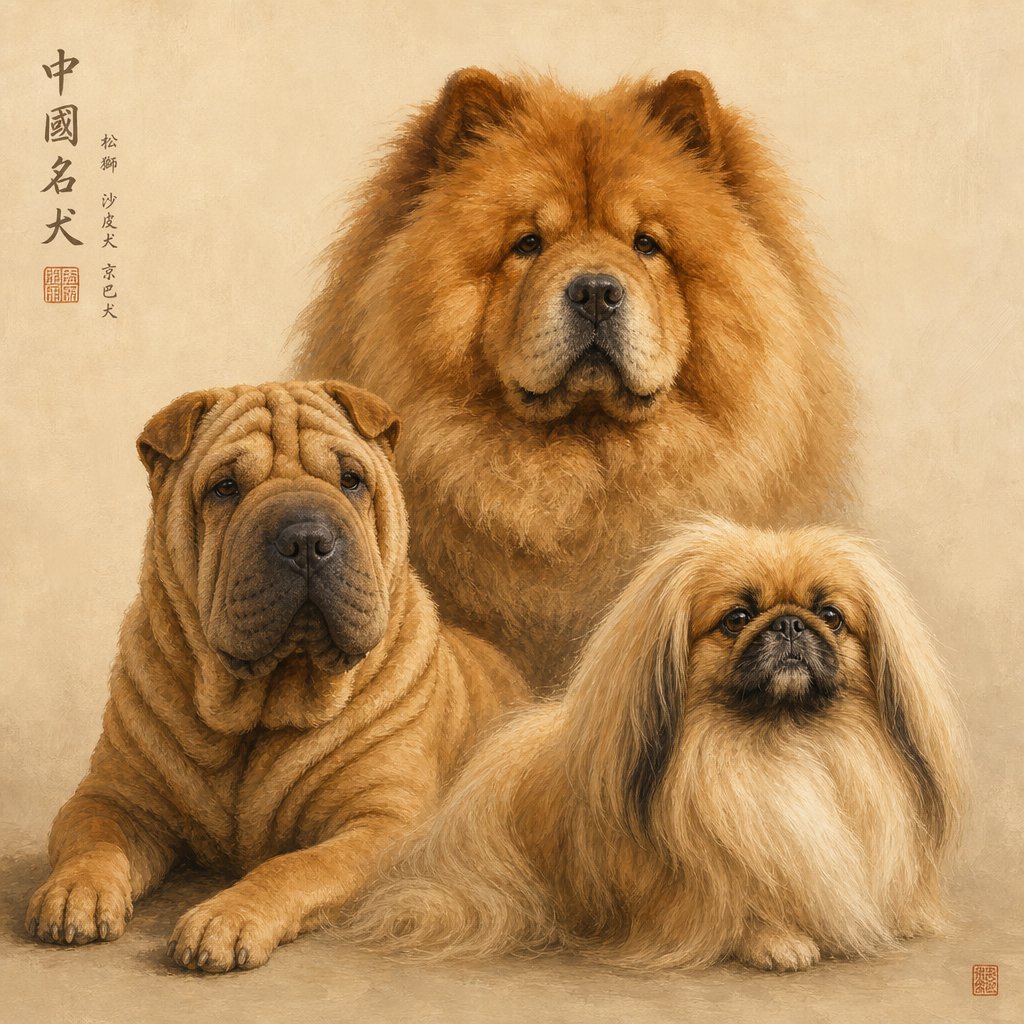
Chinese dog breeds carry their own naming traditions shaped by centuries of cultural association. A Pekingese is not just any dog — it is a breed that historically served as the canine companion of Chinese royalty. Naming one requires awareness of that heritage. Similarly, a Shar-Pei's wrinkled skin and a Shih Tzu's lion-like appearance each invite specific naming directions.
Here is where breed history meets naming practice:
- Pekingese (京巴 Jīngbā) — These palace dogs spent centuries in the Forbidden City. Chinese pekingese dog names often lean toward regal or literary choices: 玉珠 Yùzhū ("Jade Pearl," say "yoo-joo" with fourth then first tone), 金宝 Jīnbǎo ("Golden Treasure," say "jeen-bow" with first then third tone), or 福星 Fúxīng ("Lucky Star," say "foo-shing" with second then first tone). Avoid overly casual food names for a Pekingese if you want to honor the breed's aristocratic lineage.
- Shih Tzu (狮子狗 Shīzi Gǒu, "Lion Dog") — The breed name itself means "lion," so chinese names for shih tzu often play on that connection. 小狮 Xiǎo Shī ("Little Lion," say "shee-ow shir") is a natural fit. Other options include 威威 Wēiwēi ("Mighty-mighty," say "way-way" with first tone) or 毛毛 Máomáo ("Fluffy-fluffy," say "mow-mow" with second tone) to highlight their luxurious coat.
- Shar-Pei (沙皮 Shāpí, "Sand Skin") — Named for their distinctive wrinkled, sandy-textured skin. Names that reference their unique appearance work well: 皱皱 Zhòuzhòu ("Wrinkle-wrinkle," say "joe-joe" with fourth tone), 大壮 Dà Zhuàng ("Big and Strong," say "dah jwahng" with fourth tones), or 虎子 Hǔzi ("Tiger Cub," say "hoo-zuh" with third then neutral tone) for their muscular build.
- Chow Chow (松狮 Sōngshī, "Puffy Lion") — With their lion-like mane and dignified bearing, Chow Chows suit names that convey nobility without being overly delicate. 大王 Dà Wáng ("King," say "dah wahng" with fourth then second tone) or 熊熊 Xióngxióng ("Bear-bear," say "shyoong-shyoong" with second tone) both capture their imposing yet lovable presence.
- Chinese Crested (中国冠毛犬) — These elegant, partially hairless dogs suit names emphasizing grace and uniqueness: 灵灵 Línglíng ("Spirit-spirit," say "ling-ling" with second tone) or 仙子 Xiānzi ("Fairy," say "shee-en zuh" with first then neutral tone).
The key principle across all breeds: match the name's weight to the dog's cultural identity. A breed with imperial heritage deserves a name that acknowledges that history. A breed known for strength gets a name that channels power. This is not about being rigid — plenty of Pekingese owners happily name their dogs 包子 (Baozi) for the humor of it. But understanding the traditional expectations helps you make an informed choice rather than an accidental one.
One pattern worth noting: many of these names for chinese dogs work across genders. Unlike English, where "Princess" reads female and "Duke" reads male, Chinese pet names often carry neutral energy. 旺财 (Wangcai) works for any dog. 毛毛 (Maomao) suits males and females equally. Gender-specific naming does exist in Chinese culture, but it follows different rules — rules that become especially relevant when you move from dogs to cats, where the naming tradition carries its own distinct literary heritage.
Chinese Cat Names Rooted in Poetry and Tradition
Cats occupy a fundamentally different cultural space than dogs in Chinese history. Where dogs earned functional names tied to labor and loyalty, cats were companions of scholars, subjects of ink paintings, and residents of imperial libraries. During the Song dynasty, cats became so beloved among the literati that they appeared in idioms, poetry, and court paintings — and their names reflected that elevated status. Chinese farmers even worshipped a cat deity, Li Shou, a fertility goddess believed to protect crops from rats and drive away evil spirits. This literary and spiritual heritage means chinese cat names carry a poetic weight that dog names rarely match.
That distinction still echoes today. When Chinese pet owners choose a cat chinese name, they instinctively reach for something more elegant, more layered, more allusive than what they might pick for a dog. A dog can be 旺财 (Wangcai, "Prosperous Wealth") without anyone blinking. A cat named something that blunt would feel tonally wrong to most Chinese speakers. Cats demand poetry.
Classical and Literary Cat Names
Ancient Chinese naming traditions for cats drew directly from seasonal imagery, literary allusion, and the visual poetry of a cat's appearance. Classical texts documented an elaborate system where fur color and pattern determined a cat's poetic name — not as a casual nickname, but as a formal designation rooted in centuries of aesthetic tradition. A pure white cat was not simply "white." It was 尺玉 (chi yu, "a foot-long jade") or 宵飞练 (xiao fei lian, "flying white silk in the night"). A pitch-black cat became 啸铁 (xiao tie, "roaring iron") or 乌云豹 (wuyun bao, "cloudy panther").
These names read like lines of verse because they were created by the same literary minds that wrote poetry. Here are classical chinese names for cats that still carry cultural resonance:
| Chinese Characters | Pinyin (Tone Guide) | Literal Meaning | Cultural Context | Personality / Appearance Fit |
|---|---|---|---|---|
| 踏雪寻梅 Ta xue xun mei | "tah shweh shoon may" (fourth, third, second, second tone) | Stepping on snow to seek wintersweet | A classical poetic image of elegance in winter. Reserved for black cats with white paws — the white "socks" are the snow beneath dark legs. | Black cats with white feet; graceful, quiet temperament |
| 金丝虎 Jin si hu | "jeen suh hoo" (first, first, third tone) | Golden silk tiger | Compares an orange tabby's stripes to threads of gold woven into a tiger's form. Elevates a common coat pattern into something regal. | Orange or golden tabbies; bold, confident cats |
| 墨玉垂珠 Mo yu chui zhu | "maw yoo chway joo" (fourth, fourth, second, first tone) | Black jade with a hanging pearl | Describes the rare black cat whose tail tip is pure white — the single white point is the "pearl" dangling from dark jade. | Black cats with white tail tips; rare, elegant individuals |
| 乌云盖雪 Wuyun gai xue | "woo yoon guy shweh" (first, second, fourth, third tone) | Dark clouds above the snow | For cats that are black on top and white on the belly — viewed from above, all storm; from below, all purity. | Tuxedo cats or black-and-white bicolor cats |
| 将军挂印 Jiangjun gua yin | "jee-ahng joon gwah yeen" (first, first, fourth, fourth tone) | The general hangs his seal | A white cat with a colored patch on its head, as if an emperor placed a seal of authority there. Implies the cat has been chosen for greatness. | White cats with a single colored spot on the head; commanding personality |
You will notice these classical names are longer than typical modern pet names — often four characters instead of two. They function more like titles than casual nicknames. In daily life, owners might shorten them (calling a 踏雪寻梅 cat simply 雪雪, Xuexue, "Snow-snow"), but the full name carries the cultural prestige.
Nature and Personality Cat Names
Not every cat name in chinese needs to be a four-character poem. Nature-based names that reflect feline qualities — independence, grace, mystery, agility — offer a middle ground between classical grandeur and modern simplicity. These names work by mapping a natural phenomenon onto a cat's personality, creating a metaphor that deepens every time you call it.
| Chinese Characters | Pinyin (Tone Guide) | Literal Meaning | Cultural Context | Personality / Appearance Fit |
|---|---|---|---|---|
| 灵猫 Ling mao | "ling mow" (second tone, first tone: rising then steady) | Spirit cat | 灵 (ling) means spiritual, nimble, or clever. It suggests a cat connected to something beyond the physical — a mystical and ethereal name for a cat who likes to play hide and seek. | Elusive, intelligent cats who appear and vanish silently |
| 小虎 Xiao hu | "shee-ow hoo" (third tone, third tone; first shifts to second in speech) | Little tiger | Tigers are the king of land animals in Chinese culture. Calling a cat "little tiger" honors its predatory grace while keeping the scale affectionate. | Feisty, brave cats with tabby markings or high energy |
| 梅梅 Meimei | "may-may" (second tone: rising on both, like asking a question twice) | Plum blossom - plum blossom | The plum blossom blooms in winter when all else is bare — a symbol of resilience and quiet beauty. Reduplication makes it soft and calling-friendly. | Delicate, independent cats; those adopted in winter |
| 月光 Yueguang | "yweh gwahng" (fourth tone, first tone: falling then steady) | Moonlight | Cats are nocturnal hunters, and moonlight captures their nighttime elegance. Also carries romantic, poetic associations from classical verse. | Silver, gray, or white cats; cats most active at night |
| 风儿 Feng'er | "fung-er" (first tone + neutral: high and steady, then soft) | Little wind | Wind is invisible, swift, and impossible to catch — much like a cat darting through a room. The 儿 suffix adds tenderness. | Fast, agile cats; those who move gracefully and silently |
Personality-based cat names in chinese follow the same aspirational logic as dog names, but with a twist. Where dog owners might name a pet "Well-Behaved" to invoke obedience, cat owners tend to name for qualities they admire rather than expect to control. Nobody names a cat 乖乖 (Guaiguai, "Good-good") with any real expectation of compliance. Instead, cat names celebrate wildness, mystery, and independence — the very traits that make cats culturally distinct from dogs.
Modern Internet-Inspired Cat Names
China's internet culture has transformed cat naming just as dramatically as it transformed everything else. Social media platforms like Douyin and Weibo turned cats into viral content, and with that visibility came a new wave of naming conventions driven by humor, food obsession, and pop-culture references. These modern chinese cat names often deliberately contrast the classical tradition — choosing absurdity where ancestors chose elegance.
- 咪咪 Mimi — "mee-mee" (first tone). The onomatopoeic classic. It mimics the sound a cat makes and has been popular for decades, bridging traditional and modern eras. Simple, universally recognized, and effortless to call.
- 橘座 Juzuo — "joo-zwaw" (second, fourth tone). Literally "Orange Majesty" or "His Orangeness." Born from the internet meme that all orange cats are insatiably hungry and inevitably fat. Chinese netizens call orange cats 大橘 (Da Ju, "Big Orange") as a running joke about their appetite.
- 奶茶 Naicha — "nai-chah" (third, second tone). "Milk tea." Reflects China's bubble tea obsession. Perfect for cream-and-brown cats whose coloring resembles a freshly poured cup.
- 豆腐 Doufu — "doe-foo" (fourth, third tone). "Tofu." Soft, white, and delicate — exactly how owners see their fluffy white cats. The food association adds warmth and humor.
- 布丁 Buding — "boo-ding" (fourth, first tone). "Pudding." A loanword-inspired name that sounds cute in Chinese while carrying the softness and sweetness of the dessert. Popular for caramel-colored or cream cats.
- 小鱼干 Xiao Yugan — "shee-ow yoo-gahn" (third, second, first tone). "Little dried fish." A meta name — you are naming the cat after its own favorite treat. The humor lies in the circularity: the cat becomes what it desires most.
What connects these modern names to the classical tradition is not style but function. A Song dynasty scholar naming a black cat 啸铁 ("Roaring Iron") and a Gen-Z owner naming an orange cat 橘座 ("His Orangeness") are doing the same thing: translating a visual observation into language that carries cultural meaning for their era. The vocabulary shifts, but the impulse to make a name do more than merely identify — to make it comment, celebrate, or joke — remains constant across a thousand years of cat names in chinese tradition.
Color and pattern still drive many naming choices, just as they did in imperial times. The difference is tone: where classical names turned a white tail tip into "black jade with a hanging pearl," modern owners might simply call the same cat 奥利奥 (Aoliao, "Oreo") for its black-and-white cookie pattern. Both approaches honor the same visual reality. One wraps it in poetry; the other wraps it in snack food. Neither is wrong — they just reflect different relationships between owner and animal, different eras of what it means to share your life with a cat.
These naming choices, whether classical or contemporary, all operate within an invisible framework of cultural rules. Some of those rules are positive — choosing auspicious sounds, balancing character aesthetics. But others are prohibitive, marking certain sounds, meanings, and associations as off-limits. And those taboos are where most non-Chinese speakers unknowingly stumble.
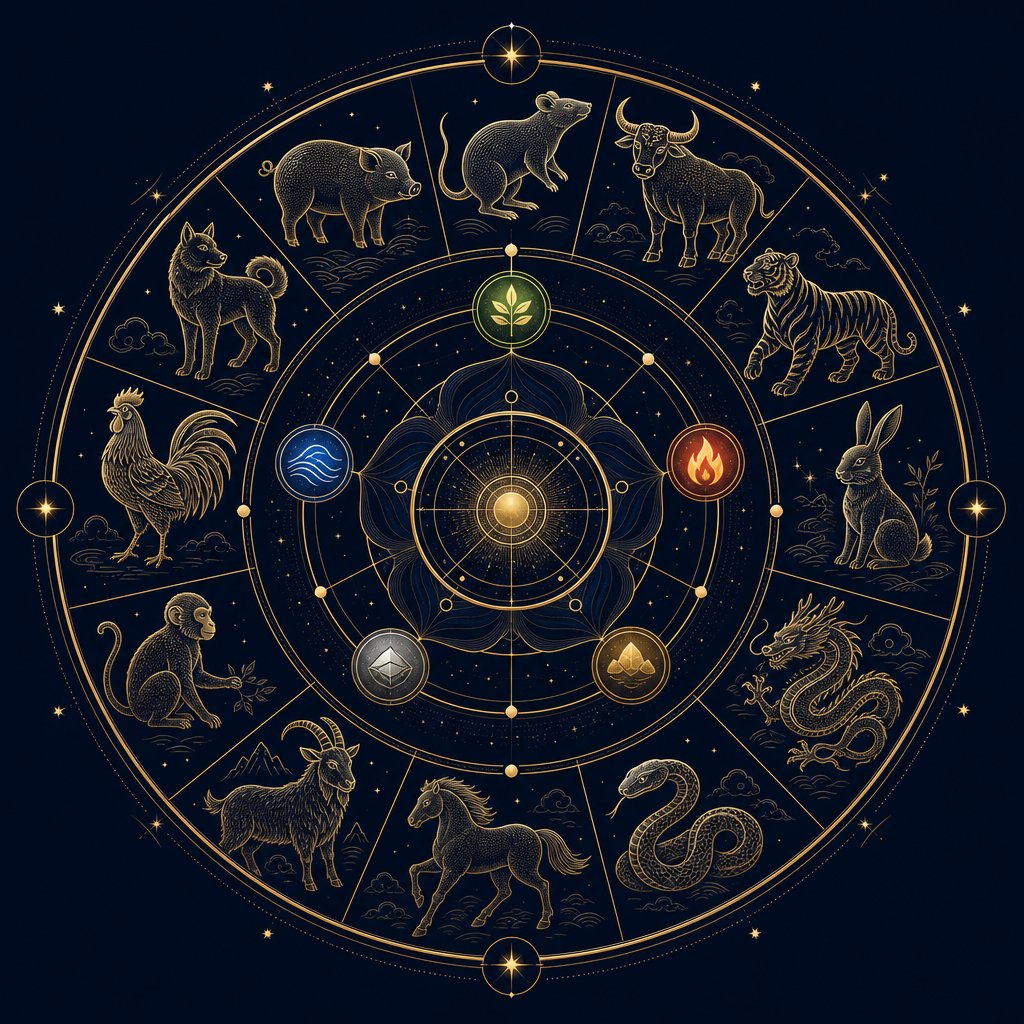
Zodiac, Numerology, and Feng Shui in Pet Naming
Those positive rules — the ones that guide owners toward auspicious sounds and balanced characters — run deeper than most people realize. Beneath the surface of every carefully chosen chinese name dog owners settle on lies an older system: one built from zodiac cycles, numerical patterns, and elemental theory. In traditional Chinese culture, a person's constitution and fate are believed to be shaped by their Eight Characters (Ba Zi), which encode the year, month, day, and hour of birth using cyclical signs connected to the twelve zodiac animals and the Five Elements. Pet owners increasingly apply this same logic to their animals.
Sounds like a lot of metaphysics for a puppy? Maybe. But when you understand how these systems work, you will see why certain names feel instinctively "right" for certain animals — and why some combinations make Chinese speakers wince without quite knowing why.
Chinese Zodiac and Your Pet's Birth Year
Every pet born in a given year falls under one of twelve zodiac animals: Rat, Ox, Tiger, Rabbit, Dragon, Snake, Horse, Goat, Monkey, Rooster, Dog, and Pig. The naming method combines information about the birth year with references to the specific features of the symbolic animal in order to influence the pet's fortune. In practice, this means choosing characters whose meanings or structural components complement the zodiac animal's nature.
Imagine you adopt a kitten born in the Year of the Tiger. A chinese name for cat in this case might incorporate characters associated with strength, forests, or kingship — elements that support the tiger's energy rather than conflict with it. A name suggesting water or confinement would work against the tiger's nature.
Here are zodiac-aligned naming directions for common birth years:
- Year of the Rat (2020, 2032) — Rats thrive with characters containing the grain radical (米) or roof radical (宀), suggesting abundance and shelter. Names like 安安 (An'an, "Peace-peace") or 粒粒 (Lili, "Grain-grain") support this energy.
- Year of the Tiger (2022, 2034) — Tigers benefit from characters with the mountain radical (山) or king radical (王), reinforcing their dominance. Names like 小岳 (Xiao Yue, "Little Mountain Peak") or 琳琳 (Linlin, containing the jade/king radical) align well.
- Year of the Rabbit (2023, 2035) — Rabbits favor characters with grass radicals (艹) or mouth radicals (口), suggesting food and safe burrows. 茉莉 (Moli, "Jasmine") or 品品 (Pinpin, triple-mouth character) fit naturally.
- Year of the Dragon (2024, 2036) — Dragons align with water radicals (氵) and star/sky imagery. 小泽 (Xiao Ze, "Little Marsh") or 星星 (Xingxing, "Star-star") channel their celestial nature.
- Year of the Dog (2018, 2030) — Dogs benefit from characters with the person radical (亻) or clothing radical (衤), suggesting companionship and care. A chinese dog name like 小伙 (Xiao Huo, "Little Buddy") or 佳佳 (Jiajia, "Good-good") resonates here.
The underlying logic is consistent: choose characters whose structural radicals echo what the zodiac animal needs to flourish. This method considers not just the lexical meaning of names but also their formal aspects, such as forms of Chinese characters and the meaning of individual graphical elements that compose them.
Lucky Numbers and Stroke Count in Names
Every Chinese character is composed of a specific number of brush strokes, and that number carries its own fortune. This is not abstract theory — it is a system that Japanese and Chinese naming traditions both use to evaluate whether a name will bring its bearer luck or hardship.
The core principle: certain stroke counts are auspicious, others are not. When selecting a chinese name dog or cat owners want to last a lifetime, the total stroke count of the name characters matters.
- 8 strokes — Highly auspicious. The number 8 (八, ba) sounds like 发 (fa, "to prosper"). Characters with 8 strokes include 宝 (bao, "treasure"), 明 (ming, "bright"), and 幸 (xing, "fortunate").
- 6 strokes — Smooth and flowing. The number 6 (六, liu) sounds like 流 (liu, "to flow"), suggesting a life without obstacles. Characters include 安 (an, "peace") and 吉 (ji, "lucky").
- 5 strokes — Associated with good fortune and harmony. Characters include 玉 (yu, "jade") and 乐 (le, "joy").
- 4 strokes — Avoided when possible. The number 4 (四, si) is a near-homophone for death (死, si). Characters with exactly 4 strokes are not inherently bad, but naming practitioners prefer to steer clear of this count in prominent positions.
- 9 strokes — Can predict adversity or nervous energy. Used cautiously.
In practice, dedicated owners will count the strokes of each character in a potential name and check whether the total falls on a favorable number. A two-character name totaling 16 strokes (8+8) would be considered doubly blessed. A name totaling 14 strokes (containing two 4s, essentially) might give a traditional-minded owner pause.
Five Elements Theory Applied to Pet Naming
The Five Elements — Wood (木), Fire (火), Earth (土), Metal (金), and Water (水) — form the backbone of Chinese cosmological thinking. In naming, they function as a balancing system. The idea is straightforward: if a person's (or pet's) birth chart lacks an element, a name containing characters that represent that missing element may be chosen to bring balance and support their fortune.
Each element carries distinct qualities that translate directly into naming choices:
| Element | Qualities | Associated Radicals | Example Pet Names | Best For |
|---|---|---|---|---|
| Wood (木) | Growth, vitality, creativity | 木, 艹 (grass), 竹 (bamboo) | 小林 Xiaolin ("Little Forest"), 花花 Huahua ("Flower-flower"), 松松 Songsong ("Pine-pine") | Pets born in autumn/winter who need growth energy; timid animals needing vitality |
| Fire (火) | Passion, warmth, energy | 火, 灬 (fire dots), 日 (sun) | 小炎 Xiaoyan ("Little Flame"), 晴晴 Qingqing ("Sunny-sunny"), 暖暖 Nuannuan ("Warm-warm") | Lethargic or cold-natured pets; animals needing more spark and activity |
| Earth (土) | Stability, nourishment, grounding | 土, 山 (mountain), 石 (stone) | 小石 Xiaoshi ("Little Stone"), 安安 An'an ("Peace-peace"), 坤坤 Kunkun ("Earth-earth") | Anxious or restless pets; animals needing calm, grounded energy |
| Metal (金) | Strength, precision, clarity | 金, 钅(metal radical) | 鑫鑫 Xinxin ("Prosperity-prosperity"), 铃铃 Lingling ("Bell-bell"), 小银 Xiaoyin ("Little Silver") | Unfocused or scattered pets; animals needing structure and discipline |
| Water (水) | Fluidity, wisdom, adaptability | 水, 氵(water radical), 雨 (rain) | 小溪 Xiaoxi ("Little Stream"), 雨雨 Yuyu ("Rain-rain"), 海海 Haihai ("Sea-sea") | Rigid or aggressive pets; animals needing softness and emotional depth |
The productive cycle matters here too. Wood feeds Fire, Fire creates Earth, Earth produces Metal, Metal carries Water, and Water nourishes Wood. A pet whose birth chart is heavy in Wood but lacking Fire might benefit from a name with fire-element characters, since Wood naturally supports Fire — the name helps complete a cycle that was left unfinished.
You do not need to become a feng shui master to apply this. A simplified approach: note your pet's birth season (spring = Wood, summer = Fire, late summer = Earth, autumn = Metal, winter = Water), identify which element might be underrepresented, and choose name characters that introduce that missing energy. A winter-born cat heavy in Water energy might thrive with a Wood-element name like 小竹 (Xiao Zhu, "Little Bamboo"), since Water nourishes Wood in the productive cycle.
These systems — zodiac alignment, stroke count numerology, and elemental balancing — represent the constructive side of Chinese naming philosophy. They tell you what to reach toward. But every system that points you toward good fortune necessarily implies its opposite: the sounds, numbers, and associations you must actively avoid. Those prohibitions carry just as much weight in practice, and breaking them can turn an otherwise beautiful name into something no Chinese speaker would comfortably call out loud.
Naming Taboos and Superstitions Every Owner Should Know
Knowing what to avoid matters just as much as knowing what to choose. In Chinese culture, a name that accidentally invokes misfortune is not a harmless mistake — it is an active invitation for bad energy to attach itself to the animal. This is the area where non-Chinese speakers stumble most often, selecting characters that look beautiful on paper but carry phonetic landmines invisible to anyone unfamiliar with the language's homophone density.
A name should never invite misfortune. In Chinese naming philosophy, speaking a word aloud gives it power — and calling an unlucky sound dozens of times daily is believed to draw that energy into your household.
Homophones and Unlucky Sounds to Avoid
Mandarin is a language where dozens of characters share identical pronunciations, distinguished only by tone. This means a perfectly innocent character can sound exactly like something deeply inauspicious when spoken aloud. Since you call a pet's name constantly — across parks, in veterinary offices, at home — any phonetic overlap with negative words gets amplified through sheer repetition.
Here are the sounds that experienced Chinese pet owners instinctively reject when choosing dog names chinese or cat names chinese:
- Si (any tone resembling third tone) — Sounds like 死 (si, "death"). This is the most universally avoided sound in Chinese naming. It is the same reason buildings skip the fourth floor and phone numbers containing 4 sell at a discount. Any name where the dominant syllable sounds like "si" will make Chinese speakers uncomfortable.
- Ku (third tone) — Sounds like 苦 (ku, "bitter" or "suffering"). Calling your pet "Bitter" multiple times a day is believed to invite hardship into both the animal's life and your own.
- Bing (fourth tone) — Sounds like 病 (bing, "illness" or "disease"). A chinese name for dog or cat that echoes this sound suggests you are naming sickness into existence.
- San (fourth tone) — Sounds like 散 (san, "to scatter" or "to separate"). This implies the pet will leave, run away, or that the bond between owner and animal will dissolve.
- Sang (first tone) — Sounds like 丧 (sang, "mourning" or "funeral"). Particularly avoided in southern regions where funeral customs carry heavy cultural weight.
- Shuai (first tone) — While 帅 (shuai, "handsome") seems positive, it is a near-homophone for 摔 (shuai, "to fall/stumble"), which some owners avoid for accident-prone pets.
The critical detail: these taboos apply to how the name sounds, not just what it means. You could choose a character with a lovely meaning, but if its pronunciation overlaps with any of these unlucky words in casual speech, the name carries that shadow regardless of your intention.
Cultural Faux Pas in Chinese Pet Naming
Beyond phonetic taboos, certain naming choices violate social and cosmological rules that are less about sound and more about hierarchy and proportion.
The most serious faux pas: using names of living family members, especially elders. In Chinese culture, this practice is called 避讳 (bihui, "name taboo"), and it applies to pets as strongly as it applies to children. Naming your cat after your grandmother — even affectionately — implies you are placing the animal on the same hierarchical level as a respected elder. This is not charming. It is deeply disrespectful in traditional households.
A second, subtler faux pas involves choosing names with meanings too grand for a small animal. Characters like 龙 (long, "dragon"), 帝 (di, "emperor"), or 天 (tian, "heaven") carry enormous cosmological weight. Traditional belief holds that a name's energy must match its bearer's capacity. A tiny kitten named "Emperor" is not cute — it is burdened. The name's weight is believed to "overwhelm" (压不住, ya bu zhu) the animal's fate, potentially causing illness or misfortune because the creature cannot sustain that level of energy.
Practical guidelines to avoid these missteps:
- Never duplicate the name of a living relative, especially anyone from an older generation.
- Avoid characters associated with historical figures who met tragic ends — the belief is that negative fates carry through names.
- Keep name meanings proportional to the animal's size and nature. A hamster named "Supreme Ruler" invites cosmological imbalance.
- Do not use names identical to current political leaders. This is both culturally taboo and, in some contexts, legally sensitive.
Regional Differences in Naming Taboos
China is not a monolith. What sounds unlucky in Mandarin-speaking Beijing may carry no negative weight in Cantonese-speaking Guangzhou, and vice versa. Regional dialects create entirely different homophone landscapes, meaning a name that is perfectly safe in one city becomes problematic in another.
In Cantonese-speaking regions (Hong Kong, Guangdong, diaspora communities in Southeast Asia), the number 7 carries funeral associations because 七 (cat) sounds similar to a vulgar term. The sound "gong" in certain tonal combinations resembles words for emptiness or loss. Meanwhile, in Hokkien-speaking communities (Fujian, Taiwan, parts of Southeast Asia), the syllable "xia" can sound like a word meaning "to scare," making names containing that sound less desirable for a pet you want to feel safe.
Shanghainese dialect adds another layer. The Wu dialect spoken in Shanghai and surrounding areas has its own set of homophones that do not exist in standard Mandarin. A name that sounds neutral in Putonghua might accidentally echo an unlucky Shanghainese word when the owner's elderly parents call the pet.
The practical takeaway: if your family speaks a regional dialect alongside Mandarin, test any potential name in both languages before committing. Say it aloud in the dialect your oldest family members use daily. If it produces a wince or a laugh for the wrong reasons, keep looking. The safest dog names chinese and cat names chinese are those that pass the homophone test across every language your household actually speaks.
These taboos are not arbitrary superstitions disconnected from daily life. They are the guardrails that keep naming choices within culturally safe territory. And they become especially relevant for one growing audience: non-Chinese pet owners drawn to Chinese names, and diaspora families navigating between two naming traditions simultaneously.

Modern Trends Reshaping Chinese Pet Names
Those taboos and guardrails still hold weight, but the people navigating them look very different than they did a generation ago. China's pet-owning population has shifted dramatically younger, and with that shift comes an entirely new naming sensibility. The rules have not disappeared — they have been remixed, subverted, and sometimes deliberately broken for comedic effect by a generation that treats pet ownership as an emotional identity rather than a practical arrangement.
The Generational Divide in Naming Styles
Ask someone's grandmother what she called the family dog in the 1970s, and you will likely hear something functional: 大黄 (Da Huang, "Big Yellow"), 黑子 (Heizi, "Blackie"), or 旺财 (Wangcai, "Prosperous Wealth"). These names described appearance or invited fortune. They treated the animal as a household asset — valued, but not a family member in the emotional sense.
Young Chinese pet owners in their 20s and 30s operate from a completely different premise. They increasingly see their pets as members of the family, and the naming conventions reflect that elevation. A dog is no longer "Big Yellow." It is 奶茶 (Naicha, "Milk Tea"), 糯米 (Nuomi, "Sticky Rice"), or even a full human name like 张大福 (Zhang Dafu) — complete with a surname, as if the pet were a child carrying the family name.
This is not a subtle shift. One Goldman Sachs analysis concluded that Chinese cities could already have more pets than human toddlers. When young people delay marriage and children but still crave companionship, pets fill that emotional space — and receive names that match their elevated status. A pet funeral company owner in Beijing described the dynamic plainly: if you have a dog named Bubble, she would greet the owners as "Bubble's mom" or "Bubble's dad."
Social Media and Internet Culture Names
Weibo, Douyin (China's TikTok), and Xiaohongshu have turned pet naming into a participatory cultural event. Viral cat videos spawn naming trends overnight. A single meme can make a dog chinese name ubiquitous across millions of households within weeks. The result is a naming landscape that moves at internet speed, cycling through trends faster than any previous generation experienced.
Here are the dominant trending categories shaping cute asian dog names and cute chinese cat names right now:
- Food and drink names — China's foodie culture bleeds directly into pet naming. 汤圆 (Tangyuan, "glutinous rice ball"), 麻薯 (Mashu, "mochi"), 芋圆 (Yuyuan, "taro ball"), 奶盖 (Naigai, "milk cap tea"). These names are soft, round-sounding, and evoke comfort. They dominate among young urban owners who see naming a pet after a beloved snack as the ultimate expression of warmth.
- C-drama and anime references — Characters from popular Chinese dramas and Japanese anime provide ready-made names with built-in personality. A regal cat might become 甄嬛 (Zhen Huan, from the palace drama Empresses in the Palace). A mischievous dog might earn 哪吒 (Nezha, the rebellious deity from animated film). These names signal the owner's cultural tastes while giving the pet a narrative identity.
- Ironic or absurdist humor — Younger owners deliberately choose names that subvert expectations. A tiny Chihuahua named 巨无霸 (Juwuba, "Big Mac" or "Colossus"). A lazy cat called 闪电 (Shandian, "Lightning"). The comedy lies in the gap between name and reality — a distinctly Gen-Z sensibility that older generations find baffling.
- Human-style formal names — The pet humanization trend has reached its logical extreme: pets receiving full human names with surnames. 王富贵 (Wang Fugui, "Wang Wealthy-and-Noble"), 李狗蛋 (Li Goudan, "Li Dog-Egg" — a deliberately rustic human name given ironically). This trend treats the pet as a comedic character with its own social identity.
- Western loanword names — Particularly among cosmopolitan owners, English or French names transliterated into Chinese characters offer an international flair. Names like 布丁 (Buding, "Pudding"), 可可 (Keke, "Coco"), or 米奇 (Miqi, "Mickey") blend foreign sounds with Chinese phonetic charm.
The social media effect is self-reinforcing. Owners choose trending names for chinese dogs partly because those names perform well on platforms — they are recognizable, searchable, and generate engagement. A cat named after a viral meme instantly connects to a community of people who share that reference.
Regional Variations Across Chinese-Speaking Communities
The naming trends above describe mainland urban China, but Chinese-speaking communities are not monolithic. Taiwan, Hong Kong, and diaspora populations each bring distinct flavors to how they name pets.
In Taiwan, Japanese cultural influence runs deep. Asian names for dogs often borrow from Japanese naming patterns: 小丸子 (Xiao Wanzi, from the anime Chibi Maruko-chan) or names using the Japanese-influenced suffix 醬 (jiang, equivalent to Japanese "-chan"). Taiwanese pet names tend toward softer, more whimsical choices compared to mainland trends, reflecting the island's distinct pop-culture diet.
In Hong Kong, Cantonese phonetics reshape everything. Names must sound good in Cantonese tones, not just Mandarin. The bilingual environment also produces hybrid names — a cat might have an English name for the vet and a Cantonese nickname at home. Popular Cantonese pet names like 肥仔 (Fei Zai, "Chubby Boy") or 靚女 (Leng Neui, "Pretty Girl") use Cantonese-specific vocabulary that would sound odd in Mandarin.
Among diaspora communities in North America, Southeast Asia, and Europe, naming becomes a negotiation between cultures. A family might choose a Chinese name that also works phonetically in English — 美美 (Meimei) doubles as "May-May," 可可 (Keke) sounds like "Coco." This dual-functionality requirement narrows the options but produces names that travel well across linguistic contexts.
What unites all these communities is the underlying belief that a name should do something beyond identification. Whether it channels internet humor in Shanghai, Japanese kawaii culture in Taipei, or bilingual practicality in Vancouver, the name still carries intention. And for anyone navigating this landscape from outside — whether as a non-Chinese speaker drawn to these traditions or a diaspora family balancing two worlds — a clear framework for making these choices can turn an overwhelming cultural landscape into a manageable, enjoyable process.
A Cross-Cultural Guide to Picking the Perfect Chinese Pet Name
Whether you are a non-Chinese speaker drawn to the beauty of these naming traditions or a diaspora family balancing heritage with daily life in an English-speaking country, the challenge is the same: how do you choose a name that feels authentic without accidentally breaking rules you never knew existed? The philosophy, history, and taboos covered so far give you the knowledge. This section gives you the process.
A Step-by-Step Framework for Choosing Your Name
Picking chinese names for dogs female or male, cats, or any pet does not require fluency in Mandarin. It requires a structured approach that respects the cultural layers while staying practical for your daily life. Here is a framework that works whether you speak the language or not:
- Observe your pet's personality for one to two weeks. Resist naming immediately. Watch how they move, what they gravitate toward, whether they are bold or shy, energetic or calm. In Chinese naming philosophy, the name should reflect the animal's true nature — not a projection of what you hope they will become. A timid cat named "Little Tiger" creates dissonance rather than charm.
- Choose a theme that resonates with you. Nature, food, personality traits, color, literary references — pick one lane. Trying to combine too many ideas into a two-syllable name produces confusion. A nature name like 小溪 (Xiaoxi, "Little Stream") works because it commits fully to one image.
- Select characters with clear, simple pronunciation. If you are not a native speaker, avoid names with sounds that do not exist in English. The "x" sound in Mandarin (like "sh" but with the tongue forward), the "q" sound (like "ch" but lighter), and the "zh" sound (like "j" but retroflex) trip up English speakers daily. Names built from sounds like "mai," "bao," "lin," or "mei" are far easier to pronounce consistently and correctly.
- Check the stroke count and tonal flow. Count the strokes of each character. Aim for totals that include 6, 8, or 5 — auspicious numbers. Say the name aloud ten times quickly. If your mouth stumbles or the rhythm feels awkward, keep looking.
- Verify meaning with a native speaker. This step is non-negotiable. Online dictionaries give you the primary meaning of a character, but they rarely flag regional homophones, slang connotations, or outdated associations. A five-minute conversation with a Chinese-speaking friend, colleague, or language tutor can save you from a name that means something embarrassing in Cantonese or carries funeral associations in Hokkien.
- Test it in both languages your household uses. For diaspora families, the name needs to work when Grandma calls the dog in Mandarin and when your neighbor calls it in English. Names like 可可 (Keke/"Coco"), 美美 (Meimei/"May-May"), or 宝宝 (Baobao/"Bow-Bow") cross linguistic boundaries without losing their Chinese identity.
Gender Conventions in Chinese Pet Names
Chinese does not mark gender grammatically the way Romance languages do, but naming conventions still carry gendered associations. Understanding these patterns helps you choose chinese female dog names that feel culturally coherent — or deliberately subvert expectations with full awareness of what you are doing.
According to Chinese naming conventions, female names tend to feature characters containing the female radical (女), words relating to beauty and flowers (often with the grass radical 艹), and reduplicated characters. Male names lean toward characters conveying strength, featuring the tree radical (木) or metal radical (钅). Many Chinese pet names are gender-neutral, but when a name does carry gender associations, it is more likely to read as feminine.
Here is a side-by-side comparison of popular chinese dog names for females and males, with pronunciation guidance:
| Female Dog Names | Pinyin (Pronunciation) | Meaning | Male Dog Names | Pinyin (Pronunciation) | Meaning |
|---|---|---|---|---|---|
| 美美 Meimei | "may-may" (third tone, soft and dipping) | Beautiful-beautiful | 大壮 Da Zhuang | "dah jwahng" (fourth tone, sharp and strong) | Big and strong |
| 小花 Xiaohua | "shee-ow hwah" (third + first tone) | Little flower | 小狼 Xiao Lang | "shee-ow lahng" (third + second tone) | Little wolf |
| 莉莉 Lili | "lee-lee" (fourth tone, falling on both) | Jasmine-jasmine | 虎子 Huzi | "hoo-zuh" (third + neutral tone) | Tiger cub |
| 娜娜 Nana | "nah-nah" (fourth tone, graceful drop) | Graceful-graceful | 旺财 Wangcai | "wahng-tsai" (fourth + second tone) | Prosperous wealth |
| 雪儿 Xue'er | "shweh-er" (third + neutral tone) | Little snowy | 阿福 A Fu | "ah-foo" (neutral + second tone) | Lucky one |
| 安安 An'an | "ahn-ahn" (first tone, steady and calm) | Peaceful-peaceful | 小熊 Xiao Xiong | "shee-ow shyoong" (third + second tone) | Little bear |
| 巧巧 Qiaoqiao | "chee-ow chee-ow" (third tone, dipping) | Skillful-skillful | 刚刚 Ganggang | "gahng-gahng" (first tone, high and firm) | Strong-strong |
A few patterns emerge from this table. Female chinese dog names favor softer sounds — open vowels, gentle tones, and characters associated with nature, beauty, or peace. Male names lean toward harder consonants, falling tones, and characters linked to strength, fortune, or animal power. The reduplication pattern (doubling a character) appears in both columns but reads as more feminine when the base character itself carries soft associations.
That said, gender conventions in pet naming are far more relaxed than in human naming. A male dog named 美美 (Meimei) might raise an eyebrow among older Chinese speakers, but younger owners regularly give pets cross-gender names for humor or affection. The key is knowing the convention exists so your choice is intentional rather than accidental.
Pronunciation Tips for Non-Chinese Speakers
You do not need perfect Mandarin pronunciation to use a Chinese pet name. You need consistency. Dogs and cats respond to the sound pattern you repeat, not to tonal accuracy. But getting reasonably close matters for two reasons: it shows cultural respect when speaking to Chinese friends or neighbors, and it avoids accidentally saying a different word entirely.
Here are the sounds that trip up English speakers most, with practical workarounds:
- X (as in Xiao) — Not "ex." Place your tongue where you would say "sh," then smile slightly to push the sound forward. It lands between "sh" and "s." Think of whispering "she" very softly. If this feels impossible, "shee-ow" is close enough for daily use.
- Q (as in Qiao) — Not "kw." It is a "ch" sound made with the tongue flat against the roof of the mouth. Say "cheese" and notice where your tongue sits — that is the Q position. "Chee-ow" works as an approximation.
- Zh (as in Zhuang) — Like "j" in "judge" but with the tongue curled back slightly. "Jwahng" gets you close enough.
- The third tone — This is the one that matters most for pet names because 小 (xiao) uses it. Do not try to do the full dip-and-rise in casual speech. In natural conversation, Chinese speakers often just go low and flat on third tones. Say the syllable at the bottom of your vocal range and you will sound more natural than someone exaggerating the textbook dip.
One practical test: say your chosen name to a Chinese speaker and ask them to repeat back what they heard. If they recognize the name immediately, your pronunciation is functional. If they look confused, ask them to model it for you three times and mimic the mouth shape, not just the sound. Choosing a name with one to two syllables and hard consonants makes the whole process easier — these names are simpler for both you and your pet to work with daily.
The beauty of this naming tradition is that it welcomes outsiders who approach it with genuine curiosity. You do not need to be Chinese to give your pet a Chinese name. You need to understand that the name carries cultural weight, verify your choice with someone who speaks the language, and commit to saying it with care. That respect — not perfect pronunciation — is what makes the name authentic.
Frequently Asked Questions About Chinese Pet Naming Culture
1. What are the most popular Chinese pet names and what do they mean?
Some of the most popular Chinese pet names include Doudou (豆豆, 'Bean-bean'), a reduplicated name loved for its bouncy rhythm; Wangcai (旺财, 'Prosperous Wealth'), a classic dog name where 'wang' mimics a bark while 'cai' invites fortune; and Mimi (咪咪), an onomatopoeic cat name mimicking feline sounds. Food names like Tangyuan (汤圆, 'glutinous rice ball') and Naicha (奶茶, 'milk tea') dominate among younger owners. Each name operates on three levels: tonal sound, character meaning, and visual form when written.
2. What names should you avoid when naming a pet in Chinese?
Chinese pet naming has strict phonetic taboos. Avoid any name sounding like si (死, death), ku (苦, bitter/suffering), bing (病, illness), san (散, separation), or sang (丧, mourning). Beyond sound, never use names of living family elders, as this violates hierarchical respect rules called bihui (避讳). Also avoid overly grand characters like dragon (龙) or emperor (帝) for small animals, as traditional belief holds that excessive name energy can overwhelm a pet's fate and invite misfortune.
3. How do Chinese zodiac and feng shui influence pet names?
Chinese zodiac influences pet naming through character radicals that complement the birth year animal. A pet born in the Year of the Tiger benefits from characters containing mountain (山) or king (王) radicals, while a Rabbit-year pet suits grass radicals (艹). Five Elements theory adds another layer: if a pet's birth season suggests a missing element, owners choose name characters containing that element's radical to restore balance. Stroke count numerology also plays a role, with totals of 6, 8, or 5 strokes considered auspicious.
4. Can non-Chinese speakers give their pets Chinese names?
Absolutely. The key is following a structured approach: observe your pet's personality before naming, choose characters with sounds that exist in English (like 'mai,' 'bao,' 'lin,' or 'mei'), verify meaning with a native speaker to catch regional homophones or slang, and test the name aloud for tonal flow. Names with one to two syllables and hard consonants work best for non-native pronunciation. Cultural respect and verification matter more than perfect tonal accuracy.
5. What is the difference between Chinese dog names and Chinese cat names?
Dogs and cats carry different cultural weight in Chinese naming tradition. Dogs historically received functional, fortune-based names tied to loyalty and protection, like Wangcai (旺财, 'Prosperous Wealth') or Da Huang (大黄, 'Big Yellow'). Cats earned literary, poetic names drawn from classical verse and visual imagery, such as Taixuexunmei (踏雪寻梅, 'Stepping on snow to seek wintersweet') for black cats with white paws. Modern trends have blurred this divide, but cats still tend toward more elegant, layered names while dogs accept more casual or humorous choices.