Understanding Chinese Sibling Name Matching Rules
Imagine you meet two siblings named WANG Qingzhao and WANG Qingxi. You'll notice they share the character "Qing" in the same position within their given names. That's not a coincidence. It's a deliberate naming choice rooted in centuries of tradition, and it's one of the most recognizable examples of how Chinese names work within a family unit.
Chinese sibling name matching rules — known as 兄弟姐妹取名规则 (xiōngdì jiěmèi qǔmíng guīzé) — are the traditional and modern conventions that create linguistic, visual, or symbolic connections between the names of brothers and sisters. These rules go far beyond simple aesthetics. They encode family unity, generational identity, and philosophical beliefs into the very characters chosen for each child.
What Are Chinese Sibling Name Matching Rules
At their core, these rules are a set of chinese naming conventions that ensure sibling names relate to one another in a meaningful way. The matching can happen through several channels:
- A shared character placed in the same position within each sibling's given name
- A shared radical (the structural component of a Chinese character) across different characters
- A unified theme, such as nature, virtues, or seasons, linking the meanings of each name
- Tonal harmony, where the names sound pleasing when spoken together
- Elemental balancing based on the Five Elements (wǔxíng) system
Each method carries its own cultural weight. Some families follow strict generational poems passed down for centuries. Others take a lighter approach, choosing names that simply share a visual or thematic thread. Either way, the underlying principle is the same: siblings' names should reflect their shared origin.
Why These Naming Conventions Matter
To understand why these chinese naming customs carry so much significance, you need to understand the chinese name definition at a deeper level. In Chinese culture, a name is not just a label. It's composed of carefully selected characters — each carrying its own pronunciation, meaning, and even spiritual resonance. As Temple University's Center for Chinese Language Instruction explains, Chinese names tell the story of parents' ideals and hopes, aspirations that the bearer often embraces throughout life.
In Western naming traditions, sibling names might share a first letter or a similar sound purely for aesthetic reasons. In Chinese culture, matched sibling names serve a structural purpose: they visibly mark children as belonging to the same generation within the same family line, carrying forward a shared identity that can be read directly from the characters themselves.
This distinction matters whether you're a parent choosing typical chinese names for a second child or a researcher trying to decode family relationships from a genealogy record. Sibling matching reinforces that children belong to one family unit and one generational line. It's a naming philosophy where individual identity and collective belonging coexist within the same two or three characters.
The methods for achieving this balance, however, vary widely — from ancient clan poetry systems to modern thematic pairing. Each carries its own logic, its own history, and its own set of creative possibilities.
The Generational Name System and Zibei Poems
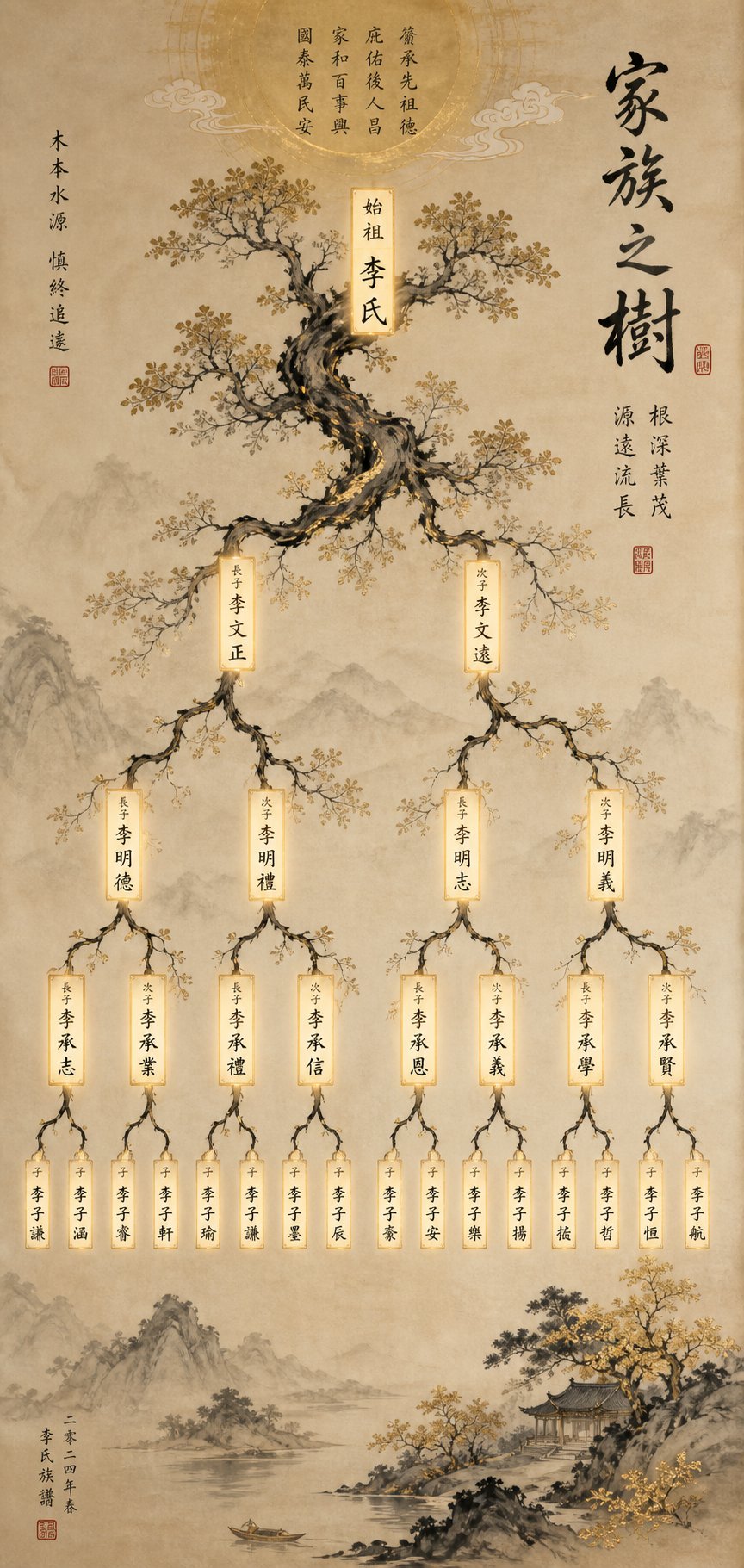
Of all the methods for matching sibling names, none carries more historical weight than the generational name system — known as 字辈 (zìbèi). This system doesn't just connect brothers and sisters. It links entire generations of a clan through a single shared character, making it possible to identify someone's place in the family line simply by reading their name.
Here's how it works. A committee of clan elders composes a generational poem, called a 字辈诗 (zìbèi shī). Each character in this poem is assigned to a successive generation. When a child is born into that generation, the designated character becomes part of their given name — placed in a fixed position, typically as the first character of a two-character given name. Every sibling, and every cousin sharing the same paternal grandfather, carries that identical character.
This is the most structured expression of chinese name order in practice: the chinese surname comes first, followed by the generational character, and then a unique personal character. The result is a name where family identity, generational identity, and individual identity each occupy a distinct position.
How Generational Poems Work Step by Step
Imagine a family with the surname LI (李) whose clan poem includes the sequence: 仁义礼智信 (rén yì lǐ zhì xìn) — meaning "benevolence, righteousness, propriety, wisdom, trust." Each character corresponds to one generation.
In the generation assigned 礼 (lǐ, propriety), every child's given name begins with that character. So you might see:
- 李礼明 (Lǐ Lǐmíng) — first son
- 李礼华 (Lǐ Lǐhuá) — second son
- 李礼芳 (Lǐ Lǐfāng) — a cousin
The first name chinese readers encounter after the surname is always 礼 for this entire generation. Only the final character — the personal character — distinguishes one individual from another. When this generation's children grow up and have kids of their own, those children receive 智 (zhì, wisdom) as their generational character, and the cycle continues.
As FamilySearch explains, the generation character most often appears as the first given character, though some clans place it second. Either way, the shared link across relatives is preserved. The poem's structure typically follows ordered lines in sets of five or seven characters, sometimes with rhyme schemes, sometimes without.
Generational Names Across Clans and Regions
Every family clan (家族/jiāzú) maintains its own unique generational poem. Some stretch back centuries. A poem can range from a dozen characters to hundreds, and because each character represents one generation, a long poem can guide naming for dozens of generations into the future.
This is where chinese family names and meanings become deeply intertwined. The characters chosen for generational poems aren't random — they typically express virtuous goals and ideals. Characters like 俊 (jùn, talented) or 豪 (háo, heroic) appear frequently, embedding aspirational values into the family's naming DNA. According to My China Roots, generational poems were usually composed whenever a new lineage was established through geographical emigration or social elevation, giving the new branch a sense of legitimacy.
A few important details to keep in mind:
- Generational poems for the same chinese surname can vary by location — two LI families in different provinces may follow entirely different poems
- The system historically applied primarily to male descendants, with daughters receiving names outside the generational framework
- Modern families increasingly include daughters in the system, applying the generational character regardless of gender
- The matching extends beyond immediate siblings to all patrilineal cousins within the same generation — anyone sharing the same paternal grandfather carries the same character
This last point is crucial. When you encounter two people with the same chinese surname and the same first name character, they aren't necessarily brothers or sisters. They could be cousins from different branches of the same clan, united by a generational poem composed generations before they were born. That shared character acts like a fingerprint, identifying not just family membership but precise generational placement within the larger clan structure.
The generational system represents the most formal and historically significant approach to sibling name matching. But it's far from the only method available — and many families today prefer techniques that offer more creative flexibility while still honoring the principle of connection between siblings' names.
Five Major Methods of Matching Sibling Names
The generational poem system is elegant, but it requires a clan infrastructure that many modern families no longer maintain. So what do parents do when they want their children's names to feel connected without following a centuries-old poem? They draw from a broader toolkit of matching techniques — each one creating a different type of bond between sibling names.
Think of these methods as a spectrum. On one end, you have exact character sharing — the most visible and literal connection. On the other, you have subtle thematic or tonal links that only reveal themselves when you know what to look for. Do chinese people have middle names in the Western sense? Not exactly. A Chinese given name typically consists of one or two characters that function as a unified personal identifier, not a separate "middle name in chinese" naming conventions. But within those one or two characters, parents have room to embed connections that tie siblings together.
Here are the five major methods, broken down systematically.
Shared Character Position Method
This is the most straightforward approach and the one closest to the generational system. Siblings share one identical chinese character name in the same position within their given names. The shared character occupies either the first or second slot of the two-character given name, while the other slot carries a unique character for each child.
For example, imagine a family with the surname CHEN (陈):
- 陈志明 (Chén Zhìmíng) — first child, with 志 (zhì, ambition) as the shared character
- 陈志华 (Chén Zhìhuá) — second child, same 志 in the same position
- 陈志远 (Chén Zhìyuǎn) — third child, again carrying 志
You'll notice the pattern immediately: every sibling's given name starts with 志, and only the second character differs. This creates a strong visual and phonetic link. Anyone reading these names together instantly recognizes the family connection.
The shared character can also appear in the second position. A pair like 明志 (Míngzhì) and 华志 (Huázhì) would place 志 at the end instead. The first-position placement is more common because it mirrors the generational name tradition, but second-position sharing works equally well for families who want a slightly less formal feel.
Shared Radical or Component Method
What if you want each child's name to stand on its own while still carrying a hidden thread of connection? That's where the shared radical method comes in. Instead of using the same character, siblings' names use different characters that share the same radical — the structural building block known as 部首 (bùshǒu).
Consider the water radical 氵. A family might name their children:
- 浩 (hào, vast/grand) — contains the water radical
- 洁 (jié, pure/clean) — also contains the water radical
- 涵 (hán, to contain/cultivate) — water radical again
Each name is distinct in sound and meaning, yet all three share the same visual root. When written in Chinese characters, the connection is immediately visible on the page — three names with the same left-side component, like siblings wearing matching accessories rather than identical outfits.
This technique appears in classical literature too. As noted in the Wikipedia entry on Chinese names, the Jia clan in Dream of the Red Chamber uses shared radicals across generations: 政 (zhèng), 赦 (shè), and 敏 (mǐn) in one generation all share components, while 璉 (liǎn), 珍 (zhēn), and 環 (huán) in the next all carry the jade radical 王.
Why does this method resonate so deeply? Because radicals in Chinese carry elemental meaning. The water radical suggests fluidity and wisdom. The wood radical 木 evokes growth. The fire radical 火 implies energy. By naming chinese characters with a shared radical, parents symbolize family unity at the structural level while granting each child a fully individual identity.
Thematic and Phonetic Pairing Methods
Not every family wants a visual match. Some prefer names that connect through meaning or sound — a more poetic, less literal form of sibling bonding.
Thematic pairing draws sibling names from a unified concept. Common themes include:
- Seasons: 春 (chūn, spring) and 秋 (qiū, autumn)
- Nature: 松 (sōng, pine) and 梅 (méi, plum blossom)
- Virtues: 仁 (rén, benevolence) and 义 (yì, righteousness)
- Celestial bodies: 星 (xīng, star) and 月 (yuè, moon)
The Cultural Atlas notes that Chinese parents often choose names embodying goodwill and auspiciousness. Thematic pairing extends this principle across siblings — the names don't just wish good things for each child individually, they create a coherent family narrative when read together.
Phonetic pairing, meanwhile, focuses on how names sound together. Parents might choose names with complementary tones — pairing a falling tone (fourth tone) with a rising tone (second tone) for pleasing contrast. Or they might select names that share a vowel sound or rhyme subtly, creating a musical quality when the siblings are called together. A pair like 嘉 (jiā) and 佳 (jiā) shares identical pronunciation but uses different characters with related meanings, blending phonetic and semantic matching.
Here's a comprehensive comparison of all five methods:
| Method Name (Chinese/Pinyin) | How It Works | Example Sibling Set | Cultural Symbolism |
|---|---|---|---|
| 字辈共字法 (zìbèi gòngzì fǎ) — Generational Character | All siblings share a character assigned by a clan poem, placed in a fixed position | 李礼明, 李礼华 (shared 礼) | Clan continuity, generational order, ancestral respect |
| 同字定位法 (tóngzì dìngwèi fǎ) — Shared Character Position | Siblings share one identical character in the same position within their given names | 陈志明, 陈志华 (shared 志) | Direct family bond, visible unity, collective aspiration |
| 同部首法 (tóng bùshǒu fǎ) — Shared Radical | Different characters sharing the same radical appear in sibling names | 浩, 洁, 涵 (all with water radical 氵) | Shared elemental nature, unity with individuality |
| 主题关联法 (zhǔtí guānlián fǎ) — Thematic Pairing | Names drawn from a unified concept like seasons, virtues, or nature | 松 (pine) and 梅 (plum blossom) | Poetic harmony, complementary strengths, family narrative |
| 音韵协调法 (yīnyùn xiétiáo fǎ) — Phonetic Harmony | Names that sound pleasing together through complementary tones or shared sounds | 嘉 (jiā) and 佳 (jiā) | Aesthetic beauty, oral tradition, musical balance |
In practice, these methods aren't mutually exclusive. A skilled parent — or a professional naming consultant — might combine two or three approaches in a single sibling set. A pair of names could share a radical and follow a nature theme and have complementary tones. The more layers of connection, the richer the relationship between the names.
What all five methods share is a deeper principle: that chinese middle names and given names aren't chosen in isolation. Each child's name exists in relationship to their siblings' names, forming a small constellation of meaning within the family. The specific method a family chooses often depends on factors beyond pure preference — including the metaphysical system of the Five Elements and the numerological significance of stroke counts, which add another dimension to how sibling names interact.
Five Elements and Stroke Count in Sibling Naming
Shared characters and radicals create visible connections between sibling names. But there's an invisible layer of matching that many families consider just as important — one rooted in cosmology rather than linguistics. This is where the Five Elements system, or 五行 (wǔxíng), enters the picture.
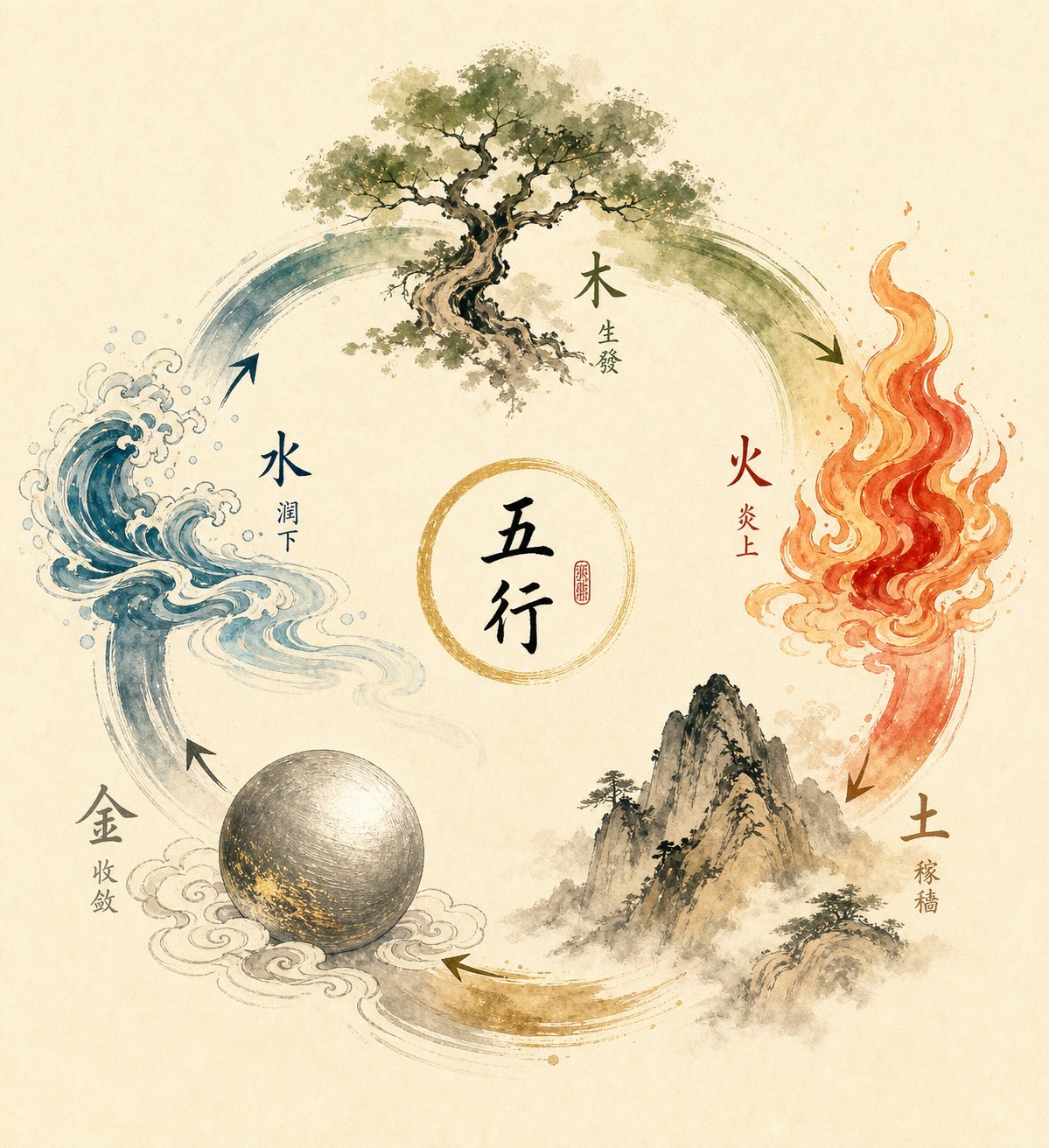
In Chinese philosophy, every character carries an elemental association with one of five phases: Wood (木/mù), Fire (火/huǒ), Earth (土/tǔ), Metal (金/jīn), and Water (水/shuǐ). These associations come from the character's radical, its semantic meaning, or sometimes its stroke count. For example, a character like 林 (lín, forest) carries Wood energy through both its radical and meaning, while 鑫 (xīn, prosperity) is strongly Metal due to its triple-金 composition. Understanding the chinese meaning of names at this elemental level adds a metaphysical dimension to sibling matching — one where the relationship between names mirrors the cycles of nature itself.
Balancing Elements Across Children
When parents apply Five Elements thinking to sibling names, they aren't just picking characters that sound nice together. They're designing an elemental relationship between their children's names based on the Generating Cycle (相生/xiāngshēng) — the natural sequence in which each phase nourishes the next:
- Wood feeds Fire
- Fire creates Earth
- Earth bears Metal
- Metal collects Water
- Water nourishes Wood
Imagine a first child whose birth chart (八字/bāzì) analysis reveals a need for Wood energy. The parents choose a name with strong Wood associations — perhaps 柏 (bǎi, cypress). When the second child arrives, a naming consultant might recommend a Fire-element name like 煜 (yù, radiant), because Wood feeds Fire in the productive cycle. The sibling names now form a harmonious elemental pair rather than a conflicting one.
How does a family determine which element each child needs? This is where chinese name interpretation gets personal. A BaZi birth chart is calculated from the baby's exact birth date, time, and place. The chart reveals which elements are abundant, which are weak, and which are entirely absent. A naming consultant identifies the Day Master — the element representing the child — and checks whether it needs support or release. The name then supplies the missing or supportive element through carefully chosen characters.
For sibling naming, this creates an interesting challenge. Each child has their own birth chart and their own elemental needs. The goal is to satisfy each child's individual balance while also ensuring the siblings' names relate to each other harmoniously within the Generating Cycle — not the Controlling Cycle (相克/xiāngkè), where elements restrain each other. A Water-element name paired with a Fire-element name, for instance, would create tension (Water quenches Fire), which most families prefer to avoid.
How Stroke Count Connects to Numerology
Beyond elemental associations, the mandarin name meaning of a character also extends to something purely structural: its stroke count. The total number of strokes (笔画/bǐhuà) in a name carries numerological weight in Chinese tradition. This system evaluates the full name — surname plus given name — by calculating stroke totals and mapping them to auspicious or inauspicious number patterns.
The Taichung City Government's cultural guide describes this practice as "an art in word application," where the luck and misfortune of numerical strokes are deduced alongside the Five Elements characteristics of each character. The analysis produces readings for the "Heaven Grid," "Earth Grid," and "Man Grid" — three numerological positions that together describe a person's fortune trajectory.
For sibling names, stroke count harmony means parents consider how the numerical profiles of their children's names relate to each other. Here's a practical example:
| Sibling | Full Name | Stroke Count (Surname + Given Name) | Numerological Profile |
|---|---|---|---|
| First child | 王俊杰 (Wáng Jùnjié) | 4 + 9 + 12 = 25 | Auspicious (associated with talent and leadership) |
| Second child | 王俊瑶 (Wáng Jùnyáo) | 4 + 9 + 15 = 28 | Mixed (may be adjusted) |
| Second child (adjusted) | 王俊瑜 (Wáng Jùnyú) | 4 + 9 + 14 = 27 | Auspicious (associated with independence and creativity) |
You'll notice the second child's name was adjusted by swapping one character — from 瑶 (15 strokes) to 瑜 (14 strokes) — to shift the total into a more favorable number. Both characters carry the jade radical and a positive name in chinese meaning, so the thematic connection remains intact. The change is subtle, but for families who follow numerological principles, it matters.
In practice, stroke count analysis rarely overrides meaning or sound. It functions as a final filter — a way to choose between two equally appealing candidates when the elemental balance and thematic matching are already satisfied. Parents who consult professional namers often receive a shortlist of characters that pass the elemental and semantic tests, with stroke count serving as the tiebreaker.
These metaphysical layers — Five Elements cycling and stroke numerology — represent the most technical dimension of sibling name matching. They require specialized knowledge that most parents access through naming consultants, temple advisors, or increasingly, digital tools that automate BaZi calculations. Yet even families who don't follow these systems strictly often absorb their logic intuitively, avoiding element clashes or choosing characters whose stroke counts "feel right" without running formal calculations.
The interplay between cosmic philosophy and practical naming decisions didn't emerge overnight, though. These systems evolved across centuries of Chinese history, shaped by imperial decrees, clan politics, and dramatic social upheavals that repeatedly transformed how families approached the act of naming their children.
Historical Evolution From Imperial Clans to Modern Families
Five Elements theory and stroke numerology gave families a cosmic framework for matching names. But these tools didn't exist in a vacuum — they developed alongside a much older institutional system that governed how chinese full names were assigned across entire clans for centuries. The story of sibling naming rules is inseparable from the story of Chinese political and social history itself.
Imperial Era and Clan Registry Traditions
During imperial China, large clans maintained formal genealogies called 族谱 (zúpǔ) — detailed family registries that recorded every member's name, birth, marriage, and death. These weren't casual family trees. They were legal and social documents, sometimes running to dozens of volumes, and they enforced strict generational naming requirements.
The system's purpose was practical: any clan member could identify another's generation and branch simply by reading their name. If you encountered someone with your surname and recognized their generational character, you immediately knew whether they were your elder, your peer, or your junior — even if you'd never met. In a society where kinship determined social obligations, inheritance rights, and ritual responsibilities, this was essential information encoded in just two or three characters.
Research by Li Zhonghua and Edwin Lawson traces the generation name practice back to the end of the Han Dynasty (206 BC - 220 AD), when Liu Biao's two sons were given names sharing the same character component. By the Song Dynasty (960-1279), the system had matured into its full form: predetermined chains of characters, often composed as poems, assigned to successive generations before children were even born.
Perhaps the most famous example comes from the Ming dynasty imperial family. The founding emperor Zhu Yuanzhang assigned each of his sons a generational poem, then mandated that each generation's names follow the Five Elements cycle through their radicals — Wood, Fire, Earth, Metal, Water — rotating in sequence. This meant that full chinese names in the imperial line carried both a generational character and an elemental radical, creating a double-layered matching system visible across centuries of rulers.
The Mao clan of Shaoshan, Hunan Province offers another well-documented case. Their generational poem, composed in 1737 and expanded in 1881, contains 40 characters arranged in eight lines of five — enough to guide naming for 40 generations. Mao Zedong's generation character 泽 (zé) stands as the fourteenth character in this poem, placing him precisely in the clan's generational sequence. His grandfather's generation used 恩 (ēn), his father's used 贻 (yí) — each character a stepping stone in the poem's progression.
Republican Period Through the One-Child Policy
The fall of the Qing dynasty in 1911 began loosening these clan-based naming obligations. Urbanization pulled families away from ancestral villages where generational poems were enforced by social pressure and elder authority. Intellectuals increasingly viewed the system as a relic of feudal patriarchy — a hierarchy that ranked men by birth order and excluded women entirely.
The Communist revolution accelerated this shift dramatically. During the Cultural Revolution (1966-1976), many young people abandoned their generational characters altogether, replacing them with politically charged names like 卫东 (Wèidōng, "protect Mao Zedong") or 红卫 (Hóngwèi, "Red Guard"). Fathers who might have followed clan tradition didn't dare use generational names for their babies during this period.
The data tells a stark story. Li and Lawson's research found that 90.4% of men born in the pre-Mao era (1940-1949) used generation names in their common chinese full names. By the second Mao period (1960-1976), that figure had plummeted to just 41.2%. Four forces drove this collapse: urbanization severing ties to ancestral land, the breaking of traditional community bonds, the perceived feudal nature of generation names, and direct political pressure under Mao's regime.
Then came the one-child policy in 1979. For an entire generation of only children, sibling naming rules became largely irrelevant. You can't match names between siblings who don't exist. The two-character name pattern — surname plus a single given-name character, with no room for a generational marker — surged in popularity. Chinese names in chinese naming practice grew simpler, more individualistic, and less connected to clan structures.
Revival in the Post-One-Child Era
Something shifted after Mao's death in 1976. Li and Lawson's data shows generation name usage recovering to 53% in the post-Mao period (1977-1983) — a statistically significant rebound, though still well below pre-revolution levels. The end of political suppression allowed traditional culture to breathe again, and some families quietly returned to their clan poems.
The real turning point, however, came with the relaxation of birth restrictions. China moved to a two-child policy in 2016 and a three-child policy in 2021. Suddenly, millions of families faced a question their parents never had to answer: how do you name a second child in relation to the first?
This policy shift has sparked renewed interest in sibling naming traditions. Sixth Tone reported on families navigating new naming dynamics after the two-child policy, with some parents giving the first child the father's surname and the second child the mother's — a practice that would have been nearly unthinkable a generation earlier. AFP reporting via The Jakarta Post noted that one in ten babies born in Shanghai in 2018 carried their mother's surname, reflecting how profoundly family naming dynamics have shifted.
Modern parents aren't simply reviving imperial-era systems wholesale, though. They're adapting traditional principles — shared characters, thematic pairing, elemental balancing — to fit contemporary values. The rigid clan poem that once dictated names for male descendants only is giving way to flexible matching methods that include daughters, accommodate blended families, and work across both Chinese and English-language contexts. The tradition lives on, but in forms that earlier generations might barely recognize.
Modern Adaptations and Regional Variations
Tradition is adapting, not disappearing. The rigid clan poem system may be fading, but the impulse to connect sibling names remains strong across Chinese-speaking communities worldwide. What's changed is how families execute that connection — and the answer depends heavily on where they live, what languages they navigate daily, and how they define family itself.
Mainland China vs Taiwan vs Diaspora Approaches
In mainland China, most young parents today use informal matching methods rather than strict generational poems. Shared radicals, thematic pairing, and complementary tones have largely replaced the zibei system for everyday families. The Straits Times reported that among university students surveyed in Singapore — a community with deep mainland Chinese roots — more than half did not have a generation name at all. Associate Professor Lee Cher Leng from NUS observed that in her cohorts of about 200 students, fewer than ten came from families still using the zu pu or jia pu to determine generational names.
What's replaced the formal system? Many mainland families now consult naming professionals who focus on Five Elements balancing and stroke count analysis, producing names with rare characters tailored to each child's birth chart. Others simply choose a common character for all children so they can identify as siblings — a lighter version of the generational tradition that doesn't extend to cousins or require a clan poem.
Taiwanese families often maintain stronger connections to clan genealogies. Taiwan's uninterrupted access to traditional culture (without the disruptions of the Cultural Revolution) means that some families still reference their ancestral zu pu when naming children. The practice carries more social prestige there, and clan associations remain active in preserving and publishing genealogical records.
For overseas Chinese communities — in Southeast Asia, North America, Australia, and Europe — the challenge multiplies. These families must match mandarin chinese names while simultaneously considering how those names interact with English or local-language names. A parent might want siblings' Chinese names to share a radical, but also want their English names to start with the same letter. Or they might prioritize a chinese name with english name compatibility, ensuring the Chinese given name can be easily pronounced by non-Chinese speakers.
The Cultural Atlas documents how many Chinese people adopt Western personal names for international contexts — a practice that adds another naming layer for diaspora siblings. If the first child goes by "James" in English and carries the generational character in Chinese, the second child's parents face a dual coordination challenge: matching both the Chinese names and the Western names in some coherent way. Some families solve this by giving siblings chinese names in english that share initials (like Trevor and Tyler, or James and Jessica), creating a parallel matching system across languages.
Gender Equality in Modern Sibling Naming
Historically, generational naming applied primarily to sons. Daughters received names outside the system — often beautiful, poetic names, but ones that didn't carry the clan's generational marker. The logic was patrilineal: since daughters would marry into another family, their names didn't need to encode their birth clan's generational sequence.
This is changing. Modern families increasingly apply matching rules equally to all children regardless of gender. When researching chinese female names and surnames, you'll find that contemporary parents are just as likely to give a daughter the shared family character as a son. The Pang family profiled by The Straits Times illustrates this shift — though Ms. Pang Sze Yunn noted that being female, she could not pass on her family's generational naming tradition to her own children under the old rules. Her generation still felt that constraint, even as younger families discard it.
What about half-siblings and step-siblings? Traditionally, sibling naming rules follow the paternal line exclusively. Two children sharing a father would share a generational character; two children sharing only a mother would not. Modern blended families are writing new conventions here. Some step-parents choose to create a fresh thematic link between all children in the household, regardless of biological parentage — a shared radical or nature theme that signals "we are one family now" without claiming false generational continuity.
The landscape of chinese female names and surnames has broadened considerably. Parents who once reserved strong, ambitious characters for sons and gentle, aesthetic characters for daughters now mix freely. A brother-sister pair might share the character 睿 (rui, wise) or the jade radical — connections that would have been unusual a generation ago, when matching was seen as a male-line concern.
Here are the most common modern adaptations families are using today:
- Relaxed matching — using the same theme (nature, virtues, celestial imagery) rather than requiring an identical shared character
- Cross-gender matching — applying the same generational character or radical to both sons and daughters equally
- Bilingual name coordination — ensuring chinese with english names work together across both languages, sometimes matching initials or syllable patterns in both systems
- Simplified element balancing — considering Five Elements harmony between siblings without requiring a full BaZi consultation for each child
- Maternal surname inclusion — giving the second child the mother's surname while maintaining a thematic or radical link to the first child's given name
These adaptations reflect a broader cultural shift: the move from obligation to intention. Earlier generations followed naming rules because clan elders enforced them. Today's parents choose to match sibling names because they want to — because the practice feels meaningful, not because anyone is checking a genealogy book. The result is a more diverse, more creative, and more inclusive naming landscape, one where the old principles survive in new forms.
Of course, wanting to match names and knowing how to do it are two different things. A parent staring at their first child's name, trying to reverse-engineer a matching strategy for baby number two, faces a very specific practical puzzle — one that requires analyzing the existing name's structure before generating candidates for the new one.
How to Name a Second Child to Match the First
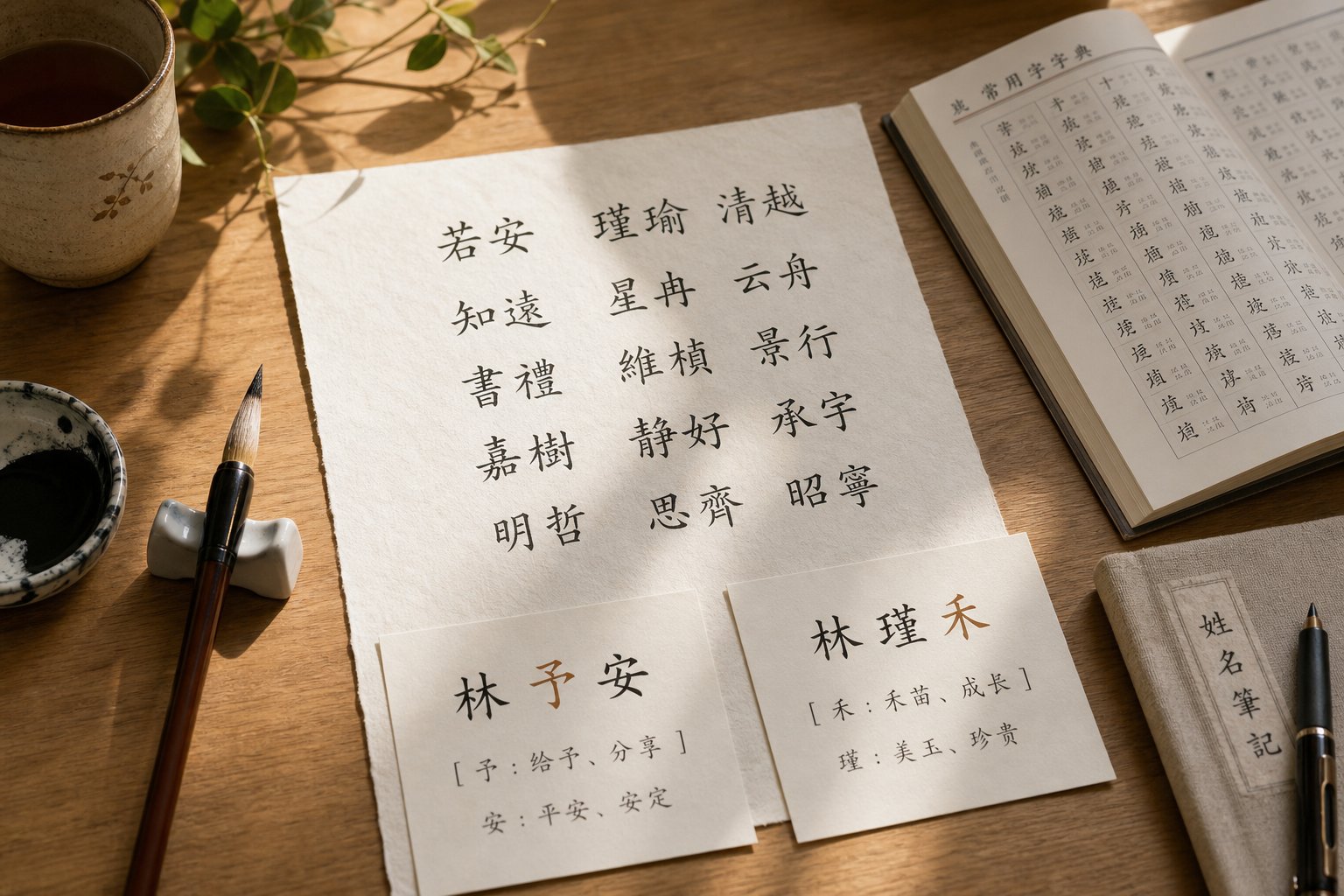
You've already named your first child. The characters are chosen, the birth certificate is filed, and the name has become part of your family's identity. Now baby number two is on the way, and you're wondering: how do I create a name that connects to the first without feeling forced? This is the practical heart of sibling name matching — working backward from an existing name to find its natural partner.
Whether you're figuring out how to name your asian baby using traditional methods or simply want your children's names to feel like they belong together, the process starts with a careful analysis of what you already have.
Analyzing Your First Child's Name for Matching Potential
Before generating ideas for the second name, you need to understand the structure of the first. Think of it like reading a blueprint — every character contains multiple layers of information that can serve as connection points.
Take the name 林雨桐 (Lin Yutong) as an example. Here's what you'd examine:
- Characters: 雨 (yu, rain) and 桐 (tong, paulownia tree)
- Radicals: 雨 uses the rain radical (雨), while 桐 contains the wood radical (木)
- Elemental associations: 雨 carries Water energy; 桐 carries Wood energy
- Stroke counts: 雨 has 8 strokes, 桐 has 10 strokes — total given name is 18 strokes
- Thematic meaning: Both characters evoke a natural scene — rain falling on a tree
Each of these layers offers a different matching path. You could match through the wood radical (giving the second child a name like 雨柏, sharing both the character 雨 and the nature theme). You could match through the nature theme alone (choosing characters like 雪松, snow and pine, which echo the weather-plus-tree pattern). Or you could match through elemental harmony, selecting a Fire-element name that continues the Water-feeds-Wood-feeds-Fire cycle.
The key question is: which matching method best suits the first name's structure? A name rich in radical possibilities (like one containing the jade radical 玉 or water radical 氵) lends itself naturally to radical matching. A name built around a clear theme invites thematic pairing. A name with a strong, versatile shared character — one that combines well with many other characters — makes shared-character matching the easiest path.
Step-by-Step Process for Creating a Matched Sibling Name
Once you've mapped the first name's structure, follow this process to build the second:
- Identify the shared element. Decide which connection type you'll use — a shared character, a shared radical, a thematic link, or an elemental relationship. This decision shapes everything that follows.
- Generate candidate characters. List characters that fulfill your chosen match. If you're sharing the radical 氵, brainstorm characters like 澄 (cheng, clear), 润 (run, moist), 泽 (ze, grace), or 溪 (xi, stream). If you're matching a nature theme, gather characters from the same conceptual family.
- Check stroke count and tonal harmony. For each candidate, calculate the total stroke count of the full name (surname + given name) and verify it falls within auspicious number ranges. Then say both siblings' names aloud together — do the tones flow naturally, or do they clash?
- Verify the combined meaning is auspicious. Each character should carry positive connotations on its own, and the two-character given name should read as a coherent, favorable phrase. Avoid combinations that accidentally form words with negative associations.
- Confirm the name works with the family surname. Read the full name — surname plus given name — as a complete unit. Some character combinations create unintended puns or awkward sounds when paired with certain surnames. The surname 史 (shi), for instance, sounds identical to 屎 (shi, feces), so any given-name character that amplifies that association should be avoided.
This process applies whether you're translating chinese names from an existing family tradition or creating something entirely new. The pronunciation of chinese names matters enormously here — a name that looks beautiful on paper but sounds awkward when spoken aloud will cause daily frustration.
Common Pitfalls to Avoid
Even experienced parents stumble on these issues. Keep them in mind as you finalize your choice:
- Homophone traps: Chinese is full of characters that share identical pronunciation but carry vastly different meanings. The character 梅 (mei, plum blossom) is lovely, but in some dialects it sounds like 霉 (mei, mold/bad luck). As eChineseLearning notes, even characters with positive meanings can create unfortunate puns when combined with certain surnames or sibling names.
- Dialect compatibility: A name that sounds harmonious in Mandarin might clash in Cantonese, Hokkien, or Shanghainese. If your family speaks a dialect at home, test the pronunciation of chinese names in both Mandarin and your home dialect before committing.
- Unintended phrases: When two sibling names are spoken together — as they often will be — check that the combination doesn't accidentally form a word or phrase. Siblings named 大为 (Dawei) and 小为 (Xiaowei) might seem like a cute big/small pairing, but calling them together sounds like you're making a comparison rather than addressing two individuals.
- Over-matching: Names that are too similar can blur individual identity. If both children share a character and a radical and rhyme, people may constantly confuse them. Leave enough distinction for each child to own their name fully.
- Ignoring how to write your name in chinese: Consider the visual complexity of the characters. If the first child has a name with simple, low-stroke characters, giving the second child a name packed with 20-stroke characters creates an imbalance — one child will learn to write their name in kindergarten while the other struggles for years.
A final practical note: if you're working across languages — creating a chinese translation for names that also need to function in English or another language — test the full combination in both contexts. The matched Chinese names should feel connected when written in characters, and whatever romanized or English names you use should sit comfortably alongside them. Some families find that matching the initial sounds of both the Chinese and English names (like siblings named 明 and 美 in Chinese, "Michael" and "Mia" in English) creates a satisfying cross-linguistic echo.
The beauty of this process is that it's both systematic and creative. The rules give you structure; the thousands of available characters give you freedom. And once you understand how sibling names are constructed, you'll start noticing these patterns everywhere — in your friends' families, in historical records, and in the Chinese names you encounter in daily life.
Recognizing Sibling Name Patterns in Real Life
Knowing how to create matched sibling names is one skill. Spotting those patterns when you encounter them in the wild is another — and it's surprisingly useful whether you're researching family history, learning Mandarin, or working across cultures.
Spotting Generational and Radical Patterns
When you see two people who share the same surname and the same character in the first position of their given name, you're almost certainly looking at siblings or same-generation cousins. This is the most reliable signal. If you encounter a family tree listing ZHANG Weiming, ZHANG Weihua, and ZHANG Weijun, the shared 伟 (wei) tells you these three belong to the same generational line — even before you check birth dates or parent records.
Radical patterns are subtler. You need to look at the characters themselves, not just the romanized spellings. Two siblings named 浩 (hao) and 涵 (han) won't look obviously connected in pinyin, but written in characters, that shared water radical 氵 jumps off the page. This is why understanding how are chinese names structured at the character level — not just the sound level — matters for anyone doing genealogical or translation work.
Practical Applications for Researchers and Learners
These pattern-recognition skills serve different audiences in different ways:
- Genealogy researchers can trace family lines by identifying generational characters across records. If you're working through a jiapu or zupu, recognizing the shared first name character lets you group individuals by generation instantly — even when other records are incomplete.
- Mandarin learners gain context for why classmates' siblings have similar-sounding names. Understanding chinese names and pronunciation patterns together deepens vocabulary retention and cultural literacy simultaneously.
- Translators face a specific challenge: preserving sibling name relationships when romanizing chinese first and last names. If two siblings share a radical-based connection visible only in characters, a good translator notes this relationship rather than letting it disappear into pinyin.
- Cross-cultural professionals navigating Chinese family introductions can use these patterns to understand relationships faster. When a colleague introduces their brother and you notice the shared character in their chinese first names, you demonstrate cultural awareness that builds trust.
The key insight about chinese names and pronunciation is that romanization alone often obscures the connections that are obvious in written characters. Two names that look unrelated in English spelling may share radicals, elements, or thematic links that only become visible when you examine the original characters. This is why first name last name chinese conventions reward deeper investigation beyond surface-level transliteration.
Understanding sibling name matching patterns isn't just an academic exercise — it's a practical key to reading Chinese family relationships, respecting cultural identity, and communicating across linguistic boundaries with genuine depth rather than surface-level politeness.
Whether you're naming your own children, tracing ancestors through historical records, or simply curious about the names around you, these traditions offer a window into something larger: a culture that treats naming as an act of connection. Each matched pair of sibling names carries forward the belief that family is not just lived — it's written into the very characters that identify us. That's linguistic artistry, generational continuity, and family harmony, all held within a few carefully chosen strokes.
Frequently Asked Questions About Chinese Sibling Name Matching Rules
1. Do Chinese siblings always have to share a character in their names?
No, sharing an identical character is just one of several matching methods. Families can also connect sibling names through shared radicals (structural components of characters), thematic meaning (like both names referencing nature or virtues), tonal harmony, or Five Elements balancing. Modern families often prefer these subtler approaches over strict character sharing, allowing each child a more distinct identity while maintaining a family connection.
2. How does the generational name poem (zibei) system work for siblings?
A clan's elders compose a poem where each character is assigned to a successive generation. All children born into that generation use the designated character in a fixed position within their given name, typically as the first character. This means siblings, and even same-generation cousins sharing a paternal grandfather, all carry the same character. The personal character in the second position is what distinguishes individuals from one another.
3. Can daughters be included in Chinese sibling name matching traditions?
Historically, generational naming applied only to sons since daughters were expected to marry into another family. However, modern Chinese families increasingly apply matching rules equally to all children regardless of gender. Today, parents commonly give daughters the same shared character, radical, or thematic link as their sons, reflecting broader shifts toward gender equality in Chinese naming culture.
4. What role do the Five Elements play in choosing matched sibling names?
Each Chinese character carries an elemental association with Wood, Fire, Earth, Metal, or Water. Parents aim to create a productive cycle between siblings' names rather than a conflicting one. For example, if the first child's name carries Wood energy, the second child might receive a Fire-element name because Wood feeds Fire. A BaZi birth chart analysis helps determine which element each child needs for personal balance.
5. How do I create a matching name for my second child if my first child already has a Chinese name?
Start by analyzing your first child's name for its characters, radicals, elemental associations, stroke counts, and thematic meanings. Then choose which matching method suits the existing name best. Generate candidate characters that fulfill the match, check stroke count harmony and tonal flow, verify the meaning is auspicious, and confirm the full name works well with your family surname. Testing pronunciation in both Mandarin and any family dialect is also essential.