Understanding Chinese Surnames and the Pinyin System
When you encounter a Chinese name for the first time, where do you even start? Is it "Zhang" like it looks in English, or something else entirely? If you have ever hesitated before saying a colleague's or classmate's Chinese last name out loud, you are not alone. A reliable chinese surname pinyin list solves that problem by giving you the exact pronunciation for every common surname in one place.
Why a Chinese Surname Pinyin List Matters
Pinyin is the official romanization system for Mandarin Chinese, introduced in the 1950s to represent the sounds of the language using Latin letters. It is the standard on mainland Chinese passports, in language textbooks, and across digital input systems used by over a billion people. For anyone outside China, pinyin is the key that unlocks correct pronunciation of chinese surnames without needing to read characters.
A dedicated reference list matters for several reasons. Professionals working across cultures need to pronounce names respectfully. Genealogy researchers tracing chinese family names need to connect Anglicized spellings back to their Mandarin originals. And language learners benefit from seeing how tones and initials work in real-world names rather than abstract vocabulary drills. Whether you are looking up a single surname in chinese or browsing dozens, having a structured list saves time and prevents embarrassing mispronunciations.
The top 100 Chinese surnames cover almost 86% of China's population of over 1.3 billion people, according to the Ministry of Public Security. That means a relatively short list can help you pronounce the vast majority of chinese last names you will ever encounter.
How Chinese Names Are Structured
Chinese names follow a structure opposite to most Western conventions. The surname (姓, xing) comes first, followed by the given name. So in a name like Wang Xiaoming, Wang is the family name and Xiaoming is the given name. Most chinese surnames are a single syllable, and all of the top 100 family names have just one character. Given names typically have one or two characters, making a full name two or three syllables total.
This structure matters when reading any list of asian names and surnames because it tells you exactly where to look: the first syllable is almost always the surname. Understanding that simple rule makes the rest of this guide immediately usable.
In the sections ahead, you will find a ranked table of the most common chinese last names with pinyin tone marks, a pronunciation guide tailored to English speakers, regional spelling variants, and tools to look up any chinese surname you need. Think of it as both a quick-reference lookup and a deeper learning resource you can return to whenever a new name crosses your path.
The Most Common Chinese Surnames in Pinyin
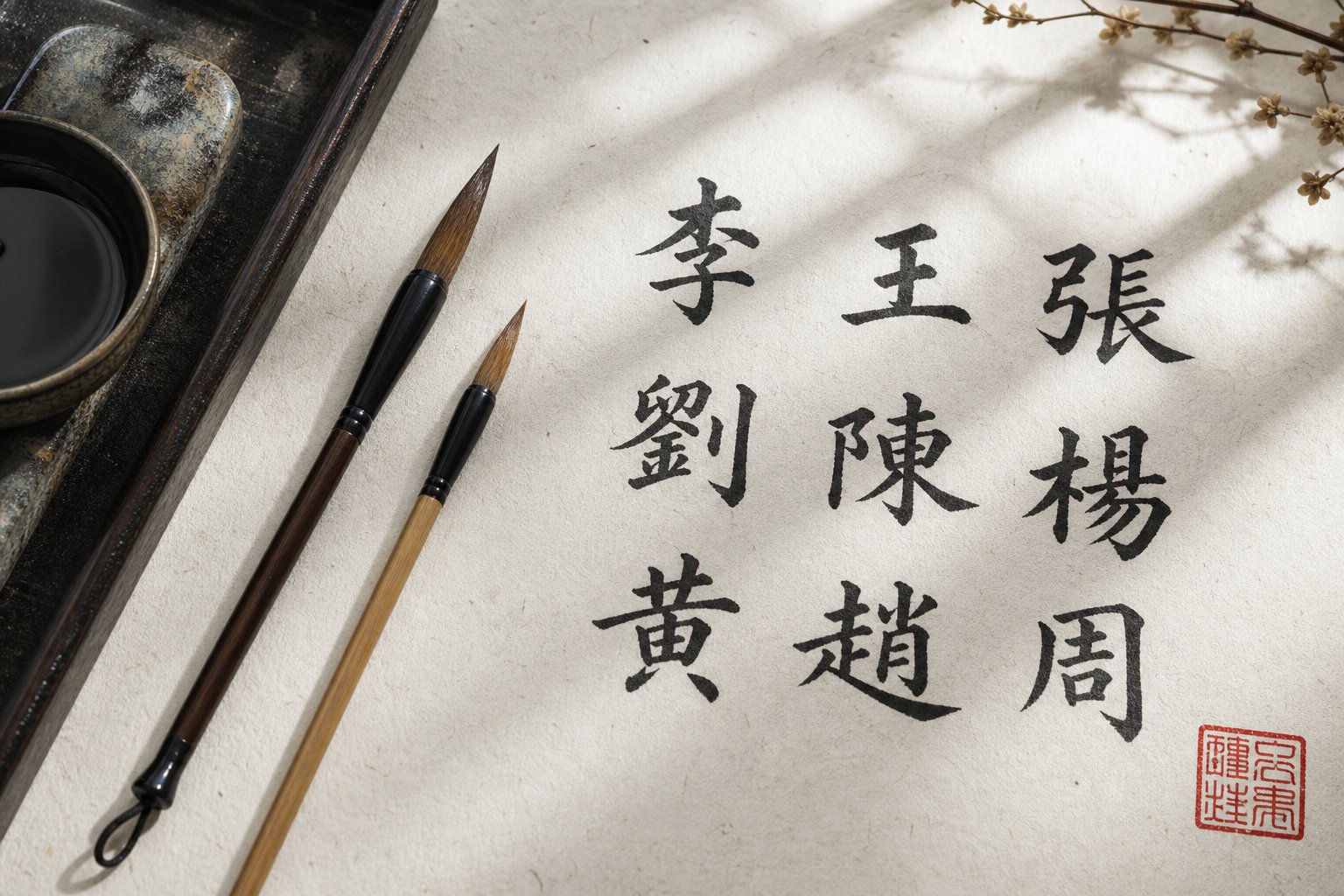
With over 20,000 surnames recorded throughout Chinese history, the list might seem overwhelming. The good news? A surprisingly small number of names dominates. Data from China's Seventh National Population Census (2021) shows that just the top 10 most common chinese surnames account for roughly half of the Han Chinese population. The chinese surnames list below gives you pinyin with tone marks, characters in both simplified and traditional forms, and an English pronunciation approximation so you can say each name with confidence.
Top 10 Chinese Surnames by Population
These are the top chinese last names you will encounter most frequently, whether in business, academia, or everyday life. The most common chinese surname is Li, representing about 7.94% of the Han population alone.
| Rank | Simplified | Traditional | Pinyin | Approximate Pronunciation |
|---|---|---|---|---|
| 1 | 李 | 李 | Lǐ | "lee" (dipping tone) |
| 2 | 王 | 王 | Wáng | "wahng" (rising tone) |
| 3 | 张 | 張 | Zhāng | "jahng" (flat tone) |
| 4 | 刘 | 劉 | Liú | "lyoh" (rising tone) |
| 5 | 陈 | 陳 | Chén | "chuhn" (rising tone) |
| 6 | 杨 | 楊 | Yáng | "yahng" (rising tone) |
| 7 | 黄 | 黃 | Huáng | "hwahng" (rising tone) |
| 8 | 赵 | 趙 | Zhào | "jaow" (falling tone) |
| 9 | 周 | 周 | Zhōu | "joe" (flat tone) |
| 10 | 吴 | 吳 | Wú | "woo" (rising tone) |
You'll notice that Wáng (7.65%) and Zhāng (7.07%) follow closely behind Li. Together, these three popular chinese last names alone cover more than 22% of the Han ethnic group, which itself makes up over 91% of China's total population.
Surnames Ranked 11 Through 50
Expanding to the top 50 most common chinese last names captures the vast majority of surnames you will realistically encounter. This tier includes many of the most popular chinese last names found in international workplaces and diaspora communities worldwide.
| Rank | Simplified | Traditional | Pinyin | Approximate Pronunciation |
|---|---|---|---|---|
| 11 | 徐 | 徐 | Xú | "shoo" (rising) |
| 12 | 孙 | 孫 | Sūn | "swun" (flat) |
| 13 | 朱 | 朱 | Zhū | "joo" (flat) |
| 14 | 马 | 馬 | Mǎ | "mah" (dipping) |
| 15 | 胡 | 胡 | Hú | "hoo" (rising) |
| 16 | 郭 | 郭 | Guō | "gwoh" (flat) |
| 17 | 林 | 林 | Lín | "lin" (rising) |
| 18 | 何 | 何 | Hé | "huh" (rising) |
| 19 | 高 | 高 | Gāo | "gow" (flat) |
| 20 | 梁 | 梁 | Liáng | "lyahng" (rising) |
| 21 | 郑 | 鄭 | Zhèng | "juhng" (falling) |
| 22 | 罗 | 羅 | Luó | "lwoh" (rising) |
| 23 | 宋 | 宋 | Sòng | "soong" (falling) |
| 24 | 谢 | 謝 | Xiè | "syeh" (falling) |
| 25 | 唐 | 唐 | Táng | "tahng" (rising) |
| 26 | 韩 | 韓 | Hán | "hahn" (rising) |
| 27 | 曹 | 曹 | Cáo | "tsow" (rising) |
| 28 | 许 | 許 | Xǔ | "shoo" (dipping) |
| 29 | 邓 | 鄧 | Dèng | "duhng" (falling) |
| 30 | 萧 | 蕭 | Xiāo | "syow" (flat) |
| 31 | 冯 | 馮 | Féng | "fuhng" (rising) |
| 32 | 曾 | 曾 | Zēng | "dzuhng" (flat) |
| 33 | 程 | 程 | Chéng | "chuhng" (rising) |
| 34 | 蔡 | 蔡 | Cài | "tsai" (falling) |
| 35 | 彭 | 彭 | Péng | "puhng" (rising) |
| 36 | 潘 | 潘 | Pān | "pahn" (flat) |
| 37 | 袁 | 袁 | Yuán | "ywen" (rising) |
| 38 | 于 | 于 | Yú | "yoo" (rising) |
| 39 | 董 | 董 | Dǒng | "doong" (dipping) |
| 40 | 余 | 余 | Yú | "yoo" (rising) |
| 41 | 苏 | 蘇 | Sū | "soo" (flat) |
| 42 | 叶 | 葉 | Yè | "yeh" (falling) |
| 43 | 吕 | 呂 | Lǚ | "lyoo" (dipping) |
| 44 | 魏 | 魏 | Wèi | "way" (falling) |
| 45 | 蒋 | 蔣 | Jiǎng | "jyahng" (dipping) |
| 46 | 田 | 田 | Tián | "tyen" (rising) |
| 47 | 杜 | 杜 | Dù | "doo" (falling) |
| 48 | 丁 | 丁 | Dīng | "ding" (flat) |
| 49 | 沈 | 沈 | Shěn | "shuhn" (dipping) |
| 50 | 姜 | 姜 | Jiāng | "jyahng" (flat) |
Scanning through these common chinese last names, you might notice something: many pinyin spellings look nothing like how an English speaker would instinctively read them. Xu does not rhyme with "zoo," Cai is not "kay," and Qiu (ranked 65) is not "kwee-you." The pronunciation approximations above get you close, but the real challenge lies in understanding how pinyin consonants and tones actually work, especially the sounds that have no direct English equivalent.

How Pinyin Tones Work in Chinese Surnames
You have seen the tone marks sitting above vowels in the tables above. But what do they actually mean for pronunciation? Here is the key point: in Mandarin Chinese, tone is not optional decoration. It is part of the word itself. Change the tone on a single syllable chinese surname and you get a completely different character, a different meaning, or a nonsense sound. Two mandarin surnames can share the exact same letters yet refer to entirely different families because of tone alone.
The Four Tones Explained With Surname Examples
Mandarin has four main tones plus a neutral (unstressed) tone. Each one shapes the pitch of your voice in a specific pattern. Imagine you are reading through a chinese surname pinyin list and you see "Li" appear multiple times. Without the tone mark, you cannot tell which surname it is. With the mark, everything becomes clear.
- First Tone (high level) — mark: ā, ē, ī, ō, ū
Your pitch stays flat and high, like holding a musical note. Think of saying "Ahhh" at the doctor's office.
Surname examples: Zhāng (张), Zhōu (周), Gāo (高) - Second Tone (rising) — mark: á, é, í, ó, ú
Your pitch rises from mid to high, similar to the intonation when you ask "What?" in English.
Surname examples: Wáng (王), Chén (陈), Huáng (黄) - Third Tone (dipping) — mark: ǎ, ě, ǐ, ǒ, ǔ
Your pitch dips low and then rises slightly, like saying "Reeeally?" with skepticism. In natural speech, it often just stays low.
Surname examples: Lǐ (李), Mǎ (马), Xǔ (许) - Fourth Tone (falling) — mark: à, è, ì, ò, ù
Your pitch drops sharply from high to low, like giving a firm command such as "Stop!"
Surname examples: Zhào (赵), Xiè (谢), Wèi (魏) - Neutral Tone (unstressed) — no mark
Shorter and lighter than the other tones, with pitch determined by the preceding syllable. Rarely appears in one syllable last names themselves, but shows up in particles and repeated-character patterns like māma (妈妈).
Why does this matter practically? Consider the syllable "ma." Pronounced mā (first tone), it means mother. Pronounced mǎ (third tone), it is the surname 马, meaning horse. Same letters, entirely different identity. When you look up a surname 中文 character in a dictionary or converter tool, the tone mark is what tells you which word you are actually dealing with.
Reading Tone Marks vs Tone Numbers
You will encounter two notation systems when browsing any reference list. The first uses diacritical marks placed above vowels, which is what you see in the tables throughout this article: Lǐ, Wáng, Zhào. This is the standard format in textbooks, dictionaries, and official documents.
The second system uses numbers after the syllable to indicate tone: Li3, Wang2, Zhao4. This format is common in digital contexts where special characters are hard to type, such as older databases, plain-text emails, or genealogy software. The number simply corresponds to the tone: 1 for first, 2 for second, 3 for third, 4 for fourth, and 5 (or no number) for neutral.
Both systems convey identical information. If you see a 3 letter chinese name written as "Li3 Wei2" in a family tree database, you know the surname is Lǐ (third tone) and the given name character is second tone. Neither format is more correct than the other; they are just different ways of encoding the same pronunciation data.
The critical takeaway? Never ignore the tone information. Skipping it is like ignoring half the spelling. Two surnames that look identical without tones, such as Yú (于, rank 38) and Yú (余, rank 40), happen to share the same tone in this case. But others diverge completely: Dīng (丁, first tone) versus a hypothetical fourth-tone reading would point to an entirely different character. Tones are the reason a chinese surname pinyin list includes those small marks above every vowel, and they are the single biggest factor separating a confident pronunciation from a confused guess.
Knowing which tone belongs to which surname is only half the battle, though. The other half is producing the actual consonant and vowel sounds correctly, especially the ones that look deceptively familiar but sound nothing like their English counterparts.
Pinyin Pronunciation Guide for English Speakers
Imagine meeting someone named Xu for the first time. Your instinct says "zoo." Or maybe "ex-oo." Both are wrong. Pinyin uses familiar Latin letters, but many of them map to sounds that simply do not exist in English. This mismatch is the single biggest reason English speakers mangle even the most common chinese names. The good news? Only a handful of consonants and vowel combinations cause real trouble, and once you learn the correct mouth positions, every chinese last name on the list becomes readable.
Consonants That Sound Nothing Like English
The trickiest pinyin initials fall into two groups: the "tongue-forward" set (x, q, j) and the "tongue-back" retroflex set (zh, ch, sh). English has sounds close to the retroflex group but nothing resembling the tongue-forward group. On top of those, the initials c and z catch people off guard because they look like single consonants but actually represent sounds English only uses in the middle or end of words.
Here is a cheat sheet built specifically around typical chinese names and chinese common last names you are likely to encounter:
| Pinyin Initial | Common Surnames Using It | How English Speakers Misread It | Correct Approximate Sound |
|---|---|---|---|
| x | Xú (徐), Xiè (谢), Xiāo (萧) | "z" as in zoo, or "ex" | "sh" with a smile, tongue forward near teeth (like "she" but lighter) |
| q | Qián (钱), Qiū (邱), Qín (秦) | "kw" as in queen | "ch" with tongue forward, close to "cheese" (not "chair") |
| zh | Zhāng (张), Zhào (赵), Zhōu (周) | "z" as in zebra | "j" as in jam, with tongue curled back |
| ch | Chén (陈), Chéng (程), Chǔ (褚) | "ch" as in church (close but not exact) | "ch" as in chirp, tongue curled back with a puff of air |
| c | Cài (蔡), Cuī (崔), Cáo (曹) | "k" as in cat | "ts" as in "boots" or "cats" |
| z | Zēng (曾), Zōu (邹), Zhāng vs Zāng | "z" as in zebra (voiced) | "ds" as in "woods" (unvoiced, no buzzing) |
| r | Rén (任), Ruǎn (阮) | English "r" as in red | Tongue curled back, closer to the "s" in "vision" than English "r" |
The pattern to remember: x, q, and j all require your tongue to sit forward, near your front teeth, with your lips slightly spread as if smiling. Meanwhile, zh, ch, sh, and r all curl the tongue backward. English speakers tend to collapse both groups into the same retroflex sounds, which is why Xu and Shu, or Qian and Chian, end up sounding identical when they should not.
Vowel Combinations English Speakers Mispronounce
Consonants get most of the attention, but vowels trip people up just as often in common chinese full names. A few patterns to watch:
- -iu (as in Liú, Qiū): Not "ee-oo." Sounds closer to "yo" in "trio" or the "eo" in "Leo."
- -ui (as in Cuī, Guī): Not "oo-ee." Closer to "way" with a rounded start.
- -ü (as in Lǚ, Xǔ): Does not exist in English. Round your lips for "oo," then say "ee" without moving them. German speakers recognize this as their "u" sound.
- -ao (as in Cáo, Gāo): Not "ay-oh." Sounds like "ow" in "how" or "about."
- -e alone (as in Hé, Gě): Not "ee" or "eh." Closer to the "u" in "duh" or the unstressed "a" in "again."
One particularly common mistake involves the most common chinese names with the vowel "u" after x, q, j, or y. In these positions, the "u" is actually pronounced as "ü" even though the umlaut dots are dropped in standard pinyin spelling. So Xú (徐) is not "shoo" with a normal "oo" sound. It is "shü," with that rounded-lips-plus-ee combination. The same applies to Qū, Jù, and Yú.
Putting consonants and vowels together, you can decode any entry on a surname reference list. Take Cuī (崔): the "c" is a "ts" sound, the "ui" is close to "way," and the tone is first (flat and high). Or Xiè (谢): the "x" is a forward "sh," the "ie" sounds like "yeah," and the tone falls sharply. Once these patterns click, you stop guessing and start reading pinyin the way it was designed to be read.
Of course, not every Chinese surname you encounter in daily life will be written in standard pinyin. Many people of Chinese heritage carry Anglicized or dialect-based spellings on their IDs and business cards, spellings that look nothing like the Mandarin pinyin originals. Understanding how those variant spellings connect back to the standard system is the next piece of the puzzle.
Anglicized Chinese Surnames Mapped to Pinyin
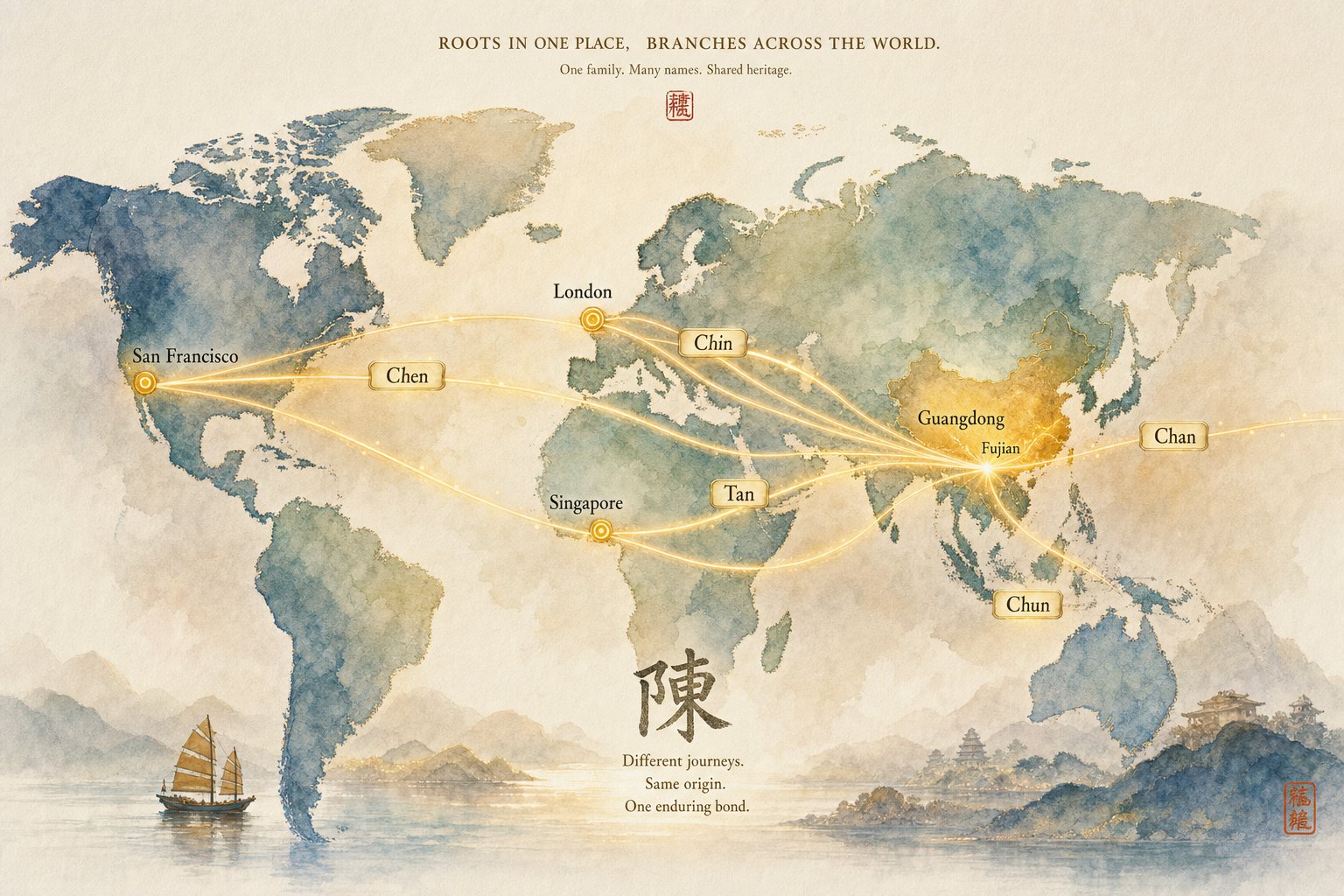
You probably already know several Chinese surnames without realizing it. Lee, Wong, Chan, Ng — these spellings appear on office directories, movie credits, and restaurant signs across the English-speaking world. But if you search for them on a standard pinyin list, you will not find them. That is because these are dialect-based romanizations, not Mandarin pinyin. Connecting these familiar forms back to their pinyin originals is one of the most practical things you can do with a surname reference.
Common Anglicized Spellings and Their Pinyin Originals
Many chinese american surnames trace their English spellings to Cantonese, Hokkien, or Teochew pronunciations rather than Mandarin. Early immigrants from southern China registered their names using the sounds of their home dialects, and those spellings stuck through generations. The table below maps the most frequently encountered Anglicized forms to their standard Mandarin pinyin, the underlying Chinese character, and the dialect that produced the English spelling.
| Anglicized Spelling | Standard Pinyin | Chinese Character | Dialect Origin |
|---|---|---|---|
| Lee | Lǐ | 李 | Cantonese / general Anglicization |
| Wong | Wáng or Huáng | 王 or 黄 | Cantonese |
| Chan | Chén | 陈 | Cantonese |
| Tan | Chén | 陈 | Hokkien / Teochew |
| Chow / Chau | Zhōu | 周 | Cantonese |
| Ng | Wú | 吴 | Cantonese |
| Lim | Lín | 林 | Hokkien / Teochew |
| Ong | Wáng | 王 | Hokkien |
| Cheung / Teo | Zhāng | 张 | Cantonese / Hokkien |
| Lau / Low | Liú | 刘 | Cantonese / Hokkien |
| Goh | Wú | 吴 | Hokkien |
| Yeo / Yeung | Yáng | 杨 | Hokkien / Cantonese |
Notice that Wong can represent two entirely different characters: 王 (Wáng) and 黄 (Huáng). Both are pronounced "Wong" in Cantonese, which is why context or asking the person directly is sometimes the only way to know which character their family uses. Similarly, the family name Ng maps to Wú (吴) in Mandarin pinyin — a connection that surprises many people because the two spellings look completely unrelated.
Why the Same Surname Has Multiple Spellings
The core reason is straightforward: Chinese is not one spoken language. Mandarin, Cantonese, Hokkien, Teochew, and Hakka all pronounce the same written characters differently. When Chinese families emigrated to English-speaking countries, they romanized their names based on whichever dialect they spoke at home. A family from Guangdong registered their 陈 as "Chan" (Cantonese). A family from Fujian registered the same character as "Tan" (Hokkien). A family arriving after pinyin became standard might use "Chen" (Mandarin).
This is why chinese american last names can look so varied even when they share the same character. The lim last name origin, for example, traces to Hokkien-speaking communities from Fujian province and Southeast Asia, where 林 is pronounced "Lim" rather than the Mandarin "Lin." Cantonese surnames and cantonese last names follow their own romanization patterns — "Cheung" for 张, "Leung" for 梁, "Kwok" for 郭 — none of which resemble pinyin at all.
In diaspora communities like Singapore and Malaysia, the spelling of last names chinese families carry often signals which region their ancestors came from. A person surnamed "Wong" is understood to have Cantonese heritage, while "Ong" points to Hokkien roots. Both write the same character 王 and would appear as "Wáng" on any standard pinyin reference.
Understanding these mappings means you can work backward from an Anglicized spelling to find the correct Mandarin pinyin and character. That skill becomes especially useful when dealing with official documents, genealogy records, or professional settings where the standard pinyin form is needed alongside the spelling a person actually uses day to day.
Single and Compound Surnames With Regional Variants
Every surname covered so far has been a single character: Lǐ, Wáng, Zhāng. That is the norm. The overwhelming majority of Chinese family names consist of one syllable and one character. But there is a smaller, historically rich category that breaks this pattern: compound surnames (复姓, fùxìng), which use two or more characters. If you have ever encountered names like Sima Qian or Zhuge Liang in history books, you have already met compound surnames without necessarily realizing they function as a single family name rather than a first-plus-last combination.
Single-Character Surnames in Pinyin
Single-character surnames (单姓, dānxìng) account for the vast majority of chinese surnames and meanings you will find on any reference list. All of the top 100 surnames by population fall into this category. Their pinyin forms are one syllable each: Lǐ, Wáng, Chén, Liú, Yáng. This simplicity is part of why Chinese names tend to be short — a one-syllable surname plus a one- or two-syllable given name produces a full name of just two or three syllables total.
The chinese surname meanings behind single-character names often trace back thousands of years to ancient states, noble titles, or ancestral given names. For example, Zhào (赵) derives from an ancient feudal state during the Warring States period. Chén (陈) also originates from a state name. Jiāng (姜) is one of the oldest surnames in China, tracing to the legendary Shennong in matriarchal clan society — you will notice the character contains the radical for "woman" (女), reflecting those ancient matrilineal origins. Understanding the meaning of chinese last names adds a layer of cultural depth to what might otherwise look like a simple pronunciation list.
Compound Surnames and Their Pinyin Romanization
Compound surnames are rare chinese surnames by any measure. China currently has fewer than 100 compound surnames still in active use, down from over 1,000 in ancient times. They are two syllables long in pinyin and carry distinctive historical weight. Here are the most notable ones:
- Ōuyáng (欧阳) — China's most-used compound surname, with over 1.1 million bearers according to the 2020 National Name Report. Originates from a place name in ancient China.
- Shàngguān (上官) — The second most common compound surname, used by approximately 88,000 people. Derives from an ancient official title.
- Huángfǔ (皇甫) — Traces to a noble lineage during the Western Zhou dynasty.
- Zhūgě (诸葛) — Made famous by the legendary strategist Zhuge Liang of the Three Kingdoms era.
- Sīmǎ (司马) — Originally an ancient military official title meaning "master of horses."
- Sītú (司徒) — Another official-title surname, referring to a minister of education in ancient courts.
- Línghú (令狐) — Derives from a place name granted as a fief during the Spring and Autumn period.
- Nángōng (南宫) — Literally "southern palace," originating from a residential location near a royal palace.
These rare chinese last names carry stories within their characters. Some were ancient official titles (Sīmǎ, Sītú). Some came from geographic regions (Ōuyáng, Dōngguō). Others were adapted from ethnic minority tribal names during periods of cultural integration. Their rarity today makes them stand out — if you meet someone with a two-syllable surname, you are encountering a piece of living history that fewer than a few million people in all of China share.
When reading chinese last names and meanings in compound form, remember that both characters together form the surname. In the name Ouyang Nana (the Taiwanese actress and cellist), "Ouyang" is the complete family name and "Nana" is the given name. Do not split it into "Ou" and "Yang."
How Regional Romanization Systems Differ
Mandarin pinyin is just one of several romanization systems used for Chinese surnames. Depending on the region, the same character gets spelled very differently on official documents, academic papers, and personal identification. The major systems include:
- Hanyu Pinyin — The mainland China standard, used throughout this article.
- Wade-Giles — An older system developed in the 19th century, still seen in some Taiwanese documents and historical texts.
- Jyutping — The standardized romanization for Cantonese pronunciation, common in Hong Kong linguistic contexts.
- Hokkien romanization (POJ/Tâi-lô) — Used by Hokkien-speaking communities in Fujian, Taiwan, and Southeast Asia.
The table below shows how three common surnames appear across these systems, illustrating why the same person's family name can look completely different depending on which romanization convention applies:
| Character | Hanyu Pinyin (Mandarin) | Wade-Giles | Jyutping (Cantonese) | Hokkien (POJ) |
|---|---|---|---|---|
| 陈 | Chén | Ch'en | Can4 | Tân |
| 黄 | Huáng | Huang | Wong4 | N̂g / Uînn |
| 林 | Lín | Lin | Lam4 | Lîm |
You can see why a single character like 陈 ends up as "Chen," "Ch'en," "Chan," or "Tan" depending on context. Wade-Giles adds apostrophes to mark aspiration (Ch'en vs Chen), Jyutping uses numbers for Cantonese tones, and Hokkien romanization reflects an entirely different spoken pronunciation. None of these are wrong — they simply encode different dialects and conventions.
For anyone researching chinese surnames and meanings across regions, recognizing which system a spelling comes from is essential. A surname written as "Lam" points to Cantonese. "Lim" signals Hokkien. "Lin" could be either Mandarin pinyin or Wade-Giles (they happen to match for this character). Knowing the system helps you trace the name back to its character and, from there, to its full historical and linguistic context.
These regional differences become even more pronounced when surnames cross international borders and land on official documents like passports, where government policy — not personal preference — often dictates which romanization system gets used.
How Chinese Surnames Appear on Passports and Documents
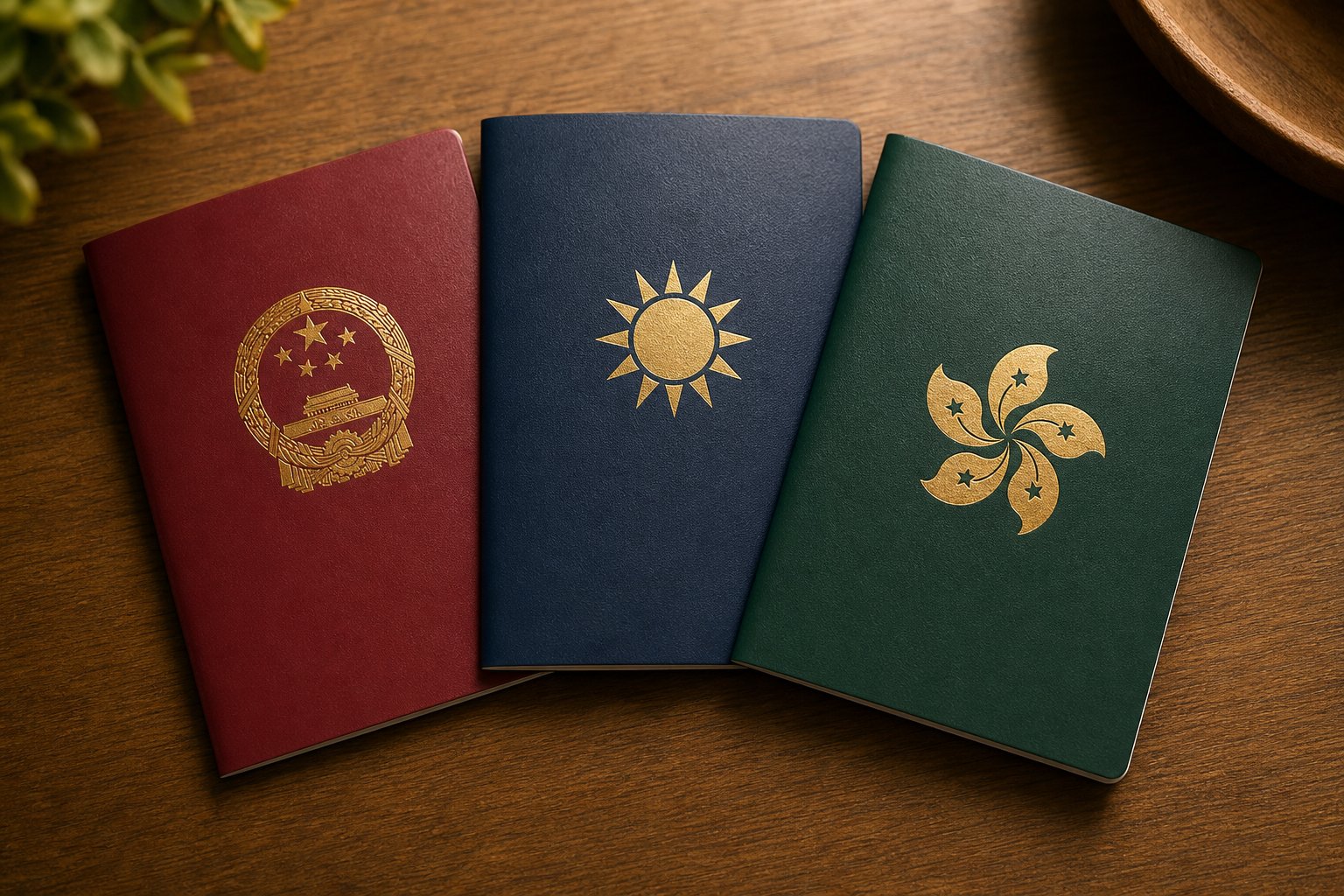
Why does the actor's passport say "Chow" while his mainland-born co-star's reads "Zhou"? Both share the character 周, yet their official English spellings look nothing alike. The answer comes down to geography: each Chinese-speaking region enforces its own romanization rules on government-issued documents. If you have ever been confused by inconsistent spellings of china last names in professional or academic settings, passport policy is usually the explanation.
Passport Romanization Rules by Region
Three major regions issue passports to ethnic Chinese citizens, and each follows a different system for converting surname characters into Latin letters:
- Mainland China — Uses Hanyu Pinyin exclusively. Since 2000, all People's Republic of China passports romanize names strictly according to the pinyin standard, without tone marks. A person surnamed 王 will always appear as "WANG" on a mainland passport. No exceptions, no personal choice.
- Taiwan — Historically used Wade-Giles romanization, and many taiwanese surnames still appear in that format on passports (e.g., "Hsieh" for 谢 instead of pinyin "Xie"). Since 2009, Taiwan has officially adopted Hanyu Pinyin as the default for new passport applications, but holders can request alternative spellings based on personal preference or established usage. This means taiwanese last names on passports remain a mix of systems.
- Hong Kong — Uses Cantonese-based romanization with no single codified standard. The Hong Kong SAR passport records surnames in traditional Chinese characters and English, with the English spelling reflecting Cantonese pronunciation rather than Mandarin. Hong Kong surnames like "Chan" (陈), "Leung" (梁), and "Kwok" (郭) follow conventions rooted in local Cantonese speech patterns.
The practical result? A single character like 陈 produces three different official passport spellings depending on where the document was issued. None of them is wrong — each reflects the legitimate linguistic reality of its region.
Taiwanese and Hong Kong Surname Spellings
The table below shows how the same top surnames appear on official documents across the three regions. This is the reference you need when a colleague's passport spelling does not match what you expect from a standard pinyin list.
| Character | Mainland China (Pinyin) | Taiwan (Common Passport Form) | Hong Kong (Cantonese) |
|---|---|---|---|
| 王 | Wang | Wang | Wong |
| 李 | Li | Li / Lee | Lee |
| 张 | Zhang | Chang | Cheung |
| 陈 | Chen | Chen / Ch'en | Chan |
| 黄 | Huang | Huang / Hwang | Wong |
| 林 | Lin | Lin | Lam |
| 周 | Zhou | Chou | Chow |
| 吴 | Wu | Wu | Ng |
| 刘 | Liu | Liu | Lau |
| 谢 | Xie | Hsieh | Tse |
A few patterns stand out. Surnames in taiwan often retain Wade-Giles features like "Ch" for the pinyin "Zh" sound (Chang vs Zhang) and "Hs" for the pinyin "X" (Hsieh vs Xie). Hong Kong surnames diverge even further because Cantonese pronunciation differs dramatically from Mandarin — 黄 is "Wong" in Cantonese but "Huang" in Mandarin, and 吴 becomes the consonant-only "Ng" rather than "Wu."
For anyone working with international teams, verifying academic citations, or processing immigration documents, this regional variation is not a quirk — it is the system working as designed. The spelling on a person's passport reflects their region of origin and the romanization policy in force when the document was issued. Knowing this, you can trace any unfamiliar spelling back to its character and then to its Mandarin pinyin equivalent using the tables in this guide.
These naming conventions did not appear out of nowhere. They grew from centuries of surname tradition, a tradition rooted in one of China's oldest classical texts and shaped by patterns of lineage that stretch back thousands of years.
The History Behind Chinese Family Surnames
China has over 1.4 billion people, yet only around 6,000 surnames in recorded use — and the top 100 cover roughly 85% of the entire population. How did a civilization this vast end up with so few family names? The answer lies in a tradition of patrilineal inheritance stretching back more than 4,000 years, codified in one of the most famous educational texts ever written.
The Hundred Family Surnames Classical Text
During the early Song Dynasty (around 960 CE), an anonymous scholar compiled the Hundred Family Surnames (百家姓, Bǎi Jiā Xìng). Despite its name, the text actually lists over 500 surnames arranged in rhyming couplets designed for easy memorization. It was never meant as a frequency ranking. Instead, it served as a literacy primer — children across China recited it alongside the Three Character Classic and the Thousand Character Classic as part of their foundational education for over a thousand years.
Zhào Qián Sūn Lǐ, Zhōu Wú Zhèng Wáng — the opening line of the Hundred Family Surnames, listing the surnames Zhao, Qian, Sun, Li, Zhou, Wu, Zheng, and Wang. Zhao appears first not because it was the most common surname in china at the time, but because it was the imperial surname of the Song Dynasty ruling family.
That political ordering is a reminder: the text reflects power structures of its era, not population data. The most common last name in china today is actually Li (李), followed by Wang (王) and Zhang (张) — a ranking determined by modern census counts rather than dynastic prestige. Still, the Hundred Family Surnames remains culturally significant as a symbol of shared chinese family identity and collective heritage.
Why China Has So Few Surnames for So Many People
Several historical forces compressed China's surname pool over millennia:
- Strict patrilineal inheritance — Children take their father's surname with almost no exceptions. Unlike some cultures where new surnames emerge through occupation, geography, or personal choice, the chinese family tree passes the same character down unchanged through dozens of generations.
- Early standardization — China's surname system solidified during the Warring States period (475-221 BCE), long before most European surname traditions even began. Once fixed, surnames rarely changed.
- Absorption of minority names — Over centuries, many ethnic minority groups adopted Han chinese surnames during periods of cultural assimilation, further concentrating the pool around a small set of common characters.
- Population growth without surname creation — China's population exploded from roughly 60 million during the Song Dynasty to over 1.4 billion today, but no new major surnames entered the system. The same china family names simply multiplied.
The result is a naming landscape where a single common surname in china like Wang is shared by over 100 million people. That concentration is precisely why a pinyin reference list is so practical — a short document covering just 100 entries handles the pronunciation needs for the vast majority of Chinese names you will ever encounter.
This historical context also explains why the most common name in china keeps appearing in every international setting, from academic papers to corporate directories. The system was designed for continuity, not variety. Knowing that helps frame the next practical question: if you have a Chinese surname — or an Anglicized version of one — how do you actually find its correct pinyin and trace it back through the tradition?
How to Find Your Chinese Surname in Pinyin
Maybe you already know your Chinese surname character and just need the pinyin. Or maybe all you have is an Anglicized spelling passed down through generations — "Fung" or "Tan" or "Ng" — and you want to trace it back to its Mandarin pronunciation. Either way, free tools and a simple process can get you there.
Free Tools to Convert Characters to Pinyin
If you have the Chinese character for your surname, converting it to pinyin takes seconds. Here are the most reliable methods:
- Google Translate — Paste the character into the input field, set the source language to Chinese (Simplified or Traditional), and the pinyin with tone marks appears above the character automatically. No account needed.
- MDBG Chinese Dictionary (mdbg.net) — Enter the character or paste it into the search bar. The results show pinyin with tone marks, definitions, stroke order, and audio pronunciation. This is one of the most thorough free chinese name list resources available for individual character lookups.
- Pleco (mobile app) — Available for iOS and Android, Pleco lets you draw a character with your finger if you cannot type it. The app returns pinyin, definitions, and example usage instantly.
- Pin1yin1.com — A dedicated bulk converter. Paste an entire chinese names list of characters and get pinyin output for all of them at once, useful if you are working through a family registry or genealogy document.
Each of these tools handles single-character and compound surnames equally well. For compound surnames like 欧阳 or 司马, paste both characters together and the tool returns the full two-syllable pinyin.
Tracing Your Surname From an Anglicized Spelling
The harder case is when you only have a romanized spelling and no character. Many descendants of overseas Chinese find themselves in this position — a Legacy Tree Genealogists guide notes that researchers frequently start with nothing more than a name like "Francis Fung" and must work backward to identify the original character. Here is a step-by-step approach:
- Identify the likely dialect — Determine where your ancestors emigrated from. Cantonese speakers came largely from Guangdong, Hokkien speakers from Fujian and Southeast Asia, Hakka speakers from eastern Guangdong and parts of Taiwan. The dialect narrows down which characters your spelling could represent.
- Cross-reference dialect romanization tables — Wikipedia's List of Common Chinese Surnames includes columns for Cantonese, Hokkien, and other dialect romanizations alongside Mandarin pinyin. Search for your Anglicized spelling in the relevant dialect column.
- Check a forebears surname distribution database — Sites like Forebears (forebears.io) show geographic distribution of surname spellings worldwide, which can confirm whether your spelling clusters in regions associated with a particular dialect group.
- Ask older family members — Relatives may know the character, have old documents with Chinese writing, or remember which village the family came from. Tombstones, clan association records, and old immigration papers often contain the character even when everyday usage switched to English generations ago.
- Consult a chinese surname list with dialect variants — Use the Anglicized-to-pinyin mapping table earlier in this article or resources like FamilySearch's Chinese last names guide to match your spelling to a character and its standard pinyin.
Once you have the character, any of the converter tools above gives you the Mandarin pinyin in seconds. From there, you can look up the surname's rank, meaning, and historical origin using the list of chinese surnames and reference tables throughout this guide.
Whether you came here to quickly check the pinyin for a colleague's name or to trace a family surname through dialect layers and immigration records, this chinese last names list and pronunciation guide is designed to be bookmarked and revisited. Names matter — and saying them right is one of the simplest ways to show respect across cultures.
Frequently Asked Questions About Chinese Surname Pinyin
1. What is the most common Chinese surname?
Li (李, Lǐ) is the most common Chinese surname, representing approximately 7.94% of the Han Chinese population according to the Seventh National Population Census. Wang (王, Wáng) and Zhang (张, Zhāng) follow closely, and together these three surnames account for over 22% of all Han Chinese people. The top 100 surnames collectively cover roughly 85-86% of China's entire population.
2. Why do Chinese surnames have different English spellings?
The same Chinese character gets romanized differently depending on the dialect spoken and the region where the document was issued. Cantonese speakers spell 陈 as 'Chan,' Hokkien speakers write it as 'Tan,' and Mandarin pinyin renders it as 'Chen.' Additionally, mainland China uses Hanyu Pinyin on passports, Taiwan historically used Wade-Giles, and Hong Kong uses Cantonese-based romanization. These regional policies explain why colleagues with identical surname characters may carry completely different English spellings.
3. How do you pronounce the pinyin letters X, Q, and Zh in Chinese surnames?
These three initials are the most commonly mispronounced by English speakers. X (as in Xu, Xie) sounds like a soft 'sh' with the tongue positioned forward near the teeth. Q (as in Qian, Qiu) sounds like 'ch' in 'cheese' with the tongue forward, not like 'kw' in 'queen.' Zh (as in Zhang, Zhao) sounds like 'j' in 'jam' with the tongue curled back. The key distinction is tongue position: X and Q are tongue-forward sounds, while Zh is a retroflex sound with the tongue curled backward.
4. What are compound Chinese surnames and how are they written in pinyin?
Compound surnames (复姓) consist of two characters instead of the usual one, making them two syllables in pinyin. Fewer than 100 compound surnames remain in active use in China today. The most common is Ouyang (欧阳, Ōuyáng), followed by Shangguan (上官, Shàngguān). Other well-known examples include Sima (司马, Sīmǎ), Zhuge (诸葛, Zhūgě), and Nangong (南宫, Nángōng). These surnames often originated from ancient official titles, place names, or noble lineages.
5. How can I find the pinyin for my Chinese surname if I only know the Anglicized spelling?
Start by identifying which dialect your ancestors likely spoke based on their region of origin — Cantonese from Guangdong, Hokkien from Fujian, or Hakka from eastern Guangdong. Then cross-reference your spelling against dialect romanization tables on resources like Wikipedia's List of Common Chinese Surnames. You can also check surname distribution databases like Forebears to confirm regional clustering, consult older family members who may have documents with Chinese characters, or use the Anglicized-to-pinyin mapping tables available in surname reference guides.