How Fallen Kingdoms Became Family Names
When States Fell and Surnames Were Born
Imagine an entire kingdom erased from the map. Its walls torn down, its rulers exiled or executed, its armies scattered. Yet something survived — something no conqueror could strip away. The people who once lived under that kingdom's banner carried its name forward, not on flags or coins, but as their own identity. That is exactly how many Chinese surnames were born.
Hundreds of states rose and fell across the Zhou Dynasty (1046-221 BCE), the Spring and Autumn Period, and the Warring States era. When these kingdoms collapsed, their populations did something remarkable: they adopted the state's name as a personal surname in chinese tradition, turning political geography into permanent family identity. Today, many of the most common Chinese last names — Chen, Zhao, Wei, Song, Zheng, Qin — trace directly back to states that vanished over two thousand years ago.
This is not a minor footnote in history. Chinese surnames from ancient states account for a significant portion of the names carried by over a billion people alive today. The meaning of chinese last names, in many cases, is literally the name of a lost kingdom preserved across generations.
After the Qin state unified China in 221 BCE and conquered the remaining six kingdoms, displaced nobles and commoners alike adopted their former state's name as a hereditary surname — preserving identity when everything else had been taken from them.
Understanding Xing and Shi in State-Derived Names
To understand how chinese family names emerged from fallen states, you need to grasp a distinction that existed in ancient China between two types of names: xing (姓) and shi (氏).
Xing were the original clan surnames — ancient, broad, and tied to mythological ancestors. Only a handful existed, like Ji (姬), Jiang (姜), and Ying (嬴). These belonged to entire ruling clans and traced back to semi-legendary origins.
Shi, on the other hand, were practical identifiers that branched off from xing. Think of xing as the trunk of a tree and shi as the branches. As populations grew and clans spread across different territories, people needed more specific labels. State names became one of the most powerful sources of shi. If your family lived in the state of Chen (陈), you became "Chen." If your ancestors served in the state of Zheng (郑), you became "Zheng."
Over time — particularly after the Qin unification dissolved the old feudal order — the distinction between xing and shi collapsed. Shi became the standard surname, and chinese names as we know them today took shape. The state-derived shi stuck permanently, which is why so many modern Chinese last names map directly onto ancient political boundaries.
What follows is a detailed mapping of specific ancient states to the exact chinese surnames and meanings they produced — from the mighty Seven Warring States to the smallest Zhou-era fiefdoms that left behind surnames carried by millions today.
The Zhou Dynasty Feudal System Behind Every State Surname
The Zhou Feudal System That Created Hundreds of States
Where surnames originate from often depends on the political structures people lived under. In ancient China, one system above all others made state-derived surnames possible: fengjian (分封制), the Zhou Dynasty's method of parceling out land to relatives and allies in exchange for political loyalty.
Here is how it worked. After the Zhou kings overthrew the Shang Dynasty around 1046 BCE, they faced a practical problem — how do you govern a vast territory with no modern communication or transportation? Their solution was decentralization. The Zhou royal house granted territories to clan relatives, military allies, and descendants of earlier dynasties, establishing each recipient as the hereditary ruler of a semi-independent state. The fengjian system literally means "demarcation and establishment" — carving out boundaries and installing lords within them.
Each of these vassal states, ruled by lords called zhuhou (诸侯), operated with significant autonomy. They maintained their own tax systems, legal codes, currencies, and even distinct writing styles. The ruling clans of these states — Ji (姬) in Lu, Jiang (姜) in Qi, Ying (嬴) in Qin — became deeply embedded in local identity over generations. For ordinary people living within these borders, the state name was not just a political label. It was home, culture, and community rolled into one word.
This is the structural reason why so many ancient surnames trace back to territory names rather than occupations or physical traits. The fengjian system created dozens upon dozens of distinct political entities, each lasting centuries, each forging a population whose identity was inseparable from the state itself. When those states eventually fell, the name remained — carried forward as a personal surname by people who had no kingdom left but refused to lose their chinese roots entirely.
From Territory to Identity Across Three Eras
The transformation from state name to family name did not happen overnight. It unfolded across three distinct historical periods, each pushing the process further along.
Western Zhou (c. 1046-771 BCE): Establishment of vassal states through fengjian grants. Spring and Autumn Period (770-476 BCE): Fragmentation into over 140 competing states as Zhou authority weakened. Warring States Period (475-221 BCE): Consolidation through conquest, ending with Qin's unification in 221 BCE and the mass adoption of state names as hereditary surnames.
During the Western Zhou, the system functioned largely as intended. The Zhou king sat at the center, and vassal lords paid tribute and provided military support. States like Lu (鲁), Wei (卫), Yan (燕), and Qi (齐) were established during this era, each with a ruling clan tied to the Zhou royal family or its key allies. Populations identified with their state, but surnames had not yet crystallized for commoners — the ancient last names of this period still belonged primarily to aristocratic clans.
The Spring and Autumn Period changed everything. As Zhou royal authority crumbled, vassal states began acting independently, fighting each other, absorbing smaller neighbors, and fragmenting internally. The number of recognized states swelled to over a hundred. Smaller fiefdoms like Cai (蔡), Cao (曹), Teng (滕), and Xu (许) each developed their own local identities. For people living through this era of constant political upheaval, the state you belonged to became your most meaningful social anchor — more stable than any individual ruler, more enduring than any single generation.
Then came the Warring States Period, when ancient china names shifted from political geography into personal identity permanently. Seven major powers — Qi, Chu, Yan, Han, Zhao, Wei, and Qin — swallowed their smaller neighbors one by one. Each conquest displaced populations and dissolved political structures that had existed for centuries. When Qin finally unified China in 221 BCE and abolished the fengjian system entirely, replacing it with centrally appointed administrators, the old state identities had nowhere to live except in people's names.
The mechanism was straightforward. A citizen of the state of Chen (陈) — conquered by Chu in 479 BCE — no longer had a state to belong to. But by adopting "Chen" as a hereditary surname, that person preserved a connection to ancestors, homeland, and community. Nobles did it to signal their lineage. Commoners did it to maintain group cohesion among displaced populations. Over time, these ancient surnames became fixed and passed from parent to child without interruption, regardless of which dynasty ruled overhead.
This is why the fengjian system matters so deeply to understanding chinese surnames from ancient states. Without it, there would have been no patchwork of named territories for people to identify with. Without centuries of autonomous statehood, those names would never have rooted deeply enough to survive political extinction. The system created the states, the states created the identities, and the identities became the surnames — a chain stretching from a king's land grant in 1046 BCE to the family name on a modern passport.
Yet the fengjian system did not produce surnames equally. Some founding clans were far more prolific than others. One clan in particular — the Ji (姬) surname of the Zhou royal house itself — seeded more states and more resulting surnames than all others combined.
Eight Ancient Clan Names That Seeded an Empire of Surnames
The Eight Matriarchal Surnames That Started Everything
Every chinese surname carried today branches from a surprisingly small root system. Before there were hundreds of states, before the fengjian grants carved up territory, there were just eight original clan names — the ba da xing (八大姓). These eight ancient chinese family names predate written history and belong to a period when lineage was traced through mothers rather than fathers.
The eight are: Ji (姬), Jiang (姜), Si (姒), Ying (嬴), Yun (妘), Gui (妫), Yao (姚), and Ji (姞). Look closely at the chinese names and characters, and you will notice something striking — every single one contains the nu (女) radical, meaning "woman." This is not coincidence. These surnames originated during a matriarchal period of Chinese civilization when clan identity passed through the maternal line. They are linguistic fossils of a social structure that predates the patriarchal dynasties by centuries.
Why do these eight matter for understanding state-derived surnames? Because the ruling clans of virtually every Zhou-era state belonged to one of these eight lineages. When the Zhou kings distributed territories through fengjian, they granted land to members of their own Ji (姬) clan, to allied Jiang (姜) families, and to descendants of earlier dynasties carrying surnames like Gui (妫) and Ying (嬴). Each state that resulted eventually produced its own set of mandarin surnames when it fell — but all of them trace upward to one of these eight roots.
The eight ancient surnames were not just names — they were the genetic trunk from which every branch of traditional chinese names eventually grew. One clan, Ji (姬), produced more state-derived surnames than the other seven combined.
How Ji Alone Produced Dozens of State Surnames
The Ji (姬) clan held the Zhou throne for nearly eight centuries. As the royal surname, Ji was the identity shared by the Zhou kings and their extensive network of relatives. When those relatives received fiefdoms, they carried the Ji surname into their new territories. Over generations, their descendants stopped using Ji and instead adopted the name of the state they governed. This single mechanism produced an extraordinary number of modern surnames.
Consider the genealogical chain. The Duke of Zhou — a Ji clansman — had his descendants installed as rulers of Lu (鲁). When Lu fell, its people became surnamed Lu. The Ji clan also founded the states of Wei (卫), Jin (晋), Zheng (郑), Wu (吴), and Yan (燕). Each of these states eventually collapsed, and each collapse generated a chinese surname that millions carry today. Jin state alone later split into three successor states — Han (韩), Zhao (赵), and Wei (魏) — each producing its own surname lineage.
Historians estimate that Ji produced over 100 derivative surnames through this branching process. Some came directly from state names. Others came from sub-fiefdoms, official titles, or place names within Ji-ruled territories. No other ancient clan comes close to this level of surname generation.
The Ying (嬴) clan tells a parallel but smaller story. Ying was the royal chinese surname of the Qin ruling house and also the ancestral surname of the Zhao clan. When Qin unified China, the Ying name itself largely disappeared into its derivatives — Qin (秦) and Zhao (赵) being the most prominent. The Jiang (姜) clan, associated with the state of Qi (齐) and various smaller fiefdoms, similarly branched into surnames like Qi, Lu (吕), Xu (许), and Shen (申).
The table below maps each of the eight ancient surnames to the major states they founded and the modern surnames that resulted. You will notice that Ji dominates — a reflection of the Zhou royal family's outsized role in distributing territory across ancient China.
| Ancient Surname | Character | Associated Ruling Clan | States Founded | Modern Surnames Produced |
|---|---|---|---|---|
| Ji | 姬 | Zhou royal house | Lu, Wei, Jin, Zheng, Wu, Yan, Cao, Hua | Lu (鲁), Wei (卫/魏), Jin (晋), Zheng (郑), Wu (吴), Yan (燕), Cao (曹), Han (韩), Zhou (周) |
| Jiang | 姜 | Yan Emperor descendants | Qi, Lu, Xu, Shen | Qi (齐), Lu (吕), Xu (许), Shen (申), Jiang (姜) |
| Si | 姒 | Xia Dynasty descendants | Qi (杞), Yue | Si (似), Xia (夏), Bao (鲍) |
| Ying | 嬴 | Qin and Zhao ruling houses | Qin, Zhao, Xu (徐) | Qin (秦), Zhao (赵), Xu (徐), Lian (廉) |
| Yun | 妘 | Zhu Rong descendants | Zheng (鄫), Kuai | Yun (云), Zeng (曾) |
| Gui | 妫 | Shun Emperor descendants | Chen | Chen (陈), Tian (田), Yuan (袁), Hu (胡) |
| Yao | 姚 | Shun Emperor (alternate line) | Related to Chen state | Yao (姚), Wu (吴 — alternate origin) |
| Ji | 姞 | Yellow Emperor descendants | Nan Yan, Mi | Ji (吉), Yan (燕 — alternate origin) |
Notice how the Gui (妫) clan — despite founding only one major state, Chen — produced an outsized number of chinese surname meanings that remain common today. Chen, Tian, Yuan, and Hu all trace back to the Chen state's ruling family, which itself descended from the legendary Emperor Shun. This is a pattern you will see repeatedly: a single state can generate multiple surnames through different branches of its ruling house, different historical moments of displacement, or different geographic dispersals after conquest.
These eight root surnames functioned like a genetic code for an entire civilization's naming system. Every state that rose during the Zhou era carried one of these eight identities at its core. And every state that fell left behind surnames that still connect living people to those ancient clan origins — a chain of identity stretching back over three thousand years.
The most dramatic chapter in this story belongs to the seven great powers that dominated the final era of Chinese fragmentation. When those kingdoms fell one by one to Qin's armies, they produced some of the most widely carried surnames in the world today.
Surnames Born from the Seven Warring States
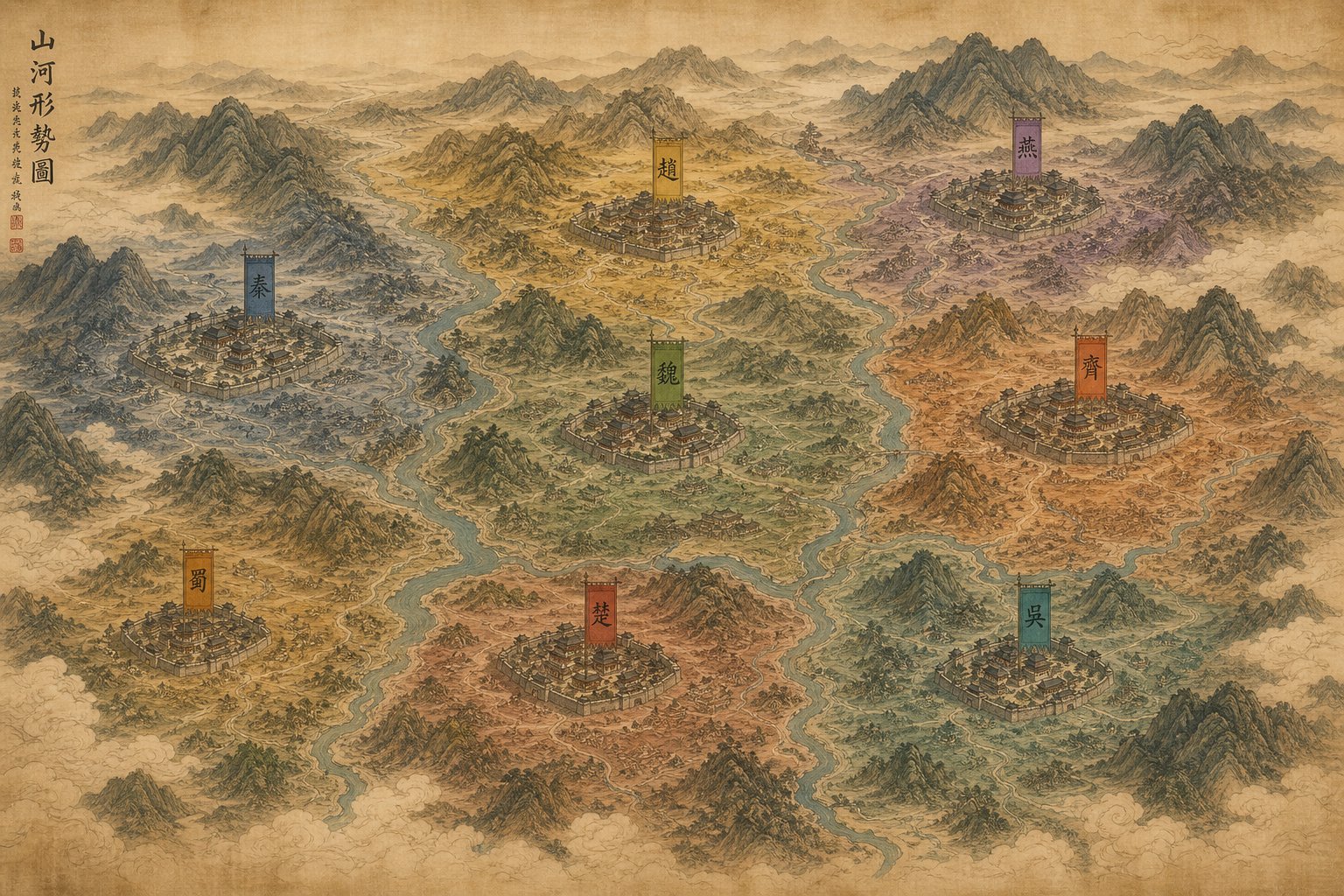
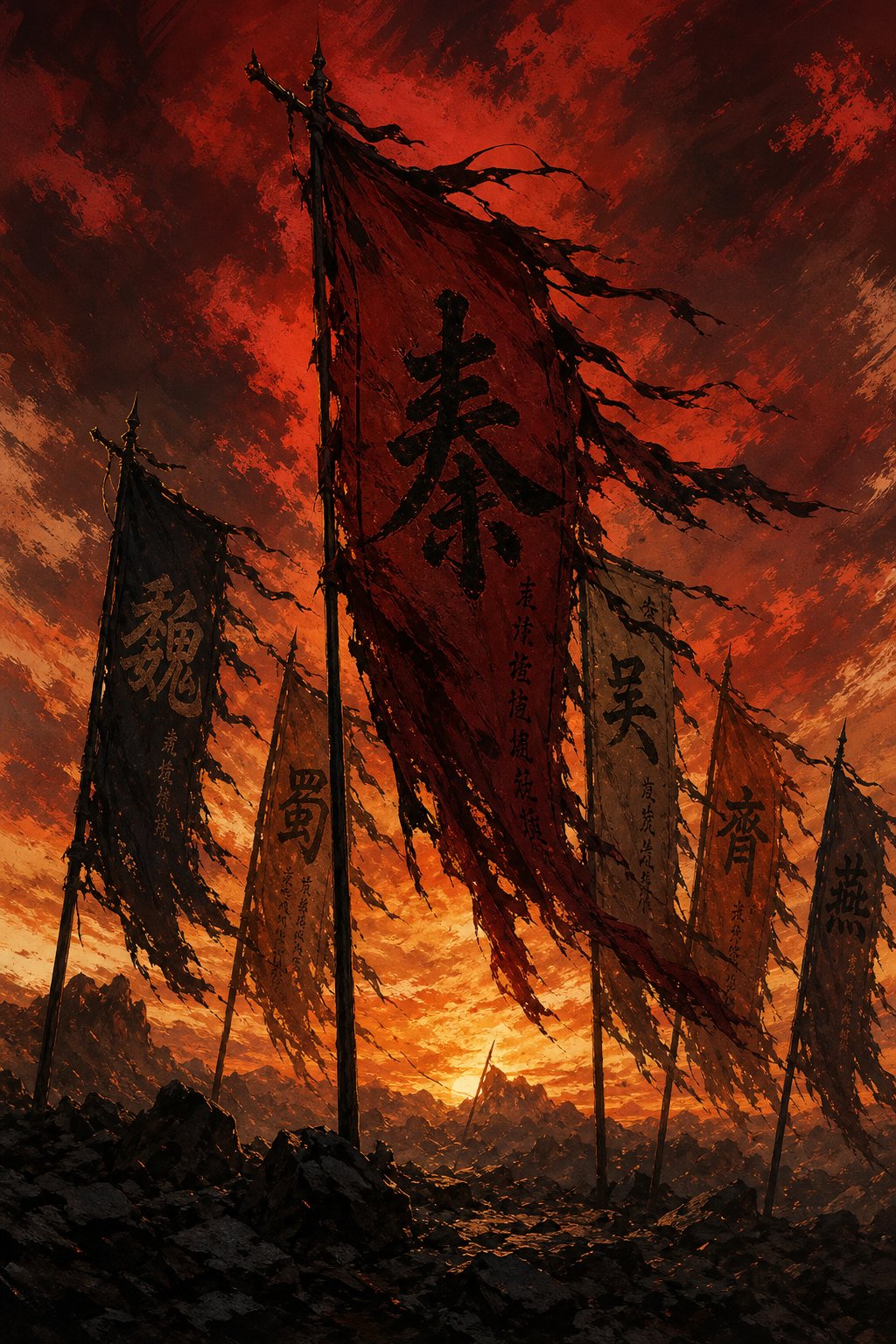
Seven kingdoms dominated the final century of Chinese fragmentation. Known collectively as the Warring States Seven (战国七雄), these powers — Qi (齐), Chu (楚), Yan (燕), Han (韩), Zhao (赵), Wei (魏), and Qin (秦) — fought relentlessly until Qin swallowed them all between 230 and 221 BCE. Each conquest displaced millions. Each displacement turned a state name into a chinese last name carried by descendants for the next two millennia.
What makes this group especially interesting is a key distinction. Some surnames that emerged ARE the state name itself — Zhao from Zhao state, Qin from Qin state, Chu from Chu state. Others arose from the ruling family's internal branches but differ from the state name entirely. Understanding chinese last name meanings in this context requires separating these two pathways.
Zhao, Wei, Han — The Three States from Jin's Partition
These three states share an unusual origin. They did not receive their territories from the Zhou king directly. Instead, they carved themselves out of the massive state of Jin (晋) in 403 BCE — an event known as the Partition of Jin (三家分晋). Three powerful noble families within Jin simply divided the state among themselves, each taking a piece and establishing an independent kingdom.
Zhao (赵) was founded by the Zhao clan, itself a branch of the ancient Ying (嬴) lineage. Located in what is now Shanxi and Hebei provinces, Zhao state lasted until Qin conquered it in 222 BCE. After its fall, the Zhao name became one of the most common chinese surnames — so widespread that it was placed first in the Hundred Family Surnames (百家姓) text compiled during the Song Dynasty. Today, Zhao ranks among the most popular chinese last names, carried by approximately 27 million people in China.
Wei (魏) occupied territory in modern Shanxi and Henan. Its ruling clan originally bore the Ji (姬) surname, tracing back to the Zhou royal house. When Qin destroyed Wei in 225 BCE, the state name became the hereditary surname Wei (魏) for its displaced population. Note the distinction from the earlier state of Wei (卫) — same pronunciation, different character, different origin.
Han (韩) controlled parts of modern Henan and Shanxi. Also descended from the Ji clan, Han was the first of the seven states to fall, conquered by Qin in 230 BCE. The surname Han (韩) that resulted remains a common chinese surname today, carried by over 8 million people.
Qi, Chu, Yan, Qin — Surnames from the Remaining Powers
Qi (齐) was originally founded by the Jiang (姜) clan under the famous strategist Jiang Ziya during the early Zhou period. Located in modern Shandong province, Qi was later taken over by the Tian (田) family in 386 BCE — a rare case of internal usurpation. When Qin conquered Qi in 221 BCE (the last state to fall), both surnames proliferated: Qi (齐) from the state name and Tian (田) from the ruling clan that governed it in its final century.
Chu (楚) was the largest of the seven states, spanning much of southern China across modern Hubei, Hunan, and Anhui. Its ruling house bore the surname Mi (芈), though the state name Chu (楚) became the more widely adopted surname after Qin's conquest in 223 BCE. Chu also produced the surname Xiong (熊), from the clan name used by its kings.
Yan (燕) occupied the far northeast, in modern Hebei and Liaoning. Founded by the Ji (姬) clan — direct relatives of the Zhou kings — Yan fell to Qin in 222 BCE. The surname Yan (燕) persists today, though it is less common than surnames from the other six states.
Qin (秦) itself, the conquering state, also produced a surname. After the Qin Dynasty collapsed in 206 BCE — lasting only 15 years after unification — the former royal Ying (嬴) clan and ordinary citizens of the old Qin heartland in Shaanxi adopted Qin (秦) as their surname. The most common chinese surname in this group, Zhao (赵), outranks Qin in modern population counts, but Qin remains widely carried across China.
The table below summarizes each of the Seven Warring States, their ruling clans, the dates they fell, and the specific surnames they produced. You will notice that several states generated multiple surnames — one from the state name itself and others from ruling family branches.
| State Name | Character | Ruling Clan | Fall Date | Resulting Surname(s) |
|---|---|---|---|---|
| Zhao | 赵 | Ying (嬴) / Zhao branch | 222 BCE | Zhao (赵), Ma (马) |
| Wei | 魏 | Ji (姬) / Wei branch | 225 BCE | Wei (魏) |
| Han | 韩 | Ji (姬) / Han branch | 230 BCE | Han (韩) |
| Qi | 齐 | Jiang (姜), later Tian (田) | 221 BCE | Qi (齐), Tian (田) |
| Chu | 楚 | Mi (芈) / Xiong branch | 223 BCE | Chu (楚), Xiong (熊) |
| Yan | 燕 | Ji (姬) | 222 BCE | Yan (燕) |
| Qin | 秦 | Ying (嬴) | 206 BCE (dynasty collapse) | Qin (秦) |
These seven states represent the most dramatic examples of chinese last names and meanings rooted in political collapse. Their surnames rank among the most common chinese last names carried today — collectively accounting for tens of millions of living people. Yet the seven great powers were not the only source of state-derived surnames. Dozens of smaller vassal states, many conquered centuries before Qin's final unification, produced surnames that are even more common in the modern world. Chen state alone left behind a surname carried by nearly 70 million people — far outstripping any single surname from the Warring States Seven.
Lesser-Known States That Produced Today's Most Common Surnames
The seven great powers get the dramatic narratives — epic battles, famous generals, cinematic collapses. Yet when you look at which common chinese last names actually dominate modern population counts, the smaller vassal states punch far above their historical weight. States that most people have never heard of left behind surnames carried by tens of millions more people than the mighty Warring States Seven ever did.
Chen, Song, and Lu — Small States with Massive Surname Legacies
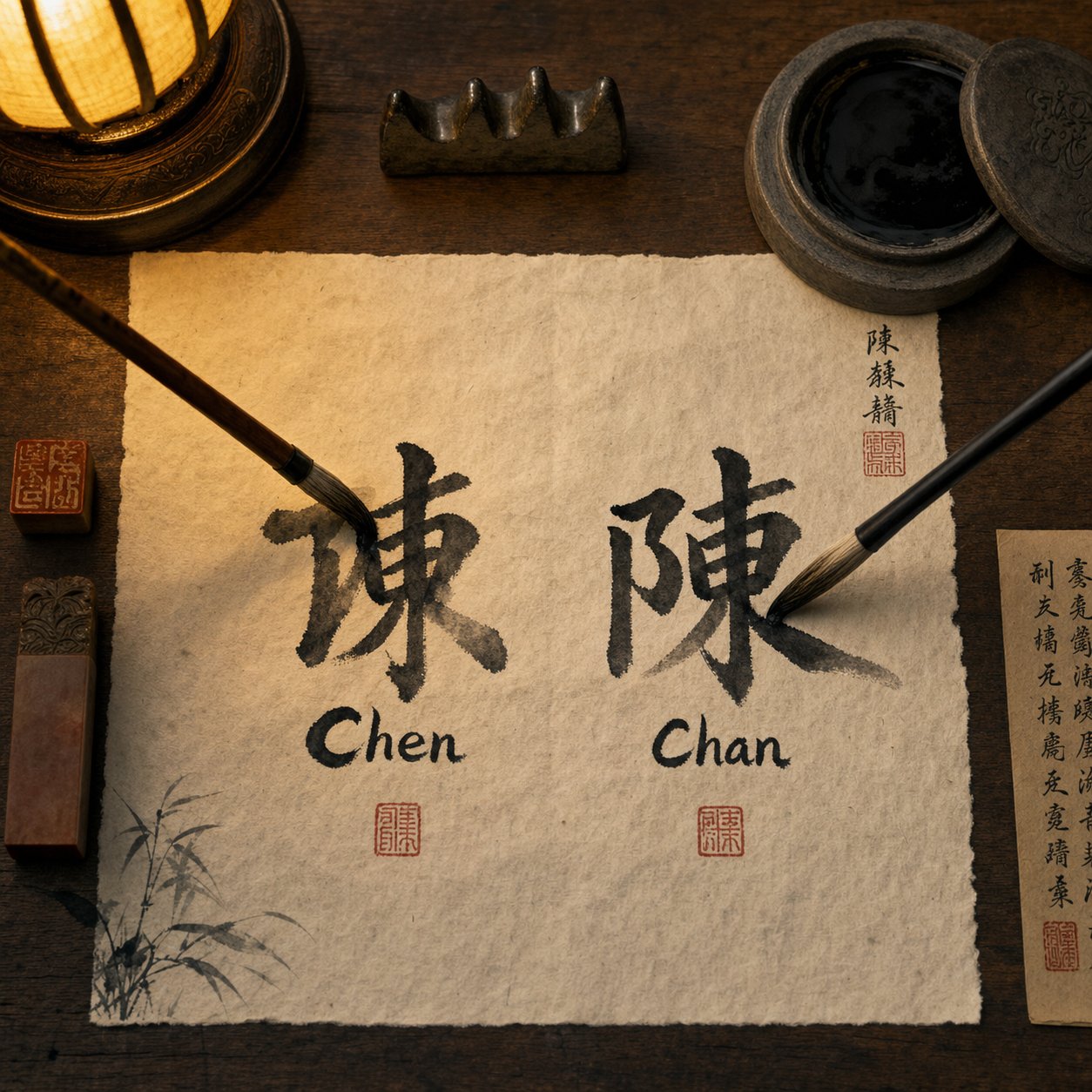
Chen (陈) state stands as the single most powerful example. Founded during the early Zhou period by descendants of the legendary Emperor Shun, Chen belonged to the ancient Gui (妫) clan. Its territory centered on modern Huaiyang in Henan province, and it operated as a mid-sized vassal state for over five centuries. Chu conquered Chen in 479 BCE — more than 250 years before Qin unified China. Yet the chen surname that emerged from this relatively modest kingdom became one of the five most common chinese surnames in the world today, carried by over 54 million people in mainland China alone.
The chen last name origin story does not end at China's borders. In Cantonese-speaking regions and throughout Southeast Asia, the same surname is romanized as "Chan" — making the chan last name one of the most recognizable Chinese surnames internationally. The chan last name origin traces to exactly the same source: the fallen state of Chen and its displaced Gui-clan descendants who scattered across southern China over subsequent centuries.
Song (宋) state has a different pedigree. The Zhou kings established it as a home for descendants of the defeated Shang Dynasty, granting them territory in modern Shangqiu, Henan. The ruling house bore the surname Zi (子). Song survived until 286 BCE, when Qi, Chu, and Wei jointly dismembered it. The surname Song (宋) that resulted is carried by approximately 10 million people today.
Lu (鲁) state holds outsized cultural significance. Founded by the son of the Duke of Zhou — the architect of the fengjian system itself — Lu occupied modern Shandong province with its capital at Qufu. This was Confucius's home state, and it became a center of ritual learning and classical scholarship. Chu conquered Lu in 256 BCE. While the surname Lu (鲁) is less common numerically than Chen or Song, its cultural weight is enormous.
Cai, Zheng, Xu, and Other Overlooked State Surnames
Beyond the better-known vassal states, a constellation of smaller fiefdoms produced surnames that remain widespread today.
Huang (黄) state occupied territory in modern Henan before Chu conquered it in 648 BCE — remarkably early compared to most state collapses. Despite this ancient destruction, the huang surname thrives today with over 33 million carriers, making it one of the top ten common chinese surnames in China. Its longevity demonstrates how deeply a state identity could embed itself even after very early political extinction.
Zheng (郑) state was founded by King Xuan of Zhou's younger brother around 806 BCE in modern Henan. A significant player during the Spring and Autumn Period, Zheng fell to the state of Han in 375 BCE. The surname Zheng (郑) is carried by approximately 12 million people today.
Xu (许) state traces to the Jiang (姜) clan and sat in modern Henan before Chu absorbed it around 375 BCE. In Wade-Giles romanization — still common in Taiwan — this surname appears as "Hsu," making the hsu last name another international variant of a state-derived Chinese surname. Approximately 9 million people carry this name today.
Cai (蔡) state was established by a brother of King Wu of Zhou, placing it firmly in the Ji (姬) lineage. Located in modern Henan, Cai endured repeated relocations before Chu finally destroyed it in 447 BCE. The surname Cai (蔡) is carried by roughly 8 million people. Cao (曹) state, another Ji-clan fiefdom in modern Shandong, fell to Song in 487 BCE and left behind a surname carried by approximately 7 million. Xue (薛) state in Shandong produced a surname of similar scale. Even tiny Teng (滕) state — a minor Ji-clan territory also in Shandong, conquered around the 4th century BCE — survives as a surname today, though far less common than its neighbors.
Xu (徐) state deserves separate mention from Xu (许) above — same romanization, different character, different origin entirely. This Xu (徐) belonged to the Ying (嬴) clan and occupied territory in modern Jiangsu and Anhui. Wu state conquered it around 512 BCE. The resulting surname is carried by over 20 million people, making it significantly more common than its homophone.
Ranked by modern population, these smaller-state surnames reveal a striking pattern — the less famous the kingdom, the more people often carry its name today:
- Chen (陈) — approximately 54 million carriers, from Chen state (fell 479 BCE)
- Huang (黄) — approximately 33 million carriers, from Huang state (fell 648 BCE)
- Xu (徐) — approximately 20 million carriers, from Xu state (fell c. 512 BCE)
- Zheng (郑) — approximately 12 million carriers, from Zheng state (fell 375 BCE)
- Song (宋) — approximately 10 million carriers, from Song state (fell 286 BCE)
- Xu (许) — approximately 9 million carriers, from Xu state (fell c. 375 BCE)
- Cai (蔡) — approximately 8 million carriers, from Cai state (fell 447 BCE)
- Cao (曹) — approximately 7 million carriers, from Cao state (fell 487 BCE)
- Xue (薛) — approximately 7 million carriers, from Xue state (fell c. 4th century BCE)
- Lu (鲁) — approximately 3 million carriers, from Lu state (fell 256 BCE)
The combined population carrying surnames from these smaller vassal states dwarfs the total from the Seven Warring States. Chen alone outweighs Zhao, the most common surname from the seven great powers. This inversion — where political insignificance produced demographic dominance — reflects a simple truth: these smaller states fell earlier, giving their surnames more centuries to spread through natural population growth and migration.
Most of these surnames are single characters, following the dominant pattern in Chinese naming. But not all state-derived surnames fit neatly into one character. Some ancient territories and official positions within states produced something rarer and more distinctive — compound surnames of two or more characters that carry their own fascinating survival stories.
Compound Surnames That Survived from Ancient Territories
Single-character surnames dominate the landscape of chinese surnames from ancient states. But a smaller, more distinctive category exists alongside them — compound surnames, or fuxing (复姓). These two-character names trace not to state names themselves but to territories, official titles, and aristocratic positions within those states. They represent some of the most unique chinese last names still in use, and their survival stories are as precarious as they are fascinating.
What separates compound surnames from their single-character counterparts? The distinction lies in origin type. A surname like Zhao (赵) comes directly from the state name — clean, simple, one character. Compound surnames, by contrast, emerged from more specific sources: a military office held within a state, a sub-territory granted to a noble family, or a hereditary title passed down through generations of court officials. They are more granular, more particular, and far rarer.
Compound Surnames Traced to Specific Ancient Territories
Fewer than 100 compound surnames remain in active use across China today. Among those that survive, several trace directly to ancient state structures:
- Sima (司马) — Originally the title for a military commander (literally "controller of horses") serving in multiple states including Jin, Song, and Chu. Descendants of officials holding this position adopted it as a hereditary surname.
- Gongsun (公孙) — Meaning "duke's grandson," this surname arose across numerous states wherever a ruler's grandchildren needed a distinguishing identifier. States including Lu, Qi, Wei, and Zheng all produced Gongsun lineages.
- Linghu (令狐) — Derived from a specific territory called Linghu within the state of Jin (晋), granted to a noble family during the Spring and Autumn Period. The place name became the clan's permanent surname.
- Zhongli (钟离) — From the small state of Zhongli in modern Anhui, conquered by Chu. The full state name survived as a compound surname, though many carriers later simplified it to Zhong (钟).
- Shangguan (上官) — Originated from an official title in the state of Chu, where "upper official" designated a specific court rank. Descendants preserved the title as a surname.
- Ouyang (欧阳) — Traced to a territory south of Mount Ou in the state of Yue (越). When Yue fell, the family governing that region adopted the geographic marker as their compound surname.
- Situ (司徒) — The title for ministers of education and land management across multiple Zhou-era states. Like Sima, it transitioned from office to surname when descendants needed a fixed family name.
- Duanmu (端木) — Associated with the state of Wei (卫), where a noble family bearing this name produced the famous Confucian disciple Zigong.
These uncommon chinese surnames share a common thread — they preserve not just a state identity but a specific role or place within that state's internal hierarchy. They are, in a sense, higher-resolution records of ancient political life than single-character state names.
Why Most Compound State Surnames Disappeared
If dozens of states each had multiple official titles, noble territories, and aristocratic ranks, why do so few compound surnames survive? The answer involves centuries of steady erosion through three forces.
First, simplification. Chinese bureaucratic systems from the Qin Dynasty onward favored brevity. Census records, tax rolls, and official documents were easier to manage with single-character entries. Families carrying uncommon surnames of two characters faced constant pressure to shorten them. Zhongli (钟离) became Zhong (钟). Sima (司马) occasionally compressed to Ma (马). Gongsun (公孙) sometimes reduced to Sun (孙). Each generation that simplified erased the compound form from one more family line.
Second, social blending. Compound surnames marked their carriers as visibly different — descendants of specific noble houses or officeholders. During periods of political upheaval, standing out could be dangerous. Families fleeing persecution or seeking anonymity after a dynasty change often dropped the extra character to blend into the single-surname majority.
Third, intermarriage and migration diluted compound surname populations over time. Because these names originated from narrow sources — one specific office, one specific territory — their initial carrier populations were tiny compared to state-name surnames adopted by entire displaced populations. A surname like Chen started with hundreds of thousands of former state citizens. A surname like Linghu started with one noble family and its retainers. The demographic math was never in their favor.
Today, compound surnames represent some of the rarest chinese surnames in active use. Carriers of names like Sima, Ouyang, or Shangguan number in the tens or hundreds of thousands rather than the millions who carry Chen or Zhao. They are the uncommon chinese last names that draw curiosity and questions — living proof that ancient states produced not just broad population-level surnames but also highly specific, almost biographical family identifiers.
These rare last names, whether single-character or compound, all eventually found their way into one canonical text that attempted to catalog the full scope of Chinese surname diversity. That text — compiled a thousand years after the states themselves vanished — reveals just how deeply ancient state origins shaped the entire system of Chinese family naming.
The Hundred Family Surnames and Their Ancient State Roots
State Surnames in the Hundred Family Surnames Text
That canonical text arrived during the early Song Dynasty, around 960 CE. Known as the Baijiaxing (百家姓), or Hundred Family Surnames, it was compiled as a rhyming poem listing Chinese surnames in groups of four — designed for children to memorize as part of their classical education. It contains approximately 504 surnames in its most widely circulated version, and it remains one of the most recognized chinese family name lists in existence.
What is immediately striking is the very first character: Zhao (赵). Why does Zhao open the text? Not because it was the most common surname at the time. The compiler placed it first because Zhao was the imperial surname of the Song Dynasty — the ruling house under which the text was written. And that imperial surname? It traces directly back to the ancient state of Zhao, one of the Seven Warring States conquered by Qin in 222 BCE. The most prominent position in China's most famous chinese surname list belongs to a name born from a fallen kingdom.
Zhao (赵), Qian (钱), Sun (孙), Li (李); Zhou (周), Wu (吴), Zheng (郑), Wang (王). The opening eight surnames of the Hundred Family Surnames include at least four with direct ancient state origins — Zhao from Zhao state, Zhou from the Zhou royal domain, Wu from Wu state, and Zheng from Zheng state.
Scan further through the text and the pattern intensifies. Chen (陈), Wei (魏), Jiang (蒋), Han (韩), Xu (许), Lu (吕), Qin (秦), Xu (徐), Cai (蔡), Tian (田), Song (宋), Zheng (郑), Cao (曹), Xue (薛) — all present, all traceable to specific Zhou-era states or territories. Historians who have analyzed the full list of chinese surnames in the Baijiaxing estimate that roughly one-third of its entries derive from ancient state or fiefdom names. That proportion rises further if you include surnames that originated from sub-territories and official positions within those states.
The text was never meant as a genealogical reference. It was a literacy tool, a mnemonic device. Yet by gathering surnames into a single authoritative list of chinese family names, it inadvertently preserved awareness of their origins. Families could locate their surname within the poem and, through oral tradition or clan genealogies, trace it back to a specific state. The Baijiaxing became a cultural anchor — a reminder that these names were not arbitrary labels but historical artifacts with geographic and political roots.
The Modern Scale of Ancient State Surname Legacies
The demographic reality behind these entries is staggering. China's population exceeds 1.4 billion people, and surnames derived from ancient states account for a substantial share of that total. Consider just the top chinese last names with confirmed state origins:
| Surname | Character | Source State | Estimated Modern Carriers |
|---|---|---|---|
| Chen | 陈 | Chen state | ~54 million |
| Huang | 黄 | Huang state | ~33 million |
| Zhao | 赵 | Zhao state | ~27 million |
| Wu | 吴 | Wu state | ~25 million |
| Zhou | 周 | Zhou royal domain | ~25 million |
| Xu | 徐 | Xu state | ~20 million |
| Song | 宋 | Song state | ~10 million |
| Zheng | 郑 | Zheng state | ~12 million |
| Wei | 魏 | Wei state | ~9 million |
| Han | 韩 | Han state | ~8 million |
Add these figures together and you reach well over 200 million people carrying surnames from just ten ancient states. Expand the count to include all confirmed state-derived surnames — Cai, Cao, Xue, Teng, Lu, Qi, Qin, Chu, Yan, Xu (许), and dozens more — and the total climbs toward 300-400 million. That means roughly one in every four or five people in China carries a surname that is, at its root, the name of a vanished kingdom.
These are not obscure names buried in historical footnotes. They rank among the most common surnames in china by every modern census measure. Chen consistently places in the top five. Huang and Zhao sit comfortably in the top ten. Wu, Zhou, and Xu all appear in the top twenty. The Baijiaxing captured this dominance a thousand years ago, and modern demographic data confirms it has only grown since.
The cultural significance extends beyond raw numbers. Clan associations, ancestral halls, and genealogical societies organized around these surnames remain active across China, Taiwan, and diaspora communities worldwide. A person surnamed Chen can visit Huaiyang in Henan — the site of the ancient Chen state capital — and find ancestral temples maintained specifically for Chen-surname descendants. The same is true for Zhao families in Hebei, Zheng families in Henan, and Wu families in Jiangsu. The Baijiaxing gave these connections a textual home. Modern demographics give them living scale.
Knowing that a surname appears in the Hundred Family Surnames and traces to an ancient state is one thing. Figuring out whether your own specific surname belongs to this category — and which state it connects to — requires a more practical approach.
Is Your Chinese Surname from an Ancient State
You know the history. You have seen the lists. But the practical question remains — does your own surname trace back to one of these vanished kingdoms? The answer depends on which of several origin categories your name falls into, and a straightforward three-step method can help you find out.
Tracing Your Surname to a Specific Ancient State
Not every Chinese surname comes from an ancient state. Some derive from occupations (Tao 陶, meaning potter). Others come from physical features, imperial grants, or adoptions during times of political danger. To understand how do chinese names work at the surname level, you need to recognize these distinct origin categories and determine which one applies to your family name.
Here is a simple method for tracing any surname back to its source:
- Look up the surname's traditional origin narrative. Most Chinese surnames have a recorded origin story preserved in texts like the Yuanhe Xingzuan (元和姓纂) or the Tongzhi Shizu Lue (通志·氏族略). These classical genealogical references document whether a surname derives from a state name, a title, an occupation, or another source.
- Check whether the surname maps to a known Zhou-era state. Cross-reference the origin story against the historical record of feudal states. If the surname matches a documented vassal state from the Western Zhou, Spring and Autumn, or Warring States periods, you likely have a state-derived name.
- Verify through the ancestral hall name (堂号 tanghao). Chinese clan associations traditionally maintain hall names that encode geographic or historical origins. A tanghao referencing a specific ancient state capital or territory is strong confirmation. For example, many Chen (陈) families use the hall name "Yingchuan" (颍川), referencing the region of the old Chen state.
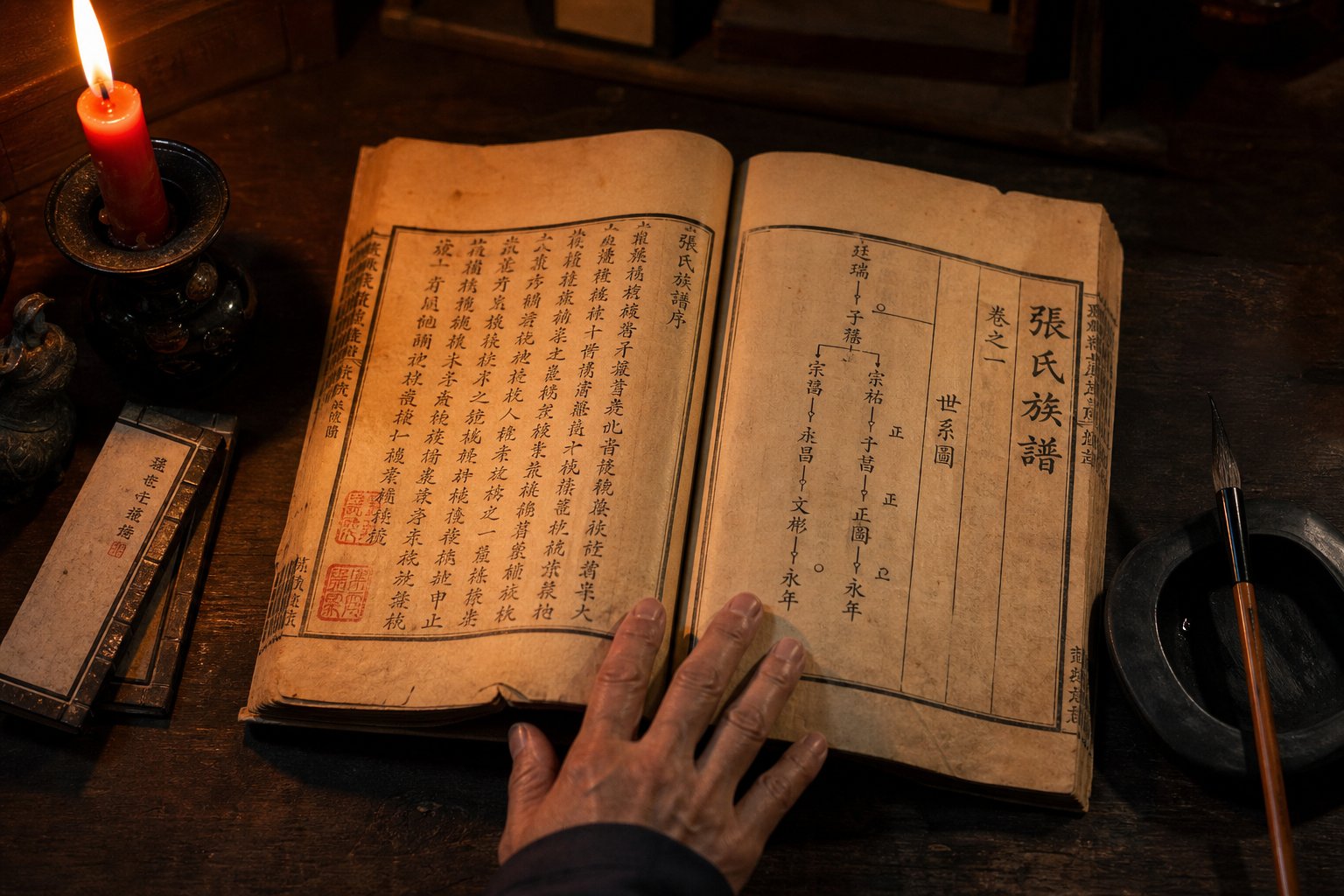
This method works because chinese last name first traditions preserved genealogical records with remarkable consistency. Clan genealogies (族谱) maintained by extended families across centuries often record the exact state and migration path that produced their surname line.
Common Surnames and Their State Connections
Let us address the most searched surnames directly. If you carry one of China's top twenty surnames, here is whether it traces to an ancient state — and if so, which one.
The wang last name is China's most common surname, carried by over 100 million people. Its wang last name origin is complex — Wang (王) means "king" and derives primarily from descendants of the Zhou royal house and other royal lineages who adopted the character for "monarch" as their surname after losing power. While connected to the Zhou royal domain, it is not a direct state name in the way Chen or Zhao are. It falls into a hybrid category: royal lineage rather than a specific named state.
Li (李) — China's second most common surname — traces primarily to an ancient official title (理官, a judicial officer) rather than a state. Some branches connect to geographic origins, but Li is not classified as state-derived.
The liu last name presents an interesting case. The liu last name origin connects partially to the ancient state of Liu (刘), a small fiefdom granted during the Zhou period in modern Henan. However, the surname's massive modern population also includes lines descended from the Han Dynasty imperial family, who adopted Liu through different channels. It qualifies as partially state-derived.
Huang (黄) — yes, directly from Huang state, a small kingdom in modern Henan conquered by Chu in 648 BCE. One of the clearest state-to-surname connections among the top ten.
The lin surname tells a different story. The lin last name does not derive from any ancient state. Lin (林) traces to the Shang Dynasty prince Bi Gan, whose descendants fled persecution and hid in a forest (林 means "forest"). It is one of the most common surnames with a non-state origin — a reminder that not every major Chinese surname follows the state-derivation pattern.
Chen (陈) — yes, directly from Chen state, as detailed extensively in earlier sections. One of the most straightforward state-to-surname connections in the entire system.
The table below covers the top twenty most common Chinese surnames and classifies each by origin type. You will notice that roughly half trace to ancient states, while the remainder come from royal titles, occupations, or other sources.
| Surname | Character | Origin Type | Source State (if applicable) |
|---|---|---|---|
| Wang | 王 | Royal lineage | Zhou royal domain (indirect) |
| Li | 李 | Official title | — |
| Zhang | 张 | Occupation (bow-maker) | — |
| Liu | 刘 | Partial state origin | Liu state (刘国) |
| Chen | 陈 | State | Chen state |
| Yang | 杨 | Fiefdom | Yang state (杨国) |
| Zhao | 赵 | State | Zhao state |
| Huang | 黄 | State | Huang state |
| Zhou | 周 | State/Dynasty | Zhou royal domain |
| Wu | 吴 | State | Wu state |
| Xu | 徐 | State | Xu state |
| Sun | 孙 | Lineage term | — |
| Hu | 胡 | State (indirect) | Chen state branch |
| Zhu | 朱 | State | Zhu state (邾国) |
| Gao | 高 | Fiefdom/title | Qi state branch |
| Lin | 林 | Ancestral narrative | — |
| He | 何 | State (modified) | Han state (韩→何) |
| Guo | 郭 | State | Guo state (虢国) |
| Ma | 马 | State (indirect) | Zhao state branch |
| Luo | 罗 | State | Luo state (罗国) |
A few entries deserve extra explanation. He (何) is a fascinating case — it derives from the state of Han (韩), but after Qin's conquest, some Han-surnamed refugees altered their name's pronunciation and character to avoid detection. The surname literally evolved under political pressure. Guo (郭) traces to the state of Guo (虢), a Zhou-era vassal state in modern Henan and Shaanxi that was conquered by Jin in 655 BCE. And Hu (胡) connects to the Chen state's ruling family through a specific ancestor — it is a branch surname rather than a direct state name.
What emerges from this table is a clear picture: among China's twenty most common surnames, at least twelve have confirmed or partial connections to ancient states and fiefdoms. The remaining eight trace to occupations, titles, ancestral narratives, or other non-state sources. If you carry a Chinese surname, the odds are better than even that your name was once the name of a kingdom.
For those whose surnames do connect to ancient states, the link is not merely academic. Ancestral hall associations, clan genealogies, and even modern DNA-based surname studies continue to map these connections with increasing precision. A surname is not just a label inherited from your parents — it is a compressed history, a single word carrying the memory of a territory, a people, and a political world that ended over two thousand years ago but never truly disappeared.
Frequently Asked Questions About Chinese Surnames from Ancient States
1. How many modern Chinese surnames come from ancient states?
Roughly one-third of the entries in the Hundred Family Surnames text trace to ancient state or fiefdom names. When you count all confirmed state-derived surnames by population, approximately 300-400 million people in China carry a surname that was once the name of a Zhou-era kingdom. Among the top twenty most common Chinese surnames, at least twelve have confirmed or partial connections to ancient states and feudal territories.
2. What is the most common Chinese surname that comes from an ancient state?
Chen (陈) holds that distinction, carried by over 54 million people in mainland China alone. It derives from the state of Chen, a vassal kingdom founded during the early Zhou period by descendants of Emperor Shun. Chu conquered Chen in 479 BCE, and its displaced population adopted the state name as a hereditary surname. In Cantonese regions and Southeast Asia, the same surname is romanized as Chan.
3. What is the difference between xing and shi in Chinese surnames?
Xing (姓) were ancient clan surnames tied to mythological ancestors — only about eight existed originally. Shi (氏) were practical branch identifiers that developed as clans spread across different territories. State names became a major source of shi. After the Qin unification in 221 BCE dissolved the old feudal order, the distinction collapsed entirely, and shi became the standard hereditary surname passed down through families regardless of social class.
4. Why does Zhao open the Hundred Family Surnames text?
Zhao (赵) was placed first not because it was the most common surname at the time of compilation, but because it was the imperial surname of the Song Dynasty, under which the text was written around 960 CE. The Song ruling house itself traced its Zhao surname back to the ancient state of Zhao, one of the Seven Warring States conquered by Qin in 222 BCE. This makes the most prominent position in China's most famous surname catalog a direct inheritance from a fallen kingdom.
5. How can I find out if my Chinese surname comes from an ancient state?
Follow a three-step method: First, look up your surname's traditional origin narrative in classical genealogical texts like the Yuanhe Xingzuan or Tongzhi Shizu Lue. Second, cross-reference that origin story against documented Zhou-era vassal states. Third, verify through your clan's ancestral hall name (堂号 tanghao), which often encodes geographic references to ancient state capitals. For example, many Chen families use the hall name Yingchuan, referencing the old Chen state region.