The Fire Radical in Chinese Characters at a Glance
When you first encounter Chinese characters, they can feel like an endless sea of complex strokes. But here is the thing: nearly every character is built from smaller, repeating building blocks called radicals. And among the 214 radicals in the traditional Kangxi system, few are as visually striking or as frequently encountered as the fire radical chinese character, 火.
What Is the Fire Radical in Chinese
A radical (部首, bushou) is the component of a Chinese character used to categorize and index it in dictionaries. Think of it as a filing label. Every character has exactly one radical, and that radical often hints at the character's core meaning. The chinese character for fire, 火 (huǒ), serves as Radical 86 in the Kangxi Dictionary, where it indexes 639 characters related to heat, flame, cooking, and light.
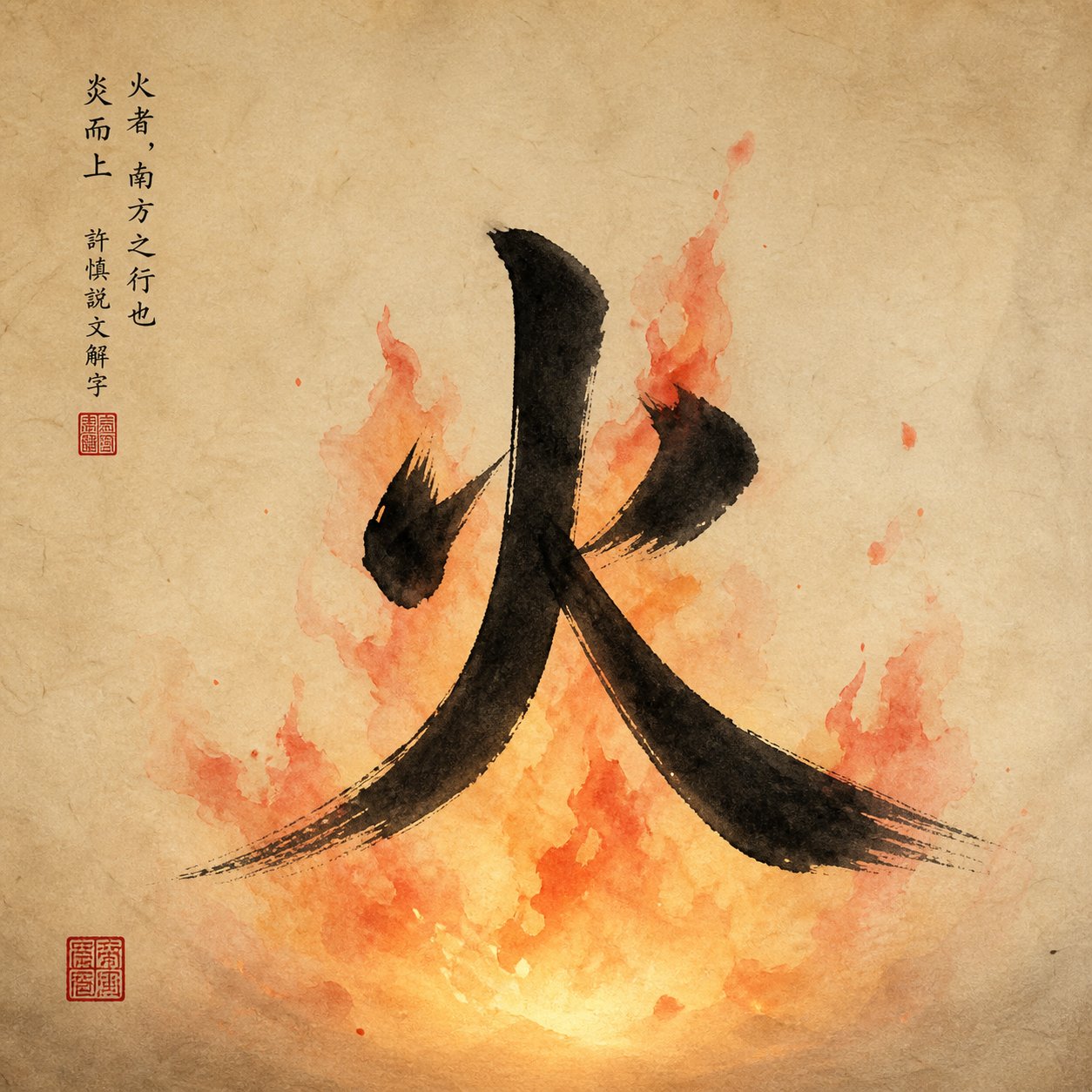
The fire radical (火, Radical 86) is a four-stroke component meaning "fire" that appears in hundreds of Chinese characters to signal meanings connected to flame, heat, light, or intense energy. It has two written forms: 火 when used as a standalone character or on the left side, and 灬 (four dots) when positioned at the bottom.
You will also see this radical referred to as the chinese symbol for fire, since 火 functions both as an independent character and as a building block inside larger ones. Its alternate bottom form, 灬, often surprises learners who do not realize those four small dots represent the same element of fire chinese writing uses in characters like 热 (hot) and 煮 (boil).
Why the Fire Radical Matters for Learners
Recognizing fire in chinese characters gives you three practical advantages:
- Meaning prediction - Spotting 火 or 灬 inside an unfamiliar character immediately tells you the word likely relates to heat, burning, cooking, or emotional intensity.
- Dictionary navigation - Whether you use a traditional radical index or a modern app, identifying the radical is the first step to looking up any unknown character.
- Memory efficiency - Grouping characters by shared radicals, rather than memorizing each one in isolation, dramatically speeds up vocabulary acquisition.
This guide goes beyond a simple character list. It covers both radical forms, their exact stroke order, the semantic logic behind fire chinese character compounds, and study strategies you can apply right away. Whether you are a beginner building your first radical vocabulary or an intermediate learner filling in gaps, understanding this single radical unlocks recognition of dozens of everyday characters, and reveals a system that makes the rest of the writing system far less intimidating.
Historical Evolution of the Fire Radical
Every stroke in the modern fire character chinese learners practice today carries over 3,000 years of visual history. The radical did not always look like the angular 火 you see in textbooks. It started as a small drawing of actual flames, and understanding that journey from picture to symbol makes the character far easier to remember.
From Oracle Bone to Modern Script
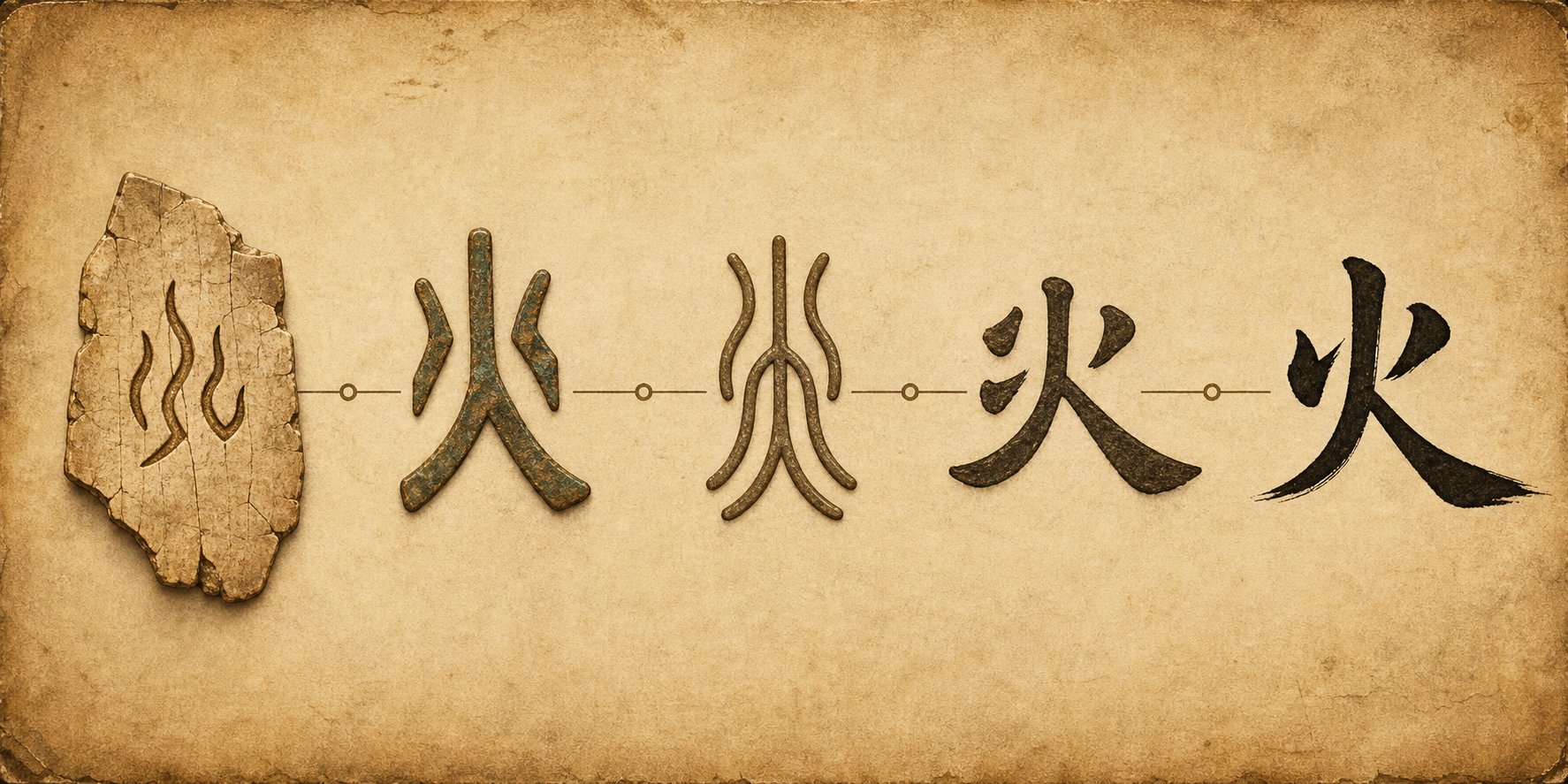
The earliest chinese writing for fire appears on oracle bone inscriptions from the Shang Dynasty (c. 1250-1046 BCE). Carved into turtle shells and ox bones for divination, the original pictograph depicted a rising flame, sometimes resembling a person with arms raised and tongues of fire flickering upward. The image was unmistakable: you could look at it and immediately think "fire."
As writing moved to new materials, the form shifted with it. During the Western Zhou Dynasty (1046-771 BCE), scribes cast characters onto bronze ritual vessels. The fire character chinese scholars find in these bronze inscriptions became rounder and more decorative, suited to the casting process. The pictographic flame was still recognizable, but its lines grew smoother and more stylized.
The Qin Dynasty's unification of writing (221-206 BCE) brought Small Seal Script, which gave the fire radical elegant, symmetrical curves of uniform thickness. Then came the real turning point: Clerical Script during the Han Dynasty (206 BCE-220 CE). Brush and ink replaced carving tools, and curved lines straightened into angular strokes. The pictographic quality faded, replaced by efficiency. By the time Regular Script emerged during the Wei-Jin period and matured under the Tang Dynasty, the fire radical had settled into the precise four-stroke form still used today.
How Pictographs Became Abstract Strokes
This progression follows a pattern common across all Chinese radicals. As scholars have documented, the shift from ancient to modern scripts eliminated curved, pictographic shapes in favor of straight strokes. The result is that modern Chinese script is no longer pictographic in the strict sense. It is a system of abstract symbols composed of standardized strokes. The fire radical is a clear example: what once looked like dancing flames is now four deliberate brush movements.
The table below traces the fire radical's visual transformation across each major script period:
| Script Period | Era | Approximate Form | Key Characteristics |
|---|---|---|---|
| Oracle Bone (甲骨文) | c. 1250-1046 BCE | Pictograph of rising flames | Sharp, carved lines; clearly depicts fire |
| Bronze (金文) | c. 1046-771 BCE | Rounded flame shape | Decorative, cast in metal; still pictographic |
| Seal Script (篆书) | c. 221-206 BCE | Symmetrical curved strokes | Uniform line thickness; elegant and standardized |
| Clerical Script (隶书) | c. 206 BCE-220 CE | Flattened, angular strokes | Brush-written; horizontal emphasis; less pictographic |
| Regular Script (楷书) | c. 220 CE-present | 火 | Square structure; precise stroke order; modern standard |
Knowing this history gives you a mental anchor. When you write 火, you are not drawing arbitrary lines. You are producing the modern descendant of a flame picture that ancient diviners once scratched into bone. That connection between image and symbol is exactly what makes fire in chinese writing more intuitive than it first appears, and it is the same logic that governs how the radical behaves inside compound characters.
Two Forms of Fire: 火 and 灬 and Where They Appear
Here is something that trips up many learners: the fire radical does not always look like 火. When it sits at the bottom of a character, it transforms into four small dots written in a row: 灬. These two shapes are the same radical, Radical 86, just wearing different outfits depending on where they appear. Once you understand this positional rule, you will start recognizing the chinese fire symbol in characters you never associated with fire before.
火 as a Standalone and Left-Side Radical
In its full four-stroke form, 火 works in two ways. First, it stands alone as an independent character meaning "fire" (huǒ). Second, it appears on the left side of compound characters, sometimes slightly compressed to make room for the right-side component. You will see this left-side placement in characters like:
- 灯 (dēng) - lamp, light
- 炒 (chǎo) - to stir-fry
- 烧 (shāo) - to burn
- 炉 (lú) - stove, furnace
In each case, the fire symbol chinese readers encounter on the left side signals that the character's meaning connects to heat, flame, or cooking. The shape stays recognizable as 火, just narrower.
灬 as the Four-Dot Bottom Variant
When the fire radical moves to the bottom of a character, it flattens into 灬, four dots arranged horizontally. This form is called 四点底 (sì diǎn dǐ), literally "four-dot bottom." According to Han Hai Language Studio, the first dot angles to the left while the remaining three dots angle to the right. Characters with this fire chinese symbol at the bottom usually relate to burning or heat, though some exceptions exist. Common examples include:
- 点 (diǎn) - dot, point; to ignite
- 煮 (zhǔ) - to boil
- 煎 (jiān) - to pan-fry
- 热 (rè) - hot
- 照 (zhào) - to shine, to illuminate
- 黑 (hēi) - black (think of soot from fire)
Imagine embers glowing beneath a pot. That visual captures exactly what 灬 represents: heat rising from below.
The Positional Rule Explained
The logic is straightforward. If the radical occupies the left side or stands alone, it keeps its full form: 火. If it sits beneath another component, it compresses into the dot pattern: 灬. There is no overlap. You will never find 灬 on the left or 火 flattened across the bottom. This consistent rule makes identification reliable once you internalize it.
The table below puts both forms of this chinese symbol fire learners need to master side by side:
| Form | Unicode | Position in Character | Chinese Name | Example Characters |
|---|---|---|---|---|
| 火 | U+706B | Standalone or left side | 火字旁 (huǒ zì páng) | 灯, 炒, 烧, 炉, 烤 |
| 灬 | U+706C | Bottom | 四点底 (sì diǎn dǐ) | 点, 煮, 热, 照, 蒸, 黑 |
Both forms share the same radical number (86) and the same semantic function: they tell you the character involves fire, heat, or energy. The only difference is position and shape. Recognizing this duality is what separates learners who can decode new characters on sight from those who memorize each one individually.
Of course, knowing where the radical appears is only half the challenge. Writing each form correctly, with the right stroke direction and sequence, is what makes your characters legible and natural.
Stroke Order Guide for Both Fire Radical Forms
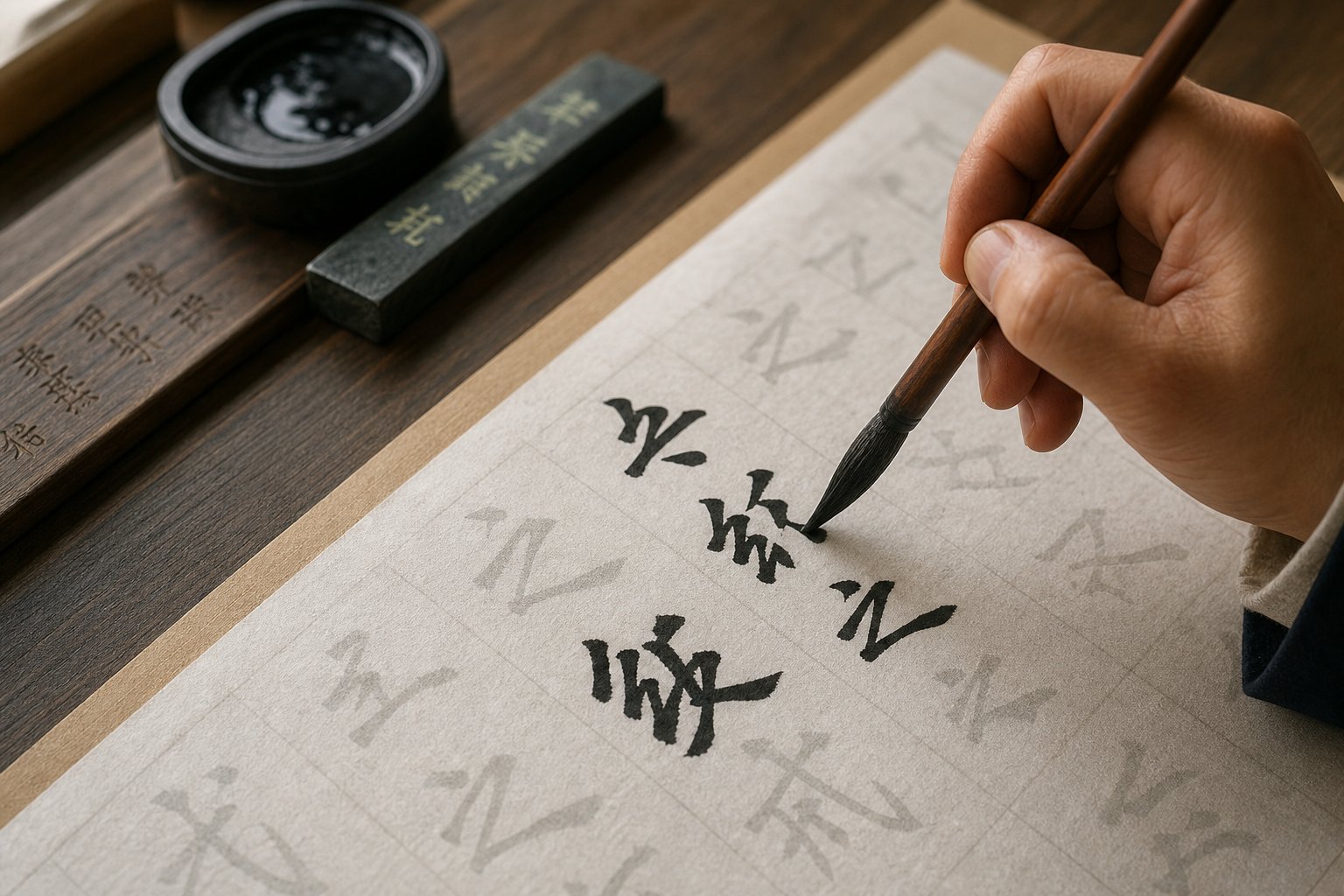
Knowing where 火 and 灬 appear is one thing. Writing them correctly is another. Stroke order in Chinese is not arbitrary. It affects the balance, proportion, and flow of every character you produce. Get the 火 stroke order wrong, and the character looks awkward. Get it right, and each subsequent character containing this radical feels natural under your pen.
Writing 火 Step by Step
The standalone fire radical consists of four strokes. Many learners assume you start with the large sweeping strokes, but the correct sequence begins small and builds outward. Here is the proper order:
- Left dot (点, diǎn) - Start slightly above the center-left. Press down and flick briefly toward the lower left. This short stroke angles downward to the left, like a spark flying off to the side.
- Right short stroke (短撇, duǎn piě) - Begin at roughly the same height as stroke one, but on the right side. Press and pull downward to the lower right. This mirrors the first dot, creating symmetry.
- Long left-falling stroke (撇, piě) - Start at the top center, above and between the first two strokes. Sweep downward to the lower left in a longer, curved motion. This stroke passes through the space between the two dots and extends below them.
- Right-falling stroke (捺, nà) - Begin at the same starting point as stroke three (the top center). Pull downward to the lower right, gradually pressing harder to create a thickening tail. This stroke crosses stroke three near the top and fans out to the bottom right.
The result is a balanced shape: two small marks flanking the upper area, with two longer strokes crossing beneath them like legs of a campfire. Think of it as building the sparks first, then the flames. This sequence applies whether you are writing 火 as a standalone character or as the left-side radical in compounds. When compressed on the left side, the proportions narrow, but the stroke order stays identical.
Writing 灬 Step by Step
The four-dot bottom form looks simpler, but each dot has a specific direction that learners often overlook. The dots are not four identical marks. They follow a directional pattern:
- First dot (leftmost) - Start at the far left of the bottom area. Press and angle the dot toward the lower left. This is the only dot that slants leftward.
- Second dot - Position it to the right of the first dot. Press and angle toward the lower right.
- Third dot - Continue rightward with the same lower-right angle as the second dot.
- Fourth dot (rightmost) - Place it at the far right, again angling toward the lower right.
The pattern is simple to remember: one dot goes left, three dots go right. Imagine embers scattering beneath a cooking pot. The first spark flies left while the rest drift right. Space the dots evenly across the width of the component above them so the character looks balanced.
Common Stroke Order Mistakes to Avoid
Even with clear instructions, a few errors come up repeatedly among learners practicing the fire kanji symbol and its Chinese equivalent:
- Starting with the long strokes - The most common mistake with 火 is writing the central crossing strokes (piě and nà) first, then adding the dots. This produces an unbalanced character because the dots end up squeezed in as afterthoughts rather than anchoring the upper structure.
- Making all four dots identical in 灬 - When writing the four-dot form, beginners often angle every dot the same direction or write them as straight vertical taps. Remember: first dot left, remaining three right. This directional contrast gives 灬 its characteristic look and distinguishes it from other dot patterns.
- Uneven dot spacing - The four dots in 灬 should span the full width of the component above. Clustering them too tightly in the center makes the character look top-heavy.
- Confusing 火 stroke order with 小 - The character 小 (small) also has a central stroke flanked by dots, but its stroke order differs. Do not let visual similarity trick you into applying the wrong sequence.
A useful practice habit: write each form slowly ten times while counting strokes aloud. Once the muscle memory sets in, speed follows naturally. The kanji symbol for fire in Japanese uses the same stroke order as the Chinese form, so mastering this sequence serves double duty if you study both languages.
With the physical act of writing covered, the next question becomes: what do these radicals actually tell you when you spot them inside unfamiliar characters? The answer lies in how the fire radical functions as a semantic signal, pointing you toward meaning before you ever reach for a dictionary.
How the Fire Radical Signals Meaning in Characters
Imagine encountering an unfamiliar character and instantly knowing it relates to heat, cooking, or light, without opening a dictionary. That is exactly what the fire radical does for you. As a semantic analysis by researchers at the University of Leuven demonstrates, the 火 meaning in compound characters forms a radial network: a web of related senses branching outward from the core concept of fire. The radical acts as a built-in clue, narrowing down a character's meaning before you even check its pronunciation.
The chinese word for fire, huǒ (火), carries associations far beyond literal flames. In Mandarin, huo in chinese culture connects to one of the five classical elements (五行), which means its semantic reach extends into cooking, emotion, illumination, and even animal imagery. Let's break these categories down.
Fire, Heat, and Cooking Characters
The most intuitive group. When you see 火 or 灬 in a character related to food preparation or temperature, the connection is direct:
- 烤 (kǎo) - to roast or bake; fire on the left, heat applied to food
- 炒 (chǎo) - to stir-fry; quick cooking over high flame
- 煮 (zhǔ) - to boil; 灬 at the bottom represents fire beneath a pot
- 煎 (jiān) - to pan-fry; again, 灬 signals heat from below
- 炖 (dùn) - to stew; slow fire cooking over time
- 烫 (tàng) - scalding hot; the sensation of touching something heated by fire
- 灰 (huī) - ash; what remains after fire consumes material
The 灰 meaning is literally "ash" or "gray," and it makes perfect sense once you see the fire radical at work: fire burns something down, leaving behind gray residue. This character also extends metaphorically to mean "discouraged" (心灰意冷), connecting physical aftermath to emotional deflation.
Light and Illumination Characters
Before electricity, fire was the only source of artificial light. That historical reality is baked into the writing system:
- 灯 (dēng) - lamp; fire in mandarin once meant the only way to see at night
- 炎 (yán) - blazing, inflammation; two fires stacked, intensifying the heat
- 照 (zhào) - to shine, to illuminate; 灬 at the bottom powers the light above
- 烛 (zhú) - candle; a controlled flame for lighting
- 焰 (yàn) - flame; the visible part of fire that produces light
Notice how these characters preserve an ancient worldview where fire and light were inseparable concepts. The radical encodes that relationship permanently.
Unexpected Fire Radical Characters and Why
Some characters containing the fire radical seem to have nothing to do with flames at first glance. But dig into their etymology and the logic emerges:
- 烦 (fán) - annoyed, vexed; intense emotion burns like internal fire
- 熊 (xióng) - bear; ancient texts linked bears to fire imagery, possibly because bears were seen near forest fires or associated with fiery strength
- 熟 (shú) - ripe, cooked, familiar; food becomes "done" through fire, and the meaning extended to maturity and familiarity
- 黑 (hēi) - black; soot and charring from fire produce darkness
- 然 (rán) - correct, so, to burn (original meaning); the 灬 at the bottom preserves its fire origin even though modern usage shifted toward "thus" or "correct"
Research into the fire radical's semantic structure shows that these extensions are not random. The radical develops meaning along predictable paths: from literal fire, to heat, to cooking, to transformation, to emotional intensity. Each branch connects logically to the one before it, forming what linguists describe as a prototype-based radial network with fire at its center.
This semantic grouping approach is far more useful for learners than organizing characters by stroke count alone. When you cluster fire-radical characters by meaning category, you build mental associations that reinforce each other. Seeing 烤, 煮, and 炒 together as "cooking words with fire" is stickier than memorizing them in isolation.
The same radical carries these semantic functions whether you are reading simplified Chinese, traditional Chinese, or Japanese kanji, though the specific characters and their simplification histories differ across these systems in ways worth understanding.
The Fire Radical Across Chinese and Japanese Writing
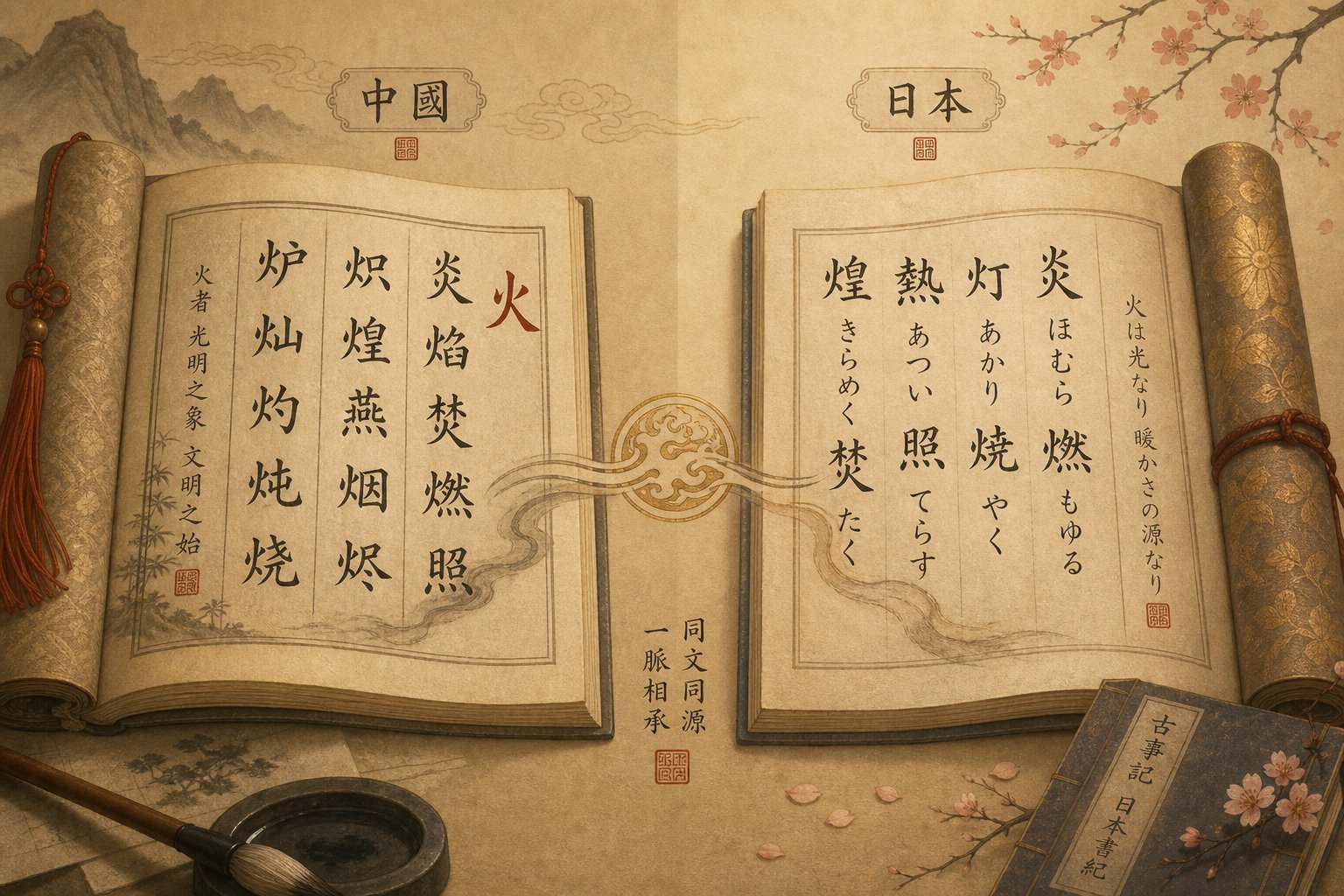
If you study both Chinese and Japanese, you will notice something reassuring: the fire radical looks the same in both languages. The forms 火 and 灬 cross borders. They appear in traditional Chinese, simplified Chinese, and Japanese kanji with identical radical structure. The differences lie not in the radical itself, but in what happened to the compound characters built around it when China simplified its writing system in the 1950s and 1960s.
Fire Radical in Simplified vs Traditional Chinese
China's script reform simplified many high-stroke characters, but the fire radical (火/灬) was already simple at four strokes, so it stayed untouched. What changed were the phonetic or semantic components paired with it. Some fire-radical characters were streamlined; others remained identical across both systems.
Characters that changed during simplification:
- 灯 (simplified) vs 燈 (traditional) - lamp; the right-side component was drastically reduced
- 烧 (simplified) vs 燒 (traditional) - to burn; the phonetic element was simplified
- 炉 (simplified) vs 爐 (traditional) - furnace; a complex 16-stroke character became just 8 strokes
- 烛 (simplified) vs 燭 (traditional) - candle; the right component was replaced
Characters that stayed the same in both systems:
- 火 - fire
- 炒 - stir-fry
- 烤 - roast
- 焦 - scorched
- 煮 - boil
- 熊 - bear
The pattern is clear: when the non-radical portion of a character had too many strokes, simplification targeted that portion while leaving 火 or 灬 intact. This means your knowledge of the fire radical transfers perfectly between both Chinese writing systems.
Fire Radical in Japanese Kanji
Japanese adopted Chinese characters centuries before China's modern simplification reforms, so kanji for fire often preserves traditional forms. The character 火 is one of the kyoiku kanji taught in first grade of Japanese elementary school, making it among the earliest kanji fire students encounter.
In Japanese, the radical has its own naming system. When 火 appears on the left side of a character, it is called ひへん (hihen), literally "fire side-radical." When 灬 sits at the bottom, it is called れっか (rekka, meaning "row of fire") or れんが (renga). These names help Japanese learners discuss character structure in classroom settings, and knowing them is useful if you reference Japanese dictionaries or study materials.
Japan also performed its own simplification (新字体, shinjitai) after World War II, but independently from China. This created a three-way split for some characters. The kanji of fire-related words sometimes matches simplified Chinese, sometimes matches traditional Chinese, and occasionally takes a unique Japanese form:
| Meaning | Simplified Chinese | Traditional Chinese | Japanese Kanji | Notes |
|---|---|---|---|---|
| Lamp | 灯 | 燈 | 灯 | Japan and China simplified identically |
| Burn | 烧 | 燒 | 焼 | Japan used a unique simplified form |
| Furnace | 炉 | 爐 | 炉 | Japan and China simplified identically |
| Flame | 焰 | 焰 | 焔 | Japan uses a variant right component |
| Roast | 烤 | 烤 | 烤 | Identical across all three systems |
| Boil | 煮 | 煮 | 煮 | Identical across all three systems |
Notice how 焼 (burn) in Japanese is different from both the simplified Chinese 烧 and the traditional 燒. It is a uniquely Japanese simplification. Meanwhile, 灯 and 炉 happen to match between simplified Chinese and Japanese because both systems independently arrived at the same reduced form. These overlaps and divergences make the japanese fire symbol system fascinating for cross-language learners.
The practical takeaway: fire in japanese kanji uses the exact same radical shapes (火 and 灬) with the same positional rules you already learned for Chinese. If you can spot the fire radical in one language, you can spot it in the other. The japanese symbol of fire carries identical visual DNA, which means your radical knowledge doubles in value the moment you begin studying kanji.
Shared radicals across writing systems are powerful, but they also introduce a new challenge. When characters from different radicals look similar at a glance, misidentification becomes a real risk, especially with radicals that share stroke patterns with fire.
Radicals That Look Like Fire and How to Tell Them Apart
You have learned to spot fire 86 in its two forms. But what happens when another radical looks almost identical at a glance? Misidentifying a radical sends you to the wrong dictionary section and attaches the wrong meaning to a character. A few common look-alikes trip up learners repeatedly, so let's clear them up.
Fire Radical vs Water Radical
The most frequent confusion occurs between the fire radical and radical 85, the water radical. In their full standalone forms, 火 (fire) and 水 (water) look quite different. The problem appears when both compress into left-side positions. The water radical becomes 氵, three short strokes stacked vertically. The fire radical stays as 火, narrowed but still recognizable with its crossing central strokes.
Here is the key distinction: 氵 is purely vertical, three separate dots or flicks arranged top to bottom with no crossing strokes. The fire radical on the left still shows its characteristic piě and nà strokes crossing each other. If you see strokes that intersect, it is fire. If you see three parallel flicks with no intersection, it is water.
Distinguishing 灬 from Other Dot Patterns
The four-dot bottom form 灬 can be confused with other dot-based components. Radical 34 (夂, zhǐ, meaning "slow" or "go") sometimes appears at the bottom of characters and involves downward strokes that beginners mistake for dots. The difference: 夂 consists of three connected strokes forming an angular shape, while 灬 is four clearly separated dots with no connecting lines between them.
Another source of confusion is the bottom of characters like 求 (to beg). As detailed analysis of radical structure shows, the lower portion of 求 is not the water or fire radical at all. It derives from a hand radical (寸) combined with pictographic elements. Resemblance does not equal identity.
Quick Recognition Tips
When you are unsure which radical you are looking at, use this comparison table:
| Confusing Pair | Stroke Differences | Mnemonic |
|---|---|---|
| 火 (fire, left side) vs 氵 (water, left side) | 火 has crossing central strokes; 氵 has three separate vertical flicks with no intersection | "Flames cross, water drips straight down" |
| 灬 (fire, bottom) vs 夂 (radical 34, bottom) | 灬 is four separate dots; 夂 is three connected angular strokes | "Embers scatter apart, feet stay connected" |
| 灬 (fire, bottom) vs bottom of 求 | 灬 has four evenly spaced dots; 求's lower strokes radiate from a central crossing point | "Four even sparks vs one tangled knot" |
A practical habit: count the separate elements. If you see four distinct, unconnected dots at the bottom, it is almost certainly 灬. If strokes connect or cross, you are looking at a different component entirely. This counting method works faster than analyzing individual stroke angles, especially when reading at speed.
Confident identification is the first step. The next is putting that skill to practical use: looking up unknown characters in dictionaries using the radical you have just identified.
How to Look Up Characters Using the Fire Radical
You can now identify the fire radical in both forms and distinguish it from look-alikes. So what do you actually do with that knowledge when you encounter an unfamiliar character in the wild? You look it up. The radical system was designed for exactly this purpose, and knowing the chinese for fire radical gives you a direct path into any dictionary, whether it is a dusty print volume or a modern app on your phone.
Using the Kangxi Radical Index
The Kangxi radical system, established in the 18th-century Kangxi Dictionary, organizes all Chinese characters under 214 radicals sorted by stroke count. The fire radical (火) falls under the four-stroke section as Radical 86. Every traditional Chinese dictionary follows this same structure, which means the lookup method you learn here works universally.
Here is the step-by-step process for finding a fire-radical character in a print dictionary:
- Identify the radical - Determine whether the character contains 火 on the left side or 灬 at the bottom. Both point you to Radical 86.
- Locate Radical 86 in the radical index - Open the dictionary's radical index (部首检字表) and find the four-stroke section. Look for 火 in that group.
- Count the remaining strokes - Subtract the radical's strokes from the total character. For example, 烤 (roast) has 10 total strokes. Remove the 4 strokes of 火, leaving 6 remaining strokes from the component 考.
- Find the character under the correct stroke count - Within the Radical 86 section, characters are sub-sorted by remaining stroke count. Go to the "6 strokes" subsection and scan for 烤.
- Read the entry - The listing provides pronunciation (pinyin or zhuyin), definitions, and sometimes example compounds.
The trickiest part for most learners is step three: counting remaining strokes accurately. A common mistake is counting the radical's strokes twice or miscounting strokes in the non-radical component. Practice with characters you already know, like 灯 (7 total strokes minus 4 for 火 equals 3 remaining) or 煮 (12 total strokes minus 4 for 灬 equals 8 remaining), until the process feels automatic.
Digital Dictionary Lookup by Radical
Physical dictionaries teach you the logic, but digital tools make the process faster. Most Chinese dictionary apps and websites offer radical-based search as one of several input methods. The fire in chinese word lookup works like this in a typical app:
- Open the radical search mode - In apps like Pleco, MDBG, or the built-in dictionary on Chinese operating systems, tap the radical input option (often labeled 部首 or shown as a grid icon).
- Select the stroke count - Tap "4 strokes" to filter the radical list down to manageable size.
- Tap 火 - The app displays all characters indexed under Radical 86.
- Filter by remaining strokes (optional) - Most apps let you further narrow results by specifying how many additional strokes the character has.
- Tap the character - You get instant access to pronunciation, meaning, example sentences, and often stroke order animations.
Beyond radical search, two other digital methods work well when you spot a fire-radical character you cannot read:
- Handwriting input - Draw the character on your phone's touchscreen or trackpad. The system recognizes your strokes and suggests matches. Correct stroke order (which you have already practiced) improves recognition accuracy significantly.
- Online radical indexes - Websites like MDBG.net and Yellowbridge let you click through kangxi radicals visually, browsing all characters under Radical 86 without needing to know stroke counts in advance.
The beauty of understanding the radical system is that it gives you independence. You do not need to know a character's pronunciation to find it. You do not need someone to tell you what it means. A single visual identification, spotting 火 or 灬, hands you the key to unlock any fire-radical character on your own.
Of course, looking characters up is reactive. The real efficiency gain comes from proactive study: building memory systems that help you recognize fire-radical characters before you ever need a dictionary.
Memory Aids and Study Tips for the Fire Radical
Dictionaries solve the problem of the moment. But what if you could recognize fire-radical characters instantly, without reaching for any tool at all? That is where memory techniques come in. The fire radical lends itself naturally to vivid imagery, and pairing that imagery with structured study habits turns short-term recognition into permanent knowledge.
Visual Mnemonics for 火 and 灬
Your brain remembers pictures far better than abstract strokes. The trick is to attach a strong visual story to each radical form so that every time you see it, the image fires automatically.
- 火 as a person beside a campfire - Look at the character shape. The two central crossing strokes resemble a person standing with legs apart, while the two small dots on either side look like sparks or raised arms. Picture someone warming their hands at a campfire, arms lifted toward the heat. That human-plus-flame image anchors the shape in your memory.
- 火 as a bonfire from above - Imagine looking down at a fire pit. The central strokes form the crossed logs, and the dots are glowing embers on either side. This top-down perspective helps you remember the stroke layout: small elements flanking a central cross.
- 灬 as embers beneath a pot - Visualize a cooking pot sitting over four glowing coals. The dots are individual embers, spaced evenly, radiating heat upward into whatever component sits above them. This explains both the shape and the position: 灬 always appears at the bottom because fire heats from below.
- 灬 as sparks scattering - Picture a blacksmith striking metal. Four sparks fly outward along the ground. The first spark shoots left; the other three scatter right. This matches the actual stroke directions perfectly and makes the dot pattern feel dynamic rather than static.
These images work because they connect abstract strokes to physical experiences you already understand. Fire heats from below. Sparks scatter. People warm their hands. Each mnemonic reinforces both the shape and the meaning simultaneously.
The same visual logic applies if you study fire in kanji. The japanese fire kanji uses identical forms, so a mnemonic that works for Chinese transfers directly. When you encounter the kanji for flame (焰 or its Japanese variant 焔), you can picture the fire radical on the left as a person feeding flames, while the right component adds phonetic information. One image, two languages.
Study Strategies for Fire Radical Characters
Mnemonics get characters into your memory. Structured review keeps them there. Research on radical-based grouping found that beginning learners who studied characters sharing the same radical in groups consistently achieved better recall and stronger radical generalization than those who encountered the same characters distributed randomly. Here is how to apply that finding:
- Group by semantic category - Collect all fire-radical characters you know and sort them into meaning clusters: cooking words (烤, 煮, 炒, 煎), light words (灯, 照, 烛), emotion words (烦, 焦), and transformation words (熟, 灰, 黑). Reviewing clusters together reinforces the radical's semantic signal and creates associative links between related vocabulary.
- Use spaced repetition with radical tags - Add fire-radical characters to your SRS deck (Anki, Pleco, or any flashcard app) and tag them with "Radical 86." Periodically filter by that tag and review the entire group in one session. This concentrated exposure strengthens your ability to spot the radical automatically.
- Introduce new characters alongside known ones - When you learn a new fire-radical character like 焕 (huàn, "radiant"), review it next to familiar ones like 烧 and 灯. The shared radical creates a visual anchor that makes the new character feel less foreign.
- Practice both forms in the same session - Do not study 火-left characters and 灬-bottom characters separately. Mix them. Writing 炒 followed by 煮 followed by 烤 followed by 热 trains your brain to recognize the radical regardless of its position or shape.
The research also showed that intermediate learners benefited less from external grouping because they had already internalized radical patterns through experience. This means the grouping strategy is most powerful early on. Start it now, and by the time you reach an intermediate level, radical recognition will be automatic.
Building Your Fire Radical Character Map
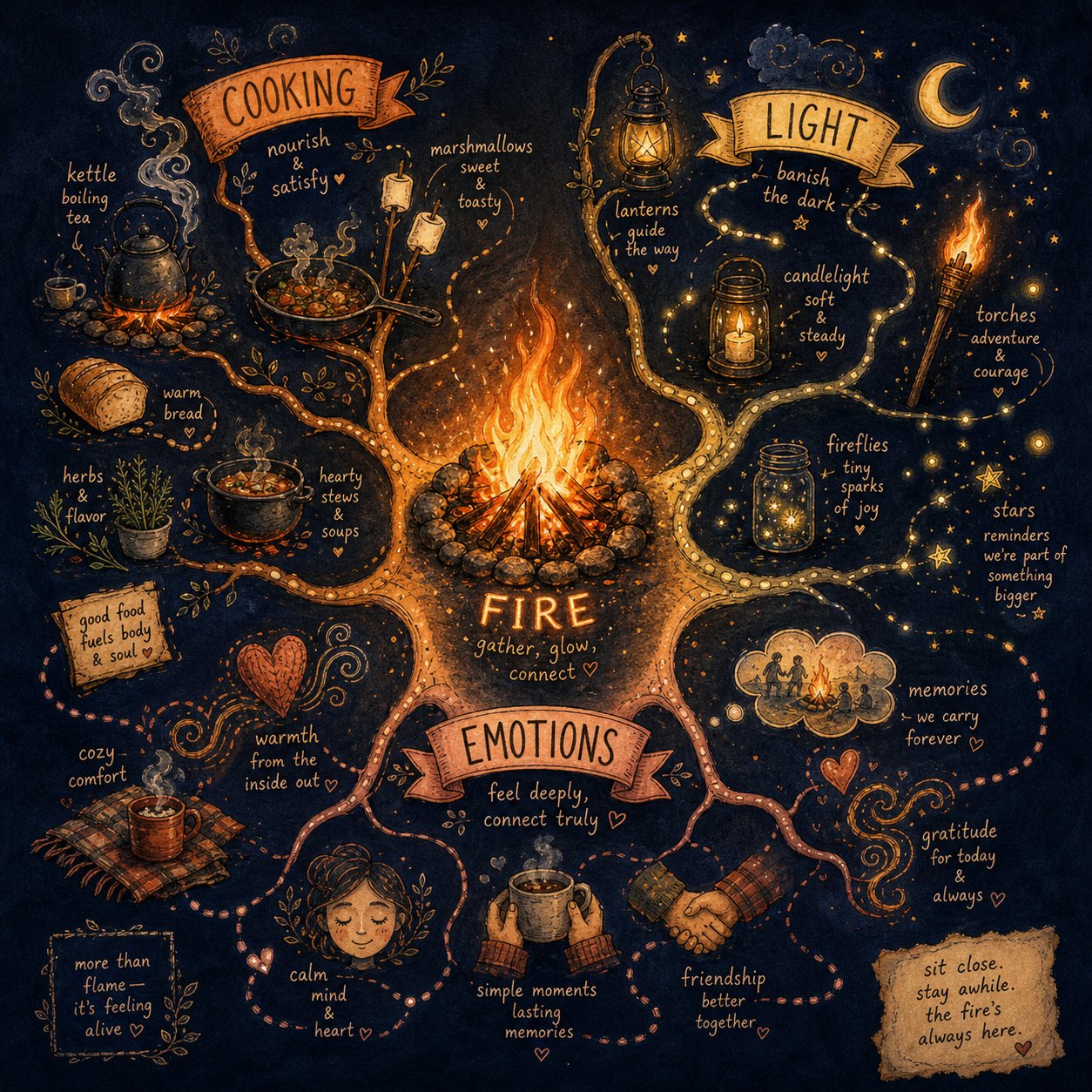
A character map is a simple visual tool: write 火 in the center of a page, then branch outward by category. One branch holds cooking characters. Another holds light and illumination. A third holds emotions and abstract meanings. A fourth holds characters where the fire connection is historical or surprising (like 熊 or 然). Each time you encounter a new fire-radical character in your reading, add it to the appropriate branch.
This map does three things at once:
- It gives you a single-page overview of every fire-radical character you have learned
- It visually reinforces the semantic grouping that research shows improves recall
- It reveals gaps, showing you which meaning categories you have covered and which still need attention
You can build the same map for the flame kanji and fire japanese kanji characters if you study Japanese alongside Chinese. Many entries will overlap since characters like 烤, 煮, and 熊 are identical across both systems. The japanese sign for fire (火) sits at the center of your map regardless of which language you are working in, because the radical is universal.
Here is the encouraging reality: mastering this one radical, in both its forms and across its semantic categories, unlocks instant recognition of dozens of common characters. You are not memorizing dozens of unrelated symbols. You are learning one building block and watching it repeat across the writing system, in Chinese and in Japanese, in ancient texts and modern menus, in dictionary entries and street signs. That single piece of knowledge compounds every time you encounter a new character built on fire. The system rewards you for understanding it, and the fire radical is one of the best places to start.
Frequently Asked Questions About the Fire Radical in Chinese
1. What is the fire radical in Chinese characters?
The fire radical is Radical 86 in the Kangxi Dictionary system, written as 火 (huo). It is a four-stroke component that appears in hundreds of Chinese characters to indicate meanings related to flame, heat, cooking, light, or intense energy. It has two positional forms: 火 when standalone or on the left side of a character, and 灬 (four dots) when placed at the bottom. Together, these forms index over 639 characters in traditional dictionaries.
2. Why does the fire radical have two different forms?
The fire radical changes shape based on its position within a compound character. When it appears as a standalone character or on the left side, it keeps its full form: 火. When it moves to the bottom of a character, it compresses into four horizontal dots: 灬 (called 四点底, si dian di). This positional adaptation is common among Chinese radicals and helps characters maintain balanced proportions. Both forms carry the same semantic meaning and share the same radical number (86).
3. Is the fire radical the same in Chinese and Japanese?
Yes, the fire radical uses identical forms (火 and 灬) in both Chinese and Japanese writing systems. The positional rules and stroke order are the same. The differences lie in the compound characters built around the radical: China and Japan simplified certain characters independently, so some fire-radical characters like 焼 (Japanese for burn) differ from their Chinese equivalents (烧 simplified, 燒 traditional). In Japanese, the left-side form is called hihen (ひへん) and the bottom form is called rekka (れっか).
4. How do you write the fire radical stroke by stroke?
For 火 (4 strokes): start with a left-angled dot in the upper left, then a right-angled short stroke on the upper right, followed by a long left-falling sweep from top center downward left, and finally a right-falling stroke from the same top center point downward right. For 灬 (4 dots): write the first dot angling to the lower left, then three dots moving left to right, each angling to the lower right. The key rule for 灬 is one dot left, three dots right.
5. How can I tell the fire radical apart from the water radical?
When compressed on the left side of characters, the fire radical (火) retains its crossing central strokes (pie and na intersecting). The water radical becomes 氵, which is three separate vertical flicks stacked top to bottom with no intersection. The mnemonic is: flames cross, water drips straight down. If you see strokes that intersect each other, you are looking at fire. If you see three parallel, non-crossing flicks, it is water.