What the Water Radical Really Means in Chinese
You've spotted those three small dots on the left side of a Chinese character and wondered what they signal. Maybe you noticed them in 河 (river), 洗 (wash), and 海 (sea) and thought, "These all relate to water." You're right, and that observation is the key to unlocking hundreds of characters at once.
The water radical (氵), known as sān diǎn shuǐ in Chinese, is a semantic component that signals a connection to water, liquids, or fluid concepts in any character where it appears. It is the simplified left-side form of the full character 水 (shuǐ, water).
What the Water Radical Means in Chinese Characters
So what does the water radical mean in Chinese? At its most basic level, 氵 tells you that the character carries some relationship to water, whether literal or metaphorical. When you see it attached to a character, you're looking at a built-in meaning clue. Characters like 湖 (hú, lake) and 汁 (zhī, juice) have obvious liquid connections. Others, like 法 (fǎ, law) or 深 (shēn, deep), stretch the concept into abstraction, linking water's qualities of levelness and depth to broader ideas.
The three dot water radical meaning goes beyond a simple tag. It functions as a semantic key, a piece of the character's DNA that points you toward its conceptual family. Think of it as a filing system: every character carrying 氵 belongs to the same broad drawer labeled "water, fluidity, and everything water touches."
Why Understanding This Radical Transforms Your Learning
Most learners encounter Chinese characters as isolated units to memorize one by one. That approach is exhausting. When you understand the 氵 radical meaning and function, you shift from brute-force memorization to pattern recognition. Instead of seeing a random cluster of strokes, you see a logical structure: a meaning component on the left and a phonetic hint on the right.
This matters because water's significance in Chinese extends far beyond rivers and rain. It reaches into philosophy, where water represents adaptability and quiet strength. It flows into emotional vocabulary, where tears and calmness both carry the radical. It surfaces in geography, law, and even the concept of life itself. The water radical is not just a visual marker. It is a window into how Chinese speakers have categorized the world for thousands of years, connecting the physical element to abstract thought through a single, elegant symbol.
That layered logic is exactly what this article unpacks, starting with how a pictograph of flowing water evolved into the compact three-dot form you see in modern characters today.
How the Chinese Water Radical Developed Over Time
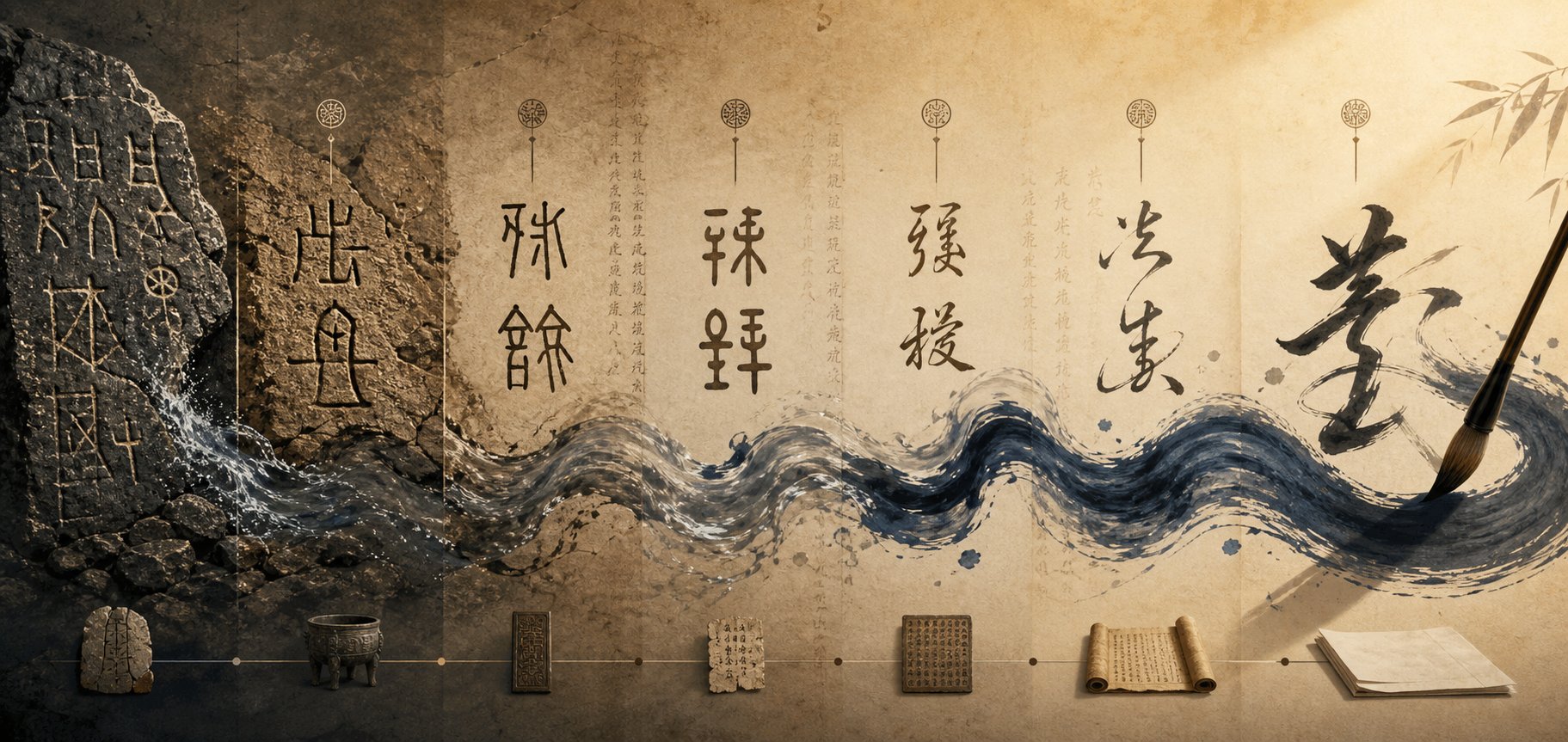
Every Chinese character has a backstory, and the water radical's story stretches back over three thousand years. The compact three-dot form you recognize today started as something far more pictorial: a small drawing of flowing water. Tracing that transformation from ancient Chinese water pictograph to modern form reveals how visual logic gradually compressed into efficient brushstrokes without losing its core meaning.
From Oracle Bone to Modern Form
The earliest known version of shuǐ (水) appears in oracle bone script from the late Shang dynasty, roughly 1250 to 1050 BCE. Imagine a central wavy vertical line representing a stream's current, flanked on each side by smaller dots or short strokes suggesting splashing droplets. The whole shape looked unmistakably like water in motion. You could glance at it and think, "That's a river."
As Outlier Linguistics explains, the main tendency in script evolution from the Shang through the Zhou dynasties was linearization and streamlining: thick pictographic shapes gradually became finer, more abstract lines influenced by brush writing. The water character followed this exact path.
How Flowing Water Became Three Dots
Here's the chronological journey of shuǐ (水) through each major script stage:
- Oracle Bone Script (jiǎgǔwén 甲骨文, c. 1250-1050 BCE) - A central curving line flanked by four to six small dots or droplets on either side, clearly depicting a stream with splashing water. The form was carved into turtle shells and animal bones, so curves were often made angular for easier inscription.
- Bronze Inscriptions (jīnwén 金文, Shang and Zhou dynasties) - The shape retained its flowing quality but became more symmetrical and stylized. The central stream remained prominent, while the side droplets consolidated into fewer, more deliberate strokes. Bronze script was the formal script of this era, preserving more pictographic detail than everyday writing.
- Small Seal Script (xiǎozhuàn 小篆, Qin Dynasty, 221-207 BCE) - After the Qin unification standardized writing across the empire, the water character became a regulated, elegant form. The central current appeared as a smooth vertical stroke, with balanced curved lines branching off symmetrically on both sides. Still recognizable as water, but polished into uniformity.
- Clerical Script (lìshū 隸書, Han Dynasty, 206 BCE - 220 CE) - Curved strokes straightened further. The flowing branches flattened into angular strokes. When used as a standalone character, 水 (shuǐ) kept its full structure. But when squeezed into the left side of a compound character, scribes needed a faster shorthand.
- Regular Script (kǎishū 楷書, matured by the Tang Dynasty) - The radical form fully stabilized as 氵, three short strokes stacked vertically on the left. The original stream and droplets compressed into a minimal, efficient shape that could be written in a fraction of a second.
The Princeton Chinese Characters project notes that clerical script represents a turning point in character evolution, after which Chinese writing transitioned into its modern stage. For the water radical specifically, this was the era when the pictograph of flowing water permanently became the abstract three-dot shorthand.
What's remarkable is that the logic never disappeared. Those three dots in 氵 are the last visible echo of splashing droplets beside a stream, compressed across millennia of daily writing into the most efficient form possible. The meaning stayed anchored even as the picture dissolved, which is precisely why the radical still works as a reliable semantic signal in characters you encounter today. That reliability raises a practical question: how does this three-dot form relate to the other water-related shapes that appear in different positions within a character?
Three Water-Related Radical Variants Compared
The three-dot form isn't the only water-related shape hiding inside Chinese characters. In fact, three distinct variants show up depending on where the radical sits within a character and what specific concept it conveys. Mixing them up is one of the most common stumbling blocks for learners, so let's break down each one clearly.
The Three-Dot Form 氵 on the Left Side
This is the variant you'll encounter most often. Called sān diǎn shuǐ (三点水, literally "three dots of water"), 氵 appears on the left side of a character and signals a connection to water, liquids, or fluid-related concepts. It's the compressed radical form of the full character 水 (shuǐ), optimized for the narrow left column of a compound character.
You'll notice it in characters spanning everything from rivers to emotions:
- 河 (hé) - river
- 海 (hǎi) - sea
- 泡 (pào) - bubble, foam
- 液 (yè) - liquid
- 浪 (làng) - wave
- 清 (qīng) - clear, transparent
The positional rule is straightforward: when the water radical needs to share horizontal space with another component to its right, it takes the three-dot form. This is its default appearance in the vast majority of water radical characters.
Full Water 水 as a Bottom Component
Sometimes the full character 水 appears as a radical, but in a different position. Instead of sitting on the left, it typically occupies the bottom of a character. In this role, it retains more of its original shape rather than compressing into three dots.
Consider these examples:
- 泉 (quán) - spring (water source), where 水 sits beneath 白
- 浆 (jiāng) - thick liquid or starch, with 水 at the base
- 泰 (tài) - peaceful, grand, with 水 as the lower component
The logic here is spatial. When a character's structure stacks components vertically rather than placing them side by side, there's room for the full 水 form. The meaning connection remains the same: water, liquid, or fluidity. The difference is purely about where the radical lands within the character's architecture.
The Ice Radical 冫 and How to Tell Them Apart
Here's where confusion creeps in. The radical 冫, called liǎng diǎn shuǐ (两点水, "two dots of water"), looks visually similar to 氵 but carries a fundamentally different meaning. It represents ice and cold, not liquid water. The Kangxi Dictionary classifies these as entirely separate radicals with distinct semantic functions.
Characters with 冫 relate to freezing, coldness, or solidification:
- 冰 (bīng) - ice
- 冷 (lěng) - cold
- 冻 (dòng) - to freeze
- 凉 (liáng) - cool
- 凝 (níng) - to congeal, solidify
The visual difference? Count the dots. Three dots (氵) means liquid water. Two dots (冫) means ice or cold. When you're reading quickly or looking at handwritten text, this distinction can blur. A reliable trick: if the character's meaning involves temperature, freezing, or hardening, you're looking at the ice radical. If it involves flow, moisture, or bodies of water, it's the three-dot water radical.
Here's a side-by-side comparison that clarifies the three variants at a glance:
| Form | Name / Pinyin | Position in Character | Meaning Connection | Example Characters |
|---|---|---|---|---|
| 氵 | sān diǎn shuǐ (三点水) | Left side | Water, liquids, fluidity | 河 (hé, river), 洗 (xǐ, wash), 海 (hǎi, sea) |
| 水 | shuǐ (水) | Bottom or standalone | Water, liquid (full form) | 泉 (quán, spring), 浆 (jiāng, thick liquid), 泰 (tài, peaceful) |
| 冫 | liǎng diǎn shuǐ (两点水) | Left side | Ice, cold, freezing | 冰 (bīng, ice), 冷 (lěng, cold), 冻 (dòng, freeze) |
Notice that both 氵 and 冫 appear on the left side of characters, which is exactly why they get confused. The semantic difference is significant though: one deals with liquid and flow, the other with solid and cold. Thinking of it this way helps: water in motion has more energy, so it gets three strokes. Water frozen still has less, so it gets only two.
With these three variants sorted out, you have a complete map of how water-related meaning distributes itself across character structures. The next step is seeing how the dominant form, 氵, branches out across different categories of meaning, from literal rivers to abstract emotions.
Common Water Radical Characters Organized by Category
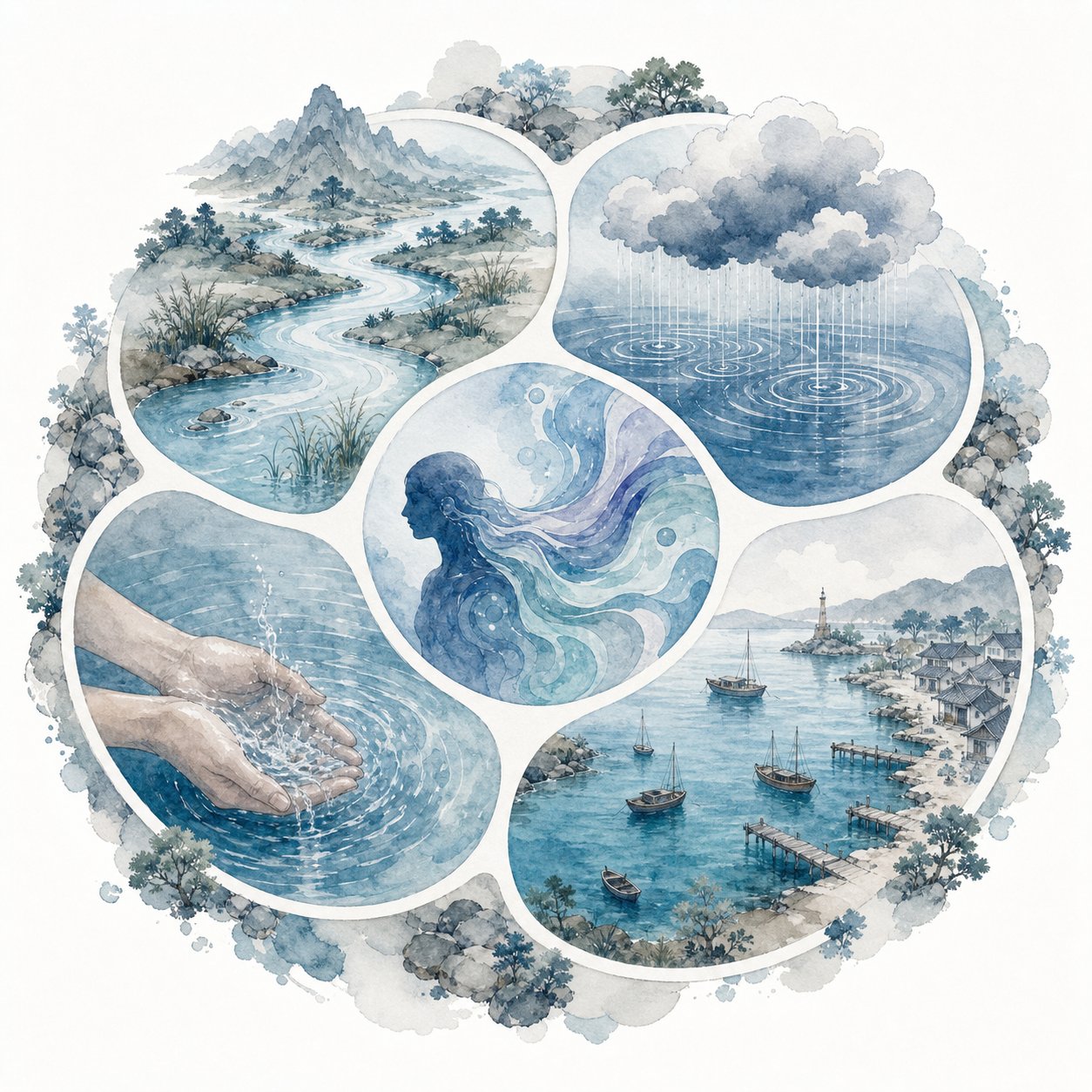
Most character lists sort Chinese characters with 氵 and their meanings by stroke count or textbook level. That's useful for test prep, but it doesn't help you see the logic. When you group water radical character examples with pinyin by what they actually mean, patterns emerge fast. You start noticing that the radical isn't randomly attached. It's a semantic thread connecting entire families of words.
Think of it this way: the water radical acts like a filing cabinet label. Every character inside that cabinet relates to water, but the drawers are organized by topic. Here are the five major drawers you'll encounter.
Physical Liquids and Bodies of Water
The most intuitive category. These characters describe water itself, the places it collects, and the substances that flow. When you see 氵 in these characters, the connection is immediate and literal.
- 河 (hé) - river
- 湖 (hú) - lake
- 海 (hǎi) - sea
- 洋 (yáng) - ocean
- 港 (gǎng) - harbor, port
- 溪 (xī) - stream, creek
- 汁 (zhī) - juice
- 液 (yè) - liquid
- 浪 (làng) - wave
- 泉 (quán) - spring (water source)
You'll notice that geography dominates this group. Rivers, lakes, seas, and oceans are all named with the water radical because they are, quite literally, bodies of water. The Kangxi Dictionary lists 1,595 characters under the water radical, and a significant portion falls into this physical-liquid category.
Weather, Emotions, and Fluid Actions
This is where the radical's reach gets more interesting. Water doesn't just sit in lakes. It falls from the sky, moves through the body, and describes how we feel. The remaining categories show how Chinese character construction extends the concept of water into increasingly abstract territory.
Weather and Climate
Water in motion through the atmosphere. These characters describe what happens when water becomes a force of nature:
- 洪 (hóng) - flood
- 涝 (lào) - waterlogging, excessive rain
- 涌 (yǒng) - to surge, gush
- 潮 (cháo) - tide, damp
- 滴 (dī) - drop (of water)
- 溢 (yì) - to overflow
Emotions and States
Imagine tears flowing, feelings washing over you, or a mood as calm as still water. Chinese maps these experiences through the water radical because emotions, like water, move and shift:
- 泪 (lèi) - tears
- 淡 (dàn) - bland, calm, indifferent
- 满 (mǎn) - full, satisfied
- 沉 (chén) - to sink; heavy-hearted
- 淋 (lín) - to drench; drenched (as in rain)
- 渴 (kě) - thirsty
The character 渴 (kě, thirsty) is a memorable example. As DigMandarin notes, 渴 (thirsty) carries the water radical, while 喝 (hē, to drink) carries the mouth radical. If you're thirsty, you need water. If you're drinking, you need your mouth. The logic is elegant.
Actions Involving Liquid
Verbs that describe what people do with water or in water. These are action words where liquid is either the medium or the tool:
- 洗 (xǐ) - to wash
- 游 (yóu) - to swim
- 泡 (pào) - to soak, to steep
- 浇 (jiāo) - to water (plants), to pour
- 漂 (piāo) - to float, to drift
- 泼 (pō) - to splash, to sprinkle
- 注 (zhù) - to pour into, to concentrate
- 沐 (mù) - to bathe
Notice how each verb involves water as a participant in the action. You wash with water, swim through water, soak in water. The radical isn't decorative. It tells you what element is involved before you even know the full character.
Geography and Place Names
Beyond generic bodies of water, the radical appears in characters used specifically for geographic and navigational terms:
- 港 (gǎng) - harbor, port
- 湾 (wān) - bay, gulf
- 洲 (zhōu) - continent, islet
- 沙 (shā) - sand (found near water)
- 滩 (tān) - beach, shoal
- 渡 (dù) - to cross (a body of water), ferry
These characters show up constantly in Chinese place names. 港 appears in 香港 (Xiānggǎng, Hong Kong, literally "fragrant harbor"). 洋 shows up in 太平洋 (Tàipíngyáng, Pacific Ocean). Once you recognize the radical, you can often guess that a place name involves water before you even look it up.
What makes this category-based approach powerful is the mental scaffolding it creates. Instead of memorizing a flat list of Chinese characters with water radical, you're building a web of associations. Each new character slots into a domain you already understand. A character with 氵 that seems to describe weather? Check the climate drawer. One that feels emotional? Check the emotions drawer.
Still, some characters resist easy categorization. They carry the water radical but seem to have nothing to do with rivers, rain, or washing. Characters like 法 (fǎ, law) or 活 (huó, alive) don't fit neatly into any of these five drawers. Their connection to water runs deeper, hidden in layers of metaphor and ancient reasoning that reward a closer look.
The Hidden Logic Behind Abstract Water Radical Characters
Some characters wear their water connection on their sleeve. 河 (hé, river) and 海 (hǎi, sea) make immediate sense. But what about 法 (fǎ, law)? Or 活 (huó, alive)? These characters seem to have wandered into the wrong filing cabinet. Why does law have water radical? Why does the concept of life carry three dots that represent liquid?
The answer lies in how ancient Chinese thinkers understood water's properties and mapped them onto abstract ideas. The hidden meaning of water radical in characters like these isn't random. It reflects a deliberate semantic logic that connects water's physical behavior to human concepts like fairness, clarity, and vitality.
Why Law Contains Water
The character 法 (fǎ) means law, method, or standard. Its structure breaks down into 氵 (water radical) on the left and 去 (qù, to go) on the right. At first glance, the combination seems arbitrary. Law and water?
The connection becomes clear when you think about what water does on a flat surface. It finds its own level. No matter the shape of the container, water settles evenly, perfectly horizontal. In ancient China, the water level was the standard for fairness. A just law, like water, treats everything equally. It doesn't favor one side over another. It levels out.
The traditional form of this character is even more revealing. In older scripts, the right component depicted a mythical beast called 廌 (zhì), said to distinguish right from wrong. Water plus this beast of justice created the concept of law. The modern simplified form replaced the beast with 去, but the water radical stayed because the metaphor of levelness remained central to the character's meaning.
Here's a mnemonic that sticks: water always finds level ground. Law should do the same.
Emotion, Depth, and Life Through the Water Radical
法 isn't alone. Several abstract Chinese characters with water radical meaning follow the same pattern of mapping water's physical qualities onto intangible concepts. Each one rewards a closer look.
漢 (hàn) - Han Chinese, man
This character references the Han River (漢水, Hàn Shuǐ), one of the longest tributaries of the Yangtze. The Han Dynasty (206 BCE - 220 CE) took its name from this river, and the dynasty's cultural dominance was so profound that the ethnic majority in China became known as 漢族 (Hàn zú, Han people). The water radical here isn't metaphorical at all. It's geographical. The entire identity of the Han Chinese traces back to a river, and the character preserves that origin. Structure: 氵 (water) + 漢's right component serving as the phonetic element.
淚 / 泪 (lèi) - tears
This one bridges the physical and emotional. Tears are literally liquid, so the water radical makes obvious sense on a material level. But the character also carries emotional weight. In the traditional form 淚, the structure is 氵 (water) + 戾 (lì, fierce, perverse), suggesting water that comes from intense feeling. The simplified form 泪 is even more transparent: 氵 (water) + 目 (mù, eye). Water from the eye. The radical-phonetic logic here is beautifully direct. You see the radical and immediately know the substance. You see the other component and know the source.
深 (shēn) - deep, profound
Imagine standing at the edge of a lake and looking down into water so dark you can't see the bottom. That physical sensation of depth is where 深 begins. The structure is 氵 (water) + 罙 (shēn, a phonetic component depicting a hand reaching deep into a hole). Water gave Chinese speakers the primary experience of depth, so when the concept extended into abstraction, the water radical came along. A deep thought (深思, shēn sī), a deep relationship (深厚, shēn hòu), a deep night (深夜, shēn yè) all carry the echo of looking into unfathomable water.
清 (qīng) - clear, pure, clean
Picture a mountain stream so transparent you can count the pebbles on the bottom. That's the image encoded in 清. Its structure is 氵 (water) + 青 (qīng, blue-green), where 青 serves as both a phonetic hint and a color association. Clear water appears blue-green. The character then extends from physical transparency to moral purity. A person of integrity is 清白 (qīngbái, clean and innocent). An uncorrupted official is 清廉 (qīnglián, honest and upright). The water radical semantic logic here moves from what you can see through water to what you can see through a person's character.
活 (huó) - alive, living, lively
Why does life itself carry the water radical? Because without water, nothing lives. The structure is 氵 (water) + 舌 (shé, tongue), where 舌 functions as the phonetic component. But there's a deeper resonance: a living tongue is wet. A dead one is dry. Flowing water is alive. Stagnant water breeds death. The association between water and vitality runs so deep in Chinese thought that the character for "alive" couldn't belong to any other radical family. When water moves, life follows.
What connects all these characters is a single principle. Ancient character creators didn't just ask, "Does this word involve liquid?" They asked, "Does this concept share a quality with water?" Levelness became law. Transparency became purity. Unfathomable darkness became depth. Movement became life. The water radical in these characters isn't labeling a substance. It's encoding a metaphor.
That metaphorical thinking didn't emerge in a vacuum. It grew from a civilization that placed water at the center of its philosophy, its cosmology, and its understanding of power. The same cultural reverence that shaped these characters also produced some of the most enduring ideas in Chinese thought.
Cultural and Philosophical Roots of the Water Radical
Water isn't just a physical substance in Chinese civilization. It's a root metaphor, a lens through which thinkers have interpreted human nature, governance, and the cosmos for over two thousand years. The cultural significance of water in Chinese writing runs so deep that you can't fully understand why certain characters carry 氵 without understanding the philosophy behind them.
Water in Daoist Philosophy and the Five Elements
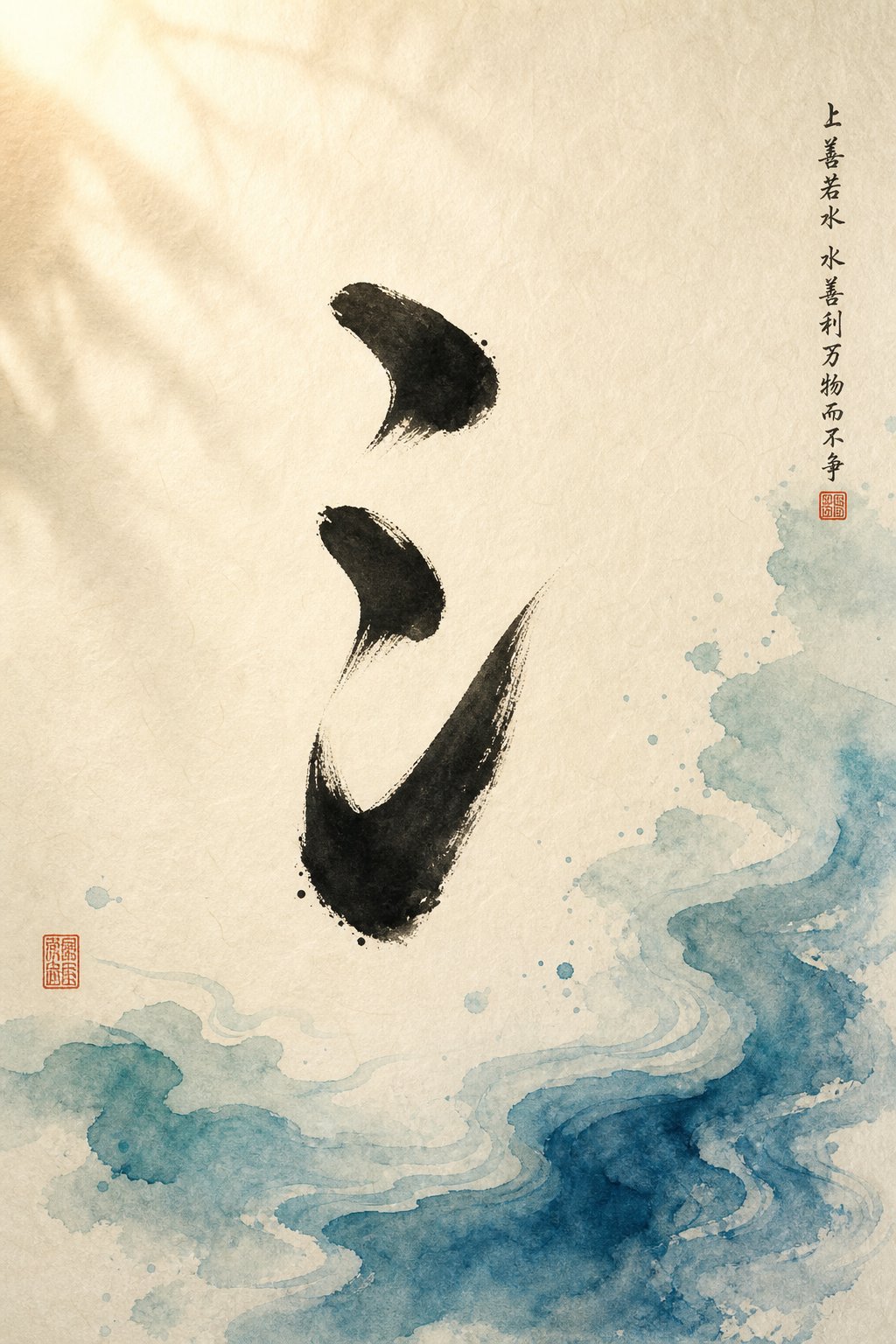
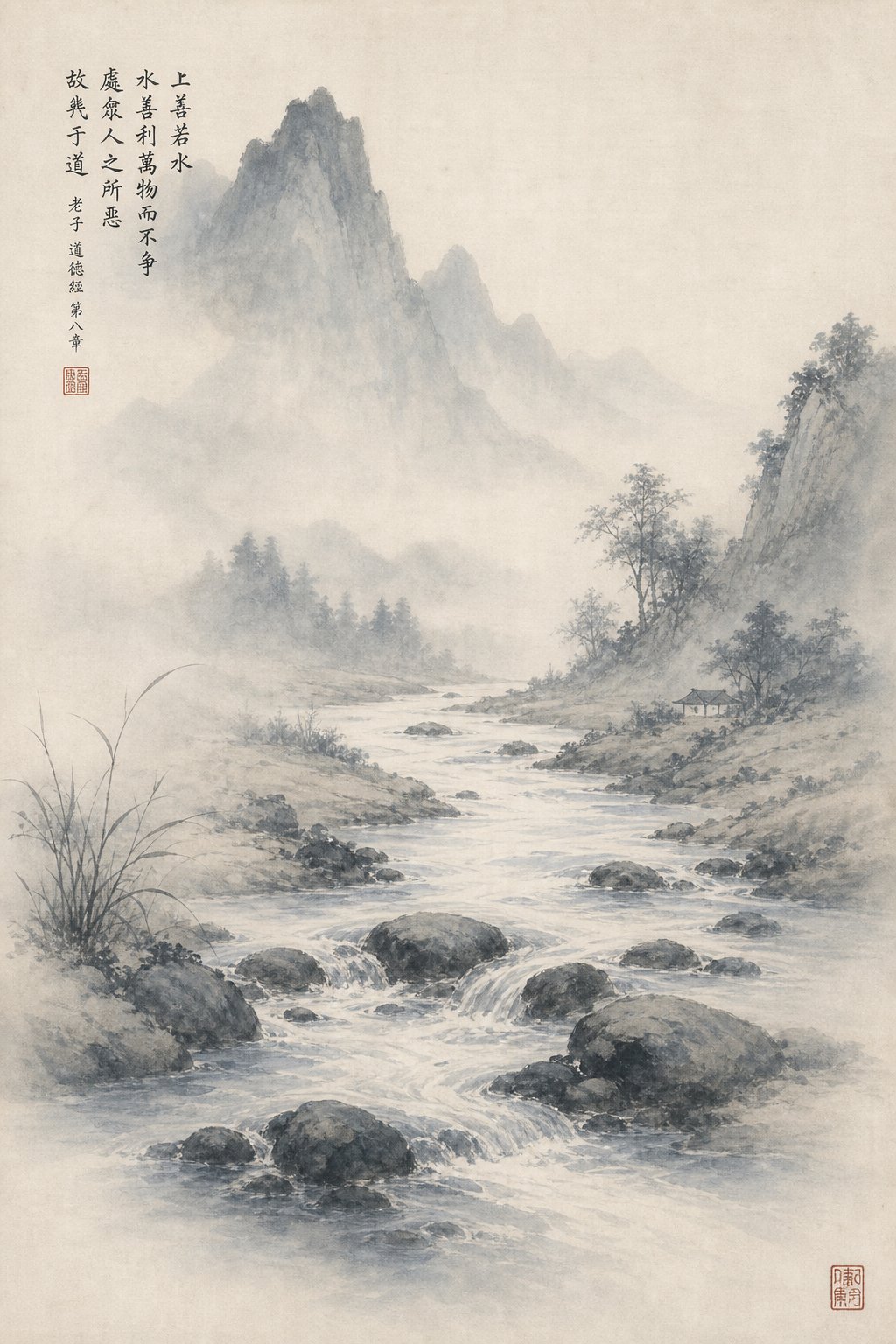
Imagine a substance that nourishes everything it touches, never fights for position, and yet nothing in the world can overpower it. That's how Laozi, the foundational Daoist philosopher, described water in Chapter 8 of the Dao De Jing:
The highest good is like water. Water nourishes all things without contention. It stays in places that people disdain. Therefore it is similar to the Dao.
This passage captures the core of water symbolism in Chinese culture and language. Water benefits all living things without competing. It flows downward to the lowest places others avoid. It is soft and yielding, yet over time it carves through stone. For Daoist philosophy, water represents the ideal way of being: powerful through gentleness, influential without force.
This isn't just poetic abstraction. It directly shaped how characters were built. When ancient scribes needed a radical for 法 (fǎ, law), they chose water because water finds its own level, embodying fairness. When they constructed 清 (qīng, purity), they chose water because a clear stream reveals everything beneath it. Daoist philosophy and Chinese characters share the same symbolic vocabulary.
Water also holds a central position in the Five Elements system (五行, wǔ xíng). In this framework, water (水) is associated with winter, the direction north, the color black, and the quality of wisdom. It represents 藏 (cáng), meaning storage and stillness, the phase where energy retreats inward and gathers strength before spring's renewal. Water personalities in Five Elements theory are described as wise, reflective, and adaptable, qualities that echo Laozi's teachings perfectly.
How Cultural Symbolism Shapes Character Meaning
When you understand this philosophical backdrop, abstract water radical characters stop feeling arbitrary. The five elements water meaning in Chinese connects water to wisdom and depth, which explains why 深 (shēn, deep/profound) carries the radical. Daoist reverence for water's life-giving force explains why 活 (huó, alive) belongs to the water family. The belief that water's clarity reflects moral transparency explains 清 (qīng, pure).
Chinese culture treats water as more than a resource. It's a teacher. As one scholar puts it, water is "the model for philosophical ideas about the nature of the cosmos" in ancient China. The dragon, symbol of imperial power, was believed to be the living force behind water's movement. The word for landscape, 山水 (shānshuǐ), literally joins mountain and water as the two essential elements of nature. Even the concept of civilization itself traces back to rivers: the Han Chinese (漢族) take their name from the Han River.
This cultural weight means the water radical carries more semantic range than almost any other radical in the system. It doesn't just label liquid. It encodes an entire worldview: adaptability is strength, clarity is virtue, depth is wisdom, and flow is life. Every time you encounter 氵 in a character, you're seeing a small piece of that philosophy compressed into three brushstrokes.
That philosophical depth is fascinating, but it also raises a practical question. When you encounter an unfamiliar character with the water radical in the wild, how do you actually use that knowledge to look it up and decode it?
How to Look Up Water Radical Characters in a Chinese Dictionary
You've spotted 氵 in an unfamiliar character. You know it relates to water, liquids, or fluidity. But knowing the meaning category is only half the puzzle. The other half is finding that character in a dictionary so you can confirm its pronunciation and exact definition. This is where the Kangxi radical system becomes your practical toolkit.
Radical 85 in the Kangxi System
The Kangxi Dictionary (康熙字典, Kāngxī Zìdiǎn), published in 1716, established the standard classification system that organizes all Chinese characters under 214 radicals. The water radical is number 85 in this system. Whether you're using a traditional print dictionary, a modern learner's dictionary, or a digital lookup tool, this numbering remains the universal reference point.
What does Radical 85 actually cover? Every character that carries 氵 as its primary semantic component gets filed under this number. That includes over 1,500 characters, making water one of the most populated radical categories in the entire system. In a print dictionary, you'd flip to the Radical 85 section and find all those characters grouped together, sorted by the stroke count of their remaining components.
Digital dictionaries and apps still use this framework behind the scenes. When you select "radical search" in tools like Pleco or MDBG, you're navigating the same Kangxi structure. You pick the water radical from a visual menu, then narrow results by stroke count. The interface is modern, but the logic is three centuries old.
Recognizing the Water Radical in Any Context
In printed text, 氵 is easy to spot: three short strokes stacked vertically on the left side of a character. But handwriting and stylized fonts can blur the picture. Here are tips for identifying the water radical when it doesn't look textbook-perfect:
- Handwritten forms - The three dots often connect into a single flowing stroke that resembles a curved vertical line with a slight hook. Calligraphers may write them as one continuous motion rather than three separate dots.
- Cursive and semi-cursive scripts - The radical can compress into what looks like a wavy vertical line or a quick zigzag. If you see a fluid stroke on the left side of a character, consider whether it might be 氵 written quickly.
- Stylized fonts - Some decorative typefaces elongate or reshape the dots. Look for the consistent pattern: three marks, left side, stacked vertically.
- Distinguishing from 冫 - Count the strokes. Two marks on the left means ice radical (冫). Three means water (氵). In messy handwriting, look at the character's meaning context for confirmation.
The key principle: if you see a cluster of short strokes on the left side of a character and the count is three, you're almost certainly looking at the water radical regardless of how stylized the writing appears.
Once you've confirmed the radical, the next step is counting the strokes in everything else. As one Chinese learner explains, characters within a radical section are ordered by stroke count of the remaining component. So for 河 (hé, river), you identify 氵 as the radical, then count the strokes in 可 (the right-side component): five strokes. You'd look in the Radical 85 section under "5 additional strokes."
Here's the complete process for looking up an unknown water radical character in a dictionary:
- Identify the radical. Look at the left side of the character. If you see three short strokes (氵), you've found Radical 85, the water radical.
- Isolate the remaining component. Mentally separate the three-dot radical from the rest of the character. What's left is the non-radical portion.
- Count the strokes in the remaining component. Be careful with strokes that look like two but count as one. For example, the corner stroke in 口 counts as a single stroke, not two. Practice helps here.
- Navigate to Radical 85 in your dictionary. In print, find the radical index and locate number 85. In digital tools, select the water radical from the radical input menu.
- Find the correct stroke-count subsection. Within the Radical 85 section, locate the group matching your stroke count from step 3.
- Scan for your character. Browse the characters listed under that stroke count until you find a match. In digital dictionaries, the results list is usually short enough to scan quickly.
Sounds complex? It gets intuitive fast. After a few lookups, you'll count strokes almost automatically. The real skill is step one: correctly identifying the radical in the first place.
One important caveat that trips up many beginners: not every water-related word uses the water radical. The character 雨 (yǔ, rain) is itself a radical (Radical 173) and heads its own family of characters like 雪 (xuě, snow), 雷 (léi, thunder), and 霜 (shuāng, frost). Rain falls as water, but in the radical system it belongs to a separate category covering atmospheric precipitation. Similarly, 冰 (bīng, ice) is classified under the ice radical 冫 (Radical 15), not under water. The Kangxi system draws boundaries based on how characters were historically constructed, not on modern semantic intuition. So if you can't find a water-related character under Radical 85, consider whether it might belong to rain, ice, or another related radical family instead.
This lookup method works whether you're flipping through a paper dictionary or tapping through an app. The underlying logic is identical: radical first, stroke count second, then scan. Master this process for the water radical, and you've learned a technique that transfers directly to all 214 radicals in the system. The real payoff, though, comes when you stop needing the dictionary altogether, when the radical itself tells you enough to guess a character's meaning before you ever look it up.
Practical Strategies for Mastering Water Radical Characters
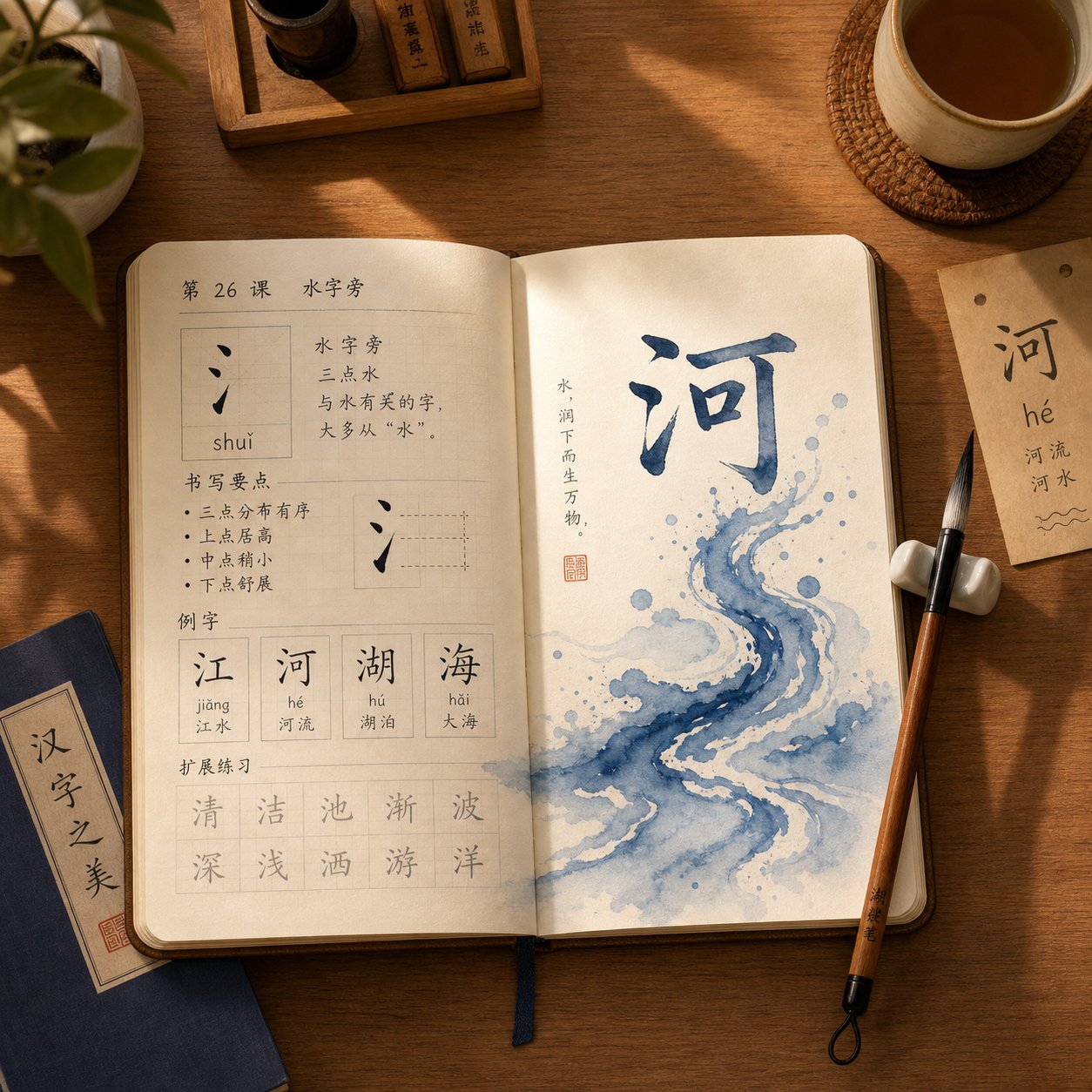
Knowing what the water radical means and where it comes from is valuable. But knowledge without a system for retention fades quickly. The real question is: how do you memorize water radical characters so they stick permanently rather than slipping away after a week?
The answer is surprisingly simple. Stop treating characters as isolated shapes and start treating the radical as your first clue in a meaning puzzle. Every character with 氵 is asking you the same question: what's the water connection here?
A Meaning-First Memorization Framework
When you encounter any new character with the three-dot water radical, pause and ask one question before reaching for a dictionary: "What connection to water, liquid, or fluidity could this word have?" Sometimes the answer is literal. 湖 (hú, lake) is obviously a body of water. Other times the answer is metaphorical. 活 (huó, alive) connects to water because flowing water sustains life.
This single habit transforms how your brain encodes characters. Instead of memorizing a shape and a definition as two disconnected facts, you're building a mnemonic narrative that links them through logic. As mnemonic research in language learning shows, our brains are wired for narrative, not abstract strokes. A well-built story connecting the radical to the meaning creates an initial encoding far stronger than repetition alone.
Here's what this looks like in practice. You see 清 (qīng) for the first time. You spot 氵 on the left and think, "Water connection." The right side is 青 (qīng, blue-green). Blue-green water. What kind of water looks blue-green? Clear water. The meaning clicks: clear, pure. You've just built a radical-based Chinese character memorization strategy for this word in about five seconds.
The same approach works for abstract characters. You see 法 (fǎ) and spot the water radical. You ask, "What does law have to do with water?" Water finds its own level. Law should be level and fair. That metaphor is memorable precisely because it's surprising. The slight cognitive effort of connecting water to law creates a stronger memory trace than passively reading a definition.
Batch learning by semantic domain accelerates this further. Rather than studying random characters from a textbook list, group your water radical characters into the categories covered earlier: physical liquids, weather, emotions, actions, and geography. When you study five river-related characters together, each one reinforces the others. Your brain builds a cluster rather than five isolated data points.
One more critical tip: practice radical recognition as a standalone skill before tackling full characters. Spend time simply scanning text and identifying which characters contain 氵. Don't worry about reading them yet. Just spot the radical. This trains your eye to parse character structure automatically, which is the best way to learn Chinese radicals for beginners who feel overwhelmed by complex characters.
Here are water radical study tips for Chinese learners condensed into actionable steps:
- Ask the water question first. For every new 氵 character, identify the water connection (literal or metaphorical) before memorizing the definition.
- Build a 30-second story. Spend half a minute creating a mnemonic linking the radical's meaning to the character's definition. Write the character 3-5 times while repeating the story mentally.
- Group by meaning, not stroke count. Study water radical characters in semantic batches (rivers together, emotions together, actions together) to build associative clusters.
- Train radical recognition separately. Practice spotting 氵 in running text before worrying about full character readings. Speed up your structural parsing first.
- Find characters in context. After initial study, encounter your new characters in real reading material: news, subtitles, social media. Contextual encounters solidify what mnemonics start.
- Let the mnemonic retire. The story is a bridge, not a destination. Once you've seen a character enough times in context, you'll recall it instantly without needing the narrative.
Key Takeaways for Water Radical Mastery
The water radical is not just a visual marker that decorates the left side of characters. It's a meaning key that unlocks over 1,500 characters through logical association. Here's what that means for your learning:
- 氵 signals a connection to water, liquids, or fluid qualities in every character where it appears, whether the connection is physical or metaphorical.
- Three dots mean liquid water. Two dots (冫) mean ice. The full form 水 appears at the bottom of characters. Knowing all three variants prevents confusion.
- Characters group into clear semantic families: bodies of water, weather, emotions, actions, and geography. Learning by category builds stronger memory networks than random lists.
- Abstract characters like 法 (law), 清 (purity), and 活 (alive) encode water's philosophical qualities: levelness, clarity, and life-giving force.
- The radical doubles as a dictionary lookup tool (Kangxi Radical 85), giving you a practical method for finding unfamiliar characters.
Every character with 氵 is a small window into how Chinese speakers have organized the world for millennia, connecting rivers to emotions, depth to wisdom, and flowing water to life itself. When you learn to read that radical as a meaning signal rather than a random decoration, hundreds of characters stop being strangers and start making sense.
Frequently Asked Questions About the Water Radical in Chinese
1. What does the three-dot water radical mean in Chinese characters?
The three-dot water radical (氵), called san dian shui in Chinese, is a semantic component indicating that a character relates to water, liquids, or fluid concepts. It appears on the left side of characters and functions as the compressed form of the full character 水 (shui, water). Characters carrying this radical range from literal water terms like 河 (he, river) to abstract concepts like 法 (fa, law), where water symbolizes levelness and fairness.
2. What is the difference between the two-dot radical (冫) and the three-dot water radical (氵)?
The three-dot radical 氵 represents liquid water and appears in characters related to rivers, washing, and fluidity. The two-dot radical 冫 represents ice and cold, appearing in characters like 冰 (bing, ice) and 冷 (leng, cold). Both sit on the left side of characters, which causes frequent confusion. The simplest way to tell them apart is to count the strokes: three dots means flowing water, two dots means frozen water or coldness.
3. Why does the Chinese character for law (法) contain the water radical?
The character 法 (fa, law) contains the water radical because of how ancient Chinese thinkers understood water's behavior. Water always finds its own level on a flat surface, settling evenly regardless of the container's shape. This natural property of levelness became a metaphor for justice and fairness. A just law, like water, should treat all sides equally without favoring one over another. The water radical preserves this philosophical connection between water's physical behavior and the concept of impartial law.
4. How many Chinese characters use the water radical?
The Kangxi Dictionary lists over 1,595 characters under Radical 85, the water radical. This makes it one of the most populated radical categories in the entire Chinese writing system. These characters span multiple semantic domains including physical bodies of water, weather phenomena, emotions, actions involving liquid, and geographic terms. Many abstract concepts also carry the radical through metaphorical connections to water's qualities like depth, clarity, and flow.
5. How do I use the water radical to look up characters in a Chinese dictionary?
First, identify the three-dot water radical (氵) on the left side of the character. Then isolate the remaining component on the right and count its strokes. Navigate to Radical 85 in your dictionary's radical index, find the subsection matching your stroke count, and scan for the character. Digital tools like Pleco and MDBG offer radical search menus that follow this same Kangxi system. If a water-related character is not found under Radical 85, check related radicals like 雨 (rain, Radical 173) or 冫 (ice, Radical 15).