What Phonetic Components Are and Why They Matter
Imagine looking at a Chinese character and already having a clue about how to pronounce it, without ever having seen it before. Sounds too good to be true? It is not. The vast majority of Chinese characters carry built-in pronunciation hints, and once you learn to spot them, reading becomes far less mysterious.
Most learners start their journey believing that every character is a tiny picture, a drawing of the sun or a mountain or a tree. Teachers often reinforce this by showing how 日 looks like the sun, 月 resembles the moon, and 木 depicts a tree. These examples are memorable, but they paint an incomplete and misleading picture of how the writing system actually works.
What Are Phonetic Components in Chinese Characters
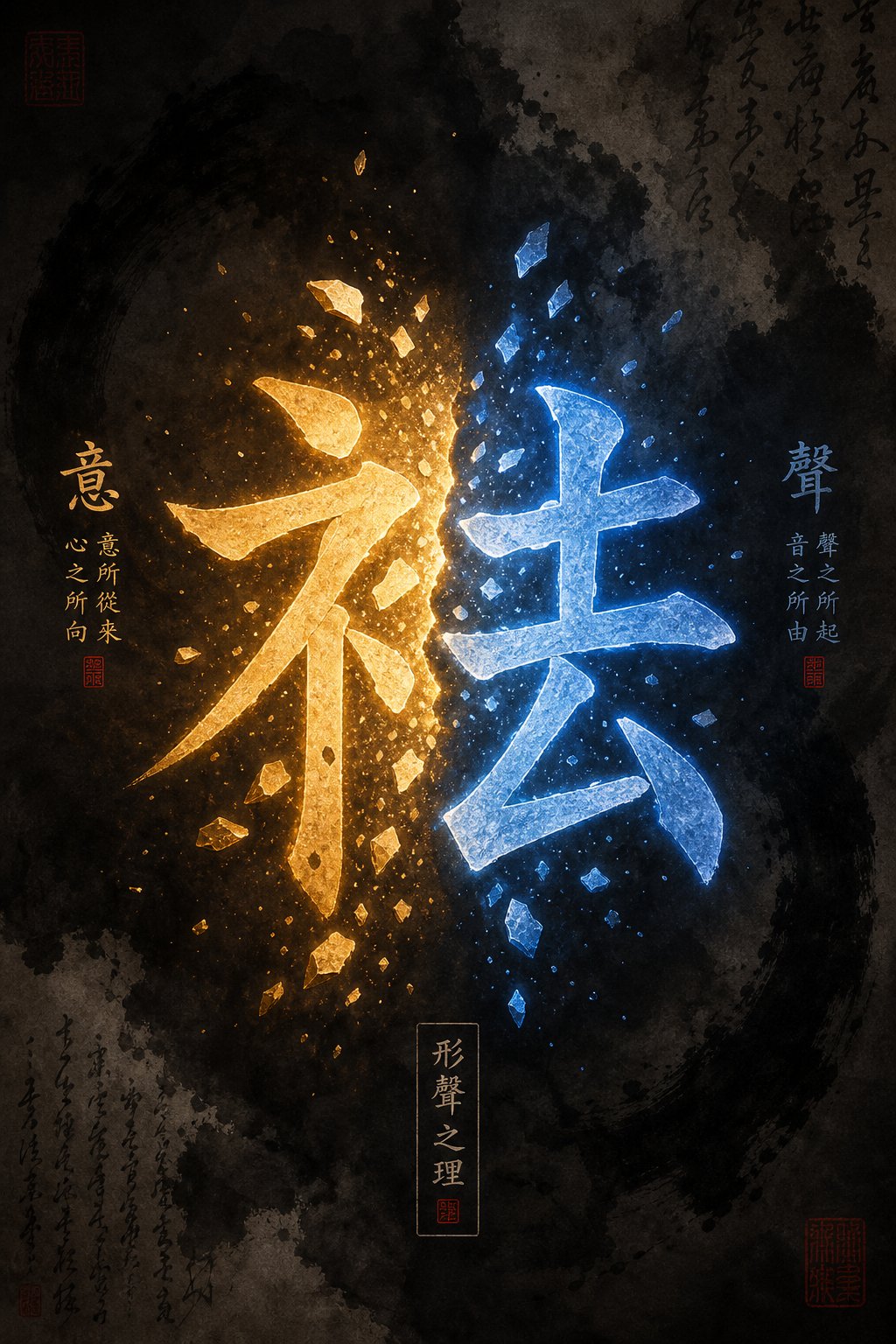
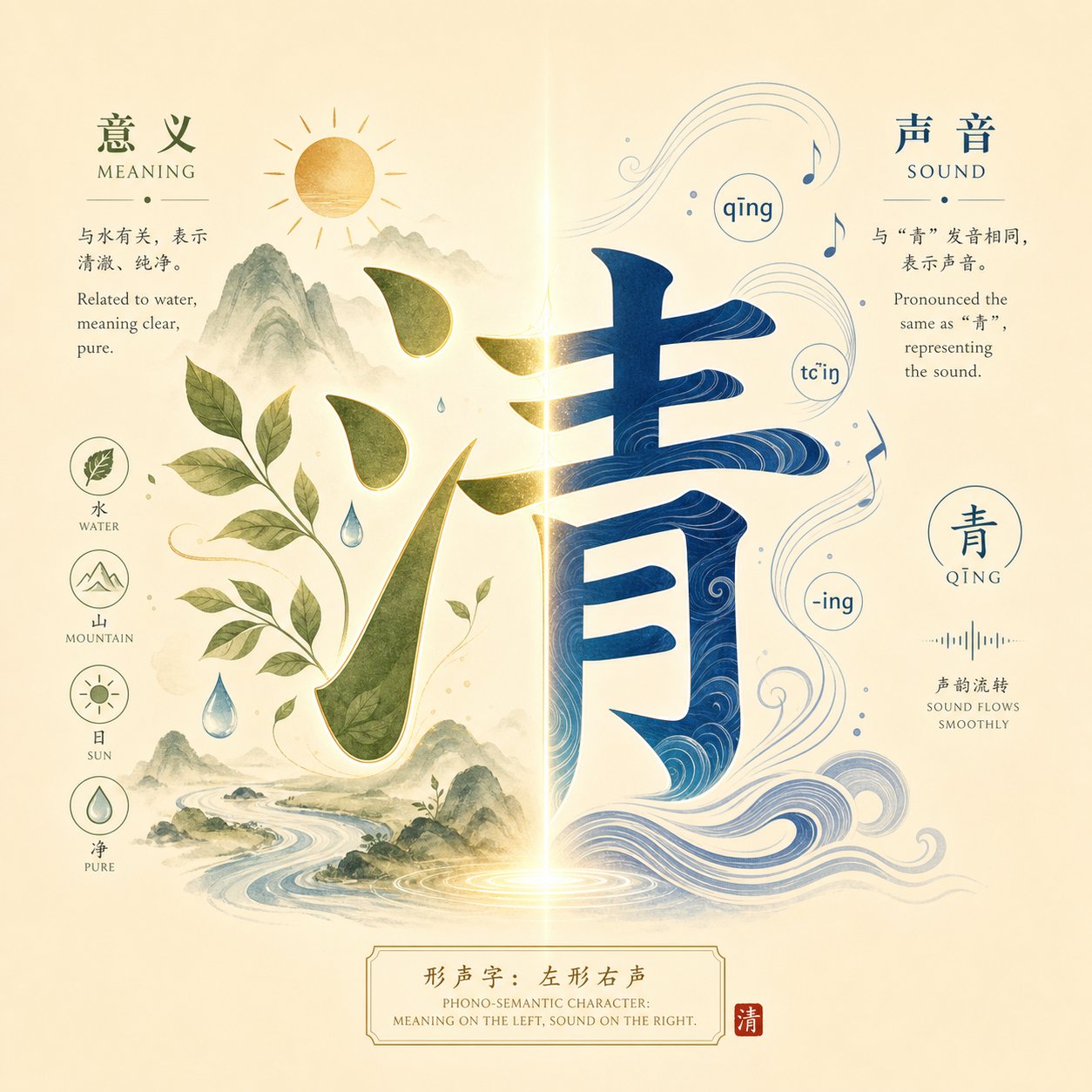
A phonetic component is the part of a Chinese character that provides a clue to its pronunciation. It appears alongside a semantic radical, which hints at meaning. Together, these two parts form a phono-semantic compound character (形声字, xingshengzi), the single largest category in the Chinese writing system.
Here is the key number: roughly 80% of all Chinese characters are phono-semantic compounds. That means four out of every five characters you encounter contain a component whose job is to signal how the character sounds. The system is not random. It is structured, and that structure is learnable.
Take the character 洋 (yang, ocean). The left side, 氵, is the water radical, telling you the meaning relates to water. The right side, 羊 (yang, sheep), is the phonetic component, telling you the character is pronounced "yang." Sheep and ocean have nothing to do with each other semantically. The connection is purely sonic.
Why Most Characters Are Not Pure Pictographs
If you have ever browsed a chinese pictograms list, you will notice it is surprisingly short. Pictographic characters like 山 (mountain), 火 (fire), and 口 (mouth) account for only about 4% of all Chinese characters. They are the ones that get the most attention in beginner materials because they are visually intuitive, but they represent a tiny fraction of the writing system.
The real engine behind Chinese character creation is the phono-semantic method. When ancient writers needed to represent words that could not easily be drawn, they combined a meaning hint with a sound hint. This approach scaled beautifully, producing thousands of characters from a relatively small set of components. Understanding the components of Chinese characters at this structural level changes how you read, how you memorize, and how you guess pronunciation on the fly.
The gap most learners face is not awareness. Many have heard that chinese character components include phonetic elements. The gap is practical application: knowing which part carries the sound, how reliable that sound hint is, and how to use it during real-time reading. That is exactly what the rest of this article addresses, starting with how the dual-component system breaks down in practice.
How the Phonetic System Actually Works
Every phono-semantic compound character is a two-part package. One part tells you what category of meaning the character belongs to. The other part tells you how to say it. When you learn how to interpret chinese characters through this lens, even unfamiliar ones start to feel approachable.
Semantic Radicals vs Phonetic Components
The chinese character semantic side is handled by the radical. Think of it as a category tag. The water radical 氵 flags anything related to liquids. The wood radical 木 signals trees, timber, or wooden objects. The speech radical 讠 points to language and communication. These radicals narrow down meaning, but they do not help you pronounce the character.
That job belongs to the phonetic component. It is typically the larger, more complex portion of the character, and its pronunciation either matches or closely resembles the full character's pronunciation. The phonetic component has no meaningful connection to the character's definition. Its role is purely sonic.
Here is the practical takeaway: when you look up a chinese character you have never seen before, split it into its two functional parts. The radical gives you a meaning clue. The phonetic component gives you a pronunciation guess. Together, they form a complete reading strategy.
Breaking Down Characters Into Their Parts
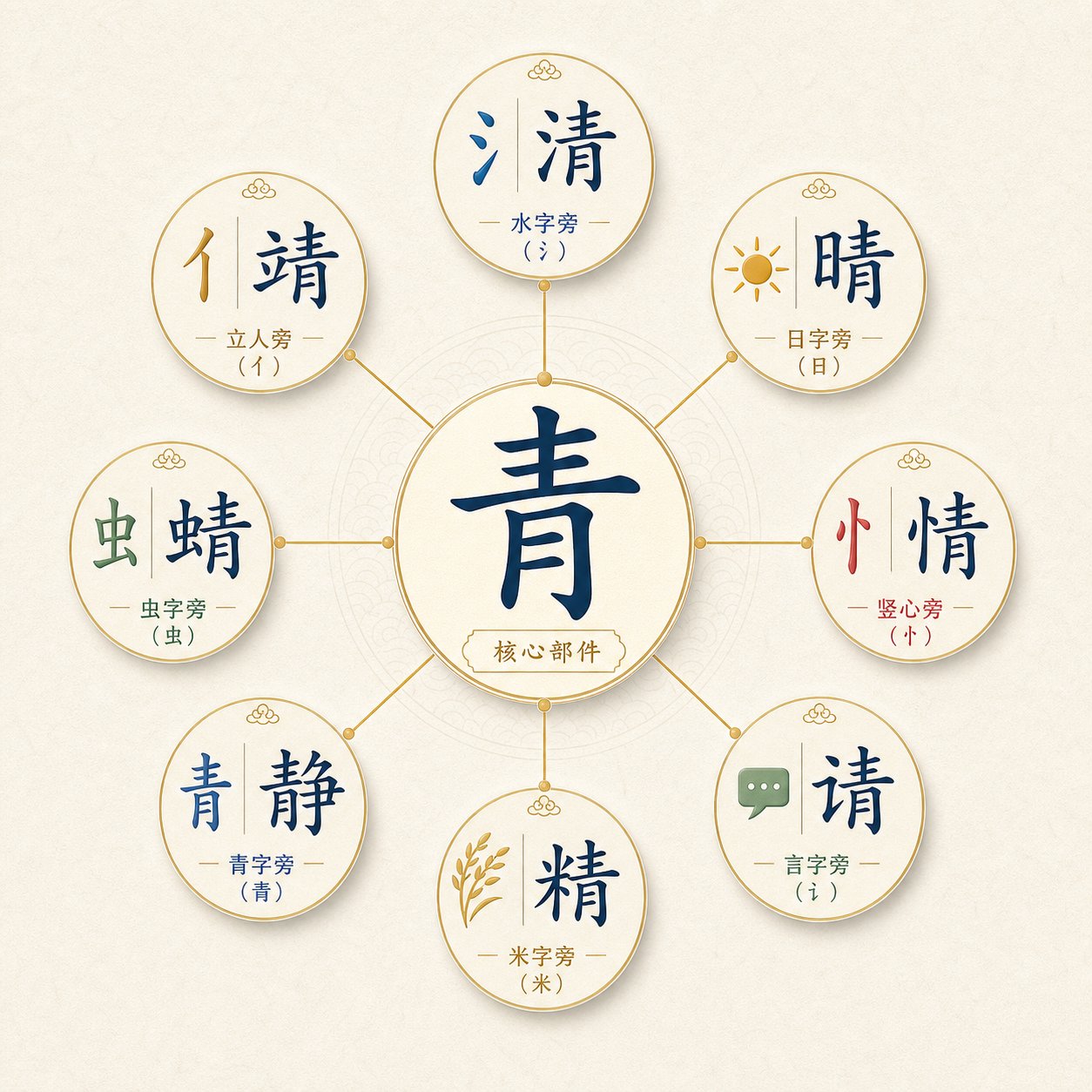
A single example only shows that the system exists. Multiple examples across different character families reveal that it is a pattern. Consider the phonetic component 青 (qing). Pair it with different semantic radicals and you get an entire family of characters, all pronounced similarly but with distinct meanings determined by their radicals.
| Character | Semantic Radical | Phonetic Component | Pronunciation | Meaning |
|---|---|---|---|---|
| 清 | 氵 (water) | 青 (qing) | qing | clear, pure |
| 请 | 讠 (speech) | 青 (qing) | qing | to request, please |
| 晴 | 日 (sun) | 青 (qing) | qing | sunny, clear sky |
| 情 | 忄 (heart) | 青 (qing) | qing | emotion, feeling |
| 睛 | 目 (eye) | 青 (qing) | jing | eyeball |
Notice the pattern. The first four characters all share the "qing" syllable, differing only in tone. The radical steers meaning: water gives you "clear," speech gives you "please," sun gives you "sunny," and heart gives you "emotion." The fifth character, 睛, shows that the system is not perfect. Its pronunciation shifted to "jing," which still shares the same final sound but has a different initial consonant.
This same logic applies across hundreds of phonetic families. The component 方 (fang) generates 房 (fang, room), 纺 (fang, to spin), and 放 (fang, to release). The component 马 (ma) produces 妈 (ma, mother), 吗 (ma, question particle), and 骂 (ma, to scold). Each family works the same way: swap the radical, keep the sound.
Once you recognize this dual-component architecture, characters stop looking like arbitrary drawings. They become predictable combinations, and the phonetic side gives you a pronunciation foothold even when you are reading something entirely new. The natural follow-up question is: how often can you actually trust that pronunciation hint? The answer depends on which reliability tier the phonetic component falls into.
Reliability Levels and When to Trust Phonetic Hints
Not all phonetic hints are created equal. Some give you the exact pronunciation of a character, tone and all. Others only get you in the neighborhood. Knowing which level of reliability you are dealing with is the difference between confidently guessing hanzi pronunciation and being led astray by a false friend.
Researchers and linguists classify phonetic component reliability into four distinct tiers, based on how closely the derived character's pronunciation matches the component itself. Understanding these tiers helps you calibrate your expectations when you try to pronounce chinese characters you have never encountered before.
Four Levels of Phonetic Reliability
Think of these levels as a confidence scale. Level 1 gives you a near-certain guess. Level 4 gives you only a faint echo of the original sound.
| Reliability Level | What Matches | Phonetic Component | Example Characters | Pronunciations |
|---|---|---|---|---|
| Level 1: Exact match (syllable + tone) | Same syllable and same tone | 马 (ma3) | 吗, 玛, 码, 蚂 | ma3, ma3, ma3, ma3 |
| Level 2: Same syllable, different tone | Same initial + final, tone differs | 青 (qing1) | 请, 情, 晴 | qing3, qing2, qing2 |
| Level 3: Same rhyme (final) only | Shared vowel ending, different initial | 亡 (wang2) | 忙, 芒, 盲 | mang2, mang2, mang2 |
| Level 4: Same initial only | Shared consonant onset, different final | 青 (qing1) | 睛, 猜 | jing1, cai1 |
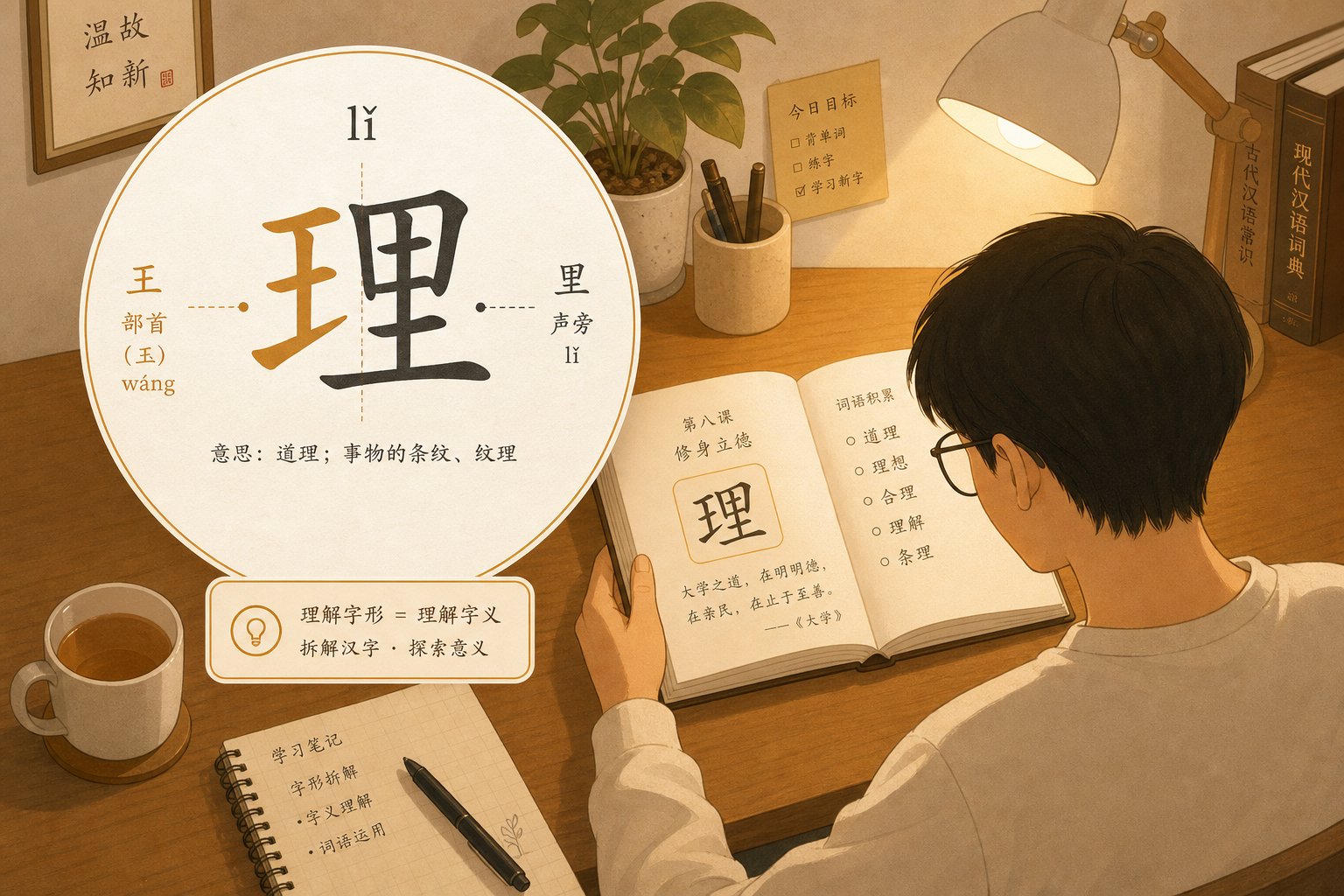
Level 1 is the gold standard. When you see 马 inside a character, there is a strong chance the whole character is pronounced "ma" in the third tone. The component 里 (li3) works the same way: 理, 鲤, 俚, and 锂 are all pronounced li3. These highly regular sets let you guess chinese character pronunciation with real confidence.
Level 2 is still extremely useful. You get the right syllable but need to learn the tone separately. The 方 (fang1) family illustrates this well: 房 is fang2, 纺 is fang3, and 放 is fang4. You know the syllable is "fang" but cannot predict which of the four tones applies. Research on CSL learners confirms this pattern. Studies measuring character recognition among second-language learners often exclude tones from scoring precisely because tone acquisition follows a different developmental path than syllable recognition.
Levels 3 and 4 offer diminishing returns. A shared rhyme still narrows your options considerably, since Mandarin has a limited set of finals. But a shared initial alone leaves too many possibilities open to be a reliable guess in isolation.
When Phonetic Hints Mislead You
Here is the honest picture: only about 35% of commonly used compound characters fall into the "regular" category, meaning the phonetic component and the full character share the same syllable. That leaves roughly two-thirds of phono-semantic compounds where the hint is partial, degraded, or outright misleading in modern Mandarin.
Consider the component 每 (mei3). It generates 梅 (mei2), 霉 (mei2), and 莓 (mei2), all sharing the syllable but differing in tone. So far, so useful. But it also appears in 海 (hai3) and 悔 (hui3), where the pronunciation has drifted far from the original. If you relied on 每 to guess "mei" for every character containing it, you would be wrong a significant portion of the time.
Tonal prediction is the weakest link. Even within highly regular phonetic families, tone is rarely consistent. The component 令 (ling4) produces 零 (ling2), 铃 (ling2), 龄 (ling2), and 领 (ling3), spanning three different tones. You can trust the syllable "ling" but not the tone mark. For learners working with hanyu pinyin chinese characters, this means the phonetic component reliably narrows your guess to the correct syllable, while tone still requires separate memorization or context.
The practical rule of thumb: trust the syllable guess from a phonetic component, hold the tone loosely, and be prepared for exceptions. The more characters you learn within a phonetic family, the better your intuition becomes for which families are trustworthy and which have been fractured by centuries of sound change. That historical fracturing is not random either. It follows patterns rooted in how Chinese pronunciation evolved from ancient to modern forms.
Historical Sound Changes and Modern Inconsistencies
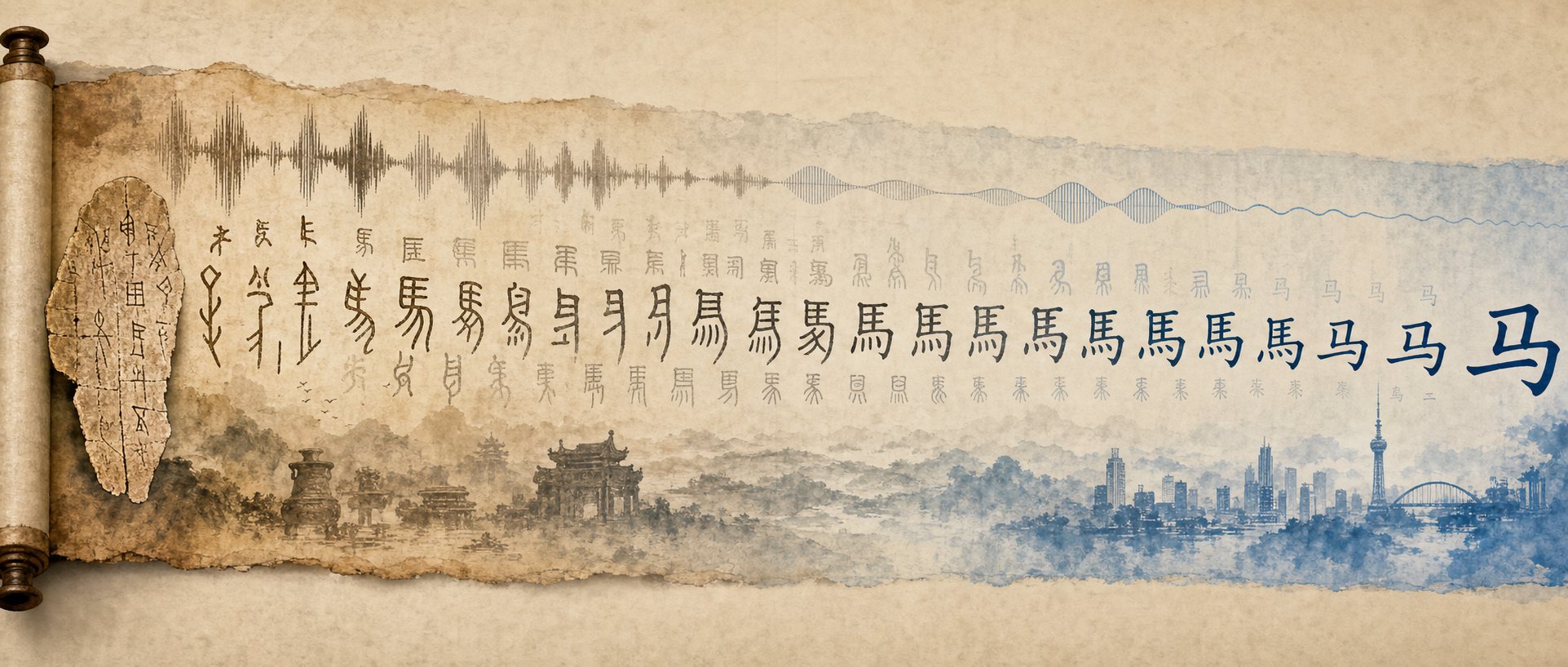
Chinese characters were locked into place thousands of years ago, but the spoken language kept moving. The writing system preserved pronunciation relationships that made perfect sense in ancient times, while the sounds themselves shifted, split, and merged across centuries. This mismatch is the single biggest reason phonetic components sometimes fail modern readers.
Why Sound Changes Broke the System
The history of chinese language phonetics divides into three broad stages: Old Chinese (roughly 1250 BC to 200 AD), Middle Chinese (581 to 1279 AD), and Early Mandarin onward. Each stage brought systematic pronunciation shifts. Vowels merged, consonant clusters simplified, and entire tonal categories split or collapsed as the language evolved from one era to the next.
When a phonetic component was first assigned to a character family, the pronunciations matched. The component 每 and its derivatives 梅, 海, and 悔 likely shared a much closer sound in Old Chinese. Over time, different initial consonants and vowel shifts pushed these characters apart in Modern Mandarin, even though the written forms stayed frozen. The characters remember a pronunciation relationship that the spoken language has forgotten.
Scholars like Bernhard Karlgren reconstructed these ancient sound systems by comparing modern dialects, historical rhyme dictionaries like the Qieyun (601 AD), and borrowings into Japanese, Korean, and Vietnamese. Their work reveals that many "irregular" phonetic families were perfectly regular in Middle Chinese. The irregularity is not in the system. It is in the passage of time.
Once you recognize that phonetic "exceptions" are fossils of older pronunciation, they stop being random frustrations and become predictable patterns. Characters that share a phonetic component but sound different today often rhymed in Middle Chinese, and knowing this turns confusion into a historical clue.
This is why some chinese phonetic relationships only become visible when you look at Cantonese, Hakka, or other dialect readings that preserved older sound distinctions Mandarin lost. A component that seems unreliable in Mandarin may still be perfectly regular in another variety of Chinese.
Simplified vs Traditional Phonetic Patterns
Character simplification in the 1950s and 1960s reduced stroke counts, but did it damage phonetic transparency? The answer is mixed. Many simplified characters kept their phonetic components intact. The character 请 (qing, to request) is simplified from 請, but the phonetic element 青 remains unchanged in both forms. The same holds for hundreds of common characters where simplification targeted the radical rather than the phonetic side.
In other cases, simplification did disrupt the phonetic link. The traditional character 鄰 (lin, neighbor) contains the phonetic 粦 (lin), making the sound connection clear. Its simplified form 邻 replaces that component with 令 (ling), which is phonetically close but not identical. Anyone working from a traditional chinese characters list will occasionally find phonetic relationships that are more transparent than their simplified counterparts.
The practical impact is modest. Studies of the most common 3,000 characters show that simplification preserved phonetic utility in the majority of cases. Where it did not, the damage is usually limited to a tone or initial consonant mismatch rather than a complete phonetic breakdown. Learners of either system benefit from phonetic component awareness, though traditional forms sometimes offer a slightly cleaner window into the original sound logic.
These historical layers explain why some phonetic families are gold-standard reliable while others require caution. The next practical question is which components give you the most coverage, the ones that generate the largest number of everyday characters and deserve your attention first.
Most Common Phonetic Components by Frequency
Some phonetic components pull far more weight than others. A single productive component can unlock the pronunciation of ten, fifteen, or even twenty characters in one stroke. If you are working through a chinese characters list and want maximum return on your study time, these high-yield components deserve priority.
The logic is simple: learn one phonetic component, and you gain a pronunciation foothold for every character built from it. A component that generates twelve common characters is six times more valuable than one that generates two. Prioritizing by productivity means you cover more of the chinese hanzi list faster, with less brute-force memorization.
The Most Productive Phonetic Components Ranked
The table below draws on phonetic set data from HanziCraft, which analyzed the 6,800 most frequent characters in Chinese. Components are ranked by the number of commonly used derived characters they produce across both exact-match and same-syllable reliability tiers.
| Phonetic Component | Pinyin | Derived Characters (Common) | Example Characters |
|---|---|---|---|
| 令 | ling2 | 19+ | 零, 玲, 铃, 龄, 伶, 翎, 聆, 羚, 领, 岭 |
| 方 | fang1 | 15+ | 放, 房, 防, 访, 纺, 芳, 坊, 妨, 肪 |
| 俞 | yu2 | 13+ | 愉, 瑜, 逾, 榆, 渝, 揄, 愈, 喻, 谕 |
| 朱 | zhu1 | 12+ | 珠, 株, 蛛, 诛, 铢, 茱, 洙 |
| 胡 | hu2 | 12+ | 湖, 糊, 蝴, 葫, 瑚, 猢, 醐 |
| 皇 | huang2 | 11+ | 惶, 煌, 凰, 蝗, 徨, 隍, 湟, 遑, 篁 |
| 龙 | long2 | 11+ | 笼, 胧, 聋, 珑, 泷, 拢, 陇, 垄 |
| 曼 | man4 | 10+ | 慢, 漫, 蔓, 幔, 馒, 鳗, 缦 |
| 里 | li3 | 10+ | 理, 鲤, 俚, 锂, 狸, 厘 |
| 非 | fei1 | 9+ | 菲, 啡, 绯, 扉, 霏, 匪, 斐, 翡, 诽 |
| 青 | qing1 | 9+ | 清, 请, 情, 晴, 睛, 蜻, 氰 |
| 马 | ma3 | 9+ | 吗, 妈, 玛, 码, 蚂, 骂 |
| 加 | jia1 | 9+ | 茄, 迦, 伽, 枷, 架, 驾, 袈 |
| 仑 | lun2 | 7+ | 论, 伦, 轮, 沦, 纶, 抡, 囵 |
| 几 | ji1 | 8+ | 机, 饥, 肌, 讥, 玑, 矶 |
High-Frequency Phonetic Families to Learn First
A few patterns jump out from this list of chinese characters grouped by sound. The component 令 alone connects you to nearly twenty characters spanning everyday vocabulary like 零 (zero), 铃 (bell), 龄 (age), and 领 (to lead). Learning one component and its sound gives you a pronunciation anchor for all of them.
Similarly, 方 is one of the most versatile components in the entire system. Its derived characters include high-frequency words you encounter early: 房 (room), 放 (to release), 防 (to prevent), and 访 (to visit). The syllable stays "fang" across all of them, with only the tone varying.
You will also notice that several components on this list are themselves standalone characters with common meanings: 马 (horse), 青 (green/blue), 里 (inside/mile), 方 (direction). This is a bonus. You already know these characters, which means you already know the pronunciation key for their entire family. No extra memorization required for the component itself.
Not all chinese characters share a phonetic component, of course. Simple characters, pictographs, and ideographs stand outside this system. But among the thousands of compound characters that make up the bulk of any list of chinese characters at the intermediate level and beyond, these fifteen components alone account for well over 150 commonly used characters. That is significant coverage from a small investment.
The question that naturally follows: when you encounter an unfamiliar character in the wild, how do you actually apply this knowledge in real time? Identifying the phonetic component, checking it against what you know, and making a pronunciation guess is a skill that benefits from a clear, repeatable process.
How to Identify and Use Phonetic Components in Practice
Knowing that phonetic families exist is one thing. Using them on the fly while reading a text, a menu, or a street sign is something else entirely. The difference between passive knowledge and active skill comes down to having a repeatable decision process you can run in seconds. Think of it less like a memorization trick and more like a reading strategy, one that native Chinese speakers use instinctively when they encounter rare characters.
There is even a folk saying taught in Chinese elementary schools that captures this approach: "有边读边, 没边读中间" (you bian du bian, mei bian du zhongjian), meaning "if you can read the side, read the side; if not, read the middle." That informal rule is the seed of a more systematic method you can apply every time you face an unfamiliar character.
A Step-by-Step Method for Decoding New Characters
When you come across a character you have never seen before and want to figure out how to pronounce chinese words without reaching for a dictionary, run through this sequence:
- Identify the semantic radical. Look for the common meaning-signaling components you already know: 氵 (water), 木 (wood), 讠 (speech), 忄 (heart), 钅 (metal), 火 (fire), and so on. These are usually positioned on the left side, top, or bottom of the character. Their job is meaning, not sound, so set them aside.
- Isolate the remaining portion. Whatever is left after you remove the radical is your candidate phonetic component. In a left-right structured character like 铃, the left side 钅 is the metal radical. The right side 令 (ling) is the phonetic component. In a top-bottom character like 花, the top 艹 is the grass radical, and the bottom 化 (hua) is the phonetic element.
- Check if the phonetic component is a character you recognize. Can you already read it as a standalone character or have you seen it inside other characters you know? If 令 is familiar to you as "ling," you have your pronunciation hypothesis. If the component is not one you recognize, try breaking it down further or move to context clues instead.
- Assess the reliability level. Recall the four tiers. Is this component part of a highly regular family (like 马 producing ma-sounds consistently) or a family known for drift (like 每, which produces both mei and hai)? If you have studied the high-frequency phonetic families, you will have a sense of which components you can trust and which require caution.
- Make your pronunciation guess, holding the tone loosely. Commit to the syllable but stay flexible on the tone. If the component is 方 (fang1), guess "fang" for the character but accept that the tone might be second, third, or fourth. You are aiming for intelligibility, not perfection.
- Verify or adjust using context. Does your guess make sense within the sentence or phrase? If you guessed "fang" and the surrounding words form a compound you half-recognize, you are likely correct. If the guess produces nonsense in context, reconsider whether you identified the radical and phonetic component correctly.
This entire process takes only a few seconds once it becomes habitual. You are not solving a puzzle from scratch each time. You are pattern-matching against a growing library of phonetic families stored in your memory.
Using Phonetic Components While Reading
The real power of this method shows up during extended reading, not isolated flashcard review. Imagine you are reading a news article and hit the character 蝗. You have never studied it. Here is how the process plays out in real time:
You spot the radical 虫 (insect) on the left. That tells you the character refers to some kind of bug. The right side is 皇 (huang2), a character you know means "emperor." Your phonetic guess: huang. The character is 蝗 (huang2), meaning locust. Radical gave you "insect," phonetic gave you "huang," and together you decoded a character you never formally learned.
This is exactly how do you pronounce chinese words you have not memorized. You are not sounding out letters the way English readers do with an alphabet. You are reading structural clues baked into the character itself. There is no phonetic chinese alphabet hidden inside each character, but there is a phonetic signal, and it works often enough to be a genuine reading tool rather than a party trick.
A few practical tips to sharpen this skill during daily reading:
- When you learn a new character, always note its phonetic component. Over time, you build a mental catalog of reliable families.
- If your guess turns out wrong, check why. Was the component from a historically irregular family? Did simplification alter the phonetic element? Each correction refines your intuition.
- Group unknown characters by their phonetic component rather than by radical. This trains your brain to see sound patterns first, which is exactly what speeds up reading fluency.
The method works best when you already have a base of recognized phonetic components to match against. That base grows naturally as your vocabulary expands, but it grows faster when you are deliberate about which stage of learning you are in and what kind of characters dominate at each level.
Phonetic Components Across Learning Stages
Your ability to exploit phonetic clues depends heavily on where you are in your learning journey. A beginner working through their first 200 characters encounters a very different landscape than an intermediate learner tackling their second thousand. The proportion of phono-semantic compounds in your active vocabulary shifts dramatically as you advance, and understanding that shift helps you invest your study energy where it pays off most.
When Phonetic Components Become Most Useful
So how many characters are in Mandarin Chinese, and how many of them actually contain phonetic hints? The Chinese government's official standard, the Tongyong Guifan Hanzi Biao (2013), defines 8,105 characters for general use, with 3,500 designated as the common literacy set. Beyond that standard, comprehensive dictionaries catalog upward of 50,000 characters, though most are archaic or highly specialized. For practical purposes, the characters you will encounter in daily reading number between 3,000 and 6,000.
Of those, roughly 80% are phono-semantic compounds. But that 80% figure is not evenly distributed across frequency bands. A phonetic analysis of commonly studied characters found that among the first 100 characters learners typically encounter, only a handful contain useful phonetic components. Characters at this stage tend to be pictographs (日, 月, 山), simple ideographs (上, 下, 中), or high-frequency standalone components that serve as building blocks for later compounds.
The tipping point arrives around the 500 to 1,000 character mark. At this stage, the majority of new characters you encounter are compound forms, and phonetic component awareness shifts from "nice to know" to genuinely practical. By the time you are learning your second thousand characters, phono-semantic compounds dominate so thoroughly that ignoring their structure means relying almost entirely on rote memorization.
Here is how the value of phonetic component knowledge scales across a typical learning path:
- First 300 characters (HSK Band 1): Heavy on pictographs, basic radicals, and simple characters. Phonetic components appear occasionally (妈 from 马, 吗 from 马) but are not yet the primary pattern. Focus here is on learning the building blocks that will later serve as phonetic components themselves.
- 300 to 900 characters (HSK Bands 2-3): Phono-semantic compounds start appearing regularly. You begin recognizing that 请, 清, and 情 share a component and a sound. This is where deliberate phonetic awareness starts saving you time.
- 900 to 1,500 characters (HSK Bands 4-5): The majority of new characters are now compounds. Phonetic component knowledge becomes a primary decoding tool. Characters like 偿 (chang2, from 尝), 碍 (ai4, from 碍), and 融 (rong2) reward learners who can spot the sound signal inside unfamiliar forms.
- 1,500 to 3,000 characters (HSK Bands 6-9): Nearly every new character is a phono-semantic compound. At this level, phonetic component mastery is not optional. It is the difference between efficient acquisition and grinding through chinese characters all one stroke at a time.
Phonetic Patterns Across Vocabulary Levels
This progression explains a common frustration. Beginners hear that 80% of characters have phonetic components, look at their vocabulary list of basic characters, and think the claim is exaggerated. It is not. The statistic applies to the full writing system, not to the beginner subset. The first few hundred characters are disproportionately weighted toward simple, non-compound forms precisely because those forms are the components from which everything else is built.
Think of it this way: you need to learn 马 (horse) as a standalone character before it can function as a phonetic key inside 妈, 吗, 码, and 骂. You need to know 青 before it unlocks 清, 请, 情, and 晴. Early-stage learning is partly about stockpiling these phonetic building blocks, even if you do not yet realize that is what you are doing.
The practical implication is clear. If you are in the first few months of study, do not worry that phonetic components seem scarce in your vocabulary. They are coming. By the time you cross the 1,000-character threshold, where text coverage reaches nearly 90%, the system clicks into place and every new character family you learn reinforces the pattern rather than adding isolated data points.
For learners working through any list of chinese symbols at the intermediate level, grouping new vocabulary by shared phonetic component rather than by textbook lesson order can dramatically accelerate retention. You are no longer memorizing individual characters in isolation. You are learning families, and each family member reinforces the others. That shift from isolated memorization to family-based learning is exactly what a structured study plan should build toward.

A Practical Study Plan for Phonetic Mastery
Shifting from isolated character memorization to family-based learning sounds appealing in theory. In practice, it requires a deliberate study routine that puts phonetic relationships front and center. The plan below gives you a concrete sequence for integrating this approach into daily practice, whether you are reviewing flashcards, reading graded texts, or building vocabulary from scratch.
Building Your Phonetic Component Study Plan
Follow this sequence to systematically build your phonetic chinese knowledge over weeks and months rather than trying to absorb everything at once:
- Audit your existing vocabulary for phonetic families. Go through your current chinese character list and tag characters that share a phonetic component. You will likely discover clusters you never consciously noticed. Group 清, 请, 情, and 晴 together. Link 房, 放, 防, and 访. This step alone reshapes how you see characters you already know.
- Learn the top 15 to 20 most productive components. Use the frequency-ranked reference from earlier in this article as your starting point. For each component, learn its standalone pronunciation and then map out its family members. Spend one to two weeks per batch of five components, adding their derived characters to your review rotation.
- Create phonetic family flashcards. Instead of one card per character, build cards that show the entire family on one side and test individual members on the other. When you review 令, you are simultaneously reinforcing 零, 铃, 龄, 领, and 岭. This leverages active recall across the whole set rather than treating each character as an island.
- Practice phonetic guessing during reading. Set aside ten minutes of daily reading where you deliberately attempt to pronounce unfamiliar characters before looking them up. Track your accuracy. Over time, your hit rate will climb as your mental catalog of reliable components grows.
- Build a personal reliability reference. Keep a simple document or notebook where you record which phonetic families proved trustworthy and which ones tripped you up. After a few months, you will have a personalized guide that reflects the characters you actually encounter, not a generic list.
A few supplementary tips to keep the process efficient:
- When you learn a new character, always ask: what is the phonetic component, and do I already know other characters from this family? This single habit compounds over time.
- Use spaced repetition software that lets you tag cards by phonetic family. Reviewing related characters in clusters strengthens the associative links between them.
- Do not try to memorize tone from the phonetic component. Learn the syllable from the component and the tone from exposure and repetition. Separating these two tasks reduces frustration.
- Revisit your phonetic family groups every few weeks. As your vocabulary grows, families that once had two or three members will expand to five or six, reinforcing the pattern further.
Beyond Mandarin and Dialect Considerations
If you are studying Cantonese, Hokkien, or another Chinese variety, phonetic component reliability shifts in interesting ways. Many components that seem irregular in Mandarin are actually more transparent in Cantonese because Cantonese preserves older sound distinctions that Mandarin merged. The component 每 (mui5 in Cantonese) generates 梅 (mui4), 霉 (mui4), and 海 (hoi2). The first two remain regular, while 海 diverges, just as it does in Mandarin. But other families that broke apart in Mandarin stay intact in Cantonese due to its retention of entering tones and final consonants.
For learners wondering how do you say words in chinese across different dialects, the core principle holds: phonetic components signal pronunciation. The specific reliability percentages shift depending on which variety you speak, but the structural logic is identical. If you study both Mandarin and Cantonese, you will sometimes find that a "broken" family in one dialect is perfectly regular in the other, giving you a richer understanding of why the written system works the way it does.
Phonetic component mastery is not a weekend project or a quick hack that instantly makes characters easy. It is a long-term investment in reading fluency that pays increasing dividends the more characters you know. Each new family you internalize makes the next unfamiliar character a little less foreign, a little more guessable, and a little easier to retain. Over months and years, this compounds into something powerful: the ability to look at a character you have never studied and already have a reasonable idea of how it sounds. That is not magic. It is the system working exactly as it was designed to, thousands of years ago.
Frequently Asked Questions About Phonetic Components in Chinese Characters
1. What percentage of Chinese characters contain phonetic components?
Approximately 80% of all Chinese characters are phono-semantic compounds, meaning they contain a phonetic component that hints at pronunciation alongside a semantic radical that signals meaning. However, this percentage is not evenly distributed across frequency bands. Among the first 100 characters beginners learn, very few contain useful phonetic hints because early vocabulary tends to be pictographs and simple ideographs. The proportion of phono-semantic compounds increases dramatically once learners pass the 500-character mark, and by the time you reach 1,500 or more characters, nearly every new addition follows this pattern.
2. How reliable are phonetic components for guessing Chinese character pronunciation?
Phonetic component reliability varies across four tiers. At the highest level, the component gives you the exact syllable and tone (like 马 producing ma3 in 吗, 玛, 码). At the second level, you get the correct syllable but a different tone. The third level shares only the final sound, and the fourth shares only the initial consonant. Research indicates that only about 35% of commonly used compound characters fall into the fully regular category. The practical approach is to trust the syllable guess confidently while holding the tone loosely, and to learn which specific phonetic families are historically reliable versus those that have drifted over time.
3. Why do some phonetic components give incorrect pronunciation hints?
The main reason is historical sound change. Chinese characters were created thousands of years ago when the spoken language sounded very different from modern Mandarin. As pronunciation evolved through Old Chinese, Middle Chinese, and into modern forms, vowels merged, consonants simplified, and tonal categories split or collapsed. The written characters preserved ancient pronunciation relationships that the spoken language no longer reflects. Additionally, character simplification in the 1950s-60s occasionally replaced original phonetic elements with visually simpler but phonetically less accurate substitutes, further disrupting some sound connections.
4. Which phonetic components should I learn first for maximum benefit?
Prioritize the most productive components, those that generate the largest number of commonly used characters. The component 令 (ling) alone connects to nearly 20 characters including 零, 铃, 龄, and 领. Other high-yield components include 方 (fang, 15+ derivatives), 俞 (yu, 13+ derivatives), 朱 (zhu, 12+ derivatives), and 胡 (hu, 12+ derivatives). Many of these top components are themselves common standalone characters you likely already know, meaning you already have the pronunciation key memorized and simply need to recognize the pattern in compound characters built from them.
5. At what stage of learning Chinese do phonetic components become most useful?
Phonetic component awareness becomes genuinely practical around the 500 to 1,000 character mark, typically corresponding to HSK Bands 2-3. Before that point, most vocabulary consists of simple pictographs and basic building-block characters that will later serve as phonetic components themselves. From 900 to 1,500 characters onward, the majority of new vocabulary is phono-semantic compounds, and phonetic knowledge shifts from a helpful bonus to an essential decoding tool. By the advanced stage of 1,500 to 3,000 characters, nearly every new character follows this pattern, making phonetic mastery the difference between efficient learning and pure rote memorization.