What Are the Five Elements in Chinese Naming
Five elements chinese naming refers to the practice of selecting Chinese characters based on Wu Xing (五行) — a philosophical framework of five dynamic phases: Wood, Fire, Earth, Metal, and Water. Rather than picking characters for sound or meaning alone, this tradition uses a person's birth chart to identify which elemental energies are missing or weak, then compensates through carefully chosen name characters. The goal is balance — aligning a person's identity with the natural rhythms of the universe from the moment they receive their name.
What Is Wu Xing and Why It Matters for Names
So what is five elements in the Chinese context? The character Xing (行) literally means "to walk" or "to move." Wu Xing is better understood as "five movements" or "five phases" — not five static substances sitting in a jar. These phases describe how energy transforms in a continuous cycle: Wood grows, Fire radiates, Earth stabilizes, Metal refines, and Water flows. Each phase feeds into the next, creating an interconnected system that Chinese thinkers have applied to medicine, governance, music, and personal naming for over two millennia.
When applied to naming, wuxing becomes a diagnostic tool. A naming specialist calculates which phases dominate or are absent in your birth chart, then selects characters whose elemental associations restore equilibrium. Imagine a child born with abundant Metal and Earth energy but almost no Water — their name might include a Water-radical character like 涵 (meaning "contain") or 泽 (meaning "grace") to supply what nature left out. The five chinese elements aren't decorative labels; they're functional prescriptions embedded in the characters themselves.
Five Phases vs Four Elements in Western Tradition
You might wonder how the five elements differ from the four elements of Western tradition — earth, air, fire, and water. The distinction is fundamental.
Wu Xing represents transformative phases in dynamic interaction, not fixed material substances. The Chinese character Xing describes movement and metamorphosis. Where the Greek four elements were understood as unchanging building blocks of matter, the Chinese viewed their five phases as ever-changing material forces — energies that generate, control, and transform one another in perpetual motion.
This insight, drawn from scholarly analysis of how Xing functions in the Chinese language, reshapes how we understand the five elements entirely. The Western system asks "what is something made of?" The Chinese system asks "what is something becoming?" That difference matters enormously for naming. A name built on wuxing principles isn't labeling a child with a fixed trait — it's setting a trajectory, channeling the phase of energy that will carry them toward balance throughout life.
What are the five elements in practice, then? They are Wood (木), Fire (火), Earth (土), Metal (金), and Water (水) — but experienced as living processes rather than inert materials. And the characters chosen for a name don't just reference these elements symbolically. Through their radicals, meanings, and energetic associations, they actively participate in the elemental system. The question isn't simply what are the 5 elements — it's how those phases interact within a single name to create harmony or conflict.
That interaction follows precise rules, governed by cycles of generation and control that determine which elements strengthen each other and which create tension. Understanding each element's unique qualities is the first step toward seeing how those rules play out in real character choices.
Understanding Each Element and Its Naming Qualities
Each of the five elements carries a distinct personality — a set of qualities, associations, and energies that shape how naming characters are chosen. When parents or naming specialists select a character to balance a birth chart, they aren't just picking any character tagged with the right radical. They're looking for a character whose meaning resonates with the deeper spirit of that element. Wood isn't just "trees." It's growth, flexibility, and benevolence. Fire isn't just "heat." It's illumination, passion, and propriety.
Think of it this way: if your child's chart needs Water, you wouldn't just grab any water-radical character at random. You'd consider whether the child needs Water's wisdom, its adaptability, or its quiet depth — and choose a character that embodies that specific quality.
Qualities and Associations of Each Element
The five elements — wood, fire, earth, metal, water — each correspond to a season, direction, color, Confucian virtue, and personality archetype. These associations have remained consistent across Chinese philosophy for centuries, forming a reliable map for character selection. The table below lays out the full system at a glance.
| Element | Season | Direction | Color | Virtue | Personality Traits |
|---|---|---|---|---|---|
| Wood (木) | Spring | East | Green | Benevolence (仁) | Growth-oriented, adaptable, warm, forward-moving, gentle |
| Fire (火) | Summer | South | Red | Propriety (礼) | Passionate, brilliant, intense, energetic, attention-commanding |
| Earth (土) | Late Summer | Center | Yellow | Trustworthiness (信) | Stable, supportive, dependable, receptive, nurturing |
| Metal (金) | Autumn | West | White | Righteousness (义) | Decisive, precise, resilient, innovative, clear-minded |
| Water (水) | Winter | North | Black/Dark Blue | Wisdom (智) | Deep, introspective, adaptable, strategic, quietly powerful |
These aren't arbitrary pairings. Spring is when vegetation pushes upward — that's Wood energy in action. Summer peaks with radiant heat — Fire at its fullest. Autumn strips away excess, leaving only what's essential — the precision of Metal. Winter draws energy inward, conserving and strategizing beneath a still surface — pure Water. Earth sits at the center, the transitional ground that makes all other phases possible.
How Elemental Traits Translate to Name Meanings
Here's where philosophy becomes practical. Each element's personality traits point directly toward specific character meanings that parents seek when naming a child. The 5 elements of life aren't abstract categories — they're guides for choosing characters whose meanings align with the energy a child needs.
Consider how this works element by element:
- Wood — Characters embodying growth, flexibility, and living potential. A name like 梓 (Zi, meaning "catalpa tree") suggests someone who can be shaped into something beautiful. 柏 (Bai, meaning "cypress") carries endurance — staying green through all seasons. These chinese elements symbols point toward life that bends without breaking.
- Fire — Characters radiating warmth, brilliance, and dynamic energy. 煜 (Yu, meaning "to illuminate") suggests someone who brings clarity to others. 煦 (Xu, meaning "genial warmth") offers a gentler fire — approachable, comforting. Fire names demand to be noticed.
- Earth — Characters grounded in stability, nourishment, and support. 坤 (Kun) represents the receptive, nurturing principle from the I Ching. 安 (An, meaning "peace") is one of the most beloved naming characters across centuries — simple, universal, steady.
- Metal — Characters conveying precision, value, and enduring strength. 铭 (Ming, meaning "to inscribe") suggests someone who leaves a lasting mark. 钧 (Jun, meaning "substance and gravitas") carries weight and significance. Metal names feel decisive and unambiguous.
- Water — Characters expressing depth, wisdom, and quiet nourishment. 泽 (Ze, meaning "grace" or "blessing") describes how water benefits all living things without asking anything in return. 清 (Qing, meaning "clear") suggests moral transparency and honesty.
You'll notice that chinese element signs don't just label a child with a trait — they set an aspiration. A Wood-element name doesn't say "this child is flexible." It says "may this child grow with the adaptability and warmth of spring." A Water-element name doesn't declare wisdom as a fact. It invites depth, introspection, and the quiet power of something that shapes stone over time.
The gap between knowing the 5 elements philosophically and actually choosing a character comes down to this: you need to match the specific quality your chart requires with a character whose meaning carries that exact energy. A child who needs Fire's warmth gets a different character than one who needs Fire's brilliance — even though both fall under the same element.
That raises a practical question. How do you know which element your chart actually needs? The answer lives in the Four Pillars of your birth date — a calculation that maps your elemental distribution with surprising precision.
How to Determine Which Element You Need
Every person is born with a unique mix of elemental energies — some strong, some weak, some entirely absent. The system that maps this distribution is called BaZi (八字), meaning "eight characters." It's also known as the Four Pillars of Destiny, and it's the diagnostic foundation behind five elements chinese naming. If you've ever wondered "what is my element in chinese astrology," BaZi is where you find the answer — not through a single zodiac sign, but through a full chart of eight interacting elemental forces.
Reading the Four Pillars of Your Birth Chart
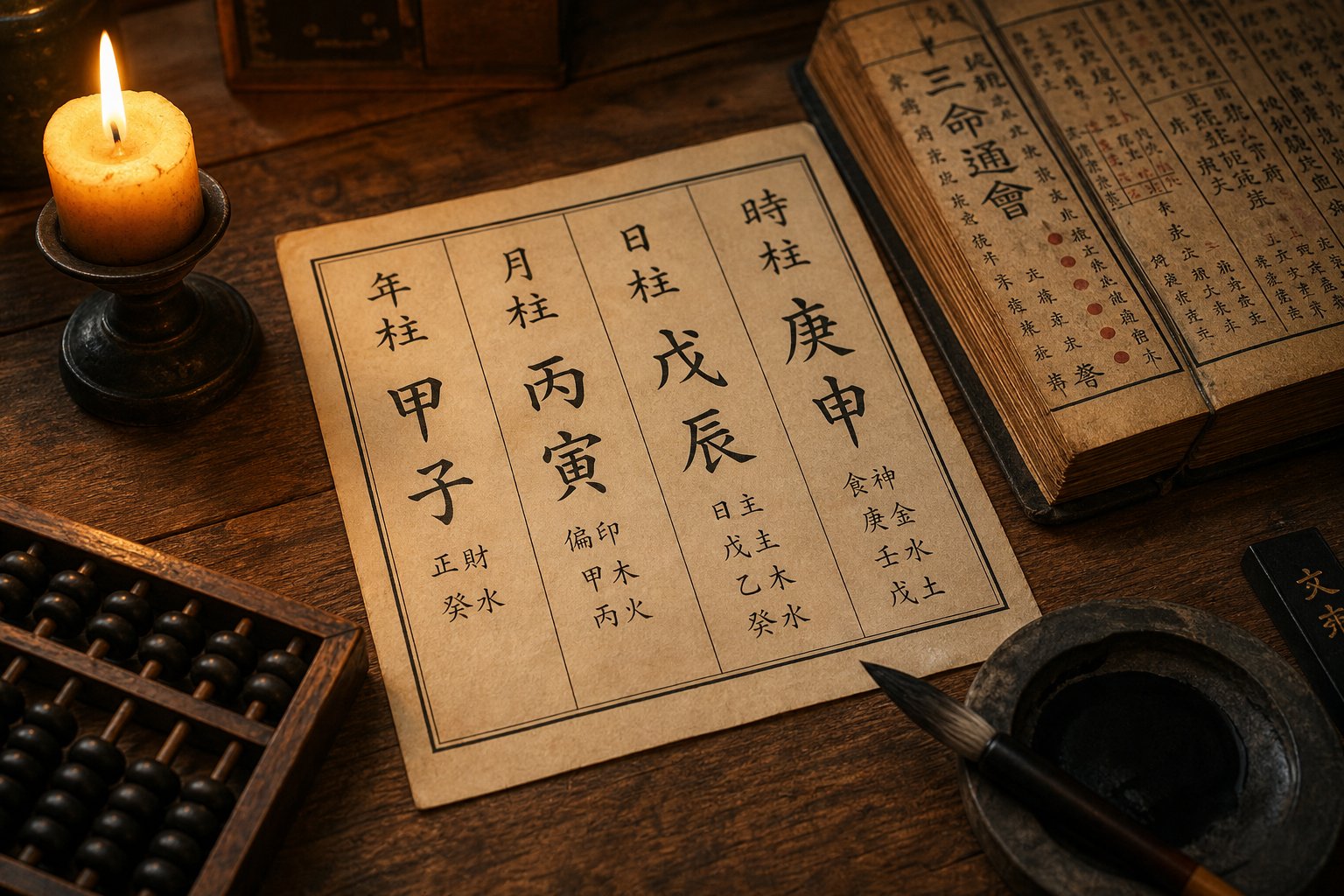
Your BaZi chart is built from four data points: your birth year, month, day, and hour. Each of these becomes a "pillar," and each pillar contains two characters — a Heavenly Stem (天干) on top and an Earthly Branch (地支) on the bottom. Four pillars, two characters each, gives you eight characters total. That's the "Ba" (eight) in BaZi.
Here's what makes this relevant to naming: every single one of those eight characters carries a specific elemental assignment. The ten Heavenly Stems pair up into five elemental groups — Jia and Yi belong to Wood, Bing and Ding to Fire, Wu and Ji to Earth, Geng and Xin to Metal, Ren and Gui to Water. The twelve Earthly Branches follow a similar logic: Yin and Mao are Wood, Si and Wu are Fire, Shen and You are Metal, Hai and Zi are Water, while Chen, Xu, Chou, and Wei belong to Earth.
Each pillar also governs a different dimension of life. The Year Pillar reflects ancestral and environmental influences. The Month Pillar — often considered the most powerful — governs seasonal energy and career potential. The Day Pillar is the center of the chart; its Heavenly Stem is your Daymaster (日主), the element that represents you. The Hour Pillar shapes output, creativity, and later life stages. When someone asks "what is my chinese element," the most precise answer is their Daymaster — the Heavenly Stem of their birth day.
Identifying Your Missing or Weak Element
Sounds complex? The core logic is actually straightforward. Once you have all eight characters plotted, you count how many times each element appears. A chart might show three Wood characters, two Fire, two Earth, one Metal, and zero Water. That imbalance — the missing Water — is exactly what a naming specialist looks for.
Here's the step-by-step process for determining what element am i chinese astrology practitioners use:
- Convert your birth date and time to the traditional Chinese calendar system (based on solar terms, not the lunar calendar alone).
- Map each of the four pillars — year, month, day, and hour — to their corresponding Heavenly Stem and Earthly Branch pair.
- Assign the Five Element value to each of the eight characters, then count the elemental distribution across your full chart.
- Identify your Daymaster — the Heavenly Stem of your Day Pillar — which represents your core elemental identity.
- Determine which element strengthens, supports, or balances your Daymaster given the overall chart dynamics.
That fifth step is where things get nuanced. A chart isn't just about what's missing — it's about what the Daymaster needs. A person with a weak Fire Daymaster surrounded by Water and Metal might need Wood (which generates Fire) rather than more Fire directly. This is why chinese astrology five elements analysis goes deeper than simple counting.
Why the Needed Element Drives Name Selection
The element identified through this process is called the "useful god" (用神, yong shen) — the specific elemental force that, when introduced, restores balance to the entire chart. As experienced BaZi practitioners explain, the favourable element is not a preference or personality trait. It's a precise diagnosis derived from how all eight characters interact.
This is the element that drives every naming decision. If your useful god is Water, your name should contain characters that carry Water energy — through their radical, their meaning, or both. If it's Wood, the naming specialist reaches for characters embodying growth, flexibility, and upward movement. The chinese horoscope 5 elements framework doesn't just tell you what is my chinese zodiac heavenly element — it tells you what elemental medicine your name should deliver every time someone speaks it.
The useful god concept also explains why two children born in the same year can receive completely different elemental prescriptions in their names. Year alone determines only one pillar out of four. The month, day, and hour shift the balance dramatically. A child born in a Fire-heavy summer month at midday has a vastly different elemental profile than one born the same year in a Water-dominant winter night.
Knowing which element you need is only half the equation. The next challenge is practical: which specific Chinese characters actually carry that element's energy? The answer lies in the radical system — the structural building blocks hidden inside every character.
Chinese Character Radicals That Reveal Elemental Identity
Radicals (部首) are the structural DNA of Chinese characters. Every character contains at least one radical — a component that signals its meaning category the way a prefix or root does in English. When you see the three-dot water radical (氵) on the left side of a character, you know that character relates to liquid, flow, or moisture. When you spot the fire radical (火) or its four-dot variant (灬) at the bottom, you're looking at something connected to heat, light, or energy.
For five elements chinese naming, radicals are the most reliable shortcut for identifying which element a character belongs to. A naming specialist scanning for Water-energy characters looks first at the radical. It's the fastest way to sort thousands of potential characters into their elemental categories — and it's the system you can learn to use yourself.
Radical Groups for Each Element
Each element has primary radicals that unmistakably mark a character's elemental identity. The table below maps these radicals to popular naming characters and their meanings — giving you a practical reference for chinese symbols for the elements as they appear in real names.
| Element | Primary Radicals | Example Characters | Meanings |
|---|---|---|---|
| Water (水) | 氵(three-dot water), 水 | 涵, 泽, 清, 澜, 润 | Contain/nourish, grace/blessing, clear/pure, rippling waves, moisten/enrich |
| Wood (木) | 木 (tree), 艹 (grass) | 桐, 芷, 林, 梓, 萱 | Paulownia tree, angelica herb, forest, catalpa tree, daylily |
| Fire (火) | 火 (fire), 灬 (four dots) | 煜, 烨, 炎, 灿, 熙 | Brilliant/radiant, splendid, flame, dazzling, prosperous warmth |
| Earth (土) | 土 (earth), 山 (mountain) | 坤, 岳, 培, 城, 峻 | Earth/receptive feminine, great mountain, cultivate, city/fortress, lofty peak |
| Metal (金) | 金 (gold), 钅(metal radical) | 锦, 铭, 鑫, 钧, 锐 | Brocade/splendid, inscribe/engrave, triple gold/prosperous, weight/gravitas, sharp/keen |
Notice the pattern. Water in chinese (水, shui) transforms into the compact three-dot form 氵 when it sits on the left side of a character — a shorthand called san dian shui (三点水). Similarly, fire in chinese (火, huo) becomes the four-dot base 灬 when it appears at the bottom of characters like 熙 or 烹. Metal in chinese (金, jin) compresses into 钅 on the left side, which is why characters like 铭, 锦, and 银 all carry Metal energy despite looking quite different from the standalone character 金.
The earth symbol in chinese works the same way. The radical 土 appears on the left side of characters like 坤, 培, and 城, immediately flagging them as Earth-element options. The mountain radical 山 also belongs to the Earth category — characters like 岳 (great mountain) and 峻 (lofty, steep) carry grounded, stable energy even though they depict height rather than soil.
Beyond Obvious Characters Like 鑫 森 淼 焱 垚
You might have seen characters that stack the same element multiple times: 鑫 (three gold), 森 (three trees), 淼 (three waters), 焱 (three fires), 垚 (three earths). These are visually dramatic and unmistakably elemental. But experienced naming practitioners rarely reach for them first.
Why? Because these stacked characters are blunt instruments. They deliver maximum elemental intensity but limited semantic richness. A name using 鑫 says "prosperous" and nothing more. Compare that to 铭 (to inscribe, to remember) — which carries Metal energy through its radical while also embedding a meaningful aspiration about leaving a lasting mark. Or consider 锦 (brocade), which brings Metal's precision alongside connotations of beauty and refinement.
The best naming characters do double duty: they satisfy the elemental prescription and carry a layered, poetic meaning. Water in mandarin offers a perfect example. The character 涵 doesn't just contain the water radical — its meaning ("to contain, to nourish, to be inclusive") echoes Water's philosophical quality of depth and receptivity. The character 润 ("to moisten, to enrich") mirrors how water quietly sustains life without force. These characters deliver Water energy through both structure and semantics simultaneously.
Identifying Element Characters on Your Own
You don't need to memorize thousands of characters to work with this system. Here's a practical approach for identifying elemental identity in any character you encounter:
- Check the left-side radical first. Most naming characters place their radical on the left (氵, 钅, 木, 土) or at the bottom (灬, 土). This is your primary elemental signal.
- Look at the top radical for grass-category characters. The grass radical 艹 sits on top and marks Wood-element characters like 芷 (angelica), 萱 (daylily), and 蕊 (pistil).
- Consider meaning when the radical is ambiguous. Some characters carry elemental energy through what they describe rather than their structural radical. The character 晨 (morning, dawn) contains the sun radical 日 — and while 日 isn't a standard Fire radical, the meaning of radiant early light gives it Fire associations in naming contexts.
- Watch for the earth symbol chinese characters that use 山 (mountain). Characters like 岚 (mountain mist) and 嵘 (towering) belong to Earth even though their imagery feels more dramatic than "soil."
This meaning-based classification is where the system gets subtle. A character like 天 (heaven/sky) has no obvious elemental radical, yet some practitioners assign it Fire energy because of its association with the sun and celestial brightness. The character 海 (sea) clearly belongs to Water through both its radical (氵) and its meaning — an easy case. But 雨 (rain)? No water radical, yet undeniably Water in elemental function.
The rule of thumb: radical trumps meaning when both are present. When a character lacks a clear elemental radical, meaning and traditional classification guides the assignment. Experienced practitioners maintain reference lists built over generations for exactly these edge cases.
Knowing which characters belong to which element solves one problem. But a name typically contains two given-name characters side by side — and those characters don't exist in isolation. They interact with each other through the same generating and controlling cycles that govern the five elements themselves. The question becomes: which element pairings create harmony, and which create friction?
Using the Generating Cycle for Harmonious Name Pairs
Two characters sitting side by side in a given name aren't just neighbors — they're in a relationship. And like any relationship, the dynamic between them can be supportive or destructive. The Sheng cycle (相生), also called the generating or producing cycle, describes the order of transformations through which each element nourishes the next. It's the foundational rule for pairing characters that strengthen rather than undermine each other within a single name.
The Generating Cycle Explained
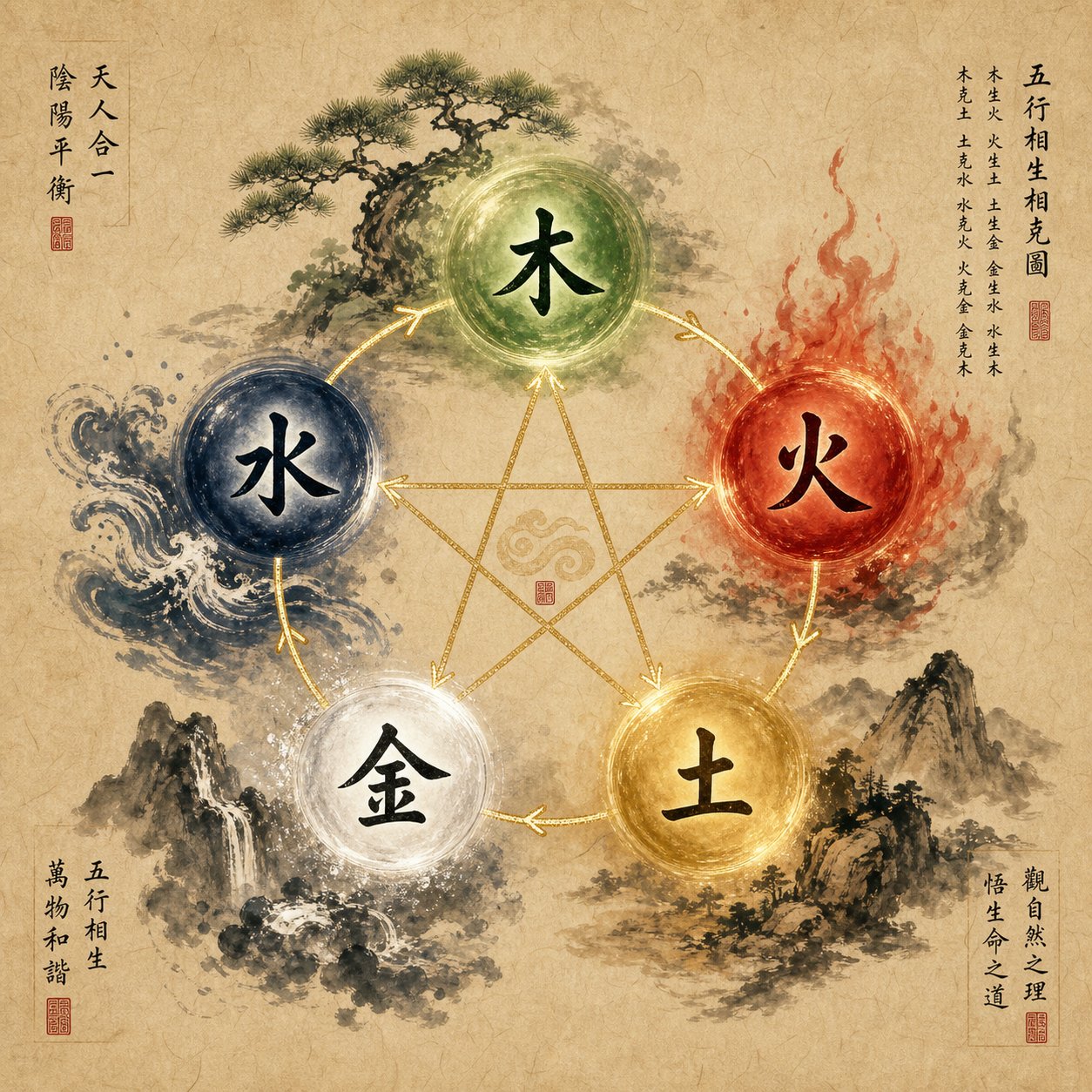
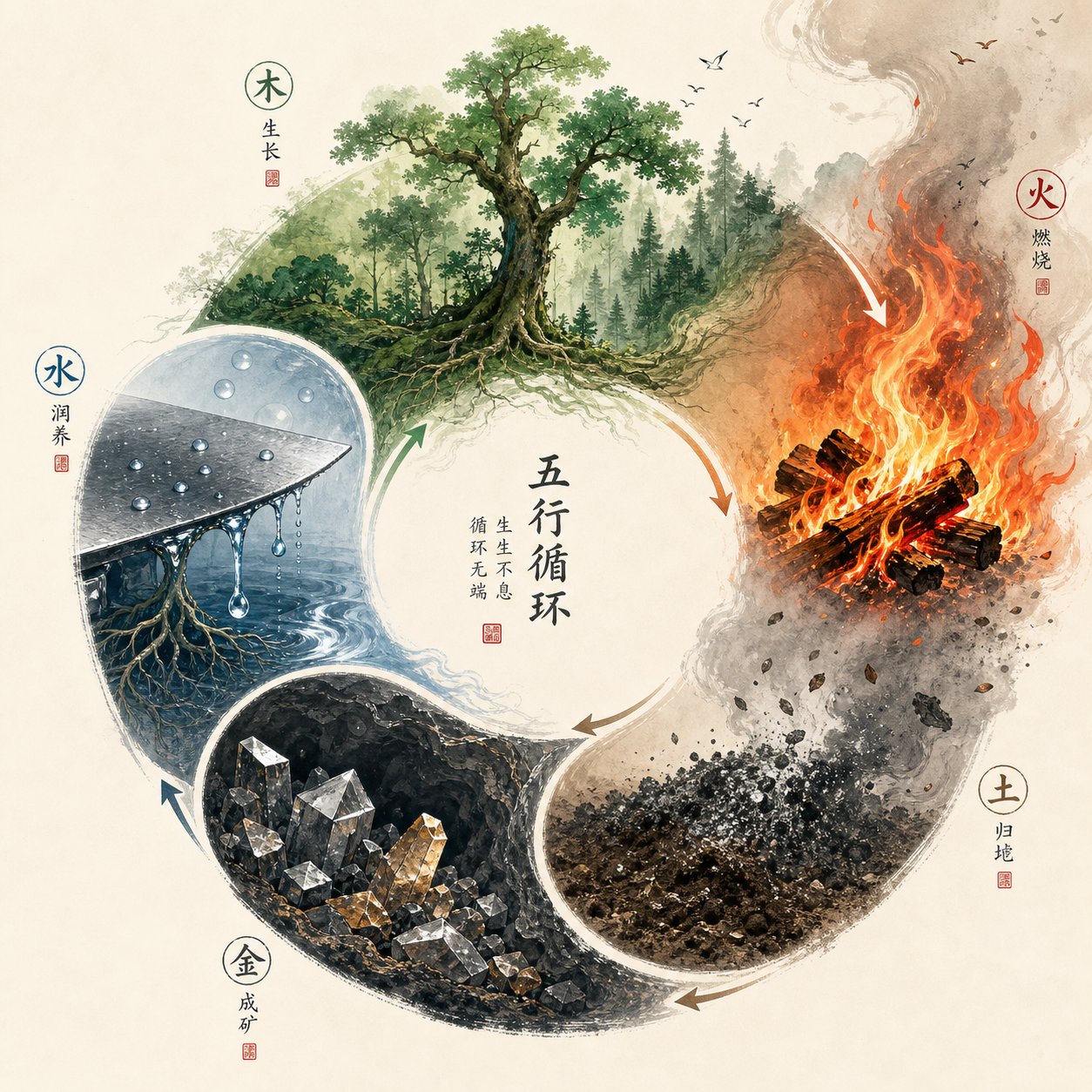
Imagine a continuous loop where each phase of energy creates the conditions for the next to thrive. In wu xing the five elements, this productive sequence flows in one direction:
- Wood feeds Fire — Wood provides fuel, allowing Fire to burn and expand. A log doesn't compete with flame; it enables it.
- Fire creates Earth — Fire burns material into ash, which returns to the soil. Destruction becomes nourishment.
- Earth bears Metal — Over millennia, compressed earth forms metal ores deep within its layers. Patience produces value.
- Metal collects Water — Metal surfaces attract condensation, gathering moisture from thin air. Structure creates flow.
- Water nourishes Wood — Water irrigates roots, allowing trees and plants to grow upward. Depth fuels expansion.
The complete sequence — Wood, Fire, Earth, Metal, Water, and back to Wood — forms an unbroken circle. Each element is both a child (generated by the one before it) and a parent (generating the one after it). This is the core mechanism of five elements theory that governs how wuxing elements interact in any system, including the characters within a person's name.
If you've seen a chinese five elements chart, you'll recognize this as the clockwise arrow connecting all five phases. The cycle never stops. Water doesn't just "end" — it circles back to feed Wood, which feeds Fire again. That perpetual motion is exactly what makes it useful for naming: a name built on the generating cycle carries internal momentum rather than internal friction.
Applying the Sheng Cycle to Two-Character Given Names
Here's where philosophy becomes a naming constraint. In a two-character given name, the first character and second character occupy a sequence — and that sequence can either follow the generating cycle or work against it. When the first character's element naturally produces the second character's element, the name carries a built-in flow of supportive energy. The first character "feeds" the second, creating a sense of forward movement and internal coherence.
Consider a practical scenario. A child's BaZi chart reveals that Fire is their useful god — the element they need most. A naming specialist might select a Wood-element first character like 梓 (catalpa tree) paired with a Fire-element second character like 煜 (brilliant, radiant). Why this order? Because Wood generates Fire. The first character acts as fuel for the second, mirroring the natural productive relationship. The name 梓煜 doesn't just contain the needed Fire element — it generates that Fire through the internal logic of the name itself.
Reverse the order — placing Fire first and Wood second — and the relationship breaks down. Fire doesn't generate Wood; it consumes it. The tao 5 elements framework would read that pairing as energetically backward, like trying to grow a tree by setting it on fire.
This principle gives naming specialists a clear set of ideal pairings for two-character given names. When the first character's element generates the second character's element, the name achieves what practitioners call internal harmony (内和). Here are the productive pairings:
- Wood → Fire: First character carries Wood energy (e.g., 林, 桐, 芷), second character carries Fire energy (e.g., 煜, 烨, 灿). Wood fuels the brilliance of Fire.
- Fire → Earth: First character carries Fire energy (e.g., 炎, 煦, 熙), second character carries Earth energy (e.g., 坤, 培, 城). Fire's transformation creates stable ground.
- Earth → Metal: First character carries Earth energy (e.g., 岳, 培, 峻), second character carries Metal energy (e.g., 铭, 锦, 钧). Earth's patience yields refined strength.
- Metal → Water: First character carries Metal energy (e.g., 鑫, 锐, 铭), second character carries Water energy (e.g., 涵, 泽, 清). Metal's structure gathers flowing depth.
- Water → Wood: First character carries Water energy (e.g., 涵, 润, 澜), second character carries Wood energy (e.g., 林, 梓, 萱). Water's nourishment enables upward growth.
The name Li Jinze (李金泽) from traditional naming analysis illustrates this perfectly. Jin (金) is Metal. Ze (泽) contains the water radical and represents Water. Metal generates Water in the Sheng cycle — so the given name carries a natural productive flow from first character to second. The elemental relationship isn't accidental; it's engineered.
What about names where both characters share the same element? A double-Water name like 涵清 or a double-Wood name like 林萱 doesn't violate the generating cycle — but it also doesn't activate it. Same-element pairings reinforce a single energy without creating internal movement. Practitioners sometimes use this approach when a chart desperately needs one element in concentrated form, but the generating pairing is generally preferred for its dynamic quality.
The generating cycle tells you which pairings create flow. But it raises an equally important question: which pairings create conflict? The controlling cycle — the Sheng cycle's counterpart — defines exactly which element combinations to avoid placing side by side in a name.
The Controlling Cycle and Element Conflicts to Avoid
The generating cycle shows you which pairings build momentum. The controlling cycle (相克, Ke) shows you which pairings tear it apart. In the taoist 5 elements framework, every element has one element it dominates and one that dominates it — a system of checks and balances that prevents any single phase from growing unchecked. This is healthy in nature. In a name, however, placing two elements locked in a controlling relationship side by side creates internal tension rather than harmony.
The Controlling Cycle and Name Conflicts
The Ke cycle follows a specific sequence: Wood parts Earth (roots break soil apart), Earth dams Water (soil absorbs and blocks flow), Water extinguishes Fire (obvious and absolute), Fire melts Metal (heat overcomes structure), and Metal chops Wood (an axe fells a tree). Each relationship describes one element actively suppressing another — not gently, but forcefully.
In the Five Element System, the controlling cycle represents relationships that prevent any given element from becoming overwhelming. Think of it as a legislative checks-and-balances system. In nature and medicine, this control is beneficial — it maintains equilibrium. But within the compact space of a two-character given name, a controlling relationship reads differently. Instead of balance, it suggests one part of your identity constantly suppressing another.
Imagine naming a child with a Metal-radical first character like 锐 (sharp, keen) followed by a Wood-radical second character like 林 (forest). Metal chops Wood. The name's internal logic suggests the first character is actively destroying the second — cutting down the very growth the name is supposed to nurture. That's not harmony. That's a name at war with itself.
If you already know your chinese zodiac element — say you've identified as Wood through your birth year — understanding the 五行 相生相克 (generating and controlling cycles) reveals why certain element combinations feel uncomfortable. A Wood person surrounded by Metal energy isn't just "different" — they're being actively constrained. The same dynamic plays out within wu xing elements when they sit together in a name.
Element Pairings to Avoid in Given Names
The table below maps each controlling pair, explains the nature of the conflict, and shows why it matters when two characters share space in a name.
| Controlling Element | Controlled Element | Nature of Conflict | Naming Implication |
|---|---|---|---|
| Metal (金) | Wood (木) | Metal chops Wood — axe fells tree | First character suppresses growth energy of second; suggests cutting short potential |
| Wood (木) | Earth (土) | Wood parts Earth — roots break soil | Creates instability; the grounding quality of Earth is disrupted by Wood's expansion |
| Earth (土) | Water (水) | Earth dams Water — soil blocks flow | Water's wisdom and adaptability are trapped; suggests stagnation rather than depth |
| Water (水) | Fire (火) | Water extinguishes Fire — complete suppression | Fire's brilliance and passion are snuffed out; the name undermines its own radiance |
| Fire (火) | Metal (金) | Fire melts Metal — heat destroys structure | Metal's precision and resilience are dissolved; suggests loss of clarity and form |
Consider the chinese zodiac elements wood vs earth dynamic. A name pairing a Wood-radical character with an Earth-radical character places them in direct conflict — Wood's roots literally break Earth apart. A child whose chart needs both elements would be better served by inserting Fire between them (Wood generates Fire, Fire generates Earth), using the generating cycle as a bridge rather than forcing two conflicting elements into direct contact.
The metal wuxing relationship with Wood is particularly relevant because Metal-element surnames are common (金 Jin, 钱 Qian) and Wood-element given names are popular for their associations with growth and vitality. Pairing them without awareness of the controlling dynamic means the surname is energetically "chopping" the given name every time it's spoken. Similarly, understanding metal in chinese astrology helps explain why someone with strong Metal in their birth chart might feel friction with Wood-dominant names — the elements are working against each other rather than together.
The wood wuxing relationship with Earth creates a subtler but equally problematic tension. Parents who want their child's name to feel both grounded (Earth) and growth-oriented (Wood) might instinctively pair these elements — not realizing that in the Ke cycle, Wood destabilizes Earth rather than complementing it.
Does this mean you can never use elements that exist in a controlling relationship? Not exactly. The key distinction is position and context. When a controlling element appears in the surname (which is fixed and inherited) and the controlled element appears in the given name, the tension is harder to avoid. But when both elements appear in the broader chart and only one enters the name, the conflict doesn't activate within the name itself. The rule is simple: avoid placing two characters whose elements form a Ke pair directly adjacent in the given name.
This raises a question that most people overlook entirely. Your surname isn't something you choose — it's inherited. And every surname carries its own elemental identity. If your surname is Metal and you need Wood in your given name, you're walking straight into a controlling relationship. How do you navigate that constraint? The answer depends on understanding exactly which element your surname belongs to — and how that fixed element shapes every given-name decision that follows.
How Your Surname Element Shapes Given Name Choices
Your given name is negotiable. Your surname is not. It's inherited, fixed at birth, and — crucially — it carries its own elemental identity that interacts with every character placed after it. When you set out to find your chinese name or select one for a child, the surname isn't just a family label. It's the first elemental variable in the equation, and it constrains everything that follows.
How to Classify Your Surname by Element
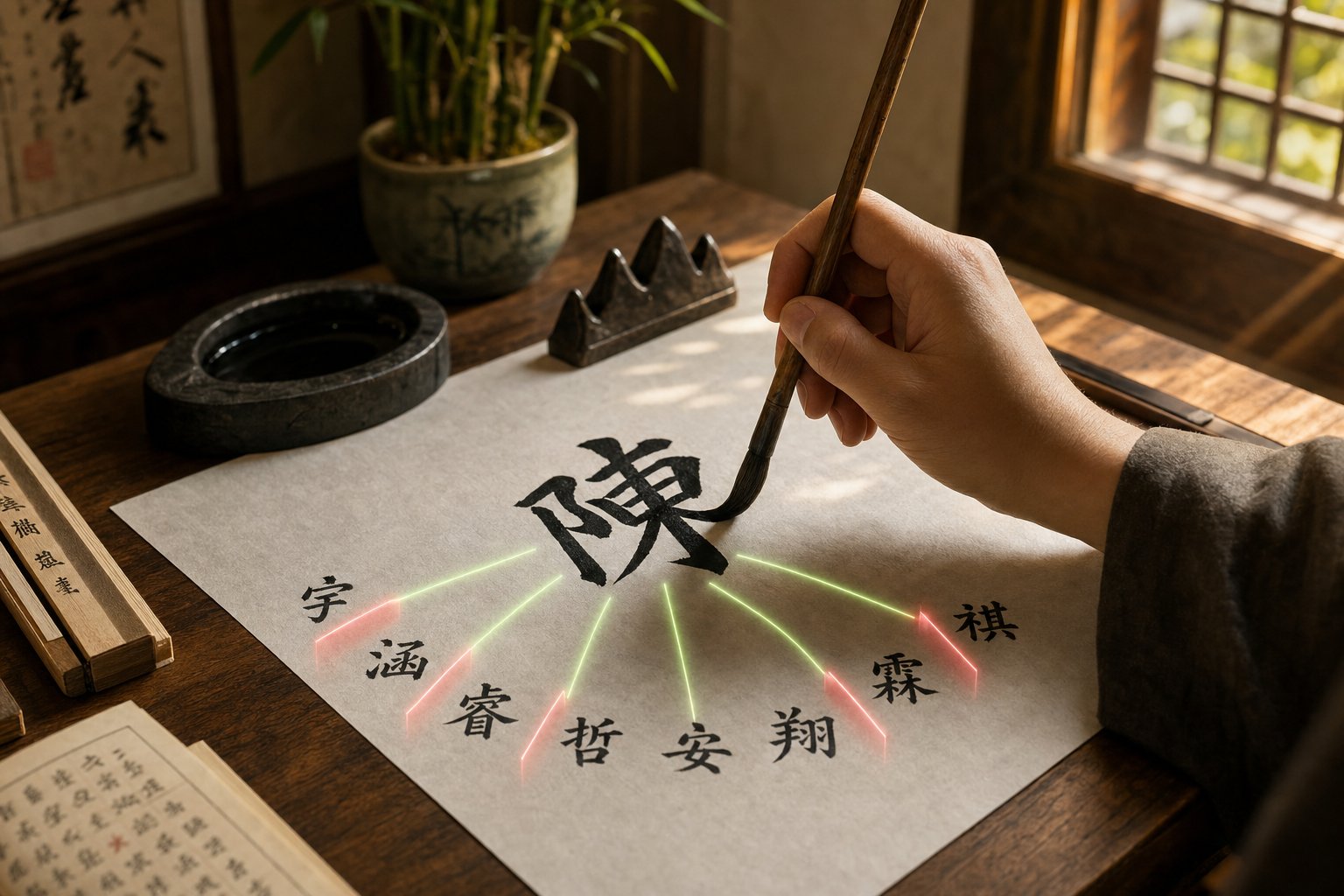
Every Chinese surname belongs to one of the five elemental categories, classified by its primary radical or semantic association under classical doctrine. The surname 林 (Lin) contains the wood radical 木 — it's Wood. The surname 金 (Jin) literally means "gold" — it's Metal. The surname 江 (Jiang) carries the water radical 氵 — it's Water. Some classifications are less obvious: 王 (Wang, meaning "king") belongs to Earth, and 張 (Zhang) is classified under Fire.
Why does this matter at scale? According to classical surname reference data, approximately 85% of all ethnic Chinese share the top 100 surnames — and every one of those surnames falls into a defined elemental category. That means the vast majority of people looking to find out your chinese name's elemental dynamics can start by identifying which of the five groups their surname belongs to.
Here are common surnames grouped by element:
- Wood (木): 李 Li, 楊 Yang, 林 Lin, 梁 Liang, 蔡 Cai, 蘇 Su, 葉 Ye, 杜 Du, 高 Gao, 何 He
- Fire (火): 張 Zhang, 趙 Zhao, 馬 Ma, 羅 Luo, 鄭 Zheng, 唐 Tang, 丁 Ding, 夏 Xia, 熊 Xiong
- Earth (土): 王 Wang, 陳 Chen, 黃 Huang, 胡 Hu, 田 Tian, 姚 Yao, 崔 Cui, 龍 Long, 方 Fang
- Metal (金): 劉 Liu, 周 Zhou, 徐 Xu, 孫 Sun, 謝 Xie, 宋 Song, 金 Jin, 錢 Qian, 石 Shi
- Water (水): 馮 Feng, 潘 Pan, 江 Jiang, 汪 Wang, 孟 Meng, 洪 Hong, 湯 Tang, 雷 Lei
Surname-Given Name Element Interactions
The surname sits at the front of every Chinese name. It's the first element spoken, the first energy activated. Whatever element your surname carries, it forms either a generating or controlling relationship with the given-name characters that follow.
Take the Wood-element surname 林 (Lin). Through the generating cycle, Wood feeds Fire and is nourished by Water. That means Water-element given names (like 涵 or 泽) support the surname — Water nourishes Wood, creating a harmonious flow from given name back into surname. Fire-element given names (like 煜 or 烨) receive energy from the surname — Wood generates Fire, so the surname "feeds" the given name forward. Both directions work.
But pair 林 with a Metal-element given name like 锐 (sharp) or 铭 (inscribe), and you've activated the controlling cycle. Metal chops Wood. The given name's elemental energy is actively suppressing the surname's energy every time the full name is spoken. That internal conflict is exactly what practitioners aim to avoid.
The same logic applies to every surname. If your chinese name starts with a Metal-element surname like 劉 (Liu) or 金 (Jin), pairing it with Fire-element given names creates tension — Fire melts Metal. A Water-element surname like 江 (Jiang) conflicts with Earth-element given names — Earth dams Water. The pattern is consistent: controlling relationships between surname and given name introduce friction that the generating cycle would resolve.
What if your BaZi chart says you need an element that conflicts with your surname? This is where skilled practitioners earn their reputation. The solution often involves using the generating cycle as a bridge — inserting an intermediary element in the first given-name character that connects the surname's element to the needed element without triggering a direct Ke relationship. A Metal surname needing Wood energy might use a Water-element first character (Metal generates Water) followed by a Wood-element second character (Water generates Wood), creating a smooth chain: Metal → Water → Wood.
Your surname is the one piece of the naming puzzle you cannot change. But understanding what is your chinese name's elemental starting point transforms it from a constraint into a guide — the fixed star around which every other naming decision orbits.
Element, however, is only one dimension of a well-crafted name. A character might satisfy the elemental prescription perfectly yet sound awkward when spoken aloud, or look visually unbalanced when written. The real art of naming lies in satisfying all dimensions simultaneously — element, sound, meaning, and form — within a single two-character space.
Combining Element, Sound, Meaning, and Form in One Name
A character that delivers the perfect elemental prescription can still fail as a name. Maybe it shares a tone with the surname, creating a flat, monotone sound when spoken aloud. Maybe its stroke count is so dense that it looks like an inkblot next to a simple three-stroke surname. Maybe its meaning, while technically positive, carries an outdated or obscure connotation that no modern Chinese speaker would recognize. This is why five elements chinese naming is never a one-dimensional exercise — it's a four-dimensional puzzle where every piece must fit simultaneously.
If you've ever wondered how to find my chinese name or what would be my chinese name, the answer isn't a single lookup. It's a process of elimination across four filters, where a candidate character must survive all four to earn its place.
Balancing Element with Tone and Sound
Mandarin has four tones — high level (first), rising (second), falling-rising (third), and falling (fourth). A full name of two or three characters creates a tonal sequence, and that sequence either flows naturally or stumbles. The rule practitioners follow: avoid placing all characters in the same tone. A name where every syllable sits at the same pitch sounds flat and lifeless, like a song played on one note.
Imagine you need a Fire-element character for the second position in a given name. You've identified three candidates from your list of chinese names meaning fire: 煜 (Yu, fourth tone — "brilliant"), 烨 (Ye, fourth tone — "splendid"), and 灿 (Can, fourth tone — "dazzling"). All three are fourth tone. If your surname is also fourth tone — say 赵 (Zhao, fourth tone) — then every candidate creates a tonal collision. You'd need to search further for a Fire character in a different tone, like 熙 (Xi, first tone — "prosperous warmth") or 炎 (Yan, second tone — "flame").
Beyond tone, practitioners check for homophones. A name that sounds identical to a common word with negative connotations — illness, loss, death — is immediately disqualified regardless of how well it satisfies the other three dimensions. The four-dimensional naming framework treats sound as a non-negotiable gate: if the name doesn't pass the "introduce yourself across a crowded room" test, it doesn't move forward.
Visual Stroke Balance and Character Aesthetics
Chinese characters aren't abstract letters — they're visual compositions that occupy square space. Each character has a stroke count, and the relationship between stroke counts across a full name creates a visual rhythm. A one-stroke surname like 一 paired with a twenty-three-stroke given name character creates a lopsided visual signature. The name looks unbalanced on paper, on business cards, and especially in calligraphy.
The principle is proportion, not uniformity. A surname with moderate complexity (seven to ten strokes, like 陈 or 张) pairs comfortably with given-name characters in a similar range. A simple surname (three to five strokes, like 丁 or 王) can accommodate slightly more complex given names without visual strain. What practitioners avoid is extreme disparity — pairing the simplest possible characters with the densest, or stacking three equally complex characters that become an unreadable wall of strokes.
This matters practically. In today's professional environments, your name appears on digital documents, company seals, and international business cards. A name with strong calligraphic presence communicates thoughtful self-presentation — something that holds whether you're signing a contract in Shanghai or introducing yourself at a global conference.
A Worked Example Combining All Dimensions
Let's walk through how a practitioner actually evaluates candidates. Imagine a child surnamed 李 (Li, third tone, Wood element, seven strokes). Their BaZi chart identifies Water as the useful god, with Metal as a supportive secondary element. The task: find a two-character given name that delivers Metal-generating-Water energy while sounding melodic, looking balanced, and carrying meaningful aspirations.
The practitioner starts with the elemental constraint: first character should be Metal (to connect with the Wood surname via the generating bridge Metal → Water), second character should be Water (the needed element). Candidate pair: 铭 (Ming, second tone, Metal, "to inscribe") + 泽 (Ze, second tone, Water, "grace/blessing").
Checking the four dimensions:
- Element: Metal generates Water — productive cycle active. Water also nourishes the Wood surname, creating a full chain: Wood (surname) ← Water ← Metal. Passes.
- Sound: Li (third tone) → Ming (second tone) → Ze (second tone). Two consecutive second tones in the given name create slight monotony. Not ideal — the practitioner notes this as a weakness.
- Meaning: "Inscribe grace" or "engrave blessings" — a child who leaves lasting marks of kindness. Strong literary resonance. Passes.
- Form: 李 (seven strokes) + 铭 (eleven strokes) + 泽 (eight strokes). Moderate progression — visually balanced without extreme density. Passes.
The tonal issue prompts a second candidate. Replace 铭 with 锦 (Jin, third tone, Metal, "brocade/splendid"): Li (third) → Jin (third) → Ze (second). Two consecutive third tones — worse. Try 钧 (Jun, first tone, Metal, "gravitas"): Li (third) → Jun (first) → Ze (second). Three different tones, rising melodic contour. All four dimensions satisfied.
The final name: 李钧泽 (Li Junze). Metal generates Water. Tones cascade from falling-rising to high-level to rising. Stroke counts progress 7-9-8, visually even. Meaning: "gravitas and grace" — a person of substance whose influence flows outward like water.
A Chinese name is a poem written in four languages at once — sound, image, meaning, and energy. All four must rhyme.
This is why whats my chinese name can never be answered by a translation tool or a single-dimension lookup. Tools that only transliterate English sounds into Chinese characters operate on one axis while ignoring three others entirely. A name that genuinely works — one you'd be proud to introduce yourself with in Beijing or Taipei — requires all four dimensions resolved in concert. Whether you want to find my chinese name for professional use or get my chinese name for personal identity, the process demands this multi-layered evaluation.
The four-dimensional framework represents the craft at its most rigorous. But how do real families actually apply it today? The spectrum ranges from parents who consult professional naming masters for weeks-long deliberations to those who use mobile apps for quick elemental checks — and both approaches reflect a living tradition that continues to evolve.
How Modern Families Practice Five Elements Naming Today
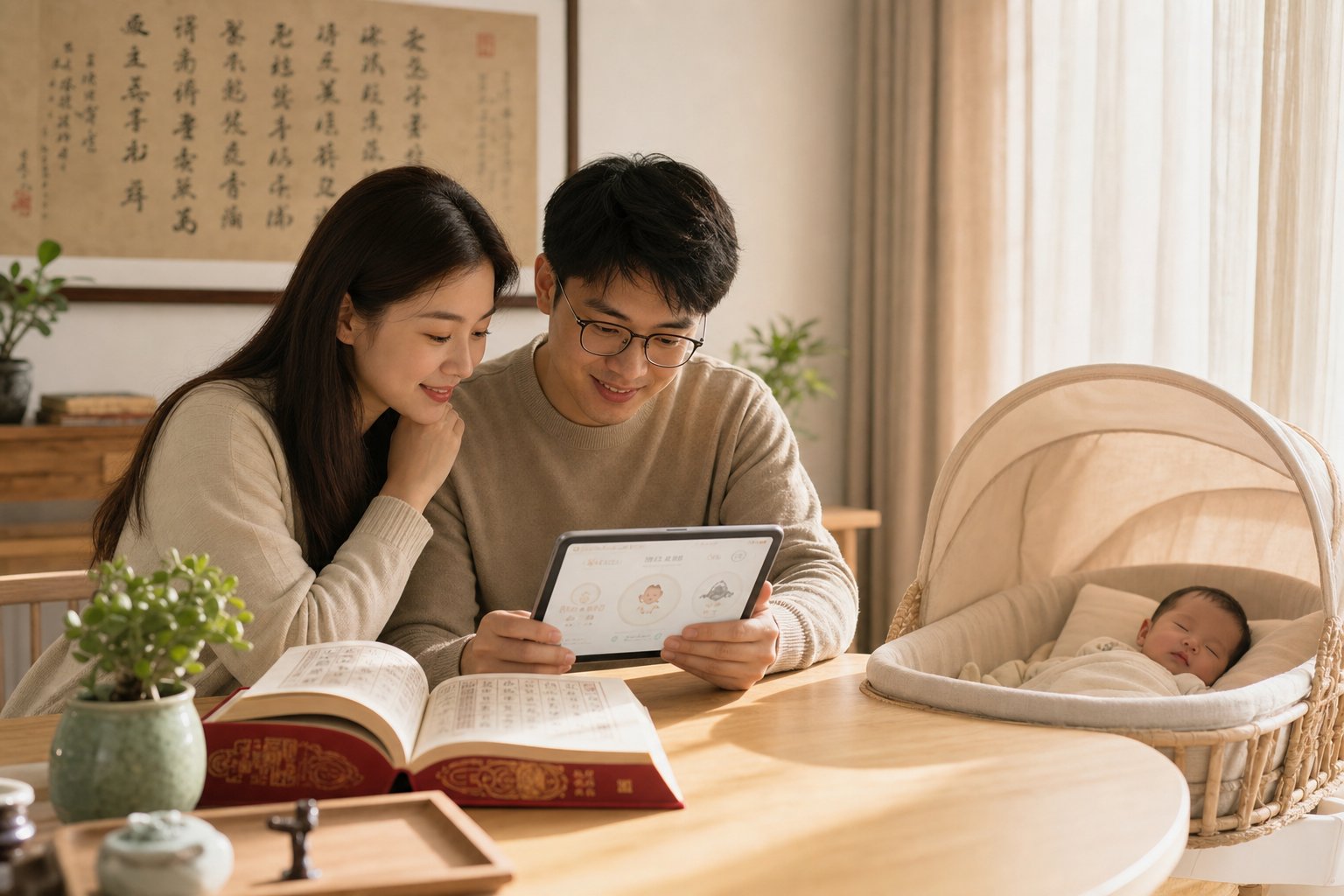
Five elements chinese naming isn't a museum artifact. It's a living practice that millions of families engage with every year — though the way they engage looks dramatically different from household to household. Some parents spend weeks consulting professional naming masters who hand-calculate BaZi charts and cross-reference classical texts. Others open a mobile app, enter a birth date, and browse algorithmically generated suggestions over lunch. Both approaches draw from the same philosophical root, but the depth of application varies as widely as the families themselves.
Traditional Practitioners vs Modern Parents
At one end of the spectrum, traditional naming masters still operate much as they have for centuries. A family brings the child's exact birth date and time, the master calculates the Four Pillars by hand or with specialized software, identifies the useful god element, and then spends days — sometimes weeks — selecting candidate characters that satisfy elemental balance, tonal harmony, stroke-count aesthetics, and semantic meaning simultaneously. These consultations often involve multiple rounds of revision, with the master presenting three to five name options and explaining the reasoning behind each.
This approach remains common in regions with strong cultural continuity — particularly in southern China, Taiwan, Hong Kong, and among overseas Chinese communities in Southeast Asia. Families who follow this path typically view the name as a serious investment in the child's future, not unlike choosing the right school or neighborhood. The consultation fee reflects that seriousness, ranging from modest to substantial depending on the master's reputation.
At the other end, a growing number of urban parents treat the chinese five elements as one input among many rather than the governing framework. They might check whether a favorite name happens to align with their child's elemental needs — and feel reassured if it does — without letting elemental balance override a character they love for its sound or literary associations. For these families, the 5 elements chinese zodiac connection provides a cultural anchor rather than a strict prescription.
As Global Times reporting on contemporary naming trends illustrates, post-1990 generation parents increasingly draw inspiration from classical Chinese poetry and philosophy when naming children. A mother in Chengdu named her daughter "Chirou" after a line from the Tao Te Ching about the quiet power of softness — a choice driven by literary meaning and personal philosophy rather than strict BaZi calculation, yet still deeply rooted in traditional Chinese thought.
When Five Elements Naming Meets Contemporary Culture
Several forces have reshaped how families approach this tradition:
Urbanization concentrated populations in cities where traditional naming masters are less accessible than in ancestral villages. Globalization created demand for names that work across languages — a child named 泽熙 (Zexi) needs that name to feel natural in Mandarin while also being pronounceable for English-speaking classmates and teachers. Digital technology democratized access to BaZi calculation, putting what once required years of specialized training into anyone's pocket.
The result is a spectrum of modern approaches, ranging from full traditional engagement to casual elemental awareness:
- Full traditional consultation: Parents hire a professional naming master who calculates the complete BaZi chart, identifies the useful god, and crafts names satisfying all four dimensions (element, sound, meaning, form). Multiple revision rounds are standard.
- Guided digital tools: Parents use AI-powered naming platforms or apps that calculate the five elements chinese distribution from birth data and suggest character combinations. As BaZi naming guides note, AI handles the initial analysis while parents make the final selection based on personal taste and family context.
- Element-aware selection: Parents choose a name they love for its meaning and sound, then verify it doesn't conflict with their child's elemental profile. Think of it as a compatibility check rather than a design constraint — similar to how someone might check a wedding date against the Chinese almanac without planning the entire ceremony around it.
- Cultural-literary approach: Parents draw from classical texts, poetry, and historical allusions — choosing names like "Yanzhou" (inkstone and boat, from a Song Dynasty poem) or "Jincheng" (splendid prospects, from a four-character idiom) — where elemental considerations are secondary to literary resonance and cultural identity.
- Hybrid international naming: Parents select a Chinese name with elemental awareness and pair it with an English or international name that echoes similar qualities. A child needing Water energy might receive both a Water-radical Chinese name and an English name associated with calmness or depth.
None of these approaches is more "correct" than another. The chinese 5 elements framework has always adapted to its era. During periods of political upheaval, names reflected patriotic aspirations — characters like "建国" (build the nation) and "爱民" (love the people) dominated regardless of elemental considerations. In the 1980s, names favored strength and ambition. The 1990s brought romanticized, poetic characters influenced by Hong Kong and Taiwanese media. Today's revival of classical naming — where parents research ancient texts and consider five elements of the chinese zodiac alongside literary meaning — represents the latest evolution, not a return to some fixed original form.
What's striking about the current moment is that tradition and technology aren't competing — they're converging. A parent might use an app to run a chinese elements wood fire earth test on their child's birth chart, then bring those results to a grandmother or family elder for character suggestions that honor generational naming rules. Or they might consult a professional master who uses digital databases to cross-reference thousands of characters far faster than hand-searching classical dictionaries allowed.
The practical advice for anyone exploring this tradition: match your approach to your values. If elemental balance feels philosophically important to your family, invest in a thorough BaZi analysis — whether through a traditional practitioner or a well-designed digital tool. If you're drawn to the cultural richness of 5 chinese elements naming but don't want it to override personal preference, use it as a filter rather than a formula. Check that your chosen name doesn't place conflicting elements in direct tension, verify the surname-given name relationship follows a productive rather than destructive cycle, and let that confirmation give you confidence in a name you already love.
Either way, you're participating in a tradition that has shaped Chinese identity for over two thousand years — one that continues to evolve precisely because it was never rigid to begin with. The five phases move. That's the whole point.
Frequently Asked Questions About Five Elements Chinese Naming
1. How do I find out which Chinese element I am based on my birth date?
Your core Chinese element is determined by your Daymaster — the Heavenly Stem of your Day Pillar in the BaZi (Four Pillars) birth chart. To calculate it, convert your exact birth date and time into the traditional Chinese calendar system, map each of the four pillars (year, month, day, hour) to their Heavenly Stem and Earthly Branch pairs, then identify the Heavenly Stem of your Day Pillar. This single character reveals whether your fundamental elemental identity is Wood, Fire, Earth, Metal, or Water. Note that your birth year zodiac animal only accounts for one pillar out of four, so it gives an incomplete picture of your full elemental profile.
2. What is the difference between the Chinese five elements and the Western four elements?
The Chinese Wu Xing system comprises Wood, Fire, Earth, Metal, and Water as dynamic, transformative phases that continuously generate and control one another in cyclical relationships. The Western system uses Earth, Air, Fire, and Water as static material building blocks. The key philosophical difference is that Wu Xing asks 'what is something becoming?' while the Greek tradition asks 'what is something made of?' This distinction matters for naming because Chinese elemental characters aren't fixed labels — they represent trajectories of energy meant to guide a person toward balance throughout life.
3. Can I use five elements naming if my surname conflicts with the element I need?
Yes, skilled practitioners handle surname-element conflicts by using the generating cycle as a bridge. For example, if your surname is Metal (like Jin or Liu) and your chart needs Wood — a controlling relationship where Metal chops Wood — the solution is to insert a Water-element first given-name character between them. Metal generates Water, and Water generates Wood, creating a smooth productive chain (Metal to Water to Wood) that avoids direct conflict. The intermediary element transforms a destructive pairing into a harmonious sequence.
4. Do modern Chinese families still use five elements when naming children?
Absolutely, though the depth of practice varies widely. Some families hire traditional naming masters for weeks-long consultations involving full BaZi analysis and multi-round character selection. Others use AI-powered naming apps that calculate elemental balance from birth data and suggest character combinations. A growing number of urban parents treat elemental balance as one factor among many — verifying that a name they already love doesn't create elemental conflicts rather than building the entire name around the prescription. All these approaches reflect a living tradition that adapts to contemporary life.
5. How do Chinese character radicals indicate which element a name character belongs to?
Radicals are structural components within Chinese characters that signal meaning categories. Each element has primary radicals that mark elemental identity: Water uses the three-dot radical (氵), Wood uses the tree radical (木) or grass radical (艹), Fire uses the fire radical (火) or four-dot base (灬), Earth uses the soil radical (土) or mountain radical (山), and Metal uses the gold radical (金) or its compressed form (钅). When selecting naming characters, practitioners check the radical first as the most reliable elemental indicator. Characters without obvious elemental radicals are classified by their semantic meaning or traditional reference lists.