What the Four Pillars of Destiny Reveal About Choosing a Name
When a child is born in a traditional Chinese family, the first question is rarely about weight or length. It is: "What hour was the baby born?" That single detail unlocks an elemental map of the child's nature, and it is the starting point for one of the most systematic naming methods in existence.
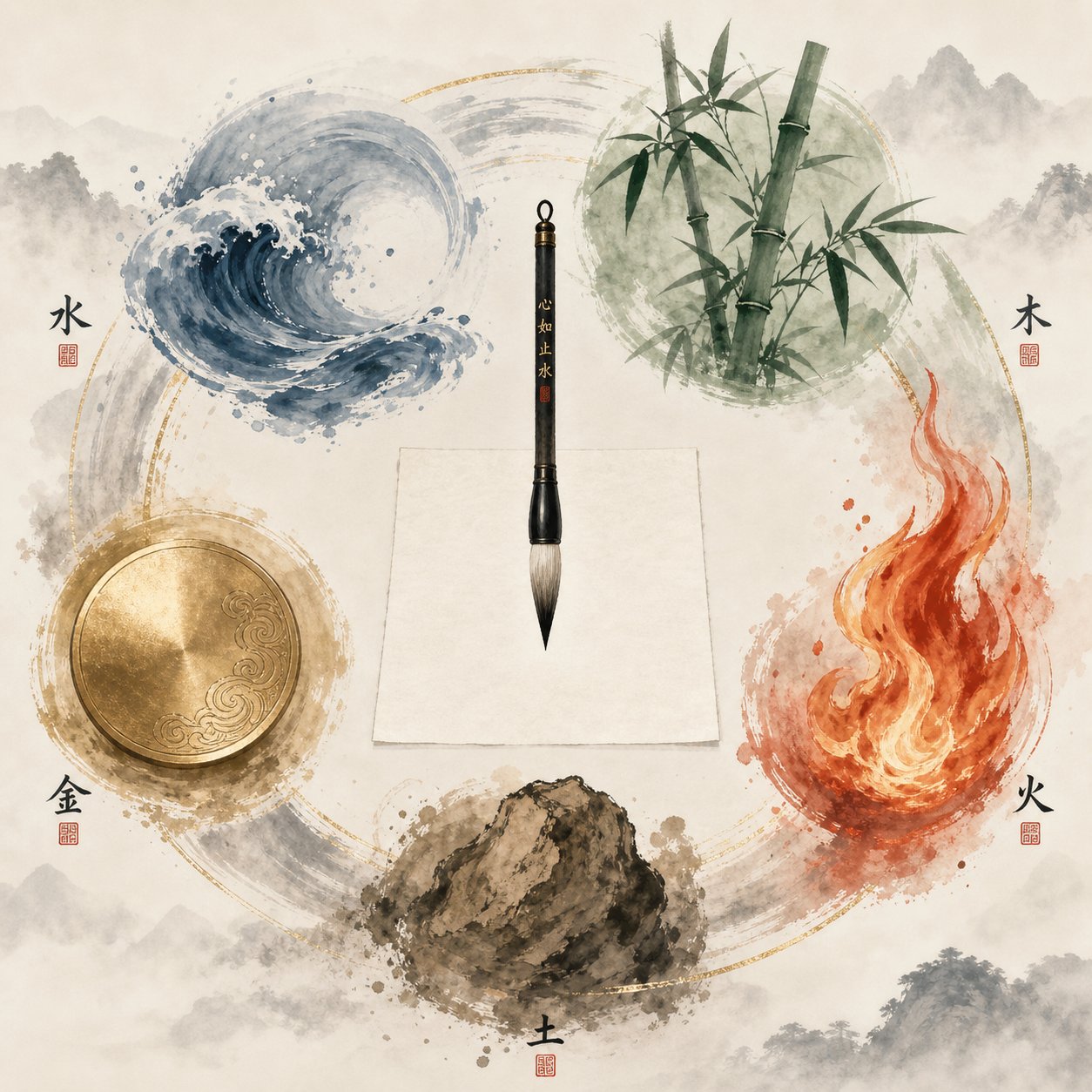
This method is rooted in BaZi (八字), also known as the Four Pillars of Destiny. Unlike generic baby-naming guides that focus on trends, meanings, or phonetics alone, four pillars of destiny name selection uses a person's birth chart as a diagnostic tool. The chart reveals which of the Five Elements (Wood, Fire, Earth, Metal, Water) are strong, weak, or absent, and the name is then crafted to restore balance.
What Is BaZi Name Selection
So what is BaZi in practical terms? It is a calendar-based calculation system, first systematized during the Tang Dynasty and refined by Song Dynasty master Xu Ziping. BaZi takes four units of time (birth year, month, day, and hour) and converts each into a pair of characters from the Heavenly Stems and Earthly Branches. Four pairs equal eight characters, hence the name "Eight Characters" (八字). Chinese astrology four pillars of destiny analysis reads these characters to map your elemental composition.
BaZi name selection applies this map directly to character choice. Rather than picking a name because it "sounds nice" or ranks well on a popularity list, practitioners identify which elemental energies the chart needs and select characters that carry those specific energies. The process is diagnostic first, creative second.
Why Birth Chart Analysis Matters for Naming
Four pillars astrology treats each person's elemental makeup as unique. Two children born a day apart can have entirely different charts requiring opposite naming strategies. One may need Water energy for cooling and depth; the other may need Fire for warmth and drive. This is why a one-size-fits-all approach to naming falls short.
A name should compensate for elemental imbalances revealed in the Four Pillars chart, not simply reflect parental preference or cultural trend.
The gap most English-language resources leave open is the bridge between reading a BaZi chart and actually selecting name characters based on that reading. You'll find plenty of guides explaining the 4 pillars of destiny in theory, but very few that walk you from chart analysis to actionable character selection. That connection is exactly what this guide provides, starting with the structural anatomy of the BaZi four pillars of destiny chart itself.
Understanding the Four Pillars and Their Elemental Structure
A BaZi chart looks deceptively simple: four columns, two characters each, eight characters total. But each column, or pillar, encodes a specific dimension of your life. When you understand what each pillar governs, you can see exactly why certain characters belong in a name and others do not.
The four destiny pillars are derived from the year, month, day, and hour of birth. Each pillar consists of one Heavenly Stem on top and one Earthly Branch below. Together, these eight characters form the complete elemental fingerprint used in four pillars Chinese astrology to guide decisions ranging from career timing to, yes, name selection.
The Ten Heavenly Stems and Twelve Earthly Branches
Every pillar in a BaZi chart is built from two interlocking systems. The Ten Heavenly Stems represent celestial energy and cycle through five elemental pairs:
- Jia and Yi — Wood (Yang and Yin)
- Bing and Ding — Fire (Yang and Yin)
- Wu and Ji — Earth (Yang and Yin)
- Geng and Xin — Metal (Yang and Yin)
- Ren and Gui — Water (Yang and Yin)
The Twelve Earthly Branches represent terrestrial energy and correspond to the familiar Chinese zodiac animals (Zi-Rat through Hai-Pig). Their elemental assignments follow seasonal logic: Yin and Mao belong to Wood (spring), Si and Wu to Fire (summer), Shen and You to Metal (autumn), Hai and Zi to Water (winter), while Chen, Xu, Chou, and Wei belong to Earth as transitional periods between seasons.
When a Yang Stem pairs with a Yang Branch (or Yin with Yin), they form one of sixty possible combinations known as the Sixty Jiazi Cycle. This is the engine behind the chinese zodiac four pillars system. Your birth data simply locates four specific combinations within this cycle, one for each pillar.
How Each Pillar Influences Name Decisions
Here is where most guides stop at theory. For naming purposes, each pillar does not carry equal weight, and each governs a distinct life domain. Understanding these domains tells you which elemental gaps matter most for a name's intended purpose.
| Pillar | Life Domain | Age Period | Naming Relevance |
|---|---|---|---|
| Year Pillar (年柱) | Ancestry, social image, family heritage | 0–15 | Reflects public perception; elemental tone sets how the name is received socially |
| Month Pillar (月柱) | Career, parents, innate personality | 15–30 | Most influential pillar; determines seasonal strength of the Day Master |
| Day Pillar (日柱) | Self, spouse, inner nature | 30–45 | Contains the Day Master (core identity); primary reference for all naming decisions |
| Hour Pillar (时柱) | Children, ambitions, legacy | 45+ | Reveals hidden potential; relevant when naming for long-term aspirations |
Imagine two charts that are identical except for the Hour Pillar. One shows strong Metal in that position, the other shows Water. The first child already has Metal energy supporting their legacy domain, so adding more Metal characters to the name would be redundant. The second child lacks that support and might benefit from Metal or Water reinforcement. The chinese pillars do not just tell you what elements exist; they tell you where those elements operate in life.
Reading the Elemental Composition of Your Chart
To read the elemental composition of a BaZi chart, you assign the Five Element value to each of the eight characters and then tally the results. A chart might contain three Fire characters, two Earth, one Metal, two Water, and zero Wood. That raw count gives you a starting picture, but it is not the full story.
The Month Branch carries outsized influence because it represents the season of birth, which directly controls how strong or weak your Day Master element is. A Wood Day Master born during spring (Yin or Mao month) is naturally robust. The same Wood Day Master born in autumn (Shen or You month) faces Metal's controlling energy and arrives weakened. This seasonal context is what separates a useful chinese zodiac 4 pillars reading from a superficial element count.
The four pillars of chinese zodiac analysis, then, is not just about tallying elements. It is about understanding positional weight. And the single position that matters most for naming is the Day Pillar's Heavenly Stem, your Day Master, the subject of the next critical step in the process.
The Day Master and Seasonal Strength Assessment
Your BaZi chart has eight characters, but only one of them represents you. That character is the Heavenly Stem of the Day Pillar, called the Day Master (日主). Every other element in the chart is interpreted in relation to it. In bazi reading, the Day Master is the self, and everything else is environment.
This distinction matters enormously for naming. The name you choose is not meant to balance the chart in the abstract. It is meant to support or regulate the Day Master specifically. So before selecting a single character, you need to know two things: which element your Day Master is, and whether it is strong or weak.
Identifying Your Day Master Element
Finding your Day Master is straightforward. Look at the Day Pillar of your chart and identify the Heavenly Stem sitting on top. That stem belongs to one of five elements in either Yang or Yin polarity:
- Wood — Jia (Yang) or Yi (Yin). Strongest in spring (Yin/Mao months). Weakest in autumn when Metal controls it.
- Fire — Bing (Yang) or Ding (Yin). Strongest in summer (Si/Wu months). Weakest in winter when Water pressures it.
- Earth — Wu (Yang) or Ji (Yin). Strongest in late summer and transitional months (Chen/Xu/Chou/Wei). Weakest in spring when Wood parts it.
- Metal — Geng (Yang) or Xin (Yin). Strongest in autumn (Shen/You months). Weakest in summer when Fire melts it.
- Water — Ren (Yang) or Gui (Yin). Strongest in winter (Hai/Zi months). Weakest in late summer when Earth dams it.
If you do not already have your chart plotted, you will need your exact birth date and time. The bazi month pillar calculation formula converts your birth month into its Stem-Branch pair using the lunar calendar, and the month pillar calculation year stem method derives the Month Stem from the Year Stem through a fixed pattern. Online calculators handle this automatically, but understanding the logic helps you verify results.
Seasonal Strength Assessment for the Day Master
Here is the concept that separates a useful bazi chart interpretation from a naive element count: the Month Branch determines the season, and the season determines how much natural energy your Day Master has to work with.
Think of it this way. A Bing Fire Day Master born in June (Wu month, peak summer) arrives into a world already saturated with Fire energy. The season feeds it. That Day Master starts strong. The same Bing Fire born in December (Zi month, deep winter) enters a world dominated by Water, the very element that extinguishes Fire. That Day Master starts weak, regardless of what other characters appear in the chart.
Season gives the first direction, but it is not the whole picture. After checking the Month Branch, a complete bazi reading basics assessment also examines whether the Day Master has roots in the Earthly Branches (same-element characters hidden within the branches), whether Resource stars (the element that produces the Day Master) appear in the chart, and how much drain or control is present from Output, Wealth, and Officer elements.
Strong vs Weak Day Masters and Naming Implications
A strong Day Master has seasonal support, visible roots, and Resource or Companion stars backing it up. A weak Day Master lacks these and faces heavy pressure from controlling or draining elements.
Why does this matter for how to read bazi chart data into a naming decision? Because the strength verdict flips the entire naming strategy:
- Weak Day Master — needs strengthening. The name should carry elements that produce or support the Day Master. A weak Wood Day Master benefits from Water characters (Water nourishes Wood) or additional Wood characters (Companion support).
- Strong Day Master — needs regulation. The name should carry elements that drain or control the Day Master. A strong Metal Day Master benefits from Water characters (Metal produces Water, draining excess Metal) or Wood characters (Metal controls Wood, giving it a productive outlet).
This is the pivot point of the entire naming process. Get the strength assessment wrong, and you will select characters that push the chart further out of balance rather than correcting it. But there is a subtlety most guides miss entirely: the element that best serves the chart is not always the missing one. It is the one that most effectively restores equilibrium to the Day Master's position. That element has a specific name in professional practice, and it changes everything about how character selection works.
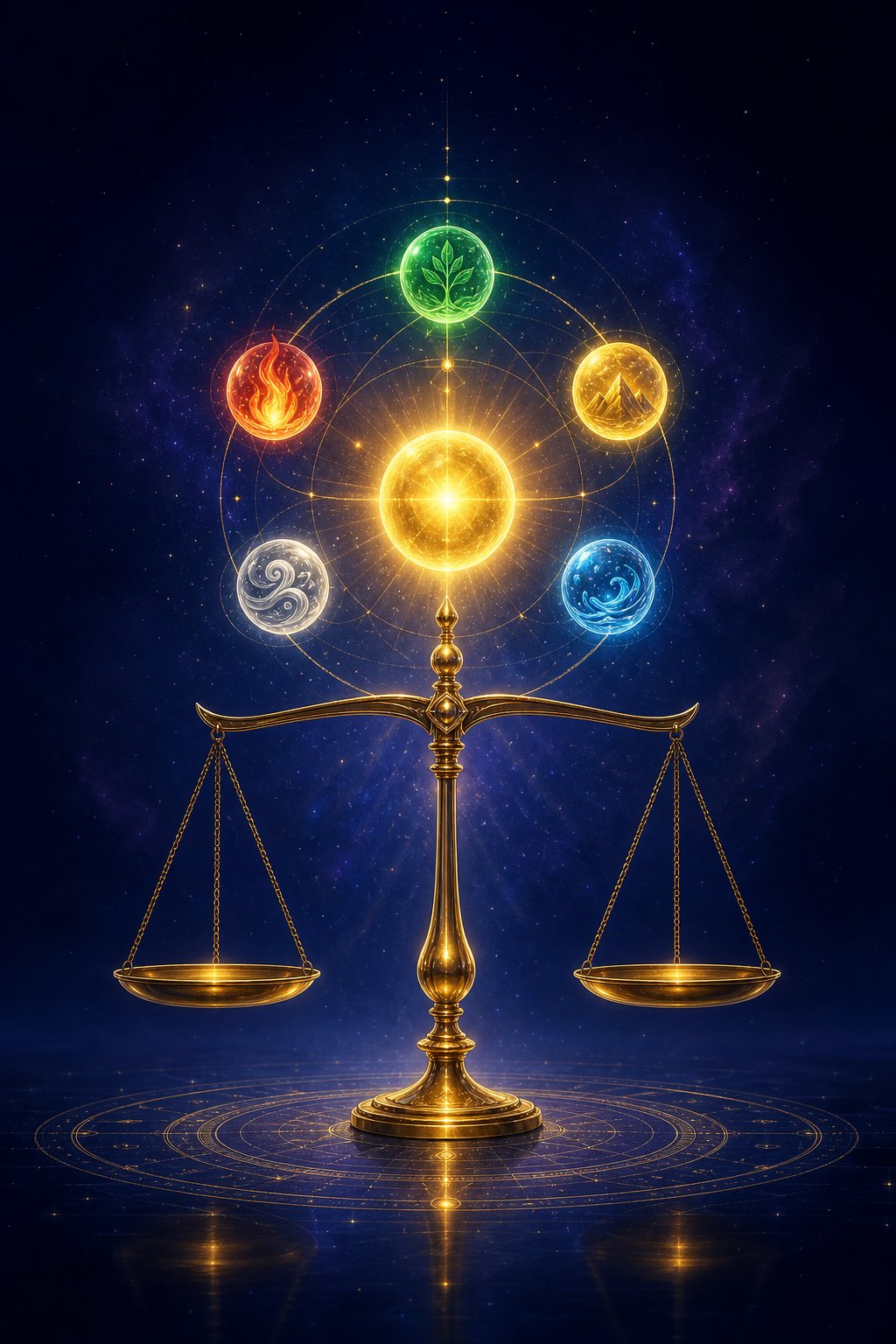
The Useful God Concept That Professionals Use for Naming
That element is called the Useful God (用神, yong shen), and it is the single most important concept separating amateur name selection from professional practice. If you take away only one idea from this entire guide, let it be this: the element your name should carry is not necessarily the one missing from your chart. It is the one that most effectively balances your Day Master.
Why the Missing Element Is Not Always the Right Choice
Imagine a chart with a Bing Fire Day Master born in deep winter (Zi month). The chart shows zero Wood characters. A surface-level reading might say: "Wood is missing, so add Wood to the name." And in this case, that logic happens to work, because Wood generates Fire and would warm a cold, weakened Day Master.
But flip the scenario. Imagine a Gui Water Day Master born in winter, already drowning in Water energy from the season. The chart is missing Fire entirely. Should you add Fire characters to the name? Not necessarily. If the Day Master is extremely strong (too much Water), Fire represents the Wealth element, which Water controls. Adding Fire gives the strong Water something to dominate, which can work. But if the chart also has heavy Metal producing even more Water, the Day Master might actually need Earth to dam the flood first, not Fire to be overwhelmed by it.
This is where bazi fortune telling practitioners earn their expertise. The missing element is a red herring more often than people realize.
The Useful God is not the element absent from your chart. It is the element that most effectively restores balance to your Day Master's relationship with its environment.
Determining the Useful God From Day Master Strength
The logic follows directly from the strength assessment covered earlier. Once you know whether your Day Master is strong or weak, the Useful God selection becomes systematic rather than guesswork.
For a weak Day Master, the chart needs elements that build it up:
- Resource stars (the element that produces the Day Master). A weak Wood Day Master benefits from Water as its Useful God, since Water nourishes Wood.
- Companion stars (the same element as the Day Master). A weak Fire Day Master may benefit from more Fire energy to strengthen its presence.
For a strong Day Master, the chart needs elements that drain or control it:
- Output stars (the element the Day Master produces). A strong Earth Day Master benefits from Metal, since Earth generates Metal, channeling excess energy outward.
- Wealth stars (the element the Day Master controls). A strong Water Day Master benefits from Fire, giving it something productive to manage.
- Authority stars (the element that controls the Day Master). A strong Wood Day Master may benefit from Metal, which prunes and disciplines excessive growth.
Any ba zi reading that skips this logic and jumps straight to "fill what is missing" risks making the chart worse. A bazi calculator and analysis tool can map your elemental distribution, but interpreting which element actually serves as the Useful God requires understanding the Day Master's position within its seasonal context.
Favorable vs Unfavorable Elements for Your Name
Once the Useful God is identified, every element in the Five Elements system falls into one of two categories for naming purposes: favorable or unfavorable.
Favorable elements include the Useful God itself and any element that supports or produces it through the generating cycle. Unfavorable elements are those that weaken, control, or clash with the Useful God.
Consider a practical example from bazi fortune telling tradition. A Yin Metal (Xin) Day Master born in mid-winter faces cold, damp conditions dominated by Water. Metal generates Water, so the Day Master is constantly being drained. The chart needs warmth. The Useful God here is Fire, specifically Yang Fire, to warm and activate the Metal. Supporting elements would include Wood (which feeds Fire) as a secondary favorable choice. Unfavorable elements would be Water (which extinguishes Fire) and additional Metal (which produces more Water drain).
A thorough bazi calculator and interpretation process assigns these favorable and unfavorable labels before any character selection begins. You are essentially building a filter: only characters carrying favorable elemental energy pass through to the candidate list for your name.
This filter is powerful, but it raises an immediate practical question. If your Useful God is Water, and Water's supporting element is Metal, how exactly do the Five Elements interact to create these support relationships? The generating and controlling cycles hold the answer, and they dictate not just which elements to include in a name but which combinations to avoid entirely.
Five Elements Cycles and How They Shape Name Choices
The Five Elements do not exist in isolation. They feed each other, restrain each other, and drain each other in predictable patterns. When you select characters for a name based on the Useful God, you are not just picking one element in a vacuum. You are activating a chain reaction. Understanding these cycles lets you choose characters that reinforce your Useful God and avoid characters that quietly undermine it.
Any reliable chinese elements calculator will show you which element dominates your chart, but it cannot tell you how those elements behave together. That requires understanding three fundamental cycles: generating, controlling, and weakening.
The Generating Cycle and Supportive Name Elements
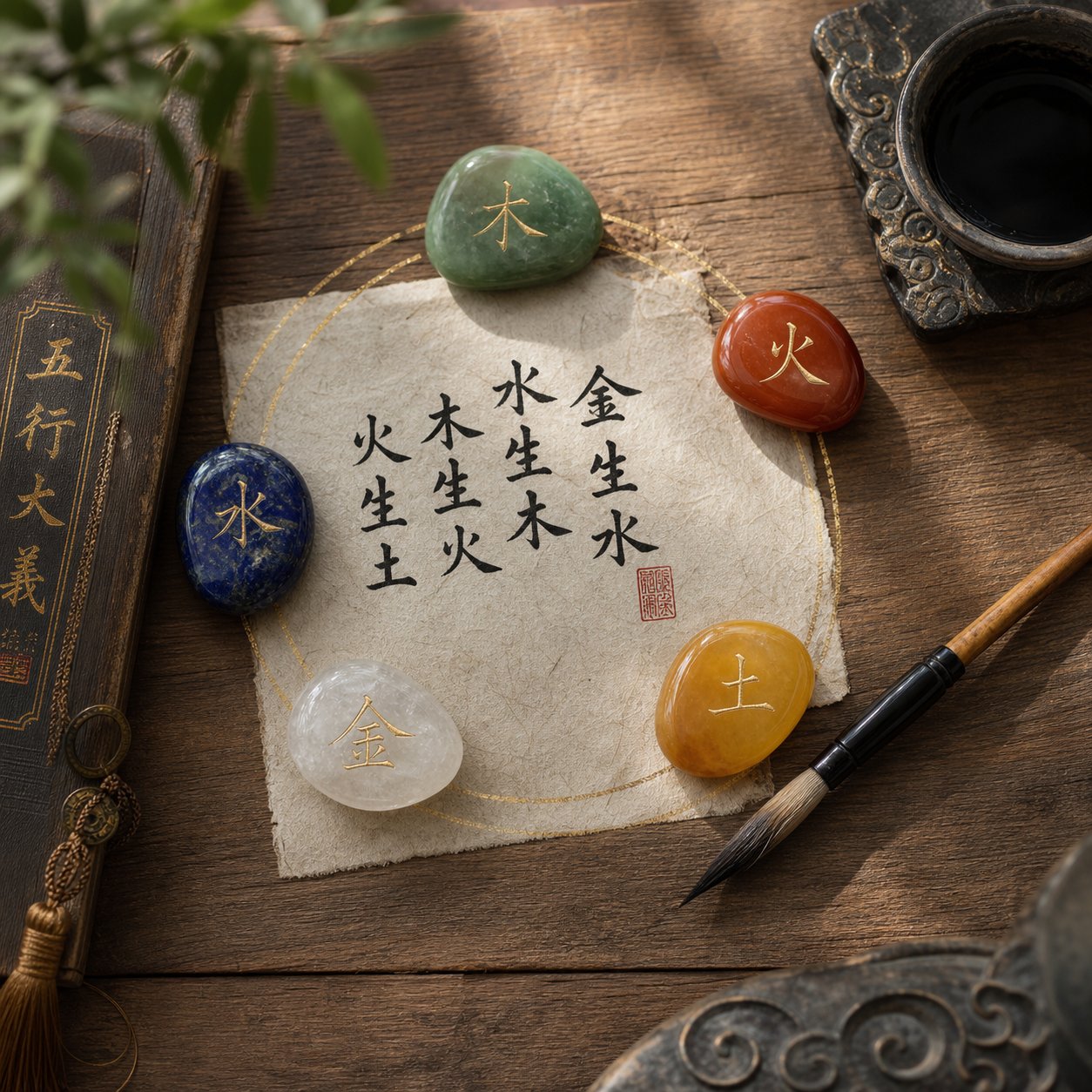
The Generating Cycle (相生) describes how each element nourishes the next in a continuous loop of creation:
- Wood feeds Fire — Wood provides fuel for Fire to burn and expand.
- Fire creates Earth — Fire burns material into ash, returning it to Earth.
- Earth bears Metal — Earth compresses over time to form Metal ores within its depths.
- Metal collects Water — Metal surfaces attract condensation, gathering Water.
- Water nourishes Wood — Water irrigates the soil, allowing Wood to grow.
For naming, this cycle tells you which secondary element to include alongside your Useful God. If your Useful God is Fire, then Wood characters serve as the "mother" element, feeding Fire energy into the name. You are not limited to Fire-radical characters alone. Wood characters act as a supply line, ensuring the Fire energy in your name has sustained support rather than burning out in isolation.
Think of it as building a small ecosystem within the name itself. A feng shui birth chart reading applies the same logic to spatial design, but here you are designing identity rather than a room. The principle is identical: support the element you need by including the element that generates it.
The Controlling Cycle and Elements to Avoid
The Controlling Cycle (相克) describes how each element restrains another, preventing excess:
- Wood parts Earth — roots break through soil, dominating it.
- Earth dams Water — earthen banks absorb and block Water's flow.
- Water extinguishes Fire — Water cools and smothers flames.
- Fire melts Metal — intense heat softens and reshapes rigid Metal.
- Metal chops Wood — blades cut down trees and shape Wood.
In a healthy system, control prevents any single force from overwhelming everything else. But in naming, you want to protect your Useful God from being controlled. If your Useful God is Water, then Earth characters are dangerous because Earth dams Water. Including an Earth-radical character in the name actively suppresses the very energy you are trying to strengthen.
There is also a weakening cycle to consider. Each element is drained by the element it produces. Fire is weakened by Earth (because Fire spends energy creating Earth). Metal is weakened by Water (because Metal spends energy generating Water). When you see a chinese zodiac with elements calculator showing your elemental distribution, remember that an element can be diminished not only by what controls it but also by what it feeds. For naming, this means avoiding characters of the element your Useful God produces, since they siphon energy away from it.
Applying Cycle Logic to Character Selection
Here is where yin and yang destiny theory becomes a practical naming tool. Each Useful God element has a clear set of allies and enemies based on these three cycles. The table below maps the relationships you need for character selection:
| Useful God | Supporting Element (Mother) | Element to Avoid (Controller) | Element That Drains (Child) |
|---|---|---|---|
| Wood | Water (nourishes Wood) | Metal (chops Wood) | Fire (Wood feeds Fire, draining itself) |
| Fire | Wood (feeds Fire) | Water (extinguishes Fire) | Earth (Fire creates Earth, draining itself) |
| Earth | Fire (creates Earth) | Wood (parts Earth) | Metal (Earth bears Metal, draining itself) |
| Metal | Earth (bears Metal) | Fire (melts Metal) | Water (Metal collects Water, draining itself) |
| Water | Metal (collects Water) | Earth (dams Water) | Wood (Water nourishes Wood, draining itself) |
A concrete example brings this to life. Suppose your chart analysis reveals Water as the Useful God. Your primary name characters should carry Water energy (氵 radical, rain radical, or water-meaning characters). Your secondary characters should carry Metal energy, since Metal is the mother of Water in the generating cycle. Characters with Earth energy are off-limits because Earth controls Water directly. And Wood characters, while not hostile, quietly drain Water by consuming its nourishment.
If you have used a chinese zodiac and elements calculator or a tool marketed as a "what is my feng shui birth element calculator," you likely already know your dominant and missing elements. The cycle logic above transforms that raw data into a filtering system. You now have three categories for every potential name character: include (Useful God and its mother), avoid (controller and drainer), and neutral (elements that neither help nor harm significantly).
A chinese element calculator gives you the starting ingredients. The cycles tell you which combinations create harmony and which create conflict. With this framework in place, the next challenge is translating elemental needs into actual Chinese characters, radicals, and stroke counts that carry the right energy into a name.
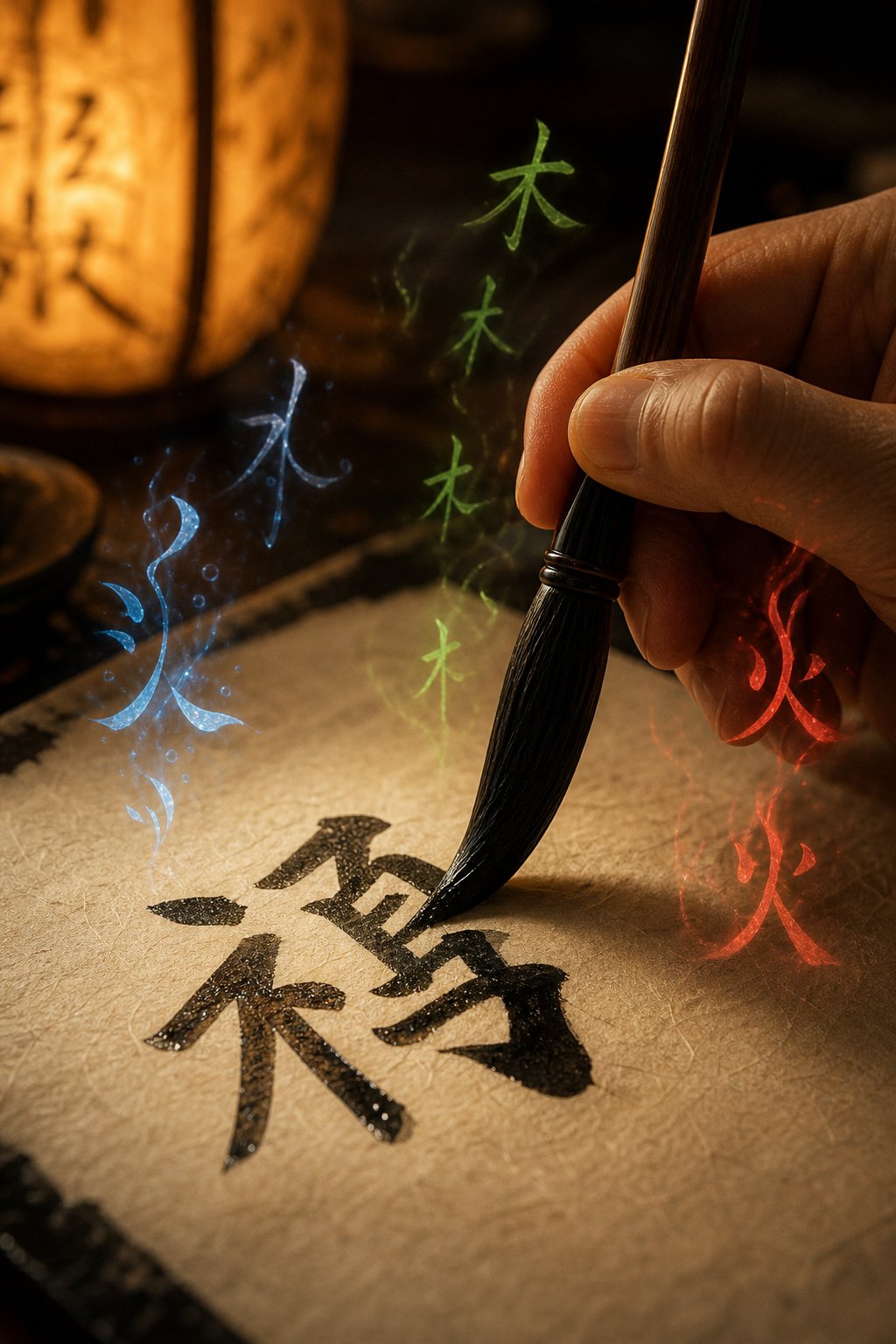
Mapping Characters and Stroke Counts to the Five Elements
You know which element your name needs. You have identified the Useful God, checked the generating cycle for supporting elements, and flagged the controllers to avoid. The question that remains is deceptively practical: which Chinese characters actually carry the elemental energy you are looking for?
This is where nameology (the study of name construction) moves from theory into craft. A ba zi chart tells you what your name should do. Character selection determines how it does it. In Chinese bazi practice, practitioners rely on four methods to classify a character's elemental nature, but two of them dominate professional name selection: radical identification and meaning association.
Radical-Based Element Classification for Characters
The most direct way to identify a character's Five Element is through its radical (偏旁). Radicals are the structural building blocks of Chinese characters, and many of them signal elemental identity as clearly as a label. When you see the three-dot water radical (氵) on the left side of a character, you are looking at a Water character. The logic is visual, ancient, and reliable.
Here is a reference table mapping the most common radicals to their Five Element categories, with example characters frequently used in naming:
| Five Element | Primary Radicals | Example Characters | Pinyin and Meaning |
|---|---|---|---|
| Water (水) | 氵(three-dot water), 冫(ice), 雨 (rain) | 涵, 清, 淼, 霖, 泽 | han (contain), qing (clear), miao (vast water), lin (lasting rain), ze (marsh) |
| Wood (木) | 木 (wood/tree), 艹 (grass), 竹 (bamboo) | 林, 森, 萱, 芳, 桐 | lin (forest), sen (dense forest), xuan (day lily), fang (fragrant), tong (paulownia) |
| Fire (火) | 火 (fire), 灬 (four-dot fire), 日 (sun) | 焱, 煜, 烨, 晨, 昭 | yan (flames), yu (brilliant), ye (blazing), chen (morning), zhao (illustrious) |
| Earth (土) | 土 (earth), 山 (mountain), 石 (stone) | 坤, 培, 峰, 岩, 磊 | kun (earth), pei (cultivate), feng (peak), yan (rock), lei (stacked stones) |
| Metal (金) | 金 (gold/metal), 钅(metal component) | 鑫, 铭, 锋, 钰, 銮 | xin (prosperity), ming (inscription), feng (blade), yu (precious metal), luan (bells) |
The advantage of radical-based classification is its clarity. You do not need deep expertise in bazi chart reading to apply it. If the character has a visible elemental radical, the classification is settled. A character like 涵 (han, meaning "to contain" or "inclusive") carries the 氵 radical, placing it firmly in the Water category. A character like 锋 (feng, meaning "sharp edge") carries the 钅 radical, making it Metal without debate.
The limitation? Many popular naming characters do not carry obvious elemental radicals. Characters like 文 (wen, culture), 宇 (yu, universe), 嘉 (jia, excellence), and 德 (de, virtue) lack a clear Five Element signal in their structure. For these, you need a second method.
Meaning-Based Element Associations Beyond Radicals
When the radical does not point to an element, practitioners turn to the character's core meaning. This is where chinese bazi naming becomes more interpretive, but the logic remains grounded.
Consider the character 辉 (hui, meaning "radiance" or "brilliance"). It has no fire radical in its simplified form, yet its meaning is entirely about light and luminescence. Light belongs to Fire. So 辉 is classified as a Fire character through semantic association. Similarly, 智 (zhi, meaning "wisdom") connects to Fire because traditional Five Elements philosophy links the heart and mental faculties to the Fire element.
Here are the meaning-based associations that guide professional bazhi name selection when radicals are absent:
- Water meanings: ocean, river, rain, flow, depth, cold, darkness, communication, wisdom in motion. Characters like 航 (hang, navigate) or 雪 (xue, snow) belong to Water through meaning even when their radicals are ambiguous.
- Wood meanings: growth, spring, benevolence, flexibility, upward movement, plants, creativity. Characters like 仁 (ren, benevolence) map to Wood because Wood governs the virtue of cherishing life.
- Fire meanings: light, warmth, brilliance, passion, clarity, the south, summer energy. Characters like 明 (ming, bright) or 辉 (hui, radiance) belong here.
- Earth meanings: stability, nurturing, containment, trust, the center, harvest, reliability. Characters like 信 (xin, trustworthiness) or 宇 (yu, space/dwelling) connect to Earth's bearing quality.
- Metal meanings: sharpness, decisiveness, justice, autumn, contraction, purity, discipline. Characters like 毅 (yi, resoluteness) belong to Metal through their association with firm determination.
When both the radical and the meaning point to the same element, the classification is rock-solid. When they conflict, the standard practice in Chinese nameology gives priority to the radical first, then meaning. Phonetic classification and stroke count serve as secondary references rather than primary determinants.
Stroke Count Numerology and Elemental Correspondence
Beyond radicals and meaning, there is a numerical dimension to character selection. The stroke count system (笔画) assigns Five Element values based on the Kangxi Dictionary stroke count of each character. The rule follows the Heavenly Stems correspondence:
- Terminal digit 1 or 2 — Wood (木). Corresponds to Jia and Yi stems.
- Terminal digit 3 or 4 — Fire (火). Corresponds to Bing and Ding stems.
- Terminal digit 5 or 6 — Earth (土). Corresponds to Wu and Ji stems.
- Terminal digit 7 or 8 — Metal (金). Corresponds to Geng and Xin stems.
- Terminal digit 9 or 0 — Water (水). Corresponds to Ren and Gui stems.
So a character with 12 Kangxi strokes has a terminal digit of 2, placing it under Wood. A character with 15 strokes ends in 5, placing it under Earth. This system is operationally simple: once you confirm the accurate Kangxi stroke count, the element is determined without subjective judgment.
However, stroke count classification can contradict radical and meaning classifications. The character 淼 (miao, vast water) is unmistakably Water by both radical and meaning, yet if its stroke count terminal digit pointed elsewhere, you would still classify it as Water. The professional consensus in bazi chart reading practice is clear: when stroke count conflicts with radical or meaning, radical and meaning win.
Where stroke count becomes essential is in the Three Talents (天地人) framework. This system, sometimes referenced alongside a feng shui chart analysis, evaluates the structural harmony of a complete name by dividing it into three grids: Heaven (天格, derived from the surname), Person (人格, bridging surname and given name), and Earth (地格, derived from the given name characters). Each grid's stroke count total is converted into a Five Element using the terminal digit rule above. The Three Talents configuration is then assessed for generating or controlling relationships among those three elements.
A name where the Three Talents flow in a generating sequence (for example, Heaven = Wood, Person = Fire, Earth = Earth) is considered harmonious. A name where the Person grid's element is controlled by both Heaven and Earth grids signals conflict. Think of it as a feng shui calculator applied to name structure rather than room layout: you are checking whether the elemental flow through the name's architecture supports or undermines the person carrying it.
In practice, professional four pillars of destiny name selection balances all these dimensions simultaneously. The Useful God determines which elements to target. Radical and meaning classification identify candidate characters. Stroke count numerology verifies that the name's structural grid does not accidentally introduce controlling relationships. The result is a name that works on multiple levels: elemental, structural, and semantic.
With characters classified and stroke counts verified, the remaining challenge is assembling these pieces into a coherent, step-by-step process that moves from raw birth data to a finished name. That workflow is where all the theory converges into a single actionable sequence.
Step-by-Step BaZi Name Selection From Chart to Characters
Every concept covered so far converges into a single workflow. The elemental cycles, the Day Master assessment, the Useful God logic, the character classification methods — they all serve one purpose: guiding you from a birth date to a name that carries the right energy. Here is that process laid out as a complete sequence, the kind of structured walkthrough that no other English-language resource currently provides.
Calculating Your Four Pillars From Birth Data
The process begins with accurate birth information. You need the year, month, day, and hour of birth, and you need them converted into the Stem-Branch calendar system. This is not the same as the standard lunar calendar. BaZi uses solar terms (节气) to mark month transitions, meaning the Year Pillar shifts at the Start of Spring (立春), not on Lunar New Year's Day. Getting this wrong throws off the entire chart.
A reliable bazi calculator online handles this conversion automatically. If you prefer manual calculation, you will need a Ten Thousand Year Calendar (万年历) to look up the Stem-Branch pairs for each pillar. For most parents, a bazi calculator online free tool is the practical starting point — it eliminates conversion errors and gives you the four pillars in seconds. Just verify that the tool uses solar term boundaries rather than lunar month boundaries for the Month Pillar.
From Chart Analysis to Character Selection
With your four pillars plotted, the naming process follows a clear sequence:
- Identify the Day Master element. Look at the Heavenly Stem of the Day Pillar. This is the self-element — Wood, Fire, Earth, Metal, or Water — and every subsequent decision revolves around it.
- Assess Day Master strength using seasonal context. Check the Month Branch. Is the Day Master in season (strong) or out of season (weak)? Then examine whether other pillars provide roots, Resource stars, or Companion support. A four pillars of destiny calculator will show you the elemental distribution, but you must interpret the seasonal weight yourself.
- Determine the Useful God element. Weak Day Masters need elements that produce or support them (Resource and Companion). Strong Day Masters need elements that drain or control them (Output, Wealth, Authority). The Useful God is the element that most effectively restores balance.
- Select characters matching the Useful God and its supporting element. Use radical-based classification first, then meaning-based association. If your Useful God is Metal, prioritize characters with the 金 or 钅 radical, then consider characters whose meanings evoke sharpness, clarity, or autumn energy. Include the mother element (Earth for Metal) as a secondary character choice.
- Verify stroke count harmony through the Three Talents framework. Calculate the Heaven, Person, and Earth grid values from the combined surname and given name stroke counts. Confirm that the Three Talents elemental flow is generating rather than controlling.
- Evaluate phonetics, meaning, and cultural appropriateness. Read the full name aloud. Check for awkward homophones, unintended meanings when characters combine, and tonal monotony. A name with all four tones identical sounds flat in Mandarin.
- Cross-reference against unfavorable elements. Confirm that no selected character belongs to the controlling or draining element identified in your cycle analysis. One misplaced character can undermine the entire elemental strategy.
Always select characters based on the Useful God element, not simply the element missing from the chart. A missing element may be absent precisely because it would harm the Day Master if present.
An online bazi calculator can get you through steps one and two quickly. Steps three through seven require human judgment. The bazi chart calculator gives you raw data; interpretation is where the craft lives.
Final Verification and Cross-Cultural Considerations
For families living in English-speaking environments or raising bilingual children, the name must function across two linguistic worlds. A character chosen for its Water radical and elegant meaning still needs to produce a given name that works phonetically in English conversation. Consider how the pinyin romanization sounds to non-Chinese speakers. Does it flow naturally? Is it easy to pronounce without distortion?
Some parents solve this by selecting a Chinese name optimized for BaZi balance and a separate English name for daily use. Others look for characters whose pinyin romanization doubles as a recognizable English name or syllable. Neither approach is wrong, but the four pillars calculator analysis should always drive the Chinese character selection first. Cross-cultural phonetic fit is a secondary filter applied after elemental requirements are met.
A final practical note: run your completed name through the full checklist one more time. Confirm the Useful God alignment, verify the Three Talents grid, speak the name aloud in both languages, and check that the characters are not so rare that they cause problems on official documents or digital systems. A name built on solid BaZi logic but impossible to type on a standard keyboard creates friction the child will carry for decades.
This seven-step process gives you a repeatable framework. But naming traditions extend beyond Chinese BaZi practice alone. Korean Saju (사주) uses the same Four Pillars foundation with its own cultural conventions, and understanding how both traditions evaluate names holistically adds depth to your final decision.
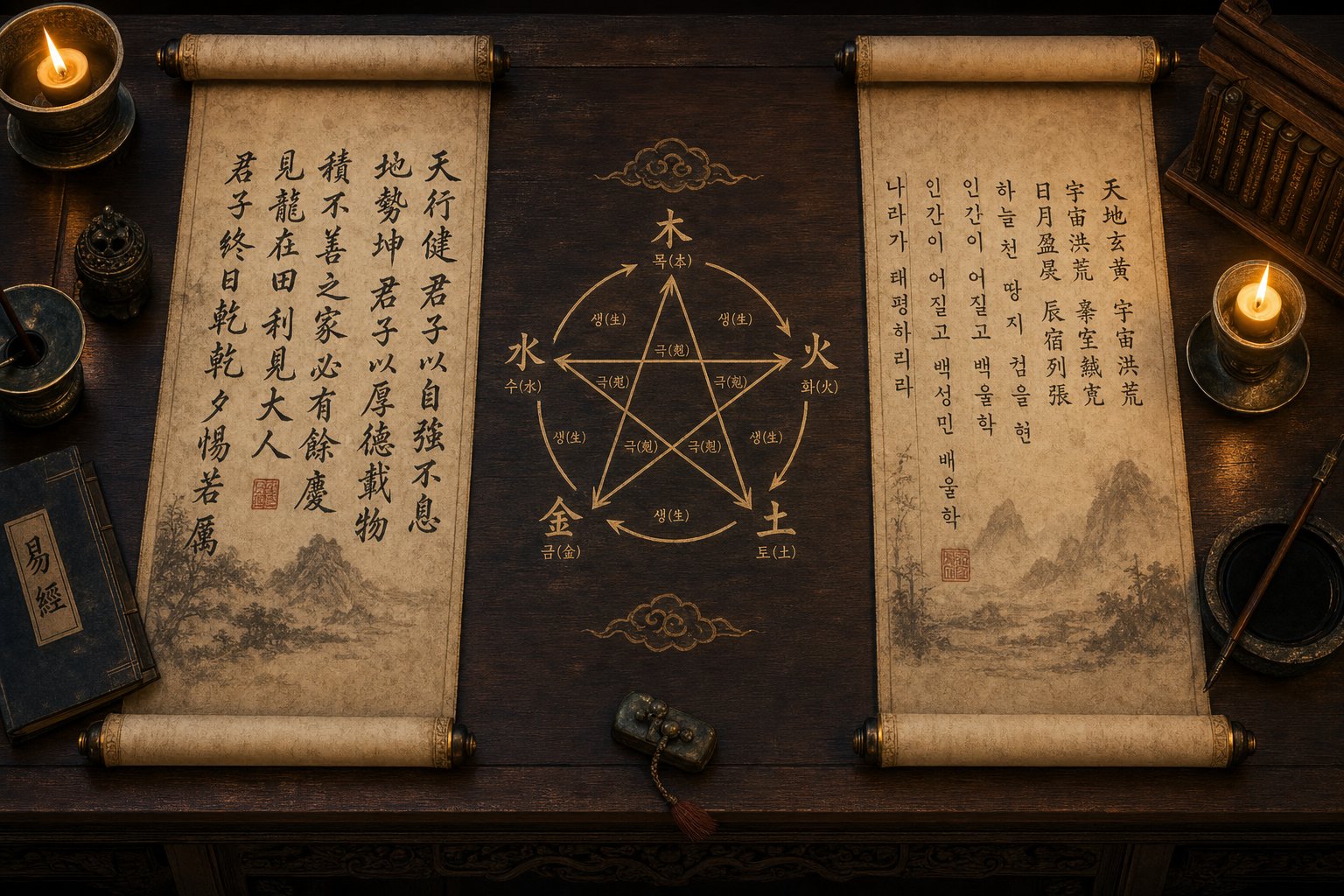
Saju Naming Traditions and Holistic Name Evaluation
The Four Pillars framework did not stay within China's borders. Korean Saju (사주) shares the same structural DNA — four pillars, Heavenly Stems, Earthly Branches, Five Elements — but over centuries of independent development, it evolved its own naming conventions, interpretive priorities, and cultural weight. If you are exploring four pillars of destiny name selection from a Korean perspective, or simply want a more complete picture of how this system operates across cultures, Saju naming offers valuable insight into what holistic name evaluation actually looks like in practice.
Saju Naming and Its Shared Four Pillars Foundation
Korean Saju and Chinese BaZi are cousins, not twins. Both systems calculate a birth chart from the year, month, day, and hour pillars. Both use the same sixty-year Stem-Branch cycle. Both identify the Day Master as the core reference point and assess elemental balance to determine what the chart needs. The foundational logic is shared: analyze the chart, find the imbalance, and correct it through the name.
Where the traditions diverge is in execution. Korean naming specialists (작명가, jangmyeongga) work with hanja — the Korean use of Chinese characters — and apply a stroke count system that maps each character to one of the Five Elements using numerical correspondence. A saju calculator or saju fortune calculator will generate the same four-pillar structure you would see in a BaZi reading, but the interpretive emphasis shifts. Korean Saju practitioners tend to place heavier weight on the Ten Gods (십신) relational framework and often read charts with a more narrative, less formulaic style than many Chinese BaZi schools.
The naming ceremony itself, called 작명 (jangmyeong), typically happens within the first few weeks after birth. Some families consult traditional practitioners in person; others use popular Korean Saju apps. The goal mirrors Chinese BaZi naming exactly: give the child a name that supplies the elemental energy their chart lacks, supporting their natural fortune rather than working against it.
One practical difference worth noting: Korean Saju practitioners sometimes apply different time zone and solar time adjustments for the Hour Pillar, which can shift the chart compared to a standard Chinese BaZi calculation. Even a thirty-minute difference in birth time can change the Hour Pillar entirely, altering the elemental composition and potentially changing which element the name should carry. If you are using a bazi compatibility calculator or any cross-system tool, verify which time standard it applies before trusting the output for naming decisions.
Holistic Name Evaluation Across Multiple Dimensions
Both Chinese and Korean traditions agree on something critical: elemental correction alone does not make a good name. A character that perfectly matches your Useful God but sounds harsh, carries an unfortunate homophone, or clashes with family naming conventions will create problems no amount of elemental balance can fix. Professional practitioners in both traditions evaluate names across multiple dimensions simultaneously.
Imagine you have identified Water as the Useful God and found a beautiful Water-radical character with an elegant meaning. Before committing, a skilled practitioner checks whether that character harmonizes with the surname tonally, whether its stroke count supports the Three Talents grid, whether its meaning pairs well with the second given-name character, and whether it respects any generational naming rules the family follows. The name must work as a complete unit, not as a collection of individually optimized parts.
Here are the evaluation criteria that both traditions use for a complete name assessment:
- Elemental balance — Does the name carry the Useful God element and its supporting mother element? Does it avoid the controlling and draining elements identified in the cycle analysis?
- Stroke count harmony — Do the Three Talents (Heaven, Person, Earth grids) flow in a generating sequence rather than a controlling one? Are the individual character stroke counts verified against the Kangxi Dictionary standard?
- Phonetic quality — Does the full name sound pleasing when spoken aloud? Are the tones varied enough to avoid monotony? Are there awkward homophones that create unintended meanings in daily use?
- Character meaning — Do the individual characters carry positive, aspirational meanings? When combined, do they create a coherent semantic impression rather than a contradictory one?
- Cultural fit — Does the name respect generational naming conventions (돌림자 in Korean, 辈分 in Chinese)? Does it work within the family's cultural context, whether that context is traditional, modern, or diasporic?
Korean families face an additional layer: since legally changing a registered name in Korea requires a court petition, the pressure to get every dimension right the first time is real. This is not superstition — it is due diligence applied to a decision that follows the child for life.
A bazi compatibility calculator can tell you whether two people's charts interact well, but evaluating a name requires the same multi-dimensional thinking applied to a single identity. No single factor should override all others. A name with perfect elemental alignment but terrible phonetics will embarrass its bearer. A name that sounds beautiful but actively undermines the Day Master through its elemental composition misses the entire point of chart-based naming.
The practitioners who do this work well — whether Chinese BaZi masters or Korean Saju specialists — hold all five dimensions in mind at once, iterating through candidate characters until they find the combination that satisfies every criterion without compromising any single one. That balancing act is the art within the science, and it is also where self-study reaches its natural limits.
Avoiding Common Mistakes and Knowing When to Seek Help
That balancing act between elemental precision, phonetic grace, and cultural resonance is exactly where most DIY attempts go sideways. Understanding the logic behind four pillars of destiny name selection gives you a tremendous advantage — you can evaluate a practitioner's recommendations, ask informed bazi questions, and avoid the most damaging errors. But knowing the theory and executing it flawlessly on a complex chart are two different skills.
Common Mistakes in DIY BaZi Name Selection
After walking through the entire process, you can probably already guess where things tend to break down. These are the errors that practitioners see most often when parents attempt chart-based naming without professional guidance:
- Confusing the missing element with the Useful God. This is the single most common mistake. A chart missing Water does not automatically need Water in the name. As practitioner Sean Chan notes, blindly introducing a missing element can collapse the chart's structure and make existing flaws more pronounced. The Useful God is determined by Day Master strength, not by absence.
- Ignoring seasonal context when assessing Day Master strength. Counting elements across the chart without weighting the Month Branch leads to wrong strength verdicts. A Fire Day Master with three Fire characters in the chart might still be weak if born in deep winter. Season is the first filter, not an afterthought.
- Selecting characters only by radical without checking stroke count harmony. A character with the perfect radical can still sabotage the Three Talents grid if its stroke count creates a controlling relationship. Radical classification identifies candidates; stroke count verification narrows the final selection.
- Neglecting phonetic harmony and tonal flow. A name that looks elegant on paper but sounds awkward when spoken aloud creates daily friction. Two adjacent characters sharing the same flat tone, or a given name that forms an unfortunate homophone with common words, undermines the name's practical function regardless of its elemental precision.
- Using simplified stroke counts instead of Kangxi Dictionary counts. Many free bazi calculator tools and online references default to simplified character stroke totals. The Three Talents and Five Structures systems require traditional Kangxi counts, which can differ significantly. The character 王 appears to have four strokes but counts as five in the Kangxi system.
- Ignoring the surname's elemental contribution. The surname is fixed, but it carries elemental weight. A surname like 林 (Lin) already contributes strong Wood energy before the given name is even considered. Failing to account for this skews the entire elemental calculation.
When to Seek Professional Consultation
Self-study works well for straightforward charts — cases where the Day Master is clearly strong or clearly weak, the seasonal context is unambiguous, and the Useful God follows logically without competing considerations. You can learn how to calculate bazi four pillars manually, verify results against an online tool, and apply the character selection framework with confidence.
Professional consultation becomes valuable when the chart presents complexity that resists simple categorization:
- The Day Master is borderline — neither clearly strong nor clearly weak — making the Useful God determination ambiguous.
- Multiple elemental clashes or combinations (合, 冲, 刑) transform elements within the chart, changing the effective elemental composition from what appears on the surface.
- The chart has competing needs — for example, needing Fire for warmth (调候) but Water for structural balance (格局) — requiring a practitioner to prioritize one framework over another.
- Family naming conventions or generational characters constrain the available options, forcing creative solutions within tight boundaries.
- The surname's elemental energy conflicts with the Useful God, requiring careful navigation of the Three Talents grid.
Think of it this way: if your bazi questions center on "which element is my Useful God" and you cannot answer with confidence after applying the seasonal strength method, that uncertainty is the signal to consult someone with experience reading hundreds of charts. A free ba zi calculator gives you the raw data, but interpretation of edge cases is where professional training earns its value.
Your BaZi Naming Verification Checklist
Whether you complete the process yourself or review a professional's recommendation, use this checklist to confirm that every dimension has been addressed:
- Confirm the Four Pillars are calculated using solar term boundaries (not lunar month boundaries) and the correct time zone for the birth location.
- Identify the Day Master element from the Day Pillar's Heavenly Stem.
- Assess Day Master strength with the Month Branch as the primary seasonal indicator, then check for roots, Resource stars, and Companion support.
- Determine the Useful God based on Day Master strength — not based on which element is missing from the chart.
- Verify that selected characters belong to the Useful God element or its mother element through radical classification, meaning association, or both.
- Confirm that no selected character belongs to the element that controls or drains the Useful God.
- Check stroke counts against the Kangxi Dictionary standard and verify the Three Talents grid flows in a generating sequence.
- Speak the full name aloud in all relevant languages. Listen for tonal monotony, awkward homophones, and pronunciation difficulty.
- Confirm the characters are not so rare that they cause problems on official documents, digital systems, or everyday communication.
- Verify that the name respects any family generational naming conventions and fits the cultural context the child will grow up in.
A calculate bazi free tool gets you started. The framework in this guide gets you through the logic. And the checklist above ensures nothing falls through the cracks. Four pillars of destiny name selection is ultimately a practice of informed intention — giving a child a name that works with their elemental nature rather than against it, grounded in a system that has refined its methodology across more than a thousand years of continuous use.
Frequently Asked Questions About Four Pillars of Destiny Name Selection
1. What is the difference between the missing element and the Useful God in BaZi naming?
The missing element is simply whichever of the Five Elements does not appear in your birth chart. The Useful God (yong shen) is the element that most effectively restores balance to your Day Master's relationship with its environment. These are often different. A chart missing Water might not benefit from Water if adding it further weakens an already struggling Day Master. Professional practitioners determine the Useful God based on Day Master strength and seasonal context, not by filling gaps in the elemental count.
2. How do I determine if my Day Master is strong or weak for name selection?
Start with the Month Branch, which represents the birth season. If your Day Master element is in season (Wood in spring, Fire in summer, Metal in autumn, Water in winter), it begins strong. Then check whether other pillars provide roots (same-element characters in the Earthly Branches), Resource stars (the element that produces your Day Master), or Companion stars. Heavy support means a strong Day Master needing drainage. Lack of support with heavy control or drain means a weak Day Master needing reinforcement through the name.
3. Can I use a free online BaZi calculator for name selection?
Online BaZi calculators reliably handle the mathematical conversion of birth data into four pillars. They eliminate errors in Stem-Branch pairing and solar term boundary calculations. However, they cannot interpret Day Master strength with full seasonal nuance or determine the Useful God for you. Use a calculator to generate your chart accurately, then apply the Useful God logic manually. Verify that your chosen tool uses solar term boundaries for the Month Pillar rather than standard lunar calendar months.
4. How do Chinese characters get classified into Five Elements for naming?
Characters are classified through three methods in order of priority. First, radical identification: characters with the water radical belong to Water, wood radical to Wood, and so on. Second, meaning association: characters whose core meaning relates to an element (like brilliance relating to Fire) are classified by semantic connection. Third, stroke count numerology: the terminal digit of the Kangxi Dictionary stroke count maps to an element. When these methods conflict, radical takes priority over meaning, and both override stroke count.
5. What is the difference between Korean Saju naming and Chinese BaZi naming?
Both systems share the same Four Pillars structural foundation, using Heavenly Stems, Earthly Branches, and Five Elements to analyze a birth chart. The differences lie in execution. Korean Saju practitioners work with hanja characters, apply Korean phonetic conventions, and often place heavier emphasis on the Ten Gods relational framework. Time zone and solar time adjustments may also differ, potentially shifting the Hour Pillar. The core naming logic of identifying elemental imbalance and correcting it through character selection remains the same across both traditions.