The He Surname and Its Place in Chinese Heritage
Imagine carrying a last name that literally translates to "what" or "why." For the millions of people bearing the He surname (何), that is exactly the case. Ranked 17th among the most common surnames in China and appearing at position 21 in the classic Baijiaxing (Hundred Family Surnames), He is one of the most historically layered family names in the Chinese-speaking world.
What the He Surname Represents
The surname He traces its roots to a dramatic moment of dynastic collapse over two thousand years ago. At its core, the last name He connects bearers to fallen Zhou Dynasty royalty who reinvented their identity to survive Qin persecution. That origin story alone makes it one of the most compelling surnames in Chinese genealogy, but the layers go deeper. The He name spans multiple unrelated lineages, geographic migration patterns stretching from Anhui to Southeast Asia, and cross-cultural adaptations across Korean, Vietnamese, and diaspora communities.
Why This Surname Is Uniquely Complex
Here is what makes the surname He especially fascinating: it is not one surname at all. The romanization "He" maps to several completely different Chinese characters, each with its own meaning, origin, and bearer population. The most common is 何, but others include 贺, 和, 赫, and more. Each represents a distinct lineage with a separate history.
The character 何 literally means "what," "how," or "why" in modern Chinese, making it the only major surname that doubles as an interrogative word.
That linguistic quirk is not a coincidence. It points directly to the founding legend of the He clan, a story of quick thinking at a river checkpoint that turned a desperate question into a permanent identity. Understanding the he surname meaning requires peeling back each of these layers, from etymology and dynastic upheaval to global migration and modern genealogy.
Decoding the Chinese Characters Behind He
A single romanized spelling hiding seven completely different characters, each with its own history and meaning. That is the reality facing anyone researching the he chinese character. To understand which "He" you are dealing with, you need to look past the alphabet and into the structure of the characters themselves.
The Literal Meaning of 何
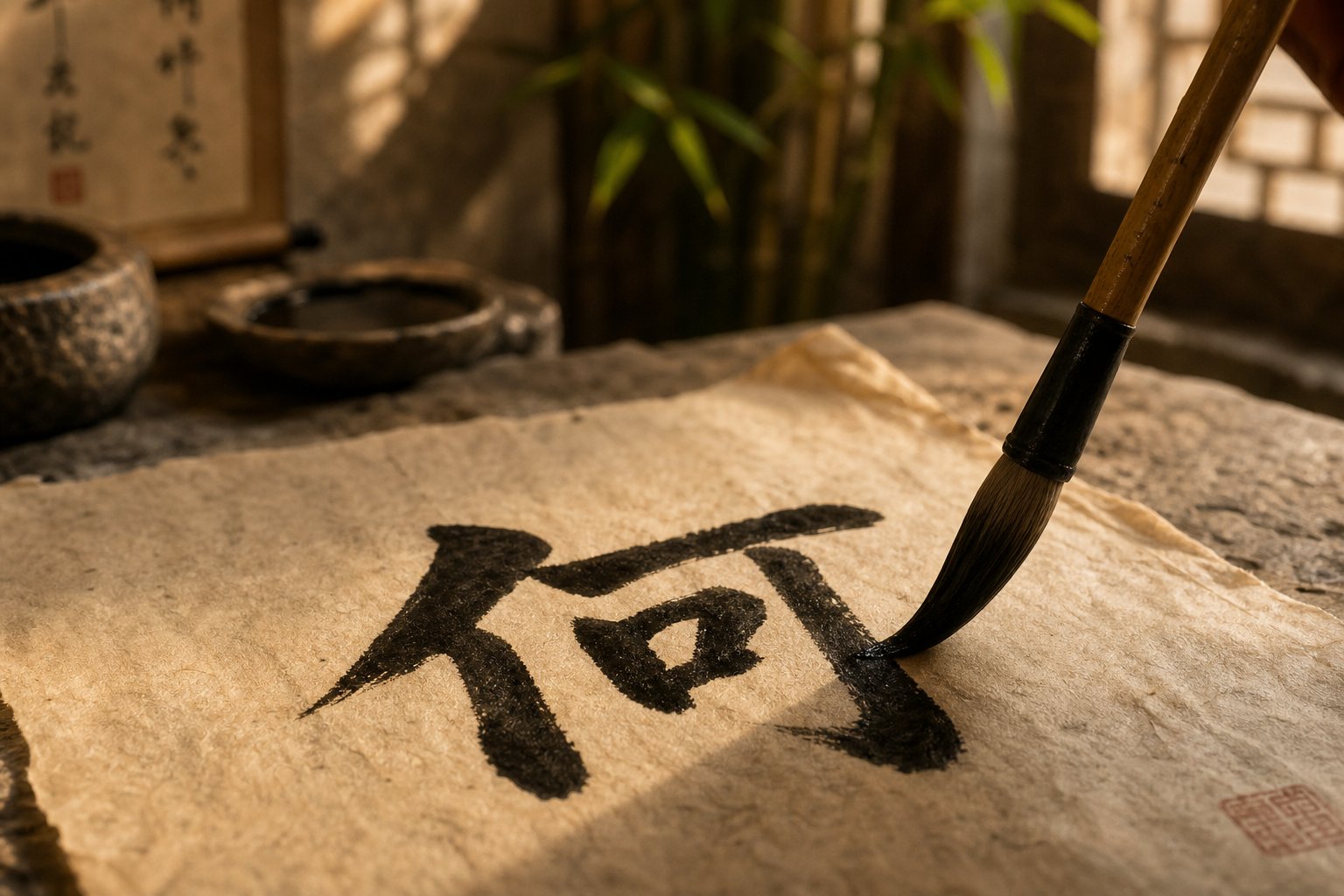
The most common chinese character for he as a surname is 何 (pronounced he with a rising tone, he2). In modern Mandarin, 何 functions as an interrogative word meaning "what," "how," "why," or "which." You will find it in everyday expressions like 如何 (ruhe, "how") and 为何 (weihe, "why"). But this questioning meaning was not the character's original purpose.
Oracle bone inscriptions dating to roughly 1250-1000 BC reveal that 何 originally depicted a person carrying an axe or heavy burden on their shoulders. The left component 亻 (a compressed form of 人, meaning "person") serves as the meaning radical, while the right component 可 (ke, "able to") provides the phonetic clue. The ancient dictionary Shuowen Jiezi confirms this directly: "何, 儋也" — meaning "何 is to carry on the shoulder."
So how did a char in chinese that originally meant "to shoulder a burden" become an interrogative word? Through a process called phonetic borrowing (假借, jiajie). Because 何 sounded similar to the spoken word for "what" in Old Chinese, scribes began using it to write that interrogative meaning. Over centuries, the borrowed meaning overtook the original one entirely. The physical "carrying" sense migrated to a newer character, 荷, which still means "to carry" (and also "lotus").
This layered history explains the 何 meaning in English: it is simultaneously "what" in modern usage and "to carry" in its ancient pictographic roots. Neither definition seems like obvious surname material, which is precisely why the founding ancestor story matters so much. The character became a surname not through its meaning but through a specific historical moment when a fugitive's evasive answer became his new identity.
Seven Characters Behind One Romanization
Here is where things get complicated for genealogical research. When you see the last name "He" written in English, it could represent any of several unrelated Chinese characters. Each one carries a completely different meaning, traces back to a separate origin lineage, and connects to a distinct population of bearers. Treating them as interchangeable would be like assuming everyone named "Lee" shares the same ancestry regardless of whether they are Chinese, Korean, or English.
The table below breaks down the major characters romanized as "He" in standard Pinyin, showing how each char in chinese maps to a unique meaning and bearer community:
| Character | Pinyin (with tone) | Literal Meaning | Approximate Bearer Population |
|---|---|---|---|
| 何 | he2 (rising tone) | What / How / Why | ~18.7 million |
| 贺 | he4 (falling tone) | To congratulate | ~2.8 million |
| 和 | he2 (rising tone) | Harmony / Peace | ~1.2 million |
| 河 | he2 (rising tone) | River | Rare as surname |
| 赫 | he4 (falling tone) | Brilliant / Prominent | ~800,000 |
| 禾 | he2 (rising tone) | Grain / Crop | Very rare as surname |
| 合 | he2 (rising tone) | To unite / Together | Very rare as surname |
You will notice that 何 dominates by sheer numbers, accounting for the vast majority of people surnamed "He" worldwide. The character 贺 comes in a distant second, with its own distinct origin tied to the ancient Qinghe region. Meanwhile, 赫 often traces to Manchu and other northern ethnic groups who adopted Chinese-style surnames during the Qing Dynasty.
For anyone researching their family history, identifying the correct character is not optional. It is the single most important step. Two families both surnamed "He" in English might share zero common ancestry if one writes 何 and the other writes 贺. Their genealogical records, ancestral halls, and migration histories diverge completely.
The dominance of 何 among these variants raises an obvious question: how exactly did a character meaning "what" become the permanent identity of nearly 19 million people? The answer lies in a specific moment during the Qin Dynasty, when a fleeing prince's split-second response at a checkpoint rewrote his family's future forever.

The Founding Ancestor Story of the He Clan
A fugitive prince, a river checkpoint, and a single word that became a family name for over 18 million people. The origin of 何 as a surname reads less like genealogy and more like a survival thriller set against the violent unification of China.
The Qin Dynasty Escape That Created a Surname
In 221 BC, Qin Shi Huang completed his conquest of the rival states and declared himself the first emperor of a unified China. The Zhou Dynasty, which had ruled for nearly 800 years, was already gone. Its royal house, the Ji (姬) clan, had lost real power centuries earlier, but its descendants still carried the Ji surname and the political target it painted on their backs. The new Qin regime viewed former Zhou nobility as a threat to legitimacy. Persecution followed.
According to traditional genealogical accounts, a descendant of the Ji royal line named Han (韩) was fleeing southward when he reached a river crossing guarded by Qin soldiers. When the guards demanded his surname, he faced an impossible choice. Answering truthfully meant revealing Ji clan blood and almost certain execution. In that split second, he deflected with the word 何, pronounced he in mandarin, meaning "what?" or "why do you ask?" The guards, hearing what sounded like a common surname rather than an evasive question, let him pass.
That moment of quick thinking became permanent. The ancestor adopted 何 as his new surname, and his descendants carried it forward. What began as a desperate deflection hardened into an identity that has persisted for over two thousand years.
From Ji Clan Nobility to the He Identity
The Ji (姬) surname was no ordinary family name. Traditionally credited to the Yellow Emperor (Huangdi) himself, Ji is considered the mother of many Chinese surnames, with roughly 82% of China's current 504 surnames tracing back to it. The Zhou kings who bore it ruled the longest dynasty in Chinese history. So when the He ancestor abandoned Ji for 何, he was not just changing a name. He was severing a visible link to the most powerful royal lineage in Chinese civilization.
The Baijiaxing, compiled during the early Song Dynasty around 960 AD, later codified 何 at position 21 among the Hundred Family Surnames. By that point, the He clan had grown large enough and established enough regional prominence to earn a high ranking in what became China's most authoritative surname reference text. The mandarin he pronunciation was standardized, and the surname's legitimacy was beyond question.
Historical Context of Dynastic Surname Changes
The He founding story is dramatic, but it was far from unique. Dynastic collapse routinely forced Chinese families to reinvent their identities. When the Qin defeated the Zhou, a large number of Zhou royal families changed their surname from Ji to feudal state names like Lu (鲁), Wu (吴), Wei (魏), and Cai (蔡). The He clan simply took a different path, choosing an interrogative word rather than a place name.
This pattern repeated across Chinese history. Imperial naming taboos forced families to alter surnames that overlapped with an emperor's name, with penalties as severe as execution for non-compliance. Bestowal by emperors created new surname lines overnight. And sinicization brought waves of non-Han peoples into the Chinese surname system entirely. Each mechanism produced new surnames or redistributed existing ones.
What makes the He origin story stand out is its specificity. Most dynastic surname changes were administrative or gradual. The He narrative pins everything on a single encounter, a single word, a single ancestor's refusal to die for a name. Whether the checkpoint story is literal history or a compressed folk memory of a broader migration, it encodes a real truth: the He surname exists because Qin persecution made the Ji surname lethal to carry.
That founding moment also raises a question the story itself cannot answer. If one branch of the Ji clan became He through this escape, what happened to the other branches? The answer reveals that 何 is not the only lineage hiding behind this surname. Multiple unrelated origin streams eventually converged on the same character through entirely different historical paths.
Several Origin Lineages Behind the Same Surname
Two families both carrying the He name sit down at the same table. They assume shared ancestry. In reality, their lineages may have originated centuries apart, in different regions, from entirely different ethnic groups. The character 何 is a single container holding multiple unrelated histories.
Multiple Unrelated Lineages Under One Name
The Ji clan checkpoint story is the most famous origin, but it accounts for only one branch. At least three major streams fed into the surname 何 over the centuries, each arriving through a completely different mechanism:
- Ji (姬) clan descendants: The founding lineage. Royal Zhou Dynasty blood that adopted 何 during the Qin persecution to conceal their identity. This remains the largest and most documented origin stream for the he name.
- Xianbei ethnic adoption: During the Northern Wei Dynasty (386-534 AD), the ruling Xianbei people underwent mass sinicization. A group originally surnamed Heba (贺拔) shortened their name to 何, permanently merging into the Chinese surname system. This is a clear case of he and chinese identity fusing through imperial policy rather than blood descent.
- Jiang (姜) clan and Han kingdom connection: A separate, older lineage traces to the Jiang clan of Yandi (the Flame Emperor) through the ancient Han kingdom during the Warring States period. These bearers share the character 何 but connect to a completely different ancestral figure than the Ji clan.
- Boat Dweller communities: Numerous Tanka (Boat Dweller) families along China's southern coast also carry the surname 何, representing yet another distinct social origin for the name of He.
Each stream arrived at the same character through a different door. One fled persecution. Another was administratively assigned. A third inherited it from a pre-Qin kingdom. The result is that the name of He functions less like a single family tree and more like a forest of separate trees that happen to share the same label.
How Genealogical Records Distinguish Origins
So how does a modern bearer figure out which lineage they actually belong to? The answer lies in 族谱 (zupu), the clan genealogical records that Chinese families have maintained for centuries. These documents track generation names (字辈), ancestral hall locations, migration routes, and founding ancestor narratives specific to each branch.
A zupu from Anhui province will typically trace back to the Ji clan origin. One from Inner Mongolia or northeastern China might reveal Xianbei roots. Southern coastal records could point to Boat Dweller heritage. The geographic location of your earliest documented ancestors is often the strongest clue to which origin stream your he name belongs to.
Without consulting these records, two He families cannot assume any shared connection beyond the character itself. The surname is a shared roof, not a shared bloodline. And that geographic dimension, where your ancestors settled and why, turns out to be just as revealing as the origin story itself.
Geographic Heartland and Migration Patterns in China
Where your ancestors settled tells a story that genealogical records alone cannot. For the approximately 18.7 million people carrying the surname 何 in mainland China, geography is not just a backdrop. It is a map of dynastic upheaval, forced relocations, and survival strategies spanning two millennia.
Anhui as the Ancestral Homeland
The founding narrative places the He surname's origin near the Huai River region of what is now Anhui province. When the Ji clan descendant fled Qin soldiers at a river checkpoint, the surrounding territory corresponded to modern-day Lujiang County in Anhui. This area became the recognized ancestral homeland, or "junwang" (郡望), for the primary 何 lineage. Early He clan members concentrated in this region during the Han Dynasty, building the local prominence that would later earn the surname its high ranking in the Baijiaxing.
Anhui's role as the cradle of the He surname is not just symbolic. Genealogical records from the Han through Tang dynasties consistently reference Lujiang Commandery as the clan's base of operations. From this heartland, successive generations radiated outward, pushed by war, pulled by opportunity, and scattered by imperial policy.
Migration Waves That Spread the He Surname South
The He surname did not stay in Anhui. Three major migration waves reshaped its geographic footprint across China:
The first significant dispersal came during the Western Jin Dynasty collapse (early 4th century), when northern warfare drove many families south of the Yangtze River. He clan members joined this broader exodus, establishing new branches in Zhejiang and Jiangxi.
The second and most transformative wave arrived with the fall of the Southern Song Dynasty in the 1270s. As Mongol armies swept south, massive population movements carried the He surname deep into Guangdong, Fujian, and Sichuan. This period overlapped with the Hakka migrations, when northern Chinese communities relocated to South China's less fertile upland areas. Many He families traveled as part of these Hakka groups, adopting local dialects while preserving their surname. The Hakka, originally from Henan and Shanxi provinces, moved through Jiangxi before settling in Guangdong and Fujian, carrying the He surname into regions where it had never existed before.
The third wave occurred during the early Ming Dynasty (14th-15th centuries), when government-organized relocations from Shanxi's Hongtong County redistributed populations across northern and central China. He families were among those resettled into Henan, Shandong, Hubei, and Jiangsu.
The result? A surname that started in one Anhui county now spans every province in China. When people ask what is the most common surname in China, the answer is Wang or Li depending on the year, but He consistently ranks in the top 20, a testament to how effectively these migration waves distributed the clan across the country.
The table below shows the provinces with the highest He (何) surname concentration and the historical reasons behind each cluster:
| Province | Significance | Primary Migration Period |
|---|---|---|
| Anhui | Ancestral homeland (Lujiang Commandery); original Ji clan settlement | Qin/Han Dynasty origin |
| Sichuan | Major refuge during Southern Song collapse; continued growth through Ming-era resettlement | Song-Ming Dynasties |
| Guangdong | Hakka migration destination; became a springboard for overseas diaspora | Southern Song-Ming Dynasties |
| Guizhou | Frontier settlement during Ming military campaigns; ethnic integration | Ming-Qing Dynasties |
| Hunan | Central corridor for north-south migration; multiple branch lineages established | Tang-Song Dynasties |
| Zhejiang | Early expansion from Anhui; strong presence since Han Dynasty | Han-Jin Dynasties |
| Jiangxi | Transit hub during southward migrations; Hakka staging ground | Jin-Song Dynasties |
Guangdong deserves special attention. As the final destination for many Hakka-affiliated He families, it became the launching point for overseas migration in the 18th and 19th centuries. He in chinese communities across Southeast Asia trace their immediate origins not to Anhui but to Guangdong villages where their ancestors had already lived for five or six centuries. Taiwan last names also reflect this pattern, with many He families on the island descending from Fujian and Guangdong migrants who crossed the Taiwan Strait during the Qing Dynasty.
This geographic spread created something unexpected: dialect fragmentation. A He family in Guangdong pronounces their surname "Ho" in Cantonese. A Hakka-speaking branch says "Ha." A Fujianese branch uses "Hoe." Same character, same ancestry, completely different sounds. And when these families eventually left China for other countries, those dialect pronunciations became permanent spelling differences in immigration records, a story that plays out across every continent where the He surname landed.
Cross-Cultural Guide to the He Surname Worldwide
Dialect differences within China already split one surname into multiple spellings. Step outside China's borders, and the picture fractures further. The same character 何 traveled into Korean, Vietnamese, and Japanese naming systems centuries ago, picking up new pronunciations and new cultural contexts along the way. Meanwhile, completely unrelated surnames in those languages ended up romanized with similar or identical spellings, creating confusion that trips up genealogical researchers to this day.
He in Chinese, Korean, and Vietnamese Traditions
In Korean, the character 何 is read as 하 (Ha). The Ha surname in Korea traces to Chinese immigrants who brought the character across during various dynasties, and it remains a relatively small Korean clan. But here is where things get confusing: Korea also has the surname 허 (romanized as Heo or Ho), which uses the character 許, meaning "to permit." These two surnames, Ha (何) and Heo (許), share no common ancestry whatsoever. Someone researching he korean connections needs to determine which character applies before assuming any link to the Chinese 何 lineage.
Vietnamese naming follows a parallel pattern. The surname Hà corresponds directly to 何, maintaining the same character and the same ancestral connection to the Chinese He clan. Vietnamese families surnamed Hà can often trace their lineage to Chinese migrants who settled in northern Vietnam during the Tang and Song dynasties. However, the Vietnamese surname Hồ uses the character 胡 (Hu in Mandarin), which is an entirely separate lineage with its own origin story. Confusing Hà (何) with Hồ (胡) is a common mistake in English-language records where diacritical marks get dropped.
This cross-cultural spread is not unique to the He surname. Similar romanization collisions happen with other Vietnamese surnames. The hoang last name (Hoàng/黄), for instance, shares its character with the Chinese Huang but gets romanized differently depending on whether the bearer uses Vietnamese or Cantonese conventions. These overlapping spellings across East Asian naming traditions make character identification essential for anyone tracing family connections across borders.
Dialect Romanization Variants Explained
Even within the Chinese-speaking world, the character 何 sounds dramatically different depending on which dialect group is speaking. A Cantonese speaker pronounces it "Ho." A Hakka speaker says "Ha." A Hokkien speaker renders it "Hoe" or "Ho." Each of these pronunciations became a permanent spelling when families emigrated and registered their names in Latin script.
So is Ho a chinese last name? Absolutely. In most cases, "Ho" is simply the Cantonese or Wade-Giles romanization of 何, the same character that Mandarin speakers write as "He." What does ho mean in chinese? It carries the same interrogative meaning as He (what/how/why) because it is the same character read through a different dialect lens. The meaning does not change; only the sound does.
Japanese also absorbed the character 何 through its on'yomi (Chinese-derived reading) system, pronouncing it "Ka." While 何 is not commonly used as a Japanese surname, it appears in Japanese vocabulary with the same interrogative meaning (何 = nani/nan, meaning "what"). The on'yomi reading "Ka" shows up in compound words rather than as a standalone family name.
The table below consolidates how 何 and its commonly confused counterparts appear across languages and dialects:
| Language/Dialect | Romanization | Original Character | Meaning |
|---|---|---|---|
| Mandarin (Pinyin) | He | 何 | What / How / Why |
| Cantonese (Jyutping) | Ho | 何 | What / How / Why |
| Hokkien | Hoe / Ho | 何 | What / How / Why |
| Hakka | Ha | 何 | What / How / Why |
| Korean | Ha | 何 | What / How / Why |
| Korean (unrelated) | Heo / Ho | 許 | To permit |
| Vietnamese | Ha (Hà) | 何 | What / How / Why |
| Vietnamese (unrelated) | Ho (Hồ) | 胡 | Reckless / Barbarian (archaic) |
| Japanese (on'yomi) | Ka | 何 | What |
Why the Same Spelling Carries Different Meanings
You will notice a pattern in the table: every dialect reading of 何 preserves the same meaning because it is the same character. The confusion arises only when different characters produce similar romanizations. "Ho" could be 何 (Cantonese) or 許 (Korean Heo). "Ha" could be 何 (Hakka or Korean) or an unrelated surname entirely. Without knowing the original character, the romanized spelling alone tells you almost nothing about ancestry.
This is why ho in chinese contexts almost always points back to 何, while "Ho" in Korean contexts might mean 許 instead. The romanization system used, the dialect spoken, and the country of origin all determine which character hides behind those two letters. For diaspora families who lost track of their Chinese characters generations ago, recovering that information often requires working backward from immigration records, dialect identification, and ancestral village documentation.
The same confusion extends to other East Asian surnames that share romanizations across cultures. Just as the hoang last name requires distinguishing between Vietnamese Hoàng and Chinese Huang despite their shared character 黄, the He/Ho/Ha cluster demands the same precision. A surname that looks identical on a passport may connect to completely different histories depending on which side of a border the family originated from.
These dialect and cross-cultural spelling variations did not stay academic once families began emigrating. When millions of Ho, He, Ha, and Hoe bearers landed in Southeast Asia, North America, and beyond, their immigration paperwork locked in whichever pronunciation they used at the port of entry, creating permanent spelling splits within the same lineage.

The He Surname in the Global Diaspora
A Cantonese-speaking emigrant steps off a ship in San Francisco in 1882 and tells the immigration officer his surname. The officer writes down "Ho." Decades later, a Mandarin-speaking cousin from the same ancestral village arrives in New York and registers as "He." Same character. Same bloodline. Two permanently different legal identities. That scenario played out thousands of times across ports worldwide, and its consequences still shape how diaspora families connect, or fail to connect, with their relatives today.
How Dialect Shaped Diaspora Spellings
The ho last name origin story in overseas communities almost always traces back to a single variable: which dialect the emigrant spoke when they arrived. Immigration officers in the 19th and early 20th centuries had no standardized system for transcribing Chinese names. They wrote down what they heard. A Cantonese speaker from Guangdong said "Ho." A Hakka speaker said "Ha." A Hokkien speaker from Fujian might produce "Hoe" or "Ho." Each pronunciation got locked into official documents, birth certificates, and naturalization papers, becoming the family's permanent English-language identity.
This was not a problem unique to the He surname. As My China Roots documents, a single Chinese surname can be transcribed in dozens of ways depending on dialect and destination country, with no consistent standard applied across immigration systems. The surname 何 alone appears as Ho, He, Hoe, Ha, and Haw in various records. For researchers tracing the ho last name, understanding this fragmentation is essential. Two families spelled differently on paper may share identical ancestry, while two families spelled the same way might descend from completely different characters.
The timing of emigration also mattered. Families who left China before the adoption of Hanyu Pinyin in 1958 almost never appear as "He" in overseas records. That spelling only became common among post-1980s emigrants from mainland China who used the Pinyin system. Earlier waves from Hong Kong, Macau, and Southeast Asian transit points overwhelmingly registered as "Ho" following Cantonese pronunciation or older Wade-Giles romanization conventions.
The He Surname in Southeast Asia and the West
Most overseas Ho families who left China in the past 400 years originated from Guangdong and Fujian provinces. These two coastal regions served as the primary departure points for Chinese emigration, and their dominant dialects, Cantonese and Hokkien, determined how the surname sounded in new homelands.
Southeast Asia absorbed the earliest and largest waves. Cantonese migrants established communities in Singapore, Malaysia, Vietnam, and Thailand beginning in the Tang Dynasty, with major surges during the Qing era. The Cantonese were one of the earliest Chinese groups to migrate to Southeast Asia, settling first as artisans and tradesmen before some ventured into tin mining, rubber planting, and trade. Ho families were part of this broader Cantonese migration pattern, concentrating in Penang, Singapore, Kuala Lumpur, and Saigon.
The last name Ho spread across different regions with distinct spelling patterns depending on the destination country and its colonial language:
- United States and Canada: Predominantly "Ho" from Cantonese speakers who arrived during the Gold Rush and railroad eras. Post-1980s mainland immigrants register as "He." Chinese Exclusion Act records contain over 4,700 entries for Ho-surnamed individuals.
- Singapore and Malaysia: "Ho" dominates among Cantonese-origin families, while Hokkien speakers may appear as "Hoe" or "Ho." Clan associations like the Ho Clan Association maintain genealogical connections.
- Indonesia and Suriname: "Ho" is common, often among families who emigrated from Guangdong during the Dutch colonial period. Some Indonesian families adopted local names during anti-Chinese policies but retained Ho in family records.
- Australia and New Zealand: A mix of "Ho" (earlier Cantonese arrivals) and "He" (recent mainland migrants). Gold rush-era records from Victoria contain numerous Ho entries.
- United Kingdom and Europe: "Ho" from Hong Kong emigrants who arrived after the 1960s. "He" from mainland Chinese students and professionals who settled from the 1990s onward.
- Jamaica and the Caribbean: "Ho" among descendants of Cantonese laborers who arrived in the mid-19th century, often with further spelling adaptations over generations.
The geographic concentration is striking. In the United States, Ho/He families cluster in California, New York, and Hawaii, mirroring the historical entry points for Chinese immigration. In Southeast Asia, Malaysia and Singapore host the densest populations, a direct legacy of the Cantonese migration waves that built those countries' Chinese communities over centuries.
For modern diaspora families, these spelling differences create real obstacles. A "Ho" in San Francisco searching genealogical databases may miss records filed under "He," "Hoe," or "Ha" that belong to direct relatives. The reverse is equally true. Reuniting these fragmented branches requires looking past the English spelling and recovering the original Chinese character, the dialect of the emigrating ancestor, and the specific village in Guangdong or Fujian where the journey began.
That village-level specificity matters because the He surname did not produce only anonymous migrants. Across two thousand years of recorded history, bearers of 何 left their mark on Chinese philosophy, science, mythology, and governance, figures whose regional origins connect directly to the lineage branches and migration corridors already mapped above.
Notable Figures Who Carried the He Surname
A surname that began as a fugitive's evasive answer went on to produce philosophers, physicists, and even a Daoist immortal. Across two millennia of he chinese history, bearers of 何 shaped intellectual movements, advanced scientific frontiers, and embedded themselves in mythology. Their stories also reveal something practical: each figure connects to a specific regional lineage and migration corridor, offering modern bearers clues about where their own branch fits in the larger picture.
Ancient Scholars and Philosophers
The He surname's intellectual legacy stretches back to the Three Kingdoms period, when philosophical debate was as politically charged as military strategy. The chronological record shows how consistently 何 bearers appeared at pivotal cultural moments:
- He Yan 何晏 (190-249 AD), Wei Dynasty philosopher: Born the son of general He Jin, He Yan grew up at the court of the warlord Cao Cao and married a princess of the Cao-Wei royal house. He rose to become Minister of Personnel under regent Cao Shuang, but his lasting impact was intellectual, not political. He Yan co-founded the School of the Mystery (xuanxue 玄学), a philosophical movement that fused Confucian ethics with Daoist metaphysics. He initiated the tradition of "pure conversations" (qingtan 清谈) and compiled the Lunyu Jijie, the oldest surviving collection of commentaries on the Confucian Analerta. His philosophy elevated "nothingness" (wu 无) as the origin of all things, arguing that virtuous non-action was superior to legalist governance. He Yan's lineage traces to the northern plains, consistent with the early He clan presence near the Yellow River region.
- He Xiangu 何仙姑 (c. 7th century AD), Tang Dynasty Daoist immortal: One of the Eight Immortals in Chinese mythology, He Xiangu is traditionally described as a young woman from Guangdong province who achieved immortality after consuming a supernatural pearlescent substance. Whether historical or legendary, her association with Guangdong aligns perfectly with the southward migration of He families during the Tang Dynasty. She remains one of the most recognizable figures in Chinese folk religion and a cultural icon for the hè chinese surname's presence in southern China.
Modern Scientists and Cultural Figures
The surname's contributions did not end with antiquity. Modern bearers of 何 made breakthroughs that shaped China's scientific infrastructure:
- 何泽慧 He Zehui (1914-2011), nuclear physicist: Born in Suzhou on the lower Yangtze into a family that valued education equally for daughters and sons, He Zehui graduated top of her class from Tsinghua University's physics department in 1936. She earned her doctorate in Germany studying experimental ballistics, then pivoted to nuclear physics under Nobel laureate Walther Bothe at the Kaiser Wilhelm Institute in Heidelberg. There she captured the first-ever photograph of a positron-electron scatter in 1945. After marrying classmate Sanqiang Qian, she moved to the Curie Institute in Paris, where the couple proved the existence of nuclear ternary fission and she made the first observation of quaternary fission in 1946. Returning to China in 1948, He Zehui spent decades building the country's nuclear research capacity from scratch, serving as deputy director of both the Atomic Energy Institute and the Institute of High-Energy Physics. Her Suzhou origins place her squarely within the Yangtze Delta branch of the He lineage, one of the earliest expansion zones from the Anhui homeland.
- He Zhengjun 何正军 (contemporary), military figure: A representative of the He surname's continued presence in Chinese public life, connecting to the broader pattern of He families in government and military service across multiple dynasties.
- Stanley Ho 何鸿燊 (1921-2020), business magnate: Born in Hong Kong to a prominent Cantonese He family, Stanley Ho built a gaming and hospitality empire in Macau. His Cantonese "Ho" spelling reflects the Guangdong lineage branch that produced much of the overseas diaspora. His family's prominence illustrates how southern He clans leveraged their coastal position into commercial success across Southeast Asia.
You will notice a geographic pattern threading through these figures. He Yan operated in the northern heartland near the original Anhui-adjacent territory. He Xiangu belongs to the Guangdong migration wave. 何泽慧 emerged from the Yangtze corridor. Stanley Ho represents the Cantonese commercial diaspora. Each figure maps onto a specific branch of the migration history covered earlier, reinforcing that knowing your regional lineage is not just academic. It connects you to a specific strand of cultural achievement within the broader He clan story.
These individual accomplishments, spanning philosophy, physics, mythology, and commerce, demonstrate something larger about the surname's trajectory. A name adopted in desperation became a vehicle for contributions across every domain of Chinese civilization. That transformation, from survival mechanism to cultural legacy, is ultimately what the He surname encodes for its modern bearers.
Understanding Your He Surname Heritage
A fugitive's evasive answer at a checkpoint. Centuries of southward migration. Dialect splits that turned one character into a dozen English spellings. The he surname meaning is not a single definition you can look up in a dictionary. It is a compressed archive of dynastic collapse, ethnic integration, and global dispersal, all encoded in two strokes of romanized text.
Tracing Your He Lineage Today
If you carry the ho surname, the surname ho, or any of its variant spellings, practical research starts with three steps:
- Identify your dialect: Does your family say "Ho," "Ha," "Hoe," or "He"? The pronunciation points to a specific dialect group (Cantonese, Hakka, Hokkien, or Mandarin) and narrows the geographic origin to a handful of provinces.
- Recover the original character: Determine whether your surname is 何, 贺, 和, or another character entirely. Older family documents, ancestral tablets, or clan association records often preserve this information even when English-language paperwork does not.
- Consult genealogical records: Once you know the character and dialect, search for your family's jiapu (家谱) through provincial libraries, FamilySearch's digitized Chinese genealogy collections, or clan associations in your ancestral region. These records can trace lineages back centuries, connecting you to a specific origin stream.
Understanding the ho surname origin for your particular branch means working backward from what you know now, your spelling, your dialect, your family's earliest remembered location, toward the character and the history it carries.
Why Character Identification Matters Most
Every other step in genealogical research depends on getting the character right. A 何 family from Anhui and a 贺 family from Shaanxi share nothing beyond a romanized spelling. Their ancestral halls are different. Their zupu records are filed in different archives. Their migration histories diverge completely. Treating them as the same surname because they look identical in English is the single most common mistake in He surname research.
The He surname is not one name but a constellation of separate histories that converged on a shared spelling through dynastic upheaval, dialect variation, and immigration paperwork.
That complexity is not a barrier. It is actually an advantage. Once you identify your specific character and origin lineage, the research path becomes remarkably clear. Chinese genealogical records are among the most detailed in the world, with some jiapu tracing families back over a thousand years. The surname that began as a desperate act of concealment left behind an extraordinarily well-documented trail for those willing to follow it.
Frequently Asked Questions About the He Surname
1. What does the Chinese surname He (何) literally mean?
The character 何 functions as an interrogative word in modern Chinese, meaning 'what,' 'how,' or 'why.' Its original pictographic meaning depicted a person carrying a burden on their shoulders, but phonetic borrowing shifted it to its questioning sense over centuries. It became a surname not through its literal meaning but through a founding ancestor's evasive response at a Qin Dynasty checkpoint, where the word 'what?' was mistaken for a family name.
2. Is Ho the same surname as He in Chinese?
Yes, in most cases Ho and He represent the same Chinese character 何. The difference is purely dialectal: Cantonese speakers pronounce it 'Ho,' while Mandarin speakers say 'He.' When Chinese families emigrated, immigration officers recorded whichever pronunciation they heard, creating permanent spelling differences within the same lineage. However, 'Ho' can occasionally represent other characters like 胡 (Hu), so confirming the original Chinese character is essential for accurate genealogical research.
3. How many people have the surname He in China?
Approximately 18.7 million people carry the surname 何 in mainland China, making it one of the top 20 most common Chinese surnames. When you add bearers of other He-romanized characters like 贺 (about 2.8 million) and 和 (about 1.2 million), the total number of people surnamed 'He' in some form exceeds 22 million within China alone, not counting diaspora populations across Southeast Asia, North America, and beyond.
4. What is the origin of the He surname?
The primary origin traces to the Qin Dynasty (221 BC), when a descendant of the Zhou royal Ji clan fled persecution after Qin Shi Huang unified China. At a river checkpoint, the ancestor answered guards' identity questions with the word 何 ('what?'), which was mistaken for his surname. He adopted it permanently to conceal his royal Ji lineage. Additional origin streams include Xianbei ethnic groups who sinicized during the Northern Wei Dynasty and Jiang clan descendants from the ancient Han kingdom.
5. How can I trace my He or Ho family ancestry?
Start by identifying your family's dialect pronunciation (Ho, Ha, Hoe, or He), which narrows your geographic origin to specific Chinese provinces. Next, recover the original Chinese character from older family documents or clan association records, since 何, 贺, and 和 represent completely unrelated lineages. Finally, search for your family's jiapu (genealogical records) through provincial libraries, FamilySearch's digitized collections, or regional clan associations that maintain records stretching back centuries.