The Living Legacy of Historical Chinese Baby Names
Imagine condensing an entire philosophy of life, a family's deepest hopes, and a line of classical poetry into just two or three characters. That is exactly what historical Chinese baby names accomplish. For over 3,000 years of documented history, Chinese names have functioned as compact vessels of meaning, carrying cosmological beliefs, literary heritage, and moral aspirations within a handful of brushstrokes.
Unlike most naming traditions worldwide, traditional Chinese names are not simply labels. Each character in a name operates across multiple dimensions simultaneously: sound, visual form, cultural meaning, and even elemental balance. A person's name tells the story of their parents' ideals and hopes, aspirations that the name's bearer often embraces throughout their life. This article explores how ancient chinese names were structured, how dynasty-specific traditions shaped naming patterns, which classical texts served as sourcebooks, what philosophical frameworks guided character selection, and how modern families can adapt these traditions today.
Why Historical Chinese Names Still Resonate Today
You might wonder why naming customs from centuries ago still matter. The answer is simple: chinese names and meanings remain deeply intertwined with identity. Even a common chinese name like Wang Wei (王伟) carries deliberate intent, pairing a widespread surname with a character meaning "great." Parents today still draw from the same classical poetry and Confucian virtues that guided families during the Tang and Song dynasties. Among asian names, few traditions match this depth of intentional meaning-making.
What Makes Chinese Naming Unique Among World Cultures
A single Chinese character can carry layers of meaning — literary allusion, elemental energy, visual beauty, and tonal harmony — that require a full sentence to translate into English.
This density is what sets chinese baby names apart. Where English naming is largely a one-dimensional exercise focused on phonetic appeal, Chinese naming operates across four simultaneous dimensions: sound, form, meaning, and cosmological element. The result is a tradition where every stroke of every character serves a purpose, and where the act of naming a child can take weeks of careful deliberation. What follows is a deep look into how this remarkable system works, from its structural foundations to the poetry that fuels it.
How Chinese Names Work From Surname to Given Name
Every Chinese name follows a precise architecture. When you encounter a name like Wang Xiaoming (王小明), you are reading it in the correct Chinese order: family name first, given name second. This structure is the opposite of Western conventions, and understanding it is essential for anyone exploring how do chinese names work in historical records, genealogies, or classical literature.
Surname First and Given Name Second
The surname (姓/xìng) always leads. It represents not just an individual but an entire lineage, reinforcing the Confucian principle that family precedes the self. There are only about 400 different family names in China, with the top 100 single-syllable surnames covering roughly 85 percent of the population. The three most common — Li (李), Wang (王), and Zhang (张) — are shared by more than 270 million people. Studying chinese last name meanings reveals fascinating histories: Wang means "king," Li means "plum tree" and rose to prominence during the Tang dynasty, and Zhang connects to the ancient invention of the bow and arrow.
The given name (名/míng) follows the surname and is where parents invest the most creative energy. Chinese given names are typically one or two characters, each chosen for phonetic beauty, semantic depth, and sometimes cosmological balance. Unlike Western first names drawn from a relatively fixed pool, chinese given names are assembled character by character, making nearly infinite combinations possible.
The Role of Generation Characters in Family Identity
Here is where the system gets especially interesting. Many traditional families use a generation character (字辈/zìbèi) — a single character shared by all siblings and patrilineal cousins of the same generation. Imagine a family where every child born in one generation carries the character "Zhēn" (振) in their name. Siblings might be named Jia Zhenni (贾振妮), Jia Zhenhai (贾振海), and Jia Zhenhua (贾振华). You can hear the shared "Zhēn" binding them together as a cohort within the family tree.
These generation characters were not chosen randomly. Families composed generational poems — short verses where each character, read in sequence, designated the generation name for successive generations. The tradition of generational poems began prior to the Song dynasty (960-1279 AD) and formalized during the Ming and Qing periods. One documented example is a four-line poem used by the Wong clan of Gom Benn village for nearly 300 years, with each character in the poem corresponding to a different generation. This system allowed distant relatives to immediately identify their generational relationship simply by hearing each other's names.
Single-Character vs Two-Character Given Names
A two-character given name in a family using the generation system breaks down neatly: one character is the shared generational marker, and the other is the unique "meaning character" chosen specifically for that child. In a single-character given name, there is no room for a generation marker, so the one character must carry all the personal meaning on its own. Historically, two-character given names dominated because they allowed families to maintain the generational system while still personalizing each child's identity.
The table below shows how name chinese characters break down structurally in practice:
| Full Name | Surname | Generation Character | Meaning Character | English Meaning |
|---|---|---|---|---|
| 王世明 (Wáng Shìmíng) | 王 (Wáng) | 世 (Shì) — "generation" | 明 (Míng) — "bright" | Bright one of the Shi generation |
| 贾振海 (Jiǎ Zhènhǎi) | 贾 (Jiǎ) | 振 (Zhèn) — "invigorate" | 海 (Hǎi) — "sea" | Vast as the sea, Zhen generation |
| 黄传法 (Huáng Chuánfǎ) | 黄 (Huáng) | 传 (Chuán) — "transmit" | 法 (Fǎ) — "method" | Transmitter of wisdom, Chuan generation |
| 李文静 (Lǐ Wénjìng) | 李 (Lǐ) | 文 (Wén) — "literature" | 静 (Jìng) — "tranquil" | Tranquil scholar, Wen generation |
When you look at chinese family names and meanings together with the given name structure, you begin to see how a full name functions as a miniature genealogical record. The surname anchors a person to their clan. The generation character locates them in time. The meaning character expresses their parents' individual hopes. This layered architecture is why confusing chinese first and last names — or misreading which part is which — can collapse centuries of embedded meaning into nonsense.
For anyone researching historical records, the practical rule is straightforward: if you see a three-syllable Chinese name, the single syllable is almost always the surname, and the two-syllable portion is the given name. This structural logic held steady across dynasties, even as the philosophical content of names shifted dramatically with each era's values and literary tastes.
The Ancient Naming Lifecycle From Birth to Adulthood
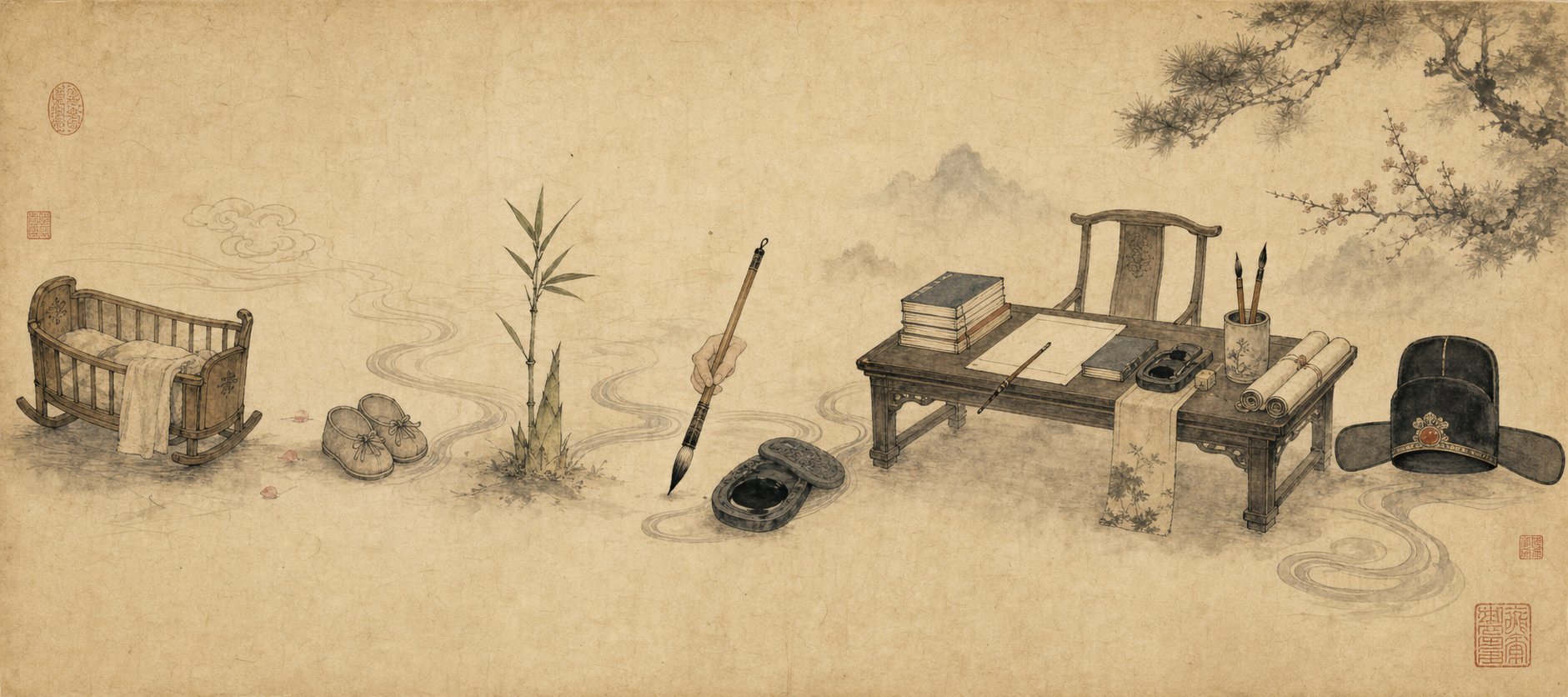
A single name was never enough. In traditional Chinese society, a person accumulated multiple names and characters across their lifetime, each one marking a distinct stage of social and intellectual growth. This layered naming lifecycle — now largely extinct — reflected a worldview where identity was not fixed at birth but cultivated over decades. Understanding these old chinese names and the system behind them reveals how deeply Confucian values of maturation shaped personal identity.
Here is the chronological sequence a person moved through from infancy to full adulthood:
- Milk name (乳名/rǔmíng) — given at birth or within the first few days of life, often by grandparents
- Formal given name (名/míng) — bestowed by parents, used in official contexts and by elders
- School name (学名/xuémíng) — assigned when a child entered formal education
- Courtesy name (字/zì) — conferred at the coming-of-age ceremony, around age 20 for men and 15 for women
- Art name or pen name (号/hào) — self-chosen by scholars, poets, and artists, sometimes multiple throughout life
Each transition carried social weight. You did not simply grow older — you earned new names that signaled your evolving place in the world.
Milk Names and the Superstition of Humble Beginnings
The very first name a child received was the milk name, and it was deliberately unimpressive. Parents chose humble, even ugly-sounding names to trick malevolent spirits into overlooking the infant. The logic was straightforward: if a child appeared worthless, demons would not bother stealing their soul. Common milk names included words like Gou (狗, "dog"), Tiě (铁, "iron"), or Chǒu (丑, "ugly"). Wealthy families and peasant families alike practiced this superstition.
These chinese first names of infancy were intimate and familial. Only parents, grandparents, and close relatives used them. As the child grew, the milk name faded from public use but often persisted within the household as a term of endearment. Think of it as a protective shell — temporary, affectionate, and rooted in the belief that the spirit world was always listening.
Courtesy Names and the Transition to Adulthood
The most significant naming event in a person's life was receiving their courtesy name (字/zì). This happened during the Guan Li (冠礼) — the Confucian capping ceremony — when a young man turned 20 or a young woman turned 15. The ceremony took place in the family's ancestral temple on an auspicious date, organized by a respected senior relative, with guests and an official ceremony master present.
The courtesy name was not random. It typically expanded upon or complemented the meaning of the person's formal given name (名/míng), creating a semantic relationship between the two. Once conferred, the courtesy name became the primary way peers and acquaintances addressed you. Using someone's given name (名) after they had received their courtesy name was considered either deeply intimate or outright rude — reserved only for parents, grandparents, teachers, and the emperor.
Consider some famous chinese names to see this relationship in action. The Tang dynasty poet Li Bai (李白) — where Bai (白, "white" or "pure") was his given name — carried the courtesy name Taibai (太白, "great whiteness"), which amplified the original meaning. The philosopher Zhuge Liang (诸葛亮), whose given name Liang (亮) means "bright," bore the courtesy name Kongming (孔明, "exceedingly bright"). The pattern is clear: the courtesy name deepens and elaborates what the birth name began.
This system encoded a Confucian ideal of social maturation. A child's name belonged to their family. An adult's courtesy name belonged to society. The transition was not merely linguistic — it marked the moment a person assumed adult responsibilities, could marry, inherit property, and participate fully in civic life.
Art Names Chosen by Scholars and Poets
Beyond the courtesy name lay one final layer: the art name or pen name (号/hào). Unlike every other name in the lifecycle, this one was self-chosen. Scholars, poets, painters, and officials selected their own 号 to express personal philosophy, geographic identity, or artistic aspiration. You could have multiple art names throughout your life, and there was no limit on character count.
Li Bai again provides a vivid example. His art name was Qinglian Jushi (青莲居士, "Householder of the Green Lotus"), referencing both his birthplace and Buddhist imagery. The Song dynasty poet Su Shi (苏轼) took the art name Dongpo Jushi (东坡居士, "Householder of the Eastern Slope") after the farmland he cultivated during political exile. These names and characters functioned as creative self-portraits — public declarations of what a person valued most.
When people addressed someone by their 号, it conveyed respect layered with distance. Younger generations and outsiders used it when even the courtesy name felt too familiar. In traditional practice, the art name stood alone without the surname attached, further distinguishing it from all other name types.
Taken together, this lifecycle meant that a single historical figure might be known by five or more different names depending on context, period of life, and the speaker's relationship to them. For anyone researching genealogical records or reading classical texts, this multiplicity explains why the same person can appear under entirely different names in different documents. The system faded during the twentieth century, but its philosophical core — that identity deepens and transforms as a person grows — remains one of the most elegant ideas embedded in Chinese naming tradition.
Of course, names did not evolve only across individual lifetimes. They also shifted dramatically across dynasties, as political upheavals and philosophical movements reshaped what parents considered meaningful, virtuous, or beautiful in a name.
How Naming Traditions Evolved Across Chinese Dynasties
Political power shapes language, and language shapes names. Across more than two millennia of imperial rule, each dynasty brought distinct values to the forefront — military conquest, moral philosophy, poetic beauty, scholarly discipline — and parents encoded those values directly into their children's names. Tracing chinese dynasty names from the Zhou through the Qing reveals a living record of what each era considered most worthy of aspiration.
Zhou and Han Dynasty Names Rooted in Virtue and Rank
During the Zhou dynasty (1046-256 BC), names served primarily as markers of clan identity and feudal position. Nobility possessed elaborate naming structures that commoners simply did not have access to. The ancient chinese characters used in Zhou-era names often referenced territorial holdings, ancestral titles, or military rank. A noble's name told you exactly where they stood in the feudal hierarchy before you ever met them.
Commoners during the early Zhou period often had only a single personal name (名/míng) with no surname at all. It was not until the late Spring and Autumn period (around 500 BC) that surnames began trickling down to common people, a process that took several centuries to complete. By the late Han dynasty (1st-2nd century AD), all Chinese commoners finally had family names.
The Han dynasty (206 BC-220 AD) transformed naming culture by elevating Confucian virtues to the center of personal identity. Characters like Ren (仁, "benevolence"), Yi (义, "righteousness"), and Xin (信, "trustworthiness") became popular chinese names for boys. This was no accident — the Han court officially adopted Confucianism as state ideology, and parents responded by embedding those ideals into their children's identities. Single-character given names dominated this period, with roughly 70 percent of names using just one character during the early Han. After the usurper Wang Mang banned two-character names outright during his brief Xin dynasty (9-23 AD), single-character names rose beyond 98 percent — a restriction that persisted culturally for nearly 400 years.
Tang and Song Dynasty Names Inspired by Poetry and Scholarship
The Tang dynasty (618-907 AD) changed everything. Poetry became the supreme cultural achievement, and the era's literary explosion poured directly into naming practices. Parents drew from the works of Du Fu, Wang Wei, and Li Bai to craft names that evoked natural beauty, philosophical depth, and emotional resonance. Common chinese names from this period favored characters associated with landscapes, seasons, and cosmic imagery — Yun (云, "cloud"), Feng (风, "wind"), and Ming (明, "bright") appeared frequently.
Tang dynasty women's names were notably bolder than those of later periods. Female names from this era often carried characters suggesting talent, ambition, and even martial spirit, reflecting the dynasty's relatively open attitudes toward women's social participation. The most popular chinese last names — Li (李), Wang (王), and Zhang (张) — were already dominant by this period, with Li holding special prestige as the imperial surname.
The Song dynasty (960-1279 AD) shifted the emphasis from poetic grandeur to scholarly refinement. Where Tang names celebrated the vast and dramatic, Song names favored the subtle and cultivated. Characters like Wen (文, "literature"), Xue (学, "learning"), Shu (书, "book"), and Ya (雅, "elegance") became typical chinese names among the educated class. The Song also saw two-character given names become the majority for the first time in a sustained way, as families increasingly adopted generation-name systems that required the extra character.
Ming and Qing Dynasty Names and Generational Poems
The Ming dynasty (1368-1644) formalized what earlier periods had only practiced loosely: the generation poem system. Clans composed structured verses — usually in lines of five or seven characters — where each character designated the shared generation name for successive cohorts of descendants. These poems could plan naming for sixteen, thirty-two, or more generations into the future.
One well-documented example is the generation poem selected in 1737 for the family of Mao Zedong, which reads: "立显荣朝士,文方运济祥。祖恩贻泽远,世代永承昌" — a four-line verse mapping out naming characters for sixteen generations. The character Ze (泽) in Mao Zedong's name comes directly from this poem, placing him precisely in the fourteenth generation of his clan's sequence.
The Qing dynasty (1644-1912) continued and expanded this practice. Chinese names popular during the Qing often reflected both Han cultural values and the Manchu ruling class's influence. The generation poem tradition became so widespread that even modest rural families maintained them, creating a system where distant cousins meeting for the first time could immediately identify their generational relationship simply by comparing names. By the late Qing, the combination of a one-character surname, a generation character, and a personal meaning character had become the standard three-character name structure still recognized today.
The table below summarizes how most common chinese names shifted in theme and structure across these major periods:
| Dynasty | Era | Naming Themes | Example Names |
|---|---|---|---|
| Zhou | 1046-256 BC | Clan identity, feudal rank, territorial holdings | 姬发 (Jī Fā) — "Ji clan, to prosper"; 公子重耳 (Gōngzǐ Chóng'ěr) — "Prince Double-Ears" |
| Han | 206 BC-220 AD | Confucian virtues, moral character, single-character names | 刘彻 (Liú Chè) — "thorough/penetrating"; 班固 (Bān Gù) — "solid/firm" |
| Tang | 618-907 AD | Poetic imagery, natural beauty, literary flourish | 王维 (Wáng Wéi) — "to maintain/uphold"; 杜甫 (Dù Fǔ) — "begin/great" |
| Song | 960-1279 AD | Scholarly refinement, elegance, intellectual cultivation | 苏轼 (Sū Shì) — "crossbar of a carriage"; 朱熹 (Zhū Xī) — "bright/prosperous" |
| Ming | 1368-1644 AD | Generation poems, clan unity, formalized naming systems | 朱瞻基 (Zhū Zhānjī) — "gaze upon the foundation"; 王阳明 (Wáng Yángmíng) — "bright sun" |
| Qing | 1644-1912 AD | Generation poems continued, literary allusion, balanced elements | 毛泽东 (Máo Zédōng) — "grace the East"; 曾国藩 (Zēng Guófān) — "nation's fence/protector" |
Notice how each dynasty's dominant values — military strength under the Zhou, moral cultivation under the Han, artistic beauty under the Tang, intellectual discipline under the Song, and clan cohesion under the Ming and Qing — map directly onto the naming patterns that emerged. Names were never just personal. They were political and philosophical statements, miniature declarations of what a civilization valued most at any given moment in its history.
These dynasty-level shifts did not happen in a vacuum. Behind the evolving preferences stood specific literary texts — classical poetry collections and philosophical works that served as naming sourcebooks for centuries, giving parents a shared vocabulary of beauty and meaning to draw from.
Classical Literature That Inspired Generations of Names
Chinese parents did not invent names from thin air. For centuries, they turned to a shared canon of classical texts — poetry anthologies, philosophical treatises, and mythological epics — as sourcebooks for naming their children. This practice carried a dual purpose: it produced beautiful chinese names rooted in literary tradition, and it signaled the parents' own education and cultural refinement. A name traced to a famous poem told the world that this family read, studied, and valued the written word.
The most enduring convention is captured in a six-character saying still quoted today: "女诗经,男楚辞" — girls' names from the Book of Songs, boys' names from the Chu Ci. These two texts, composed between roughly 1000 and 300 BC, provided the foundational vocabulary for meaning chinese names across millennia. But they were not the only sources. Books of Tang poet collections and the Book of Changes (易经/Yìjīng) also fed the naming tradition, each contributing a distinct flavor of beauty and philosophy.
Book of Songs Names for Girls and Their Poetic Origins
The Book of Songs (诗经/Shījīng) is China's oldest poetry anthology, containing 305 poems dating from the 11th to 7th centuries BC. Its verses celebrate love, nature, domestic life, and seasonal beauty — themes that made it a natural source for chinese names female and meanings associated with grace and charm. When you encounter pretty chinese names drawn from the Shijing, you are hearing echoes of lyrics that are over 2,500 years old.
Here are specific chinese girl names and meanings traced directly to Shijing verses:
- 静姝 (Jìngshū) — from 《邶风·静女》: "静女其姝,俟我于城隅" (The quiet girl, so beautiful, waits for me at the corner of the wall). Meaning: serene and lovely.
- 琼琚 (Qióngjū) — from 《卫风·木瓜》: "投我以木瓜,报之以琼琚" (You toss me a papaya, I give you a jade pendant in return). Meaning: precious jade ornament.
- 舜华 (Shùnhuá) — from 《郑风·有女同车》: "有女同车,颜如舜华" (A woman rides beside me, her face like hibiscus blossoms). Meaning: hibiscus flower, radiant beauty.
- 蓁蓁 (Zhēnzhēn) — from 《周南·桃夭》: "桃之夭夭,其叶蓁蓁" (The peach tree is young and fresh, its leaves lush and full). Meaning: flourishing, abundant vitality.
- 静好 (Jìnghǎo) — from 《郑风·女曰鸡鸣》: "琴瑟在御,莫不静好" (When zither and lute play together, all is peaceful and fine). Meaning: tranquil contentment.
Notice how each name carries not just a definition but an entire scene — a woman at a city wall, jade exchanged between lovers, peach blossoms in spring. This is what gives names in chinese and meanings their distinctive depth. The name is a doorway into a poem, and the poem is a doorway into an ancient emotional world.
Chu Ci Names for Boys With Heroic Undertones
The Chu Ci (楚辞/Chǔcí), or Songs of Chu, is a collection of poems attributed primarily to Qu Yuan (屈原, c. 340-278 BC), a nobleman and patriot of the Chu state. Where the Shijing is gentle and domestic, the Chu Ci is dramatic, mythological, and fiercely idealistic. Its verses describe cosmic journeys, encounters with gods, and the anguish of political exile. This made it the preferred source for chinese names with meaning tied to ambition, integrity, and heroic aspiration.
- 正则 (Zhèngzé) — from 《离骚》: "名余曰正则兮,字余曰灵均" (They named me Upright Principle, and styled me Divine Balance). Meaning: upright and principled. This was Qu Yuan's own given name.
- 灵均 (Língjūn) — from the same line above. Meaning: divinely balanced, spiritually harmonious.
- 修远 (Xiūyuǎn) — from 《离骚》: "路漫漫其修远兮,吾将上下而求索" (The road ahead is long and far; I shall search high and low). Meaning: long-reaching, persevering.
- 望舒 (Wàngshū) — from 《离骚》: "前望舒使先驱" (I sent Wangshū, the moon's charioteer, to ride ahead). Meaning: the one who greets the moon, a mythological chariot driver.
- 信芳 (Xìnfāng) — from 《离骚》: "苟余情其信芳" (If only my heart remains truly fragrant). Meaning: genuinely virtuous, inner integrity.
These names carry weight precisely because the Chu Ci itself carries weight. Qu Yuan is remembered as the archetype of the loyal, principled scholar who chose death over moral compromise. Naming a son from his verses was a declaration: we want this child to stand for something, even when standing is difficult.
Tang Poetry as a Source of Elegant Given Names
By the Tang dynasty (618-907 AD), China's poetic tradition had reached its peak. The Complete Tang Poems (全唐诗/Quán Tángshī) contains nearly 50,000 poems by over 2,200 authors — an enormous reservoir of imagery and language. Parents mining these books of Tang poet collections found names that blended natural beauty with philosophical resonance, producing some of the most elegant given names in Chinese history.
- 云帆 (Yúnfān) — from Li Bai's 《行路难》: "长风破浪会有时,直挂云帆济沧海" (A time will come to ride the wind and cleave the waves; I'll hoist my cloud-white sail and cross the vast sea). Meaning: cloud sail, boundless ambition.
- 清泉 (Qīngquán) — from Wang Wei's 《山居秋暝》: "明月松间照,清泉石上流" (Bright moon shines through the pines; clear spring flows over stones). Meaning: clear spring, purity and naturalness.
- 春晓 (Chūnxiǎo) — from Meng Haoran's 《春晓》: "春眠不觉晓" (In spring sleep, one does not notice the dawn). Meaning: spring dawn, gentle awakening.
- 逸兴 (Yìxīng) — from Li Bai's 《宣州谢朓楼饯别校书叔云》: "俱怀逸兴壮思飞" (We both harbor soaring spirits and bold thoughts that fly). Meaning: unbounded inspiration.
The Book of Changes (易经/Yìjīng) added yet another dimension. Names drawn from the Yijing — such as Qianyuan (乾元, "primal creative force") or Hengfu (恒孚, "enduring sincerity") — connected a child to cosmological principles of transformation and balance. These names carried an almost talismanic quality, as if aligning the child's identity with the fundamental patterns of the universe itself.
Literary sourcing was never merely decorative. It functioned as a social signal, a philosophical statement, and a form of cultural inheritance all at once. A name traced to the Shijing or Chu Ci told everyone who heard it that this family valued education, respected tradition, and understood the weight of language. That same impulse — encoding values into characters — extended beyond literature into the deeper systems of philosophy and cosmology that governed which characters were considered auspicious, balanced, or fated for a particular child.
Philosophy and Cosmology Behind Choosing the Right Name
Literature gave names their beauty. But philosophy gave names their power. Behind every carefully chosen character lay a web of cosmological systems — elemental theory, numerological analysis, moral frameworks, and spiritual beliefs — that determined whether a name was merely pleasant or genuinely auspicious. For families who took these systems seriously, understanding what a chinese name mean went far beyond dictionary definitions. It meant reading the universe's blueprint and aligning a child's identity with cosmic forces.
Five Elements Theory and Balancing a Child's Destiny
The Five Elements theory (五行/wǔxíng) was perhaps the most influential system governing name selection. The concept is straightforward: everything in the universe belongs to one of five elemental categories, and these elements interact through cycles of generation and destruction. A child's birth time — calculated through the "eight characters" (八字/bāzì) of year, month, day, and hour — reveals which elements are present or absent in their destiny. The parents' task was to compensate for whatever element was missing by embedding it in the child's name.
Imagine a child born at a time dominated by fire and earth but lacking water. The parents would select characters containing the water radical (氵) or carrying water-associated meanings — names like 浩 (Hào, "vast waters"), 泽 (Zé, "marsh/grace"), or 淼 (Miǎo, "expansive water"). This was not decoration. It was considered a form of destiny correction, a way to restore elemental balance to a life that might otherwise tilt toward imbalance.
Each element carries distinct qualities and associated characters commonly used in naming:
- Metal (金/jīn) — represents righteousness and strength. Common name characters: 鑫 (Xīn, "abundance of gold"), 锋 (Fēng, "sharp edge"), 铭 (Míng, "inscribed/remembered")
- Wood (木/mù) — represents benevolence and growth. Common name characters: 林 (Lín, "forest"), 松 (Sōng, "pine tree"), 荣 (Róng, "flourishing")
- Water (水/shuǐ) — represents wisdom and adaptability. Common name characters: 浩 (Hào, "vast"), 涵 (Hán, "contain/encompass"), 清 (Qīng, "clear")
- Fire (火/huǒ) — represents propriety and passion. Common name characters: 炎 (Yán, "blazing"), 煜 (Yù, "radiant"), 烨 (Yè, "brilliant")
- Earth (土/tǔ) — represents fidelity and stability. Common name characters: 坤 (Kūn, "earth/feminine"), 培 (Péi, "cultivate"), 城 (Chéng, "city/fortress")
The generating cycle — metal produces water, water nourishes wood, wood feeds fire, fire creates earth, earth bears metal — also influenced how parents paired characters within a two-character given name. Ideally, the elements in a name would flow in a generative rather than destructive relationship. A chinese name related to luck was not simply one with a "lucky" meaning; it was one whose elemental composition harmonized with the child's birth chart.
Stroke Count Analysis and Auspicious Characters
Beyond elemental balance, the physical structure of characters mattered. Stroke count analysis (笔画/bǐhuà) treated the number of brushstrokes in each character as numerologically significant. Characters with an even number of strokes were classified as Yin, while those with an odd number were Yang. A well-constructed name needed to balance these forces in specific patterns — Yang-Yang-Yin, Yin-Yin-Yang, Yang-Yin-Yin, or Yin-Yang-Yang.
The total stroke count of the full name also had to land on an auspicious number. Certain totals — 3, 5, 6, 8, 11, 13, 15, 16, 21, 23, 25, 31, 32, 33, 37, 39, 45, 48, 52, 63, 65, 67, 68, 73, and 81 — were considered favorable. Parents or naming specialists would test different character combinations until they found one where meaning, sound, elemental balance, and stroke count all aligned. Sounds complex? It was. Professional name consultants existed precisely because juggling all these variables required specialized knowledge.
This system also explains why the mandarin name meaning of a character was never the sole consideration. Two characters might share an identical definition, but one could be auspicious and the other inauspicious based purely on stroke count and elemental classification. The china name meaning operated on visible and invisible levels simultaneously.
Confucian Virtues Encoded in Name Characters
Not every family relied on cosmological calculation. For Confucian-minded parents, the five cardinal virtues offered a more direct path to meaningful naming. These virtues — 仁 (Rén, "benevolence"), 义 (Yì, "righteousness"), 礼 (Lǐ, "propriety"), 智 (Zhì, "wisdom"), and 信 (Xìn, "trustworthiness") — appeared as name characters across every dynasty from the Han onward. A name like 仁杰 (Rénjié, "benevolent and outstanding") or 义山 (Yìshān, "righteous as a mountain") wore its moral aspiration openly.
Buddhist and Daoist traditions introduced a different vocabulary. Buddhist-influenced names favored characters like 慧 (Huì, "enlightenment/wisdom"), 净 (Jìng, "purity"), and 觉 (Jué, "awakening"). Daoist names leaned toward naturalness and harmony: 道 (Dào, "the Way"), 玄 (Xuán, "mysterious/profound"), and 逸 (Yì, "free/unrestrained"). The chinese symbol that means love — 爱 (Ài) — also carried Buddhist overtones of universal compassion, though it appeared more commonly in names after the Song dynasty when Neo-Confucianism blended these traditions together.
All of these systems — elemental, numerological, and philosophical — operated within one final constraint that overrode everything else: naming taboos.
In imperial China, using any character from the reigning emperor's personal name in your child's name was not merely disrespectful — it was a criminal offense punishable by imprisonment or death.
This practice, called bìhuì (避讳), extended beyond the emperor. Families were expected to avoid characters used in the names of living elders — parents, grandparents, and ancestors going back as many as seven generations. The naming taboo of the state (国讳/guóhuì) prohibited the emperor's name characters; the naming taboo of the clan (家讳/jiāhuì) prohibited ancestral characters; and the naming taboo of the sages (圣人讳/shèngrén huì) discouraged using the names of revered figures like Confucius.
The consequences were real. In 1777, scholar Wang Xihou wrote the Qianlong Emperor's name without omitting the required stroke — and his entire family was executed. Some emperors, recognizing the burden this placed on millions of people, deliberately chose rare characters for their names. Emperor Xuan of Han even changed his own name from the common characters 病已 (Bìngyǐ) to the far rarer 询 (Xún) specifically to ease the public's naming restrictions.
For parents, taboos meant that the perfect name — elementally balanced, numerologically sound, philosophically rich — could still be forbidden if it happened to share a character with the wrong person. This added yet another layer of complexity to an already demanding process, and it explains why naming a child in traditional China was never a casual decision but a careful negotiation between aspiration, cosmology, and political reality.
Historical Chinese Boy Names Grouped by Meaning
Philosophical systems and literary sources provided the raw materials. But what did the finished product actually look like? When parents sat down to name a son, they chose characters that expressed specific aspirations — and those aspirations shifted depending on whether the empire was at war or at peace, expanding its borders or cultivating its libraries. Chinese boy names from the historical record cluster around four major themes: martial strength, scholarly achievement, moral virtue, and natural imagery.
What makes these male chinese given names so revealing is how directly they mirror the political climate of their era. Warring States and early Han parents favored characters evoking military power and territorial ambition. Tang and Song parents reached for literary elegance and intellectual depth. Ming and Qing parents blended both traditions, often within a single two-character name. The result is a naming archive that reads like a cultural mood ring spanning two millennia.
Names Reflecting Strength and Military Honor
During periods of conflict and territorial expansion, masculine chinese names leaned heavily toward martial imagery. Characters referencing weapons, conquest, and physical power dominated. The Han general Huo Qubing (霍去病, Huò Qùbìng) bore a name meaning "expel illness" — a fierce declaration of strength. The Tang general Xue Rengui (薛仁贵, Xuē Rénguì) carried characters meaning "benevolent and noble," blending Confucian virtue with warrior identity. These were not abstract wishes. They were battle cries compressed into two syllables.
Common chinese boy names from military eras include 武 (Wǔ, "martial"), 刚 (Gāng, "steel-hard"), and 胜 (Shèng, "victory"). Parents who named sons during the Warring States period or the Three Kingdoms era chose characters that projected dominance — a child named 文武 (Wénwǔ, "literary and martial") was expected to master both the brush and the blade.
Names Celebrating Scholarship and Wisdom
Peaceful dynasties produced a different vocabulary. When the empire was stable and the civil examination system determined social mobility, chinese masculine names shifted toward intellectual aspiration. Characters like 志 (Zhì, "ambition/will"), 远 (Yuǎn, "far-reaching"), and 博 (Bó, "broad learning") became the building blocks of scholarly identity.
The name 志远 (Zhìyuǎn, "far-reaching ambition") traces its philosophical roots to Zhuge Liang's famous letter to his son: "非淡泊无以明志,非宁静无以致远" — without tranquility, one cannot reach far. Song dynasty scholar-officials favored names like 思齐 (Sīqí, "aspires to virtue"), drawn directly from the Analerta of Confucius. The name 天赐 (Tiāncì, "heaven-bestowed") expressed gratitude and cosmic favor, popular among families who viewed their son's birth as divinely ordained.
Names Drawn From Nature and Cosmic Imagery
A third category of chinese names for boys drew power not from human achievement but from the natural world. Mountains, rivers, dragons, and celestial bodies provided imagery that suggested permanence, grandeur, and forces beyond human control. The Tang poet Wang Wei (王维) bore a name meaning "to uphold" — paired with his courtesy name Mojie (摩诘), it referenced the Buddhist figure Vimalakirti. The name 浩然 (Hàorán, "vast and righteous spirit") comes from Mencius's concept of the "flood-like qi" and was borne by the Tang poet Meng Haoran.
These nature-derived chinese male names carried a philosophical edge. Naming a son after a mountain was not merely poetic — it was a statement about endurance. Naming him after the sky declared limitless potential.
The table below presents a curated selection of chinese boy names and meanings organized by theme, with dynasty context and cultural background:
| Chinese Characters | Pinyin | Meaning | Dynasty/Era | Cultural Context |
|---|---|---|---|---|
| 文武 | Wénwǔ | Literary and martial | Zhou-Han | The ideal of mastering both civil and military arts; echoes the phrase "允文允武" |
| 去病 | Qùbìng | Expel illness/enemies | Han | Name of general Huo Qubing, who defeated the Xiongnu at age 17 |
| 世民 | Shìmín | Benefit the people | Tang | Personal name of Emperor Taizong of Tang, one of China's greatest rulers |
| 志远 | Zhìyuǎn | Far-reaching ambition | Song-Ming | From Zhuge Liang's letter: "非宁静无以致远" (without calm, one cannot reach far) |
| 浩然 | Hàorán | Vast righteous spirit | Tang | From Mencius's "浩然之气"; name of poet Meng Haoran |
| 天赐 | Tiāncì | Heaven-bestowed | Ming-Qing | Expresses gratitude for divine favor; popular among devout families |
| 定国 | Dìngguó | Stabilize the nation | Han | Name of Han dynasty minister Zhang Dingguo; projects political responsibility |
| 思齐 | Sīqí | Aspire to virtue | Song | From the Analects: "见贤思齐" (see virtue, aspire to match it) |
| 鹏飞 | Péngfēi | Roc in flight | Song-Ming | From Zhuangzi's mythical Peng bird; symbolizes soaring ambition |
| 继光 | Jìguāng | Inherit the light | Ming | Name of general Qi Jiguang, who defended China's coast against pirates |
| 博文 | Bówén | Broad learning | Song-Qing | From the Analects: "博学于文" (study literature broadly) |
| 凌云 | Língyún | Piercing the clouds | Tang-Song | Suggests ambition that transcends ordinary limits; common in poetry |
You'll notice a pattern: names from wartime eras reference concrete action — expelling, stabilizing, defending. Names from peaceful eras reference inner qualities — aspiration, learning, righteousness. And nature names transcend both, offering imagery that works in any political climate. This is why names like 浩然 and 志远 have remained popular across centuries while names like 去病 feel rooted in a specific historical moment.
The gendered dimension matters here too. While these chinese boy names emphasize outward achievement and cosmic scale, the naming tradition for girls drew from an entirely different palette — one centered on natural beauty, poetic grace, and literary heroines whose names carried their own quiet power.
Historical Chinese Girl Names With Poetic Origins
Where boys' names projected outward into the world — conquering, stabilizing, soaring — female chinese names historically turned inward toward beauty, refinement, and emotional depth. Ancient chinese girls names drew from flowers, jade, moonlight, and the quiet power of literary heroines. Yet this palette was never static. Tang dynasty women bore bold names suggesting talent and independence, while Song dynasty parents favored restrained elegance. Ming and Qing naming leaned toward classical allusion and moral grace. Each era's ideals for women shaped the characters parents chose, making chinese names for girls a mirror of shifting cultural expectations across centuries.
Names Inspired by Flowers and Natural Beauty
Flowers, gemstones, and celestial imagery formed the most enduring vocabulary for chinese girls names. The logic was both aesthetic and symbolic: a flower name did not merely sound pretty — it carried specific associations with virtue, resilience, or seasonal meaning. Orchids (兰/lán) represented moral purity. Lotus (莲/lián) suggested rising above muddy circumstances. Plum blossoms (梅/méi) symbolized perseverance through winter hardship.
The name 兰芝 (Lánzhī, "orchid and lingzhi mushroom") combined two plants associated with longevity and moral refinement. It appears in the Han dynasty narrative poem Southeast the Peacock Flies (《孔雀东南飞》) as the name of the tragic heroine Liu Lanzhi — a woman whose loyalty and dignity made her a literary icon. The name 明月 (Míngyuè, "bright moon") drew from countless Tang poems celebrating moonlight as a symbol of purity and emotional longing. Li Bai's famous line "举头望明月" (I raise my head and gaze at the bright moon) gave this name an almost universal resonance.
Jade imagery was equally powerful. In classical Chinese literature, jade described not just the stone but anything supremely desirable — the colors of the sky, the hills, and the sea could all be found in jades, which the Chinese considered the most precious of stones. Names like 玉环 (Yùhuán, "jade armlet") — the personal name of the famous Tang concubine Yang Guifei — and 琼瑶 (Qióngyáo, "precious jade") carried this layered symbolism of beauty, rarity, and enduring value.
Names Embodying Grace and Classical Femininity
Beyond natural imagery, a distinct category of china female names encoded feminine virtues directly into characters. The Book of Songs provided 婉清 (Wǎnqīng, "gentle and pure"), drawn from verses celebrating women of graceful temperament. The character 婉 (wǎn) alone — meaning "gentle, compliant, beautiful" — appeared in countless names across dynasties, paired with characters for clarity, tranquility, or literary refinement.
A study on Chinese women's naming practices notes that traditional female names often centered on four qualities: virtue (德/dé), speech (言/yán), appearance (容/róng), and needlework (功/gōng). While this framework reflected patriarchal expectations, it also produced names of genuine linguistic beauty. Characters like 淑 (Shū, "virtuous and kind"), 慧 (Huì, "intelligent"), and 贞 (Zhēn, "steadfast") gave a chinese girl name moral weight alongside aesthetic appeal.
The Tang dynasty loosened these conventions considerably. Women's names from this era sometimes carried characters suggesting boldness and talent — 英 (Yīng, "heroic"), 才 (Cái, "talent"), and even 武 (Wǔ, "martial"), as in the case of Empress Wu Zetian. This openness contracted during the Song dynasty, when Neo-Confucian ideals reasserted more restrained feminine virtues, and names like 静 (Jìng, "tranquil") and 柔 (Róu, "soft") regained dominance.
Names From Poetry and Literary Heroines
Some of the most enduring chinese names girl families chose came not from abstract virtues but from specific literary characters and real historical women whose stories gave the name emotional resonance. The name 徽因 (Huīyīn, "excellent fame") was drawn from the Book of Songs and later made famous by the modern poet and architect Lin Huiyin (1904-1955), whose original name 徽音 came directly from the Shijing verse praising a woman of outstanding reputation. The name 莫愁 (Mòchóu, "free of sadness") first appeared in the Collection of Yuefu Poetry spanning the Qin through Tang dynasties, and became one of the most recognized literary names in Chinese culture.
The name 芷若 (Zhǐruò) combines two herbal plants — angelica and pollia — reflecting the ancient Chinese tradition of likening beautiful women to fragrant herbs. Similarly, 语嫣 (Yǔyān) derives from the classical phrase "语笑嫣然," describing a woman whose smile and speech radiate warmth. These names demonstrate how chinese female names could encode an entire aesthetic ideal within two characters.
The table below presents a curated selection of historical chinese names for girls organized by theme:
| Chinese Characters | Pinyin | Meaning | Literary Source | Era |
|---|---|---|---|---|
| 婉清 | Wǎnqīng | Gentle and pure | Book of Songs (诗经) | Zhou-Han |
| 兰芝 | Lánzhī | Orchid and lingzhi | Southeast the Peacock Flies (孔雀东南飞) | Han |
| 明月 | Míngyuè | Bright moon | Li Bai, Tang poetry | Tang |
| 玉环 | Yùhuán | Jade armlet | Historical — Yang Guifei's personal name | Tang |
| 静姝 | Jìngshū | Serene and lovely | Book of Songs, 《邶风·静女》 | Zhou-Han |
| 徽因 | Huīyīn | Excellent fame | Book of Songs (诗经) | Zhou onward |
| 莫愁 | Mòchóu | Free of sadness | Collection of Yuefu Poetry (乐府诗集) | Six Dynasties-Tang |
| 映月 | Yìngyuè | Reflection of the moon | Classical imagery | Tang-Song |
| 芷若 | Zhǐruò | Angelica and pollia | Chu Ci tradition of herbal metaphor | Pre-Qin onward |
| 淑慧 | Shūhuì | Virtuous and wise | Confucian virtue tradition | Song-Ming |
| 秋瑾 | Qiūjǐn | Autumn jade | Historical — revolutionary poet Qiu Jin | Late Qing |
| 琼瑶 | Qióngyáo | Precious jade | Book of Songs, 《卫风·木瓜》 | Zhou onward |
You'll notice a trajectory in this table. Early names (Zhou-Han) tend toward natural simplicity — flowers, jade, moonlight described plainly. Tang names grow bolder, sometimes referencing real women of power and beauty. Song-Ming names return to scholarly refinement and moral virtue. Late Qing names like 秋瑾 (Qiūjǐn) — borne by the revolutionary feminist poet who was executed in 1907 — signal a dramatic break, using imagery of autumn sharpness rather than spring softness.
This evolution matters because it shows that female chinese names were never a monolithic tradition of passive beauty. They tracked the same cultural and political currents that shaped men's names, just through a different symbolic vocabulary. The boldness of Tang, the restraint of Song, the formality of Ming — all left their fingerprints on what parents considered a fitting name for a daughter.
For modern families drawn to these traditions, the practical question becomes: how do you carry a name rooted in classical poetry and dynastic culture into a world of international travel, multiple dialects, and government character regulations? That bridge between heritage and practicality is where the real work of adaptation begins.
Adapting Historical Names for Modern Families
A name like 婉清 (Wǎnqīng) looks perfect on paper — poetic origin, balanced tones, elegant meaning. But what happens when that name needs to appear on a passport, be pronounced by a kindergarten teacher in Toronto, or pass through a government character database in Beijing? For families who want to honor centuries of naming tradition while living in a globalized world, the gap between classical beauty and modern practicality is where the real decisions happen.
Choosing Characters That Work Across Dialects and Romanizations
One character can sound completely different depending on whether it is read in Mandarin, Cantonese, Hokkien, or Hakka. The character 明 is "Míng" in Mandarin Pinyin, "Ming" in Cantonese Jyutping, and would have appeared as "Ming" in the older Wade-Giles system too — a lucky case of consistency. But many characters are not so cooperative. The character 志 is "Zhì" in Pinyin, "Zi" in Jyutping, and "Chih" in Wade-Giles. For diaspora families whose relatives span multiple dialect groups, this divergence matters.
The Library of Congress Pinyin Conversion Project documents the key differences between Wade-Giles and Pinyin romanization systems. Wade-Giles uses apostrophes and hyphens — a personal name like "Wang T'ieh-jen" becomes "Wang Tieren" in Pinyin. Syllables that were hyphenated in Wade-Giles get joined together in Pinyin. This means the same historical name can appear under entirely different spellings depending on when and where it was recorded. If you are researching chinese names in chinese genealogical records, recognizing both systems prevents you from mistaking one ancestor for two different people.
For parents choosing a name today, the practical implication is clear: test how your chosen characters romanize across systems. A name that produces a clean, pronounceable Pinyin spelling — without awkward consonant clusters like "zh" or "x" that trip up non-Mandarin speakers — will travel more easily across linguistic borders. Names in chinese that begin with sounds like "L," "M," "W," or "Y" tend to cross dialect and language boundaries with less friction.
Balancing Cultural Heritage With International Practicality
Official naming regulations add another layer. In mainland China, names must use characters found in the standardized General Standard Chinese Characters table — a set of roughly 8,105 characters. Rare classical characters that appear in ancient poetry may not be included, which means a name drawn directly from the Chu Ci or Book of Songs could be rejected at the household registration office. Taiwan follows its own Name Act regulations, requiring that adopted Chinese names use approved characters and follow the surname-first convention without periods or spaces separating family and given names.
For families living abroad, the question of how to say "my name is" in chinese contexts while also functioning in English-speaking environments often leads to a dual-name strategy. Many parents give their child a formal Chinese name for family and cultural identity alongside an English name for daily use. Others choose a Chinese name whose romanized form doubles as a recognizable English name — names like 美 (Měi/May), 丽 (Lì/Lee), or 凯 (Kǎi/Kai) bridge both worlds without requiring a separate Western name.
A chinese name generator tool can suggest characters based on desired meanings or sounds, but these automated options rarely account for tonal harmony, dialect pronunciation, or the cultural weight of specific character combinations. Consulting a native speaker — ideally someone familiar with classical literature — remains the most reliable path to a name that feels authentic rather than assembled from a database.
Honoring Tradition While Meeting Modern Naming Requirements
The generation poem tradition has faded in urban China but persists in many overseas Chinese communities and rural clans. Families who want to maintain this practice face a practical tension: the generation character assigned by the poem may not pair well with modern naming aesthetics or may use a character unfamiliar to younger generations. Some families compromise by using the generation character as a middle character in the legal name while choosing a more contemporary meaning character. Others honor the tradition informally — recording the generational name in family documents while using a different name in daily life.
If you are selecting a historical name for a child today, here is a practical checklist:
- Verify character legality — confirm that your chosen characters appear in the approved character set for the country where the birth will be registered (mainland China, Taiwan, or other jurisdiction).
- Check stroke count if desired — if your family values numerological balance, calculate the total strokes and verify they fall on an auspicious number before finalizing.
- Test pronunciation across languages — say the full name aloud in Mandarin, your family's dialect, and the primary language of your community. Listen for unintended homophones or awkward sounds.
- Confirm no unintended meanings in other dialects — a character that sounds elegant in Mandarin may carry slang or negative connotations in Cantonese, Hokkien, or Shanghainese. Ask relatives who speak those dialects.
- Evaluate the romanized spelling — write out the Pinyin (or Jyutping, if Cantonese-speaking) and consider whether non-Chinese speakers can approximate the pronunciation from the spelling alone.
- Research the name in chinese meaning across contexts — search the characters online to check whether they appear in any widely known negative associations, brand names, or pop culture references that might date the name.
Historical chinese baby names carry something that trendy modern names often lack: depth tested by centuries of use, literary resonance that connects a child to a civilization's greatest poetry, and philosophical weight that gives a name purpose beyond sound. A child named 修远 (Xiūyuǎn) carries Qu Yuan's determination. A daughter named 静好 (Jìnghǎo) carries the peaceful harmony of a 2,500-year-old love poem. These are not relics. They are living connections to a tradition that understood naming as one of the most consequential acts a parent could perform — a gift of identity that would shape how a person moved through the world for an entire lifetime.
Frequently Asked Questions About Historical Chinese Baby Names
1. How do Chinese names work structurally?
Chinese names place the surname (姓/xìng) first, followed by a one- or two-character given name (名/míng). In families using the generation character system (字辈/zìbèi), one character in the given name is shared by all siblings and cousins of the same generation, while the second character is unique to the individual. This structure means a three-character Chinese name typically breaks down as one-character surname plus two-character given name, functioning as a compact genealogical record that identifies clan, generation, and personal identity simultaneously.
2. What classical texts were traditionally used to choose Chinese baby names?
The two most important sources follow the saying '女诗经,男楚辞' — girls' names from the Book of Songs (诗经/Shījīng) and boys' names from the Chu Ci (楚辞/Chǔcí). The Book of Songs, dating from the 11th to 7th centuries BC, provided names associated with natural beauty and grace. The Chu Ci, attributed to poet Qu Yuan, offered names tied to heroic ambition and moral integrity. Tang poetry collections and the Book of Changes (易经/Yìjīng) also served as naming sourcebooks, contributing imagery of landscapes, cosmic principles, and philosophical depth.
3. What is the Five Elements theory in Chinese naming?
The Five Elements theory (五行/wǔxíng) is a cosmological system where a child's birth time reveals which elements — metal, wood, water, fire, or earth — are present or absent in their destiny. Parents compensate for missing elements by choosing name characters containing the corresponding radical or meaning. For example, a child lacking water might receive a name with the water radical (氵) such as 浩 (Hào, vast waters). The goal is elemental balance rather than simply selecting a character with a pleasant definition, making it a form of destiny correction through naming.
4. Why did ancient Chinese people have multiple names throughout their lives?
Traditional Chinese society used a layered naming lifecycle reflecting Confucian values of social maturation. A person received a milk name (乳名) at birth — often deliberately humble to ward off evil spirits — then a formal name for official use, a school name upon entering education, a courtesy name (字/zì) at their coming-of-age ceremony around age 20, and finally a self-chosen art name (号/hào) as a scholar or artist. Each name marked a distinct stage of identity development, with strict social rules governing who could use which name in conversation.
5. How can modern families use historical Chinese naming traditions today?
Modern families can adapt historical traditions by verifying that chosen characters appear in approved government character sets, testing pronunciation across dialects and languages, checking for unintended meanings in Cantonese or other regional varieties, and evaluating how the romanized spelling reads to non-Chinese speakers. Families maintaining the generation poem tradition can use the generational character as a middle character while choosing a contemporary meaning character. Consulting native speakers familiar with classical literature helps ensure a name feels authentic rather than assembled from automated tools.