How Historical Chinese Naming Practices Shaped Identity and Power
Imagine a system where your name could determine your political standing, reveal your generation within a clan stretching back millennia, and even reshape the written language itself. For most of Chinese history, naming was never a casual act. It was a philosophical statement, a political tool, and a familial contract rolled into a handful of carefully chosen characters.
Historical Chinese naming practices operated as one of the most elaborate identity systems any civilization has produced. From the earliest oracle bone inscriptions of the Shang dynasty through the final years of imperial rule, the act of naming carried weight that extended far beyond personal preference. It touched governance, kinship, cosmology, and social hierarchy in ways that still echo through Chinese culture today.
How Chinese Names Are Structured
The chinese name order reverses what English speakers expect. The surname (姓, xing) comes first, followed by the given name (名, ming). A person named Wang Wei, for example, belongs to the Wang family and carries the personal name Wei. This structure reflects a core cultural priority: the collective identity of the family precedes the individual.
What makes this chinese name structure especially revealing is the etymology of the word for surname itself. The character 姓 combines two components: 女 (woman) and 生 (birth). It literally encodes the concept of "born of a woman," pointing to a time when lineage was traced through mothers rather than fathers. The earliest chinese last names, including 姬 (Ji), 姜 (Jiang), and 姚 (Yao), all contain the 女 (woman) radical, preserving this matrilineal origin in their very brushstrokes.
As Chinese society shifted toward patrilineal inheritance during the Zhou dynasty, the surname system transformed with it. Yet the linguistic fossil of its matrilineal roots remained embedded in the character 姓, a reminder that the system predates the patriarchal order most people associate with Chinese tradition.
The concentration of common chinese names is staggering. The five most common chinese last names, Wang, Li, Zhang, Liu, and Chen, are shared by more than 433 million people, roughly 30% of China's population. The top three surnames alone account for approximately 270 million people. China has recorded over 20,000 surnames throughout its history, yet only about 6,000 remain in use, and nearly 86% of the population shares just 100 of them.
Why Naming Carried Political and Philosophical Weight
Chinese names were never merely labels. They functioned as instruments of social order. No thinker articulated this more clearly than Confucius, whose doctrine of zhengming, the "rectification of names," elevated naming from a personal matter to a pillar of statecraft.
"If names are not rectified, then language will not be in accord with truth. If language is not in accord with truth, then things cannot be accomplished." This Confucian principle of zhengming (正名) transformed naming into political philosophy, asserting that correct names produce correct relationships, and correct relationships produce a harmonious state.
The doctrine of zhengming implied that every citizen should live out the full meaning of their name and role. A ruler must rule; a minister must serve; a father must parent. When names no longer matched reality, Confucius argued, social disorder followed. This philosophy meant that chinese names carried prescriptive force. They did not simply describe a person. They defined what that person ought to be.
This fusion of naming and governance produced a tradition spanning thousands of years, from the day-stem names inscribed on Shang dynasty oracle bones to the imperially decreed generational poems of the Qing era. Each dynasty layered new conventions, taboos, and cosmological calculations onto the act of choosing a name, building a system of extraordinary depth and consequence.
Origins and Evolution of Chinese Family Names
The concentration of chinese last names among a relatively small pool raises an obvious question: where did these surnames come from, and why are there so few? The answer stretches back over three thousand years, to a time when the concept of a surname in chinese culture meant something fundamentally different from what it means today.
From Matrilineal Clans to Patrilineal Surnames
The earliest Chinese surnames emerged during the Shang dynasty (c. 1600-1046 BC), appearing on oracle bone inscriptions as markers of clan identity. These original surnames, called 姓 (xing), functioned as identifiers for exogamous blood groups. They told people who they could not marry. If two people shared the same xing, they belonged to the same maternal clan and marriage between them was forbidden.
You'll notice something telling about the oldest surviving xing: 姬 (Ji), 姜 (Jiang), 姚 (Yao), 姒 (Si), and 嬴 (Ying) all contain the 女 (woman) radical. This is not coincidence. These names trace back to matrilineal clan structures where lineage passed through mothers. Each xing connected to a semi-mythological ancestress, and the clan it represented could encompass thousands of people spread across vast territories.
Alongside xing, a second category existed: 氏 (shi). While xing marked the broad maternal clan, shi identified specific patrilineal branches within that clan. Think of it this way: xing was the trunk of the tree, and shi were the individual branches. A single xing could contain dozens of shi, each representing a distinct family line with its own territory, title, or occupation.
During the Zhou dynasty feudal system (1046-256 BC), only nobility held surnames. Feudal lords received shi based on their granted fiefdoms, official positions, or ancestral honors. The state of Ouyang gave rise to the surname Ouyang (欧阳). Military titles like Sima (司马, "war minister") became hereditary names. Occupations produced surnames like Tao (陶, "potter") and Tu (屠, "butcher"). Birth order generated names like Meng (孟, eldest), Zhong (仲, second), and Ji (季, youngest). Ordinary people, meanwhile, had no surnames at all until much later.
The Merger of Xing and Shi Into One System
The two-track system could not last forever. As feudal hierarchies collapsed during the Warring States period (481-221 BC), the rigid distinction between xing and shi began dissolving. The concepts gradually merged as the social structures that separated them fell apart. Women, who had previously used xing exclusively, abandoned the old system. Men began adopting xing alongside their shi. The rule forbidding marriage between people of the same xing weakened.
By the Western Han dynasty (202 BC-9 AD), the merger was essentially complete. Every person, noble or common, carried a single family name that combined the functions of both xing and shi. This is the unified chinese surname system that persists today. Understanding chinese surnames meaning requires recognizing this layered history: a modern surname like Li or Wang may trace back to a territorial shi, an occupational title, or an ancient matrilineal xing, depending on which Li or Wang family you ask.
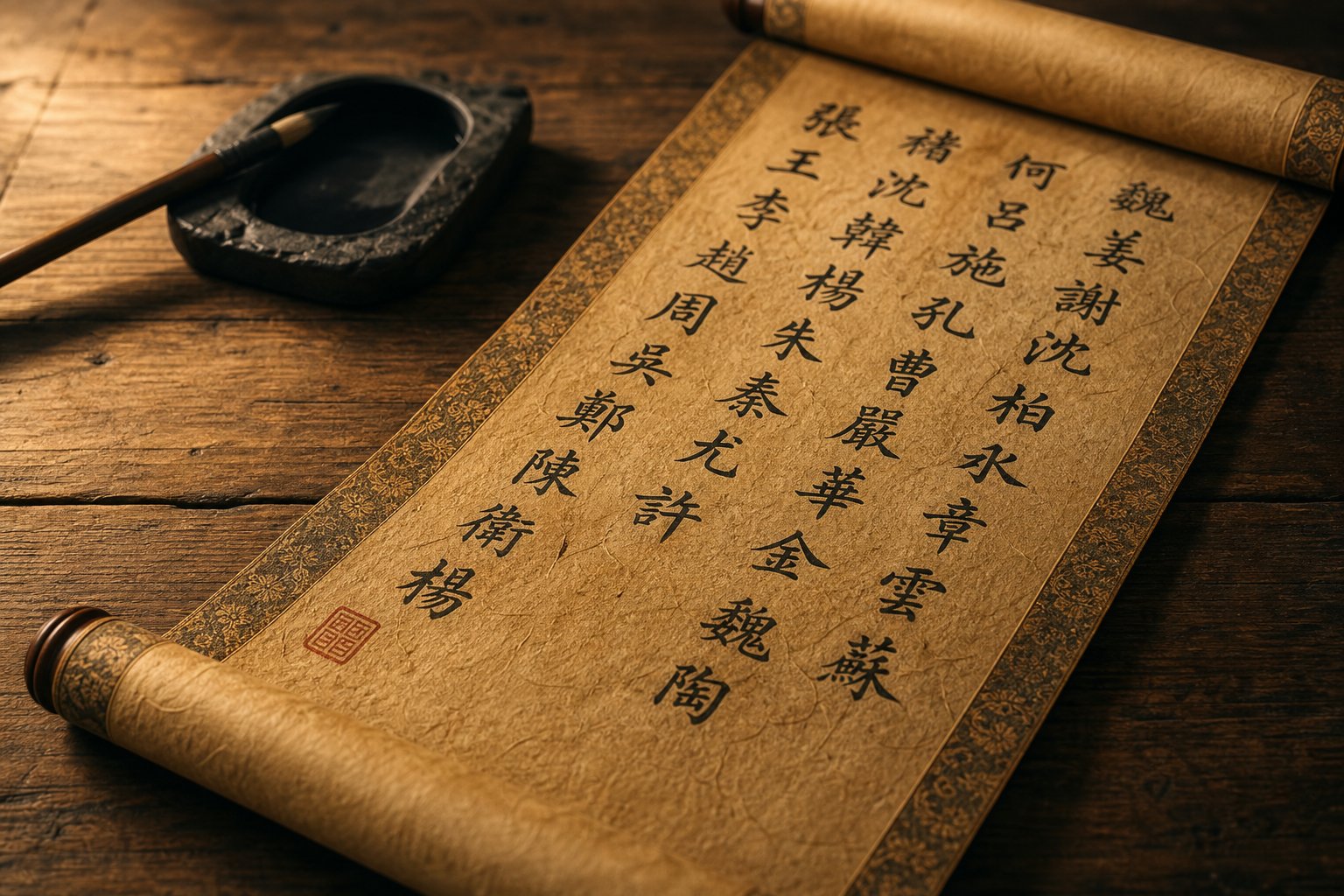
The Song dynasty (960-1279 AD) formalized this unified system in a text called the Baijiaxing (百家姓), or "Hundred Family Surnames." Despite its name, it listed over 500 surnames in common use, including about 60 two-character compound surnames. The text became a standard educational primer, memorized by schoolchildren for centuries. It codified chinese family names and meanings into a canonical reference that shaped how people understood their own lineage.
The table below illustrates how five of the most common surnames today trace back through very different derivation paths, revealing the diversity hidden beneath surface uniformity:
| Surname | Pinyin | Origin Type | Etymological Root | Historical Derivation |
|---|---|---|---|---|
| 李 | Li | Occupation / Royal grant | Originally linked to 理 (li, "judge" or "administrator") | Descended from officials called 理官 (judges); later adopted as the imperial surname of the Tang dynasty, spreading widely through royal grants |
| 王 | Wang | Title | 王 means "king" or "ruler" | Descendants of various royal houses who lost power adopted 王 to mark their former royal status; over 100 distinct origin lines |
| 张 | Zhang | Occupation | 张 means "to draw a bow" or "to stretch" | Traced to Huī, a grandson of the Yellow Emperor, credited with inventing the bow and arrow; his descendants took Zhang as their shi |
| 刘 | Liu | Place name / Royal lineage | Linked to an ancient territory called Liu | Became the imperial surname of the Han dynasty (206 BC-220 AD); widespread adoption followed as subjects and allies took the royal name |
| 陈 | Chen | State name | Named after the state of Chen (modern Henan) | When the state of Chen fell, its people adopted the state name as their surname; especially common in southern China |
Each of these surnames carries multiple possible origin stories. The name Li alone has over 100 possible origins, meaning two people named Li may share no common ancestor whatsoever. This multiplicity of roots, funneled into a small set of characters over millennia of consolidation, explains why chinese last name meanings can vary dramatically even within the same surname.
The surname system, once stabilized, became the foundation upon which all other naming layers were built. Given names, courtesy names, and generational markers all attached themselves to this inherited family identifier, creating an increasingly complex architecture of identity that shifted with each ruling dynasty.
Dynasty by Dynasty Evolution of Naming Conventions
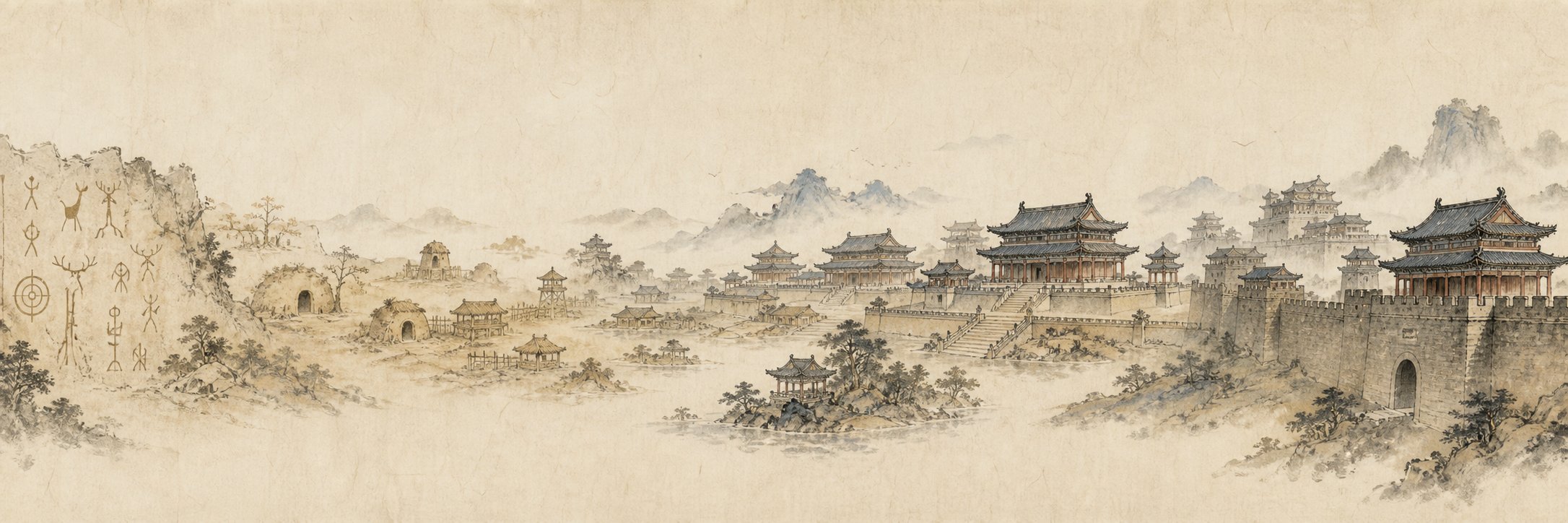
The surname system provided the stable foundation, but given names shifted dramatically from one era to the next. Each dynasty brought new political realities, philosophical currents, and aesthetic preferences that reshaped how parents chose names and characters for their children. Tracing these shifts reveals how ancient chinese names functioned as cultural barometers, reflecting the values and anxieties of their time.
Naming Patterns From Shang Through Han
The earliest chinese naming conventions bear almost no resemblance to later practices. During the Shang dynasty, royal names followed a system so alien to modern sensibilities that scholars debated its logic for decades. Kings received names based on the Heavenly Stems (天干), a ten-day cycle used in the ritual calendar. A ruler named 武丁 (Wu Ding) carried "Ding" not as a meaningful character but as a calendrical marker, likely tied to the day of sacrificial rites associated with him. These oracle bone inscriptions from 1400-1100 BC preserve the earliest written evidence of this naming system, where names served ritual rather than aspirational purposes.
The Zhou dynasty transformed this approach entirely. As feudal hierarchy solidified and Confucian thought took root, traditional chinese names began carrying moral weight. Virtue characters like 文 (cultured), 武 (martial), and 德 (virtuous) appeared frequently among the nobility, signaling the qualities a person was expected to embody. Naming became aspirational rather than calendrical.
The Han dynasty introduced one of the most striking shifts in chinese name conventions. When the usurper Wang Mang seized power in 9 AD, he issued an edict mandating single-character given names. His reasoning drew on Confucian classicism: ancient sages had single-character names, so proper names should follow suit. Two-character given names were associated with criminals and the lower classes. This policy held such cultural force that even after Wang Mang's regime collapsed, single-character names dominated for centuries. During the Eastern Han, over 90% of recorded names used just one character.
Tang Song and Ming Qing Naming Shifts
The Tang dynasty (618-907 AD) broke open the naming palette. As China's most cosmopolitan era, it absorbed Buddhist and Daoist influences that introduced entirely new naming themes. Characters referencing Buddhist concepts like 慧 (wisdom), 空 (emptiness), and 禅 (meditation) entered the naming vocabulary. Daoist-inflected names drew on nature and longevity: 云 (cloud), 鹤 (crane), 仙 (immortal). Two-character given names regained popularity, and the rigid formality of Han-era conventions loosened.
Song dynasty (960-1279 AD) naming reflected the era's literary sophistication. The scholar-official class, empowered by the civil examination system, chose names dense with poetic allusion and classical reference. Parents selected characters that demonstrated erudition: names and characters drawn from the Book of Songs, the Analerta, or Tang poetry signaled a family's cultural aspirations. This was the golden age of naming as literary art.
The Ming dynasty (1368-1644 AD) systematized generational naming (字辈) on an unprecedented scale. The imperial Zhu family itself followed a strict pattern: each generation used a designated character, and the remaining character in the given name had to contain a radical corresponding to one of the Five Elements in a fixed cycle (wood, fire, earth, metal, water). This imperial model filtered down through society, and clans across China adopted similar generational poems to organize their lineages.
The Qing dynasty (1644-1912 AD) introduced a unique tension. The ruling Manchu elite followed their own naming traditions, which lacked fixed surnames in the Han sense and used polysyllabic names like Nurhaci and Dorgon. Han chinese naming conventions continued largely unchanged among the majority population, but Manchu-Han cultural exchange produced hybrid practices. Some Manchu families adopted Han-style names; some Han bannermen took Manchu names. By the dynasty's end, many Manchu families had fully sinicized their naming practices.
The full chronological progression shows how each era left its fingerprint on the naming system:
- Shang (c. 1600-1046 BC): Single-character names using Heavenly Stem day-markers for royalty; ritual and calendrical function over personal meaning.
- Zhou (1046-256 BC): Virtue-based naming tied to feudal rank; moral characters like 文, 武, and 德 signaled expected conduct.
- Han (206 BC-220 AD): Single-character given names dominated after Wang Mang's edict; two-character names carried stigma.
- Tang (618-907 AD): Cosmopolitan expansion; Buddhist and Daoist characters entered naming vocabulary; two-character names returned.
- Song (960-1279 AD): Literary and poetic naming flourished among the scholar class; classical allusions prized.
- Ming (1368-1644 AD): Generational naming systematized with Five Elements radical rotation; clan-wide naming poems formalized.
- Qing (1644-1912 AD): Manchu-Han naming interaction; Manchu polysyllabic names coexisted with and gradually merged into Han conventions.
Each dynasty did not simply replace the previous era's preferences. It layered new conventions on top of existing ones, producing an increasingly rich system where a single name could simultaneously honor ancestors, encode generational position, balance cosmological forces, and express literary taste. Yet for historical elites, even this elaborate given name was only one piece of a much larger naming ecosystem.
The Complete Naming Ecosystem of Historical Elites
A single given name, however carefully chosen, told only part of the story. For educated men in imperial China, identity unfolded across a sequence of names acquired at different life stages, each governed by strict rules about who could use it and when. This was not a collection of random aliases. It was an integrated system where each name related to the others through literary logic, social hierarchy, and ritual function. Understanding famous chinese names requires grasping this ecosystem as a whole.
Birth Names and Courtesy Names as Paired Concepts
The foundation was the birth name (名, ming), given shortly after a child entered the world. This was the intimate name, the private name. From adulthood onward, only the bearer himself and his elders could properly use it. Speaking someone's ming directly was an act of either intimacy or disrespect, depending on your relationship to that person.
At age twenty, a young man underwent the capping ceremony (冠礼, guanli), a coming-of-age ritual that marked his entry into adult society. At this moment he received his courtesy name (字, zi), bestowed by a respected elder. Women sometimes received theirs at fifteen, upon marriage. The chinese courtesy name became the proper form of address among peers and in formal writing. Using someone's zi showed respect; using their ming in public showed either closeness or contempt.
Here is what makes this system intellectually fascinating: the courtesy name was never arbitrary. It had to relate semantically to the birth name through synonym, elaboration, allusion, or complementary meaning. The two names formed a conceptual pair, like two sides of a coin. Consider these famous chinese names and the literary logic connecting them:
- Zhuge Liang (诸葛亮) - his ming, Liang, means "bright." His courtesy name was Kongming (孔明), meaning "very bright" or "greatly illuminated." The zi amplifies the ming.
- Yue Fei (岳飞) - his ming, Fei, means "to fly." His courtesy name was Pengju (鹏举), meaning "the roc soars." The zi transforms a simple verb into a mythological image of the same concept.
- Cao Cao (曹操) - his ming, Cao, means "to grasp" or "to conduct." His courtesy name was Mengde (孟德), meaning "eldest virtue." The zi shifts from action to the moral quality that should guide action.
- Li Bai (李白) - his ming, Bai, means "white" or "pure." His courtesy name was Taibai (太白), meaning "great whiteness," also the Chinese name for the planet Venus. The zi elevates the ming to cosmic scale.
- Du Fu (杜甫) - his ming, Fu, means "beginning" or "great." His courtesy name was Zimei (子美), meaning "son of beauty." Both names gesture toward excellence and admirable qualities.
This pairing system meant that chinese name interpretation was never a matter of reading a single name in isolation. You read the ming and zi together to grasp the full aspiration encoded in a person's identity. The Northern Qi scholar Yan Zhitui articulated the principle clearly: while the ming distinguished one person from another, the zi should express the bearer's moral integrity.
Birth order also shaped courtesy names. The characters 伯 (bo, eldest), 仲 (zhong, second), 叔 (shu, third), and 季 (ji, youngest) frequently appeared as the first character of a zi. Confucius himself, whose ming was Qiu (丘), carried the courtesy name Zhongni (仲尼), where 仲 signals he was the second son. General Sun Jian's four sons followed this pattern precisely: Sun Ce (伯符), Sun Quan (仲谋), Sun Yi (叔弼), and Sun Kuang (季佐).
Art Names and Posthumous Names in Elite Culture
Beyond the ming-zi pair, elites accumulated additional names throughout life and even after death. The art name or pseudonym (号, hao) was self-chosen, a luxury the courtesy name did not allow. It expressed personal taste, philosophical leanings, or a connection to a beloved place. The Song dynasty poet Su Shi (苏轼), for instance, called himself Dongpo Jushi (东坡居士, "the retired scholar of the Eastern Slope"), referencing the farmland he cultivated during political exile. The Ming philosopher Wang Shouren is better known in the West as Wang Yangming (王阳明), Yangming being his hao rather than his ming or zi.
A person could adopt multiple hao over a lifetime. The Song calligrapher Huang Tingjian used both Fuweng (涪翁, "Old man from Fu") and Shangu Daoren (山谷道人, "Daoist of the mountain valley"). Changing your hao was socially acceptable in ways that changing your ming or zi was not. The hao functioned as a creative outlet within a system otherwise governed by rigid convention.
Death brought two final naming layers reserved primarily for emperors and high officials. The posthumous name (谥号, shihao) was granted after death by the court, using a fixed vocabulary of evaluative characters. Each character carried a predefined judgment. 文 (wen, "cultured") praised scholarly achievement. 武 (wu, "martial") honored military prowess. 厉 (li, "severe") condemned cruelty. 炀 (yang, "excessive") damned extravagance. The Sui dynasty's last emperor received the posthumous name Yang (炀), a permanent verdict on his ruinous reign.
The temple name (庙号, miaohao) applied exclusively to emperors and was inscribed on the memorial tablet placed in the Imperial Ancestral Temple. Founders of dynasties typically received names ending in 祖 (zu, "ancestor"): Taizu, Gaozu, or Shizu. Successors who maintained the dynasty received names ending in 宗 (zong, "forebear"): Taizong, Shizong, Gaozong. Before the Tang dynasty, not all emperors earned a temple name. It was a mark of genuine distinction. From the Tang onward, every emperor received one, and the temple name became the standard way to reference rulers in historical writing.
The table below shows how these names in chinese and meanings layered across the lives of five historical figures, forming a complete naming ecosystem for each person:
| Historical Figure | Birth Name (名) | Courtesy Name (字) | Art Name (号) | Posthumous Name (谥号) | Temple Name (庙号) |
|---|---|---|---|---|---|
| Zhuge Liang | Liang 亮 (bright) | Kongming 孔明 (greatly bright) | Wolong 卧龙 (sleeping dragon) | Zhongwu 忠武 (loyal and martial) | N/A |
| Li Shimin (Tang Taizong) | Shimin 世民 (world's people) | N/A (abandoned upon enthronement) | N/A | Wen Huangdi 文皇帝 (cultured emperor) | Taizong 太宗 (grand forebear) |
| Su Shi | Shi 轼 (carriage rail) | Zizhan 子瞻 (son who gazes far) | Dongpo Jushi 东坡居士 (scholar of the Eastern Slope) | Wenzhong 文忠 (cultured and loyal) | N/A |
| Yue Fei | Fei 飞 (fly) | Pengju 鹏举 (roc soaring) | N/A | Wumu 武穆 (martial and reverent) | N/A |
| Zhu Yuanzhang (Ming Taizu) | Yuanzhang 元璋 (fundamental jade) | Guorui 国瑞 (national auspice) | N/A | Gao Huangdi 高皇帝 (high emperor) | Taizu 太祖 (grand ancestor) |
Notice how each person's naming ecosystem reflects their social position. Emperors accumulated temple names and elaborate posthumous titles but lost the use of their courtesy names upon taking the throne, since no one dared address them so familiarly. Scholar-officials like Su Shi collected art names but lacked temple names. Military heroes like Yue Fei received evaluative posthumous titles but had no need for literary pseudonyms.
The social rules governing name usage were absolute. You called yourself by your ming to show humility. Peers addressed you by your zi to show respect. Admirers might use your hao. Only the state, speaking after your death, could assign your shihao. And only the imperial ancestral rites could invoke your miaohao. Violating these conventions was not merely rude. It was a breach of the social order itself, the kind of disorder Confucius warned about when he insisted that names must be rectified.
This layered system meant that a single historical figure might appear under four or five different names across different sources, depending on who was writing, when, and for what purpose. Recognizing which name type you are encountering is essential for navigating Chinese historical texts. Yet even this elaborate personal naming system operated within constraints far more severe than most readers expect, constraints enforced not by etiquette but by imperial law.
Naming Taboos That Reshaped Language and Governance
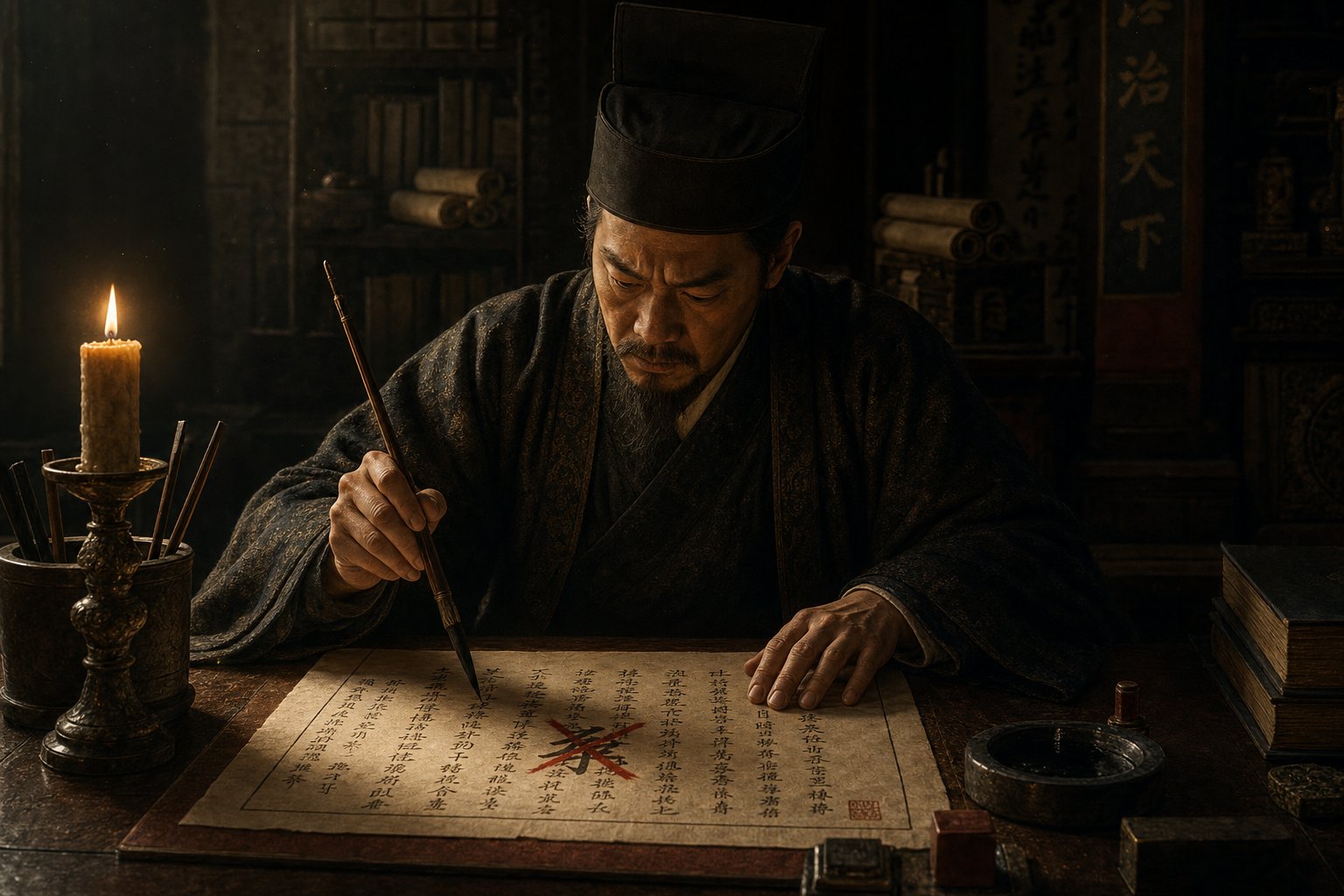
Those constraints enforced by imperial law were not abstract principles. They had a name: bihuì (避諱), the tabooing of names. This practice stands as one of the most distinctive and consequential features of historical Chinese naming, a system so pervasive that it altered pronunciation, rewrote geography, and sent scholars to their deaths over a single misplaced brushstroke. For anyone studying chinese characters for names in historical documents, understanding bihuì is not optional. It is the key to decoding why texts say what they say and why certain characters appear where they should not.
The core principle was straightforward: characters appearing in an emperor's personal name became forbidden. No one could write them in official documents, use them in examination essays, or speak them in formal contexts. The ban extended to characters that sounded the same, looked similar, or shared components with the taboo character. When a new emperor took the throne, his name characters effectively vanished from public life, and the entire bureaucratic apparatus had to adjust.
Sounds extreme? It was. The practice of naming taboo persisted from at least the Western Zhou period (1046-771 BC) through the end of imperial rule in 1912, with its most intense enforcement during the Song and Qing dynasties. Its consequences rippled through every level of society, from the imperial court to village schools, reshaping the Chinese language itself in ways that persist to this day.
Imperial Naming Taboos and Their Consequences
The earliest well-documented case involves Qin Shi Huang, China's first emperor, whose personal name was Zheng (政). Because this character was pronounced identically to the zheng (正) in zhengyue (正月, "first month"), the pronunciation of the calendar term had to change. What had been zhèngyue became zhēngyue, a shift in tone that survives in modern Mandarin over two thousand years later. The emperor's name literally rewired how an entire nation referred to the start of the year.
The Tang dynasty produced an even more dramatic example. Emperor Taizong's personal name was Shimin (世民), containing two extremely common characters: shi (世, "world") and min (民, "people"). Initially, Taizong tried to soften the burden by ruling that only the two characters used together needed avoidance, not each character in isolation. His son Emperor Gaozong reversed this leniency after Taizong's death, requiring full avoidance of both characters separately. The consequences were immediate and institutional. The Minbu (民部, "Ministry of the People") was renamed Hubu (户部, "Ministry of Revenue"), a name it retained for the rest of imperial history. The famous general Li Shiji (李世勣) was forced to drop the shi from his name entirely, becoming simply Li Ji (李勣). Writing chinese names in official documents required constant vigilance against accidentally reproducing these forbidden characters.
The examination system turned naming taboos into career-ending traps. During the Yuan dynasty, candidates who violated imperial taboo characters in their essays were rejected and failed automatically. In the Ming dynasty, a top-ranked examination candidate named Qi Shun (祁顺) was demoted to the bottom of the list in 1460 simply because his surname matched a character in the emperor's name. The content of his essay was irrelevant. His name alone disqualified him from honor.
The Qing dynasty pushed enforcement to lethal extremes, merging naming taboos with the broader "literary inquisition" (wenziyu 文字狱). In 1775, the scholar Wang Xihou compiled a dictionary in which he inadvertently wrote the complete personal names of the Kangxi, Yongzheng, and Qianlong emperors without the required stroke omissions. When he realized the error, he cut the names from his printing blocks, but unexpurgated copies had already circulated.
Wang Xihou's accidental writing of a few imperial name characters cost him his life. Emperor Qianlong condemned it as rebellion and high treason. Wang was executed on December 27, 1777. His property was confiscated, his books burned, his sons and grandsons killed or sent as slaves to Heilongjiang, and several provincial officials were dismissed for failing to catch the offense.
This was not an isolated incident. The examiner Zha Siting (查嗣庭) selected a verse from the Classic of Poetry as an examination topic in 1726. Someone noticed that two characters in the verse, when stripped of their top strokes, resembled the Yongzheng Emperor's name in "decapitated" form. Zha was arrested, died in prison, and his corpse was dismembered and displayed publicly. Provincial examinations in his home region of Zhejiang were suspended for years as collective punishment.
How Taboos Reshaped Language and Geography
The impact of naming taboos extended far beyond individual punishment. Entire cities were renamed. Classical texts were rewritten. Pronunciations shifted permanently. When the Kangxi Emperor's name Xuanye (玄燁) made the character xuan (玄) taboo, the Xuanwu Gate (玄武門) of the Forbidden City became the Shenwu Gate (神武門, "Gate of Divine Might"). During the late Ming, when Emperor Taichang's name Changluo (常洛) became taboo, the city of Luoyang (洛陽) had to be written as Luoyang (雒陽) using a substitute character. Luonan, Luochuan, Luoshui, and several other place names underwent the same forced substitution.
Three primary methods existed for handling name chinese characters that fell under taboo:
- Character substitution: Replacing the taboo character with a synonym or near-homophone. The Minbu became the Hubu; xuan (玄) became yuan (元) or yuan (圓).
- Stroke omission: Writing the character but deliberately leaving out the final stroke, signaling awareness of the taboo while preserving readability.
- Blank space: Simply leaving an empty gap where the character should appear, or covering it with yellow paper in printed texts.
Each method created problems for later readers. When naming chinese characters were substituted with alternatives, the original meaning could become obscured within a generation. When strokes were omitted, later copyists sometimes "corrected" the character without realizing the omission was intentional. When blanks were left, the intended word might be lost entirely.
Family-level taboos (jiahui 家諱) operated on the same principle but within the domestic sphere. A filial son was expected to avoid writing or speaking the characters in his father's and grandfather's names, extending back as many as seven generations. The Song dynasty scholar Xu Ji (徐積), whose father's name meant "stone" (shi 石), reportedly never used stone tools in his life and had to be carried across stone bridges on other people's backs. Liu Wensou (劉溫叟), whose father's name meant "high mountains" (yue 岳), never hiked and could not listen to music because the character for "music" (yue 樂) was a homophone of his father's name. Even if these stories are partly apocryphal, they illustrate the extraordinary reach that name taboos claimed over daily life.
The teacher Feng Dao (馮道) of the Five Dynasties period gave his students a memorable lesson in the absurdity of strict taboo observance. When they read the opening line of the Daodejing, "The Dao that can be spoken is not the enduring Dao" (道可道非常道), they dared not pronounce the character dao aloud because it was their teacher's name. Instead, they recited: "'Not dare to say' that can be 'Not dare to say' is not the enduring 'Not dare to say.'"
For modern scholars working with historical texts, naming taboos create a forensic puzzle. When you encounter an unusual character substitution in a manuscript, it may signal which dynasty or even which specific reign period produced that copy. The field of bihuixue (避諱學, "taboo studies") uses these substitutions as dating tools, identifying when a text was written or copied based on which characters it avoids. A document that substitutes yuan (元) for xuan (玄) was likely produced during the Kangxi reign. One that writes Hubu instead of Minbu dates to after 650 AD. Understanding which characters were taboo and when is essential for anyone writing chinese names in historical research or tracing the transmission history of classical texts.
The practice of bihuì reveals something profound about the relationship between language and power in imperial China. A name was not merely a label. It was considered the essence of a person, and the emperor's name carried the weight of cosmic authority. To speak or write it casually was to diminish that authority, to treat the sacred as common. The taboo system enforced a hierarchy of naming that placed the emperor's characters beyond ordinary reach, making the very act of writing an exercise in political awareness.
Yet naming taboos represented only one dimension of how names encoded social structure. Beyond the prohibitions that constrained what characters could not be used, an equally elaborate system dictated what characters must be used, binding generations of clan members together through carefully composed naming poems and cosmological calculations.
Generational Systems and Cosmological Naming Methods
If taboos dictated which characters were forbidden, the generational naming system dictated which characters were mandatory. Clans across imperial China composed poems whose characters, read in sequence, assigned a fixed naming element to every generation born into the lineage. This system, called zibei (字辈), transformed a person's given name into a genealogical coordinate, instantly revealing their position within a family tree spanning centuries.
Generational Poems and Clan Identity
The mechanism was elegant. A clan's elders composed a generation poem (字辈诗 or 派字歌), typically ranging from a dozen to several hundred characters. Each successive character in the poem became the designated generation marker for the next generation of descendants. When you met a stranger who shared your surname and you both knew your clan's poem, you could immediately determine your relative seniority by comparing which character appeared in each person's name.
Generation names could occupy either the first or second position in a two-character given name, and most lineages kept this placement consistent. In a fictional Li family, for example, the father's generation might use the character Yu (裕), making siblings Li Yufeng and Li Yuyan. Their children's generation would use the next character in the poem, Wen (文), producing names like Li Wenlong and Li Wenfeng. Any Li clan member encountering these names would know exactly which generation each person belonged to.
The most famous example belongs to the Kong family, direct descendants of Confucius. During the Ming dynasty, Emperor Jianwen honored the Kong lineage by imperially decreeing a generation poem. Subsequent emperors extended it, including the Chongzhen Emperor of the Ming, the Tongzhi Emperor of the Qing, and later the Ministry of Interior of the Beiyang government. The poem reads in part: 希言公彦承, 宏闻贞尚衍, 兴毓传继广, 昭宪庆繁祥. Each character designates one generation, meaning a Kong family member named Kongfanli belongs to the 繁 (fan) generation, and anyone familiar with the poem knows precisely how many generations separate them from any other Kong descendant.
This system was not limited to the Kong family. The Song dynasty's imperial House of Zhao maintained its own generation poem of 42 characters, split into three groups of 14 for the offspring of Song Taizu and his two brothers. The Ming dynasty princes followed imperially assigned generational poems with an additional constraint: the non-generational character in each prince's name had to contain a radical corresponding to one of the Five Elements in a fixed rotation. Even Muslim Hui Chinese communities adopted the practice, calling it lunzi paibie, with families like the Na clan cycling through designated characters across generations.
Generation poems were typically composed by a committee of family elders whenever a new lineage branch was established through geographical migration or social elevation. Families sharing a common poem were considered to share a common ancestor and place of origin. The poem functioned as a portable genealogy, a mnemonic device that encoded lineage information directly into every clan member's name. Understanding the chinese meaning of names within these systems requires reading the generational character not for its individual semantic content but for its positional function within the poem's sequence.
Birth Charts and Five Elements in Name Selection
Generational poems determined one character in a name. But what about the other? This is where cosmological calculation entered the picture, layering metaphysical precision onto the already complex naming process. For centuries, the chinese name meaning carried not just literary or aspirational weight but elemental balance calibrated to the exact moment of a child's birth.
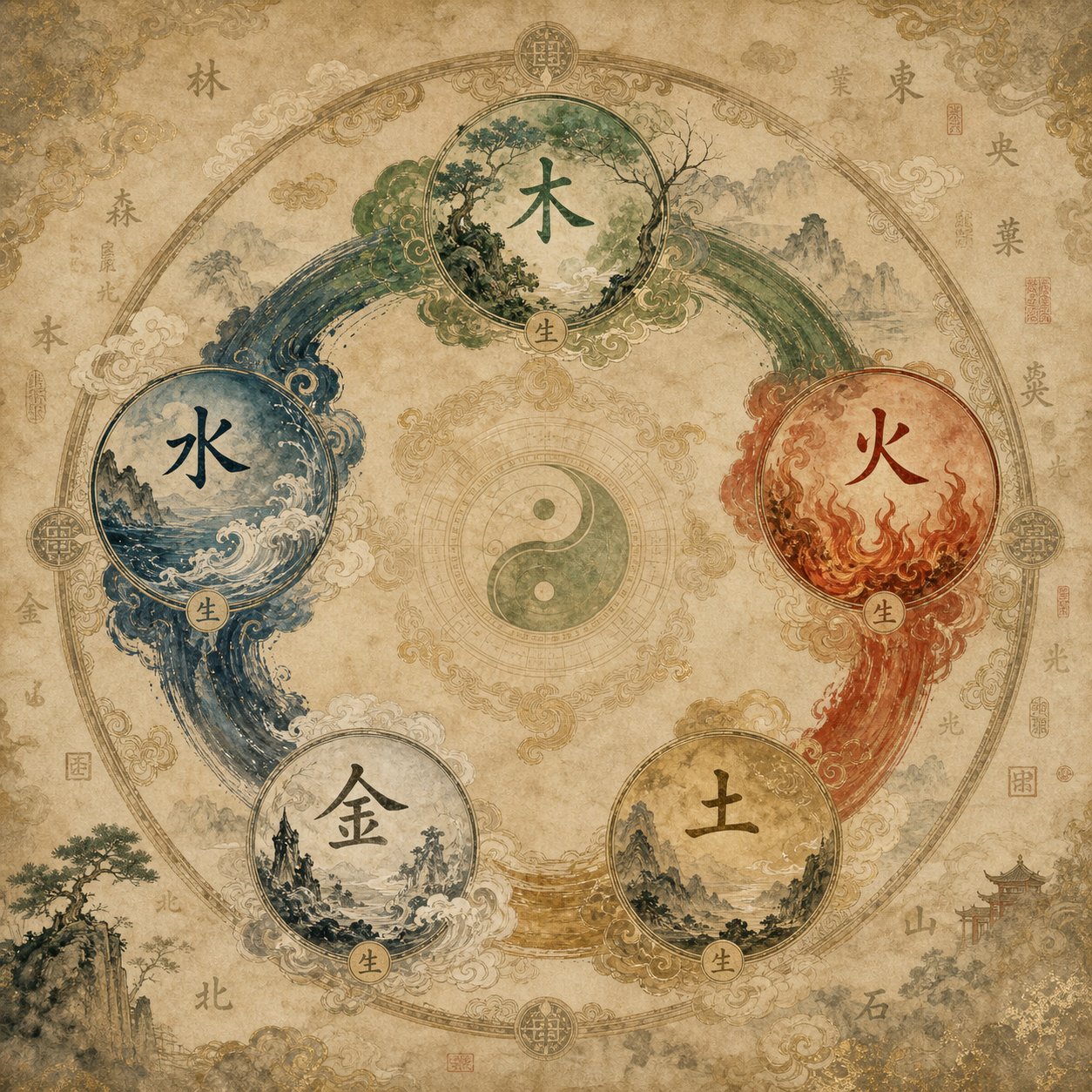
The system began with the BaZi (八字, "Eight Characters") birth chart. A child's year, month, day, and hour of birth were each expressed as a pair of characters from the Heavenly Stems and Earthly Branches cycle, producing eight characters total. Each of these characters carried an elemental association with one of the Five Phases (五行, wuxing): Wood, Fire, Earth, Metal, and Water. A naming specialist, often a fortune teller or educated elder, would analyze the distribution of elements across the eight characters to identify which phases were dominant, which were weak, and which were entirely absent.
The diagnosis determined the prescription. If a child's birth chart lacked Water energy, the naming specialist selected characters containing Water-associated radicals. If Metal was deficient, characters with the Metal radical (金 or 钅) were chosen. The goal was not arbitrary decoration but cosmic rebalancing, compensating for elemental gaps that might otherwise manifest as personality weaknesses or life obstacles. The mandarin name meaning, in this framework, was inseparable from its metaphysical function.
The Five Elements and their associated naming radicals worked as follows:
- Wood (木, mu): Associated with growth, vitality, and benevolence. Common radicals include 木 (wood) and 艹 (grass). Naming examples: 林 (lin, forest), 芳 (fang, fragrant), 桐 (tong, paulownia tree).
- Fire (火, huo): Associated with passion, illumination, and propriety. Common radicals include 火 (fire) and 灬 (fire dots). Naming examples: 炎 (yan, flame), 煜 (yu, radiant), 照 (zhao, illuminate).
- Earth (土, tu): Associated with stability, trust, and nurturing. Common radicals include 土 (earth) and 山 (mountain). Naming examples: 坤 (kun, earth/feminine), 岳 (yue, peak), 城 (cheng, city).
- Metal (金, jin): Associated with righteousness, structure, and decisiveness. Common radicals include 金 (metal) and 钅 (metal variant). Naming examples: 鑫 (xin, prosperity), 铭 (ming, inscription), 锐 (rui, sharp).
- Water (水, shui): Associated with wisdom, adaptability, and depth. Common radicals include 氵 (water) and 雨 (rain). Naming examples: 涵 (han, contain), 泽 (ze, marsh/beneficence), 润 (run, moist).
The character 行 (xing) in 五行 does not mean "element" in the Western chemical sense. It means "movement" or "phase." These five categories describe dynamic patterns of energy transformation, not static substances. The Five Phases interact through two fundamental cycles: the Generating Cycle (相生), where each phase nourishes the next (Wood feeds Fire, Fire creates Earth, Earth bears Metal, Metal collects Water, Water nourishes Wood), and the Controlling Cycle (相克), where each phase restrains another to prevent excess. A skilled namer considered both cycles when selecting characters, ensuring the chosen element would harmonize with rather than clash against the child's existing elemental profile.
Beyond elemental radicals, stroke count numerology (姓名学, xingmingxue) added yet another computational layer. This system assigned numerical values to the total stroke count of each character in a name, then evaluated whether the resulting numbers fell into auspicious or inauspicious categories. Different schools of xingmingxue used different calculation methods, but all shared the premise that the physical structure of written characters, the number of brushstrokes required to produce them, carried metaphysical significance independent of semantic meaning.
The result was a naming process that could involve days of calculation. A family might consult the generational poem for one character, then commission a fortune teller to analyze the child's BaZi chart, identify the missing element, propose characters with the correct radical, verify that the stroke counts produced favorable numbers, and confirm that no character violated any active naming taboo. The chinese meaning of names produced through this process was simultaneously literary, genealogical, cosmological, and numerological. Each layer constrained the options further, until the final name emerged as the single point where all systems converged.
This convergence of systems produced names that functioned differently depending on who was reading them. A casual acquaintance saw a pleasant-sounding name. A clan member recognized the generational marker. A fortune teller read the elemental compensation. A calligrapher assessed the stroke balance. Chinese names and meanings operated on multiple registers simultaneously, each legible only to those who knew the relevant code. Yet all of these systems, from generational poems to Five Elements calculations, applied differently depending on where you stood in the social hierarchy, and whether you were born male or female.
Social Class and Gender in Historical Name Selection
A peasant farmer and a Ming dynasty prince might share the same surname, but their given names inhabited entirely different worlds. The cosmological calculations, generational poems, and Five Elements balancing described above applied universally in theory. In practice, the depth and sophistication of the naming process scaled directly with social position. Your name did not just reflect your family's hopes. It broadcast your class.
Imperial and Scholar-Official Naming Privileges
At the apex of the hierarchy, imperial naming followed rules so rigid they functioned as law. The Ming dynasty royal family offers the most systematic example. Emperor Zhu Yuanzhang assigned each of his twenty-six sons a unique generational poem. Every prince's descendants had to use the next character in their branch's poem as one character of their given name. The second character had to contain a radical corresponding to one of the Five Elements, cycling through Wood, Fire, Earth, Metal, and Water across successive generations. The father's elemental radical had to "generate" the son's according to the Generating Cycle.
This constraint produced an extraordinary side effect. As the royal family expanded over 276 years, the pool of existing characters containing the required elemental radicals ran dry. Princes needed names with increasingly obscure Metal or Water radicals, and when no suitable character existed, new ones were invented. Many of these invented characters later found a second life in the modern Chinese Periodic Table of Elements. The element Sodium (钠), Magnesium (镁), and dozens of others use characters originally coined to name Ming princes. Imperial naming literally expanded the written language.
Scholar-officials operated with more creative freedom but within their own conventions. Chinese first names male among the literati class drew heavily from classical texts. A father might name his son after a phrase in the Book of Songs, the Analects, or the Zuo Commentary, embedding a literary allusion that educated readers would immediately recognize. Characters like 文 (wen, cultured), 德 (de, virtuous), 学 (xue, learning), and 志 (zhi, ambition) appeared constantly in this class. The name itself served as a credential, signaling that the family possessed the classical education necessary to select such a reference. A boy named Yanzhao (彦昭, "illustrious scholar") announced his family's aspirations before he ever sat for an examination.
Merchants occupied an awkward middle ground. Wealthy enough to hire naming specialists but lacking the cultural prestige of the scholar class, merchant families gravitated toward characters encoding prosperity and good fortune. Characters like 富 (fu, wealth), 贵 (gui, noble), 财 (cai, riches), 兴 (xing, flourishing), and 盛 (sheng, abundant) appeared frequently. These names were functional rather than literary, designed to attract favorable energy toward the family business. Scholar-officials sometimes mocked such names as vulgar, a reminder that naming was as much about cultural capital as it was about meaning.
Gendered Naming Patterns Across Social Classes
The starkest naming divide, however, was not between rich and poor but between the imperial court and the village. Commoner families, especially in rural areas, followed a logic that inverted everything the upper classes practiced. Instead of choosing auspicious, beautiful characters, many peasant parents deliberately gave children ugly or demeaning names. The reasoning was protective: evil spirits and demons targeted valuable children, so a child with a worthless-sounding name would escape their notice.
Names like 狗蛋 (goudan, "dog egg"), 铁柱 (tiezhu, "iron pillar"), 狗剩 (gousheng, "dog's leftover"), and 丑娃 (chouwa, "ugly baby") were not insults. They were shields. As documented in Chinese naming traditions, infants were sometimes given derogatory names like "Pig Manure" or "Dog" so that demons would be less inclined to harm the child. Children were also not given formal names during the first month of life, when they were considered most vulnerable to spirit abduction. This practice persisted well into the twentieth century in rural communities.
Gender added another layer of differentiation that cut across all classes. Chinese names for boys historically drew from a vocabulary of ambition, strength, and public achievement. Characters like 伟 (wei, great), 强 (qiang, strong), 勇 (yong, brave), 志 (zhi, ambition), and 文 (wen, cultured) dominated chinese masculine names across centuries. These characters pointed outward, toward the world a son was expected to conquer through examination, military service, or governance.
Chinese first names female, by contrast, drew from nature, beauty, and domestic virtue. Characters like 兰 (lan, orchid), 芳 (fang, fragrant), 淑 (shu, gentle and virtuous), 梅 (mei, plum blossom), and 玉 (yu, jade) dominated chinese feminine names. Analysis of naming data confirms that popular characters for women invoked beauty, purity, and floral imagery across multiple generations, while male names emphasized being "open," "forthright" (明), "ambitious" (志), and "cultured" (文).
The disparity went deeper than character choice. In many traditional communities, girls received minimal naming attention altogether. It was not uncommon for daughters to be called simply by birth order: 大妹 (damei, "eldest sister"), 二妹 (ermei, "second sister"). Some were given names that expressed disappointment at their sex, like 招弟 (zhaodi, "beckoning a younger brother") or 盼弟 (pandi, "hoping for a brother"). According to anthropological research, many women in traditional villages never received a formal given name at all, being addressed throughout life only as "grandmother" or "aunty" in relation to male family members.
The table below compares naming themes across four social classes, illustrating how the same culture produced radically different naming philosophies depending on status:
| Social Class | Naming Theme | Example Characters (Male) | Example Characters (Female) | Underlying Logic |
|---|---|---|---|---|
| Imperial | Cosmological mandate, elemental radicals, dynastic continuity | 朱棣 (Di, "thorny tree" - Wood radical), 朱炫 (Xuan - Fire radical) | Names rarely recorded; princesses identified by title | Names encode dynastic legitimacy and cosmic order through mandated elemental cycles |
| Scholar-Official | Classical allusion, literary elegance, moral aspiration | 文 (cultured), 彦 (accomplished), 学 (learning), 德 (virtue) | 淑 (virtuous), 慧 (wise), 贞 (chaste), 秀 (elegant) | Names demonstrate erudition and signal family's cultural standing |
| Merchant | Prosperity, fortune, abundance | 富 (wealth), 贵 (noble), 兴 (flourishing), 盛 (abundant) | 金 (gold), 银 (silver), 珠 (pearl), 宝 (treasure) | Names attract favorable energy toward commercial success |
| Commoner | Protective ugliness, humility, durability | 狗蛋 (dog egg), 铁柱 (iron pillar), 石头 (stone) | 招弟 (beckoning brother), 大妹 (eldest sister), or no formal name | Names deflect evil spirits by making children seem worthless or undesirable |
This class-based naming hierarchy was not entirely static. The civil examination system offered a path for talented commoners to enter the scholar-official class, and when they did, their children's names shifted accordingly. A man born as 狗蛋 who passed the imperial examinations would name his own sons with literary characters befitting their new status. The name change across generations became a visible marker of social mobility, a family's ascent written into its genealogy one generation at a time.
Yet all of these conventions, from imperial elemental mandates to commoner protective naming, applied specifically to the Han Chinese majority. The peoples who conquered, bordered, or coexisted with Han civilization followed entirely different naming logics, creating a patchwork of traditions that collided and merged across China's multiethnic history.
Non-Han Naming Traditions and Romanization Complexities
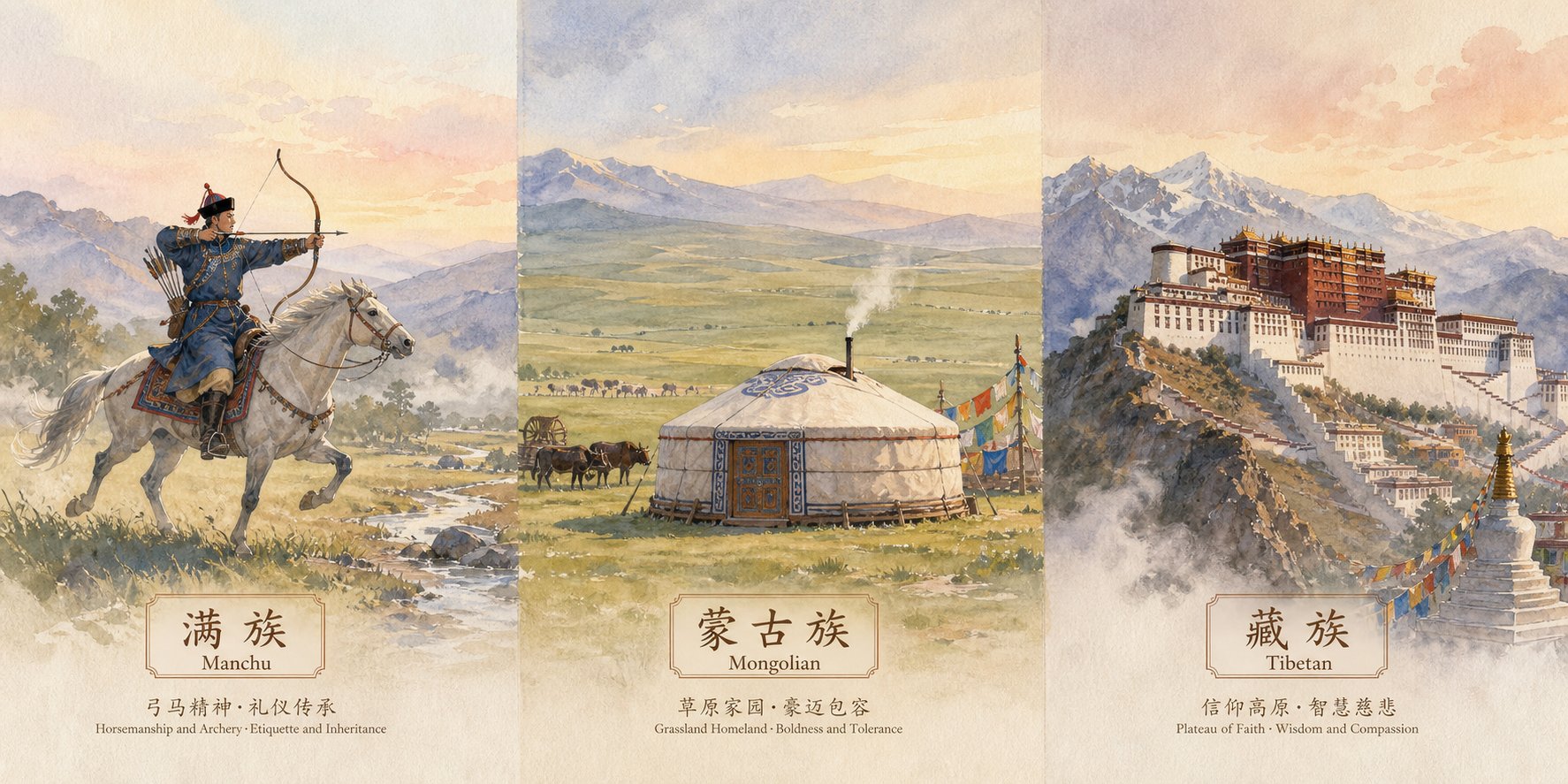
The Han Chinese naming system, with its fixed surnames, generational poems, and elemental calculations, was only one tradition among many within China's borders. The Manchu, Mongol, and Tibetan peoples who ruled, traded with, and lived alongside Han populations followed naming logics so fundamentally different that forcing them into Han categories distorted their meaning. And when Western scholars attempted to render any of these names into the Roman alphabet, the confusion multiplied further.
Manchu Mongol and Tibetan Naming Traditions
The Manchu ruling class of the Qing dynasty did not use surnames the way Han Chinese did. Their system revolved around clan names (hala), which functioned more like broad tribal affiliations than hereditary family names in the Han sense. The imperial clan bore the name Aisin Gioro, where "Aisin" meant "gold" in Manchu and "Gioro" designated the clan grouping. Distant branches of the imperial family used only "Gioro" without the "Aisin" prefix. Other prominent Manchu clans included Nara, Guwalgiya, and Niohuru, each encompassing thousands of people with no close blood ties.
The nature of "Gioro" itself remains debated. Qing dynasty officials stated that "Gioro is a surname," but this conflicts with Manchu linguistic usage, where the word for surname is "Hala," not "Gioro." The Russian scholar Sergei Shirokogoroff proposed that "Gioro" derives from the Manchu word "Giohoto," meaning "beggar," possibly referencing destitute remnants of the Jin dynasty who formed a special clan group. Modern researchers view the Gioro clan as a loose confederation formed over centuries by the Jianzhou Jurchens, with branches having no close blood relations and even intermarrying freely.
In daily life, Manchu names were polysyllabic and stood alone without a preceding surname. Nurhaci, Dorgon, Hongli: these were complete names, not given names awaiting a family name prefix. When Manchus needed to identify their clan in formal contexts, the clan name followed rather than preceded the personal name, reversing the Han convention entirely. After the Qing dynasty collapsed in 1912, most Manchu families adopted single-character Han-style surnames to avoid persecution. The Aisin Gioro clan scattered into surnames like Jin (金, "gold," translating "Aisin"), Zhao, Luo, and others. The Nara clan became Na (那). The Guwalgiya became Guan (关). Within a generation, centuries of Manchu naming tradition vanished into the Han surname system.
Mongol naming operated on yet another principle. Traditional Mongolian culture used a patronymic system rather than fixed hereditary surnames. A person was identified by their given name followed by their father's name. There was no family name passed unchanged across generations. Research on Chinese Mongolian naming confirms that the naming norms of Mongolians and Han Chinese are linguistically and structurally distinct. Mongolian names written in Chinese characters are transliterations based on pronunciation, meaning each character loses its individual semantic content and functions only as a phonetic marker. A name like 乌兰图雅 consists of two Mongolian words: "Ulan" (red) and "Tuya" (sunglow), but the four Chinese characters used to write it carry no independent meaning in this context.
Tibetan naming followed a religious rather than familial logic. Children typically received their names from lamas or Buddhist monks, often incorporating religious concepts like Tashi (auspicious), Dorje (thunderbolt/diamond), or Dawa (moon). No hereditary surname existed in the Han sense. A Tibetan person's name might consist of four syllables drawn from Buddhist vocabulary, with no element indicating family lineage. Social status was sometimes marked by prefixes or titles rather than inherited name components.
When these systems collided with Han conventions during periods of conquest and assimilation, the results were messy. Mongol rulers of the Yuan dynasty never adopted Han surnames, but their Chinese subjects had to figure out how to record Mongol names using Chinese characters designed for a completely different naming logic. Manchu bannermen who governed Han populations sometimes maintained dual identities: a Manchu name for clan contexts and a Han-style name for administrative convenience. Some Han families enrolled in the Manchu banner system adopted Manchu-style names, while some Manchu families living among Han populations gradually sinicized their naming practices long before the dynasty fell.
Romanization Challenges in Historical Records
If non-Han naming traditions created confusion within China, the problem of chinese name translation into Western languages compounded it exponentially. Multiple romanization systems developed over centuries, each reflecting different linguistic assumptions, and none achieving universal adoption until very recently.
The Wade-Giles system, developed by Sir Thomas Francis Wade and modified by Herbert Allen Giles in 1912, dominated English-language scholarship for over a century. It used apostrophes to distinguish aspirated from unaspirated consonants (ch' versus ch, t' versus t) and superscript numbers for tones. Printers frequently dropped these diacritical marks, creating ambiguity. The system rendered Pinyin's j, q, zh, and ch all as variations of "ch," making chinese name pronunciation nearly impossible to reconstruct from the written romanization alone.
In 1958, the People's Republic of China introduced Pinyin as its official romanization standard, and it replaced Wade-Giles in most international contexts by 1979. But Taiwan continued using Wade-Giles (with modifications) for decades. Meanwhile, Cantonese names from Hong Kong and Guangdong followed entirely separate romanization conventions based on Cantonese pronunciation rather than Mandarin. And overseas Chinese communities in Southeast Asia, the Americas, and Europe often romanized their names according to local dialect pronunciations from Hokkien, Teochew, or Hakka.
The result? A single historical figure can appear under half a dozen different spellings across English-language sources, making it nearly impossible to know how to pronounce chinese names consistently or to connect references across different texts. Consider these examples of the same names rendered in different systems:
- Mao Zedong (Pinyin) = Mao Tse-tung (Wade-Giles) = Mo Tsak-tung (Cantonese romanization)
- Sun Zhongshan (Pinyin) = Sun Chung-shan (Wade-Giles) = Sun Yat-sen (Cantonese name, most commonly used in English)
- Kong Qiu (Pinyin) = K'ung Ch'iu (Wade-Giles) = Confucius (Latinized form)
- Laozi (Pinyin) = Lao Tzu (Wade-Giles) = Lao Tse (older English variant)
- Jiang Jieshi (Pinyin, Mandarin) = Chiang Kai-shek (Wade-Giles, Cantonese pronunciation) = Chiang Chieh-shih (Wade-Giles, Mandarin)
- Li Bai (Pinyin) = Li Po (Wade-Giles, based on alternate reading 白 as "po") = Li Pai (older romanization)
The case of Sun Yat-sen is particularly revealing. His Mandarin name was Sun Zhongshan (孙中山), but the English-speaking world knows him by a Cantonese romanization of a completely different name, Sun Yixian (孙逸仙). Cantonese names like these dominate early English-language records of Chinese history because the first sustained Western contact with China occurred through Guangdong province, where Cantonese was spoken. Researchers tracing chinese names into english records from the nineteenth century must account for Cantonese pronunciation as the default, not Mandarin.
For genealogical researchers, this multiplicity creates genuine obstacles. A family surname spelled "Wong" in one immigration record, "Wang" in another, and "Huang" in a third may all represent the same character (王 or 黄) romanized through Cantonese, Mandarin Pinyin, and Mandarin Wade-Giles respectively. Without knowing which dialect and which romanization system produced a given spelling, connecting records across generations becomes guesswork. The character 陈 alone appears as Chen (Pinyin), Ch'en (Wade-Giles), Chan (Cantonese), Tan (Hokkien), and Ting (some Hakka dialects) depending on where and when the romanization occurred.
This tangle of competing systems means that understanding historical Chinese naming requires not just knowledge of the names themselves but awareness of the layers of translation, transliteration, and dialect variation that separate a written romanization from the original characters. Every romanized Chinese name in an English-language source is an interpretation, shaped by the specific system, dialect, and historical moment that produced it. Stripping away these layers to reach the underlying characters is often the first and most essential step in any serious historical or genealogical research involving Chinese names.
The Living Legacy of Historical Chinese Naming
Stripping away those layers of romanization and dialect variation brings us back to the characters themselves, and to a question that runs through every era covered in this article: what are chinese names, really? They are not labels. They are compressed narratives, encoding family history, philosophical aspiration, cosmological balance, and social position into one or two carefully chosen characters. And despite the upheavals of the twentieth century, this tradition has not disappeared. It has adapted.
Enduring Legacy of Traditional Naming Philosophy
Walk into any naming consultation service in China today and you will find the same Five Elements analysis that guided parents during the Ming dynasty. Birth charts are still cast. Stroke counts are still calculated. The tools may have moved online, but the underlying logic remains: a name should harmonize with the cosmic forces present at the moment of a child's birth.
Generational naming persists as well, though its reach has narrowed. In Jinhua, Zhejiang Province, a village of Zhuge Liang's descendants still derives every villager's name from an 80-character poem. Each character rotates every five years, so all individuals born within a given period share that specific generation marker. The village leader, Zhuge Kunheng, describes his name not as a token for showing off but as "a reminder of my responsibility as a descendant: to protect and preserve my family's heritage."
Meanwhile, a new generation of parents is reaching back into classical texts for inspiration. Names like "Yanzhou" (inkstone and boat), drawn from a Northern Song poem by Zeng Gong, and "Jincheng," rooted in the idiom meaning "splendid prospects," have appeared on recent newborn name lists across multiple provinces. Cultural sociologist Xu Shumin observes that these choices signal something deeper than a pursuit of uniqueness: "Young parents are reclaiming traditional Chinese culture as a living aesthetic in everyday life." The mother who named her daughter "Chirou" after a line in the Tao Te Ching about the quiet power of softness is participating in the same tradition that produced courtesy names drawn from the Book of Changes two thousand years ago.
How do chinese names work in this modern context? The structure remains unchanged: surname first, given name second. The order of chinese names still prioritizes collective identity over individual expression. But the sources of meaning have expanded. Where a Song dynasty scholar drew exclusively from Confucian classics, today's parents might reference Tang poetry, Buddhist philosophy, or even characters from historical costume dramas. The form endures while the content evolves.
Practical Applications for Researchers and Readers
For anyone engaging with Chinese historical texts or tracing Chinese ancestry, the naming systems covered in this article are not academic curiosities. They are practical tools. Here is what to keep in mind:
- Name order matters. How are chinese names structured in historical sources? Always surname first, given name second. A reference to "Zhuge Liang" means the person belongs to the Zhuge clan and carries the personal name Liang. Reversing this order, as English-language sources sometimes do, creates confusion.
- Recognize courtesy names. Historical texts frequently refer to the same person by different names depending on context. If a source mentions "Kongming" in one passage and "Zhuge Liang" in another, these are the same individual, referenced by courtesy name and full name respectively. Knowing the ming-zi pairing system prevents you from treating one person as two.
- Identify generational characters. When examining Chinese genealogical records, look for a shared character appearing in the same position across siblings and cousins of the same generation. This is the zibei marker. Once identified, it allows you to place any clan member within the generational sequence and determine their relationship to others in the lineage.
- Account for taboo substitutions. If a character in a historical text seems oddly chosen or a place name changes spelling between periods, check whether an imperial naming taboo forced the substitution. This can also help date manuscripts.
- Cross-reference romanizations. A single ancestor may appear as Wong, Wang, and Huang across different records. Always work backward to the original Chinese character before assuming two entries represent different people.
Chinese naming customs, from the matrilineal origins of the surname system to the cosmological calculations of the Five Elements, represent one of the longest continuous cultural traditions in human civilization. Understanding what are chinese names in their full historical depth transforms how you read classical literature, interpret official documents, and reconstruct family histories.
Chinese naming is not merely a cultural practice but a living archive, connecting individual identity to family lineage, philosophical tradition, and state power across an unbroken span of more than three thousand years.
Every name in a Chinese historical text carries layers: genealogical position, elemental balance, literary aspiration, political constraint, and social class. Reading those layers is not just an exercise in cultural appreciation. It is the difference between seeing a label and understanding a life.
Frequently Asked Questions About Historical Chinese Naming Practices
1. Why do Chinese names put the surname first?
Chinese names place the surname (姓) before the given name (名) because the system prioritizes collective family identity over individual expression. This structure reflects a deep cultural principle rooted in Confucian philosophy: the family unit takes precedence over the person. The convention has remained unchanged for over three thousand years, from oracle bone inscriptions through modern usage. The surname anchors a person within their lineage, while the given name distinguishes them as an individual within that lineage. This ordering also served practical purposes in imperial bureaucracy, where clan affiliation determined legal obligations, tax status, and marriage eligibility.
2. What is a Chinese courtesy name and how does it differ from a birth name?
A Chinese courtesy name (字, zi) was a formal name bestowed during the capping ceremony at age twenty, marking entry into adult society. Unlike the birth name (名, ming), which was intimate and used only by elders or the bearer himself, the courtesy name served as the proper form of address among peers and in official correspondence. The two names were never arbitrary pairings. They had to connect through synonym, elaboration, or complementary meaning. For example, Yue Fei's birth name meant 'to fly' while his courtesy name Pengju meant 'the roc soars,' transforming a simple verb into a mythological image of the same concept.
3. How did naming taboos affect daily life in imperial China?
Imperial naming taboos (避諱) banned characters appearing in an emperor's personal name from all official documents, examination papers, and formal speech. The consequences were sweeping: cities were renamed, government ministries changed their titles, classical texts were rewritten with substitute characters, and pronunciations shifted permanently. Examination candidates could fail or face punishment for accidentally writing a taboo character. At the family level, filial sons avoided speaking or writing characters from their father's and grandfather's names for generations. These taboos reshaped the Chinese language itself, and modern scholars use taboo substitutions as forensic tools to date historical manuscripts.
4. What role did the Five Elements play in choosing Chinese names?
The Five Elements (五行) system used a child's exact birth time to calculate which elemental energies were present or absent in their cosmic profile. A naming specialist analyzed the Eight Characters (八字) birth chart to identify deficiencies in Wood, Fire, Earth, Metal, or Water. Names were then chosen with specific radicals to compensate for missing elements. A child lacking Water energy received characters containing the water radical (氵), while Metal deficiency called for characters with the metal radical (金 or 钅). This was not decorative but was considered essential cosmic rebalancing that could influence a person's temperament and life trajectory.
5. Why did some Chinese families give children ugly or demeaning names?
Commoner families, especially in rural areas, deliberately gave children names like 狗蛋 (dog egg) or 狗剩 (dog's leftover) as a protective measure against evil spirits. The belief held that demons targeted valuable or attractive children, so a child with a worthless-sounding name would escape their notice. This practice inverted the upper-class convention of choosing auspicious characters and persisted well into the twentieth century in rural communities. Infants were also sometimes left unnamed during their first month of life, when they were considered most vulnerable to spirit abduction. The practice reflects how naming logic varied dramatically across social classes within the same culture.