The Ancient Art That Shaped an Entire Civilization
Imagine a single brushstroke carrying the weight of an empire's authority, a scholar's moral character, and three thousand years of unbroken tradition. That is the history of Chinese calligraphy — not merely a way of writing, but the visual art form that defined a civilization's identity from the Shang dynasty (ca. 1600-1046 BCE) through the present day.
What Is Chinese Calligraphy and Why Does It Matter
So what is the history of Chinese calligraphy really about? At its core, calligraphy (shufa, literally "the method of writing") is the disciplined art of forming Chinese characters with brush and ink. But calling it handwriting misses the point entirely. In traditional Chinese culture, calligraphy occupied a position no other visual art could touch.
Calligraphy was revered as a fine art long before painting. It was not until the Song dynasty (960-1279) that painting shed its status as mere craft and joined the higher ranks of the fine arts.
This ranking — calligraphy above painting — reflects something deeper about Chinese civilization. This was a culture devoted to the power of the word. Emperors engraved their pronouncements on mountainsides. Scholars, whose main currency was the written word, rose to dominate government, society, and culture. Your brushwork revealed your intellect, your discipline, even your moral fiber.
A Living Tradition Spanning Three Millennia
How long is the history of Chinese calligraphy? The written language began developing over 3,000 years ago and eventually evolved into five basic script types — all still in use today. From oracle bone inscriptions carved during the Shang dynasty, through the golden age of Tang dynasty (618-907) masters, to UNESCO's recognition of Chinese calligraphy as Intangible Cultural Heritage in 2009, this tradition has never stopped evolving.
You'll notice something remarkable about that timeline. Unlike many ancient art forms preserved only in museums, calligraphy remains a living practice. Contemporary artists still grind ink, load brushes, and engage with the same fundamental techniques refined over millennia. Each character written today carries the DNA of those earliest pictograms scratched onto bone.
What follows is a journey through dynasties, master calligraphers, philosophical traditions, and material innovations that shaped this art. You'll see how political upheaval fueled creative breakthroughs, how a simple brush became an extension of the human body, and how five distinct script styles emerged to serve different expressive needs. The story begins where all Chinese writing begins — with cracks in heated bone and the questions of kings.
From Oracle Bones to the First Unified Script
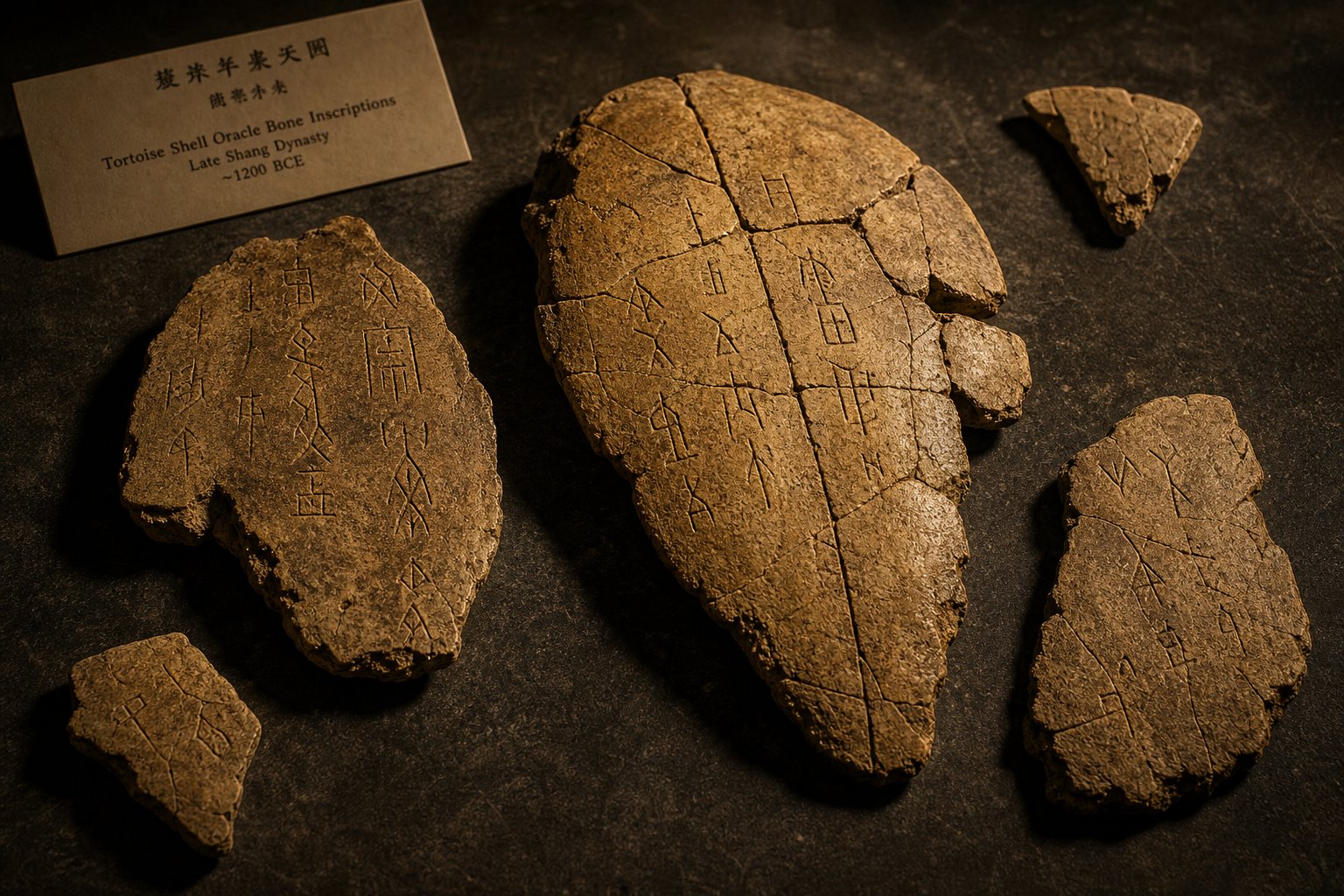
Every brief history of Chinese calligraphy starts in the same place: a royal diviner heating a piece of turtle shell or ox bone until it cracked, then carving the king's question and the spirits' answer into the surface. These oracle bone inscriptions, known as jiaguwen, date to the Shang dynasty (ca. 1600-1046 BCE) and represent the earliest confirmed examples of Chinese writing.
Oracle Bones and the Birth of Written Chinese
Picture the characters themselves. They are angular, sharp, and unmistakably pictographic. A figure for "sun" looks like a circle with a dot inside. "Mountain" resembles three peaks. The lines are thin and scratchy — carved with pointed tools into hard, brittle surfaces — giving them a jagged energy entirely different from later brush-written forms. Yet even here, you'll notice something beyond pure function. Diviners varied the size and spacing of characters, arranged them in neat columns, and occasionally displayed a sense of visual balance that went beyond what communication alone required.
This early aesthetic awareness matters. It tells us that the history of ancient Chinese calligraphy did not begin with art and then become practical. Writing and visual beauty emerged together from the start.
Bronze Inscriptions and Early Aesthetic Awareness
During the Zhou dynasty (ca. 1046-256 BCE), writing moved from bone to bronze. Inscriptions cast into ritual vessels — called jinwen — recorded dedications, military victories, and land grants. The medium changed the look of the characters dramatically. Bronze casting produced rounder, more fluid strokes with even line widths. Characters grew more complex and decorative, sometimes filling the interior of a vessel with dense, rhythmic patterns.
These bronze inscriptions also introduced something crucial to the history of Chinese calligraphy writing: variation. Different Zhou states developed their own regional character forms. A word written in the state of Chu might look nothing like the same word in the state of Qin. By the Warring States period (475-221 BCE), this fragmentation had produced dozens of local scripts — a situation that would demand a radical political solution.
The Qin Unification That Changed Everything
In 221 BCE, Emperor Qin Shi Huang conquered the remaining warring states and unified China under a single centralized government. One of his first acts was to standardize the writing system. Imperial edicts and laws needed to be legible to officials in every corner of the empire. The result was Xiao Zhuan — Small Seal Script — a single, regulated set of characters imposed across all of China.
This was calligraphy as political power. The emperor erected inscribed stone stelae at strategic locations throughout his realm, their elegant seal script characters serving as permanent claims of legitimacy. The written word carried such authority in early China that simply installing these monuments constituted a cogent act of governance.
Small Seal Script itself is visually distinctive: characters are tall and narrow, with strokes of uniform thickness that curve smoothly and symmetrically. Every line carries the same weight, giving the script a formal, almost architectural quality. It was designed for clarity and control — a visual expression of the Qin state's obsession with order.
Yet the Qin unification also set the stage for something the emperor never intended. As writing shifted from carved stone and cast bronze to brush-applied ink on bamboo strips and silk, the physical act of writing transformed entirely. A brush, unlike a chisel, responds to pressure, speed, and angle. It can produce thick and thin lines in a single stroke. It rewards fluidity over rigidity. This transition from carving to brushwork opened up expressive possibilities that would eventually give rise to entirely new script styles — each one a response to what the brush could do that no blade ever could.
The Five Major Script Styles Explained
The brush did not simply replace the chisel — it unleashed an entire family of writing styles. Over roughly a thousand years, Chinese calligraphy branched into five distinct scripts, each born from specific historical pressures and each offering a different balance between legibility, speed, and artistic expression. Understanding these five styles is essential to grasping a history of Chinese calligraphy as a whole, because every master, every dynasty, and every philosophical debate circles back to them.
In Chinese, they are called the Five Scripts (wuti): Seal Script, Clerical Script, Regular Script, Running Script, and Cursive Script. All other variations branch from these five pillars.
| Script Name | Chinese | Dynasty of Origin | Key Visual Characteristics | Primary Historical Use | Difficulty Level |
|---|---|---|---|---|---|
| Seal Script | 篆书 (zhuan shu) | Qin (221-206 BCE) | Even-width strokes, rounded curves, tall symmetrical structure | Official seals, stone inscriptions, imperial edicts | Moderate (slow, meditative) |
| Clerical Script | 隶书 (li shu) | Han (206 BCE-220 CE) | Flattened characters, wave-like horizontals with flared endings | Government documents, administrative records | Moderate |
| Regular Script | 楷书 (kai shu) | Late Han / Three Kingdoms (ca. 220-317 CE) | Square, upright, balanced strokes executed separately | Official documents, printed text, education | Foundational (taught first) |
| Running Script | 行书 (xing shu) | Eastern Jin (317-420 CE) | Connected strokes, fluid movement, partially simplified | Personal correspondence, daily writing, poetry | High (demands mastery of Regular Script first) |
| Cursive Script | 草书 (cao shu) | Late Han, matured in Tang (618-907 CE) | Radically abbreviated, continuous brush movement, angular-less forms | Artistic expression, emotional release | Very High (difficult to read and write) |
Seal Script and Clerical Script as Foundational Forms
Seal Script (zhuan shu) is the style closest to nature. Its strokes maintain a consistent width from start to finish, curving smoothly without sharp corners. Characters are taller than they are wide, built around a central axis of symmetry. Writing a single character in this style can take one to two minutes — the brush tip must stay perfectly centered to achieve those even lines. The result feels architectural, almost meditative. Even native Chinese speakers often struggle to read it, yet its visual elegance makes it immediately appreciable as art.
Clerical Script (li shu) emerged when the Han dynasty's expanding bureaucracy demanded faster document production. There is a saying that captures the shift perfectly: "Seal script is like a painting; Clerical script is like a wave." You'll notice the characters flatten out, becoming wider than they are tall. The most recognizable feature is the "silkworm head and goose tail" stroke — a horizontal line beginning with a rounded press on the left and ending with an upward flare on the right. This flourish was only possible because brush-and-ink writing allowed calligraphers to modulate stroke width at will, pressing down for thickness and lifting for thinness. Clerical Script marks the moment calligraphy truly became an art of pressure and rhythm rather than uniform line-making.
Regular Script and the Standard of Legibility
Regular Script (kai shu) combined the separate, deliberate strokes of Clerical Script with the more fluid proportions emerging in cursive experiments. The result is the clearest, most legible form of Chinese writing — and the one you'll encounter in virtually every printed book, street sign, and textbook today. Each stroke is executed individually, with strict rules governing width, angle, and proportion. The Song dynasty calligrapher Su Shi described it vividly: "Regular Script is like standing, Running Script is like walking, Cursive Script is like running."
Its golden age arrived during the Tang dynasty (618-907 CE), when political stability and institutional confidence demanded visual order. From that period onward, every candidate in the imperial civil service examination was required to write in Regular Script. This single mandate shaped the history of Chinese calligraphy art for centuries, making kai shu the script that every educated person had to master before exploring freer styles.
Running and Cursive Scripts as Expressive Freedom
Running Script (xing shu) relaxes the rules just enough to let the brush flow between strokes without fully lifting from the paper. It is faster, more personal, and remains the most widely used handwriting style in daily life. Its flexibility has produced enormous stylistic variety — no two masters write Running Script quite the same way, which is precisely what makes it so technically demanding to master well.
Cursive Script (cao shu) pushes further still. Strokes merge into single continuous movements. Characters lose their angles and take on rounded, grass-like shapes — hence its Chinese nickname, "Grass Script." Reading it requires specialized knowledge of conventional abbreviations called caofa. Yet this difficulty is the point. Cursive Script is the most emotionally expressive of the five styles, a form of rhythmic release where speed, pressure, and spontaneity converge. Many calligraphers historically wrote cursive after drinking wine, freeing the hand to follow feeling rather than formula.
Each of these five scripts did not simply appear in isolation. They were shaped by the calligraphers who pushed their possibilities — individuals whose innovations became the standards against which all later work was measured.
Famous Chinese Calligraphy Masters Who Defined the Art
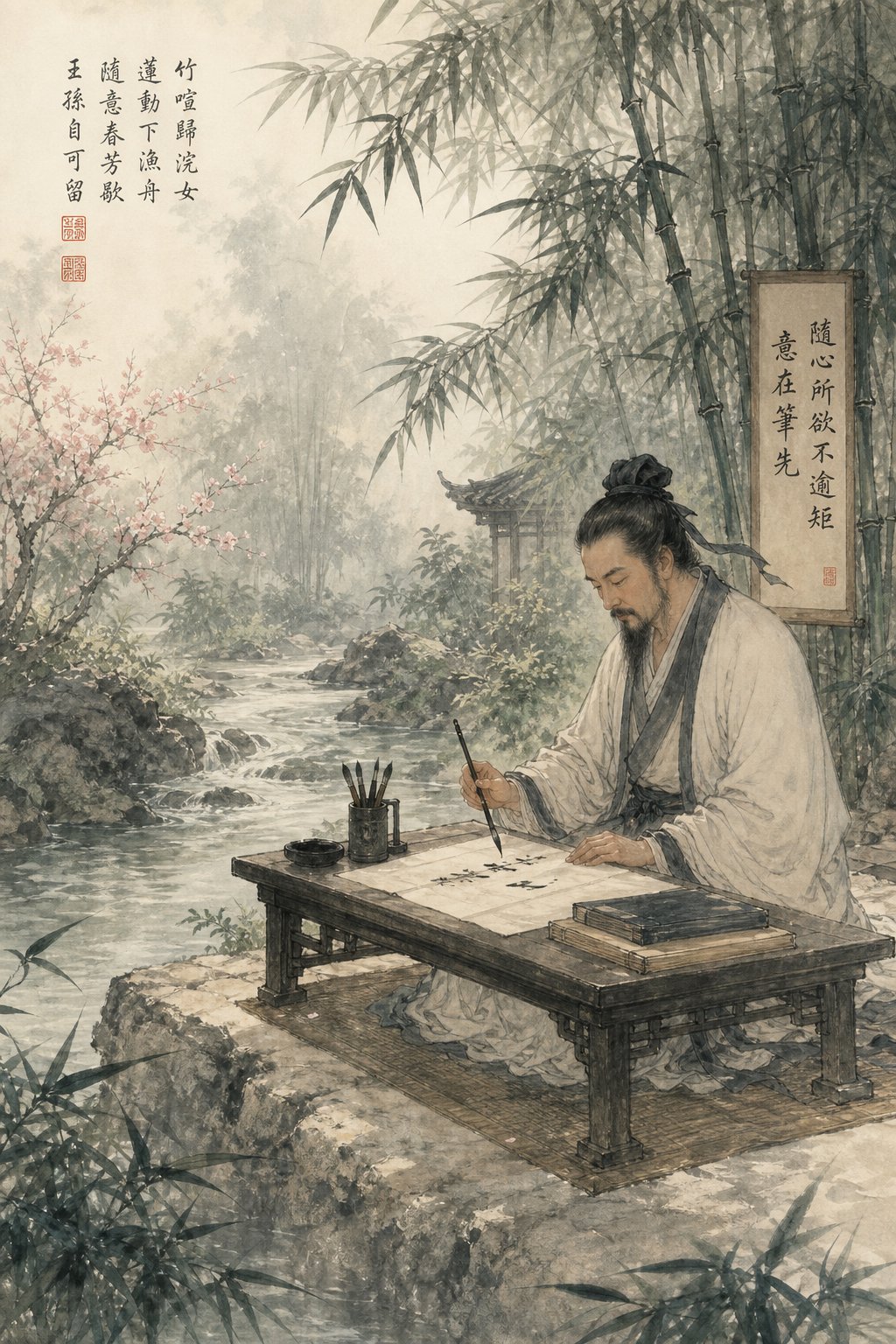
Scripts are systems. Masters are the individuals who breathed life into those systems, bending rules just enough to create something unmistakably personal while remaining rooted in tradition. The famous Chinese calligraphy masters history remembers are not simply skilled technicians — they are figures whose brushwork became the vocabulary later generations used to speak. Scholars like Tseng Yu-ho, in her landmark study a history of Chinese calligraphy, traced how each master's innovations rippled forward through centuries of practice and imitation.
Wang Xizhi and the Sage of Calligraphy
If one name dominates the entire tradition, it is Wang Xizhi (303-361 CE). Active during the Eastern Jin dynasty, he earned the title "Sage of Calligraphy" (shu sheng) — a distinction no one has challenged in over 1,600 years. His genius lay in transforming Running Script from a casual shorthand into a vehicle for profound artistic expression.
Imagine a spring day in 353 CE. Wang Xizhi gathers with 41 friends at the Orchid Pavilion in Shaoxing for a wine-drinking poetry contest along a winding stream. At the end of the gathering, slightly intoxicated, he picks up his brush and writes a preface to the collected poems. The result — the Preface to the Orchid Pavilion (Lanting Xu) — became the single most celebrated work in all of Chinese calligraphy. Its Running Script flows with a naturalness that feels effortless yet contains subtle variations in pressure, spacing, and rhythm that no one has successfully replicated.
Here is the twist: no original survives. Legend holds that Emperor Taizong of the Tang dynasty (r. 626-649) was so obsessed with the piece that he had it buried with him in his tomb. What remain are Tang dynasty copies and stone rubbings — themselves considered masterpieces. Every character in the Lanting Xu is slightly different from the next, even when the same word repeats. The character for "zhi" (之) appears twenty times, and each instance is written differently. That single detail captures Wang Xizhi's philosophy: calligraphy must be alive, never mechanical.
Tang Dynasty Masters Who Defined Standard Script
The Tang dynasty (618-907 CE) brought political stability and institutional confidence that demanded visual order. Three masters codified Regular Script into forms still taught in classrooms today:
- Ouyang Xun (557-641) — Early Tang dynasty. Regular Script. Known for characters with tight internal structure and slightly elongated proportions. His style emphasizes precision and angular clarity, earning the nickname "Ou-style" (Outi). His Jiucheng Palace Stele remains a standard copybook for beginners.
- Yan Zhenqing (709-785) — Mid-Tang dynasty. Regular Script. Developed a bold, muscular style with thick strokes and expansive structure — a deliberate contrast to the slender elegance of earlier masters. His innovation was partly personal and partly political: Yan served as a loyal official during the devastating An Lushan Rebellion, and his memorial steles for fallen relatives carry an emotional weight visible in every powerful horizontal and sturdy vertical. His Stele for the Yan Family Temple defined what strength looks like in brushwork.
- Liu Gongquan (778-865) — Late Tang dynasty. Regular Script. Synthesized the precision of Ouyang Xun with the power of Yan Zhenqing, producing characters that are lean, sharp, and architecturally balanced. He famously told Emperor Muzong that "the heart must be upright for the brush to be upright" — linking moral character directly to brushwork quality.
Together, Ouyang, Yan, and Liu established the three pillars of standard script that every student of calligraphy still encounters first.
Song and Yuan Innovators Who Pushed Boundaries
Where Tang masters codified rules, Song dynasty (960-1279) literati deliberately broke them. Personal expression mattered more than technical perfection. Two figures stand out:
- Su Shi (1037-1101) — Northern Song dynasty. Running Script. A poet, painter, and statesman whose calligraphy reflected his turbulent political career. His brushwork is broad, slightly flattened, and unapologetically personal. He once declared that his calligraphy was like "a worn-out horse at the end of the road" — exhausted but free. His Cold Food Observance scroll, written during political exile, is considered one of the three greatest Running Script works in history.
- Mi Fu (1051-1107) — Northern Song dynasty. Running and Cursive Scripts. Known for dramatic tilting strokes and unpredictable rhythm. Mi Fu studied ancient masters obsessively before developing a style so distinctive that contemporaries called it "wild and unrestrained." His brushwork leans and sways like a dancer, with sudden shifts in pressure that create visual surprise on every line.
The Yuan dynasty (1271-1368) brought Mongol rule and a crisis of cultural identity for Chinese scholars. Zhao Mengfu (1254-1322) responded by looking backward — reviving the elegance of Wang Xizhi and Jin dynasty aesthetics as a form of cultural preservation. His Running and Regular Scripts are graceful, refined, and deliberately classical, proving that innovation sometimes means returning to origins with fresh eyes.
These masters did not work in isolation. Their brushes required specific materials — ink, paper, and stone — each with its own long history of development that shaped what was physically possible on the page.
The Four Treasures of the Study and Their Evolution
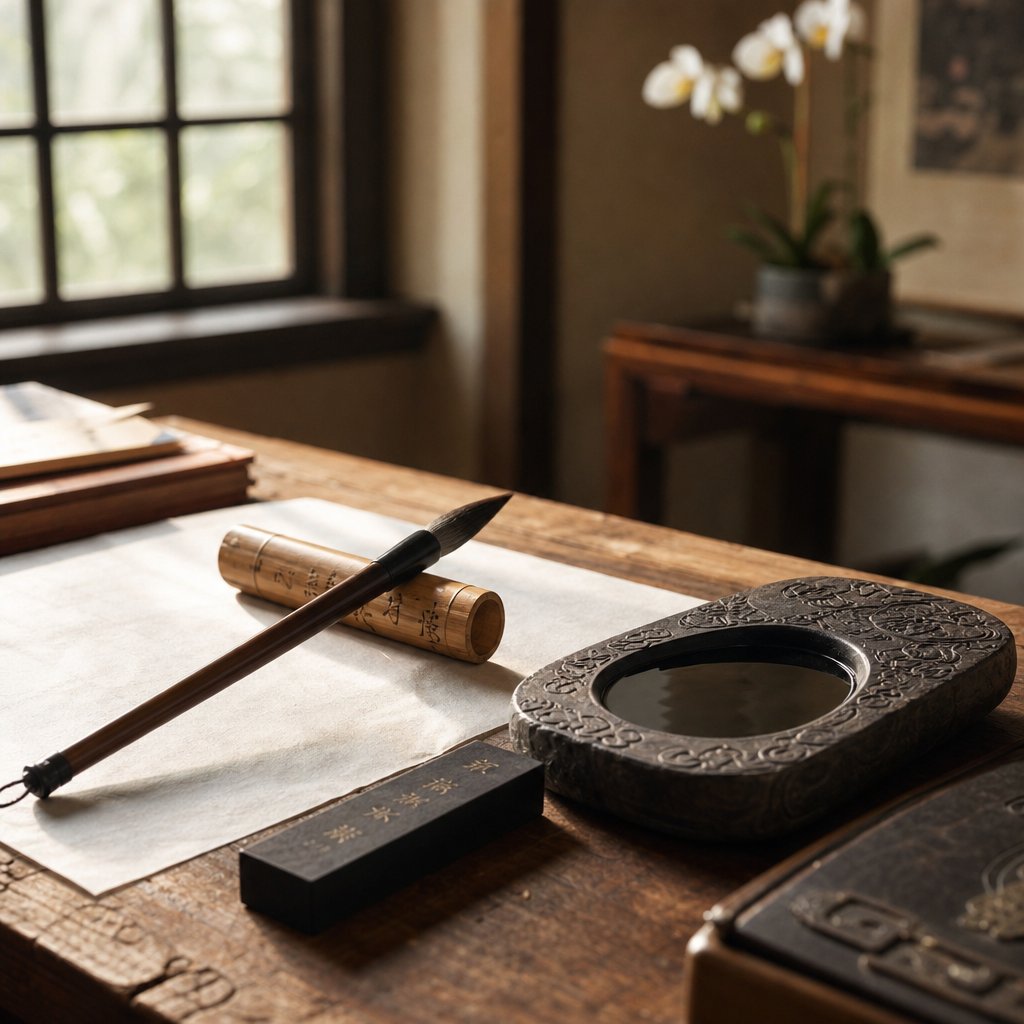
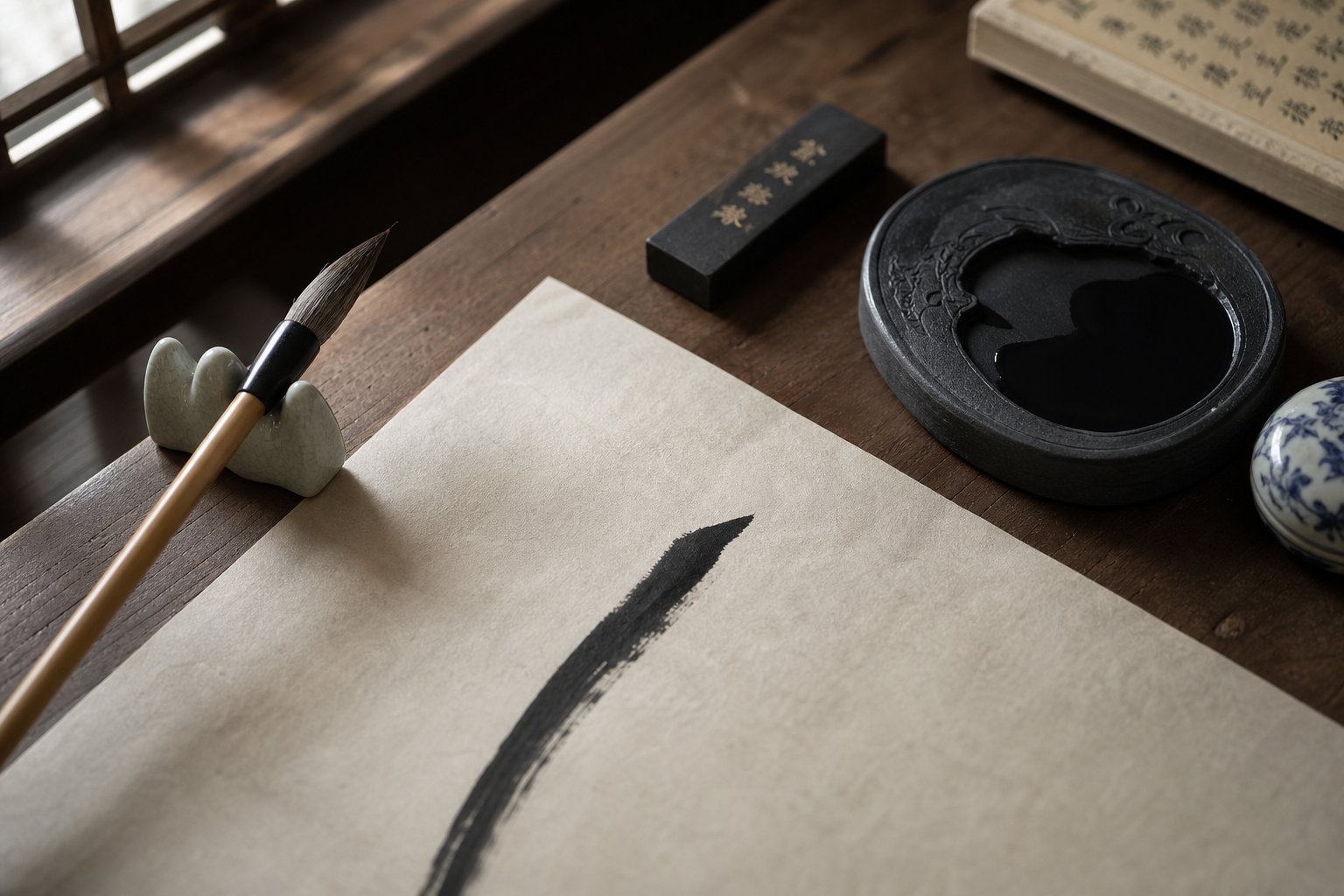
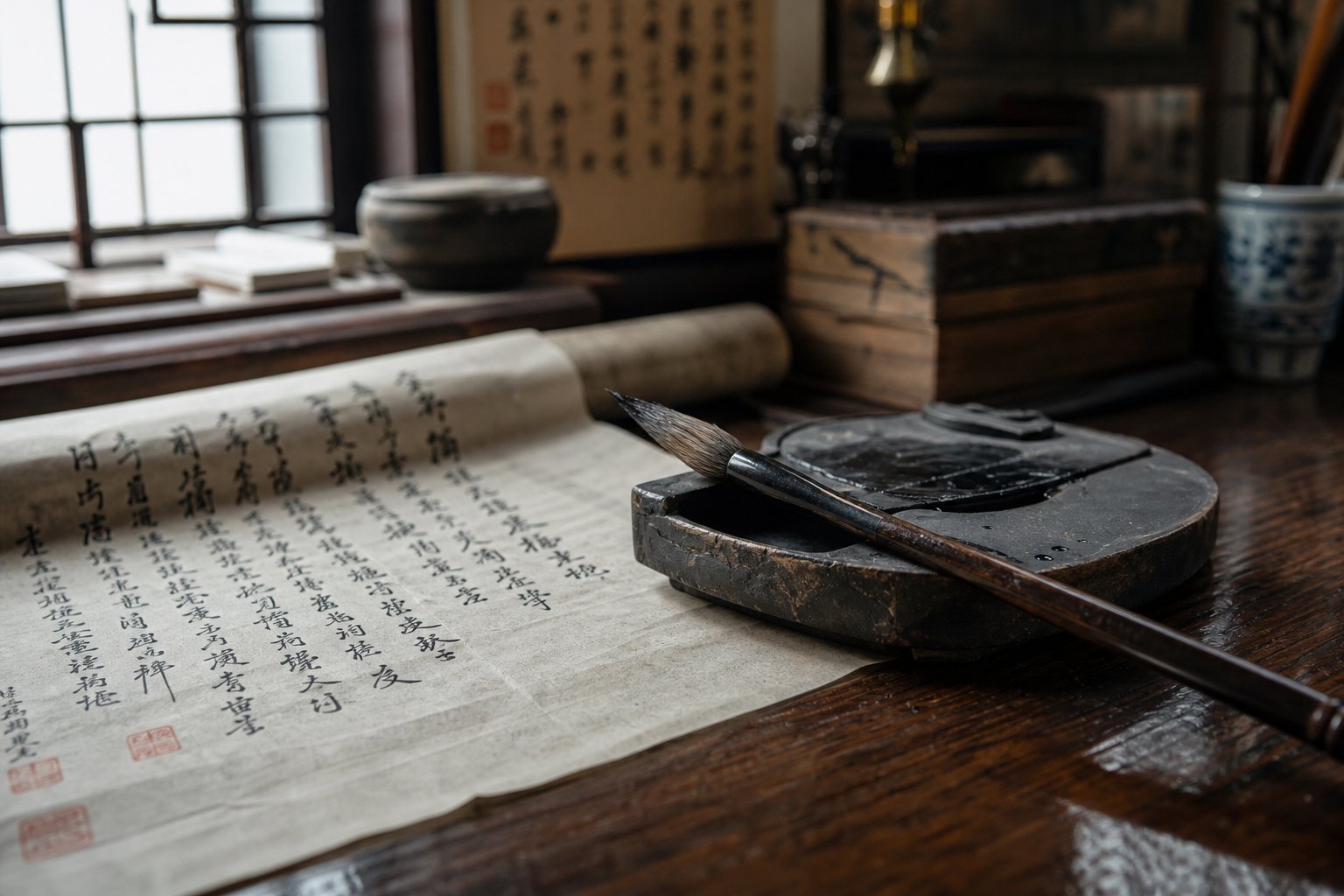
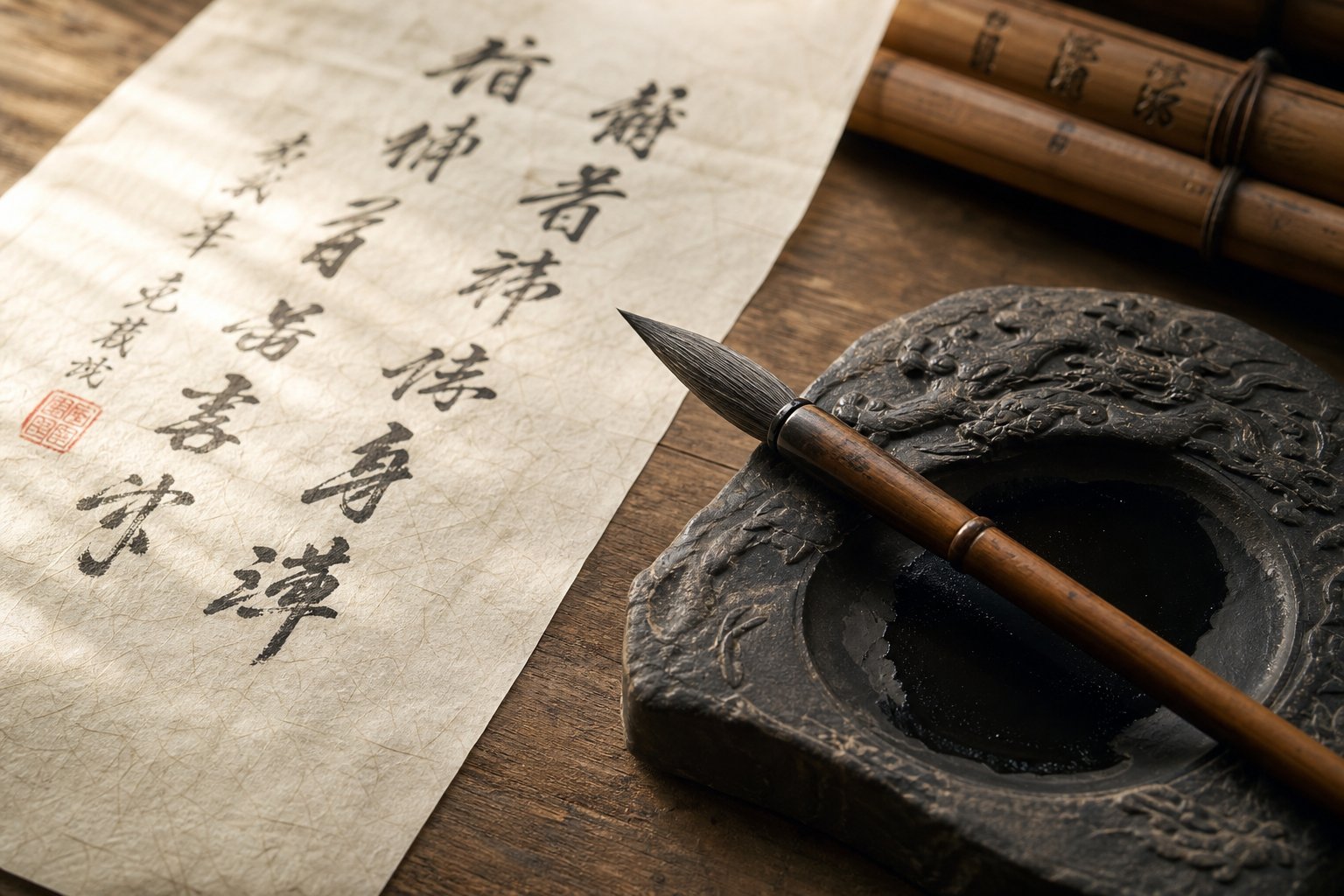
A master calligrapher without proper tools is like a musician without an instrument. The history of the Chinese calligraphy brush, the ink stick, the paper sheet, and the inkstone is not a footnote to the art — it is the art's physical foundation. Each material innovation unlocked new expressive possibilities, and together these four objects became so central to scholarly life that they earned a collective title: the Four Treasures of the Study (wenfang sibao).
The Brush and Its Transformative Evolution
The earliest writing tools in China were not brushes at all. Shang dynasty scribes used sharpened bamboo or bone styluses to carve characters into hard surfaces. The transition to a soft-tipped brush — a bundle of animal hair bound to a bamboo or wooden handle — changed everything about how characters could look and feel.
Tradition credits General Meng Tian of the Qin dynasty (ca. 210 BCE) with inventing the modern brush, though archaeological evidence suggests hair brushes existed earlier. What Meng Tian likely did was standardize and improve the design, selecting specific animal hairs for specific qualities. The history of writing Chinese characters with pencils, pens, and calligraphy brushes all traces back to this pivotal shift from rigid tool to flexible tip.
- Brush (bi) — Origin: pre-Qin period, refined ca. 3rd century BCE. Materials: rabbit hair (stiff, for precise strokes), goat hair (soft, for fluid cursive), or mixed-hair combinations. Impact: softer brushes enabled the flowing connected strokes of Running and Cursive Scripts, while stiffer brushes supported the angular precision of Regular Script.
Paper and Ink as Revolutionary Technologies
Before paper, calligraphers wrote on bamboo strips or expensive silk. Bamboo was heavy, awkward to store, and limited how large or fluid a character could be. Silk was smooth and receptive to ink but prohibitively costly for everyday use. The invention of paper removed both constraints at once.
Archaeological evidence points to primitive hemp-based paper appearing as early as the 2nd century BCE. The traditional date for refined paper is 105 CE, when Cai Lun, director of the Imperial Workshops at Luoyang, developed a method of soaking and pressing plant fibers, then drying them in sheets on wooden frames. By the end of the Han dynasty (220 CE), paper quality had improved dramatically through experimentation with bark, rattan, and various plant fibers. The combination of brush, ink, and paper established calligraphy and painting as the most important areas of Chinese art for the next two millennia.
- Paper (zhi) — Origin: 2nd century BCE (primitive forms), refined 105 CE. Materials: hemp, rattan, bamboo fiber, mulberry bark. Impact: absorbent paper allowed ink to bleed and feather slightly, creating the soft-edged "ink wash" effects prized in cursive styles. Different paper textures gave calligraphers control over how ink spread, enabling regional aesthetic traditions.
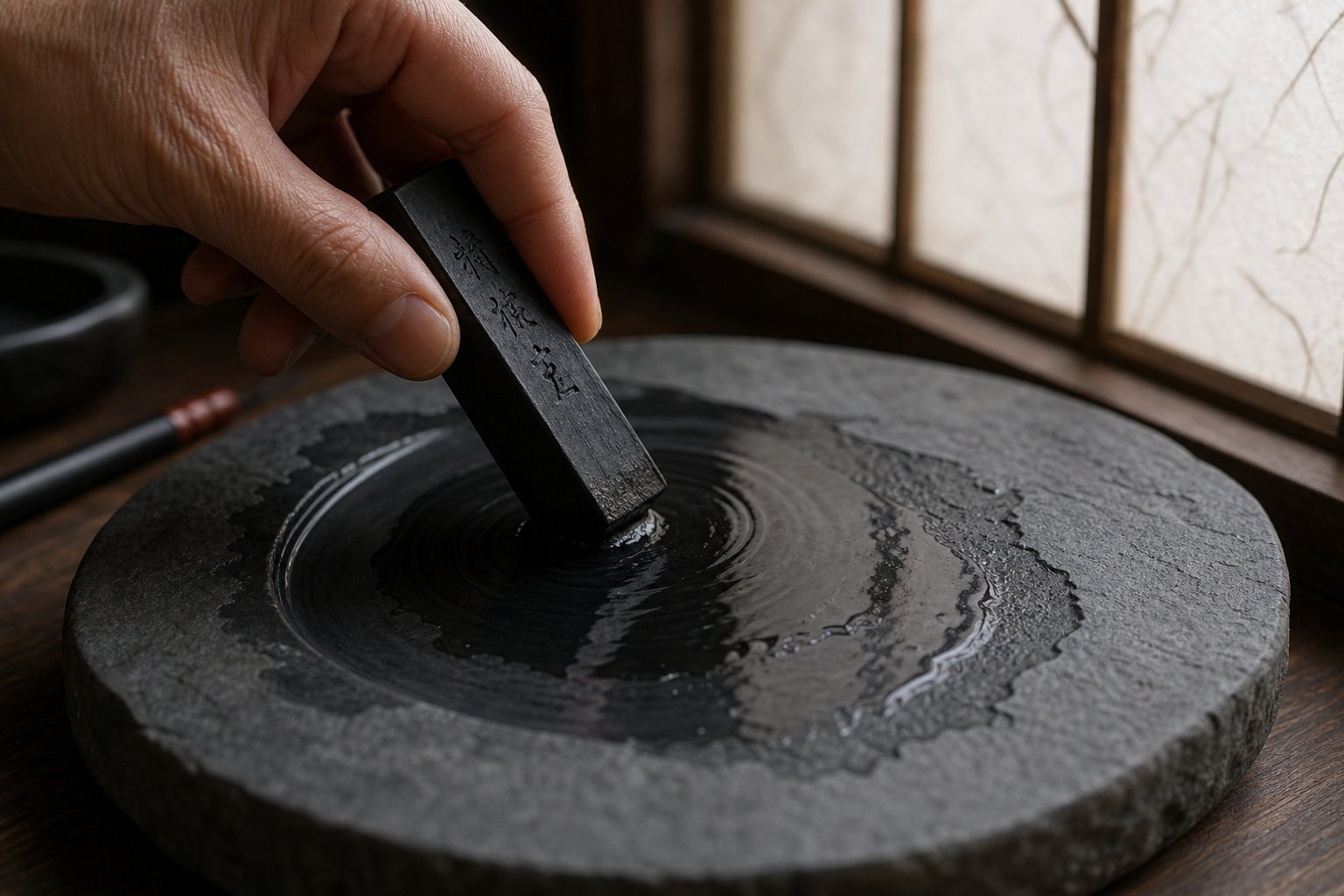
- Ink (mo) — Origin: Neolithic soot-based pigments, refined into stick form during the Han dynasty. Materials: pine soot or oil soot bound with animal glue, pressed into solid sticks. Impact: the grinding ritual — rubbing the ink stick against a wet stone until the desired consistency is reached — served as meditative preparation, slowing the calligrapher's mind before brush touched paper. Thicker ink produced sharp, defined strokes; diluted ink created translucent washes.
- Inkstone (yan) — Origin: Han dynasty, with famous quarries established by the Tang dynasty. Materials: fine-grained stone (Duan stone from Guangdong, She stone from Anhui). Impact: the stone's texture determined how smoothly and quickly ink could be ground. A superior inkstone produced ink of even consistency without grit — essential for the uninterrupted flow demanded by cursive writing.
How Materials Shaped Artistic Possibility
The relationship between tools and style was never one-directional. Softer goat-hair brushes made the sweeping, connected strokes of Cursive Script physically possible. Highly absorbent paper from the Song dynasty onward rewarded speed and confidence — hesitate too long and the ink pools into a blot. Stiffer brushes on sized (less absorbent) paper gave Tang dynasty masters the control needed to perfect Regular Script's crisp geometry.
The history of Chinese cloth calligraphy, silk scrolls, and later paper formats all reflect this feedback loop: new materials invited new techniques, and new techniques demanded better materials. When you look at a piece of calligraphy, you are seeing not just a calligrapher's skill but the accumulated material knowledge of centuries — the right hair, the right stone, the right fiber, all converging on a single sheet.
Yet tools alone do not explain why calligraphy became the supreme art of Chinese civilization. Behind the brush lay an entire philosophical framework — Confucian, Daoist, and Buddhist — that elevated writing from craft to spiritual discipline.
Philosophy and Power Behind the Brush
Why did an entire civilization treat handwriting as a spiritual discipline? The answer lies in three philosophical traditions — Confucianism, Daoism, and Buddhism — each contributing a distinct layer to the Chinese calligraphy philosophy and cultural significance that elevated brushwork far beyond communication. These ideas did not remain abstract. They shaped how students trained, how masters were judged, and how careers were made or broken.
Confucian Discipline and the Cultivation of Character
In the Chinese tradition, "art" is not associated with technology or science as it is in Europe — it is associated with self-cultivation. The etymology of "art" (yi) in Chinese references the verbs "plant" and "cultivate." Confucius himself urged: "Concentrate your will on the Way... and take pleasure in the arts" (Analects, VII.6). Calligraphy became the primary vehicle for this moral cultivation.
What does that look like in practice? Years — sometimes decades — of copying masterworks stroke by stroke. A student learning Regular Script might spend months on a single character, internalizing not just its shape but the discipline required to produce it consistently. The logic is straightforward: if you cannot govern your brush, how can you govern yourself? If you cannot govern yourself, how can you govern others?
In Chinese tradition, a written character should reveal itself as a moral exemplar — a manifestation of the energy of the human body and the vitality of nature itself. One's calligraphy reveals one's moral character.
This belief was not metaphorical. Tang dynasty theorists described properly written characters in explicitly physical and moral terms: "Calligraphy that has much bone but slight flesh is called sinew-writing. Calligraphy with much strength and rich in sinew is of sagelike quality; that with neither strength nor sinew is sick." The rankings of calligraphers took into account not only the quality of their works but also their personal morality — a practice unthinkable in Western art criticism.
Daoist Spontaneity in Brush and Ink
If Confucianism demanded discipline, Daoism demanded its opposite: letting go. The concept of ziran (naturalness, spontaneity) taught that the finest brushwork emerges not from conscious effort but from a state of emptiness where the calligrapher becomes a medium for larger forces.
The Zhuangzi — a foundational Daoist text frequently invoked by calligraphers — contains the famous declaration: "I and all things are one." In calligraphic practice, this translates to a specific ideal. The calligrapher empties their mind (xu xin, "void heart"), and the brush follows the movement of creation between heaven and earth rather than the anxious calculations of the intellect. Yu Shinan, the Tang dynasty calligrapher and minister, described how the brush "glides" when the calligrapher's heart "seizes the movement" of the universe — effortless, unforced.
You can see this philosophy encoded directly in the aesthetics. Black ink against white paper mirrors the Daoist interplay of yin and yang. The empty space surrounding a character is not absence — it is active, breathing, essential. A stroke's power comes as much from where it stops as from where it moves. Stillness and motion, presence and void, exist in dynamic balance on every page.
Buddhist meditation deepened this further, particularly within Chan (Zen) traditions. The ritual of grinding ink — slow, circular, repetitive — functioned as a form of mindfulness practice, stilling the mind before the brush ever touched paper. Chan monks practiced calligraphy as a path to enlightenment, treating each stroke as a complete act of awareness. The resulting aesthetic prized immediacy: no revision, no hesitation, just the unmediated trace of a focused mind.
Calligraphy as Social Capital and Political Power
Philosophy alone did not make calligraphy central to Chinese life. Political power did. The imperial examination system (keju), which selected government officials through written tests from the Sui dynasty (581-618 CE) onward, made beautiful brushwork a mandatory career requirement. Your answers might be brilliant, but if your calligraphy was poor, examiners could reject your paper outright.
Consider what this meant across centuries of Chinese society. Every family with ambitions for their sons invested in calligraphy training. Every scholar spent hours daily practicing brushwork alongside memorizing classical texts. The history and cultural heritage of Chinese calligraphy cannot be separated from this institutional reality — the art form was embedded in the machinery of governance itself.
Emperors reinforced this connection by practicing calligraphy publicly and collecting masterworks. Emperor Taizong of the Tang dynasty was so devoted to Wang Xizhi's work that he commissioned multiple copies and reportedly took the original Lanting Xu to his grave. When a ruler demonstrated calligraphic skill, he signaled cultural legitimacy. When officials displayed fine brushwork, they signaled fitness for power.
This fusion of philosophy, education, and political authority gave calligraphy a weight no other art form carried. It was simultaneously a spiritual practice, a moral test, and a career tool — three functions converging in a single brushstroke. That convergence also meant calligraphy was uniquely vulnerable to political disruption. When dynasties fell, when stability shattered, the art did not simply continue unchanged — it transformed in response to the forces reshaping Chinese society.
Chinese Calligraphy History by Dynasty: The Forces That Shaped Each Era
Calligraphy never evolved in a vacuum. Every major stylistic shift — from restrained formality to wild expressiveness, from rigid orthodoxy to radical experimentation — maps directly onto political events that reshaped Chinese society. Trace the footprints of history through Chinese calligraphy and you find something striking: the brush responded to war, peace, fragmentation, and unification as sensitively as any seismograph responds to tremors underground.
How Political Upheaval Fueled Artistic Expression
When the Han dynasty collapsed in 220 CE, China fractured into competing kingdoms. The Three Kingdoms period, followed by the Jin dynasty and the chaotic Northern and Southern Dynasties (420-589), produced centuries of instability, warfare, and displacement. For scholars, the old certainties vanished. Government service became dangerous. Confucian ideals of public duty gave way to Daoist withdrawal and personal cultivation.
What happened to calligraphy during this upheaval? It exploded with individuality. Freed from bureaucratic expectations, scholars turned inward. Cursive and Running Scripts — faster, more personal, less constrained by official legibility — flourished precisely because the institutions demanding formal writing had crumbled. Wang Xizhi and his son Wang Xianzhi developed their celebrated Running Script during the Eastern Jin dynasty (317-420), a period of political exile for the Chinese elite who had fled south after losing northern China to non-Han invaders.
The connection is not coincidental. When public life becomes treacherous, private expression becomes essential. Calligraphy offered scholars a space where personal feeling could flow without political consequence — where a single brushstroke could carry grief, defiance, or transcendence that no official document ever could.
Stability and Standardization in the Tang Golden Age
The Tang dynasty (618-907) reversed this dynamic entirely. Wise governance, prosperity, long-lasting peace, and active commerce created what historians call China's Golden Age. Poetry, painting, and calligraphy were fully developed and revered by accomplished practitioners across the empire. Political confidence demanded visual order — and calligraphy delivered it.
Regular Script reached its highest expression during this period. The three sub-styles that emerged — Ouyang Xun's precise "Ou-style," Yan Zhenqing's bold "Yan-style," and Liu Gongquan's sharp "Liu-style" — became the standard forms that calligraphy students still choose from today. This codification was not accidental. A stable empire running a massive civil service examination system needed legible, standardized handwriting from every candidate. The Tang state essentially institutionalized calligraphic excellence.
Yet stability did not mean stagnation. The same era produced Zhang Xu and Huai Su, whose wild cursive (kuangcao) pushed expressiveness to its absolute limit. Zhang Xu, nicknamed "Crazy Zhang," reportedly created his most extraordinary cursive pieces while intoxicated, performing for visiting dignitaries. Huai Su's brushwork was described as resembling "snakes and dragons reeling in storms" — continuous, rounded strokes that moved across the paper like steel wire being bent at speed. The Tang was confident enough to contain both extremes: perfect order and ecstatic freedom, side by side.
Song, Ming, and Qing: Personal Expression Versus Orthodox Tradition
The Song dynasty (960-1279) shifted the center of gravity from technical mastery to personal voice. Literati culture — scholars who painted, wrote poetry, and practiced calligraphy as interconnected arts — elevated individual expression over rule-following. Su Shi captured the attitude perfectly when he declared his calligraphy was like "a worn-out horse at the end of the road." The point was authenticity, not perfection. Song calligraphers deliberately broke Tang rules to assert that brushwork should reveal the writer's inner state, not merely demonstrate skill.
The Ming dynasty (1368-1644) amplified this tension. Artists frequently broke with tradition, exhibiting what scholars describe as a free, liberated, diverse style. Figures like Wen Zhengming, Zhu Yunming, and Dong Qichang were accomplished across painting, poetry, and calligraphy simultaneously — treating all three as facets of a single creative identity. Innovation meant personal synthesis: absorbing the old masters, then producing something unmistakably your own.
The Qing dynasty (1644-1911) introduced a fascinating counter-movement. Scholars increasingly turned to overlooked ancient seal and clerical script inscriptions as sources of fresh inspiration. This antiquarian impulse produced calligraphers like Deng Shiru and Zhao Zhiqian, who revived archaic forms with new energy — proving that looking backward could be its own form of innovation.
Regional Schools and Northern Versus Southern Traditions
Running beneath these dynastic shifts was a geographic divide that shaped calligraphic aesthetics for over a thousand years. During the Northern and Southern Dynasties period, two distinct traditions crystallized:
- Northern Stele School (beixue) — Rooted in stone engravings and stelae inscriptions. Characters are angular, powerful, and moderately flat with bold strokes. The Wei Stelae Style (wei bei ti) exemplifies this tradition: a transitional form borrowing from both clerical and regular characteristics, featuring angular strokes (fang bi) and characters that appear wide yet tall. The hard stone surface and chisel-based origins gave northern calligraphy its muscular, architectural quality.
- Southern Copybook School (tiexue) — Rooted in brush-written manuscripts and ink rubbings of masterworks. Characters favor elegance, fluidity, and refined curves. Wang Xizhi's running style remained dominant in the south, where scholars preserved brush-on-paper traditions through careful copying and transmission of model books.
These differences were not merely aesthetic preferences. Geography determined available materials — the north had abundant stone for carving, while the south had better paper and ink production. Politics mattered too: northern dynasties were often ruled by non-Han peoples who adopted Chinese writing but brought different sensibilities to its visual expression. The south, home to displaced Chinese elites, preserved older aristocratic traditions more conservatively.
By the Qing dynasty, the Stelae School experienced a major revival as scholars rediscovered and studied northern inscriptions with fresh eyes. This created a productive tension — a dialogue between power and grace, angularity and flow — that continues to animate calligraphic practice today. The history of writing Chinese characters through pencils, pens, and calligraphy brushes across these centuries reveals not a single linear progression but a constant oscillation between competing ideals, each era finding its own balance between discipline and freedom, tradition and invention.
That oscillation faced its most severe test in the twentieth century, when the very survival of traditional calligraphy came into question — threatened not by rival aesthetics but by modernization itself.
Modern Challenges and the Fight for Survival
The twentieth century nearly killed Chinese calligraphy. Not through neglect or gradual decline, but through deliberate political campaigns that questioned whether traditional characters — the very foundation of the art — should continue to exist at all.
Twentieth Century Disruptions and Near Extinction
When the Qing dynasty fell in 1912, reformers saw the Chinese writing system as an obstacle to modernization. Intellectuals during the May Fourth Movement (1919) argued that the complexity of traditional characters kept literacy rates low and held China back from competing with Western nations. Some proposed abolishing characters entirely in favor of a romanized alphabet. The written language that had sustained calligraphy for millennia was suddenly on trial.
The debate intensified after 1949. Beginning in the 1950s, the People's Republic of China issued official character simplifications designed to boost literacy rates. While some simplified forms drew on existing cursive abbreviations, others were phonetic substitutions with no visual connection to their traditional counterparts. For calligraphers trained in classical scripts, this reform severed the link between everyday writing and the aesthetic traditions built over centuries. Taiwan retained traditional characters, creating a split that persists today.
Then came the Cultural Revolution (1966-1976). Traditional arts were denounced as feudal remnants. Calligraphy masters were persecuted, collections destroyed, and teaching suppressed. A generation grew up with little exposure to classical brushwork. The art form that had survived dynastic collapses, foreign invasions, and centuries of political turmoil came closer to extinction during these ten years than at any other point in its long history.
Revival Movements and UNESCO Recognition
Recovery began in the 1980s as China reopened culturally. Calligraphy associations reformed, exhibitions resumed, and older masters who had survived the Cultural Revolution began teaching again. The Chinese Calligraphers Association, reestablished in 1981, became a focal point for organizing practice, scholarship, and public engagement nationwide.
The most significant international milestone came in 2009, when UNESCO inscribed Chinese calligraphy on its Representative List of the Intangible Cultural Heritage of Humanity. The evaluation praised calligraphy as "an artistic practice that reflects the unique character, spirit, temperament, interest, and way of thinking of the Chinese people." This recognition affirmed what practitioners had long known — that calligraphy is far more than decorative writing. It is a living system of cultural transmission.
Calligraphy in the Digital Age
Here is the paradox of our current moment: keyboards and smartphones have made daily handwriting nearly obsolete, yet calligraphy resources are more accessible globally than at any point in history. Video instruction, digital archives of masterworks, and online communities connect students worldwide. Anyone searching for a history of Chinese calligraphy PDF or a history of Chinese calligraphy powerpoint can find scholarly materials that were once locked in university libraries.
Contemporary artists have responded to this tension creatively. Figures like Xu Bing, whose installation A Book From the Sky features thousands of painstakingly carved yet unreadable characters, interrogate the relationship between tradition and meaning. Qiu Zhijie spent eleven years writing Wang Xizhi's Orchid Pavilion Preface one thousand times on a single sheet — watching legibility dissolve into pure blackness. These works prove that the tradition still generates vital creative energy, even when — especially when — it confronts its own potential obsolescence.
Key milestones in calligraphy's modern survival and adaptation:
- 1950s — PRC character simplification reforms reduce stroke counts but alter traditional forms
- 1981 — Chinese Calligraphers Association reestablished, organizing national practice and exhibitions
- 2009 — UNESCO inscribes Chinese calligraphy as Intangible Cultural Heritage of Humanity
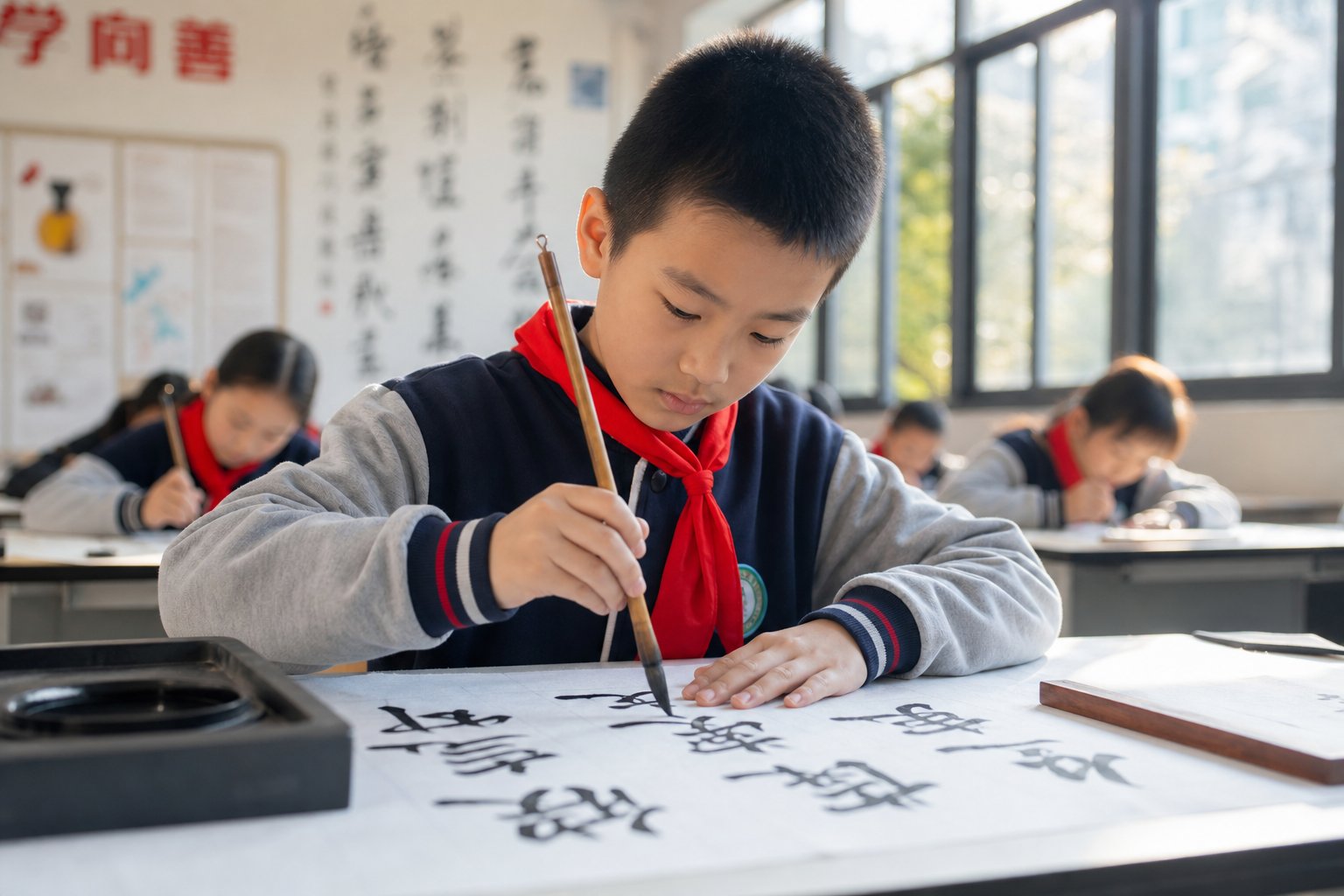
- 2010s-present — Calligraphy reintroduced as a required subject in Chinese primary schools
- Ongoing — Contemporary artists blend classical techniques with installation, performance, and digital media
Schools across China now teach calligraphy as part of the standard curriculum — making the history of Chinese calligraphy for kids not just an academic subject but a hands-on practice connecting young people to their cultural roots. Calligraphy clubs, workshops, and competitions remain active in communities and art academies throughout Chinese-speaking societies worldwide.
The art survived the twentieth century battered but unbroken. Its influence, however, never stayed within China's borders. For centuries, the brush carried Chinese aesthetic ideals outward — into Japan, Korea, Vietnam, and eventually the global contemporary art world.
Beyond China and Into the Future
Chinese calligraphy did not simply influence its neighbors — it gave them a written language. As characters traveled outward along trade routes, diplomatic missions, and Buddhist networks, each receiving culture absorbed the art and then reshaped it into something distinctly its own. The history of Chinese painting and calligraphy is inseparable from this broader East Asian story, because the same brush techniques, the same ink, and the same philosophical framework took root across the region.
Calligraphy Across East Asia
Japan first encountered Chinese characters through the Korean kingdom of Baekje in the 5th century. By the Nara period (710-794), masters like Kukai (774-835) were producing accomplished work modeled on Tang dynasty styles. What made Japanese calligraphy — Shodo, "the Way of writing" — unique was the development of kana syllabaries. These flowing, cursive-derived scripts gave Japanese calligraphers a second visual vocabulary alongside kanji (Chinese characters), enabling aesthetic combinations impossible in Chinese practice alone. In 2020, the Japanese government designated Shodo as a national art project for international cultural exchange.
Korea adopted Chinese characters around the 2nd or 3rd century, and its calligraphic tradition — Seoye, "the art of writing" — initially followed Tang masters like Ouyang Xun closely. Calligraphers such as Kim Saeng (711-791) established Korean brushwork as a serious discipline. Even after King Sejong created Hangul in 1443, Chinese characters remained the official script until the late 19th century, meaning Seoye continued to develop alongside the new alphabet rather than being replaced by it. Vietnamese thu phap followed a similar trajectory, adapting Chinese scripts before eventually developing its own romanized writing system.
The history of seals in Chinese calligraphy and painting also migrated with the art — Korean, Japanese, and Vietnamese calligraphers all adopted the practice of stamping finished works with carved seal impressions, a tradition linking every piece back to its Chinese origins.
A Tradition That Refuses to Become History
Step back and consider the full arc. From oracle bones scratched by Shang diviners to UNESCO heritage recognition, from a single emperor's standardization decree to millions of schoolchildren grinding ink today — this tradition has been shaped by politics, philosophy, material innovation, and individual genius across more than three millennia. It survived fragmentation, foreign conquest, revolution, and the digital displacement of handwriting itself. Whether encountered through a history of Chinese calligraphy video online or through the quiet ritual of brush meeting paper, the art remains what it has always been: a direct, unmediated encounter between a human being and the act of making meaning visible.
Calligraphy endures not as a relic of the past but as a living practice — one where every stroke written today carries the accumulated weight of thirty centuries and the fresh energy of the hand that writes it now.
Frequently Asked Questions About the History of Chinese Calligraphy
1. How long is the history of Chinese calligraphy?
Chinese calligraphy has a continuous history spanning over 3,000 years. It began with oracle bone inscriptions during the Shang dynasty (ca. 1600-1046 BCE) and has evolved through five major script styles without interruption. UNESCO recognized it as Intangible Cultural Heritage in 2009, confirming its status as one of the longest-running artistic traditions in human civilization.
2. What are the five major styles of Chinese calligraphy?
The five major styles are Seal Script (zhuan shu), Clerical Script (li shu), Regular Script (kai shu), Running Script (xing shu), and Cursive Script (cao shu). Each emerged during a different historical period and serves a distinct purpose, ranging from formal inscriptions to rapid personal expression. They developed sequentially from the Qin dynasty through the Tang dynasty, and all five remain in active use today.
3. Who is considered the greatest Chinese calligrapher in history?
Wang Xizhi (303-361 CE) of the Eastern Jin dynasty holds the title 'Sage of Calligraphy' and is widely regarded as the greatest master in the tradition. His Preface to the Orchid Pavilion is the most celebrated work in Chinese calligraphy history, famous for its natural flowing Running Script where the same character never appears identically twice. No original survives, as legend says Emperor Taizong of the Tang dynasty had it buried in his tomb.
4. How did Chinese calligraphy influence other Asian countries?
Chinese calligraphy spread to Japan, Korea, and Vietnam through trade routes, diplomacy, and Buddhist networks. Japan developed Shodo by combining Chinese characters (kanji) with native kana syllabaries, creating unique aesthetic possibilities. Korea established its Seoye tradition following Tang dynasty models, maintaining Chinese character practice even after creating Hangul in 1443. Each culture absorbed the core techniques and philosophical framework while developing distinct national characteristics.
5. Why was calligraphy so important in ancient Chinese society?
Calligraphy served simultaneously as a spiritual practice, a moral test, and a career requirement. The imperial examination system, which selected government officials from the Sui dynasty onward, demanded beautiful brushwork from every candidate. Poor calligraphy could disqualify even brilliant answers. Beyond politics, Confucian philosophy taught that one's brushwork revealed one's moral character, making calligraphy practice a form of self-cultivation essential to scholarly identity.