Why Choosing a Chinese Name Matters More Than You Think
Imagine walking into a meeting in Shanghai and introducing yourself with a name that accidentally means "old mosquito." It happens more often than you'd think. Choosing a Chinese name is not a simple matter of plugging your English name into a translator and hoping for the best. It's a cultural act rooted in thousands of years of philosophy, family values, and linguistic aesthetics.
So what are Chinese names, really? Each one is a carefully constructed combination of characters, where every stroke carries meaning. Chinese naming culture has deep historical roots influenced by Confucianism, family heritage, and personal aspiration. Parents spend weeks deliberating over a child's name because they believe it shapes identity and even destiny. When you learn how to choose a Chinese name for yourself, you're participating in that same tradition.
Why a Chinese Name Is More Than a Translation
A direct phonetic translation of your Western name might produce characters that sound vaguely similar but mean nothing coherent, or worse, something embarrassing. The character for a particular sound might evoke "ugly" or "stench" depending on the tone. Native speakers evaluate names by sound, meaning, and cultural resonance all at once. A well-chosen Chinese name signals respect for the language and opens doors that a clumsy transliteration never will.
Think of it this way: your Chinese name is a first impression compressed into two or three characters. It tells people whether you took the time to understand the culture or just grabbed the first result from an online tool. Getting it right matters whether you're networking in Beijing, studying in Taipei, or writing a novel set in ancient China.
Who This Guide Is For
People look into how to get a Chinese name for very different reasons, and each situation calls for a slightly different approach. Here's who will benefit most from this guide and what each group should prioritize:
- Language learners - You need a name that's easy to pronounce, memorable in class, and culturally appropriate. Prioritize natural sound and simplicity.
- Business professionals - Working in China or with Chinese partners means your name appears on cards, emails, and introductions. Prioritize professionalism and phonetic connection to your legal name.
- Parents of mixed-heritage children - You're selecting a name that will follow your child for life. Prioritize deep meaning, tonal harmony, and family significance.
- Fiction writers - Naming characters authentically requires understanding period, region, and social class. Prioritize historical accuracy and believability.
No matter which group you fall into, the process of how to pick a chinese name follows the same core principles: understand the structure, select meaningful characters, check the tonal flow, and validate with native speakers. This guide walks you through each step so you end up with a name that sounds natural, carries genuine chinese name meaning, and avoids the cringe-worthy mistakes that haunt so many well-intentioned learners.
The journey starts with something fundamental that trips up nearly everyone at first: the basic architecture of Chinese names and why the surname always comes before the given name.
Step 1 - Understand How Chinese Names Are Structured
You wouldn't build a house without understanding the blueprint. The same logic applies here. Before picking characters or worrying about meaning, you need to grasp the basic chinese name structure that governs every name in the language. It's straightforward once you see the pattern, but it works in the opposite direction from what English speakers expect.
Surname First and Given Name Second
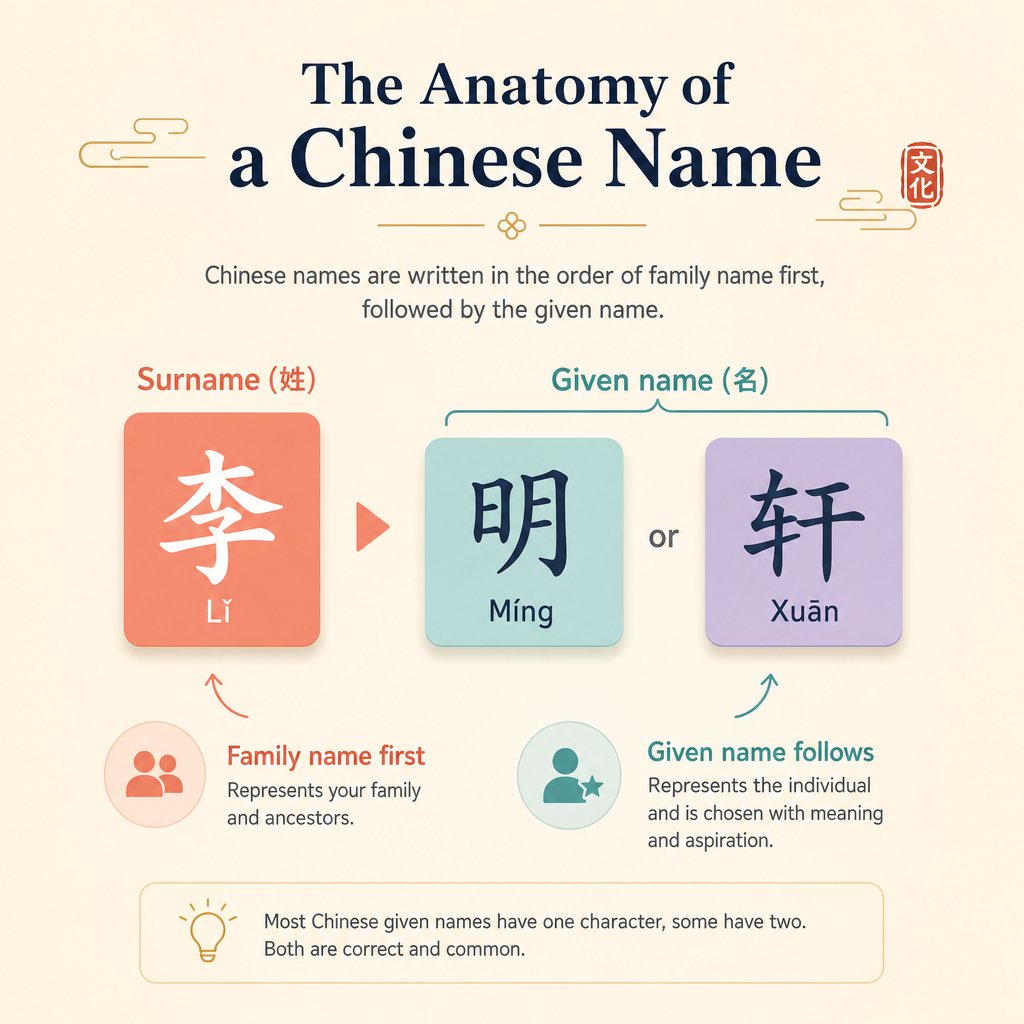
In English, you say "John Smith" - given name first, family name second. In Chinese, it's flipped. The surname (姓, xing) always comes first, followed by the given name (名, ming). So when you hear 姚明 (Yao Ming), the basketball legend's family name is 姚 (Yao) and his personal name is 明 (Ming, meaning "bright").
This isn't just a quirk of grammar. The ordering reflects a Confucian value system where family identity takes precedence over the individual. Your surname anchors you to your ancestral lineage; your given name is the part crafted specifically for you. Understanding how are chinese names structured at this fundamental level prevents the most common mistake foreigners make: accidentally introducing themselves with their given name where the surname should be.
Two-Character vs Three-Character Names
A complete Chinese name is typically either two or three characters total. Here's how that breaks down:
- Two-character names - One character for the surname, one for the given name. Example: 李明 (Li Ming). These are concise and punchy.
- Three-character names - One character for the surname, two for the given name. Example: 王小红 (Wang Xiaohong). The two-character given name allows for richer meaning combinations.
Most modern Chinese people carry three-character names because two given-name characters create a mini-phrase that expresses a more complete idea. A single given-name character was more common in older generations. When you're choosing your own name, a two-character given name gives you more creative room to combine meanings and balance tones.
The following table shows how these structures break down in practice:
| Full Name | Surname | Given Name | Meaning |
|---|---|---|---|
| 李明 (Li Ming) | 李 (Li) | 明 (Ming) | Bright, brilliant |
| 王小红 (Wang Xiaohong) | 王 (Wang) | 小红 (Xiaohong) | Little red (a classic name evoking warmth) |
| 张伟 (Zhang Wei) | 张 (Zhang) | 伟 (Wei) | Great, magnificent |
| 陈美华 (Chen Meihua) | 陈 (Chen) | 美华 (Meihua) | Beautiful splendor |
You'll notice that the surname is almost always a single character. While compound surnames like 欧阳 (Ouyang) or 诸葛 (Zhuge) do exist, they're rare. For practical purposes, assume one character for the surname and one or two for the given name.
How Chinese Name Order Differs From English
The first name and last name for chinese names can cause real confusion in cross-cultural settings. What English speakers call a "last name" is actually the first thing spoken in Chinese. What they call a "first name" comes last. This reversal has caused mix-ups for generations - early Chinese immigrants to English-speaking countries sometimes had their surnames and given names accidentally swapped on official documents, creating "wrong" family names that persisted for decades.
Here's a practical way to keep it straight: when you see a Chinese name written in characters with no spaces (like 王小红), the first character is always the surname. When written in pinyin, the surname is typically capitalized or listed first: Wang Xiaohong. In formal contexts, many Chinese people fully capitalize their surname on business cards - WANG Xiaohong - specifically to prevent this confusion.
How do chinese names work in everyday conversation? People generally use full names rather than given names alone. Calling someone just by their given name implies close intimacy - reserved for family and very close friends. In professional settings, you'd say the full name or use the surname plus a title, like 王老师 (Wang laoshi, "Teacher Wang"). This is another reason your chosen surname matters: it's the part people will use most often when addressing you formally.
A Chinese name is short - just two or three characters - but every element carries weight. Getting the structure right is the foundation everything else builds on.
With the blueprint clear, the next question becomes which surname to place at the front of your name. That choice is less obvious than it sounds, and there are several smart approaches depending on your situation.
Step 2 - Select a Surname That Fits
Your surname is the anchor of your Chinese name. It's the character people use when addressing you formally, the part that appears first in every introduction, and the element that immediately signals whether your name sounds authentic or foreign. Picking the right chinese surname sets the tone for everything that follows.
The Most Common Chinese Surnames and Their Origins
China has recorded over 6,000 surnames currently in use, yet the distribution is wildly uneven. The top five chinese family names - Wang, Li, Zhang, Liu, and Chen - are shared by more than 433 million people, roughly 30% of the population. Expand that to the top 100, and you cover nearly 86% of all Chinese citizens. This concentration traces back to the Hundred Family Surnames (百家姓, Bai Jia Xing), a Song Dynasty text from the 10th century that cataloged the most prevalent surnames and became a standard educational text for children.
Why does this matter for you? Choosing one of the common chinese last names gives your name instant credibility. Native speakers won't blink at a 王 (Wang) or 李 (Li) the way they might at an obscure surname that raises questions. Think of it like choosing "Smith" or "Johnson" in English - it blends in naturally.
Here are the top 10 most common chinese surnames ranked by frequency:
| Rank | Character | Pinyin | Original Meaning | Approx. % of Population |
|---|---|---|---|---|
| 1 | 王 | Wang | King | 7.25% |
| 2 | 李 | Li | Plum | 7.19% |
| 3 | 张 | Zhang | Bow-maker | 6.83% |
| 4 | 刘 | Liu | Battle-axe | 5.38% |
| 5 | 陈 | Chen | Ancient | 4.53% |
| 6 | 杨 | Yang | Poplar tree | 3.08% |
| 7 | 黄 | Huang | Yellow | 2.29% |
| 8 | 赵 | Zhao | Beyond | 2.16% |
| 9 | 吴 | Wu | Wu state | 2.08% |
| 10 | 周 | Zhou | Cycle | 1.96% |
Each of these surnames carries centuries of history. 王 originally referred to royalty, 李 was the imperial surname of the Tang Dynasty, and 陈 connects to one of China's ancient states. Even the meaning of chinese last names can add a subtle layer of identity to your full name.
Worth noting: taiwanese surnames follow a similar distribution, though 陈 (Chen) and 林 (Lin) rank significantly higher in Taiwan than on the mainland. If your connections are primarily in Taiwan, 林 (ranked 18th in mainland China but among the top 3 in Taiwan) might be a more regionally appropriate choice.
Three Ways to Pick Your Surname
There's no single correct method. The approach you choose depends on your priorities - whether you want a phonetic link to your birth name, a meaningful connection, or simply a natural-sounding result. Here are three methods, ordered from most commonly recommended to most personal:
- Phonetic matching to your Western surname - Find a common chinese surname that echoes the sound of your existing family name. This is the most popular approach because it creates a bridge between your two identities. Someone named "Garcia" might choose 高 (Gao), while a "Wilson" could go with 魏 (Wei) or 吴 (Wu).
- Accepting a teacher's or friend's suggestion - If you're studying Chinese or working with native speakers, let someone who knows you assign a surname. This mirrors how many Chinese people receive their names - through the judgment of someone with cultural fluency. A teacher can factor in tonal balance with your given name, regional associations, and subtle connotations you'd never catch on your own.
- Selecting based on personal meaning - Some people choose a surname purely for what it represents. 林 (Lin, "forest") appeals to nature lovers. 金 (Jin, "gold") carries connotations of prosperity. 白 (Bai, "white") suggests purity and clarity. This method works well when phonetic matching doesn't produce a satisfying result.
Matching Your Western Name Phonetically
Phonetic matching is the most intuitive starting point, but it requires some flexibility. You're not looking for an exact sound replica - you're looking for the closest natural-sounding chinese surname that shares a syllable or consonant with your Western name. Here are a few examples of how this works in practice:
- "Martin" or "Ma-" names → 马 (Ma, "horse", ranked 13th)
- "Lee" or "Li-" names → 李 (Li, "plum", ranked 2nd)
- "Garbett" or "Ga-" names → 高 (Gao, "tall", ranked 19th)
- "Chen" or "Ch-" names → 陈 (Chen, "ancient", ranked 5th)
- "Dunn" or "Du-" names → 杜 (Du, "stop/birch tree", ranked 42nd)
If you're searching for the surname中文 equivalent of your family name, focus on the first syllable. Perfect matches are rare, and that's fine. A close approximation from the top 100 list will always sound more natural than forcing an obscure character just to replicate your English pronunciation exactly.
Your surname is the part of your Chinese name that people will say most often. Choose one that feels comfortable to hear dozens of times a day.
A surname gives your name its foundation, but the real personality lives in the given name that follows it. The characters you pair with your surname need to flow together musically - and that's where tonal harmony becomes your secret weapon.
Step 3 - Master Tonal Pairing for a Natural Sound
Here's something most naming guides skip entirely: a Chinese name can have a beautiful meaning and still sound terrible. Native speakers evaluate names by ear before they ever consider the characters on paper. The tonal rhythm of your name - how the pitches rise, fall, and contrast across syllables - determines whether it rolls off the tongue or stumbles out awkwardly. When figuring out how to say chinese names naturally, tone pairing is the invisible ingredient that separates a polished name from a clunky one.
How the Four Tones Create Rhythm in Names
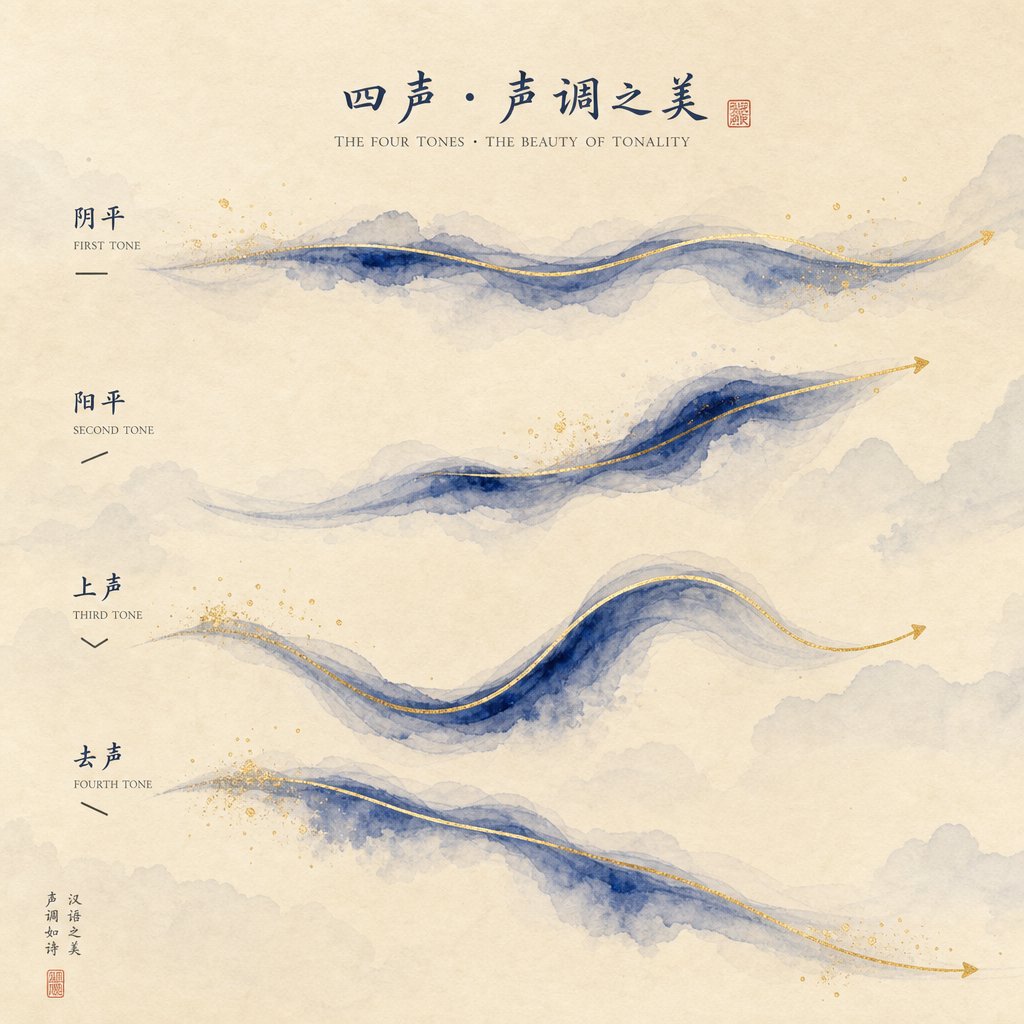
Mandarin has four main tones plus a neutral tone. Each syllable in your name carries one of these tonal contours, and when placed side by side, they create a melodic pattern. Think of it like musical intervals - some combinations feel satisfying, others clash.
A quick refresher on what each tone sounds like:
- Tone 1 (high and level) - a steady, sustained pitch, like holding a musical note. Example: 高 (gao, tall)
- Tone 2 (rising) - pitch climbs upward, like asking "what?" in English. Example: 明 (ming, bright)
- Tone 3 (low/dipping) - drops low and may rise slightly at the end. Example: 美 (mei, beautiful)
- Tone 4 (falling) - a sharp drop from high to low, like a firm command. Example: 志 (zhi, ambition)
When you string two or three of these together in a name, the transitions between tones create rhythm. A name in mandarin that alternates between contrasting tones feels dynamic and easy to pronounce. A name where tones fight each other or flatten out feels monotonous or strained.
As research on Mandarin rhythm points out, spoken Chinese tends toward evenness - each character gets roughly equal weight and time. This means tonal contrast between characters becomes the primary source of musicality in a name. Without that contrast, a name blends into a flat drone.
Tone Combinations to Seek and Avoid
Not all pairings work equally well. For a two-character given name (the part after your surname), certain tone combinations produce a stronger, more memorable sound. Here's a practical breakdown:
| Tone Combination | Rhythm Effect | Example | Recommendation |
|---|---|---|---|
| Tone 2 + Tone 4 | Rising then falling - strong and decisive | 明志 (Mingzhi) | Excellent |
| Tone 1 + Tone 4 | High level then sharp drop - confident | 天赐 (Tianci) | Excellent |
| Tone 4 + Tone 2 | Falling then rising - energetic rebound | 瑞林 (Ruilin) | Very good |
| Tone 1 + Tone 2 | Level then rising - gentle upward momentum | 书涵 (Shuhan) | Good |
| Tone 2 + Tone 1 | Rising then level - calm resolution | 宁安 (Ning'an) | Good |
| Tone 3 + Tone 3 | Both low/dipping - heavy and awkward | 美雨 (Meiyu) | Avoid |
| Tone 4 + Tone 4 | Double falling - abrupt and harsh | 世盛 (Shisheng) | Use with caution |
The Tone 3 + Tone 3 combination deserves special attention. When two third tones appear consecutively, Mandarin tone sandhi rules force the first one to shift into a second tone in actual speech. So 美雨 would be pronounced "Meiyu" with a rising second tone on 美 rather than its natural dip. The name still works phonetically, but many native speakers find consecutive third-tone characters slightly heavy on the page, even if pronunciation smooths them out. When you have dozens of character options available, why not pick a combination that sounds clean without needing a mental adjustment?
The same logic applies to double fourth tones. Two sharp falling pitches in a row can sound curt or aggressive - fine for a fictional warrior, less ideal for a business professional introducing themselves at a conference.
Don't forget the surname. Your full name is two or three syllables total, so the surname's tone matters too. If your surname is Tone 2 (like 陈, Chen), pairing it with a Tone 4 + Tone 2 given name creates a satisfying wave pattern: rising, falling, rising. Map out the full tonal contour of your complete name, not just the given name in isolation.
Testing Your Name Aloud
Sounds complex? Here's the simplest test: say your candidate name out loud, ten times in a row, at conversational speed. Does it flow? Does your mouth feel comfortable with the transitions? Or do you stumble, hesitate, or feel like you're forcing the sounds together?
A name should feel comfortable to say repeatedly because it will be used in daily conversation - in classrooms, offices, introductions, and phone calls, dozens of times a week.
When testing my name in mandarin chinese, I recommend recording yourself and playing it back. You'll catch awkwardness that you miss in the moment. Better yet, ask a native speaker to say your candidate name naturally in a sentence - "请问,___在吗?" (Excuse me, is ___ here?) - and listen to whether it sounds like a real name or a tongue twister.
Remember that romanization meaning only captures part of the picture. Pinyin tells you the sounds and tones, but it can't convey how those tones feel when spoken at natural speed. Two names might look equally good on paper yet sound completely different aloud. Your ear is the final judge.
A few practical tips for the testing phase:
- Say the name in different sentence positions - at the beginning, middle, and end of a phrase
- Try calling the name across a room, as if getting someone's attention
- Listen for whether the name has a natural stress point or feels uniformly flat
- Check that the name doesn't accidentally sound like a common word when spoken quickly
Tonal harmony gives your name its music. But music without meaning is just noise. The next layer of the process is selecting characters that carry the aspirations, values, or imagery you actually want your name to express - and that's where the real creative work begins.
Step 4 - Choose Characters by Meaning and Aspiration
Tonal flow gives your name its music, but the characters themselves give it a soul. Every given name in chinese is built from characters that each carry independent meaning - and when combined, they form a compact phrase expressing a wish, a value, or an image. This is where naming chinese characters becomes genuinely creative. You're not just labeling yourself; you're composing a two-character statement about who you are or who you aspire to be.
Chinese parents traditionally spend weeks selecting characters because the name in chinese meaning is something the bearer carries for life. The same care applies when you're choosing for yourself. Below, you'll find characters organized by thematic category, each with pronunciation, meaning, typical gender association, and an example of how it appears in a full name. Use these as building blocks - mix categories, combine a nature character with a virtue character, or pair aspiration with beauty.
Nature Characters for Grounded Names
Nature imagery is one of the oldest naming traditions in Chinese culture. These characters connect a person to the natural world - mountains suggest steadfastness, water implies adaptability, and forests evoke growth. Names in chinese and meanings drawn from nature tend to feel timeless rather than trendy.
| Character | Pinyin | Meaning | Common Gender Association | Example Name |
|---|---|---|---|---|
| 山 | shan | Mountain | Male | 李志山 (Li Zhishan - "ambition like a mountain") |
| 海 | hai | Sea, ocean | Male | 王海明 (Wang Haiming - "bright as the sea") |
| 林 | lin | Forest, grove | Neutral | 陈林 (Chen Lin - "forest") |
| 雨 | yu | Rain | Female | 张雨涵 (Zhang Yuhan - "rain's depth") |
| 云 | yun | Cloud | Female | 刘云飞 (Liu Yunfei - "clouds in flight") |
| 泽 | ze | Marsh, grace, brilliance | Male | 赵泽宇 (Zhao Zeyu - "graceful universe") |
| 梅 | mei | Plum blossom (resilience) | Female | 王梅 (Wang Mei - "plum blossom") |
Notice how 林 (forest) works for any gender, while 雨 (rain) and 云 (cloud) lean feminine in contemporary usage. The character 海 (sea) appears frequently in names of chinese male bearers, often paired with characters suggesting brightness or ambition to create a sense of vast potential.
Virtue and Aspiration Characters
Virtue characters reflect Confucian ideals that have shaped Chinese naming for millennia. Aspiration characters point toward the future - what the bearer hopes to achieve or become. These two categories often overlap, and they remain among the most popular choices for chinese given names male bearers carry into professional life.
| Character | Pinyin | Meaning | Common Gender Association | Example Name |
|---|---|---|---|---|
| 德 | de | Virtue, moral character | Male | 张德明 (Zhang Deming - "bright virtue") |
| 信 | xin | Trust, faithfulness | Male | 李信 (Li Xin - "trustworthy") |
| 仁 | ren | Benevolence, kindness | Male | 王仁杰 (Wang Renjie - "benevolent hero") |
| 志 | zhi | Ambition, will, aspiration | Male | 陈志远 (Chen Zhiyuan - "far-reaching ambition") |
| 飞 | fei | Fly, soar | Male | 刘飞 (Liu Fei - "soaring") |
| 远 | yuan | Far, distant, visionary | Neutral | 何志远 (He Zhiyuan - "aspiration reaches far") |
| 勇 | yong | Brave, courageous | Male | 赵勇 (Zhao Yong - "courageous") |
| 慧 | hui | Wisdom, intelligence | Female | 林慧 (Lin Hui - "wise") |
The character 志 (ambition) is a workhorse in names of chinese male bearers - it pairs beautifully with almost any second character and carries a tone 4 that gives names a decisive ending. Meanwhile, 慧 (wisdom) has risen sharply in popularity for chinese names girl bearers receive, particularly since the 1990s, reflecting shifting attitudes about what parents aspire for daughters.
Characters Popular in Modern Chinese Names
Beauty and elegance characters have traditionally dominated chinese girl names and meanings, but modern naming increasingly crosses these boundaries. A male name might include 雅 (elegance) to suggest refinement, while a female name might use 伟 (greatness) to signal strength. Here's where convention meets personal expression:
| Character | Pinyin | Meaning | Common Gender Association | Example Name |
|---|---|---|---|---|
| 美 | mei | Beautiful, fine | Female | 李美华 (Li Meihua - "beautiful splendor") |
| 雅 | ya | Elegant, refined | Female | 王雅文 (Wang Yawen - "elegant literature") |
| 婷 | ting | Graceful, poised | Female | 张婷 (Zhang Ting - "graceful") |
| 杰 | jie | Outstanding, heroic | Male | 陈杰 (Chen Jie - "outstanding") |
| 伟 | wei | Great, magnificent | Male | 张伟 (Zhang Wei - "magnificent") |
| 欣 | xin | Joyful, delighted | Female | 刘欣怡 (Liu Xinyi - "joyful and content") |
| 嘉 | jia | Excellent, auspicious | Neutral | 黄嘉明 (Huang Jiaming - "excellent brightness") |
| 瑞 | rui | Auspicious, lucky | Neutral | 赵瑞 (Zhao Rui - "auspicious") |
A few patterns worth noting. Characters like 嘉 (excellent) and 瑞 (auspicious) work across genders without raising eyebrows - they're genuinely neutral. Characters like 婷 and 美 remain strongly feminine; using them in a male name would confuse native speakers. On the flip side, 伟 and 勇 in a female name would read as deliberately unconventional - not wrong, but noticeable.
When browsing these tables, resist the urge to pick the character with the "best" meaning in isolation. A name isn't a single word - it's a combination. 美德 (Meide, "beautiful virtue") sounds like a concept from a textbook, not a person's name. 美涵 (Meihan, "beautiful depth") feels more natural because it creates imagery rather than stating an abstract quality. The best names suggest rather than declare.
Here's a practical approach to combining characters:
- Pair a concrete image (nature, object) with an abstract quality (virtue, aspiration) - like 海志 (sea + ambition)
- Combine two complementary qualities - like 慧雅 (wisdom + elegance)
- Use one character for sound and one for meaning - letting tonal harmony guide which goes first
- Check that the two-character combination doesn't already exist as a common word with a different meaning
Gender conventions in Chinese naming are real but loosening. Research on naming trends across decades shows that characters associated with intelligence and joy have surged for both genders since the 1990s, while older patterns linking military terms exclusively to boys and flower imagery exclusively to girls have softened considerably. If you're choosing a name for yourself as a language learner or professional, you have more freedom than a Chinese parent might feel - but staying within broadly recognized gender patterns avoids confusion in daily interactions.
Characters carry meaning, but they also carry history. Many of the most popular naming characters connect to deeper traditions - the Five Elements system, generational naming customs, and philosophical frameworks that have guided Chinese families for centuries. Understanding these traditions, even if you don't follow them strictly, adds another layer of intentionality to your choice.
Step 5 - Consider Traditional Naming Principles
Characters carry meaning on their own, but traditional chinese names are rarely chosen in a vacuum. For centuries, Chinese families have relied on structured systems to guide their selections - frameworks that connect a child's name to cosmic forces, family lineage, and the balance of natural energy. Even if you don't follow these systems strictly, understanding them reveals the deeper logic behind chinese naming customs and helps you make more intentional choices.
The Five Elements and Birth Time Naming
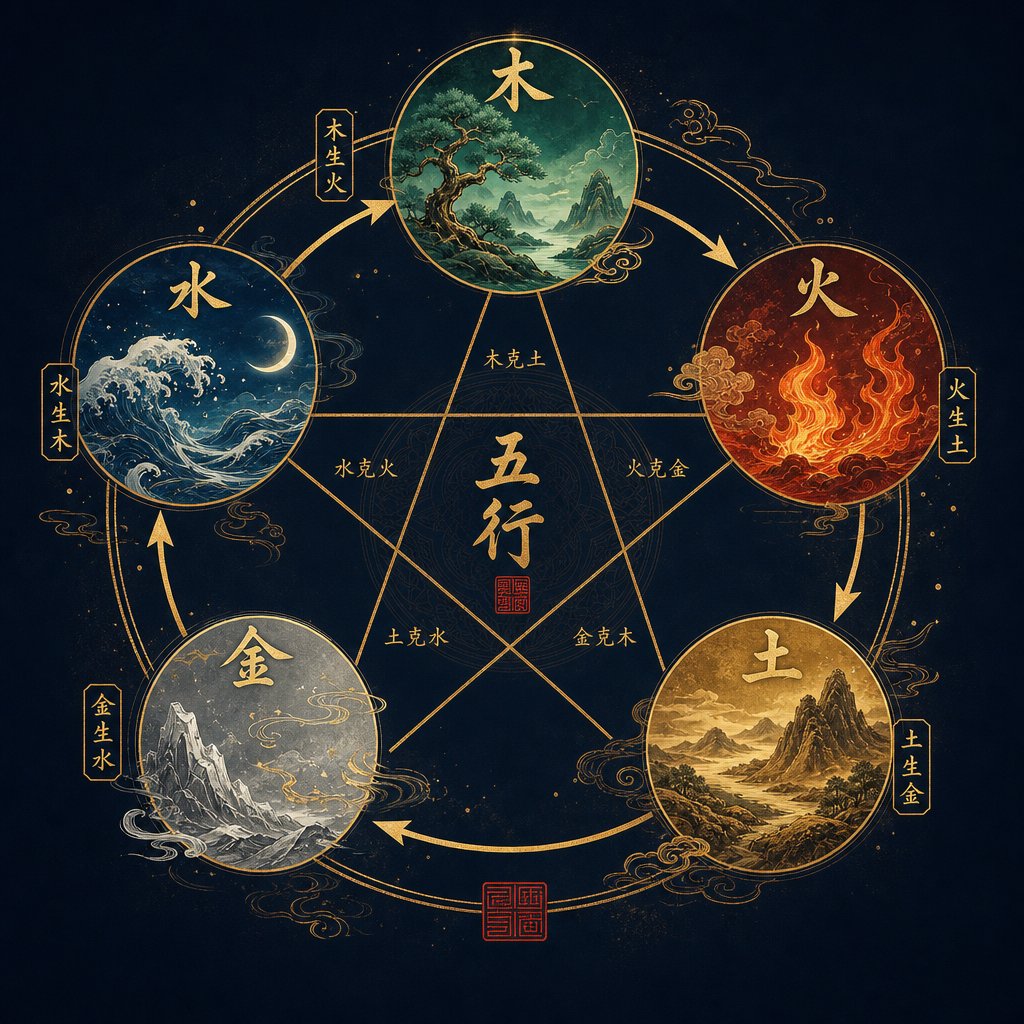
The Five Elements system, known as Wu Xing (五行), is one of the oldest and most influential chinese name conventions still practiced today. The idea is straightforward: every person is born with a unique energetic profile based on their birth date and time, calculated through a system called BaZi (八字, "Eight Characters" or "Four Pillars"). This profile maps the distribution of five elemental energies - Wood, Fire, Earth, Metal, and Water - and reveals which elements are strong, weak, or missing entirely.
When an element is deficient in someone's birth chart, a naming specialist selects characters containing radicals associated with that element to restore balance. The chinese name origin of this practice stretches back over two millennia to the Book of Documents (尚书), dating to approximately 1000 BCE. It's worth noting that "Five Elements" is actually a common mistranslation - the character 行 (xing) means "movement" or "phase," not a static material. These are dynamic patterns of energy, not chemical substances.
Here's how each element connects to specific character radicals you can look for when building a name:
- Wood (木, mu) - Associated with growth, vitality, and spring energy. Look for radicals: 木 (wood) and 艹 (grass). Example characters: 林 (forest), 芳 (fragrant), 桐 (paulownia tree).
- Fire (火, huo) - Associated with passion, warmth, and visibility. Look for radicals: 火 (fire) and 灬 (fire dots). Example characters: 炎 (flame), 煜 (radiant), 照 (illuminate).
- Earth (土, tu) - Associated with stability, trust, and grounding. Look for radicals: 土 (earth) and 山 (mountain). Example characters: 坤 (earth/feminine), 岳 (peak), 城 (city).
- Metal (金, jin) - Associated with clarity, discipline, and refinement. Look for radicals: 金 (metal) and 钅 (metal variant). Example characters: 鑫 (prosperity), 铭 (inscription), 锐 (sharp).
- Water (水, shui) - Associated with wisdom, adaptability, and depth. Look for radicals: 氵 (water) and 雨 (rain). Example characters: 涵 (contain), 泽 (marsh/grace), 润 (moist).
These elements also interact through generating and controlling cycles. Wood feeds Fire, Fire creates Earth, Earth bears Metal, Metal collects Water, and Water nourishes Wood. A skilled namer considers not just which element is missing but how the chosen element relates to the dominant ones already present. As reported by the South China Morning Post, modern Chinese parents increasingly embrace Five Elements analysis when deciding how to name your asian baby, blending ancient cosmology with contemporary sensibilities.
Generational Names and Family Traditions
The second major traditional system is generational naming (字辈, zibei). In this practice, all males of the same generation within a family share one fixed character in their given name. These generation characters are determined in advance - sometimes centuries ahead - and recorded in the family genealogy or expressed through a poem where each character corresponds to a successive generation.
Imagine a family where the current generation's assigned character is 文 (wen, "literature"). Every male cousin born in that generation would have 文 as one character of their given name: 文杰, 文明, 文涵. The second character is where individual identity lives. According to the Asia Media Centre, these generation names "are worked out long in advance and cannot be changed - they are written in the history of the family, or a poem which expresses best wishes for the family."
This tradition has weakened in urban China since the one-child policy era, but it remains alive in many families, particularly in rural areas and among overseas Chinese communities. If you're choosing a name for a child with Chinese heritage, asking the family whether a generational character exists is an important step that shows cultural awareness.
Balancing Traditional and Modern Approaches
So how do modern families actually use these systems? The answer varies widely. Some parents consult professional namers who run full BaZi analyses and cross-reference element charts with stroke counts and tonal patterns. Others treat the Five Elements as one input among many - checking whether their preferred name happens to align with their child's elemental needs, but not letting it override a name they love. Still others skip traditional systems entirely and choose based purely on sound and meaning.
While Five Elements naming and generational conventions are optional for non-Chinese learners, understanding them shows cultural respect and deepens your name selection process considerably.
For language learners and professionals choosing their own chinese traditional names, here's a practical middle path: identify which element resonates with qualities you value, then use that element's radical list as a starting filter when browsing characters. Someone who values adaptability and depth might gravitate toward Water-radical characters like 涵 (contain) or 泽 (grace). Someone seeking clarity and decisiveness might prefer Metal characters like 铭 (inscription) or 锐 (sharp). You're not calculating a birth chart - you're using the elemental framework as a meaningful lens for character selection.
The key takeaway is that these traditions exist on a spectrum, not as rigid rules. A name that nods to traditional principles while reflecting personal identity hits the sweet spot that most modern Chinese families aim for. Your situation, though, might call for additional adjustments - because a language learner picking a classroom name faces very different constraints than a novelist naming a Tang Dynasty general. Those situational differences deserve their own attention.
Step 6 - Adapt Your Name Choice to Your Situation
A language student picking a name for Tuesday's class and a novelist naming a Song Dynasty merchant are solving fundamentally different problems. The core principles - structure, tone, meaning - remain constant, but the weight you give each one shifts dramatically depending on why you need the name and where it will be used. A chinese name from english name conversion that works perfectly for a business card might feel completely wrong on the page of a historical novel.
Names for Language Learners and Professionals
If you're studying Mandarin or working with Chinese colleagues, your name needs to do one thing above all else: function smoothly in daily conversation. People will say it dozens of times a week in classrooms, meetings, and casual greetings. Practicality beats poetry here.
Key considerations for this group:
- Keep it simple - Choose characters with common pronunciations that you can say confidently. If you stumble over your own name, others will too.
- Maintain a phonetic link - A chinese name translation that echoes your English name helps colleagues remember both versions. "Michael" becoming 麦克 (Maike) or adopting the surname 马 (Ma) creates a bridge between identities.
- Avoid overly grand meanings - Naming yourself 龙帝 (Dragon Emperor) as a first-year student will get laughs, not respect. Stick to names that sound like they belong to a real person your age. Common chinese full names like 张伟 or 李明 are common precisely because they're understated and natural.
- Be slightly playful if you want - Language learners have more freedom than parents naming a child. A name with a gentle humor or personal reference is fine as long as it still sounds like a legitimate name to native ears.
For professionals, the stakes rise slightly. Your chinese name from english will appear on business cards, email signatures, and WeChat profiles. It becomes part of your professional identity in Chinese-speaking markets. Here, err toward conservative choices - good chinese names for business contexts tend to use virtue or aspiration characters (信, 明, 杰) paired with common surnames. Think of it as the difference between a casual nickname and what you'd put on a resume.
Naming Fictional Characters Authentically
Fiction writers face a completely different challenge. You're not choosing a name for yourself - you're creating a name that convinces readers this character belongs in a specific time, place, and social class. A random chinese name pulled from a generator won't cut it for published work.
As one native Chinese reader and writer notes, the names in Western novels featuring Chinese characters either immerse readers in the world or pull them out with cringe-worthy mistakes. The difference comes down to research depth.
What fiction writers need to consider:
- Historical period accuracy - Tang Dynasty names tend toward the poetic and elaborate. Republican Era names mix traditional and modern sensibilities. Contemporary names follow current trends. A character named 子轩 (Zixuan) in a Ming Dynasty setting would feel as jarring as a medieval English knight named "Jayden."
- Genre conventions - Wuxia (martial arts) fiction uses nature imagery and weapon references. Xianxia (cultivation fantasy) leans toward celestial and Daoist concepts. Contemporary fiction uses ordinary, common names. Match the genre's naming register.
- Character role alignment - Heroes, villains, mentors, and love interests each carry naming expectations. A villain named 美美 (Beautiful Beautiful) breaks immersion. A warrior named 战威 (Battle Might) fits the archetype while still sounding like a plausible name.
- Distinctiveness within your cast - Avoid giving multiple characters surnames with similar sounds. If you have a 张 (Zhang) and a 赵 (Zhao), readers unfamiliar with Chinese will confuse them. Spread your surname choices across different initial sounds.
- Chinese name transliteration for non-Chinese characters - If your story includes a foreigner with a transliterated name, research how english to chinese name conversions actually work in that era. Modern transliterations follow different conventions than 19th-century ones.
The bottom line for writers: a language learner can recover from a slightly awkward name choice by explaining it with a smile. A published novel lives forever with its naming decisions baked in. Invest the extra research time, and hire a sensitivity reader who's a native Chinese speaker to review your manuscript before publication.
Dialect Differences Between Mandarin and Cantonese
Here's a factor that catches many people off guard: the same characters sound completely different depending on which Chinese dialect pronounces them. A name crafted for beautiful tonal flow in Mandarin might land flat - or worse, sound unfortunate - in Cantonese. This matters enormously for families with roots in different Chinese-speaking regions.
Mandarin and Cantonese are not mutually intelligible in spoken form. Mandarin uses four tones; Cantonese uses six tones plus three entering tones - nine total. The same character 明 is "ming" (Tone 2) in Mandarin but "ming4" in Cantonese, with a different tonal contour entirely. A name that rises and falls gracefully in Mandarin's four-tone system might produce an awkward tonal sequence in Cantonese's nine-tone system.
Practical implications by situation:
- Families in Hong Kong, Macau, or Guangdong - Test the name in Cantonese pronunciation first, since that's what the bearer will hear daily. Many Hong Kong parents choose names that work well in both systems, but Cantonese takes priority for local use.
- Diaspora families - Older generations in Chinatowns worldwide often speak Cantonese, while younger relatives may use Mandarin. A name that sounds good in both dialects avoids the awkwardness of grandparents struggling with a name optimized purely for Mandarin.
- Taiwan connections - Mandarin is standard in Taiwan, but pronunciation differs slightly from mainland Mandarin, and traditional characters are used exclusively. A name written in simplified characters will need its traditional equivalent for any Taiwanese context.
- Fiction set in specific regions - A character living in 1950s Hong Kong would be called by their Cantonese pronunciation. Writing "Zhang Wei" for a Cantonese speaker is like writing "Jean" with an English pronunciation for a French character. The romanization should reflect the dialect: "Cheung Wai" in Cantonese, not "Zhang Wei."
If your name will primarily be used in Mandarin-speaking environments - mainland China, Taiwan, Singapore, or a Mandarin language class - you can optimize purely for Mandarin tones. But if there's any chance the name crosses into Cantonese-speaking contexts, run it through both pronunciation systems. Online dictionaries like MDBG provide both Mandarin pinyin and Cantonese jyutping for every character, making this cross-check straightforward.
Dialect awareness also extends to homophones. A character combination that sounds perfectly innocent in Mandarin might accidentally echo a Cantonese slang term or vulgar expression. This is exactly the kind of trap that only a native speaker of the relevant dialect can catch - which brings us to the most important quality check in the entire naming process: getting real feedback from people who grew up hearing these sounds every day.

Step 7 - Validate Your Name With Native Speakers
You've selected your characters, checked the tonal flow, and feel good about the meaning. The temptation is to stop here and start using the name. Don't. Even experienced learners miss things that native speakers catch instantly - a homophone that sounds like a slang insult in one region, a character combination that reads as a brand name, or a tonal pattern that accidentally mimics a common joke. Validation is the step that separates a name you're proud of from one that quietly embarrasses you for months before someone finally tells you.
What to Ask Native Speakers About Your Name
When you show someone your name in chinese characters, don't just ask "is this good?" That question is too vague and invites polite nodding. Instead, run through specific prompts that force honest, useful feedback. Here's a validation checklist to work through with at least two or three different native speakers:
- Does this sound like a real person's name, or does it feel made up?
- What age and gender does this name suggest to you?
- Does any part of the name sound like a word with a negative, funny, or vulgar meaning?
- Would you find it strange if a colleague or classmate introduced themselves with this name?
- Does the name remind you of any famous person, brand, or fictional character?
- How does it sound when spoken quickly in a sentence - does anything blur together awkwardly?
- If you're from a different region, does it carry any dialect-specific associations I should know about?
That last question matters more than most people realize. A name validated only in Mandarin might carry baggage in Cantonese, Hokkien, or Shanghainese. If your life involves multiple Chinese-speaking communities, ask speakers from each one.
Checking for Unintended Meanings and Homophones
Chinese is packed with homophones - words that share identical pronunciation but carry wildly different meanings. As naming experts point out, characters like "Si" (to think) combined with "Wang" (prosperous) sound nearly identical to "Siwang" (death). The character "Ri" means "sun" but doubles as a vulgar expletive in colloquial speech. These traps are invisible to non-native speakers because they require cultural context, not just dictionary knowledge.
An english to chinese name converter or automated tool can't reliably catch these issues. Software handles character-level meaning but misses the associative leaps that native speakers make unconsciously. When someone hears your name, their brain doesn't process characters in isolation - it pattern-matches against every word, phrase, and cultural reference stored in memory. Only a human ear does that reliably.
Even experienced learners should verify their chosen name with native speakers because homophone traps and regional slang can create embarrassing associations completely invisible to non-native ears.
A few specific traps to watch for:
- Characters that sound like numbers with negative connotations (4 sounds like "death," 250 means "fool")
- Combinations that echo brand names, movie characters, or internet memes
- Tonal patterns that, when spoken quickly, blur into an unrelated common word
- Characters with secondary slang meanings popular among younger speakers that dictionaries haven't caught up with
Where to Get Reliable Feedback
Knowing what to ask is half the battle. The other half is finding people who'll give you honest answers rather than polite encouragement. Here's where to look:
- Language teachers - They've seen hundreds of students choose names and know exactly which mistakes repeat. A good teacher will tell you bluntly if something doesn't work.
- Language exchange partners - Apps like Tandem or HelloTalk connect you with native speakers who are already in "teaching mode" and comfortable giving corrections. Ask multiple partners from different regions for broader coverage.
- Online communities - Subreddits like r/ChineseLanguage, Chinese learning Discord servers, and forums on platforms like Zhihu allow you to crowdsource opinions. The advantage here is volume - ten strangers will catch things two friends might miss.
- Colleagues or friends from different dialect backgrounds - If you know speakers of both Mandarin and Cantonese, ask both. A name that passes in one dialect might fail in another.
One important note: don't rely solely on a chinese name converter tool to answer "what is my chinese name" for you. These tools are useful for brainstorming initial options, but they can't replicate the cultural intuition of a real person. Think of automated tools as a starting point and human feedback as the final filter. If three native speakers independently say your name sounds natural and carries no hidden baggage, you're ready to commit.
Validation complete? Good. The final stretch is about putting your name into action - introducing yourself confidently, writing it correctly in different contexts, and making it feel like yours rather than something borrowed.
Step 8 - Finalize and Start Using Your Chinese Name
Your name has survived the gauntlet - structure, tone, meaning, tradition, and native speaker validation. It exists on paper. The question now is how to make it feel like yours rather than a costume you put on when speaking Mandarin. The gap between "I have a Chinese name" and "this is my chinese name" closes through repetition, confidence, and consistent use across every context where it matters.
Introducing Yourself With Your New Name
The first time you say your name in chinese aloud to a stranger, it will feel slightly unreal. That's normal. The key is committing to it without hesitation or apology. Native speakers respond to confidence - if you introduce yourself smoothly, they accept the name at face value. If you stumble, hedge, or immediately explain "it's not my real name," you undermine the entire effort.
Two patterns work for introductions, depending on formality:
- Casual settings - Use 我叫 (wo jiao, "I'm called") followed by your full Chinese name. This is the standard pattern for classrooms, language exchanges, and social gatherings. Example: 我叫王明远 (Wo jiao Wang Mingyuan).
- Professional settings - Use 我是 (wo shi, "I am") followed by your full name. This carries slightly more weight and works for business meetings, conferences, and formal introductions. Example: 我是王明远 (Wo shi Wang Mingyuan).
If you also need to share your English name - common in international workplaces - add it after: 我叫王明远, 英文名是Michael ("I'm called Wang Mingyuan, my English name is Michael"). This two-name introduction pattern is completely standard in bilingual environments and signals that you operate comfortably in both worlds.
Practice the introduction ten times before you need it. Say it while walking, while cooking, while waiting for the bus. The goal is muscle memory - your name should leave your mouth as naturally as your English one does.
Writing Your Name in Pinyin and Characters
Your name in chinese will appear in different formats depending on context. Prepare all three versions once and save them somewhere accessible so you never have to reconstruct them on the spot:
- Characters - The full name written in Chinese script: 王明远. Use simplified characters for mainland China and Singapore; traditional for Taiwan and Hong Kong.
- Pinyin with tone marks - Wang Mingyuan (Wang Mingyuan). Include this on profiles where pronunciation guidance helps readers unfamiliar with Chinese.
- Pinyin without tone marks - Wang Mingyuan. Use this on forms, email signatures, and documents where special characters cause formatting issues.
In Chinese-language contexts, always write surname first: 王明远. In English-language contexts where you want to avoid confusion, capitalize the surname - WANG Mingyuan - or add a note clarifying which part is the family name. This small formatting choice prevents the decades-old problem of Western systems accidentally swapping your surname and given name.
For professional documents like resumes or LinkedIn profiles targeting Chinese-speaking audiences, include both characters and pinyin. Something like "王明远 (Wang Mingyuan)" gives readers everything they need in one glance. Consistency across platforms matters - pick one format and stick with it everywhere so people searching your name in chinese characters can find you reliably.
Tools and Resources for Further Exploration
Wondering how to find your chinese name if you want to explore additional options or refine your choice? A chinese name generator or mandarin name generator can be useful for brainstorming - these tools suggest character combinations based on inputs like desired meaning, gender, and phonetic preferences. They're particularly helpful when you feel stuck or want to see possibilities you hadn't considered.
That said, treat generator output as raw material, not a finished product. The cultural understanding you've built through this guide - tonal pairing, meaning layering, dialect awareness, native speaker validation - is what transforms a random suggestion into an authentic name. A tool might produce your name in chinese characters, but it can't tell you whether those characters carry awkward associations or sound clunky in conversation.
Practical next steps to keep your momentum going:
- Set your Chinese name as your display name on at least one platform you use daily - WeChat, a language app, or a study group chat
- Practice writing the characters by hand until you can produce them from memory without checking a reference
- Use the name every time you introduce yourself in Chinese, even in low-stakes situations like ordering coffee or greeting a language partner
- Revisit your name after six months of use - if something feels off after extended daily use, you have permission to adjust
- Keep a note with your full name in all three formats (characters, pinyin with tones, pinyin without tones) for quick copy-pasting into forms and profiles
The process of discovering your name in chinese is ultimately personal. Online tools can accelerate brainstorming, teachers can offer guidance, and native speakers can catch mistakes - but the final choice belongs to you. A name chosen with intention, validated with care, and used with confidence becomes genuinely yours over time. It stops being "my Chinese name" and starts being simply your name, in another language, carrying meaning you selected on purpose.
Frequently Asked Questions About Choosing a Chinese Name
1. How are Chinese names structured differently from English names?
Chinese names place the surname (family name) first, followed by a one or two-character given name. A complete name is typically two or three characters total. For example, in the name 王小红 (Wang Xiaohong), 王 is the surname and 小红 is the given name. This order reflects Confucian values where family identity precedes individual identity, which is the opposite of English naming conventions where the given name comes first.
2. Can I just translate my English name into Chinese characters?
A direct phonetic translation often produces characters that sound vaguely similar to your English name but mean nothing coherent or carry embarrassing meanings. Instead, the recommended approach is to select a common Chinese surname that echoes part of your Western name, then independently choose given-name characters based on meaning, tonal harmony, and cultural appropriateness. This produces a name that functions like a real Chinese name rather than an awkward transliteration.
3. What are the most common Chinese surnames to choose from?
The top five Chinese surnames - Wang, Li, Zhang, Liu, and Chen - are shared by over 430 million people. Choosing from the top 100 most common surnames gives your name instant credibility because native speakers recognize them immediately. For people with connections to Taiwan, surnames like Chen and Lin rank higher there. The selection method can be phonetic matching to your Western name, accepting a teacher's suggestion, or choosing based on personal meaning.
4. Why does tonal pairing matter when choosing a Chinese name?
Native Mandarin speakers evaluate names by ear before considering the written characters. Certain tone combinations create pleasing rhythms while others sound awkward or harsh. For instance, a Tone 2 followed by Tone 4 produces a strong rising-then-falling pattern that sounds decisive, while two consecutive Tone 3 characters feel heavy and require pronunciation adjustments. Testing your full name aloud repeatedly at conversational speed reveals whether the tonal flow works naturally in daily use.
5. How do I verify my Chinese name doesn't have embarrassing hidden meanings?
Ask at least two or three native speakers specific questions rather than a vague 'is this good?' Run through a checklist: Does it sound like a real person's name? Does any part echo a word with negative or vulgar meaning? Does it remind them of a brand or famous person? Ask speakers from different regions since a name that works in Mandarin might carry unfortunate associations in Cantonese or other dialects. Online communities and language teachers are reliable sources for honest feedback.